Tag: Imperia Invest IBC

  • As Promos On Ponzi Forums Continue And Members Claim IRS Recognition, Club Asteria Acknowledges That Its Members Used PayPal ‘To Cheat Fellow Members’; Says Fraudsters Were Turned Over To Unidentified ‘Authorities’; Existing Members Of Virginia-Based Firm Told To Use Offshore Processors

    This May 1 promo for Club Asteria describes its as an "investment company" and instructs prospects that "you will not again anything unless you invest." The promo advertises returns of up to 7 percent a week. "I am happy because even if I am not doing anything I still manage to earn from it," the promo claims.

    In June 2010, the U.S. Department of Justice used its Blog to warn about the emerging threat of “mass marketing fraud,” specifically citing the criminal allegations of a $70 million Ponzi fraud against Nicholas Smirnow of Pathway To Prosperity (P2P).

    P2P was promoted on the TalkGold and MoneyMakerGroup Ponzi forums.

    A little over a month later, in July 2010,  the Financial Industry Regulatory Authority (FINRA) described the HYIP sphere as a “bizarre substratum of the Internet” and issued a fraud alert. FINRA also referenced the P2P case. At the same time, it pointed to the collapsed Genius Funds Ponzi, believed to have consumed $400 million.

    Genius Funds also was promoted on TalkGold and MoneyMakerGroup.

    In December 2010, the interagency Financial Fraud Enforcement Task Force led by U.S. Attorney General Eric Holder specifically warned the public to be wary of social-networking sites and chat forums. The warning was part of “Operation Broken Trust,” a law-enforcement initiative in which investigators described more than $10 billion in losses from recent fraud cases.

    One of the cases described was the SEC’s action against Imperia Invest IBC, a murky offshore business accused of stealing millions of dollars from the deaf.

    Imperia Invest also was promoted on TalkGold and MoneyMakerGroup.

    Last week, promoters of a Virginia-based company known as Club Asteria (CA) announced on the Ponzi boards that PayPal had frozen CA’s funds and blocked its access to the PayPal system. Although CA has been presented as a wholesome “opportunity” recognized by the Internal Revenue Service as a nonprofit organization (see graphic below), the CA promoter who announced the PayPal news last week on MoneyMakerGroup simultaneously was promoting two “programs” that purportedly pay 60 percent a month.

    Some CA promoters claim CA pays 520 percent a year. Even jailed Ponzi schemer Bernard Madoff would blush at such advertised rates of return.

    MoneyMakerGroup is referenced in federal court filings as a place from which Ponzi schemes are promoted. So is TalkGold, another well-known forum in the HYIP world.

    This morning — also on the MoneyMakerGroup — a different CA promoter announced that CA’s Andrea Lucas had responded to last week’s PayPal news. Even as the CA member was announcing on a known Ponzi scheme and criminals’ forum that Lucas had issued a statement on the PayPal matter, he simultaneously was promoting two HYIPs and something called One Dollar Riches.

    “OneDollarRiches allows you to parlay a small investment of just one dollar into a constant stream of cash, day in and day out!” according to its ad. “You can make 100 times your investment in just a few days by following our simple step by step instructions.”

    The mere presence of CA promotions on the Ponzi boards leads to questions about whether the firm’s receipts are polluted by Ponzi proceeds. Paying members from such proceeds would put CA members in possession of tainted money — and banks into which they deposited those proceeds also would be in possession of tainted money.

    Lucas, according to the CA website, now has publicly acknowledged last week’s actions by PayPal. Details, though, were spartan. CA did not say how much money PayPal had frozen. Meanwhile, the firm instructed members to fund their accounts by using offshore processors.

    At the same time, CA urged members not to spread bad news about the company on forums. Members who shared negative information were subject to having their CA accounts revoked, according to the company.

    “Members shall not publically (sic) disparage, demean or attack Club Asteria, its members, services or charitable activities,” CA remarks attributed to Lucas on the CA website read. The remarks were dated May 16 and appeared in the “News” section of the site.

    In the same announcement, Lucas acknowledged that a “small group” of CA members “used their PayPal accounts to cheat fellow members.”

    The company claimed it had turned the members “over to the authorities,” but did not identify the authorities or say whether they were based in the United States or elsewhere.

    CA, which said PayPal was “acting with integrity,” then counseled its members to rely on offshore processors.

    “First, if you have been paying for your membership through PayPal, please discontinue your subscription with PayPal immediately and start using one of the other approved payment processors AlertPay, Towah or CashX to ensure that your membership stays current,” the remarks attributed to Lucas read.

    “Second, Do NOT use online forums, websites or social networks to lodge blame or complaints about PayPal or your Club Asteria team,” the remarks continued. “There is no benefit or purpose in this, and it only serves to create discord and spread rumors. Not only that, doing so is a direct violation of Code of Ethics & Conduct, Rule 8 and can result in immediate revocation of your membership.”

    CA’s bizarre announcement occurred against the backdrop of thousands of bizarre promos for the firm that appear online. Some promos claim $20 spent with CA monthly turns into a lifetime income of $1,600 a month. Others claim CA is a “passive” investment opportunity, which raises questions about whether CA — whose members claim the program typically pays out about 3 percent to 4 percent a week or up to 208 percent a year — is selling unregistered securities as investment contracts.

    Lucas has been referred to in promos as a former “chairman” and “vice president” of the World Bank. Several promos have described her as a Christian “saint.”

    CA’s claims that only a “small group” of members is causing problems may be dubious. Wild claims have been made in promo after promo for the firm, which says it is not in the investment business.

    This promo for CA contains a link that resolves to an active CA affiliate site. The affiliate site has a low affiliate ID number, suggesting the affiliate was one of CA's earliest members. The promo claims CA is a 501 (c)(3) nonprofit organization recognized by the IRS.
  • BULLETIN: SEC Alleges ‘Payday Loan’ Ponzi Scheme In Utah; Second Major Ponzi Case Brought In State In Two Days; Schemes Attracted Almost $75 Million

    BULLETIN: The SEC has gone to federal court in Utah to halt what it described as a $47 million “payday loan” Ponzi scheme and offering fraud in which investors were lured by the prospect of “extraordinary returns” while the alleged operator diverted large sums of cash to himself and other business interests.

    The payday-loan Ponzi case against John Scott Clark, Impact Cash LLC and Impact Payment Systems LLC was the second major Ponzi case brought by the SEC in Utah in a matter of days. On March 23, the SEC charged Mike Watson Capital LLC of Provo, Michael P. Watson of Mapleton and Joshua F. Escobedo of Spanish Fork in an alleged real-estate and promissory-notes Ponzi scheme that gathered more than $27.5 million from more than 120 investors.

    Clark and his companies were charged on March 25. Utah has been plagued by Ponzi schemes and other forms of fraud, many of them directed at people of faith. The FBI said last year that thousands of residents of the state had been victimized in investment-fraud schemes.

    Now, Clark’s alleged payday-loan fraud has been added to Utah’s Ponzi mix by the SEC. If the alleged Clark total is added to the total gathered in the alleged Watson/Escobedo fraud, a figure of at least $74.5 million emerges from the two schemes.

    “Investors were promised extraordinary returns while Clark was actually diverting their money to make such extraordinary personal purchases as a fully restored classic 1963 Corvette Stingray,” said Ken Israel, director of the SEC’s Salt Lake Regional Office. “Clark recruited new investors through referrals from earlier investors who thought the Ponzi payments they received were actual returns on their investments and sought to share the lucrative opportunity with family and business associates.”

    Clark also bought “multiple expensive cars and snowmobiles” and “stole investor funds to purchase a home theater, bronze statues and other art for himself,” the SEC charged.

    In October, the SEC’s Salt Lake office also filed charges against Imperia Invest IBC, a mysterious offshore firm alleged to have stolen millions of dollars from thousands of deaf investors. The Imperia scheme was promoted on Ponzi boards such as TalkGold and MoneyMakerGroup.

    In the Clark case, the SEC said “at least” 120 investors were affected. The scheme operated between March 2006 and September 2010.

    Investors were recruited to fund payday loans, the SEC said. One recruiter was paid more than $500,000 to help drive business to the unregistered offering, according to the complaint.

    Clark 58, of Hyde Park, “has never been registered with the Commission or any other regulatory agency in any capacity,” the SEC charged.

    Investors were offered their own companies with an LLC designation and lured by suggestions that Clark and his Impact companies could generate returns “averaging at least 80% per year,” the SEC said.

    “Clark explained to investors that Impact would create a unique LLC for each investor or investor group for the purpose of investing with Impact,” the SEC said. “The investor LLC would then enter into a Joint Operating Agreement with Impact to provide money to Impact to fund payday loans.”

    And Clark’s “early investors” — impressed by their returns — helped the Ponzi gain a head of steam, the SEC said.

    “Many of Clark’s early investors mentioned their astronomical returns to their families or
    business associates, who then invested with Clark,” the SEC said. “Clark paid one salesperson between $500,000 and $600,000 over a four or five year period to locate potential investors and attend payday loan conferences and trade shows. Clark also paid certain individuals commissions ranging from 2% to 4% for bringing in investors to Impact.”

    Neither firm that used the word “Impact” in its name was registered, the SEC said.

    Although investors believed they were funding payday loans, Clark diverted cash to “to make unauthorized investments, including a real estate investment company, a diabetes research company and an online products store,” the SEC said.

    The assets of Clark and his companies have been frozen. Read the SEC complaint against Clark.

    Read the SEC’s statement on the alleged Ponzi scheme involving Watson and Escobedo, who have settled without acknowledging wrongdoing.

  • SEC Chief Makes Veiled Reference To Imperia Invest Case In Congressional Testimony: Will Ongoing Law-Enforcement Initiatives Spell More Trouble For Serial Online Scammers And Their Enablers?

    SEC Chairman Mary Schapiro

    SEC Chairman Mary Schapiro alluded to the agency’s investigation of the alleged Imperia Invest IBC scam in testimony before Congress this morning, a development that may signal more bad news is in the offing for serial scammers online.

    Without mentioning Imperia by name, Schapiro told members of the House Subcommittee on Financial Services and General Government that the agency, which is a member of the Financial Fraud Enforcement Task Force, participated in “Operation Broken Trust.”

    In December, the U.S. Department of Justice noted that the Imperia case brought by the SEC in October was part of the operation. Imperia was promoted on Ponzi and criminals’ forums such as TalkGold and MoneyMakerGroup, both of which have been identified in federal court filings as places from which family-destroying international Ponzi and HYIP fraud schemes are promoted.

    Schapiro said today that the SEC has been aggressively pursuing “Ponzi scheme operators and perpetrators of offering frauds.” The Imperia case, which the SEC brought in Utah, is an example of an Internet-based offering fraud, as are many of the “programs” pitched on the Ponzi boards.

    In December, members of the Financial Fraud Enforcement Task Force identified Ponzi Scheme "hot spots" in the United States. Pictured here are FBI Executive Assistant Director Shawn Henry (foreground), with Attorney General Eric Holder (right) and Chief Postal Inspector Guy Cottrell. The Task Force specifically warned investors to be wary of social-networking sites and chat forums. And officials noted that "we continue to use sophisticated investigative techniques—like undercover operations and court-authorized electronic surveillance—to collect evidence in ongoing cases and to identify and stop criminals before they prey on others."

    Salt Lake City was identified in December by the Task Force as one of the “top five Ponzi scheme hot spots in the country.” Other Ponzi hot spots include Los Angeles, New York, Dallas and San Francisco, the Task Force said, cautioning Americans that the fraud hardly was limited to those cities.

    “Be wary of people you meet on social networking sites and in chat rooms, where investment fraud criminals have been known to troll for victims,” the Task Force urged.

    In June 2010, the Justice Department used its Justice Blog to create awareness about the emerging threat of mass-marketing fraud, specifically referencing the alleged Pathway To Prosperity Ponzi scheme. Pathway To Prosperity, which the U.S. Postal Inspection Service said created tens of thousands of victims from virtually all corners of the world, also was promoted on TalkGold and MoneyMakerGroup.

    In October, before the public knew Operation Broken Trust was under way, the SEC said Imperia had stolen millions of dollars from thousands of Americans with hearing impairments. The firm used a payment processor known as Perfect Money, a favorite among international scammers who populate the Ponzi boards. Imperia also purported to have a relationship with Visa, but was using the name “without authorization” to disarm skeptical investors, the agency said.

    Not a “single penny” was paid to Imperia investors, the SEC said.

    Money from the Imperia scheme is believed to have been funneled into accounts in Cyprus and New Zealand. Imperia purported to have operated from the Bahamas and Vanuatu, but the business addresses were “fake,” the SEC said.

    The Justice Department said Imperia used “a series of offshore PayPal style bank accounts to raise “in excess of $7 million from at least 14,000 investors worldwide, including 6,000 investors in the U.S. who have invested in excess of $4 million.”

    Earlier this year, the CFTC turned its attention to purported Forex programs that were promoted on TalkGold and MoneyMakerGroup. Some of those programs also used PerfectMoney. Like the SEC, the CFTC is part of the Financial Fraud Enforcement Task Force.

    Tips From The Task Force

    • Be careful of any investment opportunity that makes exaggerated earnings claims, especially during a short period of time.
    • Ask for written information about the investment, such as a prospectus, recent quarterly or annual reports, or an offering memorandum.
    • Consult an unbiased third party, like an unconnected broker or licensed financial adviser, before investing.
    • Don’t be fooled into believing an investment is safe just because someone you know is recommending it. So-called “affinity scams” are one of the favorite methods used to lure people in.
    • If you feel you are being pressured into investing, don’t do it.
    • Be wary of people you meet on social networking sites and in chat rooms, where investment fraud criminals have been known to troll for victims.
  • TalkGold Ponzi And Criminals’ Forum Deletes ‘Sticky’ Thread On InstaForex; Firm Named Defendant In CFTC Sweep Used Payment Processor Whose Contact Person Is Referenced In International Money-Laundering And Narcotics Case

    The TalkGold Ponzi scheme and criminals’ forum has deleted a “sticky” thread reportedly paid for by InstaForex, a dubious company named a defendant in a registration sweep conducted by the U.S. Commodity Futures Trading Commission last month.

    The PP Blog reported two days ago that InstaForex was using TalkGold to promote a scheme by which participants who sent InstaForex at least 1,000  U.S. dollars could qualify to win a Lotus Elise valued at more than $50,000. Although sweepstakes that require a purchase are illegal in the United States, InstaForex bizarrely instructed investors that they could improve their odds of winning the car by opening up to 100 accounts each.

    Some of the InstaForex promoters used photographs of attractive women to promote the scheme. It was unclear whether the photos were actual pictures of the promoters or whether they were stage props designed to lure skeptical investors.

    Why any investor from any country would open a single account — let alone 100 accounts — with a firm that advertises on TalkGold was left to the imagination. TalkGold and similar sites such as MoneyMakerGroup are referenced in multiple filings in U.S. federal courts as places from which international Ponzi and fraud schemes are pushed.

    A separate ad for which InstaForex apparently paid TalkGold $95 remains operational on the forum. The ad shows an image of a red Lotus and claims the company is “THE BEST BROKER IN ASIA.” Directly below the ad is an ad for a company that claims to provide a return of 525 percent “After 1 Minute” and 9,860 percent “After 6 Hours.”

    Just four of the thousands of schemes pushed on TalkGold — Imperia Invest IBC, EMG/Finanzas Forex, Legisi and Pathway to Prosperity — created tens of thousands of victims globally while gathering hundreds of millions of dollars, according to court records.

    The precise time at which TalkGold deleted the paid “sticky” thread on InstaForex and the precise reason why the thread of at least 109 pages was deleted were unclear. Records suggest the thread was deleted in the past 24 hours. The once-massive thread now returns a “No Thread specified” error.

    Among other things, InstaForex advertised that it accepted payments through Perfect Money, a murky money-services business purportedly operating from Panama. Imperia Invest, which the SEC accused in October of stealing millions of dollars from thousands of participants, also used Perfect Money, according to court filings.

    Included among the Imperia Invest victims were thousands of Americans with hearing impairments, according to the SEC.

    Meanwhile, the name of Roger Alberto Santamaria del Cid — the purported contact person of Perfect Money — appears in federal court filings in the EMG/Finanzas Forex forfeiture case.

    A Florida-based task force that specializes in detecting and uncovering massive fraud schemes brought the EMG/Finanzas Forex case last year. Del Cid, Perfect Money’s purported contact person in Panama, is listed as EMG’s “Secretary” in court filings that allege that tens of millions of dollars seized in the probe were tied to the international narcotics trade.

    EMG/Finanzas Forex was so corrupt that some participants were told the only way they could get their money out was to recruit new investors, have the new investors pay them directly — and use the proceeds from the new investors to recover their initial outlays, according to court filings.

    The very first EMG post on the now-shuttered ASA Monitor Ponzi and criminals’ forum referenced yet-another widely promoted Ponzi scheme: 12DailyPro. The 12DailyPro case, brought by the SEC in February 2006, also is cited in the AdSurfDaily Ponzi prosecution brought by the U.S. Secret Service in August 2008. ASD also was promoted on TalkGold.

    Writing on ASA Monitor, an EMG/Finanzas Forex aficionado claimed to have learned the ropes from 12DailyPro.

    “I have been in internet business for 3 years now and in autosurf industry from 12dailypro,” the ASA poster began. He (or she) then proceeded to tell readers about how they could earn commissions by recruiting for EMG/Finanzas, which the Feds later described as an international menace with tentacles in Central America, South America and Europe.

    Court filings in the EMG/Finanzas case paint a picture of an incredibly elaborate maze of companies and bank accounts set up to confuse both investors and law enforcement. At least 59 bank accounts, 294 bars of gold and nine luxury vehicles were seized.

    The EMG allegations were explosive because they showcased the undeniable fact that people who promote programs such as HYIPs and autosurfs because such programs may pay “commissions” to recruit new members may be operating as fronts or conduits for international drug dealers and money-launderers.

  • SPECIAL REPORT: Forex Firms Named In CFTC Sweep Used Same Offshore Processor As Alleged Imperia Invest Fraud; Name Of Man Linked To ‘Perfect Money’ Appears In Ponzi Forfeiture Complaint In Which Feds Tied Cash To International Narcotics Trade

    InstaForex, a company accused by the CFTC last month of targeting U.S. customers to purchase unregistered offerings and paying through Perfect Money, says participants can win this Lotus — but they have to pay to play by depositing at least $1,000 USD. Sweepstakes that require a purchase by participants are illegal in the United States.

    SPECIAL REPORT: UPDATED 2:27 P.M. ET (U.S.A., FEB. 9) Federal court and web records show that at least three of the 14 purported Forex dealers named defendants in a major sweep of unregistered firms last month by the Commodity Futures Trading Commission advertised that they accepted funds from Perfect Money.

    Perfect Money is a murky money-services business purportedly based in Panama that allegedly was used by a company that defrauded thousands of deaf investors by promising Visa debit cards and returns of 1.2 percent per day, according to federal records. The name of a man purported to be Perfect Money’s contact person in Panama City is referenced in federal court filings that tie money from the alleged EMG/Finanzas Forex fraud scheme to an international narcotics probe that led to the seizure of at least 59 bank accounts in the United States and the companion seizure of 294 bars of gold and at least seven luxury vehicles.

    The number of purported Forex dealers that allegedly accepted Perfect Money and were named defendants in the CFTC sweep could be higher than three because not all of the defendants publicly disclosed the precise mechanisms by which they accepted payments from U.S. customers.

    According to court filings and web records, some of the companies also advertised that they accepted funds from Liberty Reserve, another murky offshore processor, and even PayPal. PayPal’s Acceptable Use Policy specifically bans the use of its services for “currency exchanges,” businesses that support Ponzi and pyramid schemes and businesses associated with “off-shore banking.”

    PayPal says it requires “pre-approval” for any businesses “selling stocks, bonds, securities, options, futures (forex) or an investment interest.” Whether any of the businesses named in the CFTC Forex complaints received approval from PayPal to either use its name in promos or use its services to collect money is unclear.

    Records show (see paragraph 17 of SEC complaint) that Perfect Money payments were accepted by Imperia Invest IBC, the mysterious offshore company accused by the SEC in October 2010 of pulling off a spectacular fraud that fleeced at least 14,000 people of millions of dollars. Included among the Imperia victims were thousands of Americans with hearing impairments, the SEC said.

    Imperia was promoted on Ponzi scheme and criminals’ forums such as TalkGold, which also promoted at least two of the companies named defendants in the CFTC’s Forex sweep. One of the companies — InstaTrade Corp., doing business as InstaForex — is advertising on TalkGold that participants will have a chance in the months ahead to win a Lotus Elise, a sports coupe that carries a price tag of more than $50,000.

    To win the expensive car, however, investors have to pay to play, according to InstaForex. Sweepstakes that require a purchase are illegal in the United States, according to the Federal Trade Commission.

    InstaForex investors can qualify to win the Lotus by replenishing “the real trading account in InstaForex Company with 1000 USD or more during [the] Campaign period,” the company says in stilted English.

    “Participant has a right to register in the Campaign more than 1 account and raise his/her chances for the victory,” InstaForex continues in stilted English. “However, in case contest administration detects more than 100 accounts registered by one person, it reserves the right to decrease the number of accounts till (sic) 100.”

    Meanwhile, the name of Roger Alberto Santamaria del Cid — the purported contact person of Perfect Money — appears in federal court filings in the EMG/Finanzas Forex forfeiture case. The EMG/Finanzas case was brought last year by a federal task force based in Florida and alleges that tens of millions of dollars seized in Arizona as part of the probe were linked to the international narcotics trade. (See Paragraph 10 of the federal affidavit for the reference to del Cid, who is identified as the “Secretary” of EMG. Del Cid is referenced in domain-registration data for PerfectMoney.com as the contact person for Perfect Money Finance Corp.)

    Elements of the prosecution against more than $100 million in assets linked to EMG/Finanzas were brought by members of the same task force that brought civil and criminal prosecutions against Florida-based AdSurfDaily. Some of the members of the task force have experience working with the U.S. Drug Enforcement Administration (DEA), the U.S. Secret Service, the IRS and other agencies to reverse-engineer fantastically complex financial crimes.

    At least one of the investigators, according to records, was instrumental in bringing the successful money-laundering conspiracy prosecution against the e-Gold payment processor in 2007. The e-Gold case was brought in U.S. District Court for the District of Columbia. It resulted in guilty pleas announced on July 21, 2008.

    About two weeks later, the U.S. Secret Service raided ASD’s headquarters in Quincy, Fla. Federal prosecutors later alleged ASD was operating a Ponzi scheme that had gathered at least $110 million — and had ceased using e-Gold “shortly after” the e-Gold indictments were announced in April 2007.

    Federal prosecutors also alleged that 12DailyPro and PhoenixSurf — two autosurfs charged by the SEC with operating Ponzi schemes — also had used e-Gold. In December 2010, prosecutors said that ASD also had the ability to accept money from e-Bullion, yet-another processor accused of accepting and distributing Ponzi funds from various schemes.

    James Fayed, the operator of e-Bullion, was accused of arranging the July 2008 murder of Pamela Fayed, his estranged wife and potential witness against him. Pamela Fayed’s body was found in a California parking garage  just days before the ASD raid in Florida.

    Erma Seabaugh, known among ASD members as the “Web Room Lady,” used E-Bullion in November 2007 to transfer $10,510 to ASD, according to a forfeiture complaint filed in December 2010.

    On Jan. 26, the CFTC sued 14 purported Forex companies simultaneously, alleging that they were unregistered entities that were illegally targeting  U.S. residents. At least three of the companies — ForInvest (Perfect Money reference appears online), InstaTrade Corp. (see Paragraph 21 of CFTC complaint for the Perfect Money reference) and Kingdom Forex Trading and Futures Ltd. (see Paragraph 17 of CFTC complaint for the Perfect Money reference) — accepted Perfect Money, according to records.

    Two of the complaints — InstaTrade and Kingdom Forex — were brought in the U.S. District Court for the District of Columbia, the same venue in which the e-Gold case was brought in 2007. The case against ForInvest was brought in U.S. District Court from the Northern District of Illinois.

    Perfect Money advertised a relationship with at least two of the defendants named in the CFTC cases: InstaForex and FXOpen, according to web records.

    On its website, Perfect Money advertised its relationship with InstaForex and FXOpen, two companies accused by the CFTC of targeting Americans with unregistered Forex offerings. The FXOpen website now appears to be blocked from loading in the United States. It was not immediately clear if the site will load in other parts of the world.
  • ‘FRAUD CREEP’: The Two-Word Term That Explains How Crime Expands On The Internet To Affect Tens Of Thousands Of Victims At A Time

    EDITOR’S NOTE: Our definition of “fraud creep” — and suggestions on the context in which the term should be applied — appears lower in this story.

    First, some background . . .

    Investigators now are counting victims of massive, web-based fraud schemes tens of thousands at a time. Such scams pose both budgetary and logistical challenges to law enforcement, bankruptcy trustees and court-appointed receivers — and a single scam may take years to unravel. In recent court filings, federal prosecutors said they had amassed 500,000 pages of emails, 100,000 pages of banking records and 5,000 pages of other records as part of the AdSurfDaily Ponzi probe, which began in July 2008. The U.S. Secret Service raided ASD’s headquarters in August 2008.

    The ASD Ponzi scheme, which operated from Florida, may have defrauded 40,000 or more victims while gathering at least $110 million, prosecutors said.

    Meanwhile, in a civil case brought in Utah in October 2010, the SEC said Imperia Invest IBC defrauded more than 14,000 investors worldwide while gathering small sums that ultimately led to a haul of more than $7 million. Among the victims were thousands of deaf investors in the United States.

    Imperia claimed until late 2009 to be located in the Bahamas, but the Bahamian address was “fictitious,” the SEC said, adding that Imperia later claimed to be located in Vanuatu.

    But Imperia was “not registered to do business in Vanuatu and the address listed on its website appears also to be fictitious,” the SEC said.

    Despite the fact Imperia gathered money from thousands of Americans, “[n]either Imperia nor its securities are registered with the Securities and Exchange Commission,” the SEC said. “Imperia is not licensed or registered with the Commission, with any state, or with any Self Regulatory Organization.”

    In a separate civil case brought in Nevada last month, the FTC accused Utah resident Jeremy Johnson, I Works Inc. and other companies of orchestrating a massive, continuity-billing scheme that used 51 shell companies, maildrops and “straw-figures” as company officers “to keep the scam going.”

    The complaint names as defendants 10 individuals, 10 corporations and the 51 shell companies. Citing court documents, the Salt Lake Tribune reported that Johnson’s companies allegedly took in more than $350 million and ensnared 15,000 consumers a day at the height of the scheme.

    Customers were lured into purchasing “trial” memberships for “bogus government-grant and money-making schemes,” and then were “repeatedly” charged monthly fees “for these and other memberships that they never signed up for,” the FTC said.

    “[T]his scheme has caused hundreds of thousands of consumers to seek chargebacks — reversals of charges to their credit cards or debits to their banks accounts,” the FTC said.

    “The high number of chargebacks has landed the defendants in VISA’s and MasterCard’s chargeback monitoring programs, resulted in millions of dollars in fines for excessive chargebacks, and prevented the defendants from getting access to the credit card and debit card billing systems using their own names,” the FTC said.

    “To keep the scam going, the defendants tricked banks into giving them continued access to these billing systems by creating 51 shell companies with figurehead officers, and by providing the banks with phony ‘clean’ versions of their websites.”

    Like ASD’s Andy Bowdoin, Johnson denies wrongdoing.

    Making Sense Of It All

    Today the PP Blog offers a two-word term, contexts in which we believe the term applies and proposed definitions as a means of educating the public by describing a complex process of organized, international theft and reducing it to its essence. Understanding how online schemes proliferate — and the emotions they trade on and “scam signals” they send — may help consumers protect themselves from the fraudsters.

    fraud creep [frawd kreep]

    1. Principal definition: The tendency of a web-based financial crime undetected by law enforcement to expand across the Internet until it achieves critical mass, reaches the limits of a criminal organization’s ability to manage and forces investigators to respond. Such a crime may creep (advance slowly) to ultimately create thousands or even tens of thousands of victims globally.

    2. Associated definition: A criminal business model (fraud-creep enterprise) that includes a suggestion of exceptional earnings and generous recruiting commissions and the use of tailored messages that appeal to greed, envy, despair or anger. A fraud-creep enterprise also may be characterized by images of wholesome or enticing amenities designed to attract prospects to an illicit scheme whose purpose is hidden or undisclosed.

    3. Associated definition: A form of deceit (fraud-creep plan) employed by hucksters, particularly on the Internet, characterized by efforts to popularize an illicit pursuit by withholding critical information and demonizing market regulators. Profits are reaped by tapping into disillusionment and despair and creating a bogeyman or figure of blame to rationalize participation in a dubious or illegal enterprise. The bogeyman or figure of blame often may be the government, a branch of government, a law-enforcement or regulatory agency or government employee.

    4. Associated definition: A particular instance of such deceit in which an appeal is made to recruit holders of a particular political philosophy into a scam. Politicians and other public figures may be demonized in this form of fraud creep, which may include vicious name-calling or passive-aggressive slime. Images of success may be juxtaposed against images of people or entities cast as barriers to success. This form of fraud creep also may be accompanied by an effort to create marketplace sympathy and to sanitize and expand a fraud scheme by suggesting evil forces are seeking to prevent investors and eager entrepreneurs from creating wealth by erecting barriers or denying them access to the marketplace.

    5. Associated definition: One who practices fraud creep — i.e., a fraud creep.

    Usage example: As the economy struggles and mortgage foreclosures pile up, law-enforcement agencies nationwide are seeing more and more examples of fraud creep in which criminals succeeded in  making Internet scams go “viral” by luring thousands of prospects with images of amenities they’ll purportedly enjoy by registering for a program and sending money.

    Usage example: The ASD fraud-creep and Ponzi scheme gradually expanded to fleece more than 40,000 investors out of at least $110 million, investigators said, noting that participants were lured by the promise that they would be paid $5,000 if a family member or friend they recruited spent $50,000 on “advertising.”

    Usage example: Although Smith routinely bemoaned “Washington” while showing a video of himself behind the wheel of a Maserati parked outside a mansion in a driveway lined by exotic flowers as a groundskeeper toiled nearby, authorities say the investigation uncovered a classic case of fraud creep: Smith simply decided that registering with the SEC was for the “fools who don’t understand the Constitution.” The Maserati, authorities said, was a day rental — and Smith paid the groundskeeper $100 to let him film the driveway and mansion scenes on a Saturday morning when the owners were on the golf course.

    Usage example: The stage was set for fraud creep, authorities said, when the accused huckster — a recidivist who did not disclose his previous conviction for securities fraud in a $20 million scheme  — persuaded  unsophisticated investors that the FBI was forcing the best companies to move offshore and that the SEC and IRS were trying to destroy the middle class.

    Usage example: Authorities began to suspect fraud creep when Jones incongruously explained to investors that the United States was turning into both a “Nazi” and a “Socialist” state and making it impossible for honest “Main Street Capitalists to deliver the American Dream and do what the market does best: get poor people and illegals off Food Stamps and turn them into productive citizens.”  Although Jones, a U.S. resident, frequently talked about his “attorney” and the efforts he had undertaken to ensure his offshore company complied with all laws and regulations,  he refused to provide prospects the name of the attorney, claiming that a previous attorney had been hounded by callers who had sought to verify claims about the program.

    Usage example: Federal agents announced the arrest of yet-another alleged fraud creep today, saying the Florida man was either running or participating in multiple fraud-creep schemes, including autosurfs, HYIPs and penny-stock scams.

    Usage example: Fraud creeps on the fraud-creep forums were urging their marks not to file complaints with regulators or law enforcement — and not to contact the offshore payment processors that had processed all the Ponzi payments for the suddenly defunct HYIP. One forum fraud creep opined that the government would steal any remaining money. Another issued a dire warning that a receiver was sure to be appointed by the court and that the “greedy” receiver and “brain-dead” judge would conspire against the participants. Yet-another fraud creep ventured that the government would use the remaining fraud proceeds to help it finance its own Ponzi scheme: Social Security.

    Usage example: In court documents, federal authorities said fraud-creep forums such as TalkGold, MoneyMakerGroup and ASAMonitor were helping fraud creeps and fraud-creep schemes steal millions of dollars globally.

  • Another MPB Today Site Uses Walmart’s Name In Domain Name; Positions ‘Grocery’ Biz As ‘Freedom Club’ In Domain Hidden Behind Proxy; Uses Images Of Buffet, Trump And Late Sam Walton

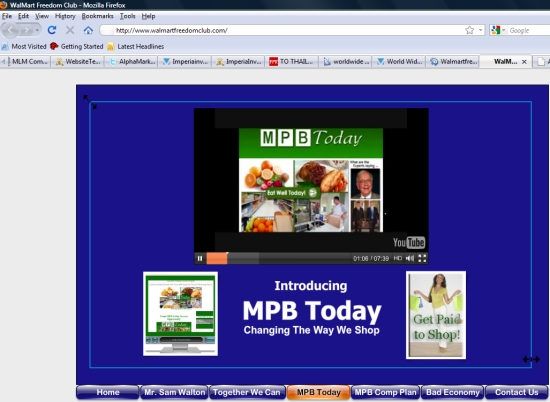
    This pitch for MPB Today positions it as the Walmart Freedom Club. The pitch misspells the word "prosper" as "prospour." The website registration is hidden behind a proxy, and uses Walmart's name in the domain name. It is unclear if Walmart authorized the domain name or the use of its intellectual property in the MPB Today promo.

    Yet-another domain linked to the purported MPB Today “grocery” program is using Walmart’s name in its domain name. The domain name is registered behind a proxy and uses images of Warren Buffet, Donald Trump and Sam Walton to position the opportunity as a “Freedom Club.”

    Sam Walton is the late founder of Walmart. It is unclear if the owners of the website have Walmart’s permission to use its name and the likeness of Sam Walton in a pitch for the MPB Today program. Also unclear is whether the website owners have the permission of Trump and Buffet to use their images in promos for MPB Today.

    Separately, yet another pitch for MPB Today features a narrator who notes that food is necessary to stay “alive” and laments, “I wish we could sell air too.” The “air” video is on a restricted YouTube site maked as “unlisted.” An unlisted video “means that only people who know the link to the video can view it (such as friends or family to whom you send the link,” according to YouTube.

    MPB Today is a multilevel-marketing (MLM) program based in Pensacola, Fla. The “opportunity” is tied to a grocery business in Pensacola known as Southeastern Delivery. Both companies are linked to Gary Calhoun, who has a poor track record with the Better Business Bureau and was the recipient of a warning letter from the Food and Drug Administration for his marketing of a product that purported to be a treatment for Lou Gehrig’s disease, Herpes and Alzheimer’s, among others.

    The new domain that uses Walmart’s name is at least the third linked to the MPB Today program — and the second to position MPB Today as a “club” tied to Walmart.  The domain was registered Sept. 9, after MPB Today itself removed images of Walmart, Buffet and Trump from the homepage of its website.

    Other MPB Today-linked websites branded with Walmart’s name imply the retail giant offers free groceries or that Walmart is partnered with MPB Today.

    Meanwhile, still-other websites linked to the MPB Today program position it as a “Grocery Assistance” program and a program linked to the Food Stamp program administered by the U.S. Department of Agriculture. MPB Today also is being pitched from known Ponzi and criminals’ forums such as ASA Monitor, TalkGold and MoneyMakerGroup.

    On Wednesday, the SEC filed an emergency action in federal court in Utah to stop a program known as Imperia Invest IBC dead in its tracks, amid allegations it had fleeced millions of dollars from thousands of Americans with hearing impairments. Like MPB Today, Imperia was promoted on the Ponzi forums.

    Among the allegations in the Imperia case were that the operators were using trademarks and the intellectual property of a major company — Visa Inc. — without the company’s authorization. All in all, more than 14,000 Imperia investors were fleeced, the SEC said.

    In this separate promo for MPB Today, a narrator notes that food is necessary to stay "alive" and laments that he wishes members also could sell "air" through the MPB Today MLM program.

  • BULLETIN: SEC Gains Asset Freeze, Seeks Shutdown Of Imperia Invest In Emergency Action; Program Pitched On Same Ponzi Forums Promoting MPB Today; Agency Says Imperia Defrauded Thousands Of Deaf Americans

    BULLETIN UPDATED 5:02 P.M. EDT (U.S.A.): The SEC has gone to federal court in Utah to halt the operations of Imperia Invest IBC, alleging a spectacular fraud that fleeced money from thousands of Americans with hearing impairments.

    Imperia was promoted from the MoneyMakerGroup Ponzi forum — one of the Ponzi forums promoting the MPB Today “grocery” MLM. Imperia also was the topic of discussion and defenses on TalkGold and ASAMonitor, two other forums that are pitching MPB Today.

    The SEC’s allegations against Imperia are stunning. More than 14,000 investors were defrauded worldwide, the agency said.

    Among the victims were thousands of deaf investors in the United States, the SEC said.

    Imperia gathered relatively small sums from thousands of people, the SEC charged, noting that “no evidence has been found that any of the investors have received a single payment.”

    “Imperia Invest IBC is a web-based entity that claimed, until late 2009, to be located in the Bahamas,” the SEC charged. “The Bahamian address listed by Imperia is fictitious. Imperia now claims to be located in Vanuatu. However, Imperia is not registered to do business in Vanuatu and the address listed on its website appears also to be fictitious. Neither Imperia nor its securities are registered with the Securities and Exchange Commission. Imperia is not licensed or registered with the Commission, with any state, or with any Self Regulatory Organization.”

    Categorically absurd representations of earnings and the program’s potential were made to investors, the SEC said.

    “Investors were promised eye-popping amounts of money in return for a simple $50 or $100 investment, and Imperia has made numerous excuses on its website about why these returns haven’t been paid,” said Ken Israel, director of the SEC’s Salt Lake Regional office.

    “The Imperia website shows an example of such earnings in which a $50 investment will return $134,000 to the investor in six months,” the SEC charged. At the same time, the agency said some investors were told that spectacular sums were due them for doing business with Imperia.

    “Imperia represented to one investor who invested $150.00 with Imperia that Imperia owed him $36,610,755.20 within a two year time frame,” the SEC charged. “Another individual’s account statement who invested $500 in July 2007 showed he is owed $43,907,652.20 as of May 2010.”

    It was not immediately clear how so many deaf investors became involved in Imperia. A federal judge has approved an asset freeze.

    Imperia called its product Traded Endowment Policies (TEP), which the SEC described as “the British term for viatical settlements.”

    “A TEP or viatical settlement involves the sale of an insurance policy by the policy owner before the policy matures, and policies are sold at a discount from face value in an amount greater than the current cash surrender value,” the SEC said.

    “There are at least 14,000 [Imperia] investors worldwide with a total investment exceeding $7 million,” the SEC said. “In the United States, there appear to be approximately 6,000 investors, most of whom belong the hearing impaired community, who have invested in excess of $4 million with Imperia.”

    Imperia used offshore payment processors such as “Liberty Reserve, located in Costa Rica; Perfect Money, located in Panama; and Procurrex, located in the British Virgin Islands,” the SEC charged. “Once Imperia received funds from Investors, it appears that Imperia then transferred amounts from these accounts to foreign bank accounts, including but not limited to accounts located in Cyprus and New Zealand.”

    Even as Imperia was ripping off investors, it also was infringing trademarks and the intellectual property of Visa, the credit-card service, the SEC charged..

    “Imperia also requires that investors purchase a Visa debit card to access their investment proceeds,” the SEC said. “Imperia charges customers a fee to purchase the Visa debit card ranging from $145 to $450.

    “Visa has not authorized Imperia to use its name or trademarks and has sent Imperia a cease-and-desist letter to halt its unauthorized use of the Visa name and logo,” the SEC said. “There is no evidence that any investor who has ordered a Visa debit card from Imperia has actually received such a card.”

    One poster on the MoneyMakerGroup forum advised prospects that he would keep an “open mind” about Imperia, according to web records.

    “Anyway, in the final analysis each person must make their own decision,” the poster said in 2007.

    While the MoneyMakerGroup poster was holding forth about keeping an “open mind,” Imperia was cloaking itself to siphon millions of dollars, according to web records and court records.

    “Imperia took proactive steps to conceal the identity of its control persons by using an anonymous browser to host its website, by communicating with all investors via email without disclosing the identity of any control persons and by establishing off-shore Paypal-style bank accounts to conceal the recipient of the investment proceeds,” the SEC charged.

    In July, the Financial Industry Regulatory Authority issued a warning about HYIP schemes pitched online. In May, the U.S. Postal Inspection Service accused an HYIP known as Pathway To Prosperity of defrauding more than 40,000 people in a scheme that took in about $70 million.

    Pathway To Prosperity also was promoted on the Ponzi and criminals’ forums. ASAMonitor, TalkGold and MoneyMakerGroup are specifically referenced in court filings in the Pathway to Prosperity case.

    MoneyMakerGroup is specifically referenced in court documents in the alleged Legisi HYIP and Ponzi scheme, a fraud that allegedly gathered more than $70 million.

    Read the SEC complaint against Imperia.