UPDATED 10:04 A.M. EDT JULY 18 U.S.A. The Zeek Rewards’ receivership this morning told the PP Blog it had “no comment” on a report that alleged Zeek insider Darryle Douglas was involved in a new scheme known as “AuctionAttics.”
BehindMLM.com reported early yesterday that Douglas, who owes the Zeek estate $2.2 million plus postjudgment interest, was involved in the selling of shares in a purported “profit pool” offered by Auction Attics. The report led to immediate questions about whether Douglas, a Californian, was involved in another cross-border offering fraud and would market it to former Zeek members.
Zeek is alleged by the SEC and federal prosecutors in the Western District of North Carolina to have been a Ponzi scheme that gathered hundreds of millions of dollars. The SEC filed civil charges in August 2012. Prosecutors have filed criminal charges against alleged operator Paul R. Burks and former executives Dawn Wright-Olivares and Daniel Olivares, her stepson.
Wright-Olivares and Olivares entered guilty pleas to the criminal charges in February 2014. The criminal case against Burks is proceeding toward trial. Douglas was identified as a Zeek “insider” in a lawsuit filed by Zeek receiver Kenneth D. Bell in February 2014.
AuctionAttics appears to be an upstart MLM “program” pitched on social-media sites such as Facebook. The “program” appears to be in prelaunch phase and to have a dotcom website that uses graphics that resemble Post-it brand notes, a trademark owned by 3M.
A spokesperson for 3M did not immediately return a call by the PP Blog for comment on whether the company was concerned its trademark was being infringed by AuctionAttics.
A snippet from the Business North Carolina story (italics added):
“Some of these folks had been engaged in this kind of thing before, and frankly, some of our largest winners re-engaged in similar schemes right away.”
Based on a victims’ count on the order of 800,000, Zeek likely is the largest or second-largest Ponzi scheme in U.S. history. (In the end, the TelexFree scheme shut down by the SEC and federal prosecutors last year may take the title, but the final numbers are unclear.)
Zeek was a purported “penny auction.” AuctionAttics appears to be using a similar theme, amid suggestions that its customers can be both bidders and sellers who will generate enormous personal profits either way.
The AuctionAttics website appears to be publishing testimonials attributed to people who were big winners, despite the fact the “program” appears not even to have launched.
One of the testimonials quotes “Maria” as saying, “I can earn much more selling on Auction Attics than i [sic] could anywhere else.” The “program” itself claims “Maria didn’t have a store front, she sold reconditioned cell phones exclusively on Auction Attics and earned up to 500% profit.”
Another “program” claim: “Micheal [sic?] and Brenda buys [sic] items, and then sells [sic] them on Auction Attics. They have the potential to earn $1,000’s weekly!”
“Micheal” and Brenda, meanwhile, are quoted as saying, “What a business, we love it.”
The images depicting them appear to be clipart.
An “opportunity” page on the site of AuctionAttics positions the “program” as the next Apple, Instagram and eBay. Namedropping is a common theme in MLM/network-marketing scams.
Among other things, the website of Auction Attics purports to sell “Cover Ads,” explaining them in this fashion:
“Cover ads are so called because they cover more than the original cost of your item even when it was new.”
In July 2014, according to court filings, Zeek’s Burks, Wright-Olivares and Olivares agreed to a $600 million civil consent judgment with the receivership “to be satisfied with substantially all of their assets.”
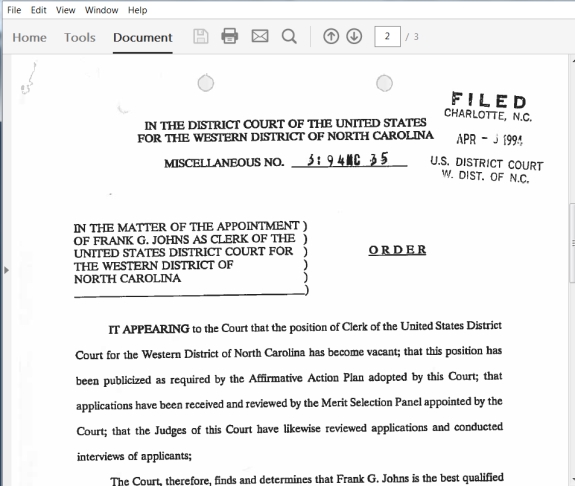
Viewed as a PDF, this is a section from a court order signed by three federal judges appointed by the President of the United States. The order from April 1994 officially appointed Frank G. Johns clerk of the U.S. District Court for the Western District of North Carolina.
UPDATED 9:21 A.M. EDT JULY 2 U.S.A. As the PP Blog reported on June 25, at least one odd sideshow is occurring while court-appointed receiver Kenneth D. Bell is pursuing clawback actions against alleged “winners” in Zeek Rewards.
A filing docketed June 23 and attributed to Canadian alleged winner Catherine Parker led to questions about whether Parker, of Hamilton, Ontario, was a “sovereign citizen.” Parker is facing a default judgment of nearly $214,000. Among other things, the June 23 filing attributed to her accused longtime U.S. Court Clerk Frank G. Johns of the Western District of North Carolina of dishonoring his office.
Johns has held the office for more than two decades.
The filing identified Johns as a “respondent.” It also requested “a certified copy” of any oath taken by Johns and “certified copies and detailed lists of all [the clerk’s] court related bonds, sureties, indemnifications, and insurance related policies.”
Such tactics are consistent with filings by “sovereign citizens.” It is unclear whether Parker adheres to the bizarre “sovereign” ideology, some of which surfaced in the AdSurfDaily Ponzi case and ultimately led to criminal charges and convictions against ASD story figure Kenneth Wayne Leaming.
Leaming acted out on some of his legal fantasies, ultimately participating in the filing of bogus liens against U.S. judicial officials. “Sovereigns” sometimes don’t know when to stop, and escalations often land them in trouble.
Chief Deputy Clerk Terry T. Leitner of U.S. District Court for the Western District of North Carolina responded to the June 23 filing attributed to Parker today.
This is from a letter from Leitner to Parker today (italics added):
In response to your request for a copy of the oath of office form for Frank G. Johns, Clerk, U.S. District Court, this office does not release copies of personnel documents.
This letter will confirm, however, that Frank G. Johns was appointed Clerk of the U.S. District Court for the Western District of North Carolina on April 11, 1994. The oath of office taken by a Clerk may be found in the United States Code at 28 USC Section 951.
Attached is a copy of the Order appointing Mr. Johns which is public record.
Included with the Leitner letter was a copy of a 21-year-old court order from April 1994 that appointed Johns clerk of the district. Three judges signed the order, including then-U.S. District Judge Graham C. Mullen. The order was signed on April 5, 1994. It went into effect on April 11 of that year.
Mullen, who is hearing the Zeek clawback cases, went on to become Chief Judge of the district. A former Naval officer, Mullen is now a Senior District Judge. He also is presiding over the SEC’s Ponzi/pyramid action against Zeek brought in August 2012.
The June 23 letter attributed to Parker appears to contend she entered a defense to the clawback action in October 2014 but that the defense never was entered into the record of the case. Johns entered a clerk’s order of default judgment against Parker on Jan. 6, 2015. The letter requesting the clerk’s oath was filed more than six months later. It complained about Parker’s name being presented in all-caps and accused two attorneys working for the Zeek receivership of dishonoring the court.
The June 23 filing attributed to Parker marked at least the second time a resident of Canada has filed a document that raised questions about whether a person north of the U.S. border was playing potentially costly “sovereign” games in the Zeek clawback actions in the United States.
Bell alleged in September 2014 that Sandra Gavel of Sechelt, British Columbia, was a Zeek winner who owed the receivership estate nearly $90,000, plus interest. As was the case with Parker, Bell alleged that Gavel had received Ponzi proceeds that had come from Zeek victims.
Gavel wrote a letter to the North Carolina court in October 2014 that sought to make Johns or the court itself a “respondent” and asserted Johns had made an “offer to contract” with her, according to records.
“Your offer to contract is hereby rejected as unacceptable,” the letter read in part. It also solicited “evidence that the United States Constitution, North Carolina Constitution, United States Laws, United States statutes and United States codes apply to me.”
Like the June 23 letter attributed to Parker, the Gavel letter described Gavel as a “natural person.”
As is the case with Parker, it is unclear whether Gavel adheres to “sovereign” ideology. But Bell raised questions about Gavel’s curious letter in February 2015. From the receiver (italics added/spacing approximated):
However, Ms. Gavel failed to file a substantive answer to the Complaint. Rather, acting pro se, Ms. Gavel filed a letter that was received by the Court on October 24, 2014. (Doc. No. 32). In the letter, Ms. Gavel states:
Your offer to contract is hereby rejected as unacceptable. . . . I do NOT consent to the jurisdiction of any United States Magistrate, or the jurisdiction of any United States Article III Judge in the UNITED STATES DISTRICT COURT WESTERN DISTRICT OF NORTH CAROLINA . . . .
(Id.). It is unclear whether, in light of the Defendant’s pro se status, the Court construes this letter as a Rule 12(b)(2) motion to dismiss for lack of personal jurisdiction or merely a failure to answer or defend.
Defendants, of course, are entitled to defend themselves in actions brought in U.S. courts. In general, pro se filers — people representing themselves — are held to lower pleading standards. Regardless, they are expected to follow the rules of the court. In U.S. courts, judges have the power to construe a pleading by a pro se filer because the plain meaning may not be clear.
When “sovereigns” are involved, however, it often is the case that the filers are being deliberately obtuse, sometimes as a means of harassment against judges, clerks and litigation opponents. One “sovereign” strategy present in the AdSurfDaily case has been described as “mailbox arbitration” — making an impossible demand of an opponent or perceived opponent, putting in on a tight deadline and declaring a “win” if the demand isn’t met.
The practice needlessly adds to litigation costs and wastes the time of the courts.
The June 23 letter attributed to Parker asserted that Johns had 30 days to produce his oath and other information.
Failure to do so “is your tacit admission to perpetrating fraud upon Catherine Parker in her natural capacity,” the letter read in part.
Johns is a lawfully appointed clerk whose appointment to office was witnessed and verified by three U.S. judges appointed by the President of the United States. Their order was signed on April 5, 1994 and, as noted above, became effective on April 11 of that year. It is captioned “ON THE MATTER OF THE APPOINTMENT OF FRANK G. JOHNS AS CLERK OF THE UNITED STATES DISTRICT COURT FOR THE WESTERN DISTRICT OF NORTH CAROLINA.”
It has legal effect even though the name of Johns appears in all-uppercase lettering.
4TH UPDATE 2:47 P.M. EDT JUNE 27 U.S.A. An unsigned pro se pleading docketed June 23 and attributed to Zeek Rewards’ clawback defendant Catherine Parker is leading to questions about whether Parker is a Canadian “sovereign citizen” taunting a U.S. federal court in North Carolina and the receivership judicially empowered to gather hundreds of millions of dollars for Zeek victims.
The 2008 petition called for the U.S. Senate to investigate federal prosecutors and the Secret Service, claiming that “we as Americans have a right to advertise with any company without interferences [sic] by [sic] Attorney General and /or any of its agents.”
Prosecutors said ASD was a securities company offering unusually consistent, above-market returns while posing as an “advertising” firm. Zeek, which also had a purported “advertising” element while allegedly offering securities, offered unusually consistent returns even higher than ASD.
Parker resides in Hamilton, Ontario, according to the June 23 pleading attributed to her. That’s the same city and province that appeared under the name of Catherine Parker in the 2008 ASD petition, leading to questions about whether a Zeek beneficiary with “sovereign” ties also had profited from ASD’s outrageous scheme that also was advanced by “sovereigns.”
The June 23 pleading attributed to Parker was sent back to Parker’s Hamilton address for a signature, according to the clawback case docket. The case is styled “Bell v. Parker et al.” Kenneth D. Bell is the court-appointed Zeek receiver. In the early months after the SEC’s August 20012 Ponzi- and pyramid action against Zeek, Bell, a former federal prosecutor, was accused by an asserted Zeek member to have committed a felony.
Senior U.S. District Judge Graham C. Mullen is presiding over the Zeek clawback actions. A longtime jurist and former Naval officer, Mullen is no stranger to poisonous filings that may be designed to embarrass or even ruin public officials by making scandalous claims against them.
In 2002, in a case unrelated to Zeek, Mullen became the alleged target of a smear campaign that used both the court docket and the Internet. Mullen then was the chief judge in North Carolina’s Western District.
In the 2002 case, the disciplinary committee of the North Carolina State Bar found that an attorney had used a website and created a “fictitious criminal record” for Mullen and had asserted that the judge had a felony record for horribly disgraceful crimes.
The attorney, who allegedly complained about “the record keeping practices of several federal, state and local entities,” including the IRS, the FBI, the CIA, the Administrative Office of the United States’ Courts, the Charlotte Mecklenburg Police Department, the Mecklenburg County Sheriff and the North Carolina State Bar, also allegedly tried to weaponize his own pleading accusing Mullen of felonies, according to the Bar filing.
“Now that these documents are a part of the record in this case, any person can come look at the court file, and copy only the pages that they want, and publish them in any newspaper or on any web site, with or without any explanatory comment, for any purpose they want to accomplish,” the attorney allegedly wrote. “No one is under any obligation to say that these are spoof pages and that the Chief District Judge did not do these things and was not ever arrested for these things. Isn’t freedom wonderful! And as long, as they only publish the pages, and don’t comment on whether they are true or not, they can’t be sued for libel, due to the absolute privilege that attaches to court filings.”
The June 23 pleading attributed to Parker appears to contend that Parker, who faces a Zeek-related default judgment of nearly $214,000, entered a defense to the clawback claims in October 2014 and that Parker has a postal receipt to prove it — but that a 46-page document she submitted in her defense was never entered into the record of the case. The pleading, however, does not detail the asserted October 2014 defense. Nor does it appear to include a copy in the form of an exhibit that presents the claimed defense.
Instead, the pleading purports to make a U.S. court clerk for the Western District of North Carolina the “respondent.” It also contends that the clerk and two attorneys working for the Zeek receivership under Bell have “dishonored the court.” At the same time, the pleading puts the court’s Charlotte Zip Code in a bracket — “[ 28202 ]” as opposed to a straightforward 28202, the standard convention.
A pleading that asserts “dishonor” claims against public officials and litigation opponents is consistent with tactics employed by “sovereigns” and their adherents. So is the use of a bracket to encase a Zip Code. (See the Blog of the Anti Defamation League, which has a March 15, 2013, story unrelated to Zeek that references a bracket and “sovereign” conspiracy theories about Zip Codes. The ADL story reports on a particularly tragic outcome for a purported “sovereign” the PP Blog also has written about.)
Whether the asserted October 2014 filing by Parker complied with the local rules of U.S. District Court for the Western District of North Carolina — the venue from which Parker was sued for the return of her alleged Zeek winnings plus interest — is not known. What is known is that pleading standards exist in U.S. courts. Pro se filings also are one of the hallmarks of “sovereign citizens,” individuals who may express sentiment that laws do not apply to them or that courts do not have jurisdiction over them.
A court is not mandated to accept any and all pleadings. Some “sovereigns,” for instance, have been known to submit vexatious pleadings that seek to use the courts as an outlet for smear campaigns against judges, clerks, government officials and litigation opponents. “Sovereigns” also have been known to submit nonsensical claims or antigovernment or extremist political arguments, rather than cogent legal defenses.
Whether Parker is a “sovereign” is unclear. Some individuals have fallen under spells by “sovereigns” who sell pleading kits online or at speaking engagements. Now-jailed AdSurfDaily Ponzi-scheme figure Kenneth Wayne Leaming was a purported “sovereign citizen.” Fellow ASD figure Curtis Richmond also was a purported “sovereign.”
Is A Canadian ‘Sovereign Citizen’ Taunting The U.S. Court And The Zeek Receivership?
On its first page, the June 23 pleading attributed to Parker includes what appears to be an ink stamp or seal of something called the “INTERNATIONAL FLAG OF PEACE.” Some “sovereigns” have shown a fascination with ink stamps, including ones in red that purportedly signify a bloody thumb print. (See this May 13, 2015, story in the Jackson Hole News & Guide that refers to purported “sovereigns” in Wyoming and the “International Flag of Peace.”)
Meanwhile, some “sovereigns” have expressed a fascination with capital letters, arguing in essence that if their names appear in caps, the reference is to a nonperson, a person who does not exist or to a person who exists in two forms. The June 23 pleading attributed to Parker asserts she is a “natural person.”
Another oddity with the June 23 pleading attributed to Parker is that it requests “a certified copy” of any oath taken by the court clerk and “certified copies and detailed lists of all [the clerk’s] court related bonds, sureties, indemnifications, and insurance related policies.”
This, too, is consistent with filings by “sovereign citizens.”
Although the June 23 pleading attributed to Parker is typewritten, the phrase “special, private, priority” is scrawled in longhand down the left-side margin of both pages. The reason why was not immediately clear. Some “sovereigns,” however, have expressed a belief that certain word combinations and certain types of punctuation have magical properties that can render courts and litigation opponents powerless, resulting in the dismissal of a case.
The June 23 pleading attributed to Parker ends with the words “Notice to Principal is notice to Agent and Notice to Agent is Notice to Principal.” Similar words have appeared in filings by “sovereign citizens” in U.S. courts.
“Sovereign citizens” in Canada sometimes have been called “Freemen on the land.” In certain instances, they have polluted Canada’s courtrooms with gobbledygook and have behaved in fashions similar to American “sovereigns” — claiming interests in properties they do not own and asserting their actions flow from common law or the Uniform Commercial Code.
Although many “sovereigns” clutter court dockets with mind-numbing nonsense, they do not act out in violent ways.
“Sovereigns,” however, have been linked to violence, including the murders of police officers.
Questions have been raised about whether a Canadian “sovereign citizen” murdered Edmonton Constable Daniel Woodall earlier this month.
EDITOR’S NOTE: (Updated 3:06 p.m. EDT U.S.A.) The information below is from Kenneth D. Bell, the court-appointed receiver in the Zeek Rewards’ Ponzi- and pyramid-scheme case. It is reproduced verbatim from an announcement by Bell dated June 18. Also, make sure you read the Comments thread below for the URL to a June feature on Bell by Business North Carolina. The story touches on the issue of certain MLMers proceeding from one fraud scheme to another. In addition, the publication reports that Bell, prior to his appointment as Zeek’s receiver, served as a federal prosecutor who investigated a Hezbollah terrorist cell. Many Zeekers perhaps already know about the Hezbollah prosecution. Business North Carolina is reporting that, during his career as an Assistant U.S. Attorney, Bell encountered a person who wanted to hire a hit man . . .
**___________________________**
ANNOUNCEMENT FROM THE RECEIVER – June 18, 2015
I am pleased to announce that we will be making a second partial interim distribution to all Affiliates who hold Allowed Claims on the next Court authorized distribution date (July 31, 2015), which, when combined with the first partial interim distribution and the amounts paid by Zeek Rewards before it was shut down, will return to victims 60% of allowed claimed losses due to the Zeek Rewards Ponzi scheme.
There has been some confusion about how the amounts of distributions are calculated using the Court ordered “rising tide” method. The rising tide method of loss calculation is designed to make every recognized claimant equally whole (as a percentage of their investment). Take for example two recognized claimants, each of whom invested $10,000 into the Zeek Rewards Ponzi scheme. The first claimant received nothing back from Zeek Rewards while the scheme was operating. The second claimant received $4,000 out of Zeek Rewards before it was shut down. Under the rising tide method, the second claimant is deemed to have already received 40% of her investment back, while the first claimant has received nothing back. When we made the first partial interim distribution of 40% the first claimant received $4,000, but the second claimant did not receive a distribution check.
When the second interim partial distribution is made, the first claimant will receive an additional $2,000, and the second claimant (who did not get a first distribution) will receive $2,000. This will ensure that both claimants have received 60% of the amounts they invested. While some Affiliates have complained about the rising tide method, I believe it is the most fair way to make the Zeek Rewards victims equally whole; two investors put $10,000 into the scheme and each will receive $6,000 total, whether it was received from the scheme itself, or from distributions from the receivership, or a combination of both.
There also has been some confusion about our quarterly distributions. Some mistakenly believe that they will receive a distribution every quarter. There was a first partial interim distribution and will soon be a second. Each quarter we send distribution checks only to claimants who completed the claims process since the last quarter.
Unfortunately, nearly 50,000 claimants with recognized claims have not received a first, nor will they receive a second, partial interim distribution. The only reason for this is that those 50,000 claimants have not electronically signed the Release and OFAC certification available through the claims portal. Many have called or emailed asking for personal assistance signing and submitting these forms. We will soon create and post on the receivership website an instructional video showing how to electronically sign and submit the Release and OFAC certification through the claims portal. The cost to create and post this video will be a minimal expense to the receivership.
We have received calls and emails asking that we cut off the recovery rights of the 50,000 recognized claimants who have not completed the process and distribute their share of distributions to those who have. That day may come, but it has not yet. I will give each claimant with a recognized claim every opportunity to receive their share of the recovery. Nonetheless, I implore everyone to promptly complete the Court required process. Sometime before the end of the receivership I will have no option but to ask the Court for permission to distribute all remaining receivership assets to only those recognized claimants who have completed the process.
If your contact information has changed, or the claims portal shows that you were issued a check that you have not received, or a check you were mailed was issued in the wrong name, please click on the following link to learn how to let us know: https://cert.gardencitygroup.com/zrwdet/fs/home.
After this second partial interim distribution, the receivership will maintain sufficient funds to pay those claimants who have not yet, but hopefully will, electronically sign the Release and the OFAC certification, and sufficient funds to allow the receivership team to continue to pursue additional recoveries for the ultimate benefit of eligible Affiliates. We are not going to hold onto money that we could otherwise distribute to victims.
We are in negotiations or litigation with financial services firms to recover tens of millions of dollars for Affiliates. The litigation against U.S and foreign net winners (those who took more money out of the scheme than they put in, essentially holding the victims money) is progressing. I remain confident that we will succeed in all of these efforts. Unfortunately, litigation is never quick, and once we have judgments against the net winners, in amounts exceeding $200 million, we will have to collect on those judgments. I don’t anticipate making a third partial interim distribution for quite some time because the funds for such a distribution will largely have to come from litigation recoveries that will take quite some time.
I know and understand that recovering only 60% of your investment is not what you want. I have read letters from and spoken to many of you. I know the hardships that Zeek Rewards inflicted on thousands of people. It may be no comfort, but a 60% recovery by victims of a Ponzi scheme is unusually high, and I am proud that the receivership team spends less as a percentage of total recoveries than any receivership of which I am aware.
I am entirely confident that when we are finished with our work on your behalf your total recovery will be more than the 60% we will distribute. I ask you for your patience, and thank you for your continuing support.
URGENT >> BULLETIN >> MOVING: (13th Update 1:43 p.m. EDT U.S.A.) After an investigation by the U.S. Secret Service, Kristi Johnson (Kristine Louise Johnson) of the “Achieve Community” has been charged criminally with wire-fraud conspiracy and has agreed to plead guilty, federal prosecutors said.
“By the time the scheme collapsed in February 2015, the conspirators owed victim-investors at least $51 million in purported investment returns, yet Johnson, her conspirators and TAC had available only 4% or approximately $2.6 million,” the office of Acting U.S. Attorney Jill Westmoreland Rose of the Western District of North Carolina said.
The SEC charged Johnson, 60, civilly in February 2015 with operating a combined Ponzi- and pyramid scheme that allegedly had gathered at least $3.8 million. She resided in Aurora, Colo., the agency said. The securities regulator also charged Troy A. Barnes, 52, of Riverview, Mich.
Barnes disclosed in February that he was a target of a federal criminal investigation. A charge sheet (known as an “information”) filed by prosecutors yesterday against Johnson described an alleged co-conspirator as “CC#1.” The information also suggested there were other co-conspirators “known and unknown to the United States Attorney.”
These individuals were not named.
The conspiracy prosecution brought by the Secret Service and federal prosecutors appears to have upped the Ponzi dollar sum to $6.8 million. Prosecutors said Achieve “defrauded more than 10,000 investor victims” worldwide.
Prosecutors called Achieve a “sham internet company.” The case against Johnson was brought in the venue — the Western District of North Carolina — that is the center of action in the 2012 Zeek Rewards’ Ponzi- and pyramid scheme.
Achieve and Zeek are known to have had promoters in common. Both schemes instructed prospects and recruits not to call the respective programs “investment” programs in bids to skirt securities laws. Such disingenuousness dates back to at least 2008 and the AdSurfDaily Ponzi scheme, also broken up by the Secret Service.
According to court filings, as the scheme grew in size and scope, Johnson and her conspirators concealed the true nature of the scheme through multiple misrepresentations. According to court records, when the conspirators became concerned that the use of the term “investment” would draw scrutiny from regulators, they instructed victim-investors that “We ARE NOT an INVESTMENT program, please don’t use that term when you speak or post about our re-purchase strategy.”
According to court records, Johnson and her conspirators also lied about the company’s “business model” to the third-party payment processors which processed TAC’s money transactions. When one payment processor concluded that TAC was operating a Ponzi scheme and terminated TAC as a client, court records show that Johnson and her conspirators falsely told victim investors that it was because the payment processor was unable to handle the large amount of money TAC paid to its investors.
As indicated in court documents, the investment scheme began to crumble when payment processors stopped processing the Ponzi payments to victim-investors. By the time the scheme collapsed in February 2015, the conspirators owed victim-investors at least $51 million in purported investment returns, yet Johnson, her conspirators and TAC had available only 4% or approximately $2.6 million.
Prosecutors said “a signed plea agreement was also filed [Thursday], and Johnson is expected to appear before a U.S. Magistrate judge in the coming days to formally accept the plea. The wire fraud charge carries a maximum of 20 years in prison and a $250,000 fine. As part of her plea agreement, Johnson has agreed to pay restitution, the amount of which will be determined by the Court.”
In December 2014, the PP Blog reported that Achieve boosters were parroting each other and circulating a promo that read, “We are not investing in a stock or buying shares in a company. We are using our God given universal right to spend our money the way we want. We choose not to sell out to the banking system for their tiny little 1% annual return.”
Prosecutors described Achieve’s purported 700 percent return as “bogus.” The SEC described Achieve as a “pure Ponzi and pyramid scheme” whose revenue “has consisted entirely of investor-contributed funds.”
Claims of that a “triple algorithm” made such outsized returns possible also were bogus, authorities said.
From an Achieve promo playing on YouTube. Masking by PP Blog.
Achieve offered a 700 percent ROI, according to the SEC and federal prosecutors.
EDITOR’S NOTE: Certain reports by the PP Blog that are available to any person with an Internet connection are referenced in a consolidated, amended prospective class-action complaint that makes claims against various defendants with an alleged association with TelexFree. Information from other publicly available sites, including BehindMLM.com, RealScam.com and others, also is referenced.
The purpose of the PP Blog is to make information available to a wide audience interested in Ponzi schemes, pyramid schemes, securities-fraud schemes and concerns about the interconnectivity of such schemes. The Blog was not consulted about the inclusion of its links or quoted material from the Blog. Nor was the Blog compensated. The PP Blog has no association with the class-action attorneys, who obviously are readers of the Blog and the other online publications.
**__________________________**
Still promoting MLM HYIP schemes in the face of evidence they cause intractable financial, legal and emotional pain that sometimes mushrooms to involve hundreds of thousands of people?
On March 9, 2015, the PP Blog reported that the name of “MyAdvertisingPays” was referenced in a TelexFree-related proposed class-action lawsuit filed in U.S. District Court for the Southern District of New York in December 2014.
The filing appeared to mark the first time MyAdvertisingPays, known in shorthand as MAPS, was referenced in a federal-court filing.
History shows that such references are closely watched by law enforcement. Indeed, they sometimes serve as unofficial triggering actions and presage federal regulatory action by civil authorities such as the SEC and even actions by agencies empowered to enforce criminal laws.
When the California Department of Business Oversight was investigating the WCM777 scam in 2013, for instance, TelexFree’s name popped up in the context of the cross-promotion of MLM HYIP schemes.
This was months before it became known that the SEC and the U.S. Department of Homeland Security were investigating TelexFree, alleged to have gathered at least $1.6 billion in a combined pyramid- and Ponzi scheme.
Instead, the complaint alleged that TelexFree huckster Daniil Shoyfer was “the largest single Promoter” of TelexFree “in the greater New York area.” Web records showed that Shoyfer also was promoting MAPS alongside MAPS colleagues such as U.K. hucksters Simon Stepsys and Shaun Smith.
Willfully blind and supremely disingenuous MLM HYIP promoters moving from one cross-border fraud scheme to another has been a longtime problem. Such promoters may have little of their own money invested, but contribute to a condition under which banks and payment processors become warehouses for fraudulent proceeds cycling between and among scams.
New York is the financial center of the United States. The filing of the proposed TelexFree class action there contributed to questions about whether MAPS soon would be on the U.S. regulatory and enforcement radar.
The answer to that question remains unclear. What is clear is that the New York complaint was transferred to Massachusetts, the U.S. home base of TelexFree. And it’s also clear that Shoyfer has been named a defendant in an amended TelexFree class-action complaint filed April 30 in Massachusetts federal court.
Among the allegations against Shoyfer (italics added/light editing performed/formatting not precise):
TelexFree changed its compensation plan on or about March 9, 2014, much to the fury of affiliates, noted below. Shoyfer, however, continued to promote it unremittingly, sending group text messages to his network with such as the following:
Hey..my team Telexfree! ! And here we go again..Come to check out and learn about new compensation plan TF 2.0.. and how to grow it even faster and MUCH more aggressively and efficiently than the one we had before.…Here is this week’s schedule. . Monday 03/24 at Salon Delacqua (2027 86 str) at 8.00 pm (in English) ..Wednesday 03/26 at SOHO launch(2213 65th street) at 7.45 pm ( in Russian) and Thursday 03/27 at 7.30 pm at 63-112 Woodhaven Blvd in a real estate office. In my case, since I have started from absulute zero during this passed week Mon 03/17- Sun 03/23/14 I booked 11,500 from new one and 21,600 still coming from old plan..A total of 31,100 in 7 short days… Go Telex!!!
After the institution of the new TelexFree compensation plan in March 2014, Shoyfer took part in a closed meeting with TelexFree’s directors and owners in Marlborough, Massachusetts, at which Shoyfer was instructed not to discuss the new TelexFree compensation plan with others and non-insiders, as the new compensation plan was detrimental to Promoters and was adopted to forestall [TelexFree] filing bankruptcy.
So, a man who allegedly promoted TelexFree and had inside information detrimental to ordinary TelexFree affiliates allegedly kept it to himself, continued to promote the scheme — and then moved on to MAPS. This naturally leads to questions about whether Shoyfer has kept information from ordinary MAPS members.
Purpose Of The Amended TelexFree Class Action
The complaint is an effort to consolidate for the sake of efficiency various TelexFree-related class actions filed in various courts. Such actions were filed in multiple U.S. states.
But that’s not the only news: The amended complaint also names TelexFree pitchman Scott Miller a defendant alongside Shoyfer and HYIP huckster Faith Sloan. In documents prepared by Zeek receiver Kenneth D. Bell, Miller’s name appears as an alleged winner in the $897 million Zeek scheme.
In 2013, Miller promoted TelexFree through a publication known as Home Business Advertiser. Another advertiser promoted a cash-gifting scheme. A columnist described Jesus Christ as the person who inspired modern network marketers through his recruitment of 12 disciples.
A Semacon cash-counting machine appeared as a stage prop in a cash-gifting video advertised in Home Business Advertiser. The promos appeared after two women in Connecticut were sentenced to federal prison for their roles in a cash-gifting scheme and tax fraud.
Also named promoter-defendants in the amended TelexFree class action are Sanderley Rodrigues de Vasconcelos (Sann Rodrigues), a two-time SEC defendant in pyramid-scheme cases who allegedly also claimed his actions were inspired by a deity; Santiago de la Rosa; and Randy N. Crosby.
How the promoter-defendants will pay for their defenses in the amended class action is an open question. One of the risks of promoting such schemes is to be left totally on your own if the government or class-action attorneys file lawsuits.
Another open question is whether other shoes will drop in the government actions. The government probes are ongoing. Some of the class-action defendants conceivably could become defendants in amended or new actions filed by the SEC or agencies that have criminal enforcement power.
The amended TelexFree class action asserts fraud claims under Massachusetts law against a slew of defendants, including financial vendors and MLM attorney Gerald Nehra, also a figure in the the Zeek scheme and the AdSurfDaily Ponzi-scheme story. ASD was a $119 million Ponzi scheme broken up by the U.S. Secret Service in 2008. ASD operator Andy Bowdoin was sentenced to federal prison in 2012, after authorities tied him to at least two other cross-border fraud schemes: OneX and AdViewGlobal.
ASD’s name is referenced repeatedly in the amended TelexFree complaint, as is the name of Zeek. When the complaint will be heard is anyone’s guess. That’s because there are unresolved criminal matters against alleged TelexFree principals James Merrill and Carlos Wanzeler, both of whom are named defendants in the amended complaint and also are among the subjects of the SEC complaint.
Katia Wanzeler, Wanzeler’s wife, also is named a defendant in the amended complaint. So is TelexFree figure Joe Craft, another defendant in the SEC action. Brazilian TelexFree figure Carlos Costa also is named a defendant in the amended class action.
Also named a defendant in the amended class action is Jason “Jay” Borromei of Laguna Niguel, Calif. Along with a company known as Opt3, he is accused of “intentionally, knowingly, unfairly and deceptively set[ting] up TelexFree’s United States-based servers in Brazil with the intent of directly furthering, aiding or abetting their unlawful and fraudulent operation, including facilitating the placement of evidence of the Pyramid Scheme beyond the jurisdiction of the United States’ courts.”
With TelexFree itself in bankruptcy court, the class-action plaintiffs contend that “Opt3 and Borromei have a history of providing technical services within the multilevel marketing industry and hold themselves out as having related specialized knowledge. For example, Borromei previously served as chief information officer of Joystar, Inc., later renamed Travelstar, a multilevel marketing company that collapsed in approximately late 2008, and subsequently entered involuntary chapter 7 bankruptcy.”
Though not named a defendant in the amended class action, TelexFree and Zeek figure Tom More also is referenced in the 200-page complaint.
‘Private Jet’ Gets A Mention
On March 9, 2014, the PP Blog reported that a person who took the stage at a TelexFree rah-rah fest in Massachusetts asserted that TelexFree had access to a “private jet” that recently had ventured to the Dominican Republic and Haiti.
The “private jet” also was referenced in the class-action complaint. Details about it remain unclear.
At the moment, the April 30, 2015, amended and consolidated complaint is posted here at the website of class-action attorney Robert Bonsignore.
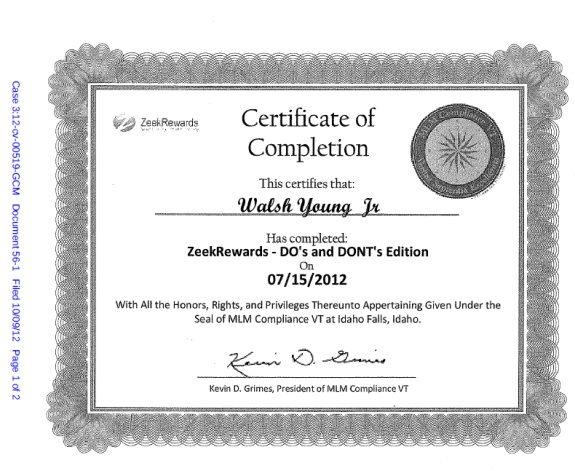
A “Certificate of Completion” for a compliance course Zeek receiver Kenneth D. Bell alleged to be bogus. Source: Federal court filing in 2012.
UPDATED 10:44 A.M. EDT U.S.A. In an amended complaint filed in August 2014, Zeek Rewards’ receiver Kenneth D. Bell sued MLM attorney Kevin Grimes, the Grimes & Reese law firm and a Grimes-related entity known as MLM Compliance VT LLC.
Among other things, Bell alleged that Grimes and MLM Compliance received $843,000 from the Zeek pyramid- and Ponzi scheme through the sale of a “bogus compliance course.”
Bell further alleged that “[t]he final payment from [Zeek operator Rex Venture Group] to Grimes and MLM Compliance was, upon information and belief, a check rushed to and [e]ndorsed by Kevin D. Grimes for $342,510, which posted on August 13, 2012, less than a week prior to ZeekRewards’ shutdown.”
By April 2015, Bell and the defendants had entered settlement talks through mediation, according to court filings. In late May, there was news of a definitive settlement agreement. The sum was not immediately known.
On June 2, the sum became known: $1.175 million. How the figure was arrived at was not immediately clear. The number, however, appears to absorb the entire $843,000 Grimes and MLM Compliance allegedly received through sales of the compliance course alleged to be bogus. It also appears to erase virtually all of the $342,510 Grimes and MLM Compliance allegedly received via a “rushed” check in Zeek’s closing days and hours.
As part of the settlement agreement docketed June 3, Grimes and the other defendants “do not admit to any wrongdoing or liability to the Receiver and the Receiver does not admit that the Defendants should be exonerated from liability for the wrongdoing alleged by the Receiver in the Grimes lawsuit.”
Senior U.S. District Judge Graham C. Mullen of the Western District of North Carolina has approved the settlement.
The parties specified in the settlement that they wished to enter the agreement “for the purposes of resolving these disputed matters and to avoid the cost and expense of litigation.” All parties will bear their own attorneys’ fees and costs.
Mullen ruled that the settlement was “in the best interest of the Zeek victims.”
Those 80 victims lost a total of $131,063.95, Bell alleged, citing calculations by FTI Consulting Inc., a forensic and litigation firm assisting the receivership.
It is unclear from filings whether MacGregor Fraser also created a small subset of winners among his alleged 96 recruits and whether those people are being sued for the return of Zeek hauls. Bell has sued thousands of alleged winners with U.S. addresses and dozens of individuals with overseas addresses.
In court filings last month, MacGregor Fraser said he joined Zeek in “November 2011″ while he was a “resident of Malaysia” and maintaining “a Post Office Box in New Zealand.”
Eleven of the alleged 80 MacGregor Fraser victims have filed claims and received a distribution from the receivership estate, Bell asserted. He further alleged that MacGregor Fraser hauled $89,722 out of Zeek, but “invested only $828.00 USD.”
Although MacGregor Fraser argued last month that he had “no specific knowledge that ZeekRewards was initiated from the United States” and that he was was “unaware that ZeekRewards originated in North Carolina,” Bell disputed those contentions in court filings yesterday.
From the receiver’s argument that Senior U.S. District Judge Graham C. Mullen of the Western District of North Carolina should reject MacGregor Fraser’s jurisdiction claims and motion to dismiss (italics added/light editing performed/formatting not precise):
[Zeek operator Rex Venture Group] made known to anyone interested in the ZeekRewards program that the company was based in North Carolina, in the United States of America. At the top of the ZeekRewards homepage, where Defendant Fraser logged in every day, there was a conspicuous “About Us” link. . . . A single click on the “About Us” link disclosed the following:
Zeekler and ZeekRewards are owned by Rex Venture Group LLC, a subsidiary of Lighthouse America, US (NV) company. The company was established on June 24, 1997 and adopted the d/b/a Lighthouse America later that year.
Our headquarters is located in the beautiful town of Lexington, NC, USA on the I- 85 corridor connection [sic] Charlotte and Raleigh . . . .
. . . The “About Us” page further stated:
Office Hours & Location
Home office is located at 803 West Center St., Lexington, NC 27292
Zeekler & ZeekRewards primarily operates online with skype and email support.
Office hours are 9:30AM to 5:00PM EST Monday – Friday . . .
. . . And, there was no question that the company not only was headquartered in but also operated in the USA. The ZeekRewards homepage stated:
Here’s How It Works:
Each night after the close of the business day (east coast USA time) the company tallies its sales and shares up to 50% of its net profits with its qualified affiliates . . .
Moreover, on the “How It Works” section of the ZeekRewards website, there is an image of United States currency at the top of the page . . .
“From the day he signed up with ZeekRewards, Fraser actively directed efforts and attention to ZeekRewards, in North Carolina, every day until the scheme’s collapse in August 2012,” Bell argued. “Starting on November 4, 2011 and continuing through August 16, 2012, when ZeekRewards was shut down, Fraser logged into his ‘back office’ page to report his having met the so-called daily ‘advertising’ requirement. . . . . In addition, on a frequent, often weekly basis, Defendant Fraser logged in to the ZeekRewards site to request a cash-out payment from them scheme. These payments came from ZeekRewards’ account at a bank in North Carolina and all the money Defendant Fraser requested and received from ZeekRewards was stated in US dollars . . .
“. . . Moreover, Defendant Fraser also directed his actions to North Carolina through the ZeekRewards site by frequently changing the allocation of his daily ‘Retail Profit Pool’ (‘RPP’) payouts between the repurchase of VIP bids and ‘available cash.’ . . .
Exhibits submitted by Bell include several screen shots. That MacGregor Fraser used a computer overseas should not be a barrier to holding him accountable to return his winnings, Bell contended.
“Fraser knew or should have known that if he purposefully availed himself of an opportunity to make money in North Carolina (whether or not he cared to find out the location of the scheme) that any claims related to his participation might be brought in a court in North Carolina,” Bell argued. “To hold otherwise would be to allow individuals outside the state to intentionally come to North Carolina electronically and engage in conduct that subjects them to claims but effectively avoid liability because of the distance and cost of pursuing them outside of North Carolina.
“Fraser even falsely claims that there was supposedly no ‘injury’ from his actions – the 80 victims he recruited to the scheme would undoubtedly disagree. Accordingly, it is both fair and just for this Court to exercise jurisdiction over Defendant Fraser based on his intentional, repeated and extensive participation in the ZeekRewards scheme in North Carolina.”
UPDATED 9:35 P.M. EDT U.S.A. Saying that Zeek Rewards’ clawback defendant Trudy Gilmond of Vermont “refused” to appear in North Carolina federal court on May 27 as directed, Senior U.S. District Judge Graham C. Mullen has entered a judgment against Gilmond for $2,129,522.27.
Mullen’s ruling is a significant win for Zeek receiver Kenneth D. Bell. Bell alleged in April that Gilmond and fellow Zeek clawback defendant Jerry Napier of Michigan had failed to defend the actions against them and had missed depositions in Vermont and Detroit, respectively.
Bell sought default judgments against both Gilmond and Napier and asked Mullen to make them appear in federal court for the Western District of North Carolina to show cause why judgments should not be entered against them.
“On May 11, 2015, the Court entered an Order directing Trudy Gilmond to personally appear before the Court on May 27, 2015 at 11:00 a.m. to show cause why judgment should not be entered against her as requested by the Receiver,” Mullen wrote in an order dated yesterday. “Ms. Gilmond failed to appear as directed. Indeed she advised the court by letter that she refused to do so.
“IT IS THEREFORE ORDERED that the Receiver’s Motion is GRANTED and judgment is hereby ENTERED against Defendants Trudy Gilmond and Trudy Gilmond LLC in the amount of $2,129,522.27,” Mullen wrote.
The news was better for Napier, from whom the receiver is seeking more than $2.041 million.
Bell informed the court that “Mr. Napier has appeared for a deposition and is cooperating in the production of documents,” Mullen wrote in a separate order dated yesterday.
UPDATED 9:37 P.M. EDT U.S.A. David Ian MacGregor Fraser, a New Zealand resident who allegedly used the Zeek Rewards’ username of “sovlife,” has challenged a U.S. Court’s jurisdiction over him in a clawback lawsuit filed in February by Zeek receiver Kenneth D. Bell.
Bell alleged that David Ian MacGregor Fraser received $89,722 from Zeek’s “unlawful combined Ponzi and pyramid scheme.” The receiver, who contends the U.S. Court has jurisdiction in international clawback actions in part because Zeek operated from North Carolina and sent money from the state to participants such as MacGregor Fraser, is seeking a judgment in that amount, plus interest. He alleges the money came from Zeek victims.
The U.S. Securities and Exchange Commission described Zeek in 2012 as a massive, cross-border fraud scheme that had gathered hundreds of millions of dollars. In October 2014, alleged Zeek operator Paul R. Burks was charged criminally with wire- and mail-fraud conspiracy, wire fraud, mail fraud, and tax-fraud conspiracy.
Earlier in 2014, Zeek figures Dawn Wright-Olivares and her stepson Daniel Olivares pleaded guilty to criminal charges filed in 2013 — Wright-Olivares to investment-fraud conspiracy and tax-fraud conspiracy and Olivares to investment-fraud conspiracy.
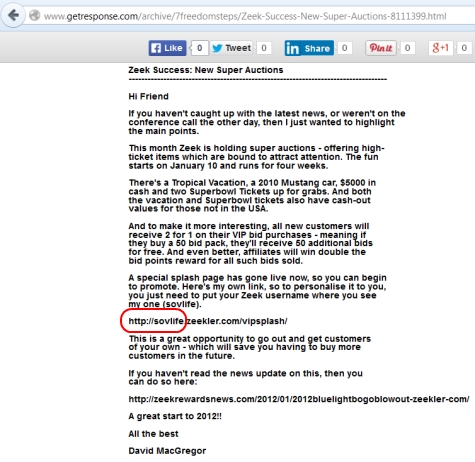
Web records suggest MacGregor Fraser used the shortened name of “David MacGregor” when pitching Zeek online through GetResponse.com, an email service sold in the United States and other countries.
A Zeek promo in which the username “sovlife” and the name “David MacGregor” appear begins in this fashion, according to Google search results. (Italics added):
Hi Friend
If you haven’t caught up with the latest news, or weren’t on the conference call the other day, then I just wanted to highlight the main points.
Screen shot of promo for Zeek. Red highlight by PP Blog.
MacGregor Fraser, who is represented in the clawback lawsuit by North Carolina attorney June K. Allison of Shumaker, Loop & Kendrick in Charlotte, answered Bell’s complaint as “David Fraser.” The answer, however, acknowledges the longer version of the name as it appeared in Bell’s complaint. So does an affidavit submitted to the U.S. court by David Ian MacGregor Fraser.
The moniker “sovLife” appears repeatedly on the website theclassifiedsplus.com through which videos play. Some of these videos point to MLM “programs” such as the Empower Network in which “sovLife” is used as the affiliate ID.
Other videos at theclassifiedsplus point to a web entity known as sovereignlife.com. This domain is styled “SovereignLife” and identifies its operator as “David MacGregor.” There is a corresponding YouTube account in that name through which videos viewable through theclassifiedsplus.com play.
One of them with an upload date of July 3, 2013, is titled “My July 4 Message for the America That Was.” In the video, a man (presumptively “David MacGregor”) holds forth that he once was a big supporter of the United States. That support, however, apparently has evaporated in that the man contends in the video that the United States is “Dare I say it? A force for evil.”
Other videos in the David MacGregor account have titles such as “Bitcoin Debit Card – How to Get One,” “You Can Now Be a Reseller For SovereignLife And Keep All The Money!,” “Tax Slave or Sovereign Individual?”
Some individuals who may identify with the word “sovereign” have participated in various fraud schemes, have painted their fellow human beings as slaves (see Frederick Mann) or government-owned property (see Kenneth Wayne Leaming) and have expressed an irrational belief that laws do not apply to them.
Other “sovereigns” have made wild claims that they hold diplomatic immunity and thus cannot be prosecuted or are answerable only to Jesus Christ.
Zeek Clawback Defense
Compared to the “David MacGregor” video suggestion that America is evil, the David Fraser response to Bell’s clawback complaint before Senior U.S. District Judge Graham C. Mullen of the Western District of North Carolina includes no inflammatory rhetoric or claims of evildoing by the United States.
Fraser, through the American law firm, is seeking dismissal of the complaint for lack of jurisdiction. He also is seeking to quash process in New Zealand, even though he acknowledges he has been served.
Among Fraser’s specific defense claims is that he was an “innocent participant” in Zeek, having joined the program in “November 2011” while he was a “resident of Malaysia” and maintaining “a Post Office Box in New Zealand.”
In possible conflict with the information shown in the screen shot above that references a sum ($5,000 in U.S. cash), the Super Bowl played in the United States and Super Bowl tickets that have “cash-out values for those not in the USA,” Fraser further contends he had “no specific knowledge that ZeekRewards was initiated from the United States.”
He also contends he was “unaware that ZeekRewards originated in North Carolina.” This, too, may be in possible conflict with information generally known about Zeek, in that Zeek openly operated from North Carolina and invited participants to events held in that state.
At one point in its history, Zeek openly advertised auctions for sums of U.S. cash — even as it preemptively denied it was operating a pyramid scheme and complained that the U.S. Social Security system was a “legal” and “collapsing” pyramid scheme.
Precisely why Zeek was making political statements on its website is unknown.
Accused Zeek Ponzi schemer Paul R. Burks lived in North Carolina. In 2012, Federal Election Commission records showed that Burks gave money to the campaign of U.S. Presidential hopeful Rep. Ron Paul.
From a U.S. standpoint, Zeek used offshore payment processors such as SolidTrustPay and AlertPay, both of which provided services for the $119 million AdSurfDaily Ponzi scheme broken up by the U.S. Secret Service in 2008.
Now-jailed AdSurfDaily Ponzi-scheme operator Andy Bowdoin also made donations to a political cause, according to the 2010 indictment against him.
In his defense filings, Frazer said he “made or received” Zeek payments through AlertPay over the Internet, but maintained he’d never set foot in North Carolina.
Now, he contends, he unfairly is being “haled” to appear in court in North Carolina.
“To ask him to defend this suit halfway around the world on account of falling into the [Zeek] Insider’s international Internet scheme would clearly offend traditional notions of fair play and substantial justice,” his lawyer argued.
“Defendant Fraser never ordered or directed that anything of value be sent to him in either Malaysia or New Zealand from North Carolina,” his lawyer argued. “Rather, based on the way the website operated, amounts he earned on-line were credited to his on-line Payza account by ZeekRewards . . . Defendant Fraser did not know from what country or state the funds originated . . .”
In court filings, Fraser says he has been a citizen of New Zealand since 1978 and was born in Great Britain. He is a citizen there, too, according to his affidavit.
Billing records in the TelexFree bankruptcy case show that advisers to court-appointed Trustee Stephen B. Darr held an hour-long teleconference with McGuireWoods, counsel to Zeek Rewards’ receiver Kenneth D. Bell.
This appears to mark the first time that Zeek’s name has surfaced in TelexFree-related court matters. The two cross-border MLM/network-marketing fraud schemes allegedly gathered a combined sum approaching $3 billion. Each scheme operated for only about two years.
The conference took place on Nov. 6, 2014. Precisely what was discussed was not disclosed, although the records suggest Darr’s advisers were studying the claims form used in the Zeek Ponzi- and pyramid case. Participants included Mesirow Financial Consulting LLC and McGuireWoods.
Mesirow, which provides accounting and financial services, has assisted Darr in the mammoth job of reverse-engineering the alleged $1.8 billion TelexFree cross-border fraud scheme. McGuireWoods has provided litigation counsel to Bell, who has sued Zeek vendors and thousands of individual participants who allegedly profited from the $897 million cross-border scheme shut down by the SEC in August 2012.
McGuireWoods is not providing legal counsel to Darr. That duty has been undertaken by Murphy & King (M&K.) Still, there may be lessons to be learned from the Zeek litigation. On Nov. 7, 2014, a day after the conference, two of Darr’s advisers at Mesirow noted “research regarding MLM payment schemes and Zeek rewards” in billing records.
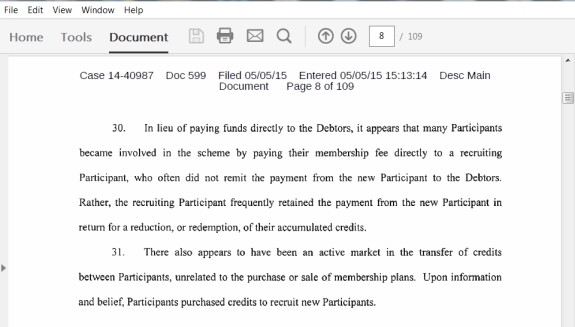
Such schemes raise the prospect of a black market and back-alley deals infecting the legitimate commerce stream. It has been a concern in the TelexFree, Zeek and ASD cases. The screen shot below is taken from Mesirow’s first interim application for payment for assisting Darr in his TelexFree probe.
Mesirow’s billings notes make several mentions of M&K, Darr’s legal counsel. One of them, dated Jan. 15, 2015, noted a discussion “regarding promoter to promoter payments.”
Billing notes by Mesirow say the firm analyzed “reports related to Colombian investigation” and that Mesirow is aware of a “Colombian creditor claiming $3MM.” In September 2014, the PP Blog reported that TelexFree President James Merrill claimed at a 2013 TelexFree event in California that Colombia “feared” network marketing.
The California TelexFree event may create a tie with Zeek, the Blog reported in April 2014.
In 2010, the U.S. government established ties between a Colombian MLM “program” known as D.M.G. Group to money-laundering in the United States to conceal narcotics profits.
As the PP Blog reported on Nov. 24, 2010 (italics added):
DMG’s membership ranks swelled to more than 400,000, with the scheme capturing hundreds of millions of dollars. The pyramid collapsed in 2008 — but not before [David] Murcia and others had set up an international money-laundering operation that routed narcotics proceeds through Mexico and concealed the criminality in real estate and other holdings in the United States, prosecutors said.
“The so-called ‘Bernie Madoff of Colombia’ now stands convicted of money-laundering in Manhattan federal court,” said U.S. Attorney Preet Bharara” [of the Southern District of New York].
TelexFree In Brazil
Mesirow’s billing notes also reference an ongoing investigation in Brazil into TelexFree activities through an affiliate known as Ympactus.
The shutdown by Brazilian authorities of Ympactus in the summer of 2013 “was the first of many indication that the Debtors were operating an unsustainable pyramid scheme,” Mesirow said.
It noted in the fee application that it has been in “regular contact” with U.S. government officials and “representatives of the Brazilian government.”
In its first billing, Mesirow said it has assisted Darr in recovering more than $17 million since the firm was formally appointed to assist the trustee on July 14, 2014. Mesirow is seeking about $1.6 million in fees for more than 2,962 hours of work, plus reimbursement of expenses of $20,942.
Read the Mesirow application and billing notes, which reference TelexFree figures such as Merrill, Carlos Wanzeler, Carlos Costa, accountant Joe Craft and MLM Attorney Gerald Nehra.
M&K, legal counsel to Darr, also has submitted a billing application with notes that reference Zeek Rewards. M&K, like Mesirow, joined with the trustee in July 2014. M&K is seeking more than $1.3 million, saying it has expended more than 2,784 hours. It also is seeking reimbursement of expenses of $36,116.
One M&K reference to Zeek mentions a “Review [of] Zeek Rewards settlement pleadings with net winners and insiders.” Another references a conference “regarding Zeek Rewards application to TelexFree case and practical implications.” Yet another references a “Review [of] Zeek Rewards docket re: how to treat inter-promoter activity.”
Still another note says this: “Research potential claims against Nehra.”
There are other Zeek references, plus references to other Ponzi cases.