Source: FBI graphic from Jan. 4, 2016, retrospective on the E-Bullion case from 2008.
Still pushing Ponzi-board schemes in the age of cross-border fraud and terrorism?
In a retrospective on the 2008 E-Bullion case, a retired FBI special agent says convicted murderer James Fayed was scamming HYIP scammers.
“He just pocketed the money from all these high-yield investment programs after they ran,” said Maura Kelley. “And the money continued to come in because the word didn’t get out right away that they weren’t paying. And people were still investing.”
In 2011, Fayed, then 48, was sentenced to death for the brutal contract slaying of Pamela Fayed, his wife and a potential witness against him. Indeed, the effective bagman for a host of Ponzi-board swindles ultimately turned to homicide in a bid to cover his tracks.
Pamela was stabbed 13 times and left to die outside a Los Angeles-area parking garage.
E-Bullion has been linked to multiple Ponzi schemes, including Legisi, Gold Quest International and FEDI. The FEDI scheme has been linked to Abdul Tawala Ibn Ali Alishtari, also known as Michael Mixon. Ali Alishtari pleaded guilty in 2009 to financing terrorism and fleecing investors in the FEDI scheme.
So, a man with murder in his heart also was supplying financial services to Ali Alishtari, an HYIP swindler who believed he was funding the purchase of night-vision goggles for a terrorist training camp in Afghanistan.
Upon the conviction of Alishtari, U.S. Attorney Peeet Bharaha of the Southern District of New York offered remarks. As the PP Blog noted, here is part of what Bharaha and the FBI said:
“Alishtari . . . admitted that he stole millions from investors and knowingly financed what he believed to be tools of terror. In enriching himself, Alishtari displayed a deliberate disregard for the financial and personal security of others.”
Investigators said Alishtari “facilitated the transfer of $152,000, with the understanding that the money would be used to fund training for terrorists.
“In the latter half of 2006,” according to investigators, “Alishtari agreed to discreetly transfer these funds for an undercover officer, believing that the money was going to be used to purchase night vision goggles and other equipment for a terrorist training camp in Afghanistan. During his guilty plea, Alishtari admitted that he sent the money from the United States knowing that the funds were to be used to help finance alleged terrorist activity in Pakistan and Afghanistan.”
From a Zhunrize slide as viewed through Open Office. Red highlight by PP Blog.
2ND UPDATE 5:25 P.M. EDT U.S.A. Purported “Plans B” are one of the core signatures of the the MLM HYIP sphere, which is known for incredibly toxic global frauds such as Zeek Rewards and AdSurfDaily. In 2009, an ASD reload scam known as AdViewGlobal was positioned as a “Plan B.”
The individual schemes of Zeek and ASD took in a combined sum of at least $969 million. AdViewGlobal appears to have disappeared with millions of dollars — after targeting ASD victims for a second time.
Laggos’ listeners were told that, if things went south at Zeek, Lyoness would be an excellent hedge through which $10,000 directed at the scheme might return “a quarter-million dollars.”
“Plan B” also is known as “Don’t put all your eggs in one basket.” HYIP prospects often are told to join more than one scheme or to quickly get in another if something goes wrong with the current scheme, sometimes known as “Plan A.”
Plan B schemes typically are a means by which prospects are lured into a continuous cycle of MLM frauds. Zeek and OneX promoter T. LeMont Silver later went on to “Plan B” schemes such as GoFunPlaces/GoFunRewards and JubiMax/JubiRev. Those schemes cratered or encountered difficulties. Silver now is pushing the exceptionally murky BitClub Network “opportunity” as a Plan B.
MLM HYIP schemes may switch forms. They may appear as straight-line investment-fraud schemes such as Legisi, which collapsed after an SEC intervention in 2008. ASD was an “autosurf advertising” scheme that collapsed in 2008 after an intervention by the U.S. Secret Service. Zeek, a purported “penny auction” company, collapsed in 2012 after an SEC intervention.
The trend now appears to be to wrap traditional products such as cosmetics and diet shakes into murky and confusing schemes that pay recruitment commissions. No specific payout may be mentioned.
The phrase “Plan B” even appears in promo material for Zhunrize. The material also references Plan A. Based on this information, it appears as though Zhunrize was touting itself as both a “Plan A” and “Plan B” scheme.
“Do you know anyone who would like to develop a plan ‘A’ Or plan ‘B’?” the Zhunrize promo queries.
In the promo, Zhunrize prospects are told they can earn “thousands each month by helping others to save time, gas, money and avoiding crowds.”
One of the problems in this bizarre sphere of MLM is that tainted money from earlier scams may flow into emerging scams, in effect making banks and payment vendors warehouses for a continuous stream of fraud proceeds that flow between and among pyramid schemes and Ponzi schemes.
Like Lyoness, Zhunrize is involved in the shopping-portal business. Like Zeek and other “programs,” Zhunrize also was positioned as a “profit-sharing” or “revenue-sharing” opportunity.
Case files associated with various recent HYIP/revenue-sharing schemes put losses in the billions of dollars. Because some promoters simply move from one scam to another, they are eviscerating wealth on a global scale.
If someone pitches you on an MLM “Plan B,” run like the wind.
Faith Sloan in a TelexFree promo. Source: YouTube.
UPDATED 8:55 P.M. EDT U.S.A. Veteran HYIP huckster Faith Sloan told a federal judge presiding over the SEC’s TelexFree case that she is a victim of the company and was duped by TelexFree executives James Merrill, Carlos Wanzeler and Steve Labriola.
And, the former Noobing, Zeek Rewards and Profitable Sunrise pitchwoman asserted, she also was duped by MLM attorney Gerald Nehra, a lawyer for TelexFree.
Sloan was among four TelexFree promoters charged with fraud by the SEC. Four executives also were charged.
“Sloan believed what Defendants Carlos Wanzeler, James Merrill, Steve Labriola and their attorney, Gerald Nehra, had told her, until TelexFree continued to miss the deadlines for the launch of its new products, which were to be the foundation of TelexFree’s growing business going forward into 2014,” Sloan said in court filings through her attorney.
Those new products, Sloan said, included “MyFinancialAdvantagePlan,” “Mobile App,” “TelexCommerce” and “TelexMobile.”
Taking a swipe at Nehra, Sloan contended that she and fellow promoters were “excited” about TelexFree after Nehra “had stood on the stage and publicly announced that TelexFree was ‘on a solid legal ground’, because they were selling a real product.”
Nehra made the remark at a TelexFree rah-rah fest in Newport Beach, Calif., in July 2013, according to YouTube videos. The remarks followed a June 2013 action in Brazil in which certain TelexFree assets were frozen and new registrations were suspended, amid pyramid-scheme allegations.
Sloan did not say why she continued to promote TelexFree with serious pyramid allegations on the table, except to suggest that Nehra’s remarks paved the way for her to continue with TelexFree. Nor did Sloan say whether her experience promoting Noobing, Zeek and Profitable Sunrise provided her any clues that something could be amiss at TelexFree.
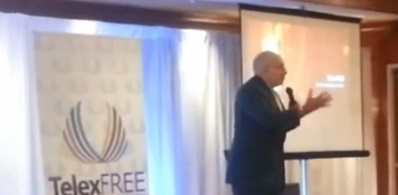
MLM attorney Gerald Nehra offering remarks about TelexFree; Source: YouTube.
Sloan was not charged in the Noobing, Zeek and Profitable Sunrise cases. Regulators say Noobing, an HYIP that targeted people with hearing impairments, was attached to a government-grants swindle. It effectively was shut down by the FTC.
Zeek, meanwhile, was an $850 million pyramid- and Ponzi scheme, and Profitable Sunrise was a cross-border securities swindle effectively run by a ghost that potentially raked in tens of millions of dollars. Both “programs” collapsed after SEC actions.
In April 2014, the SEC described TelexFree as an epic, billion-dollar cross-border pyramid and Ponzi-swindle that engaged in securities fraud and the sale of unregistered securities. All four of the “programs” offered returns that bested Bernard Madoff on orders of between 20 and 70 to one on an annualized basis.
Regulators have been warning about HYIP schemes for years, saying they offer returns that are too good to be true and make cosmetic tweaks to dupe the masses.
Many such schemes proliferate because serial promoters turn blind eyes to obvious markers of fraud such as preposterous interest rates, a presence of a “program” on Ponzi-scheme forums, the presence of other serial fraud promoters and fractured relationships with payment vendors during the course of the fraud. The schemes pay commissions to unlicensed promoters to sell securities to recruits and typically have an illegal investment arm attached.
When a scheme collapses, serial promoters disingenuously point fingers of blame back at management. Though the blame is deserved, it ignores the promoters’ roles in driving dollars to scams.
Sloan also today accused Merrill and Labriola of threatening to boot her from the “program” after she made unflattering remarks about it — after she’d been in the “program” for a year or so and suddenly realized something was wrong at TelexFree.
“In response to her public complaints, Labriola, with the approval of the Defendant, Merrill, threatened to terminate Sloan’s relationship with TelexFree shortly before they filed for bankruptcy protection on April 13, 2014,” Sloan contended in a “verified” memorandum of law filed by her attorney. The document seeks to have the charges against Sloan dismissed.
From Sloan’s motion (italics added):
Sloan became a “promoter” of TelexFree early in 2013. Sloan attended public webinars (web-based seminars) along with thousands of other TelexFree “promoters”. During those webinars, Sloan was told by TelexFree leaders that they were growing a company based on remarkable new products such as the “MyFinancialAdvantagePlan” (MFA), “Mobile App” “TelexCommerce” and “TelexMobile”, which was built on the backbone of Sprint, Verizon, and T-Mobile. All these products were due to be launched during the last quarter of 2013. The Mobile App was touted as being on a par with “WhatsApp”, which had been purchased by Facebook for 19 billion dollars. Based on what she was told by her fellow Defendants, Sloan and her fellow “promoters” were excited about the future of TelexFree, especially after the companies’ lawyer, Gerald Nehra, had stood on the stage and publicly announced that TelexFree was “on a solid legal ground”, because they were selling a real product.
Sloan’s troubles aren’t limited to the SEC case. She’s also a defendant in at least three prospective class-action lawsuits that allege fraud and racketeering.
Nehra is accused in the class-action complaints of turning a blind eye to TelexFree’s fraud to line his own pockets and dupe the masses.
In the Legisi HYIP Ponzi case, HYIP figure Matthew John Gagnon tried a defense similar to Sloan’s defense in the SEC civil case. It didn’t work.
Gagnon was held civilly liable and eventually was charged criminally for making a secret deal with Legisi to promote its scam, which had payouts similar to TelexFree, Noobing, Zeek and Profitable Sunrise. He was sentenced to five years in federal prison.
Like the criminal side of the TelexFree case, the Legisi case was brought after an undercover investigation.
MLM attorney Gerald Nehra at a TelexFree rah-rah event in California last year. Source: YouTube.
In case you missed the big news yesterday, TelexFree figures James Merrill and Carlos Wanzeler were charged criminally.
Unofficially this brings the number of charged MLM HYIP “programs” (or clients) with links to MLM attorney Gerald Nehra to three in recent years. Nehra was an “expert witness” for AdSurfDaily in 2008. He testified that ASD, a 1-percent-a-day “program,” was a legitimate business and not a Ponzi scheme.
ASD operator Andy Bowdoin, who compared the men and women who guard the President of the United States to “Satan” and the 9/11 terrorists and clucked that “God” * was on his side, later was charged criminally and sentenced to a lengthy term in federal prison.
Nehra was brought in for marquee value and as an adviser to Zeek Rewards, Zeek operator Paul Burks said in late 2011 or early 2012. Zeek executives Dawn Wright-Olivares and Daniel Olivares later were charged criminally. Zeek was a 1.5-percent-a-day “program.”
At some point in 2012 or 2013, Nehra began to advise TelexFree. TelexFree executive Steve Labriola, like Zeek’s Burks before him, also saw marquee value in Nehra, according to Labriola’s comments in a TelexFree promo on YouTube. Now, Merrill and Wanzeler face the prospect of jail. Because the investigation is ongoing, others may, too.
TelexFree’s bogus returns were not tied to sales of its VOIP product and computed to more than 200 percent a year, making the “program” a classic Ponzi- and pyramid swindle, according to court filings. Some promoters claimed $15,125 returned $57,200. One promoter allegedly told an undercover federal agent that he’d scored $1.6 million in TelexFree “without selling a TelexFree product.”
This is a column about willful blindness and feigned obtuseness. (Think Faith Sloan.) It’s also a column about missed signals, whether they’re missed purposely or otherwise. (Think: Why would TelexFree hire Nehra after ASD and Zeek — and why would Nehra ever accept the work, which was bound to lead to racketeering allegations? Put another way, if you’re at the scene of too many highly suspicious fires, you shouldn’t be surprised if serious people start to believe you’re the arsonist or the arsonist’s helper. Even assuming Nehra is no MLM arsonist or racketeer, accepting the TelexFree work potentially put him in the position of being extorted or otherwise abused by the trade’s arsonists and racketeers.)
Spot any common themes or information roadmaps in the quoted material below?
AdSurfDaily “is not” a Ponzi scheme. “It is a legally structured, direct selling business model with multilevel compensation.” — Gerald Nehra, MLM attorney, Aug. 18, 2008. (Context: Nehra’s submitted testimony as defense witness in civil forfeiture action in the $119 million AdSurfDaily MLM HYIP Ponzi case. **)
“[AdViewGlobal] is the next iteration of the Ponzi scheme auto-surf programs, which [are] staffed with former [AdSurfDaily] executives and Bowdoin disciples.” — Class-action attorneys suing AdSurfDaily operator Andy Bowdoin and AdSurfDaily attorney Robert Garner of North Carolina, June 30, 2009. (Context: Motion in member-filed lawsuit against Bowdoin and Garner that alleged RICO (racketeering) violations.)
“With all of our efforts to punish and deter this criminal enterprise, the rights of innocent parties are protected and will subsequently be returned.” — A.T. Smith, assistant director, U.S. Secret Service Office of Investigations, Sept. 26, 2011. (Context: Successful forfeiture actions and remission (restitution) in AdSurfDaily MLM HYIP Ponzi case.)
“We will continue to use every tool at our disposal to bring justice to the citizens defrauded by these insidious schemes.” — Assistant Attorney General Lanny A. Breuer, U.S. Department of Justice, Criminal Division, Sept. 26, 2011. (Context: Successful forfeiture actions and remission (restitution) in AdSurfDaily MLM HYIP Ponzi case.)
“Just having him on retainer and having him on our team, it goes a long way from keeping anybody from launching an attack. Because generally when Gerry Nehra is involved, the Feds know that he’s cleaned up the act really well.” — Paul Burks, Zeek Rewards operator, c. December 2011. (Context: Burks’ remarks to early Zeek members that MLM attorney Nehra was on board.)
“I am pleading guilty because I am in fact guilty of the offense(s) identified in this Plea Agreement.” — Andy Bowdoin, AdSurfDaily operator, May 2012. (Context: Plea agreement to wire fraud in which Bowdoin disagreed with MLM attorney Nehra and acknowledged AdSurfDaily was a Ponzi scheme.)
“Capitalizing on the strength of our financial task force partnerships, we aggressively pursue criminals using computer experts, forensic specialists, investigative experts and intelligence analysts.” — Dennis Ramos Martinez, special agent in charge, U.S. Secret Service Orlando Office, Aug. 29, 2012. (Context: Prison sentence imposed on AdSurfDaily operator Andy Bowdoin.)
“While [Gregory] McKnight himself referred to Legisi as a “loan” program, and demanded that “members” not refer to their “loan” and an “investment,” Legisi was, in reality, an investment contract, which is considered a security and therefore regulated by the Securities and Exchange Commission. This semantic obfuscation was quite obviously an attempt to sidestep the securities laws.” — Office of U.S. Attorney Barbara L. McQuade, Eastern District of Michigan, September 2012. (Context: Sentencing memo against Gregory McKnight in Legisi $72 million HYIP swindle.)
“I’m not sure how many of you have heard the name ‘Gerry Nehra.’ But it is a very big name in this industry.” — Steve Labriola, TelexFree executive, Newport Beach, Calif., July 2013. (Context: Labriola introducing Nehra to TelexFree members at “Super Weekend” MLM rah-rah fest.)
“ZeekRewards used the enormous power of the Internet to rip off $850 million from hundreds of thousands of victims in less than two years. We will continue to work with our law enforcement partners to take down greedy scam artists who think nothing of stealing the savings of hard working people.” — U.S. Attorney Anne M. Tompkins, Western District of North Carolina, Dec. 20, 2013. (Context: The filing of criminal charges in the Zeek Rewards MLM/HYIP case.)
“The Massachusetts Securities Division charged TelexFREE Inc., with running a Ponzi scheme targeting Brazilian-Americans that has raised over $90 million from Massachusetts residents and around $1 billion globally.” — U.S. Department of Homeland Security,April 17, 2014. (Context: U.S. financial infrastructure protection. Sourced from DHS Daily Open Source Infrastructure Report.)
“At this [TelexFree] ‘super weekend’ event, Attorney Nehra spoke at length to attending investors, assuring them of the legality of TelexFree’s operation stating: ‘It is legally designed . . . you are on very solid legal ground.’” — Class-action attorneys, May 3, 2014. (Context: The filing of a prospective class-action against TelexFree and Nehra that alleged RICO (racketeering) violations.)
“Attorney Nehra’s extensive experience in multi-level marketing, and particularly his involvement with the Ponzi schemes involving AdSurfDaily and Zeek Rewards, armed him with the knowledge of what constitutes violations of United States securities law. Indeed, Attorney Nehra was well aware that the use of semantics and obscured phraseology to obfuscate securities laws fails to legitimize TelexFree’s illegal Pyramid Ponzi Scheme.” — Class-action attorneys, May 3, 2014. (Context: The filing of a prospective class-action against TelexFree and Nehra that alleged RICO (racketeering) violations.)
“Investigating the flow of illicit money across U.S. borders and the criminal enterprises behind that money is one of our top priorities.” — Bruce Foucart, special agent in charge, Homeland Security Investigations, May 9, 2014. (Context: Comment on the filing of criminal charges in the TelexFree Ponzi- and pyramid case.)
“As alleged, these defendants devised a scheme which reaped hundreds of millions of dollars from hard working people around the globe.” — U.S. Attorney Carmen Ortiz, District of Massachusetts,May 9, 2014. (Context: Comment on the filing of criminal charges in the TelexFree Ponzi- and pyramid case.)
* Like jailed AdSurfDaily operator Andy Bowdoin, TelexFree figure Carlos Costa contends God is on his side. While Bowdoin talked of “Satan,” one TelexFree promoter has called a prosecutor in Brazil a “blonde she-devil.”
** Two members of AdSurfDaily who went on to become members of Zeek Rewards liked Nehra’s opinion so much they used it in a failed lawsuit (2011) against the U.S. government. The members, Todd Disner and Dwight Owen Schweitzer, both are listed as “winners” in the $850 million Zeek Rewards’ scheme. Disner’s Zeek haul was alleged to be more than $1.875 million.
(3nd Update 9:16 A.M. EDT, May 11, 2014 U.S.A.) When contacted by the U.S. Securities and Exchange Commission April 17 by phone, alleged TelexFree promoter and securities swindler Faith Sloan shot back, “Why are you picking on me? There are bigger promoters than me.”
The assertion is contained in new SEC filings dated yesterday in the agency’s Ponzi- and pyramid case against TelexFree, which filed for bankruptcy protection April 13 and was sued by state and federal regulators on April 15.
Sloan, whom the SEC says is 51 and lives in Chicago, is a former promoter of the Zeek Rewards “program” (1.5 percent a day, not including “compounding”), and Profitable Sunrise (up to 2.7 percent a day, not including “compounding”). She also promoted the collapsed Noobing HYIP scheme that became popular after the collapse of the AdSurfDaily HYIP Ponzi scheme (1 percent a day) in 2008.
In 2012, the SEC shut down Zeek, alleging a combined Ponzi- and pyramid scheme that had collected hundreds of millions of dollars and potentially had affected hundreds of thousands of people. In 2013, the SEC filed charges against Profitable Sunrise, effectively alleging it was being operated by a ghost from a “mail drop” in England and had used a pyramid scheme to defraud thousands of people potentially out of tens of millions of dollars. Money allegedly was diverted on a cross-continental basis, with investors left holding the bag.
The Federal Trade Commission (FTC) effectively shut down Noobing in 2009, after alleging a related firm under an umbrella company had orchestrated a government-grants swindle. Noobing in part was targeted at people with hearing impairments. The enterprise was based in Kansas, and had an offshoot in Nevis. [May 11, 2014, edit.]
Like TelexFree and other schemes, Noobing had a strong presence on YouTube. The SEC says in court filings that it has watched lots of TelexFree promos on YouTube.
Any number of HYIP fraud-scheme promoters wrongly have believed that no individual liability can attach as a result of their participation in such schemes. The TelexFree case — like the Legisi HYIP case before it — demonstrates the falsity of the belief. Legisi promoter Matthew John Gagnon first was sued by the SEC. He later was charged criminally by the U.S. Secret Service and federal prosecutors in Michigan.
Like the AdSurfDaily HYIP Ponzi case, the Legisi case was initiated in 2008 and began with an undercover probe in which government agents interacted with participants and kept notes of the contacts. Gagnon, who had a secret deal with Legisi’s operator to promote the scheme, was sentenced to five years in federal prison. Legisi operator Gregory McKnight was sentenced to 15 years.
It is known that there is a parallel criminal investigation into the activities of TelexFree. The mechanics of that probe and whether it dovetailed with state and federal civil investigations into TelexFree are unclear.
What is clear is that Sloan was not pleased when an SEC investigator informed her by phone on April 17 that she’d been charged with fraud, according to court filings by the SEC.
Sloan first wanted to know if the investigator was state [Massachusetts Securities Division] or federal [SEC]. When the investigator informed Sloan he was with the SEC, she responded that the agency was “picking on” her and implied it should go after bigger fish.
Eight TelexFree managers or promoters (including Sloan) have been sued, according to SEC filings.
“Sloan then asked where she could find the complaint,” the SEC investigator asserted in an affidavit. “I walked her through the SEC website and to the location of the press release and the complaint.”
Sloan then said, “I need to speak to my lawyers,” according to the affidavit.
The SEC investigator then asked Sloan if she had counsel. “Sloan did not respond” to the question, according to the affidavit.
Whether TelexFree will provide Sloan a lawyer is unclear. Any number of accused fraud promoters over the years have been left in the lurch by “management” or “corporate” when “programs” have been sued.
The SEC investigator asked Sloan for her home and email addresses, according to the affidavit. Sloan refused to provide them.
“You just sued me,” she responded, according to the affidavit. “You must know everything about me so you can figure it out.”
It remained unclear this morning whether Sloan had hired counsel or responded to the complaint, which charged her with securities fraud and selling unregistered securities.
But in the HYIP sphere, the small fish are what create the bigger fish — and “small” appears no longer to provide much cover in HYIP-related prosecutions and lawsuits.
Kenneth D. Bell, the court-appointed receiver in the Zeek case, has filed lawsuits against thousands of Zeek winners. The lawsuits are in the form of a class-action, with the threshold for being sued set at only $1,000, according to court filings.
The purported TataAgro entity had a presence on the Ponzi boards and appears to have used trading screens to dupe the worldwide investing public. Image source: Google cache.
BULLETIN: (3rd Update 8:32 a.m. ET, Feb. 20 U.S.A.) The Tata Group, a global conglomerate based in India, says its name has been stolen by an HYIP Ponzi scheme. The fraud scheme is associated with a domain styled TataAgro.com and has a presence on the MoneyMakerGroup, TalkGold and DreamTeamMoney Ponzi forums, according to search results.
Like the recently exposed WCM777 fraud scheme, the TataAgro scam claims a business presence in the British Virgin Islands. WCM777 also traded on the names of famous companies, including Siemens, the German conglomerate. Siemens issued statements warning the public about WCM777. Tata now has done the same thing with the purported TataAgro entity.
The TataAgro website “claims that ‘Tata Agro Holding is a subsidiary of the globally known Tata group, [and is] one of the top 10 agro investment players in Asia’s financial market,’” the real Tata says. “It goes on to offer a wide range of investment plans with a monthly profitability of up to 100%.
“Members of the public are hereby cautioned that the information provided on the website is absolutely false, misleading and intended to defraud innocent and unwary members of the public,” the real Tata says. “Neither Tata Sons nor any other Tata company has any connection whatsoever with the aforesaid Tata Agro Holding. Tata Sons is initiating appropriate action in the matter.”
PonziTracker.com was among the first outlets to report the news of the Tata warning.
The TataAgro site appears not to be loading.
It is somewhat common for fraud schemes to try to steal the identities of major figures on the world financial stage. CONSOB, the Italian securities regulator, regularly publishes information on purported “opportunities” that adopt the names of legitimate firms to create confusion and fleece the masses.
A post dated Dec. 3, 2013, at the MoneyMakerGroup Ponzi forum claims the purported TataAgro entity pays “1.9-3.1% daily for 15-90 days” and accepts Perfect Money, BitCoin, EgoPay and Qiwi.
Meanwhile, a post dated Dec. 17 at the DreamTeamMoney Ponzi forum makes this claim (italics added):
Tata Agro is an agricultural investment company founded in 2012 in British Virgin Islands. We are a subsidiary of transcontinental conglomerate Tata Group that has been established in India back in 1868 and now boasts the combined market capitalization of $96 bln.
We have retained only the best things from a rich and long experience of our ancestor: the unique corporate culture, client-oriented and customized approach, and understanding of the market through retrospective analysis. Our fundamental aim is to help you grow your capital.
We work with assets like barley, soya, soya oil and meat, corn, wheat, and livestock and currently operate in CME Group, TOCOM, and MGEX exchange houses.
We are eager to offer you four investment plans with the daily ROI of 1.9% to 3.1% and investment term of 15 to 120 days. You can invest from 5 to 10,000 USD. Apart from that, we offer you a profitable referral program that lets you earn more and work side by side with your family and friends.
A post dated Dec. 17 at the TalkGold Ponzi forum makes these claims (italics added):
Invest 5 to 100$ for 15 days and earn 1.9% ROI daily;
Invest 100 to 1000$ for 30 days and earn 2.3% ROI daily;
Invest 1000 to 5000$ for 60 days and earn 2.5% ROI daily;
Invest 5000 to 10,000$ for 120 days and earn 3.1% ROI daily.
Collapsed fraud schemes such as Zeek Rewards, AdSurfDaily, Legisi, Pathway to Prosperity, Profitable Sunrise, Imperia Invest IBC and many more also had a presence on the Ponzi boards.
The TelexFree “program” currently has a presence on the Ponzi boards.
UPDATED 7:36 P.M. ET (U.S.A.) Let’s say you’re out there feverishly flogging the TelexFree MLM even as the pyramid-scheme probe moves forward in Brazil, a judge and prosecutor have been threatened with death and TelexFree executive Carlos Costa is pulling an Andy Bowdoin and telling the world that God used him to bring the purported opportunity to the flock.
There’s always risk associated with HYIP schemes. Now, however, it seems those risks are becoming even greater.
Here is a key fact: The sender used an IP based in France that has been associated by Project Honeypot with comment-spamming — pitches for porn sites and sites that purport to give you a good price on designer goods in advance of a predicted “downturn,” for example. (Basic message: You can look wealthy even if you’re not, even after the economy tanks. Buy your knockoffs now and look good when the sky is falling on your life.)
The sender, now adding HYIP schemes to the porn and designer-good mix from that specific IP, used a handle that incorporated the word “Silver” within its overall handle and sought to plant a URL at the PP Blog to a Panamanian venture that advertises a custody service for precious metals. The PP Blog is declining to publish the URL and the name of the enterprise which, among other things, reproduces on its website the logos of an internationally famous insurer based in London and an internationally famous accounting firm based in Chicago. The site also publishes various contact phone numbers in the United States, Panama, New Zealand, Australia, Switzerland, the United Kingdom and Hong Kong. Although there is a chance that the service is legitimate, the PP Blog questions why someone or some thing is spamming links to the precious-metals site and loading them up further with links to “positive” coverage of seemingly unrelated HYIPs.
For the purposes of this PP Blog post, the Panamanian venture is a sidebar tidbit. Far more interesting was the body content of the spam, which appears to be a compendium of gushing affiliate pitches for TelexFree that appear on the net. The spam appears to have been cobbled together by a human scraper or scraping device of some sort that had visited one or more TelexFree-related websites. Links embedded in the spam are the “real story” in the context of this PP Blog post.
So, for starters, TelexFree’s name is being used as part of a bid to drive traffic to a precious-metals website on which visitors curiously are told they must provide 15 days’ notice if they wish to visit the office in Panama City. The PP Blog likely was targeted by the spammer simply because the word “TelexFree” appears here many times in reports about TelexFree-related events in Brazil and the United States.
The spammer — be it bot or human — appears to have made the calculation that TelexFree members might be the perfect customers for the precious-metals venture. Contained within the spam were three links: One to a site styled TelexFreeUnitedStates and two to a URL-shortening service that redirected visitors to Photobucket, the popular image-hosting and story-sharing website.
Here’s where the story really begins . . .
One of the picture stories told at at the Photobucket site was told inside a subfolder of a folder labeled “aaronsharazeek.” (Emphasis added.) The subfolder was slugged “First Zeek Red Carpet Event April 18th 2012.” Zeek conducted a Red Carpet event on that date.
The SEC moved against Zeek on Aug. 17, 2012. On the same date, the Secret Service said it also was investigating Zeek. Court records suggest the SEC began the Zeek probe at least by April 17, 2012, one day before the April 18 Zeek Red Carpet event highlighted within the “aaronsharazeek” folder on Photobucket.
On April 17, 2012, according to court filings, the SEC tasked an IT specialist to “conduct Website/video capture” of ZeekRewards.com.
Paul Burks appears to have been in deep thought on April 18, 2012, one day after the SEC tasked an IT specialist to capture content from Zeek Rewards.com. This is a slice of a photo from a larger photo that appears on Photobucket in a folder labeled “First Zeek Red Carpet Event April 18 2012.”
Precisely when Zeek operator Paul R. Burks found out about the SEC probe remains unclear. But photos inside the “First Zeek Red Carpet Event April 18th 2012” subfolder at the Photobucket site show a Burks who appears to be in deep thought. One can only wonder what 66-year-old Burks was thinking about on that date. His health? His wife’s stress level, given the noise Zeek was creating in the small town of Lexington, N.C.? His ability to keep Zeek going? The prospect that investigators were closing in?
There are 18 other photos in the Red Carpet event subfolder, some showing Zeek luminaries such as former SEC defendant Keith Laggos, former Zeek COO Dawn Wright-Olivares, former Zeek videographer OH Brown (looking happy), former Zeek trainer Peter Mingils (identified in one photo as the “V.P. of the Association of Network Marketing Professionals”). Other photos of Zeek personalities/staffers appear in the folder, as do photos showing attendees.
Absent the “Silver”/TelexFree spammer, the PP Blog likely never would have seen these photos.
Also within the “aaronsharazeek” folder at Photobucket is a subfolder slugged “Zeek Trip,” and subfolders slugged “Banners Broker” and “telexfree.” The “Zeek Trip” folder appears to contain four photos of Zeek-related real estate in Lexington, N.C. (In the ASD Ponzi case, affiliates suggested that ASD couldn’t possibly be illegitimate because ASD had an office. The same thing has been asserted by TelexFree promoters.)
Meanwhile, the “Banners Brokers” folder contains a video of a sales pitch, and the “telexfree” folder contains images of government documents from the state of Massachusetts and the country of Brazil that appear to have been designed to plant the seed that TelexFree couldn’t possibly be a scam.
Taken as a whole, the various folders and photos demonstrate the interconnectivity of MLM HYIP schemes, regardless of who actually controls the Photobucket site. It is known from other sources that some Zeekers also were in the JSSTripler/JustBeenPaid scam and the exceptionally murky Profitable Sunrise scam shut down by the SEC and various state regulators earlier this year.
Banners Broker is an uber-bizarre Ponzi-board program. On July 2, 2013, the PP Blog reported that MLM attorney Kevin Thompson said that the name of his law firm had been used by scammers in a bid to dupe members of Banners Broker and Profit Clicking, the JSS/JBP-associated “program” linked to Frederick Mann that may have ties to the extremist “sovereign citizens” movement. The July 2 PP Blog post was titled, “Law Firm’s Name Used In Bid To Dupe Members Of Banners Broker, Profit Clicking, MLM Attorney Says.”
Within the July 2 post, the PP Blog reported that it had received menacing messages in apparent “defense” of Banners Broker. As the Blog reported at the time (italics added):
WARNING: The next paragraph includes quoted material from one of the Jan. 18, 2013, spams, and the PP Blog is reproducing it to illustrate the bizarre and often menacing nature of the HYIP sphere. Indeed, the apparent Banner’s Broker supporter wrote (italics added):
” . . . I am Big Bob’s cock meat sandwich. Your mom ate me and made me do press ups until I threw up . . . I am gonna report you. When you make false accusations, you can get done. Maybe you will be seen in court soon . . .”
It is as ugly today as it was on the January date the PP Blog received the communication.
Why “programs” such as TelexFree, Zeek Rewards, BannersBroker and ProfitClicking become popular with people of faith is one of the head-scratching mysteries of current times. Gold fever, of course, is nothing new; it’s been around for centuries. What’s at least relatively new in the Internet Age is that the gold- and silver-sellers appear to be piggybacking off HYIP pitchmen, apparently hoping to rope in customers for shiny-object schemes.
This “comment” sent to the PP Blog on Nov. 22 sought to drive traffic to a precious-metals site by planting a link to the site and also planting links related to TelexFree.
On Oct. 25, the PP Blog reported that an alleged shiny-object scheme had taken root in Zeek’s back yard in North Carolina. On June 19, the PP Blog reported that the receiver in the Legisi HYIP Ponzi case was going after assets linked to E-Bullion, a collapsed payment processor with shiny-object woo. James Fayed, E-Bullion’s operator, is sitting on death row in California after a jury found him guilty of arranging the brutal contract slaying of his own wife.
The Legisi scheme was targeted at Christians, and E-Bullion’s cheerleaders included the Canadian clergyman Brian David Anderson, who was sent to U.S. federal prison in 2010 for the Frontier Assets Ponzi scheme. Anderson also was linked to the Flat Electronic Data Interchange (FEDI) HYIP scheme that put Abdul Tawala Ibn Ali Alishtari, also known as “Michael Mixon,” in federal prison after his September 2009 convictions for financing terrorism and fleecing FEDI investors.
Yes, financing terrorism.
Alishtari traded on his purported ties to prominent politicians, just like ASD’s Andy Bowdoin. At least one of the schemes linked to Alishtari and Anderson used the term “rebates,” just like ASD. The narrative surrounding FEDI read like impossibly outrageous fiction, a mind-bending example of a shiny-object scheme. Ten members of purported “Royal families” in the Middle East were said to have set aside “50 Billion in Gold” ($5 billion each) to advance the scheme. Another entity in the Middle East was said to have supplied a “total of 100 Billion in Gold.” Still another entity was said to have put up “500 Million dollars in liquid gold assets.”
FEDI marks were solicited to purchase what effectively were trading desks that somehow would enable them to profit on the coattails of Middle East royals interested in escrowing huge sums to fund worldwide construction projects, with money purportedly flowing to the “labor” force. If that weren’t enough, the scheme purportedly was married to a venture that purportedly would put vending machines in at least 50,000 locations. The vending machines purportedly would sell debit cards, and were purportedly backed by $150 billion in gold and an insurance policy in Canada.
In March 2012, the PP Blog reported on FTC allegations that three Florida companies and a Florida man had roped customers into a shiny-object scam, a precious-metals boondoogle allegedly carried out by telemarketers.
Imagine what would happen if a scamming telemarketing firm had the customer lists for TelexFree, Zeek, Banners Broker, Profit Clicking, AdSurfDaily, Legisi and others.
If the MLM industry seeks to win favor on Main Street and stop being the brunt of jokes, it needs to act forcefully to eradicate these schemes. MLM attorneys need to stop permitting schemes to trade on their names, thus potentially setting the stage for prospects to believe that no scam could be occurring because no lawyer would permit his name to be used in this fashion.
But even today, what does one get when one visits the website of TelexFree? A pitch in which the alleged TelexFree pyramid scheme announces its pride at having MLM lawyer Gerald Nehra on board.
Zeek traded on the name of MLM attorney Kevin Grimes, who comes off in Red Carpet Day shots as a Zeek crowd prop, and also the name of Nehra. Bidify traded on Kevin Thompson’s name. The lawyers should not permit this to happen. And they should stop making personal appearances at “opportunity” events and start questioning why so many of these “programs” are targeted at people of faith and promise or suggest the likelihood of absurd returns.
Profitable Sunrise — perhaps recognizing that an MLM scheme can be made to appear legitimate if affiliates simply are provided the name of a purported lawyer — appears to have conjured up an attorney’s name out of thin air. It then allegedly proceeded to run off with millions and millions of dollars. When ASD’s Bowdoin switched from the two scams that eventually put him in prison (ASD and AdViewGlobal) and began pitching the alleged OneX pyramid scheme, one of the first things he did was assure the former ASD members he was pitching in a webinar that OneX had an “attorney,” adding that the venture was a great fit for college students. Bowdoin, mixing in God talk during the October 2011 webinar, never identified the purported lawyer by name. Neither did a former ASD pitchwoman pitching the OneX scheme alongside Bowdoin.
In the absence of self-imposed, self-regulatory restraints in the MLM industry — lawyers restraining themselves from becoming accidental or purposeful stage props and sanitizers of “programs,” for example — MLM prospects may be well-advised to view any MLM “program” with the highest degree of skepticism, regardless of the programs’ wares.
Every single one of the “programs” referenced in this story has ridden on the coattails of a deity and lawyers. It did not matter whether the lawyers were real or imagined.
And it did not matter that the Gods of many faiths were observing it all, perhaps mournfully wondering how the precious Children of the Earth had come to view MLM money as the maximum deity.
EDITOR’S NOTE: KrebsOnSecurity is written by Brian Krebs, who worked as a reporter for the Washington Post from 1995 to 2009. Our thanks to a PP Blog reader who brought our attention to information highlighted in the story below. Although the PP Blog is focusing on the TalkGold angle, the KrebsOnSecurity report covers much more, including how a U.S. credit-reporting agency potentially was doing business with a credit-card scammer and forum huckster hiding behind a proxy and wiring money from Singapore. It is highly recommended reading. Two links to the report appear in the story below.
An individual who used the handle “hieupc” on the “scammer-friendly” TalkGold forum may have peddled stolen Social Security numbers at the forum and appears also to have been in the business of defacing websites and “even attacking the Web site of his former university in New Zealand after the school kicked him out for alleged credit card fraud,” KrebsOnSecurity reports.
Hieu Minh Ngo, 24, a Vietnamese national, now is jailed in the United States. He was charged in a sealed, 15-count indictment in November 2012 with conspiracy to commit wire fraud, substantive wire fraud, conspiracy to commit identity fraud, substantive identity fraud, aggravated identity theft, conspiracy to commit access device fraud, and substantive access device fraud, the U.S. Department of Justice said on Oct. 18.
It may be a case of an offshore fraudster who erroneously believed that U.S. agents and prosecutors couldn’t touch him and grew increasingly confident that oceans and land masses that separated him from the United States would insulate him from arrest. In its remarkable story, however, KrebsOnSecurity is reporting that U.S. federal agents “set up a phony business deal to lure Ngo out of Vietnam and into Guam, an unincorporated territory of the United States in the western Pacific Ocean.”
Citing the indictment, the Justice Department said, “[F]om 2007 through 2012, Ngo and other members of the conspiracy acquired, offered for sale, sold, and/or transferred to others packages of [Personally Identifiable Information] for more than 500,000 individuals.” (Bolding added by PP Blog.)
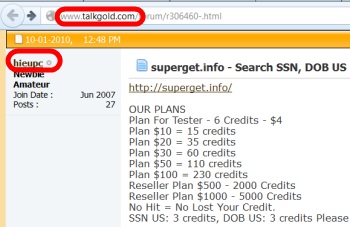
The User ID of “hieupc” appears to have been formed at TalkGold in June 2007. (See screen shot above.) In October 2010, a TalkGold post attributed to “hieupc” offered for sale the Social Security numbers and dates of birth (at least) of Americans.
If “hieupc” is Ngo, it could mean he was trawling TalkGold as a teen-ager and seeking to recruit HYIP scammers as customers for his identity-theft ring. Such an approach conceivably could enable fellow criminals to join HYIP scams under assumed names while providing them a means of accessing U.S. bank accounts, potentially setting the stage for them to steal money from the accounts and even pass tax liabilities for HYIP program “earnings” to unknowing victims. TalkGold is populated by serial HYIP fraudsters and willfully blind promoters of online fraud schemes. Over the years, such schemes have led to DDoS attacks on the sites of fraud schemes (and sites that report on them) and repeated claims of account hackings.
Here is part of the “hieupc” TalkGold pitch (italics added):
OUR PLANS
Plan For Tester – 6 Credits – $4
Plan $10 = 15 credits
Plan $20 = 35 credits
Plan $30 = 60 credits
Plan $50 = 110 credits
Plan $100 = 230 credits
Reseller Plan $500 – 2000 Credits
Reseller Plan $1000 – 5000 Credits
No Hit = No Lost Your Credit.
SSN US: 3 credits, DOB US: 3 credits Please register an account to buy credits. Thanks
Such packages of Personally Identifiable Information, the Justice Department said, are known as “fullz” and “typically included a person’s name, date of birth, social security number, bank account number and bank routing number.”
And Ngo had at least one co-conspirator, according to the now-unsealed grand-jury indictment filed in U.S. District Court for the District of New Hampshire. In the indictment, the co-conspirator is identified as “JOHN DOE ONE,” also known as “rr2518” and “Wan Bai.”
Here is the first paragraph from the indictment, which is available through a link at the KrebsOnSecurity website:
Defendant HIEU MINH NGO (“NGO”), also known by online monikers that include “hieupc” and “traztaz659,” resided in New Zealand and Vietnam. He is one of the control persons and administrators for the websites “findget.me” and “superget.info,” and its associated data.
During the 2007-2012 time period, “Ngo and other members of the conspiracy acquired, offered for sale, sold, and/or transferred to others stolen payment card data, which typically included the victim account holder’s payment card number, expiration date, card verification value number, account holder name, account holder address and phone number,” the Justice Department said in its Oct. 18 statement.
Meanwhile, the indictment notes that an “undercover agent located in New Hampshire” was involved in the probe that led to Ngo’s arrest and that the agent was instructed by scammers “to open an account with ‘Liberty Reserve’ in order to engage in any financial transactions with them.”
In May 2013, federal prosecutors in New York alleged that Liberty Reserve had engaged in a $6 billion money-laundering conspiracy. The U.S. Secret Service is known to be involved in both the Liberty Reserve and Ngo identity-theft probes. Liberty Reserve was popular among HYIP fraudsters and other scammers.
TalkGold is not referenced in the Ngo indictment. But the forum’s name appears in other court filings as a place from which online Ponzi and fraud schemes are promoted. Just five of the hundreds of recent (or relatively recent) scams promoted at the forum — Zeek Rewards, Profitable Sunrise, AdSurfDaily, PathwayToProsperity and Legisi — are believed to have generated receipts approaching or exceeding $1 billion. (Zeek Rewards = $600 million; ProfitableSunrise = unknown tens of millions; AdSurfDaily = $119 million; PathwayToProsperity = $70 million; Legisi = $72 million.)
Will it be the shot heard ’round the HYIP world — or will serial Ponzi-board and social-media fraudsters continue to pretend it is meaningless?
Matthew John Gagnon, a 45-year-old pitchmen for the $72 million Legisi HYIP Ponzi scheme and other online fraud schemes, is listed as an inmate at Federal Correctional Institution (FCI) in Sheridan, Ore.
In July, Gagnon was sentenced to 60 months in prison, ordered to pay $4.4 million in restitution and further ordered to serve three years’ supervised probation after his prison release. He was permitted to self-report to prison. That appears to have occurred yesterday.
Gagnon colleague and Legisi operator Gregory N. McKnight was sentenced to a prison term of more than 15 years. McKnight’s age is listed as 53. He was sentenced last month and was ordered taken into custody immediately. He is listed as an inmate at the FCI in Milan, Mich. McKnight was ordered to pay more than $48.9 million in restitution and further ordered to serve three years’ supervised probation after his prison release.
Legisi was promoted on Ponzi-scheme forums such as TalkGold and MoneyMakerGroup. In 2007, Legisi became the subject of an undercover investigation by state regulators in Michigan and the U.S. Secret Service. Both criminal and civil charges followed.
In court filings on June 6, Legisi receiver Robert D. Gordon said more than 85 percent of the $72.6 million directed at Legisi had flowed through e-Bullion.
e-Bullion is a now-defunct processor. One-time e-Bullion operator James Fayed is on California’s death row after being convicted of ordering the brutal contract slaying of Pamela Fayed, his wife and a potential witness against him.
AdSurfDaily, a $119 million Ponzi scheme also promoted on the Ponzi forums, also accepted money from e-Bullion, according to court filings.
Legisi’s Terms of Service read like an invitation to join an international financial conspiracy. Members had to affirm they were not associated with the SEC, the IRS, the FBI and the CIA — along with “Her Majesty’s Police,” the Intelligence Services of Great Britain and the Serious Fraud Office.
EDITOR’S NOTE: As the PP Blog reported on Aug. 6, Legisi HYIP Ponzi-scheme operator Gregory N. McKnight was sentenced to 188 months in federal prison. McKnight is 53. He was ordered taken into custody immediately after sentencing last week and is listed as “in transit” to an unspecified detention facility. Legisi was promoted in part on Ponzi forums such as TalkGold and MoneyMakerGroup.
The SEC today released the statement reproduced below . . .
U.S. SECURITIES AND EXCHANGE COMMISSION
Litigation Release No. 22776 / August 13, 2013
Securities and Exchange Commission v. Gregory N. McKnight, et al., Civil Action No. 08-cv-11887 (E.D. Mich.)
15 Year Prison Term for Gregory Mc[K]night, Orchestrator of $72 Million Ponzi Scheme
The Securities and Exchange Commission announced that on August 6, 2013, the Honorable Mark A. Goldsmith of the United States District Court for the Eastern District of Michigan sentenced Gregory N. McKnight to 188 months (15 years and 8 months) in prison, followed by supervised release of 3 years, and ordered McKnight to pay $48,969,560 in restitution to his victims. McKnight, 53, of Swartz Creek, Michigan, had previously pled guilty to one count of wire fraud for his role in orchestrating a $72 million Ponzi scheme involving at least 3,000 investors. The U.S. Attorney’s Office for the Eastern District of Michigan filed criminal charges against McKnight on February 14, 2012. McKnight was taken into custody immediately after the sentencing hearing.
The criminal charges arose out of the same facts that were the subject of an emergency action that the Commission filed against McKnight and others on May 5, 2008. On that same day, the Court issued orders freezing McKnight’s assets and those of several companies he controlled, and appointed a Receiver. The Commission’s complaint alleged that, from December 2005 through November 2007, McKnight, through his company Legisi Holdings, conducted a fraudulent, unregistered offering of securities in which he raised approximately $72 million from more than 3,000 investors in all 50 states and several foreign countries. According to the Commission’s complaint, McKnight represented that he would invest the offering proceeds in various investment vehicles and pay interest of as much as 15 percent per month from the resulting profits. The complaint charged that McKnight invested less than half of the offering proceeds and that these investments resulted in millions of dollars in losses. The Commission’s complaint further charged that McKnight used investor funds to make Ponzi payments to investors and for his own use. The Commission’s complaint charged McKnight with violating Sections 5(a), 5(c), and 17(a) of the Securities Act of 1933, Section 10(b) of the Securities Exchange Act of 1934, and Rule 10b-5 thereunder.
On July 6, 2011, the Court entered a final judgment against McKnight in the Commission’s action, and ordered McKnight to pay disgorgement of ill-gotten gains, prejudgment interest, and civil penalties totaling approximately $6.5 million. The court also issued orders permanently enjoining McKnight from future violations of Sections 5(a), 5(c), and 17(a) of the Securities Act, Section 10(b) of the Exchange Act, and Rule 10b-5 thereunder. On July 9, 2013, McKnight’s associate Matthew J. Gagnon was sentenced to five years in prison for his role in promoting Legisi.
For additional information, see Litigation Release No. 20563 (May 8, 2008), No. 20588 (May 20, 2008), No. 22269 (Feb. 24, 2012) and No. 22749 (July 11, 2013).
**[UNCONFIRMED]** A report in Brazilian media translated by Google Translate from Portuguese to English says that prosecutors in Brazil have asked a U.S. court to prevent new members from joining TelexFree and to block the accounts of TelexFree figures Carlos Wanzeler, James Merrill, Carlos Costa and Lyvia Wanzeler.
The PP Blog could not immediately confirm the report. If it is true, it could mean that law-enforcement agencies in Brazil have contacted their U.S. counterparts and asked them to begin the process of investigating a potential seizure of TelexFree-related funds that may be in the United States and perhaps to disable or otherwise block the functionality of the TelexFree web domains. The United States has said on various occasions that it is interested in fostering partnerships with law-enforcement agencies across the globe to combat commercial fraud online.
As of 1:03 p.m. EDT today in the United States, the TelexFree websites remained online and appeared still to be capable of enrolling recruits.
TelexFree has said it has U.S. arms in the states of Massachusetts and Nevada. Some U.S. afffiliates of TelexFree also appear to have formed business entities in California and Florida. Some TelexFree affiliates have claimed the “opportunity” did business through Bank of America, TD Bank and ProPay. (See July 8, 2013, PP Blog report on some of the claims.)
Despite allegations in Brazil that TelexFree was conducting a massive pyramid scheme and that a Brazilian judge and prosecutor had been threatened with death, TelexFree nevertheless held a rah-rah session in California late last month in which an MLM pitchman appears to have tried to sustain the scheme by telling a joke about “Carlos Danger,” an online identity purportedly used by U.S. Democratic politician Anthony Weiner. A companion TelexFree promo playing in the United States on YouTube claims that people who send $15,125 to TelexFree can expect to profit to the tune of more than $42,000 in a year.
TelexFree has a presence on well-known Ponzi-scheme forums such as TalkGold, MoneyMakerGroup and DreamTeamMoney. The forums previously were used as staging grounds for the Legisi Ponzi scheme, the AdSurfDaily Ponzi scheme, the PathwayToProsperity scheme, the Zeek Rewards scheme and the Profitable Sunrise scheme, among others. The SEC has described Zeek as a $600 million Ponzi- and pyramid fraud. The agency has described Profitable Sunrise as a fraud that may have gathered tens of millions of dollars through a series of accounts. Federal prosecutors in Illinois have described PathwayToProsperity as a fraud that made its way into at least 120 countries.
In May, the United States indicted the Liberty Reserve payment processor and forced it offline, amid allegations that Liberty Reserve and some of its operators had engaged in a $6 billion money-laundering conspiracy. In June 2011, U.S. Attorney General Eric Holder described the amount of money being stolen online as “staggering.”
“In recent years, we’ve seen clear, and alarming, advances in the sophistication and commercialization of crimes involving electronic networks,” Holder said. “And the staggering volume of money being stolen online today has the potential to threaten not only the security of our nation — but the integrity of our government, the stability of our economy, and the safety of our people.”
Nearly a year later — in May 2012 — INTERPOL said that “[Eighty] per cent of crime committed online is now connected to organized gangs operating across borders.”
In October 2012, Lisa Monaco, then-Assistant Attorney General for National Security, said that cyber intrusions may have resulted in “the greatest transfer of wealth in history.”
Monaco is now President Obama’s chief counterterrorism adviser.
Some TelexFree members have claimed that the purported “opportunity” has gathered in excess of $300 million. Among other things, TelexFree has purported to be in the hotel-development business in the run-up to the 2014 World Cup and the 2016 Summer Olympics in Brazil. TelexFree, an MLM business, also purports to be in the VOIP telephone business.
Many HYIP “opportunities” that use an MLM sales model have members and promoters in common and promise absurd rates of return. The practice has led to questions about whether groups of MLMers — however loosely associated — may be engaging in willful blindness and causing banks and payment processors to become warehouses for fraud proceeds.
The ASD, Zeek, Legisi, PathwayToProsperity and Profitable Sunrise HYIP schemes may have gathered on the order of $1 billion, court filings suggest. Alleged PathwayToProsperity operator Nicholas Smirnow is listed as wanted by INTERPOL. So is Robert Hodgins, who reportedly once provided payment services to ASD and is listed as an INTERPOL fugitive in a money-laundering case allegedly involving the offloading of narcotics profits in Colombia.