It was not immediately clear whether the spammer was a bot. What is clear is that the would-be poster used the identity of “telexfree” and sought to plant links to a YouTube video that appears to be selling “leads” for TelexFree and other MLMs. The spams used a gmail address that (in part) included this phrase: “LoBuzcy.”
On March 31 (Easter Sunday), the PP Blog reported that an apparent Telexfree boat-shark was seeking to recruit members of the collapsed Profitable Sunrise “program”:
The SEC later said Profitable Sunrise was an international pyramid scheme.
Now, someone appears to be trying to ride on the PP Blog’s bandwidth to drive traffic to a third-party leads provider for the TelexFree “program.”
This is one of those days that MLM just makes people want to vomit. The would-be spammer sought to use both flattery and derision to drive traffic to the YouTube video for the purported TelexFree “leads”:
Example of flattery: “Excellent write-up. I definitely love this website. Thanks!” the spammer wrote.
Example of derision: “The next time I read a blog, Hopefully it doesn’t disappoint me as much as this one,” the spammer wrote.
More background: On Feb. 15, BehindMLM.com reported that TelexFree was under criminal investigation in Brazil.
So, what we have here is either a bot or a human being serial-spamming the PP Blog for a leads “program” that:
Apparently doesn’t care if TelexFree is under criminal investigation if there is money to be made.
Apparently doesn’t care that TelexFree is being pitched to Profitable Sunrise victims.
Apparently doesn’t care that the first story targeted in the spam campaign was about the AdSurfDaily Ponzi scheme as investigated by the U.S. Secret Service.
Apparently believes that it is entitled to ride on bandwidth provided by Google and the PP Blog because there is money to be made through a purported MLM “leads” program for a company under criminal investigation.
Old Aunt Ethel will join the masses paying to join TelexFree after she notices the success affiliates are having, according to a video playing on Facebook at a Profitable Sunrise site.
UPDATED 12:42 P.M. EDT (U.S.A.) An apparent affiliate for an MLM “program” known as “TelexFree” is trying to recruit Profitable Sunrise members on Facebook on Easter Sunday morning. In yet another stunning example of disconnect within the MLM sphere, a poster left a link to a video titled, “Telex Free — Earn Weekly Posting Ads.”
Here’s the Facebook text pitch: “Finally! A program the GUARANTEES YOU a WEEKLY INCOME! Takes Minutes Per Day – No Sponsoring – No Sales!”
The name of TelexFree is not mentioned in the video, which plays on a page styled “EarnWeeklyPostingAds.com” and also within a frame on Facebook itself. The EarnWeeklyPostingAds site appears to be hosted in Utah. Meanwhile, the video playing on the page includes a representation of an artist’s hand making stylistic drawings, including one that represents an old woman dubbed “Aunt Ethel.”
In the past, according to the video’s male narrator, “Aunt Ethel” was turned off when approached by MLMers. But because TelexFree is a different kind of program that pays people based on their purchase of a “contract,” “Aunt Ethel” will note the success and follow the masses who join the “program” by plunking down sums up to $15,125.
For the $15,125 sum, recruits will earn a minimum of “never less than $1,100 a week for an entire year.” Lesser sums for the purchase of a “contract” result in lesser earnings, according to the video.
Everyone — “Aunt Ethel” included — will say the same thing: “I WANT IN,” according to the 7:48 video.
“And again,” the narrator intones, “if they want to make more money, they can just buy more contracts.”
The video asserts that TelexFree has a business relationship with the Best Western hotel chain “to build 500 hotels.”
Profitable Sunrise has been offline for 17 days. In recent days, various boat sharks on FaceBook have been hawking other “programs.” Profitable Sunrise purported to have a “Long Haul” plan that paid 2.7 percent a day. Members purportedly were due an “Easter Gift” to be paid out tomorrow, April Fool’s Day.
At least 34 regulators in the United States and Canada have issued warnings about the Profitable Sunrise “program.”
“In examining these facts, the Receiver has determined that because the VIP Points aspect of the multilevel marketing program did nothing more than redistribute funds among Affiliates in Ponzi-scheme fashion, points generated and/or accumulated by Affiliates will not be an includable part of an Affiliate’s claim for purposes of receiving a distribution from the Receivership Estate. Including any of these points as part of any claim of an Affiliate would merely effectuate a continued redistribution of funds from later-investing Affiliates to earlier-investing Affiliates. In other words, these Retail Profit Points were an instrument for the perpetration of the Scheme and will, therefore, not be honored as claims by the Receiver. Instead, the Receiver will solely recognize the actual cash paid to ZeekRewards by or for the benefit of an Affiliate, not Retail Profit Points accumulated by such Affiliates that were ‘earned’ through the perpetration of the Scheme.” — Kenneth D. Bell, court-appointed receiver in the Zeek Rewards Ponzi scheme case, March 29, 2012
In a Good Friday filing, the court-appointed receiver in the Zeek Rewards Ponzi-scheme case has asked a federal judge to approve the claims process and a procedure by which claimants will be notified.
Receiver Kenneth D. Bell also asked Senior U.S. District Judge Graham C. Mullen of the Western District of North Carolina to set a deadline for claims to be filed (the “bar date”).
The claims process is largely designed to be handled over the Internet because there may be more than 800,000 claimants, nearly all of whom had an existing electronic relationship with Zeek, Bell advised Mullen.
It is likely to be a bittersweet day for many Zeek affiliates. Some may be be happy because the approval motion means the receivership is advancing the ball down the field, meaning a key milestone has been met in the process of putting money back in victims’ hands. But it also may be a day that brings Zeek’s alleged fraud into fuller focus, causing winces among affiliates who trusted the “program” and their purported upline leaders.
Here is the wince — and it’s one that occurs in Ponzi scheme after Ponzi scheme carried out on the Internet:
Bell advised Mullen that claimants should not be compensated for Zeek’s so-called “Retail Profit Points” (RPP), saying the points “aspect of the multilevel marketing program did nothing more than redistribute funds among Affiliates in Ponzi-scheme fashion.”
And, Bell advised Mullen, “these Retail Profit Points were an instrument for the perpetration of the Scheme and will, therefore, not be honored as claims by the Receiver. Instead, the Receiver will solely recognize the actual cash paid to ZeekRewards by or for the benefit of an Affiliate, not Retail Profit Points accumulated by such Affiliates that were ‘earned’ through the perpetration of the Scheme.”
The process calls for affiliates to provide documentation of their claims. There will be a reconciliation process by which the cash outlay to Zeek will be balanced against the money affiliates may have received from Zeek, Bell advised Mullen.
Visit the receiver’s “Case Documents” page to read the motion to approve the claims process and other filings. (The approval motion is titled, “Receiver’s Motion for Order Seeking Approval of (1) Claims Process, (2) Setting of Bar Date, and (3) Certain Notice Procedures.”
Bell also published a “Letter from the Receiver” today. Read it here. (It is dated 3-29-13.)
In August 2012, the SEC described Zeek as a $600 million Ponzi- and pyramid scheme that had duped people into believing they were earning an average of 1.5 percent a day on their money legitimately.
It may be an especially introspective Easter weekend for some Zeek affiliates, given they also were involved with Profitable Sunrise, now the subject of Investor Alerts or cease-and-desist orders in at least 34 U.S. states or provinces in Canada. The United Kingdom and New Zealand also have issued warnings on Profitable Sunrise, whose website has gone missing.
Compound150 says it is a spinoff of T2MoneyKlub, while targeting "compounding lovers" like a sandwich joint targets lovers of cheeseburgers.
The ink was barely dry on the most recent civil judgments for millions of dollars against serial HYIP pitchman Matthew J. Gagnon when Compound150 launched yesterday. On Tuesday, the SEC announced $4.2 million in new court-ordered assessments against Gagnon, who’d earlier been hit with more than $2.5 million in assessments in a related case and became the subject of a criminal complaint filed by the U.S. Secret Service.
Gagnon was a web-based pitchman for the Legisi HYIP Ponzi scheme and other high-yield “opportunities,” including a “program” in which his alleged partner was a twice-convicted felon. The SEC essentially charged Gagnon with turning a blind eye to obvious fraud schemes — repeatedly.
Apparently not taking the clue that HYIP promoters are at risk of both civil and criminal prosecution, the operators of JSS Tripler 2 have launched the Compound150 feeder scam, a companion to the original JSS Tripler 2 scam. After suspending member payouts in December 2011 amid reports of an AlertPay freeze, JSS Tripler 2 — also known as T2 — gave itself a new name: T2MoneyKlub.
The addition of the Compound150 scam means that the entity — purportedly operated by “Dave” from locales ranging from Britain to Cambodia to Thailand — means that the original JSS Tripler 2 entity now has a third entry in its scam lineup.
But the strangeness does not end there: Indeed, JSS Tripler 2 reportedly based its original name on JSS Tripler, a purportedly unrelated “program” whose affiliates became the subjects in January of a probe by CONSOB, the Italian securities regulator. Compound 150 reportedly launched during a period in which “Dave” was building prelaunch buzz while simultaneously battling (or recovering from) a bout with Dengue fever.
In the fraud sphere, it is common for “opportunities” to refer to illnesses, server problems or catastrophes such as typhoons. In upholding the 20-year prison sentence of pyramid schemer Seng Tan, the U.S. Court of Appeals last month pointed out that Tan — who targeted the scam she ran with her husband at Cambodian émigrés in the United States — blamed the scam’s inability to make payouts on Hurricane Katrina.
Tan’s husband — James Bunchan — ultimately received sentences totaling 60 years because he discussed murdering witnesses and the federal prosecutor who brought the case.
How strange could the JSS Tripler2/T2MoneyKlub/Compound150 “opportunity” get? The answer, perhaps, is that the sky is the limit. Perhaps positioning itself as a category creator, Compound150 says “compounding lovers” are among its target audience.
Compound150 apparently believes it is to multilevel marketing (MLM) what a fast-food chain is to lovers of cheeseburgers
Compound150 opened its doors amid a weekend flap at the MoneyMakerGroup Ponzi forum in which “Dave” — posting as Peakr8 — protested the forum’s description that the emerging opportunity was an HYIP, not an MLM opportunity.
“So are we a HYIP?” Dave asked.
“Hell no!” he answered himself, even as Compound150 was claiming on its website that it pays participants “1% daily for 150 days up to 150%.”
In effect, Compound 150 is advertising a (precompounding) annualized return of 365 percent, about the same purported ROI that led to the 2010 indictment of AdSurfDaily President Andy Bowdoin amid allegations he was operating an international Ponzi scheme.
If convicted on all counts in his September 2012 Ponzi trial, Bowdoin, 77, faces up to 125 years in federal prison and fines in the millions of dollars. As part of the ASD Ponzi investigation, the U.S. Secret Service seized the bank accounts of some individual ASD promoters.
Ten of Bowdoin’s personal bank accounts were seized — and five bank accounts allegedly involved in the operation of Golden Panda Ad Builder, a companion autosurf, were seized.
“Dave” was joined in his protest by JSS Tripler2/T2MoneyKlub/Compound150 shill “lolalola,” who insisted that Compound150 was an MLM.
In the civil portion of the ASD case, ASD also insisted it was an MLM. A federal judge was unmoved, ordering the forfeiture of more than $80 million, including more than $65.8 million from Bowdoin’s personal bank accounts.
An “opportunity” can at once be both an HYIP and an illegitimate MLM “program.” (Simply calling a program an ‘MLM” does not cure a program of legal defects, and some scams mix-and-math elements of both pyramid schemes and Ponzi schemes. Such programs may be described by investigators as pyramid-style Ponzi schemes.)
Compound150 appears to have a confluence of payout schemes very similar to the schemes that led to at least FOUR ASD-related forfeiture actions, the filing of a racketeering (RICO) lawsuit against Bowdoin, the seizure of tens of millions of dollars, millions of dollars in ASD-related civil judgments — and the ultimate filing of wire fraud and securities- fraud charges against Bowdoin.
Bowdoin also was charged with selling unregistered securities.
Like Bowdoin, Seng Tan also insisted her “opportunity” was an MLM.
EDITOR’S NOTE: Simply put, the World Marketing Direct Selling (WMDS) and OneUniverseOnline (1UOL) pyramid scheme of James Bunchan and Seng Tan was one of the ugliest — if not the ugliest — in U.S. history. Bunchan eventually was implicated in a a murder-for-hire plot in which 12 witnesses and a federal prosecutor in Massachusetts were discussed as targets.
Bunchan was convicted in both the pyramid case and the murder-for-hire case, which was brought separately. He was sentenced to a combined 60 years in federal prison, sentences upheld by the U.S. Court of Appeals.
Tan was sentenced to 20 years for her role in the WMDS/1UOL pyramid scheme, which also was a Ponzi scheme. The U.S. Court of Appeals for the First Circuit now has upheld that conviction. The opinion of the panel was written by Circuit Judge Ojetta Rogeriee Thompson in exceptionally straightforward language apt to put readers “right there.”
A link to the full opinion appears at the bottom of this story . . .
“She usually made quite an entrance, showing up in a chauffeur-driven Mercedes . . . Tan’s pitch was quite attractive. She and Bunchan were millionaires, she said, and the ‘gods’ had sent her to make ‘the Cambodian people’ millionaires too.” — First Circuit Judge Ojetta Rogeriee Thompson, writing for the court and denying the appeal of Seng Tang in the WMDS/1UOL pyramid-scheme case, March 23, 2012
An affinity fraudster who ran a $20 million pyramid scheme with her husband has lost her bid to overturn her conviction and 20-year prison sentence.
Writing for the U.S. Court of Appeals for the First Circuit, Judge Ojetta Rogeriee Thompson laid out the thinking of a three-judge panel that denied the appeal of Seng Tan, who ran the fraud scheme with James Bunchan.
Using exceptionally straightforward language in the 17-page opinion, Thompson recounted the nature of the pyramid case. The opinion began with a subhead titled “SETTING THE STAGE.”
“A federal jury convicted James Bunchan and Seng Tan, a husband and wife team, of numerous mail-fraud, money-laundering, and conspiracy crimes committed in furtherance of a classic pyramid scheme that swindled some 500 people out of roughly $20,000,000 in the early to mid-2000s,” the opinion began. “Fellow scammer Christian Rochon pled guilty to similar charges on the first day of trial, and his testimony in the prosecution’s case helped seal the couple’s fate.”
Thompson next described the venture, below a subhead titled “THE SCHEME.”
“Bunchan founded and owned two self-styled multi-level marketing (MLM) companies — World Marketing Direct Selling (WMDS) and Oneuniverseonline (1UOL) — that supposedly made a mint selling health and dietary supplements. In a legit MLM venture — think Avon, Mary Kay, Amway (companies Tan had worked for) — each person who joins the sales force also becomes a recruiter who brings in other persons underneath her. But the venture survives by making money off of product sales, not off of new recruits.
“Not so with WMDS and 1UOL,” Thompson continued. “Neither sold much of anything, and both raised gobs of money almost exclusively by recruiting new investors, also called members.”
“Here,” Thompson continued, “is how it all worked.” (Italics added.)
Bunchan tasked Tan with drumming up new members, something she was born to do, apparently. Both she and Bunchan are Cambodian émigrés. And they focused their recruitment efforts primarily on Cambodians living here, many of whom were first-generation Cambodian-Americans who had limited educations and spoke little English. As “CEO Executive National Marketing Director,” Tan ran informational seminars for potential investors, meeting them at hotels, their homes, and elsewhere. She usually made quite an entrance, showing up in a chauffeur-driven Mercedes. And she spoke to the attendees in their native language (Khmer), stressing their common background too (including their shared experiences living in Cambodia during the murderous reign of the Khmer Rouge).
Tan’s pitch was quite attractive. She and Bunchan were millionaires, she said, and the “gods” had sent her to make “the Cambodian people” millionaires too. She bragged about how profitable both companies were thanks to high product sales, which earned members at the “Distributor” level fantastic sales commissions. But a member did not have to sell a single item to make money, she explained. For a lump-sum payment of $26,347.86, an investor could skip the Distributor level, become a “Director I,” and get an immediate “bonus” of $2,797, plus $300 every month for the rest of her life, her children’s lives, their children’s lives, and so on. Promotional pamphlets also promised investors that if they recruited more members and kicked in more money (any where from $130,000-$160,000), they could become “Gold Directors” and earn even higher never-ending monthly payouts (something like $2,500 a month). And Tan urged persons short on cash to take out second mortgages or home-equity loans or to borrow money from their retirement accounts to finance their investments, and more than 150 people did. She even had members sign forms so that the loan proceeds would be wired directly to WMDS or 1UOL.
When prospective investors asked her point-blank whether they had to sell company merchandise to get money, Tan answered no. She and Bunchan reduced their promises to writing, with Tan even signing letters guaranteeing monthly returns basically forever.
In words that could describe many corrupt ventures, Thompson noted that the “scheme started out swimmingly.
“WMDS and 1UOL used newly-invested money to trick old investors into thinking that the good times were here to stay,” Thompson wrote. “Not knowing any better, members were ecstatic. Bunchan and Tan were too, obviously. And with cash pouring in, the pair used the companies’ coffers as their own personal piggy bank.”
The Beginning Of The End — And A ‘Hurricane’ Explanation
It frequently is the case in the universes of corrupt “opportunites,” including HYIPS, that the weather gets blamed when payment problems develop — so much so, that explanations involving high winds have become an investment-fraud cliché.
Such was the case in the WMDS/1UOL scam.
“[Tan] started having trouble signing up new investors,” Thompson wrote. “So WMDS and 1UOL stopped mailing out the monthly checks. Members revolted, naturally. Tan tried to quell the uprising, blaming the ‘delay’ on banking glitches caused by Hurricane Katrina and telling members that they would get their checks soon — out-and-out lies, the record reveals.”
Even more fraud clichés came into play, including thefts from family members to prop up the scheme, the continued gathering of funds while the enterprise was tanking and the issuance of selective payouts to calm nervous investors and sustain the deception.
“Worse still,” Thompson wrote, “after getting an earful from irate investors, Tan flew to Minnesota and raked in hundreds of thousands of dollars — bilking her son-in-law out of $150,000 and his friend out of $300,000 — making the same false promises of unending returns she had made before. And she herself decided which lucky member would get a check from the new money — an ill-conceived stopgap measure, it turns out.”
The ruling also includes a footnote that speaks to yet-another investment-fraud cliché: the appointment of a “name-only” executive to become the face of an enterprise. This was the alleged role of Rochon, the purported “president.”
“A high-school graduate, Rochon became president (in name only, though) for one reason, and one reason only: Bunchan wanted an ‘American face’ for his companies, and his neighbor Rochon (a Caucasian of Canadian decent) apparently fit the bill,” the footnote reads. “And after renting Rochon a suit jacket and taking him to a professional photographer, Bunchan had Rochon’s photo plastered all over the companies’ promotional pamphlets.”
Read the ruling and the dissection of the legal issues here.
BULLETIN: A federal judge in California has ordered the operators and top promoters of the BurnLounge MLM scam to pay nearly $17 million.
The FTC brought the BurnLounge pyramid-scheme case in 2007, saying the program “primarily provided payments to participants for recruiting of new participants, not on the retail sale of products or services.”
In an amended final judgment and order for permanent injunction released by the FTC today, U.S. District Judge George H. Wu of the Central District of California directed BurnLounge Inc. and CEO Juan Alexander Arnold of Studio City, Calif., to pay $16,245,799.
Pitchman John Taylor of Houston was ordered to pay $620,138 , and pitchman Rob DeBoer of Irmo, S.C., was ordered to pay $150,000. In 2007, pitchman Scott Elliott of Forney, Texas, settled with the agency for $20,000.
BurnLounge masqueraded as a legitimate multilevel-maketing firm and made misleading claims about earnings while sucking in more than 56,000 participants, the FTC said.
“BurnLounge recruited consumers from across the country by telling them that participants earned huge incomes,” the FTC said. “Investors could buy into the BurnLounge organization for prices ranging from $29.95 to $429.95, plus monthly fees. While participants were compensated for music and album sales, most compensation came from recruiting others into the plan.”
“Foreclosure-rescue scams prey on distressed homeowners’ desire to save their homes and to find any means to help fix their dire financial situations. As is the case with most loan-modification and foreclosure-rescue operations, consumers who dealt with Bella Homes lost not only the thousands of dollars they paid for ‘help,’ but also their homes.” — John Suthers, Attorney General of Colorado, Feb. 23, 2012
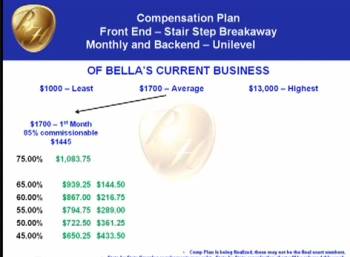
From a YouTube pitch for the Bella Homes' MLM compensation scheme.
BULLETIN: Colorado’s U.S. Attorney and the state’s Attorney General have gone to federal court in Denver to halt what they described as a foreclosure-rescue scam operated through an entity known as Bella Homes LLC.
Bella, which operated as an MLM and allegedly recruited more than 200 salespeople who paid the firm a combined total of more than $138,000 to pitch the “opportunity” and earn a shot at commissions from desperate homeowners, has been sued.
Also named defendants were Mark Stephen Diamond, Michael Terrell, David Delpiano and Daniel David Delpiano.
In court filings in the civil case, Daniel Delpiano was described by state and federal prosecutors as the Georgia-based “mastermind” of the Bella Homes fraud, which allegedly gathered more than $3 million.
Daniel Delpiano is a convicted felon currently on supervised federal probation, prosecutors said. Terrell is a Georgia attorney, and Diamond is an Arizona businessman, according to the complaint.
In February 2005, Daniel Delpiano was convicted of conspiracy to commit wire fraud in the District of Massachusetts. After that — in November 2006 — he was convicted of conspiracy to commit mail fraud, wire fraud and money laundering in the Middle District of Florida, prosecutors said.
And in May 2007, prosecutors noted, he was convicted of mortgage fraud and racketeering in Georgia Superior Court. Daniel Delpiano is the father of David Delpiano, who also resides in Georgia, prosecutors said.
RealScam.com, a forum that concerns itself with mass-marketing fraud, was among the first outlets today to report the news of the Colorado lawsuit. RealScam has been tracking Bella Homes’ developments at least since Nov. 27, 2011.
“To become a representative, the representative must pay Bella Homes an initial enrollment fee of $99.00 and a $195.00 fee to complete mandatory online training,” prosecutors said. “Each representative also has an option to pay a $49.00 monthly fee to create his own replicate of the Bella Homes website in order to recruit homeowners for the program.”
But the program, which has ceased to operate in the wake of the state and federal action, was a scam, prosecutors said.
“Bella Homes gave false hope to desperate homeowners, taking advantage of their desire to do anything to save their homes,” said U.S. Attorney John Walsh. “Bella Homes’s actions not only hurt those vulnerable homeowners, but the housing market generally. The company will now face the consequences of its misconduct.”
At least 450 people sent Bella money to save their homes, but no evidence has surfaced that Bella saved any homes, prosecutors said.
The 52-page complaint includes a number of examples in which financially strapped homeowners allegedly paid Bella thousands of dollars in illegal, upfront fees.
“The homeowner is fraudulently induced to pay ‘rent’ to Bella Homes in lieu of making the mortgage payments,” prosecutors charged. “Some of the mortgage lenders and mortgage servicers detrimentally affected by Bella Homes’ fraudulent scheme are federally insured financial institutions.”
Most of the money paid by victims “has been diverted to the individual Defendants for their own personal use,” prosecutors said.
Diamond, for instance, allegedly received “at least” $321,000 in fraud proceeds, “including more than $277,000 for his American Express bills,” prosecutors said.
Meanwhile, Daniel Delpiano received “at least” $184,000 in fraud proceeds that were applied to personal expenses. Of that sum, as much as $86,180 appears to have come in the form of ATM cash withdrawals, prosecutors said.
“The ATM cash withdrawals were frequently in the amount of $700,” prosecutors said.
Although YouTube videos touting the Bella Homes’ MLM compensation scheme continue to appear, the company’s website is offline and a federal judge has issued orders to preserve assets.
Here is a snippet from the complaint. (Italics added):
Rather than helping homeowners remain in their homes long term, as promised, Bella Homes preys upon distressed homeowners, duping them into paying thousands of dollars based on false promises and false representations, yet provides no meaningful assistance to prevent foreclosure or to allow homeowners to remain in their home for the time period promised by Bella Homes.
Bella Homes has fraudulently obtained approximately $3,000,000 from over 450 homeowners across the nation, and is rapidly expanding its fraudulent operations. In the last two months of 2011 alone, it has fraudulently obtained approximately $1,000,000 from homeowners.
As part of the scheme, Defendants solicit distressed homeowners to convey title to their home to Bella Homes for no consideration and to enter into purported three-, five-, or seven-year lease agreements under which the homeowner pays Bella Homes monthly “rent.” Bella Homes also collects an advance fee from the homeowner of three-months? “rent” upon transferring title and signing the lease. Despite Bella Homes taking title to and collecting “rent” for the property, it does not pay the homeowner for the property and it does not pay off or assume the existing mortgage. Nor does Bella Homes make any of the mortgage payments or pay any of the taxes or insurance for the property.
Here is a snippet from the preliminary injunction. (Italics added):
Except as noted below, Defendants and those involved in active concert with them who are served with a copy of this Order are ENJOINED from:
1. Conducting or continuing to conduct business activities by or on behalf of Bella Homes, LLC, including but not limited to: (a) engaging in any action affecting real title to any property; (b) entering into any agreements relating to real property; (c) collecting, negotiating, or depositing any rental payments made by purported lessees of Bella Homes, LLC; (d) distributing or receiving disbursement of any funds from Bella Homes, LLC; and (e) advertising, promoting, or soliciting customers on behalf of Bella Homes, LLC.
2. Transferring, withdrawing, pledging, dissipating, or otherwise using or concealing funds of Bella Homes, LLC or funds received by any Defendant from Bella Homes, LLC in any accounts with any financial institution . . .
The defendants have agreed to the preliminary injunction, which calls for “ceasing further operations and transferring approximately $500,000 to the government for homeowner restitution, pending final resolution of the case,” prosecutors said.
A week after CONSOB, the Italian securities regulator, announced it was opening a probe into the activities of JSS Tripler promoters amid claims the absurd “program” advertised returns that would make Bernard Madoff blush, a new “press release” ignores the CONSOB development, calls participants “investors” (eight times) and suggests the U.S. government has approved the JSS Tripler “program.”
The issues in the Italian probe are whether JSS Tripler and promoters are selling unregistered securities as investment contracts unlawfully as part of a multilevel online scheme that offers preposterous returns that compute to an annualized rate of 730 percent — with compounding “bonuses” and two-tier downline commissions totaling 15 percent on top of the advertised returns.
Madoff, jailed for 150 years in the aftermath of the collapse of his massive Ponzi scheme, generally offered annualized returns between 48 and 73 times lower than the advertised JSS Tripler returns.
Dated today, the “press release” appears to have been issued by a JSS Tripler affiliate and is available through Google News. The release does not mention the week-old CONSOB probe. Nor does it identify either the affiliate or the purported company as individuals or entities authorized in any jurisdiction to sell securities.
Moreover, the release does not seek to qualify customers in any way. The only apparent customer qualification is access to a bank or payment account to send money to JSS Tripler and wait for ludicrous profits in return.
A Patent Absurdity
“Thousands of high return programs on the internet have been created for people who want to work from home,” the release begins. “However, the majority of these fast money work home (sic) programs are not sustainable. Frederick Mann solved this problem with his recently US patented system JustBeenPaid! and its subprogram JSS Tripler.”
“JustBeenPaid” (JBP), an exceptionally murky entity, is the purported operator of JSS Tripler. Frederick Mann, JBP’s purported operator, once advertised that he was a promoter for AdSurfDaily, which the U.S. Secret Service has described as an online Ponzi scheme involving at least $110 million.
JBP itself is advertising a U.S. patent, a specious and hollow claim. Regardless of whether a patent exists as part of JBP’s purported software platform, the U.S. Patent and Trademark Office does not regulate securities markets or approve the issuance of securities.
Those responsibilities rest with the world’s securities-regulatory bodies, including — for just two examples — CONSOB in Italy and the SEC in the United States. Virtually all developed countries have such regulatory bodies. In the United States and Canada, individual states and provinces also have regulatory responsibility over securities.
Scams routinely make specious claims and divine a connection to government as a means of disarming doubting prospects. The relatively new “patent” claim in the context of JSS Tripler, however, could be a sign that the “program” is becoming increasingly desperate to raise cash and has dialed up its deception to achieve that end.
The nationality of the press-release author was not immediately clear. But he is using a Google Gmail address and appears also to be presenting the release in U.S. English, based on the spelling of the word “program” (as opposed to the chiefly British “programme”) and certain elements of punctuation associated with U.S. English.
The release, which is accessible from the United States, has five embedded JustBeenPaid affiliate links, each of which rotates to a pitch page with a signup prompt page that asks investors to register using a Gmail address.
Among the incongruities about JBP/JSS Tripler is that the purported opportunity continued to solicit customers to register with Gmail addresses — even after Google-owned YouTube deleted promos for the “opportunity” last year.
“No sweat, I own over 500 Youtube accounts, so I’ll just keep making videos like normal, plus I can always use Viddler and Windows movie maker and facebook video as well,” MoneyMakerGroup poster “gtprosperity” claimed.
Apparently oblivious to the CONSOB probe, the serious concerns about the unlawful sale of securities and the bizarre JBP/JSS Tripler developments over many months, the author of the news release asserts that the “program currently has over 125,000 members, and over 2,000 new investors join each day.
“Investors can earn a 2 percent daily, with over 60 percent earned in a month,” the release claims. “Investors earn 2 percent daily on each position they purchase. New positions can be bought with money or earnings. Daily earnings can also be cashed out by sending them to one’s JSS account for withdrawal. Withdrawals take 24 hours to process.”
“Work Home Fast Money Making System To Earn Extra Income Recently US Patented,” the release headline reads.
Among the potential problems with the claim is that it likely demonstrates that JBP/JSS Tripler is selling unregistered securities as investment contacts to U.S. citizens — even as it is doing the same thing in Italy and other countries.
"ABOUT US" and "JOIN NOW" buttons — each punctuated with exclamation points — appear below this image of actor Will Smith in Club Asteria's September 2011 house organ. The PP Blog has cropped this screen shot not to show Smith's face, but his face appears in the Club Asteria promo.
UPDATED 1:47 P.M. EDT (U.S.A. OCT. 29, 2011.) An image of famed actor and rapper Will Smith appears in Club Asteria’s September house organ, an online glossy used by the firm to recruit affiliates across the world. It was unclear if Smith had knowledge of the promo or had authorized Club Asteria to use his likeness.
A link to the publication featuring the image of Smith appeared on the TalkGold Ponzi forum yesterday. TalkGold is referenced in federal court filings as a place from which international fraud schemes are promoted.
Smith’s publicists at the 42West agency in Los Angeles had no immediate comment on the promo when contacted today by the PP Blog, which provided a link to the Club Asteria publication. The entertainer’s image appears on Page 7 of the September gusher.
Buttons using the words “LEARN MORE!” “ABOUT US! and “JOIN NOW!” appear a short distance below the image of Smith. But readers who press the buttons do not receive information about Smith. Rather, the buttons forward to Club Asteria’s website. The “JOIN NOW” button, for instance, takes readers to Club Asteria’s registration page.
The presence of the image of Smith, the wording and design of the page and the positioning of the buttons lead to questions about whether the “Independence Day” and “Men in Black” star had endorsed the purported Club Asteria opportunity or whether Club Asteria was trying to create the impression among readers that he was a spokesman for the company.
In May, Club Asteria promotions were banned in Italy by the Italian securities regulator CONSOB. The agency has published its orders and findings on Club Asteria affiliate websites in Italy.
It is common for shady promoters of multilevel-marketing (MLM) “opportunities” to plant the seed in promos that a particular product or service is endorsed by a celebrity when no actual endorsement exists.
A headline of “Will Smith Inspires the World With Enthusiasm for Life, Work & People!” appears above the image of Smith in the Club Asteria promo.
A deck below the headline uses these words, “An Interview With Will Smith,” suggesting that Club Asteria itself had a direct connection to him. In a short blurb below the deck, readers are told that the “interview” and “discussion” with Smith will inform them about the wisdom he gained “throughout his journey to success” and that Smith will explain “the importance of extraordinary dreams.”
A button to a video — apparently one that appeared on YouTube and is being reframed inside the house organ — appears below the image of Smith. When clicked, the video loads footage of an interview with Smith conducted by 60 Minutes reporter Steve Kroft (NOTE: This paragraph was edited on Oct. 29, 2011, to reflect that Kroft, not Scott Pelley, conducted the 60 Minutes’ interview.) As the video proceeds, it loads footage of Smith being interviewed by broadcaster Charlie Rose. It then works in footage of a Smith interview on NBC’s Today show and a Smith interview on the “Ellen” show. Footage from other shows also are spliced into the video.
Club Asteria reportedly recruited more than 300,000 members in a worldwide promotional blitz that traded on the name of the World Bank. Hundreds — if not thousands — of promos for the firm claimed Club Asteria was a program that provided a weekly return on investment of between 3 percent and 10 percent. The offers were targeted at the world’s poor, with Club Asteria positioned as a company that could lift them out of poverty.
Club Asteria was widely promoted on forums associated with Ponzi schemes and the sale of unregistered securities. Members said Club Asteria first slashed weekly payouts to members in the spring and then eliminated them. Club Asteria announced in May that its PayPal account had been frozen, a development it blamed on members.
In various promos prior to the PayPal freeze, Club Asteria affiliates preemptively denied Club Asteria was operating a Ponzi scheme. Club Asteria managing member Andrea Lucas, whom the World Bank said in March once held a staff position at the bank, last worked for the bank in 1986 — 25 years ago.
Lucas was described in promos for Club Asteria as a former “Director,” chairman and vice president of the World Bank. Images of Hank Needham, another Club Asteria principal, appeared in 2008 promos for AdSurfDaily.
In August of that year, the U.S. Secret Service seized tens of millions of dollars from the personal bank accounts of ASD President Andy Bowdoin, alleging that he was presiding over an international Ponzi scheme.
Bowdoin was arrested on criminal charges of wire fraud, securities fraud and selling unregistered securities in December 2010. His trial is pending. Like Club Asteria, ASD also was promoted on Ponzi boards such as TalkGold and MoneyMakerGroup, which is listed in federal court filings as a place from which the alleged Pathway To Prosperity and Legisi Ponzi schemes were promoted.
ASD, Pathway To Prosperity and Legisi created tens of thousands of victims globally and fraudulently obtained a combined total of about $250 million, according to court filings.
He once had command of legions — and AdSurfDaily members lined by the hundreds and waited in line for hours to pay Andy Bowdoin to give them a chance to “build wealth.” At its peak in the summer of 2008, ASD reportedly was posting tens of millions of dollars a week in revenue.
But that was then.
Now, three summers later, Bowdoin says he is having trouble even establishing contact with members listed in a database that contains 77,000 names. Those few members still willing to read his emails have been stingy with their wallets and pocketbooks.
A month ago — after preliminary fanfare that started weeks prior — Bowdoin formally asked members to pony up $500,000 to pay for his criminal defense on charges of wire fraud, securities fraud and selling unregistered securities. Bowdoin’s “positive” appeal to get members to join “Andy’s Fundraising Army,” though, has been a dud.
The army has managed to cough up only $19,300, leaving Bowdoin $480,700 short of his goal, according to Bowdoin.
Bowdoin, however, said in an email that he remains positive — and that he’ll launch a Facebook fan site to broaden his appeal.
Whether his potential Facebook donors will want their names and photographs splashed all over Bowdoin’s fan page — thus exposing themselves to questions about why they are cheerleading for an accused felon implicated in an alleged $110 million Ponzi scheme after earlier having been implicated in a separate securities swindle — remains unclear.
Some ASD figures have identified themselves as “sovereign citizens.” Others have emerged as multilevel-marketing (MLM) junkies who race from scheme to scheme to scheme. Still others have circulated purported prayers calling for death and destruction to rain down on federal prosecutors and the men and women who guard the President of the United States and the U.S. financial infrastructure.
Two ASD figures thought it prudent last year to sue the United States for more than $29 TRILLION — more than double the U.S. Gross Domestic Product in 2009.
One ASD member claimed that $21 in “silver coinage” taken to a Missouri courthouse could reverse a mortgage foreclosure. Another was sued successfully under the federal racketeering statute in a scheme to have enormous financial judgments placed against public officials. Yet another advanced a belief that the United States passed secret legislation in the 1990s in anticipation of a visit by a race of reptilian aliens.
During that same decade Bowdoin was arrested in Alabama in a securites caper. And one of his business partners was implicated by the SEC in three prime-bank schemes.
David Eduardo Helmut Murcia Guzman (David Murcia), the MLM huckster whose pyramid scheme targeted the poor in Latin America and laundered money for a Colombian narcotics operation, has been sentenced to nine years in a U.S. federal prison.
Murcia, 30, also faces a 30-year prison sentence in Colombia after his release from a U.S. jail.
“Murcia Guzman wove an intricate web of deception across continents to disguise his dirty drug money and support his lavish lifestyle,” said U.S. Attorney Preet Bharara of the Southern District of New York. “But his web has been untangled and his lifestyle dramatically curtailed by this sentence.”
Murcia was at the helm of a Colombian MLM scheme known as D.M.G. Group, which collapsed in 2008 after luring customers by offering prepaid debit cards that purportedly would elevate their standard of living. Along with five co-conspirators, Murcia laundered drug money through the MLM company and other entities, prosecutors said.
In January 2010, the U.S. Drug Enforcement Administration (DEA) brought Murcia from Colombia to the United States to face trial. Murcia, wearing a bulletproof jacket, was whisked under heavy guard from his prison cell in Bogota to a waiting DEA aircraft.
Although it is common for online criminals to promote fraud schemes by saying the operations are outside the reach of U.S. regulators and law enforcement, such claims are a myth.
Finding the United States an unfriendly environment, the so called autosurf and HYIP “industries” increasingly are relying on offshore money-exchange businesses and debit cards to entice participants, sometimes advising them that the offshore locations are “safe” havens that “shelter” U.S. residents from regulators and law-enforcement agencies.
 ANNOUNCEMENT: The PP Blog has banned a specific IP that appears to originate in the area of Fort Wayne, Ind.






 He once had command of legions — and AdSurfDaily members lined by the hundreds and waited in line for hours to pay Andy Bowdoin to give them a chance to “build wealth.” At its peak in the summer of 2008, ASD reportedly was posting tens of millions of dollars a week in revenue.