Tag: MoneyMakerGroup

  • AN HYIP PARANOIA-MAKER: Undercover Agent Listens To Alleged Bankrupt Fraudster’s Pitch In ‘Hooters’; SEC Files Emergency Action Alleging Christopher Love Blackwell At Helm Of Massive Fraud Scheme

    EDITOR’S NOTE: This developing story on the alleged actions of accused securities schemer Christopher Love Blackwell is apt to cause paranoia among HYIP and prime-bank fraudsters, including criminals who populate online forums such as TalkGold and MoneyMakerGroup.

    It features the presence of a Department of Homeland Security (DHS) undercover operative who allegedly infiltrated Blackwell’s scheme and was so good at keeping his identity secret that Blackwell pitched him repeatedly over a period of months in a Hooters restaurant and bar as other agents worked to unmask the complex caper. The undercover agent eventually returned an “investment contract”  prepared by Blackwell and plunked down $1,000 of government money as a down payment on a purported $500,000 investment. Blackwell allegedly later contacted the undercover agent repeatedly via email and telephone to collect the outstanding “balance” of $499,000. Blackwell even left a voicemail on the agent’s phone, according to court filings.

    BULLETIN: The SEC has gone to federal court in Dallas and is seeking an emergency injunction to halt an alleged Ponzi scheme involving Christopher Love Blackwell of Euless, Texas, and Roswell, N.M., AV Bar Reg Inc. of Colleyville, Texas, and Millers A Game LLC of Chandler, Ariz.

    Blackwell, 31, and his companies initially came on the Feds’ radar screens last year when the U.S. Department of Homeland Security (DHS) was alerted that he was wiring large sums of money and conducting cash transactions that raised terrorism concerns, according to court records.

    In the end, the SEC dryly advised a federal judge, “it became clear to DHS that Blackwell was not a terrorist — just a thief.”

    Regardless, the SEC said, the fraud was ongoing and  Blackwell still appeared to be selling the scheme as recently as Jan. 19.

    DHS operatives kept Blackwell under surveillance, assembled documents, conducted interviews and “made video and audio recordings of meetings during which Blackwell offered investments to undercover agents,” the SEC said in court filings.

    Records show that Blackwell was on the receiving end of a default judgment of $24 million in a civil fraud case filed in July 2008 and sought Chapter 7 protection in U.S. Bankruptcy Court on Christmas Eve 2008.

    Despite the lawsuit, judgment and bankruptcy filing, Blackwell continued to operate what he described as a “Fixed Income Trading Program” that offered returns of up to 30 percent a month, according to the SEC.

    To pull off his Ponzi and fraud scheme, Blackwell bragged about his “academic pedigree,” falsely claiming to have Master’s and PhD degrees “from a prestigious university in Spain” and also falsely claiming once to have been employed by Goldman Sachs and the Bank of Madrid.

    In 2007, with the scheme unknown to law enforcement, Blackwell stole $750,000 from an investor. In 2008, according to court filings, he swindled $200,000 from another investor, returning $9,926 in bogus “profits” to the investor. This investor was introduced to Blackwell by “an intermediary who claimed to run a faith-based business and investment development firm,” according to the SEC complaint.

    The purported faith-based intermediary assured the investor that Blackwell’s program in “foreign bank instruments” was “totally safe,” the SEC alleged. Despite the assurance of the intermediary, Blackwell immediately began to distribute the $200,000 provided by the investor to other companies and people, including Blackwell’s former business partner and Blackwell’s father.

    By late 2008, according to the SEC, Blackwell was engineering a scheme to rip off a former football player for the Dallas Cowboys. The player had been introduced to Blackwell by another player, according to the complaint.

    Neither player was identified in the complaint. The former player, lured by the promise of safe returns from an experienced international trader, gave Blackwell $250,000 in the belief that he was purchasing an investment note from HSBC Bank, one of the largest financial firms in the world.

    Blackwell “never” purchased an HSBC note. Instead, according to the SEC, he instructed an attorney exercising control over the escrow account to which the former Cowboy had wired the funds to transfer nearly all of the $250,00 to a Phoenix company controlled by a friend of Blackwell.

    When confronted by the SEC, Blackwell allegedly told the agency that he had “earned” the money despite his assurances to the player that the sum would be used to purchase a safe bank note.

    Although Blackwell showed the former football player a document on HSBC letterhead as purported proof  he had purchased a bank note with the player’s money, “HSBC’s Security and Fraud Risk group has confirmed that the letter was fraudulent.

    “In other words,” the SEC said, “it was a forgery.”

    The former player appears to have been ripped off for the entire $250,000 investment, the SEC said.

  • TalkGold Ponzi And Criminals’ Forum Deletes ‘Sticky’ Thread On InstaForex; Firm Named Defendant In CFTC Sweep Used Payment Processor Whose Contact Person Is Referenced In International Money-Laundering And Narcotics Case

    The TalkGold Ponzi scheme and criminals’ forum has deleted a “sticky” thread reportedly paid for by InstaForex, a dubious company named a defendant in a registration sweep conducted by the U.S. Commodity Futures Trading Commission last month.

    The PP Blog reported two days ago that InstaForex was using TalkGold to promote a scheme by which participants who sent InstaForex at least 1,000  U.S. dollars could qualify to win a Lotus Elise valued at more than $50,000. Although sweepstakes that require a purchase are illegal in the United States, InstaForex bizarrely instructed investors that they could improve their odds of winning the car by opening up to 100 accounts each.

    Some of the InstaForex promoters used photographs of attractive women to promote the scheme. It was unclear whether the photos were actual pictures of the promoters or whether they were stage props designed to lure skeptical investors.

    Why any investor from any country would open a single account — let alone 100 accounts — with a firm that advertises on TalkGold was left to the imagination. TalkGold and similar sites such as MoneyMakerGroup are referenced in multiple filings in U.S. federal courts as places from which international Ponzi and fraud schemes are pushed.

    A separate ad for which InstaForex apparently paid TalkGold $95 remains operational on the forum. The ad shows an image of a red Lotus and claims the company is “THE BEST BROKER IN ASIA.” Directly below the ad is an ad for a company that claims to provide a return of 525 percent “After 1 Minute” and 9,860 percent “After 6 Hours.”

    Just four of the thousands of schemes pushed on TalkGold — Imperia Invest IBC, EMG/Finanzas Forex, Legisi and Pathway to Prosperity — created tens of thousands of victims globally while gathering hundreds of millions of dollars, according to court records.

    The precise time at which TalkGold deleted the paid “sticky” thread on InstaForex and the precise reason why the thread of at least 109 pages was deleted were unclear. Records suggest the thread was deleted in the past 24 hours. The once-massive thread now returns a “No Thread specified” error.

    Among other things, InstaForex advertised that it accepted payments through Perfect Money, a murky money-services business purportedly operating from Panama. Imperia Invest, which the SEC accused in October of stealing millions of dollars from thousands of participants, also used Perfect Money, according to court filings.

    Included among the Imperia Invest victims were thousands of Americans with hearing impairments, according to the SEC.

    Meanwhile, the name of Roger Alberto Santamaria del Cid — the purported contact person of Perfect Money — appears in federal court filings in the EMG/Finanzas Forex forfeiture case.

    A Florida-based task force that specializes in detecting and uncovering massive fraud schemes brought the EMG/Finanzas Forex case last year. Del Cid, Perfect Money’s purported contact person in Panama, is listed as EMG’s “Secretary” in court filings that allege that tens of millions of dollars seized in the probe were tied to the international narcotics trade.

    EMG/Finanzas Forex was so corrupt that some participants were told the only way they could get their money out was to recruit new investors, have the new investors pay them directly — and use the proceeds from the new investors to recover their initial outlays, according to court filings.

    The very first EMG post on the now-shuttered ASA Monitor Ponzi and criminals’ forum referenced yet-another widely promoted Ponzi scheme: 12DailyPro. The 12DailyPro case, brought by the SEC in February 2006, also is cited in the AdSurfDaily Ponzi prosecution brought by the U.S. Secret Service in August 2008. ASD also was promoted on TalkGold.

    Writing on ASA Monitor, an EMG/Finanzas Forex aficionado claimed to have learned the ropes from 12DailyPro.

    “I have been in internet business for 3 years now and in autosurf industry from 12dailypro,” the ASA poster began. He (or she) then proceeded to tell readers about how they could earn commissions by recruiting for EMG/Finanzas, which the Feds later described as an international menace with tentacles in Central America, South America and Europe.

    Court filings in the EMG/Finanzas case paint a picture of an incredibly elaborate maze of companies and bank accounts set up to confuse both investors and law enforcement. At least 59 bank accounts, 294 bars of gold and nine luxury vehicles were seized.

    The EMG allegations were explosive because they showcased the undeniable fact that people who promote programs such as HYIPs and autosurfs because such programs may pay “commissions” to recruit new members may be operating as fronts or conduits for international drug dealers and money-launderers.

  • ‘FRAUD CREEP’: The Two-Word Term That Explains How Crime Expands On The Internet To Affect Tens Of Thousands Of Victims At A Time

    EDITOR’S NOTE: Our definition of “fraud creep” — and suggestions on the context in which the term should be applied — appears lower in this story.

    First, some background . . .

    Investigators now are counting victims of massive, web-based fraud schemes tens of thousands at a time. Such scams pose both budgetary and logistical challenges to law enforcement, bankruptcy trustees and court-appointed receivers — and a single scam may take years to unravel. In recent court filings, federal prosecutors said they had amassed 500,000 pages of emails, 100,000 pages of banking records and 5,000 pages of other records as part of the AdSurfDaily Ponzi probe, which began in July 2008. The U.S. Secret Service raided ASD’s headquarters in August 2008.

    The ASD Ponzi scheme, which operated from Florida, may have defrauded 40,000 or more victims while gathering at least $110 million, prosecutors said.

    Meanwhile, in a civil case brought in Utah in October 2010, the SEC said Imperia Invest IBC defrauded more than 14,000 investors worldwide while gathering small sums that ultimately led to a haul of more than $7 million. Among the victims were thousands of deaf investors in the United States.

    Imperia claimed until late 2009 to be located in the Bahamas, but the Bahamian address was “fictitious,” the SEC said, adding that Imperia later claimed to be located in Vanuatu.

    But Imperia was “not registered to do business in Vanuatu and the address listed on its website appears also to be fictitious,” the SEC said.

    Despite the fact Imperia gathered money from thousands of Americans, “[n]either Imperia nor its securities are registered with the Securities and Exchange Commission,” the SEC said. “Imperia is not licensed or registered with the Commission, with any state, or with any Self Regulatory Organization.”

    In a separate civil case brought in Nevada last month, the FTC accused Utah resident Jeremy Johnson, I Works Inc. and other companies of orchestrating a massive, continuity-billing scheme that used 51 shell companies, maildrops and “straw-figures” as company officers “to keep the scam going.”

    The complaint names as defendants 10 individuals, 10 corporations and the 51 shell companies. Citing court documents, the Salt Lake Tribune reported that Johnson’s companies allegedly took in more than $350 million and ensnared 15,000 consumers a day at the height of the scheme.

    Customers were lured into purchasing “trial” memberships for “bogus government-grant and money-making schemes,” and then were “repeatedly” charged monthly fees “for these and other memberships that they never signed up for,” the FTC said.

    “[T]his scheme has caused hundreds of thousands of consumers to seek chargebacks — reversals of charges to their credit cards or debits to their banks accounts,” the FTC said.

    “The high number of chargebacks has landed the defendants in VISA’s and MasterCard’s chargeback monitoring programs, resulted in millions of dollars in fines for excessive chargebacks, and prevented the defendants from getting access to the credit card and debit card billing systems using their own names,” the FTC said.

    “To keep the scam going, the defendants tricked banks into giving them continued access to these billing systems by creating 51 shell companies with figurehead officers, and by providing the banks with phony ‘clean’ versions of their websites.”

    Like ASD’s Andy Bowdoin, Johnson denies wrongdoing.

    Making Sense Of It All

    Today the PP Blog offers a two-word term, contexts in which we believe the term applies and proposed definitions as a means of educating the public by describing a complex process of organized, international theft and reducing it to its essence. Understanding how online schemes proliferate — and the emotions they trade on and “scam signals” they send — may help consumers protect themselves from the fraudsters.

    fraud creep [frawd kreep]

    1. Principal definition: The tendency of a web-based financial crime undetected by law enforcement to expand across the Internet until it achieves critical mass, reaches the limits of a criminal organization’s ability to manage and forces investigators to respond. Such a crime may creep (advance slowly) to ultimately create thousands or even tens of thousands of victims globally.

    2. Associated definition: A criminal business model (fraud-creep enterprise) that includes a suggestion of exceptional earnings and generous recruiting commissions and the use of tailored messages that appeal to greed, envy, despair or anger. A fraud-creep enterprise also may be characterized by images of wholesome or enticing amenities designed to attract prospects to an illicit scheme whose purpose is hidden or undisclosed.

    3. Associated definition: A form of deceit (fraud-creep plan) employed by hucksters, particularly on the Internet, characterized by efforts to popularize an illicit pursuit by withholding critical information and demonizing market regulators. Profits are reaped by tapping into disillusionment and despair and creating a bogeyman or figure of blame to rationalize participation in a dubious or illegal enterprise. The bogeyman or figure of blame often may be the government, a branch of government, a law-enforcement or regulatory agency or government employee.

    4. Associated definition: A particular instance of such deceit in which an appeal is made to recruit holders of a particular political philosophy into a scam. Politicians and other public figures may be demonized in this form of fraud creep, which may include vicious name-calling or passive-aggressive slime. Images of success may be juxtaposed against images of people or entities cast as barriers to success. This form of fraud creep also may be accompanied by an effort to create marketplace sympathy and to sanitize and expand a fraud scheme by suggesting evil forces are seeking to prevent investors and eager entrepreneurs from creating wealth by erecting barriers or denying them access to the marketplace.

    5. Associated definition: One who practices fraud creep — i.e., a fraud creep.

    Usage example: As the economy struggles and mortgage foreclosures pile up, law-enforcement agencies nationwide are seeing more and more examples of fraud creep in which criminals succeeded in  making Internet scams go “viral” by luring thousands of prospects with images of amenities they’ll purportedly enjoy by registering for a program and sending money.

    Usage example: The ASD fraud-creep and Ponzi scheme gradually expanded to fleece more than 40,000 investors out of at least $110 million, investigators said, noting that participants were lured by the promise that they would be paid $5,000 if a family member or friend they recruited spent $50,000 on “advertising.”

    Usage example: Although Smith routinely bemoaned “Washington” while showing a video of himself behind the wheel of a Maserati parked outside a mansion in a driveway lined by exotic flowers as a groundskeeper toiled nearby, authorities say the investigation uncovered a classic case of fraud creep: Smith simply decided that registering with the SEC was for the “fools who don’t understand the Constitution.” The Maserati, authorities said, was a day rental — and Smith paid the groundskeeper $100 to let him film the driveway and mansion scenes on a Saturday morning when the owners were on the golf course.

    Usage example: The stage was set for fraud creep, authorities said, when the accused huckster — a recidivist who did not disclose his previous conviction for securities fraud in a $20 million scheme  — persuaded  unsophisticated investors that the FBI was forcing the best companies to move offshore and that the SEC and IRS were trying to destroy the middle class.

    Usage example: Authorities began to suspect fraud creep when Jones incongruously explained to investors that the United States was turning into both a “Nazi” and a “Socialist” state and making it impossible for honest “Main Street Capitalists to deliver the American Dream and do what the market does best: get poor people and illegals off Food Stamps and turn them into productive citizens.”  Although Jones, a U.S. resident, frequently talked about his “attorney” and the efforts he had undertaken to ensure his offshore company complied with all laws and regulations,  he refused to provide prospects the name of the attorney, claiming that a previous attorney had been hounded by callers who had sought to verify claims about the program.

    Usage example: Federal agents announced the arrest of yet-another alleged fraud creep today, saying the Florida man was either running or participating in multiple fraud-creep schemes, including autosurfs, HYIPs and penny-stock scams.

    Usage example: Fraud creeps on the fraud-creep forums were urging their marks not to file complaints with regulators or law enforcement — and not to contact the offshore payment processors that had processed all the Ponzi payments for the suddenly defunct HYIP. One forum fraud creep opined that the government would steal any remaining money. Another issued a dire warning that a receiver was sure to be appointed by the court and that the “greedy” receiver and “brain-dead” judge would conspire against the participants. Yet-another fraud creep ventured that the government would use the remaining fraud proceeds to help it finance its own Ponzi scheme: Social Security.

    Usage example: In court documents, federal authorities said fraud-creep forums such as TalkGold, MoneyMakerGroup and ASAMonitor were helping fraud creeps and fraud-creep schemes steal millions of dollars globally.

  • EDITORIAL: ASD By The Numbers: Why America And The World Should Be Shocked — And Why Serial Autosurf And HYIP Promoters Should Be Prosecuted

    ASD's Andy Bowdoin.

    UPDATED 12:04 P.M. ET (U.S.A.) In court filings this week in the AdSurfDaily autosurf Ponzi scheme case, federal prosecutors in the District of Columbia revealed a series of jaw-dropping numbers. The biggest of these is 500,000 — the number of pages of emails gleaned so far in the investigation, which began in July 2008.

    Because prosecutors put the qualifier “at least” on the already-staggering number, it is clear the number actually could increase. Each of the pages is subject to the discovery process, meaning that attorneys from both sides and perhaps the court itself faces the monumental challenge of sifting through at least half a million pages of scheme-related correspondence.

    Other big numbers in the alleged $110 million ASD Ponzi include 100,000, the number of pages of bank records, and 5,000, the number of pages of documents that emerged after the U.S. Secret Service searched ASD’s office in Quincy, Fla., and the home of company president Andy Bowdoin.

    To date, investigators have identified 40,000 potential ASD victims. This number also could grow because there is reason to believe that “there may be members who provided funds to ASD but whose information ASD did not enter into its database,” according to prosecutors.

    ASD’s database included information on 97,000 members. Some participants have claimed ASD actually had 120,000 members. Regardless of the final number that emerges, ASD created victims by the tens of thousands, including victims who do not live in the United States, prosecutors said.

    The import — and the danger of these numbers — is that ASD is only one autosurf. There may be hundreds if not thousands of autosurfs operating in the world at any one time, along with hundreds or thousands of HYIPs. Like other autosurfs and HYIPs, ASD was promoted on Ponzi forums such as TalkGold, MoneyMakerGroup and ASA Monitor. The Ponzi pitchmen love American money, and commission-grubbing American salespeople and serial promoters who play dumb to line their pockets at the expense of their fellow countrymen specialize in spreading the misery globally.

    In May, the PP Blog reported on criminal charges filed against Nicholas Smirnow, the alleged operator of the Pathway to Prosperity (P2P) Ponzi and HYIP scheme. The numbers that have emerged from that alleged scheme are equally stunning: $70 million fleeced from 40,000 victims in 120 countries from “all of the permanently inhabited continents of the world,” according to the U.S. Postal Inspection Service.

    The criminal complaint filed against Smirnow specifically references the TalkGold, MoneyMakerGroup and ASA Monitor Ponzi forums — the same forums from which ASD and countless other schemes have been promoted.

    Legisi, yet another alleged scheme pitched at the forums, also produced some big numbers. Among them are $72.6 million fleeced from at least 3,000 victims. Matthew Gagnon, one Legisi pitchman, netted $3.8 million alone from the scheme, according to the SEC.

    So, in just the three alleged schemes referenced in this column — ASD, P2P and Legisi — the numbers shape up like this: at least $252.6 million gathered from at least 83,000 victims. If the P2P and Legisi cases are shaping up like the ASD case from the standpoint of paper production, investigators, attorneys from both sides and the courts may have to go through more than a million pages of documents and corresponding bank records to make sense of it all.

    Meanwhile, the wink-nod, serial promoters continue to ply their trade on the Ponzi boards — all while the U.S. and world economies are trying to navigate the choppiest waters since the Great Depression. While the serial promoters are lining their pockets at the expense of Moms and Pops from virtually every corner of the earth, they are anticipating the danger signs consistent with the implosion of their currently favorite Ponzi — and they are preparing their next round of lies to protect their illicit profit pipeline and explain away the problems that inevitably will emerge.

    Some of the professional criminals will tell their marks that it is their duty to be patient when Ponzi payments slow down. They’ll add that problems affect all enterprises regardless of size, and that it’s not unusual for payment bottlenecks to occur. They’ll explain that it likely is a problem with software or the need to acquire a new server to accommodate traffic. After all, they’ll say, “growing pains” are something to celebrate because they signal the success of the enterprise.

    And the serial criminals also will talk about a doubting recruit’s duty to be loyal to the enterprise. After all, they’ll explain, the company is doing the right thing by acquiring the equipment and manpower needed to streamline operations and thus return to a normal payout schedule.

    While the professional Ponzi criminals are explaining all of this, investors will become further separated from their money before the final round of excuse-making begins. Investors will be cautioned not to contact the authorities and told not to contact the payment processors. After all, the serial pitchmen will explain, if the authorities seize the cash or if the payment processors freeze the accounts, no one will get paid.

    When the scheme ultimately collapses, some of the serial criminals will shrug their shoulders and feign surprise. They’ll explain why they had every reason to believe that this one was different, that they’d been assured by the Christian operator it was different. No matter, they’ll say, perhaps positioning themselves as people of faith. Recruits who invested more than they could afford to lose have only themselves to blame, they’ll claim. (This is if they call it “investing” at all; many serial criminals avoid that word like the plague. After all of these years and all of this Bible-thumping, they still apparently believe that it’s possible to skirt securities laws by avoiding the word “investment” and calling it something else.)

    Then they’ll unapologetically move on to the next scam. After all, they’ll explain, they have a right to make a living. Some of them will explain that the government, which refuses to see the beauty of the autosurf and HYIP models, is to blame. Along the way they’ll create some clone promoters, and the clones will multiply. The clones will add to the purported, pro-Bible (and antigovernment chorus) — and before long, investigators trying to reverse-engineer a single case will be sifting through 500,000 pages of emails, 100,000 pages of bank records and 5,000 pages of records created as the result of the execution of a search warrant or as a result of actual documents seized.

    Agents then will begin the mind-numbing and time-consuming process of identifying victims by the tens of thousands.

    Some of the victims will lose their homes because they borrowed against their equity to take advantage of “bonus” ad packs and to maximize their “earnings” through “compounding.” Others will have lost savings set aside to educate their children. Still others will have lost their life savings and money set aside for retirement.

    Many of the people who created all the pain will sprint back to the Ponzi forums — and the government will be left to clean up the colossal mess. The Ponzi pitchfest is in constant motion as property values decline in neighborhood after neighborhood, driven by the foreclosures glut. The Stepfords among the promoters will write their Congressman or Senator or perhaps the Inspector General at the Justice Department.

    They’ll more or less say that it would be in the interests of America if the Congressman or Senator or Inspector General would see fit to fire all the prosecutors and agents who made these unseemly events occur.

    And then they’ll gather up their lists of suckers and try to recruit them into yet-another MLM, autosurf or HYIP nightmare. This they will call “freedom.” Some of them will be angry. Some of them will write rambling diatribes on forums. Invective will be part of the diatribes. Some of them will call public officials “Nazis” and “Socialists,” perhaps even in the same fractured paragraph. Some of them even will try to sue the government or have the prosecutors and judges charged with crimes. They’ll talk about “treason” and high crimes against the Constitution.

    What they will never do is make any sense.

    It is impossible to imagine that any government agency has the resources to take down all of the corrupt MLMs, autosurfs and HYIPs. But one can imagine a systematic process by which the government identifies the serial promoters and plans a litigation strategy from which will emerge the “shot heard round the world” of corrupt online investment “opportunities.”

    That day cannot come soon enough — and the numbers demand it: more than $250 million gathered from victims of just the three alleged schemes referenced on this page, perhaps 1 million or more emails and other documents produced by the investigations, at least 83,000 victims from virtually all corners of the earth, an untold number of agents/investigators from multiple government entities forced to sift though monumental piles of evidence.

    It is clear that wealth is being drained by the billions. It is equally clear that vast sums of money have gone missing in the Age of Terrorism.

    Clearest of all, however, is that the corrupt MLMs, autosurfs and HYIPs cannot thrive without their greedy and dangerous promoters — and that highly public lawsuits and early morning raids designed to hold the wink-nod Ponzi pitchmen accountable would send an unmistakable message that pain is in your future if you promote these criminally toxic businesses. Serial promoters deserve the same treatment as mid-level drug dealers.

    No economy can thrive if a single case among thousands of potential cases is producing 500,000 pages of emails and creating 40,000 victims while consuming tens of millions of dollars — and if “shell companies,” the “shadow banking system” and wink-nod, serial promoters are driving the wanton criminality and letting the cancers metastasize globally.

    Here’s hoping such an operation aimed specifically at corrupt MLMs, autosurfs and HYIPs already is under way.

  • PROSECUTION: ASD Member Funded Account With Transfer From E-Bullion And Used Ad Rotator To Pitch ‘StreamlineGold,’ Apparent Pyramid Scheme; Records Show E-Bullion Founder Charged In Wife’s Murder In California

    An AdSurfDaily promoter whose cash was seized in February 2009 and now has been targeted for forfeiture funded one of her three ASD accounts in part with a transfer from E-Bullion, a shuttered payment processor whose founder was charged in 2008 with operating an unlicensed money-transmitting business and hiring a hit man to kill his estranged wife, according to records.

    The E-Bullion allegation raises troubling new questions about the sinister worlds of autosurfs and HYIPs, how ASD and its members were exchanging money and whether ASD and top promoters were employing secret conduits. In 2008, prosecutors asserted ASD had a relationship with E-Gold, a payment processor accused in 2007 of money-laundering. Yesterday’s assertion that ASD also had a relationship with E-Bullion marked the first time that prosecutors have raised E-Bullion’s name in the ASD case.

    Erma Seabaugh, known among ASD members as the “Web Room Lady,” used E-Bullion in November 2007 to transfer $10,510 to ASD, according to a forfeiture complaint filed yesterday.

    SCREEN SHOT: Federal prosecutors asserted yesterday that ASD member Erma Seabaugh funded one of her ASD accounts by transferring $10,510 from E-Bullion.

    E-Bullion founder James Fayed was jailed in California in August 2008, the same month as the seizure of tens of millions of dollars from ASD and nine months after the firm was used to transfer money to ASD, according to records. He initially was charged in an indictment unsealed in August 2008 by federal prosecutors with operating an unlicensed money-transmitting business that had processed more than $20 million in Ponzi scheme payments. The scope of E-Bullion’s alleged Ponzi business is unclear, but the company now has been linked to at least three alleged Ponzi schemes.

    In September 2008, Fayed was charged by the Los Angeles District Attorney’s office with the July 2008 murder of his wife, Pamela Fayed.

    In June 2008, a month before she was killed in a California parking garage by a man who allegedly had accepted $25,000 from James Fayed to carry out the plot, Pamela Fayed had informed federal prosecutors in California that she wished to cooperate in the investigation of E-Bullion, according to records. E-Bullion is referenced in court files as a payment processor used by Gold Quest International (GQI), an alleged Ponzi scheme operating in Las Vegas that was charged by the SEC in May 2008 and also was charged by Canadian regulators.

    A total of four people, including James Fayed, now have been charged in the murder plot. As with many things in the miserable worlds of HYIPs and autosurfs, the prosecution of GQI by the SEC turned into Theatre of the Absurd.

    GQI, accused in May 2008 by the SEC in a $29 million Ponzi case, sought to derail the case by filing a lawsuit for $1.7 trillion against the agency. Company officials absurdly asserted that GQI was immune to U.S. law because its Las Vegas operations enjoyed purported sovereignty that was portable from an “Indian” tribe in North Dakota and that GQI also was off-limits to prosecution in the United States because it was registered in Panama.

    Chillingly, E-Bullion also is referenced in documents filed by the Ontario Securities Commission in a case against Ponzi swindler Brian David Anderson, a former Christian clergyman from Vancouver, British Columbia. Anderson was sentenced to prison in the United States earlier this year for his role in a Ponzi scheme known as Frontier Assets.

    Anderson also was linked to a mysterious scheme known as the “Alpha Project.” U.S. and Canadian investigators also identified Anderson as a pitchman for an international HYIP known as Flat Electronic Data Interchange (FEDI). FEDI’s operator, Abdul Tawala Ibn Ali Alishtari, also known as Michael Mixon, was convicted in September 2009 of financing terror and fleecing investors in the FEDI scheme.

    In addition to the ASD account funded by the E-Bullion transfer, Seabaugh had at least two other ASD accounts, prosecutors charged in the forfeiture complaint. She used one of her accounts to advertise a mysterious business known as StreamlineGold, which was described by investigators as a probable “pyramid scheme dealing with the sale of memberships that are sold to customers.”

    The account through which Seabaugh promoted StreamlineGold was funded by a transfer from La Fuente Dinero, yet-another Ponzi scheme associated with ASD, prosecutors said.

    StreamlineGold’s website now throws an error message, but web records show it was promoted on the MoneyMakerGroup and TalkGold forums, two websites that are associated with Ponzi schemes and referenced in federal court records as a place from which the alleged Pathway To Prosperity Ponzi scheme was promoted.

    “StreamLine Gold is literally what it says,” a poster crowed on the MoneyMakerGroup Ponzi site in November 2007, the same month Seabaugh allegedly was promoting the same scheme through ASD. “[I]t can provide you with an unlimited income through the combination of Precious Metals and Cash with a business model whose time has come PLUS the most advanced and lucrative pay plan ever devised.”

    Records suggest StreamlineGold had failed in an earlier iteration — and then failed again after rebirthing itself.

  • DISTURBING: Email Received By Some ASD Members Suggests They Could Be Sued For Participating In Refund Program; Records Suggest ‘Legal Opinion’ Was Offered By Man Named In Complaints For ‘Unauthorized Practice Of Law’ And Linked To ‘Extremist Group’ By Anti-Defamation League

    In a bizarre and unsettling development, some members of AdSurfDaily who may be planning to file for restitution through the official claims administrator have received a confusing and threatening email from a “group” of ASD members.

    The email, which appears to be a compendium that cobbles together communications from the group and asks ASD members to pass along the information, implies that ASD members who file for restitution through the government-approved process may face legal action from the group, which has or will file claims against the “illicit UNITED STATED (sic) OF AMERICA INC. et al” for its prosecution of the ASD Ponzi scheme case brought by the U.S. Secret Service in August 2008.

    The lawsuit threat appears to be targeted at ASD members who are planning to file a restitution claim through Rust Consulting Inc. of Minneapolis. Rust Consulting is under contract with the government to administer the restitution program through a process known as remission in which ASD members must certify they are crime victims.

    Pasted into the email is a purported “legal opinion” by a person described as “Keny” of “AMERICAN-International Business Law inc. (sic).”

    “Keny” does not appear to be the source of the lawsuit threat. Rather, the email quotes a purported “legal opinion” by “Keny” — and then implies members who file through Rust Consulting may be sued by members of the group. The email asks members not to file for a refund through the official process.

    “Please send me your response(s) and I will manage the feedback timely,” says an email signed “MYHUB.” “Again, we are asking that our Claimants do not engage in the DOJ’s Remission Process, as long you want to maintain being part of our Group Claims whatsoever. If you are indeed wanting to eat on the other side of the fence, you must let us know before you submit anything to the DOJ, without causing us potential harm and further damages. In case you were to fail to notify us, we would have a possible claim against you, and that’s not what you want us to do in the first place.

    “We very much appreciate your understanding in this rather sensitive time of legal dealings,” the email continues. “No worries, we are just getting started to fight for and along with you. If you feel that this email could help some of your friends in ASD that are not part of our Group Claims, we are allowing you to share and forward this email as long it doesn’t end up in Blogs et al., but then again, people need to be informed since they can’t read and or understand the legal language or the meaning of words any longer.”

    Google search results include multiple references to “AMERICAN-INTERNATIONAL BUSINESS LAW INC” and a person referenced as “Keny.”

    One of the references appears on a website operated by Cornell University Law School under a heading of “Legal Services & Lawyers.” The Cornell reference identifies a person named Kenneth Wayne Leaming of AMERICAN-INTERNATIONAL BUSINESS LAW INC. of Spanaway, Wash. The Cornell site notes that correspondence should be sent to the attention of “Keny” and that Kenneth Wayne Leaming practices “Admiralty/Maritime, Business Law, Estate Planning and Native American Law.”

    Records at the Practice of Law Board at the Washington State Bar Association (WSBA) say that Kenneth Wayne Leaming, also known as Kenneth Wayne, was accused of the unauthorized practice of law by clients in 2005.

    One client accused Leaming of “actively market[ing] legal services via seminars and the internet” and of providing “legal advice” and preparing “pleadings for many clients,” according to WSBA.

    Another client accused Leaming of contracting with him “to assist him in avoiding an IRS lien on his home” and failing to provide the services.

    On Dec. 20, 2005, WSBA said in a letter to Leaming that his “conduct constitutes the unauthorized practice of law.” The final disposition of the matter was not immediately clear. Also unclear is whether Leaming ever was a licensed attorney or authorized to practice law in any state.

    Separately, the Anti-Defamation League (ADL) lists Leaming as a member of an “extremist group” known as “Little Shell Pembina Band of North America.”

    Leaming, according to ADL, is a “self-described ‘recognized international lawyer’ who once served as a deputy sheriff and member of the Civil Rights Task Force, a “sovereign citizen group that has used badges and raid jackets to resemble law enforcement officers.”

    “His CRTF partner, David Carroll Stephenson, was ordered by a federal court in March 2004 to stop promoting an alleged tax scam that allowed people to avoid an estimated $43 million in federal income taxes,” according to ADL.

    The identity of “MYHUB” was unclear in the email received by ASD members. Portions of the email were pieced together by a sender known as “Sara.” A person named Sara Mattoon once served as ASD’s official spokeswoman and is referenced in a court filing by the Secret Service in 2009.

    In the email, “Sara” referenced remarks attributed to “Keny” as a “legal opinion about why it may be unwise for you to fill out the [Rust Consulting] form, aside from it working against ASD.”

    The “Sara” email then reproduces the “MYHUB” email and the purported “legal opinion” by “Keny.”

    The purported legal opinion describes the Rust Consulting website, which is listed in court documents as the official site for ASD victims, as “almost exclusively a propaganda site to get the viewer to ‘believe’ the gov’t LIE that advertising via network marketing on the internet is somehow bad business and fraudulent, and solicit false testimony from the viewer based on the false information!”

    In yet-another email received by ASD members, a fellow member referenced as “Robert” also referred to the claims program administered by Rust Consulting. The email from “Robert” includes an unattributed opinion, meaning the identity of the person who offered the opinion is unclear.

    “If members feel it absolutely necessary to complete the remission form now instead of waiting a little longer for the legal process to be completed then they may want to write on a separate piece of paper and have it notarized saying that they were not an investor,” according to the opinion contained within the email from “Robert.”

    Members also should swear that “they purchased advertising for their website and that they were happy with their purchase,” according to the unattributed opinion circulated by “Robert.”

    “The govt is trying to trick people into saying it was an investment,” the opinion claimed.

    Separately, an apparent ASD member known as MMG7 who posts on the MoneyMakerGroup Ponzi forum left a scathing missive yesterday in an ASD thread at the forum.

    “The same people who abused their power, under the color of law, back in August of 2008 and basically *shut down* the company without due process are up to yet additional tactics to *CREATE VICTIMS* out of thin air,” the post read in part.

    “The general consensus is that once they can *create victims* they can then turn around and use it against ASD or even YOU.

    “It is VERY HEALTHY to question their motives. Remember, these are the same people that ruined the lives of 100,000+ people in the blink of an eye without so much as having to provide an explanation for their actions.

    “Could it be they thought ASD would roll over and play dead so they could put a feather in their cap and claim victory? Not to mention being able to keep a hefty sum of members monetary property.”

    The MoneyMakerGroup forum is referenced in a May filing by the U.S. Postal Inspection Service as a place from which Ponzi schemes are promoted. The filing accused an entity known as Pathway To Prosperity of conducting an international Ponzi scheme that defrauded more than 40,000 investors across the globe.

    MMG7 did not explain in his post how he arrived at the conclusion that ASD was denied due process in a court case that has featured more than 175 filings and a hearing called at ASD’s request to free seized money.

    ASD’s request was denied in November 2008 because it did not demonstrate at the hearing it requested to prove its legitimacy that it was operating lawfully and was not a Ponzi scheme, according to court records.

    ASD President Andy Bowdoin later met with federal prosecutors over a period of at least four days. Bowdoin, according to court filings, signed a proffer letter and acknowledged the government’s material allegations in the case were all true.

    Although Bowdoin initially contested the forfeiture of tens of millions of dollars seized in the case, he submitted to it in January 2009. By the end of February 2009, however, Bowdoin reentered the case, acting as his own attorney and seeking to reassert his claims to the money. Months of legal wrangling followed, and Bowdoin was forced to hire new attorneys. A federal judge ruled last fall that Bowdoin would not be permitted to reenter the case, and an order of forfeiture was signed in January 2010.

    Nor did MMG7 explain how he had arrived at his conclusion that the government “ruined the lives of 100,000+ people in the blink of an eye without so much as having to provide an explanation for their actions.”

    Court records plainly show that that the government explained in considerable detail to at least two federal judges why it sought the authority to seize tens of millions of dollars contained in the personal bank accounts of Bowdoin, who was accused of swindling investors in an Alabama securities caper in the 1990s. Moroever, the government has said all along that it intended to establish a restitution pool from the assets seized in the case.

    The implementation of both the pool and the restitution/remission process were delayed by appeals filed by Bowdoin.

    Bowdoin was sentenced to prison in the Alabama case, but avoided jail time by agreeing to make restitution, according to records.

    Clarence Busby, his business partner in the AdSurfDaily/Golden Panda Ad Builder venture, also swindled investors in a separate securities scheme in the 1990s, according to the SEC.

    At the same time, MMG7 did not explain how he arrived at his conclusion that the government “shut down” ASD. Records show that ASD was permitted to continue to display advertising after the seizure, but that Bowdoin chose not to do so.

    Prosecutors say that, despite ASD’s claims to a federal judge that it had no money to operate, the company had $1 million in an account under a “different name” on the island nation of Antigua.

    Records show that Bowdoin did not reveal the existence of the Antigua money to members until after ASD had asked the court for emergency cash to pay its rent and webhosting bill.

    U.S. District Judge Rosemary Collyer, whom Bowdoin and another member later tried to have removed from hearing the case, refused to release funds to ASD.

  • Did MPB Today Have Predecessor Company Known As ‘MyPremierBiz’ In 2009? Wellness, ‘Apps’ Programs Pitched From Ponzi Boards Last Year Prior To Birth Of ‘Grocery’ MLM

    This video promo from June 2009 hawks "My Premier Biz," a site now associated with the MPB Today "grocery" program. My Premier Biz was pitched on Ponzi forums more than a year before promos for MPB Today began to appear on the Ponzi forums. MyPremierBiz was a purported opportunity for distributors to pay up to $3,456 to have wellness products associated with MPB Today operator Gary Calhoun placed in retail stores.

    A website known as MyPremierBiz.com was hyped on Ponzi boards last year and videos were produced to drive traffic to a confusing “opportunity” that included both a straight-line and a 2×2 matrix cycler and a hard-to-decipher sales and compensation program.

    Affiliate links were created for the program, which was purported on the MoneyMakerGroup forum to gather between $312 and $3,456 from distributors to place “Pro Packs” — cases of wellness products — in retail stores. The more a prospect sent in to acquire purported retail space for “Pro Packs,” the more he or she purportedly would earn. As of yesterday, some of the links redirected to the website of the purported MPB Today “grocery” program, research shows.

    The product line-up for the MyPremierBiz opportunity is associated with products offered by Gary Calhoun of MPB Today. One promoter on a Ponzi board claimed MyPremierBiz had lined up “outlets” that are “independent nutrition and health food stores, specialty wellness shops, holistic or independent pharmacies, spas, salons, etc.

    “We have a certain number right now, but NOT ENOUGH members to cover the sales! Talk about a GROUND-FLOOR OPPORTUNITY!” the affiliate exclaimed. “As this gets rolling, you will be a part of a small, elite nucleus of people who will have THOUSANDS of STORES in your downline within 12-36 months!”

    Incongruously, a video on YouTube displayed photos of several retail outlets, but included a disclaimer in tiny type that “Stores shown are for example only and are not affiliated with our company.”

    The root of the domain — MyPremierBiz.com — displayed this message this morning: “MPB Today is off-line for site maintenance.” However, other URLs at the site served pages, including a page that included a link for the MPB Today “grocery” program. The fate of the “Pro Packs” offer first advertised last year was not immediately clear.

    The development strongly suggests that MPB Today, which itself is being promoted on the Ponzi boards, had a predecessor site more than a year ago that also was pitched from the Ponzi boards. Receipt of any revenue from Ponzi schemes or criminal business opportunities is potentially catastrophic for MPB Today because the company could be paying members with proceeds from other online schemes.

    Separately, MPB Today Inc. has canceled its Florida incorporation, according to documents on file in the state. The company now is known simply as “MPB Today” — without the “Inc.” designation — according to  a filing dated Sept. 24. MPB Today is operating as a fictitious entity owned by Le330 Inc., another entity associated with MPB Today operator Gary Calhoun.

    Whether MPB Today Inc. actually ever was incorporated in Florida is unclear. A filing by the firm in July suggests the fictitious entity assigned itself a corporate designation under Le330’s designation. Checks recently received by MPB Today members no longer have the “Inc.” designation. Earlier images of checks posted online by affiliates included the “Inc.” designation. New checks simply list “Mpb Today” as the account-holder.

    Like promos for MPB Today, promos for MyPremierBiz were filled with hype and began with a proposition.

    In March 2009, a poster at MoneyMakerGroup wrote, “Would you spend $312, ONE-TIME ONLY, to EARN at least $360 in PROFIT, from Retail Store sales, year after year?”

    MPB Today uses a similar pitch to plant that seed that a $200, “one-time” purchase can lead to free groceries for life.

    MyPremierBiz was positioned last year as “a new division of a six-year-old company that is turning heads both on and off the internet,” according to a promoter writing on the MoneyMakerGroup forum. MoneyMakerGroup is referenced in court filings in the Pathway To Prosperity (P2P) case, amid allegations that P2P was an international Ponzi scheme that fleeced more than 40,000 participants across the globe.

    Writing about MyPremierBiz on MoneyMakerGroup in June 2009, a promoter said that “I am the #2 person in the company. I’m building the TOP Team and I want you to have the same success. Together, I KNOW we can do it!

    “We have SO MANY ways you can get paid and I am going to get you off to an INCREDIBLE START with my MPB Team Build,” the promoter continued. “Here’s what I will do for you. I’ll put two people under you and that will get you off to a ROCKET START! If you join MPB, you will pay $11.50 for the annual website fee, plus $20 for your first monthly order, plus a little shipping for that order, and you can also purchase your way right into our 2 x 2 matrix for only $50 (just one part of our comp plan, but a VERY exciting and rewarding part). So your total expense, to get started is only $89. And you will now be part of several PASSIVE RESIDUAL Compensation Components, and you will be earning a check the very NEXT week!”

    One of the Ponzi-forum references to MyPremierBiz included a tie-in to a program known as “Froggy Apps,” which purported to be a downloads service.

    “FROGGY APPS are HERE!” a pitchman roared on the MoneyMakerGroup forum on July 9, 2009. “APPS are just getting started. People are downloading them at an ASTOUNDING rate, and iPhones, and other ‘Smart Phones’ are selling at a PHENOMENAL CLIP!”

    Links to the MyPremierBiz promos placed in the MoneyMakerGroup forum during the summer of 2009 redirect to the current MPB Today grocery program. So do links to the FroggyApps program.

    All three websites — MyPremierBiz.com, MPBToday.com and FroggyApps.com — are registered behind proxies. When the PP Blog visited the FroggyApps site, it was redirected to the MPB Today site.

    Not all affiliate links formed under the MyPremierBiz domain, however, appear to resolve to an MPB Today affiliate site. The PP Blog clicked on an old MyPremierBiz affiliate link yesterday, and was sent to a page that said, “The page or associate name was not found on this server. Please click the link below to continue.”

    The link below led to the MPB Today site.

  • Another MPB Today Site Uses Walmart’s Name In Domain Name; Positions ‘Grocery’ Biz As ‘Freedom Club’ In Domain Hidden Behind Proxy; Uses Images Of Buffet, Trump And Late Sam Walton

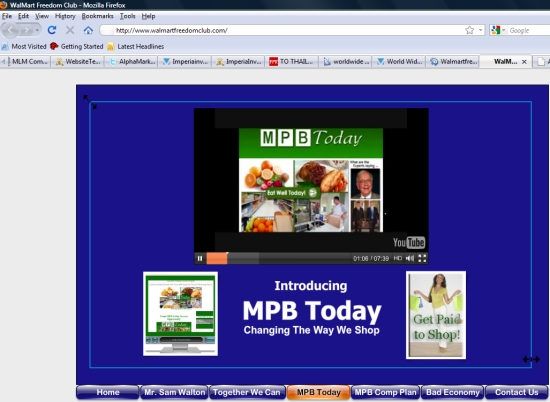
    This pitch for MPB Today positions it as the Walmart Freedom Club. The pitch misspells the word "prosper" as "prospour." The website registration is hidden behind a proxy, and uses Walmart's name in the domain name. It is unclear if Walmart authorized the domain name or the use of its intellectual property in the MPB Today promo.

    Yet-another domain linked to the purported MPB Today “grocery” program is using Walmart’s name in its domain name. The domain name is registered behind a proxy and uses images of Warren Buffet, Donald Trump and Sam Walton to position the opportunity as a “Freedom Club.”

    Sam Walton is the late founder of Walmart. It is unclear if the owners of the website have Walmart’s permission to use its name and the likeness of Sam Walton in a pitch for the MPB Today program. Also unclear is whether the website owners have the permission of Trump and Buffet to use their images in promos for MPB Today.

    Separately, yet another pitch for MPB Today features a narrator who notes that food is necessary to stay “alive” and laments, “I wish we could sell air too.” The “air” video is on a restricted YouTube site maked as “unlisted.” An unlisted video “means that only people who know the link to the video can view it (such as friends or family to whom you send the link,” according to YouTube.

    MPB Today is a multilevel-marketing (MLM) program based in Pensacola, Fla. The “opportunity” is tied to a grocery business in Pensacola known as Southeastern Delivery. Both companies are linked to Gary Calhoun, who has a poor track record with the Better Business Bureau and was the recipient of a warning letter from the Food and Drug Administration for his marketing of a product that purported to be a treatment for Lou Gehrig’s disease, Herpes and Alzheimer’s, among others.

    The new domain that uses Walmart’s name is at least the third linked to the MPB Today program — and the second to position MPB Today as a “club” tied to Walmart.  The domain was registered Sept. 9, after MPB Today itself removed images of Walmart, Buffet and Trump from the homepage of its website.

    Other MPB Today-linked websites branded with Walmart’s name imply the retail giant offers free groceries or that Walmart is partnered with MPB Today.

    Meanwhile, still-other websites linked to the MPB Today program position it as a “Grocery Assistance” program and a program linked to the Food Stamp program administered by the U.S. Department of Agriculture. MPB Today also is being pitched from known Ponzi and criminals’ forums such as ASA Monitor, TalkGold and MoneyMakerGroup.

    On Wednesday, the SEC filed an emergency action in federal court in Utah to stop a program known as Imperia Invest IBC dead in its tracks, amid allegations it had fleeced millions of dollars from thousands of Americans with hearing impairments. Like MPB Today, Imperia was promoted on the Ponzi forums.

    Among the allegations in the Imperia case were that the operators were using trademarks and the intellectual property of a major company — Visa Inc. — without the company’s authorization. All in all, more than 14,000 Imperia investors were fleeced, the SEC said.

    In this separate promo for MPB Today, a narrator notes that food is necessary to stay "alive" and laments that he wishes members also could sell "air" through the MPB Today MLM program.

  • BULLETIN: SEC Gains Asset Freeze, Seeks Shutdown Of Imperia Invest In Emergency Action; Program Pitched On Same Ponzi Forums Promoting MPB Today; Agency Says Imperia Defrauded Thousands Of Deaf Americans

    BULLETIN UPDATED 5:02 P.M. EDT (U.S.A.): The SEC has gone to federal court in Utah to halt the operations of Imperia Invest IBC, alleging a spectacular fraud that fleeced money from thousands of Americans with hearing impairments.

    Imperia was promoted from the MoneyMakerGroup Ponzi forum — one of the Ponzi forums promoting the MPB Today “grocery” MLM. Imperia also was the topic of discussion and defenses on TalkGold and ASAMonitor, two other forums that are pitching MPB Today.

    The SEC’s allegations against Imperia are stunning. More than 14,000 investors were defrauded worldwide, the agency said.

    Among the victims were thousands of deaf investors in the United States, the SEC said.

    Imperia gathered relatively small sums from thousands of people, the SEC charged, noting that “no evidence has been found that any of the investors have received a single payment.”

    “Imperia Invest IBC is a web-based entity that claimed, until late 2009, to be located in the Bahamas,” the SEC charged. “The Bahamian address listed by Imperia is fictitious. Imperia now claims to be located in Vanuatu. However, Imperia is not registered to do business in Vanuatu and the address listed on its website appears also to be fictitious. Neither Imperia nor its securities are registered with the Securities and Exchange Commission. Imperia is not licensed or registered with the Commission, with any state, or with any Self Regulatory Organization.”

    Categorically absurd representations of earnings and the program’s potential were made to investors, the SEC said.

    “Investors were promised eye-popping amounts of money in return for a simple $50 or $100 investment, and Imperia has made numerous excuses on its website about why these returns haven’t been paid,” said Ken Israel, director of the SEC’s Salt Lake Regional office.

    “The Imperia website shows an example of such earnings in which a $50 investment will return $134,000 to the investor in six months,” the SEC charged. At the same time, the agency said some investors were told that spectacular sums were due them for doing business with Imperia.

    “Imperia represented to one investor who invested $150.00 with Imperia that Imperia owed him $36,610,755.20 within a two year time frame,” the SEC charged. “Another individual’s account statement who invested $500 in July 2007 showed he is owed $43,907,652.20 as of May 2010.”

    It was not immediately clear how so many deaf investors became involved in Imperia. A federal judge has approved an asset freeze.

    Imperia called its product Traded Endowment Policies (TEP), which the SEC described as “the British term for viatical settlements.”

    “A TEP or viatical settlement involves the sale of an insurance policy by the policy owner before the policy matures, and policies are sold at a discount from face value in an amount greater than the current cash surrender value,” the SEC said.

    “There are at least 14,000 [Imperia] investors worldwide with a total investment exceeding $7 million,” the SEC said. “In the United States, there appear to be approximately 6,000 investors, most of whom belong the hearing impaired community, who have invested in excess of $4 million with Imperia.”

    Imperia used offshore payment processors such as “Liberty Reserve, located in Costa Rica; Perfect Money, located in Panama; and Procurrex, located in the British Virgin Islands,” the SEC charged. “Once Imperia received funds from Investors, it appears that Imperia then transferred amounts from these accounts to foreign bank accounts, including but not limited to accounts located in Cyprus and New Zealand.”

    Even as Imperia was ripping off investors, it also was infringing trademarks and the intellectual property of Visa, the credit-card service, the SEC charged..

    “Imperia also requires that investors purchase a Visa debit card to access their investment proceeds,” the SEC said. “Imperia charges customers a fee to purchase the Visa debit card ranging from $145 to $450.

    “Visa has not authorized Imperia to use its name or trademarks and has sent Imperia a cease-and-desist letter to halt its unauthorized use of the Visa name and logo,” the SEC said. “There is no evidence that any investor who has ordered a Visa debit card from Imperia has actually received such a card.”

    One poster on the MoneyMakerGroup forum advised prospects that he would keep an “open mind” about Imperia, according to web records.

    “Anyway, in the final analysis each person must make their own decision,” the poster said in 2007.

    While the MoneyMakerGroup poster was holding forth about keeping an “open mind,” Imperia was cloaking itself to siphon millions of dollars, according to web records and court records.

    “Imperia took proactive steps to conceal the identity of its control persons by using an anonymous browser to host its website, by communicating with all investors via email without disclosing the identity of any control persons and by establishing off-shore Paypal-style bank accounts to conceal the recipient of the investment proceeds,” the SEC charged.

    In July, the Financial Industry Regulatory Authority issued a warning about HYIP schemes pitched online. In May, the U.S. Postal Inspection Service accused an HYIP known as Pathway To Prosperity of defrauding more than 40,000 people in a scheme that took in about $70 million.

    Pathway To Prosperity also was promoted on the Ponzi and criminals’ forums. ASAMonitor, TalkGold and MoneyMakerGroup are specifically referenced in court filings in the Pathway to Prosperity case.

    MoneyMakerGroup is specifically referenced in court documents in the alleged Legisi HYIP and Ponzi scheme, a fraud that allegedly gathered more than $70 million.

    Read the SEC complaint against Imperia.

  • ASA Monitor Ponzi And Criminals’ Forum Locks MPB Today Thread — Again; Naysayers Scolded By Mod For Challenging ‘Ken Russo’

    EDITOR’S NOTE: The ASA Monitor Ponzi forum now has reopened its thread on the MPB Today MLM program — with a warning in red to “Play nice . . .”

    UPDATED 9:54 A.M. EDT (U.S.A.) A forum infamous for promoting Ponzi schemes and other criminal pursuits has locked the thread from which the MPB Today 2×2 matrix cycler is being pitched.

    The official explanation for locking the thread was that naysayers challenging ASA Monitor member “Ken Russo” needed a “temporary cooling off period.” (See Editor’s Note above: The thread now has been unlocked.)

    “Ken Russo” is a reliable cheerleader for Ponzi schemes and highly questionable business pursuits on ASA Monitor and other forums. ASA Monitor’s name is referenced in a May criminal case filed against the alleged Pathway To Prosperity Ponzi scheme. Prosecutors said the scheme mushroomed globally, gathering about $70 million and defrauding more than 40,000 participants.

    A similar program known as Legisi gathered more than $70 million and also fleeced thousands of participants, according to the SEC. It, too, was promoted on the Ponzi forums. A court filing in the Legisi case specifically references the MoneyMakerGroup forum, another venue from which MPB Today is being promoted.

    This marks the second time the MPB Today thread has been locked at ASA Monitor. It was locked earlier this month and then reopened amid similar circumstances. ASA Monitor initially deleted several references to the PP Blog in the initial closure of the thread, but later restored them.

    One of the principal incongruities of the MPB Today program is that it is being targeted at people of faith from a known Ponzi forum. Because ASA Monitor members routinely promote Ponzi schemes, some of the funds being passed to MPB Today could be criminal proceeds from Ponzi and other fraud schemes.

    “Ken Russo,” for example, promoted the alleged Regenesis 2×2 Ponzi scheme. Like MPB Today, Regenesis used a 2×2 matrix cycler. The U.S. Secret Service executed search warrants in the Regenesis case in July 2009. The agency said in court filings that it had linked the scheme to a convicted felon.

    Spectacular international frauds have been promoted at ASA Monitor. Meanwhile, some of MPB Today’s own members have said there are liars and thieves in the organization, including liars and thieves who are using false information to recruit prospects. The claims have been made in public on YouTube. Incongruously, they have been positioned as reasons to join the program under specific uplines that purport to be honest.

    How MPB Today’s payments to members could be clean if it has come into possession of money tainted by the lies of its own pitchmen and money tainted by Ponzi schemes promoted on forums such as ASA Monitor is left to the imagination.

    Last week the PP Blog reported that a “news release’ that appeared online encouraged MPB Today prospects to sell $200 worth of Food Stamps to raise money to join the program. One of the URLs referenced in the release also was being promoted on ASA Monitor by “Ken Russo.” Other information suggests that promoters of the judicially declared CEP Ponzi scheme are promoting MPB Today.

    Some ASA Monitor members use a strategy of playing dumb to promote Ponzi schemes. One form of the strategy is to repeatedly accept at face value whatever a company says in sales literature — and then blame the company and dishonest affiliates if a scheme collapses or is taken down by law enforcement.

    Another form of the strategy is to include links to the sites of other promoters, apparently on the theory that favorable commentary about an “opportunity” demonstrates that no scam could be occurring. If the opportunity later proves to be a Ponzi or a fraud scheme, promoters who employ the play-dumb method point out that others got taken, perhaps through the actions of a fraudster who was particularly clever.

    Yet another form of the play-dumb method is to position an opportunity as a matter of free choice. Such wink-nod efforts are part of numerous Ponzi schemes.

    In February 2010, the Secret Service said in a search-warrant application in Minnesota that it believed a company known as INetGlobal was operating a Ponzi scheme. In court filings, the agency said an undercover agent was introduced to INetGlobal by a member of the alleged AdSurfDaily (ASD) Ponzi scheme, describing the introduction as a wink-nod deal.

    ASD, which was accused of operating a $100 million Ponzi scheme, also was promoted from websites and forums. Federal agents seized about $26 million in the INetGlobal case, which is still under investigation. Steve Renner, the operator of INetGlobal, is in federal prison for income tax-evasion in a case linked to his money-services business.

    Court records show Renner-related ties to at least four Ponzi schemes.

    Among the targets of promotions for MPB Today were victims of the alleged ASD Ponzi scheme, foreclosure subjects, the unemployed, Food Stamp recipients, senior citizens, college students and other vulnerable populations.

  • BULLETIN: USDA Following Specific Leads In MPB Today Matter; Agency’s Food And Nutrition Arm Will ‘Take Appropriate Action As Needed’

    BULLETIN: The U.S. Department of Agriculture (USDA) said this afternoon that the agency’s Food and Nutrition Service is following specific leads in the MPB Today matter and will “take appropriate action as needed.”

    For the first time, the agency used the word “investigate” in its remarks about MPB Today, an MLM tied to a purported “grocery” business known as Southeastern Delivery of Pensacola, Fla. USDA previously referred to the MPB Today matter as a “review.” The agency did not explain why the Food and Nutrition Service had entered the probe.

    The Food and Nutrition Service, known as FNS, says its “mission is to provide children and needy families better access to food and a more healthful diet through its food assistance programs and comprehensive nutrition education efforts.”

    The announcement followed on the heels of claims by MPB Today affiliates that there are liars and thieves within the organization, that the government and Walmart endorsed the MPB Today program and that the USDA’s Food Stamp program was “affiliated” with MPB Today.

    On Tuesday, the PP Blog reported that a purported “news release” promoting MPB Today suggested that Food Stamp recipients should sell $200 of their allotment to raise money to join the MLM program.

    Yesterday the Blog reported that at least two MPB Today members claimed there are liars and thieves inside the organization, using the claims to suggest prospects should join the program only under specific downlines. The Blog also reported that MPB Today affiliates may have ties to the judicially declared CEP Ponzi scheme, the alleged AdSurfDaily Ponzi scheme and other Ponzi schemes promoted on forums such as ASAMonitor, TalkGold and MoneyMakerGroup.

    All three forums were referenced in a criminal case filed in May by the U.S. Postal Inspection Service against the alleged Pathway To Prosperity Ponzi scheme.

    In July, the Financial Industry Regulatory Authority (FINRA) issued a warning about HYIP scams that use forums and social-media sites such as YouTube and Facebook to spread virally on the Internet.

    MPB Today’s website says it ships “ONLY” dry goods to customers, who can expect to pay a shipping charge of up to 50 percent of an order. MPB Today affiliates have used the high shipping charges as a reason for Food Stamp recipients and other customers to join to the MLM program, saying a one-time purchase of $200 in groceries could result in free groceries for life.

    Affiliates have claimed MPB Today issues grocery “vouchers” that can be converted to Walmart gift cards and cash to purchase gasoline, electronics and other nonfood products.

    Among other things, the purported “news release” claimed that the idea about selling Food Stamps for cash to join MPB Today occurred “[on] a beautiful Sunday afternoon” during a drive home from “Church.”

    One promo for MPB Today showed a 46-inch Samsung television and other electronics that purportedly had been acquired by an MPB Today member through the program. Other promos have show prepaid Visa cards that spend like cash.

    MPB Today operates a 2×2 matrix cycler — a business model that has come under fire by the U.S. Secret Service in a Ponzi scheme probe in the Seattle area. The Seattle program was known as Regenesis2x2, and was promoted on some of the same forums MPB Today is being promoted.