Tag: Pamela Fayed

  • SPECIAL REPORT: Forex Firms Named In CFTC Sweep Used Same Offshore Processor As Alleged Imperia Invest Fraud; Name Of Man Linked To ‘Perfect Money’ Appears In Ponzi Forfeiture Complaint In Which Feds Tied Cash To International Narcotics Trade

    InstaForex, a company accused by the CFTC last month of targeting U.S. customers to purchase unregistered offerings and paying through Perfect Money, says participants can win this Lotus — but they have to pay to play by depositing at least $1,000 USD. Sweepstakes that require a purchase by participants are illegal in the United States.

    SPECIAL REPORT: UPDATED 2:27 P.M. ET (U.S.A., FEB. 9) Federal court and web records show that at least three of the 14 purported Forex dealers named defendants in a major sweep of unregistered firms last month by the Commodity Futures Trading Commission advertised that they accepted funds from Perfect Money.

    Perfect Money is a murky money-services business purportedly based in Panama that allegedly was used by a company that defrauded thousands of deaf investors by promising Visa debit cards and returns of 1.2 percent per day, according to federal records. The name of a man purported to be Perfect Money’s contact person in Panama City is referenced in federal court filings that tie money from the alleged EMG/Finanzas Forex fraud scheme to an international narcotics probe that led to the seizure of at least 59 bank accounts in the United States and the companion seizure of 294 bars of gold and at least seven luxury vehicles.

    The number of purported Forex dealers that allegedly accepted Perfect Money and were named defendants in the CFTC sweep could be higher than three because not all of the defendants publicly disclosed the precise mechanisms by which they accepted payments from U.S. customers.

    According to court filings and web records, some of the companies also advertised that they accepted funds from Liberty Reserve, another murky offshore processor, and even PayPal. PayPal’s Acceptable Use Policy specifically bans the use of its services for “currency exchanges,” businesses that support Ponzi and pyramid schemes and businesses associated with “off-shore banking.”

    PayPal says it requires “pre-approval” for any businesses “selling stocks, bonds, securities, options, futures (forex) or an investment interest.” Whether any of the businesses named in the CFTC Forex complaints received approval from PayPal to either use its name in promos or use its services to collect money is unclear.

    Records show (see paragraph 17 of SEC complaint) that Perfect Money payments were accepted by Imperia Invest IBC, the mysterious offshore company accused by the SEC in October 2010 of pulling off a spectacular fraud that fleeced at least 14,000 people of millions of dollars. Included among the Imperia victims were thousands of Americans with hearing impairments, the SEC said.

    Imperia was promoted on Ponzi scheme and criminals’ forums such as TalkGold, which also promoted at least two of the companies named defendants in the CFTC’s Forex sweep. One of the companies — InstaTrade Corp., doing business as InstaForex — is advertising on TalkGold that participants will have a chance in the months ahead to win a Lotus Elise, a sports coupe that carries a price tag of more than $50,000.

    To win the expensive car, however, investors have to pay to play, according to InstaForex. Sweepstakes that require a purchase are illegal in the United States, according to the Federal Trade Commission.

    InstaForex investors can qualify to win the Lotus by replenishing “the real trading account in InstaForex Company with 1000 USD or more during [the] Campaign period,” the company says in stilted English.

    “Participant has a right to register in the Campaign more than 1 account and raise his/her chances for the victory,” InstaForex continues in stilted English. “However, in case contest administration detects more than 100 accounts registered by one person, it reserves the right to decrease the number of accounts till (sic) 100.”

    Meanwhile, the name of Roger Alberto Santamaria del Cid — the purported contact person of Perfect Money — appears in federal court filings in the EMG/Finanzas Forex forfeiture case. The EMG/Finanzas case was brought last year by a federal task force based in Florida and alleges that tens of millions of dollars seized in Arizona as part of the probe were linked to the international narcotics trade. (See Paragraph 10 of the federal affidavit for the reference to del Cid, who is identified as the “Secretary” of EMG. Del Cid is referenced in domain-registration data for PerfectMoney.com as the contact person for Perfect Money Finance Corp.)

    Elements of the prosecution against more than $100 million in assets linked to EMG/Finanzas were brought by members of the same task force that brought civil and criminal prosecutions against Florida-based AdSurfDaily. Some of the members of the task force have experience working with the U.S. Drug Enforcement Administration (DEA), the U.S. Secret Service, the IRS and other agencies to reverse-engineer fantastically complex financial crimes.

    At least one of the investigators, according to records, was instrumental in bringing the successful money-laundering conspiracy prosecution against the e-Gold payment processor in 2007. The e-Gold case was brought in U.S. District Court for the District of Columbia. It resulted in guilty pleas announced on July 21, 2008.

    About two weeks later, the U.S. Secret Service raided ASD’s headquarters in Quincy, Fla. Federal prosecutors later alleged ASD was operating a Ponzi scheme that had gathered at least $110 million — and had ceased using e-Gold “shortly after” the e-Gold indictments were announced in April 2007.

    Federal prosecutors also alleged that 12DailyPro and PhoenixSurf — two autosurfs charged by the SEC with operating Ponzi schemes — also had used e-Gold. In December 2010, prosecutors said that ASD also had the ability to accept money from e-Bullion, yet-another processor accused of accepting and distributing Ponzi funds from various schemes.

    James Fayed, the operator of e-Bullion, was accused of arranging the July 2008 murder of Pamela Fayed, his estranged wife and potential witness against him. Pamela Fayed’s body was found in a California parking garage  just days before the ASD raid in Florida.

    Erma Seabaugh, known among ASD members as the “Web Room Lady,” used E-Bullion in November 2007 to transfer $10,510 to ASD, according to a forfeiture complaint filed in December 2010.

    On Jan. 26, the CFTC sued 14 purported Forex companies simultaneously, alleging that they were unregistered entities that were illegally targeting  U.S. residents. At least three of the companies — ForInvest (Perfect Money reference appears online), InstaTrade Corp. (see Paragraph 21 of CFTC complaint for the Perfect Money reference) and Kingdom Forex Trading and Futures Ltd. (see Paragraph 17 of CFTC complaint for the Perfect Money reference) — accepted Perfect Money, according to records.

    Two of the complaints — InstaTrade and Kingdom Forex — were brought in the U.S. District Court for the District of Columbia, the same venue in which the e-Gold case was brought in 2007. The case against ForInvest was brought in U.S. District Court from the Northern District of Illinois.

    Perfect Money advertised a relationship with at least two of the defendants named in the CFTC cases: InstaForex and FXOpen, according to web records.

    On its website, Perfect Money advertised its relationship with InstaForex and FXOpen, two companies accused by the CFTC of targeting Americans with unregistered Forex offerings. The FXOpen website now appears to be blocked from loading in the United States. It was not immediately clear if the site will load in other parts of the world.
  • UPDATE: E-Bullion, Firm Alleged To Have Provided Payment Services To ASD, Linked To Alleged Legisi Ponzi Scheme; Like ASD, FEDI Fraud Scheme Called Payments ‘Rebates’

    Andy Bowdoin

    UPDATED 2:25 P.M. ET (U.S.A.) Still pushing autosurf and HYIP frauds?

    Last week, the PP Blog reported that the U.S. Secret Service and federal prosecutors had established a link between California-based E-Bullion and Florida-based AdSurfDaily. E-Bullion is a shuttered payment processor whose owner, James Fayed, is awaiting trial on charges of murdering his wife, Pamela Fayed, whom prosecutors said wished to cooperate in the E-Bullion probe.

    It was the first public assertion by the government that ASD had a tie to E-Bullion.

    The Blog further reported that E-Bullion had been linked to at least three alleged Ponzi or fraud schemes: ASD, Gold Quest International (GQI) and Flat Electronic Data Interchange (FEDI), whose convicted operator, Abdul Tawala Ibn Ali Alishtari, was associated with convicted Ponzi schemer Brian David Anderson.

    Alishtari, also known as Michael Mixon, was convicted in 2009 of financing terrorism. Anderson, a FEDI pitchman, was sentenced to federal prison for his role in yet-another Ponzi scheme known as Frontier Assets. He also has been linked to a mysterious scheme known as the “Alpha Project.”

    Like ASD’s Andy Bowdoin, Alishtari donated money to the National Republican Congressional Committee, according to the Federal Election Commission database. Documents reviewed by the PP Blog show that payments from the FEDI scheme were referred to as “rebates.” ASD also called its payments to participants “rebates.”

    Today the PP Blog is reporting that federal investigators also have established a link between E-Bullion and Legisi, a company whose operator, Gregory N. McKnight, was accused by the SEC in May 2008 of operating a massive Ponzi and fraud scheme based in Michigan. During the same month, the SEC also accused GQI of operating a massive Ponzi and fraud scheme from Las Vegas. Investigators likewise established a GQI link to E-Bullion.

    Documents reviewed by the PP Blog show that records maintained by E-Bullion were the subject of a subpoena issued on Aug. 6, 2008 — five days after tens of millions of dollars were seized by the U.S. Secret Service from bank accounts controlled by ASD’s  Bowdoin. The subpoena was issued in the Legisi case.

    As the PP Blog previously reported, the Secret Service, which used undercover operatives in the ASD case, also used an undercover operative in the Legisi case. In fact, the Blog reported, the Secret Service undercover operative and an undercover operative from the state of Michigan, had a face-to-face meeting with Legisi’s McKnight in his office.

    Legisi later began to act in a fashion that only can be described as bizarre, allegedly morphing into a sort of super-secret enterprise that was exhibiting clear signs of paranoia. Investors, for example, were asked to submit to a loyalty oath and pledge that they weren’t government investigators or informants.

    The AdViewGlobal autosurf, which has close ties to ASD, later began to operate in a similar fashion, morphing into a so-called “private association,” scolding members for asking questions in public and exhibiting paranoia.

    “This Association of members hereby declares that our main objective is to protect our rights to freedom of choice regarding our advertising and marketing information and conduct, through maintaining our Constitutional rights,” AVG announced on its website in February 2009.

    Court records show that the Secret Service also employed undercover operatives in the investigation of the INetGlobal autosurf. An affidavit in the case notes that at least two operatives were present at an INetGlobal function in New York earlier this year and that one undercover agent had been introduced to INetGlobal by an ASD member.

    ASD President Andy Bowdoin was indicted earlier this month on federal charges of wire fraud, securities fraud and selling unregistered securities. Prosecutors alleged he was operating a Ponzi scheme that had gathered at least $110 million. The indictment accused Bowdoin of making campaign donations to the National Republican Congressional Committee with proceeds from the ASD Ponzi scheme.

    Six days ago, prosecutors alleged in a forfeiture complaint that ASD member Erma Seabaugh used E-Bullion in November 2007 to transfer $10,510 to ASD. The alleged transfer occurred about six months before E-Bullion’s name surfaced in the GQI and Legisi cases brought by the SEC.

    When investigators later searched the home of James Fayed in the murder investigation, they found “approximately $60,000 in cash wrapped in plastic material; approximately $3,000,000 in gold; and approximately 31 firearms, including one with a long-range night vision scope, along with thousands of rounds of matching ammunition,” prosecutors alleged.

    Pamela Fayed was stabbed to death in a California parking garage on July 28, 2008. The Secret Service, which had begun its investigation of Bowdoin less than a month earlier, seized his assets three days later, on Aug. 1, 2008.

    The agents said Bowdoin was moving large sums of money outside the United States and had talked about buying a home in another country. In September 2008, the month after ASD’s assets were seized, an indictment was unsealed in Connecticut that accused Robert Hodgins of Virtual Money Inc. of helping a Colombia narcotics operation launder money at ATMs in Medellin.

    Virtual Money Inc. once provided debit cards to ASD, according to an ASD downline group.

    CLOSING NOTE: Read this chilling document from the case against Fayed in California.  Also see this 2007 report from CBS News. CBS reported FEDI operator Alishtari claimed to be “[National Republican Congressional Committee] New York State Businessman of the Year. ASD members later would make similar claims about Bowdoin.)

  • PROSECUTION: ASD Member Funded Account With Transfer From E-Bullion And Used Ad Rotator To Pitch ‘StreamlineGold,’ Apparent Pyramid Scheme; Records Show E-Bullion Founder Charged In Wife’s Murder In California

    An AdSurfDaily promoter whose cash was seized in February 2009 and now has been targeted for forfeiture funded one of her three ASD accounts in part with a transfer from E-Bullion, a shuttered payment processor whose founder was charged in 2008 with operating an unlicensed money-transmitting business and hiring a hit man to kill his estranged wife, according to records.

    The E-Bullion allegation raises troubling new questions about the sinister worlds of autosurfs and HYIPs, how ASD and its members were exchanging money and whether ASD and top promoters were employing secret conduits. In 2008, prosecutors asserted ASD had a relationship with E-Gold, a payment processor accused in 2007 of money-laundering. Yesterday’s assertion that ASD also had a relationship with E-Bullion marked the first time that prosecutors have raised E-Bullion’s name in the ASD case.

    Erma Seabaugh, known among ASD members as the “Web Room Lady,” used E-Bullion in November 2007 to transfer $10,510 to ASD, according to a forfeiture complaint filed yesterday.

    SCREEN SHOT: Federal prosecutors asserted yesterday that ASD member Erma Seabaugh funded one of her ASD accounts by transferring $10,510 from E-Bullion.

    E-Bullion founder James Fayed was jailed in California in August 2008, the same month as the seizure of tens of millions of dollars from ASD and nine months after the firm was used to transfer money to ASD, according to records. He initially was charged in an indictment unsealed in August 2008 by federal prosecutors with operating an unlicensed money-transmitting business that had processed more than $20 million in Ponzi scheme payments. The scope of E-Bullion’s alleged Ponzi business is unclear, but the company now has been linked to at least three alleged Ponzi schemes.

    In September 2008, Fayed was charged by the Los Angeles District Attorney’s office with the July 2008 murder of his wife, Pamela Fayed.

    In June 2008, a month before she was killed in a California parking garage by a man who allegedly had accepted $25,000 from James Fayed to carry out the plot, Pamela Fayed had informed federal prosecutors in California that she wished to cooperate in the investigation of E-Bullion, according to records. E-Bullion is referenced in court files as a payment processor used by Gold Quest International (GQI), an alleged Ponzi scheme operating in Las Vegas that was charged by the SEC in May 2008 and also was charged by Canadian regulators.

    A total of four people, including James Fayed, now have been charged in the murder plot. As with many things in the miserable worlds of HYIPs and autosurfs, the prosecution of GQI by the SEC turned into Theatre of the Absurd.

    GQI, accused in May 2008 by the SEC in a $29 million Ponzi case, sought to derail the case by filing a lawsuit for $1.7 trillion against the agency. Company officials absurdly asserted that GQI was immune to U.S. law because its Las Vegas operations enjoyed purported sovereignty that was portable from an “Indian” tribe in North Dakota and that GQI also was off-limits to prosecution in the United States because it was registered in Panama.

    Chillingly, E-Bullion also is referenced in documents filed by the Ontario Securities Commission in a case against Ponzi swindler Brian David Anderson, a former Christian clergyman from Vancouver, British Columbia. Anderson was sentenced to prison in the United States earlier this year for his role in a Ponzi scheme known as Frontier Assets.

    Anderson also was linked to a mysterious scheme known as the “Alpha Project.” U.S. and Canadian investigators also identified Anderson as a pitchman for an international HYIP known as Flat Electronic Data Interchange (FEDI). FEDI’s operator, Abdul Tawala Ibn Ali Alishtari, also known as Michael Mixon, was convicted in September 2009 of financing terror and fleecing investors in the FEDI scheme.

    In addition to the ASD account funded by the E-Bullion transfer, Seabaugh had at least two other ASD accounts, prosecutors charged in the forfeiture complaint. She used one of her accounts to advertise a mysterious business known as StreamlineGold, which was described by investigators as a probable “pyramid scheme dealing with the sale of memberships that are sold to customers.”

    The account through which Seabaugh promoted StreamlineGold was funded by a transfer from La Fuente Dinero, yet-another Ponzi scheme associated with ASD, prosecutors said.

    StreamlineGold’s website now throws an error message, but web records show it was promoted on the MoneyMakerGroup and TalkGold forums, two websites that are associated with Ponzi schemes and referenced in federal court records as a place from which the alleged Pathway To Prosperity Ponzi scheme was promoted.

    “StreamLine Gold is literally what it says,” a poster crowed on the MoneyMakerGroup Ponzi site in November 2007, the same month Seabaugh allegedly was promoting the same scheme through ASD. “[I]t can provide you with an unlimited income through the combination of Precious Metals and Cash with a business model whose time has come PLUS the most advanced and lucrative pay plan ever devised.”

    Records suggest StreamlineGold had failed in an earlier iteration — and then failed again after rebirthing itself.

  • CHILLING: Terrorism Link, A Ponzi, An HYIP, Gold, Mysterious ‘Offshore’ Businesses, ‘Rebates’ — And A Brutal Murder In California

    EDITOR’S NOTE: HYIP or autosurf promoter? Can’t say no to the commissions from recruiting people into scheme after scheme? Position yourself as an “expert” on Internet forums — even though you don’t have a clue about the motivations of the program owners and may not even know their names? Find yourself promoting programs that reference “gold” and “funds” and relying on marketing assertions that cannot be verified? Tell your recruits that the programs are money “games” or nontraditional investments? Been involved in one program after another that has failed in this seedy and dangerous world? Think that you’ll have a lifetime of plausible deniability and that professional investigators will believe you when you explain you didn’t really know what was going on — despite the fact you’ve been involved in one failed “program” after another, perhaps for months and even years?

    Here’s a story about what can happen in the sea of HYIP, “Gold,” Ponzi and autosurf corruption . . .

    UPDATED 12:42 P.M. ET (U.S.A.) Yesterday a reader provided us a document that can only be described as chilling. The document, from the Ontario Securities Commission (OSC), includes exhibits from a 2003 Canadian civil-securities case against convicted Ponzi swindler Brian David Anderson, a former Christian clergyman from Vancouver, British Columbia.

    Last week, Anderson was sentenced to 90 months in federal prison in the United States for operating a $4 million Ponzi scheme known as Frontier Assets. Anderson also was linked to a mysterious scheme known as the “Alpha Project.”

    U.S. and Canadian investigators, meanwhile, also identified Anderson as a pitchman for an international HYIP known as Flat Electronic Data Interchange (FEDI). FEDI’s operator, Abdul Tawala Ibn Ali Alishtari, also known as “Michael Mixon,” was convicted in September 2009 of financing terror and fleecing investors in the FEDI scheme.

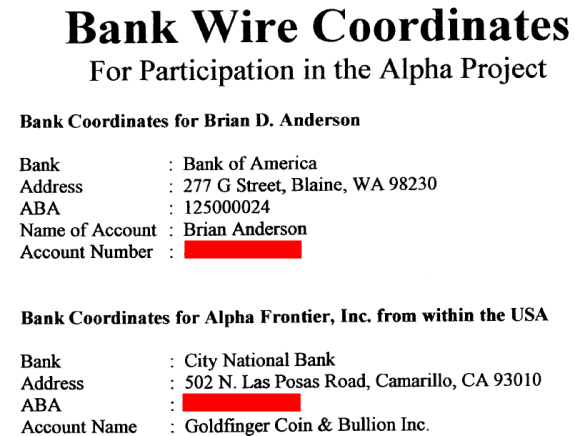
    Why is the document chilling? For starters, its references a bank account held by Goldfinger Coin & Bullion Inc. in Camarillo, Calif. If that name does not ring a bell, think “E-bullion,” the now-shuttered money-exchange business purportedly backed by gold.

    James Fayed, the operator of Goldfinger and E-Bullion, was charged in 2008 with operating an unlicensed money-transmitting business. Investigators said E-Bullion had been used to transact at least $20 million in Ponzi scheme payments.

    During the same general time period in 2008, the SEC was conducting a Ponzi scheme investigation into a separate company known as Gold Quest International (GQI), which used E-Bullion and claimed to be registered in Panama.

    GQI operated from Las Vegas. It initially tried to claim that it was immune to U.S. law because of links to a “sovereign” Indian tribe. GQI was charged in May 2008 by the SEC with operating a Ponzi scheme. The purported “attorney general” of the purported “sovereign” tribe reacted by trying to file a lawsuit against the SEC for the preposterous sum of $1.7 trillion. A federal judge was not amused, and struck the bizarre filings.

    Woman Stabbed To Death

    On July 28, 2008, Pamela Fayed — James Fayed’s estranged wife — was brutally murdered in a parking garage in California. She was stabbed in the chest, neck and face — and left to die, according to court filings. Prosecutors said there was no evidence of robbery or carjacking. The murder, according to court filings, occurred just minutes after a meeting Pamela attended with her criminal attorney and her husband’s criminal attorney.

    James Fayed was present at the meeting, according to court filings. A meeting with separate attorneys — this one involving a divorce hearing — had been scheduled for the next day, July 29, 2008. Prosecutors said that James Fayed was at risk of being ordered to turn over nearly $1 million to Pamela at the divorce proceeding.

    Pamela had advised the government in June 2008 that she wished to cooperate in its criminal investigation of E-Bullion, according to prosecutors.

    “Pamela’s murderer left the crime scene in a red SUV that was captured on surveillance video, along with its license,” prosecutors said. “The license was traced to Avis car rentals in Camarillo, not far from [the] defendant’s business. The vehicle had been rented from Avis on July 3, 2008 using an American Express card issued to defendant and GCB.

    “An American Express credit card with the same account number was found in defendant’s wallet during a search of his residence in the days following Pamela’s murder. During the search of defendant’s residence, officers also found approximately $60,000 in cash wrapped in plastic material; approximately $3,000,000 in gold; and approximately 31 firearms, including one with a long-range night vision scope, along with thousands of rounds of matching ammunition,” prosecutors alleged.

    Prosecutors also alleged James Fayed arranged for the July 28 meeting to create an alibi.

    Read a court filing in the federal case against James Fayed in which prosecutors alleged he operated an unlicensed money-transmitting business. The filing references the alleged murder plot.

    Murder Charges Filed

    James Fayed and an employee — Jose Luis Moya — were charged by the Los Angeles District Attorney’s office with murder and a conspiracy plot in September 2008. Fayed paid Moya “approximately $25,000 to arrange the murder of Pamela Fayed,” investigators said.

    On July 3, 2008, investigators said, “Fayed and his company — Goldfinger, Inc. — rented a Suzuki sport utility vehicle that was used by the killers at the Watt Tower parking garage where Pamela Fayed was killed.

    “The Suzuki SUV was driven to Fayed’s Ventura County ranch on Happy Camp Road after the killing,” according to investigators. Moya returned the vehicle to Avis the next day.

    OSC Document Outlined Purported Anderson/E-Bullion Meeting In 2003

    The OSC document filed in Canada is important — and we suggest you read every word of it from the link below — because exhibits in the document show the murkiness and just plain creepiness of the HYIP and Ponzi worlds. One exhibit suggests Anderson planned to meet with Fayed and his wife in 2003 to discuss business.

    The document also references Alishtari and FEDI, claiming an investment program was backed by $125 billion in gold. Among other things, the document lists the name of Goldfinger Coin & Bullion and an account number, along with directions on how to open an E-Bullion account.

    Screen shot: From exhibit in 2003 OSC filing.

    Also included in the document is a purported joint-venture agreement marked “STRICTLY CONFIDENTIAL” that purportedly was used by Anderson to recruit investors into an international fraud scheme.

    Parallels To AdSurfDaily Case

    Parts of the document include claims very similar to claims made by promoters of the alleged AdSurfDaily (ASD) Ponzi scheme in the United States. Anderson, for example, was positioned as a “very successful business executive” who attended a function to observe Alishtari receive an award “for Republican Business Man of the Year for the State of New York.” Similar claims were made about ASD President Andy Bowdoin.

    Investor payouts, according to an exhibit in the OSC document, were called “rebates.” ASD, whose assets were seized by the U.S. Secret Service in August 2008 amid Ponzi allegations, also called its payouts “rebates.” Exhibits in the OSC document were thick with references to God and family — another similarity to the ASD case.  Anderson’s efforts to promote the program were deemed “heroic,” and business was conducted in part from Boca Raton, Fla. ASD was thick with Florida members.

    In a purported email from Anderson dated April 17, 2003, according to an exhibit within the OSC document, Anderson laid out the case for the new venture.

    “Dear Family,” the email began. Chillingly, the email appears to reference Pamela Fayed, allegedly murdered by her husband and conspirators five years later. The email suggests there once were happy days between the Fayeds.

    “I am very pleased that my recommendations and leg work have paid off and the Alpha Project will be merging its gold value/currency transfer through E-Bullion,” the email purportedly sent by Anderson claimed.

    “E-Bullion is owned by a wonderful couple who have their roots in Egypt and, therefore, are Arab in descent. I will be spending personal time with them on Monday in California.”

    Screen shot: Exhibit of purported Anderson email in 2003 OSC filing.

    The email, which discusses a trip to Panama, promised investors an “offshore” company and outlined a plan to sell “debit cards” through vending machines that would be positioned in posts offices, hotels and college buildings.

    Put “$20 into a vending machine and the machine spits out a loaded Debit card for you,” the email said. “Now you can begin to see why the Alpha Project in will in time be another Microsoft in size.”

    Claims in HYIP and Ponzi schemes that a company is destined to become the “next” Microsoft or Google are common. Beyond that, the use of debit cards in the murky HYIP and autosurf words is becoming increasingly popular — as are appeals for investors to entrust funds to “offshore” businesses, amid claims that such businesses are outside the reach of U.S. law enforcement.

    Read the OSC document from 2003.

  • Receiver In Gold Quest International Ponzi Scheme Case Settles With Charles Capps Ministries For $100,000; Other GQI Money Is Part Of California Homicide Investigation

    breakingnewsAll that glitters was not gold in the seedy world of Gold Quest International (GQI), according to the receiver in the GQI Ponzi scheme case.

    Corrupt money was given to a ministry in the form of a gift, and other corrupt money is part of a homicide investigation in Los Angeles, according to court filings.

    Receiver Larry Cook has informed a federal judge that he has accepted a settlement of $100,000 from Charles Capp Ministries, saying the Oklahoma-based Christian organization unwittingly received fraudulent transfers of “at least” of $201,517 between January 2006 and August 2008 from the Ponzi scheme, according to court filings.

    “No allegations of fraud or securities violations were alleged against Charles Capps Ministries in the complaint filed by the SEC in this action,” Cook said. “Based on the information and belief of the receiver, Charles Capps Ministries was the unwitting recipient of investor funds from Defendant David Greene. Upon learning of the source of the funds it received from Greene, Charles Capps Ministries agreed to return the $100,000 settlement amount.”

    David Greene also is known as “Lord David Greene.” He is one of four named defendants in the SEC case. The others are GQI, John Jenkins and Michael McGee. The SEC filed the action in May 2008, and was hit almost immediately with a bizarre effort to undermine the prosecution.

    A litigant purporting to be the “attorney general” of a purported “sovereign” Indian tribe attempted unsuccessfully to file a lawsuit against the SEC for $1.7 trillion for enforcing securities laws. The GQI entity may have links to an extremist group — The Little Shell Pembina Band of North America — monitored by the Anti Defamation League.

    The ‘Goldfinger’ Murder

    Cook, who performed an international paper chase in the GQI case, further informed the judge that certain GQI assets are tied up in a homicide investigation in California.

    “The owner of E-Bullion was arrested in August 2008 for arranging the murder of his wife, a co-owner of E-Bullion,” Cook said. “The Receiver and the Commission have made numerous inquiries regarding future access to the E-Bullion business records and funds, and we have been advised the U.S. Attorney’s office has not made a decision on when or how these records and funds will be administered.”

    E-bullion co-founder James Fayed, 46, was charged with murder by the Los Angeles District Attorney’s office in September 2008. Prosecutors said he paid Jose Luis Moya, 49, a sum of $25,000 to arrange the murder of his wife, Pamela Fayed. The case has been dubbed the “Goldfinger Murder” in California.

    E-bullion was one of the payment processors used by GQI, which the SEC says operated a $28 million Ponzi scheme with Panamanian registration from Las Vegas. GQI purported to be immune from U.S. law because it was part of a “sovereign” Indian tribe in North Dakota.

    More than 2,100 investors from the United States and Canada participated in GQI. Participants perhaps received as much as $19 million in Ponzi payments, according to investigators in the United States and Canada.

    Cook reported that he had recovered only $389,145.57 to date by tracking money all over the world. Much of the money simply disappeared after making its way to New Zealand, he said.

    “Defendant David Greene has testified that he believed that GQI was going to pay investors the returns promised to them via the profits earned by GQI’s investments in Topaz Group Ltd., an entity based in New Zealand,” Cook said. “The Receiver has identified approximately $3.15 million in payments to Topaz Group from the Tri Fund Inc. account, David Greene[‘s] personal account, and John Jenkins[‘] personal account.

    “The Receiver identified and contacted the owner of Topaz Group Ltd., John Davies, in New Zealand,” Cook continued. “Davies advised the Receiver that the funds he received from David Greene were sent to him on behalf of David Greene. Davies stated that Greene always represented that the investment was Greene’s personal investment and it was not until February 2008 that Greene disclosed the funds belonged to an investment group. Davies stated the funds were not for a specific investment, but were used to fund the expenses of individuals working in Europe to complete various banking transactions that were scheduled to close and pay large profits. Davies further stated that none of these transactions were successful.

    “The Receiver, with the Commission’s assistance, has obtained copies of the Topaz Group Ltd. bank account records in New Zealand,” Cook said. “The Receiver has examined and analyzed this account and determined the majority of the funds transferred by Greene to Topaz were immediately transferred from the Topaz Group business account to the account of Wendy Smurthwaite Davies, the wife of John Davies. A small percentage of the funds Greene sent to Topaz were wired to the individuals identified by John Davies as working on the banking transactions in Europe, and the remainder appear to be used for Topaz Group’s miscellaneous expenses.

    “The Receiver and the Commission have participated in conference calls with the New Zealand law enforcement authorities,” Cook said. “The Receiver has provided the New Zealand investigators with information concerning transfers of investor funds from Defendants Greene and Jenkins to Topaz Group Ltd.”

    For additional information see this document from the Alberta Securities Commission.

    See this filing by the SEC.

    Cook also is the receiver in the case against Affiliate Strategies Inc., the parent company of the Noobing autosurf. Noobing pitched itself to individuals with hearing impairments.