Tag: Paul R. Burks

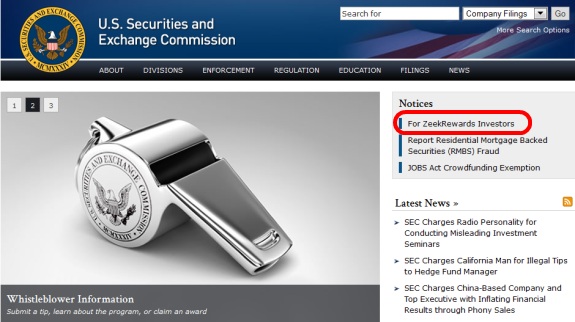
  • UPDATE: Zeek Case Gets Top Billing On SEC Website Today; Agency Establishes Information Page

    The SEC has established an information page for victims of the alleged Zeek Rewards Ponzi- and pyramid scheme. The Zeek case, which may affect up to 2 million individuals, is spotlighted today on the SEC's main webpage.

    Information for victims of the alleged Zeek Rewards Ponzi scheme is getting top billing on the SEC’s website today, and the agency has established a webpage for Zeek victims.

    Here is that page, which includes a link to the website of the court-appointed receiver. Kenneth D. Bell is filling that role. Visit the receiver’s website.

    Zeek was operated by Paul R. Burks and Rex Venture Group LLC of Lexington, N.C. The SEC described Zeek as a $600 million Ponzi- and pyramid that operated online.


  • The Bizarre Wordplay Of ‘ProfitClicking’

    “25. Individual PC members are not responsible for the performace [sic] of PC or any other programs, products, and services provided by PC. Individual PC members, including those who introduce, sponsor, or refer other members, incur no liabilities or obligations in respect of PC’s financial decisions and directions and any other programs, products, and services launched.”From the ProfitClicking Terms of Service, Sept. 3, 2012

    ProfitClicking, the nascent follow-up scam to JSS Tripler/JustBeenPaid that surfaced last month amid claims of the sudden retirement of purported JSS/JBP operator Frederick Mann, appears to be trying to tell affiliates that they’ll incur no liability for promoting the “program.”

    And even as it does this, ProfitClicking is disclaiming any liability on the part of the “opportunity”:

    “Participants agree to hold the ProfitClicking! owners, managers, and operators harmless in respect of any losses incurred as a result of participation in any activity related to ProfitClicking!” the “opportunity” claims in its Terms.

    The development occurs on the heels of the collapse of Zeek Rewards, which the SEC described as a $600 million Ponzi- and pyramid scheme that recruited investors by making them believe they’d joined a sort of online nirvana that provided a return of 1.5 percent a day. Zeek’s Aug. 17 collapse already has triggered at least two class-action lawsuits, the appointment of a receiver who has signaled he’ll pursue winners for ill-gotten gains and the seizure of Zeek-related money by the U.S. Secret Service.

    Like JSS/JBP before it, highly secretive ProfitClicking plants the seed that it will pay even more than Zeek.

    One of the Zeek-related, class-action lawsuits is targeted at Zeek operator Paul R. Burks and 10 “John Does,” meaning the plaintiffs are targeting individuals believed to have profited from the alleged Zeek Ponzi scheme or perhaps helped Burks pull off the scam.

    Given that disclaimer language never has succeeded in warding off a fraud prosecution or private lawsuit in HYIP Ponzi land, ProfitClicking’s words aimed at insulating itself are virtually meaningless. Whether ProfitClicking actually believes it can provide legal cover for its pitchmen is unclear. What is clear is that the ProfitClicking Terms — like the JSS/JBP Terms before it — read like an invitation to join an international financial conspiracy.

    If you’re a ProfitClicking promoter, good luck at your deposition in the post-AdSurfDaily*, post-Legisi**, post-Pathway To Prosperity*** and post-Zeek era when a private attorney or lawyer for the government asks you why you were promoting a “program” that advertised a return in the hundreds of percent per year and made you affirm you were not with the “government.”

    Some highlights from the ProfitClicking Terms (italics added):

    6. I affirm that I am not an employee or official of any government agency, nor am I acting on behalf of or collecting information for or on behalf of any government agency.

    7. I affirm that I am not an employee, by contract or otherwise, of any media or research company, and I am not reading any of the PC pages in order to collect information for someone else.

    22. It is your responsibility to check your payment system accounts to be sure you actually received all payments that you should have received. Because certain payments are made member to member in PC, the PC system cannot confirm that any payments between members were actually made.

    24. In the event of a disagreement between two members regarding payments, it is the responsibility of the members involved to resolve the disagreement. The PC managers hold no responsibility at all in such scenarios.

    Here’s one way to read the Terms: Either ProfitClicking or its affiliates can rip you off — and there’s not a damned thing you can do about it.

    With Zeek’s Paul Burks confronting litigation on at least three fronts and with “John Does” being part of the mix, ProfitClicking’s words are just more HYIP drivel.

    * ASD operator Andy Bowdoin was sentenced to 78 months in federal prison for his Ponzi scheme.

    ** Legisi operator Gregory McKnight faces sentencing Sept. 11 for his Ponzi scheme. Legisi pitchman Matt Gagnon, meanwhile, faces civil judgments in the millions of dollars, along with a criminal charge.

    *** Pathway To Prosperity’s alleged operator Nicholas Smirnow is listed by INTERPOL as an international fugitive.

  • Zeek Operator Paul R. Burks Was Cooperating With SEC Prior To Date Of Ponzi Complaint, New Filing Suggests

    Paul R. Burks, the operator of Zeek Rewards, was cooperating with the SEC prior to the filing of the Aug. 17 complaint that alleged Zeek was a $600 million Ponzi scheme and pyramid fraud, a new court filing suggests.

    That “period of cooperation” resulted in the production of “hundreds of thousands of documents, including financial records, e-mails, and all manner of electronic files,” according to the filing by Noell P. Tin, an attorney for Burks.

    The filing does not specify when the cooperation began or say whether others inside of Zeek knew that the SEC had access to Zeek records prior to the filing of the complaint and a freeze on the assets of Zeek’s parent company, Rex Venture Group LLC. But it may explain at least in part why Burks agreed to settle the case without admitting or denying the allegations and to cooperate with Kenneth D. Bell, the court appointed receiver: The SEC effectively already had been inside the company.

    Separately, First Premier Bank of Sioux Falls, S.D., has advised Senior U.S. District Judge Graham C. Mullen of the Western District of North Carolina that it is holding more than $31.2 million in three separate Rex Venture accounts frozen under court order. The largest Rex account at the bank holds more than $30.9 million. A smaller account holds more than $284,000, and the smallest account holds only $90, according to a filing by the bank.

    To date, court filings suggest that Rex Venture has an account at Charles Schwab that holds $10.3 million in cash and more than $4.94 million in securities. The company also has an account at North Carolina-based NewBridge Bank that holds more than $11.64 million.

    Rex Venture also holds an account at Four Oaks Bank & Trust Co. Inc., another bank in North Carolina. The bank has asked the judge to give it until Sept. 3 to say how much it is holding because of the “complexity of the financial information that must be analyzed and the need to obtain relevant information from a third party.”

    All in all, the SEC said on Aug. 17 that the Burks-controlled entities used 15 foreign and domestic financial institutions.

    Burks’ personal assets were not frozen in the Aug. 17 SEC action, and the accused Ponzi schemer wants to keep it that way, according to court filings.

    “There is no basis and no need to freeze Mr. Burks’ personal funds,” his attorney wrote in response to a motion by Bell that raised the possibility that “Recoverable Assets” were controlled by Burks and his family. “Mr. Burks has never expatriated the assets of Rex Ventures Group, LLC or his personal money. He has fully cooperated in the SEC investigation, which included examination of relevant financial records. He is 65 years old, married, a two time cancer survivor, and has lived in Lexington, North Carolina for 23 years. He has never been a defendant in any action, civil or criminal, until this matter. Mr. Burks is aware of the importance of this proceeding and will abide by any orders this Court imposes.”

    One of the remaining mysteries of Zeek is how and when key executives found out about the SEC probe and whether they or other insiders feathered their own nests prior to the collapse.

  • URGENT >> BULLETIN >> MOVING: Charles Schwab Accounts Holding Nearly $18.6 Million In Name Of Accused Zeek Operator Paul Ray Burks Or Rex Venture Group Have Been Frozen

    URGENT >> BULLETIN >> MOVING: (UPDATED 12:16 P.M. EDT (U.S.A.) The office of the corporate counsel for Charles Schwab in San Francisco has informed a federal judge that it is holding almost $18.6 million in two accounts linked to the alleged Zeek Rewards’ Ponzi scheme.

    One of the accounts is in the name of Rex Venture Group LLC and has more than $10.3 million in cash and more than $4.94 million in securities, according to court filings. Rex Venture is Zeek’s purported parent company.

    The second Schwab account, meanwhile, holds more than $2.3 million in cash and more than $1.3 million in securities, Schwab informed the court. The second account is in the name of Paul Ray Burks, Zeek’s alleged operator.

    Schwab has “frozen” the assets in both accounts under court order, the firm said in a court filing.

    Separately, North Carolina-based NewBridge Bank has certified in court filings that it is holding more than $11.64 million in an account under the name of Rex Venture Group LLC, Zeek’s purported parent company. Zeek announced suddenly on May 28 (Memorial Day) that it was closing its NewBridge account and advised members to cash checks before June 1 or they would bounce.

    Why so much money remained in the account was not immediately clear.

    Other court filings suggest that Rex Venture also had money on deposit at Four Oaks Bank & Trust Co. Inc., a bank in North Carolina. Four Oaks has asked the court to give it until Sept. 3 to comply with an order to specify precisely how much Rex had on deposit at the institution.

    Extra time was needed because of the “complexity of the financial information that must be analyzed and the need to obtain relevant information from a third party,” the bank informed the court.

    Four Oaks did not identify the third party.

    When the U.S. Secret Service brought the AdSurfDaily Ponzi case in 2008, it was discovered ASD President Andy Bowdoin had more than $65.8 million in 10 personal bank accounts.

    On Aug. 17, the SEC alleged that Zeek was a massive Ponzi- and pyramid scheme that had gathered about $600 million.

    ASD operator Andy Bowdoin is scheduled to be sentenced tomorrow on a charge of wire fraud.

    Zeek is known to have members in common with ASD. The U.S. Secret Service also is investigating Zeek.


  • JSS Tripler/JustBeenPaid Hides Behind Zeek-Like Wordplay On Eve Of Zeek Collapse

    Frederick Mann

    On Aug. 17, the SEC filed spectacular allegations of Ponzi- and pyramid-scheme fraud against Zeek Rewards, which claimed it was not selling securities and members were not making an investment. Zeek operator Paul R. Burks was charged with selling unregistered securities as investment contracts.

    Zeek abused the power of the Internet and raised $600 million from more than 1 million participants, the SEC charged

    In August 2008, the U.S. Secret Service filed similar allegations against AdSurfDaily, a company with a 1-percent-a-day “program” similar to Zeek. Like Zeek, ASD claimed it was not selling securities and members were not making an investment. ASD operator Andy Bowdoin was indicted in November 2010 on charges of selling unregistered securities, securities fraud and wire fraud.

    Bowdoin later acknowledged he was presiding over a Ponzi scheme that had gathered at least $110 million.

    On Aug. 16 — just one day before the SEC went to court to halt the operations of Zeek — a “program” known as JSS Tripler/JustBeenPaid was clinging to its Zeek- and ASD-like cover story that it was not selling securities and members were not making an investment. JSS/JBP effectively has advertised a return of 2 percent a day: 730 percent a year.

    “I just want to know — in the amount of money that I do invest . . .  use to buy positions, is that . . . the investment that I’m doing?” a caller quizzed Frederick Mann, JSS/JBP’s purported operator.

    “Dale,” JSS/JBP’s female conference-call host, then sought to set the caller straight on the wordplay of JSS/JBP.

    “Well, first of all, we’re not investing here. We’re purchasing and we’re repurchasing. So, you need to get that verbiage clear.”

    The SEC moved against Zeek the very next day. The U.S. Secret Service also is investigating Zeek.

    Mann was a former pitchman for ASD’s scheme. Any number of Zeek members also promoted JSS/JBP.

    Bowdoin pleaded guilty to wire fraud in May 2012. He is scheduled to be sentenced Aug. 29.

    Like Zeek, JSS/JBP says it has more than 1 million members. Like Legisi, another HYIP scam broken up by the SEC and the Secret Service, JSS/JBP makes members affirm they are not with the government.

    Legisi operator Gregory McKnight pleaded guilty to wire fraud earlier this year. He faces sentencing Sept. 11.


  • NORTH CAROLINA ATTORNEY GENERAL WARNS: Watch For ‘Reload Scams’ In Wake Of Zeek Collapse

    UPDATED 4:06 P.M. EDT (U.S.A.) It happened after the collapse of AdSurfDaily in 2008 — and it’s happening now in the aftermath of the collapse of Zeek Rewards amid spectacular allegations by the SEC Friday of Ponzi and pyramid fraud.

    The office of North Carolina Attorney General Roy Cooper issued a warning minutes ago about “reload scams” aimed at taking advantage of Zeek victims.

    Here is the warning in its entirety (italics added):

    Reload scams hit consumers when they’re down, offering to help them make back money they lost to a previous scam or bad business decision. These scams have been popular for years with telemarketing fraud rings but can also follow other types of fraud.

    We’re now seeing reload scams seeking to recruit consumers who were members of Zeekler, a penny auction website headquartered in North Carolina that shut its doors last week and entered into a settlement with the U.S. Securities and Exchange Commission. The SEC determined that Zeekler was a Ponzi scheme, using money from later investors to pay back earlier investors until the scheme started running out of money. The Attorney General’s Office is continuing to investigate Zeekler.

    Blogs, news releases online, and individuals leaving comments in articles about the Zeekler shut down are already touting opportunities “for those that are looking for something that can help them replace the income they were receiving from Zeek Rewards.”  If you’ve been a part of a scheme such as Zeekler that collapsed, or if you lost money to another recent scam, don’t fall for a reload scam.  Better to cut your losses than lose even more.

    The exact phrase quoted by Cooper’s office in the paragraph above appears in a news release for something called TheMayDayReport.

    The SEC called Zeek a $600 million Ponzi- and pyramid scheme that had affected more than 1 million investors. Cooper’s office opened a probe into Zeek in July, and the U.S. Secret Service also is investigating Zeek.

    Over the weekend, the PP Blog received multiple spams aimed at Zeek threads. Purportedly from “Briant,” those spams promoted a “program” called Ultimate Power Profits. Like Zeek, Ultimate Power Profits has a presence on well-known Ponzi scheme forums such as MoneyMakerGroup.

    Zeek’s former head cheerleader at MoneyMakerGroup — “mmgcjm” — also is the head cheerleader for Ultimate Power Profits at the forum.

    On Friday — the same day of the Zeek collapse — an MLM “program” known as Vi-Tel Wireless (Vi-Tel) issued a news release to announce it was sponsoring a “Zeek Rescue Program.” Affiliates busied themselves heralding the purported rescue program across the web.

    Vi-Tel called itself a “safe refuge.” Vi-Tel affiliates aimed sales pitches at websites carrying information on Zeek, leading to questions about whether reps were circling like vultures.  It was remarkably awful PR.

    In other post-Zeek news, an auction “program” known as Bidify now is offine. The company says it is trying to retool itself in the aftermath of the Zeek collapse.

    Like Zeek prior to the collapse, Bidify denies it is an investment program.

    Zeek, Rex Venture Group LLC and operator Paul Burks were charged Friday with selling unregistered securities as investment contracts.

  • URGENT >> BULLETIN >> MOVING: SEC Calls Zeek ‘$600 Million Online Pyramid And Ponzi Scheme’

    URGENT >> BULLETIN >> MOVING: (UPDATED 6:25 P.M. EDT (U.S.A.) The SEC has filed an emergency action in federal court in Charlotte, N.C., that alleges Zeek Rewards is a $600 million Ponzi and pyramid scheme.

    “The obligations to investors drastically exceed the company’s cash on hand, which is why we need to step in quickly, salvage whatever funds remain and ensure an orderly and fair payout to investors,” said Stephen Cohen, an associate director in the SEC’s Division of Enforcement. “ZeekRewards misused the power of the Internet and lured investors by making them believe they were getting an opportunity to cash in on the next big thing. In reality, their cash was just going to the earlier investor.”

    In its emergency filing, the SEC described Zeek as a classic Ponzi scheme. The agency charged that “approximately 98% of ZeekRewards’ total revenues, and correspondingly the purported share of ‘net profits’ paid to current investors, are comprised of funds received from new investors.”

    Records show that the AdSurfDaily Ponzi scheme which, like Zeek, suggested that investors would receive a return on the order of 1 percent a day, also received only about 2 percent of its revenue from sources other than members. Zeek had members in common with ASD.

    Zeek, the SEC alleged, “is teetering on collapse.”

    Zeek CEO Paul R. Burks has been charged with selling unregistered securities as investment contracts, the SEC said. Burks presided over Rex Venture Group LLC, Zeek’s purported parent company. Rex Venture also has been charged. The SEC said it was aided in the probe by the Quebec Autorite des Marches Financiers and the Ontario Securities Commission.

    Burks’ program holds “approximately $225 million in investor funds in approximately 15 foreign and domestic financial institutions, and those funds are at risk of imminent dissipation and depletion,” the SEC charged, noting that the Ponzi potentially could affect more than 1 million people globally.

    A federal judge has ordered an emergency asset freeze and a receiver will the appointed, the SEC said.

    “Through the ZeekRewards program, Defendants offer affiliates several ways to earn money, two of which involve the offer and sale of securities in the form of investment contracts: the ““Retail Profit Pool” and the “Matrix,” the SEC charged.

    And, the agency said, the “compounding” effect has created a condition under which 3 billion Zeek “Profit Points” are outstanding.

    “Based on the ZeekRewards current outstanding Profit Point balance, the company would be obligated to pay out approximately $45 million per day if all Qualified Affiliates elected to receive their daily award in cash,” the agency charged.

    Amid Zeek claims that it paid out 50 percent of its daily net and that its business model was “proprietary,” investigators discovered that Zeek delivered an unusually consistent return of about 1.5 percent a day.

    “In fact, the dividend bears no relation to the company’s net profits,” the SEC charged. “Instead, Burks unilaterally and arbitrarily determines the daily dividend rate so that it averages approximately 1.5% per day, giving investors the false impression that the business is profitable.

    Similar allegations were made in 2008 against ASD operator Andy Bowdoin.

    Zeek’s fabled Zeekler “bids” were described by the SEC as smoke-and-mirrors. From the complaint (italics added):

    Despite encouraging affiliates to purchase and give away VIP Bids to promote and drive traffic to the Zeekler penny auction website, Defendants fail to disclose that almost none of the VIP Bids given away by Qualified investors are actually used on the Zeekler penny auction website. Of approximately 10 billion VIP Bids purchased by or awarded to investors, less than one-quarter of one percent have been actually used in auctions on the Zeekler penny auction website. Thus, the VIP Bids do little or nothing to actually promote the retail business.

    Zeek operator Burks, meanwhile, “has withdrawn approximately $11 million while operating Rex Venture and ZeekRewards, of which approximately $4 million remains in his possession, custody or control.

    Burks “distributed approximately $1 million of the funds garnered from ZeekRewards to family members,” the SEC said.

    Amid high drama and confusing website reports from Zeek yesterday, including the virtual abandonment of its office in Lexington, N.C., and petition drives by Zeek affiliates to demand the return of Zeek, it turns out that “Burks has agreed to settle the SEC’s charges against him without admitting or denying the allegations, and agreed to cooperate with a court-appointed receiver,” the SEC said.

    The U.S. Secret Service also is investigating Zeek, as is the office of North Carolina Attorney General Roy Cooper.

    Read the SEC complaint.
  • URGENT >> BULLETIN >> MOVING: U.S. Secret Service Confirms Probe Of Zeek Under Way

    URGENT >> BULLETIN >> MOVING: Zeek Rewards, the multilevel marketing program married to the penny-auction site Zeekler, is under investigation by the U.S. Secret Service and the Securities and Exchange Commission, the Secret Service confirmed at 4:14 p.m. EDT today.

    “There will be no further comment,” said Max Milien, a spokesman for the U.S. Secret Service in Washington.

    The Secret Service leads a multiagency electronic crimes Task Force in Charlotte, N.C. The Charlotte Task Force is known by the acronym CMECTF.

    Zeek, part of Rex Venture Group LLC, is based in Lexington, N.C. Paul R. Burks is Zeek’s chief executive officer.

    The Zeek probe is not the first investigation of its sort in which the Secret Service and the SEC looked into the business practices of online schemes that suggest or promise outsize investment returns. A probe of the Legisi HYIP began in 2007 with an undercover investigation by the Secret Service and state securities regulators in Michigan.

    That probe later led to civil charges brought by the SEC and criminal charges brought by the Secret Service.

    Legisi operator Gregory McKnight pleaded guilty to wire fraud earlier this year. He is scheduled to be sentenced next month. Legisi gathered more than $72 million.

    The Secret Service also led the AdSurfDaily Ponzi probe. ASD President Andy Bowdoin is scheduled to be sentenced Aug. 29.

    ASD was a 1-percent-a-day Ponzi scheme that gathered at least $110 million. Zeek Rewards has a similar business model.

    See earlier story.

  • UPDATE: North Carolina Investigators Demanded Info From Zeek On July 6; State Says It Has Not Taken Shutdown Action

    UPDATED 10:58 A.M. EDT (U.S.A.) Two new details have emerged in the mysterious shutdown yesterday of the office and websites of Zeekler/Zeek Rewards: The office of North Carolina Attorney General Roy Cooper told the PP Blog this morning that it has taken no action to shut down Zeek, the operator of an MLM and a penny-auction site.

    “We have not taken action to shut the company down and are currently working to get more information so we can pass that along to consumers who may be impacted by this,” said Noelle Talley, a spokeswoman for Cooper.

    But Cooper’s office did say that it had issued a Civil Investigative Demand (CID) to Zeek on July 6. That’s weeks earlier than initially believed and leads to questions about whether Zeek had known for five weeks that it had been under investigation and did not inform participants.

    Without providing details, Zeek announced on its Blog yesterday that it had canceled its Aug. 22 “Red Carpet” event. By early evening, the Zeek Rewards and Zeekler sites began to publish this message: “Zeek Rewards is currently unavailable. More information will be available shortly on this website.”

    Earlier in the week, Zeek announced that “there won’t be any training, recruitment or leadership calls for the next few days while planning is going on.”

    With Zeek leaving affiliates in an information vacuum, many of them took to the Web. At least two petition drives appear to be under way demanding the government to reopen Zeek. As of the time of this post, the PP Blog has been unable to confirm that an action by any government agency — state or federal — was responsible for Zeek’s sudden absence.

    The Blog still is in the process of trying to piece together events in what has emerged as a bizarre and fluid situation. Sensing Zeek affiliates were vulnerable, some MLM opportunists raced to various sites such as The Dispatch newspaper in North Carolina and YouTube with offers to join their “programs.”

    Zeek fans on the MoneyMakerGroup Ponzi forum almost immediately blamed critics for Zeek’s problems, with one poster declaring he’d already mined his profits from Zeek and was confident they could not be attached by prosecutors in the United States.

    The Better Business Bureau said this morning that it was aware of reports that the doors at Zeek’s office in Lexington, N.C., were closed. The BBB added that it would publish more information as it became available.

    Zeek is a purported arm of Rex Venture Group LLC, led by Paul R. Burks.

  • BULLETIN: Zeek Asked To Supply ‘Documents’ To North Carolina Attorney General’s Office; ‘Concerns’ Over Zeek ‘Continue,’ Agency Says

    “The complaints generally seek refunds and say the company has not lived up to its promises.” Office of North Carolina Attorney General Roy Cooper, Aug. 7, 2012

    BULLETIN: The Zeek “program” that marries an MLM scheme (Zeek Rewards) to a penny-auction site (Zeekler) is the subject of a state examination by the office of Attorney General Roy Cooper, the agency said this morning.

    Cooper’s office did not provide specifics on what the examination would entail, but Zeek has been asked to provide “documents,” said Noelle Talley, a spokeswoman for Cooper.

    “I can tell you that we continue to have concerns about Zeek Rewards and have asked the company to provide us with documents so we can examine its business practices,” Talley said.

    Cooper’s office first expressed those concerns publicly in June, after Zeek’s Blog linked to a television station’s report that suggested Zeek had been deemed legal. No such determination had been made, Cooper’s office said at the time.

    Meanwhile, Talley said Cooper’s office had set up “a recorded message about Zeek Rewards.”

    Such recordings typically are made “when we get a high volume of calls about a particular issue or company,” Talley said.

    News about the Zeek examination occurred against the backdrop of a Saturday (Aug. 4) Blog post by Zeek that blasted unspecified “North Carolina Credit Unions” for expressing concerns about the company to Zeek customers. Zeek is a a purported arm of Rex Venture Group LLC. Paul R. Burks is the chief executive officer of Zeek.

    Talley declined to comment when asked about whether Cooper’s office was aware of Saturday’s post on the Zeek Blog, which accused the credit unions of slander and implied Zeek would penalize members who questioned the company in public.

    But Talley did note that Cooper’s office had received complaints about Zeek and that “[t]he complaints generally seek refunds and say the company has not lived up to its promises.”

    Zeek plants the seed that participants can receive a daily return of between 1 percent and 2 percent, but denies it is offering an investment program. The company also denies it is operating a “pyramid scheme.”

    “Programs” such as AdSurfDaily have made similar claims and have had a similar payout scheme. ASD was accused in 2008 by the U.S. Secret Service of operating a massive online Ponzi scheme that had gathered $110 million and operated across national borders. ASD President Andy Bowdoin pleaded guilty to wire fraud in May 2012. Zeek is known to have promoters in common with ASD, a company that became engulfed in both civil and criminal litigation.

    In 2009, Bowdoin was sued by some of his own members under the federal racketeering statute. That lawsuit was placed on hold because of all the other litigation piling up around ASD, which was named in at least three federal forfeiture actions and was the subject of a federal grand-jury investigation in the District of Columbia that led to the indictment of Bowdoin on charges of wire fraud, securities fraud and selling unregistered securities.

    Like ASD, Zeek has a presence on forums referenced in federal court filings as places from which Ponzi schemes are promoted. Some Zeek members are promoting JSSTripler/JustBeenPaid, a “program” that claims it provides a return of 60 percent a month and may have ties to the “sovereign citizens” movement.

    Consumers can access the state’s recorded message about Zeek by calling 919-716-6046.

    Talley provided this transcript of the recording (italics added):

    Thank you for calling the North Carolina Attorney General’s Consumer Protection Division about Zeek Rewards.  We cannot tell you whether or not to invest or participate in Zeek Rewards or any other company. 

    If you would like to file a complaint with our office, you can either leave a message with your name and address after the beep and we will mail you a complaint form, or you can visit our website at www.ncdoj.gov for an online complaint form. 

    Specific questions about how Zeek Rewards works should be directed to the company itself.  Again, the Attorney General’s Office cannot give you investment or legal advice, and we do not endorse any program or business.  However, we always encourage people to do their own research before investing in any business.  Many people have asked if we have received complaints about Zeek Rewards, and we can confirm that we have received several complaints. Thank you again for contacting our office.

    Zeek has gone viral and is being pitched by some promoters of JSS Tripler/JustBeenPaid, an "opportunity" that purports to provide a return of 60 percent a month.
  • Zeek MLM Chief Keen On Ron Paul For President; Paul Burks Has Ponied Up $2,500; Meanwhile, Zeek Members Say They’re Not Getting Paid For Auction Winnings

    UPDATED 12:27 P.M. EDT (JUNE 12, U.S.A.) Paul R. Burks, the chief executive officer of Rex Venture Group LLC, has made four contributions to the GOP Presidential campaign of Rep. Ron Paul since July 2011, Federal Election Commission records show.

    Rex Venture is the purported parent company of Zeek Rewards, a North Carolina-based MLM program that plants the seed that returns of more than 1 percent a day are possible, and Zeekler, a penny-auction site that is auctioning sums of U.S. currency and curiously says it pays successful bidders through offshore payment processors such as AlertPay (now Payza) and SolidTrustPay.

    Some Zeekler bidders now claim they have not been paid for their winning bids on U.S. currency for weeks or even months. They’re also complaining about slow, absent or circular customer support.

    The Ron Paul 2012 Presidential Campaign Committee Inc. recorded a $500 contribution from Burks on July 19, 2011, another $500 contribution on Aug. 20, 2011, a $1,000 contribution on Sept. 17, 2011 and a $500 contribution on Jan. 14, 2012, according to Federal Election Commission records.

    Rex Venture has scored an “F” rating from the Better Business Bureau, the BBB’s lowest score.

    Zeek insists it is not offering an investment product and has preemptively denied it is operating a pyramid scheme.

    In 2008, an MLM company with a business model similar to Zeek — AdSurfDaily — preemptively denied it was operating a Ponzi scheme. Federal Election Commission and other records showed that ASD President Andy Bowdoin was making campaign donations to the National Republican Congressional Committee in 2007 even as ASD members were complaining about not getting paid.

    In August 2008, the U.S. Secret Service moved to seize $65.8 million from Bowdoin’s bank accounts, saying he was presiding over a massive online Ponzi scheme. Federal prosecutors later accused Bowdoin of making the campaign donations with Ponzi money.

    Bowdoin pleaded guilty to wire fraud in the ASD Ponzi case last month.