Tag: Robert Mueller III

  • SOBERING: Cyber Criminals May Be Responsible For ‘The Greatest Transfer Of Wealth In History,’ Top Justice Department Official Says At Seattle Conference

    “The Intelligence Community’s most recent Worldwide Threat Assessment confirms that U.S. networks have already been subject to ‘extensive illicit intrusions.’ The head of the National Security Agency and the Pentagon’s Cyber Command, for one, believes such intrusions may have resulted in ‘the greatest transfer of wealth in history.’”Lisa Monaco, Assistant Attorney General for National Security, Oct. 25, 2012

    EDITOR’S NOTE: These are remarks prepared for delivery by Lisa Monaco, Assistant Attorney General for National Security, at the “2012 Cybercrime Conference” today in Seattle. Monaco presides over the Justice Department’s National Security Division.

    The conference was hosted by U.S. Attorney Jenny A. Durkan of the Western District of Washington. Durkan’s name may be familiar to longtime PP Blog readers because her office is involved in the prosecution of AdSurfDaily story figure Kenneth Wayne Leaming, a purported “sovereign citizen” charged with filing false liens against five public officials who had roles in the ASD Ponzi prosecution. ASD was a Florida-based online scam that created thousands of victims. Leaming also is accused of uttering a bogus “bonded promissory note” for $1 million and passing it at U.S. Bank, harboring fugitives implicated in a separate fraud scheme and being a felon in possession of firearms.

    ** ______________________________________________ **

    Good afternoon.   Thank you for having me here today.   I am grateful to the U.S. Attorney’s Office for the Western District of Washington and to U.S. Attorney Jenny A. Durkan, for organizing a conference on this important topic.   Thank you all for taking the time out of your schedules to discuss these issues.   Events like these are critical to helping us succeed in combating cyber threats.

    The Threat

    If there is one thing we all know from the presentations today and our work in the field, it is the seriousness of the cyber threat.   The President has called it “one of the most serious economic and national security challenges we face as a nation.”   It’s hard to quibble with that.   Hardly a day goes by when cyber events don’t show up in the news.   As many of you know, over the last several weeks, financial institutions in the United States have been hit by a series of Distributed Denial of Service (or DDOS) attacks.   Such attacks are relatively easy to carry out, but they can cause serious harm by disrupting companies’ website services and preventing customer access.   Although these disruptions have been temporary, their frequency and persistence underscores recent Intelligence Community warnings about the “breadth and sophistication of computer network operations . . . by both state and nonstate actors.”   The cyber alarm bell has been rung.   The Intelligence Community’s most recent Worldwide Threat Assessment confirms that U.S. networks have already been subject to “extensive illicit intrusions.”   The head of the National Security Agency and the Pentagon’s Cyber Command, for one, believes such intrusions may have resulted in “the greatest transfer of wealth in history.”

    We often think of national security threats, like that of a catastrophic terrorist attack, as questions about prevention.   But the cyber threat is not simply looming – it is here.   It is present and growing.   Although we have not yet experienced a devastating cyber attack along the lines of the “cyber Pearl Harbor” that Defense Secretary Panetta recently mentioned – we are already facing the threat of a death by a thousand cuts.   Outside the public eye, a slow hemorrhaging is occurring; a range of cyber activities is incrementally diminishing our security and siphoning off valuable economic assets.   This present-day reality makes the threat of cyber-generated physical attacks, like those that might disrupt the power grid, appear no longer to be the stuff of science fiction.   And all of this comes against the backdrop of sobering forecasts from the highest ranks of our national security community.   FBI Director Mueller – a man not prone to overstatement – predicts that “the cyber threat will pose the number one threat to our country” in “the not too distant future.”

    Despite all we know about intrusions against U.S. businesses and government agencies, what is more sobering still is the Intelligence Community’s assessment that “many intrusions . . . are not being detected.”   Even with respect to those that are detected, identifying who is behind cyber activity can be uniquely challenging.   Technologies can obscure perpetrators’ identities, wiping away digital footprints or leaving investigative trails that are as long as the web is wide.   Cyber intrusions don’t announce themselves or their purpose at the threshold.   Depending on the circumstances, the purpose or endgame of a particular intrusion may be anyone’s guess – is it espionage?   Mere mischief?   Theft?   An act of war?

    The threats are as varied as the actors who carry them out.   A growing number of sophisticated state actors have both the desire and the capability to steal sensitive data, trade secrets, and intellectual property for military and competitive advantage.   While most of the state-sponsored intrusions we are aware of remain classified, the onslaught of network intrusions believed to be state-sponsored is widely reported in the media.   We know the Intelligence Community has noted that China and Russia are state actors of “particular concern,” and that “entities within these countries are responsible for extensive illicit intrusions into US computer networks and theft of US intellectual property.”   Indeed, “Chinese actors are,” according to a public report of our top counterintelligence officials, “the world’s most active and persistent perpetrators of economic espionage.”   And we know that Secretary of Defense Panetta has stated that “Iran has also undertaken a concerted effort to use cyberspace to its advantage.”

    In cases involving state actors and others, trusted insiders pose particular risks.   Those inside U.S. corporations and agencies may exploit their access to funnel information to foreign nation states.   In these cases, perimeter defense isn’t worth much; the enemy is already inside the gates.   The Justice Department has prosecuted a number of corporate insiders and others who obtained trade secrets or technical data from major U.S. companies and routed them to other nations via cyberspace.

    Earlier this year, in the first indictment of foreign state-owned entities for economic espionage, several companies controlled by the government of China were charged in San Francisco for their alleged roles in stealing a proprietary chemical compound developed by a U.S. company for China’s benefit.   While this particular theft was not cyber-enabled, cyberspace makes economic espionage that much easier.   In an Internet age, it is no longer necessary to sneak goods out of the country in a suitcase; a single click of a mouse can transmit volumes of data overseas.   Indeed, the Department has secured convictions of individuals who stole corporate trade secrets by simply e-mailing them overseas.   In one recent case, a chemist downloaded a breakthrough chemical process just developed by his company in the United States and e-mailed it to a university in China where he had secretly accepted a new job.

    The other major national security threat in cyberspace is cyber-enabled terrorism.   Although we have not yet encountered terrorist organizations using the Internet to launch a full-scale cyber attack against the United States, we believe it is a question of when, not if, they will attempt to do so.   Individuals affiliated with or sympathetic to terrorist organizations are seeking such capabilities. We have already seen terrorists exhorting their followers to engage in cyber attacks on America.   Just this year, an al-Qaeda video released publicly by the Senate Homeland Security Committee encouraged al-Qaeda followers to engage in “electronic jihad” by carrying out cyber attacks against the West.

    Terrorists have already begun using cyberspace to facilitate bomb plots and other operations.   These activities go beyond the use of cyberspace to spread propaganda and recruit followers.   For example, the individuals who planned the attempted Times Square bombing in May 2010 used public web cameras for reconnaissance, file sharing sites to share operational details, and remote conferencing software to communicate.   Najibullah Zazi attempted to carry out suicide bomb attacks against the New York subways around the anniversary of 9/11 three years ago.   After returning to the United States from terrorist travel, he used the Internet to access the bomb-making instructions he had received in Pakistan and tried to communicate via the Internet in code with his al-Qaeda handlers in Pakistan just prior to the planned attack.   Khalid Aldawsari, who was convicted in June of this year in the Northern District of Texas, used the Internet extensively to research U.S. targets and to purchase chemicals and other bomb-making materials.

    Evolving To Meet the Threat — Learning from the Counterterrorism Model

    The threats we face in cyberspace are changing, and we must change with them.   Of course, we have faced similar challenges before.   After the devastating attacks eleven years ago, we learned some hard lessons.   We have since put those lessons into practice:   working across agencies to share information, and bringing down legal, structural, and cultural barriers.   Law enforcement’s approach to terrorism has become intelligence-led and threat-driven.   We have erected new structures, including the National Security Division, which I am privileged to lead.   As the first new litigating division at the Justice Department in nearly fifty years, the National Security Division was created to bring together intelligence lawyers and operators on the one hand, and prosecutors and law enforcement agents on the other, to focus all talent on the threats before us.

    Since September 11, we have made great progress against terrorism by developing effective partnerships that help us identify threats and choose the best tools available to disrupt them.   Much of our success is attributable to the all-hands-on-deck approach we have adopted for countering terrorism.   From where I sit, I can see this change reflected in our day-to-day operations.   In our investigations, for instance, we actively seek to preserve the ability to prosecute even while using intelligence tools and vice versa.   We must bring the same approach, a whole-of-government approach, an all-tools approach, to combat cyber threats to our national security.   Investigations and prosecutions will be critical tools for deterrence and disruption, ones that we have a responsibility to use.   But they are not the only options available.   The diversity of cyber threats and cyber threat actors demands a diverse response.   This nation has many tools – intelligence, law enforcement, military, diplomatic, and economic – at its collective disposal as well as deep, and diverse, expertise.   The trick is in harnessing our collective resources to work effectively together.

    Those of us charged with investigating and disrupting cyber threats to national security and advising operators and agents must be creative and forward-looking in our approach.   First, we must consider – in conjunction with our partners – what cyber threats will look like in the coming years.   Only by knowing what is on the horizon can we ensure that the right tools exist to address cyber threats before they materialize.   Second, we must be vigilant to prevent the formation of what the WMD Commission after 9/11 called “legal myths” that have led to “uncertainty” in the past “about real legal prohibitions” among operators.   And, together with operators, we must consider what kinds of tools, investigations, and outreach we can launch now to lay the groundwork for future cyber efforts.   These may be relatively simple things, like standardized protocols and established points of contact to make reporting intrusions easier. Or they may take the form of institutional relationships between the government and the private sector for sharing information.

    On an operational level, both public and private sector attorneys need to be able to tell clients what options they have available to deal with cyber threats.   If cyberspace is an “information super-highway,” then lawyers are the GPS system in a client’s car:   It is our job to tell the client how to get there.   When obstacles get in the way, we should tell the client how to avoid them.   We must look ahead, anticipate jams, and route clients around them.

    This metaphor is particularly applicable in the cyber realm.   As cyber events unfold in real time, we learn more about our adversary, the means available to him or her, and the vulnerabilities in our own systems.   Our advice must adapt accordingly.   For those of us in government who act as operational lawyers, it is important in this environment to be clear about where the legal debate stops and the policy debate begins.   For those of you in the private sector, I imagine one concern is that your clients not be left vulnerable in a shifting legal landscape.   And for those of you in academia, we need your help testing boundaries and pushing forward with questions that need to be asked and answered by all of us as we navigate this legal space together.

    One of the significant operational challenges we face is the same one the Intelligence Community confronted in reorganizing itself after the attacks of September 11.   The cyber threat demands ready and fluid means of sharing information and coordinating our actions.   At the National Security Division, we have made this evolution, and combating this threat, a top priority.   Working with our partners – including the FBI, the U.S. Attorney community, and the Computer Crime and Intellectual Property Section (one of their leaders, Richard Downing is here today) – we are ensuring that all resources are brought to bear against national security cyber threats.

    To help accomplish these goals, the National Security Division established earlier this year a National Security Cyber Specialists’ Network to serve as a one-stop shop in the Justice Department for national security-related cyber matters.   The network brings together experts from across the National Security Division and the Criminal Division and serves as a centralized resource for the private sector, prosecutors, and agents around the country when they learn of national security-related computer intrusions.   Each U.S. Attorney’s office around the country has designated a point of contact for the network.   These skilled Assistant U.S. Attorneys will act as force multipliers, broadening the network’s reach and ensuring a link back to their counterparts at headquarters.   Drawing upon the Joint Terrorism Task Force model, which has been successful in the terrorism realm, the network seeks to improve the flow of national security cyber information to offices throughout the country.   This means more information, earlier on, in national security cyber incidents.   Thanks to the contribution of other parts of the Department, especially CCIPS, the FBI, and the U.S. Attorney’s offices, the network has helped us to focus nationwide on bringing more national security cyber investigations.   Through this nationwide network, we are consolidating and deepening the Department’s expertise, institutionalizing information sharing, ensuring coordination, and pursuing investigations.

    We have also trained our attention on the diverse cyber capabilities that reside throughout the government.   The U.S. Secret Service, the Department of Commerce, and the Department of Defense, not to mention the FBI, are all common partners in this fight, each using their distinct tools to achieve a common goal.   We have enhanced our joint work with the FBI’s National Cyber Investigative Joint Task Force, where we now have a dedicated National Security Division liaison.

    Within DOJ, we are putting more prosecutors against the threat and focusing on how to best equip and educate our cyber cadre.   Through the National Security Cyber Specialists’ Network, we are training prosecutors around the country.   Next month, more than 100 prosecutors will gather in Washington, D.C. to share expertise on everything from digital evidence to the Foreign Intelligence Surveillance Act.   No matter who the perpetrator is, being an effective adviser today requires an understanding of the technologies at hand.   Perhaps we should all take a page from Estonia—where I understand they’re beginning a system of teaching first graders how to program!   As courts confront these technologies, we also have a role in helping them grapple with what these changes mean for the development of the law and interpretations of existing legal authorities.

    Partnership with the Private Sector

    Of course, the need for collaboration does not end there.   While interaction with the private sector is something that does not always come easily to the national security community, which is accustomed to operating in secrecy, it is absolutely necessary here.   The Intelligence Community has noted the considerable portion of U.S. companies that report they have been the victims of cybersecurity breaches as well as the increased volume of malware on U.S. networks.   Private companies are on the front lines.   Individual defenses, as well as broader efforts to reform – like the legislation proposed by the Administration last year – will require our joint efforts.

    To succeed in these efforts, we must develop a greater understanding of the concerns and pressures under which our private sector partners operate.   A home computer user, whose machine is used in a botnet attack might not have much incentive to remove or check for malware.   But a company targeted by such an attack has considerable incentive to do so.   When dealing with corporate victims, the government must understand the competing interests at play.   Companies may have shareholders, reputational concerns, and sometimes legal limitations.   Yet we cannot fight the current or the future threat with old mindsets on either side.   My colleague, the U.S. Attorney for the Southern District of New York, has spoken compellingly about the need for a “culture of security” and a “culture of disclosure” in industry.   For our part, we need to understand the private sector’s concerns; we need to understand that it is not just the red tape of government that industry fears.   They also fear that the disclosure of computer intrusions will bring yellow tape as well – that it will disrupt business by converting the corporate suite into a crime scene.   Reporting breaches and thefts of information is the first step toward preventing future harm.   For our part, we will work with industry.   We will share information where we can and use protective orders and other tools to protect confidential and proprietary information.

    Conclusion

    How we respond to cyber intrusions and attacks, and how we organize and equip ourselves going forward, will have lasting effects on our government and its relationship with the private sector.   Particularly in these early moments, in what will no doubt be a sustained endeavor, it is incumbent upon us to take notes – to identify impediments, legal questions, technical challenges, and address them together.   All the while we must bear in mind the great potential of these technologies and the importance of not stifling them as we find better ways to make them secure.

    We have heard the warnings about the potential for a cyber 9/11, but we are, for the moment, in a position to do something to prevent it.   The cyber threat poses the next test of the imperative that we see law enforcement and national security as joint endeavors.   Our work offers an opportunity to demonstrate the strength and adaptability of the lessons we have learned over the last eleven years in the fight against terrorism.   U.S. Attorney’s Offices – and all of you sitting in this room – are at the forefront of these issues.   I look forward to pursuing the threats we face in partnership.   Thank you for being with us today.
  • EDITORIAL: The Deeply Disturbing Attack On The Federal Trade Commission, A Public Official And The Court-Appointed Receiver In The Jeremy Johnson/IWorks Fraud Case

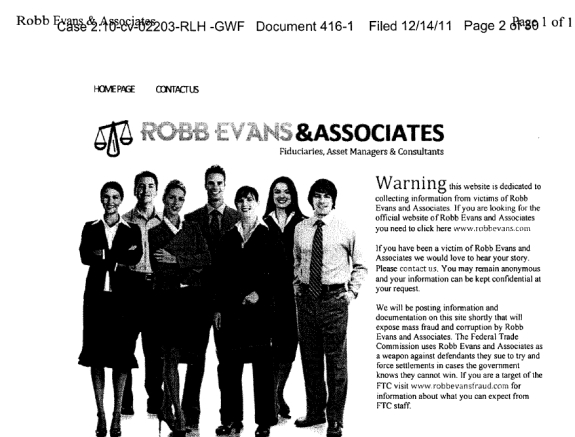
    Screen shot from Dec. 14 evidence exhibit filed as part of an emergency motion in the Jeremy Johnson/IWorks fraud cause brought by the FTC. The site shown in the exhibit and described in the emergency motion by an attorney for the court-appointed receiver in the case is not the actual site of the receiver. Rather, it is an imposter site that uses the receiver’s name and is designed to intercept traffic and undermine the receivership estate, according to the emergency motion. The bogus site later was altered further and the words “Thieves,” “Lairs” (sic) and “Crooks” were placed near the top of the page, according to a separate evidence exhibit.

    EDITOR’S NOTE: This story originally was published Dec. 22, 2011, 10:41 a.m. It was updated at 8:11 a.m. on Dec. 23, 2011. The PP Blog temporarily “unpublished” the story on March 23, 2012. Explanation of why it was taken offline temporarily is here. On March 23, 2012, the PP Blog’s security software recorded a “mass injection attack” as the Blog visited a domain styled CollotGuerard.com while researching matters pertaining to Jeremy Johnson. Collot Guerard is an attorney for the FTC and an alleged subject of harassment by Johnson or people close to Johnson because of the FTC actions against Johnson. The PPBlog is not revisiting the CollotGuerard.com domain and believes it is imprudent for readers to visit the domain.

    Our Dec, 22, 2011, story is republished below. The republication date is Jan. 15, 2013 . . .

    UPDATED 8:11 A.M. ET (DEC. 23, U.S.A.) Robb Evans, the court-appointed receiver in the Jeremy Johnson/IWorks Internet Marketing fraud case filed by the FTC a year ago, first came to national prominence as a liquidator in the Bank of Credit and Commerce International case in the 1990s. If the bank’s name alone doesn’t spark your memory, think of the acronym by which it was known: BCCI.

    If you’re, say, over 40, images of BCCI and the spectacle it created perhaps are seared in your memory. The bank’s criminality and 1991 collapse created a scandal royale on both sides of the Atlantic and all over the world, including the Middle East. BCCI, the Wall Street Journal (Europe) wrote on Aug. 3, 2001 — a little more than a month before the 9/11 terrorist attacks — was a “renegade bank” that had relied on secrecy and had been designed to be “offshore everywhere” to evade regulatory scrutiny. The stunning collapse amid allegations of international money-laundering and a disguised takeover of U.S. banks initially put customers on the hook for $9 billion in losses.

    BCCI, which allegedly conducted business with the terrorist Abu Nidal (died 2002) and the now-dead or imprisoned dictators of Iraq and Panama (Saddam Hussein [died 2006] and Manuel Noriega) — and also could not say no to the Medellin Cartel and Colombian narcotics traffickers — went on to become perhaps the most infamous acronym in the history of banking. Evans has testified before Congress on the subject of offshore banking, corruption and the war on terrorism. His bona fides and expertise in unraveling the affairs of companies implicated in complex fraud schemes are firmly established in the courts.

    U.S. District Judge Joyce Hens Green of the District of Columbia once described Evans’ efforts as “remarkable.” In 1998, noting that she had presided over elements of the multibillion-dollar BCCI case for eight years and calling it the “longest-running forfeiture proceeding in the history of federal racketeering law,” the judge thanked Evans and others publicly for helping preserve $1.2 billion in U.S. assets for distribution to defrauded BCCI customers.

    Evans is the namesake of Robb Evans & Associates LLC. What does the company do?

    “What we do in my organization is we trace money, and we try and recover it for the victims of fraud, and we do it mostly on behalf of the United States Government,” Evans told the House Subcommittee on Oversight and Investigations in 2006.

    Despite his bona fides — despite his record as a court-appointed receiver in numerous cases and his testimony before the U.S. Congress on critical matters of U.S. and international financial security — someone with a Google AdWords account and perhaps some knowledge about SEO planted the seed earlier this month that Evans was presiding over a fraudulent company, according to new federal court filings in the Johnson/IWorks case.

    For a yet-to-be-determined period of time, the names of Evans and his company were pushed down in Google search results and replaced at the top of the rankings by a domain styled RobbEvansFraud.com — with a paid AdWords ad to the right of the No. 1 search result driving traffic to the faux Evans site, according to an evidence exhibit filed in federal court on Dec. 14.

    The faux site planted the seed that Robb Evans & Associates consisted of “Thieves,” “Lairs” (sic) and “Crooks,” according to to an emergency motion filed by an attorney for Evans.

    “Warning,” the first sentence on the faux site blared, “this website is dedicated to collecting information from victims of Robb Evans and Associates.”

    In June, Johnson, 35, was arrested at the Phoenix airport at which federal agents allegedly found him in possession of $26,400 in cash and a one-way ticket to Costa Rica. He asserts his innocence to both the criminal and civil charges brought in the case. Johnson now is free on bond.

    Stop The Madness

    The FTC moved against Johnson, IWorks and other companies in December 2010, alleging an Internet-fueled fraud involving hundreds of millions of dollars. Evans was appointed receiver by a federal judge in Nevada, the venue from which the action was brought. The agency alleged that at least 51 shell companies were set up to dupe banks and to carry out the fraud, which resulted in “hundreds of thousands” of chargebacks and threats to consumers who filed chargebacks.

    FBI Director Robert Mueller III warned Congress in March 2010 and again a month later about the dangers of shadowy banking practices, noting that that shell companies often play a role in disguising fraudulent proceeds.

    “Money laundering allows criminals to infuse illegal money into the stream of commerce, thus manipulating financial institutions to facilitate the concealing of criminal proceeds; this provides the criminals with unwarranted economic power,” Mueller said.

    IWorks operated out of an office at 249 E. Tabernacle St. in St. George, Utah. The street intersects with nearby South Main, home of the historic St. George Tabernacle. The Tabernacle opened in 1876.  The city of St. George is famous for its geology, its climate and for its historic ties to Brigham Young and The Church of Jesus Christ of Latter-day Saints.

    The city, unfortunately, also is becoming increasingly known as the town from which Johnson allegedly carried out a fraud involving hundreds of millions of dollars, in part by manipulating the banking system through dozens of shell companies in Nevada and other states.

    In the emergency motion, an attorney for Evans now says that Johnson and perhaps others are seeking to interfere with the courts and the receivership estate by using the Internet to slime Evans, the FTC and Collot Guerard, an attorney for the FTC. The FTC has filed its own emergency motion.

    On Feb. 10, 2011, Chief U.S. District Judge Roger L. Hunt of the District of Nevada expressly ordered Johnson and other defendants not to interfere with the receivership, according to a preliminary injunction issued on that date.

    Despite Hunt’s order, Johnson sued Evans in Utah state court. On Dec. 7, Hunt ordered the Utah state action brought by Johnson dismissed.

    Johnson also asked Hunt to order the FTC to pay the legal fees of corporate defendants. The judge refused.

    Of all the troubling developments, perhaps the most troubling is the allegation that Johnson and perhaps others have weaponized the Internet to interfere with the administration of justice. The site that attacks Guerard — a career civil servant — clams she has been “accused of fraud and corruption.” The site was created on Oct. 7, 2011, months after Hunt issued the preliminary injunction and order not to interfere. The site appears to operate from servers in Utah, with the registration hidden behind a proxy.

    “[W]e are collecting information related to any wrongdoing on her part,” the site informs visitors.

    The attack on Guerard is just the latest in a string of attacks or veiled threats against law enforcement. AdSurfDaily figure Kenneth Wayne Leaming, for example, is jailed near Seattle on federal charges he filed bogus liens against public officials in the ASD Ponzi case, including a federal judge, three federal prosecutors and a special agent of the U.S. Secret Service.

    Vincent McCrudden, meanwhile, was arrested and jailed in January 2011 amid allegations he threatened to kill 47 regulators and government officials while using a website and emails to terrorize public servants. Just last week, federal prosecutors in Virginia said that Roger Charles Day Jr., who endangered the U.S. military and others in an offshore scam and was sentenced to 105 years in federal prison, had “filed hundreds of billions of dollars of fraudulent default judgments against more than 100 people who Day claimed had prosecuted him unfairly.”

    The Day procurement scheme involved at least 18 companies, prosecutors said. When the scheme was exposed, Day simply “directed his conspirators to discontinue bidding through those companies and instead form and use new companies,” the Justice Department said.

    In the new filings by the attorney for Evans in the FTC’s case against Johnson and IWorks, is is alleged that Johnson had a role in the posting of “false and scurrilous” material on the Internet in a bid to hamstring the administration of the receivership estate.

    Among other things, one of the websites tied to Johnson “makes false allegations concerning ‘mass fraud and corruption by Robb Evans and Associates,’” according to the attorney’s  emergency motion to disable the site.

    Gmail addresses using the names of Evans and Guerard were created and were designed to “impersonate and/or interfere” with the receiver and others associated with the case, according to the emergency motion.

    Johnson and others created other websites — including EvilFTC, FTCTactics and a site in Guerard’s name — to further undermine the legal process, according to the receiver’s emergency filing. Two other sites in the names of other FTC attorneys also were created, according to the receiver’s emergency motion.

    Those sites, according to records, both were created on Dec. 1. Like the site in Guerard’s name, the servers appear to be based in Utah.

    When the receiver’s attorney contacted Johnson to demand the site targeted at Evans be taken offline, Johnson claimed he did not own, host or control the site while insisting that “the domain has not been used for anything deceptive.”

    “It is a constitutional right to be able to speak freely even if your client does not like it,” Johnson informed the receiver’s attorney in an email, according to an exhibit attached to the receiver’s emergency motion.

  • UPDATE: 5 Convictions To Date In Money-Laundering Cases Involving Colombian Drug Operation That Used Same Debit Card As AdSurfDaily Autosurf

    Federal prosecutors have announced five convictions in an international money-laundering case involving drug proceeds and the use of “stored-value” debit cards. (See subhead below.)

    The cases were brought by the Drug Enforcement Administration in 2008 as a result of an undercover operation. The debit cards used in the transactions were provided by Virtual Money Inc., according to court records in Connecticut.

    Records show that Virtual Money, known simply as VM, was the same company that provided debit cards to AdSurfDaily and other autosurf companies. VM’s operator, Robert Hodgins, also was indicted in the drug-related cases and “is being sought by law enforcement,” federal prosecutors said.

    News about the convictions in Connecticut was announced about two weeks after FBI Director Robert Mueller III testified before Congress that “stored value devices” such as reloadable debit cards increasingly were being used to move criminal proceeds through a “shadow banking system” that endangered the United States.

    The PP Blog reported in August 2009 that VM’s name appeared in advertising materials for ASD in 2007. Research showed that VM also provided cards to other autosurfs and HYIPs, including the PhoenixSurf autosurf Ponzi scheme.

    Records suggest that Hodgins or a VM designate attended an ASD function in Orlando in November 2006, about a month after ASD began its rollout.

    During that same year, according to the DEA court filings unsealed in September 2008 after a two-year investigation, VM cards were used in Medellin, Colombia, to withdraw millions of dollars in drug proceeds at ATMs between April and August.

    The drug-related, money-laundering indictments against VM initially were filed under seal in April 2008 and then superseded under seal in June 2008. The documents were made public in September 2008, about a month after the federal seizure of tens of millions of dollars from the personal bank accounts of ASD President Andy Bowdoin, amid Ponzi scheme, wire-fraud, money-laundering and securities allegations in an autosurf case.

    Some ASD members said they observed large sums of cash at ASD “rallies” and suitcases full of cashier’s checks.

    After purportedly operating in the hole throughout much of its existence and allegedly experiencing an unreported theft of $1 million at the hands of “Russian” hackers, ASD suddenly  came into possession of tens of millions of dollars in the first half of 2008, leading to questions about whether it was serving as a front to launder proceeds from criminal organizations.

    References to VM appear in ASD advertising materials dating back to at least February 2007, and other ASD references to VM date back to the fall of 2006, when ASD was just getting off the ground.

    In March 2008, according to records, a DEA informant gave Hodgins $100,000 in undercover funds, saying an uncle needed drug money laundered in the Dominican Republic. Hodgins allegedly agreed to perform the service for a fee of 10 percent of the amount, and the DEA alleged it has audio and photographic evidence of the transaction.

    If the allegations are true, it means the DEA has audio and photographic evidence of the man who provided debit cards to ASD and other surf enterprises accepting money to participate in international drug transactions and international money-laundering.

    Convictions In Drug/Money-Laundering Cases

    On March 30, 13 days after Mueller testified before Congress on the dangers of stored-value devices, Juan Merlano Salazar, 35, of Medellin, Colombia, pleaded guilty in U.S. District Court in Connecticut to 11 counts of money-laundering and one count of conspiracy to commit money laundering.

    Merlano was named in the same indictment that charged VM’s Hodgins and the company itself. Merlano was extradited from Colombia in June 2009, a year after he, Hodgins, VM and seven other defendants were charged in the superseding indictment. Merlano has been detained since his extradition and faces sentencing in June.

    He faces a maximum penalty of 240 years in prison and a maximum fine of $6 million.

    Four other defendants also have pleaded guilty to date to “charges stemming from this conspiracy,” prosecutors said.

    Guilty pleas were entered by Francisco Dario Duque, 49, of Medellin, Colombia; Gonzalo Bueno, 72, of Brooklyn, New York; Juan Chavarriaga, 45, of Fort Lauderdale, Florida, and Jose Manotas, 46, of New York, New York.

    Each of the defendants is detained and awaiting sentencing, prosecutors said.

    “[T]he [drug]organization employed operatives in the United States and funneled millions of dollars in drug proceeds from the U.S. to Medellin, Colombia,” prosecutors said.  “The investigation, which utilized a variety of traditional and sophisticated investigative techniques, including court-authorized interception of international e-mail, disclosed that the money laundering organization used direct deposits of cash into third-party bank accounts, as well as payment of third-party debt obligations to move cash drug proceeds from the New York metropolitan area out of the country.

    “The organization also used ‘stored value cards,’ which function like debit cards and enabled cardholders to deposit U.S. dollars into accounts locally, to be withdrawn later from banks in Medellin as Colombian pesos,” prosecutors said.  “The Government has alleged that the scheme resulted in the laundering of more than $7 million in drug proceeds.”

    Hodgins was president and chief executive officer of VM, a Texas-based business.

    “Hodgins is being sought by law enforcement,” prosecutors said.

    In addition to the DEA, the case is being investigated by the Criminal Investigation Division of the IRS, prosecutors said.

  • FBI Director Again References ‘Shadow Banking System’ In Congressional Testimony; Warns About ‘Homegrown Violent Extremists’ And ‘Lone Actor’ Terrorists

    EDITOR’S NOTE: Still selling autosurfs and HYIPs? Quick! Name your autosurfing neighbor, his or her neighbors, the source of their funding — and describe their intent. Do you even know the names of the program owners, the venues from which they operate and the sources of their funding? How many companies do they own? How many bank accounts do they control? How do they keep their books? Do they truly know their own customers? Has your need to believe you could not possibly be doing business with criminals affected your ability to think things through clearly?

    Getting paid via a debit card or an offshore processor? Ever ask why? Has your “due diligence” ever gone beyond parroting what you’ve been told by others? Have you ever really peeled back layers of the onion, looked for connections to other schemes and performed anything other than cursory research? How many “bad apples” do you think you might find in a barrel of tens of thousands of members, especially if the barrel exists in a business universe already infamous for shadowy practices? Think that some of the participants may live in the dimmest corners of the nation and world and have secret agendas?

    What if their agenda is to do the unthinkable in the United States or elsewhere? What if they’re a “lone wolf” — a lone actor waiting for the perfect time? And what if you’re helping them?

    The FBI has been advising Congress about the nexus between white-collar crime and the potential for terrorism. Some very strange things have been happening in the United States as a result of what FBI Director Robert Mueller III described as the emergence of a “shadow banking system” and an increasing reliance on “shell corporations” to commit crimes and hide from investigators. Some of the crimes have been elaborate, using multiple companies, domestic and offshore venues and selling multiple “services” such as tax-avoidance schemes and “debt-elimination” services.

    Although Mueller did not mention AdSurfDaily and other “autosurf” companies in Congressional testimony yesterday, the Justice Department did outline a separate case against several companies and individuals who offered “services” similar to the “services” offered by some ASD members.

    Longtime PP readers know that ASD and a closely connected autosurf known as AdViewGlobal have been linked to racketeering allegations and tax-avoidance and debt-elimination schemes similar to the cases encapsulated below. Some members of ASD also associated themselves with militia and tax-denial movements, underground “associations” and credit-repair organizations. Some of them associated themselves with wild conspiracy theories — the kind that would cause you to lose friends and cause your family to distance itself from you if you ever associated yourself with the theories.

    Find yourself attacking the messenger or spinning impossible yarns because the truth you fear is just downright uncomfortable and you are not ready to confront it yet? Have you generally supported law enforcement throughout your life — and yet now find yourself condemning the very agencies whose efforts have permitted you to rest comfortably at night since birth? Is it really you constructing a theory that the agents mysteriously somehow had become a sort of hybrid that mixes Nazism and Communism and that the hybrids have made it their business to destroy your entrepreneurial spirit?

    Here, now, a story about a mysterious and perhaps increasingly dangerous world that largely exists outside of public view . . .

    UPDATED 7:49 P.M. EDT (U.S.A.) Returning to a theme voiced last month, FBI Director Robert Mueller III appeared before another Congressional panel yesterday and warned lawmakers about a “shadow banking system” and a troubling increase in certain areas of U.S. white-collar crime, including mortgage fraud, securities fraud and money-laundering.

    Meanwhile, cross-border crime also is producing a dangerous cocktail, Mueller said.

    “[T]he potential for terrorism-related activities associated with criminal enterprises is increasing due to the following: alien smuggling across the southwest border by drug and gang criminal enterprises; Columbian based narco-terrorism groups influencing or associating with traditional drug trafficking organizations; prison gangs being recruited by religious, political, or social extremist groups; and major theft criminal enterprises conducting criminal activities in association with terrorist-related groups or to facilitate funding of terrorist-related groups,” Mueller said.

    “There also remains the ever-present concern that criminal enterprises are, or can, facilitate the smuggling of chemical, biological, radioactive, or nuclear weapons and materials,” he said.

    But Mueller said it would be a mistake to view terrorism as a uniquely international problem and look at it only through the narrow lens of traditional threats and the post-9/11 threat posed by al Qaeda.

    “Homegrown violent extremists also pose a very serious threat,” Mueller told the Senate Committee on Appropriations, Subcommittee on Commerce, Justice, Science, and Related Agencies.

    Beware The ‘Lone Actor’

    “Homegrown violent extremists are not clustered in one geographic area, nor are they confined to any one type of setting — they can appear in cities, smaller towns, and rural parts of the country,” Mueller said. “This diffuse and dynamic threat — which can take the form of a lone actor — is of particular concern.

    “While much of the national attention is focused on the substantial threat posed by international terrorists to the homeland, the United States must also contend with an ongoing threat posed by domestic terrorists based and operating strictly within the United States,” he said. “Domestic terrorists, motivated by a number of political or social issues, continue to use violence and criminal activity to further their agendas.”

    Mueller’s testimony took place against the backdrop of a order by a federal judge in Arkansas that effectively banned a “private banking system” from operating.

    Judge Shutters ‘Private Banking System’

    Wayne Hicks and his company, My Icis Inc., gathered about $100 million between 2003 and 2006 and helped customers avoid taxes by shielding their identities and other financial transactions from the Internal Revenue Service (IRS), the Justice Department said yesterday. Hicks and My Icis consented to an injunction that barred the system from operating.

    Hicks already is serving five years in federal prison after pleading guilty to conspiracy to defraud the United States in a related criminal case. Although the agency did not raise the issue of terrorism yesterday, the case underscores the sensitivity of the United States to banking practices that are hard to monitor and may involve thousands of people whose identities are murky or unknown.

    My Icis “helped customers set up purportedly anonymous bank accounts to hide their identities, income and other financial transactions, including deposits, wire transfers and bill payments,” the Justice Department said. “Hicks admitted in his criminal case that My Icis helped customers ‘get out’ of the traditional banking system and successfully shield their financial transactions from the government, more specifically the IRS, and thereby avoid paying federal income taxes.”

    The scheme was promoted through websites, seminars in Mexico and online newsletters, the Justice Department said.

    To recruit customers, Hicks promoted his banking system at Pinnacle Quest International (PQI) seminars in 2005 in the Mexican resorts of Cancun and Ixtapa, the Justice Department said.

    Eight people associated with PQI were convicted in Florida last month of wire-fraud, money-laundering and tax charges by a federal jury following a weeks-long trial in Pensacola.

    Investigators said PQI, which also was known as Quest International, was operating a “fraudulent tax and debt elimination scheme.” My Icis was one of its vendors, and the PQI scheme crossed U.S. borders and ventured into Panama, a hotbed for financial fraud.

    “PQI was an umbrella organization for numerous vendors of tax and credit card debt elimination scams,” the Justice Department said. “Some of the PQI vendors, such as Southern Oregon Resource Center for Education (SORCE), sold bogus theories and strategies for tax evasion.

    “For fees starting at $10,000, SORCE assisted its customers in the creation of a series of sham business entities in the United States and Panama,” the Justice Department said. “Other tax-related PQI vendors denied the legitimacy of the income tax system on various theories and provided customers with a purported ‘reliance defense’ that consisted of a paper trail of frivolous correspondence [that] a client could allegedly use as evidence of good faith if the client were prosecuted.”

    My Icis “operated as a sophisticated, computerized ‘warehouse bank,’” the Justice Department said. “[It] was a single bank account in which customers pooled their money. [My Icis] was promoted to PQI’s clients as a method to hide their assets from the IRS as a result of the pooled nature of the account.”

    The company had 3,000 clients, the Justice Department said of My Icis. PQI, meanwhile, had more than 11,000 members “throughout the United States.”

    Prosecutors established that Arthur Merino, who operated a company known as Financial Solutions and sold a scheme to eliminate credit-card debt, “charged its customers thousands of dollars for a series of letters to send to credit card companies disputing the lawfulness of the underlying debt.

    “The product was wholly ineffective, and customers typically were sued by their creditors and often forced into bankruptcy,” the Justice Department said.

    Convicted in the PQI case were Claudia Constance Hirmer and Mark Steven Hirmer of Niceville, Fla. They were found guilty of conspiracy to defraud the United States, conspiracy to commit wire fraud, conspiracy to commit money laundering and tax evasion.

    Eugene “Gino” Joseph Casternovia of Ashland, Ore., Arnold Ray Manansala of Renton, Wash., Dover Eugene Perry of Renton, Wash., and Michael Guy Leonard of Troy, N.Y., were convicted of conspiracy to defraud the United States, conspiracy to commit wire fraud and conspiracy to commit money laundering.

    Meanwhile, Mark Daniel Leitner of Fairport, N.Y., and Merino, who lives in Renton, Wash., were convicted of conspiracy to defraud the United States and conspiracy to commit wire fraud.

    “The use of abusive trust schemes and fraudulent debt elimination tactics intended to conceal income from the IRS isn’t tax planning; it’s criminal activity,” said Victor S.O. Song, chief of the IRS Criminal Investigation division. “There is no secret formula that can eliminate a person’s tax obligations.”

  • BULLETIN: Trevor Cook, Minnesota Ponzi Scheme Figure, Pleads Guilty In $190 Million Fraud Case

    BULLETIN: (UPDATED 12:35 P.M. EDT (U.S.A.) Trevor G. Cook, implicated in a $190 million Ponzi scheme that pushed tremendous sums of money all over the world and is believed to have fleeced investors out of at least $139 million, has entered a guilty plea in federal court in Minnesota.

    No sentencing date has been sent.

    Cook, 37, of Apple Valley, faces up to 25 years in federal prison after pleading guilty to mail fraud and tax evasion. Cook has been in jail since January, after a finding he had violated a court order by not cooperating with investigators and continuing to spend investors’ money after he was sued by the SEC and CFTC in November. His plea deal is contingent on assisting the government in unraveling the scheme.

    Criminal charges were filed against Cook last month.

    The guilty plea included acknowledgments by Cook that he lied to investors and was “aided and abetted by others” in a scheme “to defraud no fewer than 1,000 people out of approximately $190 million by purportedly selling investments in a foreign currency trading program,” prosecutors said.

    Cook did not have $4 billion under management, as he told investors, prosecutors said.

    During his plea hearing this morning, Cook admitted that he diverted investors’ money, deceived Swiss regulators when Crown Forex SA was plunging into bankruptcy in 2008, purchased ownership interest in two trading firms with investors’ money, bought property in Panama with investors’ money, bought the Van Dusen mansion in Minneapolis with investors’ money and raided investors’ money to make personal purchases and pay gambling debts.

    “To carry out his scheme, Cook caused false statements to be made to potential investors, including promises that the investment program would generate annual returns of ten to twelve percent, and that trading would present little or no risk to investors’ principal,” prosecutors said. “He also caused material information to be withheld from investors, such as the precarious financial position of Crown Forex, SA” in Switzerland.

    Meanwhile, prosecutors said, Cook “withheld the fact that trading at PFG in Chicago generated losses in excess of $35 million between July 1, 2006, and August 31, 2009.”

    A company with a name confusingly similar to Crown Forex SA was part of the scheme, prosecutors said.

    “In furtherance of the scheme, Cook caused an account to be opened in the name of Crown Forex, LLC, at Associated Bank, which he used for depositing investor funds that he subsequently diverted for his personal use as well as the personal use of others,” prosecutors said. “He also caused statements to be sent to investors that misrepresented the status of their investments. In addition, he caused due-diligence letters to be prepared that falsely represented Oxford Global Advisors as having more than $4 billion in assets under management, and that all accounts were liquid.”

    Prosecutors gave credit for the probe, arrest and conviction to the interagency Financial Fraud Enforcement Task Force. President Obama created the task force in November 2009.

    Assistant U.S. Attorney Frank J. Magill is the lead prosecutor in the criminal aspect of the case.

    In November, the SEC and CFTC sued Cook, along with Pat Kiley. Kiley, 71, formerly hosted a program on Christian radio and is accused civilly of steering people into the international scheme.

    Law enforcement officials and prosecutors in Minnesota say they are battling several Ponzi schemes that have fleeced investors out of hundreds of millions of dollars.

    Last month, FBI Director Robert Mueller III said criminals increasingly were relying on “shell corporations” and hard-to-trace financial-services products to commit fraud on a massive scale.

  • Another Fraud Case In Minnesota: Renee Marie Brown Accused By SEC Of Starting ‘Sham’ Investment Fund Known As ‘X’

    UPDATED 7:52 A.M. EDT (April 13, U.S.A.) On the very day Tom Petters was sentenced in Minnesota to 50 years in prison for operating a colossal Ponzi scheme, a federal judge froze the assets of Renee Marie Brown after the SEC accused her of ripping off clients by persuading them to invest in a mysterious vehicle known as “Fund X.”

    U.S. District Judge Donovan W. Frank issued a temporary restraining order against Brown and her company, Investors Income Fund X LLC. The order was issued April 8.

    Brown, 46, of Golden Valley, was accused of operating a “sham” fund into which investors plowed more than $1.1 million between July 2009 and March 2010.

    “Brown told her investors that Fund X is a ‘bond fund’ with fixed annual returns of 8% or 9%,” the SEC said. “[S]he distributed fictitious ‘returns’ to investors, furthering the fiction that Fund X was a legitimate and successful investment opportunity.”

    But Brown “misappropriated most of the $1.1 million she raised from investors to, among other things, purchase a condominium for herself and build . . . office space for her new business,” the SEC said.

    Investors Income Fund X LLC was registered as a corporation in South Dakota, the SEC said.

    “Unbeknownst to her victims, Fund X is a sham — Brown’s alter ego,” the SEC said.

    The case features allegations of siphoning, forgery, cherry-picking clients of Brown’s former employer and issuing fraudulent “returns” in Bernard Madoff-like fashion. It also occurred against the backdrop of March 17 Congressional testimony by FBI Director Robert Mueller III that U.S. companies increasingly were relying on shell corporations to commit fraud.

    Minnesota Fraud Cases

    In recent months, investigators and prosecutors in Minnesota have opened up a number of major fraud probes. The combined cases are alleged to have drained hundreds of millions of dollars from investors. In some instances, prosecutors and regulators have asserted that companies used multiple names to commit fraud.

    Petters was convicted last week of presiding over that was described as the largest financial-fraud case in Minnesota history: a $3.65 billion Ponzi scheme.

    Petters displayed “stunning criminality,” prosecutors said. One of the victims wrote, “Our society, unfortunately, is becoming plagued with too many people like this, and like Bernard Madoff. Tom Petters needs to learn that there are severe consequences for his incomprehensible behavior.”

    Meanwhile, the SEC, the CFTC, the FBI, prosecutors and a court-appointed receiver are poring over records to reverse-engineer the alleged Trevor Cook/Pat Kiley Ponzi scheme. Court records suggest multiple company names were involved and that the scheme involved at least $190 million and caused investor losses of at least $139 million.

    Money was moved “all over the world,” according to court filings.

    Cook and Kiley were sued by the SEC and the CFTC in November. Cook was charged criminally last month. Prosecutors said he was “aided and abetted by others.” In this document, the National Futures Association, which also filed an action that references Cook, asserted that $75 million from a purported Swiss fund may have been directed at a mysterious investor known only as “Fased.”

    The purported payment occurred while Cook, a Minnesota resident, allegedly was managing money for a Canadian company known as KINGZ Capital Management Corp. KINGZ name also has been linked to an autosurf known as AdViewGlobal (AVG), which had close ties to an autosurf known as AdSurfDaily (ASD).

    On May 4, 2009 — on the same day the Obama administration announced a crackdown on international financial fraud — AVG announced that KINGZ had become its facilitator for international wire transfers. KINGZ denied the assertion, saying it believed it had been targeted in a scam. The company painted the picture that AVG was attempting to route money to itself through a U.S. shell company.

    AVG purportedly operated from Uruguay.

    Florida-based ASD, which members said was popular in Minnesota, was implicated in August 2008 by the Secret Service in a Ponzi scheme. A federal judge has issued orders of forfeiture totaling more than $80 million in the ASD case. ASD used at least three names, according to records: AdSurfDaily, AdSalesDaily, and ASD Cash Generator.

    Prosecutors also linked ASD to at least two other autosurfs: LaFuenteDinero (the “fountain of money”) and Golden Panda Ad Builder, the so-called “Chinese” option for ASD members.

    In February, the U.S. Secret Service alleged that Minnesota resident Steve Renner was operating a Ponzi scheme through a company known as INetGlobal and companies related to the firm. The scheme, the Secret Service said, largely targeted Chinese members who may have little or no facility in English.

    Renner denies the allegations. Prosecutors described the case as a “major fraud and money laundering investigation,” saying INetGlobal came to life during a period in which federal agents were seizing tens of millions of dollars in the ASD case amid Ponzi, wire-fraud and money-laundering assertions.

    An ASD member introduced an undercover Secret Service agent to INetGlobal, the agency said in court filings.

    Other recent fraud cases in Minnesota include the Gerard Cellette Jr. Ponzi case ($53 million); the Charles “Chuck” E. Hays case ($20 million); and the Kalin Thanh Dao case (up to $10 million).

  • Secret Service Busts Another Alleged Ponzi In Florida; Michael Greenberg Accused Of Using 9 Company Names To Bilk Investors, Banks, Law Firm, Small Business Administration

    A Florida man who spent time in prison for wire fraud and money-laundering in a previous Ponzi scheme embarked on a new scheme after his release, federal prosecutors said.

    Within two years of being released from custody in 1996 — and while still on supervised probation — Michael Greenberg, 50, started a new Ponzi and fraud scheme.

    The new scheme operated for more than a decade, gathered more than $53 million, fleeced investors and creditors out of more than $24 million and used the names of at least nine different companies, prosecutors said.

    Just days ago FBI Director Robert Mueller III warned Congress that white-collar criminals in the United States increasingly were relying on shell corporations to commit crimes and avoid detection.

    The U.S. Secret Service led the investigation, which is centered in Pinellas County, Fla. Greenberg has been charged with wire fraud.

    One of his companies existed for “no other purpose than to defraud banks and the U.S. Small Business Administration,” the Secret Service said. The agency described several of the companies as operating “on paper.”

    In 1992, Greenberg was sentenced to 46 months in federal prison after being convicted of operating a Ponzi scheme that fleeced his own father out of more than $1 million. Other investors also lost money in the scheme, according to records.

    After being released from prison, Greenberg started a company named Pure Class Inc., according to the Secret Service complaint. The business involved the need for an automobile-dealer’s license, something that might be a tall order for a convicted felon to obtain.

    Greenberg “hid behind a proxy in both forming the corporation and in obtaining the license,” the Secret Service said.

    ‘[A]ll business done with Pure Class from its inception was based on a fraud at its inception,” the Secret Service said.

    Because of the corporate deception and the proxy, the Secret Service said, persons conducting due diligence on the company would have been shielded from discovering Greenberg’s felony conviction and facts to help them make informed investment and business decisions.

    The agency painted a picture of an elaborate deception, alleging that Greenberg assumed the identity of a third person to trick at least one victim and created a bogus email account to correspond with the victim, as though Greenberg were a third party who could verify details about the business.

    Greenberg also assumed the identities of his parents to get a loan and created “sham” corporations to keep investors from learning the truth about his business operations, the Secret Service said.

    He is accused of creating false tax returns in his parents’ names, forging their signatures on a loan deal, stealing a notary stamp, affixing the stamp to the forged documents, and then forging the name of the notary.

    Greenberg formed at least nine different corporations or business names to pull off the scheme, according to the Secret Service. He is accused of fleecing at least 30 investors and banks, and also is accused of swindling the U.S. Small Business Administration.

    Among the victims were a real-estate developer and a law firm whose office manager invested the company’s line of credit of $119,000 in the scheme, according to the complaint.

    Based on Greenberg’s fraud — and elaborate measures to cover it — he duped the Small Business Administration into backing $1.5 million in loans — loans that were acquired at least in part because Greenberg forged his wife’s signature on documents, according to the complaint.

  • BULLETIN: Autosurf Biz Takes Another Pounding; Federal Judge Adds Noobing As Receivership Defendant In Fraud Case Against Parent Company; 14 Other Subsidiaries Named

    UPDATED 6:05 P.M. EDT (U.S.A., Jan. 20, 2011.) In yet another case that portends disaster for the so-called “autosurf” industry, a federal judge has ordered the Noobing autosurf to be added as a receivership defendant in a fraud case brought against its parent company.

    The FTC and attorneys general from Minnesota, North Carolina and Kansas brought the case against Noobing’s parent — Affiliate Strategies Inc. (ASI) — in July 2009. Several other companies were named defendants in the case, which alleged the firms participated in a scheme that promised guaranteed government grants from economic-stimulus funds.

    Brett Blackman, ASI’s head, also was president of Noobing, members said. Noobing was not initially named a receivership defendant.

    U.S. District Judge Julie A. Robinson issued an asset freeze Sept. 1, along with stern orders to preserve evidence and repatriate to the United States all assets and documents held on foreign soil. She also broadened the powers of Larry Cook, the court-appointed receiver.

    Through his investigation, Cook determined that Noobing was operating under the umbrella of Apex Holdings International LLC, the same company under which ASI operated. Cook also determined that at least 14 other companies were operating under the Apex Holdings umbrella.

    Noobing, which was registered in the United States, also had an offshoot in Nevis, according to court filings. Noobing targeted people with hearing impairments.

    Cook asked Robinson last month to add Noobing and the other companies as receivership defendants after determining “each of the Subsidiaries used the same post office box as the [initial] Receivership Defendants.”

    Moroever, Cook advised Robinson that he had received “receive numerous inquiries from creditors, former independent contractors, and tax authorities for the Subsidiaries.” He further argued that “each of the Subsidiaries was entirely reliant upon the business operations of the [initial] Receivership Defendants.”

    Robinson, saying Cook had shown “good cause,” added Noobing and the others as defendants March 18.

    No party  — including the FTC, the state attorneys general, the initial set of defendants and the new defendants — objected, Robinson noted. In December, Illinois joined the FTC, Minnesota, North Carolina and Kansas in the action.

    On the previous day, March 17, FBI Director Robert Mueller III, without naming names, testified before Congress. Mueller said that “shell corporations” are emerging as a threat to the U.S. banking system because owners were using them “to facilitate the concealing of criminal proceeds” and engage in money-laundering.

    Neither Noobing not its corporate parent has been accused of a crime.

    In February, the U.S. Secret Service alleged in a civil forfeiture complaint that INetGlobal, a company that operates an autosurf, was engaged in money-laundering and wire fraud while operating a Ponzi scheme.

    INetGlobal is operated by Steve Renner, under his “umbrella corporation, InterMark,” the Secret Service alleged. The agency identified what it described as “subsidiaries,” specifically referencing “Virtual Payment Systems [LLC of Wisconsin/Brackets Denoting the LLC Designation added Jan. 20, 2011], V-Media, Cash Cards International, and V-Local,” as well as a company named “INet Global Productions.”

    NOTE IN BOLD ADDED JAN. 20, 2011: An Indianapolis-based company known as Virtual Payment Systems Inc. has contacted the PP Blog to let it know it is not affiliated with the Renner company Virtual Payment Systems LLC of Wisconsin, which is referenced in the paragraph above.

    “The commission by Renner of the federal crimes of wire fraud, in violation of Title 18, United States Code Section 1343, and money laundering, in violation of Title 18, United States Code Section 1957, is essential to the operation of this Ponzi scheme,” the Secret Service alleged.

    In August 2008, the Secret Service said AdSurfDaily, a Florida-based autosurf company, also was engaging in wire fraud and money-laundering while operating a Ponzi scheme.

    U.S. District Judge Rosemary Collyer — on Jan. 4, 2010 — ordered the forfeiture of more than $65.8 million in the personal bank accounts of ASD President Andy Bowdoin. A little more than a month later, on Feb. 23, the Secret Service moved against INetGlobal.

    Records show that ASD’s Bowdoin operated several corporations over the years. In September 2009, the state of Florida revoked the corporate registrations of AdSurfDaily and Bowdoin/Harris Enterprises Inc.

    The revocations occurred just four days after Bowdoin told members he had exciting plans for ASD’s future. Despite his claim, Bowdoin never bothered to submit the paperwork to keep the firm’s registration intact, despite having been given a five-month window to do so.

    In his remarks to members, Bowdoin said the government had seized the assets of ASD members. In his own sworn court filings, however, Bowdoin said the seized assets belonged to him and his company.

    The Secret Service transcribed Bowdoin’s remarks, and presented them to Collyer Sept. 28. Federal prosecutors said Bowdoin’s remarks were evidence that “this con man cannot manage to keep his stories straight.”

    Collyer ordered the ASD asset forfeiture a little more than three months later. In the INetGlobal case, the Secret Service said one of its undercover agents was on the receiving end of a sales pitch from an ASD member who was trying to recruit the agent into INetGlobal.

    Renner’s autosurf  “began operating just weeks after ASD was put out of business by the Secret Service, and this new entity uses the same terminology and business model as ASD,” the agency said in an affidavit for a search warrant.

    At least one of the undercover agents working the INetGlobal case also worked the ASD case, according to court filings. The Secret Service searched the Web for an INetGlobal affiliate site, and the INetGlobal affiliate who pitched the undercover agent also had been an ASD member, according to the affidavit.

    “The member asked if [the undercover agent] was a network marketer,” the Secret Service said. “The member said he had previously been a member of ASD . . . and said, ‘We know what happened there.’

    “The member said he was reluctant to join iNetGlobal due to it being similar to ASD,” the agency continued in the affidavit. “The member said, ‘we all know what this program is.’” The member said his daughter and wife surfed the websites and the member did not care about the services provided. The member said he just wanted to put his money in and get it out. The member said you convert your earnings to V-cash and then receive payouts by check or through an ATM card you can sign up for.”

    Less than a month later, FBI Director Mueller told Congress that “shell corporations” and “stored value” debit devices and “reloadable debit cards” increasingly were being used “to move criminal proceeds.”

    “This has created a ‘shadow’ banking system, allowing criminals to exploit existing vulnerabilities in the reporting requirements that are imposed on financial institutions and international travelers,” Mueller said.

    Mueller did not name any companies in his Congressional testimony.