Tag: Rosemary Collyer

  • BREAKING NEWS: Bowdoin Tries To Have Judge Collyer Disqualified; Collyer Says She Will Not Step Down From Ponzi Forfeiture Case

    andybowdoinart12AdSurfDaily President Andy Bowdoin has filed a motion to disqualify U.S. District Judge Rosemary Collyer from hearing the civil-forfeiture case against tens of millions of dollars seized from ASD last year.

    Collyer reponded by issuing an order in which she refused to disqualify herself. Collyer said Bowdoin no longer had standing in the case.

    “If Mr. Bowdoin is displeased with a ruling of the Court, he has a right to appeal,” Collyer said. “If Mr. Bowdoin wishes to file a complaint against the Court for perceived judicial misconduct, he may address such complaint to Mark J. Langer, Clerk of Court, U.S. Court of Appeals for the District of Columbia Circuit.”

    Bowdoin’s motion was filed Dec. 17 — the same date ASD members said they received what purported to be an emailed Christmas greeting from ASD and Bowdoin. The email suggested Bowdoin planned to continue his legal fight and that 2010 would be the year ASD would prove it was not a Ponzi scheme after having failed to do so either in 2008 or 2009.

    In September, prosecutors said Bowdoin was “delusional.”

    In an affidavit in support of the disqualification motion, Bowdoin claimed Collyer had a “deep seated animosity” toward him and that the judge “has a personal bias and predudice” against him.

    Among Bowdoin’s assertions in the sworn affidavit was that an order Collyer issued last month proved she was biased against him.

    “The Honorable Judge Collyer evidenced personal bias and prejudgment, stating that if I were found eventually guilty of the criminal charges now being investigated by a grand jury, but upon which no indictment has yet been issued, Bowdoin ‘will face a term of incarceration for sure,” Bowdoin said.

    Charles A. Murray, a Bowdoin attorney, filed the disqualification motion.

    “Judge Collyer has, prior to trial on the merits on potential criminal charges, already foreclosed the possibility of parole, or probation, evidencing precisely . . .  ‘a deep-seated favoritism or antagonism’ which renders ‘fair judgment impossible,’” Murray argued.

    Collyer, though, said she was not stepping down.

    Noting that Bowdoin formally withdrew his claims to the seized funds in January 2009 and then attempted to reassert the claims a month later, Collyer said she ruled in November 2009 that she was not going to reverse herself and permit Bowdoin to reaasert his claims.

    “[O]n November 10, 2009, finding that he knowingly and voluntarily released his claims with respect to Defendant properties, the Court denied his motion to renew those claims,” Collyer said. “Thus, Mr. Bowdoin is no longer a party to this action. The Court therefore will deny Mr. Bowdoin’s motion for disqualification due to lack of standing.”

  • ASD ALL OVER AGAIN? ‘3 Hebrew Boys’ Accuse U.S. Attorney Of ‘Treason’; Claim Draws Another Parallel To AdSurfDaily

    Three men found guilty in South Carolina last week of operating an $82 million Ponzi scheme accused a federal prosecutor of treason on the same day the jury returned its verdict, the FBI said.

    A treason claim also was made in the federal forfeiture proceeding against assets tied to Florida-based AdSurfDaily, an alleged Ponzi scheme involving $100 million.

    U.S. District Judge Margaret B. Seymour cited the treason claim in the “3 Hebrew Boys” case as a reason to send Joseph Brunson, Tim McQueen and Tony Pough to jail immediately to await sentencing.

    “After the jury’s verdict, Judge Seymour was asked to allow the men to remain free on bond until their sentencing,” the FBI said.  “She denied the request after noting that all three men filed documents [Friday] accusing U.S. Attorney Walt Wilkins of treason and committing acts of war by prosecuting them.”

    Brunson, McQueen and Pough became known as “3 Hebrew Boys” after operating a website with the same name, which is based on a biblical story of believers who escaped a furnace by relying on their faith. The Ponzi scheme operated under the name Capital Consortium Group LLC.

    Wilkens said the scheme targeted people of faith and members of the military.

    U.S. Attorney W. Walter Wilkins
    U.S. Attorney W. Walter Wilkins

    “By calling themselves the Three Hebrew Boys, these con men tried to disguise their Ponzi scheme as a religious, charitable program of debt elimination in order to gain the trust of unsuspecting investors,” Wilkins said. “Unfortunately many people were victimized by these men, including many in our armed forces.”

    In the ASD case, the treason claim was made against U.S. District Judge Rosemary Collyer. ASD is known to have members who identify with the so-called sovereignty movement.

    California resident Curtis Richmond, a pro se litigant in the ASD case, identified himself in court documents in a separate case as a “sovereign” being who enjoyed diplomatic immunity from prosecution and answered only to Jesus Christ.

    Richmond is associated with a Utah “Indian” tribe ruled a “complete sham” last year by U.S. District Judge Stephen Friot. On the eve of a civil RICO trial last year, Richmond attempted to have Friot removed from the case by claiming he owed Richmond $30 million.

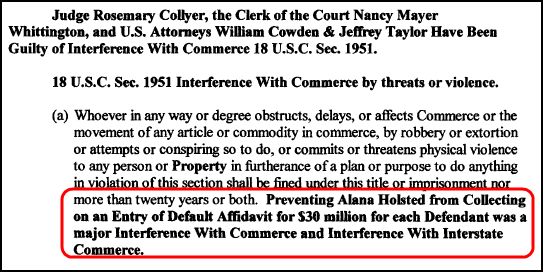
    Friot refused to step down in Utah, as did Collyer in the District of Columbia. Richmond accused Collyer earlier this year of operating a “Kangaroo Court” and violating her judicial oath. Collyer is presiding over the ASD civil-forfeiture case. Other filings in the ASD case suggested Collyer was guilty of as many as 60 felonies, and that an effort had been made by at least one ASD member to start a process to collect $120 million from Collyer, two federal prosecutors and a court clerk for “Interference With Commerce.”

    Screen shot: Section of a pro se filing in the ASD case.
    Screen shot: Section of a pro se filing in the ASD case.

    Such bizarre claims have been popping up more and more in litigation involving securities.

    Gold Quest International (GQI), a company accused by the SEC last year of operating a Ponzi scheme from Las Vegas, claimed it was part of a North Dakota Indian tribe and was immune from U.S. law.

    After the SEC brought the charges against GQI in May 2008, Michael Howard Reed, the purported “attorney general” of the tribe, tried to sue the SEC for $1.7 trillion. The sought-after amount would have exceeded the total of federal income tax paid by individual U.S. filers last year by about $575 billion.

    U.S. District Judge Kent J. Dawson struck a series of pleadings by Reed from the record.

    Meanwhile, Dawson jailed John Jenkins, one of the defendants implicated in the Ponzi scheme, for contempt. Dawson also dispatched the U.S. Marshals Service to arrest David Greene, also known as “Lord David Greene,” in part for violating orders to repatriate money offshore to the United States.

    Despite Richmond’s behavior, he was labeled a hero on the Pro-ASD Surf’s Up forum. Over the weekend, Surf’s Up reinforced an earlier announcement that it would not permit discussion about the AdViewGlobal (AVG) autosurf.

    “[P]lease don’t expect any information that concerns AVGA,” a forum Mod said Saturday. “[I]t doesn’t belong on this forum.”

    Another Mod reinforced the ban on AVG discussion today.

    “In the beginning days of AVG we made it clear this is not an AVG forum and it still will not be,” the Mod said.

    Surf’s Up members repeatedly have said they wanted to discuss AVG, which has close connections to ASD. Their requests have been consistently rebuffed. Some of the Surf’s Up Mods were among the founding members of the AVG surf, which came to life after a major court ruling went against ASD last year.

    AVG purported to be a “private association” that operated offshore. Members used the “offshore” angle as a key selling point, saying the surf’s purported country of operation — Uruguay — insulated it from prosecution.

    Like the “3 Hebrew Boys” operation, AVG sought to prevent members from discussing the company outside the confines of areas it controlled. AVG members were scolded for sharing information and calling the autosurf an “investment” program.

    As AVG was in failure mode in May and June, members were threatened with copyright-infringement lawsuits. Critics were told AVG would contact their ISPs to file abuse reports and suspend service.

  • BREAKING NEWS: Judge Denies Bowdoin’s Bid To Reenter AdSurfDaily Case; Says ASD President’s Claims Lack Merit

    UPDATED 5:18 P.M. ET (U.S.A.) A federal judge has denied the bid of AdSurfDaily President Andy Bowdoin to reverse his decision to forfeit tens of millions of dollars to the government in a case that features allegations of wire-fraud, money-laundering and operating a Ponzi scheme.

    Andy Bowdoin ina video for 'Paperless Access.'
    Andy Bowdoin in a video for 'Paperless Access.'

    “As Mr. Bowdoin’s own descriptions of events fail to support these arguments, and there is no other reason to grant reconsideration . . . the Court will deny the motion,” said U.S. District Judge Rosemary Collyer.

    Collyer also denied a motion by Bowdoin for a second evidentiary hearing, saying the matter was moot because she was not permitting him to reenter the forfeiture case after he previously submitted to the forfeiture. Collyer ruled after an evidentiary hearing last year that ASD had not demonstrated it was a lawful business and not a Ponzi scheme.

    “[N]othing in Mr. Bowdoin’s own sworn statement justifies the conclusion that he was mistaken [in releasing the claims in January], that the Government engaged in any misrepresentation or misconduct, or that his attorney provided bad advice,” Collyer ruled. “He also fails to present any meritorious defense.”

    The ruling was a crushing blow to Bowdoin, and Collyer minced no words, saying evidence in the forfeiture case against him “appears to be strong” and that Bowdoin “balked” after submitting to the forfeiture.

    “The Government charges that Mr. Bowdoin operated a Ponzi scheme on the Internet,
    whereby he, using ASD as a vehicle, bilked hundreds of people,” Collyer said. “Presented by affidavit and testimony outside the crucible of a criminal trial, its evidence appears to be strong. In the face of the civil in rem proceedings and the expected criminal prosecution, it is no surprise that his criminal lawyer would recommend a cooperation plea with demonstrated early acceptance of responsibility, i.e., withdrawal of claims to the seized assets, so that Mr. Bowdoin might earn a motion for a downward departure under Section 5K1.1 of the United States Sentencing Guidelines and/or 18  U.S.C. § 3553, both of which allow the Court to impose a sentence below the statutory minimum to reflect a defendant’s ‘substantial assistance’ to a Government investigation.”

    Bowdoin’s former attorney, Stephen Dobson, whom Bowdoin’s current attorney Charles A. Murray claimed served Bowdoin poorly while Bowdoin was meeting with prosecutors last winter to settle the forfeiture case and discuss a potential criminal plea, behaved responsibly, Collyer said.

    “Such an approach from counsel could be seen as the norm when the Government’s evidence is strong,” Collyer said. “What Mr. Bowdoin hoped to gain from his release of claims/early acceptance of responsibility and his debriefing with the Government was a promise of no jail time. When that was not forthcoming from the Assistant United States Attorney, Mr. Bowdoin balked and tried to back up, as if he had not already released his claims and talked to the Government.”

    Collyer cited several claims from Bowdoin himself when issuing her ruling this afternoon, repeating Bowdoin’s own words back to him to demonstrate he had not been ill-served by Dobson or lied to by the government: (Emphasis added.)

    • Dobson represented to me that I could possibly avoid prison or get a reduced sentence if I agreed to disclose details concerning ASD and releasing the assets.
    • I also signed a document stating that I would release my claims in the abovecaptioned civil in rem forfeiture proceeding, again thinking that necessary for a possible avoidance of a prison term.
    • I did all of this on the understanding that by cooperating I could possibly avoid a prison sentence.
    • I agreed not to exercise my rights in the civil forfeiture proceeding, anticipating from representations made by Dobson that this could possibly keep me out of prison.
    • Dobson lead [sic] me to believe that if I cooperated there was a possibility that I would not be incarcerated or imprisoned.
    • I believed that my cooperation would still result in a criminal sentence that could possibly not include imprisonment or incarceration.
    • [Prosecutor William] Cowden explained that I would be subject to the maximum penalty under the statute, but that he would inform the judge that I cooperated.
    • I slowly came to understand what I understood from Dobson not to be the case: that my agreement to cooperate provided me no benefit in the criminal matter except the possibility of a reduced sentence if the judge desired which would still be a life sentence.

    “Each of these statements indicates that Mr. Bowdoin completely understood what he
    was doing: releasing his claims and cooperating to ‘possibly avoid a prison sentence,’” Collyer said.

    In September, prosecutors argued that any thought by Bowdoin that a $100 million, wire-fraud and Ponzi scheme crime would not result in imprisonment upon conviction was ludicrous.

    Collyer said the allegations were serious and easily could result in prison time.

    “If he proceeds to trial and the evidence persuades a unanimous jury beyond a reasonable doubt that Mr. Bowdoin is guilty as charged, he will face a term of incarceration for sure,” Collyer said. “Mr. Dobson’s hope was to avoid such a result by avoiding a trial and persuading the Government to file motions with the Court that could be used to argue for a sentence that did not include jail time.”

    Collyer said Bowdoin’s behavior has been puzzling.

    “It is very strange that Mr. Bowdoin passed that opportunity by, despite clear knowledge that it ‘could possibly keep me out of prison,’” she said. “Perhaps the delay in obtaining an indictment has led Mr. Bowdoin to believe that he will not be indicted after all.”

    Collyer also pointed to a stated belief by Bowdoin that a grand-jury indictment had been returned, saying she hasn’t see one.

    “Mr. Bowdoin believes the Government ‘submitted charges before a grand jury on or about May 2009,’” Collyer said, using Bowdoin’s affidavit as her resource. “[B]ut as of this date no indictment has been returned against him in a federal court.”

    Read Collyer’s ruling.

    Read Collyer’s order denying Bowdoin’s motions.

  • EDITORIAL: The Real Meaning Of ‘Treason’

    Stewart David Nozette was arrested by the FBI yesterday for attempted espionage. Though Nozette was not formally charged with the Constitutional crime of treason — the only crime specifically described in the Constitution — the crime of espionage is viewed by the public as an act of treason against the United States because selling secrets can be viewed as a form of “levying War” against the country or giving “Aid and Comfort” to an enemy.

    Officials said Nozette accepted $11,000 in cash — with the inference more would follow — and used manila envelopes to pack up secrets. He asked for payment and delivered the secrets to, of all places, a U.S. Post Office.

    Nozette wanted his payments to be kept below $10,000 to keep the prying eyes of government away, prosecutors said. In the first two transactions, Nozette allegedly sold out his country for the price of a used car.

    Nozette thought he had been recruited by the Mossad, Israel’s spy agency. In reality, he had been targeted in an FBI sting because the government had gotten the idea he just might be willing to sell out the United States to a foreign government or entity for a fee. Prosecutors said he had left the United States in January with two computer thumb drives. Inspectors could not find the drives when he returned.

    The government of Israel was not involved in wrongdoing, authorities said.

    A thumb drive was left at the Post Office in September by Nozette, when he thought he was doing business with the Mossad, prosecutors said.

    Prosecutors from the U.S. Attorney’s office led by Acting U.S. Attorney Channing Phillips in the District of Columbia are assisting in the case, which will be heard in U.S. District Court for the District of Columbia. The same court is the venue from which the the civil-forfeiture case against tens of millions of dollars seized from AdSurfDaily Inc. in an international Ponzi scheme probe is being prosecuted.

    The Nozette case demonstrates that grave matters of national security come to the attention of prosecutors in Phillips’ office and judges in the district. Sometimes the matters include elements of international intrigue, as the Nozette case again demonstrates.

    Judge Rosemary Collyer, the judge in the ASD case, presided over an extremely complex case involving former U.S. Secretary of State Henry Kissinger, once National Security Adviser to President Richard M. Nixon. The case dated back to the early 1970s and involved the complicated issue of “sovereign immunity.”

    How complex were the legal issues in the case? Collyer’s own words provide a glimpse:

    “This lawsuit challenges covert actions allegedly directed by high-level United States officials in connection with an attempted coup in Chile in 1970 designed to prevent the election of Dr. Salvadore Allende as Chile’s first Socialist President,” Collyer wrote in 2004.

    “General René Schneider, then Commander-in-Chief of the Chilean Army, opposed military intervention in the electoral process,” she continued. “As a result, the United States allegedly plotted with Chilean nationals to neutralize him. General Schneider was shot during a failed kidnap[p]ing attempt on October 22, 1970, and died from his wounds a few days later. Two of General Schneider’s children and his Personal Representative, suing on behalf of his estate, seek to hold the United States and Henry A. Kissinger, former Assistant for National Security Affairs to President Richard M. Nixon, responsible for the General’s death.”

    In a ruling dismissing the case, Collyer said Kissinger could not be held responsible for the death, even if the assertions against Kissinger and the U.S. government were true.

    “The plaintiffs’ claims present a non-justiciable political question on foreign policy
    decisions undertaken by the Executive Branch in 1970,” Collyer said. “[T]he Court finds that Dr. Kissinger was properly certified as acting within the scope of his employment vis-a-vis the relevant events. The United States will be substituted for him as the sole defendant. With this substitution, the amended complaint is barred by the doctrine of sovereign immunity.”

    Whether or not one agrees with the ruling, one must agree that Collyer was tasked with the responsibility to reduce extremely complex issues of both law and U.S. foreign policy to their essence — and view them in the framework of Constitutionality. No critic interested in fair or logical debate would dismiss her as an intellectual lightweight.

    Words Mean Things

    The reason for this column is to point out a couple of things: First, that the responsibility of federal prosecutors is to advocate in the interests of the people of the United States. Some of the same people criticizing the ASD prosecutors in excessive fashion — and even extreme fashion — perhaps will be less vocal or not vocal at all in their criticism of Phillips’ office for its role in the prosecution of Nozette.

    It is, after all, an espionage prosecution, and the American public does not take kindly to acts that speak of treason, whether it’s the treason spelled out in the Constitution or the treason inferred from the act of selling government secrets for a fee.

    And this brings us to the use of extreme language by some supporters of ASD — language directed at both the prosecution and Judge Collyer.

    Collyer, a sitting federal judge appointed by a President of the United States and confirmed by the U.S. Senate — and a federal judge who presides over issues of national security and the affairs of state, as the Nixon/Kissinger case demonstrates — was described by an ASD member as “brain dead or taking a payoff” if she ruled against ASD.

    No such comment can be viewed as reasonable.

    Other examples of extreme language directed at Collyer can be found in this court filing by ASD mainstay Curtis Richmond. The filing uses words such as “treason” and phrases such as “Willfully Violated Her Judicial Oath” thus being “Guilty of Perjury of Oath, a Felony.”

    Richmond asserted that Collyer perhaps was guilty of as many as 60 felonies.

    No such language can be viewed as reasonable.

    Prosecutors haven’t fared much better. Dozens of pro se litigants using a pro se template practically screamed their assertions that prosecutors had “failed” to do this and “failed” to do that on matters pertaining to the production of “EVIDENCE” and “WITNESSES” and “VICTIMS” and that the ASD “action was based solely on the OPINIONS of the U. S. Government agents.”

    How reasonable is it to scream in court filings?  The judicial process is designed deliberately to ensure decorum precisely to guarantee that no side gets shouted down and that issues are decided in an atmosphere of dignity.

    Moreover, the record of the ASD case plainly shows that the prosecutors have produced evidence, prior even to introducing evidence at the evidentiary hearing last fall. Eight government exhibits of evidence were included in the August 2008 filing of the complaint. It’s all in the public record — and was in the public record long before the pro se litigants shouted that no “EVIDENCE”  had been produced.

    With respect to the screamed claim that the government relied exclusively on the “OPINIONS” of its agents, the record also plainly shows that even the ASD side agrees with some of those opinions. Here are just two purported “opinions” that both the ASD side and the government side agree on:

    • That ASD advertised that rebates “will” be paid until members received back 125 percent of their “advertising” spend.
    • That the government seized the money from Andy Bowdoin and that the money belonged to Andy Bowdoin, not ASD members.

    Bowdoin officially has held that position since August 2008, just days after the seizure. It is a theme in his court filings. Recently, though, he told ASD members in a conference call that the seized money belonged to them. The claim put him at odds with his own arguments in court, which the prosecution now claims is evidence of his willingness to lie to members he claims to be serving, while also lying to a federal judge.

    With respect to the shouted claim by the pro se litigants that the government “has failed” to produce any “VICTIMS” or “WITNESSES,” the claim is disingenuous to its core. A trial date has not even been scheduled in the case. The evidentiary hearing was exactly that — a hearing, not a trial. The hearing was held at ASD’s request. Collyer granted it in “the interests of justice.” Prosecutors were not required to try their case at the hearing. Nor were they duty-bound to produce their witnesses. It was ASD’s hearing.

    Nozette’s arrest yesterday quickly became an international story. The story will play out in some of the same venues the ASD case is playing out. It will be argued by highly skilled, highly trained prosecutors.  A highly skilled, highly trained federal judge appointed by the President of the United States and approved by the U.S. Senate will preside over the proceeding “in the interests of justice” for all parties, including Nozette.

    There will no reckless claims of judicial treason or of violating a judicial oath or of operating a “Kangaroo Court” — as has been the claim in the ASD case, against both Judge Collyer and her supervising judge, Royce Lamberth.

    The Nozette case is, after all, an espionage case, one in which the public outside the courtroom will discuss the real meaning of the word treason — something some of the ASD supporters should have been doing all along.

    The ASD case is, was and always has been about national security. If you doubt it, ask yourself if you really know who your autosurfing neighbor is — and then ask yourself if you can guarantee that all ASD members were pure as the driven snow and not interested at all in using a vehicle provided by Andy Bowdoin for criminal purposes.

  • BREAKING NEWS: Curtis Richmond Filed Motion To Disqualify Judge; Other Pro Se Litigants Filed ‘Innocent Owner’ Motions To Intervene In AdSurfDaily Forfeiture Case

    UPDATED 1:59 P.M. EDT (U.S.A.) Curtis Richmond filed a motion to disqualify U.S. District Judge Rosemary Collyer from the AdSurfDaily forfeiture case before the judge had issued any rulings on a series of pro se pleadings by Richmond and others.

    The motion was included today in a blizzard of motions made public in the AdSurfDaily forfeiture  case. Some of them date back to February.

    At least three other pro se litigants filed separate motions to intervene in the case, and Richmond himself filed a separate motion for miscellaneous relief.

    The docketing of the filings came on the heels of a ruling Collyer made last week that denied individual pro se litigants standing in the ASD case.

    Motions to intervene that asserted an “innocent owner” claim were filed by:

    • Christian Oesch, Human Economic Resource Solutions, Midvale, Utah
    • Jeffrey Robinson, Ft. Myers, Fla.
    • Joan Hughes, Ottawa, Ontario

    Hughes’ filing appears to have been the first prospective intervention filed from Canada. A stamp on the paperwork indicated the document was submitted March 3.

    All three motions to intervene appear to use the Curtis Richmond litigation blueprint.

    In his motion apparently designed to force Collyer to step down, Richmond cites this reason: “For Cause Of Extreme Bias Per U.S. Supreme Court Cases & Other Legal Citations.”

    The motion to force Collyer to disqualify herself appears initially to have been submitted to the court in May.

    In a separate motion, apparently received in March and made public today, Richmond demanded a ruling of some sort. The document appears to have been filed in response to a motion Richmond filed in February that demanded Collyer issue a ruling in the ASD case within 30 days or face sanctions.

    “This Court and Judge Rosemary Collyer both have an Absolute Duty and Obligation Under Article VI Supremacy Clause and the Judge’s Oath of Office To Support and Defend the U.S. Constitution to Obey 18 U.S.C. Sec. 983 and the Civil Forfeiture Reform Act of 2000,” Richmond said.

    “If a Judge Willfully violates these Federal Staututes and the Claimant’s Constitutional Right of Due Process & Civil Rights, She Is At War Against The U.S. Constitution And When She Is Acting Without Jurisdiction and according to the U.S. Supreme Court is Guilty of TREASON.”

    Read Richmond’s motion to disqualify Judge Collyer.

  • BREAKING NEWS: Plaintiffs In ASD RICO Case Ask Judge For More Time; Say Bowdoin, Busby, Garner Haven’t Been Served

    Robert GarnerThree former members of AdSurfDaily who accused the company of racketeering have asked a federal judge for more time to respond to a motion by Bank of America to dismiss it as a defendant in the case.

    Although not named a RICO defendant, BOA was accused of aiding and abetting ASD President Andy Bowdoin, ASD attorney Robert Garner and Golden Panda Ad Builder President Clarence Busby in a racketeering scheme.

    BOA is not opposing the plaintiffs’ motion to extend the time to respond to its own motion to dismiss. In fact, the plaintiffs’ pleading for the extension was filed today as a joint motion with BOA.

    Plaintiffs Mike Collins, Frank Greene and Natures Discount Inc. — all former ASD members — said Bowdoin, Busby and Garner haven’t been served with the lawsuit, which was filed Jan. 15.

    Why the defendants haven’t been served in more than two and one-half months since the filing of the complaint is unclear. The court reissued the summons March 18 — nearly two weeks ago — and Bowdoin, Busby and Garner still haven’t been served.

    Bowdoin, Busby and  Garner were accused of conspiring with unnamed parties in organized efforts to defraud.

    The RICO complaint alleged the men were involved in “other” schemes beyond ASD, Golden Panda and LaFuenteDinero, and have “committed or aided and abetted in the commission of countless acts of racketeering activity,” including indictable offenses.

    “The ASD Enterprise provides the RICO Defendants and other unnamed co-conspirators with a system by which to operate fraudulent schemes such as ASD, to hide the fraudulent nature of the schemes, and to profit from such schemes,” the plaintiffs alleged. “Each RICO Defendant agreed to perform services of a kind which facilitated the operation of the ASD Enterprise and facilitated the RICO Defendants and others in the operation of various fraudulent schemes, including ASD.”

    Bowdoin said he fired his attorneys in a civil-forfeiture case filed in August against proceeds linked to ASD. The U.S. Secret Service has seized nearly $100 million in the case, and Bowdoin now is acting as his own attorney.

    Bowdoin has filed several motions in the forfeiture case in the past few weeks.

    A Blog reader who described himself as having engaged Busby in a real-estate deal said he could not locate Busby for months. The reader added that he finally secured a phone number for Busby, spoke with him briefly about 11 days ago and that Busby hurried him off the phone.

    Garner once advertised offshore legal services in an online magazine known as “Escape From America Magazine.”

    Garner identified himself a “[f]ormer General Counsel for  major Miami-based securities firm with Latin and South American  focus,” according to his ad. He listed the URL for his law office in Greensboro, North Carolina, saying he also specialized in “[r]ecoveries from scam.”

    Garner’s North Carolina law license was updated March 14 by the North Carolina State Bar. Garner’s license is active, and he is in good standing with the Bar.

    The plaintiffs in the RICO case — with the consent of BOA — asked Judge Rosemary Collyer to give them until April 30 to respond to BOA’s dismissal motion — and to extend BOA’s time to respond to May 20.

  • Two New Motions To Intervene Filed In ASD Case

    Using the Curtis Richmond litigation blueprint, two new motions to intervene have been filed in the AdSurfDaily forfeiture case.

    The motions were filed by Ronald Breckenfelder of Littleton, Colo., and John R. Moore of Ames, Iowa. The motions accuse U.S. District Judge Rosemary Collyer, U.S. Attorney Jeffrey A Taylor, and Assistant U.S. Attorney William Cowden of committing crimes.

    In addition, the motions accuse the judge, the prosecutors and Chief Judge Royce Lamberth of conspiring to deny ASD members justice. Collyer and Lamberth specifically were accused of operating a “Kangaroo Court.”

    As was the case in two previous motions to intervene, including a motion filed by Richmond himself, Collyer placed a hand-written note on the cover pages of the motions.

    “Let this be filed,” she wrote. Collyer has used the exact same wording on each of four motions to intervene filed in the ASD case in recent weeks.

    The documents order Collyer to set aside the ASD forfeiture within 30 days or face criminal or civil prosecution.  At the same time, court documents filed with the motions include a list of demands made on prosecutors and Agent Roy Dotson of the U.S. Secret Service to produce “Legal Evidence” within seven days or face legal action.

    Richmond is associated with a sham Utah Indian tribe that has been successfully sued under racketeering statutes for bringing vexatious legal proceedings against judges, prosecutors and police officers. He also has been convicted of contempt of court for threatening federal judges.

    The tribe is known derisively as the “Arby’s Indians” because it once held a meeting in an Arby’s restaurant in Provo, Utah. A sham “Supreme Court” set up by the tribe used the address of a conference room attached to a doughnut shop in Utah as its chambers.

    One prong of the “Indian” strategy is to place enormous judgments against public officials in a bid to extort a litigation result. Recent motions in the ASD case that have used the Richmond blueprint have said an ASD member by the name of Alana Holsted has been prevented from collecting on a $30 million judgment because of conspiratorial actions by the judge and prosecutors.

    The Holstead claim appears to seek a total of $120 million in judgments for the alleged offenses of Interference With Commerce and Interference With Interstate Commerce.

  • BREAKING NEWS: Court Rejects Richmond Appeal Bid In Criminal Contempt Of Court Case For Threatening Judges

    UPDATED 10:34 A.M. EST (U.S.A.) The U.S. Court of Appeals for the 9th Circuit (Pasadena) has denied Curtis Richmond’s bid  to have criminal contempt of court charges for threatening federal judges dismissed.

    Richmond argued that he was denied his right to a speedy trial.

    The appeals court rejected his argument, but the effect of the ruling was not immediately clear.

    In 2007, Richmond was convicted of criminal contempt of court for threatening federal judges. He was sentenced to six months’ home confinement with electronic monitoring, a $1,000 fine and five years’ probation.

    He is now a central figure in the AdSurfDaily case and has threatened to bring charges against U.S. District Judge Rosemary Collyer, U.S. Attorney Jeffrey Taylor, Assistant U.S. Attorney William Cowden and others.

    Richmond argued in court briefs that he’d already served the home-confinement portion of his sentence even though he hadn’t been formally detained at home and was out on bail, pending trial.

    His argument appears to suggest that he satisfied the requirement of six months’ home confinement before the trial on the charge even was held.

    He told the court that the fact he was not permitted to leave San Diego County under the terms of his bail meant that he was in custody and had satisfied his six-month sentence at home.

    “The Petitioner recently learned in talking to the Tribal Atty. General that he had already served his 6 months of Custody and where he needed to go to get the Legal Evidence,” Richmond said in November 2007 court filings.

    Richmond is a member of a sham Utah Indian tribe tied to bizarre litigation and threats to imprison federal judges.

    “The Petitioner was Arrested on May 17, 2006, Jailed, and was brought for arraignment on May 18, 2006 when he was allowed to be out On Bail but Could Not Leave the County Without the Court’s Permission and was Under The Control of the Probation Department” Richmond said.

    “Any Restraint of one’s Liberty of Movement Is Considered Custody[,] which means the Petitioner’s 6 Months Arrest & Sentence Expired Nov. 17, 2006,” he argued.

    But the actual trial on the contempt charges wasn’t held until February 2007, two years ago this month.

    Owing to the nature of Richmond’s appeal filings, a federal judge ordered that a public defender be appointed to represent him. An attorney was appointed in December 2007. About 6 months later, the attorney petitioned the court to withdraw as Richmond’s counsel, but the court refused to let him withdraw.

    The denial by the 9th Circuit was Richmond’s second loss in the U.S. Court of Appeals in the past month. His appeal in the 10th Circuit (Denver) was rejected because he failed to follow procedures. The case in the 10th Circuit dealt with a finding by a federal judge that Richmond and co-defendants from the sham Utah tribe had engaged in rackeetering by pestering public servants and filing vexatious litigation.

  • Document Suggests AdSurfDaily Member Sought $120 Million From Judge, Prosecutors, Clerk Of Courts Involved In Case

    Did a member of AdSurfDaily Inc. try to force a federal judge, two federal prosecutors and a federal clerk of courts to default on demands totaling $120 million as part of a certified-mail strategy?

    Details are unclear, but a motion by Curtis Richmond in the ASD case suggests at least one ASD member sent a certified demand letter and spelled out a $30 million penalty for each of four “defendants” as the price of not submitting to the demand.

    Richmond filed a motion to set aside the forfeiture of tens of millions of dollars seized in the ASD probe. He claimed a multipronged conspiracy involving judges, prosecutors and a court clerk to deny ASD members justice.

    In his motion, Richmond asserts that actions by Judge Rosemary Collyer, U.S. Attorney Jeffrey Taylor, Assistant U.S. Attorney William Cowden and Court Clerk Nancy Mayer-Whittington prevented the member from “Collecting on an Entry of Default Affidavit for $30 million for each Defendant.”

    Just above the assertion, on Page 9 of Richmond’s motion, he lists the names of Collyer, Taylor, Cowden and Mayer-Whittington, claiming they “Have Been Guilty of Interference With Commerce.”

    alanaholstedasd

    Under point (a) of his claim, Richmond asserts the interference prevented “Alana Holsted from Collecting on an Entry of Default Affidavit for $30 million for each Defendant.” In November, Collyer denied Richmond leave to file a motion to dismiss the ASD case. Richmond said he submitted 19 affidavits to support his motion, and now claims Collyer is guilty of felonies for not permitting the documents to be filed.

    Similar tactics were used by a sham Utah “Indian tribe” with which Richmond is associated. In the Utah cases, bogus judgments for huge amounts were sought, including a fraudulent judgment for $250 million against JoAnn Stringham, the prosecutor for Uintah County.

    Uintah County countersued, and Richmond and co-defendents were ordered to pay damages and costs in excess of $100,000 for filing the bogus claims. Richmond was assessed an additional penalty of $2,915.

    The practice of sending litigation opponents a list of demands by certified mail — and stating that not acknowleding the demands, which often are deliberately unreasonable, amounts to a default — sometimes is called “Mailbox Arbitration.” The practice also is known as “paper terrorism,” and can land practitioners in a heap of trouble.

    So can making reckless claims against judges and officers of the court — as Richmond found out in California. He was charged with criminal contempt of court, arrested and found guilty. (Click here to see the order for Richmond’s arrest in the case.)

  • Will Richmond Filing Trigger New Federal Probe Or Lead To Interminable Delays In The AdSurfDaily Inc. Forfeiture Case?

    UPDATED 1:29 P.M. EST (U.S.A.) A California man associated with a sham Utah “Indian” tribe purportedly founded inside an Arby’s Restaurant lambasted District of Columbia federal judges, federal prosecutors and a court clerk in legal filings this week, accusing them of crimes and threatening them with litigation and jail time.

    Curtis Richmond said Pacific Ministry of Giving International — an entity of which he is chairman — had $41,000 at stake in AdSurfDaily Inc. and lost access to the money because of a forfeiture action prosecutors filed in August against assets linked to ASD.

    Electronic records at the California Department of State website list Pacific Ministry of Giving’s registration with the state as “forfeited” in 2004. The organization, though, is registered as a corporation sole and “religious organization” in Utah, according to electronic records in Utah.

    Judge Rosemary Collyer, who’d earlier denied Richmond leave to file in the case, permitted Richmond’s latest motion to be docketed. In the motion, Richmond accuses Collyer of dozens of felonies, saying she could spend up to 252 years in federal prison for her actions in the case.

    Richmond’s filing is a bid to set aside the forfeiture of tens of millions of dollars seized by the government. In the motion, he threatens additional litigation and criminal prosecution. At the same time, the motion appears to be designed to force Collyer to withdraw from the case.

    “Professor” Patrick Moriarty, a former board member of ASD Members International (ASDMI) and a person who championed Richmond’s legal approach, applauded the filings on his website today. Meanwhile, Steve Watt, another former ASDMI board member, said the filings equated to “credibility” for the ASD cause.

    TheAdViewGlobal Members’ forum, operated by some of the Mods at the Pro-ASD “Surf’s Up!” forum, named Richmond “Hero Of The Day!” For its part, Surf’s Up heralded the action with a three-exclamation-point headline celebrating Richmond’s legal heroics.

    But some members of other forums discussing the ASD case are scratching their heads in disbelief. They’re wondering how the filings by Richmond, who has a felony conviction for contempt of court for threatening federal judges in a separate case and is associated with a bogus Utah “Indian tribe” infamous for trying to extort favorable court results by intimidating judges and prosecutors, adds up to anything credible at all.

    What’s Ahead?

    How Richmond’s filings will affect the case is unclear. One possible outcome is that justice will be delayed — meaning that ASD members who’d hoped to get a refund through the government will have to wait even longer if Richmond and the government square off in protracted litigation.

    “Protracted” is a word that frequently accompanies litigation involving Richmond or filed by him. ASD members expecting a refund may be none too pleased if Richmond’s entry into the ASD fray results in interminable delays.

    Another possible outcome is that the litigation will trigger probes by the U.S. Marshal’s Service, which is in charge of securing federal courtrooms and federal judges, and the FBI. The FBI and the U.S. Marshals entered a probe of Richmond in California for threatening or trying to intimidate federal judges through vexatious court filings — under circumstances that are very similar to what is happening now in the ASD case.

    Richmond was convicted of criminal contempt of court in 2007, and was sentenced to six months’ home confinement with electronic monitoring, a fine of $1,000 and five years’ supervised probation. He also was ordered not to file vexatious legal pleadings in California. Richmond appealed the sentence.

    “Our office is committed to protecting the safety, security and integrity of the United States District Court for the Southern District of California,” said U.S. Attorney Carol C. Lam, upon Richmond’s February 2007 conviction. “While every citizen has the right of free speech and the right to address grievances in our courts, no one has the right to intimidate and harass judges and court staff.”

    Federal prosecutors in California said U.S. District Judges “had previously rejected arguments advanced by Richmond in civil litigation, and Richmond had responded by accusing those judges of treason, threatening to bring multi-million dollar lawsuits against them, and attempting to have the U.S. Marshal’s Service execute fraudulent arrest warrants against those judges.”

    Richmond had been “advised on several occasions that such conduct was viewed as threatening, and explicitly warned that if he continued to file pleadings accusing judges of criminal conduct he would be subject to prosecution for criminal contempt,” prosecutors said.

    In May 2006, prosecutors said, Richmond filed a pleading that accused a federal judge of engaging in fraud and criminal conspiracy and “willfully violated” an injunction banning him from filing vexatious legal papers.

    In his ASD filings, Richmond accused Collyer of conspiring with prosecutors to deny ASD members justice.

    Prosecutors and Collyer had “No Authority or Jurisdiction To Steal Most of the $93 million” seized in the case, Richmond said. He claimed prosecutors, Collyer and the court clerk were “guility” of interference with commerce, and he threatened to prosecute them for crimes, sue them under racketeering statutes and hold them “personally liable” for damages.

    In his motion, Richmond claimed Collyer and a court clerk are guilty of at least 60 felonies for not permitting 21 documents he submitted in November to be filed. These actions could lead to to prison sentences of up to 12 years for each of the documents that weren’t filed, he said.

    “Judge Collyer had the Clerk of the Court Return All Of The Motion To Dismiss Affidavits[,] including the 19 Demand For legal Evidence Notarized Affidavits In Support to Curtis Richmond,” he said.

    “This is like having 21 Witnesses to a Murder,” Richmond said. “Judge Collyer is Guilty As Charged . . .”

    Meanwhile, Richmond accused Collyer and Chief U.S. District Judge Royce Lamberth of presiding over a “Kangaroo Court” and conspiring to thwart justice.

    Utah ‘Indian’ Cases

    Richmond claims to be an adopted member of Wampanoag Nation, Tribe of Grayhead, Wolf Band, a purported “Indian” tribe a federal judge ruled a sham last year. The judge had to be brought in from an outside district because the sham tribe brought or threatened legal action against the available judges in the jurisdiction.

    Some of the legal filings read like impossible fiction, but they resulted in monumental inconvenience for judges, prosecutors, opposition attorneys, investigators, police officers and others involved in tribal litigation.

    The tribe, for instance, established its own sham “Supreme Court” and issued arrest warrants for judges and litigation opponents.

    Despite the fact he is not an attorney, Richmond has been banned from practicing law in Colorado.

  • BREAKING NEWS: Curtis Richmond, Man Linked To Sham Utah ‘Indian’ Tribe, Files Motion To Intervene in ASD Case; Says Judge Collyer Faces Criminal Charges

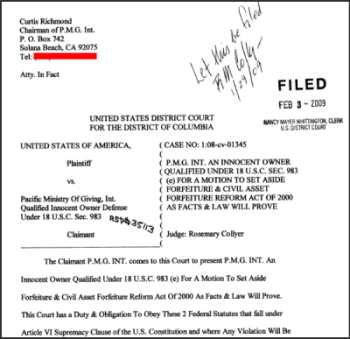
    UPDATED 12:19 A.M. EST (FEB. 5, U.S.A.) Curtis Richmond has filed a motion to intervene in the ASD case. On the cover page of the motion, Judge Rosemary Collyer inserted a handwritten note:

    “Let this be filed,” she wrote.

    richmondasdmotion350Inside the motion Richmond accused the judge and a court clerk of felonies. He filed the motion as the chairman of Pacific Ministry of Giving International of Solana Beach, Calif.

    Pacific Ministry of Giving International had $41,000 at stake in ASD — including “Upgrade Bonuses promised between July 14th and Aug. 1, 2008” — and lost access to the money because of the government seizure, Richmond said.

    Richmond asserted that, if Collyer doesn’t do as he says and overturn the forfeiture, she is guilty of civil-rights violations and is violating U.S. law. He also threatened two federal prosecutors — U.S. Attorney Jeffrey A. Taylor of the District of Columbia and Assistant U.S. Attorney William Cowden — with “legal damages,” saying he had a “binding contract” with them as a result of certified mail he had sent them.

    Cowden and Taylor ignored ASD members’ Constitutional rights in the ASD asset seizure, did not properly notify members of the seizure and interfered with commerce, Richmond claimed.

    He accused Collyer, Taylor, Cowden and Court Clerk Nancy Mayer-Whittington of engaging in a conspiracy to deny justice. He specifically accused Collyer and the prosecutors of theft.

    “The U.S. Atty. and/or U.S. Judge Had No Authority or Jurisdiction to Steal Most of the $93 million of ASD Member Ownership Interest,” Richmond said, using a mix of uppercase and lowercase letters. “All of the ASD Members had a Constitutional Right to Make A Contract With ASD and None of the ASD Members had a Contract With the U.S. Government.”

    A nonlawyer representing himself, Richmond advanced his theory of the case:

    “Since the U.S. Atty. could not present any court order giving him Authority to Seize the $40 million of Cashier Checks and deposit them in an Account Of His Choosing, he is Guilty of Misappropriation of Funds [at] a minimum and very possibly Embezzlement,” Richmond claimed.

    Richmond claimed he had “irrefutable” evidence against Collyer and the prosecutors.

    “This was accomplished by sending by Return Receipt with a ‘Demand For Legal Evidence Affidavit’ to William Cowden, Assist. U.S. Atty., Jeffrey Taylor, U.S. Atty., and Roy Dotson, Special Agent, U.S. Secret Service[,] giving them 7 Days to present Legal Evidence that the Statements Made in the Demand For Legal Evidence[,] including the Listed Constitutional Rights, WERE FALSE,” Richmond claimed.

    “The Demand for Legal Evidence [was] part of Notarized Affidavits and clearly stated “Your Silence will be an Admission that you do not have the Legal Evidence,” he said.

    Cowden, Taylor and Dotson knowingly and willingly defaulted on his demands “because they had no Legal Evidence or believed they were above the law,” Richmond said. “Attorneys & Judges Are Not Above The Law. A Lawful Default Is a Lawful Default.”

    Richmond V. Collyer

    In his motion, Richmond said Collyer “sat on” a previous motion he attempted to file in the case in the days immediately prior to her November ruling that ASD had not demonstrated it was a legal business and not a Ponzi scheme. Richmond ultimately was denied leave to file.

    Richmond said he filed 19 affidavits in support of his claims, and that Collyer and Mayer-Whittington are guilty of at least 60 felonies, including felonies that include prison sentences of up to 12 years for each affidavit that wasn’t filed.

    “Judge Collyer had the Clerk of the Court Return All Of The Motion To Dismiss Affidavits[,] including the 19 Demand For legal Evidence Notarized Affidavits In Support to Curtis Richmond,” he said.

    “This is like having 21 Witnesses to a Murder,” Richmond continued. “Judge Collyer is Guilty As Charged . . .”

    One of the aims of Richmond’s motion appears to be to force Collyer to withdraw from the case. He accused her of operating a “Kangaroo Court.”

    He accused Chief U.S. District Judge Royce Lamberth of becoming a co-conspirator, saying Lamberth also erected hurdles to block Richmond from filing as a party in the August forfeiture complaint against assets tied to ASD.

    “Either Judge Lamberth is unbelievably biased, believing he is Above The Law, or he does not know how to read the English language,” Richmond said.

    Lamberth also operated a “Kangaroo Court,” Richmond asserted.

    Richmond has a history of filing vexatious lawsuits and court motions, and of employing a strategy known as “Mailbox Arbitration” to hamstring prosecutors, judges, court clerks and others. He was convicted of criminal contempt of court in California in 2007 for threatening or trying to intimidate judges.

    Last year, a federal judge ruled an “Indian” tribe with which he is associated in Utah a “sham.” Various vexatious filings against public servants were made in the Wampanoag Nation, Tribe of Grayhead, Wolf Band case, and the judge ordered Richmond and other “tribe” members to pay damages and costs in excess of $100,000.

    In the “Indian” case, huge financial judgments against prosecutors and others were sought. At least one “tribe” member tried to enforce a bogus judgment in the hundreds of millions of dollars.

    In court filings, Richmond has claimed he was a “Sovereign” who answered only to Jesus Christ and enjoyed diplomatic immunity from prosecution.

    “Professor” Patrick Moriarty, a former board member of a defunct organization known as ASD Members International (ASDMI), associated himself with Richmond on Moriarty’s website. At the same time, Steve Watt, another former ASDMI board member, told visitors to TheJoyLuckClub ASD news site that Richmond’s court filings would lead to a major criminal complaint against members of the government.

    Before folding last month, ASDMI said on its website that it had recruited 167 members to litigate against the government in the ASD case. Moriarty also wrote of a certified-mail campaign and solicited funds to make it happen.

    Screen Shots

    1.

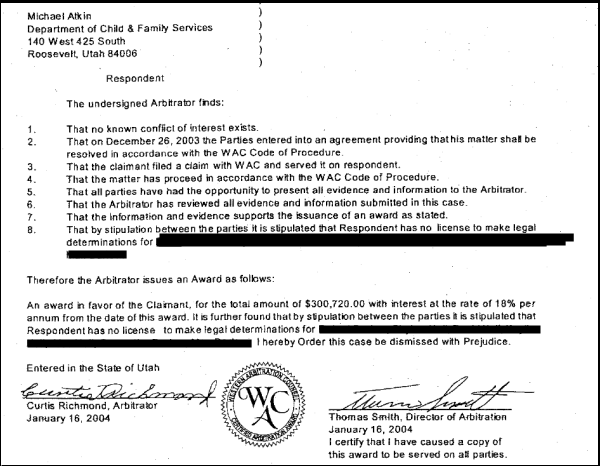
    indianchildrenCurtis Richmond’s signature as “Arbitrator” for a “tribal” panel set up by a sham Utah “Indian” tribe. In this case, the panel issued a fraudulent award of $300,720 and interest at “18% per annum against the Utah Department of Child & Family Services in a family matter.

    2.

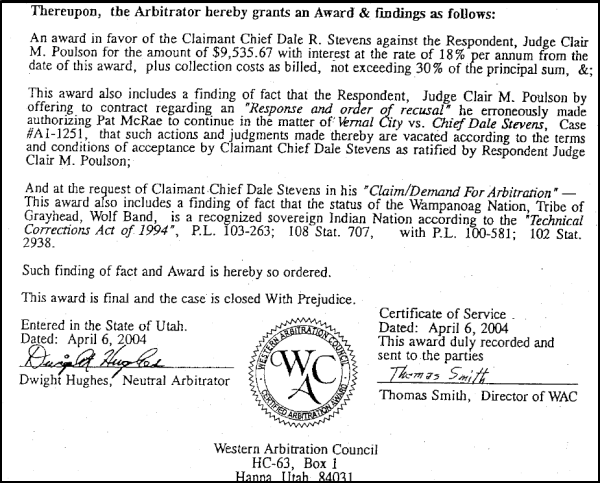
    indianjudgeSham “Indian” arbitration panel issues award of $9,535.67 to sham “Indian chief.” The “award” was lodged against a judge, assessing the judge interest of 18 percent per annum and collection costs “not exceeding 30% of the principal sum.” The “chief,” Dale Stevens, later was arrested on child porn charges and announced his intention to marry two underage girls, including a 12-year-old, with whom he sought marriage in exchange for half a cooler of “energy bars.” Stevens, 69, acknowledged his plan in open court.