Tag: SEC

  • URGENT >> BULLETIN >> MOVING: SEC Charges Alleged HYIP Operators Who Ran ‘Profits Paradise’ From India; Scammers Allegedly Used Fake Names And Engaged In Wanton Deception

    From an SEC exhibit in the Profits Paradise complaint.
    From an SEC exhibit in the Profits Paradise complaint.

    URGENT >> BULLETIN >> MOVING: (Updated 9:33 p.m. ET U.S.A.) The SEC has charged two Indian nationals with running an HYIP scheme known as “Profits Paradise” that reached into the United States and offered “extraordinary” returns of up to 480 percent in 240 days, plus “compounding.”

    As is typical in HYIP schemes, the “program” gained a head of steam on social media, the SEC charged. (A quick Google search shows that ProfitsParadise also had a presence on well-known Ponzi forums such as TalkGold and MoneyMakerGroup.)

    ProfitsParadise operated between April 2013 and early February of 2014 and offered “guaranteed” payouts, the SEC alleged.

    The scam “invited investors to deposit funds that supposedly would be pooled with money from other investors and traded on foreign exchanges as well as in stocks and commodities,” the SEC alleged.

    Pitches on Facebook, YouTube and Twitter were “pervasive” and resulted in investors being exploited, the SEC charged.

    The named respondents are Pankaj Srivastava of Mumbai and Nataraj Kavuri of Hyderabad. They also are accused of promoting the scam through Google Plus.

    Srivastava “used the pseudonym “Paul Allen,” the SEC charged. Kavuri called himself “Nathan Jones.”

    It was not immediately clear from the complaint whether the HYIP scammers intended to trade on the name of Microsoft co-founder Paul Allen. HYIP schemes, however, are infamous for trading on the names of prominent individuals.

    “Srivastava and Kavuri used excessive secrecy in their effort to swindle investors through social media outreach and a website that attracted as many as 4,000 visitors per day,” said Stephen Cohen, associate director of the SEC’s Division of Enforcement.  “Our investigation stopped the constant solicitations once the website disappeared, and successfully tracked down the identities of the perpetrators behind those fraudulent solicitations.”

    Bogus names also were used to register websites, the SEC charged.

    Srivastava caused the Profits Paradise website to be registered through GoDaddy in the name of “Jane Roe” of Seattle, the SEC charged.

    “Jane Roe is a fictitious name, and there is no connection between Profits Paradise and the dwelling at 300 Boylston Ave E., in Seattle, Washington, or its residents,” the SEC charged. “The telephone number provided to GoDaddy is a toll-free number for a conference call center that is unrelated to Profits Paradise,” the SEC charged.

    Meanwhile, a Gmail email address linked to the supposed Seattle street address was associated with IPs “located in India, not Seattle,” the SEC charged.

    At the same time, the agency charged, “Kavuri disguised Profits Paradise’s physical location by providing the false ‘whois’ data, indicating that Profit Paradise’s operations were within the United States when they were not.”

    From the SEC’s civil administrative complaint (italics added):

    “The phony name and address served a dual purpose. In addition to concealing the fact that Srivastava and Kavuri were behind the Website, the domain name registration to Jane Roe at a Seattle address was meant to attract American investors. Additionally, to create the illusion that mainly American investors were visiting the Profits Paradise Website, Srivastava instructed the web designer to ensure that the ‘Alexa detail’ showed the Website’s ‘rank in the United States’ rather than its ‘rank in India.’ “Alexa” refers to a website (www.alexa.com) that ranks other websites, by country, based on the amount of Internet traffic directed to the website.”

    Also typical of HYIP scams, payment processors such as Liberty Reserve, PerfectMoney and EgoPay were used. Dates cited in the SEC complaint suggest Profits Paradise opened its Liberty Reserve account just prior to federal prosecutors bringing criminal charges against Liberty Reserve in May 2013.

    Liberty Reserve has been described by prosecutors as a $6 billion money-laundering operation that propped up HYIPs and other frauds.

    Srivastava, in 2005, worked for Quixtar.com in Minneapolis, but returned to India in 2007, the SEC said.

    Read the SEC complaint,  which alleges the Profits Paradise scheme also was “structured so that under certain conditions investors could never recover their principal investments.”

    The SEC also has updated its Investor Alert on fraud schemes that trade on social media.

  • URGENT >> BULLETIN >> MOVING: First U.S. Criminal Prosecution Of Bitcoin-Themed Scheme; Trendon Shavers Arrested

    breakingnews72In the first U.S. criminal prosecution involving a Bitcoin-themed scheme, Trendon Shavers has been arrested and charged with securities fraud and wire fraud.

    Shavers, 32, of McKinney, Texas, was charged civilly by the SEC in July 2013. He is known as “pirateat40,”  and allegedly pushed his Bitcoin Savings and Trust Ponzi scheme from a forum.

    FBI agents arrested him today at his Texas residence.

    “As alleged, Trendon Shavers managed to combine financial and cyber fraud into a Bitcoin Ponzi scheme that offered absurdly high interest payments, and ultimately cheated his investors out of their Bitcoin investments,” said U.S. Attorney Preet Bharara of the Southern District of New York.  “This case, the first of its kind, should serve as a warning to those looking to make a quick buck with unsecured currency.”

    A top FBI official threw down the gauntlet.

    “Shavers used a new currency, but the same old reprehensible tricks,” said FBI Assistant Director-in-Charge George Venizelos. “He claimed to offer a Bitcoin market-arbitrage strategy. In reality, it was nothing more than an insidious scheme motivated by greed. Today, Shavers’ jig is up. He finds himself under arrest and charged in Manhattan federal court.”

    Some HYIP schemes appear now to have moved away from payment processors such as the now-shuttered Liberty Reserve and are moving toward Bitcoin.

    From a statement by Bharara’s office, which previously prosecuted Liberty Reserve, calling it a $6 billion money-laundering operation that enabled HYIPs and others forms of fraud (italics added):

    From at least September 2011 up through and including September 2012, SHAVERS operated a Ponzi scheme. Specifically, SHAVERS solicited investments in BCS&T on the “Bitcoin Forum” – a public, Internet-based forum where, among other things, Bitcoin investment opportunities were posted. SHAVERS’s offer to investors was straightforward: investors who lent Bitcoin to BCS&T would be paid up to seven percent interest weekly – an annualized interest rate of 3,641% per year – and investors could withdraw their investments in BCS&T at any time. SHAVERS claimed that the Bitcoin invested by BCS&T investors would be used to support a Bitcoin market-arbitrage strategy, which included (i) lending Bitcoin to others for a fixed period of time; (ii) trading Bitcoin via online exchanges; and (iii) selling Bitcoin locally via private, off-markets transactions – i.e., “over-the-counter transactions.” SHAVERS also personally guaranteed to cover any losses in the event of a market change. In truth, SHAVERS largely failed to execute the claimed market arbitrage strategy, failed to honor all of his investors’ redemption requests as well as his personal guarantee, and failed to deliver the agreed upon rates of interest.

    In the end, BCS&T was a Ponzi scheme in which SHAVERS used Bitcoin from new investors to make purported interest payments to existing investors and to cover investors’ requests to withdraw Bitcoin from existing BCS&T accounts. In addition, SHAVERS diverted investors’ Bitcoin for day trading in his own account on a Bitcoin currency exchange, and exchanged investors’ Bitcoin for U.S. dollars to pay certain of his personal expenses. At the peak of the scheme, SHAVERS raised, and had in his possession, about seven percent of all the Bitcoin that were then in public circulation. In the end, at least 48 of approximately 100 investors lost all or part of their investment in BCS&T.

    Some Bitcoin enthusiasts have fretted that dark forces and criminal organizations are seeking to use Bitcoin in the same way they used Liberty Reserve. Criminal activities could undermine confidence in Bitcoin and affect its perception in the marketplace.

    In late August, some affiliates of the collapsed $850 million Zeek Rewards Ponzi scheme began pushing a Bitcoin-themed “program” known as BitClub Network, a purported “mining venture” with an investment arm attached that purportedly supplies a payout for 1,000 days.

    Prospects were encouraged to buy in with sums ranging from $500 to $3,500.

    Zeek used traditional forms of payment.


  • SEC: Penny-Stock Scammers Used ‘Intricate Web Of Offshore Corporations, Foreign Accounts, And Financial Institutions . . . In Canada, Nevis, Panama, Switzerland, And The Turks And Caicos Islands’

    breakingnews72Two Canadians have been charged by the SEC in an alleged pump-and-dump scheme that included a reverse merger between a “shell public company” and a startup, “blast emails” and a concerted hype campaign, the U.S. agency said.

    Named defendants are Bruce D. Strebinger, 38, of Vancouver, and Brent Howard Chapman, 38, who “is or has been residing in Antigua,” the SEC said. The complaint is filed in U.S. District Court for the Northern District of Georgia.

    “Strebinger and Chapman rigged a penny stock in their favor while staging a massive promotional campaign,” said William P. Hicks, associate director for enforcement in the SEC’s Atlanta Regional Office. “They disguised their scheme by dumping their shares in relatively small amounts over extended periods of time, and they attempted to hide their proceeds from U.S. regulators by routing them through offshore accounts.”

    The shell was known as Americas Energy Company-AECo. Its stock was suspended, with the company being liquidated in bankruptcy, the SEC said. The other company was a startup coal mining and oil and gas exploration business based in Nashville, Tennessee” that became known as Americas Energy Company Inc.

    From the complaint (italics added):

    The promotion began in September 2009 and continued through April 2010. While the promotion continued and the Stock price soared, Strebinger and Chapman sold their Stock for $17 million through offshore accounts, including accounts with Swiss financial institutions in the names of three entities: (1) Muskateer Investments, Inc. (“Muskateer”), beneficially owned by Strebinger; (2) Furla Blue SpA (“Furla”), beneficially owned by Strebinger’s wife, Anne Strebinger (“Strebinger’s Wife” ); and (3) Lance Investments S.A. (“Lance), beneficially owned by Chapman.”

    The promotion increased investor demand for the Stock and enabled Strebinger and Chapman to reap huge profits through sales of the Stock while simultaneously concealing from investors not only that Strebinger and Chapman owned a significant portion of Americas Stock, but also that it was Strebinger and Chapman who were together marketing and funding a multi-million dollar promotional campaign related to the Stock.”

    All in all, the SEC charged, the duo sold their shares “through an intricate web of offshore corporations, foreign accounts, and financial institutions located in Canada, Nevis, Panama, Switzerland, and the Turks and Caicos Islands.”

    Assisting in the probe were the British Columbia Securities Commission, the Swiss Financial Market Supervisory Authority and the Financial Industry Regulatory Authority, the SEC said.

  • In Extraordinary Development, Federal Judge Approves Temporary Restraining Order ‘Without Notice’ That Directs Zeek Vendor ‘To Immediately Deposit With The Receivership’ Nearly $5 Million

    Paul Burks.
    Paul Burks.

    DEVELOPING STORY: (Updated 10:02 p.m. EDT U.S.A.) In an extraordinary development on this Halloween Friday, the federal judge presiding over the SEC’s Ponzi- and pyramid-scheme case against Zeek Rewards has issued a Temporary Restraining Order and directed a Zeek vendor to immediately turn over to the receivership more than $4.85 million.

    The order was entered “without notice,” owing to concerns the money could go missing. It applies to Zeek financial vendor Preferred Merchants Solutions LLC and Jaymes Meyer, Preferred’s California-based sole member and manager.

    Events that led to the order involve a bizarre circumstance that allegedly occurred in June 2012, when tens of millions of dollars in undeposited checks — enough to fill six to eight mail bins — had backed up at Zeek, starving the Rex Venture Group LLC enterprise for cash during a period in which Zeek was having banking problems in North Carolina and its alleged Ponzi was crumbling.

    Zeek operator Paul Burks allegedly hired Preferred to solve the problem and also to provide trust services. According to a document filed by Preferred in August 2014, the first time the company visited Zeek headquarters, “ex- or off-duty police officers [were] providing security.”

    Preferred contends it solved Zeek’s problem with the backed-up checks and legitimately is owed the $4.85 million at issue.

    But receiver Kenneth D. Bell, who is seeking a contempt sanction against Preferred and alleges that Preferred effectively transferred Zeek Ponzi cash to itself after it learned from the SEC on Aug. 16, 2012, that an order freezing Zeek assets was imminent, asked Mullen for the TRO on Oct. 28.

    Bell alleges that “the evidence establishes that Preferred Merchants and Meyer directed the $4.8 million transfer from the RVG trust account to Preferred Merchants’ account just 19 minutes after the SEC told them about the asset freeze and imminent shutdown of RVG” on Aug. 16, 2012.

    He further alleges that “[n]ot only did Meyer fail to tell the SEC about his custody and control over RVG assets, Meyer also failed to disclose that he anticipated making any transfers, or, after the transfers were executed, that he had done so.”

    From the order entered at 11 a.m. today by Senior U.S. District Judge Graham C. Mullen of the Western District of North Carolina (italics added):

    The Receiver has satisfied the requirements of Federal Rule of Civil Procedure 65(b) and established that an order is appropriate in this case to avoid irreparable injury, loss, or damage to the Receivership Estate of Rex Venture Group, LLC, including the further waste and dissipation of Receivership Property. Notably, the Court finds that the large amount of money at stake, the liquidity of the funds which could be transferred overseas or hidden, and Preferred Merchants’ and Meyer’s apparent pattern of misconduct present a likelihood of irreparable harm and necessitate this order being entered without notice. Accordingly, and for the reasons stated in the motion and memorandum, the Court will GRANT the motion.

    IT IS, THEREFORE, ORDERED, ADJUDGED, AND DECREED that:
    1. This Order is entered at 11 a.m. on October 31, 2014.
    2. The Receiver’s Motion for Temporary Restraining Order is GRANTED;
    3. Preferred Merchants Solutions, LLC (“Preferred Merchants”) and Jaymes Meyer (“Meyer”) are directed to immediately deposit with the Receivership $4,854,010.40, which is the amount they transferred from RVG’s trust account after the SEC notified them of the asset freeze and requested that they freeze all RVG accounts and assets;
    4. The Receiver is directed to deposit and maintain these funds in a segregated account;
    5. This injunction shall expire no later than fourteen (14) days from the entry of this Order or sooner upon further order of the Court.
    6. The Court will conduct a hearing on this matter on Wednesday, November 12, 2014 at 2 p.m. in Courtroom 3 at the Charles R. Jonas Federal Building, 401 W. Trade Street, Charlotte, NC 28202. The Receiver is directed to use all reasonable efforts to notify Meyer and Preferred Merchants of the date, time, and location of the hearing.

    Burks, 67, of Lexington, N.C., was indicted a week ago today on criminal charges, including mail fraud, wire fraud and conspiracy. A separate lawsuit filed by Bell last month against alleged Zeek winners in Canada contends that Zeek “insiders often worried about being caught.”

    Mountains of undeposited checks also were an issue in the AdSurfDaily Ponzi-scheme case in 2008. ASD purported to pay a dividend of 1 percent a day. Zeek’s average daily payout was about 1.5 percent, according to the SEC.

    ASD and Zeek had members in common.

    NOTE: Our thanks to the ASD Updates Blog.

  • SEC Official Speaks On TelexFree Case At ‘Fraud Affects Every Community’ Event At FTC, Announces ‘Pyramid-Scheme Task Force’ And Tells Audience That ‘Program’ Consumed Entire $50,000 Retirement Account Of Trusting Mom

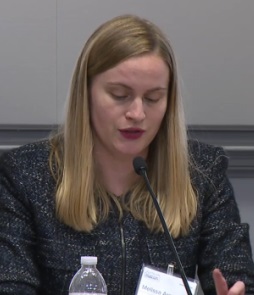
    “We know of at least one victim who borrowed, I think, $50,000 from his mother and gave it all to [TelexFree]. And it was her entire retirement.” Melissa Armstrong, assistant chief litigation counsel, U.S. Securities and Exchange Commission, Oct. 29, 2014

    Melissa Armstrong of the SEC at an FTC event today. Source: FTC video.
    Melissa Armstrong of the SEC at an FTC event today. Source: FTC video.

    UPDATED 12:19 P.M. EDT OCT. 30 U.S.A. Affinity fraud was one of the topics at an all-day symposium today at the Federal Trade Commission (FTC). The event was titled, “Fraud Affects Every Community.”

    Melissa Armstrong, assistant chief litigation counsel for the U.S. Securities and Exchange Commission (SEC), was one of the featured speakers. Her topic was the SEC’s pyramid- and Ponzi case against TelexFree and how TelexFree was a form of affinity fraud.

    In her view, Armstrong said, some TelexFree promoters exploited members of the Dominican and Brazilian communities.

    And, she told the audience, the scheme spread over YouTube, Facebook, Twitter, Instagram and though local pitchfests.

    “They sold a version of the American dream that was [meant] to appeal to recent immigrants,” she said.

    Over time, Armstrong said, TelexFree gathered “hundreds of millions of dollars from hundreds of thousands of promoters. It had promised to pay them back to the tune of [about] $5 billion.”

    “The message was always consistent: You could go from having nothing to having it all in a very short time with this program,” she said. “The organizers would travel from city to city.”

    Organizers “were given the rock-star treatment,” she said. Recruiters provided “testimonials.”

    And, she said, “training centers were nothing more than recruitment centers.”

    “Ministers” of church congregations helped the scam spread, Armstrong said.

    Armstrong also touched on TelexFree’s April 2014 bankruptcy filing. And, without mentioning TelexFree co-owner Carlos Wanzeler by name, she said he “fled to Brazil” and now faces criminal charges in the United States.

    Former TelexFree President James Merrill also faces criminal charges.

    The SEC now has a “newly established pyramid-scheme task force,” Armstrong said.

    Armstrong’s remarks begin at about the 4:22 mark below.

    More information on the “Fraud Affects Every Community” FTC symposium, including the roster of speakers and topics, is available here.

    Topics:

    • Welcome/Introduction
    • A Look at the Marketplace for Different Communities
    • How and Why Fraud Affects Different Communities
    • Getting More Specific: Community Case Studies on Fraud
    • Education and Community Outreach: An Open Discussion
    • Fraud Research: Building on Solid Data
    • Wrap Up
  • TelexFree Probe Continues; ‘Substantial Amount’ Of YouTube Video Content Sought In Search Warrant Served Oct. 16

    newtelexfreelogoThe TelexFree probe continues in the United States, with prosecutors revealing today that federal agents served a search warrant on Google on Oct. 16 that sought a “substantial amount” of content on YouTube.

    Precisely what content prosecutors are seeking was not immediately clear.

    Google told agents that “compliance will take several weeks,” according to the prosecution filing.

    Regulators have warned for years that HYIP scams are spreading through promos on social media such as YouTube, Facebook and Twitter.

    Today’s prosecution filing also revealed that undercover agents attended multiple TelexFree functions, not just a conference in Boston in March.

    In the government’s possession, prosecutors said, are “[v]arious recordings made by undercover [Homeland Security Investigations] agents at TelexFree conferences and in conversations with a TelexFree promoter.”

    The information eventually will  be provided through discovery, prosecutors said.

    The office of U.S. Attorney Carmen Ortiz of the District of Massachusetts is leading the TelexFree probe.

    According to today’s prosecution filing, other material pending processing and production for discovery includes:

    About 40 boxes of documents seized from TelexFree’s offices in Marlborough, Mass., in April 2014. These materials are being scanned and processed by a vendor, a process that will take several weeks.

    About 81 gigabytes of data (about 355,000 pages) received in October 2014 from the Trustee supervising TelexFree’s affairs in bankruptcy. (PP Blog note: Stephen B. Darr is the court-appointed TelexFree trustee.)

    Additional financial records received from the U.S. Securities & Exchange Commission pursuant to an access request, and from Homeland Security Investigations, totaling approximately 12 boxes of material.

    The results of five email search warrants served on or about Sept 25, 2014. As of this date, the government has only received materials for one of the email accounts and is following up with the other internet service providers.

    Through the discovery process so far, according to the prosecution filing, the government has “produced an electronic database containing most of the data and records the government has collected via subpoena while investigating this case (about 100,000 pages). The government has also made several productions of additional material in response to specific requests from counsel, including all bank and brokerage records, and has made available the electronic evidence seized during execution of search warrants in April 2014.”

    NOTE: Our thanks to the ASD Updates Blog.

  • Tweets Claim SEC Inquiring About ‘Hundreds’ Of Bitcoin-Themed Companies

    4th UPDATE 8:09 A.M. EDT OCT. 30 U.S.A. In the past several hours, Tweets sourced to Bitcoin-themed publications such as CoinFire, CryptoCoinsNews and CoinTelegrah claim the SEC has opened preliminary inquiries into hundreds of Bitcoin-themed enterprises.

    On the CoinTelegraph website, the publication asserts there is a “gag order attached to these requests for voluntary cooperation.”

    For starters, there appears to be no independent corroboration from the SEC of the inquiries. None may be forthcoming, given that early inquiries — if they exist — are not public by design. Moreover, references to a “gag order” may be a misinterpretation of a phrase the SEC uses when opening preliminary inquiries. Using boilerplate language, the SEC typically informs the subjects of the inquiries that “This investigation is confidential and non-public.”

    The language is designed to protect both the recipient’s interests and the SEC’s. So, if the claim that a “gag order” has been issued is hung around the boilerplate language concerning the confidential nature of SEC inquiries at this early stage, it very well may mean the “gag order” claim is incorrect.

    Not all inquiries result in an enforcement action that involves a U.S. federal court or an SEC administrative law judge. Some do, however. Here, via the Chicago Sun Times, is an example of a nonBitcoin enterprise that received an SEC boilerplate letter in September 2013 and later became the subject of a full-blown  investigation that led to an enforcement action in June 2014.

    On the whole, though, we’d say the odds the SEC wants to look down certain Bitcoin-themed rabbit holes are very high — notwithstanding the fact that the PP Blog cannot confirm the Twitter claims about the inquiries.

    It is obvious that Bitcoin-themed HYIPs are operating. Another area of obvious concern: Are Bitcoin-themed enterprises running crowdfunding scams?

    One thing to look for as this situation evolves is crackpot “defenses” of everything Bitcoin. In response to the Tweets and coverage on Bitcoin-themed publications of the asserted SEC inquiries, some such defenses already have surfaced. One poster on CryptoCoinsNews, for example, appears to be advancing a conspiracy theory that the SEC is trying to dupe recipients of the asserted inquiry letters into confessing jurisdiction.

    In the Comments thread, the poster suggests that recipients of the asserted inquiries should respond as such (italics added):

    “I _______ (state your name), present myself in pro pria persona for a special appearance, as to be distinguished from a general appearance and respectfully ask [the court to direct the prosecution] to prove for and on the record all elements of jurisdiction binding me to perform in any way whatsoever.”

    The problem with such a response is that it comes off sounding like so much “sovereign citizen” poppycock that it has the potential to subject to additional scrutiny those who’d adopt the guidance. Beyond that, even if the inquiries actually are taking place, no court appears to be involved at this time and it’s already clear that the SEC has jurisdiction over matters pertaining to securities.

    Other “defenses” suggest the SEC is sending out a squad of “goons” to make it hard for companies to do business and that the SEC is interfering in “contracts” between consenting adults.

    For whatever reason, various “defenders” of online “opportunities” have adopted a bizarre narrative that more or less asserts that all commerce is lawful as long as the parties entering a contract agree that it is lawful. Such constructions, however, would legalize murder-for-hire, terrorism plots, extortion, human trafficking, selling narcotics to school children and many other pursuits society rejects.

    Simply put, there are a lot of holes in claims that all commerce is lawful as long as the parties agree that it is lawful. Such constructions would mean that John Q. Bloodthirsty Political Extremist could enter into a contract with Carlos the Jackal to plant a car bomb designed to kill innocents in France — and no government or no person could do anything about it, including maimed survivors who never agreed to be disfigured at the hands of the contracted parties.

    It is no more lawful to operate an HYIP or crowdfunding scam that involves Bitcoin than one that involved Liberty Reserve, alleged to have helped criminals launder $6 billion.

  • Top Official Who Warned About Cross-Border ‘Criminal Enterprises’ And ‘Frivolous Libel Cases’ To Mask Them Is Leaving Justice Department

    Deputy Attorney General James M. Cole, the No. 2 official at the U.S. Justice Department, is leaving after four years, Attorney General Eric Holder confirmed in a statement. (Holder also is leaving, a topic for another day.)

    Cole said something in Mexico City at the High-Level Hemispheric Meeting Against Transnational Organized Crime in March 2012 that is as important today as it was on the day the words were spoken.

    Indeed, Cole said on March 1, 2012, “Because of the sophistication of the world economy, organized crime groups have developed an ability to exploit legitimate actors and their skills in order to further the criminal enterprises. For example, transnational organized criminal groups often rely on lawyers to facilitate illicit transactions. These lawyers create shell companies, open offshore bank accounts in the names of those shell companies, and launder criminal proceeds through trust accounts. Other lawyers working for organized crime figures bring frivolous libel cases against individuals who expose their criminal activities.”

    And Cole also said this: “The advance of globalization and the internet, while hugely beneficial to people everywhere, has also created unparalleled opportunities for criminals to expand their operations and use the facilities of global communication and commerce to carry out their criminal activities across national borders.”

    We wish Deputy Attorney General Cole the best and thank him for his dedicated service to his country.


  • CKB/CKB168, WCM777 And TelexFree Prosecutions Make SEC’s 2014 Highlight Reel; Agency Says Its Job In MLM Sphere Isn’t Done

    recommendedreading1The prosecutions of the CKB/CKB168, WCM777 and TelexFree “programs” made the SEC’s highlight reel for fiscal year 2014, which began on Oct. 1, 2013 and ended on Sept. 30 of this year.

    In a statement today, the SEC said “new investigative approaches and the innovative use of data and analytical tools contributed to a very strong year for enforcement marked by cases that spanned the securities industry.”

    Noting the FY 2014 pyramid-scheme actions against the MLM or direct-sales firms included allegations that the “programs” used social media and targeted immigrant communities, the SEC said its work wasn’t done.

    “The Enforcement Division will continue to root out pyramid and Ponzi schemes that prey on vulnerable investors,” the agency said.

    Not specifically noted in the agency’s statement today were the actions against the eAdGear and Zhunrize “programs” announced just prior to the close of the 2014 fiscal year. The eAdGear case was announced on Sept. 26; the Zhunrize case was announced on Sept. 23.

    Since the Zeek Rewards action in 2012, it has become clear that MLM HYIP schemes have tapped participants for spectacular sums. The Zeek scheme alone gathered on the order of $850 million. Filings suggest TelexFree may have gathered on the order of $1.2 billion.

    CKB/CKB168 appears to have gathered at least $20 million. WCM777 gathered on the order of $80 million. Zhunrize gathered on the order of $105 million, and eAdGear gathered on the order of $129 million, according to court filings.

    Zeek receiver Kenneth D. Bell, who is managing Zeek-related cases that involve hundreds of thousands of victims across the world, described Zeek this week as an attempt to put lipstick on a pig.

    It’s a description that could apply across the MLM HYIP sphere. The cross-border, murky nature of the “programs” raise concerns about both economic security and national security.

    On Sept. 21, the PP Blog reported that a small sampling of data from 95-self-identified victims of TelexFree shows they lost an average of $27,578 each. TelexFree potentially created 1 million victims or more.

    The SEC has broad responsibilities across the securities industry and its sectors — from Wall Street to Main Street.

    From the SEC’s statement today (italics added):

    The Securities and Exchange Commission today announced that in fiscal year 2014, new investigative approaches and the innovative use of data and analytical tools contributed to a very strong year for enforcement marked by cases that spanned the securities industry.

    In the fiscal year that ended in September, the SEC filed a record 755 enforcement actions covering a wide range of misconduct, and obtained orders totaling $4.16 billion in disgorgement and penalties, according to preliminary figures. In FY 2013, the Commission filed 686 enforcement actions and obtained orders totaling $3.4 billion in disgorgement and penalties. In FY 2012, the Commission filed 734 enforcement actions and obtained orders totaling $3.1 billion in disgorgement and penalties.

    The agency’s enforcement actions also included a number of first-ever cases, including actions involving the market access rule, the “pay-to-play” rule for investment advisers, an emergency action to halt a municipal bond offering, and an action for whistleblower retaliation.

    “Aggressive enforcement against wrongdoers who harm investors and threaten our financial markets remains a top priority, and we brought and will continue to bring creative and important enforcement actions across a broad range of the securities markets,” said SEC Chair Mary Jo White. “The innovative use of technology – enhanced use of data and quantitative analysis – was instrumental in detecting misconduct and contributed to the Enforcement Division’s success in bringing quality actions that resulted in stiff monetary sanctions.”

    “Time and again this past year, the Division’s staff applied its tremendous energy and talent, uncovered misconduct, and held accountable those who were responsible for wrongdoing,” said Andrew J. Ceresney, Director of the SEC’s Division of Enforcement. “I am proud of our excellent record of success and look forward to another year filled with high-impact enforcement actions.”

  • RECEIVER: Zeek Rewards Was ‘Pig’ To Which MLM Lawyers Attemped To Apply ‘Lipstick’ — While One Of The Lawyers Participated On Massive Ponzi Scheme’s ‘Leadership Calls’

    EDITOR’S NOTE: Kevin Grimes, MLM Compliance VT LLC and the Grimes & Reese law firm have argued that the claims against them should be dismissed. Zeek’s receiver argues otherwise, saying a “bogus ‘compliance course’” advanced by Grimes helped dupe the Zeek masses. Zeek affected hundreds of thousands of people, the SEC has said.

    Legal malpractice and other claims against MLM attorney Kevin Grimes, his entity MLM Compliance VT LLC and the Grimes & Reese law firm should stand, the court-appointed receiver in the Zeek Rewards Ponzi- and pyramid-scheme case said in court filings yesterday.

    One of the reasons, receiver Kenneth D. Bell argued in a motion to Senior U.S. District Judge Graham C. Mullen, is that the defendants “in effect attempted to put lipstick on the ZeekRewards pig.”

    Another reason is that Grimes participated in at least three affiliate “leadership calls” with Zeek insiders and “actively assisted the Insiders in promoting and legitimizing the scheme,” Bell said.

    “Grimes allowed his name and his firm’s name to be used to promote the scheme,” Bell said.

    Mullen should reject bids by the defendants to have the claims dismissed, Bell argued.

    Read the receiver’s argument, courtesy of the ASD Updates Blog.

    Read the Grimes’ brief in support of his motion to dismiss. Read the Grimes & Reese brief in support of its motions to dismiss.

    The SEC has described Zeek as a massive securities fraud that gathered hundreds of millions of dollars in a combined Ponzi- and pyramid scheme.


  • DEVELOPING STORY: Zeek Figure Robert Craddock Accused Of Trademark Infringement And Engaging In ‘Shake-Down’ Bid Against MLM Affiliates

    EDITOR’S NOTE: The story below focuses mostly on a lawsuit filed against Zeek Rewards figure Robert Craddock by a Nevada company known as BTG180. A lawsuit filed against Craddock by a Wyoming company known as OfferHubb.net Inc. makes similar claims against Craddock.

    ** ___________________________________**

    breakingnews72DEVELOPING STORY: (4th Update 10:12 a.m. EDT Oct. 14 U.S.A.) Zeek Rewards figure Robert Craddock has been accused in a private lawsuit filed in Nevada federal court of trademark infringement and using a “shell corporation” to engage in a “shake-down” bid against affiliates of at least three MLM networks: Zeek, OfferHubb and BTG180.

    The alleged shell corporation is known as Fun Club USA Inc., according to a complaint filed Feb. 5, 2014.  It has “no employees,” was  “never capitalized” and created a condition under which Craddock was able to use funds directed to the corporation by MLMers as his personal funds, the plaintiffs contend.

    The plaintiffs in the case are listed as BTG180 LLC and Randall Jeffers. A second complaint against Craddock was filed on the same day, also in Nevada. Plaintiffs in that case are OfferHubb.net Inc. and David Flynn, who allege that Craddock “immediately” embarked on a web-based disparagement campaign against them after OfferHubb chose in July 2013 not to renew a contract with Craddock and FunClub USA.

    OfferHubb.net Inc. further accused Craddock of misrepresenting the company, breaching the OfferHubb Terms of Service by inducing affiliates to make side deals and accept kickbacks from affiliates and cross-selling other MLM opportunities in contravention of his agreement with OfferHubb.

    BTG180 is associated with a “program” known as BidsThatGive, which positioned itself as an opportunity to fight child poverty and the exploitation trades. An apparent prelaunch for BidsThatGive was conducted in July 2012, the month before the SEC moved against Zeek.

    Fun Club and Craddock are referenced in a blistering memo filed in the Zeek Ponzi- and pyramid-scheme case by the SEC on Dec. 17, 2012. In the memo, the SEC accused Craddock of encouraging Zeek affiliates “not to cooperate” with Kenneth D. Bell, the court appointed receiver. The SEC further alleged that Craddock was spreading misinformation about how the agency viewed its own case against Zeek and that Fun Club appeared to have been formed 11 days after the SEC emergency action against Zeek on Aug. 17, 2012.

    Craddock has not been charged by the SEC with wrongdoing.

    Despite the SEC’s December 2012 assertions against Craddock and Fun Club, however, BTG180 appears to have entered into a contract with Craddock and Fun Club on Aug. 12, 2013, just five days shy of the one-year anniversary of the SEC’s complaint against Zeek. In the August 2012 action, the agency accused Zeek of engaging in securities fraud, selling unregistered securities and operating a combined Ponzi and pyramid scheme that had gathered hundreds of millions of dollars in just shy of 20 months.

    BTG180, according to its own lawsuit against Craddock and Fun Club filed in February 2014, paid Craddock and the shell company $50,000 in advance of work Craddock had agreed to perform for BTG180.

    BTG180 says it wants back the $50,000 because Craddock failed to deliver. It also contends other actions by Craddock caused it to suffer damages.

    Part of Craddock’s duties, according to the complaint, was to “market the BTG180 network marketing opportunity to former affiliates of the Zeek Rewards network, which had provided products similar to those provided by BTG180.”

    Craddock did not perform the agreed-to work, according to the lawsuit. Instead, he attempted to “induce BTG180 to promote and incorporate into its product line a so-called checking account draft processing system known as BTM. Craddock is the founder of a corporation  known as BTM Check Draft Inc.”

    Without authorization from BTG180’s Jeffers, according to the complaint, Craddock pitched his BTM check system to the members of BTG180, amid false claims that it “had been approved by BTG180” and was in the company’s product stable.

    Other “confrontations” between Craddock and “BTG180 executives” ensued, and Craddock tried to “induce” BTG180 to “market other products for him,” according to the complaint.

    When Craddock “continued to defy Plaintiffs requests to stop these actions,” according to the complaint, “BTG stopped paying Craddock and Fun Club.”

    Under the terms of the contract, according to an exhibit in the case, Craddock and Fun Club were to receive $20,000 a month through BTG180, plus approved expenses, from Sept. 1, 2013 through Sept. 1, 2014.

    Craddock also was required not to reveal BTG180’s trade secrets and proprietary information, according to the exhibit.

    But at some point during contractually required Craddock visits to BTG180’s operations in Nevada, according to the complaint, BTG180 came to believe that “Craddock used a computer or several computers at BTG180’s offices to access and download and/or retain contact information of BTG180’s affiliates.”

    Craddock, according to the complaint, then sought to harm BTG180 by “disrupting and ruining its relationships with its affiliates.”

    As part of his plan to ruin BTG180, according to the complaint, Craddock established a website styled BTGlegal.com and engaged in trademark infringement while doing so. As a further part of this scheme, according to the complaint, Craddock used the website to paint Jeffers as dishonest and unethical, saying Jeffers and “other principals” of BTG180 had criminal records and a history of defrauding people.

    At the same time, according to the complaint, Craddock claimed that BTG180 had been “classified” a Ponzi scheme, that the company was to be “investigated,” that “reports” about BTG180 had been filed with the North Carolina Attorney General, that a Zeek-like action against BTG180 was planned by investigators and that “BTG180 affiliates could face criminal or other legal charges for signing up new affiliates.”

    Craddock, according to the complaint, issued an “edict” that “all BTG180 affiliates were under a cease and desist order to stop doing business with BTG180.”

    By December 2013, according to the complaint, Craddock was soliciting monthly donations of $25 each from BTG180 affiliates, saying the money would help them get back sums they had paid to BTG180. At the same time, according to the complaint, Craddock was encouraging members to contact a reporter at ABC News by email and to use a subject line that read, “They Took My Money and Used Kids to Lure me In.”

    In 2012, according to the BTG180 complaint, Craddock had solicted donations from Zeek members amid assertions he was protecting their legal interests. He eventually did the same thing to BTG180 and OfferHub participants, a “shake-down” bid targeted at MLMers, according to the complaint filed by BTG180.

    Craddock is accused in the complaint of cybersquatting, trademark infringement, wrongful use of a computer, misappropriation of trade secrets, wrongful interference with economic relations, breach of contract, unjust enrichment, defamation and hiding behind a shell company.

    The trademark-infringement claim may be particularly concerning to the MLM trade, given that Craddock has asserted he works as a copyright and trademark agent on behalf of MLM “programs.”

    On July 22, 2012, while purportedly working as a “consultant” for Zeek, Craddock filed a copyright- and trademark-infringement complaint against a HubPages website operated by Zeek critic K. Chang. K. Chang, who also posts on publications such as the PP Blog and BehindMLM.com, ultimately prevailed in the action brought by Craddock.

    Less than a month later, the SEC brought the Ponzi- and pyramid action against Zeek.

    Earlier this year, a website known as Changes Worldwide identified Craddock as its copyright agent. Filings by the SEC in June 2014 alleged that Faith Sloan, accused in April 2014 of securities fraud by the agency in its Ponzi- and pyramid complaint against the TelexFree “program,” sent more than $15,000 to an entity known as Changes Worldwide LLC after an asset freeze was opposed against Sloan in the TelexFree case.

    Sloan also was a Zeek affiliate. Whether proceeds that originated in Zeek and/or TelexFree made their way into Changes Worldwide is unclear.

    BehindMLM.com, recently the subject of a DMCA takedown notice by Sloan but now back online, reported yesterday that Changes Worldwide and a companion entity known as Changes Trading are having payment problems. As the PP Blog reported on Oct. 2, the email address Sloan used to file the complaint against BehindMLM.com was associated with a 2×2 matrix “program” known as “Diamond Holiday Feeder” that was making the HYIP rounds in 2010.

    Despite the fact Sloan accused BehindMLM.com of using on its website copyrighted material she owned, one of her 2010 promos for Diamond Holiday feeder used nearly three minutes of a soundtrack recorded in 2009 by The Black Eyed Peas to celebrate the 24th season of the Oprah Winfrey Show.

    MPB Today, a collapsed matrix cycler that led to racketeering charges in Florida against the “program” operator, is an example of a 2×2. Another example is Regenesis 2×2, which led to a U.S. Secret Service probe in Washington state in 2009. Some Zeekers are known to have promoted Regenesis 2×2.

    News broke last week that Craddock is listed on Amazon.com as the author of a book on Zeek Rewards. Marketing copy for the book asserts that the U.S. government should have modeled a “stimulus program” after Zeek, rather than shutting it down.

    In the current infringement actions against Craddock, the dockets of the case suggest Craddock no longer has paid counsel and is seeking to litigate pro se against the plaintiffs, contending that the cases should have been handled through binding arbitration, not actions in federal court.

    Craddock’s wife is a co-defendant, amid claims she and her husband used Fun Club USA to dupe MLMers who provided money to protect their legal interests.

    NOTE: Our thanks to the ASD Updates Blog.