BULLETIN: A former Texas Department of Criminal Justice parole officer has been accused of honest services wire fraud and federal programs bribery, amid allegations she developed an “improper relationship” with one of her “assigned parolees” and enabled him to pull off a massive oil-and-gas swindle.
Nichelle Derricks, 37, of Cedar Hill, Texas, “secretly used her official position with TDCJ to enrich herself and others by soliciting and receiving cash payments, gifts, furniture, household goods and items, food and beverages, and other things of value from the parolee in exchange for favorable official action benefitting the parolee,” the U.S. Department of Justice said this morning.
A Dallas Observer Blog is reporting that the parolee was Alan Todd May.
In June 2010, the PP Blog reported that May was captured by the U.S. Marshals Service in San Francisco. He was wanted by the U.S. Secret Service and also was under investigation by the SEC for his multimillion-dollar “Prosper Oil & Gas Inc.” swindle.
May had a long criminal record and was described by the SEC as a “felon.” In 2010, the U.S. Marshals Service said May had assumed “multiple identities to evade apprehension.”
Although the Justice Department did not reference May by name in its news release today, the agency said this (italics added):
The indictment further alleges that Derricks repeatedly allowed the parolee to violate the terms of his parole by, among other things, permitting him to travel outside Texas without prior, written approval and by allowing the parolee to engage in prohibited financial transactions. According to the indictment, such favorable treatment allowed the parolee to facilitate a massive scheme to defraud investors through an oil and gas company founded and operated by the parolee while he was on state parole.
EDITOR’S NOTE: Would such a tale as summarized in the headline above and story below even sell as fiction in the bookstores and movie houses?
Whether your answer is yes or no, the practical reality is that it apparently has become possible in America to gather millions of dollars from at least 70 domestic and international investors (greedy suckers?) in a year by:
1.) Cherry-picking the name of a real-life German bank.
2.) Finding at least two post-Madoff Americans willing to sell anything and paying them more than $650,000 to turn a blind eye to everything as they positioned the “program” as one in which absurd returns were “100 percent guaranteed.”
3.) Taking the name of the German bank and tying it to popular fiction and a “program” named after a famous American handgun, the .44 magnum.
4.) Firing up a website that used the German bank’s name and waiting for the money to stream in — before ultimately doling out $848,500 to three Las Vegas “call girls” and another $1 million to an apparent Ponzi insider.
But what to do if you get caught? New court filings by the SEC show that you can at least try to claim you’re a victim of a real-life extortionist whose key physical characteristic is that he has only one eye — rather like a celluloid character from the world of popular fiction who had only one arm.
** _____________________________________ **
As things stand, elements of the SEC’s case against Geoffrey H. Lunn and his alleged fraud colleagues Darlene A. Bishop and Vincent G. Curry read as though the defendants came straight out of Central Casting.
The scheme itself evokes images of popular fiction, including the “Dirty Harry” movie series and “The Fugitive” television series and movie reboot. What’s more, because the scheme is alleged to have used a name that could conjure images of a German bank famous in real life, it inevitably evokes images of some downright ugly nonfiction. (The bank once was associated with infamy, given that it came under the influence of Nazis in Hitler’s Germany.)
Despite the bizarre backstory and the penetrating brightness of the red flags, Lunn’s “.44 Magnum” investors apparently displayed no qualities of discernment and allegedly bought into a scheme based upon representations that $44,000 would turn “into $2 million within 10 to 12 banking days.”
Lunn, of Sheridan, Colo., has admitted the $5.77 million “.44 Magnum Leveraged Financing Program” he is charged with orchestrating between February 2010 and February 2011 “was a con, basically,” the SEC says.
The scheme, the SEC said, married the .44 Magnum theme to the name of Dresdner Financial, a “fictitious business” with a name similar to the name of Dresdner Bank, formerly one of Germany’s largest financial institutions. It is not unusual for a scammer to trade on the name of a well-known company to pull off a con.
But Lunn, 56, claimed he could not abandon the purported Dresdner/.44 Magnum program because he was acting under the influence of an extortionist who “threatened to kill him and his family,” the SEC said.
Lunn, according to the SEC, described the purported extortionist as a “one-eyed man” who used “the alias Robert Perello.” He further claimed “he did not know Perello’s true identify or current whereabouts” and that he “was acting at Perello’s direction when he participated in the fraud.”
The alleged narrative of Lunn resembles the storyline of “The Fugitive,” a 1960s television series starring David Janssen that inspired a 1993 movie starring Harrison Ford. Both Janssen and Ford played the fictitious character Dr. Richard Kimble, accused of murdering his wife.
Kimble insisted the real killer was a “one-armed man.”
Lunn’s story also evokes images of the “Dirty Harry” movie franchise starring Clint Eastwood as fictional detective “Inspector Harry Callahan,” who armed himself with a .44 magnum handgun while battling San Francisco’s worst criminals and giving by-the-book cops, prosecutors and judges fits.
How much of Lunn’s tale was borrowed from Hollywood and the history books remains unclear. What is clear is that yet another bizarre securities caper allegedly was hatched in the United States.
“Lunn, Bishop, and Curry created an aura of credibility by inventing a fictitious firm with a name similar to a legitimate company,” said Robert J. Burson, associate regional director of the SEC’s Chicago Regional Office. “But their 100 percent guaranteed investment program and the astronomical returns they promised were nothing more than an elaborate hoax.”
Bishop, 40, resides in Odessa, Texas, and Curry, 42, resides in Las Vegas, the SEC said.
Bishop’s problems are not limited to her alleged role as a Lunn pitchwoman, according to records. In April, she was indicted in the Western District of Texas on charges of wire fraud and money laundering, amid allegations she sold purported “Proof of Fund” letters.
This is one of the allegations in the Texas indictment against Bishop (italics added):
Bishop convinced clients to wire tens of thousands of dollars to her in exchange for a POF letter that showed that they had tens of millions (sometimes hundreds of millions) of dollars in a bank account.
The Bishop clients “could then use this appearance of wealth to negotiate other
business deals or obtain money from other investors,” according to the indictment.
From the SEC’s complaint filed yesterday in Colorado (italics added):
Lunn did not use any of the investors’ money as promised. Instead, Lunn used the money for non-investment purposes, including withdrawing more than $1 million in cash and Western Union transfers, giving $848,500 to three Las Vegas call girls, paying $1.3 million to individuals who helped market the scheme (including over $650,000 to Bishop and Curry), giving $1 million in a Ponzi-like payment to a favored investor, and using the remaining funds to pay for Lunn’s personal and business expenses.
To date, “the Commission has not been able to identify or locate Perello,” the SEC said. “Regardless of whether Perello exists or had any role in the fraudulent scheme, Lunn is liable for his own conduct.”
And so, too, are the hucksters who advanced the Dresdner/.44 Magnum scheme, according to the SEC.
Read the SEC complaint against Lunn, Bishop and Curry.
AdSurfDaily figures Todd Disner and Dwight Owen Schweitzer — later to become pitchmen for the alleged Zeek Rewards Ponzi scheme — have appealed the dismissal of their ASD-related lawsuit.
In August, U.S. District Judge Rosemary Collyer dismissed claims by the ASD duo that their 4th Amendment rights had been violated when ASD computer records were seized in 2008.
Disner and Schweitzer had no standing to make the claim and had no privacy interests in records they voluntarily conveyed to ASD, Collyer ruled.
In September, the duo sought to reopen the case and have Collyer removed from hearing it, but Collyer said no.
Disner and Schweitzer now have appealed to the U.S. Court of Appeals for the District of Columbia the Aug. 29 final judgment and their denied motions to reopen the case and have Collyer stand down.
The combined ASD and Zeek schemes fetched at least $719 million, according to federal records. On Aug. 17, the SEC described Zeek as a $600 million Ponzi- and pyramid fraud.
ASD was a $119 million Ponzi scheme, according to the U.S. Secret Service. The Secret Service said in August that it also was investigating Zeek.
EDITOR’S NOTE: This may be one for your “Bubba Blue” notebook on how to have your Ponzi scheme.
A principal of USA Retirement Management Services and a pitchman have been charged in an alleged $28 million fraud scheme involving nonexistent “Turkish bonds” and targeted at senior citizens and “individuals with substantial savings,” federal prosecutors in the Northern District of Illinois said.
Facing arraignment in Chicago today are Robert C. Pribilski, 54, of Lisle, and John T. Burns III, 53, of Naperville.
Pribilski, a USA Retirement principal, was charged with five counts of wire fraud and four counts of mail fraud. Seminar pitchman Burns, meanwhile, was charged with three counts of wire fraud and three counts of mail fraud, prosecutors said.
Mahmut Erhan Durmaz, 42, also was charged with five counts of wire fraud and four counts of mail fraud, but is a “fugitive believed to be residing in Turkey,” prosecutors said.
While in the United States, Durmaz resided in the Chicago suburb of Streamwood. He also lived in Los Angeles and has used the name Francois E. Durmaz, prosecutors said.
Durmaz fled the United States on “the same day that a judge froze” his personal and business assets after an SEC civil action against Durmazin and against Pribilski in 2010, prosecutors said.
The scheme operated between 2005 and 2010 and featured the sale of promissory notes “that falsely represented USA Retirement ‘absolutely and unconditionally’ promised to pay investors between 4.75 and 11 percent annually, prosecutors said.
From a statement by the office of Acting U.S. Attorney Gary S. Shapiro:
Pribilski and Durmaz falsely claimed that the interest would be generated from investments in Turkish bonds. Instead, Pribilski and Durmaz operated a Ponzi-type scheme, using funds from the sale of promissory notes to make payments to other investors without disclosing that there were no Turkish bond investments. In offering and selling USA Retirement promissory notes, all three defendants falsely told investors that they had many years of investment banking experience in the purchase and sale of Turkish bonds, and that they had personally profited from such investments through USA Retirement. In fact, the defendants had no such banking experience and did not make any investments in Turkish bonds.
MoneyWeb has the story of Relative Value Arbitrage Fund (RVAF), an alleged massive Ponzi scheme in South Africa in which Herman Pretorius shot and killed a business partner in July and then shot and killed himself.
The scheme appears to have gathered R2.2bn, the equivalent of more than $250 million (U.S.).
From Julius Cobbett at MoneyWeb (italics/bolding added):
RVAF curators estimate that the scheme received R2.2bn from about 3000 investors. At the time of Pretorius’s death, the RVAF owed an estimated R3.1bn to investors.
The difference between the amount received and owing is most likely explained by the fund’s performance, which is believed to be fictitious.
Investigations following Pretorius’s death show that he alone was in control of a tangled web of companies, close corporations, trusts and offshore bank accounts.
NOTE BY PP BLOG: Some scammers on Ponzi-scheme forums also purport to engage in “arbitrage.” The collapse of purported arbitrage “program” Gold Nugget Invest (GNI) in 2010 brought out the “conspiracy theorists,” the PP Blog reported at the time.
Among the bizarre assertions was that the SEC was under investigation by INTERPOL.
It is common for Ponzi-board scammers to use terms that sound impressive — arbitrage, for instance — in their scams.
“Ken Russo,” a former Ponzi-board pitchman for the alleged Zeek Rewards Ponzi scheme, was promoting something called “NewGNI” even as he was promoting Zeek, according to his posts at the TalkGold Ponzi forum (as “DRdave”).
NewGNI may be a follow-up scam to the GNI scam.
Read a January 2010 PP Blog story on some of the bizarre claims surrounding the collapse of GNI, a scheme also pushed by some members of the AdSurfDaily Ponzi scheme.
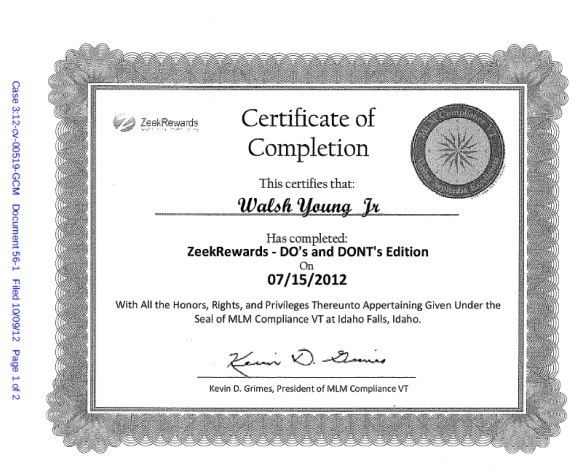
The logo of Zeek Rewards appears on this “Certificate of Completion” issued to Zeek member Walsh Young Jr. (Source: screen shot of exhibit filed by Young Oct. 9.)
For Californians Walsh J. Young Jr. and May Causing, the Zeek Rewards MLM scheme left them “on the verge of financial devastation,” according to a new filing in the Zeek Ponzi scheme case.
The self-written, self-submitted filing by Young and Causing appeared yesterday on the docket of Senior U.S. District Judge Graham C. Mullen of the Western District of North Carolina. Mullen is presiding over the Zeek case brought by the SEC Aug. 17.
Causing plowed $5,000 into the Zeek scheme in April 2012, funding her Zeek account with an “Official Check” from Citibank, according to the filing and an exhibit that accompanied it.
Causing resides in Eagle Rock.
On June 4, Young plowed $2,000 into Zeek, using a cashier’s check from Bank of America, according to the filings. Later — on June 26 — he plowed another $6,000 into Zeek, again using a Bank of America cashier’s check.
Young resides in Bell.
The filing alleges that Zeek business meetings were conducted by affiliates in Rancho Cucamonga, Harbor City, Cerritos and Carson.
Prospects, according to Young and Causing, were told that they could purchase “name brand merchandise at 95% off of retail prices” and that the company had a “long standing track record with 15 years of rock solid business practices.”
The pitch, according to Young and Causing, included references to the business bona fides of Zeek operator Paul Burks and Kevin Grimes, “known to be the best MLM attorney in the industry.”
Prospects also were told that Zeek shared “50% of its daily profits with vested affiliates,” according to the filing.
The filing claims that Zeek pitchman Tom More had acquired “over a million VIP points” and that Dolly Inocencio had acquired “over 250,000 VIP points.”
All in all, the Zeek deal seemed to make sense, given the claims, according to Young and Causing.
“This offer made it difficult to walk away with taking no action and in consideration of the money being received by Mr. Tom More and Ms. Dolly Inonencio, early Zeek members,” Young and Causing wrote.
Then came news of the August SEC action, which alleged Zeek was a $600 million Ponzi- and pyramid scheme and Burks was a securities fraudster. The SEC said last month that its probe was ongoing.
The filing by Young and Causing closed with an assertion that they “have suffered a tremendous financial hardship and are left on the verge of financial devastation” — and it asked the judge and court-appointed receiver Kenneth D. Bell for help in making them whole.
Young and Causing also alluded to a “class” of Zeek members in their filing, but the meaning of that was not immediately clear. The caption of their filing complains of “false business practices, false hopes disguised as lucrative financial business opportunities and ill gotten gain.”
Bell said in court filings Monday that he will “investigate potential claims against professionals and others” involved with Zeek to determine “who may be liable for the role they played in facilitating the operation.”
Claims against the unidentified “professionals” and others will be pursued, if warranted, Bell advised the judge.
Clawback actions against Zeek “net winners” also are contemplated, Bell said.
BULLETIN: (5TH UPDATE 6:13 P.M. EDT) The court-appointed receiver in the Zeek Rewards Ponzi scheme case says he discovered that Zeek has “at least one foreign account” that has not been seized.
It was “not clear” whether the funds would be recoverable despite the fact the bank that holds the account has been served with a freeze order, receiver Kenneth D. Bell said in court filings yesterday.
Bell did not name the bank or its home country in the filings. Nor did he say how he discovered the account.
But Bell advised Senior U.S. District Graham C. Mullen of the Western District of North Carolina that he was working with the SEC, the U.S. Secret Service and federal prosecutors to determine “the most efficient and cost effective manner to recover the funds from the entity that controls or the bank that holds this account so that the funds can be used in the distribution plan for this case.”
The amount allegedly held in the account was not disclosed. Zeek was operated by North Carolina-based Rex Venture Group LLC and Paul R. Burks, the SEC said in August. The agency described Zeek as a $600 million Ponzi- and pyramid fraud operating domestically and internationally.
Whether Zeek had silent partners or a special class of members is just one of the many mysteries still surrounding the purported “opportunity.”
Receiver May Have Cooperation Of Certain Insiders
Bell’s filings yesterday — on the Columbus Day holiday in the United States — made it plain that certain individuals associated with Zeek were cooperating in the receivership probe, sometimes through lawyers. The names of those individuals were not disclosed. Nor was the degree of their cooperation.
Filings, however, at least hinted that some people close to Zeek had stories to tell.
“Initial interviews of the Receivership Defendant’s employees and officers who were willing to be interviewed, as well as communications with various third parties, have revealed the identities of numerous other individuals and entities that might have relevant information regarding the Scheme, including potential business associates and investors of the Receivership Defendant and its principals,” Bell advised Mullen.
Moreover, the report revealed that the U.S. Secret Service largely was responsible for recovering the lion’s share of more than $293 million in Zeek-related financial accounts.
Forensic Accounting Firm Hired
Mullen ordered Bell in August to submit a preliminary liquidation plan by Oct. 8 that would update the court on the receivership’s efforts to date and lay out the early groundwork on how Zeek members could file claims.
Bell described his investigation as “still in its preliminary stages” and “ongoing.”
During the receivership’s first 52 days, Bell advised Mullen, it was learned that Zeek had about 2.2 million “affiliates,” but that some of those affiliates appeared to have “more than one user id.”
Approximately 1 million affiliates “paid money into the Zeek Rewards Program,” Bell advised Mullen.
Bell has hired FTI Consulting Inc., a forensic accounting firm, to assist in the receivership probe, according to yesterday’s receivership filing.
Meanwhile, the McGuireWoods law firm is counsel for the receiver. Kroll Ontrack is assisting with data recovery and storage, and Gilardi & Co. is hosting the receivership website and providing a means for Bell to communicate with potentially millions of individuals affected by the alleged epic fraud, Bell said in the filing.
Zeek’s Aug. 17 shutdown by consent after the SEC brought the Ponzi allegations did not stop bills from coming in, Bell said.
The estate, for example, already has disbursed more than $55,000 for payroll and benefits due employees, “taxes due the United States, North Carolina, and Arkansas” and for property rent and certain ongoing business expenses.
During the preliminary examination, Bell identified more than $922,000 in accounts payable, including “certain invoices for professional services,” according to the filing.
Bell advised Mullen that he still was “in the process of determining the validity and amounts of these accounts payable” and ascertaining the priority in which expenses will be paid.
Zeek Documentation ‘Inadequate Or Incomplete’
In a passage that may read like a familiar refrain to HYIP Ponzi analysts, Bell advised Mullen that certain Zeek-related financial documentation “has been found to be inadequate or incomplete.”
Examining paperwork and data will be time-consuming because of “the significant lack of documentation and the organization of this data,” Bell advised the judge.
Regardless, Bell said, the receivership team would follow the trail “to identify additional assets, trace the proceeds of any fraudulent conduct, evaluate claims of creditor and investors, and identify potential claims against former employees, third parties (including Affiliate-Investors), and others that may have received assets of the Receivership Estate.”
As the receiver’s probe moves forward and more evidence is gathered and analyzed, clawback claims will be contemplated under “applicable fraudulent transfer statutes against those who ran the operations and ‘net winner’ participants . . .” Bell said.
Bell envisions an approach that would “first offer those who are required to return money to the Receivership Estate the opportunity to do so cooperatively in an effort to avoid costly litigation for all concerned,” according to yesterday’s filing.
Below a subhead of “Miscellaneous Assets Recovered,” Bell advised Mullen that $5 million in cashier’s checks from BB&T Bank were located in [Rex Venture Group’s] main office.”
Zeek mysteriously announced on May 28 — Memorial Day — that it was closing its BB&T account, along with an account at NewBridge Bank. Why Zeek allegedly was in possession of $5 million in cashier’s checks that originated at BB&T was unclear in the receiver’s filing.
Despite Zeek’s claim online that it was closing the accounts and its prompt to affiliates to cash or deposit Zeek commission checks drawn on the banks before June 1 or they would bounce, court records show that NewBridge still had $11.64 million in Zeek-related funds on deposit.
Some observers have speculated that events that led to the August collapse of Zeek began in May, with the report from Zeek that it was closing the accounts voluntarily. If the account closures were less than voluntary, however, it may suggest that the banks had become suspicious of Zeek and that the Rex Venture-owned “opportunuity” was engaged in a scramble to find vendors to accept and maintain deposits.
Court records claim that Zeek used at least 15 domestic and offshore vendors, including Canada’s AlertPay and SolidTrustPay.
As of Oct. 8, the court-appointed receiver has identified these U.S. domestic companies as providers of services for Rex Venture Group LLC, the operator of the alleged Zeek Rewards Ponzi scheme. The receiver noted in court filings that “certain of the accounts listed above were closed, inactive or had a zero balance” before his August appointment.
‘Professionals’ To Receive Scrutiny
Bell advised Mullen in yesterday’s filing that he also planned to “investigate potential claims against professionals and others” involved with Zeek to determine “who may be liable for the role they played in facilitating the operation.”
Claims against the unidentified “professionals” and others will be pursued, if warranted, Bell advised the judge.
Bell further advised Mullen that the receivership would “streamline” operations as much as possible so that Zeek victims and other creditors could receive a disbursement as soon as possible. He did not rule out the possibility of a “preliminary distribution” from seized proceeds.
No specific timetable was laid out in the filings, but the task of formulating a claims process that potentially needs to accommodate 1 million or more people has begun, Bell said.
AdSurfDaily figures Todd Disner and Dwight Owen Schweitzer should not be permitted to reopen their lawsuit against the government for alleged misdeeds in bringing the ASD Ponzi-scheme case in August 2008, government lawyers said in court filings today.
Disner and Schweitzer, who became pitchmen for the alleged Zeek Rewards Ponzi scheme after their ASD days ended, sued the United States in November 2011. Collyer dismissed their lawsuit in late August, ruling that Disner and Schweitzer lacked standing to bring their 4th Amendment claim.
Collyer dismissed the case on Aug. 29, the same date upon which she sentenced ASD operator Andy Bowdoin to 78 months in federal prison. Bowdoin, 77, admitted in May that ASD was a Ponzi scheme and that the firm never operated lawfully from its 2006 inception.
Summoning a fancy word in their bid to force Collyer to step down, Disner and Schweitzer accused the judge of “sophistry.”
The move by Disner and Schweitzer to prevent Collyer from hearing ASD-related matters was at least the third. Two others failed — one by purported “sovereign” being Curtis Richmond in 2009 and another by Bowdoin himself in 2009.
“Plaintiffs’ motion to reopen and set aside the Court’s Order of August 29, 2012, merely rehashes arguments previously raised and fails to demonstrate any error, let alone clear error, in the Court’s ruling granting Defendant’s motion to dismiss. Likewise, the record provides no support for Plaintiffs’ motion to recuse Judge Collyer and this motion, too, should be dismissed,” the government said.
ASD was a Ponzi scheme that raised at least $119 million, federal prosecutors said.
Zeek Rewards was a $600 million Ponzi- and pyramid scheme, the SEC said on Aug. 17.
Precisely when Disner and Schweitzer joined Zeek is unclear.
What is clear is that some very strange events have occurred since the U.S. Secret Service brought the civil portion of the ASD Ponzi case in 2008.
Purported “sovereign citizen” Kenneth Wayne Leaming is jailed near Seattle on charges he brought false liens against Collyer, three federal prosecutors and a U.S. Secret Service agent who had roles in the case.
Leaming was arrested by an FBI Terrorism Task Force in November 2011. He since has sued President Obama and Attorney General Eric Holder. Separately, Leaming sued a county sheriff in Arkansas.
Some ASD members claimed Leaming was doing legal work for them, even though he is not an attorney.
Disner, who solicited funds to sue the government for alleged misdeeds in the ASD case, also was involved in an effort by Zeek figure Robert Craddock to raise funds to intervene in the Zeek case.
Precisely how Craddock intends to do that is unclear.
An Atlanta man has been charged by the SEC in an alleged scheme in which two elderly women were defrauded through an entity with the confidence-inspiring name of “Trinity Charitable Solutions.”
The man’s name is James S. Quay — and the SEC described him as an unlicensed financial adviser, a serial pitchman for fraud schemes and a “convicted felon and disbarred attorney.”
Quay, for instance, pitched the $35 million Ponzi scheme of Robert Copeland, another attorney, the SEC said.
In 2005, according to the SEC, Quay was convicted in U.S. District Court of the Southern District of Texas of filing a false tax return. He spent time in prison and was disbarred “as an attorney by the Supreme Court of Georgia and the Supreme Court of Texas,” the SEC said.
Quay is 50. The SEC also charged his brother: Jeffrey A. Quay, 44, also of Atlanta.
James Quay has used at least three aliases — Jim Quay, Stephen Quay, and Stephen Jameson — the SEC said.
In his most recent scam, Quay cherry-picked the elderly women from the ranks of the Burnt scheme and defrauded them again through Trinity Charitable Solutions, the SEC said.
But it gets worse: Trinity Charitable Solutions was a “sham limited partnership” Quay started with his brother, the SEC said.
From a statement by the SEC (italics added):
The SEC alleges that James S. Quay (Quay) and his brother Jeffrey A. Quay facilitated a scheme in which the women invested $560,000 with the understanding that they were investing in a covered-call equities trading program. The Quays created a sham limited partnership called Trinity Charitable Solutions (TCS) to purportedly operate the program. However, TCS never became a legal entity, and instead the Quays merely deposited the investors’ money in a Scottrade account and personally misused at least $180,000 to afford mortgage payments, lavish restaurant meals, and membership at a massage spa.
Part of the MO of James Quay was to “host free dinner seminars that target retirees in order to gain their trust,” the SEC charged.
He later held “consultations” with seminar attendees in his office while showcasing his “legal diplomas, bar certification, and other professional licenses and certifications,” the SEC said.
But he “typically would not disclose to investors his criminal background, disbarment, and loss of professional designations and licenses,” the SEC said.
Without admitting or denying the allegations, James Quay has settled with the SEC, the agency said.
“The proposed final judgment orders Quay to pay disgorgement of $1,403,638.62 plus prejudgment interest of $179,118.78 and a penalty of $450,000, the SEC said.
Litigation against Jeffrey Quay is ongoing, the SEC said.
“The audacity of this defendant’s alleged scheme was matched by its simplicity. He solicited and obtained millions of dollars from investors and simply pocketed the money for personal use. He told investors they were funding software development, then told his development team he hadn’t found investors.” — FBI Acting Assistant Director-in-Charge Mary Galligan, Oct. 3, 2012
Robert Kelly of Wwebnet Inc. was running a scam in which millions of dollars were dissipated in the Cayman Islands, prosecutors said today.
A North Carolina man sued by the SEC in August in an alleged fraud scheme now has been arrested on criminal charges.
Robert Kelly, CEO of Wwebnet Inc., was arrested yesterday in Raleigh on charges of securities fraud and wire fraud. The criminal case was brought by the office of U.S. Attorney Preet Bharara of the Southern District of New York after a probe by the FBI.
Wwebnet was a software company developing a program “capable of transmitting music, videos, and movies over the Internet.” But Kelly effectively looted the firm to “trade options, to pay his personal income taxes, and for other purposes unrelated to software development,” prosecutors said.
“As alleged, Robert Kelly was simply an old-fashioned grifter touting a new technology opportunity in order to pick people’s pockets,” Bharara said. “He is the latest in a long line of defendants who allegedly lured unsuspecting investors with the allure of new technology only to be caught by law enforcement, but regrettably, probably not the last.”
Kelly is 56. He formerly lived in New York, prosecutors said.
At least some of the money made its way offshore and was dissipated, prosecutors said.
“[Kelly] transferred at least $2.11 million in investor funds into his personal trading account in the Cayman Islands which he used to trade options,” prosecutors said. “By May 2008, that account had a zero balance.”
From a statement by prosecutors (italics added):
From 2004 through November 2008, KELLY solicited investors to send money to various Wwebnet-related bank accounts by misrepresenting that the funds would be used to develop software for transmitting music, videos, and movies over the Internet. Instead of using the millions of dollars in investor proceeds that he obtained for legitimate business purposes, KELLY diverted a substantial portion of the money that he raised for his own financial benefit. For example, KELLY transferred at least $2.11 million in investor funds into his personal trading account in the Cayman Islands which he used to trade options. By May 2008, that account had a zero balance. KELLY also used money he received from investors to pay his federal and state personal income taxes. At the same time that he was using investors’ money for his own personal benefit, KELLY falsely told his software development team that he was unable to allocate adequate resources for software development and could do so only when he was able to raise money from investors.
BULLETIN: (UPDATED 1:31 P.M. JULY 25, 2013, TO CORRECT NAME.) The SEC has gone to federal court in the Southern District of Florida, alleging that a Boca Raton swindler formerly known as Joseph Yurkin changed his name to Joseph Hilton and began scamming anew.
“By changing his name, Hilton thought he could evade further SEC scrutiny and keep the investing public from finding the truth in his background,” said Eric I. Bustillo, director of the SEC’s Miami Regional Office. “The SEC is committed to pursuing repeat offenders and ensuring the open and transparent sale of securities to investors.”
The new scam involved “investments in oil drilling projects,” the SEC said.
The bizarre caper began to unfold last year, after the SEC obtained a final judgment in a 2007 case when Hilton was known as Yurkin and was associated with a company known as Homeland Communications Corp., the agency said.
After that judgment, Yurkin changed his name and rolled out at at two more frauds, the SEC charged.
Form the SEC’s complaint against the man now known as Hilton (italics added):
From no later than March 2011 until January 2012, Hilton sold securities in the fomm of limited partnership units in at least three oil drilling projects in Tennessee sponsored by United States Energy Corporation (“U.S. Energy”). To lure investors, Hilton misrepresented his identity, the risks associated with the investment, the anticipated dividends due to investors, and the amount of oil US Energy’s wells produced.
Not only did Hilton make false representations to potential investors, he also managed a boiler room and sales agents to assist him in soliciting contributions. Hilton caused companies he controls, Pacific Northwestern Energy LLC (“Pacific”) and New Horizon Publishing Inc., to pay these sales agents commissions in exchange for finding investors and selling US Energy securities.
A federal judge has issued an emergency asset freeze and appointed a receiver, the SEC said.
 Nichelle Derricks, 37, of Cedar Hill, Texas, “secretly used her official position with TDCJ to enrich herself and others by soliciting and receiving cash payments, gifts, furniture, household goods and items, food and beverages, and other things of value from the parolee in exchange for favorable official action benefitting the parolee,” the U.S. Department of Justice said this morning.