UPDATED 6:36 P.M. EDT (U.S.A.) To hear some folks in HYIP Ponzi Land tell it, “opportunities” can avoid the long arm of the law by preemptively prohibiting affiliates from using certain words — “investment” and “security,” for two examples. Regardless, court records show that hucksters who played linguistic games to mask their fraud schemes confronted investigators who neatly exposed their wink-nod wordplay.
The following is from a transcript of a May 2007 U.S. Secret Service recording in which undercover agents posing as prospects were talking to Gregory McKnight of Legisi inside Legisi’s office in Michigan. McKnight and Legisi later were implicated in a $72 million Ponzi scheme that in part was promoted on the MoneyMakerGroup forum:
McKnight: ” . . . it is not an investment.”
Agent 1: “Okay.”
McKnight: “I hope you have any idea — if you have any inkling of an idea that it is an investment, then you should really . . .”
Agent 1: “I’m sorry.”
McKnight: “This is a loan to my corporation.”
Agent 1: “Okay.”
“Agent 2: “What’s the difference?”
McKnight: “The difference is — if I am selling investments and I am not registered with the SEC, I am going to prison.”
Agent 2: “Oh.”
Outcome: McKnight, adjudicated liable civilly in a case brought by the SEC and ordered to pay millions of dollars in restitution and penalties, is scheduled to be sentenced on a criminal charge of wire fraud on Sept. 11. The U.S. Secret Service brought the criminal case.
The following is from Paragraph 43 of the August 2008 complaint for forfeiture that targeted tens of millions of dollars in bank accounts tied to the AdSurfDaily Ponzi scheme, which gathered at least $110 million. ASD also was promoted on the Ponzi boards (italics added):
“The [undercover agent] asked her about investing with ASD. She immediately said, ‘Don’t call it investing, you know what I mean, we can get in trouble if we say that, we have to be careful.”
Outcome: A federal judge ordered the civil forfeiture of more than $80 million, including the forfeiture of more than $65.8 million in ASD President Andy Bowdoin’s personal bank accounts and more than $14 million in bank accounts linked to Golden Panda Ad Builder, another autosurf. The U.S. Secret Service brought the civil case.
The following is from the November 2010 criminal indictment against Bowdoin. The prosecution quoted from an email from Bowdoin in which the ASD patriarch himself laid out the wink-nod nature of the 1-percent-a-day ASD program and explained his bid to skirt securities laws by coming up with naming conventions to keep the government at bay (italics added):
“[L]et’s don’t (sic) use the words investment and returns. Instead, lets (sic) use ad sales and surfing commissions. The Attorney Generals in the U.S. don’t like for us to use these words in our program.”
Outcome: Bowdoin, currently jailed amid allegations he pushed other fraud schemes after the seizure and after his arrest and posting of bond, is scheduled to be sentenced on a criminal charge of wire fraud on Aug. 29. The criminal charge was brought after an investigation by the U.S. Secret Service.
And what about AdViewGlobal (AVG), the alleged 1-percent-a-day knockoff of ASD that prosecutors now say they’ve linked to Bowdoin? From the PP Blog’s April 27, 2009, report about the AVG forum warning members not to call AVG an investment program (italics added):
A Mod at an AdViewGlobal forum set up by Mods and members of AdSurfDaily has warned AVG members not to refer to their purchases as “investments.”
Rather, the Mod said, AVG members purchase “advertising” and are not “investing” or “investors.”
Posts that used the terminology of investments would be deleted, the Mod warned.
AVG members currently are stressing a so-called “80-20? strategy as a means of keeping the program viable for the long-term.
Analysts, however, point out that the “80-20? plans — taking out 20 percent in cash and letting 80 percent ride with the companies — are just another way to keep cash within ready reach of autosurf Ponzi schemes to sustain the deception.
There is not a single, documented case in the history of autosurf prosecutions in which the use of the word “advertising” to describe what the government views as an “investment” program involving the sale of unregistered securities has succeeded as a means of fending off a prosecution.
In other words, the government has made it plain that you can’t avoid prosecution by using other terminology to describe an investment program.
Regardless, many surf companies continue to insist that the use of the word “advertising” as a replacment for “investing” somehow insulates surfs from prosecution.
Outcome: Unknown. The AVG forum mysteriously disappeared, as did AVG itself. In April 2012, federal prosecutors announced in court filings that they’d linked Bowdoin to AVG.
Virtually all of the material quoted above has been a matter of record for at least three years. In the case of Legisi, it has been a matter of record for more than four years.
Wordplay, though, still is in play among “programs” that purport to pay members outsized percentages that correspond to annualized returns in the hundreds of percent per year. In the past 24 hours on the MoneyMakerGroup forum, for example, these posts (below) appeared in the context of the Zeek Rewards “program.” The first post used the word “investment.” Perhaps ignorant of history (or maybe not), the poster quickly followed up in the second post by saying the use of “investment” was a mistake and that what really was meant was that he or she had purchased “Bids.”
It was hard not to hear the echoes of ASD and AVG members doing largely the same thing summers ago, sometimes after being scolded by the purported forum masters.
BULLETIN: The SEC has gone to federal court in Portland, Ore., alleging that a company led by a recidivist huckster and operating in the state sold investors into a “royalty units” scam involving a purported $11 billion gold mine in Ohio and the promise of “whopping returns.”
Charged in the alleged caper were Harry Dean Proudfoot III, 72, of Mt. Vernon, Ohio; Matthew Dale Proudfoot, 43, of Colbert, Wash.; and Laurie Anne Vrvilo, 46, of Tigard, Ore. Matthew is Proudfoot’s son; Laurie is Proudfoot’s daughter, the SEC said. Their company is known as 3 Eagles Research & Development LLC.
The company also was charged, as was Dennis Ashley Bukantis, 70, of Denver, amid allegations he helped raise money for the outrageous scheme that allegedly raised $2.7 million from about 140 investors in 23 states.
Investors’ money “was actually spent on family cars, jewelry, vacations, and vitamin supplements,” the SEC said.
“The Proudfoots and 3 Eagles falsely represented that gold mining production would begin in late 2010 and generate approximately $1.6 million in gross monthly revenues, as well as regular royalty payments,” the SEC charged in the complaint. “These representations, among others, were flat out lies.
“Rather than using investor funds for gold mining equipment and operations, Harry, Matthew and Laurie misappropriated approximately $1.1 million of the investor funds to pay for, among other things, medical expenses, vitamin supplements, vacations, school tuition and jewelry,” the SEC continued. “Harry, Matthew and Laurie also dissipated much of the remaining investor funds for other expenses such as automobile costs, telephone expenses, travel, meals and entertainment, plus nearly two hundred thousand dollars in legal fees. By September 2011, all but approximately $38,000 of the money raised from investors was spent, without the purchase and installation of mining equipment at the Ohio project site and without the commencement of gold mining operations.”
The scheme, the SEC charged, shifted forms after Harry Proudfoot was served investigative subpoenas from the agency and state securities regulators in the fall of 2011.
While under investigation, Proudfoot resigned from 3 Eagles and “and 3 Eagles represented that it stopped selling royalty units,” the SEC charged.
But by December 2011, the “royalty units” were being sold as “membership interests” by Matthew Proudfoot, the SEC charged.
“Matthew represented to investors that the money would be used to move the Ohio mining project into production, among other things,” the SEC charged. “Once again, much of the investor money was misappropriated, going towards Matthew’s bankruptcy payments and household bills, payments to Laurie and her husband and, most of all, for retainers for separate legal counsel for 3 Eagles, Matthew, Laurie and a sibling.”
Harry Proudfoot also had a bankruptcy, and neither his bankruptcy nor his son’s was disclosed to investors, the SEC charged.
After the issuance of the subpoenas, Matthew Proudfoot sold “membership interests” totaling $400,000 to two Illinois investors, the SEC charged.
But instead of using all the money to develop the purported mine, Matthew “used approximately $200,000 of the $400,000 on attorney fees for 3 Eagles, Matthew, Laurie and another sibling in connection with the Commission’s investigation.”
Laurie, meanwhile, assisted her brother in pulling off the scam, the SEC charged.
“Laurie actively engaged with Matthew in a scheme to conceal the use of these investor funds,” the SEC charged. “She received personal checks and cashier’s checks from Matthew and deposited these into her personal bank account. Laurie also received bank wires from Matthew into her same personal bank account. Laurie then promptly transferred funds from her personal bank account into a bank account she had newly opened for 3 Eagles. With those funds, Laurie had the bank issue wires to the various law firms as their retainers.”
The SEC complaint alleges that Harry Proudfoot was a recidivist securities huckster named in prior actions in Alaska (1991/case details unclear) and Oregon (between 1993 and 2011/insurance, automated teller machines and unrelated gold-mining scheme in Canada).
“3 Eagles did not even have rights to much of the [Ohio] property it claimed to be mining for gold, and the Proudfoots instead diverted investor money for personal use rather than the mining activities outlined in presentations to investors,” the SEC charged, alleging that investors were told “they could earn 35 times their initial investment.”
From a post Friday at the Payza Blog at the close of U.S. business hours in the East. Companies sometimes make announcements late on Fridays to minimize PR fallout. Payza's announcement may put it at odds with customers who populate well-known forums whose members push HYIP and other scams that help fraud spread globally on the Internet
EDITOR’S NOTE: Payza seems to have taken an important step Friday in the battle against online fraud. The payment-processing company perhaps deserves an accolade for that. But it’s too soon to heap praise on Payza. We are particularly concerned about the phrasing of a specific line in Payza’s altered User Agreement. More on that below . . .
** ___________________________________ **
UPDATED 7:29 A.M. EDT (JULY 17, U.S.A.) Is Payza, the payment processor operating in Canada that recently changed its name from AlertPay, finally doing the right thing?
Or is it just lip service?
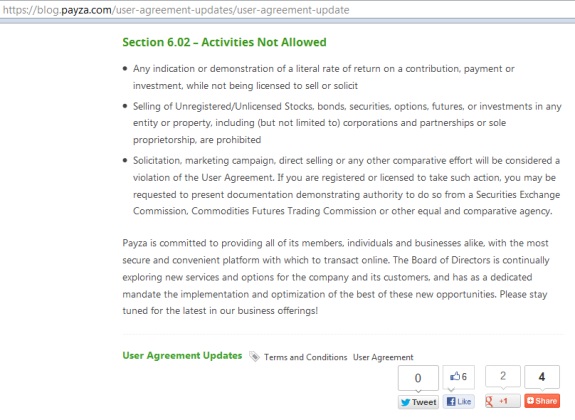
Payza has announced on its Blog that it is banning programs that show “[a]ny indication or demonstration of a literal rate of return on a contribution, payment or investment, while not being licensed to sell or solicit.”
Notice the phrasing (emphasis added): “any indication of a literal rate of return . . .”
What, precisely, does Payza mean? That expressing a literal return rate no longer is OK, but all can be cured if Payza’s current HYIP purveyors and Ponzi-board hucksters hide veiled or direct references to the return (perhaps in the back offices of HYIP affiliates or someplace else out of view of the public and search engines) or somehow find a word combination that avoids a literal expression of a return and instead relies on a deeply couched expression?
This is an important question because the HYIP “industry” cannot exist without the financial vendors that enable it, either by turning a blind eye or choosing not to peel back a single layer of the onion because choosing to see is bad for profits.
The last thing the “industry” needs is an invitation to become even more clandestine in its dealings, even more clever in its use of linguistic deception, information suppression or outright misinformation. The threat to individuals and the world’s financial infrastructure posed by con men and teams of accomplices in the thousands or hundreds of thousands already is untenable.
Payza needs to reassess its use of the phrase “literal rate of return.” Left untouched, that phrase easily could turn what’s already a dangerous, wink-nod “industry” into even more of one, thus providing scammers a new back door and actually making the problem of international financial chicanery on the Internet even worse.
Because AlertPay basically chose for years to gorge itself on HYIP fees and not to take the clues offered by the prosecution of e-Gold in the United States (by members of the same team that prosecuted the AdSurfDaily autosurf HYIP, BTW) and the disintegration of e-Bullion (while its operator stood accused of arranging the brutal contract slaying of his wife, a potential witness to e-Bullion’s Ponzi-sustaining fraud), we cannot yet offer Payza three cheers.
Owing to AlertPay’s history of choosing in e-Gold and e-Bullion-like fashion to see no evil, we question whether use of the word “literal” is just a means of signaling the scammers to do a better job of using language to disguise an investment program as something else or to hide and/or otherwise bury language that speaks to the investment elements. In the past few weeks, for example, the Payza-dependent JSS Tripler/JustBeenPaid “program” suddenly changed the language on its home page to say it offers a “LEGALLY COMPLIANT & PATENTED SYSTEM.”
Let’s pause for a moment to state the obvious, something that somehow often gets overlooked by HYIP apologists: Real people — living, breathing human beings — are being sucked into these utterly contemptible “programs” that are being enabled by processors such as Payza and SolidTrustPay.
And suddenly — out of the blue — JSS/JBP announced it was using a “WORLD RENOWNED LAW FIRM” to assure compliance. These things bizarrely clashed with recent claims by Frederick Mann, the purported operator of JSS/JBP, that attorneys could not be trusted, that government employees weren’t welcome in the “program,” that registering with securities regulators was a sign “you’ve signed up to be a slave, part of the slave system, and then they have jurisdiction over you and can shut you down” and that JSS/JBP members had nothing to fear because the “program” had no presence in the United States.
Now, all of a sudden, JSS/JBP has found the religion of compliance — or at least the language of the religion of compliance.
The New Religion Of Compliance
The Payza-dependent Zeek Rewards MLM “program” also is preaching the religion of compliance, even as it plants the seed that it can provide a JSS/JBP-like annual return of between 365 percent and 730 percent without being the Bernard L. Madoff Investment Securities LLC of multilevel marketing.
Part of what Zeek appears to be doing falls along the lines of not expressly stating a literal return. Welcome to the world of vomitous MLM in the year 2012. The players are eager to tell you what they’re not, less eager or completely unwilling to tell you what they are, and can bring a virtually unlimited supply of Stepfordians to the fore to help them cloud the issues.
Zeek has told the public it is not a “pyramid scheme.” It now says it will ban members who describe the “opportunity” as an investment program, despite the seed Zeek plants that participants can earn a return of between 1 percent and 2 percent a day. Some Zeek affiliates are practically tripping over themselves these days in what strikes us as a bizarre race to see how many times they can fit the words “attorneys” and “compliance” in their forum “defenses” for Zeek.
This Blog has not seen one instance in which a Zeek attorney has described the “program” as legal. Even so, we’ve seen plenty of examples in which Zeek affiliates implied that attorneys had given Zeek the all-clear and at least a few examples in which affiliates implied that agencies such as the SEC and FTC had scrubbed Zeek for compliance and found it in fine fettle. There have been hugely disingenuous claims from Zeek affiliates in this area — everything from describing the lack of any action against Zeek by the SEC or FTC as evidence that the agencies had examined Zeek and found nothing lacking to planting the seed that the lack of any action by the agencies is proof that Zeek is operating lawfully.
Zeek itself played this miserable game. In June, a North Carolina television station carried a report that suggested Zeek had been found to be operating lawfully by the office of North Carolina Attorney General Roy Cooper. Zeek linked to the TV station’s video report on its news Blog and certain Zeek promoters pointed to the report as proof of Zeek’s legitimacy.
But Cooper’s office said it never said Zeek was operating lawfully. After the TV station was contacted by Cooper’s office, which was concerned about the clarity and accuracy of the video report, the station removed the report. The incident produced one of those awkward moments that too often accompany the MLM trade: Zeek plainly liked the TV report because it construed Zeek as operating lawfully. The report then became a tool in Zeek’s PR arsenal — and Zeek wanted to make sure its affiliates had the same tool. It used its Blog to point affiliates to the video, and some of them predictably used it as evidence the Zeek critics were wrong and to plant the seed that Zeek had passed muster in North Carolina.
By linking to the report, Zeek tried to maximize its PR hand. When the report was removed, Zeek had nothing to say. The post on Zeek’s news Blog in which the company originally crowed that “Zeek Makes the Channel 2 News” now has been removed. Although the precise date and time in which Zeek removed the post are unclear, a Zeek affiliate with his own Blog sought to capitalize on the TV station’s report in a post that still remains.
That post featured a three-tiered headline that screamed, “Zeek Reward [sic] featured on Chanel [sic] 2 News[.] Zeek Reward [sic] featured on Chanel [sic] 2 News[.] Zeek Reward [sic] makes it on TV. Get In On the Action!”
This post on the "Empower Network" Blog of a Zeek affiliate included a three-tiered headline and a link that pointed readers to a TV station's report about Zeek. Like Zeek itself, the "Empower Network" is an MLM "opportunity."
The affiliate’s post included a graphic that described Zeek as a “Passive Income!” opportunity. One link on the site pointed to the now-removed TV station video. Another link, however, pointed to post that included a YouTube version of the TV station’s report. That YouTube report included a headline and “crawler” in a language other than English.
Like the post that included the three-tiered headline about Zeek’s TV appearance, the second post included the graphic that described Zeek as a “Passive Income!” program. The claim about passive income speaks to the heart of the issue of whether Zeek is selling unregistered securities as investment contracts and trying to disclaim its way out of an encounter with regulators.
Although a TV station took down its link to a video report on Zeek, a YouTube version apparently existed.
The Culture Of Willful Blindness
Confusing messages appeared repeatedly when the AdSurfDaily Ponzi case was playing out. All of it was monumentally embarrassing to MLM. In one instance — while it was awaiting a key ruling from a federal judge in October 2008 on whether it had demonstrated it had sufficient income and was not a Ponzi scheme at a hearing it requested and the judge granted in the interests of justice — ASD insiders leaked a story that ASD expected a revenue infusion of $200 million from a penny-stock company.
The ASD Stepfordians immediately raced to forums to spread the good news. But skeptics immediately questioned the claim, pointing out that Praebius Communications — the penny-stock firm that supposedly was going to provide ASD a $200 million injection — did not even publish audited financials. SEC records later showed that, in October 2008, the same month ASD was awaiting the court decision and claiming a new $200 million was coming on board, Praebius stock was being pumped in a fraudulent-touting scheme.
Over time, serious questions were raised about whether certain MLMers within ASD were engaging in bids to obstruct justice. Rumors were planted that federal prosecutors had secretly admitted ASD was not a Ponzi scheme but were clinging to the case as part of a bid to save face. In 2008, ASD members who did not even question the bizarre claims coming from ASD or ASD insiders raced to forums and spread a false report that Ponzi charges had been dropped against ASD in Florida. That development prompted the attorney general of Florida to issue a statement that, not only had Ponzi charges not been dropped against ASD in the state, they’d never been brought to begin with. Indeed, Florida charged ASD with operating a pyramid scheme.
The names of both AlertPay and SolidTrustPay appear in court filings in the ASD Ponzi case. It is hardly coincidental that both Zeek and JSS Tripler/JustBeenPaid also have ties to the same processors, which are offshore from a U.S. perspective. These processors are the e-Golds and e-Bullions of Canada. They also are referenced in the Pathway to Prosperity Ponzi case, which the U.S. Postal Inspection Service called a global fraud affecting 40,000 people from 120 countries. In December 2010, the federal prosecutors handling the ASD case made the first public filing that referenced e-Bullion in the context of ASD.
In 2011, e-Bullion operator James Fayed was convicted of arranging the contact slaying of Pamela Fayed, his estranged wife who was found slashed to death in a Los Angeles-area parking garage. There is absolutely no doubt — zero — that e-Bullion was enabling Ponzi schemes. James Fayed has been sentenced to death for arranging the brutal killing of his wife, a potential witness against him.
It is beyond the pale — and almost beyond belief — that certain MLMers continue to insist there is something noble about these miserable money games, that they somehow represent the best of the free market and the entrepreneurial spirit, that they’ve somehow succeeded where other MLMs have failed.
What they are are recipes for financial and personal destruction that operate as slow-motion Ponzi schemes. They need to be destroyed, not duplicated. Far from being exciting, new niches — as some MLMers tell the story — they are form-shifting monsters that spread the greatest financial cancers devised in the history of mankind. They are so dangerous that external fraudsters target them as a means of unloosing secondary frauds — everything from the issuance and passing of bogus checks to organized credit-card fraud. Some of them have been linked to narcotics-trafficking or money-laundering operations. Some of the investigators who assisted in the ASD Ponzi case also developed this case.
From our May 16, 2010 report on the EMG/Finanzas Forex case (italics added):
Research by the PP Blog suggests the purported investment program was so sordid that promoters even claimed some of the funds were being used for the “humanitarian” purpose of assisting kidnapping victims in Colombia. In a sickening display of marketing theatrics, a claim was made that investors could “adopt” kidnapping victims for a payment of $1,000 and that the company would set aside $500 in corporate funds for each victim so that their families could have bright futures if the victims ultimately were released by their captors . . .
The HYIP scheme allegedly was associated with an entity known as Evolution Market Group (EMG), which purportedly had a Forex component known as FinanzasForex. Investigators alleged in January that there were schemes within schemes in a tangled web of domestic and international deception that featured dozens of bank accounts, shell companies and various fronts for money-laundering enterprises, including companies purportedly in businesses such as real estate and car washes.
The scheme was so corrupt, according to court filings, that some investors were told that, in order to leave the program whole, they had to recruit new investors, have the new investors pay them directly — and use the proceeds from the new investors to “recover” their initial outlays . . .
A Glimmer Of Hope
We do find a glimmer of hope in Payza’s announcement because Payza’s use of the phrase “any indication” implies it actually intends to exit the fraud-enabling business and intends to protect its reputation moving forward and make it harder for viral scammers who use its service to rob people without the aid of a gun.
A return — plainly stated or implied — would seem to fall under the “any indication” umbrella. Another indication is the presence of a “program” on the Ponzi boards. (Like ASD and EMG/Finanzas Forex, Zeek and JSS/JBP have a presence of the Ponzi boards.)
Yet another indicator of fraud is disclaimer language that seeks to cloud regulatory issues by planting the seeds that payouts are not guaranteed and that joining a “program” with a plainly stated or implied return does not constitute making an investment.
Much of the HYIP fraud “industry” exists because of the wink-nod deal and the willful blindness of the purveyors, including serial scammers with global reach and payment processors that gorge themselves on fees while serving what effectively are criminal combines consisting of like-minded individuals and “teams.”
Also banned, according to the Payza Blog post, is the the “[s]elling of Unregistered/Unlicensed Stocks, bonds, securities, options, futures, or investments in any entity or property, including (but not limited to) corporations and partnerships or sole proprietorship . . .”
Meanwhile, Payza says this (italics added):
“Solicitation, marketing campaign, direct selling or any other comparative effort will be considered a violation of the User Agreement. If you are registered or licensed to take such action, you may be requested to present documentation demonstrating authority to do so from a Securities Exchange Commission, Commodities Futures Trading Commission or other equal and comparative agency.”
Language in the full, six-paragraph announcement is exceptionally formal, bordering on the florid. But if the aim is for Payza to say no to fees and wrest itself from the wretched, pain-producing universes of HYIPs, autosurfs, cycler matrices and other “programs” that reach across national borders and fleece people on a global scale, the ornate language will become only a tiny footnote.
What’s far more important is that Payza will have said no to the scammers and a subculture of eager, greedy pitchmen who help financial crime spread globally and line their pockets on the current (or pending misery) of their marks.
It is possible these days for a scammer hiding in the darkest corners of the Internet to pick the pocket of a “customer” and contribute to a mortgage foreclosure or even the failure of a bank a continent away. Such “programs” often are pushed in the purported name of freedom itself, as a purported means of helping a neglected Everyman escape the shackles of poverty and become a free man who’s escaped his tyrannical captors.
But because the scammers’ schemes constantly evolve and because they often rely on overblown prose to disguise the fraudulent nature of their “programs,” it is going to take more than just words from Payza to incorporate any real change.
For example, could an “opportunity” that simply comes up with different naming conventions and avoids the traditional language of investments fool the checkers at Payza? Or could an “opportunity” that shields Payza from information perhaps by publishing it only in the back offices of the “opportunity’s” members escape scrutiny?
And because HYIPs and their willfully blind, serially disingenuous promoters already are infamous for wink-nod presentations, the use of disclaimers and even outright denials that an investment program of any sort is being offered, will the criminal minds who dominate this cancerous space go into overdrive to come up with new and more clever ways to disguise fraud schemes?
What To Watch For
Will panic engulf the HYIP sphere because of the Payza annoucement? Here are some things to look for:
Masked investment “programs” — perhaps aware they are under scrutiny — taking once-public forums offline and engaging in bids to further compartmentalize information and scrub negative information.
Management and affiliates of such “programs” making veiled or direct references to “attorneys” and “compliance” as a means of suggesting they are wholly lawful and embrace responsible corporate citizenship.
Increased lead times between “program” payment cycles, perhaps initially explained away as “growing pains.”
Payment bottlenecks to develop as “programs” horde cash or cash equivalents and become fearful that once-reliable enablers are hopping off the wink-nod fraud train because they realize the real world no longer is going to tolerate international lawlessness so a scammer on the TalkGold or MoneyMakerGroup forums can get rich by picking the pockets of senior citizens, deaf people, the unemployed and the struggling. (Also known as the AdSurfDaily problem.)
An uptick by scammers in the use of floridspeak as a means of talking around serious legal issues and masking the investment elements of a “program.”
The creation of bogus “regulatory agencies” and “trade groups” to create the appearance that a responsible party with legal authority is monitoring the store. (Note: A bogus regulator was an element of the George Theodule Ponzi scheme in Florida.)
The sale of purported memberships in these purported “regulatory agencies” and “trade groups.”
Read the Payza post, which was made Friday at the close of traditional business hours in the Eastern United States.
UPDATED 8:42 A.M. EDT (JULY 14, U.S.A.) It’s beginning to look as though the Zeek Rewards’ MLM “program” has within it a large downline consisting of members of the AdSurfDaily Ponzi scheme. And in what may go down as one of the most spectacular PR blunders in the history of multilevel marketing, some former ASD promoters who now are Zeek promoters are encouraging their email contacts and downline members to wire money to jailed ASD President and recidivist securities huckster Andy Bowdoin — while using Zeek’s name in the appeal and describing Bowdoin as a pioneer who inspired “programs” such as Zeek to model themselves after ASD.
“You are also all aware that I believe those of us in Zeek and other programs that modeled themselves after the business model that Andy pioneered owe this man a great deal of gratitude and more,” the email read in part. “Please get in touch with your down lines as well.” (The email is reproduced below.)
For good measure, the email described Bowdoin as the man who’d provided MLMers the “path to success.” It also included a link to join the Zeek “program” under a headline of “Tired of Recruiting and Selling?” and this text teaser: “Get Rewarded DAILY for Placing Ads just like this one! Get Paid Every 24 Hours.”
A second ad in the email encouraged readers to “Get your FREE Gold Savings Account here and qualify to receive Free Gold.”
The PP Blog received news of the email early last evening, as it was preparing a post that reported an alleged HYIP purveyor in Ohio had been named in a 49-count federal indictment charging him with wire fraud and money-laundering. Terrance Osberger, 48, of Genoa, Ohio, was accused of pushing HYIP Ponzi schemes through an enterprise known as Eagle Trades LTD.
The returns Osberger allegedly offered were on par with the returns suggested by both ASD and Zeek: in the hundreds of percent per year. And like ASD and Zeek, Osberger allegedly used SolidTrustPay, an offshore payment processor, and issued a preemptive denial that a fraud scheme was under way. The alleged Eagle Trades HYIP fraud appears to have gathered at least $1.8 million, a relatively modest sum compared to HYIP frauds such as ASD ($110 million), Legisi ($72 million), Pathway To Prosperity ($70 million) and Genius Funds (an estimated $400 million).
In February 2012 — while announcing the guilty plea of Gregory McKnight in the Legisi HYIP Ponzi scheme — a special agent of the U.S. Secret Service noted that such schemes engage in form-shifting.
“Fraudulent schemes such as this have evolved significantly over the last several years,” said Jeffrey Frost, special agent in charge of the U.S. Secret Service Detroit Field Office.
AdSurfDaily was an online Ponzi scheme that said it set aside 50 percent of its daily revenue to share with affiliates. Those affiliates received an unusually consistent return of 1 percent a day. ASD described itself as a revenue-sharing program and encouraged members not to describe the “opportunity” as an investment.
Zeek also says it is a revenue-sharing program. Like ASD, Zeek claims it sets aside 50 percent of its daily revenue to share with affiliates. Affiliates have said they are earning between 1 percent and 2 percent a day, a percentage that corresponds to an annualized return of between 365 percent and 730 percent.
And like ASD, Zeek tells affiliates not to describe the “opportunity” as an investment program. Some Zeek affiliates are said to earning $1 million a month. Similar to ASD, which preemptively denied it was a Ponzi scheme, Zeek has preemptively denied it is a “pyramid scheme” — all while planting the seed that the U.S. government is running a pyramid scheme through its Social Security program.
In May, ASD’s Bowdoin pleaded guilty to wire fraud in the ASD Ponzi case. The ASD patriarch admitted his “program” was a Ponzi scheme, saying in a statement of offense the company never operated lawfully from its 2006 inception. As part of a plea bargain, Bowdoin has been banned from multilevel marketing, Internet programs and mass-marketing.
The email circulating yesterday disclosed none of these things, instead painting Bowdoin as an MLM pioneer and inspirational figure.
Nor did the email disclose Bowdoin’s felonious history as a securities huckster in Alabama a decade before he rolled out ASD in 2006. And it did not disclose that one of his business partners in ASD was implicated by the SEC in the 1990s in three prime-bank swindles, including one that suggested prospects could earn a return of 10,000 percent. In court documents originally filed under seal in February 2009 — as an upstart autosurf known as AdViewGlobal was launching — the U.S. Secret Service alleged that Bowdoin also had a “silent partner” in ASD.
That silent partner, according to the Secret Service, was Bowdoin’s sponsor in the 12DailyPro Ponzi scheme that sucked in tens of millions of dollars before the SEC destroyed it just months before ASD launched in the late summer and fall of 2006. Bowdoin and his silent partner simply tweaked the 12DailyPro business model, reducing the daily payout rate to about 1 percent and using linguistic sleight of hand in a failed bid to keep ASD under the radar, according to court filings.
Bowdoin’s nearly four-year-long legal saga began in July 2008, with the U.S. Secret Service starting an undercover probe. That probe has led to the filing of at least three civil forfeiture complaints, the seizure of tens of millions of dollars, court actions and seizures of bank accounts against certain individual ASD members, special statements by the U.S. Department of Justice and the U.S. Secret Service and the ultimate filing of criminal charges against Bowdoin.
In 2009, Bowdoin and former ASD attorney Robert Garner were accused of racketeering in a proposed class-action lawsuit filed by three former ASD members. That lawsuit was placed on hold because of all the other litigation piling up against Bowdoin and ASD-related assets.
All of it appears to be meaningless to certain ASD members now promoting Zeek.
Also apparently meaningless is Bowdoin’s record of criminality in Alabama in the 1990s in at least three counties
In June 2012, Bowdoin’s bond was revoked after federal prosecutors proffered evidence that he continued to promote scams after the seizure of more than $80 million in the ASD case by the U.S. Secret Service in August 2008 and after Bowdoin was arrested on the ASD-related Ponzi charges in December 2010. One of the alleged “programs” linked to Bowdoin by investigators was AdViewGlobal, an ASD-like autosurf that collapsed during the summer of 2009.
Bowdoin also was linked to a “program” known as “OneX,” which prosecutors described as a “fraudulent scheme” and “pyramid” that was recycling money in ASD-like fashion. Some Zeek promoters also are known to have been OneX promoters. It also is known that some Zeek promoters also are pushing JSS Tripler/JustBeenPaid, a “program” that purports to pay 2 percent a day (730 percent a year) and may have ties to the “sovereign citizens” movement.
In recent days, JSS/JBP published a claim that it had hired a criminal defense lawyer in Salt Lake City. Like ASD, Zeek, OneX and Eagle Trades, JSS/JBP has a business relationship with SolidTrustPay. (NOTE: OneX now claims it no longer uses SolidTrustPay and is trying to get a new processor after a deal it thought it had with another processor fell through. In a conference call earlier this week, OneX blamed its members for the developments and claimed it had been targeted by fraudsters. Now under indictment in Ohio, Eagle Trades’ Osberger told investors in Massachusetts that his “program” also had been targeted by fraudsters, according to records.)
The email some ASD members received last night that references Zeek appears to have forwarded by former ASD pitchman Todd Disner, who became a Zeek promoter. Former ASD member Barb Alford — also a Zeek promoter — appears to have been the author. The email’s “To” line also references Jerry Napier, another former ASD promoter who became a Zeek promoter.
Napier once was featured in a promo on Zeek’s Blog. Records suggest he signed a petition in 2008 — after two forfeiture complaints were filed against ASD-related assets — that asked the U.S. Senate to investigate the ASD prosecution team and the U.S. Secret Service agent who developed the ASD Ponzi case with the assistance of a Florida-based Task Force consisting of investigators from the IRS, the Secret Service and other agencies.
Alford is a former moderator of the pro-ASD Surf’s Up forum, which disappeared mysteriously in 2010. Teralynn Hoy, another former Surf’s Up moderator, hosted a conference call for Zeek last year. Zeek once listed Hoy as an “employee.”
In 2011, Disner joined with former ASD member Dwight Owen Schweitzer — who also became a Zeek promoter — in a lawsuit against the United States for alleged misdeeds in bringing the ASD Ponzi case. Disner and Schweitzer, who have raised the prospect in court filings that they could face prosecution for tax evasion in the aftermath of the the ASD investigation, continue to press the lawsuit — despite Bowdoin’s guilty plea to wire fraud in the ASD Ponzi case and acknowledgement he was operating a Ponzi scheme.
Here is the email circulating last night (italics/bolding added):
As you all are aware, Andy, is now sitting in a DC jail ward. He is in need of funds in his account so that he can purchase shoes, tooth brushes, tooth paste etc. the prison system charges ridiculous prices for this stuff. A pair of shoes alone in there costs 65.00.
You are also all aware that I believe those of us in Zeek and other programs that modeled themselves after the business model that Andy pioneered owe this man a great deal of gratitude and more. Please get in touch with your down lines as well.
I have received info where funds can be wired into his account to help him with his daily needs.
We can do this one of two ways. Anyone wishing to assist in the effort can send the money to me and I will wire all at once or we can do it individually. I have enclosed the wiring information below.
Let’s not drop the ball on this one. Anyone willing to do the right thing, one more time, please contact me.
I would appreciate any help you can give. It is not right that this man sits alone in jail hundreds of miles from home with no end in sight when it was he who gave us the path to success.
Respectfully Barb Alford [Phone number deleted by PP Blog]
It has to go through Western Union to be placed on his account.
City Code: [Deleted by PP Blog] State: Tennessee Senders Acct # [Deleted by PP Blog] Sender: Thomas Bowdoin
Here is his address if you want to write him Correction Treatment Facility 1901 East St. SE Med-96 Inmate 335084 Washington DC 20003
George said he gets his mail on Tuesdays and Saturdays.
Anyway, GF, I know you said a few people might want to donate to help him. I know he would love to get a letter from YOU. I am sending one tomorrow so he can get it on Saturday, I hope.
BULLETIN:Aubrey Lee Price, the missing Georgia man sued by the SEC in an alleged $40 million investment-fraud caper that depleted “substantially all” of the reserves of a bank in Southern Georgia, has been charged criminally in New York with embezzling $17 million from the bank.
The office of U.S. Attorney Loretta E. Lynch of the Eastern District of New York said Price “disappeared after telling acquaintances that he had lost a large amount of money through trading activities and that he planned to kill himself.”
He has been missing since at least June 16, prosecutors said.
Price last was seen boarding a ferry boat in Key West, Fla. The ferry was bound for Fort Myers, prosecutors said.
“Price has told acquaintances that he owns real estate in Venezuela and Guatemala,” prosecutors said. “Price recently traveled to Venezuela and returned to the United States from that trip on June 2, 2012.”
After a Price company bought a controlling portion of the bank’s stock in December 2010, he “took on the responsibility of investing the bank’s capital” in early 2011, prosecutors said.
Although the bank was told Price was investing the bank’s capital in U.S. Treasury securities, “Price fraudulently wired the bank’s funds to accounts that he personally controlled at other financial institutions and provided bank management with altered documents to make it appear as if he had invested the bank’s money in Treasury securities,” prosecutors said.
The FBI is leading the criminal probe.
Anyone with information regarding Price’s whereabouts or the alleged crime is urged to contact the FBI’s office in New York at 212-384-1000. Prosecutors said this email address also may be used: ny1@ic.fbi.gov.
Persons with information on his whereabouts also may contact the Atlanta office of the FBI at 404-679-9000 or the Lowndes County Sheriff’s Office at 229-671-2985, the SEC said yesterday.
Three vulnerable U.S. banks that processed illegal gambling payments for Full Tilt Poker in exchange for investments in the institutions later failed, federal prosecutors in the Southern District of New York said yesterday. The failures of Sunfirst Bank in St. George, Utah, and All American Bank and New City Bank — both of which were “single-branch” banks in Illinois — allegedly cost the FDIC more than $70 million.
Now, Full Tilt Poker Chief Executive Officer Raymond Bitar has been arrested in New York. The arrest occurred yesterday upon his return from Ireland, and Bitar, 40, was charged in an 11-count, superseding indictment with lying to players about the security of their funds and other crimes. He’d earlier been charged with gambling, bank fraud, and money laundering offenses.
News of Bitar’s arrest occurred on the same day the SEC alleged that a Georgia man effectively had gutted a bank in the state as part of a $40 million investment scheme. That man, Aubrey Lee Price, now is listed as missing. Fraud schemes have contributed to multiple bank failures in the United States.
In one of three counts that allege Full Tilt’s Bitar committed wire fraud against Full Tilt players, he is accused of lying to participants on an “internet forum” about players’ money being kept separate from corporate funds. Prosecutors said that Full Tilt was using players’ money as its own to sustain the scheme.
At one point, according to prosecutors, Full Tilt owed players $344 million but had only $145 million “in all of its bank accounts.” At another point, Full Tilt owed players $390 million but had only $60 million on-hand.
Among the astonishing allegations by federal prosecutors yesterday in the aftermath of an FBI investigation was that Vitar did not halt the Full Tilt Ponzi scheme after the government brought the initial set of charges in 2011. Instead, he continued to operate it offshore and “lured players to continue gambling with Full Tilt Poker by continuing to promise them that their funds were safe. In actuality, [Bitar] was using new customer deposits to pay off some of the backlog of player requests to withdraw funds and to cover the company’s operating expenses, including salary for [Nelson] Burtnick and himself. In effect, Full Tilt Poker operated what was, by then, nothing more than a Ponzi scheme. When the scheme finally collapsed, Full Tilt Poker was unable to pay players the approximately $350 million it owed them.”
Nelson Burtnick was the head of Full-Tilt’s payment-processing department. He also was charged yesterday in the superseding indictment.
Prosecutors said Bitar and Burtnick “hired agents to create dozens of phony companies, complete with fake websites, and to open bank accounts using the names of these phony companies as a cover to process payments for Full Tilt Poker.”
The codes of credit-card transactions were altered to circumvent Visa and MasterCard processing regulations and to dupe banks into processing illegal gambling transactions, according to the superseding indictment.
To keep cash flowing to Full Tilt, Bitar and Burtnick also found a way to disguise e-checks that relied on “ACH” transactions routed through an electronic network administered by the Federal Reserve. Dummy companies were used to exploit the network, federal prosecutors charged.
“Bitar and Full Tilt Poker persisted in soliciting U.S. gamblers long after such conduct was outlawed,” said Janice K. Fedarcyk, FBI assistant director-in-charge. “As alleged, Bitar has already been charged with defrauding banks to conceal the illegal gambling. Now he stands accused of defrauding Full Tilt’s customers by concealing its cash-poor condition and paying off early creditors with deposits from later customers. The on-line casino become an Internet Ponzi scheme.”
Losses to customers involved “hundreds of millions of dollars” while Bitar and Full Tilt owners were paid “over $430 million,” said U.S. Attorney Preet Bharara.
With yesterday’s arrest “and the new charges brought against him, Raymond Bitar will now be held criminally responsible for the alleged fraud he perpetrated on his U.S. customers that cost them hundreds of millions of dollars,” said Bharara. “The indictment alleges how Bitar bluffed his player-customers and fixed the game against them as part of an international Ponzi scheme that left players empty-handed.”
BULLETIN: The SEC has gone to federal court in Atlanta, alleging that Aubrey Lee Price masterminded a $40 million investment fraud and that Price might have misappropriated millions of dollars from a “failing” bank in southern Georgia after a company he controlled bought a stake in the bank in 2010.
The alleged misappropriation involved “substantially all” of the bank’s reserves, which were lost in trading, the SEC said.
In June, some investors received a 22-page letter attributed to Price in which Price allegedly “admits that he ‘falsified statements with false returns’ in order to conceal between $20-23 million dollars in investor losses,” the SEC said.
Price, 46, was believed to be living in Lowndes County, Ga., after moving there from Manatee County, Fla. But Price has gone missing, the SEC said.
“Price raised nearly $40 million from investors and made woeful financial transactions that he hid from them,” said William P. Hicks, associate director of the SEC’s Atlanta Regional Office. “Now both the money and Price are missing.”
Price managed an unregistered investment fund that went by the name of PFG LLC of McDonough, Ga., the SEC said.
U.S. District Judge Timothy C. Batten Sr. has issued an asset freeze and temporary restraining order, the SEC said.
The scheme began in 2008 and affected at least 100 investors in Georgia and Florida, the SEC said.
“Price purported to invest fund assets in traditional marketable securities, but he also made illiquid investments in South America real estate and a troubled South Georgia bank,” the SEC said. “In order to conceal mounting losses of investor funds, Price created bogus account statements with false account balances and returns that were provided to investors and bank regulators.”
Price also was associated with an entity known as PFGBI through which the banking investment was made, the SEC said.
But the “investment in the bank is substantially worthless, as the bank’s cash assets have been substantially depleted and substantially all of the bank’s reserves (including U.S. treasuries and other liquid assets) were misappropriated by Price and lost in trading,” the SEC charged.
“Goldman Sach’s records document at least $10 million in unexplained funds being transferred by Price from the bank to a trading account at Goldman Sachs,” the SEC said.
Persons with information on his whereabouts should contact the Atlanta office of the FBI at 404-679-9000 or the Lowndes County Sheriff’s Office at 229-671-2985, the SEC said.
URGENT >> BULLETIN >> MOVING: Peter Madoff, the brother of Ponzi schemer Bernard Madoff, has pleaded guilty in New York to a two-count superseding information charging him with conspiracy to commit securities fraud, tax fraud, mail fraud, ERISA fraud and falsifying records of an investment adviser.
The government is seeking a staggering forfeiture order of $143.1 billion, “including all of [Peter Madoff’s] real and personal property.”
Peter Madoff began conspiring with his brother in 1996, and the sought-after forfeiture amount “represents all of the investor funds paid” into Bernard L. Madoff Investment Securities LLC from 1996 to the Ponzi collapse in December 2008, prosecutors said.
Peter Madoff has agreed to the forfeiture amount, prosecutors said.
Peter Madoff, 66, also was charged by the SEC today. He was the chief compliance officer and senior managing director of Bernard L. Madoff Investment Securities.
“Peter Madoff enabled the largest fraud in human history,” said Preet Bharara, U.S. Attorney for the Southern District of New York. “He will now be jailed well into old age, and he will forfeit virtually every penny he has. We are not yet finished calling to account everyone responsible for the epic fraud of Bernard Madoff and the epic pain of his many victims.”
“Peter Madoff helped Bernie Madoff create the image of a functioning compliance program purportedly overseen by sophisticated financial professionals,” said Robert Khuzami, director of the SEC’s Division of Enforcement. “Tragically, the image was merely an illusion supported by Peter’s sham paperwork and false filings for which he was rewarded with tens of millions of dollars in stolen investor funds.”
After the August 2008 seizure by the U.S. Secret Service of tens of millions of dollars in the AdSurfDaily Ponzi case, Dwight Owen Schweitzer became a pitchman for the Zeek Rewards "program," according to this ad. Schweitzer, a former attorney whose license was suspended in Connecticut, and fellow ASD figure Todd Disner sued the United States in November 2011 for alleged misdeeds in the ASD case, claiming the government had authored a "tissue of lies" in the ASD case and that ASD was a legitimate business. ASD President Andy Bowdoin admitted last month that ASD was a Ponzi scheme and that his business never operated legally from its 2006 inception, putting Bowdoin at odds with both Disner and Schweitzer and also purported MLM expert Keith Laggos, who curiously opined ASD was not a "Ponzie" scheme. Bowdoin is now jailed in the District of Columbia after a federal judge revoked his bond. The judge ordered Bowdoin jailed pending formal sentencing after the government proffered evidence that Bowdoin continued to promote fraud schemes after the seizure of $65.8 million from his personal bank accounts in 2008 and after Bowdoin was arrested in December 2010 on ASD-related charges of wire fraud, securities fraud and selling unregistered securities.
EDITOR’S NOTE: The filing by Todd Disner and Dwight Owen Schweitzer to which the PP Blog refers in this story was in response to a May 18 government motion to dismiss a lawsuit filed by Disner and Schweitzer against the United States in the Southern District of Florida or to transfer the case to U.S. District Court for the District of Columbia. The government filed its motions on the same date ASD President Andy Bowdoin pleaded guilty to wire fraud and admitted that ASD was a Ponzi scheme . . .
BULLETIN: In a curious, 23-page narrative, AdSurfDaily figures Todd Disner and Dwight Owen Schweitzer — who went on to become promoters of the Zeek Rewards MLM — have raised the prospect that they could be prosecuted for tax evasion because of the government seizure of ASD’s database in August 2008.
Neither Disner nor Schweitzer referenced Zeek in a filing stamped June 15 and entered today on the docket of U.S. District Judge Cecilia M. Altonaga of the Southern District of Florida. But the filing includes the name of Zeek consultant Keith Laggos, positioning Laggos as an expert on Ponzi schemes who ventured an opinion that ASD was not a Ponzi scheme.
The Disner/Schweitzer filing does not mention that Laggos repeatedly misspelled “Ponzi” as “Ponzie” in his purported expert opinion in the ASD case. Nor does it mention that Laggos was prosecuted by the SEC in a 2004 case that alleged he issued laudatory press releases and a laudatory article for a company that later become the subject of a securities investigation without disclosing he was being compensated for touting the purported opportunity.
Laggos neither admitted nor denied the SEC’s allegations, which involved a company known as Converge Global Inc. and a subsidiary known as TeleWrx Inc. The future Zeek consultant settled the 2004 SEC case by disgorging nearly $12,000, paying interest of nearly $2,000, paying a civil fine of $19,500 and agreeing to a five-year penny-stock ban.
Laggos was permanently enjoined in the case from violating Section 17(b) of the Securities Act, which makes it unlawful to tout a stock without disclosing the nature and substance of any consideration, whether present or future, direct or indirect, received from an issuer, underwriter or dealer.
An image of Laggos now appears in a commercial for Zeek, and a publication owned by Laggos has issued laudatory coverage of the purported MLM opportunity, which plants the seed it provides a return of between 1 percent and 2 percent a day without being a “pyramid scheme” and without constituting an investment opportunity.
It is known that Zeek and ASD had common promoters and that, beginning in about July 2011, some well-known figures in the ASD story began to emerge publicly as Zeek boosters. Among them are former “Surf’s Up” moderator Terralynn Hoy and former ASD pitchman Jerry Napier.
Hoy, who has been listed as a “Zeek” employee and has hosted at least once conference call for Zeek, was a moderator of a defunct ASD cheerleading forum known as “Surf’s Up.” While “Surf’s Up” still was operating, Hoy became a moderator of a forum that led cheers for an autosurf known as AdViewGlobal, which federal prosecutors now say was a fraudulent scheme backed by ASD President Andy Bowdoin. Both Surf’s Up and the AdViewGlobal forum, which also now is defunct, described ASD figure and purported “sovereign citizen” Curtis Richmond as a “hero.”
Richmond has a contempt of court conviction for threatening federal judges and once was sued successfully under the federal racketeering statute for participating in a scheme in which enormous purported judgments were filed against public officials and the officials were threatened with arrest. ASD is known to have had ties to tax deniers and “sovereign citizens.”
Some Zeek promoters also are pushing a purported “opportunity” known as JSS Tripler/JustBeenPaid that may have links to the “sovereign citizens” movement. Frederick Mann, the purported operator of JSS/JBP, does not identify where the purported opportunity operates from and has speculated that the servers of JSS/JBP could be targeted in a “cruise missile” attack by the government.
JSS/JBP advertises a return of 2 percent a day, a percentage that Zeek sometimes says it has matched or exceeded — though Zeek generally stays between 1 percent and 2 percent a day when the purported payout is averaged over a week, Zeek promoters claim.
As a Zeek promoter, Napier was given a puff piece last summer by the purported Zeek opportunity. An individual with the same name appears to have signed a petition in December 2008 calling for the U.S. Senate not to investigate ASD and Bowdoin, but to investigate various federal prosecutors and the U.S. Secret Service agent who brought the ASD Ponzi case in August 2008. The petition showing the name of “Jerry Napier” appears to have been signed by “Jerry Napier” after federal prosecutors brought a second forfeiture case against ASD-related assets on Dec. 19, 2008. As was the case with the August 2008 forfeiture filing by the government, the December 2008 case alleged a Ponzi scheme.
Today’s filing by Disner and Schweitzer advances a theory — even after Bowdoin’s guilty plea to wire fraud last month and public acknowledgment that he presided over a Ponzi scheme — that the government’s Ponzi claims constituted a “house of cards.”
It also plants the seed that prosecutors shopped the ASD case to a “frendly [sic] forum” in the District of Columbia to make it easier for the government to enlist “some of their Washington D.C. operatives to become members of ASD, thereby making them potential witnesses.”
Disner and Schweitzer claim that the seizure of ASD’s database in Florida was unconstitutional because it subjected them to an invasion of privacy and potentially a tax investigation.
“The plaintiffs have alleged that the information taken by the defendant places the plaintiffs in jeopardy of the defendant seeking to prosecute the plaintiffs for tax evasion as a result of the defendant having taken the plaintiffs records which are necessary to enable the plaintiffs to file accurate tax returns for the period covered by those records,” Disner and Schweitzer argued.
And Disner and Schweitzer further ventured (italics added):
As a result of the government’s action, the plaintiffs cannot file accurate tax returns, have lost both past and future business revenues, their reputations have been damaged to the extent that they recruited others to join in the program that the defendant alleged to be a Ponzi scheme, and by inference the plaintiffs have therefore enlisted others to participate in an illegal enterprise. The injuries suffered by the plaintiffs are not hypothetical or conjectural but are both finite and calculable. They have alleged that the actions taken against them were authorized without meeting the constitutionally guaranteed and statutorily increased requirements to establish probable cause and resulted in an illegal search and seizure of their property and effects.
Neither Zeek nor any of its executives or promoters have been accused of wrongdoing. Zeek, though, claimed last month that it was closing two U.S. bank accounts and looking to open an account with a bank it did not name.
Zeek is using offshore payment processors linked to numerous schemes that promote outsize returns. A Zeek auction arm known as Zeekler is auctioning sums of U.S. cash and telling winners it will pay them via offshore processors.
Components of the Zeek scheme are similar to components of the ASD Ponzi scheme.
In 2008, an HYIP scheme known as Legisi resulted in an an SEC civil prosecution. Court papers showed that the U.S. Secret Service and state regulators in Michigan were conducting an undercover probe of Legisi which, like JSS/JBP, sought to make participants affirm they were not government employees.
Like ASD’s Bowdoin, Legisi operator Gregory McKnight pleaded guilty to wire fraud. Records show that a tier of the purported Legisi program offered a daily return that was about one-fourth the daily return Zeek plants the seed can be realized through its purported opportunity.
Although Surf’s Up, which received ASD’s official endorsement as a news outlet with Hoy as a moderator, led cheers for ASD and Bowdoin until the forum mysteriously vanished in January 2010, Hoy appears to believe that Ponzi schemes actually can exist.
SSH2 Acquisitions, a Nevada company that listed Hoy as a director, claimed in 2010 that it had been defrauded in a Ponzi scheme.
NOTE: 10:46 A.M. EDT: Certain references to “Aaron” (below) in the context of “Aaron and Shara” have been deleted, pending the resolution to a report we received that disputed certain information.
Question: Did the Zeek Rewards MLM “program” that plants the seed it provides a return of between 1 percent and 2 percent a day without constituting an investment opportunity give a puff piece to an affiliate who signed a petition in 2008 that called for the U.S. Senate to investigate the federal prosecutors and the U.S. Secret Service agent who brought the AdSurfDaily Ponzi case?
Separately, this classified ad for Zeek from “Jerry Napier” of Owosso, Mich., ran on Nov. 17, 2011.
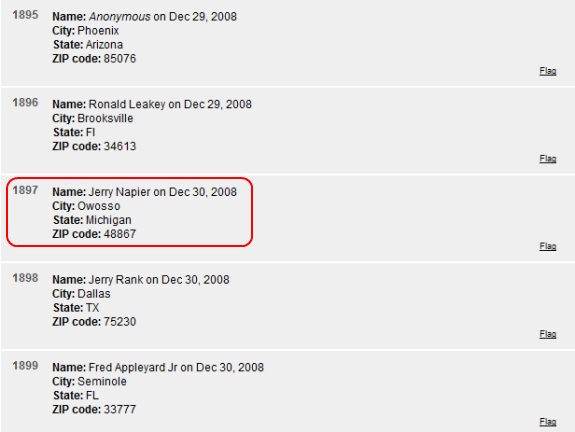
On Dec. 30, 2008, “Jerry Napier” of Owosso, Mich., signed a petition that called for the U.S. Senate to investigate (see No. 1897 on the petition) then-U.S. Attorney General Michael Mukasey; then U.S. Attorney Jeffrey Taylor of the District of Columbia; then-lead ASD prosecutor William Cowden; and Roy Dotson, a special agent of the U.S. Secret Service, according to ipetitions.com.
Screen shot and highlight by PP Blog.
“Whereas, we as Americans have a right to advertise with any company without interferences [sic] by [sic] Attorney General and /or any of its agents,” the petition began. “Whereas, Ad Surf Daily [sic] hereafter (ASD) [sic] an advertising company on the internet were [sic] members received re-bates [sic] for advertising and looking at other advertising sites, thus purchase [sic] products and services.”
In August 2008, the U.S. Secret Service and federal prosecutors brought the first of at least three civil-forfeiture actions in the ASD Ponzi case. Those actions were parallel to a criminal investigation that ultimately led to the arrest of ASD President Andy Bowdoin in December 2010 and his guilty plea to wire fraud last month.
ASD, like Zeek, planted the seed that it paid a daily return on the order of 1 percent.
Among the other top Zeek earners listed in the post are “Aaron and Shara” and Trudy Gilmond. “Aaron and Shara” is a veteran HYIP team.
Gilmond, whom Zeek identifies as a Zeek “employee” on its website, once was a promoter of a scheme known as Regenesis 2X2, which became the subject of a U.S. Secret Service probe in 2009.
The 2008 petition calling for the Senate to investigate the ASD prosecutorial team also includes “Catherine Parker” as a signatory (on Page 33, Nos. 1604 and 1605). “Catherine Parker” was quoted in emails that became part of the ASD story. (See such an attribution on AdLandPro, a site from which ASD was promoted.)
EDITOR’S NOTE: A reader contacted the PP Blog yesterday, saying the JSS Tripler/JustBeenPaid “program” was being “glorified and promoted” on a website styled Vatican Assassins.org. Sure enough, a fawning pitch dated May 21 for JSS/JBP appears on the site — along with a graphic that advertises the purported JSS/JBP payout rate of 60 percent a month and includes a prompt that higher earnings were possible through “daily compounding.”
But VaticanAssassins could serve up yet another PR disaster for JSS/JBP, which openly acknowledges it is not registered to sell securities, does not disclose its base of operations or identify itself with a nation-state, uses offshore payment processors linked to numerous fraud schemes, may have ties to the “sovereign citizens” movement and says its members must affirm they are not with the “government.”
“In general, government people are not welcome in JBP,” said JSS/JBP’s purported operator Frederick Mann on May 24, noting that a “cruise missile” attack against the “program” could not totally be ruled out.
It is paranoia coupled with a curious form of discrimination — we’ll call it exclusion by employment — and JSS/JBP’s new helpmate is almost certain to cause even more stomachs to turn. Indeed, VaticanAssassins describes black people as “savages” and “bastards” even as it tries to link the Catholic Church to one conspiracy after another.
Blacks, Catholics and other people of goodwill who are JSS/JBP members may recoil in horror if they spend so little as 10 minutes on the VaticanAssassins site and read the ramblings of their fellow pitchman for the “opportunity.”
On Feb. 7 — presumably in his pre-JSS/JBP days — the pitchman wrote this on VaticanAssassins:
“If you do not appreciate reading about the racial TRUTH in the Black Pope’s pro-Black, anti-White, ‘Holy Roman’ Fourteenth Amendment, Corporate-fascist, Socialist-Communist American Empire (1868-Present) then this website is not for you.”
On March 14, 2011 — while trying to draw a distinction between what he deemed “Majority Savage Blacks and the Minority Civil Blacks” — the pitchman said this:
“28 Majority Savage Black beasts, raised by their fornicating mothers due to seventy-percent of all Black American births being illegitimate, committed this gang rape. Yes, these animalistic Black bastards (for they act like animals’ and are indeed ‘bastards,’ they having no legitimate fathers) have perpetrated yet another unspeakable crime, this time against an 11-year old Hispanic girl.”
Just who is this pitchman?
None other than Eric Jon Phelps, who tells readers on another part of the site that he paid an IRS tax lien for $164,551.30 (presumably prior to his involvement in JSS/JBP) and introduces a conspiracy that the Pope secretly controls the tax-collection agency.
The reader who contacted us yesterday expressed concern, but also confusion.
“I thought they were shut down by the SEC,” he said of JSS/JBP. “I almost bought into this. Is there anything you can do to prevent people from losing [their] money? Or is this a [legitimate] business?”
Equally compellingly — in a JSS/JBP conference call Thursday — a distressed woman who said her name was “Ping” implied she was ill with a serious heart condition, was managing three JSS/JBP accounts that had been hacked a month ago and said her “sister borrowed on her house [to] put money in JBP.”
“I need, Mr. Mann, I beg your lifesaving help,” Ping said to Frederick Mann.
Ping recited her ticket number multiple times and asked Mann to intervene personally in her case because JSS/JBP customer support had been unresponsive for weeks.
Mann said, “Well, ah, one of our support staff will check it out.”
But what Mann said was not what Ping wanted to hear.
“Yes, but it has been one month and no one — I told them my situation, I told them my life was on [the] line. But help is so slow. Could you please take my case?”
At that point, JSS/JBP’s female conference-call host — “Dale” — intervened in an apparent bid to reassure the panicked woman that the “opportunity,” which advertises a daily return that corresponds to an annualized return of 730 percent, would look into her case. But Ping, who’d been panting and said she had made a recent trip to “the ER,” either did not hear what “Dale” was saying or was not satisfied that her complaint had been heard and would be escalated and resolved.
“Dale” then became agitated at Ping’s persistence.
“Ping, yes,” Dale barked. “We’re gonna try to handle that on this end. OK?”
Although Dale did express concern for Ping’s health, the remarks came off as patronizing because of the agitation she had displayed toward Ping. The scene had the deeply disturbing feel of the surreal/unreal: a woman who may be seriously ill and whose second language was English was on a conference call begging an HYIP that does not even disclose its base of operations for help. Why? Because support doesn’t respond, not even when a person’s home may be at risk.
My God.
Here is Ping’s Ticket No: 836560. May it become the most famous ticket number in the sordid history of HYIP frauds — and may Ping get the help she needs.
As the PP Blog was preparing a report on Thursday’s JSS/JBP call, it received the report about the promo on VaticanAssassins.org. We present that development below — with Ping still very much on our mind . . .
In a YouTube video dated April 7, 2009, Eric Phelps shares a vision of a "white" America.
UPDATED 12:29 P.M. EDT (JUNE 3, U.S.A.) JSS Tripler/JustBeenPaid is being promoted on a website whose operator touts a vision of “white” America, advances conspiracy theories, bashes Catholics, claims the Motion Picture Association of America is “ruled” by the “Black Pope’s Knights of Malta” — all while the conspiracy site is linked to a purported church that says it preaches the “True Gospel Of The Risen Lord Jesus Christ to White-raced peoples of North America, Europe, Southern Africa and Australia.”
The website is known as VaticanAssassins.org. Meanwhile, the church is known as Reformation-Bible Puritan-Baptist Church. Both entities have conspiracy theorist Eric Jon Phelps, also known as Brother Eric Jon Phelps, in common — and Phelps now has emerged as a JSS/JBP pitchman.
Whether the site has received the blessing of JSS/JBP is unclear.
Phelps’ sales pitch asks prospects to obtain a Gmail account, register for JSS/JBP and to acquire accounts at the offshore payment processors AlertPay and SolidTrustPay — and start earning 60 percent a month.
“Your Editor is delighted to inform his readers of JSS Tripler,” Phelps gushes on VaticanAssassins in a post dated May 21. “It has been existence for over a year now with nearly one million members. This is a way we can make a little extra cash to help with daily needs or we can buy more Tripler positions and continue to make money over a period of time and benefit from greater returns.”
One of the most popular posts on Vatican Assassins is titled, “Three Savage Black American Soldiers Rape 12-Year Old Japanese Girl, 1995.”
Here is a snippet (italics added):
Meanwhile, no one, not one news room or major daily reported these merciless, heartless, savage bullies were Black. To add insult to injury, all articles in the Pope’s Trilateral Commission-controlled Japanese Press have removed every reference indicating these criminals were Black! Under orders from Jesuit-ruled Washington, Jesuit-ruled Tokyo removed this blatant fact of race, further generating a hatred for all Americans in general, as though we White Protestants and Baptists are equally guilty of such wicked and shameful behavior.
The post went on to assert that “Majority Savage Blacks were never taught to behave in civil White Protestant culture and thus have been released upon us Reformation Bible-believing Whites to further destroy our once White Protestant and Baptist American culture founded upon the Reformation’s AV1611 English Bible and a White Protestant Presbyterian Constitution with its attached White Baptist-Calvinist Bill of Rights.”
Both JSS/JBP and the payment processors have members who are black and/or Catholic. Mann has publicly claimed that JSS discriminates against no one — with the possible exception of government workers who are “part of a criminal gang of robbers, thieves, murderers, liars, imposters.”
Whether Mann or the payment processors would repudiate Phelps’ views was not immediately clear. For now, at least, Phelps has active affiliate links for both JSS/JBP and the processors.
Also unclear was whether Phelps had any licenses or registrations required to sell securities. The business model of JSS/JBP is similar in key aspects to the business model of AdSurfDaily, a Florida-based scam broken up the U.S. Secret Service in 2008. ASD President Andy Bowdoin pleaded guilty last month to wire fraud in the ASD case.
Federal prosecutors said ASD had gathered at least $110 million over the Internet, including tens of millions of dollars in just weeks during the spring and summer of 2008. ASD is known to have had “sovereign citizens” within its membership ranks. In 2008, JSS/JBP’s Mann was identified as an ASD pitchman — and a website linked to Mann has showcased videos on Francis Schaeffer Cox, a purported “sovereign citizen” implicated in an alleged murder plot against public officials.
Whether Phelps has any sympathies with the purported “sovereign citizens” movement is unclear. What is clear is that his presence as a JSS/JBP pitchman could become divisive. JSS/JBP purports to have a membership of about 1 million. It is a virtual certainty that a group of that size would include people of all races, belief systems and political persuasions — and Phelps potentially could alienate a large part of the JSS/JBP base.
In a YouTube video dated April 7, 2009, Phelps said he’d contemplated visiting Mexico to take in its culture, venturing that if he made such a trip he’d enjoy observing women in “beautiful Mexican dresses” and men in their “Mexican wedding shirts.”
And Phelps also ventured that he’d enjoy eating “tacos.”
But when it became time to leave Mexico, Phelps said, “I want to go back to my country that’s white. We speak English. We have organic hamburgers on wheat bread.”
The United States, he ventured, is experiencing an “alien invasion of Mexican Roman Catholics.”
“Mexico could be a wealthy country, but why it is broken is because of the Papacy, because of the Vatican . . .”
In his “new white nation,” Phelps ventured, “all the junk food’s gone.”
And then the man who’d one day become a JSS/JBP pitchman hatched a conspiracy theory involving “sugar processing” and the “Jesuit Order.”