“Geringer painted the picture of a successful fund weathering America’s financial crisis through a diversified, conservative investment strategy. The reality, however, was the complete opposite. Geringer lost millions of dollars in the market, tied up remaining investor funds in a pair of illiquid private companies, and lied about it in phony account statements.” — Marc Fagel, director of the SEC’s San Francisco Regional Office, May 24, 2012
A California investment adviser presiding for years over a $60 million fraud duped investors by making Ponzi payments and used the names of the Securities and Exchange Commission and the National Association of Securities Dealers to sanitize his scheme, the SEC charged.
Named defendants in a fraud case filed in the Northern District of California were John A. Geringer, 47, of Scotts Valley, and his Scotts Valley-based companies: GLR Capital Management LLC; GLR Advisors LLC; and Geringer, Luck & Rode LLC. GLR Growth Fund L.P. of Scotts Valley was named a relief defendant amid allegations it received ill-gotten gains.
The SEC said Geringer touted imaginary annual trading profits of between 17 and 25 percent to lure investors into his scam, describing the investigation as one that exposed internal inconsistencies. Fraud schemes are known for such inconsistencies.
“Although the fund was started in 2003, marketing materials claimed 25 percent returns in 2001 and 2002 — before the fund even existed,” the SEC charged. “The marketing materials also falsely indicated a nearly 24 percent return in 2008 from investing mainly in publicly-traded securities, options, and commodities, while the S&P 500 Index lost 38.5 percent.”
And Geringer “further lied” to investors when the claimed his venture was “MEMBER NASD SEC APPROVED,” the agency said.
“The SEC does not ‘approve’ funds or investments in funds, nor was the fund (or any related entity) a member of the NASD (now called the Financial Industry Regulatory Authority — FINRA),” the SEC said.
Geringer raised more than $60 million since 2005, mostly from investors in the Santa Cruz area, the SEC said.
“To mask his fraud, Geringer paid millions of dollars in ‘returns’ to investors largely by using money received from newer investors,” the SEC said. “He also sent investors periodic account statements showing fictitious growth in their investments.”
BULLETIN: In an unprecedented move, the SEC today announced that it had suspended trading in 379 penny stocks, saying the companies were delinquent in filings and ripe for hijacking and scams involving reverse mergers and pump-and-dump schemes.
“The trading suspension marks the most companies ever suspended in a single day by the agency as it ramps up its crackdown against fraud involving microcap shell companies that are dormant and delinquent in their public disclosures,” the agency said.
The previous one-day record for trading suspensions was 35. That mark was set in 2005, but the SEC now says “enhanced intelligence technology” has enabled it to spot dormant companies more effectively and head off trouble at the pass.
“Empty shell companies are to stock manipulators and pump-and-dump schemers what guns are to bank robbers — the tools by which they ply their illegal trade,” said Robert Khuzami, director of the SEC’s Division of Enforcement. “This massive trading suspension unmasks these empty shell companies and deprives unscrupulous scam artists of the opportunity to profit at the expense of unsuspecting retail investors.”
Regulators such as the SEC and FTC and agencies such as the FBI long have fretted about the use of shell companies to pull off fraud schemes, dupe investors, customers and vendors and conceal crimes and civil offenses.
“It’s critical to assess risks to investors in the capital markets and, through strategic planning, develop ways to neutralize them,” said Thomas Sporkin, director of the SEC’s Office of Market Intelligence. “We were able to conduct a detailed review of the microcap issuers quoted in the over-the-counter market and cull out these high-risk shell companies.”
As part of an initiative dubbed “Operation Shell-Expel” undertaken by the SEC’s Microcap Fraud Working Group, the trading suspensions announced today affect “clearly dormant shell companies in 32 states and six foreign countries that were ripe for potential fraud,” the agency said.
“The existence of empty shell companies can be a financial boon to stock manipulators who will pay as much as $750,000 to assume control of the company in order to pump and dump the stock for illegal proceeds to the detriment of investors,” the SEC said. “But with this trading suspension’s obligation to provide updated financial information, these shell companies have been rendered essentially worthless and useless to scam artists.”
BULLETIN: Arnett Lanse Waters, 62, of Milton, Mass., was “permanently barred” on March 9 “from association with any” Financial Industry Regulatory Authority member for failing to provide testimony” in a FINRA probe, the SEC said.
This ban occurred after Waters — in 1993 — was “censured and barred for two years by the New York Stock Exchange for forging a document to secure a bank loan and refusing to comply with the Exchange’s requests for information and testimony,” the SEC charged.
Regardless, a Boston-area church appears to have plowed $500,000 into Waters’ fraud scheme via a “subscription agreement” on March 22, about 13 days after the FINRA ban and nine days after Waters was interviewed by the SEC in its developing probe based on the FINRA matters, the agency said.
The church received a “a copy of the Private Placement Offering Memorandum on March 15,” about six days after the FINRA ban and a week before entrusting Waters with the $500,000 “capital contribution,” according to court filings.
Early details are sketchy, but court filings by the SEC suggest that at least some of the church’s money was misdirected by Waters and his wife to pay for a lawyer and personal expenses — and none of the money went toward what the church believed it was investing in: a portfolio of securities.
Charged in the alleged caper, which affected investors other than the church, were Waters and two business entities under his control: broker-dealer A.L. Waters Capital LLC of Braintree and investment adviser Moneta Management LLC, also of Braintree.
Named relief defendants were Janet Lee Waters, 55, of Milton, and a purported funds business known as Port Huron Partners LLP of Braintree. The funds allegedly were under the control of her husband, with Janet Waters serving as chief compliance officer of A.L. Waters Capital.
Janet Waters also was banned by FINRA on March 9, the SEC said.
A federal judge has granted an asset freeze, the agency said.
“The Court’s order further provides that the defendants are prohibited from soliciting or accepting additional investor funds and from altering or destroying any relevant documents, and also requires the defendants to provide an accounting of their assets and uses of investor funds,” the SEC said.
“The defendants used fictitious investment-related partnerships to draw in investors, misappropriate their investment money, and spend it on personal expenses,” the SEC said, alleging that the scheme dated back at least to 2009 and raised at least $780,000 from at least eight investors, including the church.
Stories about securities fraud and other crimes (or civil offenses) occurring even as investigations of purported opportunities are under way may be unusual, but are not rare.
Bowdoin faces up to 125 years in federal prison, if convicted on all counts of wire fraud, securities fraud and selling unregistered securities. Like Stinson and Arnett Waters, Bowdoin was described by investigators as a recidivist huckster.
BULLETIN: Miami penny-stock scammer Kevin Sepe — along with two attorneys in Florida and one in Utah — engaged in illegal stock-selling schemes, the SEC said.
One of the schemes “sought to capitalize on circumstances in Haiti following the earthquake that destroyed much of the country’s infrastructure in January 2010,” the SEC said.
Sepe, 51, and 10 “cohorts,” including the attorneys, have been charged in the schemes, which allegedly featured pump-and-dump components. The attorneys include Ronny Halperin, 63, of Aventura, Fla.; Melissa Rice, 51, of Miami; and David Rees, 44, of Salt Lake City.
As part of its probe, the SEC has suspended trading in the securities of entities known as Recycle Tech and HydroGenetics.
“The Recycle Tech scheme involved a promotional campaign to pump the price and volume of the purported home container building company’s stock in the wake of the Haiti earthquake,” the SEC said. “The HydroGenetics scheme took millions of unregistered shares of the company — purportedly in the business of acquiring emerging alternative energy companies — and improperly converted its debt into free-trading shares that were dumped on the investing public.”
Halperin did legal work for both firms, and Rice did legal work for HydroGenetics. Rees did legal work for Recycle Tech, the SEC said.
All three attorneys and Sepe have agreed to settle the charges without admitting or denying the allegations, the agency said.
From the SEC:
Sepe agreed to disgorgement of $1,416,466.16, prejudgment interest of $126,761.86, and penalties of $185,000 as well as a permanent bar from participating in an offer or sale of penny stocks.
Halperin agreed to disgorgement of $427,609.95, prejudgment interest of $33,595.33, and a penalty of $100,000 as well as a permanent penny stock bar and a five-year officer and director bar. He also agreed to surrender 1.97 million shares of HydroGenetics stock.
Rees agreed to disgorgement of $5,982, prejudgment interest of $406.25, and a penalty of $7,500 as well as a one-year prohibition from providing professional legal services connected to the offer or sale of securities.
Rice agreed to disgorgement of $422,445, prejudgment interest of $39,239.18, and a penalty of $60,000 as well as a five-year penny stock bar and three-year prohibition from providing professional legal services connected to the offer or sale of securities.
The schemes netted more than $3.5 million in illegal profits, the SEC said.
From one of the Sepe (et al.) complaints (emphasis added by PP Blog):
HydroGenetics is a Florida corporation with its principal place of business in Fort Lauderdale, Florida. Hydro Genetics, company name was originally Pop Starz, an entity that operated dance studios. On April 23, 2008, after Sepe and others had contracted to purchase Pop Starz, the company changed its name to Global Entertainment Acquisition, Inc. and was purportedly in the film-making business. On August 1, 2008 the company changed its name to HydroGenetics and stated it was in the business of acquiring emerging alternative energycompanies.
From the other Sepe (et al.) complaint:
Recycle Tech is a Colorado company. From February 16, 2010 through June 2010 its principal place of business was Miami, Florida. Its common stock is quoted on the OTC Link (formerly, “Pink Sheets”) operated by OTC Markets Group Inc. under the symbol “RCYT.” From no later than February 2010 to June 2010, Recycle Tech purported to be a development and engineering firm specializing in “green building.”
Read the SEC news release for the full list of the alleged cohorts and links to the complaints.
“Defendant Trebor Company (Robert spelled backward) is a sole proprietorship owned by [Robert C. Brown Jr.] and is the name he has used for his ‘investment group.’” — U.S. Securities and Exchange Commission, in civil complaint against Trebor and Brown, July 23, 2008
“Evidence at trial established that much of the investor money was funneled through the ‘WISE’ account (wise investors simply excel) opened by Duane Allen Eddings.” — Office of U.S. Attorney Benjamin B. Wagner of the Eastern District of California, April 24, 2012
It was a Ponzi scheme involving a purported expert, a shill and at least $17 million — and it featured wordplay: A business entity known as TREBOR got its name from spelling “Robert” backward, and WISE was a limited-liability company that stood for Wise Investors Simply Excel. Now, TREBORS’s namesake Robert C. Brown Jr., 59, of Vallejo, Calif., has been sentenced to 15 years and eight months in federal prison.
Meanwhile, Duane Allen Eddings, 52, of San Francisco, has been sentenced to 17 years and six months. Federal prosecutors said Ponzi cash was funneled through a WISE account he opened, setting the stage for money-laundering to occur through an account Eddings controlled in the name of CDC Global Inc. He is listed in records as the managing member of WISE, and prosecutors said he effectively was shilling for Brown by painting him as a stock-market “expert.”
Eddings was found guilty by a jury last year on Ponzi-related charges of money-laundering, wire fraud, bankruptcy fraud and tax evasion. Ponzi colleague Brown pleaded guilty to wire fraud.
In bringing a civil action in 2008, the SEC said investors believed Brown would invest their money in the stock market. But most of the funds never were invested.
Instead, “Brown deposited investors’ money into accounts that he treated like personal piggy banks, using the money to pay for luxurious personal expenses such as upkeep on his Ferrari, limousine services, and expensive shopping trips with his girlfriend,” the SEC alleged in 2008.
After the SEC brought its 2008 civil case, Brown and Eddings were charged criminally in 2009. The investigation that led to the charges was conducted by the U.S. Postal Inspection Service and IRS-Criminal Investigation.
False statements and omitted details critical to prudent investment decisions were part of the Brown/Eddings scam, prosecutors charged.
Eddings showcased his wealth to investors, claiming Brown was the “expert” who made it possible, prosecutors said.
As the probe moved forward, however, investigators discovered that Eddings had invested only $1,000 with Brown and had been using investor cash to live the high life by funneling client money that did not belong to him through WISE — and then transferring it to the CDC Global account to make personal purchases.
“In sentencing Brown, [U.S. District Judge John A. Mendez] expressed sympathy to the victims stating, ‘This is a crime among the worst that I see,’” prosecutors said. “And he said that what Brown had done to his victims was ‘evil.’ Judge Mendez later said that this comment applied equally to Eddings. He further said that he was not convinced that the defendants were ‘no longer a danger to the public.’”
About 400 victims were defrauded by the Brown/Eddings Ponzi, which operated between September 2005 and May 2007, prosecutors said.
Making matters worse was that Brown and Eddings “encouraged investors to raise additional funds by taking out mortgages and home equity lines of credit on their homes,” prosecutors said.
“Many” investors lost their homes, prosecutors said.
In reverse-engineering the complex caper involving Brown and Eddings, investigators discovered that “Edding’s personal spending habits led to the collapse of the Ponzi scheme” and that Eddings had grossly understated his taxable income during one of Ponzi years and claimed to have a taxable income of zero during two of the years.
Some of the Ponzi money went to “lulling payments to earlier investors” in a failed bid to keep the scheme afloat and prevent its detection, prosecutors said.
“It can be devastating when the financial well-being of an individual falls into the wrong hands through trickery and deceit,” said Marcus Williams, special agent in charge of the IRS Criminal Investigation Unit.
Postal Inspector Oscar Villanueva described the Brown/Eddings scheme as “complex.”
“Fraud schemes like the one perpetrated in this case are devastating to victims,” said U.S. Attorney Benjamin B. Wagner.
BULLETIN: The SEC is tackling another bizarre securities-fraud case in which the alleged elements read like fiction. In May 2011, the agency charged Allen E. Weintraub of Aventura, Fla., in a bogus “tender offer” caper in which he fraudulently claimed to have backers to purchase (for purported billions of dollars) Eastman Kodak Co. and AMR Corp., the parent company of American Airlines.
Weintraub, who declared bankruptcy in 2007, submitted the bogus tender offers while he was on probation for two felony counts of organized fraud and one felony count of money-laundering, the agency charged.
If that weren’t enough, the offers were submitted through a dissolved shell company known as Sterling Global Holdings while Weintraub was coming off a 2008 mortgage foreclosure. His criminal record dates back at least to 1992, according to records.
Weintraub and Sterling Global were ordered in January 2012 to pay civil fines totaling $400,000 for the bizarre Kodak/AMR takeover fraud — and Weintraub once again was enjoined from violating federal securities laws. The January order followed a 2002 order in which Weintraub was banned from being an officer or director of a public company as a result of a previous scam, according to records.
Alleged New Weintraub Fraud Emerges
Now — incredibly — the SEC says Weintraub is presiding over yet-another fraud, this one involving the use of the alias “William Lewis” and three companies: Private Stock Transfer Inc., PST Investments III Inc. and World Financial Solutions.
The latest scam involve the selling of “worthless shares” in an enterprise known as “PST Investments,” with Weintraub claiming he could arrange for customers to get pre-IPO shares of Facebook. The IPO scam operated at least in part through a website styled PrivateStockTransfer.com, the SEC alleged.
As part of an emergency order and asset freeze, a federal judge has ordered the site taken offline. It was serving a blank page this morning, but Google cache suggests the site was active at least through April 10. The April 10 cache entry shows the logos of Twitter and Facebook, which potentially means that Weintraub was using two social media-platforms, including Facebook, to commit fraud against Facebook and possibly Twitter.
Various government agencies have warned about social-networking fraud.
Here is how the Google cache for the landing page of PrivateStockTransfer.com read (in part) on April 10 (italics added):
Welcome to the leading company in PRIVATE STOCK buying and selling of the hottest PRIVATE COMPANIES. In the past only celebrities and big funds were invited to purchase shares in the hottest PRE-IPO companies. Today any accredited investor can have that opportunity as well. Today you can own stock in FACEBOOK, TWITTER, and other explosive pre-ipo companies.
If you currently own stock in these companies and want to sell, Private Stock Transfer, can match you up to waiting buyers. No need to wait for the IPO to cash out. Today there is a Market for your Private Stock, and buyers waiting to buy.
Another page on the site read (in part) on April 2 as follows, according to Google cache (italics added):
FACEBOOK STOCK
Currently available: April 1-30, 2012 or until sold
100,000 Shares of common stock, PRICED at $38.00 a share and a minimum investment of 3,000 shares
The April 2 page, according to the Google cache, asserted the offer was a “private placement” and, despite the offer of a specific number of shares and a “minimum investment” of 3,000 shares, asserted that “None of the information displayed represents a public offer to buy or sell any securities.”
Regulators long have warned that scammers engage in wordplay and publish disclaimers to disguise the fraudulent sale of securities.
Registration data for the domain shows it was registered to “bill lewis” of Tampa. The street address used in the domain registration appears to be the address of an office complex in Tampa that has a video-conferencing center among its amenities. The website was registered on Oct. 3, 2011, about five months after the SEC brought the “tender-offer” fraud case against Weintraub.
As part of its latest Weintraub probe, the SEC has published the phone number and name of a specific senior attorney — and is asking the public for help.
“The Division of Enforcement urges anyone who believes that Allen Weintraub may have recently defrauded them to contact John Rossetti, Senior Counsel, at 202-551-4819,” the agency announced — in bold type.
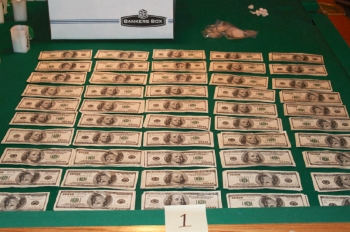
This cash came from the Trevor Cook Ponzi scheme and was stashed, according to filings in the civil case against Cook. Cook is serving a 25-year-sentence in federal prison. Photo source: Court records.
EDITOR’S NOTE: As America’s fraud plague continues, some of the scammers are polluting the free market with incongruous and even bizarre schemes — even as they purport to represent the best that freedom offers.
The PP Blog highly recommends that readers check out this September 2011 document from the SEC that warns about scammers targeting holders of self-directed IRAs. Reading the document may help improve your understanding of the story below. There are differences between IRAs (emphasis added below):
“An Individual Retirement Account (IRA) is a form of retirement account that provides investors with certain tax benefits for retirement savings,” the SEC says. “Some common examples of IRAs used by investors include the traditional IRA, Roth IRA, Simplified Employee Pension (SEP) IRA, and Savings Incentive Match Plan for Employees (SIMPLE) IRA. All IRA accounts are held for investors by custodians or trustees. These may include banks, trust companies, or any other entity approved by the Internal Revenue Service (IRS) to act as a trustee or custodian.
“A self-directed IRA is an IRA held by a trustee or custodian thatpermits investment in a broader set of assets than is permitted by most IRA custodians,” the SEC continues. “Most IRA custodians are banks and broker-dealers that limit the holdings in IRA accounts to firm-approved stocks, bonds, mutual funds and CDs.
“Custodians and trustees for self-directed IRAs, however, may allow investors to invest retirement funds in other types of assets such as real estate, promissory notes, tax lien certificates, and private placement securities.While self-directed IRAs may offer investors access to an array of private investment opportunities that are not available through other IRA providers, investments in these kinds of assets may have unique risks that investors should consider. Those risks can include a lack of disclosure and liquidity — as well as the risk of fraud.”
Here, now, a story about how holders of self-directed IRAs allegedly had their pockets picked . . .
Meanwhile, there’s William Wise, a onetime international fugitive charged in California with a massive Ponzi scheme centering on offshore CDs. (Wise surrendered earlier this week.) And then there’s Robert Stinson Jr., the Pennsylvania Ponzi swindler now doing more than 33 years for his “Life’s Good” scam. (The FBI said he was wiring money even as a raid was under way.)
And who could forget Californian Daniel C.S. Powell, implicated by the SEC in a life-settlement scam? (The venture became known as “Christian Stanley,” and its website traded on the name of former President Bill Clinton.)
Then there’s Chris Cornett, implicated by the CFTC in a Forex swindle.
Here’s why these names are important: All of these individuals — and more — are listed as scammers or alleged scammers in a proposed class-action lawsuit against Ephren W. Taylor II, now implicated by the SEC in a massive Ponzi swindle known as “City Capital.” The alleged City Capital targets were people of faith.
Though not defendants in the Taylor/City Capital lawsuit, the other alleged (or proven) scammers all had something in common beyond their abilities to separate people from their money, according to the complaint: complicit bankers and/or a means of plowing customers’ money from self-directed IRAs (SDIRAs) into their fraud schemes.
SDIRAs are sold as freedom-celebrating devices that encourage personal responsibility and permit their holders to be more flexible in their investment choices. By law, the accounts are held by a custodian or trustee. Even so, sharks allegedly swim in these waters — and the worst of the worst may deny they have any duties to their customers and may be turning a blind eye to fraud schemes as a means of keeping a fee-generating, steady supply of fresh meat and blood in the water.
“I am encouraging our plaintiffs to raise their voices and to make their legislators and regulators aware of how Ponzi schemes continue to be perpetrated through the use of self-directed IRA investment vehicles,” said Cathy Lerman of Cathy Jackson Lerman PA, one of the firms involved the prospective class action.
Other attorney/firms involved in the litigation include California local trial counsel David Dorenfeld of Snyder Dorenfeld LLP; Michael W. Brown, an associate at Snyder Dorenfeld; and Jim Gitkin, principal of Salpeter Gitken LLP.
Among the defendants named in the Taylor class action are Bank of America; Missouri Bank and Trust of Kansas City; Equity Trust Corp. of Ohio (an SDIRA provider); Entrust New Direction IRA Inc. of Colorado; The Entrust Group of California (an SDIRA provider); Entrust Administration Inc. of California; and Sunwest Trust Inc. of New Mexico. Other defendants also are named, and there is an allegation that Taylor used as many as 50 shell companies as part of his long-running fraud.
A separate proposed class action has been filed against SDIRA providers named in the Taylor class action. That lawsuit alleges that as much as $94 billion may be tied up in SDIRAs nationwide, suggesting that fresh meat and blood could churn in the waters indefinitely.
In effect, the lawyers are arguing that SDIRAs, which are lightly regulated or not regulated at all, have become the tools of criminals and are being used to separate investors from their money in one scam after another. Unlike traditional IRAs, SDIRA vessels may end up steering vast sums of cash into “opportunities” that not only may be exceptionally risky, but also may be downright crazy — such as Taylor’s purported “sweeps machines.”
The Taylor lawsuit, for instance, argues that African American Christians effectively found themselves owning machines used in illegal gambling parlors and that churches that had invited Taylor to speak also got swept into incongruous schemes.
Liberty City Church of Christ in Miami lost $100,000, owing to Taylor’s scams, the lawsuit contends. William Lee of Raleigh, N.C., got duped of $160,000 because Taylor and associates caused him to believe he was making a “socially conscious” investment that would help the public at large while at once resulting in an individual profit.
The same thing happened to Gennet Thompson of Delray Beach, Fla. Thompson entrusted $17,200 to Taylor in one “opportunity” and $10,500 in another, according to the complaint.
Trudy Morgan of Lithonia, Ga, had a similar experience — one that sucked away $30,000, according to the complaint.
If you’re a fan of “Mad Men,” the award-winning AMC television drama now back on the air after a 17-month absence, you’ve seen the cigarettes, the boozing and the debauchery weekly. (Perhaps not only in the show itself, but also in AMC’s promos for the series, a key element of which is the tagline “DEBAUCHERY IS BACK.”)
“Mad Men” is a carefully crafted period piece about the advertising business as it existed at the fictional, New York-based Sterling Cooper Draper Pryce agency on Madison Avenue in the 1960s. The show is utterly believable: The audience can’t wait to see what the gifted and self-absorbed fools running the shop will do next. It’s a safe bet, though, that whatever they do will involve a vice.
Something reminiscent of “Mad Men” is coming to the Minneapolis/St. Paul region this week. Indeed, the real-life Forex fraud trials of Bo Beckman, Pat Kiley and Gerald Durand are scheduled to get under way Thursday. All three men are figures in Trevor Cook’s $194 million Ponzi caper, believed to be the second greatest financial crime in Minnesota history behind the epic, $3.65 billion fraud of Tom Petters.
Cook, an aficionado of life’s dark alleys, pleaded guilty two years ago and was sentenced to 25 years in federal prison. In a sense, the Cook case demonstrates that debauchery still is practiced in American business, though perhaps a bit less naturally than in the decade depicted in “Mad Men.”
We highly recommend this pretrial summary by the Star Tribune, which reports that the government has referenced booze, drugs, strippers and prostitutes in court filings — and a defense lawyer is worried that prosecutors will put on a “stripper-centric” case.
URGENT >> BULLETIN >> MOVING: The SEC has gone to federal court in Los Angeles, alleging that a California man was operating a $7.5 million Ponzi scheme targeted at the Persian-Jewish community.
U.S. District Judge Jacqueline H. Nguyen has issued an emergency asset freeze.
Charged in the alleged affinity-fraud caper was Shervin Neman, 30, of the Century City area of Los Angeles. Neman, according to the SEC, formerly was known as Shervin Davatgarzadeh. He presided over an entity known as Neman Financial LP, which the agency described as a “purported hedge fund.”
It was the second major affinity-fraud case announced by the SEC in the past 24 hours. The agency said yesterday that Ephren W. Taylor II, 29, of New York, was operating an $11 million Ponzi scheme targeted at African American church congregations. Taylor was charged in Atlanta.
The Scheme Aimed At The Persian-Jewish Community
“Neman deceived members of his own community to raise money in this fraudulent Ponzi scheme,” said Michele Wein Layne, associate regional director of the SEC’s Los Angeles Office. “By exploiting investors’ trust in him, Neman was continually able to raise more money to pay back existing investors and finance an extravagant lifestyle.”
The Neman Ponzi married a real-estate flipping scheme involving purported foreclosures to purported opportunities to profit from IPOs conducted by Facebook , Groupon, LinkedIn and Angie’s List, the SEC said.
“Although Neman promised investors exorbitant returns resulting from his investing acumen and access to pre-IPO shares of well-known companies, what they actually received was simply other investors’ money in hallmark Ponzi scheme fashion,” the agency said.
Named a relief defendant in the case was Neman’s wife, Cassandra C. Neman, 33. She is not charged with wrongdoing, but the SEC said she received gifts from her husband, including a $60,000 ring, that were paid for from Ponzi proceeds.
Neman’s investors also were paying for his wife’s personal expenses, the SEC said. The Nemans wed in October 2010. The fraud scheme may date back to June 2010. It allegedly raised at least $7.54 million from investors in California, Florida and Texas, the agency said.
More than 99 percent of investors’ funds were directed either to Ponzi payments or to prop up Neman’s tony lifestyle, the SEC said.
“Specifically,” the agency said, “of the $7.54 million raised from investors since June 2010, Neman has used more than $5.4 million to make Ponzi payments to existing investors, and has spent another nearly$1.6 million to support a lavish lifestyle and maintain the appearance of an upscale
business operation. Due to recent investments from new and existing investors,Neman owes nearly $2.7 million in principal payments alone to his investors.”
Neman filled his personal bank account with investors’ money, the SEC said.
“In most instances, Neman directed investors to wire their funds to a personal bank account held in Neman’s name or to write checks to him personally, which he then deposited into his personal account,” the SEC charged. “Neman commingled investor funds in his personal account.”
As was the case yesterday in the SEC’s allegations against Taylor in the alleged affinty-fraud scheme targeted at Christians, the agency said today that Neman’s fraud involved promissory notes.
Neman was operating a straightforward scam, the SEC said.
“Among other things, Neman used investor funds to pay for his wedding and honeymoon, his wife’s engagement ring, luxury cars, VIP tickets to entertainment venues, jewelry, hotels, and restaurants,” the SEC charged. “Neman also used investor funds to lease and redecorate a new office in an upscale building in the Century City area of Los Angeles, hire two administrative assistants, and pay legal and other professional expenses . . .”
URGENT >> BULLETIN >> MOVING:Robert Stinson Jr., the Philadelphia-area Ponzi schemer who was wiring stolen funds from one account to another even as the FBI was conducting a raid in 2010, has been sentenced to 400 months in federal prison. The term amounts to more than 33 years.
Stinson, a 57-year-old securities huckster and recidivist felon whose criminal record dates back at least to 1986, defrauded more than 260 investors out of more than $17 million in his most recent scam, federal prosecutors said.
The scam operated through an entity known as Life’s Good Inc. and featured false claims that Stinson was a graduate of the Massachusetts Institute of Technology and a fabulously successful businessman.
In reality, he was a serial huckster who’d twice filed for bankruptcy and was enjoined in a 1990 SEC case from breaking federal securities laws.
At 12:06 p.m. on June 29, 2010 — the date of the raid and while federal agents were executing search warrants and seizing two Mercedes Benz sedans Stinson had purchased with money stolen from investors — Stinson began a series of wire transactions in which he moved at least $225,000 to prevent the cash from being seized, according to the indictment.
Two of the transactions occurred during the same minute and involved two separate banks, according to the indictment.
Stinson’s wife, Susan L. Stinson, is scheduled to be sentenced tomorrow on charges of obstructing the SEC’s 2010 investigation into her husband.
U.S. District Judge Michael M. Baylson of the Eastern District of Pennsylvania presided over Robert Stinson’s sentencing today. In addition to ordering Stinson jailed for decades, Baylson ordered restitution of $14 million and three years’ supervised release when Stinson leaves jail.
Stinson will be close to the age of 90 if he survives the term of incarceration.
The Philadelphia Daily News is reporting tonight that Stinson told the judge today that he’d “changed” while awaiting sentencing and had dedicated his life to serving God.
Risher, a 61-year-old recidivist felon last living in Sanibel, Fla., pleaded guilty to Ponzi-related offenses last year and was sentenced to 19 years and seven months in federal prison.
Sebastian, 49, pushed the scheme on senior citizens, church members, educators and golfers, the SEC charged last year.
He was found dead in a van last week, TheLedger reported, citing information from the Manatee County Sheriff’s Office.
The scheme gathered about $22 million, with Sebastian conducting business as “Safe Harbor,” the SEC charged last year.
 A California investment adviser presiding for years over a $60 million fraud duped investors by making Ponzi payments and used the names of the Securities and Exchange Commission and the National Association of Securities Dealers to sanitize his scheme, the SEC charged.