Tag: SEC

  • A FLORIDA TRIFECTA: FTC Goes To Federal Court To Halt ‘Timeshare’ Telemarketing Scheme; ‘When Consumers Realized They Had Been Duped, The Defendants Routinely Dodged . . . Phone Calls,’ Agency Says

    BULLETIN: Even as the SEC and CFTC were charging alleged Ponzi schemers and “precious-metal” fraudsters in Florida yesterday, the FTC was preparing to announce charges against an alleged “timeshare” telemarketing scheme operating in the Sunshine State.



    Charged by the FTC in the alleged timeshare scam were Albert M. Wilson, David S. Taylor, Frank M. Perry Jr., Vacation Property Services Inc. (VPS), Vacation Property Sellers Inc. (dba Timeshare Experts), and Higher Level Marketing Inc. (HLM, dba Vacation Property Services).

    Two of the companies — VPS and HLM — had previous run-ins with law enforcement over timeshare schemes, the FTC said.

    Although the telemarketing schemers were eager to sell their scam over the phone, they were less eager to pick up the phone to answer calls when confused or disgruntled customers called, the FTC said.

    A federal judge has issued a Temporary Restraining Order that halts the scam in its tracks, the FTC said. The scheme was operating in the St. Petersburg area, the agency added.

    Even customers on the FTC’s “Do Not Call” list were called by the scammers, the FTC said.

    “Defendants target consumers who own timeshare properties,” the FTC said. “Many of Defendants’ victims are elderly consumers and/or immigrants who speak English as a second language. Defendants also deceive many other segments of the population.”

    The scheme featured a pitch that the companies had buyers for timeshares, the FTC said. Prospects were told that, by paying an upfront fee ranging from $200 to more than $8,000, the firms could sell the properties and the customers could cash out.

    “[C]onsumers ultimately learned the defendants had no buyers lined up to purchase their timeshare properties and no such buyers were in the offing,” the FTC said. “And, when consumers realized they had been duped, the defendants routinely dodged consumers’ phone calls and denied their refund requests.”

  • FLORIDA — AGAIN: James Clements and Zeina Smidi Of Plantation Ran $30 Million Ponzi Scheme, SEC Says; Firm Claimed ‘Protected Jurisdiction’ Offshore; Defendants Already Face $50 Million Judgment From Class-Action Lawsuit

    Two Florida residents have been accused by the SEC of operating a $30 million Ponzi and promissory-notes scheme that purported to trade foreign currency amid claims their domestic company was morphing into an “offshore” firm that would operate in a “protected jurisdiction.” The defendants in the case already face a judgment of $50 million from a class-action lawsuit filed against them by investors they ripped off, according to court filings.

    Charged by the SEC were James Clements, 45, and Zeina Smidi, 27, of Plantation. Also charged were their companies: MRT LLC, MRT Holdings LTD and Maximum Return Transaction LLC. (Collectively MRT.) The SEC said MRT Holdings was formed in the Republic of Seychelles, an island nation in the Indian Ocean.

    The SEC case also references an alleged claim by MRT in 2007 that it was “shifting” from MRT LLC into MRT Holdings to become an “offshore entity.” In April 2007, according to a company note to an investor the SEC quoted to a federal judge, Smidi said MRT would operate from Belize, a country in Central America.

    “[W]e have chosen Belize because this allows us to offer our very lucrative products and manager program to you,” Smidi allegedly wrote. “After two years of legal research, we have found that transitioning offshore is the best way to keep our program compliant.”

    By June 2007 — after it had slashed its payout rate — Clements told MRT’s pitchmen that the company was switching away from foreign currency, the SEC charged.

    Clements and Smidi “claimed in a letter to investors they wanted MRT’s money working with the best Swiss banks and advisors, and were searching for a high-yielding product that also offered a high level of security,” the SEC said.

    MRT traded very little Forex, and the trading that did occur resulted in losses, the SEC said. Instead, the company concentrated on keeping its Florida-based Ponzi scheme afloat, while investing “approximately $550,000 in a now-defunct currency trading firm that never returned MRT’s funds,” the SEC charged.

    As part of the scheme, MRT used “certain investors who agreed to be ‘account managers’ to solicit hundreds of investors through informal gatherings and word of mouth,” the SEC said.

    “During the early fall of 2007, MRT stopped answering investor phone calls, fulfilling redemption requests or responding to emails,” the SEC said.

    Read the SEC complaint.

  • FDA Chemist Cheng Yi Liang’s Very Bad Day: Busted By The Feds, Sued By The SEC For Trading On Information Lifted From Confidential Government Database

    A chemist who works for the U.S. Food and Drug Administration has been charged criminally by federal prosecutors, arrested by federal agents in Maryland, sued by the SEC — and will go to bed tonight knowing his son has been arrested in the same case.

    Cheng Yi Liang, 56, of Gaithersburg, was accused of abusing his position of trust at the FDA by mining the agency’s database for information on drug approvals or denials — and then trading on the information he gleaned to “generate more than $3.6 million in illicit profits and avoided losses,” the SEC said.

    Liang’s son, Andrew Liang, 25, also of Gaithersburg, was arrested, too.

    And high-ranking public officials minced no words when announcing the charges against the men, which included a stunning allegation that the senior Liang sought to conceal the scheme in part by trading in the account of his elderly mother in China.

    “Cheng Yi Liang was entrusted with privileged information to perform his job of ensuring the health and safety of his fellow citizens,” said Assistant U.S. Attorney General Lanny Breuer. “According to the [criminal] complaint, he and his son repeatedly violated that trust to line their own pockets.”

    Breuer is the head of the Justice Department’s Criminal Division.

    “Liang victimized both the investors who were disadvantaged by his theft of inside information and the American citizens whose trust he violated by placing private gain above public good,” said Robert Khuzami.

    Khuzami is director of the SEC’s Division of Enforcement.

    Another high-ranking official summarized today’s events by saying Liang’s actions made government workers look bad.

    “Profiting based on sensitive, insider information — as Liang is charged with today — is not only illegal, but taints the image of thousands of hard-working government employees,” sighed Elton Malone, special agent in charge of the office of special investigations for the U.S. Department of Health and Human Services, Office of the Inspector General.

    Liang, an FDA employee since 1996, began snatching information as early as July 2006, the SEC charged.

    He “illegally traded in advance of at least 27 public announcements about FDA drug approval decisions involving 19 publicly traded companies,” the agency charged.

    In a bid to cover his tracks, Liang “traded in seven brokerage accounts, none of which were in his name. One belonged to his 84-year-old mother who lives in China,” the SEC charged.

    “The insider trading laws apply to employees of the federal government just as they do to Wall Street traders, corporate insiders, or hedge fund executives,” said Daniel M. Hawke, chief of the SEC’s Market Abuse Unit.

    Father and son were charged with conspiracy to commit securities fraud and wire fraud, securities fraud and wire fraud. Federal prosecutors said investigators caught Liang after special software was installed on the work computer he was using.

    See this SEC exhibit that outlines the trades.


  • URGENT >> BULLETIN >> MOVING: Andy Bowdoin, AdSurfDaily Lose Appeal Of $65.8 Million Forfeiture Order; Panel Unanimously Upholds District Judge

    Andy Bowdoin

    BULLETIN: Andy Bowdoin and AdSurfDaily Inc. have lost their appeal of a January 2010 order by U.S. District Judge Rosemary Collyer that $65.8 million be forfeited to the government in the August 2008 civil Ponzi scheme case against Bowdoin’s assets.

    The U.S. Appeals Court for the District of Columbia unanimously upheld Collyer, rejecting Bowdoin’s claims he had been denied due process and been hoodwinked by his former attorneys into releasing his claims to the seized cash in January 2009.

    “To begin with, there can be no doubt that appellants meant to withdraw their claims,” the panel ruled. “Their withdrawal motion expressly stated that they wished to ‘withdraw and release with prejudice’ their verified claims and that they ‘consent[ed] to the forfeiture of the properties.”

    “Nor is there any basis to conclude that appellants were somehow tricked into releasing their claims,” the panel continued. “Despite Bowdoin’s protests to the contrary, his own affidavit shows that he understood well that he was receiving no promise in return for relinquishing his claims.”

    Bowdoin’s withdrawal of his claims was “free and deliberate,” the panel ruled.

    Although Bowdoin blamed one of his former lawyers for giving him bad advice, the appeals panel said nonsense.

    “[F]ar from being negligent, appellants’ attorney had sound reasons for recommending that they cooperate with prosecutors by relinquishing their claims,” the panel ruled.

    The ruling means that the government now has title to about $80 million seized in the ASD case. Bowdoin lost a previous appeal for a smaller sum in a separate forfeiture action brought in December 2008, and Collyer ordered the forfeiture of more than $14 million from Golden Panda Ad Builder in July 2009.

    Golden Panda was the purported “Chinese” arm of ASD. It was operated by Clarence Busby, whom the SEC had implicated in three prime-bank schemes in the 1990s, according to court filings.

    About $65.8 million of the total sum seized in the August 2008 forfeiture case was in Bowdoin’s personal bank accounts, including one account that contained more than $31 million.

    Bowdoin initially released his claims to the money in January 2009. By late February of the same year, he sought to reassert his claims as a pro se litigant.  He ultimately retained new counsel, and unsuccessfully sought to have Collyer removed from the case.

    Collyer refused to step down, and issued the forfeiture order for $65.8 million in January 2010. At least one other ASD member also sought unsuccessfully to force Collyer to disqualify herself from hearing the case.

    That member — Curtis Richmond — accused the judge of treason. In a separate case in Utah in 2008, Richmond claimed a federal judge owed him $30 million. That judge, too, refused to step down, finding that a purported Indian tribe with which Richmond was associated was a “sham.”

    Richmond has claimed to be a “sovereign” being, as have other people with ties to ASD.

    Bowdoin was charged criminally with wire fraud, securities fraud and selling unregistered securities in December 2010. The U.S. Secret Service said he was operating a Ponzi scheme that had gathered at least $110 million by disguising itself as a “advertising” business.

    ASD perhaps created as many as 40,000 victims, according to court filings.  The civil portion of the case featured dozens of templated, pro se filings from ASD members who asserted the government had no “EVIDENCE” of wrongdoing.

    Almost three years into the case, some ASD members still are claiming the government has no evidence — despite the fact that the evidence has been discussed in open court and in public filings dating back to August 2008.

    Read the ruling.

  • BULLETIN: SEC Alleges ‘Payday Loan’ Ponzi Scheme In Utah; Second Major Ponzi Case Brought In State In Two Days; Schemes Attracted Almost $75 Million

    BULLETIN: The SEC has gone to federal court in Utah to halt what it described as a $47 million “payday loan” Ponzi scheme and offering fraud in which investors were lured by the prospect of “extraordinary returns” while the alleged operator diverted large sums of cash to himself and other business interests.

    The payday-loan Ponzi case against John Scott Clark, Impact Cash LLC and Impact Payment Systems LLC was the second major Ponzi case brought by the SEC in Utah in a matter of days. On March 23, the SEC charged Mike Watson Capital LLC of Provo, Michael P. Watson of Mapleton and Joshua F. Escobedo of Spanish Fork in an alleged real-estate and promissory-notes Ponzi scheme that gathered more than $27.5 million from more than 120 investors.

    Clark and his companies were charged on March 25. Utah has been plagued by Ponzi schemes and other forms of fraud, many of them directed at people of faith. The FBI said last year that thousands of residents of the state had been victimized in investment-fraud schemes.

    Now, Clark’s alleged payday-loan fraud has been added to Utah’s Ponzi mix by the SEC. If the alleged Clark total is added to the total gathered in the alleged Watson/Escobedo fraud, a figure of at least $74.5 million emerges from the two schemes.

    “Investors were promised extraordinary returns while Clark was actually diverting their money to make such extraordinary personal purchases as a fully restored classic 1963 Corvette Stingray,” said Ken Israel, director of the SEC’s Salt Lake Regional Office. “Clark recruited new investors through referrals from earlier investors who thought the Ponzi payments they received were actual returns on their investments and sought to share the lucrative opportunity with family and business associates.”

    Clark also bought “multiple expensive cars and snowmobiles” and “stole investor funds to purchase a home theater, bronze statues and other art for himself,” the SEC charged.

    In October, the SEC’s Salt Lake office also filed charges against Imperia Invest IBC, a mysterious offshore firm alleged to have stolen millions of dollars from thousands of deaf investors. The Imperia scheme was promoted on Ponzi boards such as TalkGold and MoneyMakerGroup.

    In the Clark case, the SEC said “at least” 120 investors were affected. The scheme operated between March 2006 and September 2010.

    Investors were recruited to fund payday loans, the SEC said. One recruiter was paid more than $500,000 to help drive business to the unregistered offering, according to the complaint.

    Clark 58, of Hyde Park, “has never been registered with the Commission or any other regulatory agency in any capacity,” the SEC charged.

    Investors were offered their own companies with an LLC designation and lured by suggestions that Clark and his Impact companies could generate returns “averaging at least 80% per year,” the SEC said.

    “Clark explained to investors that Impact would create a unique LLC for each investor or investor group for the purpose of investing with Impact,” the SEC said. “The investor LLC would then enter into a Joint Operating Agreement with Impact to provide money to Impact to fund payday loans.”

    And Clark’s “early investors” — impressed by their returns — helped the Ponzi gain a head of steam, the SEC said.

    “Many of Clark’s early investors mentioned their astronomical returns to their families or
    business associates, who then invested with Clark,” the SEC said. “Clark paid one salesperson between $500,000 and $600,000 over a four or five year period to locate potential investors and attend payday loan conferences and trade shows. Clark also paid certain individuals commissions ranging from 2% to 4% for bringing in investors to Impact.”

    Neither firm that used the word “Impact” in its name was registered, the SEC said.

    Although investors believed they were funding payday loans, Clark diverted cash to “to make unauthorized investments, including a real estate investment company, a diabetes research company and an online products store,” the SEC said.

    The assets of Clark and his companies have been frozen. Read the SEC complaint against Clark.

    Read the SEC’s statement on the alleged Ponzi scheme involving Watson and Escobedo, who have settled without acknowledging wrongdoing.

  • Florida Ponzi Property Of Accused Minnesota Fraudster Bo Beckman Will Drain Cash, Receiver Says; Home With 5 Bathrooms Is ‘Under Water’ And Should Be Beckman’s Problem To Solve

    This 10-room home with five baths and a garage of nearly 1,100 sq. ft. in Florida is "under water" on its mortgage and could create a drain on the receivership estate in the Bo Beckman fraud case, according to the court-appointed receiver.

    Accused Minnesota fraudster Jason Bo-Alan Beckman’s 5,097-sq.-ft.-home with five bedrooms, five bathrooms and a roomy garage of nearly 1,100 sq. ft. in Palm City, Fla., is seriously “under water” on its mortgage and thus creates a drain on assets that are best used to compensate victims, the court-appointed receiver has advised a federal judge.

    Receiver R.J. Zayed has asked Chief U.S. District Judge Michael J. Davis for an order that would return control of the property to Beckman and his wife on the theory it is “imprudent to diminish the Receivership’s severely limited resources to continue efforts to market and/or maintain the Property.”

    The Beckmans, whose home in Minnesota is in foreclosure, owe “at least” $207,000 more than the Florida property is worth, Zayed advised Davis. The receiver noted that the mortgage has a balance of more than $707,301 and that the home may not even fetch $500,000 if sold.

    The “negative equity” should be the Beckmans’ problem, not the problem of the victims of his alleged fraud, which is part of the Trevor Cook Ponzi scheme case, Zayed argued. The SEC sued Bo Beckman earlier this month, alleging that he was a “leading” figure in Cook’s fraud and had “guaranteed” annual returns of 12 percent or greater in an international Forex scheme.

    Cook is serving a 25-year sentence in federal prison.

    Bo Beckman, according to the SEC, purchased luxury homes in three states and assembled a fleet of luxury cars. He essentially is accused of being a rainmaker for Cook by driving nearly $50 million to the $190 million fraud.

    “[T]he Receiver is not seeking to abandon the [Florida] property, but rather have the Court confirm the return the property to the Beckmans’ custody, control and possession, thereby placing at least some of the burden of unwinding the fraud on its perpetrators,” Zayed advised Davis.

  • URGENT >> BULLETIN >> MOVING: German Cardona Soler, Figure Associated With International Forex Scam Pushed On TalkGold And MoneyMakerGroup, Arrested By Spanish National Police; Agency Alleges $300 Million Ponzi

    BULLETIN: Spanish National Police have arrested German Cardona Soler in a case that alleges a spectacular Ponzi and fraud scheme involving more than $300 million. Two others also were arrested, and police “locked” 12 bank accounts. Although early details are unclear, it appears as though police have charged at least seven people in the alleged international caper.

    Cardona Soler, also known simply as German Cardona, is referenced in U.S. court documents in the EMG/Finanzas Forex case. Federal prosecutors traced money seized in the case to the narcotics trade, according to U.S. court filings. The scheme was promoted on TalkGold, MoneyMakerGroup and other Ponzi and criminals’ forums.

    Cardona also is referenced in other Ponzi cases, including the George Theodule Ponzi in Florida.

    Spanish police described the alleged caper as a “mini-Madoff” scheme, saying it affected more than 100,000 people in 110 countries.

  • BULLETIN: Feds Charge Minneapolis Man Amid Suspicions He Used Loot From Trevor Cook Ponzi Scheme To Party And Gamble With Strippers While Victims Suffered

    BULLETIN: Five days after Ponzi swindler Trevor Cook pleaded guilty to defrauding victims in an elaborate international scam that reduced investors to ruin, a Minneapolis man hid proceeds from the caper from law enforcement and the court-appointed receiver, federal prosecutors said.

    Victims of the Cook scheme — many of whom were people of faith — were defrauded of tens of millions of dollars. Court records strongly suggest that some of the recoverable money was spent on booze, exotic dancers and gambling — after the scheme was exposed by the SEC and CFTC in November 2009 and Cook’s assets were frozen.

    Jon Jason Greco, 40, now has been charged with making false statements to federal agents. The case was filed under seal Tuesday, and the seal was lifted yesterday.

    Cook, 38, pleaded guilty on April 13, 2010, and is serving a term of 25 years in federal prison. His plea agreement in the $190 million swindle required him to disclose the whereabouts of assets and cooperate with investigators. Investors immediately expressed fears that money that could be used to help them recover from the devastating scam had been hidden and that Cook could not be trusted in any context.

    Some of the hidden loot was found months after the plea and cooperation agreement. Part of it had been concealed behind a toilet-paper dispenser and in air ducts in an apartment occupied by Cook’s brother, Graham Cook. Loot also was found in a storage locker at the Mall of America.

    Although the recovered loot made up only a tiny percentage of the $190 million scam, victims said every dime was needed and that justice demanded that no third party should be permitted to profit from Cook’s colossal fraud.

    Prosecutors now say that Greco came into possession of some of the loot on April 18, 2010 — five days after the Cook guilty plea. Greco helped hide the loot and lied about it when questioned by investigators, according to prosecutors.

    Court records suggest investigators established links among Cook, Graham Cook and Greco, who once worked briefly for Trevor Cook as a purported security guard at the Van Dusen mansion in Minneapolis. The big break in the case appears to have occurred in July 2010, when Greco’s roommate told federal agents that Greco was “holding assets” for the Cook brothers and impeding a federal investigation.

    Investigators had believed since at least June 2010 that Greco had stashed money from the caper, according to court filings.

    The case against Greco was bolstered when an exotic dancer told an IRS criminal investigator who was following leads that Greco, believed to have been unemployed for months, suddenly began to spend generously at a Minneapolis strip club and to plow $100 bills into slot machines at a gambling emporium.

    “Greco placed some of the assets in his possession in a locker at the Mall of America,” prosecutors charged. “On July 24, 2010, law enforcement seized the assets, valued at approximately $150,000. Subsequently, Greco allegedly claimed to investigators that the seized assets belonged to him.”

    But the assets were from the Ponzi caper, prosecutors charged.

    Greco faces up to 10 years in federal prison if convicted on two counts of making false statements.

    When interviewed last summer, Greco told agents that he had no knowledge of concealed assets belonging to Cook, when, in fact, he did,” prosecutors said.

  • ‘Churning’ Scammer Fleeced 9/11 Widow, Disabled Daughter; Victim’s Husband Was Naval Officer Killed In Pentagon Attack, Authorities Say

    A Massachusetts man entrusted with $3.7 million from a widow whose husband was a Naval officer killed in the 9/11 terrorist attack on the Pentagon has been charged by state and federal authorities in a “churning” case.

    James J. Konaxis, 52, of Beverly, pocketed more than half a million dollars in commissions by making a “multitude” of unauthorized trades in the widow’s accounts, including custodial accounts she opened for her disabled teenage daughter and two other children who were minors, the SEC charged.

    An “annual turnover rate” of six is considered “excessive” if the trades do not reflect a customer’s investment aims, the SEC said. In April 2010, after Konaxis had been managing the family’s 9/11 compensation for two years, the turnover rate in one of the accounts was 16. The rate in another was nine, according to court filings.

    Massachusetts Secretary of State William Galvin now has banned Konaxis from the state’s securities industry. Investigators discovered that accounts opened by the widow accounted for 75 percent of the commissions Konaxis earned over a two-year period and that the value of the accounts had plunged by more than $2 million.

    The nondiscretionary accounts were opened with funds received from the September 11th Victim Compensation Fund, the SEC said. Konaxis traded in the accounts without the authority of the widow, who is described in court documents only as “S.T.”

    “A non-discretionary account is an account that does not empower a broker to buy and sell securities without the client’s prior knowledge and consent,” the SEC said. “Churning occurs when a registered representative controls the trading in a customer’s account and excessively trades the Customer’s funds in light of the Customer’s investment objectives while knowingly or recklessly disregarding the Customer’s interests.”

    When Konaxis’s employer approached him last year about the commissions coming from the widow’s account, he began to trade “heavily” in the account of her disabled daughter, the SEC said.

    Konaxis, who allegedly plowed some of the woman’s money into penny stocks, tried to make her feel better by telling her that she was hardly alone in experiencing a reversal of fortune in the market downturn and that her losses were “were not as great as those suffered by other investors,” the SEC charged.

    But when investigators reverse-engineered the transactions, they discovered that the lion’s share of Konaxis’s commissions had come from the widow’s accounts and that he had pocketed about $550,000.

    Meanwhile, the value of the widow’s accounts had plunged from $3.7 million to $1.6 million, according to court filings.

    Konaxis “knowingly disregarded” the interests of the family when he churned the widow’s accounts “for his own interests because of the significant commissions he earned,” the SEC charged.

  • PRIMING THE PUMP: TalkGold, MoneyMakerGroup Publish String Of ‘I Got Paid’ Posts From Club Asteria Members; ‘It’s No Scam Now,’ Poster Declares

    Two forums listed in federal court documents as places from which Ponzi schemes are promoted have published a series of “I got paid” posts from commentators who say they are members of Club Asteria (CA).

    The “I got paid” posts on MoneyMakerGroup and TalkGold appeared after CA members had complained publicly about not getting paid and fretted about the firm’s slow-loading website.

    Both the complaints and the “I got paid” posts lead to questions about whether CA’s revenue stream is polluted by Ponzi proceeds.

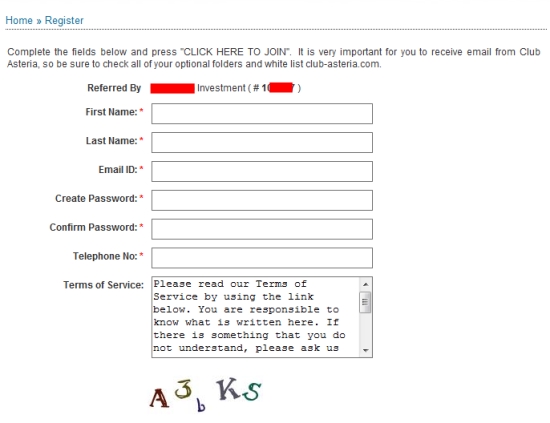
    “It’s no scam now,” a poster on MoneyMakerGroup confidently opined after the “I got paid” posts began to appear. A link under the comment led to the affiliate’s CA registration page,  which implied prospects were receiving guidance from an “Investment” company or professional financial adviser.

    This Club Asteria affiliate's sign-up page is accessible from a link on the MoneyMakerGroup Ponzi forum. The registration page implies that CA prospects are receiving guidance from a professional "Investment" company or adviser. In May 2010, the U.S. Postal Inspection Service identified MoneyMaker group as a site from which the alleged Pathway To Prosperity Ponzi scheme was pushed. Pathway To Prosperity gathered more than $70 million, creating about 40,000 victims from "all of the permanently inhabited continents of the world," according to federal court filings in the Southern District of Illinois.

    Separately on MoneyMakerGroup, another CA poster declared, “I am in over 35 forums and everyone is posting paid.”

    In July 2010, the Financial Industry Regulatory Authority (FINRA) issued an alert about investment scams and how they spread on the Internet.  Separately, court filings from May 2008 in the SEC’s case against an alleged $70 million Ponzi scheme known as Legisi include a handwritten note from a Legisi enrollee.

    “Money Maker Group.com,” the note read in part. The note was part of a 267-page evidence exhibit the SEC presented a federal judge. The SEC alleged that Legisi created thousands of victims.

    On both MoneyMakerGroup and TalkGold, posters have repeatedly noted that CA payments come from “Asteria Holdings Limited (Hong Kong).”

    CA says it accepts money through SolidTrustPay and AlertPay, both of which are Canada-based payment processors. Both companies are referenced in federal court filings in the alleged AdSurfDaily Ponzi scheme, which the U.S. Secret Service said gathered at least $110 million and created as many as 40,000 victims.

    ASD also was promoted on MoneyMakerGroup and TalkGold. Solid Trust Pay and AlertPay also are referenced in court filings in the Pathway To Prosperity Ponzi case.

    CA also notes that it conducts business with CashX, another Canadian firm. When the ASAMonitor Ponzi scheme and criminals’ forum mysteriously vanished in October 2010, the site’s landing page initially redirected to CashX.

    Some CA members are selling the “program” by describing what it is not. It is not a Ponzi scheme, and it is not an investment, they claim.

  • Sea Of Incongruity Surrounds Club Asteria: As ‘Ken Russo’ Pushes ‘Opportunity’ On TalkGold Ponzi Board, World Bank Qualifies ‘Director’ Claims Made By Promoters

    The World Bank confirmed to the PP Blog this morning that a person named Andrea Lucas left its employment in December 1986, nearly 25 years ago. But Lucas was never a member of the World Bank’s board of directors, as many members of business “opportunity” known as Club Asteria have implied in online, MLM-style promotions for the firm.

    Rather, the World Bank described Lucas as a former department head among “many” department heads who held the internal title of director of an individual department. Lucas, the World Bank said, was director of the management systems and account department. She worked in Washington, D.C., according to the World Bank’s records.

    The PP Blog initially sought comment from the World Bank on March 3 about Lucas and various claims about Club Asteria made by members of the purported opportunity. Some of the claims have been made on the TalkGold Ponzi scheme and criminals’ forum. The World Bank’s name is being used in Club Asteria promos on TalkGold and other websites.

    A blurb for Andrea Lucas on the slow-loading Club Asteria website describes her in the first sentence as “former Director of the World Bank,” using an uppercase “D” in “Director” with no other qualifiers. The reference to the World Bank begins seven words into the profile. The profile also lists Andrea Lucas as  “founder and Managing Director of Club Asteria.” No other entities are referenced in the Andrea Lucas blurb.

    The blurb makes no mention that Andrea Lucas left her staff job at the World Bank more than two decades ago, when Ronald Reagan was President of the United States and Mikhail Gorbachev was General Secretary of the Communist Party of the now-dissolved Soviet Union.

    When Andrea Lucas last worked at the World Bank, George Herbert Walker Bush was Vice President of the United States and still more than two years away from his term as President. The “Black Monday” market crash of October 1987 had not yet occurred, and Iraq’s August 1990 invasion of Kuwait that led to the Gulf War was still nearly four years away. Modern-day accused shoplifter and actress Lindsay Lohan was five months old, and few people outside of Arkansas recognized the names of Bill Clinton and Hillary Clinton. Barack Obama, a community organizer in Chicago, had yet to enter Harvard Law School or meet Michelle Robinson, who’d become his wife and, later, First Lady of the United States.

    Regardless, Lucas and the World Bank are referenced repeatedly in online promos by Club Asteria members. Why the company and promoters had seized on the World Bank’s name when Andrea Lucas last was employed there nearly a quarter of a century ago as a young woman was not immediately clear.

    “Real Profit Sharing Program ! No Ponzi !” one affiliate promo preemptively screams. “Club Asteria from the Former Director of World Bank – Andrea Lucas.” The affiliate site includes a photo of a letter dated Dec. 14, 2010, and the letter appears to feature the World Bank’s letterhead and verify the former employment of Andrea Lucas at the World Bank.  It is positioned by the affiliate as a reason to trust Club Asteria.

    Why the affiliate would preemptively argue that Club Asteria was “No Ponzi” was unclear.

    Another promo describes Club Asteria as “a perfect home based business that specializes in the remittance business of sending funds back home.

    “We provide training, opportunities, consultation and one of the most sensational pay plans of our time,” the promo continues. Club asteria (sic) is run by a former Director of the World Bank and it (sic) set to take the net by storm.”

    “Ken Russo,” who posts at TalkGold as “DRdave” and promotes one highly questionable scheme after another, announced yesterday that Club Asteria’s membership ranks had soared to 187,481.

    The announcement occurred against the backdrop of a December warning by the Financial Fraud Enforcement Task Force led by U.S. Attorney General Eric Holder that visitors to websites and forums should be skeptical of claims.

    “Be wary of people you meet on social networking sites and in chat rooms, where investment fraud criminals have been known to troll for victims,” the Task Force warned.

    Except for its confirmation this morning that a person named Andrea Lucas once worked for the World Bank and its release of certain details about her employment nearly a quarter of a century ago, the World Bank declined to comment immediately about the linkage of its name to Club Asteria and the promos at TalkGold and other websites.

    The bank, however, confirmed it is aware of the claims. Meanwhile, some Club Asteria members are grumbling in forums about the firm’s slow-loading website and spotty customer support. Among the concerns is that the company recruited members under one set of rules, but may be trying to implement a new set that may force higher costs on participants who expect to get paid.

    Some Club Asteria members appear to be confused about whether Club Asteria conducts business from the United States or Hong Kong.

    How the company makes money beyond membership fees is unclear. Also unclear is whether the firm has significant revenue streams beyond membership fees. Club Asteria appears to publish no verifiable financial data.

    The World Bank is the most recent prominent international entity to have its name appear on TalkGold and other Ponzi forums that push highly questionable business pursuits. Last year, members of the purported MPB Today “grocery” program, which operates as an MLM, flooded websites and social-media sites such as YouTube with references to Walmart.

    It is common in the MLM sphere for affiliates to trade on the names of prominent business entities even if no ties exist. Walmart’s name also appeared in promos on the Ponzi boards.

    TalkGold, MoneyMakerGroup and ASAMonitor are referenced in federal court filings as places from which international Ponzi schemes are promoted. Even if Club Asteria is a legitimate enterprise, the mere fact it is being promoted on the Ponzi boards raises troubling questions about whether its revenue stream is polluted by proceeds from any number of fraud schemes operating globally.

    In recent weeks, federal agencies such as the SEC and CFTC have taken actions against schemes promoted on the Ponzi boards. Meanwhile, the FTC announced an action this week against an online enterprise that allegedly was not policing its affiliate sales force properly.

    The FTC charged Lester Gabriel Smith and Legacy Learning of Nashville, Tenn., with disseminating “deceptive advertisements by representing that online endorsements written by affiliates reflected the views of ordinary consumers or ‘independent’ reviewers, without clearly disclosing that the affiliates were paid for every sale they generated.”

    In bringing the case, the agency held Smith and Legacy accountable for claims made by affiliates.

    “Whether they advertise directly or through affiliates, companies have an obligation to ensure that the advertising for their products is not deceptive,” said David Vladeck, director of the FTC’s Bureau of Consumer Protection. “Advertisers using affiliate marketers to promote their products would be wise to put in place a reasonable monitoring program to verify that those affiliates follow the principles of truth in advertising.”

    See the FTC news release on Legacy Learning, which was assessed a $250,000 penalty.