The FTC said today that images of President Obama were used to help a bogus "medical discount plan" trick customers into believing they were purchasing health insurance.
EDITOR’S NOTE: Some readers will recall that one of the Secret Service’s allegations in the AdSurfDaily Ponzi case is that pitchmen tried to sanitize the scheme by making false claims that ASD President Andy Bowdoin had received an award for business acumen from President George W. Bush and Vice President Dick Cheney.
Others will recall that Mantria Corp. — implicated in a Ponzi scheme by the SEC — used images of former President Clinton and other world figures to sanitize a “green” energy scheme.
Now comes word that the FTC has brought a fraud case against a company amid allegations it used images of President Obama, the White House, the U.S. Capitol and lawmakers to sanitize a bogus “medical discount plan” marketed as health insurance.
Here, now, the story . . .
A company that used images of President Obama and the White House — along with logos that resembled the logos of government agencies — has been charged by the Federal Trade Commission with marketing a bogus “medical discount plan” as healthcare insurance.
At least two other firms and their operators and associates have been charged separately with running discount scams, and a nationwide crackdown involving at least 24 states is under way. The FTC has dubbed the sweep “Operation Health Care Hustle.”
“With so many Americans struggling to deal with the costs of health care, these medical discount benefit plans sound appealing because they masquerade as health insurance,†said David Vladeck, director of the FTC’s Bureau of Consumer Protection. “But they are not insurance. They don’t offer the benefits of health insurance, and victims don’t know they’ve been ripped off until after they’ve tried to use the service and paid their bill.â€
The fraud case against Health Care One LLC and associated firms illustrates the dangers not only of promoting scams, but also of of trying to recruit customers into them by implying a product or service is endorsed by the President, members of Congress or the government in general.
Indeed, Health Care One’s website already has been seized by a court-appointed receiver — and content that once appeared on the site and affiliated sites has vanished. In a remarkable news presentation today, the FTC released a video pitch used by the company.
Healthcare One LLC used images of the White House while scamming customers, the FTC said.
The pitch features video of Obama addressing Congress about healthcare issues on Sept. 9, 2009. Heathcare One makes Obama the star of the video, showcasing remarks in which the President stated, “No one should go broke because they get sick.†Vice President Joe Biden and House Speaker Nancy Pelosi are in the background of the video.
The video then cuts away to a passage in which Obama said, “That is heartbreaking. It is wrong, and no one should be treated that way in the United States of America.”
The video then quickly cuts away again to an image of the U.S. Capitol. Official-looking logos appear on the screen, along with the words “REGISTRATION NOW OPEN[:] NATIONAL HEALTHCARE DISCOUNT PROGRAM[:] FOR ALL UNINSURED AMERICANS.”
A narrator simultaneously declares that “registration is now open for a national healthcare discount program.” The narrator — as an image of the White House replaces an image of the Capitol — goes on to say that “Citizens4Healthcare is now authorized to offer you savings of 20 to 60 percent on doctors, hospitals, prescription drugs and more.”
As the video proceeds, the narrator declares that “there are daily registration limits for this program, so call now for immediate acceptance . . .”
Healthcare One was specifically charged with claiming it sold health insurance when it did not — and of misleading the public into thinking it was affiliated with the federal government.
“Defendants’ advertisements lead consumers to reasonably believe that Health Care One’s program is affiliated with, or endorsed or sponsored by, the federal government,” the FTC said.
“It is not,” the agency said flatly in court filings, accusing the company of selling a scam.
Read more about “Operation Health Care Hustle.” (Look in the upper-right corner of the screen when you land on the FTC page. You”ll find links to other cases announced today — and also a link to the video cited above.)
EDITOR’S NOTE: The SEC complaint against Candice D. Campbell is yet-another case apt to cause unease in the incongruous worlds of online HYIP, autosurf and investment fraudsters. Among the allegations against Campbell, a purported day-trader and “CFO” of an unincorporated, Canton, Mich.-based company known as CJ’s Financial, is that she lied to investors and used a website to weave a false tale to prospects. When payments dried up earlier this year, the company allegedly emailed false information to investors in a bid to lull them. An evidence exhibit in the case shows that a free Yahoo email account was used, rather than an email account originating on the purported investment company’s servers.
The investment-fraud landscape is filled with incongruities. The use of free email services by purportedly successful investment companies to hawk programs and explain away problems is just one of them. Other incongruities that often signal fraud include claims that monthly returns of a preposterous percentage are “guaranteed” and that investors need not worry about paying taxes. Such claims are notable parts of the investment-fraud universe — and are elements in the SEC’s case against Campbell.
Here, now, the story on the Campbell allegations . . .
Investigators have whacked yet-another “small” Ponzi scheme — one in which Candice D. Campbell of Canton. Mich., is alleged to have used a number of claims typically associated with online HYIP and investment-fraud schemes.
The SEC has obtained an emergency asset freeze in U.S. District Court for the Eastern District of Michigan against Campbell and her unregistered company, CJ’s Financial (CJF). The scheme collected more than $1 million from 60 investors between May 2009 and June 2010, the agency said.
CJF’s website now appears to be offline. But the SEC said that, as recently as July 9, the firm portrayed itself on the website as an “independent investment firm dedicated to putting your money to work for you!”
Investors were told their funds were “guaranteed” to generate returns of at least 10 percent monthly. Claims of unusually high, “guaranteed” returns are one of the classic signatures of fraudsters, according to regulators.
Another classic hallmark of fraud is a claim lacking supporting details that a company or individual is “registered” or “licensed.” Among the SEC’s assertions against Campbell was that CJF used a vague claim that she was “licensed by the appropriate licensing agency for the financial planner/investment banker profession and that he/she is in good standing with such agency.â€
The SEC said Campbell was registered neither with the SEC nor the Michigan Office of Financial and Insurance Regulation. Campbell formerly worked in the “automobile industry,” according to the SEC.
Her role in the automobile industry was not immediately clear.
At the same time, in a claim that featured the use of capital letters for emphasis, CJF investors were told their “initial investment will NEVER go down in value” and that “there will be ‘NO PENALTIES OR TAXES to pay when you withdraw your money, because CJ’s Financial pays your Capital Gains taxes!’”
Frequent use of capital letters to stress sales points and an accompanying appeal to purported “tax” benefits often are associated with investment-fraud schemes.
When the CJF scheme began to collapse, the firm allegedly trotted out what regulators previously have described as a classic ruse to mask a Ponzi scheme in progress — fabricating a government action or events that had not occurred to explain why a business was not meeting its obligations to investors.
The SEC even used the word “ruse” in its complaint against Campbell and the company, highlighting the allegation under a subhead that reads, “Defendants Create A Phony SEC Asset Freeze As A Ruse To Prevent Investors From Withdrawing Their Money.
Meanwhile, the agency used strong verbs to paint a word picture of the scam (emphasis added by PP Blog):
“In 2010, as investors began requesting the return of their money, Defendants concocted a scheme to convince investors that, notwithstanding Defendants’ prior representations that investors would be able to withdraw their money ‘whenever they want,’ Defendants could not return investor funds. Defendants told investors that CJF’s bank accounts and other assets had been frozen by the Commission.”
In truth, the SEC said, the money had not been frozen. The agency then laid out an allegation that a CJF employee using a free yahoo email address to conduct business for CJF sent repeated emails to customers to update them on events that were not really happening.
The emails, which the SEC released in redacted form, paint a picture of CJF lulling investors with words and describing a purported meeting among the company, its “attorneys” and the agency that never occurred.
“[O]n May 26, 2010, Ramona Mangan, who is Campbell’s assistant, sent an e-mail to CJF’s clients updating them about the ongoing ‘government’ investigation of CJF,” the agency alleged. “Mangan acknowledged that CJF ‘knows and understands’ that ‘[m]any individuals are in need of money,’ and assured investors CJF was ‘doing everything we can do to get this issue corrected.’
“Nevertheless,” the agency continued, “Mangan claimed that ‘CJ’s Financial hands are tied in this matter.’ According to Mangan, ‘Since the Ponzi Scheme in 2009 government officials do not investigate lightly and perform detailed investigations to ensure the public is safe from fraudulent activity and trading.’”
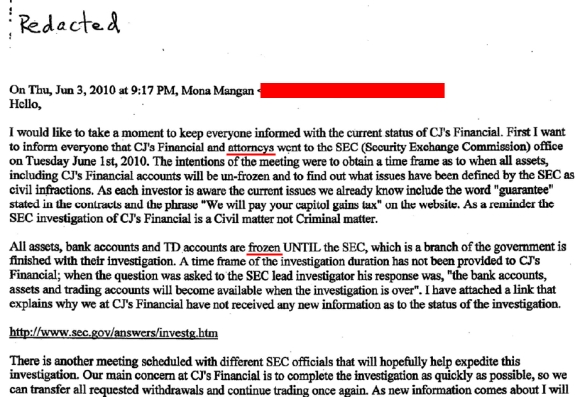
On June 3, Mangan sent another email — this one claiming that CJF’s assets had been frozen and that company “attorneys” were working with the SEC and visited its offices June 1 to determine when the purported asset freeze would be lifted, according to the agency.
“According to Mangan,” the SEC said, “‘CJ’s Financial and attorneys [sic] went to the SEC (Security Exchange [sic] Commission) office on Tuesday June 1, 2010. The intentions of the meeting were to obtain a time frame as to when all assets, including CJ’s Financial accounts will be un-frozen and to find out what issues have been defined by the SEC as civil infractions.’”
“Later in the e-mail,” the SEC continued, “Mangan reiterated that ‘All assets, bank accounts and TD accounts are frozen UNTIL the SEC, which is a branch of the government is finished with their investigation.’ Mangan quoted the ‘SEC lead investigator’ as stating that ‘bank accounts, assets and trading accounts will become available when the investigation is over.’ Mangan assured investors that ‘Our main concern at CJ’s Financial is to complete the investigation as quickly as possible, so we can transfer all requested withdrawals and continue trading once again.’”
Campbell made similar claims to investors, the agency alleged.
Regardless, the agency said, “Contrary to the information Mangan and Campbell provided to investors, there was no meeting on June 1, 2010 between the Commission and CJF and its attorneys, and the Commission had not frozen Defendants’ bank accounts, trading accounts, or other assets. Defendants fabricated this story to keep investors from realizing Defendants had stolen their money.”
Mangan is not named a defendant in the complaint.
Investigators said Campbell used only a “small” percentage of the more than $1 million collected to make trades.
“Campbell diverted the money for personal uses, including paying for vacations, cars, jewelry, sporting goods, and furniture,” the SEC charged. “Classic” Ponzi payments were made to some investors, the agency added.
Here is how Campbell, who is accused of depositing client funds into her personal account and diverting “at least” $540,000 for her personal use, spent much of the money, according to the SEC:
Cash withdrawals ($138,000).
Purchases of airline tickets and travel, including travel to resorts in Florida and Arizona ($127,000).
Purchases from several jewelry retailers ($33,046).
Purchases from sporting-goods retailers ($28,350).
Purchases from furniture stores ($29,124).
Purchases from a laser-surgery center ($20,650).
Purchases at automobile dealerships (at least $100,000).
“In an apparent effort to keep the Ponzi scheme from collapsing, Campbell used more than $350,000 of investor money to pay other investors,” the SEC charged.
Read the SEC complaint. (Make sure you read the emails, which are included in the PDF file.)
The SEC claims this June email painted a false picture than CJF could not pay investors because the agency had frozen its assets. The SEC did not file a complaint against the company and gain an asset freeze until Aug. 4. NOTE: The entire email is not reproduced in this screen shot, and the PP Blog added the red lines.
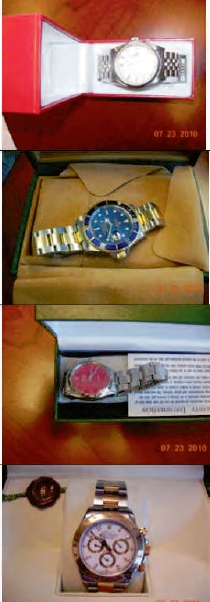
Part of the loot the FBI and the IRS found under the alleged control of Graham Cook on July 23.
Trevor Cook’s brother was hiding more than $400,000 in cash and valuables from a $190 million Ponzi scheme, according to an extraordinary statement by the court-appointed receiver in the case.
The loot was found July 23 — after Trevor Cook, whose plea agreement in the case required him to submit to a lie-detector test if requested by the government — “flubbed” the test, according to the Star Tribune of Minneapolis/St. Paul.
Graham Cook, Trevor Cook’s brother, has not been charged in the case. But the revelation that proceeds from the scheme allegedly were under his control and concealed for months from investigators and two federal judges presiding over elements of the case raise troubling, new questions about Trevor Cook’s capacity to tell the truth in any context and whether Cook and others had stashed money elsewhere.
Trevor Cook was jailed in January by Chief U.S. District Judge Michael J. Davis for concealing assets and spending money frozen by court order on Nov. 23, 2009. Davis, who is presiding over the civil elements of the case filed by the SEC and the CFTC, said the government had established that Cook had violated the court order.
Another part of the loot.
At the time, Cook made a technical argument that he had not been properly served in the case at the Van Dusen mansion in Minneapolis on Nov. 24 and thus was not bound to follow the order, a position that gave short shrift to the hundreds of victims in the case, some of whom had been rendered destitute.
Victims complained that Cook was thumbing his nose at both the court and investors. Cook also asserted his 5th Amendment right against self-incrimination, which caused victims to wonder what else he could be hiding.
Davis did not buy any of Cook’s story, and jailed him.
“[C]opies of said Orders were shown to Cook, and the relevant portions of the Orders were explained to him by the Receiver” on Nov. 24, 2009, Davis ruled. Regardless, Cook later used frozen assets to purchase $7,510 in gift cards from Cub Foods and $16,000 in gift cards from Target.
“Given the amount of investor money at issue, and Cook’s repeated violations of the Asset Freeze Orders, the Court finds that the appropriate remedy for the contempt finding in this case is to incarcerate Cook until such time as he purges such contempt.”
Jail was an appropriate remedy for Cook, even in a civil case, a top SEC official said at the time.
Sports collectibles, such as this baseball card of Minnesota Twins' immortal Kirby Puckett, also were part of the stash.
“Mr. Cook has elected to disregard the court’s orders and will now be a guest of the federal correctional system until he mends his ways,†said Merri Jo Gillette, director of the SEC’s Chicago Regional Office.
In March, while Cook was jailed in the civil case, prosecutors charged him criminally with mail fraud and tax evasion, opening up a new round of litigation over which U.S. District Judge James M. Rosenbaum is presiding.
Cook pleaded guilty to the criminal charges in April. His plea required him to take a lie-detector test “if requested†by prosecutors to determine “whether he has truthfully disclosed the existence of all of his assets and the use of the fraud proceeds.â€
It is believed the test was administered in mid-July, prior to Cook’s scheduled sentencing date of July 26. Sentencing has been postponed until Aug. 24, and Rosenbaum may have to determine whether Cook once again has thumbed his nose at the court, prosecutors, victims and the receiver in a bid to prevent the discovery of funds that could be used to make the victims as whole as possible.
The discovery of the funds also raises questions about whether Cook failed to disclose the whereabouts of assets in a bid not to implicate others in the scheme.
The stash also included Rolex and other expensive watches.
Cook’s plea agreement also required him to to “fully and completely disclose to the United States Attorney’s Office the existence and location of any assets in which he has any right, title, or interest and the manner in which the fraud proceeds were used.â€
Prior even to Cook’s polygraph exam, R.J. Zayed, the court-appointed receiver, raised questions about Cook’s cooperation and level of truthfulness. The plea agreement, as written, conceived a 25-year sentence for Cook, although prosecutors said Rosenbaum had the final say.
Victims fretted that Cook, who is in his late thirties, could emerge from prison as a relatively young man in his early sixties and have access to money that had been hidden from the court, investigators and the receiver.
Zayed now says that federal prosecutors, the FBI and the IRS found the hidden loot July 23.
Seized from Graham Cook were “$202,600.00 in cash, 2891 gold and silver coins, 27 watches, some sports memorabilia cards and other personal property belonging to the Receivership,” Zayed said yesterday.
“A rough estimate of the value of the coins is approximately $200,000.00 to $225,000.00,” Zayed said.
Read this PP Blog story from April in which victims said they believed Cook was lying about the whereabouts of assets.
Read this June PP Blog story in which Cook victims said they sought a meeting with prosecutors to delay Cook’s sentencing until more facts emerged. Victims said they feared he stashed money and covered his tracks so well that he could emerge from prison and benefit from his crime — or perhaps permit insiders or unknown criminal colleagues to benefit from the fraud while he is jailed.
Read this July 12 PP Blog story in which a source told the PP Blog that Cook would be subjected to a lie-detector test.
About 200 investors turned over $11 million to a boiler-room operation selling investments in a purported “green” energy company, the SEC said.
The alleged swindle in which Kensington Resources Inc. sold unregistered shares of American Environmental Energy Inc. (AEEI) was pulled off by a convicted felon with the help of a recidivist securities offender, the SEC alleged.
Also charged in the case was yet-another convicted felon who was sentenced to federal prison more than a decade ago for telemarketing fraud, along with yet-another recidivist securities fraudster sued by the SEC in in 1998, according to records.
All in all, the SEC charged six people in the alleged boiler-room caper:
Joseph Rudolph Porche, 51, of Aliso Viejo, Calif. Porche, one of two alleged ringleaders and the former chief executive officer of Kensington, pleaded guilty in 2001 to four counts of mail fraud and was sentenced to 37 months in prison, the SEC said. Federal records show he was released from prison in 2003.
Larry Ray Crowder, 53, of Newport Coast, Calif. Also named a ringleader by the SEC, Crowder is Kensington’s former president. Crowder was charged by the SEC in 1998 with raising at least $15.7 million from more than 600 investors in an oil-and-gas venture. The oil-and-gas scheme involved misrepresentations in the sale of limited partnerships, the SEC said.
Gary Kennan Juncker, 47, of Rancho Santa Margarita, Calif. Juncker is a former senior vice president at Kensington. In 1998, according to records, Juncker was convicted on four counts of mail fraud in a telemarketing scheme and was sentenced to 30 months in prison. Federal records show he was released from prison in 2000.
Dale Jay Engelhardt, 46, of San Clemente, Calif. Engelhardt, a former member of Kensington’s sales staff, was one of Crowder’s co-defendants in the 1998 swindle, the SEC said.
Konrad Christian Kafarski, 40, of Trabuco Canyon, Calif. Kafarski is the former senior vice president of business development at Kensington.
Carlton Ladell Williams, 51, of Coto de Caza, Calif. Williams is a former senior vice president at Kensington.
“Most of the funds raised were kept by Porche and Crowder to fund their lavish lifestyles and only $315,000 of the $11 million raised went to AEEI,” the SEC alleged.
AEEI was a penny stock. The 1998 case in which Crowder and Englehardt were charged involved a company that went by the acronym “EEI,” which stood for “Environmental Energy Inc.,” according to the SEC.
EDITOR’S NOTE: Online HYIP and autosurf purveyors and their fellow “mini-Madoffs” may find the brick-and-mortar case of Gregory Todd Froning at once unsettling and instructive. In yet-another development apt to create unease in the HYIP and autosurf Ponzi worlds, a new court action by the SEC demonstrates that even “small” operators in the universe of Ponzi fraud may find their names on a court docket or named respondents in an administrative action — or both.
Here, now, the story about the allegations against Gregory Todd Froning.
A Greater Dallas financial adviser has been accused by the SEC of misappropriating more than $800,000 from investors in an upstart Ponzi scheme.
Gregory Todd Froning, 48, of Coppell, Texas, was accused yesterday of placing investors funds in a “personal bank account” and using them to make Ponzi payments, withdraw cash, make online purchases and buy groceries, meals and unspecified “adult entertainment.”
The SEC filed a lawsuit against Froning that seeks the return of ill-gotten gains from the alleged scheme, which involved the sale of “promissory notes” for Wealth Planning Partners LLC. The agency said it was assisted in the probe by the Financial Industry Regulatory Authority (FINRA) and the the Texas State Securities Board.
Froning also faces an administrative action by the SEC.
Investigators said Wealth Planning Partners was a “now-defunct financial planning company” operated by Froning.
“Froning never disclosed that he was using funds in this fashion and has never repaid a single promissory note,” the SEC said. “Further, Froning never disclosed to investors that Wealth Planning Partners had no significant business and was essentially worthless.”
Investors were denied information critical to making an informed investment decision, the SEC alleged.
Indeed, the agency alleged, Froning did not disclose that “his own financial condition was extremely precarious due, in part, to pending IRS liens.”
Froning, who neither admitted nor denied the lawsuit allegations, has consented to a permanent injunction. He already has “agreed to an administrative order barring him from future association with any broker, dealer, or investment adviser,” the SEC said.
Lack of disclosure is a common element in both brick-and-mortar and online fraud schemes that promise investors returns or interest payments. Froning’s case demonstrates that such schemes may attract the attention of multiple regulatory agencies and that operators may confront securities litigation on multiple fronts.
Despite claims on Ponzi HYIP and autosurf forums that promoters have conducted “due diligence” on operators and that “payments” received from the operators are “proof” that no Ponzi scheme exists, it often is the case that the claims of “due diligence” are false and that “payments” participants received came from other investors and were designed to lull participants into a false sense of comfort to mask the nature of the scheme.
It also often is the case that claims of “due diligence” can’t pass the giggle test because promoters have no access to legitimate financial statements, repeat lies told by other promoters or rely exclusively on false representations by Ponzi purveyors.
Froning “diverted investors’ proceeds to a personal bank account and used them both to pay personal expenses and to make Ponzi payments to some investors,” the SEC alleged.
Like Froning’s purported investment-advisory business, virtually all HYIP and autosurf companies can be viewed as “essentially worthless.” Not only are they insolvent out of the gate, their unfunded liabilities expand rapidly, and operators rely on a shell game to create the illusion of sustainability and legitimate commerce.
HYIPs and autosurfs are infamous for changing rules on the fly, providing “training” that encourages participants not to withdraw money or withdraw it in small increments as a purported means of maximizing “earnings,” treating liabilities as assets and disappearing with vast sums of money.
About 15 investors were affected by the alleged Froning brick-and-mortar Ponzi, according to the SEC. Some online Ponzis have mushroomed to gather tens of millions of dollars and have affected tens of thousands of investors, according to court filings.
The Froning case also turns yet-another online myth on its head: that regulators never bother to investigate “small” Ponzi operators and that small operators don’t have to comply with regulations.
A federal judge has extended the freeze on the assets of a website operator accused by the SEC of shilling for a Ponzi schemer and then trying to extort money from the schemer when the fraud was collapsing.
Severe restrictions placed on Mazu.com operator Matt Gagnon by U.S. District Judge George Caram Steeh of the Eastern District of Michigan illustrate the financial and legal dangers of using the Internet to promote murky businesses. At the same time, orders issued by Steeh destroy myths advanced on Ponzi forums that website operators are insulated from prosecution and that their business contacts and customers cannot be sucked into a Ponzi probe.
Demonstrating the life-altering nature of Ponzi schemes and the monumental legal entanglements and inconvenience that flow from such schemes, the judge also ordered Gagnon to submit a “sworn” statement “each Friday” to the SEC. The order requires Gagnon to account for “all funds received” during the week, including funds received “by others on his behalf.”
Steeh also ordered Gagnon and his “officers, agents, servants, employees, attorneys, nominees, banks, brokers, dealers, financial institutions, and those persons in active concert or participation with any one or more of them” not to destroy evidence.
Steeh’s order applies to “books, records, documents, correspondence, ledgers, accounts, statements, files, electronically stored information, and other property of or pertaining to the Defendant,” regardless of the location of the information.
At the same time, the judge ordered expedited discovery in the case and freed up $2,000 for Gagnon “to pay living expenses.”
Gagnon was accused in May of using his website to pitch the alleged Legisi HYIP Ponzi scheme, which the SEC described as a $72.6 million fraud. The judge’s orders followed on the heels of an awareness campaign by the Financial Industry Regulatory Authority (FINRA) to educate the public about HYIP schemes and the filing of criminal charges by the U.S. Postal Inspection Service against Nicholas Smirnow, accused of operating a $70 million Ponzi HYIP scheme known as Pathway to Prosperity (P2P).
FINRA issued its HYIP warning on July 15, calling the HYIP universe a “bizarre substratum of the Internet†and saying “HYIPs are old-fashioned Ponzi schemes dressed up for a Web 2.0 world.â€
In May, federal prosecutors declared in court filings in the P2P case that “[a] large percentage, if not all, HYIPs, are Ponzi schemes.†In its HYIP alert, FINRA built on that theme, declaring that “[v]irtually every HYIP we have seen bears hallmarks of fraud†and noting that schemers were using websites, forums and social-media sites such as Twitter and Facebook to spread Ponzi misery globally.
“From January 2006 through approximately August 2007, Gagnon helped orchestrate a massive Ponzi scheme conducted by Gregory N. McKnight . . . and his company, Legisi Holdings, LLC,†the SEC said.
“Gagnon promoted Legisi but in doing so misled investors by claiming, among other things, that he had thoroughly researched McKnight and Legisi and had determined Legisi to be a legitimate and safe investment,†the SEC said.
Among other things, the SEC alleged that Gagnon “had no basis for the claims he made about McKnight and Legisi.
“Gagnon also failed to disclose to investors that he was to receive 50% of Legisi’s purported ‘profits’ under his agreement with McKnight,†the SEC said. “Gagnon received a net of approximately $3.8 million in Legisi investor funds from McKnight for his participation in the scheme.â€
In its complaint against Gagnon, the SEC alleged he moved from one fraud scheme to the next and even had promoted a scheme operated by the late Bryan K. Foster, a convicted felon. Some of the money from the alleged Legisi Ponzi scheme ended up in the control of Foster, who was running a purported investment program of his own.
The allegation that proceeds from one fraud scheme ended up as proceeds of a second scheme demonstrates the interconnectivity of schemes in the age of the Internet.
“Gagnon has been unrelenting in his efforts to raise money from the public through fraudulent, unregistered offerings,†the SEC said in May. “He remains a danger to the investing public.â€
See earlier story titled “Requiem For The Forum Pimps . . .” The story discusses some of the history of the Legisi Ponzi case.
A California man accused of bilking Korean-Americans in an $80 million Forex Ponzi scheme was sentenced yesterday to 15 years in federal prison.
Prior to the sentencing of Peter C. Son of Danville, a courtroom spectator yelled in Korean that “You’ve got to kill that bastard!” according to the San Francisco Chronicle.
In June 2009, the SEC accused Son, 38, and his business partner, Jin K. Chung, of Los Altos, of targeting Korean-Americans in a scheme in which “funds were not traded in the forex market as claimed.”
Instead, the SEC said, the funds were used to pay cash “returns” to certain investors in “Ponzi-like fashion” and used to make mortgage payments on Son’s multimillion-dollar home.
“Supposed” Forex returns were “faked,” and investors were given “monthly account statements showing fictitious returns,” the SEC said.
Some of the funds were used to pay a $3,000 monthly salary to Son’s wife, who “did no work,” the SEC said. As the scheme was collapsing in 2008, funds were transferred “overseas,” the agency charged.
Investors were invited to the scheme’s offices purportedly to “view work stations with multiple trading monitors, ostensibly set up to allow . . . employees to monitor market conditions relevant to forex trading,” the SEC said.
But representations of Forex success were “false,” and the scheme “conducted little or no forex trading,” the SEC charged.
The “supposed forex investment program was a fabrication used by Son and Chung to attract investors,” the SEC charged.
Chung has not been not charged criminally.
The scheme operated through a company known as SNC Asset Management Inc. (SNCA) of Pleasanton, Calif. It also operated through a company in New York that had a similar name — SNC Investments Inc. (SNCI) — investigators said.
About 500 investors were defrauded, the SEC said.
It is not unusual for companies to use multiple names — including confusingly similar names — to pull off a fraud scheme. Nor is it unusual for fraudulent companies to claim they have a local, regional, national or international footprint to disarm skeptical investors.
Son’s scheme, fueled by advertisements and word-of-mouth, pulled in investors from at least five U.S. states, South Korea and Taiwan, the SEC said. His home in a gated community was valued at $2.6 million, and Son used investors’ money to pay “country club dues,” the agency charged.
Part of the scheme involved an advertisement that had been altered to appear as through it were an article in Business Week magazine.
It is common in fraud schemes for operators to imply their product or service is endorsed by famous people or companies. In 2009, members of the failed AdViewGlobal autosurf used the logo of Forbes magazine in a sales promo.
Separately, members of the alleged AdSurfDaily autosurf Ponzi scheme claimed the program’s operator, Andy Bowdoin, received a special award from the White House for business acumen.
Gina Cook, the wife of acknowledged Ponzi schemer Trevor Cook, received a wire transfer of $103,437 on June 23, 2009, one day after six attorneys and accountants from the SEC began a “surprise” investigation at the scheme’s Minneapolis headquarters and served Trevor Cook with a subpoena, according to the court-appointed receiver in the case.
Receiver R.J. Zayed now has filed a clawback action against Gina Cook, saying the payment was a preferential transfer from the proceeds of her husband’s international Ponzi scheme. Gina Cook is one of 23 parties named in clawback petitions in recent days.
All in all, Zayed is seeking to claw back $112,410 from Gina Cook, saying she also received a preferential transfer of $8,973 on Feb. 23, 2009 — after Trevor Cook knew that Swiss authorities were investigating one of his firms and were in the process of shuttering it.
“[Gina Cook] received payments preferentially over hundreds of other investors who were defrauded by Trevor Cook and unable to withdraw the money they had invested in the Trading Program,” Zayed said.
Gina Cook invested $55,575.52 in her husband’s program, and received back her principal, plus a phantom profit of $56,834.48, according to an exhibit in the clawback action.
She has not been accused of wrongdoing.
“The doctrine of unjust enrichment and the principles of law and equity require that the $112,410.00 received by [Gina Cook] on or after February 23, 2009 be returned to the Receiver for equitable distribution to all defrauded investors and other creditors,” Zayed said.
Any preferential retention of money from the scheme by Gina Cook “violates fundamental principles of justice, equity, and good conscience,” Zayed said.
BULLETIN: The Securities and Exchange Commission has charged General Electric Co. and two foreign subsidiaries in an alleged kickback scheme with the Iraq government “to win contracts to supply medical equipment and water purification equipment.”
Robert Khuzami, director of the SEC’s Division of Enforcement, did not mince words when announcing the charges and a settlement in the case.
“Bribes and kickbacks are bad business, period,” said Khuzami. “This case affirms that law enforcement is active across the globe — offshore does not mean off-limits.”
GE, which neither admitted nor denied the allegations, agreed to pay $23.4 million to settle the case. The SEC said GE cooperated in the probe, which crossed into Europe and the Middle East. The United Nations assisted the SEC and the U.S. Department of Justice in the probe.
“GE failed to maintain adequate internal controls to detect and prevent these illicit payments by its two subsidiaries to win Oil for Food contracts, and it failed to properly record the true nature of the payments in its accounting records,” said Cheryl J. Scarboro, chief of the SEC’s Foreign Corrupt Practices Act Unit.
For its part, GE said the conduct “did not meet our standards, and we believe that it is in the best interests of GE and its shareholders to resolve this matter now, without admitting or denying the allegations, and put the matter behind us.”
“GE is committed to the highest standards of conduct in all transactions in all of the jurisdictions where we do business throughout the world,” the company said.
“In this case, the SEC has identified 18 contracts under the Oil-for-Food Program that it alleges were not accounted for or controlled properly. Fourteen of these transactions involve businesses that were not owned by GE at the time of the transactions,” the company said. “The SEC alleges that, in acquiring these companies, GE acquired their liabilities as well as their assets. The other four transactions relate to GE Healthcare units in Europe. These units declined to make cash payments to the Iraqi Ministry of Health, but they acquiesced when their agent offered instead to make in-kind payments of computer equipment, medical supplies, and services to the Iraqi Health Ministry, and then failed to reflect the transactions accurately in their books and records.”
The case against GE and the subsequent settlement may be seen as a blow to other types of business pursuits that fall under the SEC’s purview. Ventures such as autosurfs and HYIPs routinely claim that “offshore” locations shelter them from U.S. law enforcement, and commission-based shills and hucksters use the claim to recruit investors.
GE is an iconic company that traces its roots to 1890, when inventor Thomas Alva Edison founded Edison General Electric Co.
EDITOR’S NOTE: The briefs below summarize recent developments in Ponzi cases or actions in new Ponzi cases.
Sentenced:Matthew B. Pizzolato, 26, Tickfaw, La. Ripped off senior citizens in Ponzi scheme.
In sentencing Pizzolato to 30 years in federal prison, U. S. District Judge Lance M. Africk said Pizzolato “stole from hard working Americans†and “swindled the salt of the earth,†prosecutors noted.
“[B]ecause of you,” the judge noted, “many must find ways to pay for their daily bread.â€
Prosecutors called the 30-year sentence “powerful.”
“[The] powerful 30-year federal prison sentence handed down by U. S. District [Judge] Africk against convicted swindler Matthew Pizzolato will hopefully serve as a stark deterrent to those calculating predators who, like Pizzolato, may seek to prey on the trust and innocence of hard working citizens,” said U.S. Attorney Jim Letten. “The human wreckage of broken lives, dreams, and peace of mind — as well as stolen life savings — is shockingly evident in this case and in the tragedies of the victims whom Pizzolato hunted. Our hope is that these decent, trusting victims can begin to find some sense of justice and peace knowing that this criminal will not steal again.”
A veteran FBI agent said members of the public would serve themselves well by imagining how a Ponzi scheme aimed at senior citizens could cripple entire families.
“Mr. Pizzolato targeted senior citizens for his own gain,” said David Welker, FBI special agent in charge. “Personalizing this — what if it was your own mother, father or grandparent? Mr. Pizzolato’s actions were reprehensible and his punishment reflects the seriousness of his crime.â€
The IRS is well-equipped to peel back layers of the Ponzi onion, a criminal investigator said.
“Special Agents of IRS Criminal Investigation are highly trained investigators who specialize in financial crimes of greed,” said Michael J. De Palma, special agent in charge of the IRS Criminal Investigation Unit. “We are committed in our efforts and will continue to work with our Law Enforcement partners and the United States Attorney’s Office to pursue evidence of criminal activity wherever it leads.”
Postal inspectors have prioritized the investigation of crimes against senior citizens, an official said.
“Frauds against the elderly are a priority for the Postal Inspection Service and we will continue to work closely with our partners to aggressively investigate these types of crimes,” said Keith E. Milke, U. S. postal inspector in charge.
Accused: Laurence M. Brown, a certified public accountant in Armonk, N.Y. Brown was arrested on allegations of securities fraud, wire fraud and money-laundering. Prosecutors said he fleeced investors in a $2 million Ponzi scheme involving a purported gas pipeline in Tennessee. Brown was sued separately by the SEC.
One need not pull off a Bernard Madoff-sized fraud to get the attention of the Feds, a top prosecutor said.
“Laurence Brown allegedly concocted a scheme that fleeced clients and fattened his own wallet,” said U.S. Attorney Preet Bharara. “[The] charges show that you do not have to be a billion-dollar Ponzi schemer to get our attention. We are committed to rooting out financial fraud wherever it may hide.”
Investors were duped into putting money into a company known as Infinity Reserves-
Tennessee Inc. The SEC also charged Ronald J. Mangini in its civil case, saying he and Brown fraudulently sold securities and misappropriated the money for their own use. Mangini also is an accountant, the SEC said.
“In fact,” the SEC said, “the securities Brown and Mangini sold were fictitious.
“Infinity Reserves is the name of a company owned by one of their clients, and the company’s principal asset is a now defunct natural gas pipeline in Tennessee,” the agency continued. “Without the knowledge or authorization of the client, who is the sole shareholder of Infinity Reserves, Brown and Mangini have been falsely holding themselves out to investors as senior officers of Infinity Reserves with authority to sell the phony securities at issue.”
Arrested: Former Grand Am racecar driver Henri Zogaib has been arrested again after making bail in the original case filed against him in Florida, WFTV reports.
As the original Ponzi probe progressed, investigators discovered other victims, including NASCAR drivers, the station reported.
Zogaib’s bail now has been upped to $2.2 million, and there may be other victims, the station reported. Bail on the original arrest was set at $100,000.
Guilty plea: Donald Anthony Young, 38, of Palm Beach, Florida, has pleaded guilty to one count of mail fraud and one count of money laundering. Federal prosecutors charged him in a $25 million fraud scheme involving companies operating in Pennsylvania.
“He solicited individuals to invest with him, claiming that their funds would be invested in the stocks of large stable companies,” prosecutors said. “Ultimately, Young obtained more than $95 million from his investors. Instead of investing all of these funds as promised, Young allegedly diverted more than $25 million of investor funds for his own use, purchasing, among other things, luxury homes for himself in Palm Beach, Florida, Coatesville, Pennsylvania, and Northeast Harbor, Maine.
“When investors requested redemptions, Young was forced to liquidate other investors’ funds to make the pay outs,” prosecutors said.
Young also tried to obstruct the SEC probe, prosecutors said.
“When the United States Securities and Exchange Commission opened an investigation into Young’s business, Young attempted to obstruct the investigation by providing false and misleading information to the SEC and by refusing to provide the SEC documents, to which it was legally entitled.”
Young used $1.9 million in funds stolen from investors “to purchase his luxury home in Palm Beach,” prosecutors said.
In January, U.S. Attorney General Eric Holder ventured to the Palm Beach area, warning fraudsters they were writing their own tickets to jail.
Young faces up to 30 years in prison when sentenced in October, prosecutors said.
BULLETIN: Yet-another bizarre paperwork attack on U.S. law enforcement has occurred.
A California man has been charged with filing “false liens” in Nevada against federal officials and employees of the SEC, the Secret Service, the IRS, four federal judges and staff members of the U.S. Attorney’s Office for the Southern District of California, federal prosecutors said.
Thanh Viet Jeremy Cao was indicted by a federal grand jury in Las Vegas on charges of filing 22 false liens ranging from $25 million to $300 million against the officials, prosecutors said.
He also sought $20 billion in fraudulent tax refunds, prosecutors charged.
Cao resides in Orange County, Calif. If convicted on all counts, he faces up to 223 years in prison and a fine of up to $5.75 million.
“Cao corruptly obstructed the administration of the federal tax laws, by, among other things, filing retaliatory false liens against IRS employees, filing and attempting to file with the IRS false Forms 1099-OID (Original Issue Discount) that claimed fictitious income tax withholdings, filing and attempting to file false tax returns that claim fraudulent refunds totaling approximately $20 billion, and preparing at least five false tax returns for third parties that claimed fraudulent income tax refunds totaling in excess of $1.1 million based upon fictitious income tax withholdings,” prosecutors said.
In June, Ronald James Davenport of Deer Park, Wash., was charged with filing false liens against federal officials in Washington state.
Davenport sought the spectacular sum of nearly $5.2 billion from each of the officials, including U.S. Attorney James McDevitt of the Eastern District of Washington, an assistant U.S. attorney, a court clerk and an IRS agent, according to court records.
Prosecutors described Davenport as a “tax defier.†Davenport has described himself in court filings as a “sovereign.â€
Some members of the alleged AdSurfDaily autosurf Ponzi scheme and other HYIP schemes have been linked to tax-deniers and the so-called “sovereign” movement.
See earlier story that references the Davenport action. (The story also provides some background on court filings and other actions by ASD members.)
In a civil case that preceded the criminal indictment against Davenport, Senior U.S. District Judge Justin L. Quackenbush ruled in May that the liens “were filed to retaliate against the officers for their good-faith efforts to enforce the tax laws against Mr. Davenport.â€
Quackenbush struck the liens, which were filed in the form of UCC Financing Statements with the Washington State Department of Licensing, according to records. The liens not only were fraudulent, but also contained “sensitive personal information†that violated privacy laws, the judge ruled.
Davenport also filed instruments dubbed “Notice[s] of Claim of Maritime Lien†with the Spokane County Auditor’s Office, according to records. Those, too, were struck.
The act of filing false liens or sending “demand” letters to officials or litigation opponents in a bid to hamstring civil and criminal prosecutions has been referred to as “paper terrorism” and “mailbox arbitration.”