When the AdViewGlobal (AVG) autosurf — now failed — was in prelaunch phase in December 2008, it positioned itself as an offshore cure for what ails the U.S. and world economies.
Less than two years earlier, promoters of the AdSurfDaily autosurf — which has close ties to AVG — implied that the individual surf accounts of ASD members were insured by the FDIC and that ASD provided “shelter” from the FTC and the SEC.
ASD’s assets were seized by the U.S. Secret Service in August 2008, amid allegations of wire-fraud, money-laundering and selling unregistered securities via a Ponzi scheme. Only months later AVG began its ignoble task of encouraging members to move cash offshore and permit it to be managed by unknowns, thus separating participants from even more wealth.
The result was a colossal failure AVG announced in June, before it disabled its forum to prevent members from asking uncomfortable questions. AVG even threatened members who shared the news with copyright-infringement lawsuits. Indeed, AVG went from a much ballyhooed cure to a thuggish disease that attacked its own participants in only weeks.
Neither ASD nor AVG created any new wealth or cured anything. About the only thing the surfs managed to do was siphon wealth from one group and transfer it to another, all during a time a global recession was rearing its ugly head and putting jobs and lifetimes of hard work in harm’s way.
The U.S. economy shed 263,000 jobs in September, and the unemployment rate edged up to 9.8 percent, the Labor Department said yesterday.
Unemployment virtually has doubled since December 2007. The number of persons looking for work now totals 15.1 million, and the unemployment rate is the highest since June 1983.
When discouraged workers and workers who’ve accepted part-time jobs in the absence of full-time employment are factored into the numbers, the so-called “real” unemployment rate is 17 percent. The number could be distorted — meaning the true employment numbers could be masked to a degree — because older workers separated from their jobs have been applying for Social Security, rather than continuing their struggle to find work when the odds are against them.
The Social Security Administration told Bloomberg News that it had expected an increase of 315,000 applications for the one-year period ending Sept 30, but instead received 465,000, an increase of 150,000 applications.
Meanwhile, regulators seized three more U.S. banks yesterday, bringing the year-to-date total to 98. Because the FDICÂ is close to operating in the red, the agency is in the process of recapitalizing and has proposed a plan that would force banks to pay insurance premiums early to protect customer deposits, rather than pass along the cost of the recapitalization to taxpayers.
“First and foremost, bank customers should know that their insured deposits have and always will be 100 percent safe, no matter what,” said FDIC Chairman Sheila Bair. “This commitment to depositors is absolute. The decision today (Sept. 29) is really about how and when the industry fulfills its obligation to the insurance fund. It’s clear that the American people would prefer to see an end to policies that look to the federal balance sheet as a remedy for every problem. In choosing this path, it should be clear to the public that the industry will not simply tap the shoulder of the increasingly weary taxpayer.”
At risk, however, are banking profits when the industry already is struggling, but the FDIC insists that “banks overall have enough liquid assets to make the proposed prepayment.”
U.S. regulators have not confronted a challenge of this magnitude since the late 1980s and early 1990s, when the savings and loan industry recorded 745 failures, in no small part due to fraud, mismanagement and regulatory laxity.
EDITOR’S NOTE:This is an update to supplement a story about bizarre securities litigation that has occurred recently. (Updated 9:10 P.M. EDT (U.S.A.)
Think the $250 million judgment sought against a public servant by a sham “sovereign” Utah “Indian” tribe to which AdSurfDaily mainstay Curtis Richmond belonged was bizarre and extreme?
It turns out to have been a drop in the bucket compared to the $1.7 trillion sought by the bogus “attorney general” of an unrecognized North Dakota tribe. Michael Howard Reed, who is not an attorney but purported to hold the title of “attorney general,” sought the award after the Securities and Exchange Commission sued purported tribal members for running a $29 million Ponzi scheme from Nevada.
The sought-after amount of $1.7 trillion would have exceeded the total of federal income tax paid by individual U.S. filers last year by about $575 billion.
A federal judge was not pleased by the gamesmanship in the securities-fraud case against Gold Quest International, which purported to be registered in Panama but was operating the alleged Ponzi scheme from Las Vegas while claiming immunity from U.S. law.
Meanwhile, Dawson jailed John Jenkins, one of the defendants implicated in the Ponzi scheme, for contempt.
Dawson also dispatched the U.S. Marshals Service to arrest David Greene, also known as “Lord David Greene,” in part for violating orders to repatriate money offshore to the United States.
All of this took place only weeks before the U.S. Secret Service seized tens of millions of dollars from Florida-based ASD, itself accused of operating a Ponzi scheme and selling unregistered securities.
Wikipedia says Reed was jailed in Nevada on charges of attempted murder, although no details were provided in the entry. (UPDATE Jan. 21, 2010: This Wikipedia entry appears to have been disputed, with the reference to Reed and the purported attempted-murder charge removed.)
Richmond entered the ASD fray in November. By early February, he was filing pro se motions suggesting ASD members intended to pursue claims of $120 million against the prosecutors, a judge and a court clerk.
By late February, ASD President Andy Bowdoin himself was filing pro se motions, acknowledging ASD had been operating illegally but claiming he’d been denied “fair notice” his conduct was illegal.
Bowdoin’s actions coincided with an announcement by the AdViewGlobal (AVG) autosurf that it was shifting to an “association” structure.” Such structures sometimes are associated with tax schemes.
AVG introduced members to Pro Advocate Group, which is associated with Karl Dahlstrom. Dahlstrom was convicted in a securities scheme in the 1990s and sentenced to 78 months in federal prison.
The Utah “Indian” tribe to which Richmond belonged was ruled a “complete sham” by a federal judge last year. Meantime, the North Dakota tribe to which the GQI defendants purportedly belonged is not recognized by the federal government. There is substantial securities litigation against GQI in Canada, as well.
An AdSurfDaily downline group known as “oneteam” used the names of U.S. government agencies, a Congressionally chartered insurance entity for depositors and Bank of America in what appears to have been a brazen bid to disarm doubting prospects continuously in advertisements for at least 18 months.
The ads appeared online beginning in February 2007.
Among other things, the ads advised prospects that ASD provided “shelter” from the Federal Trade Commission (FTC) and the Securities and Exchange Commission (SEC). The FTC, among its many duties, polices false advertising; the SEC regulates the securities industry, prosecuting illegal activities such as securities fraud, the sale of unregistered securities and Ponzi schemes in a securities environment — all of which are activities associated with the so-called autosurf “industry.”
Autosurfs typically call themselves “advertising” companies in a bid to avoid regulatory scrutiny and short-circuit prosecutions. “oneteam’s” ads began to appear one year to the month after the SEC filed fraud charges against 12DailyPro in February 2006, in a widely publicized case that effectively smashed a $50 million Ponzi scheme. ASD was struggling to recruit members when the “oneteam” ads debuted.
“oneteam’s” ads also repeatedly mentioned the Federal Deposit Insurance Corp. (FDIC), an independent agency created by Congress during the height of the Great Depression in 1933 to maintain stability and public confidence in the U.S. financial system. One version referenced the FDIC in prominent type in a headline box and included another FDIC reference below, placing Bank of America’s name right next to the FDIC claim.
The web library archive.org archived the ads at a specific “oneteam” URL between February 2007 and October 2007, a period of eight months. The ads, however, appear to have continued for at least 10 months beyond that, according to a screen shot taken Aug. 26, 2008, as part of this Blog’s research into ASD.
‘Damned Determined To Be Rich’
Meanwhile, a second URL associated with “oneteam” styled the group as “Teamed For Integrity,” noting that members were known as the “Damned Determined To Be Rich Bunch.”
The URL “oneteam” created for its ASD ads was active for a minimum of 25 days after the government began the process of seizing tens of millions of dollars from ASD on Aug. 1, 2008, amid allegations of wire fraud, money-laundering and securities fraud in a Ponzi environment. The “oneteam” ad appeared at the URL at least through Aug. 26, 2008. It went missing on a date uncertain after Aug. 26.
The URL — http://oneteam.homestead.com/asdall.html — now resolves to the main page at homestead.com, a hosting service. Previously it behaved as a subdomain, with the URL resolving to the ASD ads.
An archive.org archive from Feb. 9, 2007 (see note below about an earlier archive from a different URL), strongly suggests that “oneteam” was trying to plant the seed that ASD was like no other surf program because member deposits were “insured” by the FDIC. Bank of America’s name appeared directly next to the FDIC claim, the third claim on a numbered list.
Here is a screen shot of “oneteam’s” Bank of America claim, with our notes included in red outlines:
Screen shot of 'oneteam' making claim that ASD deposits were insured by the FDIC, that the company provided 'shelter' from the FTC and the SEC — and highlighting a tie to Bank of America next to one of the FDIC insurance claims.
To see the archive.org archives of “oneteam” ads, visit archive.org and type in this URL:
http://oneteam.homestead.com/asdall.html
To see the archive.org archive of the “Teamed For Integrity” page, visit archive.org and type in this URL:
http://oneteam.homestead.com/index.html
NOTE ABOUT EARLIER ARCHIVE: To see the archive.org archive for yet another URL “oneteam” used to promote ASD, visit archive.org and type in this URL:
http://oneteam.homestead.com/asd.html
The URL that ends with “asd.html” first was recorded by archive.org on Feb. 3, 2007, and lists several captures beyond that. In these versions of the ad, “oneteam” touted ASD “longevity.” The Feb. 3, 2007, version of the ad said ASD was “predicted to go mainstream by 2/23/07!” — making an additional claim that ASD had a “NEW Un-Breakable Business Model.” The “oneteam” group later changed the predicted date ASD would go “mainstream” from Feb. 23, 2007, to May 1, 2007. The earliest archived version of this URL (Feb. 3, 2007) also featured the FDIC claim in a prominent headline box, and placed Bank of America’s name next to the FDIC claim lower in the ad.
FDIC Claim Removed From Headline
The Feb. 9, 2007, ad at “asdall.html” appears to have been pulled quickly — perhaps appearing online for a minimum of one day and a maximum of eight before being edited and restructured. By Feb. 17, Bank of America’s name had been deleted from the numbered list — although the FTC, SEC and FDIC claims remained — and Bank of America’s name continued to appear elsewhere in the ad.
“oneteam” also restructured the ad in other places. The Feb. 9 version, for instance, made the brazen FDIC insurance claim in 14-point Arial type in a headline box near the top of the page. The FDIC claim in the headline box did not appear on Feb. 17, 2007, the date archive.org recorded its next visit to the site.
Later versions of the ad also dropped the FDIC claim from the headline, while maintaining the claim lower in the ad and not mentioning Bank of America in the context of FDIC insurance. The final archive entry is dated Oct. 5, 2007.
“oneteam’s” pitch was supplemented in forum posts that also used Bank of America’s name. Here is a claim from Feb. 25, 2007, that cites the “oneteam” URL, Bank of America’s name and a sign-up link for ASD.
At one time, the first external link on the “oneteam” page at “asdall.html” resolved to this URL: http://www.adsurfdailytraining.com
ASD President Andy Bowdoin is listed as the adsurfdailytraining.com domain owner. The domain was registered on Oct. 12, 2006. It listed an address — 13. S. Calhoun Street, Quincy, Fla. — federal prosecutors later said was fraudulent. Heardy Myers of Marietta, Ga., is listed as the technical contact for the domain. The URL now resolves to a parked GoDaddy.com page.
Virtually every claim made in the “oneteam” ad is dubious or demonstrably false, including the apparently toned-down version that deleted Bank of America’s name from the numbered slot next to the FDIC claim. Some of the claims — the references to the SEC, FTC and FDIC, for instance — can be described aptly as utterly preposterous.
Although the Bank of America reference in the numbered list next to the FDIC claim was deleted, subsequent versions of the ad continued to reference the bank lower in the copy, using these words:
“*USA – Direct Deposits can be made through Bank of America*.”
The asterisks led to a prompt to “*Please get back to the person who invited you to this page for their Web Site Link*.” A confusing claim also was made that Dallas Cowboys’ owner Jerry Jones had provided a testimonial, apparently for a non-Bank of America debit card somehow connected to ASD.
Even as Bowdoin — whom prosecutors described as a “convicted fraudster” — was suspending pay-outs and blaming problems on a script that purportedly overpaid members and drained ASD’s resources in early 2007, “oneteam” positioned ASD as “well-capitalized” with “top management.”
“oneteam” also repeatedly heralded (for months) an imminent ASD name change and, at one point, asserted that ASD had been marketing itself “all wrong.”
Some of the claims border on the bizarre, because they are so obviously untrue. The references to “shelter” can be construed as a bid to make ASD appear to be legal or a safe option — unlike 12DailyPro, which was smashed by the SEC in February 2006, one year prior to the appearance of “oneteam’s” ASD ads.
Meanwhile, the FDIC claims can be construed as a bid to fool customers into believing that money they invested in ASD was insured against investor losses, meaning there was no way to lose money with ASD.
Here is a screen shot taken by this Blog Aug. 26, 2008, of a “oneteam” ASD ad that appeared live at the “asdall.html” URL:
Screen shot of a second version of 'oneteam' claim. This ad eliminated the FDIC insurance claim in the headline (while preserving it lower in the copy) and dropped Bank of America's name from the slot next to the FDIC claim. Bank of America's name, however, appeared elsewhere in the ad (not pictured).
UPDATEÂ 9:16 P.M. EST (U.S.A.) The indictment against Karl Dahlstrom is available in PDF format at the bottom of this post.
Here, below, our earlier post . . .
In a desperate bid to hide itself underground after its management structure was exposed, the controversial autosurf AdViewGlobal has formed a private association and is taking advice from an entity known as “Pro Advocate Group.”
Pro Advocate Group is associated with Karl Dahlstrom. In 1997, Dahlstrom was sentenced to 78 months in federal prison for his participation in a securities scheme.
Dahlstrom and others “were indicted for their involvement in a nationwide solicitation campaign for the purpose of selling unregistered shares” of Inferno Snuffers Inc. (ISI), and Inferno Engineering and Consulting Inc. (IEC), the SEC said.
AdSurfDaily, under fire for selling unregistered securities amid allegations of wire fraud, money-laundering and running a $100 million Ponzi scheme, is led by Andy Bowdoin, himself a convicted felon from a 1990s securities scheme. Prosecutors seized part of ASD’s assets in an August forfeiture complaint.
George Harris, Bowdoin’s stepson, is listed as a trustee for AVG. In December, about a week after AVG started being talked about in online forums, federal prosecutors seized additional assets linked to ASD, filing a second forfeiture complaint. Among the assets seized was a Tallahassee home owned by George Harris and his wife, Judy Harris.
Under Dahlstrom’s direction, the SEC said, ISI and IEC “were marketing ‘Uni-Snuff,’ a product claimed to be useful in extinguishing and suppressing fires, and the ‘Snuffer System,’ a method of dispensing Uni-Snuff.”
The website for Pro Advocate Group lists “Clara Dahlstrom” as the administrator. Clara Dahlstrom is Karl Dahlstrom’s wife. In court documents in a tax case, Karl Dahlstrom is described as having “been in the abusive trust business for many years.”
AVG announced its association with Pro Advocate Group in a members’ conference call earlier this week. A Mod at the Pro-AdSurfDaily “Surf’s Up” forum introduced listeners to Gary Talbert, a former ASD executive now listed as the chief executive officer of AVG.
Talbert, in turn, introduced listeners to Pro Advocate Group and a man identified as “Carl,” who delivered remarks.
“He discussed why AVG decided to establish a 1st and 14th Amendment Private Membership Association,†a source said.
Like ASD, Pro Advocates Group uses religion in its sales pitch.
“We are proud of our Christian moral values and feel that we stand alone in a sea full of Master Deceivers in the world of Asset Protection,” the group says on its website. “Let us help you find the proper legal solution for your problem and peace of mind. We are founded upon legal principles that are backed by book, chapter and verse of legal rulings, regulations and Supreme Court interpretation of the U.S. Constitution. We teach and support the inherent rights of DUE PROCESS and EQUAL PROTECTION under the law.”
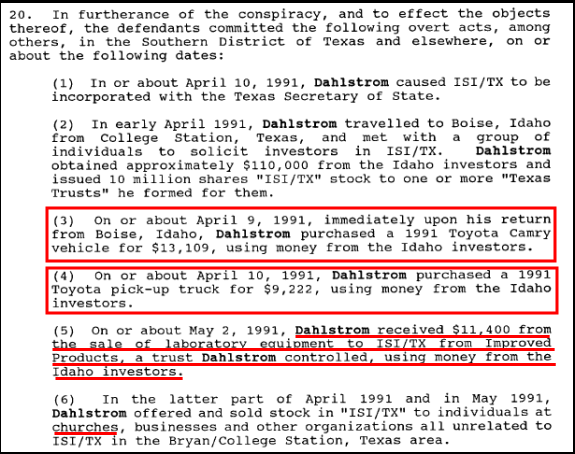
Read the indictment against Karl Dahlstrom, Karla Dahlstrom (his daughter), Hubert Leopard and Richard Lopez. Some of the allegations read like the allegations against ASD.
Karl Dahlstrom was accused of using investors' funds to purchase new vehicles and pitching the opportunity to church groups.
Hats off to Houston Chronicle writer Loren Steffy, who explained economically why cons work.
A con, Steffy explained, works because the con weaves “a tapestry of believable lies.” It’s a pointed, short, highly memorable line that deserves special mention because it puts readers “right there.”
Steffy detailed some of disgraced financier Allen Stanford’s lies in this column. Lots of things in the column reminded us of the Andy Bowdoin case. Bowdoin is the head of AdSurfDaily Inc., a Quincy, Fla.-based company accused of operating a $100 million Ponzi scheme.
Here are some Stanford/Bowdoin parallels:
Friends in high places. Stanford went around saying he’d been knighted by Prince Phillip. Bowdoin went on a tour to showcase a special award he’d received for business acumen from President Bush. It turned out that Buckingham Palace called Stanford on his lie; in fact, he’d been given the title of “Sir” by the prime minister of Antigua, a Caribbean Island nation of 85,000 known for lax banking standards and money-laundering.
In Bowdoin’s case, the U.S. Secret Service called Bowdoin on his friends-in-high-places lie. It turned out that the award he received was an award for writing checks to the National Republican Congressional Committee. Basically, Bowdoin wrote a check for banquet tickets and called it a special honor from the President of the United States. Bowdoin, by the way, had more than $1 million on deposit in Antigua. The Sunday Times reports today that $8 billion is missing from Stanford’s bank and that regulators suspect a Ponzi scheme.
Charities and sports. Stanford “sold” clients on his benevolence. So did Bowdoin, who once gifted 100,000 ASD “ad packs” to a charity. Stanford was big on sports sponsorships. Bowdoin told his faithful that ASD soon would become a sponsor for professional auto racing. Members claimed ASD would have a car in the Indy 500.
Holes in the resume: Stanford claimed to be related to the founders of Stanford University. The school exposed the lie and sued him for trademark infringement. Bowdoin claimed to have operated a string of highly successful businesses. Turned out that one of his highly successful enterprises was at the center of a securities-fraud investigation in Alabama and that Bowdoin and co-scammers had fleeced investors out of hundreds of thousands of dollars. He pleaded guilty to a felony, was sentenced to a year in prison, but the sentence was suspended when he agreed to make restitution.
In August 2008, he still owed the Alabama victims $45,000. Just a month before, he paid $50,000 for a new Lincoln. In June, ASD cash was used to retire the $157,000 mortgage of his wife’s son and daughter-in-law, and about $28,000 was used to buy them a new car. At the time, Bowdoin owed his ex-wife more than $162,000.
Nothing out of the ordinary. As Stanford’s empire was collapsing, he told investors that the SEC investigation they were reading about in the newspaper was a “routine” look into the business. He also said he was cooperating fully, which the SEC said was a lie when it later alleged a multibillion-dollar, international fraud scheme.
Bowdoin told members that his business had been approved by regulators and was perfectly compliant. It turned out that ASD didn’t even have a compliance attorney and knew in 2007 — months before it started gathering tens of millions of dollars from members at company “rallies” — that the business was illegal. In the hours after the August seizure of ASD’s assets by the government, people with close ties to Bowdoin sought to assure members that the matter was a temporary blip that would be settled within days.
For good measure, Bowdoin later told ASD members that Ponzi allegations against ASD hand been dropped in Florida. People flooded forums to share the good news — except it wasn’t true. As recently as last week, some ASD members continued to make the claim that Ponzi allegations had been dropped, despite the fact that the office of Florida Attorney General Bill McCollum specifically refuted the claim months ago.
FBI agents today located financier R. Allen Stanford in Virginia and served papers on him at the behest of the Securities and Exchange Commission. Stanford was not taken into custody.
The SEC issued a statement:
“At the request of the SEC, Special Agents of the Federal Bureau of Investigation’s Richmond Division today located and identified Stanford Financial Group chairman Allen Stanford in the Fredericksburg, Va., area. The agents served Mr. Stanford with court orders and documents related to the SEC’s civil filing against him and three of his companies. The SEC very much appreciates the outstanding assistance of the FBI in this matter.”
Stanford and three of his companies were accused Tuesday of running a fraudulent, multibillion dollar investment scheme.
His companies include Stanford International Bank (SIB) of Antigua; Houston-based broker-dealer and investment adviser Stanford Group Co. (SGC), and investment adviser Stanford Capital Management.
Also charged were SIB Chief Financial Officer James Davis and Stanford Financial Group Chief Investment Officer Laura Pendergest-Holt.
Meanwhile, the government of Antigua and banking officials in Antigua appealed for calm after customers flooded banks and tried to withdraw cash. The government of Antigua released two extraordinary statements urging customers not to panic.
Elsewhere, the governments of at least five Latin America countries are investigating Stanford banking or securities outlets. At least one Stanford outlet in Venezuela was seized, and two in Ecuador were seized. Banking authorities in Panama also seized a Stanford outlet.
Attorneys in the United States are investigating Stanford for running a Bernard Madoff-like Ponzi scheme through his network of companies.
Regional Autosurf Ties
AdSurfDaily Inc., a U.S. company accused of operating a $100 million Ponzi scheme, had at least $1 million on deposit in Antigua, according to court filings. At the same time, other firms involved in the autosurf business have been promoting their offshore locations in country’s such as Panama and Uruguay as a key selling point.
Today, BizAdSplash, one of the surfs, told members about a special deal it was offering. BizAdSplash says it is registered in Uruguay; its servers resolve to Panama.
Despite all the upheaval in the financial world — despite the alleged Madoff Ponzi, the alleged AdSurfDaily Ponzi, the alleged egregious financial abuses of Allen Stanford — BizAdSplash today encouraged customers to give it even more money.
One promoter called the BizAdSplash news an “EXCITING MAJOR ANNOUNCEMENT!!!!: 100% Match Week.”
Here is the deal BizAdSplash promoted today (italics added):
Over the past week we have had a number of you contact us about your initial deposit and that you only purchased a small amount of Ad Packages just to test the system. Now you are ready to make a larger purchase. Your question is can we get the 100% match or discount on the cost of a larger Ad Package. Biz Ad Splash has agreed to open a small window for this 100% additional match. Any new purchases made from outside the system will be given the same benefit as your initial purchase and will be given the 100% match along with the sponsor match. This is only on purchases made on February 23 through February 28. This is a tremendous opportunity for all our Biz Ad Splash advertisers.
Thank you for your patience while we are in our beta launch. We value your participation in Biz Ad Splash and we look forward to exceeding your expectations.
In the aftermath of a probe by the Securities & Exchange Commission and the FBI, a former Texas bail-bondsman has been accused of swindling investors — many of them senior citizens — out of millions of dollars.
Rod Cameron Stringer was named a defendant in an SEC complaint filed yesterday in Texas.
Stringer claimed his stock-trading strategy “has generated annual returns as high as 61%, and total returns in excess of 600%,” the SEC said.
‘Extremely Lavish Lifestyle’
In truth, the agency said, Stringer “has been operating a fraudulent scheme since at least 2001, during which he has misappropriated millions of dollars of investor funds to support an extremely lavish lifestyle and to make Ponzi payments to earlier investors with new investor funds.”
Stringer used less than 20% of the investors’ funds to engage in securities transactions, and those transactions have resulted in substantial losses, not gains, as reported to investors, the SEC said.
An “expedited investigation” by the FBI and the SEC focused on Stringer’s activities since January 2007, the SEC said.
“Since that time, the complaint alleges that Stringer raised at least $8.5 million from approximately 12 -15 investors. Contrary to Stringer’s representations, only approximately $1.5 million of this amount made its way into three securities brokerage accounts, each of which is maintained in Stringer’s personal name.”
What happened to the money is unclear.
“The exact disposition of the remaining funds is presently unknown, but it is clear that Stringer used substantial amounts of investor funds to, among other things, finance a horse racing partnership, purchase a luxury boat, build a swimming pool at his office, purchase several pieces of jewelry, pay off mortgages on at least two houses, and purchase several expensive cars and trucks,” the SEC said.
At least $2.4 million of the $8.5 million invested by clients was used “to pay distributions and purported profits to other investors,” the SEC said.
A receiver has been appointed “to recover and conserve assets for the benefit of defrauded investors,” the SEC said.
Breaking News 2:24 p.m. EST (U.S.A.). The Securities & Exchange Commission has just accused missing fund manager Arthur Nadel of fraud.
“Nadel provided false and misleading information for dissemination to investors about the Funds’ historical returns and falsely overstated the value of investments in the Funds by approximately $300 million,” the SEC said. “In contrast, the Funds appear to have total assets of less than $1 million.”
Nadel has been missing since Jan. 14. The Sarasota Herald-Tribune reported today that he was believed to have been in Louisiana in recent days and told family members in a suicide note that he believed people might kill him.
SEC investigators also allege that Nadel recently moved $1.25 million into a secret account.
A judge today granted a temporary restraining order, an asset freeze, and preliminary injunction against Nadel and preliminary injunctions and asset freezes against Scoop Capital and Scoop Management.
“In addition, the complaint seeks permanent injunctions, disgorgement plus prejudgment interest, and civil money penalties against all the defendants,” the SEC said. “Without admitting or denying the allegations of the complaint, defendants Scoop Capital and Scoop Management consented to the entry of, among other things, preliminary injunctions, asset freezes, and the appointment of a Receiver.”
The complaint also names as relief defendants two investment management companies, Valhalla Management, Inc. and Viking Management, LLC, and the six Funds, Scoop Real Estate, L.P., Valhalla Investment Partners, L.P., Victory IRA Fund, Ltd., Victory Fund, Ltd, Viking IRA Fund, LLC, and Viking Fund, LLC. The complaint seeks disgorgement plus prejudgment interest against each of the relief defendants.
Nadel simply doctored client statements, pulling numbers from thin air, the SEC said.
“[O]ne e investor from Virginia who invested in the Victory IRA Fund received a statement for October 2008 indicating his investment was valued at $599,551.55, and a November 2008 statement indicating his investment was valued at $602,965.39,” the SEC said in its complaint.
“This same investor made a second investment in Victory IRA Fund through another account and
subsequently received an October 2008 statement indicating this investment was valucd at
$172,354.07, and a November 2008 statement indicating this investment was valued at
$1 73,335.45.
“These statements were false because the total value of the entire Victory IRA Fund’s holdings was only $2,938.86 at the end of October and November 2008,” the SEC said.
He ran a slow-motion Ponzi scheme in Massachusetts that lasted 20 years. Now Bradford Bleidt is in federal prison, doing 11 years for money-laundering and mail fraud.
The scheme fell apart earlier this decade when Bleidt couldn’t pay a $1.5 million redemption requested by a Greek Orthodox church.
His final take was estimated at $32.6 million. People said he had a magnetic personality and charmed people with his southern accent. His voice was one of his tools.
Bleidt confessed to the SEC on tape. His “day of reckoning” came when he couldn’t make the distribution, Bleidt said.
“The money’s gone,” he said. “I stole it.”
Today’s Boston Globe carries a story about Bleidt’s victims. The Bernard Madoff case has caused them to relive memories of being defrauded.
And it was affinity fraud, too: Most of the victims were members of local social clubs and civic, fraternal or benevolent organizations.
“We are seeing an uptick in Ponzi scheme cases because, in this economic climate, new investors cannot be found to perpetuate the scheme. As these schemes collapse, the CFTC will move swiftly to prosecute those who harm innocent investors.†— Stephen J. Obie, CFTC
“Run the other way” if someone promises you exorbitant investment returns, warned the acting director of enforcement for the the U.S. Commodity Futures Trading Commission (CFTC).
In a statement, Stephen J. Obie also said regulators were seeing an uptick in Ponzi fraud because of the poor economy.
Last week, CFTC charged James Ossie of Dawsonville, Ga., and his company, CRE Capital Corp. (CRE) of Alpharetta, Ga., with operating a Ponzi scheme that defrauded investors of about $25 million in a forex scam.
CFTC said “Ossie and CRE promised pool participants that they would earn a 10 percent return on their money within 30 days by trading United States and Japanese currency pairs. The complaint further alleges that since June 18, 2008, rather than making money for pool participants, Ossie and CRE lost approximately $4.4 million trading forex.
“Finally,” the agency said, “the complaint alleges that Ossie and CRE operated a Ponzi scheme, in which forex trading ‘profits’ were actually paid from the principal of subsequent pool participants.”
Obie didn’t mince words.
“Investors must run the other way when approached by anyone claiming to guarantee exorbitant monthly returns, like those promised by CRE and Ossie,” he said. “Such representations should raise an immediate red flag that such investment is too good to be true.
“We are seeing an uptick in Ponzi scheme cases because, in this economic climate, new investors cannot be found to perpetuate the scheme,” Obie continued. “As these schemes collapse, the CFTC will move swiftly to prosecute those who harm innocent investors.â€
CFTC said the case against Ossie and CRE was the first brought by its Forex Enforcement Task Force. Congress granted the agency new powers last summer under the Food, Conservation, and Energy Act of 2008.
Under its new mandate, CFTC is resposible for “investigating and litigating fraud in the off-exchange retail foreign currency (forex) market.”
CFTC’s task force will focus on fraud in the retail forex market and will work cooperatively with other federal and state regulatory and criminal authorities.
“The formation of the CFTC’s new Forex Enforcement Task Force reaffirms our agency’s commitment to stopping unscrupulous individuals working in this space,” said Michael Dunn, head of CFTC’s Forex Education and Outreach Task Force.
“This announcement sends a clear signal that the CFTC is on the beat, and that our continued and increased cooperation with law enforcement authorities will help put these forex dealers where they belong – in jail.â€
Obie said forex fraud affects investors of all stripes.
“With the creation of the retail forex task force, the CFTC has committed the resources necessary to expand its efforts to identify and prosecute those who commit fraud in the retail forex market.â€
The Securities & Exchange Commission has charged CRE Capital Corp. with running a Ponzi scheme that sucked millions of dollars from investors.
Meanwhile, a hedge-fund operator in Florida has gone missing — along with $350 million in clients’ money. Although the Florida case is brand new and the SEC hasn’t announced a probe, it almost certainly will open one.
Arthur Nadel, 75, has been missing since Wednesday. The Sarasota Herald-Tribune reported Nadel left a suicide note in a case that’s already being called a “mini-Madoff.”
In the CRE Capital case, the SEC accused the Alpharetta, Ga., company and its president, James G. Ossie, of paying off old investors with money from new investors to create the illusion of profitability.
Ossie and CRE suffered steep losses, the SEC said in its complaint.
“In April 2008, CRE and Ossie opened a trading account in the name of CRE at Forex.com, a division of Gain Capital Group, LLC (“Gain Capital”). CRE and Ossie deposited over $5 million into the Forex.com trading account. Since June 18, 2008, CRE and Ossie traded foreign currency futures in the Forex.com account and incurred losses totaling over $4 million, including commissions and fees.
“On or about December 2, 2008,” the SEC continued, “CRE and Ossie represented to Forex.com, in response to inquiries from that firm, that all of the funds they had deposited into CRE’s trading account were their own funds, and not those of customers or investors. These statements were false.
“In approximately June 2008,” the SEC said, “CRE and Ossie opened a second trading account in the name of CRE in London, at Deutsche Bank. From June through December 2008, CRE and Ossie transferred $12 million of investor funds to the Deutsche Bank trading account in London. From June 2008 through January 8, 2009, CRE and Ossie’s currency trading in the account generated losses totaling $8,067,032.40.”
CRE’s assets have been frozen and a receiver has been appointed.
“CRE and Ossie fraudulently obtained at least $25 million from investors during 2008 by representing that it would use their money to engage in a currency trading program,” the SEC said. “Most investors were advised that they would receive guaranteed returns of 10 percent every 30 days, although a few investors were promised as much as 20 percent.
The company employed multiple layers of deception to fleece investors, the SEC said.
“CRE also falsely claimed that the firm and its program were audited by an outside accounting firm, which had concluded that CRE was not a Ponzi scheme,” the SEC said.
Ossie and CRE also were charged with fraud “relating to their offer to sell $100 million in CRE stock that was slated to begin in early 2009,” the SEC said.
“The SEC’s emergency action in this case will protect investors from further harm — both those who have invested and need all remaining assets preserved as well as those who were contemplating an investment,” said Katherine S. Addleman, regional director of the SEC’s Atlanta regional office.
“We also want to remind investors to be skeptical of promoters promising exorbitant returns. Such claims should be a red flag to investors,” Addleman said.
In the Nadel case, investors grew suspicious when they did not receive statements this month. The Herald-Tribune reported that one of the funds — “Scoop” — in Nadel’s three-fund portfolio could not meet a year-end demand for $50 million in redemptions.
The others were known as “Viking” and “Valhalla.”
People have filed complaints with Sarasota police — not the usual place one goes to file an investment-fraud report — but a place that demonstrates the word “Ponzi” has become positively nuclear.
As was the case with the alleged Madoff Ponzi, local charities have been affected, as have investors’ sense of security and retirement income.
And to think that some members of AdSurfDaily accorded Ponzi operator Andy Bowdoin folk-hero status.