Tag: Surfs Up

  • Patrick Pretty ‘Poof’ Penalty Plagues Portal Posters

    A poster at the Pro-AdSurfDaily Surf’s Up forum has just made brief posts in 11 separate threads in a period of only minutes. The effect of the posts was to knock a post pertaining to this Blog’s coverage of the indictment against ASD mainstay “Professor” Patrick Moriarty off the front page at Surf’s Up.

    The poster punctuated his burst of activity by starting a thread titled, “Overrun With Rats, Bed Bugs, Maggots, Cockroaches And Everything Else.”

    In the thread, he advised readers about what he had just done.

    “This is what happens when you leave a forum go on by itself,” he said. “What would you do if this forum was shut down[?] Would you miss it????”

    The move came on the heels of recent deletions at Surf’s Up that referenced our reporting on the ASD case. Surf’s Up announced Friday that it had a “poof!” policy with respect to this Blog.

    Mention the Patrick Pretty.com Blog at Surf’s Up and your post may go “poof!” It even may go “poof!” if you do not mention the name of this Blog, if the Mods can ascertain that the information might have originated here.

    Two such threads on prosecutors’ recent actions in the ASD case went “poof!” over the weekend, and yesterday an individual post that referenced our reporting Sunday on the Moriarty indictment went “poof!”

    A different member, however, started a new Moriarty thread later yesterday in which another Surf’s Up member referenced our Sunday and Monday reports — and it survived for hours, before being knocked to the second page this morning in a furious burst of posts.

    Surf’s Up management, so far, has chosen to say nothing about the Moriarty indictment or even inform members about it.

    Here is the official explanation for the “poof!” policy from Surf’s Up Mod Barb McIntyre. McIntyre announced the policy Friday night.

    “[P]osting PP BS is nothing but stirring trouble so I am calling the other mods and don’t be surprised if it goes ‘poof!’” McIntyre said.

    McIntyre, along with Moriarty, was one of five co-founders of a defunct organization known as ASD Members International (ASDMI). The organization registered as a Missouri nonprofit in October, making the strange claim that it would litigate against government entities involved in the AdSurfDaily case — even if they were behaving legally. If lawsuits didn’t work, then perhaps ASDMI would see about having prosecutors charged with crimes.

    ASDMI existed for less than 90 days — Oct. 30, 2008 through Jan. 26, 2009. The process of dissolving the entity actually began on Dec. 10, about 41 days after its founding. Formal papers were signed Jan. 21, and the dissolution was recorded Jan. 26.

    ASDMI gathered contributions from at least 167 ASD members before dissolving itself. No lawsuit was filed. Even after ASDMI ceased business, Surf’s Up continued to promote Moriarty. McIntyre sent an email to members, announcing an important letter Moriarty had written to Sen. Patrick Leahy, chairman of the Senate Judiciary Committee.

    Despite the fact ASD’s assets were seized as the proceeds of a criminal wire-fraud, money-laundering and Ponzi-scheme operation, Moriarty advised Leahy that the Senate should set its sights on the prosecutors who prevented the scheme from mushrooming globally — not Andy Bowdoin, the person responsible for organizing the scheme

    “Over 50 individual and notarized DEMAND[S] FOR LEGAL EVIDENCE were sent to Jeffrey Taylor, US Attorney; William Cowden, Assistant US Attorney; and Roy Dotson, Special Agent, US Secret Service,” Moriarty said in the February letter to Leahy.

    “Not once did any of these three Government Servants respond,” Moriarty said.

    “Innocent Americans have suffered and continue to suffer because of these incredulous and despicable acts” by prosecutors, Moriarty said.

    Yesterday this Blog reported that, in 2006, Moriarty set up a nonprofit in the name of a man accused of breaking into a woman’s home and murdering her. The man also shot a police officer four times and another man eight times. The man pleaded guilty to first-degree (premeditated) murder last month.

    The Power Of ‘Poof!’

    If you have some money — and if you believe anything you read on the PatrickPretty.com Blog — McIntyre will sell you a bridge in Arizona, she said.

    “Comes with ocean frontage,” McIntyre added.

    Posting a reference to PatrickPretty.com is an act consistent with “trouble makers” and inconsistent with adult behavior, McIntyre advised.

    “We fixed the forum so that the trouble makers could not harass and most of you are not troublemakers and do not need babysitting…or so we thought,” she said.

  • AVG Forum Warns Members Not To Call Purchases An ‘Investment’; Posts Citing ‘Return’ Or ‘ROI’ Will Be Deleted

    UPDATED 5:44 P.M. EDT (U.S.A.) A Mod at an AdViewGlobal forum set up by Mods and members of AdSurfDaily has warned AVG members not to refer to their purchases as “investments.”

    Rather, the Mod said, AVG members purchase “advertising” and are not “investing” or “investors.”

    Posts that used the terminology of investments would be deleted, the Mod warned.

    AVG members currently are stressing a so-called “80-20” strategy as a means of keeping the program viable for the long-term.

    Analysts, however, point out that the “80-20” plans — taking out 20 percent in cash and letting 80 percent ride with the companies — are just another way to keep cash within ready reach of autosurf Ponzi schemes to sustain the deception.

    There is not a single, documented case in the history of autosurf prosecutions in which the use of the word “advertising” to describe what the government views as an “investment” program involving the sale of unregistered securities has succeeded as a means of fending off a prosecution.

    In other words, the government has made it plain that you can’t avoid prosecution by using other terminology to describe an investment program.

    Regardless, many surf companies continue to insist that the use of the word “advertising” as a replacment for “investing” somehow insulates surfs from prosecution.

    Prosecutors cited the wink-nod nature of autosurfs — including bids to avoid the word “investment” — in the August forfeiture complaint against ASD.

    The complaint details an instance in which an ASD member insisted to an undercover agent from an IRS/Secret Service task force that bad things could happen if people joined ASD and started calling it an investment.

    “The [undercover agent] asked her about investing with ASD,” prosecutors said of the ASD member. “She immediately said, ‘Don’t call it investing, you know what I mean, we can get in trouble if we say that, we have to be careful.’”

    Prosecutors also made a veiled reference to “80-20” pitches in the August ASD complaint, again citing an undercover agent’s contact with an ASD member.

    “He said the best way to make money in the system is to keep putting your money back into the system as it accumulates,” prosecutors said of the ASD member’s pitch to the undercover agent.

    Some of the Mods and members of the Pro-ASD Surf’s Up forum set up the AVG forum after ASD gave the Surf’s Up forum its official endorsement after a federal judge ruled in November that ASD had not demonstrated it was a legal business and not a Ponzi scheme.

    Prelaunch buzz for AVG started shortly thereafter. On December 19, prosecutors filed a second forfeiture complaint against assets tied to ASD. The complaint did not mention AVG by name, but it outlined allegations against George Harris, the stepson of ASD President Andy Bowdoin.

    Harris is a trustee for the AVG association. AVG’s former chief executive officer — Gary Talbert — is a former ASD executive. On March 20, AVG announced Talbert’s resignation in an unsigned note to members. On March 23, AVG announced its bank account had been suspended.

    On April 24, prosecutors announced that Bowdoin — on an unrevealed date — had signed a proffer letter and acknowledged to law enforcement officials that the material allegations against ASD all were true.

    Proffer letters sometimes are used when prosecutors believe the one who proffers can aid law enforcement in an investigation.

  • Bowdoin’s Proffer Talk Of The Autosurf World

    In the end, prosecutors saved their best for last. Ordered by a federal judge April 3 to respond to a series of pro se motions filed by ASD President Andy Bowdoin in a federal forfeiture case involving tens of millions of dollars, prosecutors first addressed Bowdoin’s motion to dismiss the case for lack of fair notice.

    Then they addressed Bowdoin’s motion to set aside the forfeiture because the court lacked jurisdiction over him in the forfeiture action. The first two prosecution responses occurred between April 6 and early in the day on April 24.

    Finally, late in the day on April 24, prosecutors responded to Bowdoin’s motion to rescind a decision he made in January to submit to the forfeiture.

    That’s when prosecutors dropped a bomb, telling U.S. District Judge Rosemary Collyer that Bowdoin, prior to submitting to the forfeiture, had told “law enforcement agents that the material allegations that the government made in its forfeiture complaint in this case were all true.”

    Bowdoin even had signed a proffer letter, prosecutors told Collyer. Prosecutors used the words “confirmed” and “acknowledged” in their memo to help drive home their points (emphasis added).

    • “Mr. Bowdoin confirmed to law enforcement officials that he modeled his enterprise on another’s failed fraud scheme”
    • “[H]e acknowledged that there was almost no revenue independent from what he secured from the ‘members’”
    • “Mr. Bowdoin also confirmed that the revenue figures of the enterprise were managed to make it appear to prospective members that the enterprise called Ad Surf Daily was a consistently profitable, and brilliant, passive income opportunity”

    Web buzz over the weekend focused as much on what prosecutors did not say as what they did say: Prosecutors, for example, did not say precisely what else Bowdoin had told the government. They did not reveal if he had named names. They did note that the proffer letter Bowdoin signed “informed him that his proffered statements would not be used against him in the government’s case-in-chief in any criminal prosecution of him — other than a prosecution for perjury, giving a false statement, or obstruction of justice.” (Emphasis added.)

    But they added (emphasis added) that Mr. Bowdoin’s proffered statements could be used for “other” purposes.”

    Prosecutors did not reveal what “other” purposes they had in mind.

    Proffer letters sometimes are used when prosecutors believe the one who proffers can contribute to an ongoing investigation and perhaps even aid in the prosecution of others.

    In the end, prosecutors said that Bowdoin, who’d been hailed a business genius by supporters who engaged in one letter-writing campaign after another to clear his name, admitted that ASD had no meaningful revenue streams other than member payments and fudged its numbers to create the appearance of brilliance — something that takes arrows out of the quivers of his supporters and destroys the credibility of all those letters written on his behalf.

    Bowdoin himself had encouraged all the letter-writing, but he didn’t tell members about his confirmations and acknowledgments to the government. And he didn’t mention the proffer.

    Not even the Mods at the Pro-ASD Surf’s Up forum — grand central for Bowdoin apologists — had anything to say about Bowdoin’s confirmations and acknowledgements and proffer letter this weekend.

  • Surf’s Up Report About Judge’s Order Adds Confusion

    Citing an email from her AdSurfDaily downline, a member of the Pro-ASD Surf’s Up forum has advised other members that a federal judge has ordered prosecutor William Cowden to “charge Andy Bowd[o]in or end it and return the money.”

    There are no documents in the public record to substantiate the claim. Judge Rosemary Collyer appears not to have issued such an order.

    On April 3, Collyer issued an order to show cause, ordering prosecutors to respond to certain Bowdoin pro se pleadings by April 24. The judge acknowledged in the order that “uncertainties surrounding the status of [Bowdoin and associated corporations’] counsel” had contributed to a delay in filing responses to Bowdoin pleadings.

    Bowdoin himself contributed to the confusion by filing motions on his own behalf even though the record of the case showed that he still had paid counsel. On March 26, Collyer ordered Bowdoin’s attorneys to state whether they intended to proceed as Bowdoin’s counsel or withdraw, and also to instruct Bowdoin on critical matters of law.

    The Akerman Senterfitt law firm, Bowdoin’s paid counsel, now has sought leave to withdraw, saying its representation of Bowdoin had become unreasonably difficult and advising the court that Bowdoin hadn’t consulted with the firm before he filed a series of motions on his own behalf.

    Last week, Florida attorney Charles A. Murray filed an appearance notice on Bowdoin’s behalf, although Collyer has not yet granted Akerman Senterfitt’s motion to withdraw as Bowdoin’s paid counsel.

    Murray’s entry in the case, however, suggests that Bowdoin’s days as a pro se litigant have come to an end.

    Meanwhile, the Surf’s Up post that quoted from the member’s downline and passed along confusing information urged ASD members to begin yet another letter-writing campaign on Bowdoin’s behalf.

    Here is the downline information being circulated at Surf’s Up (italics added):

    Once again, seems we might be on the cusp of getting our money return to the rightful owners – you and I. Recently the Judge has ordered Cowden to charge Andy Bowdin or end it and return the money.

    Now is a great time to put on the pressure. Write another letter today expressing your need for your money return and how you feel about them taking our money in the first place.

    Don’t give up. If we don’t act, apathy could cost us our money. Bad succeeds when good stands down.

    If you are writing from Panda point of view, keep in mind that is a separate company from out point of view. Write your letters accordingly.

    Don’t write a book. Succinctly write the wrongness of the gov taking our money, keeping it and creating the victims they claim they were protecting. Please use your own words and be brief. Just get your side counted.

    Include copies to:
    William Cowden/Jeffery Taylor
    United States Attorney’s Office
    555 4th Street, NW
    Washington, DC 20530

    Also write and send copies to the Ombudsman of the DOJ. This is the office that’s charge with protecting us from abuse from within the DOJ. File a complaint in regards to any perceived wrong-doing by the attorney generals in this case.
    http://www.usdoj.gov/usao/eousa/vr/

    Despite the claim in the email that the money seized by the government belonged to the members, Bowdoin has argued in court that the money belonged to him and his companies.

    Both Bowdoin and the prosecution agree that the members do not own the seized funds.

  • Why The Government Is ‘Right’ About AdSurfDaily (And Why The December Forfeiture Complaint May Help Fill In The Missing AdViewGlobal Links)

    UPDATED 1:45 P.M. EDT (U.S.A.) Language federal prosecutors used in a December forfeiture complaint against assets tied to AdSurfDaily might help explain the emergence of AdViewGlobal (AVG), a surf firm with common management and close ties to ASD.

    Meanwhile, court filings by ASD President Andy Bowdoin continue to electrify some ASD members, but Bowdoin’s once-considerable support base is diminishing in size rapidly. Evidence continues to mount that fewer and fewer people are buying what Bowdoin is selling in his various pro se legal pleadings.

    We’ve written about this before. Today we’ll do so again because Bowdoin’s filings never add clarity. They add only clutter. Even so, Bowdoin’s few remaining champions at the Pro-ASD Surf’s up forum always can be relied upon to cloud the issues further.

    But clutter by Bowdoin and other pro se litigants in the ASD civil-forfeiture case is delaying justice for rank-and-file ASD members. The case involving money and property seized by the government in August nearly was litigated to conclusion in January, when Bowdoin formally submitted to the forfeiture. The government was on the cusp of implementing an orderly process through which ASD’s assets would be liquidated to create a restitution pool.

    All of that is on hold now because of Bowdoin’s emergence in February as a pro se litigant.

    Points To Ponder

    A second forfeiture case filed in December against assets tied to ASD is proceeding on a separate track — one that appears to have been designed by prosecutors as leverage to make ASD members as “whole” as possible. Prosecutors asserted that some of Bowdoin’s family members, including his wife and stepson, had used ASD money to fuel extravagant spending, including the wholesale retirement of a $157,216 mortgage on the home of George Harris, Bowdoin’s stepson.

    George Harris is listed as a trustee for AVG. Gary Talbert, a former ASD executive, was chief executive officer of AVG before resigning suddenly last month. The resignation was announced after Bowdoin acknowledged in a pro se pleading that ASD was operating illegally when agents seized tens of millions of dollars in August.

    Nearly $30,000 also was used to buy a car for George Harris and his wife, Judy Harris. About $33,000 was used to buy a car for an ASD employee, and Bowdoin himself parked a Lincoln valued at nearly $50,000 in his driveway, prosecutors said.

    The purchase of the Lincoln was telling. Bowdoin had an appetite for expensive cars when he was charged in Alabama in the 1990s with 89 separate counts of securities fraud, according to his victims.

    Bowdoin never told ASD members about the Alabama fraud charges when he was busy collecting money from them. Nor did he tell his Alabama victims of his newfound ASD wealth. The money used to purchase the Lincoln would have been more than enough for Bowdoin to retire the remaining restitution due Alabama victims from more than a decade ago.

    He chose the Lincoln instead.

    In the end, though, it’s probably a good thing that Bowdoin chose the Lincoln over his Alabama victims. The government views ASD’s assets as the proceeds of an illegal enterprise. In theory, the government could claw back any ASD money sent to the victims, who’d then hold the unenviable distinction of having been ripped off by Bowdoin twice.

    Contemplating that outcome is just plain sad — but there’s more. What’s left could explain the formation of AdViewGlobal and how close Bowdoin associates could be using it to line their pockets while Bowdoin files one pro se pleading after another in the ASD case.

    The ASD/AVG Tie

    Prosecutors say Bowdoin did not file a police report when more than $1 million went missing from ASD at the purported hands of “Russian” hackers. Nor did Bowdoin file a police report when other money went missing from ASD.

    What Bowdoin did, according to prosecutors, was engage attorney Robert Garner to figure new and better ways to steal from ASD members. This led to the production of a video that sanitized the ASD business model. Before long, ASD couldn’t even get all of the cash it was collecting to the bank.

    Those Pesky Details

    Certain details from the December forfeiture complaint haven’t gotten much play on Blogs and forums. They may prove to be critical, however, because they may explain how AdViewGlobal (AVG) came into being.

    Prelaunch promotions for AVG began to appear online during the second week of December. Early promotions suggested ASD members would be able to port their ASD earnings/expenditures to AVG. The government filed the second forfeiture complaint Dec. 19, just as AVG buzz was building.

    Included in the December complaint were assertions that ASD had played the rebuilding card before, telling members that a renamed and reconstituted version of ASD would emerge because cash-flow problems had crippled the original enterprise. The renamed version would be called the ASD “Cash Generator.”

    Screen shot of Page 21 from December forfeiture complaint against assets tied to ASD. Andy Bowdoin, while ASD was in failure mode, explains and process by which ASD accounts would be transferred to ASD "Cash Generator. Early promotions for AdViewGlobal (AVG), a surf with close ASD ties, suggested account balances from ASD Cash Generator might be ported to AVG.
    Screen shot of Page 21 from December forfeiture complaint against assets tied to ASD. Andy Bowdoin, while ASD was in failure mode, explains a process by which ASD accounts would be transferred to ASD "Cash Generator. Early promotions for AdViewGlobal (AVG), a surf with close ASD ties, suggested account balances from ASD Cash Generator might be ported to AVG.

    Prosecutors very well may have a recording and/or a transcript of an ASD Cash Generator pitch given by Bowdoin because some quotations from the December complaint are attributed directly to Bowdoin and notes from a transcriptionist appear to be contained within a document prosecutors are using. The information sounds very much like the early pitches for AVG, with references to transferring account balances from one entity to the other.

    AVG may be nothing more than ASD history repeating itself in a different form, with insiders receiving benefits hidden from rank-and-file members.

    Here is what prosecutors said in the December complaint (italics added to emphasize quotations from Bowdoin and bold added to emphasize what appears to be notes from a transcriptionist):

    “To avoid regulatory scrutiny when ASD’s first iteration collapsed, Mr. Bowdoin explained that account balances of the prior operation would be transferred to the new operation, allowing the old program’s participants to share in the new revenue stream as new funds came into the new operation.

    “In discussing the transferring of such account balances, Mr. Bowdoin explained:

    ‘You have heard us talk about not overwhelming the system by not transferring all of the ad packages from the old site at one time. If we did that it would never get off the ground. To avoid that from happening, we must transfer the balances in increments.

    ‘Here is the plan our Accountant suggested. Based on the sales that we now have, transfer over 150,000 ad packages which will be about 5%. Based on $3,000 per day in sales we can pay 1%. 50% of $3,000 is $1,500 which is 1% of the 150,000.

    ‘We have enough sales now to start at $3,000 per day for the first 5 days and the $1,500 on Sat. And [sic] Sun.

    ‘As our sales increase in increments of $3,000 per day we will transfer another 150,000 ad purchases.

    ‘In other words, when sales reach $6,000 per day we will transfer another 150,00 [sic] ad purchases [strike out “ad purchases”], when they reach $9,000 per day we will transfer over [strike out “over”] another 150,000. Then when they start expiring we will transfer more and we will continue this until we get all of the balances transferred.

    ‘All credits for surfing will be transferred. All pending cash outs will be paid from profits from the new cash generator site and then all cash balances on the old site will also be paid from profits. The time for paying pending cash outs and cash balances will be determined by Sales.’

    “Mr. Bowdoin never told later participants with ASD that the funds they paid to ASD were being used to pay returns to participants with AdSurfDaily who failed to receive promised returns because one or more Russians had defrauded AdSurfDaily,” prosecutors said.

    In essence, prosecutors are saying that ASD emerged as ASD “Cash Generator” because Andy Bowdoin owed participants a pile of money he couldn’t pay. He solved the problem by porting old obligations to the new company, but never told new members they were paying the freight for the original group of insiders and members who were not in the loop.

    Bowdoin avoided getting sued by using this approach. He also avoided trouble from insiders to whom large sums were owed, in effect creating a new generation of victims so his original insiders could get paid.

    Some of those insiders now appear to have become players in AVG — ASD history repeating itself in a different form.

    The government is right about the ASD case. Its duty is to stop the “rebates aren’t guaranteed” madness before huge criminal combines begin to use it as a license to take money and keep it by hiding behind a disclaimer that gives them a license to steal.

    Read the Dec. 19 forfeiture filing.

  • ‘Paperless Access’ Video Release, Removal Coincided With Issuance Of Second Summons To Bowdoin, Garner, Busby

    News that a federal court had issued a second summons to ASD President Andy Bowdoin, ASD attorney Robert Garner and Golden Panda Ad Builder President Clarence Busby to notify them they’d been named defendants in a racketeering lawsuit broke on March 19.

    On the same date — March 19 — a video for upstart surf company Paperless Access that featured Bowdoin telling viewers that they could recapture money seized by the U.S. Secret Service in the ASD Ponzi scheme investigation appeared online. The video was removed from the Paperless Access site within days — without explanation.

    Lawyers in the racketeering lawsuit said yesterday that Bowdoin, Garner and Busby still have not been served with notice of the RICO lawsuit — despite the issuance of the original summons on Jan. 15 and the follow-up summons on March 18.

    Now U.S. District Judge Rosemary Collyer has granted a delay in the RICO case.

    Plaintiffs Mike Collins, Frank Greene and Natures Discount Inc. — all former ASD members — asked for the delay yesterday.

    Bank of America, named a non-RICO defendant in the lawsuit and accused of aiding and abetting Bowdoin, Busby and Garner in a fraud scheme, joined in the plaintiffs’ motion.

    The Plaintiffs now have until April 30 to respond to a BOA motion to be dismissed as a defendant, and BOA has until May 20 to respond to the plaintiffs’ argument against the dismissal.

    Why Bowdoin, Garner and Busby have not been served more than two and one-half months after the filing of the lawsuit is unclear.

    Also unclear are the date upon which the Bowdoin video for Paperless Access was recorded and the location at which the video was recorded.

    Some rank-and-file ASD members were outraged that Bowdoin was pitching another surf. They also were angry that Bowdoin had transferred the ASD database to Paperless Access, which gave the company access to private information.

    The first explanation for the video removal appeared yesterday, several days after the video disappeared from the Paperless Access website. A Mod at Surf’s Up, a Pro-ASD forum that received ASD’s official endorsement as an ASD infomation source in November, reported that Bowdoin asked Paperless Access to remove the video because the firm had “not accurately presented” its program to Bowdoin.

    Surf’s Up did not explain how the company misrepresented itself to Bowdoin.

    Also left up in the air were questions about why Bowdoin sent an email broadcast yesterday for Paperless Access after apparently deciding days ago that the firm had misrepresented itself and asking for the video to be removed.

    Bowdoin has not announced to members — through Surf’s Up or in a conference call — why he has not responded to the RICO complaint.

  • ‘Paperless Access’ Video May Seal Bowdoin’s Slide Into Infamy

    Andy Bowdoin
    Andy Bowdoin

    UPDATED 10:45 A.M. EDT (U.S.A.) History may record that ASD President Andy Bowdoin’s final slide into infamy began last week with the release of a video for Paperless Access, a new surf company.

    Some ASD members, including members of the Pro-ASD Surf’s Up forum, reacted with anger and horror. Surf’s Up predictably went into damage-control mode by ending debate on the subject, but it was too late. This genie refused to go back in the bottle.

    Incredibly, Bowdoin positioned PaperlessAccess as a way members could recapture funds federal agents seized in August as part of the ASD Ponzi scheme investigation. Although insisting he was not involved with the Paperless Access business, Bowdoin did not name the company owners in his video pitch. Nor did he say where the company was located.

    Nor did Bowdoin describe how the company was legal, choosing instead to make the vague claim that Paperless Access employed a business model “based solely on outside revenue.” Bowdoin didn’t mention his own name in the video. Nor did he mention the name of ASD.

    No, with nothing that resembled clarity, Andy Bowdoin told members to sign up for Paperless Access — and this only a few days after he acknowledged in court filings that ASD was operating illegally when agents seized tens of millions of dollars last summer.

    One of the ways the video can be construed is as a fail-safe for Bowdoin: He is a defendant in a private racketeering lawsuit brought by ASD members. One question, of course, is whether he is trying to minimize the number of plaintiffs against him by telling people they can get back their money by joining Paperless Access.

    Another question the video raises is whether Bowdoin is trying to limit the number of complaints ASD members file with the government, which intends to implement a refund program.

    Within hours of the release of the Paperless Access video, web records surfaced that showed Paperless Access was using virtually the same template ASD used in June 2007 — right down to the FAQs. The company called itself an “Income Generator”; ASD had been a “Cash Generator,” and Paperless Access used “viewing earnings” to describe what ASD called “rebates.”

    Surf’s Up, doing what it does, deleted complaints about Bowdoin’s decision to turn over the ASD database to Paperless Access. Members’ private information now is in the hands of people Bowdoin wouldn’t identify.

    Think about what just happened: Bowdoin, who said he spent $800,000 to try to get back money the government seized from him, submitted to the forfeiture in January. He didn’t tell members. They found out about it in the newspaper and by reading Blogs. Nor did Bowdoin tell members about a second forfeiture complaint that had been filed against assets tied to ASD in December.

    The December forfeiture complaint described how Bowdoin’s family members used company money to buy cars, water equipment and haul trailers — and then used company funds to pay off the mortgage on the home of Bowdoin’s stepson, George Harris.

    Harris is a trustee in AdViewGlobal (AVG), yet another autosurf with ASD ties.

    Members again learned about unsettling events from the newspaper and Blogs. Bowdoin didn’t tell them; he simply vanished from the stage. While he was off-stage, some of the Surf’s Up Mods created a promotional site for AVG — after receiving ASD’s official endorsement in November.

    In late February, Bowdoin resurfaced. He blamed his defeat on his paid attorneys. He changed his mind about submitting to the forfeiture and started acting as his own attorney — all while AVG announced it was receiving advice from Pro Advocate Group.

    A man named Karl Dahlstrom is associated with Pro Advocate Group, which says it can help people practice law without a license. Dahlstrom was sentenced to 78 months in prison in the 1990s for securities fraud.

    Securities fraud is one of the elements in the ASD case. It could be one of the elements in any future case that might evolve against AVG or Paperless Access.

    All of this was done while Bowdoin was choosing not to respond to the RICO lawsuit filed against him by ASD members. In a prospective class-action, the members accuse Bowdoin of racketeering — and Bowdoin’s response was to ignore the lawsuit and star in a video for Paperless Access.

    The theory behind the RICO lawsuit is that Bowdoin, ASD attorney Robert Garner and Golden Panda Ad Builder President Clarence Busby engaged with unnamed parties in a conspiracy to defraud. The plaintiffs claim  the defendants committed indictable racketeering offenses.

    Now Bowdoin is starring in a video for unnamed parties at Paperless Access, as controversy swirls around every square inch of the ASD and AVG operations.

    For its part, one of the first acts by Paperless Access was to turn over its brand to Andy Bowdoin, a convicted felon and suspected racketeer. The decision boggles the mind.

    Bowdoin, however, has lost what once was a considerable support base, his celebrity days at an end, the vestiges of his reputation propped up by Surf’s Up Mods and a handful of remaining loyalists.

    People want their money back. They’re growing increasingly tired of Bowdoin’s pro se legal pleadings, and the release of the Paperless Access video well may be recorded as the singular event that cemented his place in infamy.

  • Prosecutors: Richmond Filing May Lead To ‘Unconscionable’ Delays, Thus Denying ASD’s Rank-And-File Justice

    When Curtis Richmond began filing pleadings in the ASD case, the Surf’s Up forum hailed him a hero. Prosecutors see things a different way.

    A federal judge should not permit Richmond and three others to intervene in the AdSurfDaily forfeiture case because the pleadings “will cause either manifest injustice, unconscionable delay, or both,” federal prosecutors said late yesterday.

    “Movants are but an unhappy few of the many thousands of victims of the fraud schemes
    described in the complaint,” prosecutors said of Richmond and three other men who used Richmond’s pro se litigation blueprint.  “They seek to muscle aside their fellow sufferers, and cannot even pretend to be acting in the best interests of the other [ASD] victims.”

    Prosecutors said the government is establishing a mechanism to provide refunds to ASD victims and that Richmond’s filings essentially create a small, special class of victims and could result in interminable delays for rank-and-file ASD members.

    Absent in the prosecutors’ response to Richmond were direct references to assertions by Richmond and the others that the government had committed crimes. Some ASD members treated Richmond’s assertions as red meat for the masses, using them to feed dissent against the government and build support for ASD President Andy Bowdoin.

    Prosecutors virtually ignored the assertions. Richmond was convicted of contempt of court in 2007 for threatening federal judges. He also was ordered by a federal judge to pay damages and costs to Utah public employees targeted by vexatious legal filings. The employees sued Richmond, a member of a sham Utah “Indian tribe,” under federal racketeering statutes.

    The Four-Corner Offense?

    It is NCAA “March Madness” basketball tournament time in the United States. Sometimes basketball teams try to slow down the game by employing the “four-corner offense,” situating players in a square and simply passing the ball around the square, rather than advancing it toward the basket.

    Prosecutors may be anticipating a four-corner offense from Bowdoin and others to slow down the ASD case. They referenced Bowdoin’s own pro se pleadings in the case, but did not respond to them directly in their response to motions by Richmond and the others.

    It would not be surprising if the government later takes the stand that Bowdoin’s filings are designed to delay justice. Pointedly, prosecutors described Bowdoin as “apparently proceeding pro se,” a possible sign of developments to come.

    For scale, consider that the first filing in one of the Utah cases involving Richmond was entered on Aug. 11, 2004 — four and a half years ago. By Jan. 14, 2009,  the case file had grown to include 321 separate entries, not taking entries that don’t qualify as formal filings into account.

    In January, Bowdoin, acting under advice of paid counsel, submitted to the August forfeiture of tens of millions of dollars seized from him. But Bowdoin now says he has changed his mind about submitting to the forfeiture, even though he also concedes ASD was operating illegally at the time of the seizure — exactly what the government contended all along.

    The ASD case was nearly litigated to conclusion when pro se pleadings began to pour in. In their response to Richmond, prosecutors streamlined their pleadings — addressing Richmond’s filing and three similar ones by other pro se litigants in the same document, rather than producing an individual response to each of the four motions.

    Individual motions might have required to court to act on four more documents, thus slowing down the case even more.

    If history is a guide, though, ASD members should not be surprised if the case slows to a crawl, thus delaying refunds. In the past, Richmond has filed pro se document after pro se document — and then turned to appeals courts for remedies when denied by district courts.

    He even has named judges defendants in his pleadings.

  • Sign Of The Apocalypse? Ning.com Surf Sites Removed

    Ning.com sites by David Courtney that promoted autosurfs have been taken offline without explanation. It is unclear if the removal is permanent, but sites for MegaLido, AdGateWorld and BizAdSplash went offline last night and remain offline this morning.

    “This social network has been taken offline by its owner,” each site said. “It’s likely that the owner will bring it back online shortly.”

    The sites have been offline for at least 11 hours.

    Courtney also promoted Noobing, which is under fire from members for collecting money, paying rebates of up to 3 percent for a while, and then slashing rates to a fraction of 1 percent. Noobing blamed the rate cut on an unclear ruling in the ASD case and implored members to complain to the government.

    The surf also is under fire from the deaf community.

    Courtney said he’ll no longer write about Noobing in his newsletter, and he also announced that he won’t publish information about AdViewGlobal to protect members of a newly formed private association. Meanwhile, Courtney said he’d no longer publish information about the rebate-paying histories of AdGateWorld or BizAdSplash.

    At the same time, Courtney announced he was down on Aggero Investment, which crashed and burned over the weekend after collecting money until the bitter end.

    “Roger from Aggero really dropped a bomb on us over the weekend,” Courtney said. “Whereas just 13 days prior Roger was saying how great and wonderful everything was going, and even raised the maximum investment from $3,000 to $5,000, a mere two weeks later he announced that the program was in trouble and that he was closing.

    “This announcement was further shocking due to the fact that just a couple of days prior, Roger announced that Premium Ads Club was closing up but that those of us in Aggero had nothing to worry about. Less than 48 hours after that announcement, he told us that Aggero was in fact having problems.”

    In other ASD news, an ALL-CAPS POSTER named “David” — not David Courtney — screamed in multiple threads at the Pro-ASD Surf’s Up forum last night for people to wake up and not let ASD’s big winners hang onto their ASD money.

    David implored the winners to turn over their earnings to the government so ill-gotten gains could be distributed among the rank-and-file losers. One poster assured David that the winners weren’t acting in their own self-interest by trying to rally troops to write letters and rail against the government.

    But David didn’t buy it, and continued to post in ALL CAPS. A poster then appealed to the Mods to shelter Surf’s Up members from the high truths he was telling. Eventually his posts were deleted.

  • BREAKING NEWS: AdViewGlobal Aligned With Second Felon?

    UPDATE  9:16 P.M. EST (U.S.A.) The indictment against Karl Dahlstrom is available in PDF format at the bottom of this post.

    Here, below, our earlier post . . .

    In a desperate bid to hide itself underground after its management structure was exposed, the controversial autosurf AdViewGlobal has formed a private association and is taking advice from an entity known as “Pro Advocate Group.”

    Pro Advocate Group is associated with Karl Dahlstrom. In 1997, Dahlstrom was sentenced to 78 months in federal prison for his participation in a securities scheme.

    Dahlstrom and others “were indicted for their involvement in a nationwide solicitation campaign for the purpose of selling unregistered shares” of Inferno Snuffers Inc. (ISI), and Inferno Engineering and Consulting Inc. (IEC), the SEC said.

    AdSurfDaily, under fire for selling unregistered securities amid allegations of wire fraud, money-laundering and running a $100 million Ponzi scheme, is led by Andy Bowdoin, himself a convicted felon from a 1990s securities scheme. Prosecutors seized part of ASD’s assets in an August forfeiture complaint.

    George Harris, Bowdoin’s stepson, is listed as a trustee for AVG. In December, about a week after AVG started being talked about in online forums, federal prosecutors seized additional assets linked to ASD, filing a second forfeiture complaint. Among the assets seized was a Tallahassee home owned by George Harris and his wife, Judy Harris.

    Under Dahlstrom’s direction, the SEC said, ISI and IEC “were marketing ‘Uni-Snuff,’ a product claimed to be useful in extinguishing and suppressing fires, and the ‘Snuffer System,’ a method of dispensing Uni-Snuff.”

    The website for Pro Advocate Group lists “Clara Dahlstrom” as the administrator. Clara Dahlstrom is Karl Dahlstrom’s wife. In court documents in a tax case, Karl Dahlstrom is described as having  “been in the abusive trust business for many years.”

    AVG announced its association with Pro Advocate Group in a members’ conference call earlier this week. A Mod at the Pro-AdSurfDaily “Surf’s Up” forum introduced listeners to Gary Talbert, a former ASD executive now listed as the chief executive officer of AVG.

    Talbert, in turn, introduced listeners to Pro Advocate Group and a man identified as “Carl,” who delivered remarks.

    “He discussed why AVG decided to establish a 1st and 14th Amendment Private Membership Association,” a source said.

    Like ASD, Pro Advocates Group uses religion in its sales pitch.

    “We are proud of our Christian moral values and feel that we stand alone in a sea full of Master Deceivers in the world of Asset Protection,” the group says on its website. “Let us help you find the proper legal solution for your problem and peace of mind. We are founded upon legal principles that are backed by book, chapter and verse of legal rulings, regulations and Supreme Court interpretation of the U.S. Constitution. We teach and support the inherent rights of DUE PROCESS and EQUAL PROTECTION under the law.”

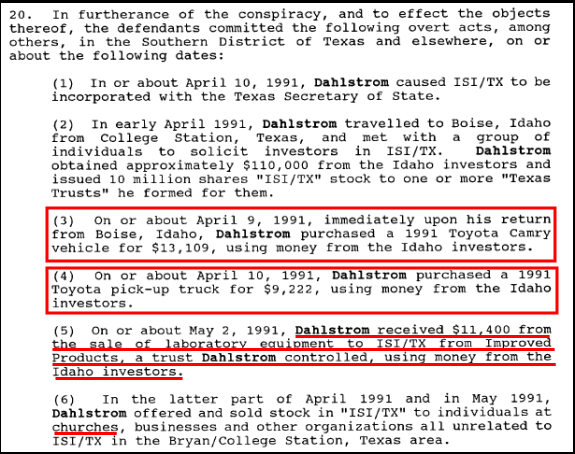
    Read the indictment against Karl Dahlstrom, Karla Dahlstrom (his daughter), Hubert Leopard and Richard Lopez. Some of the allegations read like the allegations against ASD.

    Karl Dahlstrom was accused of using investors' funds to purchase new vehicles and pitching the opportunity to church groups.
    Karl Dahlstrom was accused of using investors' funds to purchase new vehicles and pitching the opportunity to church groups.
  • Aggero Investment Surf In Slow-Mo Tank On Heels Of Earlier Failure Of Premium Ads Club: Bad Week For ‘Industry’

    Earlier this week we reported on the failure of Premium Ads Club (PAC). Now a surf with close ties to PAC is in its death spiral. Aggero Investment says tomorrow will be its last day, absent a miracle that will prevent a run on the bank as investors race to collect returns advertised at 60 percent a month, on top of bonus returns.

    Like PAC, Aggero Investment collected money right up to the bitter end, assuring investors that things were just fine and that external investments paying astronomical returns made Aggero Investment’s merely collossal returns possible.

    Aggero Investment relied on some of the same promoters as AdSurfDaily (ASD), the Quincy, Fla,-based autosurf that had nearly $100 million in assets seized by the U.S. Secret Service in August amid allegations of money-laundering, wire fraud and running a Ponzi scheme.

    ASD had more than $250 million in unfunded liabilities at the time of seizure, prosecutors said. ASD, however, tried to tell a federal judge that it had no liabilities because rebates weren’t guaranteed.

    The judge didn’t buy it.

    The usual script is in play on the Ponzi boards in the wake of the Aggero Investment collapse. Some posters are angry and bitter. Others are urging calm, advising participants not to file claims through SolidTrustPay, a Canadian payment processor fond of surf fees, because claims could make it harder on everybody. Still others are hoping Aggero Investment will slash payouts to something more “reasonable,” suggesting that 30 percent — what ASD paid monthly — might be the ticket.

    Yet others are referring to the electronic Ponzi-scheme business as an “industry,” positioning themselves as experts and the voices of reason. Serial promoters in the “industry” all have exposure — both to civil and criminal litigation — and routinely spin surf failures as nothing to get all worked up about.

    It has been a bad week for surfs. AdViewGlobal (AVG), which has management in common with ASD, desperately is trying to get undergound. Its new gambit is to form a private asssociation and dispatch shills to rail against the government in a bid to make its exposure go away and deflect from the central issues of the autosurf prosecutions: the sale of unregistered securities by wire in a Ponzi environment.

    The Pro-ASD Surf’s Up forum, which also is shilling for AVG, can’t delete posts that shed light on this soulless business fast enough these days. Some Surf’s Up members were electrified this week when ASD members used a litigation template by Curtis Richmond to file motions to intervene in the ASD case.

    Richmond and his co-litigants are accusing the judge and prosecutors in the ASD case of crimes, and its music to the ears of the Surf’s Up crackpots. Never mind that Richmond is associated with a sham Utah Indian tribe that was sued successfully under federal racketeering statutes for nuisancing federal judges with vexatious litigation.

    And never mind that Richmond has a conviction for criminal contempt of court for threatening federal judges, has been banned from the practice of law in Colorado despite the fact he’s not an attorney, and describes himself in court documents as a “Sovereign” who answers only to Jesus Christ and enjoys diplomatic immunity from prosecution.

    His theory of diplomatic immunity didn’t play well with a federal judge who ordered Richmond and other members of the sham tribe to pay nearly $110,000 in damages and costs to victims of their litigation schemes. And it didn’t play well with another federal judge who found Richmond gulity of criminal contempt of court and sentenced him to six months of home confinement with electronic monitoring and five years’ probation.

    This week has featured the collapse of Aggero Investment and Premium Ads Club, and a renewed commitment by AVG and Surf’s Up to take the absurdity to new levels — on the heels of a bonus program to get new money into the AVG system, of course.