URGENT >> BULLETIN >> MOVING: (UPDATED 1:06 P.M. ET U.S.A.) Gary Calhoun, the operator of the the MPB Today MLM “program” and a companion grocery-delivery business known as Southeastern Delivery, has pleaded guilty to a state-level racketeering charge in Florida. He was charged in December.
Calhoun, 56, of Pensacola, was not immediately sentenced. But he is expected to turn in his passport to the Florida Department of Law Enforcement “within 48 hours,” according to the docket of the case in Escambia County. The docket also notes correspondence from the U.S. Attorney’s Office for the Northern District of Florida and references a “voluntary forfeiture agreement.”
In July, federal prosecutors filed a forfeiture complaint for a property at 8812 Grow Drive, also known as Grow Road, in Pensacola. The property is the business address of Southeastern Delivery and also the address of a Calhoun-controlled entity known as WL Property Holdings LLC. The property also is the address of MPB Today.
MPB Today was among a number of “programs” pitched on Ponzi-scheme forums such as TalkGold and MoneyMakerGroup.
The Calhoun guilty plea represents the second time in 24 hours that the name of a “program” operator whose “opportunity” was pitched on the Ponzi boards has surfaced in the news, either as a current prison inmate or potential one.
David Merrick, the operator of the Trader’s International Return Network (TIRN) fraud scheme that was promoted from the Ponzi boards in 2008 and 2009, was sentenced in 2012 to 97 months in federal prison and was handed additional civil sanctions and a restitution order yesterday totaling more than $22.8 million.
MPB Today was promoted on the Ponzi boards in 2010.
Some individual MPB Today promotions were bizarre, including one that cast President Obama and former U.S. Secretary of State Hillary Rodham Clinton as Nazis. Another MPB Today promoter videotaped himself making a deposit of his MPB Today commissions at an FDIC-insured bank. At least one of MPB Today’s banks was operating under an FDIC consent agreement.
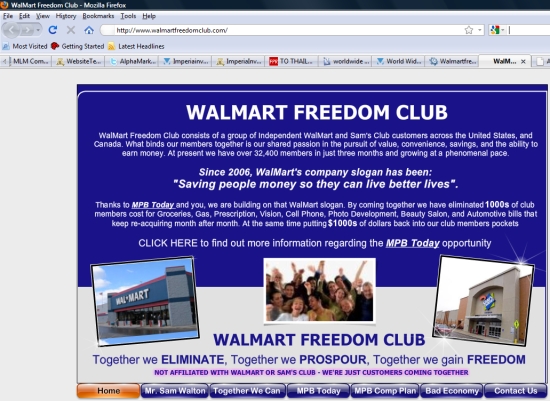
Still other MPB Today affiliates taped commercials for the enterprise inside Walmart stores. Some promoters asserted Walmart was affiliated with MPB Today and approved by the government. One MPB Today affiliate videotaped a UPS driver making a delivery of a television set.
The video’s narrator said the TV has been purchased “kind of, indirectly” with a Walmart gift card from MPB Today. Other MPB Today affiliates claimed a one-time purchase of $200 in groceries from Southeastern Delivery set the stage for MPB Today affiliates to receive free groceries and gasoline for life.
Clinton once sat on Walmart’s board of directors. Why some MPB Today affiliates apparently believed it prudent to attack Democratic politicians in a bid to sign up MPB Today affiliates remains unclear.
Promos for MPB Today were targeted at foreclosure subjects, Food Stamp recipients and the poor — and victims of the Florida-based AdSurfDaily Ponzi scheme. In 2010, Walmart declined to comment on MPB Today-related claims.
Some MLM “opportunities” are infamous for implying in promos that they’re endorsed by famous business people or famous companies. MPB Today used images of Donald Trump and Warren Buffett in promos, and affiliates regularly implied that Walmart had endorsed MPB Today.
David Merrick, the operator of Trader’s International Return Network (TIRN) fraud scheme, already is serving a TIRN-related, 97-month prison sentence for conspiracy to commit wire fraud, money laundering, and securities fraud, plus one count of money laundering.
And now a federal judge has imposed addition sanctions, ordering Merrick and TIRN — a presence on Ponzi boards such as MoneyMakerGroup — to pay more than $22.8 million in civil penalties and restitution.
One September 2008 post on MoneyMakerGroup declares this: “If you send money to TIRN using SolidTrustPay you will recive [sic] money on your account in a couple of hours!”
The CFTC charged Merrick and TIRN civilly in October 2009. Though a onetime resident of Apopka, Fla, Merrick, 65, is serving his prison sentence in Minnesota, according to federal records.
TIRN purported to operate from Panama as a “private investment club,” according to the CFTC.
“TIRN has been soliciting U.S. residents, and directing them to deposit their funds in U.S. bank accounts,” the CFTC said in 2009.
SolidTrustPay was among the financial vendors for Zeek Rewards, which also was promoted on the Ponzi forums. In August 2012, the SEC called Zeek a $600 million Ponzi- and pyramid fraud.
UPDATED 1:14 P.M. EDT (U.S.A.) A Florida man who allegedly received $1.5 million from an international Forex fraudster now jailed in the United States has been arrested on charges of bankruptcy fraud, federal prosecutors said.
The three-count indictment against Jon Jerald Hammill, 39, of St. Petersburg, was unsealed yesterday. It marked the fourth major Ponzi-related event in Florida in recent days. The state is the site of some of the most complex fraud investigations in the nation, and the case against David R. Lewalski — from whom Hammill and his company allegedly received money — is no exception.
Hammill, whose arrest was announced in Washington yesterday by Assistant Attorney General Lanny A. Breuer, was accused of failing “to disclose that he had received more than $100,000″ from Lewalski’s company prior to the filing of his bankruptcy petition” in February 2009. He is further accused of not disclosing his ownership of a shell company into which payments from Lewalski’s Ponzi scheme were routed and not disclosing his business relationship with Lewalski.
Although Hammill’s Chapter 7 bankruptcy initially was granted in July 2009, U.S. Bankruptcy Trustee Donald F. Walton later reopened the case and sought to revoke Hammill’s discharge for fraud. In court filings, Walton said Hammill invoked his 5th Amendment right against self-incrimination when questioned about his dealings with Lewalkski’s company, which was known as Botfly LLC.
Breuer is the head of the Criminal Division of the U.S. Department of Justice. The federal probe into the alleged $29 million Botfly Forex caper is being led by U.S. Attorney Robert O’Neill of the Middle District of Florida, with the U.S. Postal Inspection Service in Washington as the lead agency. O’Neill and his predecessor — former U.S. Attorney A. Brian Albritton — have squared off against against a series of spectacular fraud schemes operating in the region.
Among the cases are the Beau Diamond Ponzi scheme, the David Merrick Ponzi scheme known as TIRN, the $220 million Forex Ponzi scheme of Jamaican David A. Smith and the alleged EMG/Finanzas Forex fraud. Investigators say they have traced proceeds from the EMG/Finanzas fraud to the international narcotics trade. A task force working in the region also did investigative legwork in the alleged AdSurfDaily Ponzi scheme.
Some of the cases have elements that only can be described as bizarre and deeply disturbing. In the Lewalski case, for instance, it is alleged that Lewalski discussed a plan by which he’d divert blame to the government for his legal predicament in a bid to get his victims to pay for his defense.
By making the government the bogeyman, Lewalski hoped victims would come to believe that he — as opposed to investigators — offered the best shot of getting back their money, according to court filings.
At least one person gave Lewalski $50,000 to pay for a lawyer — and this occurred after Lewalski had chartered a private Gulfstream IV jet at a cost of $172,744 to fly from the United States to Belgium one day after he was charged civilly in Florida, according to court filings.
One women — an attorney for the court-appointed receiver in Florida’s civil case — was made the subject of misogynistic rants by Lewalski, according to court filings. The rants were cited by federal prosecutors who argued successfully that Lewalski should not be released on bond.
Prosecutors also argued that Lewalski had spent astronomical sums of investors’ money on luxuries in the United States and Europe and advised investors to take the 5th Amendment when questioned. In court filings, prosecutors argued that Lewalski also sought to tamper with witnesses.
Lewalkski, prosecutors said, told “family members and other potential witnesses to stay quiet and not cooperate with law enforcement.”
The receiver’s attorney was called a “c[$%!]” and a “Nazi,” according to court filings. In one rant, Lewalski allegedly said, “So f[$%!] her what a bitch.” Court documents also allude to a woman who allegedly was called an “FDLE chick” and described by Lewalski as “nuts” and a “bitch.”
It was not immediately clear if Lewalski was talking about the receiver’s attorney or a different woman employed by the Florida Department of Law Enforcement when making the alleged “FDLE chick” remark. In the context of the remark, however, Lewalski is alleged to have discussed a “nuclear option.”
Separately, the U.S. Postal Inspection Service alleged that Lewalski complained to investors he defrauded about “recent ‘Orwellian’ totalitarian tactics” employed by U.S. investigators in Ponzi scheme cases, instead of accepting accountability for his fraud.
But even as Lewalski was grumbling that his U.S. assets had been frozen, he allegedly did not tell his investors what had happened to their money and why they had not been paid as promised prior to the seizure. Instead, according to the investigating postal inspector, he talked about money he was able to access in Europe after he left the United States hastily, saying he had as many as six offshore accounts.
Among Lewalski’s other claims was that he had been “investigated and cleared by the Securities and Exchange Commission,” according to court filings. Members of ASD also have claimed that ASD, which was accused of orchestrating a $110 million international fraud from Florida, was given the green light by the SEC.
No evidence has surfaced in either the ASD case or the Botfly case that the SEC approved of the companies’ operations. Meanwhile, ASD members also have directed rants at prosecutors and investigators, describing them as “goons,” “Nazis,” merchants of “Satan” and criminals. One ASD member proposed that a federal prosecutor be placed in a medieval torture rack, with ASD members at large drawing straws to determine who got the honor of turning the torture wheel.
Another ASD member proposed that a “milita” storm Washington in defense of ASD. Still another said that the company’s critics consisted of “Rats, Bed Bugs, Maggots, Cockroaches And Everything Else.”
Lewalski, 47, operated Botfly from his mother’s home in Bayonet Point, Fla., according to court records.
After being charged civilly by the state of Florida in April 2010, Lewalski immediately left the United States, spending the next seven months in Europe, according to court filings.
He is believed to have returned to the United States in October 2010, but investigators said he pretended still to be in Europe. Lewalski was arrested in New York on November 4, 2010. Prosecutors said he was staying in a luxury suite atop the Mandarin Oriental Hotel for which he had paid $143,000 in advance with investors’ money.
The Mandarin bills itself “the most breathtaking luxury hotel in New York,” and Lewalski’s suite overlooked Central Park, according to court records.
BULLETIN: Beau Diamond, the Florida man accused of fleecing investors out of millions of dollars in a Forex Ponzi scheme, has been found guilty of all 18 counts against him.
Diamond, 32, was the operator of Diamond Ventures LLC of Sarasota. He was arrested by the Pinellas County Sheriff’s Office in September 2009, after a probe by the FBI and Internal Revenue Service. The CFTC filed civil charges in the case.
In an unusual but not unprecedented approach, a sitting U.S. Attorney actually argued elements of the criminal case against Diamond in the courtroom instead of simply supervising the government’s case.
TIRN operator David Merrick pleaded guilty in May to money laundering and conspiracy to commit wire fraud and securities fraud in the TIRN Ponzi scheme.
In the Evolution Marketing Group/FinanzasForex case, prosecutors said investigators had tied some of the money collected in the alleged scheme to the international narcotics trade. Court filings in the case paint a picture of an incredibly elaborate maze of companies and bank accounts set up to confuse both investors and law enforcement. At least 59 bank accounts, 294 bars of gold and nine luxury vehicles have been seized in the case. One of the cars was a 2008 Lamborghini Murcielago valued at more than $430,000.
The EMG/Finanzas allegations are explosive because they showcase the now-undeniable fact that people who promote programs such as HYIPs and autosurfs because such programs may pay “commissions†to recruit new members may be operating as fronts or conduits for international drug dealers and money-launderers.
Albritton also is tackling the epidemic of mortgage fraud in Florida, which has one of the highest foreclosure rates in the United States and is experiencing a rash of bank failures.
As filed by prosecutors and the CFTC, some of the allegations against Diamond read like discussions commonly seen on HYIP Ponzi forums.
Among other things, the CFTC alleged that Diamond urged members not to call authorities when the scheme was going belly-up because involving the government only would make matters worse.
The Diamond Ventures enterprise quit paying in December 2008, telling some members they had not received checks because it took longer for the U.S. Postal Service to deliver mail near the holidays, CFTC said.
Other members were told Diamond had a problem with Bank of America and was transferring his accounts to JP Morgan Chase, CFTC said.
By Jan. 7, 2009, Diamond was explaining to customers that a “serious situation†had emerged. On Jan 9, he told customers that “the funds have been lost†due to a downturn in the world economy and unprecedented volatility, CFTC said.
What Diamond did not tell customers was that he had lost huge sums in forex trades, had sent customers bogus account statements showing they were money to the good — and blew a tremendous sum on gambling, air travel, jewelry and hotel accommodations, CFTC said.
By Jan 22, 2009, CFTC said, Diamond was urging customers not to “initiate a federal investigation†because such an event would lead to a situation in which “no one will see a penny, and I most likely will be behind bars,†CFTC said.
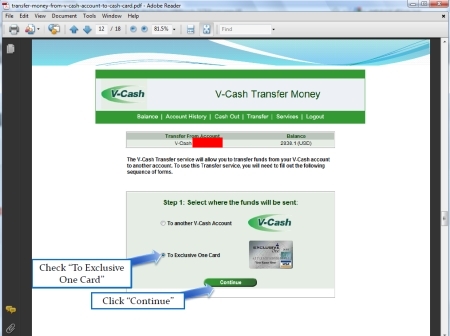
Part of the purported INetGlobal training material on how to transfer money to a debit card. (Red bar added to screen shot by PP Blog to block account number.)
Training material purportedly produced in November 2009 and published online shows prospects of INetGlobal how to transfer money from the company to a reloadable debit card. The presentation reveals that INetGlobal was using the same debit-card firm that provided services for a Florida man implicated in October 2009 — just a month before the INetGlobal training material purportedly was produced — in an alleged international fraud scheme that gathered at least $22 million and made Ponzi payments to members via debit cards.
The training material is confusing in places, and the form in which it was published suggests that some INetGlobal members with Chinese names shared information to recruit Chinese prospects. At the same time, the training material and other information accessible at the same website suggests Chinese members also worked together to create instructional materials that showed other Chinese members and prospects how to offload their profits in cash at ATM machines and receive $300 sign-up bonuses that may not have been available to all INetGlobal members.
It is possible that a single member or group of members created the training material and the companion information. Whether the material, which does not purport to be hypothetical and appears to include no disclaimer language, used the names of real members was unclear. Also unclear is whether the approach had the approval of INetGlobal. What is clear is that the information was published openly online and purportedly reflects INetGlobal financial transactions that occurred among Chinese members in November 2009.
A “Contact” address on the website that published the information lists a street address in British Columbia, even though the domain itself lists a registration address in Mainland China. The British Columbia street address returns a page in Google search results that purports to lay out a conspiracy case against judges in Canada for issuing unfavorable rulings in what appears to be a matter unrelated to INetGlobal.
Just two months earlier, in September 2009, some Clickbank vendors were complaining that links to their businesses were being placed in INetGlobal’s advertising rotator without their knowledge. The Clickbank vendors also complained that INetGlobal was passing along bandwidth costs to them and that their businesses were experiencing a surge in unproductive traffic from China.
The author of the training document on debit cards was listed as Annie Zhang, according to the “Properties” of the document, which was published in PDF format.
The training document was published on a website whose domain-registration address was listed as “Xian, Shanxi . . . China.” The domain on which the information was published was registered to Jun Zhang. The website encourages prospects to submit their email address and wait to receive a return email “to get a referrer ID and referrer name that you will need in the registration process.”
Visitors to the website registered in China are told that, by registering for INetGlobal in this fashion, they can “Make Free Fast Money $300 Right Now.” The site instructs viewers to purchase a “$2000 Executive Business Package,” provide proof of the purchase by return email and wait to receive their bonus.
“We will send $300 free fast money to your V-Cash account,” the site tells viewers. “If you prefer, we can send $300 to your PayPal account too!”
Another URL at the same domain instructs prospects on how to register for a Clickbank account to promote products through INetGlobal. The instructions are available in multiple languages, including English, Chinese and Japanese.
The debit card featured in the PDF training material on the website registered in China is known as the “Exclusive One” card and is issued by Anres Technologies Corp. of Las Vegas. The Exclusive One card is pictured in the INetGlobal training material, and Anres’ name is referenced in court filings by the U.S. Secret Service in the INetGlobal case.
Anres’ name also is referenced by the SEC in a case filed last year in Florida against David F. Merrick, Traders International Return Network (TIRN), MS Inc., GTT Services Inc., MDD Consulting Inc. and Go ! Tourism Inc. Merrick and the companies were accused of running a Florida-based Ponzi scheme that used debit cards and claimed a presence in Panama.
Among the claims in the SEC case was that “Merrick and TIRN falsely represented that investors requesting a withdrawal of funds would receive a debit card loaded with their initial investment and return on their investments, when, in fact, the money loaded on the cards was money from other investors,†according to the SEC.
The PP Blog wrote about the TIRN case on Oct. 15, 2009. Millions of dollars were moved across borders, the SEC said.
“[A]t least $2.3 million of investor funds were transferred to accounts in Panama, Mexico, Malaysia, Switzerland and the Netherlands,†the SEC said. It added that about $8.8 million was placed on debit cards to make Ponzi payments to members..
Although TIRN was not an autosurf, debit cards have become increasingly popular in the autosurf universe. The TIRN case demonstrated that alleged fraudsters were relying on debit cards to pull off international financial schemes.
Anres was not named a defendant in either the TIRN case or the emerging INetGlobal case. The company has not been accused of wrongdoing.
In recent months, the FBI has expressed public concerns that criminal organizations were turning to preloaded debit cards to launder money and that users were taking advantage of a “shadow” banking system.
Card Highlighted In Instructional PDF For INetGlobal
The purported INetGlobal training material appears in a PDF that includes screen shots. The person (or persons) who assembled the material appear to have Chinese names, and the English-language material walks prospects through the process of converting electronic credits to cash that can be loaded onto an Exclusive One debit card and withdrawn at ATMs.
In February, the Secret Service said it believed INetGlobal was targeting Chinese members in an international Ponzi scheme. The purported training material lists IP addresses in the United States and Canada in a manner that suggests Chinese members in both countries were working together to train other Chinese members how to offload profits onto debit cards and also how to transfer money using INetGlobal’s internal system from one Chinese member to another.
Among the assertions against INetGlobal by the U.S. Secret Service was that the company was engaging in wire fraud and money laundering. The IRS now has entered the case, which suggests that the government also suspects tax crimes.
Material Suggests Account-Sharing And Cross-Border Planning
The second page of the 18-page PDF purportedly shows the back office of an INetGlobal member who appears to have a Chinese name. This page lists the member’s name as “Dong,” lists a five-digit INetGlobal member number, a six-digit V-Cash account number and an IP address that comes back to Minneapolis. The page notes that automatic repurchasing of additional “adpacs” was enabled and set for 50 percent. Viewers were prompted to click on a tab labeled “V-Services.” In the next step, viewers were prompted to click on a graphic labeled “V-Cash Online Payment Services.”
This page forwarded to another prompt to click on a V-Cash logo, which led to a login screen that prompted members to enter a user ID and a password. A “Welcome” screen followed, and members were instructed to click on a tab that prompted them to go to the “Member Center.”
Once inside the Member Center, members were prompted to click on a tab labeled “V-Cash.” This led to a screen that prompted them to enter a password for their V-Cash accounts. The next screen shot showed that V-cash was logging members’ IP numbers; the IP number logged in this screen shot came back to Toronto. Why the shot displayed a Toronto IP when the earlier shot displayed a Minneapolis IP was unclear.
The Exclusive One Card, as pictured inside the training material.
The next screen shot prompted members to click on a tab labeled “balance.” This screen noted a “Currency balance” of more than $3,038 in the account. The next screen was confusing because the currency balance had been lowered by $200. Why the balance was lowered was not made clear in the presentation.
In the next screen shot, the presentation provided the initial instructions on how to transfer money to the Exclusive One card, which is pictured in the document. This screen shot also purported to show that members could transfer money from their V-Cash accounts to other V-Cash accounts from within the company’s internal system. The presentation prompted viewers to select the option to transfer money to the Exclusive One card and press “Continue.”
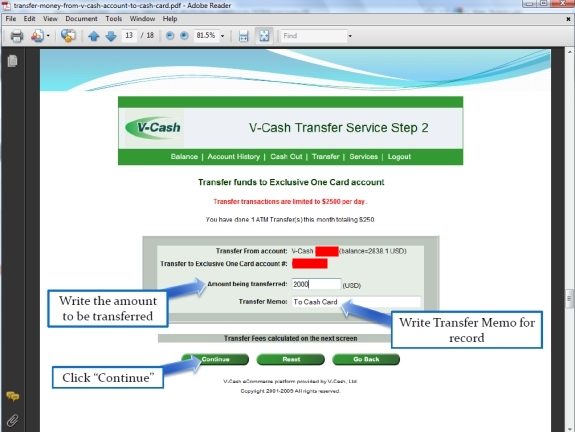
Thereafter, the presentation showed a purported transfer of $2,000 to the Exclusive One card. The presentation noted a $30 fee incurred when making the transfer. The fee rate for the transfer service was described as 1.5 percent. The screen shot noted that the total amount transferred, including the $30 fee, was $2,030. Viewers were prompted to “Click to Confirm” the transfer.
Part of purported INetGlobal traning material. (Red bars added to screen shot by PP Blog to block account numbers.)
One of the screen shots that followed purported to show a “History” of transfers to and from the account. One of the transfers showed a purported transfer “from” Annie Zhang to an INetGlobal member in the amount of $3,000. It was dated Nov. 3, 2009.
A person named Annie Zhang purportedly is one of INetGlobal’s top recruiters. Some promos for the firm have asserted Zhang was making $100,000 a month as an affiliate of INetGlobal.
Parts of the PDF presentation are confusing. For example, the member’s name that appears on the second page of the presentation does not agree with the member’s name that appears on Page 6 — even though the INetGlobal member account number appears to be the same, as does the V-Cash account number.
On Page 2, the member’s name is listed as “Dong” with an IP number that comes back to Minneapolis. On Page 6, however, the screen welcomes a member named “Lei.” An IP shown on Page 9 comes back to Toronto — not Minneapolis.
In the document’s published form, both Dong and Lei appear to have the same 5-digit INetGlobal number and the same six-digit V-Cash account number. Why two purported INetGlobal members would have the same account numbers is unclear.
INetGlobal Now Has Links To Three Ponzi Cases
In February and March court filings, the U.S. Secret Service linked INetGlobal to the alleged AdSurfDaily Ponzi scheme, alleging that an undercover agent was introduced to INetGlobal by an ASD member. The Secret Service brought the Ponzi case against ASD in August 2008.
The appearance of the Exclusive One card in the purported INetGlobal training material links INetGlobal to a second Ponzi court scrape: the SEC’s case against the alleged David Merrick/TIRN Ponzi scheme, which appears to have used the same debit card as INetGlobal to pay members. The CFTC also filed allegations against TIRN, and the U.S. Attorney for the Middle District of Florida also is investigating TIRN.
Separately, INetGlobal operator Steve Renner was linked to a Ponzi scheme known as Learn Waterhouse in 2004. A company Renner operates — Cash Cards International (CCI) — provided payment-processing services for the Learn Waterhouse scheme, and Renner himself purportedly was an investor in the scheme, according to court filings.
The document recounts the history of the case, including astonishing allegations that Learn Waterhouse told investors that it “had invested $2 billion in a gold mine in Mexico, and [was] working on a billion-dollar Columbus-era ‘find’ on the bottom of the ocean.”
Renner was alleged to have provided payment-processing services for Learn Waterhouse through CCI and to have spent investors’ money on personal purchases.
Randall Treadwell, the ringleader of the Learn Waterhouse scheme, “often claimed that he had a God-given ability to make money, but in hindsight it appears that his talents lay in extracting funds from duped investors,” according to court filings.
Indeed, according to filings in the Learn Waterhouse case, the “purported investments
did not exist at all.
“By the time the defendants’ far-reaching Ponzi scheme collapsed, more than 1,700 investors throughout the United States had lost their investments. At trial, the defendants produced no evidence to suggest that any investment profit was generated by their companies.”
Losses in the Learn Waterhouse case totaled at least $44 million.
UPDATED 1:33 P.M. EDT (U.S.A.) The failure yesterday of San Joaquin Bank in Bakersfield, Calif., brought the total of bank failures in the United States this year to 99.
With weeks remaining in the year, it is a virtual certainty that failures will top the 100 mark. Banks have been failing at an average rate of slightly less than 10 per month in 2009. Last year, 25 banks failed in the United States. In 2007, only three banks failed.
As many as 416 names of other troubled banks appear on a confidential list maintained by the Federal Deposit Insurance Corp. (FDIC). The hemorrhage of bank failures — in large measure caused by a severe recession, consumer and business defaults, a collapse of real-estate prices in many parts of the country, brazen fraud in the mortgage sector and a contraction of development — is not over.
Although banks and the government are working together to find ways to curb an explosion in the mortgage-foreclosure rate, foreclosures continue to suck wealth from the economy.
“Bank repossessions, or REOs, jumped 21 percent from the second quarter to the third quarter, corresponding to jumps in defaults and scheduled auctions in the previous two quarters,†said James J. Saccacio, chief executive officer of RealtyTrac.
RealtyTrac tracks foreclosure activity in the United States. On Oct. 14, the company said foreclosures in the third quarter set a record and were up 23 percent from the total reported in the third quarter of 2008.
Foreclosure filings, default notices, scheduled auctions and bank repossessions totaled 937,840 in this year’s third quarter, RealtyTrac reported.
Although foreclosure filings in September totaled 343,638 — a 4 percent decrease from August’s total — the number still represented a 29 percent increase from September 2008.
September’s monthly total was among the highest figures reported since January 2005, trailing only July and August of this year.
“REO activity increased from the previous quarter in all but two states and the District of Columbia, indicating that lenders may be starting to work through some of the pent-up foreclosure inventory caused by legislative delays, loan modification efforts and high volumes of distressed properties,†Saccacio said.
Florida, California Battered By Foreclosures
Six states — California, Florida, Arizona, Nevada, Illinois and Michigan — accounted for 62 percent of the foreclosure total in the third quarter, RealtyTrac reported. Foreclosures in the six states totaled 579,541.
Foreclosures in California totaled 250,054 in the third quarter; Florida posted 156,924 foreclosures, a 23 percent increase from the total reported in the third quarter of 2008.
Because Florida is an attractive state for retirees — and because those retirees have friends and loved ones in all corners of the United States — the state is an attractive target for scammers.
Florida also has a large population of immigrants, another attractive target of scammers.
Agencies Battle Florida Ponzi Fraud
In the past 72 hours alone, the SEC, the CFTC, the FBI, the U.S. Postal Inspection Service, and federal prosecutors have announced three Florida Ponzi scheme prosecutions, a conviction in a separate Ponzi case — and a conviction in a fraud case in which a Florida man created more than 260 identities on eBay and fleeced customers out of $717,000.
On the Florida Ponzi front:
David F. Merrick, Traders International Return Network (TIRN), MS Inc., GTT Services Inc., MDD Consulting Inc. and Go ! Tourism Inc. were named defendants in emergency actions in U.S. District Court for the Middle District of Florida. Merrick, 61, of Apopka, is accused of operating a $22 million Ponzi scheme with ties to Panama, Mexico, Malaysia, Switzerland and the Netherlands.
HomePals Investment Club LLC, HomePals LLC (Home Pals), Ronnie Eugene Bass Jr., Abner Alabre and Brian J. Taglieri were charged in South Florida with securities fraud, conspiracy to commit securities fraud, wire fraud and money laundering. The defendants were accused of targeting Haitian-Americans in a $14.3 million Ponzi scheme that promised investment returns of 100 percent every 90 days. The scheme gathered money from as many as 64 “investment clubs,†the SEC said.
Sean Healy, 38, of Weston, Fla., was charged in a 55-count indictment unsealed in Pennsylvania with multiple counts of wire fraud, mail fraud, money laundering and obstruction of justice. The Florida-based scheme led to at least $14.6 million in losses in Pennsylvania alone, prosecutors said, adding that Healy purchased “numerous exotic vehicles and sport cars, including a Bentley and several Ferraris, Lamborghinis and Porsches worth over $2.3 million.†Healy also bought a $2.4 million waterfront mansion furnished with more than $2 million of home improvements, plus $1.5 million in men’s and women’s jewelry, prosecutors said.
Michael Riolo, 38, of Boca Raton, was sentenced to more than 24 years in prison for bilking investors in a $44 million Ponzi scheme. Prosecutors accused Riolo of cooking the books and sending false statements to investors that reported “consistent trading profits and increasing account balances.” In reality, Riolo “misdirected money he received from some investors to make distributions to other investors who sought to withdraw money from their investment accounts,” prosecutors said.
Andy Bowdoin, 74, of Quincy, Fla., continued his efforts to get back into a Ponzi case in which he had already submitted to the forfeiture of tens of millions of dollars seized last year by the U.S. Secret Service in an international wire-fraud and money-laundering probe. Bowdoin, who submitted to the forfeiture in January, fired his attorneys and began to file as his own attorney in February. In April, federal prosecutors announced that Bowdoin had signed a proffer letter in the case prior to acting as his own attorney and acknowledged his company, AdSurfDaily Inc., had been operating illegally. “Mr. Bowdoin also confirmed that the revenue figures of the enterprise were managed to make it appear to prospective members that the enterprise called Ad Surf Daily was a consistently profitable, and brilliant, passive income opportunity,” prosecutors said. Despite his own acknowledgments of illegal conduct, despite the proffer — and despite the fact Bowdoin had asked the court to grant his request to submit to the forfeiture and that the court granted Bowdoin’s request — Bowdoin climbed back on the litigation saddle. “Mr. Bowdoin says that after discussing this case with his supporters, and concluding that they were smarter than his attorneys, he has changed his mind,” prosecutors said.
Total funds gathered in the alleged Bowdoin, Merrick, Bass, Alabre, Taglieri and Healy Ponzi schemes in Florida are estimated at $156.3 million, during a period in which U.S. banks are failing, the U.S. economy is confronting the worst business conditions since the Great Depression and mortgage foreclosures are piling up across the country, including hard-hit Florida.
With the Riolo conviction added to the estimate, the number totals $200.3 million. The estimate does not reflect the massive, $65 billion Ponzi fraud of Bernad Madoff, who wiped out clients in Florida and elsewhere. Nor does it take into account allegations that Arthur Nadel, another man implicated in a large-scale fraud in Florida, may be responsible for tens — if not hundreds — of millions of dollars of Ponzi pain.
“During these tough economic times, it is more important than ever that those who lie to and steal from the investing public be held accountable for their misconduct,” said Jeffrey H. Sloman, Acting U.S. Attorney for the Southern District of Florida, commenting on the 24-year prison sentence Riolo received.
“The United States Attorney’s Office will continue to investigate and prosecute those who perpetrate these large-scale fraud schemes,†Sloman said.
UPDATED 12:39 A.M. EDT (OCT. 16 U.S.A.) In twin actions that may send shockwaves across the offshore autosurfing “industry,” the Securities and Exchange Commission and the U.S. Commodity Futures Trading Commission have gone to court to stop an alleged Florida-based Ponzi scheme that claimed a presence in Panama.
Today’s announced actions by the SEC and CFTC expose the vulnerability of autosurfs that register as corporations offshore and arrange web-hosting overseas, but do not comply with securities laws of the United States and foreign countries in which they have a paper footprint or are not regulated in the foreign countries.
The moves also demonstrate that U.S. securities regulators — no matter where a company arranges webhosting — intend to treat American owners who flout laws as issuers of unregistered securities, unregistered investment advisers and operators of unregistered foreign investment companies from inside the United States
Named defendants in emergency actions filed yesterday in U.S. District Court for the Middle District of Florida were David F. Merrick, Traders International Return Network (TIRN), MS Inc., GTT Services Inc., MDD Consulting Inc. and Go ! Tourism Inc.
U.S. District Judge Gregory Presnell entered orders freezing the assets of the defendants and ordering them to repatriate assets to the United States.
Merrick, 61, lives in Apopka, Fla. On its website, TIRN lists the corporate address of Edificio Advanced 099-Piso 13, Calle Ricardo Arias, Panamá City, República de Panamá.
“TIRN has been soliciting U.S. residents, and directing them to deposit their funds in U.S. bank accounts,” CFTC said.
Entities Merrick controls operated a Ponzi scheme that gathered at least $22 million, the SEC said. For its part, CFTC charged Merrick and TIRN with solicitation fraud, accusing them of misappropriating customer funds totaling at least $16.4 million.
At least $3.7 million in customer funds were diverted to pay Merrick’s personal expenses and “to pay credit cards debts of MS and GTT Services,” the SEC said.
Millions of dollars were diverted to a firm that provides debit cards — another allegation that may cause autosurf participants to lose sleep.
“[A]t least $8.8 million was transferred to Anres Technologies Corporation, a privately owned company that issues pre-paid debit cards,” the SEC charged.
“Merrick and TIRN falsely represented that investors requesting a withdrawal of funds would receive a debit card loaded with their initial investment and return on their investments, when, in fact, the money loaded on the cards was money from other investors,” the SEC alleged.
Debit cards have become increasingly popular among autosurf operators. Today’s announced actions by the SEC and CFTC, however, demonstrate that regulators are viewing the money placed on cards as money taken from Peter to pay Paul.
Millions of dollars were moved across borders, the SEC said.
“[A]t least $2.3 million of investor funds were transferred to accounts in Panama, Mexico, Malaysia, Switzerland and the Netherlands,” the SEC said.
Although TIRN purported to engage in forex trading and was not an autosurf, the allegations could send a chill across the so-called “offshore” surfing industry.
TIRN, whose servers appear to resolve to Malaysia, is a registered corporation in Panama. But the Panama National Securities Commission issued a warning that TIRN “is not authorized to act as a financial intermediary for securities and investments and that the [Panama Commission] does not supervise or regulate it,” CFTC said.
AdViewGlobal (AVG), a surf with close ties to Florida-based AdSurfDaily, is among a number of surfs that use servers that resolve to Panama. Others include BizAdSplash, which says its chief consultant is Clarence Bubsy.
Busby was the president of Golden Panda Ad Builder, whose assets were seized in August 2008 by the U.S. Secret Service as part of the investigation into ASD and ASD President Andy Bowdoin.
Another surf company with servers in Panama is the now-defunct AdGateWorld.
Merrick was charged by the SEC with acting as an unregistered investment adviser and operating an unregistered foreign investment company from inside the United States.
“From at least July 2008 and continuing through at least October 2009, Merrick and TIRN have raised more than $22 million from approximately 2,500 investors through the fraudulent offer and sale of unregistered securities, in the form of investment contracts in TIRN,” the SEC charged.
“TIRN instructs investors to deposit funds into bank accounts in the names of MS and GTT, entities controlled by Merrick, and falsely states it will invest these funds in securities and other investments such as stocks and bonds. In fact, Merrick then transfers these funds to other entities he controls, including MDD and Go Tourism, and to himself, colleagues and/or entities under these individuals’ direct control, for their own benefit. Merrick has also used investors’ funds to repay other investors. None of the investors’ funds are invested in any securities or other investments described on the TIRN website,” the SEC said.