Jason 'Bo' Alan Beckman's Florida Ponzi property has a screened-in, heated pool and spa, according to court filings.
As alleged Ponzi palaces go, Jason ‘Bo’ Alan Beckman’s Florida property is hardly the gaudiest. Even so, the 11-room home in Palm City has features and amenities many Americans only dream about.
But one group of Americans — victims of the Trevor Cook Ponzi scheme — are likely only to have only bad dreams about the property. They are out millions of dollars as a result of a massive fraud in which Beckman allegedly played a big role.
The two-story, five-bedroom, five-bathroom home built in 2005 is situated near a golf course and equestrian facility, according to newly filed documents in the Beckman civil-fraud case. Receiver R.J. Zayed is seeking an order that would turn the property back over to Beckman and his wife because the home — despite its amenities — likely cannot be sold for what is owed on the $707,301 mortgage.
Keeping the property could create a drain on the receivership estate, Zayed argued.
Chief U.S. District Judge Michael J. Davis asked last week that an appraisal be done on the property. The appraisal now has been filed with the court, and the appraiser reported that the home is worth $540,000, about $167,301 less than what is owed.
Other court filings suggest the property may be worth even less. The SEC described Beckman in March as a “leading” figure in the Cook scheme, alleging that he raised about $47.3 million of the $194 million gathered in the overall fraud.
Floor plan of the Beckman Florida home.
Cook is serving a 25-year sentence in federal prison.
Beckman used $1.49 million of investors’ money for payments “toward the purchase” of luxury homes in Minneapolis, Texas and Florida, the SEC charged. The Minneapolis home already is in foreclosure, and the Florida home is situated in an upscale neighborhood trying to make a comeback after the state’s foreclosure glut caused property prices to plunge, according to court filings.
The Beckman Florida game room.
Any buyer who emerges to purchase Beckman’s Florida property will find that it has twin garages with enough floor space to hold four cars, according to court filings.
The home also features a yard with palm trees, a driveway built with colored pavers, a screened-in pool and spa, a screened-in “summer kitchen” and porch, central air, a well-appointed interior kitchen, a dining room, a living room, a family room, a game room, a den, a showy staircase, marble floors, a laundry room and other amenities.
Some of the Ponzi victims have been described in court filings as penniless.
This 10-room home with five baths and a garage of nearly 1,100 sq. ft. in Florida is "under water" on its mortgage and could create a drain on the receivership estate in the Bo Beckman fraud case, according to the court-appointed receiver.
Accused Minnesota fraudster Jason Bo-Alan Beckman’s 5,097-sq.-ft.-home with five bedrooms, five bathrooms and a roomy garage of nearly 1,100 sq. ft. in Palm City, Fla., is seriously “under water” on its mortgage and thus creates a drain on assets that are best used to compensate victims, the court-appointed receiver has advised a federal judge.
Receiver R.J. Zayed has asked Chief U.S. District Judge Michael J. Davis for an order that would return control of the property to Beckman and his wife on the theory it is “imprudent to diminish the Receivership’s severely limited resources to continue efforts to market and/or maintain the Property.”
The Beckmans, whose home in Minnesota is in foreclosure, owe “at least” $207,000 more than the Florida property is worth, Zayed advised Davis. The receiver noted that the mortgage has a balance of more than $707,301 and that the home may not even fetch $500,000 if sold.
The “negative equity” should be the Beckmans’ problem, not the problem of the victims of his alleged fraud, which is part of the Trevor Cook Ponzi scheme case, Zayed argued. The SEC sued Bo Beckman earlier this month, alleging that he was a “leading” figure in Cook’s fraud and had “guaranteed” annual returns of 12 percent or greater in an international Forex scheme.
Cook is serving a 25-year sentence in federal prison.
Bo Beckman, according to the SEC, purchased luxury homes in three states and assembled a fleet of luxury cars. He essentially is accused of being a rainmaker for Cook by driving nearly $50 million to the $190 million fraud.
“[T]he Receiver is not seeking to abandon the [Florida] property, but rather have the Court confirm the return the property to the Beckmans’ custody, control and possession, thereby placing at least some of the burden of unwinding the fraud on its perpetrators,” Zayed advised Davis.
BULLETIN: Five days after Ponzi swindler Trevor Cook pleaded guilty to defrauding victims in an elaborate international scam that reduced investors to ruin, a Minneapolis man hid proceeds from the caper from law enforcement and the court-appointed receiver, federal prosecutors said.
Victims of the Cook scheme — many of whom were people of faith — were defrauded of tens of millions of dollars. Court records strongly suggest that some of the recoverable money was spent on booze, exotic dancers and gambling — after the scheme was exposed by the SEC and CFTC in November 2009 and Cook’s assets were frozen.
Jon Jason Greco, 40, now has been charged with making false statements to federal agents. The case was filed under seal Tuesday, and the seal was lifted yesterday.
Cook, 38, pleaded guilty on April 13, 2010, and is serving a term of 25 years in federal prison. His plea agreement in the $190 million swindle required him to disclose the whereabouts of assets and cooperate with investigators. Investors immediately expressed fears that money that could be used to help them recover from the devastating scam had been hidden and that Cook could not be trusted in any context.
Some of the hidden loot was found months after the plea and cooperation agreement. Part of it had been concealed behind a toilet-paper dispenser and in air ducts in an apartment occupied by Cook’s brother, Graham Cook. Loot also was found in a storage locker at the Mall of America.
Although the recovered loot made up only a tiny percentage of the $190 million scam, victims said every dime was needed and that justice demanded that no third party should be permitted to profit from Cook’s colossal fraud.
Prosecutors now say that Greco came into possession of some of the loot on April 18, 2010 — five days after the Cook guilty plea. Greco helped hide the loot and lied about it when questioned by investigators, according to prosecutors.
Court records suggest investigators established links among Cook, Graham Cook and Greco, who once worked briefly for Trevor Cook as a purported security guard at the Van Dusen mansion in Minneapolis. The big break in the case appears to have occurred in July 2010, when Greco’s roommate told federal agents that Greco was “holding assets” for the Cook brothers and impeding a federal investigation.
Investigators had believed since at least June 2010 that Greco had stashed money from the caper, according to court filings.
The case against Greco was bolstered when an exotic dancer told an IRS criminal investigator who was following leads that Greco, believed to have been unemployed for months, suddenly began to spend generously at a Minneapolis strip club and to plow $100 bills into slot machines at a gambling emporium.
“Greco placed some of the assets in his possession in a locker at the Mall of America,” prosecutors charged. “On July 24, 2010, law enforcement seized the assets, valued at approximately $150,000. Subsequently, Greco allegedly claimed to investigators that the seized assets belonged to him.”
But the assets were from the Ponzi caper, prosecutors charged.
Greco faces up to 10 years in federal prison if convicted on two counts of making false statements.
When interviewed last summer, Greco told agents that he had no knowledge of concealed assets belonging to Cook, when, in fact, he did,” prosecutors said.
BULLETIN: Jason Bo-Alan “Bo” Beckman has been charged civilly by the SEC in the Trevor Cook Ponzi scheme in Minnesota and named a “leading” figure, according to court filings. The case against Beckman was brought as an action separate from the civil action against Cook, who also was charged criminally and is in federal prison serving 25 years after pleading guilty last year.
The SEC’s complaint suggests other defendants may follow.
“His fraud was part of a bigger scheme orchestrated by and with Trevor Cook and several associates,” the agency said, alleging that Beckman raised about $47.3 million of the $194 million gathered in the overall fraud — roughly 25 percent of the overall total. Former radio host Pat Kiley previously was charged civilly.
Chief U.S. District Judge Michael J. Davis has frozen Beckman’s assets.
One individual — a 41-year old nurse — submitted a sworn affidavit to Davis that Beckman promised him “guaranteed” annual returns of “12% or greater.”
The nurse, an inexperienced investor who put $130,000 into the scheme, asserted he learned about the purported currency-trading program from Hollie Beckman, Beckman’s wife. Hollie Beckman has been named a relief defendant amid assertions she received ill-gotten gains. Her assets also have been frozen.
Another inexperienced investor — a 60-year-old man who previously was retired but has returned to work because his life savings of nearly $750,000 were wiped out in the scheme — said in a sworn affidavit that Beckman promised him a “guaranteed” return of 10.5 percent. Like the nurse, the man was given a tour of the Van Dusen Mansion, the landmark Minneapolis estate from which Beckman and Cook conducted business.
This man rolled over his 401K account and liquidated his pension fund to become an investor, according to an affidavit.
Yet-another inexperienced investor — a 62-year-old man who works as a water-plant operator — said he put $99,300 into the scheme by liquidating an account at Bear Stearns. Beckman promised him that his “fixed” account would generate about 13 percent annually, according to a sworn affidavit.
All told, the SEC charged, “Beckman’s investors ultimately lost over $39 million by investing in the Currency Program and putting their money in his hands.” About 143 investors gave Beckman their money.
Luz M. Aguilar, an SEC investigator, said that $85 million of the $194 million “was never invested in any type of foreign currency trading.”
And Aguilar alleged that “the Beckmans deposited approximately $7.7 million into their personal joint accounts.” The funds originated “from accounts containing funds of investors,” according to Aguilar.
More than $61,000 was used to make child-support payments, Aguilar alleged.
But most of the money went to fuel an extravagant life-stlye, according to Aguilar. Here is a list of some of the spending:
$210,828 for automobile payments. The fleet allegedly included a 2010 Jaguar, a 2008 Land Rover, a 2006 Land Rover, a 2008 Mercedes, a 2008 Suzuki and a 2000 Mercedes.
$1.49 million for payments “toward the purchase” of luxury homes in Minneapolis, Texas and Florida.
$695,000 for credit-card payments.
$180,000 for a suite to watch hockey games.
$36,000 to “resorts.”
$76,000 to a country club.
$108,000 for cash withdrawals.
$224,000 for construction and repairs.
$997,000 for payments to seven law firms.
$223,000 for taxes.
“Beckman was in a position to know the truth about the Currency Program,” the SEC charged. “He worked side-by-side with Trevor Cook at the Van Dusen mansion. Red flags waved all around him. For example, he knew — by April 2008, over a year before the scheme collapsed — that investors’ funds were pooled and were not in segregated accounts at all. He also learned from Trevor Cook that the location of investors’ funds was ‘not a black and white situation.’ The warning signs were glaring. Yet Beckman kept [quiet] — and kept taking tens of millions of dollars from investors . . .
“Now that the Currency Program is over — and the money flow has stopped — the Beckmans apparently are struggling to make ends meet. Their expansive home in the Minneapolis suburbs is in foreclosure,” the SEC said.
The SEC asked Davis to halt a sheriff’s sale set for March 14, and the judge issued an order blocking it.
Even though Beckman had serious doubts about Cook, he kept them to himself, not sharing with investors information they needed to make informed decisions, the SEC charged.
EDITOR’S NOTE: The remarks below are excerpted from a speech last week in New York by Assistant U.S. Attorney General Lanny A. Breuer. As the PP Blog has previously reported, the Justice Department and agencies such as the FBI and U.S. Secret Service have been using undercover operatives to infiltrate criminal operations and networks used by the criminals.
One of the FBI investigations Breuer referenced was the Trevor Cook Ponzi scheme in Minneapolis. The scheme consumed tens of millions of dollars, defrauding victims of at least $158 million. Many mysteries remain in the case.
Meanwhile, undercover operatives also recently were used to expose penny-stock schemes operating in Florida.
It also is known that the Secret Service used undercover operatives in the AdSurfDaily case, the INetGlobal case, the Regenesis 2×2 case, the Legisi case and a case involving alleged international fraudster Vladislav Horohorin, accused of using criminal forums to peddle stolen credit-card information.
Here, now, some excerpts from Breuer’s speech . . .
Part of Trevor Cook's stash.
“Now, as I’m sure you know, financial criminals can be extraordinarily innovative, and they are often expert at covering their tracks. So we are always looking for creative ways to gather the evidence we need to bring financial criminals to justice. To that end, we have begun increasingly to rely, in white collar cases, on undercover investigative techniques that have perhaps been more commonly associated with the investigation of organized and violent crime.
“As part of this effort, we have significantly strengthened the Criminal Division’s Office of Enforcement Operations (known as OEO), which is the office in the Justice Department that reviews and approves all applications for federal wiretaps from across the country. We have a dynamic new OEO Director, Paul O’Brien, and we’ve substantially increased the number of attorneys at OEO who review these wiretap applications, adding to their ranks experienced prosecutors and recent graduates who have completed federal clerkships. As a result, the number of wiretaps we authorize – in all types of cases – has gone up.
“Let me give you just two examples of white collar cases in which we have used undercover techniques, both of which also highlight areas in which we have stepped up our white collar enforcement efforts more generally.
“The first example is the case of Trevor Cook, which was prosecuted by the U.S. Attorney’s Office in Minneapolis. Mr. Cook is just one of dozens of individuals whom we’ve prosecuted in recent months for participating in investment fraud schemes. Over the course of several years, Mr. Cook schemed to defraud at least 1,000 people out of approximately $190 million by pretending to sell them investments in a foreign currency trading program.
“In reality, he was pocketing the money or using it to pay off other investors. As was recently reported in the New York Times, we gathered evidence against Mr. Cook by using an undercover informant to record his transactions and conversations. [Cook] pleaded guilty earlier this year and was recently sentenced to 25 years in prison.
“Trevor Cook is one of literally hundreds of financial criminals who have preyed upon vulnerable, individual investors and bilked them out of their savings using investment fraud schemes. And as with Mr. Cook, we have been prosecuting these people aggressively, all over the country – from New Jersey and Connecticut to Texas and California, and everywhere in between.
“The second example comes from our enhanced efforts in the area of FCPA enforcement. Earlier this year, as I’m sure many of you know, we indicted 22 defendants in the military and law enforcement products industry for their participation in widespread schemes to bribe foreign government officials. These indictments resulted from the Department’s most extensive use ever of undercover law enforcement techniques in an FCPA investigation, and they represent the single largest prosecution of individuals in the history of our FCPA enforcement efforts. In September, one of the defendants in the case, Richard Bistrong, pleaded guilty . . .
“Over the last 18 months, we’ve devoted significant additional resources to the Criminal Division’s Fraud Section. We’ve recruited talent not only from white shoe law firms, but also from a deep pool of prosecutors around the country who bring with them extensive experience in prosecuting everyone from violent mobsters to dangerous terrorists. We are now bringing that extraordinary talent and experience to bear on prosecuting financial fraudsters.”
“Based on his track record, there is no reason to doubt — and every reason to believe — that [Trevor] Cook is hiding assets, and that he can do much, much more to recover stolen funds. Why else would Cook send millions of dollars to 14 foreign countries, including Dubai, Cyprus, Greece, Belize, Antigua, England, Germany, Denmark, Mexico, Canada, Panama, Costa Rica, Jordan, and Switzerland?”— SEC, Sept. 24, 2010
On July 21 — six months after Trevor Cook had been jailed for contempt of court in a civil case brought by the SEC, and three months after he had pleaded guilty to criminal charges and agreed to cooperate with investigators — the FBI received a tip that led agents to the home of Cook’s brother Graham.
“The investigation involved assets hidden in Graham Cook’s home in ‘air ducts,’ in ‘ceiling rafters,’ and behind a ‘toilet paper dispenser,’” the SEC said yesterday.
The FBI “learned about the assets through a tip, not from Cook,” the SEC stressed, arguing that Cook’s earlier pledge to cooperate to make victims as whole as possible was virtually meaningless.
Agents later found even more loot stashed at a Minnesota shopping mall, the SEC said.
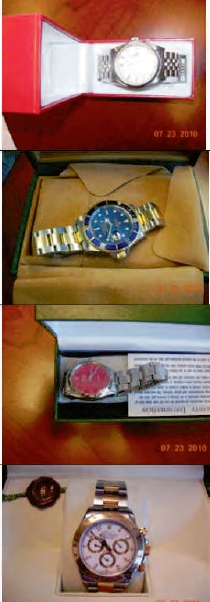
All in all, federal agents “ultimately recovered over $200,000 in cash, over 2,000 gold and silver coins (worth an additional $200,000), numerous Rolex watches, and valuable sports memorabilia” from the home, the SEC advised Chief U.S. District Judge Michael Davis of the District of Minnesota.
Meanwhile, at the mall, agents summoned by a security guard found “118 gold and platinum coins, as well as ‘stocks of different currency denominations from different foreign countries to include Iraqi Dinars, Turkish Lira, [and] Dominican Republic, Canadian, and Asian currencies,’” the SEC said.
The money stashed at the mall was recovered July 24, three days after the FBI recovered the cash from Graham Cook’s home, the SEC said.
Davis had jailed Trevor Cook in January for ignoring orders in the civil case. In August, he was sentenced to 25 years in federal prison by U.S. District Judge James Rosenbaum, who presided over the criminal aspect of the case brought by federal prosecutors.
Now, the SEC says Cook never purged the contempt citation in the civil case and should remain jailed until he does. The blistering filing suggests that, in theory, the clock may not start running on Cook’s 25-year sentence in the criminal case until he purges the civil contempt.
Some defendants jailed for contempt in civil cases involving large sums of money have remained behind bars for years, the SEC noted.
Going against the prosecution’s recommendation, Rosenbaum did not give Cook credit for time served in the civil case when sentencing the Ponzi schemer last month.
“I will tell you that I will not purge him of that contempt,” Rosenbaum said from the bench last month, according to a transcript of the proceeding in sentencing court. “That is an order of my Chief and that is his choice.”
In a memo to Davis, the SEC said Trevor Cook simply cannot be trusted.
“This Court ruled that Cook would remain incarcerated unless and until he performed 11 duties, including repatriating over $27 million from overseas, recovering over $6 million in preferential payments, and surrendering $2 million from domestic accounts, among others,” the SEC argued.
“Since then, Cook has repatriated $0 from overseas, has recovered $0 in preferential payments, and has surrendered $0 from domestic accounts,” the agency continued. “Yet Cook now asks to be released [from the contempt citation], based on the notion that he has done everything that he can do, and based on his promise to be helpful in the future. He gives his word.
“With all due respect, Cook’s word is not worth the paper that it is written on,” the SEC argued to Davis.
Any bid by Cook to argue he has cooperated with investigators and genuinely sought to purge the contempt citation is defeated by the facts of the case, the SEC argued.
“Cook promises that he is not hiding anything — honest — but Cook’s credibility has long since run out. As Judge Rosenbaum stated: ‘You haven’t got a clue what the difference is between the truth and a lie. The two words mean nothing to you,’” the SEC said, citing Rosenbaum’s courtroom comments to the Ponzi schemer.
And Cook is thumbing his nose at both the court and victims, the SEC said.
“Despite holding the keys to the jailhouse gates in his pocket, Cook has chosen to stay in jail, presumably in the hope of reaping a bounty someday,” the SEC said. “That is his choice, but he cannot now be heard to complain that his detention continues. Cook cannot secure his release by offering self-serving statements and empty promises.
“One of Cook’s victims said it best at the sentencing hearing: ‘If he wanted to help, he’s been sitting in jail since January. He could have helped recover any money that there was between now and then. Promises now of being able to help in the future are ridiculous. It’s just not acceptable,’” the SEC argued, quoting a statement from a victim.
Even as Cook professes to be cooperative, a laundry list of unanswered questions remains, the SEC said:
What were the circumstances surrounding each overseas transfer?
Who did Cook interact with concerning each transfer?
In particular, who did Cook communicate with at the foreign banks?
Who helped him create the accounts and/or wire the funds?
How much money was in each account at the time of the entry of the Asset
Freeze Order?
Where are the account statements?
What, if anything, has he done to obtain the account statements and all other financial records?
Did Cook transfer any funds from those foreign accounts to other foreign or domestic accounts? If so, where, when, and how much? And why?
What role did Cook play in creating the accounts in the first place?
What was the purpose of the offshore accounts?
What was the purpose of each transfer?
Who are the signatories? Who else had access to the funds in the accounts?
What are the passwords?
If Cook has no access to the accounts, as he suggests, then how does he know that the accounts lost money in trading?
What, if anything, has he done to return the funds to the United States?
What, if anything, has prevented him from simply contacting the foreign institutions and having them return the money?
Indeed, the SEC said, question-and-answer sessions involving the agency, Cook and R.J. Zayed, the court-appointed receiver, “were remarkable for [Cook’s] inability to remember and answer straightforward questions.”
Although Cook has the keys to the contempt cell, he has chosen not to use them, the SEC argued.
“Cook cannot lighten his burden by claiming that he has already sat in jail for eight months,” the agency said. By definition, there is no time limit for civil contempt. Sanctions for civil contempt include ‘confining a contemnor indefinitely until he complies.’”
Meanwhile, one of Cook’s victims told the PP Blog late last night that Cook showed no respect for victims and set aside money to gamble even after the SEC probe began 16 months ago.
A court filing suggests a bid was made to route the gambling money through Antigua.
“The United States suggested I give you credit for the time which you have served, and I shan’t do that,” Judge Rosenbaum told Cook in sentencing court, according to the transcript. “You’re not doing my time, you’re in jail as a contempt order. That’s called
dead time. That’s Judge Davis’s sentence. It’s not mine.
“So whatever you’ve done up until now counts zero against the sentence I’m imposing. And as far as I’m concerned, but it’s not my opinion that matters, you’re still in contempt,
and whether or not they’re going to run your time till you purge yourself with my brother, that’s up to somebody else,” Rosenbaum said.
UPDATED 7:11 P.M. EDT (U.S.A.) When U.S. District Judge James Rosenbaum sentenced Ponzi schemer Trevor Cook to a quarter of a century in federal prison earlier this week, the judge used some powerful words to describe Cook’s colossal fraud.
Rosenbaum described the scheme that bilked investors out of at least $158 million as “wretched, tawdry and cheap.” Some of the victims were rendered destitute.
It’s easy to see why a federal judge would use such words. Not only did Cook steal by the tens of millions of dollars, he stole even after the SEC and the CFTC went to court last November to bring the scheme to a halt. Cook spent money that had been frozen by court order, thus thumbing his nose at both victims and the judicial system. He later failed to disclose the whereabouts of assets — this until he failed a lie-detector test.
All of those acts — and the $190 million scheme itself — easily qualify as “wretched, tawdry and cheap.” One could argue rationally that even stronger adjectives could be applied to Cook’s behavior and still fall within the bounds of decorum.
And this brings us to the subject of AdSurfDaily — specifically, what at least one member appears to be doing to recruit former ASD members and people interested in ASD into yet-another scheme.
That’s been done before, of course. AdViewGlobal, itself a scheme that could be described fairly as “wretched, tawdry and cheap,” rose from ASD’s ashes to bilk anew.
Along those lines, who could forget MegaLido? It was yet another autosurf that became popular in the aftermath of the domestic seizure of tens of millions of dollars in the ASD Ponzi case. One former ASD member described MegaLido as “fool proof.”
It’s “OFFSHORE!!!” he exclaimed.
Some ASD members also saddled up and starting promoting the Noobing autosurf, which targeted people with hearing impairments. There were plenty of HYIPs, too. These included Genius Funds, believed to have gathered up more than $400 million; Gold Nugget Invest, which promoted itself as a betting arbitrage and later implied in was in Forex; and CashTanker, which used an image of Jesus in its sales pitch.
Look here to see a list of some of the “programs” promoted by ASD members. (Most of the programs, by the way, were promoted after the ASD seizure.)
How To Irritate A Sleeping Dog
At 9:05 p.m. yesterday, Maddy the Wonder Puppy — always and forever a wonder puppy in my mind, even though she’s two now — was going through her endearing presleep maneuvers under my desk. This is one of those things that make me feel good about the world.
As Maddy was going through her positioning dance and stretching and yawning routine, an email popped into my box. It proved to be one of those things that make me feel bad about the world.
“input on opportunity” — all lowercase — was the subject line of the email. So, I knew right away that I was about to get a sales pitch — and I suspected before opening it that was going to a disingenuous pitch at that.
“I used to belong to ASD,” the email began. “Need your input on UniqueBuyingClub.”
OK. Here’s what’s important so far: The pitch was completely unsolicited and came through the Blog’s support address; it used ASD’s name (sixth word) to catch my attention; the subject line suggested I was being asked for “input,” as though the sender saw something fishy on the Internet and wanted to get my take on it; and the pitch proved to be for MPB Today, not an entity called “UniqueBuyingClub.”
Let’s proceed. It gets worse.
The first affiliate link appeared 12 words into the pitch, meaning I wasn’t really being solicited for input — unless it was input after the fact — because the sender already had registered for MPB Today. (Note: I checked the email address of the sender against the affiliate email addresses on the MPBToday page. They matched, meaning it is highly likely that the sender was an affiliate who was spamming me.)
There was no way to unsubscribe from the “list” I now found myself on. (BTW, I’m wondering if the sender knows if Warren Buffet and Donald Trump really have endorsed MPB Today, a business that bizarrely mixes the home delivery of groceries with a 2×2 cycler. Their pictures are right at the top of the sales page, which implies an endorsement. Perhaps MPB Today missed the news about the FTC action last week in a case that alleges an Internet Marketing company that hawks Acai berry products tried to make people believe Oprah and Rachel Ray were on board.)
But it got worse from there. Not only was the “UniqueBuyingClub” angle confusing, the link asked me to visit a site called WeCreateRiches. Then, a second link asked me to visit the MPB Today site. We are only 14 words into the pitch at this point.
Let’s take another brief pause. The import of what’s happening here is that a former ASD member who perhaps got bilked in a $100 million MLM and securities scheme that promised riches now is urging me to visit a website called WeCreateRiches to sign up for a company that uses a home-delivered groceries business to promote an MLM scheme that uses a 2×2 matrix cycler. The U.S. Secret Service, which is investigating ASD, also has experience investigating cyclers.
Prior to receiving the email, I knew about MPB Today, which Rod Cook had written about. I just haven’t gotten around to writing about it yet, mostly because there is only so much time in the day. In some ways, I almost hate to write about it because writing about it potentially means that the MLM Stepfords will come of the woodwork to “defend” the company. It also potentially means the Blog will start getting spam from people angry that I dared mention the MPB Today name on a blog about scams. (Spam, in this context, means people who “defend” the company not by leaving a comment that actually defends the company, but by submitting their affiliate link on the theory that they might be able to cherry-pick a new downline member from the Blog’s readership ranks.)
In any event, the email went on to inform me that “Walmart is loving the results!!” generated by MPB Today.
Oh, really? I do hope the sender leaves a comment in this thread to substantiate the Walmart claim. It will spare me some work.
The email also wished me “Blessings and hope through your connections,” while urging me to “Please get back to me and let us help many ASD members who lost money and hope.”
Well, email sender, consider this post “getting back” to you.
It is my view that your email — and I haven’t gotten into the most revolting part yet — is “wretched, tawdry and cheap.” Like Judge Rosenbaum, I feel that way about Trevor Cook’s actions — as I do the actions of ASD’s Andy Bowdoin, who also traded on religion.
Take your “blessings” and “hope” elsewhere. I think the idea of using religion and identifying yourself as an ASD member to pitch other ASD members on MPB Today is “wretched, tawdry and cheap.”
Meanwhile, I think that sending a reporter who covers fraud schemes an email titled “input on opportunity” also is “wretched, tawdry and cheap.”
It makes me believe you’d sell anything for a commission and say anything to gain a commission. My thoughts on this subject were further reinforced this morning when I learned you sent a largely identical email to another forum.
“Blessings,” the email to the other forum concluded.
It made me want to retch. Is this what you believe Internet Marketing to be?
OK. Here’s the part of the pitch that irked me most (emphasis added):
“Just go online and order. BUT if you introduce club to just TWO and help those two introduce to two that completes ONE cycle for you. YOU – plus those six, Only qualification to be part of this is to introduce to TWO , but you may choose to get crazy and promote to many to inc. cycling. When you finish cycle one – go to backoffice and order grocery.goods BUT now company pays all shipping OR replace that voucher for a $200 WalmartGiftCard to go into the store and PLUS company sends you a $300 check to spend whereever. You NEVER add another dime. You may cycle as often as you please. People here in Orlando are cycling two to seven times in a week. There is so much excitment because people are hurting and now they can go get FREE groceries/goods and FREE gas at SamClub.”
Yep. Florida. Again.
Florida was ASD’s home. Florida means retirees — and ASD members again are being targeted in pitches to send money to MPB Today, whose headquarters also happens to be in Florida.
“Blessings,” the emailer wrote — in pitches to both places — while also claiming her “girlfriend did [a] background check” and that “all is good” in the land of 2×2 cyclers targeted at victims of previous fraud schemes and prospects from a state favored by retirees who saved to get there.
Florida has one of the highest foreclosure rates in the United States. Just three seconds — three seconds — into the video pitch for MPB Today, the word “Foreclosure” appears on the screen. It appears again at the 11-second mark.
In MPB Today’s world, the apparent remedy for the foreclosure problem is to get Florida seniors and other struggling residents to join a 2×2 cycler.
BULLETIN: Ponzi schemer Trevor Cook has been sentenced to 25 years in federal prison for his role in an international Forex Ponzi scheme that gathered more than $190 million and fleeced victims out of more than $158 million.
In ordering the prison term, U.S. District Judge James Rosenbaum sided with the prosecution’s recommendation of a quarter of a century. It is believed to be the longest prison term ever imposed in a Minnesota financial-fraud case in which the defendant pleaded guilty.
“Such a sentence fairly, adequately, and justly punishes the defendant for his offense, reflecting the seriousness of the offense, his willingness to plead guilty and provide information to law enforcement, and the need to protect the public,” prosecutors said last week in a sentencing recommendation to Rosenbaum.
“Over the course of a few years, the defendant executed an investment fraud, victimizing approximately 923 victims and defrauding them of over $158 million,” prosecutors said. “As is all too common, the defendant often used victims’ religious beliefs as a means of enticing them to give him their money.”
Cook, 38, is not out of legal harm’s way — even with the sentence of 25 years. Prosecutors disclosed last week that he has signed a waiver that would subject him to further punishment if the ongoing investigation shows he has “somehow secreted undisclosed assets.”
Victims have expressed concerns that Cook could have stashed money from the scheme anywhere on earth. Cook failed a lie-detector last month about the whereabouts of assets.
FBI and IRS agents later found more than $400,000 in undisclosed assets under the control of Graham Cook, Trevor Cook’s brother.
Despite Cook’s lack of disclosure, prosecutors contended that it made no sense to delay Cook’s sentencing any longer as the asset search by the government and R.J. Zayed, the court-appointed receiver in a civil case filed against Cook and former Christian radio host Pat Kiley last year by the SEC and the CFTC, continued.
Cook had been scheduled to be sentenced last month. Kiley, who called his radio listeners “truth seekers,” has not been charged criminally in the case.
“The government has worked closely with the court-appointed receiver to assist its efforts in finding and identifying assets,” prosecutors said of Cook. “The government and the receiver now agree that any additional time prior to sentencing will not result in any additional information or assistance to the receiver’s efforts.”
It is possible that Cook could prove to be a valuable source of information for the government — in the same sense that disbarred attorney, convicted racketeer and Ponzi schemer Scott Rothstein has become an information source.
Rothstein, who presided over a $1.2 billion Ponzi scheme in Florida, was sentenced to 50 years in federal prison earlier this year. It is known that Rothstein has provided information helpful to the government.
Cook “has been repeatedly debriefed by law enforcement in an effort to identify assets and to provide information regarding other individuals,” prosecutors said. “He has done so. The information has been of assistance to law enforcement in its ongoing investigation.”
Ponzi schemes are toxic — and frequently are incredibly elaborate. Court documents in case after case show that the schemes frequently feature schemes within schemes and elaborate money-laundering networks. Criminals often go to fantastic lengths to disguise the conduits of the schemes, using shell companies and multiple bank accounts to funnel money and make the schemes difficult to reverse-engineer.
FBI Director Robert Mueller has warned Congress at least twice this year about a “shadow” banking system criminals employ and an increasing reliance on “shell corporations†to commit crimes and hide from investigators.
Cook’s scheme featured companies with confusingly similar names.
Records show that Cook had a tie to a company the AdViewGlobal (AVG) autosurf claimed to be its facilitator of offshore wires.
KINGZ Capital Management, AVG’s purported facilitator, denied any affiliation with AVG, which has close ties to the AdSurfDaily autosurf. ASD is implicated in a Ponzi scheme alleged to involve tens of millions of dollars.
AVG collapsed in June 2009, after running a virtually nonstop promotion that advertised matching bonuses of 200 percent for both recruits and their sponsors.
The National Futures Association said last year that Cook was managing money for KINGZ. AVG made the claim KINGZ was its wire facilitator on May 4, 2008 — the same day the Obama administration announced a crackdown on offshore fraud.
Another spectacular Ponzi case has emerged in Minnesota just months after federal prosecutors charged Trevor Cook in an alleged $190 million scam and Tom Petters was convicted in a $3.65 billion scam.
Charged in a new scheme today was Corey N. Johnston of Lakeville, a Minneapolis suburb. The Minneapolis/St. Paul region also is the home base of the Cook and Petters’ cases, and a number of smaller cases.
Johnston is charged with fleecing banks on loan deals through a company known as First United Funding (FUF). Prosecutors estimated losses at $79.5 million, describing the crime as a “loan participation” scheme in which Johnston oversold interests in the same loan to multiple banks.
Loan participation is a practice in which a bank pays an original lender all or a portion of a
particular loan and then assumes that loan, along with its associated risk.
“Johnston’s alleged scheme involved selling more than 100 percent participation in at least
ten different loans arranged through FUF,” prosecutors said. “In each instance, Johnston
failed to disclose that the total participation exceeded 100 percent of the original loan, making it impossible for the participating bank to receive the full amount of money expected.”
On one deal involving a project known as White Out Way Investments, Johnston sold 100 percent participation to Western National Bank, prosecutors said.
“At the same time, however, he allegedly convinced several other banks to participate in the loan, including 100 percent participation by The National Bank in Bettendord, Iowa, as well as partial participation by four other lending institutions. In all, Johnston purportedly solicited and received $23.65 million from six banks for the $7 million loan.”
In a second deal for a project known as JM Land Development II, Johnston once again targeted Western National, selling it 100 percent participation.
“Simultaneously, however, he reportedly obtained full loan participation from Choice Financial, The National Bank, and Hillcrest Bank, along with partial participation from four other banks,” prosecutors said. “Johnston allegedly solicited a total of $38.65 million for an $8 million loan.”
Johnston was charged with filing a false tax return amid allegations he failed to report his fraudulent income and underpaid his taxes in 2005 by nearly $509,000, prosecutors said.
All in all, the scheme ensnared 17 lenders, prosecutors said.
“Johnston used some of the proceeds of the fraud to repay other loans and perpetuate the scheme,” prosecutors said. They added that he “reportedly diverted some of the fraud proceeds for his personal use as well as for use by family members.”
Cook pleaded guilty in April and is awaiting sentencing. On Wednesday, the court-appointed receiver in his case announced that federal agents had found more than $400,000 in loot from the scheme July 23, months after Cook had been ordered to reveal the whereabouts of assets to investigators. The loot allegedly was in the control of Graham Cook, Trevor Cook’s brother.
Trevor Cook was jailed in January for contempt of court after a federal judge ruled that Cook had disregarded an order designed to preserve assets for victims.
Petters was found guilty in December and sentenced in April to 50 years in federal prison. He is appealing the sentence. The Petters’ fraud is believed to be the largest in state history and one of the largest in U.S. history.
In February, the U.S. Secret Service seized about $26 million from bank accounts related to INetGlobal, a Minneapolis-based autosurf firm. INetGlobal is under investigation amid allegations it was operating a Ponzi scheme.
In November 2009, Gerard Frank Cellette Jr. was implicated by prosecutors in an alleged $53 million Ponzi scheme in Minnesota. In April — on the very same day Petters was sentenced — a federal judge froze the assets of Renee Marie Brown after the SEC accused her of ripping off clients by persuading them to invest in a mysterious vehicle known as “Fund X.â€
Brown also lives in the Minneapolis region.
Other recent fraud cases in Minnesota included the Charles “Chuck†E. Hays case ($20 million), and the Kalin Thanh Dao case (up to $10 million).
Part of the loot the FBI and the IRS found under the alleged control of Graham Cook on July 23.
Trevor Cook’s brother was hiding more than $400,000 in cash and valuables from a $190 million Ponzi scheme, according to an extraordinary statement by the court-appointed receiver in the case.
The loot was found July 23 — after Trevor Cook, whose plea agreement in the case required him to submit to a lie-detector test if requested by the government — “flubbed” the test, according to the Star Tribune of Minneapolis/St. Paul.
Graham Cook, Trevor Cook’s brother, has not been charged in the case. But the revelation that proceeds from the scheme allegedly were under his control and concealed for months from investigators and two federal judges presiding over elements of the case raise troubling, new questions about Trevor Cook’s capacity to tell the truth in any context and whether Cook and others had stashed money elsewhere.
Trevor Cook was jailed in January by Chief U.S. District Judge Michael J. Davis for concealing assets and spending money frozen by court order on Nov. 23, 2009. Davis, who is presiding over the civil elements of the case filed by the SEC and the CFTC, said the government had established that Cook had violated the court order.
Another part of the loot.
At the time, Cook made a technical argument that he had not been properly served in the case at the Van Dusen mansion in Minneapolis on Nov. 24 and thus was not bound to follow the order, a position that gave short shrift to the hundreds of victims in the case, some of whom had been rendered destitute.
Victims complained that Cook was thumbing his nose at both the court and investors. Cook also asserted his 5th Amendment right against self-incrimination, which caused victims to wonder what else he could be hiding.
Davis did not buy any of Cook’s story, and jailed him.
“[C]opies of said Orders were shown to Cook, and the relevant portions of the Orders were explained to him by the Receiver” on Nov. 24, 2009, Davis ruled. Regardless, Cook later used frozen assets to purchase $7,510 in gift cards from Cub Foods and $16,000 in gift cards from Target.
“Given the amount of investor money at issue, and Cook’s repeated violations of the Asset Freeze Orders, the Court finds that the appropriate remedy for the contempt finding in this case is to incarcerate Cook until such time as he purges such contempt.”
Jail was an appropriate remedy for Cook, even in a civil case, a top SEC official said at the time.
Sports collectibles, such as this baseball card of Minnesota Twins' immortal Kirby Puckett, also were part of the stash.
“Mr. Cook has elected to disregard the court’s orders and will now be a guest of the federal correctional system until he mends his ways,†said Merri Jo Gillette, director of the SEC’s Chicago Regional Office.
In March, while Cook was jailed in the civil case, prosecutors charged him criminally with mail fraud and tax evasion, opening up a new round of litigation over which U.S. District Judge James M. Rosenbaum is presiding.
Cook pleaded guilty to the criminal charges in April. His plea required him to take a lie-detector test “if requested†by prosecutors to determine “whether he has truthfully disclosed the existence of all of his assets and the use of the fraud proceeds.â€
It is believed the test was administered in mid-July, prior to Cook’s scheduled sentencing date of July 26. Sentencing has been postponed until Aug. 24, and Rosenbaum may have to determine whether Cook once again has thumbed his nose at the court, prosecutors, victims and the receiver in a bid to prevent the discovery of funds that could be used to make the victims as whole as possible.
The discovery of the funds also raises questions about whether Cook failed to disclose the whereabouts of assets in a bid not to implicate others in the scheme.
The stash also included Rolex and other expensive watches.
Cook’s plea agreement also required him to to “fully and completely disclose to the United States Attorney’s Office the existence and location of any assets in which he has any right, title, or interest and the manner in which the fraud proceeds were used.â€
Prior even to Cook’s polygraph exam, R.J. Zayed, the court-appointed receiver, raised questions about Cook’s cooperation and level of truthfulness. The plea agreement, as written, conceived a 25-year sentence for Cook, although prosecutors said Rosenbaum had the final say.
Victims fretted that Cook, who is in his late thirties, could emerge from prison as a relatively young man in his early sixties and have access to money that had been hidden from the court, investigators and the receiver.
Zayed now says that federal prosecutors, the FBI and the IRS found the hidden loot July 23.
Seized from Graham Cook were “$202,600.00 in cash, 2891 gold and silver coins, 27 watches, some sports memorabilia cards and other personal property belonging to the Receivership,” Zayed said yesterday.
“A rough estimate of the value of the coins is approximately $200,000.00 to $225,000.00,” Zayed said.
Read this PP Blog story from April in which victims said they believed Cook was lying about the whereabouts of assets.
Read this June PP Blog story in which Cook victims said they sought a meeting with prosecutors to delay Cook’s sentencing until more facts emerged. Victims said they feared he stashed money and covered his tracks so well that he could emerge from prison and benefit from his crime — or perhaps permit insiders or unknown criminal colleagues to benefit from the fraud while he is jailed.
Read this July 12 PP Blog story in which a source told the PP Blog that Cook would be subjected to a lie-detector test.
EDITOR’S NOTE: R.J. Zayed, the court-appointed receiver in the Ponzi and Forex fraud case brought by the SEC and CFTC against Trevor Cook and Pat Kiley, has said many investors were made destitute by the scheme. Not all investors lost their money, however. Yesterday Zayed filed petitions to claw back millions of dollars in “preferential transfers” made to investors as the scheme allegedly was unraveling.
Zayed, who is seeking to make victims as whole as possible, also filed actions against two banks to recover mortgage payments made by Cook on two Minnesota properties. All in all, the clawback actions are targeted at 22 individuals or entities on the legal theory they are not entitled to benefit from proceeds that flowed from Cook’s illegal scheme. The precise number entities or people who allegedly received tainted money is not known. One of the investors named in the clawback actions was the grandmother of a Cook employee, according to court filings.
Chief U.S. District Judge Michael J. Davis has given Zayed the authority to pursue “any third party recipient of asset transfers from Cook or any named Receivership entity,” meaning more clawback actions could be in the offing as the probe by the receivership continues.
Here, now, the clawback story . . .
Acknowledged Ponzi swindler Trevor Cook knew in 2008 that Crown Forex S.A., a Swiss entity in which the CFTC alleged Cook held a majority ownership stake, “was insolvent and incapable of paying its investors,” according to new petitions filed by the court-appointed receiver in the case.
And Cook also knew that the Financial Industry Regulatory Authority (FINRA) was asking questions as early as April 2009. “No later” than May 2009, according to receiver R.J. Zayed, Cook knew Swiss regulators had placed Crown Forex S.A. in “liquidation.”
On June 22, 2009, according to Zayed, “the SEC conducted a surprise investigation of the scheme’s headquarters and personally served Cook with a subpoena.”
Up to six SEC attorneys and accountants were poking around in Minneapolis for five days in June 2009. The clamor surrounding the scheme set in motion a series of events in which certain investors with links to Clifford Berg, a carpet salesman and Cook’s father-in-law, suddenly began to receive back their money, according to court filings.
Neither Berg nor the investors has been accused of wrongdoing. Events in the case demonstrate the risks that confront both investors and individuals who drive business to Ponzi schemes and other forms of investment fraud. Neither Ponzi principal nor interest is safe because the money comes at the expense of other investors, not as a result of legitimate commerce. Zayed is seeking to force Berg, his wife and the investors to return money traced to the scheme. The Bergs already have agreed to return $948,848.36.
Clifford Berg worked as a Cook recruiter and brought investors’ money into the scheme, according to court filings. The Bergs also were investors.
One of Cook’s investors is believed to be the husband of Berg’s dental hygienist, who learned of the purportedly profitable trading program from Berg. Other investors are believed to have known Berg from the carpet business, according to Zayed.
On June 29, seven days after the SEC appeared unannounced in Minneapolis, the investor married to the dental hygienist received two checks totaling $916,570 from the scheme, according to court filings. The investor had placed $785,162.44 in the program and did not complete paperwork for the withdrawal.
Some of the investors received calls from Berg. One of the investors placed $147,233 in the program. Although he did not request a withdrawal, he received a check for $360,700 on June 29, 2009, a week after the SEC appeared, according to Zayed.
Another investor believed to be an acquaintance of Berg placed $1,519,999.51 in the program. This investor called Cook “during the last week in June 2009” to inquire about investing money for his nephew, according to court filings.
Cook told the investor that there were problems in “another part†of the company, according to Zayed.
On the very next day, according to Zayed, the investor called Cook and requested withdrawal of his money, but did not complete paperwork for the withdrawal.
Regardless, Berg “delivered” a check to the investor at his place of business “[s]everal days later,” according to Zayed. The investor’s wife also was an investor and also received a check. Together the couple had placed more than $1.62 million in the program. The total paid to the couple exceeded their outlay, according to Zayed.
Another investor believed to be a Berg acquaintance from the carpet business placed $618,000 in the program. This investor — in late June 2009 — received a call from Berg during which Berg told him that there were “problems with the company,” according to Zayed.
“Berg also mentioned a possible investigation,” Zayed said.
The investor then went to Berg’s house to pick up a check for $747,500, according to Zayed. The check was dated June 29, a week after the SEC came to town. The investor then received three smaller checks, including a check for $2,200 drawn on a gold and bullion business, a check for $2,100 drawn on the bank account of Cook’s brother and a check for $2,100 drawn on the account of Oxford Global Partners LLC.
Another married couple believed to be acquaintances of Berg invested $243,500 in the program, according to Zayed. Although the husband and wife requested no withdrawals, Berg contacted them in late June 2009, telling the husband that accounts had been closed and that checks were in the mail, according to Zayed.
This couple received a total of $280,950 in three separate checks after the SEC came to Minneapolis, Zayed said.
On June 28, another Berg acquaintance received a call from Berg. This person had placed $375,000 in the program and did not complete paperwork for a withdrawal.
Berg told this investor that there was going to be “some sort of investigation,†according to Zayed. The investor later received a check for $413,600. The check was dated June 29, seven days after the SEC appeared in Minneapolis.
Yet another investor believed to know Berg from the carpet business plowed $752,134 into the program, according to Zayed.
This investor had “received a call from Berg” and was told “that there was some kind of investigation” and that Berg had “cashed everyone out,†according to Zayed.
Berg then “delivered” two checks totaling $795,911.53 to the investor, according to Zayed.
It appears as though Berg’s supervisor also was an investor, and placed $250,000 in the program, according to Zayed. The grandmother of a Cook employee also was an investor, placing $102,000 in the program.
When the grandmother “saw a newspaper article regarding the Receivership Entities and mentioning lawsuits filed against them,” she called her grandson “and told him to get her money out,” according to Zayed.
Each of the investors named clawback targets “received payments preferentially over hundreds of other investors who were defrauded by Cook and unable to withdraw the money they had invested in the Trading Program,” Zayed said in court filings.