Tag: U.S. Department of the Treasury

  • Conflicting Reports Over Status Of U.S. Payza Funds: Frozen? Withheld By Vendor? Seized By Department Of Homeland Security?

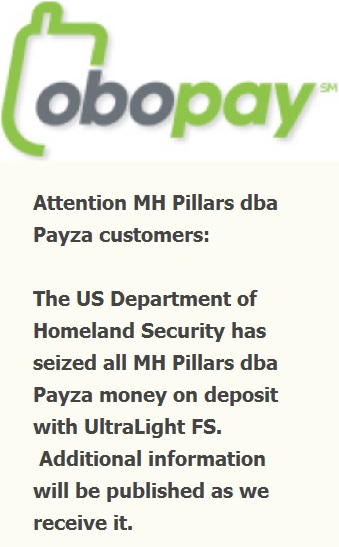
    This claim appears today on a website styled obopayusa.com. Precisely when it began to appear is unclear.
    This claim appears today on a website styled obopayusa.com. Precisely when it began to appear is unclear.

    With Cyber Monday and the traditional online sales coming up a few days from now on Dec. 2, this is what we know: Payza, the successor brand to Montreal-based AlertPay, a Ponzi-forum darling and chronic HYIP- and fraud-enabler, suddenly says this in a headline on its Community forum: “US Funds Frozen | Obopay/Ultralight FS. issue.”

    The announcement is dated yesterday, Thanksgiving Eve in the United States.

    Today is Thanksgiving Day. U.S. government offices are closed. Black Friday, another day of brisk U.S. sales activity in which retailers cater to door-busting holiday shoppers, is tomorrow.

    We also know that the U.S. government has established a tradition of taking down counterfeiting and piracy scams and their enabling websites on Cyber Monday. Moreover, we know that U.S. Immigration and Customs Enforcement (ICE), a division of the U.S. Department of Homeland Security, issued an alert two days ago that it is working with partners and “will be conducting increased operations during the holiday season targeting the importation and distribution of counterfeit and pirated products.”

    Beyond that, we know that the United States — the U.S. Secret Service, ICE and other agencies — took down the Liberty Reserve payment processor over the 2013 Memorial Day holiday period and the U.S. Department of the Treasury identified Liberty Reserve as a “Financial Institution of Primary Money Laundering Concern.” The bust was announced on May 28, the day after Memorial Day.

    Backing up a year, we also know that the AlertPay-enabled Zeek Rewards venture that allegedly conducted a $600 million Ponzi- and pyramid fraud while auctioning sums of U.S. cash and telling successful bidders they could use AlertPay and another offshore processor (SolidTrustPay) to collect it, curiously announced on Memorial Day 2012 (May 28) that checks it issued from two U.S. banks had to be cashed by June 1 or they would bounce.

    Backing up a few years, we also know that AlertPay and SolidTrustPay enabled the $119 million AdSurfDaily Ponzi scheme and the $70 million Pathway To Prosperity fraud scheme — to name just two of many.

    Meanwhile, we know that the court-appointed receiver in the Zeek case is going after money allegedly tied to Payza and SolidTrustPay. The most recent affirmation of this occurred on Nov. 14, when the receiver advised a federal judge that his efforts to gather $10 million from Payza “persisted” and that “new information has come in” that affects his analysis of Zeek-related Payza funds. Whether the $10 million sum would go up or down based on the new information was not revealed in the filing.

    Analysis of “transactional data from Payza is not yet complete,” the receiver advised the judge. He also noted that the Payza funds were held in a “foreign bank account” in an undisclosed country.  Based on its research, the PP Blog believes the country is in Eastern Europe.

    We also know that AlertPay effectively became Payza in May 2012, even as Zeek was conducting auctions for U.S. currency and experiencing trouble with U.S. banks. Payza operates through a New York entity known as MH Pillars Inc., which in May 2012 announced the “recent acquisition of AlertPay’s existing online payment platform.” Payza also is associated with a U.K. entity known as MH Pillars Ltd. of London.

    Thanksgiving Confusion

    Although Payza’s headline uses the word “Frozen,” the text below it does not identify the party that purportedly froze the funds. At the same time, the text appears to be at least slightly at odds with the headline claim that the money was “Frozen.” Indeed, the text describes the funds as “withheld.”

    Although the word choices may or may not be important, one thing seems obvious: Either word is apt to be unsettling to Payza’s U.S. customers who want their money.

    “As you may or may not already know, we are unable to complete any requests to withdraw or transfer funds for a part of our U.S. members at this time, since they are being withheld [emphasis added by PP Blog] by Ultralight Financial Services (formerly known as Obopay Inc.) a licensed U.S. money transmitter of which Payza was an agent,” the announcement begins.

    “We have tried to resolve this problem by contacting their management, their legal team and State regulators,” the announcement continues. “Their management and legal team were unresponsive. However, State regulators are willing to help us, but they have told us that they will not intervene unless they hear from you, the owner of your funds.

    “In this case, Payza is asking all affected members to demand action from both Ultralight FS and your State regulator . . .”

    At the time of this PP Blog post, the full Nov. 27 announcement is available at the Payza Community Forum. [See Update at bottom of this PP Blog post.]

    These Thanksgiving Eve claims by Payza are at odds with other claims online.
    These Thanksgiving Eve claims by Payza are at odds with other claims online.

    In short, Payza seems to be saying that Ultralight/Obopay Inc. is responsible for its inability to serve U.S. customers because the entities either froze or withheld the money.

    But here is where the information diverges and becomes even more fractious: At least two websites that state they’re associated with Obopay claim that “[t]he US Department of Homeland Security has seized all MH Pillars dba Payza money on deposit with UltraLight FS.” Both of these sites are cheesy in appearance. Both also have have copyright notices: One, styled obopayusa.com, says “Content copyright 2013. Obopay, Inc. All rights reserved.” The other, styled ultralightfs.com, says “Copyright @ UltraLight Financial Services. All rights reserved.”

    Neither site says when the money purportedly was seized. Nor does either site say how much was seized.

    So, the apparent obopay and UltraLight entities are saying the money was seized by the U.S. Feds. Payza is saying it was “frozen” or “withheld” by obopay/ultralight.

    What’s the truth? Well, it’s unclear at this time.

    There’s also a website styled obopay.com that appears to have the same logo as obopayusa.com. The obopay.com site asserts an association with Obopay Mobile Technology India Pvt. Ltd. of Bangalore and says its partners include Societe Generale, Essar Telecom Kenya Limited and Union Bank of India.

    The obopay.com site appears to make no reference to Payza or MH Pillars, but does reference Obopay Inc. of Redwood City, Calif., as its parent company. When the PP Blog clicked on a “State License” tab at the bottom of the obopay.com site, however, it received this error message: “An error occurred during a connection to www.obopay.com. Peer’s Certificate has been revoked. (Error code: sec_error_revoked_certificate).”

    So, another layer of the curious.

    Searching the database of the Financial Crimes Enforcement Network (FinCEN), the PP Blog located a document that suggests Obopay Inc. of Redwood City, Calif., is a registered Money Services Business in all 50 U.S. states, plus the District of Columbia. FinCEN is an arm of the U.S. Treasury Department. Its stated mission is “to safeguard the financial system from illicit use and combat money laundering and promote national security through the collection, analysis, and dissemination of financial intelligence and strategic use of financial authorities.”

    Information on MH Pillars Inc. of New York also appears in the FinCEN database. The information suggests the firm is a registered Money Services Business in at least 48 of the the 50 U.S. states. (California and New Hampshire appear to be possible exceptions.) MH Pillars also appears to be registered in venues such as American Samoa, the Federated States Of Micronesia, the Marshall Islands, the Northern Mariana Islands, Palau and the U.S. Virgin Islands.

    It seems clear that both Obopay Inc. and MH Pillars Inc. are registered MSBs. Why, then, can’t U.S. Payza customers get their cash? Could it be because UltraLight isn’t registered? The FinCEN database appears to have no information on UltraLight.

    But a Florida Department of State database does, and that information suggests Obopay Inc. is changing its name to ULTRALIGHT FS Inc. The Florida document is date-stamped Oct. 15, 2013. A phone number listed in the document comports with a phone number in Louisiana and Mississippi records as the number for Obopay Inc. of Mountain View, Calif.  Like Redwood City, Mountain View is a Silicon Valley community.

    Why FinCEN records show Obopay in Redwood City while state records show the enterprise in Mountain View was not immediately clear.

    What does seem clear is that some or all of Payza’s U.S. customers can’t get their money and that whatever dispute exists between Payza and OboPay/Ultralight is about money that either was frozen/withheld by OboPay/Ultralight or seized by U.S. law enforcement.

    Payza claimed in July 2012 to be cleaning up its act. This claim was made about a month prior to the August 2012 Zeek action by the SEC and an accompanying confirmation from the U.S. Secret Service that it also was investigating Zeek. Whether the Payza claim was just lip service remains to be seen.

    When the United States took down Liberty Reserve, the Secret Service changed Liberty Reserve’s domain nameservers to a “sinkhole” URL at ShadowServer.org. This initially caused Liberty Reserve to go offline. When the domain returned, the logos/badges of the U.S. Department of Justice, the Global Illicit Financial Team,  the Secret Service, the Treasury Department and Homeland Security Investigations were published on the site to let the world know that crime doesn’t pay in the United States.

    Payza’s website loaded quickly this morning, with full Payza branding and services appearing. DNS settings appear not to have been altered, suggesting at least to this point that the domain has not been seized by the United States. Whether the United States intends to seize it now or ever is not known.

    But seizing money is an altogether different matter. One of the ways to choke off HYIP and counterfeit-goods/pirating scams is to stop the fuel supply and to starve them out. If the United States desired to cripple criminal HYIPs and counterfeiting enterprises, it theoretically could attack them by seizing money that had been routed through Payza and the AlertPay predecessor.

    Whether that’s what’s happening here remains unclear. At the same time, it would be catastrophically foolish for an enterprise such as Obopay or UltraLight (or some combination thereof) to attribute a seizure of Payza funds to the U.S. Department of Homeland Security if it were not true. It also would be catastrophically foolish for Payza to claim that Obopay/UltraLight froze or withheld the money from U.S. Payza customers if that were untrue or not the complete truth.

    Seizure of money by the U.S. government requires a court order. Obopay/UltraLight either has or has not received such a court order or notice that one was on the way.

    If the United States has court-worthy evidence that Payza was facilitating online criminal enterprises, then it should become apparent in the coming days. If Obopay/UltraLight played any role, it also should become apparent.

    It could be a very interesting Black Friday or Cyber Monday.

    Update 7:31 p.m. Nov. 28:  The original Payza announcement appears to have been removed this afternoon or this evening and replaced by this considerably shorter one. There’s also a post on the Payza Blog. It is dated today and titled, “Important Update: Limited Services for Certain U.S. States.” Those states are not identified in the Payza Blog post.


  • URGENT >> BULLETIN >> MOVING: Liberty Reserve, Founder, Others Indicted In New York

    breakingnews72URGENT >> BULLETIN >> MOVING: (15TH UPDATE 2:31 P.M. EDT U.S.A.) Liberty Reserve, its founder and several others have been indicted in U.S. District Court for the Southern District of New York (Manhattan).

    The charges, which include conspiracy to commit money-laundering, conspiracy to operate an unlicensed money-transmitting business and operating an unlicensed money-transmitting business, were confirmed this morning by the office of U.S. Attorney Preet Bharara.

    Liberty Reserve founder Arthur Budovsky was using the aliases “Eric Paltz” and “Arthur Belanchuk,” according to the indictment.

    Co-conspirators, according to the indictment, include Vladimir Kats, also known as “Ragnar”; Ahmed Yassine Abdelghani, also known as “Alex”; Allan Esteban Hildago Jimenez, also known as “Allen Garcia”; Azzeddine El Amine; Mark Marmilev, also known as “Marko”; and Maxim Chukharev.

    Marmilev also is known as “Mark Halls,” according to an affidavit that accompanies the indictment.

    Budovsky and El Amine were arrested Friday in Spain, Bharara’s office said today. Kats and Marmilev were arrested Friday in Brooklyn. Chukharev was arrested Friday in Costa Rica. Hildago and Abdelghani are “at large” in Costa Rica.

    “As alleged, the only liberty that Liberty Reserve gave many of its users was the freedom to commit crimes — the coin of its realm was anonymity, and it became a popular hub for fraudsters, hackers, and traffickers,” Bharara said. “The global enforcement action we announce today is an important step towards reining in the ‘Wild West’ of illicit Internet banking. As crime goes increasingly global, the long arm of the law has to get even longer, and in this case, it encircled the earth.”

    Added Steven G. Hughes, special agent in charge of the U.S. Secret Service. “These arrests are an example of the Secret Service’s commitment to investigate and apprehend criminals engaged in the misuse of virtual currencies to conduct global monetary fraud. Cyber criminals should be reminded today that they are unable to hide behind the anonymity of the Internet to avoid regulated financial systems.”

    The IRS and the U.S. Department of Homeland Security (U.S. Immigration and Customs Enforcement’s (ICE) Homeland Security Investigations (HSI)) also are involved in the probe, as are multiple nations, Bharara’s office said.

    Liberty Reserve and its co-conspirators “intentionally created, structured, and operated Liberty Reserve as a criminal business venture, one designed to help criminals conduct illegal transactions and launder the proceeds of their crimes,” according to the indictment.

    The United States has seized the Liberty Reserve domain name along with several others, according to an affidavit that accompanies the indictment. The others include: ExchangeZone.com; SwiftExchanger.com; MoneyCentralMarket.com; and Asianagold.com. As part of the seizure process, a federal judge ordered the U.S. Secret Service to point the domain nameservers to a “sinkhole” URL at ShadowServer.org.

    News about the seizures destroys various examples of wishful thinking advanced by online HYIP hucksters at forums such as TalkGold and MoneyMakerGroup since LibertyReserve’s domain went offline Friday. On Saturday, reports surfaced that Budovsky had been arrested in Spain and that Liberty Reserve was under investigation in Costa Rica and the United States.

    Seizure notices are expected to appear on the domains, although the timing was not clear.

    The indictment ties Liberty Reserve to the crimes of “credit card fraud, identity theft, investment fraud, computer hacking, child pornography, and narcotics trafficking.”

    Among other things, the indictment alleges that “virtually all of Liberty Reserve’s business derived from suspected criminal activity” and that the scope of the fraud is “staggering.”

    Between 2006 and May 2013, according to the indictment, Liberty Reserve processed an estimated 55 million transactions and is believed “to have laundered more than $6 billion in criminal proceeds.”

    Supporting affidavits in the case show that the indictment was returned under seal on May 20 and that prosecutors applied for an injunction barring Amazon Web Services Inc. from providing services to Liberty Reserve. The affidavit also shows that the United States is seeking forfeiture of sums on deposit in at least 42 accounts in various countries

    These banks are in countries such as Costa Rica, Cyprus, Russia, Hong Kong, China, Morocco, Spain, Latvia, Australia and the United States. Tens of millions of dollars are being sought in forfeiture actions, although the final sum is unclear.

    Liberty Reserve, according to the indictment, used “exchangers” in countries with little oversight, including Malaysia, Russia, Nigeria and Vietnam. The process was part of a criminal scheme to bury evidence of fraud while providing anonymity for the fraudsters.

    The enterprise, according to the indictment, functioned “in effect as the bank of choice for the criminal underworld.”

    Link to documents posted by Bharara’s office. Read statement by Bharara’s office.

    In a separate but related action, the U.S. Department of the Treasury announced it had identified Liberty Reserve as a “Financial Institution of Primary Money Laundering Concern.”

    “Treasury is determined to protect the U.S. financial system from cyber criminals and other malicious actors in cyberspace, including overseas entities like Liberty Reserve that facilitate online crime and hope to evade regulatory scrutiny,” said Under Secretary for Terrorism and Financial Intelligence David S. Cohen. “We are prepared to target and disrupt illicit financial activity wherever it occurs – domestically, at the far reaches of the globe or across the internet.”


  • ‘In God We Trust’ Securities Huckster Found Guilty In $17 Million Swindle; Byron Keith Brown Had ‘Fleet’ Of Luxury Cars; Feds Call Business ‘Tangled Financial Web Of Lies’

    A Virginia man who traded on religious sentiments and the motto printed on U.S. currency to fleece investors in a $17 million Ponzi and securities swindle potentially faces decades in prison after being found guilty in Maryland of wire-fraud and money-laundering charges.

    Byron Keith Brown bought at least 16 luxury or high-performance cars with investors’ money, including brands such as Lamborghini and Rolls-Royce, prosecutors said.

    Brown, 32, of Vienna, operated In God We Trust Financial Services (IGT) and used his websites to ask prospects to turn over $1 million at a time, prosecutors said. He formerly lived in Ellicott City, Md.

    A veteran IRS investigator said the case demonstrated that a huckster could create the appearance of success to mask “a tangled financial web of lies.”

    “Ponzi schemes can thrive for a time on false claims about how the money is being invested and where the returns are coming from,” said Rebecca Sparkman, special agent in charge of the IRS Criminal Investigations Unit in the District of Columbia field office

    “[B]ut that time is gone and as this verdict shows it is time for those responsible to face judgment,” Sparkman said.

    Brown, prosecutors said, filed bankruptcy in 1999 — but soon emerged with a tale of fabulous success that painted him as the head of an international firm that specialized in catering to wealthy investors from offices in Washington, D.C., Wilmington, Del., New York, and London, England.

    It was all an illusion, prosecutors said.

    “[H]e had rented a mailbox or services at a virtual office that provided telephone answering services and mail forwarding services to clients,” prosecutors said.

    And Brown “used computer software to create an illusion that the investor was logging into a banking website and viewing account information when in fact, the account numbers were made up,” prosecutors said.

    U.S. Attorney Rod J. Rosenstein said the government, to date, has seized 16 high-end cars linked to Brown.

    “Byron Brown used the Internet to make it appear as if he were running an investment management business for wealthy investors, when in fact he was stealing millions of dollars from investors and using it to buy a fleet of luxury cars,” Rosenstein said.

    Included in Brown’s investor-funded haul were a 2004 Bentley, a 2005 Rolls-Royce Phantom, a 1936 Auburn Speedster, a 2007 BMW, a 1997 Jaguar, a 2006 Aston Martin, a 2007 Lamborghini, a 2008 Maserati, two Mercedes and a 2002 Ferrari, prosecutors said.

    “In addition to sentencing criminals to prison, our goal is to seize any assets purchased with criminal proceeds,” Rosenstein said.

    Brown was not licensed as a broker, dealer or investment adviser in Maryland, Virginia or the District of Columbia. The scheme operated between 2003 and 2009.

    America was dependent on the horse and buggy when the motto “IN GOD WE TRUST” became part of the national consciousness.

    The motto first appeared on the 1864 two-cent coin, the U.S. Department of the Treasury notes on its website. Abraham Lincoln was President at the time, and the United States was engaged in the Civil War against the breakaway South.

    On Nov 13, 1861, the Rev. M. R. Watkinson, Minister of the Gospel from Ridleyville, Pa., wrote to Treasury Secretary Salmon P. Chase, observing that “the Almighty God” should be recognized in some form on U.S. coins.

    Chase acted almost instantly to make it happen, according to the Treasury Department, which had received many similar “appeals from devout persons throughout the country,” the Treasury Department notes.

    Watkinson reasoned a nation that did not acknowledge God one day might be regarded a nation of heathens, according to his letter to Chase.

    “From my hearth I have felt our national shame in disowning God as not the least of our present national disasters,” Watkinson wrote to Chase nearly 150 years ago.

    In a letter dated Nov. 20, 1861 — a week after the date on Watkinson’s letter — Chase instructed James Pollock, director of the Mint at Philadelphia, to prepare a motto for U.S. coinage.

    Here is how the letter read, according to the Treasury Department.

    Dear Sir: No nation can be strong except in the strength of God, or safe except in His defense. The trust of our people in God should be declared on our national coins.

    You will cause a device to be prepared without unnecessary delay with a motto expressing in the fewest and tersest words possible this national recognition.

    The words “IN GOD WE TRUST” became the official U.S. motto by an Act of Congress in 1956, when Dwight Eisenhower was President. The words officially were added to paper currency, beginning in 1957.

    Brown operated at least three companies that used the “In God We Trust” theme, prosecutors said. Experts say scammers frequently use appeals to faith and patriotism to steal from investors or line them up to be fleeced in fraud schemes.

    Visit the Treasury Department website to read about the history of “IN GOD WE TRUST” on U.S. coins and currency.