UPDATED 8:45 PM EDT (U.S.A.) Already under investigation in Brazil and Massachusetts and linked to at least one affiliate allegedly involved in an earlier pyramid- and affinity-fraud scheme aimed at the Brazilian community, TelexFree acknowledged in a news release this morning that it had a presence in the economically challenged nation of Rwanda.
But TelexFree said it was not the firm banned from the African country by the Ministry of Trade and Industry on March 14.
TelexFree’s pushback at African media reports came on the same day the SEC announced a pyramid- and Ponzi case against WCM777, another MLM “program.” WCM777, which has some promoters in common with TelexFree, was accused of targeting Asians and Latinos and using multiple names to gather and move money.
A recent ad on an auction site offered 550 TelexFree “AdCentrals” for $16,760, a purported discount of $8,190. The AdCentrals, according to the ad, would provide a “minimum” return of $56,100. Where the ad originated is unclear.
Rwanda, TelexFree claimed, was not even on its “radar” until reports of tax evasion and money-laundering linked to the TelexFree name surfaced in African media.
“As far as we can tell, this has nothing to do with us other than the fact that somebody is making illegal use of our name,” TelexFree said in a news release. “We have in the neighborhood of half a million customers worldwide, and 121 of them are in Rwanda. But we have no connection with P.L.I. Telexfree Rwanda Ltd., the company shutdown in Rwanda. That company allegedly has been in business for 14 years, whereas we just celebrated our second year in business. We’ve checked our records and find no evidence of the names of the persons associated with that company registered as either our customers or agents. Rwanda wasn’t on our radar until this report hit the Internet.”
TelexFree did not say how it defined “customers.” Some promoters have claimed $15,125 sent to the firm returns $57,200 in a year through the purchase of “AdCentrals” offered alongside a VOIP service.
Massachusetts-based TelexFree said it believes the Rwanda matter “to be a case of mistaken identity” and that it had “not been contacted by the Rwandan government.”
Nor does TelexFree “have any reason to believe any action has been taken against it” in Rwanda, the firm said.
TelexFree, an MLM company, says it is in a number of businesses, including VOIP, an Internet telephone system.
Claims in the TelexFree news release were not attributed to a TelexFree corporate officer or executive. Rather, the assertions were attributed only to TelexFree itself. Why the firm chose not to quote an executive to refute the serious allegations in news reports was not immediately clear.
“It’s both the power and the challenge of VOIP,” TelexFREE explained in its news release. “Virtually anyone can register and use the system. The best we can figure out right now is that somebody is using our sales program to channel their own agenda, and that kind of repackaging is strictly prohibited by our Policies and Procedures. Our attorneys are doing all they can to find out what is going on.”
A Facebook site styled “telexfreerwanda” and dubbed “Telexfree Rwanda Team” has been promoting TelexFree since at least Jan. 17.
Here is one of the claims on the Facebook site (italics added):
A 14 year old Company with an Opportunity for YOU to get hired (as a Promoter) and you start getting paid on average 100 US$ each week for 52weeks. JOIN IT.
The prompt to “JOIN IT” appears to be a reference to TelexFree itself. And the assertion of a “14 year old Company” appears to reflect similar claims about TelexFree that have appeared on the web since at least July 2013, even though TelexFree says it is only two years old.
American MLMers have made claims similar to the claims on the Facebook site.
Any number of TelexFree affiliates appear to be confused about how long the company has been operating. Last summer, some affiliates claimed nine years. Others said 11 and 13 years.
In addition, the Facebook site says TelexFree can be visited “above Viva Supermarket.” On March 18, RwandaEye reported that the banned Rwandan enterprise operated from the top floor of a Viva supermarket in Remera. At least three links from the Facebook site resolve to the website of TelexFree, suggesting the operator or operators of the Facebook site are TelexFree affiliates.
The Facebook site uses affiliate identifiers such as “innosantana,” “innosanta01” and “innosanta1301.” Here is one example of a URL from the site: http://www.telexfree.com/innosantana
TelexFree did not say whether Haiti was on its radar. At a Boston pitchfest earlier this month, a man claimed from the stage that TelexFree reps recently flew on a “private jet” from the Dominican Republic to Haiti, perhaps the poorest nation in the Western Hemisphere.
TelexFree is based in a shared-office facility in Massachusetts, sharing a suite with at least 25 other firms. Promos have sought to plant the seed that TelexFree occupied the entire structure. The firm has been associated with a growing list of companies in various states, some of which use the name “TelexFree” and others that simply use “Telex.”
A document dated-stamped March 20 and on file at the Idaho Public Utilities Commission claims “[a]pplicant’s legal name is TelexFREE Telephone Company, LLC, with its principal place of business located at 225 Cedar Hill Street, Suite 200, Marlborough, MA 01752.”
That’s also the address of TelexFree Inc. at the shared office facility. There’s also a TelexFree LLC in Nevada.
The Idaho filing stressed in all-caps that TelexFree wanted its financial information kept “CONFIDENTIAL.” In Washington state, the Utilities and Transportation Commission published a document in February that asserted TelexFree LLC had made millions of dollars in intracompany loans to other TelexFree-related enterprises, including to TelexElectric LLLP, Telexfree Financial Inc., TelexMobile and Ympactus.
Filed by a self-identified TelexFree “consultant,” the Washington document also claimed TelexFree LLC had “21,613,289.00” in “Federal Income Taxes Payable” and another “3,924,262.30” in “State/Local Income Tax Payable” on its balance sheet as of Dec. 31, 2013.
UPDATED 12:21 P.M. EDT (MARCH 28, U.S.A.) Whack-A-Mole. Here’s the latest disturbing incarnation: On March 20, the Autorité des marchés financiers (AMF) published a warning on a gold “program” known as Karatbars International GmbH. BehindMLM.com spotlighted the warning yesterday.
From the AMF warning (bolding added): “With the company’s ‘Affiliates’ program, investors can make Internet-based purchases through Karatbars plans and they are encouraged to recruit two other Affiliates. These Affiliates are in turn encouraged to recruit two other Affiliates each, and so on. Affiliates are lured by the possibility of earning large payouts, in particular through a percentage of amounts collected from the Karatbars plans and gold products purchased by referrals.”
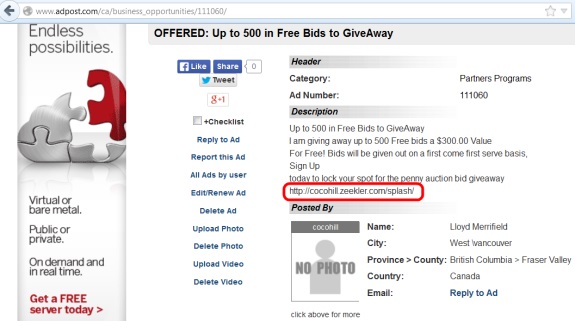
These things apparently meant little to former Zeek Rewards’ pitchman Lloyd Merrifield, who “defended” Karatbars International on BehindMLM. Zeek was an international Ponzi scheme that gathered at least $850 million, according to court records.
AdViewGlobal was an international Ponzi scheme that gathered an unknown sum before vanishing mysteriously in 2009. U.S. federal prosecutors linked it to ASD in April 2012.
Merrifield also was a pitchman for Ad-Ventures4u (ADV4U), an ASD-like HYIP scam tied to shiny-object scam known as “TradingGold4Cash.” And why not Tazoodle, a search-engine “program” whose “board” consisted of former ASD members who had the big idea they were going to unseat Google? Yep. Merrifield was there, too.
Along with ADV4U and Tazoodle, Merrifield pitched something called “20Clicks” as part of an overall package known as “The Golden Eggs.” (In 2009, the 20 Clicks website said it was “Powered by USHBB.com.” USHBB later was associated with the Zeek Rewards Ponzi scheme and is listed as a “winner” in a document assembled by the court-appointed receiver in the Zeek Ponzi/pyramid case.)
At least one HYIP pitchfest site that describes Merrifield as a “featured speaker” for Karatbars International has led cheers for “programs” such as AdHitProfits and MyFunLife and BannersBroker — and an emerging darling known as FlexKom. The site also has pushed “ProfitClicking,” one of the JSSTripler/JustBeenPaid reload scams linked to former ASD pitchman Frederick Mann.
Mann, among other things, may have ties to the “sovereign citizens” movement.
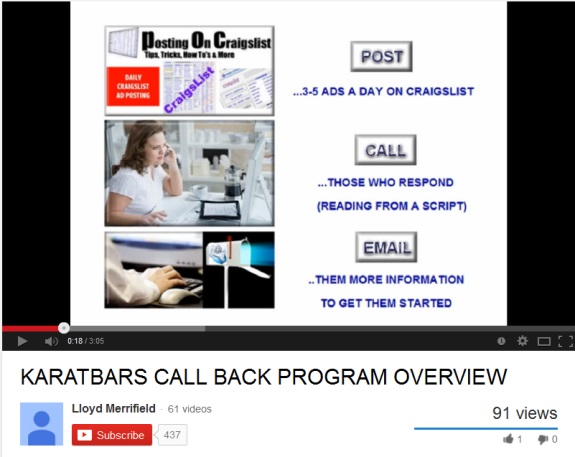
Merrifield, perhaps ignoring this 2010 FINRA warning on HYIP schemes and social media, pitches Karatbars International on YouTube and coaches viewers to line up recruits via craigslist.
Source: YouTube
On BehindMLM, Merrifield says he’s been “in the Investment Banking industry for over 35 years.”
As always, HYIP “programs” and similar ventures that may lack licensing in individual jurisdictions across the world raise the prospect that banks and payment processors are coming into possession of funds tainted by fraud. In some cases, those funds have circulated between and among various schemes.
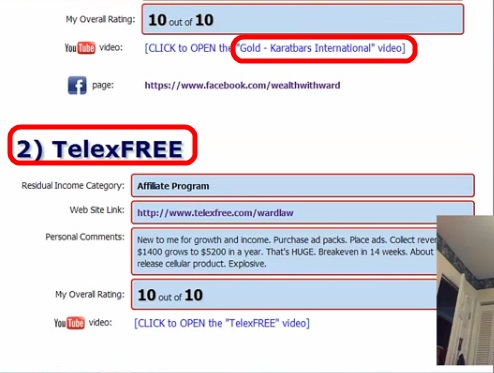
A quick Google search shows that some pitchmen are promoting Karatbars International alongside TelexFree, a “program” under investigation in North America, South America and Africa. TelexFree also has been promoted in concert with the WCM777 MLM scam.
From a video pitch that simultaneously pushes Karatbars International and TelexFree.
California-based WCM777, an MLM “program,” got booted out of Massachusetts in November 2013, amid allegations of securities fraud and affinity fraud targeted at the Brazilian community through hotel pitchfests. WCM777, purportedly operated by Ming Xu and recruiting affiliates to conduct business over the Internet, later got booted out of California. In addition to the Brazilian community, WCM777 targeted people who speak Spanish and people who speak Chinese, perhaps Christians in particular.
Massachusetts launched a probe into TelexFree, another MLM “program” associated with hotel pitchfests and affiliate recruitment over the Internet, at least by Feb. 28 of this year — probably sooner, given the nature of WCM777. TelexFree largely is targeting speakers of Portuguese and Spanish, perhaps Christians in particular. It also has an affiliate presence in India and Africa (at least).
Although the schemes do not appear to have common ownership, both WCM777 and TelexFree offered plans that encouraged recruits to buy in at higher levels to get higher “earnings.” Affiliates of each scheme appear to have engineered subschemes in which their recruits could buy in at higher levels than the “programs” themselves advertised, potentially introducing a second layer of fraud.
What this means, in essence, is that neither TelexFree nor WCM777 may know their real bottom lines and that the firms created an environment that encouraged back-alley, illegal sales of securities and secret deal-making among individual promoters. Individuals ostensibly acting as brokers for TelexFree and WCM777 could be cherry-picking cash and not even sending it to the “program” operators. In short, certain people could be creating personal and organizational underground economies and fleecing TelexFree and WCM777 even as they fleece their own marks and recruits.
Hidden members of both “programs” may be getting paid in cash by their upline sponsors or ostensible brokers, with no record of their participation — even if they supplied cash or an equivalent to join the “programs.”
The only safe assumption in HYIP Ponzi Land is that any system that can be abused will be abused. That’s why these “programs” necessarily must be viewed through the lens of national security.
Presented below are some screen shots that demonstrate promotional ties between TelexFree and WCM777. In certain instances, the websites pictured below are promoting not only TelexFree and WCM777, but also other “programs.” One of them, for instance, is promoting the almost indescribably insidious and bizarre Banners Broker “program.”
As always is the case in HYIP investigations, the concern is that banks locally, regionally, nationally and internationally are being used by corporate scammers first as warehouses to store illicit proceeds — and later, by individual promoters at potentially thousands and thousands of locations, as virtual ATMs that provide the service of offloading the “earnings” of the promoters.
The interconnectivity of these schemes endangers local, regional, state, provincial and national economies. In many cases, promoters engage in willful blindness and simply move to another MLM HYIP scam when the current “hot” one encounters regulatory intervention or craters on its own.
It’s often the case that promoters plant the seed that a scheme has been endorsed by a government or that a corporate registration is surefire “proof” that no scam exists. Social media invariably is used to help a scheme proliferate or achieve Internet virality.
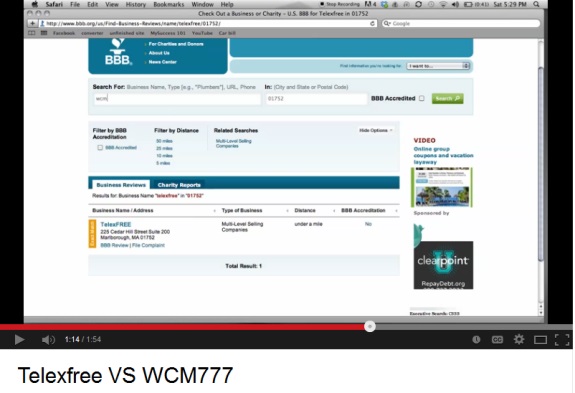
One of the shots below is from a YouTube video in which a TelexFree promoter seeks to plant the seed that TelexFree is backed by the Better Business Bureau. The narrator’s words in the video suggest he sought to plant the same seed about WCM777 but had to backtrack when he discovered a BBB listing that referred to WCM777 as a Ponzi scheme.
“Today we’re going to compare two of the most dynamic companies out there taking over right now,” the narrator said.
After recording a search of the BBB site for a TelexFree listing and finding one, the narrator suggested that the listing alone was proof that TelexFree was not a scam. He thereafter performed a search for WCM777 and found a Ponzi reference, thus triggering what appeared to be backtracking from his earlier claims that TelexFree and WCM777 were “dynamic companies.”
It also could be the case, we suppose, that he already knew about the WCM777 Ponzi listing before performing the search and that the design all along was to get people to go with TelexFree because WCM777 was a scam. Even under that interpretation, however, the video still demonstrates the underhandedness within the HYIP sphere.
The HYIP sphere always screams incongruity. Keeping that in mind, we’ll point out that one of the screen shots below shows TelexFree executive James Merrill in the same affiliate-manufactured frame as Massachusetts Commonwealth Secretary William Galvin. It was a clear bid to suggest that because TelexFree was registered as a corporation in Massachusetts, the “program” couldn’t possibly be a scam.
That is hogwash, of course. Galvin did not endorse TelexFree when his office approved a corporate registration. Besides, Galvin — as Commonwealth Secretary — oversees both the Massachusetts Corporations Division and the Securities Division. The Securities Division is probing TelexFree and possibly can rely on various documents in the Corporations Division to help investigators connect dots.
Beyond that, the website from which the screen shot promoting TelexFree by marrying images of Merrill and Galvin was taken also is promoting WCM777. Also shown below is an image from the same site in which Merrill is shown posing beside a giant SUV. Contrast that image against the image of Merrill posing in front of a large Massachusetts building as though TelexFree were its only occupant. TelexFree promoters have used the same approach, planting that seed that TelexFree owns the building and has a large physical presence in the United States.
That’s hogwash, too. TelexFree was an occupant of Suite 200 at a Regus center in Marlborough, along with dozens of other companies.
Finally, before observing the shots below, recognize that MLM itself — never a stranger to scandal — may be on the verge of experiencing a PR and legal crisis of unprecedented proportions.
People have harshly criticized hedge-fund manager Bill Ackman for attacking Herbalife. Among his contentions is that Herbalife is a pyramid scheme that targets vulnerable populations. Say what you will about Ackman’s Herbalife claims, but it is crystal clear that affinity fraud and the viral looting of impoverished/disadvantaged people have existed in the MLM realm for a long time and continues to be seen. One might even be inclined to say a market-making fraud blueprint exists within MLM: mow down one affinity cluster or population group and then move to another.
At a minimum, “programs” such as TelexFree and WCM777, which clearly have positioned themselves as wealth recipes for immigrants and vulnerable populations, can help Ackman shape and inform his Herbalife hypothesis.
James Merrill is TelexFree’s president and thus an MLM executive. TelexFree and Merrill, to date, have played into virtually every MLM stereotype that exists — everything from private jets, monster SUVs and stretch limos to business registrations and mail drops in Nevada.
Most disturbingly, though, Merrill represents an American MLM company that has been banned in Rwanda, an African nation that is trying to reverse poverty and receives aid from the World Bank. It’s hard to conceive that MLM — particularly American MLM — could card a worse PR disaster. Regardless, one could be in the offing.
Picture Story
1.
A TelexFree promoter who also promoted WCM777 extends the myth that TelexFree has a large physical presence in the United States and plants the seed that Massachusetts Commonwealth Secretary William Galvin endorsed TelexFree. Galvin’s office is investigating TelexFree after previously booting WCM777 from the state.
2.
A promoter simultaneously pitches TelexFree and WCM777. This shot is from the same site described in the photo above. The site may be based in Ecuador.
3.
This shot is from the same two sites described in the captions above — and features TelexFree President James Merrill posing with a giant SUV.
4.
This shot was taken on the same site described in the three preceding captions above. In this fourth shot, a person promoting both TelexFree and WCM777 claims that the purported parent company of WCM777 provided a loan of $20 million to a restaurant chain that sells Mexican food. The PP Blog has deleted an image of the chain’s logo that appears in the WCM777 promo. The same site plants the seed that WCM has provided hundreds of millions of dollars in loans to jewels of American business.
5.
This site features promos for various purported “opportunities,” including TelexFree and WCM777. Though not shown in the photo, the site also is promoting the uber-bizarre Banners Broker “program.” The site may be based in Italy.
6.
This site also is simultaneously promoting TelexFree and WCM777.
7.
This YouTube site describes TelexFree and WCM777 as “dynamic companies” and plants the seed that TelexFree is endorsed by the Better Business Bureau.
From a Blog leading dubious cheers for the TelexFree MLM “program.”
UPDATED 12:07 P.M. EDT (U.S.A.) You can’t blame legitimate MLMers if they’re feeling a little jittery. Herbalife, one of the industry’s stalwarts, is under investigation by the FTC, which has many duties, including enforcing laws against false advertising and pyramid schemes. Precisely why the FTC is investigating Herbalife is unknown. Hedge-fund manager Bill Ackman says Herbalife is a pyramid scheme that plumbs and churns vulnerable population groups. (See Nov. 13, 2013, PP Blog editorial: “Herbalife And Polarization In The Latino Community.”)
A public company, Herbalife itself announced the probe on March 12, saying it had received a “Civil Investigative Demand” (CID) and will “cooperate fully” with the agency.
But even as Herbalife wore a confident face and shared the FTC news, others within the MLM realm were making the trade look ridiculous on a global scale. MLM already is known for train wrecks (see example) and spectacular PR gaffes (see example). The sorry circus taking place outside of Herbalife’s immediate sphere of influence (see below) couldn’t come at a worse time for the firm.
To Herbalife’s credit, there was no attempt to demonize the FTC or pretend the CID was unimportant. So, score an early point for the supplement-maker in the category of PR awareness.
The unfortunate reality for Herbalife, however, is that it is ensconced in an industry that serves up one outrageous scam after another. And because some quirky or downright bizarre MLM “programs” have shown an almost unbelievable ability to raise tremendous sums of money quickly, the issue is not simply about a PR deficit. It’s also about national and cross-border security.
That’s why Herbalife’s conduct while it is under investigation by the FTC matters to the entire trade.
Attempts by Stepfordian MLMers to paint law enforcement as the enemy and dismiss the importance of a CID sent by North Carolina Attorney General Roy Cooper to the Zeek Rewards MLM “program” in July 2012 made MLM look silly. Claims from Zeek’s Stepfordian wing that the receipt of a CID was “exciting” news made it look beyond clueless.
Whether the trade likes it or not, all of this Stepfordian behavior gets pinned on “MLM.” And MLM therefore looked particularly ridiculous when the SEC, a month after the North Carolina CID, described Zeek as a Ponzi- and pyramid scheme that had gathered hundreds of millions of dollars in less than two years and had ripped off hundreds of thousands of people by planting the seed it paid an interest rate of 1.5 percent a day and that earnings could be “compounded.”
So, if you’re a legitimate MLMer and need a comforting thought, here’s one for you: Unlike Zeek, Herbalife isn’t trying to sell the “exciting” angle to its legions of members during a government probe. And here’s a tip for legitimate MLMers and individuals considering signing up for an MLM: When someone tells you a government investigation is exciting news, get the hell off the list or stop reading the Blog. Recognize that you’re being splashed with sugary vomit and programmed by an MLM Stepfordian.
The PP Blog’s analysis of Zeek is that it was a criminal enterprise from the start that was designed in part to reel in participants dissatisfied with traditional MLM companies such as Herbalife that sell the dream but have low distributor success rates and high burn rates. Refugees from Herbalife and other traditional MLMs were perfect marks for Zeek’s MLM, a collection of predatory vultures unlike the MLM world had ever seen.
We’re bringing this up because MLM so often ventures into Stepfordland. So, odd as it sounds, Herbalife did itself (and the industry) a favor by avoiding the word “exciting” when describing a CID. For perfectly understandable reasons, it allowed only that it “welcomes the inquiry given the tremendous amount of misinformation in the marketplace” and that it is “confident that Herbalife is in compliance with all applicable laws and regulations.”
Even though Herbalife did not fumble the ball when announcing the probe, the company still needs to work on its messaging. Last year, when the firm was confronting Ackman’s pyramid allegations and companion assertions that it was plumbing and churning Latinos/Hispanics to sustain growth, Herbalife described former U.S. Surgeon General Richard Carmona — a new appointee to its board — as “[b]orn to a poor Hispanic family in New York City.”
In highlighting Carmona’s circumstances as a newborn delivered into poverty in the Big Apple more than 60 years ago, Herbalife perhaps was projecting some stress. Whether it also was projecting an accidental hint of a Stepfordland within Herbalife remains on open question.
Given the disturbing plumbing-and-churning assertions against the firm, Herbalife would have done better by simply announcing Carmona’s appointment and including only his academic/business/public-service credentials in the announcement. It doesn’t matter that other enterprises with which he is involved have used the same line about hailing from a “poor Hispanic family” to describe him. They’re not being accused of pillaging vulnerable populations.
In short, Herbalife cannot afford to be seen as a Stepfordland company. Nothing can erode marketplace confidence faster.
Poor or even insidious messaging has harmed MLM for years. It is an industry that, unfortunately, is known for serial disingenuousness, absurd misrepresentations, gross distortions, impossible constructions and outright lies.
How Other Industry Messages Could Hurt Herbalife
On March 11, a day before Herbalife announced the FTC probe, members of the TelexFree MLM were taking to the web and planting the seed that President Obama had TelexFree’s back. The assertions are either a gross misunderstanding of the JOBS Act and the concept of raising startup capital through crowdfunding or a typical MLM lie to provide extra cover for the scheme. (See Google Translation from Portuguese to English here. See original here.)
For starters, TelexFree, which appears to have gathered $1 billion or more in less than two years, wants the public to believe it is not selling securities, despite affiliate claims the “program” delivers “passive” income. Moreover, it is not raising capital under the JOBS Act, which is a work-in-progress. In October 2013, the SEC formally proposed that a “company would be able to raise a maximum aggregate amount of $1 million through crowdfunding offerings in a 12-month period.”
The sum of $1 million is less than the sum TelexFree pitchman and former SEC defendant Sann Rodrigues says he’s earned from TelexFree since Feb. 18, 2012.
Rodrigues started pitching TelexFree before the JOBS Act even became law and before the SEC even promulgated rules. So, strike the JOBS Act claim.
Beyond that, TelexFree is under investigation by the Securities Division in its home state of Massachusetts. There’s also at least one probe in Africa, specifically in Rwanda, where a genocide occurred in the 1990s. Meanwhile, in South America, Brazilian prosecutors have called TelexFree a pyramid scheme. Police in Europe have issued warnings about TelexFree, amid concerns that the “opportunity” is targeting the Madeiran community.
At a minimum, TelexFree is at least as clueless as Zeek, home of the “exciting” CID. As noted above, TelexFree pitchman Sann Rodrigues is a former defendant in an SEC pyramid-scheme and affinity-fraud case. If that weren’t enough, TelexFree executives and reps apparently have access to a “private jet” that recently made a flight between the Dominican Republic and Haiti.
If there’s a surefire way to destroy the public’s confidence in the emerging JOBS Act, it’s for a bunch of MLMers to go around planting the seed that the President of the United States has authorized TelexFree as a crowdfunding company — and to water that seed by talking about “private jets” that can be flown by the TelexFree MLM into Haiti to line up struggling Haitians to sell credit repair and financial advice to struggling Americans.
Yes, we know: It’s altogether too much to believe. But the bitter reality for MLM — and therefore for Herbalife — is that it’s actually happening.
TelexFree says it’s in the communications business, and is expanding from VOIP into cell phones and, highly curiously, credit repair and financial advice. This is an MLM quagmire if ever there was one, especially since American MLMers say sums from $289 to $15,125 sent to TelexFree virtually triple or quadruple in a year.
If MLMers ever wonder why the trade has so many critics, they need look no further than TelexFree or Zeek before it.
With Zeek smoldering in the ashes of Ponzi/pyramid history and TelexFree serving up a current symphony of the bizarre, the MLM trade now also is confronting yet-another epic PR disaster — namely, a “program” known as WCM777 that, like TelexFree, is under investigation in multiple countries.
Like TelexFree and Zeek, WCM777 also promoted preposterous returns.
But that might be just the beginning of WCM777’s problems. Among other things, WCM777 has claimed it is “Launching The Way TV to transform nations & Joseph Global institute to train a group of Josephs to bless the world.”
But the “Joseph Global Institute” and a companion enterprise that trades on the name of Harvard appear to be shams. And The Way TV launched long ago through an entity known as Media for Christ, which became the center of an international firestorm over a production known as “Innocence of Muslims.”
Particularly disconcerting now are reports that tens of millions of dollars may have gone missing from the WCM777 coffers. In 2013, the SEC alleged that a “program” known as Profitable Sunrise may have gathered tens of millions of dollars before disappearing.
Don’t kid yourself: There is no doubt that the circumstances surrounding some MLM “programs” are affecting economic security and contributing to concerns about national security.
MLM Minefields
As noted above, precisely why the FTC is investigating Herbalife is unclear. The Zeek case initiated by the SEC, however, could supply a clue or even a specific reason for the U.S. government to be concerned about Herbalife. A look at the list of alleged “winners” by the court-appointed receiver in the Zeek case suggests that Zeek became popular in immigrant communities, which may signal MLM affinity fraud on top of Ponzi and pyramid fraud.
It also may signal immigrant-on-immigrant crime under the MLM umbrella.
This information is preliminary, meaning a more thorough analysis is needed. But it at least suggests that some MLMers are proceeding from fraud scheme to fraud scheme and either laying waste to immigrant communities in the United States or setting the stage for immigrant populations to become immersed in litigation and MLM scams.
The surname name of “Johnson,” for instance, is one of longstanding in America. So, it can be expected that a major fraud scheme with 1 million or so members such as Zeek would pull in a number of people with that last name. There are about 45 people with that name on the Zeek list.
At the same time, there are about 60 people on the list with the Asian name of “Li.” So, “Li” has significantly more appearances than “Johnson.”
And what about “Smith,” another traditional American name? Well, there are about 52 “Smiths” on the list. Contrast that with the names “Nguyen” (about 146) and “Chen” (about 137).
There also are many Latino/Hispanic names on the Zeek list. Mind you, this is the list of alleged Zeek winners, not losers. The list of losers — perhaps as many as 800,000 — is not publicly available. (Because it is believed that many Zeek members had multiple user IDs, the number of user IDs may exceed the actual number of losers. But even if the 800,000 figure only incorporates user IDs, it remains troubling. The early data on the winners’ names suggest that immigrants could have been targeted as marks by other immigrants and also by long-established American MLMers.)
Latino groups have voiced concerns about Herbalife targeting vulnerable populations. With Zeek data suggesting such targeting occurred within Zeek, the MLM trade have may to confront some tough questions: Is a mature American MLM market being shored up by a disproportionate share of recent or relatively recent immigrants? And are American MLM companies prospecting in new lands creating losing propositions for the native inhabitants of those lands?
TelexFree certainly has targeted Portuguese and Spanish speaking populations — in the United States, Brazil and elsewhere. So has WCM777, which also has targeted Asians and Asian-Americans.
People are free to criticize Bill Ackman’s assertions that Herbalife is a pyramid scheme that is targeting vulnerable populations. But if MLMers who criticize Ackman expect to be taken seriously, they’d better be able to explain what appears to have happened at Zeek and what appears to be occurring now with both TelexFree and WCM777.
U.S. MLMers of any stripe — from longstanding citizens and naturalized ones to individuals hoping one day to proudly call themselves Americans — need to say no loudly to “programs” such as Zeek, TelexFree and WCM777.
And at a minimum, Herbalife needs to stop selling a message of “get rich quick” or turning a blind eye to it and stop trying to explain away its burn rate as the byproduct of affiliates who didn’t work hard enough to realize the dream.
Herbalife cannot be blamed for Zeek, but the burn rate may explain how Zeek and similar schemes rise to cherry-pick traditional MLMers and their recruits who have made little or no money with companies such as Herbalife.
No matter what the FTC has on its mind, any assertion by Herbalife that its current program is exemplary will be the strongest evidence of all that it, too, resides in MLM La-La Land. That would be a tragedy, given that Herbalife is viewed in the MLM community as a beacon of freedom.
This image of a golden pyramid appeared on the Global-Unity website last month.
UPDATED 6:42 P.M. EDT (U.S.A.) The Autorité des marchés financiers (AMF) has issued an Investor Alert on the WCM777 MLM “program.”
Quebec’s securities regulator now joins at least nine other jurisdictions issuing Investor Alerts or filing actions against WCM777, also known as World Capital Market, Kingdom777 and Global-Unity. Global-Unity recently used a photo of a golden pyramid on its website, a possible taunt at regulators.
“World Capital Market, Inc., WCM777, Inc. and WCM777 Limited and their officers and representatives, Ming Xu, Zhi Liu and Harold Zapata, are not registered with the AMF and did not obtain a receipt for a prospectus from the AMF,” AMF said. “Consequently, any solicitation of Québec investors by these firms and individuals could violate the Québec Securities Act.”
AMF said the “scheme originated in California and is offered mainly as part of hotel presentations and through Internet ads and webinars.”
Quebec’s move brings the unofficial total of jurisdictions or regulatory agencies filing actions or issuing Investor Alerts against WCM777 to 10. The others are the country of Peru, the country of Colombia, the state of Massachusetts, the state of California, the state of Colorado, the state of Louisiana, the state of New Hampshire, the state of Alaska, the province of New Brunswick.
A giant human hand puts the top piece on a golden pyramid. Source: Global-Unity website.
Updated 6:24 p.m ET (U.S.A.) Members of the WCM777 scam, which morphed into Kingdom777 after regulatory actions were filed, have been informed by a “program” upline that the venture now is operating as Global-Unity, a source told the PP Blog today.
Parts of the Global-Unity website appear to be under construction. The “News” tab, for instance, includes no releases.
Strangely, though, it does include a photo of a giant human hand placing what appears to be the top piece on a giant golden pyramid. Whether the photo was designed as a taunt to regulators was not immediately clear.
WCM777 is the subject of regulatory actions or Investor Alerts in the United States, Canada and Peru. TelexFree is the subject of a pyramid probe in Brazil.
HYIP scammers have been known to taunt regulators. Frederick Mann, the purported operator of the JSSTripler/JustBeenPaid HYIP scam, once claimed that government workers were “part of a criminal gang of robbers, thieves, murderers, liars, imposters.”
JSSTripler/JustBeenPaid purported to pay 2 percent a day (precompounding). The original scam changed names at least twice after the Zeek Rewards’ Ponzi action by the United States in 2012. Zeek was a scam designed to make investors believe they’d received an average payout of 1.5 percent a day, the SEC said.
JSS/JBP’s Mann was a former AdSurfDaily Ponzi-scheme pitchman and appears to have had sympathies for “sovereign citizen” political extremists in the United States, including convicted “militia” man Francis Schaeffer Cox.
A scam known as “Profitable Sunrise” that became the subject of state and federal regulatory actions in the United States last year once promoted a 2.7-percent-a-day investment “plan” known as the “Long Haul.” The Long Haul payout purportedly was due April 1, 2013 — April Fool’s Day and the day after Easter.
At least one Profitable Sunrise supporter taunted North Carolina regulators after the state filed a Cease and Desist order against the “program.” (See Comments thread below this story.)
Profitable Sunrise, like both WCM777 and TelexFree, was targeted at Christians. Both the “Long Haul” name and the purported payout dates could have been taunts.
In promos, TelexFree, WCM777 and Profitable Sunrise each used an image of the Christ the Redeemer statue in Brazil.
The unofficial total of jurisdictions or regulatory agencies filing actions or issuing Investor Alerts against WCM777 stands at seven: The country of Peru, the state of Massachusetts, the state of California, the state of Colorado, the state of Louisiana, the state of New Hampshire, the province of New Brunswick.
In addition, the Canadian Securities Administrators — an umbrella organization of 13 provinces/territories of Canada that is responsible for developing a harmonized approach to securities regulation across the country — has published the New Brunswick warning. The Better Business Bureau, meanwhile, has given WCM777 an “F,” its lowest score.
Despite the regulatory actions, WCM pitchfests are continuing online.
NOTE: Our thanks to a reader who let us know about the Telemundo report.
The purported TataAgro entity had a presence on the Ponzi boards and appears to have used trading screens to dupe the worldwide investing public. Image source: Google cache.
BULLETIN: (3rd Update 8:32 a.m. ET, Feb. 20 U.S.A.) The Tata Group, a global conglomerate based in India, says its name has been stolen by an HYIP Ponzi scheme. The fraud scheme is associated with a domain styled TataAgro.com and has a presence on the MoneyMakerGroup, TalkGold and DreamTeamMoney Ponzi forums, according to search results.
Like the recently exposed WCM777 fraud scheme, the TataAgro scam claims a business presence in the British Virgin Islands. WCM777 also traded on the names of famous companies, including Siemens, the German conglomerate. Siemens issued statements warning the public about WCM777. Tata now has done the same thing with the purported TataAgro entity.
The TataAgro website “claims that ‘Tata Agro Holding is a subsidiary of the globally known Tata group, [and is] one of the top 10 agro investment players in Asia’s financial market,’” the real Tata says. “It goes on to offer a wide range of investment plans with a monthly profitability of up to 100%.
“Members of the public are hereby cautioned that the information provided on the website is absolutely false, misleading and intended to defraud innocent and unwary members of the public,” the real Tata says. “Neither Tata Sons nor any other Tata company has any connection whatsoever with the aforesaid Tata Agro Holding. Tata Sons is initiating appropriate action in the matter.”
PonziTracker.com was among the first outlets to report the news of the Tata warning.
The TataAgro site appears not to be loading.
It is somewhat common for fraud schemes to try to steal the identities of major figures on the world financial stage. CONSOB, the Italian securities regulator, regularly publishes information on purported “opportunities” that adopt the names of legitimate firms to create confusion and fleece the masses.
A post dated Dec. 3, 2013, at the MoneyMakerGroup Ponzi forum claims the purported TataAgro entity pays “1.9-3.1% daily for 15-90 days” and accepts Perfect Money, BitCoin, EgoPay and Qiwi.
Meanwhile, a post dated Dec. 17 at the DreamTeamMoney Ponzi forum makes this claim (italics added):
Tata Agro is an agricultural investment company founded in 2012 in British Virgin Islands. We are a subsidiary of transcontinental conglomerate Tata Group that has been established in India back in 1868 and now boasts the combined market capitalization of $96 bln.
We have retained only the best things from a rich and long experience of our ancestor: the unique corporate culture, client-oriented and customized approach, and understanding of the market through retrospective analysis. Our fundamental aim is to help you grow your capital.
We work with assets like barley, soya, soya oil and meat, corn, wheat, and livestock and currently operate in CME Group, TOCOM, and MGEX exchange houses.
We are eager to offer you four investment plans with the daily ROI of 1.9% to 3.1% and investment term of 15 to 120 days. You can invest from 5 to 10,000 USD. Apart from that, we offer you a profitable referral program that lets you earn more and work side by side with your family and friends.
A post dated Dec. 17 at the TalkGold Ponzi forum makes these claims (italics added):
Invest 5 to 100$ for 15 days and earn 1.9% ROI daily;
Invest 100 to 1000$ for 30 days and earn 2.3% ROI daily;
Invest 1000 to 5000$ for 60 days and earn 2.5% ROI daily;
Invest 5000 to 10,000$ for 120 days and earn 3.1% ROI daily.
Collapsed fraud schemes such as Zeek Rewards, AdSurfDaily, Legisi, Pathway to Prosperity, Profitable Sunrise, Imperia Invest IBC and many more also had a presence on the Ponzi boards.
The TelexFree “program” currently has a presence on the Ponzi boards.
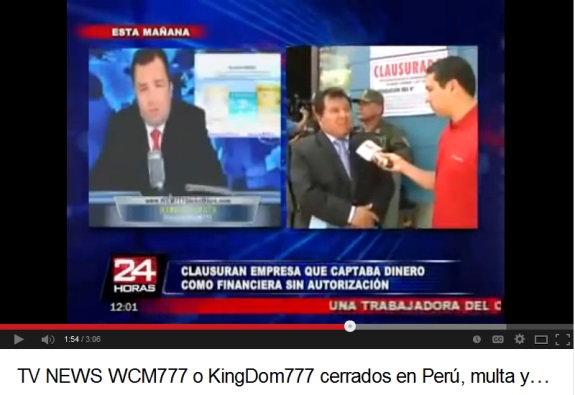
As a reporter interviews a Peruvian official at the scene of a police raid against a WCM777 outlet in Lima, an image of American pitchman Harold Zapata (left) flashes on the screen. Source: YouTube.
Still using social-media sites to promote massive fraud schemes — even after the AdSurfDaily, Zeek Rewards and Profitable Sunrise debacles?
Thanks to his presence on social media, Harold Zapata, a WCM777 YouTube pitchman named a respondent in a Desist and Refrain order announced last month by California’s Department of Business Oversight, may be trapped between a rock and a hard place.
Zapata is a California resident. Not only does the state know about his YouTube presence — indeed, his promos are referenced in the D&R — so do authorities in Peru. Whether Zapata ever has ventured to Peru is unclear. What is clear is that Peruvian media have used snippets of his U.S.-based promo as a backdrop to video reports about a police raid against a local WCM777 outlet in Lima.
Whether he likes it or not, Zapata has become one of the American faces for WCM777. In one video, Zapata identified himself as a WCM777 “director . . . working directly with our founder, CEO, chairmans [sic], leaders in our WCM777 organization.”
WCM777 executives include Ming Xu and Zhi Liu, California said. Both men are named in the D&R. Zapata also is named.
California’s action against WCM777, its executives and Zapata may signal trouble for other YouTube pitchmen for highly questionable MLM “programs” or outright scams. For starters, YouTube commercials for HYIPs sometimes are copied and used by promoters of the same purported “opportunity,” thus saving fellow pitchmen the time and trouble of making their own videos. This can happen with or without permission, perhaps with an eager recruit using the video of another sponsor but inserting a URL to the recruit’s page in a companion text pitch below the actual video.
Beyond that, some fraud-scheme pitchmen openly share their YouTube promos with downline recruits as a means of driving more business to a scam. Such approaches typically are portrayed as the acts of a helpful sponsor who wants to see his or her recruits thrive by providing them the “tools” they need to succeed.
At least one YouTube pitchman for WCM777 appears to be using Zapata’s video to drive traffic to WCM777 and possibly other “opportunities.”
Zapata appears to have noticed this at least two months ago and placed warnings in Spanish and English on the YouTube site of the fellow WCM777 pitchman.
Here’s how the warnings read (italics added):
Por favor quite este video inmediatamente o me veo obligado a reportarte por infracción de copyright, de este video.
Please remove this video immediately or I will be forced to report this video for copyright infringement.
The video nevertheless remains. It shows Zapata pitching WCM777 in English, even after the California action and the raid in Peru. The title of the video on the fellow WCM777 pitchman’s site is “WCM777. FULL PRESENTATION IN ENGLISH.”
It is unclear from Zapata’s warnings whether he was upset that the video was being used without his permission or whether he was concerned that the fellow WCM777 pitchman was using the video to cherry-pick Zapata’s earnings.
Regardless of Zapata’s specific concerns, however, the continued appearance of the video shows the vulnerability of MLM pitchmen who promote “programs” on YouTube. Such promoters not only may lose control over their own content, they literally may lose control over their own faces.
Even if Zapata has stopped promoting WCM777, the video published by the fellow WCM777 pitchman makes it appear as though Zapata still is promoting the purported opportunity, which California publicly declared a scam last month. Last week, the state asked residents who invested in WCM777 to contact the DBO immediately.
At least 5,500 Californians plowed money into the WCM777 scam, the state said.
“The California Department of Business Oversight has seen a surge of high-yield investment schemes that take advantage of social networks to market illegal investments,” said Jan Lynn Owen, commissioner of the Department of Business Oversight. (Bolding added by PP Blog.)
In 2010, FINRA called the HYIP sphere a “bizarre substratum of the Internet” and issued a warning that such schemes were spreading on social-media sites such as YouTube, Facebook and Twitter. Zapata’s experience demonstrates that some HYIP pitchmen either missed the warning or chose to ignore it.
BehindMLM.com is reporting that WCM777 — now operating as Kingdom777 — appears now to be engaging in ham-handed wordplay to continue its duping of the masses. The “program,” BehindMLM reports, now is using the word “members” and trying to steer clear of the word “investors.”
Such wordplay bids foreshadowed doom at both AdSurfDaily, a $120 million Ponzi scheme, and Zeek Rewards, which allegedly gathered at least $850 million.
As the PP Blog reported in June 2012, here is part of what the U.S. Secret Service said in a filing in the ASD Ponzi-scheme case in February 2009 (italics’bolding added):
[ASD operator Andy] Bowdoin and his sponsor knew that it was illegal to sell investment opportunities to thousands of individuals; thus, they were careful not to call participants “investors” but rather referred to them as “members.” Moreover, there were careful not to call payments to “members” “return on investments”; rather, they referred to the income program as a “rebate” program . . .
For whatever reason, HYIPs and their pitchmen apparently continue to believe they can duck or circumvent securities regulations and laws against the sale of unregistered securities by calling an investment something else.
Prosecutors made short work of the Zeek and ASD wordplay, saying both “programs” engaged in linguistic games to describe an investment as something else.
WCM777 even may dialing up the HYIP wordplay madness. From BehindMLM.com (italics added):
A “dividend” [at WCM777/Kingdom777] is now a “bonus”… cuz well, a bonus could be anything… including an investment “return”, which is now also just a “bonus”.
BULLETIN: (UPDATED 6:38 P.M. ET U.S.A.) The state of California, which last month issued a Desist and Refrain order against the WCM777 MLM “program” and called it an “investment scam,” now is asking residents who invested in WCM777 to contact the Department of Business Oversight “immediately.”
At least 5,500 Californians plowed money into the scheme, the DBO said.
The state has ordered WCM777 to halt is operations in California.
“The California Department of Business Oversight has seen a surge of high-yield investment schemes that take advantage of social networks to market illegal investments,” said Jan Lynn Owen, commissioner of the DBO. “We encourage anyone who dealt with WCM777 to immediately contact the Department.”
Affinity fraud is part of the WCM777 mix, the state said.
“Relying on Biblical themes to lure investors, the WCM777 scheme offers securities in the form of memberships that allegedly provide purchasers with up to a 60 percent profit in 100 days,” the state said.
Named in California’s order are executives Ming Xu and Zhi Liu, and YouTube pitchman Harold Zapata, all with addresses in California Also named are World Capital Market Inc., WCM777 Inc. and WCM777 Limited.
Police raided a WCM777 outlet in Peru last month. At least one Peruvian TV station showed snippets of Zapata’s YouTube pitch as part of its coverage of the raid. The development signals that HYIP pitchmen operating from the United States or other countries and using YouTube to help a fraud scheme go viral now may find their faces plastered on TV both locally and in faraway lands.
FINRA issued a warning on HYIP schemes that use social-media sites in 2010.
From the 2010 MPBToday MLM scam. Like Zeek Rewards, MPBToday traded in part on Walmart gift cards.
Ah, those serially disingenuous MLM hucksters and commission-based Ponzi pitchmen: They’ll ultimately destroy their own brands while picking millions of pockets. Before doing so, they’ll use your brand as a temporary means of sanitizing themselves, bring PR disasters to your legitimate company and perhaps even find an insidious way to turn the government into their banker.
Longtime PP Blog readers will recall the outrageous scam of MPBToday. MPBToday duped the MLM masses in part by planting the seed that Walmart gift cards or prepaid Visa cards would flow to members in unlimited supply if they sent $200 to the Florida-based “program” for a “one-time” purchase of “groceries” and if the members recruited two others who’d also recruit two others to do the same.
In addition to being a pyramid scheme that sent operator Gary Calhoun to prison in Florida on a racketeering charge, MPB Today could have been a scam that disguised “program” earnings as nontaxable “gifts” to dupe Uncle Sam.
It’s almost axiomatic in MLM Scam Land that an “opportunity” and/or its Stepfordian promoters will imply a tie to a major brick-and-mortar business or even the government, when no such ties exist or the ties are no more official than ties any consumer can enjoy — purchasing a gift card from a major retailer, having a bank account or renting a room at a major hotel chain, for instance. It happened at MPB Today in 2010, and it’s happening now within the Stepfordian wing of TelexFree — a wing in which promoters have suggested that TelexFree has been “authorized” or “approved” by the government.
It also happened both internally and externally at WCM777, now the subject of cross-border investigations in both North America and South America. In an apparent bid to sanitize the WCM777 scheme, alleged operator Ming Xu arranged to have himself photographed with celebrities such as former U.S. Vice President Al Gore and Apple co-founder Steve Wozniak. Meanwhile, WCM777 promoters rushed to YouTube and other social-media sites to claim that WCM777 had ties to famous businesses such as Siemens and a host of hospitality companies with famous flags.
Such rank MLM disingenuousness also occurred within the $850 million Zeek Rewards scheme. In the PP Blog’s view, Zeek’s maximum expression of such deception occurred when it was auctioning sums of U.S. cash and telling successful bidders they’d get paid through offshore payment processors such as AlertPay and SolidTrustPay. By divining sums up for auction and accepting bids for U.S. currency, Zeek implied it had been approved by the U.S. government, perhaps specifically the Treasury Department.
And by sending the incongruous (and bizarre) message that the Treasury-approved Zeek MLM scheme would pay members via offshore processors linked to the equally outrageous AdSurfDaily Ponzi scheme broken up by a Task Force consisting of the U.S. Secret Service and the Treasury Department (IRS) in 2008, Zeek served up another colossal mess for MLM.
Zeek, of course, followed the footsteps of MPBToday — whose operator lost his liberty after pushing all those Walmart cards out the door — by leeching off the names of major American retailers. In addition to auctioning cash, Zeek auctioned gift cards.
And this brings us to an interesting footnote in a quarterly report filed Jan. 30 by Kenneth D. Bell, the receiver in the Zeek Rewards Ponzi-scheme case. Zeek operated through Rex Venture Group (RVG).
“Unlike other retailers the Receiver Team approached, Wal-Mart and Home Depot readily agreed to refund the full amount of their gift cards held by RVG at the time of shut-down,” Bell advised Senior U.S. District Judge Graham C. Mullen. “The remaining gift cards were sold at auction, and their value is included in the gross receipts from the personal property portion of the Receivership auction.”
Walmart and Home Depot know a PR disaster when they see one. They ponied up quickly when the receiver asked them, thus making his job of gathering funds for Zeek victims a bit easier. Some other companies that perhaps have less PR savvy did not. The receiver auctioned their gift cards in public.
Bell’s examination of Zeek’s money flow continues, according to the Jan. 30 report. The report reveals that lawsuits against alleged insiders and winners had not been filed as of the 30th, but remain pending.
The receivership is “on the brink of filing,” Bell said.
Some Zeekers who choose to see instead of turning a blind eye perhaps can gain an understanding of just how dangerous the “program” was to the U.S. financial system — and not just the relatively small segment in which retailers that issue gift cards reside. Not only did Zeek create legal and PR dilemmas for itself, it created them for others, including gems of U.S. commerce and banking.
During 2013’s fourth quarter, attorneys for the receiver “sent demand letters to fifty-four (54) financial institutions seeking reimbursement for teller’s checks on which financial institutions were believed to have improperly stopped payment under Section 3-411 of the Uniform Commercial Code and in violation of the Freeze Order,” Bell advised the court.
“As of December 31, 2013, thirty-one (31) financial institutions had not responded to the Receiver’s demand(s) for payment of stopped payment cashier’s checks and bank money orders,” Bell continued. “Additionally, fifteen (15) issuers of teller’s checks had not responded to demand letters.”
Let’s hope these financial institutions develop the PR savvy of Wal-Mart and Home Depot. Zeek not only was a train wreck unto itself, it set the stage to involve legitimate enterprises in its own bizarre drama. Company after company that conducted business with Zeek or whose customers did so has had to lawyer up or at least rely on in-house counsel to determine how much exposure the “program” brought to legitimate enterprises.
The Zeek story is far from being over and likely will reverberate for years in the financial community. Bell now says that he’s “discovered additional RVG financial accounts during the fourth quarter.”
Zeek money, according to the report, circulated onshore and offshore.
“All transactional information received from financial institutions through the end of the fourth quarter has been included in the creation of the financial books and records,” Bell advised the court. “However, communications with financial institutions are ongoing, and there are outstanding requests by the Receiver for transactional information.”
When will other shoes drop?
“The Receiver Team continued its investigation into potential claims against RVG insiders and third-party advisers as a part of its ongoing fact investigation, continuing its analysis of documentary evidence that will be used in proving such claims,” Bell advised the court. “The Receiver Team also responded to requests for assistance and information from the U.S. Attorney’s Office that aided the government in obtaining plea agreements from both Dawn Wright-Olivares and Daniel Olivares.”
Wright Olivares, Zeek’s former COO, was charged criminally and civilly in December 2012 2013 (Feb. 5, 2014 edit). Olivares, her stepson, also was charged criminally and civilly. They are expected to appear in court this week to enter formal guilty pleas to criminal conduct.
Federal prosecutors say tax fraud occurred at Zeek.
Here, we’ll point you to an unrelated story by Jordan Maglich at PonziTracker.com. The story is about an alleged pitchman for Ponzi schemer Nicholas Cosmo, now serving 25 years in federal prison for his epic Agape World fraud. (Quick side note: Agape World was a purported “bridge lender,” similar in some ways to the outrageous “Profitable Sunrise” MLM fraud scheme broken up by the SEC last year.) The PonziTracker story on Agape World developments is titled, “Ponzi Associate Jailed For ‘Mind-Boggling’ Money Laundering Scheme.”
The story explains why alleged Cosmo pitchman Anthony Ciccone now is in jail. A snippet from the story:
According to prosecutors, Ciccone overpaid approximately $1.7 million in federal and state income taxes beginning in 2008 that was comprised of Ponzi scheme proceeds. Several years later, the funds were returned to Ciccone in the form of tax refunds, and Ciccone subsequently had his wife and mother-in-law launder the refund money through their bank accounts.
We wonder: Could some of the Zeekers effectively have been doing the same thing — deliberately overpaying taxes and using the government as a de facto bank that temporarily would conceal and warehouse Ponzi proceeds for return later in the form of tax refunds?
And for the 2011 tax year, according to the charging documents, “P.B.,” Wright-Olivares and others reported to the IRS that Zeek investors had received more than $108 million from the scheme when Zeek had paid out only about $13 million.
This caused Zeek victims to file “false tax returns with the IRS reporting phantom income that they never actually received,” according to the charging documents.
Zeek used the “false tax notices to perpetuate the Ponzi scheme,” according to the charging document.
 UPDATED 8:45 PM EDT (U.S.A.) Already under investigation in Brazil and Massachusetts and linked to at least one affiliate allegedly involved in an earlier pyramid- and affinity-fraud scheme aimed at the Brazilian community, TelexFree acknowledged in a news release this morning that it had a presence in the economically challenged nation of Rwanda.