Tag: Zeek clawbacks

  • Zeek Net-Winner Notifications Expected To Begin Soon; Receiver To Establish ‘Net Winnings Determination Response Portal’

    If you’re a net winner in the massive Zeek Rewards’ Ponzi- and pyramid scheme, your notice that you must return your ill-gotten haul with interest may arrive as early as next week.

    Under the terms of a court order by Senior U.S. District Judge Graham C. Mullen, the notice will apply to more than 9,000 alleged winners of at least $1,000 and will arrive via email. At least with respect to Zeek, the days of MLMers profiting from scams while the operators go to jail are over.

    In a Feb. 2 announcement, Zeek receiver Kenneth D. Bell said the receivership will establish a “Net Winnings Determination Response Portal” through which winners are “required to provide a response stating whether he or she accepts or disagrees with that amount within 60 days of the notification.”

    Bell successfully sued the winners in a defendant class-action case. The trustee in the TelexFree case is following a similar path, further demonstrating that winnings from MLM scams simply are not safe.

    FTI Consulting Inc., the Zeek receiver’s expert, found that Zeek’s net losers lost more than $822 million and the net winners hauled away more than $282 million. Ninety percent of Zeek entrants lost money, according to the findings. which defense experts were unable to refute.

    Here is Bell’s Feb. 2 announcement (italics added):

    ANNOUNCEMENT FROM THE RECEIVER – February 2, 2017

    As I previously announced, I continue to pursue Final Judgments requiring each member of the Net Winner Class of those who won at least $1000 in ZeekRewards to repay their net winnings to the Receivership for distribution to victims of the scheme. On January 27, 2017, United States District Judge Graham Mullen entered an Order on Process for Determining the Amount of Final Judgments Against Net Winner Class Members, which sets forth the process for determining the amount of the net winnings received by each member of the Net Winner Class. That amount plus prejudgment interest will then become the amount of the Final Judgment to be entered against the net winner. I intend to pursue collection of these judgments vigorously, and expect the ultimate amount collected, while uncertain, will be a substantial sum.

    The Court’s Order, which describes the process in detail, may be viewed by following this link. The first step in the process – notifying each Net Winner of the amount of their net winnings – is expected to begin next week. After notification, each Net Winner is required to provide a response stating whether he or she accepts or disagrees with that amount within 60 days of the notification using a website Net Winnings Determination Response Portal. More information and links to the Response Portal will be sent to the Net Winner Class members in the notification email. If a Net Winner does not receive their notification by February 13, 2017 then he or she should email netwinningsresponse@zeeknetwinnerclass.com to receive instructions on how to obtain the notification.

    Throughout the Receivership, the Receiver has expressed a willingness to consider voluntary final settlements with ZeekRewards’ Net Winners to efficiently resolve the claims against them. Hundreds of settlements have been negotiated with Net Winners and approved by the Court. If a Net Winner wants to discuss a settlement of the Receiver’s claims prior to Final Judgment being entered, please communicate with the Receiver at zeeksettlement@mcguirewoods.com.


    Visit the receivership website.


  • Zeek Receiver To Make Third Distribution To Ponzi Victims, Says A Fourth Is Possible

    In an announcement dated Jan. 12, 2017, Zeek receiver Kenneth D. Bell said he’ll make a third distribution to Ponzi victims and that a fourth is possible.

    After the third distribution,  victims will have received about 75 percent of their losses, Bell said. The third distribution is set for March 15.

    Let us note here that these results are remarkable. Many Ponzi victims receive only pennies on the dollar, if anything at all. Quick action by the SEC and the U.S. Secret Service in 2012 no doubt benefited the receivership and, in turn, the victims.

    A series of clawback lawsuits and other actions initiated by Bell against Zeek net winners and others may return even more to the estate.

    Here is Bell’s Jan. 12 announcement in full (italics added):

    ANNOUNCEMENT FROM THE RECEIVER – January 12, 2017

    I am pleased to announce that we will be making a third partial interim distribution to all Affiliates who hold Allowed Claims on March 15, 2017. When made, combined with the first and second partial interim distributions and the amounts paid by ZeekRewards to such Affiliates before it was shut down, the third partial interim distribution will have returned to victims with Allowed Claims a total of at least 75% of their losses using the rising tide method.

    If you previously have received payment from the Receivership, or receive a payment for the first time during the January 31 distribution, you will be issued another payment on March 15, 2017. If you had recovered more than 60% from ZeekRewards prior to its shutdown, but less than 75%, you will receive a distribution as part of the third partial interim distribution.

    The funds used to make the third partial interim distribution will be taken from the reserves that I previously held for those Affiliates whose claims were disallowed and forfeited pursuant to the Court’s November 16, 2017 Order that required these claimants to provide their Release and OFAC certification by December 31, 2016. Their failure to do so has permitted me to release these reserves and to pay the third partial interim distribution to Affiliates that hold Allowed Claims.

    Finally, we do not have authority to accept new claims and are not considering further requests to amend previously allowed claims. The time to file claims or to amend claims has passed.

    I am confident that we will make a further distribution in the future. I ask you for your patience, and thank you for your continuing support.


  • URGENT >> BULLETIN >> MOVING: Judge Begins Process Of Ordering Judgments Against Zeek Net Winners; Millions Awarded So Far, Millions More Pending

    Screen shot of the proposed final judgment against veteran HYIP huckster T. LeMont Silver in the Zeek clawback cases.
    Screen shot of the proposed final judgment against veteran HYIP huckster T. LeMont Silver in the Zeek clawback cases.

    URGENT >> BULLETIN >> MOVING: At long last, there is a spectacular crack in the ceiling of MLM HYIP Ponzi Land!

    Senior U.S. District Judge Graham C. Mullen of the Western District of North Carolina has begun the process of ordering judgments against Zeek Rewards’ winners sued by receiver Kenneth D. Bell, according to the docket of the clawback case.

    Millions of dollars in final judgments have been awarded so far, with millions more awaiting Mullen’s signature. Bell, for example, is pushing for a judgment of more than $3.1 million against veteran HYIP huckster T. LeMont Silver, his wife and a Silver shell company.

    The Silver amount includes more than $2.3 million in winnings, plus more than $802,000 in prejudgment interest. Pending the judge’s signature, any Zeek income derived by the Silvers will become attachable, with the prospect of Mullen also awarding postjudgment interest.

    Final judgments against the Silvers and several other Zeek winners could be entered by the end of the year.

    Mullen already has issued final judgments against Zeek and AdSurfDaily Ponzi scheme figure Jerry Napier ($2.349 million, including prejudgment interest of more than $600,000); Darren Miller ($2.198 million, including more than $561,000 in prejudgment interest; Aaron Andrews, Shara Andrews and an Andrews shell company ($1.359 million, including more than $347,000 in prejudgment interest).

    Longtime HYIP hucksters, Aaron and Shara Andrews were known as Team Aaron Shara.

    Each of the orders Mullen already has signed includes this language (italics added):

    The Court confirms this amount is the Final Judgment of the Court against this Defendant and hereby authorizes the Receiver to pursue appropriate collection proceedings.

    On Nov. 29, Bell won against the named winners and a defendant class of more than 9,400 other winners in summary judgment, meaning the judge rejected arguments they were entitled to keep more than $200 million in Ponzi proceeds.

    “How much of that we will be able to collect for distribution to claimants with allowed claims is uncertain at this time,” Bell wrote on Nov. 29. “However, we will pursue collection of these judgments vigorously, and expect the ultimate amount collected will be a substantial sum.”

    The money will go to the Zeek losers who filed the appropriate paperwork and whose claims were approved.

    Stephen B. Darr, the trustee for TelexFree, has followed Bell’s lead in pursuing net winners from MLM HYIP fraud schemes. Darr effectively has sued more than 93,000 alleged TelexFree winners.

    Other receivers in HYIP cases potentially could follow the leads of both Bell and Darr in pursuing clawback litigation against alleged winners.

    NOTE: Our thanks to the ASD Updates Blog.


  • EDITORIAL: Arguments Of Zeek Winners Continue La-La Land Narrative, But Come As No Surprise In MLM’s HYIP Wing

    Zeek receiver Kenneth D. Bell.
    Zeek receiver Kenneth D. Bell.

    Many people in the antiscam community applauded Kenneth D. Bell, the receiver for Zeek Rewards, when he sued more than 9,000 individuals more than two years ago for return of their gains from the scheme. Those gains — more than $200 million — came from Ponzi proceeds, Bell alleged.

    And he pointed out that the money rightfully should go to the hundreds of thousands of Zeekers globally who were “affiliate victims.” Court filings later would show that Zeek gathered on the order of $940 million in less than two years. Only TelexFree, another MLM HYIP scheme that was disintegrating when Bell announced his lawsuit against the Zeek “winners” in March 2014, may be bigger.

    More than 90,000 (gulp!) alleged TelexFree winners now are being sued by Trustee Stephen B. Darr. TelexFree infamously caused angry affiliates to pour into the company’s billion-dollar broom closet in Massachusetts. It was a good thing police were there to keep order.

    Thanks to the willful blindness and serial disingenuousness brought to you by serial MLM HYIPers such as Todd Disner, T. LeMont Silver and “Ken Russo,” huge class-action cases in which “winning” promoters of MLM securities schemes are named defendants now are a reality.

    Bell, unfairly maligned among some MLM HYIPers and even some apparent “sovereign citizens,” deserves a lot of credit for trying to bring a measure of financial justice to the hundreds of thousands of individuals ripped off by Zeek and for establishing a sort of blueprint for how Darr could proceed.

    This blueprint also is there in case the Traffic Monsoon receiver needs it. Traffic Monsoon, an alleged $207 million scheme, was broken up by the SEC last month. There already is evidence that Traffic Monsoon had promoters in common with TelexFree.

    It is true that the number of potential defendants across the HYIP sphere is staggering. But it is equally true that the number of victims of these cross-border schemes is even more staggering. This number is in the millions. The global losses are in the billions. Absent actions such as those brought by Bell and Darr, however, there would be virtually no financial accountability. Society would be saying that it’s OK to profit through the promotion of online Ponzi schemes.

    For years, the PP Blog has raised questions about the national-security implications of cross-border HYIP schemes. The narratives surrounding such schemes typically are bizarre, with anonymous Ponzi-board pitchmen typically beginning with “I am not the admin” of the “program.” It all goes recklessly downhill from there.

    To those who feel a chill every time one of these schemes gains a head of steam, it came as no surprise that the alleged Zeek “winners” are arguing they should get to keep their hauls. It is simply the natural progression of the HYIP narrative.

    Bell, a former federal prosecutor, is having none of this. Indeed, his is the voice of common sense.

    From his argument (italics/bolding added):

    Defendants still act as if Zeek was a legitimate business and Defendants were “internet marketing specialists” entitled to be paid as employees rather than investors in the scheme, all of which is of course pure fiction.

    Specifically, Defendants ask the Court to absolve the scheme’s net winners from their obligation to repay the victims’ money because of an alleged “limitation” on the timing of future claims included in the scheme’s website’s “Terms of Service” (or “TOS”), which in any event do not limit the Receiver’s claims against Defendants. The Court should resist Defendants’ invitation to create the dangerous loophole of allowing a fraudster to use the terms implementing a Ponzi scheme to limit the right of a subsequently appointed Receiver to recover funds paid to the winners of the fraudulent scheme. While such a rule would be a great recruiting tool for future Ponzi scheme operators, it is surely an unacceptable legal rule and public policy.

    Also, Defendants urge the Court to rule that by purchasing bids, posting online advertisements (which Zeek boasted would take only three to five minutes a day), and recruiting thousands of victims to the scheme, they provided “reasonably equivalent value” to ZeekRewards such that they get to keep the victims’ money that they won in the scheme. In other words, Defendants claim that those Defendants who spent the most time successfully promoting the scheme and multiplying the number of its victims should be given the most credit against the Receiver’s claims to recover their fraudulently transferred winnings. In fact, in arguing that they were supposedly rightly paid for their “services,” Defendants stretch to compare themselves to the utility company, which among many other differences does not invest money in their customers’ businesses hoping to share in compounding profits of 125% every ninety days.

    NOTE: Our thanks to the ASD Updates Blog.


  • URGENT >> BULLETIN >> MOVING: Zeek Receiver Moves For Summary Judgment Against Class-Action Clawback Defendants; Kenneth Bell Says Defense Expert Witness Has Found No Evidence That ‘Disproves That The Business As A Whole Operated As A Ponzi Scheme’

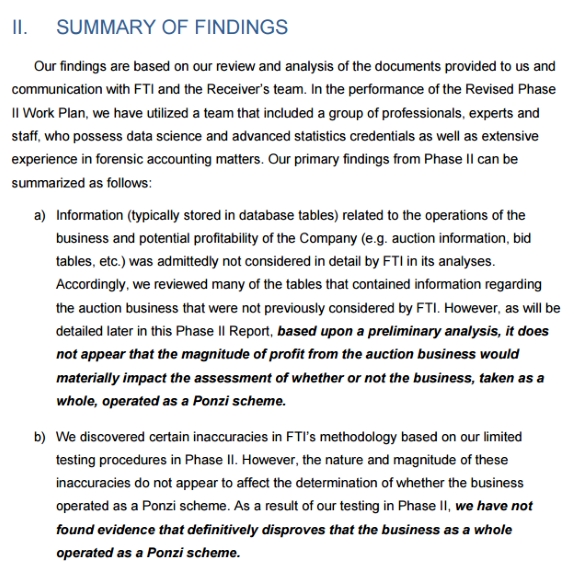
    Berkeley Research Group, an expert working for the defense in Zeek clawback litigation,has not been able to disprove the presence of a Ponzi scheme. Source: Screen shot of a Berkeley report to Senior U.S. District Judge Graham C. Mullen Jr. The report is dated May 26, 2016.
    Berkeley Research Group, an expert working for the defense in Zeek clawback litigation, has not been able to disprove the presence of a Ponzi scheme. Source: Screen shot of a Berkeley report to Senior U.S. District Judge Graham C. Mullen Jr. The report is dated May 26, 2016.

    URGENT >> BULLETIN >> MOVING: (3RD UPDATE 6:11 P.M. EDT U.S.A.) On virtually the eve of the criminal trial of Paul Burks, receiver Kenneth D. Bell has asked the court presiding over a huge class-action lawsuit against 9,400 alleged Zeek “winners” for a finding the MLM program was a Ponzi scheme.

    Such a finding would mandate winners to return nearly $300 million. Bell contended that “[o]f the over $900 million that was paid in to Zeek, only approximately $10 million (1.1%) came from actual retail purchases.”

    Retail sales are crucial to the determination of whether an MLM program is legitimate. Bell contends Zeek, which offered a penny auction, was both a Ponzi scheme and a pyramid scheme. Zeek affiliates allegedly believed enormously profitable auctions made Zeek sustainable.

    “Two of the primary creators and operators of the ZeekRewards scheme have already admitted it was a Ponzi scheme and pleaded guilty to criminal conduct in connection with the scheme,” Bell argued to Senior U.S. District Judge Graham C. Mullen in a June 30 motion. “In sum, the evidence that ZeekRewards was a Ponzi scheme is overwhelming. Even the Defendant class’ expert has acknowledged finding no evidence that ‘disproves that the business as a whole operated as a Ponzi scheme.’

    “Because Zeek’s net winners ‘won’ (the victims’) money in an unlawful Ponzi scheme, under long settled law those winners are not permitted to keep their winnings and must return the fraudulently transferred funds back to the Receiver for distribution to Zeek’s victims,” Bell argued.

    At stake in the civil clawback case is more than $282 million allegedly paid to winners by Zeek. Berkeley Research Group is the expert for the defense. Bell used FTI Consulting Inc. as his expert.

    Burks’ criminal trial is scheduled to begin Tuesday (July 5).

    What kind of financial environment did Zeek create?

    According to FTI, only about 8 percent (75,000 usernames) were winners, while 90 percent (841,000 usernames) were losers. Meanwhile, only 0.3 percent (2,778 usernames) were net neutral, with only 1.6 percent (14,500 usernames) classified as auction bidders only.

    Bell sued 9,400 alleged winners who’d received more than $1,000 each. FTI asserted that the net losers lost more than $822 million and the net winners hauled away more than $282 million. The small number of auction bidders suggests that Zeekers by and large joined for the purported money-making venture.

    But Zeek, Bell alleged, was insolvent even while paying out large sums of money.

    Cocaine Allegation Made By Alleged Insider

    During a deposition conducted in April 2016 by an attorney for the receivership, alleged Zeek insider Darryle Douglas made a claim that former Zeek COO Dawn Wright-Olivares was a user of “crack cocaine” who was “asked to leave” Free Store Club, a Zeek predecessor, according to a partial transcript included in Bell’s June 30 motion.

    Wright-Olivares also is an alleged Zeek insider and one of two Zeek figures to plead guilty to Ponzi-related criminal charges. (The other is Daniel Olivares, her stepson.) Wright-Olivares and Olivares both are expected to testify against Burks at his criminal trial.

    Whether Burks intended to use the cocaine allegation against Wright-Olivares to impeach her credibility as a witness was not immediately clear. But Wright-Olivares and Olivares both lived with Douglas at one time in Lexington, N.C., according to the transcript.

    Zeek, as part of Rex Venture Group, was based in Lexington.

    While living in Lexington, a “separation” developed between Douglas and Wright-Olivares and a once-strong business relationship between Douglas and Burks became “fractured,” according to the transcript.

    “And that’s where our separation began,” Douglas said, according to the transcript. “Dawn was a crack cocaine user . . .  Dawn used cocaine and was asked to leave the company eventually . . . This was FreeStore Club. She left but came back with the idea for a penny auction, which no one had ever heard of. Because we had a fractured relationship, we created MyBidShack, they created Zeekler. Eventually Paul decided to get rid of MyBidShack and that the company would only go under Zeekler, which made our rift expand. It set up a war that we — that’s when I was no longer allowed to have access codes or key information from accessing the system . . .”

    The receiver’s motion, memo and exhibits are available at the receivership website.

    Also see “ANNOUNCEMENT FROM THE RECEIVER – July, 1, 2016” at the receivership site.


  • BULLETIN: Receiver Sues Zeek ‘Winners’ In Canada

    breakingnews72BULLETIN: New court filings today in the Western District of North Carolina show that the court-appointed receiver in the Zeek Rewards Ponzi- and pyramid-scheme case has sued 26 alleged “net winners” in Canada.

    Each of the defendants allegedly received at least $50,000, according to filings by receiver Kenneth D. Bell.

    More . . .

  • URGENT >> BULLETIN >> MOVING: SEC Files Motion In Zeek Case To Oppose Appointment Of Examiner; In Blistering Memo, Agency Accuses Robert Craddock Of Encouraging Affiliates ‘Not To Cooperate With The Receiver’

    breakingnews72URGENT >> BULLETIN >> MOVING: (UPDATED 11:58 A.M. ET (U.S.A.) The SEC has gone to federal court in the Western District of North Carolina to oppose a motion by Zeek “winners” to appoint an “examiner” over all Zeek affiliates. In a blistering, 12-page memo, the agency accused Zeek figure Robert Craddock of encouraging Zeek affiliates “not to cooperate” with Kenneth D. Bell, the court appointed receiver.

    “Moreover,” the SEC claimed, “Craddock has asserted (incorrectly) that the SEC has acknowledged to his lawyers that the SEC has doubts or concerns about its case and is looking for ways to ‘back out’ in order to allow ZeekRewards to re-start its operations. Another Quilling client, David Kettner has repeated assertions similar to those made by Craddock in written communications to former ZeekRewards affiliates.”

    The agency also confirmed in its filing that its Zeek investigation was ongoing. The “confidential nature” of the probe, the agency said, potentially could make it difficult to respond to motions filed by opposition attorneys.

    There could come a time, the SEC said, that it would ask “to provide the Court with additional information under seal or in a closed hearing.”

    The SEC’s filing was dated yesterday — the same day Bell also asked Senior U.S. District Judge not to approve the sought-after appointment of Dallas attorney Michael J. Quilling as examiner. Quilling, Bell said, had an obvious conflict of interest. The SEC argued along the same lines.

    Quilling, the SEC said, is representing “certain significant net ‘winners’ in the ZeekRewards Ponzi scheme alleged in the Complaint” and seeks “to have himself appointed ‘Representative for Affiliates,’ provided with counsel, and compensated out of the Receivership Estate.”

    From the SEC’s motion (italics added):

    The Quilling Motion suffers from several obvious flaws:

    (1) The Motion offers no compelling factual or legal basis for the Court to consider appointing a “Representative for Affiliates” – the Commission continues to work closely with and monitor the Receiver to ensure that as much money as possible is returned to injured investors in the most efficient manner possible;

    (2) Appointment of a “Representative for Affiliates” would serve only to complicate this already complex matter, obstruct the Receiver’s ability to efficiently marshal Receivership Assets, and significantly and unnecessarily deplete the pool of assets available to be distributed to injured investors (given that Quilling and [Charlotte attorney Rodney E.] Alexander seek to be compensated from Receivership Assets); and

    (3) The interests of Quilling and Alexander’s current clients – significant net “winners” in the Ponzi scheme alleged in the Complaint – are diametrically opposed to the vast majority of ZeekRewards investors that were net “losers” in the Ponzi scheme.

    One of the potential issues is whether Craddock — through his Florida-based entity Fun Club USA — gathered money from Zeek losers and used it to bolster the aims of Zeek winners in the early days after the SEC’s Aug. 17 Ponzi complaint. Such an act potentially could have put losers in opposition to their own best interests, given that Bell intends to file clawback lawsuits against winners to help fund the receivership estate.

    In its motion, the SEC said that Fun Club USA appears to have been formed 11 days after the SEC’s actions and that it and other nonparties had “yet to explain why an entity formed after the Court froze ZeekRewards assets and appointed the Receiver should be heard on the subject matter” of the motion to appoint an examiner.

    Read the SEC motion.

  • BULLETIN: Zeek Receiver Opposes Appointment Of ‘Examiner’; Zeek Cheerleaders, ZTeamBiz Missives Get A Mention; Let Them ‘Employ Counsel At Their Own Expense,’ Bell Urges Judge

    “The ZeekRewards scheme has claimed hundreds of thousands of victims who lost hundreds of millions of dollars at the hands of the scheme’s winners who solicited their participation. Now, apparently not appreciating the irony, the lawyer for hundreds of the largest net winners asks the Court to pay him to be an ‘examiner’ or ‘representative for the affiliates,’ yet again at the expense of the scheme’s victims. The requested appointment is unnecessary and ill-advised because it would duplicate and complicate this Court’s, the Receiver’s, and the SEC’s efforts to compensate the victims, not to mention directly reduce the Receivership Assets available to pay them. Furthermore, the individual whom the net winners recommend for appointment (or more correctly who recommends his own appointment) ignores the inherent conflict of interest in seeking to somehow represent both the scheme’s ‘winners’ and ‘losers,’ two groups with irreconcilably adverse interests.”Zeek receiver Kenneth D. Bell, Dec. 17, 2012

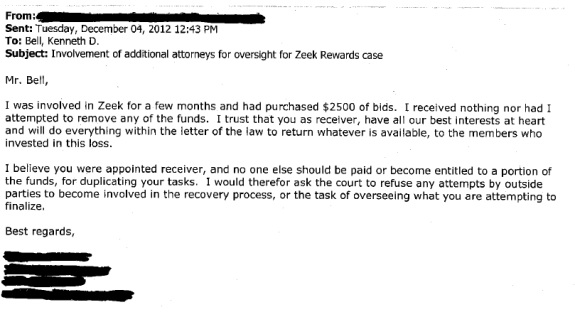
    Section from an email received by the court-appointed receiver in the Zeek Rewards Ponzi scheme case. Source: federal court files.
    Section from an email received by the court-appointed receiver in the Zeek Rewards Ponzi scheme case. The note asks the receiver to oppose efforts by Zeek winners to intervene in the case. Source: federal court files.

    Shortly after the SEC described Zeek Rewards on Aug. 17 as a $600 million Ponzi- and pyramid scheme, Zeek figure Robert Craddock solicited donations purportedly to hire an attorney and form a “protected” group of affiliates. Whether Zeek losers gave to the effort conducted at ZTeamBiz through Fun Club USA, Craddock’s Florida-based entity, remains unclear.

    On Aug. 29, PP Blog guest columnist Gregg Evans questioned how Zeek winners and losers ever could be on the same side.

    Today the court-appointed receiver effectively was asking the same question. His conclusion was that they could not — and he asked Senior U.S. District Judge Graham C. Mullen to reject a contention by certain Zeek “winners” that they could.

    “The net winners have already been put on notice that they will be asked to return their winnings to the Receiver for reimbursement to the net losers,” Bell said in court filings. “On the other hand, the net losers hope that they can recoup some of their losses from the gains of the scheme’s net winners . . . Thus, the winners and losers are plainly opposed in their respective interests regarding the winners’ efforts to keep their winnings.”

    Presumptive Zeek clawback targets Dave Kettner, Mary Kettner and David Sorrells asked Mullen last month to appoint Dallas attorney Michael Quilling as “examiner” over all Zeek affiliates. That should not be permitted to happen, Bell contended, because Quilling “has appeared in this case already as an attorney for Fun Club USA and represents the interests of those net winners.”

    In a bid to bolster his claim, Bell cited Craddock ties to Dave Kettner through ZTeamBiz and quoted from a letter attributed to Kettner.

    “In a similar vein, Mr. Kettner sent a letter seeking donations from affiliates that stated, “The SEC has tried to make us all believe that Zeek Rewards was an ‘investment’ and a Ponzi scheme. All the pages that were submitted by the SEC indictment [sic] has [sic] all been one sided and what we believe to be a misrepresentation of the truth and facts of what Zeek Rewards was as a viable and legal business,” Bell advised the judge in a footnote that included the URL to ZTeamBiz.

    Beyond that, Bell argued, the Craddock entity, the Kettners and Sorrells had no standing in the case brought by the SEC.

    And Bell said he has heard from Zeek members who want him to oppose the appointment of Quilling as examiner.

    Here, according to Bell, is a passage from one such Zeek member who contacted Bell after learning about the “examiner motion”:

    As one of the many losers in Zeek Rewards I wish to encourage you to do whatever is possible to block the motion filed on behalf of Fun Club USA (Robert Craddock) David & Mary Kettner and David Sorrells, asking that their personal attorney Michael J Quilling be appointed as the Examiner to oversee and represent the interest of ALL former Zeek Rewards affiliates.

    To many of us this is just another way for another attorney firm to slow up your process of recovery and to diminish the amount of funds to be returned to those of us who are in hopes of being able to recover some of our losses.

    Personally I feel that their agenda is also to help block your efforts to recover funds from the 1200 who received subpoenas.

    The Kettners and Sorrells potentially have exposure of nearly $2 million in receivership clawback litigation, Bell said.

    At least two apparent Zeek winners represented by attorney Ira Lee Sorkin also oppose the appointment of Quilling as examiner, according to filings last week.

    Todd Disner, a Zeek affiliate and figure in the AdSurfDaily Ponzi scheme story, once was on a conference call with Craddock.

    In recent remarks, Craddock said Disner was in Hong Kong with a “lost” passport.

    Reports now have surfaced that Craddock is pitching a “program” known as Offer Hubb that uses a Wyoming mail drop as its address. Disner’s name was listed on the Offer Hubb pitch, according to BehindMLM.com.

  • URGENT >> BULLETIN >> MOVING: Ira Lee Sorkin, Bernard Madoff’s Attorney, Files Motion For Clients Who Are Potential Clawback Targets For More Than $1.56 Million In Zeek Case

    URGENT >> BULLETIN >> MOVING: (3RD UPDATE 11:33 P.M. ET (U.S.A.) Famed defense attorney Ira Lee Sorkin is seeking pro hac vice admission to practice in U.S. District Court for the Western District of North Carolina on behalf of two prospective clawback targets in the Zeek Rewards Ponzi scheme case.

    Sorkin is with Lowenstein Sandler PC in New York. He perhaps is best known as Ponzi schemer Bernard Madoff’s defense counsel. Sorkin also is the former head of the SEC’s New York regional office.

    Sorkin’s clients are Zeek affiliates Trudy Gilmond and Kellie King, and Sorkin is arguing that Zeek did not sell securities and that the receivership should be dissolved.

    Gilmond is the prospective target of a clawback action for more than $1.364 million, with receiver Kenneth D. Bell asserting she put in only $3,105, according to Sorkin’s motion. King potentially faces a claim from Bell for more than $205,180 after paying in only $1,492, Sorkin said in the filing.

    Sorkin, according to a separate motion, also contests how the receiver issued subpoenas and is opposing a motion late last month by Dallas attorney Michael J. Quilling to be appointed “examiner.”

    Quilling sought “to represent the collective interests of the Affiliates and all creditors of the receivership estate” and desired to “be compensated out of the receivership estate,” Sorkin argued.

    But that should not be permitted to happen, Sorkin contended.

    From Sorkin’s motion (italics added):

    It is quite clear from the Receiver’s Preliminary Liquidation Plan and the defective subpoena issued to Ms. Gilmond that Qualified Affiliates have inherently conflicting positions as to one another, and thus cannot be jointly represented. To illustrate, it is in the interests of a Qualified Affiliate who is a “net-winner” to challenge the Receiver’s authority to clawback funds because the Receiver intends to use the “net-winner’s” money to pay net-losers. To the contrary, it is in the interests of a Qualified Affiliate who is a net-loser to support the Receiver’s efforts because the Receiver will take money from the “net-winner” and distribute it to the “net-loser” Qualified Affiliate. As such, an Examiner cannot be appointed to represent all of the Qualified Affiliates because the Examiner would have clients with inherently contradictory positions as to one another.

    The motion by Sorkin potentially puts Gilmond and King at odds with positions taken by Quilling clients and potential Zeek clawback targets Dave Kettner, Mary Kettner and David Sorrells. The Kettners and Sorrells, for example, moved to have Quilling appointed examiner.

    The Kettners and Sorrells potentially have a combined clawback exposure of nearly $2 million, according to court filings.

    Zeek records, according to letters from Bell cited by the trio, suggest Sorrells received $945,539 from Zeek while paying in only $1,695. Dave Kettner received $537,577.95 while paying in only $1,378, and Mary Kettner received $465,866.67 while paying in only $1,495.

  • BRIEF: Zeek Receiver Broadens Reach, Files In Southern District Of Florida — And In Northern Mariana Islands Nearly 15,000 Miles Away

    Bird Island, Saipan. Source: website of U.S. District Court for the Northern Mariana Islands.

    In yet another demonstration of the reach of the alleged Zeek Rewards Ponzi scheme, court-appointed receiver Kenneth D. Bell has filed paperwork in the Southern District of Florida — and in Northern Mariana Islands District Court.

    The Northern Mariana Islands are a U.S. Commonwealth. Saipan is perhaps the best-known island in the chain. The flight distance between Saipan and Miami — the city in which the receiver made the filing in the Southern District of Florida — is about 14,571 miles, according to Flightpedia.

    Saipan is more than 3,500 miles southwest of Hawaii, the U.S. island state in the Pacific.

    Bell previous filed in Guam, a U.S. territory in the western Pacific.

    In August, the SEC described Zeek as a $600 million Ponzi and pyramid scheme with international reach.

    Records suggest Bell has filed in more than 70 of the 94 U.S. districts in advance of anticipated clawback actions against Zeek winners.

  • Nearly $2 Million Allegedly At Stake For 3 Arizona Zeek Affiliates Who Received Subpoenas, Filings Say

    “[Zeek operator Paul] Burks is solely responsible for determining the amount of ‘net profits’ to share in the Retail Profit Pool . . . Defendants represent that daily awards are calculated by dividing ‘up to 50%’ of daily net profits by the number of Profit Points outstanding among all Qualified Affiliates. This calculation results in a daily dividend paid to each Qualified Affiliate that consistently has averaged approximately 1.5% per day . . . In fact, the dividend bears no relation to the company’s net profits. Instead, Burks unilaterally and arbitrarily determines the daily dividend rate so that it averages approximately 1.5% per day, giving investors the false impression that the business is profitable.”From the SEC complaint in the Zeek Rewards Ponzi scheme case, Aug. 17, 2012

    “The most successful Affiliates worked the hardest, placed numerous ads, and explained the Zeekler.com penny auction to groups of people several times a month. Some of the Movants, for example, traveled extensively to maintain contact with their network of peers and to educate them, among other things, on how to be successful in the program. These Movants’ successes were a direct result of the amount of time and effort they poured into the effort to promote the penny auction.”Zeek Affiliates Dave Kettner, Mary Kettner and David Sorrells, Dec. 11, 2012

    Although the SEC accused Rex Venture Group LLC/Zeek Rewards operator Paul R. Burks in August of conducting a massive Ponzi scheme and duping members into believing he was presiding over a business that created enormous profits legitimately, three members of the MLM “program” with potentially millions of dollars in ill-gotten gains subject to clawback aren’t buying it.

    At stake for Dave Kettner, Mary Kettner and David Sorrells of Arizona is at least $1.94 million they allegedly earned in the “program” through hard work, according to court filings.

    Zeek was a legitimate venture, they argued in filings dated Dec. 11. And it was no Ponzi scheme, they advised Senior U.S. District Judge Graham C. Mullen of the Western District of North Carolina. Mullen is presiding over the Zeek Ponzi scheme case brought by the SEC Aug. 17.

    It was not immediately clear whether the Kettners and Sorrells were the recipients of payouts from Zeek’s Retail Profit Pool (RPP) or commissions for sponsoring new members — or some combination of both. The RPP also is known as the Retail Points Pool.

    What is clear, according to their filings, is that each received a letter and subpoena from Zeek Receiver Kenneth D. Bell that paint them as potential clawback targets. The information about the sums Bell is seeking is contained within exhibits filed by the Kettners and Sorrells.

    Zeek records, according to letters from Bell cited by the trio, suggest Sorrells received $945,539 from Zeek while paying in only $1,695. Dave Kettner received $537,577.95 while paying in only $1,378, and Mary Kettner received $465,866.67 while paying in only $1,495.

    Bell has said Zeek created approximately eight losers for each winner. The SEC described Zeek as a $600 million Ponzi and pyramid scheme that potentially defrauded more than 1 million people.

    The PP Blog is working on a related story about assertions by the Kettners and Sorrells that significant sums of money that belong to them effectively are trapped in NxPay, a payment processor used by Zeek. More later . . .