BULLETIN: The Better Business Bureau of Southeast Florida and the Caribbean has given Data Network Affiliates (DNA) an “F” rating after the company failed to respond to complaints.
DNA, a purported multilevel-marketing (MLM) firm, publishes a street address in Boca Raton, Fla., on its website. The BBB’s file on DNA lists the Boca Raton address.
DNA now joins Dallas-based Narc That Car, also known as Crowd Sourcing International, in the lineup of purported license plate data gathering firms to have received an “F” from the BBB. The “F” rating is the BBB’s lowest on a 14-step rating scale.
Separately, bizarre events at DNA continue to occur. Earlier this year, DNA purported to be in the business of gathering license-plate numbers to assist law enforcement in locating abducted children. In a conference call, a DNA pitchman criticized the AMBER Alert program, claiming it had a bloated budget. The same pitchman recommended that members gather license-plate data at “churches” and “doctors’ offices,” triggering concerns that DNA’s business model could lead to untenable invasions of privacy.
It is far from clear that DNA has any capacity to help law enforcement locate missing kids. The company’s domain name is registered in the Cayman Islands. Earlier this year, DNA claimed the offshore address was arranged through a domain registrar so company executives would not have to put up with “stupid” calls.
DNA later declared itself the world’s low-price leader in the cell-phone business, before acknowledging that it had not studied pricing before announcing it could offer an “unlimited” plan for $10 a month, including a free phone.
DNA later said it also had ventured into the businesses of selling a purported spray to be applied to license plates that would prevent motorists from getting tickets if they ran a red light at an intersection equipped with a camera — all while purporting to support law enforcement.
The company also announced it had ventured into the mortgage-reduction business, claiming churches had the “MORAL OBLIGATION” to support the program.
In July, DNA asked existing members to pretend the company had not launched in March, asking them to “Make believe that July 26th, 2010 is the LAUNCH DATE for DNA…â€
DNA than rescheduled the make-believe launch to Aug. 9. It is unclear if the imaginary launch occurred as advertised. A countdown timer set for Aug. 23 now appears on the website.
Meanwhile, the company appears to have renamed its Business Benefit Package, which once used the acronym BBP, to the BBB. BBB is the acronym used by the Better Business Bureau.
DNA regularly employs capital letters to stress sales points in pitches to members.
“Please attend our next WEBINAR it will CHANGE YOUR LIFE,” DNA said in a recent email, which also included a pitch for products described as the “DNA Photo Blocker & The DNA $5.95 TELE-FAX BOX.”
It was not immediately clear if the product advertised as “DNA Photo Blocker” was the same product previously advertised as “DNA Protective Spray.â€
The website of AdViewGlobal (AVG), an autosurf with close ties to the alleged AdSurfDaily Ponzi scheme, has gone offline.
Why AVG’s site was offline was not immediately clear. One person told the PP Blog that the site had been “down for days.” AVG’s domain, which lists a registration address in Uruguay and appears to use a dedicated server that resolves to Panama, would not return a ping this morning.
Aug. 1 was the two-year anniversary of the seizure by the U.S. Secret Service of tens of millions of dollars in the ASD case. AVG, fueled by the participation of ASD members, launched in the aftermath of the ASD seizure and the filing of a racketeering lawsuit against ASD President Andy Bowdoin.
Promotions for AVG began to appear online less than a month after ASD lost a key court battle in November 2008. In January 2009, AVG graphics were seen on an ASD-controlled website, but AVG denied any ties to ASD. By February 2009, AVG was up an running, and some of the moderators of the Pro-ASD Surf’s Up forum started a forum to promote AVG.
AVG, whose site remained online after the company suspended payouts in June 2009 and announced it was conducting an audit of itself, perhaps is one of the oddest autosurfs of all time.
Although AVG denied any ASD ties, the person issuing the denial on behalf of AVG was a former ASD employee. Even while issuing the denial, the former ASD employee confirmed that Gary Talbert, a former ASD executive, was the chief executive officer of AVG.
AVG later went on to form a purported “private association” purportedly based in Uruguay. The surf bizarrely claimed U.S. Constitutional protections despite the competing claim it operated on foreign soil.
By June 25, 2009, AVG had collapsed — after running a virtually never-ending series of promotions that offered 200 percent bonuses to both existing members and the prospects they recruited. One promoter claimed that $5,000 placed with AVG turned into $15,000 “instantly!”
The surf later said it was the victim of a $2.7 million theft.
AVG went offline for a brief period in September 2009 after its domain-name registration expired. Records show that the domain name is valid until Sept. 22, 2010 — more than a month from today’s date.
Read this story for the names of other autosurfs/HYIPs promoted by ASD members.
Read this story on AVG threats directed at members and the media after its collapse.
Read this story on a method an AVG member said would help other members qualify for bonuses. (Make sure you read the comments from readers below the story.)
EDITOR’S NOTE: It is common for fraudsters to claim that “offshore” locations insulate HYIPs, autosurfs and other investment-fraud schemes from prosecution in the United States. It is equally common for purveyors to claim the schemes are harmless. The story of the alleged DMG pyramid scheme is one in which prosecutors allege a monstrous multilevel-marketing company created hundreds of shell companies and laundered money for narco businesses. The case is being prosecuted by U.S. Attorney Preet Bharara’s Terrorism and International Narcotics Unit.
Here, now, a story that destroys some of the myths advanced on the Ponzi boards . . .
U.S. officials now have confirmed the extradition of Margarita Leonor Pabon Castro from Colombia to the United States to face charges she helped a corrupt multilevel-marketing (MLM) company launder money for narcotics traffickers.
South American media first reported the extradition last week.
Pabon Casto, 36, was the legal adviser to David Eduardo Helmut Murcia Guzman (David Murcia), prosecutors said. Murcia, the head of D.M.G. Group (DMG), was extradited under heavy guard in January, and whisked to the United States by the U.S. Drug Enforcement Administration (DEA).
DMG used debit cards as the principal part of a pyramid scheme that largely targeted the poor in Colombia. The scheme is believed to have collected hundreds of millions of dollars from as many as 400,000 people before collapsing in 2008.
Pabon Casto was Murcia’s “personal friend,” sat on boards of companies related to DMG and “also assisted in accounting matters for DMG and in hiding information from Colombia’s
Superintendencia de Sociedades, an agency responsible for the regulation of corporations,” prosecutors said.
Part of the scheme involved the establishment of “hundreds of subsidiary and affiliated companies linked to DMG in countries including Colombia, Panama, and the United States,” prosecutors said.
Pabon Casto and six others now are charged with laundering narcotics proceeds through DMG and affiliated companies.
“With her alleged participation in a sophisticated money laundering conspiracy, Margarita Pabon Castro used her legal and accounting expertise to hide millions of dollars in dirty money,” said U.S. Attorney Preet Bharara. “Alongside our law enforcement partners here and abroad, the Manhattan U.S. Attorney’s Office will continue to pursue money launderers who profit from and drive the international drug trade.”
The DEA assisted in the extradition.
“By joining efforts with our law enforcement and prosecutorial partners, we identified, indicted and extradited those responsible for a million-dollar-a-year money laundering organization who worked for drug traffickers around the world,” said John P. Gilbride, DEA special agent in charge.
Thousands of U.S. consumers, businesses and nonprofits were tricked into paying “bogus bills” for the renewal of their website domains by “con artists” in Canada, the FTC said.
A federal judge now has issued judgments of more than $4.2 million against the accused scammers. In the cases of three defendants, the judgment was suspended based on their inability to pay. A fourth defendant, Steven E. Dale, was ordered to pay the full amount of $4.2 million.
The sum is “immediately due and payable,” ruled U.S. District Judge Robert M. Dow Jr.
Consumers were led to believe they would lose their website addresses unless they paid invoices, which proved to be bogus. Another part of the scheme featured a claim that a “Search Optimization†service would “direct mass traffic†to consumers’ sites and that a “proven search engine listing service†would help consumers gain “a substantial increase in traffic,†the FTC said.
“[M]ost consumers who paid the defendants’ invoices did not receive any domain name registration services,” the FTC said, adding that the “search optimization†service “did not result in increased traffic to the consumers’ Web sites.”
EDITOR’S NOTE: The SEC complaint against Candice D. Campbell is yet-another case apt to cause unease in the incongruous worlds of online HYIP, autosurf and investment fraudsters. Among the allegations against Campbell, a purported day-trader and “CFO” of an unincorporated, Canton, Mich.-based company known as CJ’s Financial, is that she lied to investors and used a website to weave a false tale to prospects. When payments dried up earlier this year, the company allegedly emailed false information to investors in a bid to lull them. An evidence exhibit in the case shows that a free Yahoo email account was used, rather than an email account originating on the purported investment company’s servers.
The investment-fraud landscape is filled with incongruities. The use of free email services by purportedly successful investment companies to hawk programs and explain away problems is just one of them. Other incongruities that often signal fraud include claims that monthly returns of a preposterous percentage are “guaranteed” and that investors need not worry about paying taxes. Such claims are notable parts of the investment-fraud universe — and are elements in the SEC’s case against Campbell.
Here, now, the story on the Campbell allegations . . .
Investigators have whacked yet-another “small” Ponzi scheme — one in which Candice D. Campbell of Canton. Mich., is alleged to have used a number of claims typically associated with online HYIP and investment-fraud schemes.
The SEC has obtained an emergency asset freeze in U.S. District Court for the Eastern District of Michigan against Campbell and her unregistered company, CJ’s Financial (CJF). The scheme collected more than $1 million from 60 investors between May 2009 and June 2010, the agency said.
CJF’s website now appears to be offline. But the SEC said that, as recently as July 9, the firm portrayed itself on the website as an “independent investment firm dedicated to putting your money to work for you!”
Investors were told their funds were “guaranteed” to generate returns of at least 10 percent monthly. Claims of unusually high, “guaranteed” returns are one of the classic signatures of fraudsters, according to regulators.
Another classic hallmark of fraud is a claim lacking supporting details that a company or individual is “registered” or “licensed.” Among the SEC’s assertions against Campbell was that CJF used a vague claim that she was “licensed by the appropriate licensing agency for the financial planner/investment banker profession and that he/she is in good standing with such agency.â€
The SEC said Campbell was registered neither with the SEC nor the Michigan Office of Financial and Insurance Regulation. Campbell formerly worked in the “automobile industry,” according to the SEC.
Her role in the automobile industry was not immediately clear.
At the same time, in a claim that featured the use of capital letters for emphasis, CJF investors were told their “initial investment will NEVER go down in value” and that “there will be ‘NO PENALTIES OR TAXES to pay when you withdraw your money, because CJ’s Financial pays your Capital Gains taxes!’”
Frequent use of capital letters to stress sales points and an accompanying appeal to purported “tax” benefits often are associated with investment-fraud schemes.
When the CJF scheme began to collapse, the firm allegedly trotted out what regulators previously have described as a classic ruse to mask a Ponzi scheme in progress — fabricating a government action or events that had not occurred to explain why a business was not meeting its obligations to investors.
The SEC even used the word “ruse” in its complaint against Campbell and the company, highlighting the allegation under a subhead that reads, “Defendants Create A Phony SEC Asset Freeze As A Ruse To Prevent Investors From Withdrawing Their Money.
Meanwhile, the agency used strong verbs to paint a word picture of the scam (emphasis added by PP Blog):
“In 2010, as investors began requesting the return of their money, Defendants concocted a scheme to convince investors that, notwithstanding Defendants’ prior representations that investors would be able to withdraw their money ‘whenever they want,’ Defendants could not return investor funds. Defendants told investors that CJF’s bank accounts and other assets had been frozen by the Commission.”
In truth, the SEC said, the money had not been frozen. The agency then laid out an allegation that a CJF employee using a free yahoo email address to conduct business for CJF sent repeated emails to customers to update them on events that were not really happening.
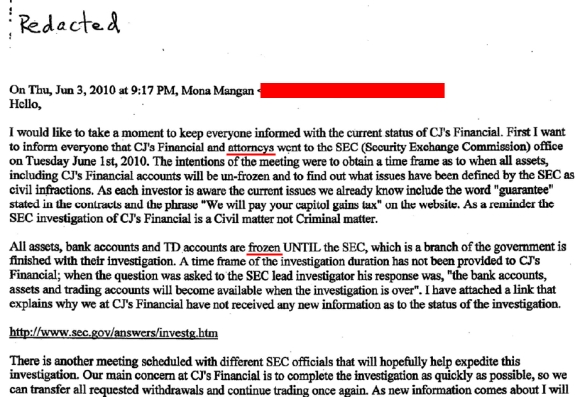
The emails, which the SEC released in redacted form, paint a picture of CJF lulling investors with words and describing a purported meeting among the company, its “attorneys” and the agency that never occurred.
“[O]n May 26, 2010, Ramona Mangan, who is Campbell’s assistant, sent an e-mail to CJF’s clients updating them about the ongoing ‘government’ investigation of CJF,” the agency alleged. “Mangan acknowledged that CJF ‘knows and understands’ that ‘[m]any individuals are in need of money,’ and assured investors CJF was ‘doing everything we can do to get this issue corrected.’
“Nevertheless,” the agency continued, “Mangan claimed that ‘CJ’s Financial hands are tied in this matter.’ According to Mangan, ‘Since the Ponzi Scheme in 2009 government officials do not investigate lightly and perform detailed investigations to ensure the public is safe from fraudulent activity and trading.’”
On June 3, Mangan sent another email — this one claiming that CJF’s assets had been frozen and that company “attorneys” were working with the SEC and visited its offices June 1 to determine when the purported asset freeze would be lifted, according to the agency.
“According to Mangan,” the SEC said, “‘CJ’s Financial and attorneys [sic] went to the SEC (Security Exchange [sic] Commission) office on Tuesday June 1, 2010. The intentions of the meeting were to obtain a time frame as to when all assets, including CJ’s Financial accounts will be un-frozen and to find out what issues have been defined by the SEC as civil infractions.’”
“Later in the e-mail,” the SEC continued, “Mangan reiterated that ‘All assets, bank accounts and TD accounts are frozen UNTIL the SEC, which is a branch of the government is finished with their investigation.’ Mangan quoted the ‘SEC lead investigator’ as stating that ‘bank accounts, assets and trading accounts will become available when the investigation is over.’ Mangan assured investors that ‘Our main concern at CJ’s Financial is to complete the investigation as quickly as possible, so we can transfer all requested withdrawals and continue trading once again.’”
Campbell made similar claims to investors, the agency alleged.
Regardless, the agency said, “Contrary to the information Mangan and Campbell provided to investors, there was no meeting on June 1, 2010 between the Commission and CJF and its attorneys, and the Commission had not frozen Defendants’ bank accounts, trading accounts, or other assets. Defendants fabricated this story to keep investors from realizing Defendants had stolen their money.”
Mangan is not named a defendant in the complaint.
Investigators said Campbell used only a “small” percentage of the more than $1 million collected to make trades.
“Campbell diverted the money for personal uses, including paying for vacations, cars, jewelry, sporting goods, and furniture,” the SEC charged. “Classic” Ponzi payments were made to some investors, the agency added.
Here is how Campbell, who is accused of depositing client funds into her personal account and diverting “at least” $540,000 for her personal use, spent much of the money, according to the SEC:
Cash withdrawals ($138,000).
Purchases of airline tickets and travel, including travel to resorts in Florida and Arizona ($127,000).
Purchases from several jewelry retailers ($33,046).
Purchases from sporting-goods retailers ($28,350).
Purchases from furniture stores ($29,124).
Purchases from a laser-surgery center ($20,650).
Purchases at automobile dealerships (at least $100,000).
“In an apparent effort to keep the Ponzi scheme from collapsing, Campbell used more than $350,000 of investor money to pay other investors,” the SEC charged.
Read the SEC complaint. (Make sure you read the emails, which are included in the PDF file.)
The SEC claims this June email painted a false picture than CJF could not pay investors because the agency had frozen its assets. The SEC did not file a complaint against the company and gain an asset freeze until Aug. 4. NOTE: The entire email is not reproduced in this screen shot, and the PP Blog added the red lines.
A California man accused of filing “false liens” against public officials in pursuit of their duties also filed a “bogus” tax-refund claim with the IRS for the preposterous sum of $82 billion, federal prosecutors said.
Thanh Viet Jeremy Cao and his business, Phoenix Financial Management Group, now have been permanently barred by a federal judge from preparing federal tax returns.
Cao was found in a civil case to have “prepared numerous federal tax returns” for clients, “claiming a total of over $200 million in tax refunds based on false representations of tax withholdings,” prosecutors said.
He filed for a bogus refund of $82 billion “on his own 2009 income tax return,” prosecutors said.
The scheme centered on a “frivolous” theory that the U.S. government established “secret” Treasury Department accounts for citizens in the 1930s and that citizens can “draw” on the accounts to pay their taxes and other debts. The theories sometimes are known as “redemption” or “straw man.”
One part of the bogus theory holds that the “secret” accounts contain enough money to make every American a millionaire and that the accounts can be tapped to satisfy debts, including tax debts. Another part of the theory holds that the secret money can be accessed by filing tax forms, including Form 1099-OID, which is why the fraud also sometimes is referred to as an “OID redemption†scheme
Cao is required to provide the government with a list of people for whom he has prepared tax returns since Jan. 1, 2005, and notify those people of the court’s order, prosecutors said.
A criminal prosecution against Cao is proceeding on a separate track.
See earlier story on Cao’s alleged “false liens” scheme.
Another spectacular Ponzi case has emerged in Minnesota just months after federal prosecutors charged Trevor Cook in an alleged $190 million scam and Tom Petters was convicted in a $3.65 billion scam.
Charged in a new scheme today was Corey N. Johnston of Lakeville, a Minneapolis suburb. The Minneapolis/St. Paul region also is the home base of the Cook and Petters’ cases, and a number of smaller cases.
Johnston is charged with fleecing banks on loan deals through a company known as First United Funding (FUF). Prosecutors estimated losses at $79.5 million, describing the crime as a “loan participation” scheme in which Johnston oversold interests in the same loan to multiple banks.
Loan participation is a practice in which a bank pays an original lender all or a portion of a
particular loan and then assumes that loan, along with its associated risk.
“Johnston’s alleged scheme involved selling more than 100 percent participation in at least
ten different loans arranged through FUF,” prosecutors said. “In each instance, Johnston
failed to disclose that the total participation exceeded 100 percent of the original loan, making it impossible for the participating bank to receive the full amount of money expected.”
On one deal involving a project known as White Out Way Investments, Johnston sold 100 percent participation to Western National Bank, prosecutors said.
“At the same time, however, he allegedly convinced several other banks to participate in the loan, including 100 percent participation by The National Bank in Bettendord, Iowa, as well as partial participation by four other lending institutions. In all, Johnston purportedly solicited and received $23.65 million from six banks for the $7 million loan.”
In a second deal for a project known as JM Land Development II, Johnston once again targeted Western National, selling it 100 percent participation.
“Simultaneously, however, he reportedly obtained full loan participation from Choice Financial, The National Bank, and Hillcrest Bank, along with partial participation from four other banks,” prosecutors said. “Johnston allegedly solicited a total of $38.65 million for an $8 million loan.”
Johnston was charged with filing a false tax return amid allegations he failed to report his fraudulent income and underpaid his taxes in 2005 by nearly $509,000, prosecutors said.
All in all, the scheme ensnared 17 lenders, prosecutors said.
“Johnston used some of the proceeds of the fraud to repay other loans and perpetuate the scheme,” prosecutors said. They added that he “reportedly diverted some of the fraud proceeds for his personal use as well as for use by family members.”
Cook pleaded guilty in April and is awaiting sentencing. On Wednesday, the court-appointed receiver in his case announced that federal agents had found more than $400,000 in loot from the scheme July 23, months after Cook had been ordered to reveal the whereabouts of assets to investigators. The loot allegedly was in the control of Graham Cook, Trevor Cook’s brother.
Trevor Cook was jailed in January for contempt of court after a federal judge ruled that Cook had disregarded an order designed to preserve assets for victims.
Petters was found guilty in December and sentenced in April to 50 years in federal prison. He is appealing the sentence. The Petters’ fraud is believed to be the largest in state history and one of the largest in U.S. history.
In February, the U.S. Secret Service seized about $26 million from bank accounts related to INetGlobal, a Minneapolis-based autosurf firm. INetGlobal is under investigation amid allegations it was operating a Ponzi scheme.
In November 2009, Gerard Frank Cellette Jr. was implicated by prosecutors in an alleged $53 million Ponzi scheme in Minnesota. In April — on the very same day Petters was sentenced — a federal judge froze the assets of Renee Marie Brown after the SEC accused her of ripping off clients by persuading them to invest in a mysterious vehicle known as “Fund X.â€
Brown also lives in the Minneapolis region.
Other recent fraud cases in Minnesota included the Charles “Chuck†E. Hays case ($20 million), and the Kalin Thanh Dao case (up to $10 million).
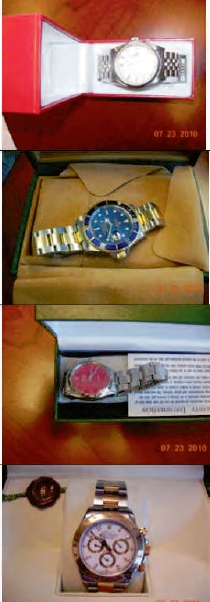
Part of the loot the FBI and the IRS found under the alleged control of Graham Cook on July 23.
Trevor Cook’s brother was hiding more than $400,000 in cash and valuables from a $190 million Ponzi scheme, according to an extraordinary statement by the court-appointed receiver in the case.
The loot was found July 23 — after Trevor Cook, whose plea agreement in the case required him to submit to a lie-detector test if requested by the government — “flubbed” the test, according to the Star Tribune of Minneapolis/St. Paul.
Graham Cook, Trevor Cook’s brother, has not been charged in the case. But the revelation that proceeds from the scheme allegedly were under his control and concealed for months from investigators and two federal judges presiding over elements of the case raise troubling, new questions about Trevor Cook’s capacity to tell the truth in any context and whether Cook and others had stashed money elsewhere.
Trevor Cook was jailed in January by Chief U.S. District Judge Michael J. Davis for concealing assets and spending money frozen by court order on Nov. 23, 2009. Davis, who is presiding over the civil elements of the case filed by the SEC and the CFTC, said the government had established that Cook had violated the court order.
Another part of the loot.
At the time, Cook made a technical argument that he had not been properly served in the case at the Van Dusen mansion in Minneapolis on Nov. 24 and thus was not bound to follow the order, a position that gave short shrift to the hundreds of victims in the case, some of whom had been rendered destitute.
Victims complained that Cook was thumbing his nose at both the court and investors. Cook also asserted his 5th Amendment right against self-incrimination, which caused victims to wonder what else he could be hiding.
Davis did not buy any of Cook’s story, and jailed him.
“[C]opies of said Orders were shown to Cook, and the relevant portions of the Orders were explained to him by the Receiver” on Nov. 24, 2009, Davis ruled. Regardless, Cook later used frozen assets to purchase $7,510 in gift cards from Cub Foods and $16,000 in gift cards from Target.
“Given the amount of investor money at issue, and Cook’s repeated violations of the Asset Freeze Orders, the Court finds that the appropriate remedy for the contempt finding in this case is to incarcerate Cook until such time as he purges such contempt.”
Jail was an appropriate remedy for Cook, even in a civil case, a top SEC official said at the time.
Sports collectibles, such as this baseball card of Minnesota Twins' immortal Kirby Puckett, also were part of the stash.
“Mr. Cook has elected to disregard the court’s orders and will now be a guest of the federal correctional system until he mends his ways,†said Merri Jo Gillette, director of the SEC’s Chicago Regional Office.
In March, while Cook was jailed in the civil case, prosecutors charged him criminally with mail fraud and tax evasion, opening up a new round of litigation over which U.S. District Judge James M. Rosenbaum is presiding.
Cook pleaded guilty to the criminal charges in April. His plea required him to take a lie-detector test “if requested†by prosecutors to determine “whether he has truthfully disclosed the existence of all of his assets and the use of the fraud proceeds.â€
It is believed the test was administered in mid-July, prior to Cook’s scheduled sentencing date of July 26. Sentencing has been postponed until Aug. 24, and Rosenbaum may have to determine whether Cook once again has thumbed his nose at the court, prosecutors, victims and the receiver in a bid to prevent the discovery of funds that could be used to make the victims as whole as possible.
The discovery of the funds also raises questions about whether Cook failed to disclose the whereabouts of assets in a bid not to implicate others in the scheme.
The stash also included Rolex and other expensive watches.
Cook’s plea agreement also required him to to “fully and completely disclose to the United States Attorney’s Office the existence and location of any assets in which he has any right, title, or interest and the manner in which the fraud proceeds were used.â€
Prior even to Cook’s polygraph exam, R.J. Zayed, the court-appointed receiver, raised questions about Cook’s cooperation and level of truthfulness. The plea agreement, as written, conceived a 25-year sentence for Cook, although prosecutors said Rosenbaum had the final say.
Victims fretted that Cook, who is in his late thirties, could emerge from prison as a relatively young man in his early sixties and have access to money that had been hidden from the court, investigators and the receiver.
Zayed now says that federal prosecutors, the FBI and the IRS found the hidden loot July 23.
Seized from Graham Cook were “$202,600.00 in cash, 2891 gold and silver coins, 27 watches, some sports memorabilia cards and other personal property belonging to the Receivership,” Zayed said yesterday.
“A rough estimate of the value of the coins is approximately $200,000.00 to $225,000.00,” Zayed said.
Read this PP Blog story from April in which victims said they believed Cook was lying about the whereabouts of assets.
Read this June PP Blog story in which Cook victims said they sought a meeting with prosecutors to delay Cook’s sentencing until more facts emerged. Victims said they feared he stashed money and covered his tracks so well that he could emerge from prison and benefit from his crime — or perhaps permit insiders or unknown criminal colleagues to benefit from the fraud while he is jailed.
Read this July 12 PP Blog story in which a source told the PP Blog that Cook would be subjected to a lie-detector test.
About 200 investors turned over $11 million to a boiler-room operation selling investments in a purported “green” energy company, the SEC said.
The alleged swindle in which Kensington Resources Inc. sold unregistered shares of American Environmental Energy Inc. (AEEI) was pulled off by a convicted felon with the help of a recidivist securities offender, the SEC alleged.
Also charged in the case was yet-another convicted felon who was sentenced to federal prison more than a decade ago for telemarketing fraud, along with yet-another recidivist securities fraudster sued by the SEC in in 1998, according to records.
All in all, the SEC charged six people in the alleged boiler-room caper:
Joseph Rudolph Porche, 51, of Aliso Viejo, Calif. Porche, one of two alleged ringleaders and the former chief executive officer of Kensington, pleaded guilty in 2001 to four counts of mail fraud and was sentenced to 37 months in prison, the SEC said. Federal records show he was released from prison in 2003.
Larry Ray Crowder, 53, of Newport Coast, Calif. Also named a ringleader by the SEC, Crowder is Kensington’s former president. Crowder was charged by the SEC in 1998 with raising at least $15.7 million from more than 600 investors in an oil-and-gas venture. The oil-and-gas scheme involved misrepresentations in the sale of limited partnerships, the SEC said.
Gary Kennan Juncker, 47, of Rancho Santa Margarita, Calif. Juncker is a former senior vice president at Kensington. In 1998, according to records, Juncker was convicted on four counts of mail fraud in a telemarketing scheme and was sentenced to 30 months in prison. Federal records show he was released from prison in 2000.
Dale Jay Engelhardt, 46, of San Clemente, Calif. Engelhardt, a former member of Kensington’s sales staff, was one of Crowder’s co-defendants in the 1998 swindle, the SEC said.
Konrad Christian Kafarski, 40, of Trabuco Canyon, Calif. Kafarski is the former senior vice president of business development at Kensington.
Carlton Ladell Williams, 51, of Coto de Caza, Calif. Williams is a former senior vice president at Kensington.
“Most of the funds raised were kept by Porche and Crowder to fund their lavish lifestyles and only $315,000 of the $11 million raised went to AEEI,” the SEC alleged.
AEEI was a penny stock. The 1998 case in which Crowder and Englehardt were charged involved a company that went by the acronym “EEI,” which stood for “Environmental Energy Inc.,” according to the SEC.
BULLETIN: ACN Inc., a North Carolina-based multilevel-marketing company that bills itself “The World’s Largest Direct Seller of Telecommunication Services,” has been accused by the state of Montana of operating a pyramid scheme.
Monica J. Lindeen, Montana’s Commissioner of Securities and Insurance, has issued a cease-and-desist order against ACN and a Notice of Proposed Agency Action.
“Pyramid schemes are immensely profitable to a few individuals at the top and a complete loss for almost everyone else,” Lindeen said. “The actions against ACN and its officers seek to shut down the company’s alleged unlawful operation before more people lose their hard-earned money.”
Also named in the actions were Gregory Provenzano, Robert Stevanovski, Anthony Cupisz and Michael Cupisz, all officers and founders of ACN, according to Lindeen’s office.
“[A]n overwhelming portion of revenues earned by ACN representatives was derived from participants who must personally buy a telephone service that does not work in many parts of Montana to become managers or recruit new participants into the program,” Lindeen’s office said.
Investigators said the odds of making any money in ACN were overwhelmingly against participants.
“In 2008, ACN recruited 91 Montana participants who paid approximately $61,741.69 to be a part of the program,” Lindeen’s office said. “Only two of the participants made any money, with one participant making $696 and the other making $700.”
In the whole of 2009, according to investigators, Montana-based reps paid ACN nearly $239,000 to be a part of the program. The money came from more than 300 participants.
“ACN’s records indicate a mere $896.86 was paid out in compensation to these participants,” Lindeen’s office said.
DEVELOPING STORY: Arthur A. Ferdig, who purported to be “taught by Angels and other wonderful beings of light, including the Christ Energy, Holy Spirit and more,” has been arrested and is listed as “in transit” to an unspecified federal detention facility.
Ferdig, 70, was indicted under seal in April 2009 for evading taxes on income of more than $6.4 million tied to a failed Forex scheme known as Tradex, which operated in the Caribbean and allegedly gathered more than $100 million before collapsing.
At the time of the indictment, federal prosecutors in California asked that the charges be filed under seal because Ferdig, a U.S. citizen, was known to spend long periods “overseas,” was believed to be living in California “under a false name” and was considered a “serious” flight risk.
Ferdig fancied himself “The Bridge” between angels and earthlings. His non-Forex product lineup included “Angel Tears,” defined on his website as “an all-natural, bio-trace mineral tincture developed to enhance human health and vitality.”
A federal magistrate judge has ruled Ferdig indigent, and a public defender has been appointed.
The case against Ferdig, who called his online followers “Truth-Seekers,” remained sealed for more than a year as investigators sought his arrest. That arrest occurred at an unspecified location on June 27, 2010. Ferdig was arraigned in West Palm Beach, Fla., according to records.
He is listed as “in transit” to an unnamed federal detention facility, according to the Federal Bureau of Prisons. Prosecutors said he had not filed a tax return for at least 15 years and owed nearly $2.5 million in taxes for the 2002 calendar year.
Wire transfers to “shell companies” were used to evade the taxes, according to the indictment.
Ferdig claimed to have met his first angel, Metatron, on Sept. 22, 2002, while Ferdig was peering over rocky sea cliffs in Negril, Jamaica. He later met Gabriel, Michael, Uriel, Ezrael, Ariel, Raphael, Muriel, Bethany “and other wonderful and loving angels and spirits of light,” according to his website.
Visit the Tradex liquidator’s site. (You’ll find case documents there. They, too, may blow your mind. Although Tradex purported to have millions of dollars under management, missives to investors were signed “The TRADEX Management and Staff” or “The Tradex Management.” Here is the first report by the liquidator, a serious document that shows just how bizarre Ponzi investigations can become.)
 BULLETIN: The Better Business Bureau of Southeast Florida and the Caribbean has given Data Network Affiliates (DNA) an “F” rating after the company failed to respond to complaints.