Author: PatrickPretty.com

  • EDITORIAL: Grab Your Umbrella And Air Freshener: Data Network Affiliates’ Vomit Spigot Wide Open And Raining Down On World Of MLM

    EDITOR’S NOTE: Readers with queasy tummies are duly cautioned that this post is on the subject of MLM vomit. No, the troops aren’t packaging and selling regurgitated stomach juice and chunky bits that pay commissions 10 levels deep — at least not yet. This post discusses MLM advertising vomit as practiced by Data Network Affiliates, which has declared that a mysterious practitioner known as “Mr P” is promoting the “D.N.A. 1000 Team.” Mr. P is said to be a “19 Time Million Dollar Earner” who “Holds Every MLM World Recruiting Record.”

    Here, now, our take on the vomitous pitch . . .

    Incoming! If you are a member of Data Network Affiliates (DNA), you have a duty to grab your umbrellas, air freshener and garden hose and warn your downline to do the same. It has become clear that the company has turned its vomit spigot wide open.

    Yesterday’s vomit attack followed on the heels of a vomitous flurry late last month that prompted members to imagine themselves racking up 10,000 miles while recording license-plate data for the company.

    “Imagine driving 10,000 miles for your DNA Business = up to a $5,000 Tax Deduction,” DNA prompted members in May.

    If you are a member of DNA — and if you are a multilevel-marketing (MLM) aficionado or one of the industry’s so-called servant-leaders — you have a duty to warn all potential prospects to be prepared for sustained email vomit attacks. Advise them that, if they intend to open the emails, to make sure the laptop on their home-office network works outdoors.

    Under no circumstances should DNA emails be opened indoors. The vomit they project can damage your carpeting, furniture, curtains and fixtures, all while stinking up the inside of your home, perhaps forever. Remember: A stink-removal crew is expensive, and there’s no guarantee the stench will fully dissipate. You could awaken in the middle of the night six years from now, take a sniff and again reach the horrifying conclusion that, yep, its still there.

    Important: Open DNA’s emails only outdoors. The initial burst of pressure from the vomit will be sufficient to pump it on an arc away from your laptop, and your laptop’s built-in vomit seal will protect it from damage. The seal will close instantly when it senses a temperature drop in the the hot-air belch that accompanies the vomit, thus protecting your computer from drips and embarrassing streaks from run-off.

    Open the emails quickly and step back. Be prepared: It may take up to three minutes for the vomit to stop gushing. Have the umbrella at the ready in case you were unable to step back quickly enough and got caught in the vomit storm.

    After the storm subsides, use the garden hose to clear the umbrella of both liquid and chunky vomit. Apply the air freshener liberally to the umbrella. Let it dry. Repeat the process as necessary or buy dollar-store, disposable umbrellas in bulk. Hint: A dollar store also is a great place to buy air freshener in bulk.

  • APOLOGISTS INTERRUPTED: Two Court Rulings Show That HYIP Operators, Players Setting Stage For Painful Downfalls, Foreclosures; Woman Loses Home While New Mom Loses Everything

    EDITOR’S NOTE: UPDATED 9:22 P.M. EDT (June 7, 2010, U.S.A.) This post is presented in seven parts. With the exception of the lengthier introduction, each part includes six to eight paragraphs. You’ll see a “GO TO PAGE” prompt at the bottom of each section. Simply click on the next page number to continue reading.

    The post takes a stark look at two recent court cases. WARNING: Some readers may find the content objectionable because it describes family-unfriendly events that occurred as a result of HYIP Ponzi schemes that operated in the Forex and futures spheres and promised huge returns. We are publishing the post because we believe it is in the public interest to do so. It reflects this Blog’s view that Ponzi apologists and pitchmen pushing unrealistic, unsustainable returns on forums and though other forms of mass communication are undermining family economies and regional economies, while threatening national economies and posing significant security risks to the nations of the world.

    If you are still pushing HYIP and investment-fraud schemes on the Ponzi boards, lying to yourself by clinging to the notion that such schemes are “games” and you’re causing no real harm by promoting them or introducing people to the “opportunities,” be advised that these cases may interrupt your fantasy.

    One of the cases is about how a woman who thought she had met a successful and generous man through an online dating service was ordered to surrender her property in Florida, despite the state’s famous Homeowner’s Exemption. The second case is about how a woman who became romantically involved with a Ponzi schemer lost just about everything. At the moment, there are hundreds of Ponzi and fraud cases with significant social and economic consequences either being investigated or working their way through the courts.

    We’ll start the editorial with the case involving the Florida woman who lost her home because it was paid for with Ponzi proceeds, even though she was unaware she had been given money from a Ponzi.

    After we outline the Florida case, we’ll turn your attention to a separate case in Tennessee in which a woman who received illegal proceeds from her Ponzi operator/paramour lost the value of a home paid for with Ponzi proceeds and lost the value of hundreds of thousands of dollars in cash and gifts that flowed from the Ponzi.

    The paramour in the Tennessee case, Luis H. Rivas, initially fled after being exposed. He ultimately was captured, arrested, charged in both federal and state courts and convicted. In November, he was sentenced to nearly 25 years in prison. Meanwhile, federal records show that the woman, Pamela Morgan, now owes the Rivas bankruptcy estate $235,100 to cover fraudulent cash transfers, $225,000 to cover a fraudulent transfer that was plunked down on a new home, $82,266 to cover fraudulent transfers that led to the purchase of a Volkswagen Toureg, and $9,821 to cover fraudulent transfers that led to the purchase of furniture.

    In the end, a federal judge also determined that Morgan owed the estate $11,000 to cover fraudulent transfers that led to the purchase of her engagement ring after she left her marriage for Rivas, who previously had spent years in prison for another fraud scheme.

    When Rivas was sentenced by a federal judge in November, some of the victims asked the judge to go light on him or not even to order a jail sentence. After all, they reasoned, should Rivas be permitted to return to the Forex HYIP business, he just might be able to reverse his $35 million fraud and make everybody whole.

    That he’d previously been sentenced to more than a decade in prison for running cons and, in fact, had fled when his latest con was exposed somehow did not fully compute. Some victims said they believed he should be set free to resume his purported trading program, thus viewing a $35 million fraud like a traffic-court case in which the defendant was charged with an innocuous offense such as overtime parking and viewing the fraudster himself as the remedy, not the problem.

    This sort of thinking is so obviously flawed that it reads like fiction and challenges readers to suspend their disbelief — but it surfaces on a daily basis because both promoters and true victims in the schemes have a profound need to create psychological wiggle room.

    In the case of true victims, the wiggle room is needed because acknowledging they have been conned in a fraud and have little hope of making a full recovery simply is too painful to contemplate. In the cases of the Ponzi players and pitchmen, the wiggle room is needed to let them off the hook and to rationalize continued participation in the frauds, which often pay commissions to recruiters for bringing in new marks whose money is used to reward earlier participants in the schemes.

    The tortured result is to give aid and comfort to the thieves who caused spectacular losses while at once directing tiny daggers to the law-enforcement agencies, courts, receivers and trustees who suddenly have a glut of Ponzi cases that have consumed billions of dollars and altered the lives of tens of thousands of victims.

    If you are collecting commissions and/or salary and payments from such schemes or recommending the schemes to prospects on the Internet, through the mails, through conference calls or other group functions or though other forms of mass communications, you are setting the stage for misery that could lead to the sort of court actions described in this post.

    This misery includes protracted litigation, insoluble personal problems, romantic conflicts, conflicts with friends, family and acquaintances, attorneys’ bills, dispossessions and hourly, spirit-crushing stress.

    Promoter? Awake yet?

    What you are doing by involving yourself in HYIPs and investment frauds as a promoter or wink-nod cheerleader is deluding yourself by slipping into a convenient psychology that lets you off the hook for the pain you potentially are causing both people you know and strangers alike. While you are arguing that pushing such schemes is a sign that you embrace “freedom of choice” and that only psychologically unhealthy people would see things a different way, you are revealing yourself as a pusher of poison and hiding behind your bogus manta of self-actualization. Your delusion is on display for all the world to see, and your purported journey toward self-discovery is more accurately described as the relentless pursuit of criminal self-indulgence.

    God pity the world if your delusions of self-actualization gain a viral following. Bottom line: You are participating in schemes that create endless nightmares, undermine families and family economies, undermine regional economies and threaten national economies and the security of nations worldwide — and you’re trying to sell yourself on the impossible notion that you’re somehow a modern-day freedom fighter and that the rest of society and the reporters and Bloggers who cover the schemes just don’t “get it.”

    Take these three things to the bank:

    Wherever there is an HYIP or autosurf Ponzi scheme, there is a player railing against the government. Wherever there is an HYIP or autosurf Ponzi scheme, there is a player railing against reporters and Bloggers and forum posters who are trying to educate the public about such schemes and the lengths to which players go to sanitize the schemes and rationalize their behavior, which is a cancer on the world.

    And wherever there is an HYIP or autosurf Ponzi scheme, there is a player railing against the court-appointed receiver or trustee. The player paints the false picture that the receiver or trustee’s greed is the issue — all while the player conveniently ignores the fact that the schemers created the situation that made it necessary for the court to appoint professionals to unravel these hugely complex frauds through a supervised, costly, time-consuming process that is undertaken only because of the conduct of fraudsters and their shills and apologists.

    With each passing day — as more and more schemes emerge — players are further marginalizing themselves, further identifying themselves not only as a criminals, but as a delusional ones. Society at large does, indeed, “get it.” What it “gets,” plainly, is the correct notion that HYIP and autosurf Ponzi pushers are capable of conflating one convenient reality after another and shaping those realities to fit any awkward or bizarre circumstance that arises.

    Despite your claims, neither you nor your marks are being denied freedom of choice. What you’re being denied is the license you divine yourself to commit crimes on a local, regional, national or international scale. If your theories had any validity at all, you’d be permitted not to feed the parking meters in your neighborhood simply because you are you and thus insulated from getting a ticket by the mere circumstance of you being you.

    On a grander scale, you’d be permitted to create a license to steal huge sums of money simply because you are, well, you — and thus insulated from prosecution by the mere circumstance of you being you.

    But it’s not about you; it’s about the lives you are helping to ruin through your relentless pursuit of thrill profits and your relentless insistence that the cops, the courts, the journalists, the forum critics and the receivers and trustees are all wrong and have ganged up against you in a giant conspiracy to strangle the human spirit and undermine freedom of choice.

    Far from being a modern-day freedom fighter, you actually are a modern-day, delusional criminal — one who is waging a war on behalf of fellow criminals. You are cementing the destruction of wealth and potentially ushering in an era of a global Third World economy.

    You are dangerous — and the law can’t get to you soon enough. Period.

    Here, now, briefs on two cases that interrupt your forum delusions . . .

  • OFFICIALS: Ponzi Schemes, Investment Fraud Have Led To Staggering Losses In Utah; Hundreds Of Potential Perpetrators Identified

    UPDATED 8:38 P.M. EDT (U.S.A.) Recent Ponzi schemes and cases of investment fraud have cost Utah residents an estimated $1.4 billion, the FBI said today.

    About 370 investigative “subjects” — defined as “potential perpetrators” in current cases — have been identified, and the agency and its law-enforcement partners have embarked on a public awareness and education campaign aimed at keeping Utahns safe from scammers.

    About 4,400 people have been affected by investment-fraud schemes in the state, the FBI said. The education campaign includes billboards and public-service messages.

    Under the umbrella of the Utah Securities Fraud Task Force, the FBI and its partners — including the SEC, the IRS, the U.S. Postal Inspection Service, the Utah Department of Commerce’s Division of Securities, the Utah County Attorney’s Office, the United States Attorney’s Office for the District of Utah and the Utah Attorney General’s Office — have produced a video that encourages viewers to be aware that schemers may target them based on their religious affiliation or interests.

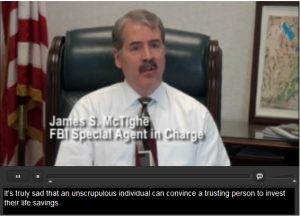
    “Affinity fraud is when someone you know — for example a church member, a coworker, or a friendd — takes advantage of you in an investment fraud scheme,” said James S. McTighe, FBI special agent in charge.

    Con artists have been known to deliberately target members of the Church of Jesus Christ of Latter-Day Saints, the FBI said.

    No group of believers — and no group of people who share a common bond — is immune to the cunning of expert con men, the FBI added.

    An investor featured in the educational video said her experience of being duped can serve as a warning to others:

    “He was a religious man, so he says, and he really, he really put on the ‘You know I am so guided by the spirit’, and ‘I know I am here to help you’, and ‘just trust me,’” the woman said.

    Nothing about a Ponzi scheme is good news, warned the SEC’s top official in Salt Lake City.

    “Ponzi schemes always collapse eventually and it’s typically because you run out of newer investors,” said Ken Israel.

    How do fraudsters profit from a Ponzi scheme?

    “The hallmark of the Ponzi scheme is that you use money from new investors to pay off your old investors and of course put a bunch in your pocket at the same time,” said Keith Woodwell, director of the Utah Division of Securities.

    Officials warned the public to be on the look out for “signs of trouble”:

    • The investment offer is unsolicited.
    • It sounds too good to be true.
    • You’re promised big monthly or yearly returns with little or no risk.
    • You’re asked to keep the investment offer secret.
    • The promoter cannot answer specific questions or provide you with written financial documentation.
    • Slick websites and glossy literature can be deceiving, and also be suspicious of documentation that looks unprofessionally produced.
    • The promoter won’t give you time to research the investment.
    • You are told you are one of the lucky few allowed in on the investment.
    • You are required to bring in more investors.
    • The salesperson is not licensed or the product is not registered.

    “Con artists who run Ponzi schemes often promise big financial returns and may tell potential investors they operate programs that can sound impressive,” the FBI said. The agency advised investors to do their homework and be skeptical of pitches for programs such as these:

    • Foreign Exchange Currency Trading.
    • Prime Bank Investment.
    • Commodities Investments.
    • Real Estate Investments.

    “Research before you invest, the FBI warned, recommending these resources for Utah residents:

    Get educated for free at the June 30 “Fraud College” at Utah Valley University in Orem

    Watch the Task Force video.

    Get more information from the FBI:

    NOTE: This story has been republished at a URL that is different than its original URL. Although this post reflects a date of June 13, it is not the original publication date. Click here to read why.

  • FEDS: Former Police Officer Recruited Active-Duty and Retired Cops, Firefighters Into Ponzi Scheme, Defrauding Them Of Nearly $900,000

    In yet-another action brought through the interagency Financial Fraud Enforcement Task Force (FFETF), a former police officer in a Cleveland suburb has been charged with operating a Ponzi scheme that defrauded law-enforcement colleagues and firefighters out of $889,000, federal prosecutors said.

    Raymond Thomas, 49, who formerly lived in Mentor, Ohio, and served on the Warrensville Heights Police Department, also was charged with filing a false tax return that understated his income in 2006 by more than $186,000.

    “It is particularly troubling to discover that a former law enforcement officer has committed a crime, especially given that law enforcement officers take an oath to uphold the law,” said U.S. Attorney Steven M. Dettelbach of the Northern District of Ohio. “These charges allege that Thomas did more than just violate the laws he had sworn to uphold, they charge that he actually targeted the law enforcement community to sustain his Ponzi scheme.”

    Prosectutors alleged that Thomas told about 25 investors — many of whom included Cleveland-area active and retired police officers and firefighters — that money they invested with him would earn “above average fixed returns with below average risk.”

    Thomas purported that he owned three legitimate companies — Strictly Stocks Investment Co. Inc., JR Ventures and Adams Title Agency — and that “Strictly Stocks would make quarterly payments to investors from income derived from ‘trading only in stocks and options,’” prosecutors said.

    JR Ventures was described as a trucking business that included a car and limousine service, and Adams Title Agency was described as a real-estate management company, prosecutors said.

    Thomas told investors that there money could be entrusted to any or all of the three companies and would be used for no other purpose than to create legitimate investment income.

    But Thomas “did not invest the money as he represented,” prosecutors said. “Instead, [he] unlawfully commingled investor funds; used investor funds for unauthorized purposes, including to make Ponzi payments to previous investors; and misappropriated investor funds for his own purposes and personal use.”

    Using words that have been associated with various so-called “mini-Madoffs” accused of operating smaller Ponzi schemes in the aftermath of Bernard Madoff’s $65 billion scheme, prosecutors said that “Thomas sent numerous interest checks, quarterly dividend checks, and financial statements to investors.”

    President Obama formed the FFETF in November 2009.

    Dettelbach’s office has brought a number of Ponzi cases recently. Last month, David Harriett, 60, of Warren, Ohio, was charged with bilking investors by telling them he built franchise restaurants for McDonald’s and Pioneer Chicken.

    In March, Enrique F. Villalba, 47, of Cuyahoga Falls, was charged in a bizarre Ponzi scheme that allegedly combined the science of physics with a unique “momentum filter” that purportedly enabled him to predict how the futures market would behave with “an uncanny degree of certainty.”

    The Villalba scheme was conducted from Beachwood Ohio, prosecutors said.

    Villalba is a graduate of the United States Military Academy at West Point and the University of Puget Sound School of Law.

    NOTE: This story has been republished at a URL that is different than its original URL. Although this post reflects a date of June 13, it is not the original publication date. Click here to read why.

  • Narc That Car President Fidgets, Struggles Through Lengthy Fox 4 News Interview In Dallas; Confirms That Members Who Don’t Recruit Make $5 A Month And Will Not Break Even For Nearly Two Years

    EDITOR’S NOTE: At the bottom of this post you’ll find links to the Fox 4 News website in Dallas-Fort Worth. We recommend you watch the video of the main report on Narc That Car broadcast by the station, and also the videos of a sit-down interview with Narc President Jacques Johnson. The interview was eminently fair, and yet the pyramid concerns remain . . .

    Narc That Car President Jacques Johnson confirmed yesterday in an interview broadcast by Fox 4 News in Dallas-Fort Worth that members who enter license-plate numbers into the company’s database but do not recruit are paid only $5 a month — 50 cents per plate.

    Narc That Car also is known as Crowd Sourcing International or CSI. Narc limits its data-gatherers to entering only 10 plates per month.

    Fox outlets in Atlanta, Los Angeles and Dallas now have broadcast reports about Narc. Despite being given access to the airwaves, no Narc representative or official — including Johnson — has been able to lay to rest questions about whether the company is operating a pyramid scheme.

    Johnson struggled in the lengthy Fox 4 News interview when trying to explain why Narc limits members to recording only 10 plates a month if its aim is to build a well-populated, viable database that would be appealing to clients willing to pay a fee for the information.

    As has been the case in its previous encounters with the media, Narc’s explanations left more questions than answers. Despite being given ample air time by Fox 4, Johnson still left the pyramid concerns on the table by confirming there is virtually no way to make money in Narc if a member does not recruit other members and by declining to name Narc’s clients for its database product.

    Johnson agreed with reporter Steve Noviello that it would take a Narc member not interested in recruiting 20 months — nearly two years — just to break even. Narc charges members a one-time, $100, up-front fee to join the program, which has a “F” rating from the Better Business Bureau.

    If a nonrecruiting member chose to pay Narc an optional $24.95 a month for a website on top of the $100 sign-up fee, the costs of belonging to the program never could be retired because paying Narc the fee would carry with it a built-in loss of $19.95 a month even if the member stayed with Narc long enough to retire the up-front fee, according to the Fox 4 report.

    Even if such a member opts not to pay for a website, the minimum amount of time it would take for the member to retire the $100 fee is about 600 days because of the 10-plate-per-month limit. According to the math of the program, such a nonrecruiting member would earn an average of about 16.66 cents per day.

    Johnson struggled throughout the interview to explain basic claims about the Narc program. The Fox 4 package includes multiple parts, including a lengthy interview with Johnson divided into four parts. (See the link under the video box below to visit the Fox 4 website.)

    Visit Fox News 4 to view the entire interview with Johnson.

    NOTE: This story has been republished at a URL that is different than its original URL. Although this post reflects a date of June 13, it is not the original publication date. Click here to read why.

  • NOTE TO READERS: Strange Behavior Of PP Site . . .

    Dear Readers,

    Late yesterday (June 11, 2010), the PatrickPretty.com Blog began redirecting improperly to another website.

    This event coincided with the migration of the PP site by its hosting company to a new platform.

    Some data appears to have been lost as a result of the migration. The site still is not behaving properly, although the problem with the errant redirect appears to have been solved.

    At the moment, data between June 2 and June 11 appears to have gone missing. Meanwhile, the Contact Form for the site is not working. There may be other problems I have not noticed yet.

    I am not sure when these problems will be fixed.

    These events have been reported to the hosting company. It is my sincere hope the problems will be fixed soon, and I apologize for the inconvenience.

    Patrick

  • BULLETIN: Yet Another Florida Ponzi Scheme; SEC Accuses Luis Felipe Perez Of Operating $40 Million Fraud Backed By Fake Diamonds And Bogus ‘Pawn Shops’

    EDITOR’S NOTE: Here’s one for your Bubba Blue notebook on the various ways to have a Ponzi scheme, as opposed to shrimp.

    UPDATED 5:50 P.M. EDT (U.S.A.) A Miami man has been charged by the SEC with gathering $40 million in a Ponzi scheme, pocketing $6 million for himself and telling investors they were helping him finance his Florida jewelry businesses and pawn shops in New York.

    Investors believed their money was safe because it was backed by the man’s jewelry operations, diamonds and life insurance, the SEC said.

    The trouble with the claims of Luis Felipe Perez, according to the SEC, was that he “had no dealings with pawn shops and never provided financing to them.”

    UPDATE 5:50 P.M: Perez also has been charged criminally by federal prosecutors with six counts of securities fraud, after a probe by the U.S. Secret Service and U.S. Immigration and Customs Enforcement, according to U.S. Attorney Wifredo A. Ferrer of the Southern District of Florida.

    The criminal case is part of an ongoing series of actions by the interagency Financial Fraud Enforcement Task Force, which President Obama established in November 2009, according to Ferrer’s office.

    At the same time, the SEC said, two “purported” jewelry businesses owned by Perez — Lucky Star Diamonds Inc. and Luis Felipe Jewelry Design Corp. — “did not generate sufficient revenue to pay investors’ principal and interest payments.”

    Clients did not know that “his primary source of money to pay investor returns was from new investors,” the SEC said.

    Although Perez said his offering was backed by “diamonds” in a bank safety-deposit box, the purported diamonds in the box “were fake,” the SEC said.

    Meanwhile, investors’ funds were not protected by a life-insurance policy as Perez had claimed because he had “defaulted on the policy premium” and allowed it to lapse, the SEC said.

    “Perez created an aura of success around him to lure old and new acquaintances into investing substantial sums of money,” said John C. Mattimore, associate regional director of the SEC’s Miami Regional Office. “Behind the luster of diamonds and jewelry, Perez told outright lies and made promises he couldn’t possibly keep.”

    While investors were imagining “guaranteed annual returns of 18 percent to 120 percent through monthly interest payments,” the SEC said, Perez spent $3.2 million of their money on a home, $1 million on jewelry for himself and his wife, $400,000 to lease luxury cars, $300,000 on clothing for his wife, $300,000 for travel by private jet and $100,000 on artwork.

    In addition, Perez paid himself a salary of $250,000, gave away more than $1 million to family members and made $100,000 in political contributions, the SEC said.

    The scheme collapsed in June 2009, when Perez “was no longer able to recruit new investors,” the SEC said.

    Because the scheme largely targeted Hispanics, it also had an element of affinity fraud, the SEC said. About 35 investors were affected.

    The U.S. Secret Service, U.S. Immigration and Customs Enforcement and the Miami Police Department assisted in the probe, the SEC said.

  • Pathway To Prosperity Case A Subject Of Discussion In Washington’s Highest Power Corridors; Website Of U.S. Attorney General Includes Link To Case Info As Part Of ‘Mass-Marketing Fraud’ Educational Campaign

    From the June 2010 International Mass-Marketing Fraud Working Group report.

    In November 2009, President Obama formed the interagency Financial Fraud Enforcement Task Force (FFETF). By January, U.S. Attorney General Eric Holder, who answers to Obama,  publicly warned fraudsters that “if you propagate an investment scheme, if you are complicit in an act of financial fraud, you are writing your ticket to jail.”

    It now turns out that the investigation into the business practices of Nicholas Smirnow and unnamed co-conspirators in an alleged $70 million, HYIP Ponzi scheme known as Pathway To Prosperity (P2P) was undertaken by elements of the FFETF.

    It further turns out the the U.S. Department of Justice — under Holder’s command — is using the P2P probe and the criminal charges it led to against Smirnow to educate the public on a global scale about “mass-marketing fraud.”

    The P2P case was mentioned prominently in a news release yesterday by the Justice Department to publicize international, cooperative efforts among seven governments to curb the proliferation of fraud that occurs on the Internet, over the telephone, through the mails, through group meetings and through other forms of mass communication.

    Last week, federal prosecutors thanked the Rotterdam-Rijnmond Regional Police in Rotterdam in the Netherlands, Filipino authorities, and the Ontario Securities Commission in Canada for assisting in the P2P probe.

    Meanwhile, an entity known as the International Mass-Marketing Fraud Working Group (IMMFWG) has released a “threat assessment” to provide governments and the public with a current assessment of the nature and scope of the threat that mass-marketing fraud poses around the world.

    IMMFWG’s participating countries include the United States, Australia, Belgium, Canada, the Netherlands, Nigeria and the United Kingdom, as well as Europol, the European police agency.

    “The IMMFWG seeks to facilitate the multinational exchange of information and intelligence, the coordination of cross-border operations to detect, disrupt, and apprehend mass-marketing fraud, and the enhancement of public-awareness and public-education measures concerning international mass-marketing fraud schemes,” the group said.

    In the Justice Department news release yesterday to publicize IMMFWG’s threat assessment, prosecutors pointedly referenced the P2P case.

    “Last week the U.S. Attorney’s Office for the Southern District of Illinois charged an individual for allegedly engaging in an international Ponzi scheme that was operated through a website,” the Justice Department said. “The scheme allegedly resulted in a total of $70 million in losses to more than 40,000 investors in more than 120 countries.”

    The news release included a link to information on the P2P case, and the letterhead in the document featured the logos of both the Justice Department and the Task Force Obama created in November.

    Despite very public warnings from Holder that the United States is serious about sending financial fraudsters to jail and a declaration in the complaint against P2P’s Smirnow that “[a] large percentage, if not all, HYIPs, are Ponzi schemes,” members of Ponzi-pushing forums such as ASA Monitor, MoneyMakerGroup, TalkGold and MyCashForums are still out in full force to push Ponzi schemes on the U.S. and world public.

    For its part, IMMFWG said in its threat assessment yesterday that “[t]here are strong indications that the order of magnitude of global mass-marketing fraud losses is in the tens of billions of dollars per year.”

    IMMFWG also said “[m]ass-marketing fraud has gradually transformed from a predominantly North American crime problem into a pervasive global criminal threat.”

    “For some victims,” IMMFWG said, “the risks extend well beyond loss of personal savings or funds to include physical threats or risks, loss of their homes, depression, and even contemplated, attempted, or actual suicide.”

    IMMFWG noted that “[l]arge-scale criminal mass-marketing fraud operations are present in multiple countries in most regions of the world” and that “similarities between such operations include targeting victims in other countries, foreign outsourcing of operations, and involvement of organized criminal enterprises.”

    Read the Justice Department news release that references P2P in the context of IMMFWG’s global effort to educate the public about mass-marketing fraud and the hideous economic and social consequences of such fraud.

    Read IMMFWG’s threat assessment as published by the interagency Financial Fraud Enforcement Task Force.

  • BULLETIN: Florida Office Of Financial Regulation Opens Probe Into PPE-Life; Firm Also Under Investigation In South Carolina Amid Allegations It Sold Unregistered Securities

    A company under investigation in South Carolina amid allegations it sold unregistered securities now is under investigation in Florida.

    The Florida Office of Financial Regulation (OFR) confirmed the probe into PPE-Life this morning.

    “OFR has an open investigation [regarding] PPE-Life and its principals at this time and cannot go into any additional details,” said Flora Beal, an OFR spokeswoman.

    OFR enforces banking, securities and financial laws in Florida.

    Last month, South Carolina Attorney General Henry McMaster ordered PPE to “cease and desist” from selling securities and collecting money in the state. The South Carolina Securities Division opened a probe May 14 amid reports the company was holding recruitment meetings in Sumter, S.C.

    Attendees at a meeting in a hotel about five miles away from Shaw Air Force Base were told PPE was the marketing arm of an unspecified “international bank.”

    When asked to identify the bank, John Barter, a PPE principal, responded that “I am the bank,” authorities said.

    South Carolina has had a problem with financial schemes targeted at military personnel and people of faith.

    Web records show that recruiting efforts for PPE were not limited to sit-down meetings. Online efforts to recruit members date back at least to January and feature images of a bull and a bear and commentary on celebrated stock trader Warren Buffet.

    Buffet is not believed to have any tie to the PPE.

    Florida records identify Barter, Walter Martin, Terry Beyer and Janet Palmer as principals of the Ocala-based company. PPE-Life’s corporate registration was filed April 29, at least three months after recruitment efforts began, according to records.

    At the same time, a web-based promotion for the firm identified it as “the marketing arm of ppe bank international.”

    No such entity appears to have been registered in Florida despite the apparent implementation of a web-based, recruitment-feeder system for PPE-Life in January.

    “what does this mean to you?” a classified ad for PPE asked in January. “this means that you can receive a paid position in this ground floor global opportunity for only $66 (one-time) not $599 (one-time). for $66 one- time, you will join a group of experienced entrepreneurs in a simple, forced 2×2, three-phase feeder system that will generate a third phase payout of $1,840. $599 of your $1840 will be used to to pay for your independent associate membership in ppe life.”

    Records in Florida show that a financial judgment of $295,785.14 was placed against Barter and Janet Palmer — both principals of PPE — in October 2009, about three months before recruitment efforts for PPE appear to have become active online.

  • Real HYIP Expert Says ‘Notion Of Secrecy’ In Commercial Fraud Meant To Discourage Reports To Law Enforcement; James Byrne Consulted With Government Before P2P Ponzi Case Was Filed

    EDITOR’S NOTE: Here is the declaration of James E. Byrne, an expert with whom the government consulted in the Nicholas Smirnow/Pathway To Prosperity Ponzi scheme case. It is a remarkable read — one that provides a free education from an expert who has consulted with the FBI and Scotland Yard, among other prominent law-enforcement organizations.

    DECLARATION OF PROFESSOR JAMES E. BYRNE

    I, Professor James E. Byrne, declare under penalty of perjury pursuant to 28 U.S.C. Section 1746:

    I. INTRODUCTORY STATEMENT

    1. I have been requested by counsel for the United States (hereafter “US”) to render my expert opinion in the above-styled litigation against Pathway to Prosperity Network or the P2P Network (hereafter “P2P”) in connection with the request for seizure of assets and other related relief. Specifically, I have been asked to opine regarding the character, nature, viability, and legitimacy of the transactions that are the subject of this action and any resemblance that they may have to fraudulent financial investments.

    2. I understand that it is my duty to express my expert opinion independently of any influence or advocacy.

    3. In rendering my opinion, I have examined the documents indicated in Exhibit A. My
    opinion is subject to revision or amplification should further documentation or information be provided to me.

    4. I have rendered my opinions in light of my experience, knowledge, research, and studies
    in the field of commercial transactions, banking operations, financial and payment systems and instruments, and commercial fraud.

    5. My Declaration is organized in the following manner:

    I. Introduction (~ 1 to ~ 5)
    II. Qualifications (~ 6 to ~ 13)
    III. Summary of Opinions (~ 14)
    IV. Explanation of Opinions (~ 15 to ~ 47)
    A. The Transactions Reflected in the Materials (~15 to ~ 19)
    B. The P2P Investment Compared to Legitimate Investment Opportunities
    and Transactions (~ 20 to ~ 22)
    C. High Yield or Multi Level Marketing Schemes (~ 23 to ~ 29)
    D. Resemblance of the Transactions in the P2P Materials to High Yield
    Features (~ 30 to ~ 47)
    V. Conclusions (~48 to ~ 49)

    II. QUALIFICATIONS

    6. For more than 25 years, I have served or do serve in various positions of leadership and
    responsibility in the field of international banking operations including:

    • Chair and Reporter of the International Standby Practices Working Group (1994-1998) which drafted ISP98 (ICC Publication No. 590) and Secretary to the Council on International Standby Practices (lSP) (since 1998) which issues Official Comments on the ISP.
    • Member of the Advisory Group to the International Chamber of Commerce (hereafter “ICC”) Task Force that drafted UCP600 (2003 – 2007).
    • Member of the U.S. Delegation to the Commission on Banking Technique and Practice of the ICC (since 1995).
    • Chair of the Group of Experts summoned to advise the Secretariat of the United Nations Commission on International Trade Law (hereinafter “UNCITRAL”) on the adoption and implementation of the United Nations Convention on Independent Guarantees and Standby Letters of Credit (since 2001).
    • Head of the U.S. Delegation to the UNCITRAL Working Group on International Contract Practices which drafted the United Nations Convention on Standby Letters of Credit and Independent Bank Guarantees (1988 – 1995).
    • Past Chair of the American Bar Association’s Subcommittee on Letters of Credit (1996 – 2000); Vice Chair (1994 – 1996).
    • Member o fthe following ICC Task Forces on the eUCP and the International Standard Banking Practice.
    • Member of the US Delegation to the meetings of the Commission on Banking Technique and Practice of the ICC .
    • Advisor to the US National Conference of Commissioners on Uniform State Laws Drafting Committee on the Revision of UCC Article 5 (1990 – 1995).
    • Director of the Institute of International Banking Law & Practice (since 1987).
    • Editor of Letter of Credit Update (1985 – 1997) and of Documentary Credit World (since 1997), monthly journals of letter of credit and bank guarantee law and practice including related commercial frauds.

    7. For more than 20 years, I have been involved in the following activities in connection
    with studying and combating commercial fraud:

    • Chair of the Group of Experts on Commercial Fraud of the Secretariat of the United Nations Commission on International Trade Law (hereafter “UNCITRAL”) (2002 to 2005).
    • Co-Chair of the UNCITRAL Symposium on International Commercial Fraud (14 to 16 April 2004).
    • Co-Chair of the North American and European Steering Committees on Combating Commercial Fraud (1999 – 2005).
    • Advisor to the Secretariat of UNCITRAL on Commercial Fraud (2005 – 2008).
    • At the request of the US Department of State, I have addressed the Plenary Session of UNCITRAL on its project on combating commercial fraud in 2002, 2003, and 2004.

    8. Since I first became aware of the problem of commercial fraud in 1987, I have been consulted by the US Office of the Comptroller of the Currency, the US Securities and Exchange Commission, the Federal Bureau of Investigation, Scotland Yard, Standard & Poor’s, the Commercial Crime Bureau of the ICC, various banks and corporations, and numerous individuals regarding commercial and financial fraud. In connection with this work, I have examined more than 1,500 sets of documents.

    9. For more than 25 years, I have lectured and taught courses in the areas of letters of credit, international trade finance, and commercial fraud, to bankers, business people, lawyers, banks, corporations, and trade associations in more than 35 countries throughout the world.

    10. In addition to the materials that I have reviewed, my opinions are based on my knowledge of standard international letter of credit and general commercial practice, and my research and studies regarding letters of credit and commercial fraud. My research and conclusions are regularly published and circulated in the letter of credit, financial, and commercial community and are subject to ongoing critical assessment. My qualifications and my publications are set forth in my resume which is attached as Exhibit B.

    11. I have received the following degrees: L.L.M., University of Pennsylvania (1978); J.D., magna cum laude, Stetson University College of Law (May 1977); B.A., cum laude, University of Notre Dame (June 1968).

    12. I have been a full-time faculty member at George Mason University School of Law since August 1982 where I teach subjects related to commercial law and practices including Commercial Paper, Letter of Credit Law, Contracts, Sales, Electronic Commerce, International Commercial Transactions, and Commercial Fraud.

    13. I have given sworn written expert statements to courts in China, France, England, Singapore, South Korea, Switzerland, and the United Kingdom. I have been admitted as an expert on commercial fraud, banking operations,and standby letter of credit practice and given expert testimony in Canada, Hong Kong, Norway, and Thailand as well as in approximately 20 federal and 4 state courts in the United States.

    III. SUMMARY OF OPINIONS

    14. In my considered professional opinion, the investment scheme described in the materials that I have reviewed are not legitimate but resemble and are classic instances of so-called high yield frauds and fraudulent pyramid schemes. The proposed returns are excessive for even the most risky legitimate investments and are simply preposterous for investments whose principal is supposedly guaranteed. In addition, the materials contain other features common to commercial frauds including an element of a pyramid scheme and, if there were payouts, it is my opinion that it is highly likely that they were derived from the investment of the same or other victims, making the scheme also a ponzi scheme. It is apparent to me that the materials and the scheme which they describe were deliberately and artfully constructed, drawing on similar scams to deceive, confuse, entice and trap would-be investors.

    IV. EXPLANATION OF OPINIONS

    A. The Transactions Reflected in the Materials

    15. Cast in the form of an “investment club”, the scheme described in the materials offer
    sustainable higher returns than those available from conventional forms of investment
    (“the highest returns in the safest environment”) in addition to so-called “handsome
    referral commissions”. The investment aims for investors with USI00 to US$25,000 to
    invest, making it a working class type of fraud.

    16. The funds are turned over to the investment and “earn” returns that range from 1.5% daily for a 7 day plan Plus the return of the initial investment to 2.67% daily for a 60 day plan or 160.2% plus the return of the initial investment. The weekly returns on the 7 day
    investment would amount to approximately 540% per year without taking into account
    the principal and the 60 day plan would return approximately 950% annualized.

    17. Despite the excessive nature of these returns, the principal invested is said to be
    “guaranteed” by a “personal guarantee”.

    18. There is no explanation in the materials that I have examined as to the source of these excessive returns or how they can be guaranteed. The materials do state, however, that it is not invested in “public securities” or the stock market, “Forex” (which I understand to mean foreign exchange transactions), and is chiefly “offshore” and managed by ”’EXPERTS in their own fields”.

    19. In the course of the investment, the materials that I have reviewed describe another venture that was begun, sometimes described as “Energy Ltd.”. “P2P Energy Bank”, and other times described as a “global ‘bank”‘. Coupled with this plan was the issuance of debit cards by which investors could withdraw their supposed funds.

    B. The P2P Investment Compared to Legitimate Investment Opportunities and
    Transactions

    20. While it is possible that a legitimate investment can occasionally yield a return in the ranges indicated in the materials, such returns in the times indicated are extremely rare and are not sustainable. Such investments are highly speculative and most such investments result not only in no returns but in the loss of principle.

    21. In the legitimate world of financial investments, the return on an investment correlates with the perceived risk undertaken. The riskier the investment, the higher the return and the lower the perceived risk, the lower the return. In legitimate financial transactions risk is measured in a variety of ways which, while not perfect, provide a relate notion of the perceived riskiness of the investment. The return on obligations of the US government for a similar period sets the bench mark for relatively safe investments and investments deemed by rating agencies to be investment grade track the yield on Treasury obligations.

    22. The returns indicated in the materials that I have examined for this scheme are so high that it would not be excessive to term them “extraordinary”. Yet because the principal is guaranteed, they would be regarded as extremely safe. Moreover, the returns are described in the materials as being obtained from “low or medium risk ventures”. Such combinations do not exist in the world of legitimate finance. These proposed returns turn the general rule regarding risk on its head, proposing to pay phenomenal returns for “safe” investments.

    C. High Yield or Multi Level Pyramid Schemes

    23. While it is my opinion that the investments described in the materials that I have reviewed do not resemble legitimate transaction, it is also my opinion that they do resemble and are, in fact, an instance of so-called high yield investment scams and of so called Pyramid scams.

    24. High Yield investment scams began to appear in a concentrated manner in the 1980s. They offered excessively high returns. Originally, they used different names since the term “high yield” was attached to a type of highly speculative legitimate investment at the time, one that involved investment in so-called ‘Junk bonds” or bonds which were not rated by rating agencies because of the low creditworthiness of their issuers. At that time, they were known by a variety of names, the most infamous of which was “prime bank” investments, a name taken from the fact that the preposterous returns were often attributed to the involvement of a major (or “prime”) bank. After the original meaning of “high yield” was forgotten and the term “prime bank” attracted unfavorable publicity, these schemes began to describe themselves as “high yield” investments.

    25. Regardless of the name, they have common characteristics which do not necessarily have anything to do with the involvement of banks. Indeed, the investments are of two types, some are very specific regarding the nature of the investment, attributing the returns to some esoteric aspect of international finance such as forfeit or first demand guarantees.

    Others are vague about the nature of the investment. Invariably, the esoteric sources of the returns turned out either to be fictions or not to yield such returns in the real world. On the other hand, the vague schemes were equally unreal. No real investment could simply avoid explaining its nature or character.

    26. Multi Level Marketing schemes (sometimes referred to as “MLM”) were quite common in the 1980s and early 1990s and when connected with high yield scams are invariably pyramid schemes. Recently, such combinations have been less common as their fraudulent character became exposed. The schemes play on notions of cooperative investment, with the pooling of funds to achieve a disproportionate return end. They involve incentives to attract other investors in the form of various financial incentives. frauds. It is also interesting to me that the materials themselves deny that P2P is a “failed” M.L.M. scheme.

    27. There are a variety of characteristics common to commercial frauds. Some are always present and others are less omnipresent. These features include:
    a. returns that are disproportionate to the risk involved;
    b. the source of the return is obscured;
    c. entail unnecessary secrecy;
    d. contain references to attractive moral principles;
    e. do not involve investments that can return the promised yields;
    f. involve intricate explanations as to why the promised returns have failed to materialize.

    28. While not all of these elements may appear in a single scheme, it is common for several of them to appear. The defining character of the scam is the promise of disproportionate returns.

    29. Regulatory authorities and other responsible institutions of the leading developed countries have publicly warned about High Yield Investment Scams and have disassociated themselves from them, including the US Office of the Comptroller of the Currency (since 1986), the Federal Reserve (1993), all US banking regulators (1993), the Head of the Banking Supervision Division of the Bank of England (1994), the British Bankers Association (1993), the US Securities and Exchange Commission (1993), the International Chamber of Commerce (1993), the US Bureau of the Public Debt (1999), and UNCITRAL and the UN Commission on Drugs and Crime (2007). Since the initial warnings, numerous other warnings have been given and can be readily obtained by any person professionally experienced in finance or investment.

    D. Resemblance of the Transactions in the P2P Materials to High Yield Features

    30. As indicated, the feature most characteristic of a high yield scam is the disproportion between the supposed returns and the perceived risk. That feature alone would identify the scheme described in the materials that I have reviewed as fraudulent. There are, however, other features of the scheme that reinforce this conclusion.

    31. As also indicated, a similar characteristic of a species of high yield scam is the failure of the scheme to offer any explanation whatsoever of the source of the extraordinary returns and guaranteed. The failure of the materials that I have reviewed to account for its promised guaranteed returns other than suggesting that it chiefly from “offshore” sources marks it as belonging to this branch of the scheme. It is somewhat unusual in that it excludes several investment modes such as traded stock, publicly traded securities, and foreign exchange (although such investments are not risk free and do not provide guarantees of the initial investment).

    32. A typical characteristic of high yield scams is that they contain an international dimension. Such an attribution adds an element of glamour, makes it much more difficult for an investor to determine the authenticity of the claimed returns. An investor could convince him or herself: “Even though such returns cannot be obtained locally, perhaps it is possible in other countries.” In fact, the same fundamental law about the correlation between risk and return applies everywhere. As indicated, the materials that I have reviewed peg the source of the promised extraordinary returns as being offshore and refer to the “international market” that they have attracted, falling into this pattern while providing some explanation for the source of the returns, however vague.

    33. Another feature of high yield scams is a sense of exclusivity. This sense is honed to a high degree in multi level marketing programs. The notion is that investors are being introduced into a special network of investors with insights not accessible to ordinary mortals and obtained in part by pooling their resources. The materials that I have reviewed contain such features as illustrated by the use of the word “Club” to describe the venture, regular reminders that the program is by invitation only and that membership is by the grace of the team of fraudsters that control the program, regular allusions to the positive affect produced by pooling (enabling investors to earn dividends “totally out of reach for the average individual” and referring to accessing “the high interest that millionaires enjoy”), and its ability to garner the type of returns only available to the very wealthy, and regular appeals to the common interest and proper behavior.

    34. Coupled with this sense of exclusivity, is the notion of confidentiality, another feature of high yield scams. The message is that the investment is by invitation only, not to be publicized, and that the investor is obligated to respect its confidentiality by not discussing it with outsiders. The materials that I have reviewed contain such references. The investor agrees that the material generated “must be kept private, confidential and protected from any public disclosure” [bold typeface in original]. The transactions are described as “private”. The materials also state that “[w]e will not tolerate nor accept any bad publicity of any nature, from anyone whatsoever” [bold typeface in original] with the threat of expulsion in the event that this prescription is violated. When complaints were made externally to service providers or supposed payment agents,
    scathing rebukes were made to the “members”.

    35. In part, this notion of secrecy in commercial frauds is meant to discourage reporting the scheme to investment councilors or public authorities who would recognize it for what it is. In addition to the features mentioned above, the materials that I have examined contain implicit warnings that complaints to public authorities contribute to the delays in paying out funds. In a similar vein, the materials incorrectly state that the transactions are exempt from the DC Securities Act of 1933 and the Securities Exchange Act of 1934 and that the materials themselves are not solicitations for an investment, a tactic not uncommon in high yield scams.

    36. In multi level marketing, there is an inconsistency with such a notion in that there are
    incentives to inducing others to invest. However, fraudulent commercial schemes are not
    noted for their internal consistency and such an inconsistency appears in the materials that I have examined. The materials that I have reviewed attempt to juggle this inconsistency by prohibiting advertising (unless it is approved) while offering incentives for finding new members and permitting them to inform relatives and friends and networking on a small scale without permitting general advertising.

    37. As noted, the materials that I reviewed contain elements of a pyramid scheme. A pyramid scheme is one in which early investors earn returns from inducing investments by subsequent investors. The more investors that a person introduces, the greater the yield to the person who introduced them.

    38. It is not uncommon for commercial frauds to contain or repeat warnings against similar
    frauds. This feature disarms suspicion with the notion that someone would not be warning about a fraud if it were itself such a fraud. The materials that I have reviewed contain several warnings about “H.Y.I.P.” (which I understand to refer to “High Yield Investment Plans”) and M.L.M.s (which I understand to refer to “Multi Level Marketing” programs). They also contain warnings to the effect that the fraudsters who have prepared the materials do not “believe” in them. Indeed, the materials that I have reviewed contain a perceptive critique of high yield programs (the interest that is offered is “ridiculous”) and state that “[t]his ‘Club’ does not rely on new people joining to succeed or sustain….”

    39. There is also a warning about the ponzi character of such schemes. The reference to “ponzi” schemes is derived from the scheme perpetrated by Charles Ponzi early in the 20th Century by which he paid earlier investors from the investments from subsequent investors or merely booked returns so that investors had large paper profits. Such schemes can only succeed provided that they balance the amounts withdrawn both by investors and the fraudsters themselves with the amounts invested. Recognizing its vulnerability to criticism, the materials cynically assure the investor that th funds pay “real returns/dividends”. They also describe a high yield program as one that “uses the funds from one investor to pay the next investors’ commission.”

    40. The cynicism of the drafters of these materials shows in their tongue in cheek statement that their “programers” recommend the use of “H.Y.I.P.” “Software”. Even if there was such software, the underlying ‘joke” was that the same software would have worked because the P2P program was just another high yield scam.

    41. Incidentally, I note that these references reveal the familiarity of those who developed this scheme with high yield and multi level marketing frauds. This familiarity is not surprising to me since the scheme that they have created is an instance of them but it is unusual for the scams to reveal their awareness of the nature of these schemes so expressly.

    42. As indicated, high yield scams often contain references to the altruistic nature of the program or those involved in it, seeking to appeal to this aspect of human nature in part in the hope that such an appeal will result in the suspension of prudent judgment about those who have (or claim to have) such traits. While not a major feature of the materials that I have examined, there is a reference in them to the “strong moral foundations” that underlie the scheme.

    43. It is not uncommon for high yield investments to refer to themselves as “legal” and to use the term “clean”, sometimes in reference to the funds that they receive or pay. Sometimes they require such a statement from investors. While the materials that I have reviewed do not use the common formula, they do contain a statement that the program is legal. While odd, this term alone is not decisive. However, the statement is that they program is “legal and clean”. The term “clean” has no meaning in this context in legitimate investments and in my opinion is drawn from the family of high yield frauds that commonly use it.

    44. In rendering my opinion, I am not unmindful of the disclaimers made in the materials that I have reviewed. It is not uncommon for high yield scams to contain such disclaimers in an attempt to provide the fraudsters with excuses or defenses in the event of inevitable complaints. Such attempts to avoid liability must be read in the context of the entire scheme. A few lines in pages of materials that suggest that the investor assumes all risk, particularly when they contradict the inducements and guarantees, would be readily overlooked by any investor and does not, in my opinion, alter the fraudulent character of a program promising impossible guaranteed returns. In this vein, the materials state that the investor agrees to indemnify and hold the principals harmless from “any liability”. They also state that the investment is at the investors own risk, despite the guarantee that is prominently given, and that past performance “is not an explicit guarantee for the same future performance”, conveniently ignoring the promised returns which are not said to be dependent on any such contingencies and do not refer to past performance but are promises of future performance.

    45. I note that the materials that I have reviewed state that the investments are undertaken by experts in their fields. Such claims are common in high yield investment scams. In my opinion and experience, any expert or and most experienced investment counselor would immediately recognize the fraudulent character of the scheme described in the materials.

    46. It is difficult from the materials to determine the full scope of the Energy Ltd. program and the plan to obtain debit cards. Attempts to imitate a bank or to provide debit cards are advantageous for a high yield scam in that they provide the appearance of legitimacy. However, claiming to be a bank or, as the materials sometimes qualify it, a “bank” does not make something a bank. Moreover, one need not be a bank to distribute debit cards. It is not clear from the materials whether the debit card program was ever launched but, even it it was, it merely would constitute a private label arrangement by which the program would fund withdrawals through a third party service provider. In the past, I have encountered high yield scams with such features.

    47. As indicated, it is common for high yield programs to generate numerous excuses when, as is inevitable, investors are unable to obtain their funds. Such excuses are intended to pacify investors, generate sympathy, or await the investment of further funds. The materials that I have reviewed contain numerous examples of such excuses. Delays are blamed on computer “glitches”, program failures, errors, trips, failure of investors to comply with rigid and counter-intuitive rules, failure to fill out forms properly, excessive demands on staff, marriages, third party providers, and the Great Recession of 2008/9. They are coupled with threats and warnings as well. A classic example is the expression of perplexity as to why anyone of good will would not “appreciate the opportunity” to earn “the returns we are being paid” and as to why they would “complain and moan” “if there is a 30,60,90, or even 120 day delay”.

    v. CONCLUSIONS

    48. It is my considered professional opinion that the programs described in the P2P materials that I have reviewed constitute an instance of high yield and multi level marketing fraud and are not legitimate.

    49. It is also my opinion that the materials that I have reviewed were deliberately constructed to give the impression of legitimacy and to entice unsophisticated investors.

  • BULLETIN: United States Seeks To Extradite Pathway To Prosperity’s Nick Smirnow From Philippines

    The U.S. government “shortly” will request the government of the Philippines to extradite accused HYIP Ponzi schemer Nicholas Smirnow to the United States to face charges of mail fraud (three counts), wire fraud (four counts), securities fraud (one count) and conspiracy to commit mail fraud, wire fraud, securities fraud and money laundering, federal prosecutors said.

    It was not immediately clear if Smirnow had been arrested and detained in the Philippines, but prosecutors listed a Philippines’ address for him. No precise timetable for the extradition was laid out early this afternoon on a website prosecutors established for victims.

    Smirnow, 53, formerly of Baysville, Ontario, Canada, is accused of operating a global Ponzi scheme through his company, Pathway To Prosperity (P2P). More than $70 million was lost in the scheme, prosecutors said.

    A message left at the office of U.S. Attorney A. Courtney Cox to clarify whether Smirnow had been arrested was not immediately returned.

    Prosecutors have set up a web page for victims here.