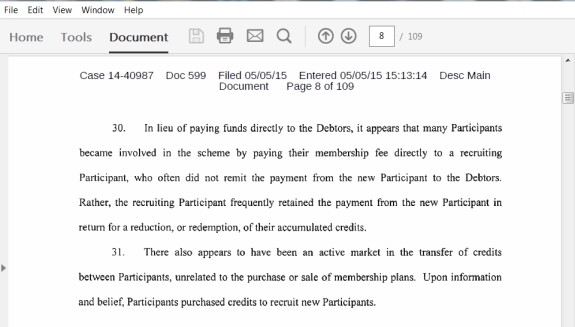
From a court filing dated Dec. 11, 2015. Red highlight by PP Blog.
DEVELOPING STORY: (5th Update 8:18 p.m. ET U.S.A.) MLM attorneys Gerald Nehra and Richard Waak will sign a confession of judgment for a whopping $100 million and acknowledge that Zeek parent Rex Venture Group “in fact operated an unlawful Ponzi and pyramid scheme” under the terms of a settlement agreement with Zeek Rewards’ receiver Kenneth D. Bell, according to new court filings.
The news comes as Nehra and Waak also are being pursued by class-action attorneys for alleged misdeeds involving the TelexFree MLM scheme broken up by the Massachusetts Securities Division, the SEC and the U.S. Department of Homeland Security in 2014.
A judge must approve the settlement proposal with Bell in which the MLM lawyers contend “that they acted in good faith as legal counsel,” but now “acknowledge and agree that, based on their current knowledge, during the period they served as counsel RVG in fact operated an unlawful Ponzi an pyramid scheme involving an unregistered investment contract that caused hundreds of millions of dollars in losses to innocent victims of the scheme,” according to filings from Bell.
In 2008, Nehra argued that AdSurfDaily — a $119 million Ponzi scheme — was not a Ponzi scheme. His own client, Andy Bowdoin, later disagreed. Nehra then became involved in both Zeek, a scheme that allegedly gathered more than $850 million, and TelexFree, which allegedly created more than $3 billion in bogus economic activity.
All three “programs” used similar business models. The cascading fraud totals have been a source of considerable concern.
The settlement proposal with Bell hints the MLM attorneys, who acknowledge no liability to the receiver, already may be wiped out in that it calls for a payment of $100,000, a small sum compared with the confession of judgment for $100 million.
In fact, according to the agreement, the MLM lawyers have submitted a sworn financial statement and the $100,000 figure represents “to the extent that it can be accomplished, the full payment of all the Nehra and Waak’s funds and assets available to satisfy the agreed judgment.”
“The Receiver believes the financial settlement, Confession of Judgment in the amount of $100 million and the acknowledgement of the existence of the Ponzi and pyramid scheme reached as part of the negotiation process is the best outcome for the Receivership and that even with the expenditure of additional funds to obtain a judgment there is not a likelihood of a materially increased recovery for the eventual distribution to the Zeek victims.” Bell wrote.
Bell sued Nehra and Waak in September, alleging that they “encouraged investors to participate in the scheme by knowingly allowing their names to be used in providing a false façade of legality and legitimacy and gave improper legal advice that allowed the scheme to continue far longer than it would have without the Defendants’ support. Nehra and Waak’s improper and negligent actions, which breached their fiduciary duties to RVG and assisted RVG’s Insiders to breach their fiduciary duties, caused significant damage to RVG.”
Bell advised Senior U.S. District Judge Graham C. Mullen today that the proposed settlement sum of $100,000 was “based on the defendants’ financial condition.”
From PP Blog archives: On April 2, a video depicting President Obama as a fan of the MyAdvertisingPays “program” appeared on YouTube. An “Obama voice” was dubbed into the video, which also shows the Presidential Seal. Text below the video reads, “Mr. President speaks about the new advertising revolution.”
“My AdvertisingPays pays its members every 20 minutes,” a mimicked voice of Obama said in the promo. “I highly recommend you to join MyAdvertisingPays.”
Like many things in network marketing, this was reckless beyond measure. MAPS, as it is known, is reminiscent of the AdSurfDaily Ponzi scheme broken up by the U.S. Secret Service in 2008. ASD, sued by some of its own members amid allegations of racketeering and described by the Secret Service as a “criminal enterprise,” thought it prudent to trade on the name of President George W. Bush to drive dollars to its $119 million scam.
It proved to be very imprudent for ASD to suggest a White House vetting and endorsement. The indictment against ASD operator Andy Bowdoin even referenced the bid to dupe members and prospects in this fashion . (Also see: “THE DAY ‘WINK-NOD’ DIED,” from the PP Blog on Dec. 2, 2010.)
MAPS Suddenly Says It Is Withdrawing From United States
After one or more MAPS’ promoters lifted footage of a Presidential address and used technology to put words in Obama’s mouth to help an MLM scheme spread its tentacles, it now has come to pass that MAPS — purportedly led by American Mike Deese of Mississippi via Anguilla, a British overseas territory — says it is pulling out of the United States.
In an announcement dated yesterday and titled “THE MOST IMPORTANT UPDATE EVER RELEASED,” MAPS more than hinted it is not wanted in America: “We are going to focus on the place where we are wanted and are making huge strides,” MAPS said.
That place is Europe, according to MAPS.
“The decision comes on the heels of a declining marketplace in the US for our company.,” MAPS said. “It simply isn’t profitable for us to remain engaged there. Over 90% of our business already comes from Europe, while we are catering to the US members by operating in US currency. It doesn’t make good business sense to continue operating in a place and expending valuable resources in a market that’s steadily declining.”
If MAPS is right — if it’s not wanted in America and if the U.S. market is steadily declining — we take this as good news that suggests MAPS perceives a serious threat from American law enforcement and class-action lawyers interested in suing under the federal RICO (racketeering) statute. Even so, it’s troubling that MAPS apparently sees a welcome mat for itself in Europe.
About 50,000 Spaniards reportedly got sucked into the TelexFree scheme. TelexFree pain, in fact, lingers across Europe and the world. It is possible that it affected 1 million people or more. MAPS currently brags that it has “209805+ Users.”
Like the other “programs,” MAPS now is planting the seed it is lining up people to sue.
From the MAPS Oct. 15 announcement (italics added):
On a different note, it has come to our attention that there exist multiple internet-based avenues being used for defamatory and libelous speech against MAP. Through our research, we have found many, if not all, of these claims to be without merit and simply an attempt by certain individuals to exploit the MAP name in order to heighten the popularity of their own product. MAP has served demand letters upon those individuals who engage in defamatory and slanderous rhetoric, and in anticipation of litigation, has prepared complaints against all such individuals. MAP would like to emphasize and reassure you that their decision to cease operations in the United States is in no way connected to the aforementioned defamation and libel claims.
Let’s say you’re an MLMer or network marketer. Your email inbox begins to fill up with offers for a scheme that purports to be an “advertising program” favored by famous brands. Spammers are trying to blast their way into your social-media accounts.
The messages: You’re going to be rich in no time. Beyond that, you’re going to receive valuable shares in a startup.
This was Bossteam E-Commerce Inc. — and it was a noxious Ponzi fraud whose “Inc.” designation was meaningless and served as a reminder that a corporate registration is not proof no scam is occurring.
AdSurfDaily ($119 million) was an “Inc.” running a fraud. Bernard Madoff was at the helm of an LLC involved in the largest Ponzi scheme in U.S. history. (NOTE: MLMers/network marketers should think about these things that next time they point to an “Inc.” or “LLC” designation” as proof of legitimacy. TelexFree, accused of operating a combined Ponzi- and pyramid scheme that gathered on the order of $1.8 billion, was both an “Inc.” and an “LLC.” Rex Venture Group “LLC” operated the Zeek Rewards scheme believed to have gathered on the order of $897 million. At one point in time, promoters of ASD, TelexFree and Zeek pointed to corporate registrations as proof no scam was occurring. The same thing happened with DFRF Enterprises, currently in the news.
As the PP Blog reported in May 2012, the Bossteam “program” surfaced in British Columbia and allegedly sold memberships for up to $5,000 each. Prospects allegedly were told they’d get paid for clicking on ads and could exchange purported “private” shares through a purported “internal trading platform.”
But “Bossteam committed fraud when they created the false impression that Bossteam members and well-known local and international businesses were paying Bossteam to advertise on its websites,” a panel of the British Columbia Securities Commission found in a decision dated yesterday. “This was untrue, as the majority of ads appearing on Bossteam’s websites were associated with Bossteam’s own accounts, and not to accounts for parties that had paid Bossteam to post their links.(NOTE: Bossteam is hardly alone in this category. Remember EAdGear?)
ASD, Zeek and TelexFree also had purported “advertising” elements.
It gets worse — and MLMers/network marketers need the learn from this history.
The panel found that each of the respondents breached the Act by:
distributing securities of Bossteam without first having filed a prospectus, contrary to section 61(1);
engaging in conduct that perpetrated a fraud on those who purchased securities of Bossteam, contrary to section 57(b);
withholding information concerning the sale of securities of Bossteam in response to a demand for production issued under section 144 of the Act, contrary to section 57.5; and
attempting to conceal or withhold information concerning the sale of securities of Bossteam by instructing others to deny Bossteam had offered such securities to the public and to refer to the concept of online trading as being planned for the future, contrary to section 57.5.
Put another way, Bossteam first ripped off its members and then tried to draft them into an international conspiracy to cover up the fraud scheme.
The decision involved the conduct of Bossteam, Guan Qiang Zhang (also known as Victor Zhang) and Yan Zhu (also known as Rachel Zhu).
Among the panel’s conclusions was that “Zhang contravened section 57.5 of the Act by attempting to conceal information concerning the sale of Bossteam securities when he instructed others to stop referring to Shares as shares and instead call them consumer credits.”
It is common for HYIP scammers to try to tweak language to skirt securities laws. Both before and after the tweaks, the scammers may seek to dupe the fleeced masses into doing the same thing — a circumstance that leads to a flood of misinformation on the web.
One of the classic fraudulent tweaks occurs when a scheme purports to be morphing from a private offering into one that soon will trade on one or more public stock exchanges. Here is part of what the BCSC said in its May 2015 Investor Alert on the DFRF scheme.
The BCSC has become aware that [Daniel Fernandes Rojo] Filho is offering investments to British Columbians with returns of up to 15% per month. Filho is also promising that DFRF will soon be listed on a public stock exchange, after which the value of members’ investments will triple within 30 days. Members will continue to receive up to 15% per month on their investment. These returns are economically impossible. Also, when selling securities, it is illegal to represent that those securities will be listed on an exchange without certain conditions being met.
Daniel Fernandes Rojo Filho also has been cited in filings as Daniel Fernandez Rojo Filho.
The SEC announced its action against Filho, DFRF and others last week. Here is part of what the agency said (italics added):
The SEC alleges that Filho and others began selling “memberships” in DFRF last year through meetings with prospective investors primarily in Massachusetts hotel conference rooms, private homes, and businesses. DFRF promoted the investment opportunity through online videos in which Filho falsely claimed that the company had registered with the SEC and its stock would be publicly traded. As DFRF’s marketing reach widened, membership sales dramatically increased from under $100,000 in June 2014 to more than $4 million in March 2015 alone.
Since late March 2015, the defendants have claimed that DFRF is registered with the Commission, its stock is about to become publicly traded, and current investors may convert their membership interests into stock options at $15.06 per share. At first, Filho represented that public trading would start in mid-April 2015. Since then, he has announced several delays and offered various excuses. On June 17, 2015, he claimed that, although public trading has not begun, the value of DFRF stock now exceeds $64 per share.
DFRF and Bossteam were not precisely alike, but both schemes allegedly were offering frauds that operated as Ponzi schemes and duped investors with talk of trading shares. Bossteam allegedly lined up about $14 million, with DFRF coming in at about $15 million.
Bossteam has been cease-traded. Zhang and Zhu have been banned from the British Columbia securities trade. Fines and disgorgement against the pair total $28 million.
Many current online HYIP schemes share a common story of above-market returns, with shared wealth being enjoyed by the masses. These may be advanced as private or public offerings, with references to in-house platforms or public stock exchanges. The term “IPO” also is used in some schemes.
In recent years, the schemes have led to losses that cascade across the globe. The schemes may be positioned as “offshore” and therefore safe or even guaranteed. There may be accompanying claims prestigious banks or insurance companies provide financing or a guarantee against losses.
Among the SEC defendants in the DFRF case is Heriberto C. Perez Valdes, 46, of Miami. The SEC alleged that he is a manager of a Massachusetts DFRF entity “with responsibility for “all administrative and executive work.’”
The agency further alleged that Valdes also is “an administrator of Platinum Swiss Trust, a purported Swiss private bank that is not actually authorized to conduct banking activities in Switzerland. (Emphasis added.) “He has made materially false and misleading statements about DFRF in public meetings and videos posted on the internet.”
How deep did the deception go? Perhaps deep into Boston Harbor.
“On October 16, 2014, DFRF sponsored a public event on a cruise ship in Boston harbor,” the SEC alleged. “Several videos of the event were posted on the internet. In one video, Filho states that DFRF makes a gross profit of 100% on its gold production in Africa, it needs the investors’ money to ‘leverage’ its credit line in Switzerland and triple its available funds, it pays 15% per month to investors (but cannot promise to do so without violating the law), and the investors’ money is fully insured. In a second video, Valdes states that the investors’ money is held in Switzerland and is fully guaranteed.”
Like other schemes (including TelexFree), an insurance company was said to provide DFRF members a safeguard against losses.
Here is part of what the SEC alleged against DFRF defendant Jeffrey A. Feldman, 56, of Boca Raton, Fla. (Italics added.)
He is the sole officer and director of Universal Marketing Group, Inc., a Florida corporation. He claims to be the U.S. representative of Accedium Insurance Company (“Accedium”), which is based in Barbados and London. In July 2007, he filed for personal bankruptcy. In 1998, he was found guilty of fraud and forgery for having received $2.5 million in premiums from a rental car chain for insurance policies that he did not actually obtain. In 1996, the state of Florida revoked his license to sell insurance after he pleaded no contest to charges that he submitted false insurance claims for losses he supposedly suffered from Hurricane Andrew. He has made materially false and misleading statements about DFRF in public meetings and videos posted on the internet.
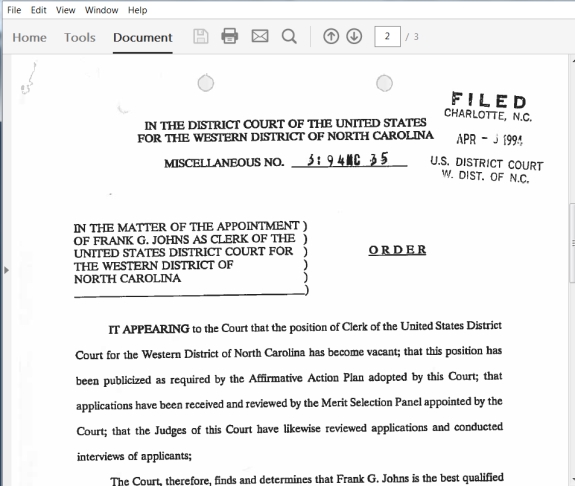
Viewed as a PDF, this is a section from a court order signed by three federal judges appointed by the President of the United States. The order from April 1994 officially appointed Frank G. Johns clerk of the U.S. District Court for the Western District of North Carolina.
UPDATED 9:21 A.M. EDT JULY 2 U.S.A. As the PP Blog reported on June 25, at least one odd sideshow is occurring while court-appointed receiver Kenneth D. Bell is pursuing clawback actions against alleged “winners” in Zeek Rewards.
A filing docketed June 23 and attributed to Canadian alleged winner Catherine Parker led to questions about whether Parker, of Hamilton, Ontario, was a “sovereign citizen.” Parker is facing a default judgment of nearly $214,000. Among other things, the June 23 filing attributed to her accused longtime U.S. Court Clerk Frank G. Johns of the Western District of North Carolina of dishonoring his office.
Johns has held the office for more than two decades.
The filing identified Johns as a “respondent.” It also requested “a certified copy” of any oath taken by Johns and “certified copies and detailed lists of all [the clerk’s] court related bonds, sureties, indemnifications, and insurance related policies.”
Such tactics are consistent with filings by “sovereign citizens.” It is unclear whether Parker adheres to the bizarre “sovereign” ideology, some of which surfaced in the AdSurfDaily Ponzi case and ultimately led to criminal charges and convictions against ASD story figure Kenneth Wayne Leaming.
Leaming acted out on some of his legal fantasies, ultimately participating in the filing of bogus liens against U.S. judicial officials. “Sovereigns” sometimes don’t know when to stop, and escalations often land them in trouble.
Chief Deputy Clerk Terry T. Leitner of U.S. District Court for the Western District of North Carolina responded to the June 23 filing attributed to Parker today.
This is from a letter from Leitner to Parker today (italics added):
In response to your request for a copy of the oath of office form for Frank G. Johns, Clerk, U.S. District Court, this office does not release copies of personnel documents.
This letter will confirm, however, that Frank G. Johns was appointed Clerk of the U.S. District Court for the Western District of North Carolina on April 11, 1994. The oath of office taken by a Clerk may be found in the United States Code at 28 USC Section 951.
Attached is a copy of the Order appointing Mr. Johns which is public record.
Included with the Leitner letter was a copy of a 21-year-old court order from April 1994 that appointed Johns clerk of the district. Three judges signed the order, including then-U.S. District Judge Graham C. Mullen. The order was signed on April 5, 1994. It went into effect on April 11 of that year.
Mullen, who is hearing the Zeek clawback cases, went on to become Chief Judge of the district. A former Naval officer, Mullen is now a Senior District Judge. He also is presiding over the SEC’s Ponzi/pyramid action against Zeek brought in August 2012.
The June 23 letter attributed to Parker appears to contend she entered a defense to the clawback action in October 2014 but that the defense never was entered into the record of the case. Johns entered a clerk’s order of default judgment against Parker on Jan. 6, 2015. The letter requesting the clerk’s oath was filed more than six months later. It complained about Parker’s name being presented in all-caps and accused two attorneys working for the Zeek receivership of dishonoring the court.
The June 23 filing attributed to Parker marked at least the second time a resident of Canada has filed a document that raised questions about whether a person north of the U.S. border was playing potentially costly “sovereign” games in the Zeek clawback actions in the United States.
Bell alleged in September 2014 that Sandra Gavel of Sechelt, British Columbia, was a Zeek winner who owed the receivership estate nearly $90,000, plus interest. As was the case with Parker, Bell alleged that Gavel had received Ponzi proceeds that had come from Zeek victims.
Gavel wrote a letter to the North Carolina court in October 2014 that sought to make Johns or the court itself a “respondent” and asserted Johns had made an “offer to contract” with her, according to records.
“Your offer to contract is hereby rejected as unacceptable,” the letter read in part. It also solicited “evidence that the United States Constitution, North Carolina Constitution, United States Laws, United States statutes and United States codes apply to me.”
Like the June 23 letter attributed to Parker, the Gavel letter described Gavel as a “natural person.”
As is the case with Parker, it is unclear whether Gavel adheres to “sovereign” ideology. But Bell raised questions about Gavel’s curious letter in February 2015. From the receiver (italics added/spacing approximated):
However, Ms. Gavel failed to file a substantive answer to the Complaint. Rather, acting pro se, Ms. Gavel filed a letter that was received by the Court on October 24, 2014. (Doc. No. 32). In the letter, Ms. Gavel states:
Your offer to contract is hereby rejected as unacceptable. . . . I do NOT consent to the jurisdiction of any United States Magistrate, or the jurisdiction of any United States Article III Judge in the UNITED STATES DISTRICT COURT WESTERN DISTRICT OF NORTH CAROLINA . . . .
(Id.). It is unclear whether, in light of the Defendant’s pro se status, the Court construes this letter as a Rule 12(b)(2) motion to dismiss for lack of personal jurisdiction or merely a failure to answer or defend.
Defendants, of course, are entitled to defend themselves in actions brought in U.S. courts. In general, pro se filers — people representing themselves — are held to lower pleading standards. Regardless, they are expected to follow the rules of the court. In U.S. courts, judges have the power to construe a pleading by a pro se filer because the plain meaning may not be clear.
When “sovereigns” are involved, however, it often is the case that the filers are being deliberately obtuse, sometimes as a means of harassment against judges, clerks and litigation opponents. One “sovereign” strategy present in the AdSurfDaily case has been described as “mailbox arbitration” — making an impossible demand of an opponent or perceived opponent, putting in on a tight deadline and declaring a “win” if the demand isn’t met.
The practice needlessly adds to litigation costs and wastes the time of the courts.
The June 23 letter attributed to Parker asserted that Johns had 30 days to produce his oath and other information.
Failure to do so “is your tacit admission to perpetrating fraud upon Catherine Parker in her natural capacity,” the letter read in part.
Johns is a lawfully appointed clerk whose appointment to office was witnessed and verified by three U.S. judges appointed by the President of the United States. Their order was signed on April 5, 1994 and, as noted above, became effective on April 11 of that year. It is captioned “ON THE MATTER OF THE APPOINTMENT OF FRANK G. JOHNS AS CLERK OF THE UNITED STATES DISTRICT COURT FOR THE WESTERN DISTRICT OF NORTH CAROLINA.”
It has legal effect even though the name of Johns appears in all-uppercase lettering.
4TH UPDATE 2:47 P.M. EDT JUNE 27 U.S.A. An unsigned pro se pleading docketed June 23 and attributed to Zeek Rewards’ clawback defendant Catherine Parker is leading to questions about whether Parker is a Canadian “sovereign citizen” taunting a U.S. federal court in North Carolina and the receivership judicially empowered to gather hundreds of millions of dollars for Zeek victims.
The 2008 petition called for the U.S. Senate to investigate federal prosecutors and the Secret Service, claiming that “we as Americans have a right to advertise with any company without interferences [sic] by [sic] Attorney General and /or any of its agents.”
Prosecutors said ASD was a securities company offering unusually consistent, above-market returns while posing as an “advertising” firm. Zeek, which also had a purported “advertising” element while allegedly offering securities, offered unusually consistent returns even higher than ASD.
Parker resides in Hamilton, Ontario, according to the June 23 pleading attributed to her. That’s the same city and province that appeared under the name of Catherine Parker in the 2008 ASD petition, leading to questions about whether a Zeek beneficiary with “sovereign” ties also had profited from ASD’s outrageous scheme that also was advanced by “sovereigns.”
The June 23 pleading attributed to Parker was sent back to Parker’s Hamilton address for a signature, according to the clawback case docket. The case is styled “Bell v. Parker et al.” Kenneth D. Bell is the court-appointed Zeek receiver. In the early months after the SEC’s August 20012 Ponzi- and pyramid action against Zeek, Bell, a former federal prosecutor, was accused by an asserted Zeek member to have committed a felony.
Senior U.S. District Judge Graham C. Mullen is presiding over the Zeek clawback actions. A longtime jurist and former Naval officer, Mullen is no stranger to poisonous filings that may be designed to embarrass or even ruin public officials by making scandalous claims against them.
In 2002, in a case unrelated to Zeek, Mullen became the alleged target of a smear campaign that used both the court docket and the Internet. Mullen then was the chief judge in North Carolina’s Western District.
In the 2002 case, the disciplinary committee of the North Carolina State Bar found that an attorney had used a website and created a “fictitious criminal record” for Mullen and had asserted that the judge had a felony record for horribly disgraceful crimes.
The attorney, who allegedly complained about “the record keeping practices of several federal, state and local entities,” including the IRS, the FBI, the CIA, the Administrative Office of the United States’ Courts, the Charlotte Mecklenburg Police Department, the Mecklenburg County Sheriff and the North Carolina State Bar, also allegedly tried to weaponize his own pleading accusing Mullen of felonies, according to the Bar filing.
“Now that these documents are a part of the record in this case, any person can come look at the court file, and copy only the pages that they want, and publish them in any newspaper or on any web site, with or without any explanatory comment, for any purpose they want to accomplish,” the attorney allegedly wrote. “No one is under any obligation to say that these are spoof pages and that the Chief District Judge did not do these things and was not ever arrested for these things. Isn’t freedom wonderful! And as long, as they only publish the pages, and don’t comment on whether they are true or not, they can’t be sued for libel, due to the absolute privilege that attaches to court filings.”
The June 23 pleading attributed to Parker appears to contend that Parker, who faces a Zeek-related default judgment of nearly $214,000, entered a defense to the clawback claims in October 2014 and that Parker has a postal receipt to prove it — but that a 46-page document she submitted in her defense was never entered into the record of the case. The pleading, however, does not detail the asserted October 2014 defense. Nor does it appear to include a copy in the form of an exhibit that presents the claimed defense.
Instead, the pleading purports to make a U.S. court clerk for the Western District of North Carolina the “respondent.” It also contends that the clerk and two attorneys working for the Zeek receivership under Bell have “dishonored the court.” At the same time, the pleading puts the court’s Charlotte Zip Code in a bracket — “[ 28202 ]” as opposed to a straightforward 28202, the standard convention.
A pleading that asserts “dishonor” claims against public officials and litigation opponents is consistent with tactics employed by “sovereigns” and their adherents. So is the use of a bracket to encase a Zip Code. (See the Blog of the Anti Defamation League, which has a March 15, 2013, story unrelated to Zeek that references a bracket and “sovereign” conspiracy theories about Zip Codes. The ADL story reports on a particularly tragic outcome for a purported “sovereign” the PP Blog also has written about.)
Whether the asserted October 2014 filing by Parker complied with the local rules of U.S. District Court for the Western District of North Carolina — the venue from which Parker was sued for the return of her alleged Zeek winnings plus interest — is not known. What is known is that pleading standards exist in U.S. courts. Pro se filings also are one of the hallmarks of “sovereign citizens,” individuals who may express sentiment that laws do not apply to them or that courts do not have jurisdiction over them.
A court is not mandated to accept any and all pleadings. Some “sovereigns,” for instance, have been known to submit vexatious pleadings that seek to use the courts as an outlet for smear campaigns against judges, clerks, government officials and litigation opponents. “Sovereigns” also have been known to submit nonsensical claims or antigovernment or extremist political arguments, rather than cogent legal defenses.
Whether Parker is a “sovereign” is unclear. Some individuals have fallen under spells by “sovereigns” who sell pleading kits online or at speaking engagements. Now-jailed AdSurfDaily Ponzi-scheme figure Kenneth Wayne Leaming was a purported “sovereign citizen.” Fellow ASD figure Curtis Richmond also was a purported “sovereign.”
Is A Canadian ‘Sovereign Citizen’ Taunting The U.S. Court And The Zeek Receivership?
On its first page, the June 23 pleading attributed to Parker includes what appears to be an ink stamp or seal of something called the “INTERNATIONAL FLAG OF PEACE.” Some “sovereigns” have shown a fascination with ink stamps, including ones in red that purportedly signify a bloody thumb print. (See this May 13, 2015, story in the Jackson Hole News & Guide that refers to purported “sovereigns” in Wyoming and the “International Flag of Peace.”)
Meanwhile, some “sovereigns” have expressed a fascination with capital letters, arguing in essence that if their names appear in caps, the reference is to a nonperson, a person who does not exist or to a person who exists in two forms. The June 23 pleading attributed to Parker asserts she is a “natural person.”
Another oddity with the June 23 pleading attributed to Parker is that it requests “a certified copy” of any oath taken by the court clerk and “certified copies and detailed lists of all [the clerk’s] court related bonds, sureties, indemnifications, and insurance related policies.”
This, too, is consistent with filings by “sovereign citizens.”
Although the June 23 pleading attributed to Parker is typewritten, the phrase “special, private, priority” is scrawled in longhand down the left-side margin of both pages. The reason why was not immediately clear. Some “sovereigns,” however, have expressed a belief that certain word combinations and certain types of punctuation have magical properties that can render courts and litigation opponents powerless, resulting in the dismissal of a case.
The June 23 pleading attributed to Parker ends with the words “Notice to Principal is notice to Agent and Notice to Agent is Notice to Principal.” Similar words have appeared in filings by “sovereign citizens” in U.S. courts.
“Sovereign citizens” in Canada sometimes have been called “Freemen on the land.” In certain instances, they have polluted Canada’s courtrooms with gobbledygook and have behaved in fashions similar to American “sovereigns” — claiming interests in properties they do not own and asserting their actions flow from common law or the Uniform Commercial Code.
Although many “sovereigns” clutter court dockets with mind-numbing nonsense, they do not act out in violent ways.
“Sovereigns,” however, have been linked to violence, including the murders of police officers.
Questions have been raised about whether a Canadian “sovereign citizen” murdered Edmonton Constable Daniel Woodall earlier this month.
URGENT >> BULLETIN >> MOVING: (13th Update 1:43 p.m. EDT U.S.A.) After an investigation by the U.S. Secret Service, Kristi Johnson (Kristine Louise Johnson) of the “Achieve Community” has been charged criminally with wire-fraud conspiracy and has agreed to plead guilty, federal prosecutors said.
“By the time the scheme collapsed in February 2015, the conspirators owed victim-investors at least $51 million in purported investment returns, yet Johnson, her conspirators and TAC had available only 4% or approximately $2.6 million,” the office of Acting U.S. Attorney Jill Westmoreland Rose of the Western District of North Carolina said.
The SEC charged Johnson, 60, civilly in February 2015 with operating a combined Ponzi- and pyramid scheme that allegedly had gathered at least $3.8 million. She resided in Aurora, Colo., the agency said. The securities regulator also charged Troy A. Barnes, 52, of Riverview, Mich.
Barnes disclosed in February that he was a target of a federal criminal investigation. A charge sheet (known as an “information”) filed by prosecutors yesterday against Johnson described an alleged co-conspirator as “CC#1.” The information also suggested there were other co-conspirators “known and unknown to the United States Attorney.”
These individuals were not named.
The conspiracy prosecution brought by the Secret Service and federal prosecutors appears to have upped the Ponzi dollar sum to $6.8 million. Prosecutors said Achieve “defrauded more than 10,000 investor victims” worldwide.
Prosecutors called Achieve a “sham internet company.” The case against Johnson was brought in the venue — the Western District of North Carolina — that is the center of action in the 2012 Zeek Rewards’ Ponzi- and pyramid scheme.
Achieve and Zeek are known to have had promoters in common. Both schemes instructed prospects and recruits not to call the respective programs “investment” programs in bids to skirt securities laws. Such disingenuousness dates back to at least 2008 and the AdSurfDaily Ponzi scheme, also broken up by the Secret Service.
According to court filings, as the scheme grew in size and scope, Johnson and her conspirators concealed the true nature of the scheme through multiple misrepresentations. According to court records, when the conspirators became concerned that the use of the term “investment” would draw scrutiny from regulators, they instructed victim-investors that “We ARE NOT an INVESTMENT program, please don’t use that term when you speak or post about our re-purchase strategy.”
According to court records, Johnson and her conspirators also lied about the company’s “business model” to the third-party payment processors which processed TAC’s money transactions. When one payment processor concluded that TAC was operating a Ponzi scheme and terminated TAC as a client, court records show that Johnson and her conspirators falsely told victim investors that it was because the payment processor was unable to handle the large amount of money TAC paid to its investors.
As indicated in court documents, the investment scheme began to crumble when payment processors stopped processing the Ponzi payments to victim-investors. By the time the scheme collapsed in February 2015, the conspirators owed victim-investors at least $51 million in purported investment returns, yet Johnson, her conspirators and TAC had available only 4% or approximately $2.6 million.
Prosecutors said “a signed plea agreement was also filed [Thursday], and Johnson is expected to appear before a U.S. Magistrate judge in the coming days to formally accept the plea. The wire fraud charge carries a maximum of 20 years in prison and a $250,000 fine. As part of her plea agreement, Johnson has agreed to pay restitution, the amount of which will be determined by the Court.”
In December 2014, the PP Blog reported that Achieve boosters were parroting each other and circulating a promo that read, “We are not investing in a stock or buying shares in a company. We are using our God given universal right to spend our money the way we want. We choose not to sell out to the banking system for their tiny little 1% annual return.”
Prosecutors described Achieve’s purported 700 percent return as “bogus.” The SEC described Achieve as a “pure Ponzi and pyramid scheme” whose revenue “has consisted entirely of investor-contributed funds.”
Claims of that a “triple algorithm” made such outsized returns possible also were bogus, authorities said.
From an Achieve promo playing on YouTube. Masking by PP Blog.
Achieve offered a 700 percent ROI, according to the SEC and federal prosecutors.
EDITOR’S NOTE: Certain reports by the PP Blog that are available to any person with an Internet connection are referenced in a consolidated, amended prospective class-action complaint that makes claims against various defendants with an alleged association with TelexFree. Information from other publicly available sites, including BehindMLM.com, RealScam.com and others, also is referenced.
The purpose of the PP Blog is to make information available to a wide audience interested in Ponzi schemes, pyramid schemes, securities-fraud schemes and concerns about the interconnectivity of such schemes. The Blog was not consulted about the inclusion of its links or quoted material from the Blog. Nor was the Blog compensated. The PP Blog has no association with the class-action attorneys, who obviously are readers of the Blog and the other online publications.
**__________________________**
Still promoting MLM HYIP schemes in the face of evidence they cause intractable financial, legal and emotional pain that sometimes mushrooms to involve hundreds of thousands of people?
On March 9, 2015, the PP Blog reported that the name of “MyAdvertisingPays” was referenced in a TelexFree-related proposed class-action lawsuit filed in U.S. District Court for the Southern District of New York in December 2014.
The filing appeared to mark the first time MyAdvertisingPays, known in shorthand as MAPS, was referenced in a federal-court filing.
History shows that such references are closely watched by law enforcement. Indeed, they sometimes serve as unofficial triggering actions and presage federal regulatory action by civil authorities such as the SEC and even actions by agencies empowered to enforce criminal laws.
When the California Department of Business Oversight was investigating the WCM777 scam in 2013, for instance, TelexFree’s name popped up in the context of the cross-promotion of MLM HYIP schemes.
This was months before it became known that the SEC and the U.S. Department of Homeland Security were investigating TelexFree, alleged to have gathered at least $1.6 billion in a combined pyramid- and Ponzi scheme.
Instead, the complaint alleged that TelexFree huckster Daniil Shoyfer was “the largest single Promoter” of TelexFree “in the greater New York area.” Web records showed that Shoyfer also was promoting MAPS alongside MAPS colleagues such as U.K. hucksters Simon Stepsys and Shaun Smith.
Willfully blind and supremely disingenuous MLM HYIP promoters moving from one cross-border fraud scheme to another has been a longtime problem. Such promoters may have little of their own money invested, but contribute to a condition under which banks and payment processors become warehouses for fraudulent proceeds cycling between and among scams.
New York is the financial center of the United States. The filing of the proposed TelexFree class action there contributed to questions about whether MAPS soon would be on the U.S. regulatory and enforcement radar.
The answer to that question remains unclear. What is clear is that the New York complaint was transferred to Massachusetts, the U.S. home base of TelexFree. And it’s also clear that Shoyfer has been named a defendant in an amended TelexFree class-action complaint filed April 30 in Massachusetts federal court.
Among the allegations against Shoyfer (italics added/light editing performed/formatting not precise):
TelexFree changed its compensation plan on or about March 9, 2014, much to the fury of affiliates, noted below. Shoyfer, however, continued to promote it unremittingly, sending group text messages to his network with such as the following:
Hey..my team Telexfree! ! And here we go again..Come to check out and learn about new compensation plan TF 2.0.. and how to grow it even faster and MUCH more aggressively and efficiently than the one we had before.…Here is this week’s schedule. . Monday 03/24 at Salon Delacqua (2027 86 str) at 8.00 pm (in English) ..Wednesday 03/26 at SOHO launch(2213 65th street) at 7.45 pm ( in Russian) and Thursday 03/27 at 7.30 pm at 63-112 Woodhaven Blvd in a real estate office. In my case, since I have started from absulute zero during this passed week Mon 03/17- Sun 03/23/14 I booked 11,500 from new one and 21,600 still coming from old plan..A total of 31,100 in 7 short days… Go Telex!!!
After the institution of the new TelexFree compensation plan in March 2014, Shoyfer took part in a closed meeting with TelexFree’s directors and owners in Marlborough, Massachusetts, at which Shoyfer was instructed not to discuss the new TelexFree compensation plan with others and non-insiders, as the new compensation plan was detrimental to Promoters and was adopted to forestall [TelexFree] filing bankruptcy.
So, a man who allegedly promoted TelexFree and had inside information detrimental to ordinary TelexFree affiliates allegedly kept it to himself, continued to promote the scheme — and then moved on to MAPS. This naturally leads to questions about whether Shoyfer has kept information from ordinary MAPS members.
Purpose Of The Amended TelexFree Class Action
The complaint is an effort to consolidate for the sake of efficiency various TelexFree-related class actions filed in various courts. Such actions were filed in multiple U.S. states.
But that’s not the only news: The amended complaint also names TelexFree pitchman Scott Miller a defendant alongside Shoyfer and HYIP huckster Faith Sloan. In documents prepared by Zeek receiver Kenneth D. Bell, Miller’s name appears as an alleged winner in the $897 million Zeek scheme.
In 2013, Miller promoted TelexFree through a publication known as Home Business Advertiser. Another advertiser promoted a cash-gifting scheme. A columnist described Jesus Christ as the person who inspired modern network marketers through his recruitment of 12 disciples.
A Semacon cash-counting machine appeared as a stage prop in a cash-gifting video advertised in Home Business Advertiser. The promos appeared after two women in Connecticut were sentenced to federal prison for their roles in a cash-gifting scheme and tax fraud.
Also named promoter-defendants in the amended TelexFree class action are Sanderley Rodrigues de Vasconcelos (Sann Rodrigues), a two-time SEC defendant in pyramid-scheme cases who allegedly also claimed his actions were inspired by a deity; Santiago de la Rosa; and Randy N. Crosby.
How the promoter-defendants will pay for their defenses in the amended class action is an open question. One of the risks of promoting such schemes is to be left totally on your own if the government or class-action attorneys file lawsuits.
Another open question is whether other shoes will drop in the government actions. The government probes are ongoing. Some of the class-action defendants conceivably could become defendants in amended or new actions filed by the SEC or agencies that have criminal enforcement power.
The amended TelexFree class action asserts fraud claims under Massachusetts law against a slew of defendants, including financial vendors and MLM attorney Gerald Nehra, also a figure in the the Zeek scheme and the AdSurfDaily Ponzi-scheme story. ASD was a $119 million Ponzi scheme broken up by the U.S. Secret Service in 2008. ASD operator Andy Bowdoin was sentenced to federal prison in 2012, after authorities tied him to at least two other cross-border fraud schemes: OneX and AdViewGlobal.
ASD’s name is referenced repeatedly in the amended TelexFree complaint, as is the name of Zeek. When the complaint will be heard is anyone’s guess. That’s because there are unresolved criminal matters against alleged TelexFree principals James Merrill and Carlos Wanzeler, both of whom are named defendants in the amended complaint and also are among the subjects of the SEC complaint.
Katia Wanzeler, Wanzeler’s wife, also is named a defendant in the amended complaint. So is TelexFree figure Joe Craft, another defendant in the SEC action. Brazilian TelexFree figure Carlos Costa also is named a defendant in the amended class action.
Also named a defendant in the amended class action is Jason “Jay” Borromei of Laguna Niguel, Calif. Along with a company known as Opt3, he is accused of “intentionally, knowingly, unfairly and deceptively set[ting] up TelexFree’s United States-based servers in Brazil with the intent of directly furthering, aiding or abetting their unlawful and fraudulent operation, including facilitating the placement of evidence of the Pyramid Scheme beyond the jurisdiction of the United States’ courts.”
With TelexFree itself in bankruptcy court, the class-action plaintiffs contend that “Opt3 and Borromei have a history of providing technical services within the multilevel marketing industry and hold themselves out as having related specialized knowledge. For example, Borromei previously served as chief information officer of Joystar, Inc., later renamed Travelstar, a multilevel marketing company that collapsed in approximately late 2008, and subsequently entered involuntary chapter 7 bankruptcy.”
Though not named a defendant in the amended class action, TelexFree and Zeek figure Tom More also is referenced in the 200-page complaint.
‘Private Jet’ Gets A Mention
On March 9, 2014, the PP Blog reported that a person who took the stage at a TelexFree rah-rah fest in Massachusetts asserted that TelexFree had access to a “private jet” that recently had ventured to the Dominican Republic and Haiti.
The “private jet” also was referenced in the class-action complaint. Details about it remain unclear.
At the moment, the April 30, 2015, amended and consolidated complaint is posted here at the website of class-action attorney Robert Bonsignore.
UPDATED 9:37 P.M. EDT U.S.A. David Ian MacGregor Fraser, a New Zealand resident who allegedly used the Zeek Rewards’ username of “sovlife,” has challenged a U.S. Court’s jurisdiction over him in a clawback lawsuit filed in February by Zeek receiver Kenneth D. Bell.
Bell alleged that David Ian MacGregor Fraser received $89,722 from Zeek’s “unlawful combined Ponzi and pyramid scheme.” The receiver, who contends the U.S. Court has jurisdiction in international clawback actions in part because Zeek operated from North Carolina and sent money from the state to participants such as MacGregor Fraser, is seeking a judgment in that amount, plus interest. He alleges the money came from Zeek victims.
The U.S. Securities and Exchange Commission described Zeek in 2012 as a massive, cross-border fraud scheme that had gathered hundreds of millions of dollars. In October 2014, alleged Zeek operator Paul R. Burks was charged criminally with wire- and mail-fraud conspiracy, wire fraud, mail fraud, and tax-fraud conspiracy.
Earlier in 2014, Zeek figures Dawn Wright-Olivares and her stepson Daniel Olivares pleaded guilty to criminal charges filed in 2013 — Wright-Olivares to investment-fraud conspiracy and tax-fraud conspiracy and Olivares to investment-fraud conspiracy.
Web records suggest MacGregor Fraser used the shortened name of “David MacGregor” when pitching Zeek online through GetResponse.com, an email service sold in the United States and other countries.
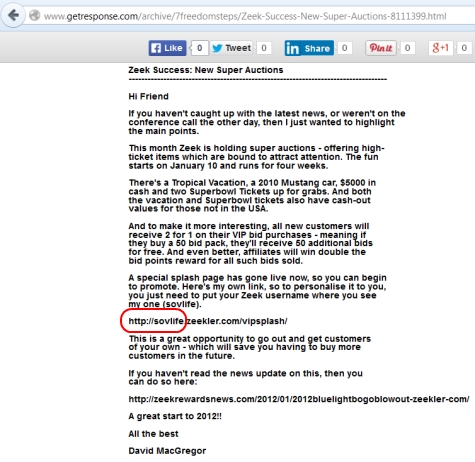
A Zeek promo in which the username “sovlife” and the name “David MacGregor” appear begins in this fashion, according to Google search results. (Italics added):
Hi Friend
If you haven’t caught up with the latest news, or weren’t on the conference call the other day, then I just wanted to highlight the main points.
Screen shot of promo for Zeek. Red highlight by PP Blog.
MacGregor Fraser, who is represented in the clawback lawsuit by North Carolina attorney June K. Allison of Shumaker, Loop & Kendrick in Charlotte, answered Bell’s complaint as “David Fraser.” The answer, however, acknowledges the longer version of the name as it appeared in Bell’s complaint. So does an affidavit submitted to the U.S. court by David Ian MacGregor Fraser.
The moniker “sovLife” appears repeatedly on the website theclassifiedsplus.com through which videos play. Some of these videos point to MLM “programs” such as the Empower Network in which “sovLife” is used as the affiliate ID.
Other videos at theclassifiedsplus point to a web entity known as sovereignlife.com. This domain is styled “SovereignLife” and identifies its operator as “David MacGregor.” There is a corresponding YouTube account in that name through which videos viewable through theclassifiedsplus.com play.
One of them with an upload date of July 3, 2013, is titled “My July 4 Message for the America That Was.” In the video, a man (presumptively “David MacGregor”) holds forth that he once was a big supporter of the United States. That support, however, apparently has evaporated in that the man contends in the video that the United States is “Dare I say it? A force for evil.”
Other videos in the David MacGregor account have titles such as “Bitcoin Debit Card – How to Get One,” “You Can Now Be a Reseller For SovereignLife And Keep All The Money!,” “Tax Slave or Sovereign Individual?”
Some individuals who may identify with the word “sovereign” have participated in various fraud schemes, have painted their fellow human beings as slaves (see Frederick Mann) or government-owned property (see Kenneth Wayne Leaming) and have expressed an irrational belief that laws do not apply to them.
Other “sovereigns” have made wild claims that they hold diplomatic immunity and thus cannot be prosecuted or are answerable only to Jesus Christ.
Zeek Clawback Defense
Compared to the “David MacGregor” video suggestion that America is evil, the David Fraser response to Bell’s clawback complaint before Senior U.S. District Judge Graham C. Mullen of the Western District of North Carolina includes no inflammatory rhetoric or claims of evildoing by the United States.
Fraser, through the American law firm, is seeking dismissal of the complaint for lack of jurisdiction. He also is seeking to quash process in New Zealand, even though he acknowledges he has been served.
Among Fraser’s specific defense claims is that he was an “innocent participant” in Zeek, having joined the program in “November 2011” while he was a “resident of Malaysia” and maintaining “a Post Office Box in New Zealand.”
In possible conflict with the information shown in the screen shot above that references a sum ($5,000 in U.S. cash), the Super Bowl played in the United States and Super Bowl tickets that have “cash-out values for those not in the USA,” Fraser further contends he had “no specific knowledge that ZeekRewards was initiated from the United States.”
He also contends he was “unaware that ZeekRewards originated in North Carolina.” This, too, may be in possible conflict with information generally known about Zeek, in that Zeek openly operated from North Carolina and invited participants to events held in that state.
At one point in its history, Zeek openly advertised auctions for sums of U.S. cash — even as it preemptively denied it was operating a pyramid scheme and complained that the U.S. Social Security system was a “legal” and “collapsing” pyramid scheme.
Precisely why Zeek was making political statements on its website is unknown.
Accused Zeek Ponzi schemer Paul R. Burks lived in North Carolina. In 2012, Federal Election Commission records showed that Burks gave money to the campaign of U.S. Presidential hopeful Rep. Ron Paul.
From a U.S. standpoint, Zeek used offshore payment processors such as SolidTrustPay and AlertPay, both of which provided services for the $119 million AdSurfDaily Ponzi scheme broken up by the U.S. Secret Service in 2008.
Now-jailed AdSurfDaily Ponzi-scheme operator Andy Bowdoin also made donations to a political cause, according to the 2010 indictment against him.
In his defense filings, Frazer said he “made or received” Zeek payments through AlertPay over the Internet, but maintained he’d never set foot in North Carolina.
Now, he contends, he unfairly is being “haled” to appear in court in North Carolina.
“To ask him to defend this suit halfway around the world on account of falling into the [Zeek] Insider’s international Internet scheme would clearly offend traditional notions of fair play and substantial justice,” his lawyer argued.
“Defendant Fraser never ordered or directed that anything of value be sent to him in either Malaysia or New Zealand from North Carolina,” his lawyer argued. “Rather, based on the way the website operated, amounts he earned on-line were credited to his on-line Payza account by ZeekRewards . . . Defendant Fraser did not know from what country or state the funds originated . . .”
In court filings, Fraser says he has been a citizen of New Zealand since 1978 and was born in Great Britain. He is a citizen there, too, according to his affidavit.
Billing records in the TelexFree bankruptcy case show that advisers to court-appointed Trustee Stephen B. Darr held an hour-long teleconference with McGuireWoods, counsel to Zeek Rewards’ receiver Kenneth D. Bell.
This appears to mark the first time that Zeek’s name has surfaced in TelexFree-related court matters. The two cross-border MLM/network-marketing fraud schemes allegedly gathered a combined sum approaching $3 billion. Each scheme operated for only about two years.
The conference took place on Nov. 6, 2014. Precisely what was discussed was not disclosed, although the records suggest Darr’s advisers were studying the claims form used in the Zeek Ponzi- and pyramid case. Participants included Mesirow Financial Consulting LLC and McGuireWoods.
Mesirow, which provides accounting and financial services, has assisted Darr in the mammoth job of reverse-engineering the alleged $1.8 billion TelexFree cross-border fraud scheme. McGuireWoods has provided litigation counsel to Bell, who has sued Zeek vendors and thousands of individual participants who allegedly profited from the $897 million cross-border scheme shut down by the SEC in August 2012.
McGuireWoods is not providing legal counsel to Darr. That duty has been undertaken by Murphy & King (M&K.) Still, there may be lessons to be learned from the Zeek litigation. On Nov. 7, 2014, a day after the conference, two of Darr’s advisers at Mesirow noted “research regarding MLM payment schemes and Zeek rewards” in billing records.
Such schemes raise the prospect of a black market and back-alley deals infecting the legitimate commerce stream. It has been a concern in the TelexFree, Zeek and ASD cases. The screen shot below is taken from Mesirow’s first interim application for payment for assisting Darr in his TelexFree probe.
Mesirow’s billings notes make several mentions of M&K, Darr’s legal counsel. One of them, dated Jan. 15, 2015, noted a discussion “regarding promoter to promoter payments.”
Billing notes by Mesirow say the firm analyzed “reports related to Colombian investigation” and that Mesirow is aware of a “Colombian creditor claiming $3MM.” In September 2014, the PP Blog reported that TelexFree President James Merrill claimed at a 2013 TelexFree event in California that Colombia “feared” network marketing.
The California TelexFree event may create a tie with Zeek, the Blog reported in April 2014.
In 2010, the U.S. government established ties between a Colombian MLM “program” known as D.M.G. Group to money-laundering in the United States to conceal narcotics profits.
As the PP Blog reported on Nov. 24, 2010 (italics added):
DMG’s membership ranks swelled to more than 400,000, with the scheme capturing hundreds of millions of dollars. The pyramid collapsed in 2008 — but not before [David] Murcia and others had set up an international money-laundering operation that routed narcotics proceeds through Mexico and concealed the criminality in real estate and other holdings in the United States, prosecutors said.
“The so-called ‘Bernie Madoff of Colombia’ now stands convicted of money-laundering in Manhattan federal court,” said U.S. Attorney Preet Bharara” [of the Southern District of New York].
TelexFree In Brazil
Mesirow’s billing notes also reference an ongoing investigation in Brazil into TelexFree activities through an affiliate known as Ympactus.
The shutdown by Brazilian authorities of Ympactus in the summer of 2013 “was the first of many indication that the Debtors were operating an unsustainable pyramid scheme,” Mesirow said.
It noted in the fee application that it has been in “regular contact” with U.S. government officials and “representatives of the Brazilian government.”
In its first billing, Mesirow said it has assisted Darr in recovering more than $17 million since the firm was formally appointed to assist the trustee on July 14, 2014. Mesirow is seeking about $1.6 million in fees for more than 2,962 hours of work, plus reimbursement of expenses of $20,942.
Read the Mesirow application and billing notes, which reference TelexFree figures such as Merrill, Carlos Wanzeler, Carlos Costa, accountant Joe Craft and MLM Attorney Gerald Nehra.
M&K, legal counsel to Darr, also has submitted a billing application with notes that reference Zeek Rewards. M&K, like Mesirow, joined with the trustee in July 2014. M&K is seeking more than $1.3 million, saying it has expended more than 2,784 hours. It also is seeking reimbursement of expenses of $36,116.
One M&K reference to Zeek mentions a “Review [of] Zeek Rewards settlement pleadings with net winners and insiders.” Another references a conference “regarding Zeek Rewards application to TelexFree case and practical implications.” Yet another references a “Review [of] Zeek Rewards docket re: how to treat inter-promoter activity.”
Still another note says this: “Research potential claims against Nehra.”
There are other Zeek references, plus references to other Ponzi cases.
Screen shot. Red highlight by PP Blog. Not only were UFun/Utoken recruits encouraged to send international bank wires through Guinea, they were further encouraged to share the instructions on at least eight social-media sites. Even as this was occurring, recruits were told to make their personal information available to their “program” sponsor — something that introduces the specter of identity theft.
UPDATED 8:18 A.M. EDT May 4 U.S.A. Affiliates of the alleged UFunClub MLM/network-marketing Ponzi- and pyramid scheme under investigation in Thailand encouraged recruits to join by wiring the Euro equivalent of sums of up to 100,000 U.S. dollars to Banque de Développement de Guinée S.A., according to promos in English published online.
Precisely how the African bank operates is unclear. Also unclear is why a “program” with an apparent base of operations in the Southeast Asia nations of Thailand and Malaysia was using a bank on the far edge of another continent.
Recruits sending wires further were instructed by UFunClub affiliates not to call UFunClub an “investment.” Rather, the recruits were told to describe UFun purchases as the acquisition of “GOODS AND SERVICES or SALARY.” The wiring instructions also suggested the acquisition could be be succinctly described as such: “Purchase Software.”
Crimes such as securities fraud, wire fraud, money-laundering, tax fraud and structuring transactions to evade bank-reporting requirements occur in this sea of wanton lawlessness. Stated “caps” or transaction limits typically suggest that the purveyors and their enablers are seeking to stay below a currency level they perceive a government may deem suspicious. (See Paragraph 23 of the 2010 indictment against AdSurfDaily Ponzi-scheme figure Andy Bowdoin in which his discussion of caps is highlighted. The indictment also outlines how Bowdoin, now in federal prison after pleading guilty to wire fraud, sought to avoid using the language of investments in his Ponzi investment program by describing it as something else.)
The unusually high UFun limit of $100,000, however, potentially was something that put the “program” on the radar of governments, despite the planning of UFunClub and its enablers. HYIP schemes typically express lower limits.
In the promos by UFunClub affiliates, the $100,000 limit was described as “per single transaction,” meaning there was no real ceiling if recruits capped second and subsequent wires at $100,000. This, too, could have caught the attention of international law enforcement.
How many governments in addition to Thailand may be investigating UFunClub is unknown. Thailand appears to be conducting a very public probe and potentially signaling its neighbors in the region that something at UFunClub is seriously and dangerously amiss.
Photos of Thai police officials have been carried in the local papers and online publications just about every day since word was received of a UFunClub raid, arrests and the issuance of warrants on April 10.
In the online instructional manual published by UFunClub affiliates, recruits were told to make Banque de Développement de Guinée the “Payee” for wires. They further were provided an International Bank Account Number (IBAN), a swift code and a street address for the bank in Conakry, a port on the Atlantic Ocean and Guinea’s capital city. The capital cities of Thailand (Bangkok) and Malaysia (Kuala Lampur) both are nearly 8,000 miles away from Conakry.
After completing their wire or wires, recruits were instructed by UFunClub affiliates of a purported “need to send a proof of bank wire payment to your sponsor at this time,” something that raises the prospect of identity theft or the outright theft of funds from a recruit’s bank account.
“Your new Ufun account will be set up after your sponsor validates your bank payment information,” the instructions continued.
Here is a portion of the follow-up instructions (italics added/formatting approximate):
Proofs must contain the following information
Sender Name
Sender Account Details
Date
Amount sent / currency
Beneficiary Name
Beneficiary Account Details
If you file your wire paperwork online, we STRONGLY suggest
Use Snipping tool or a similar software to get a clear screen capture (Windows)
Use CMND+Shift+4 to get a screen capture (Mac)
Take a screen capture of a screen that shows you ALL of the above information – not just that says “Transfer Complete”
If you file the transfer your Utoken payment in a bank branch
Ask your bank to email you the proof and forward that email to your Ufun sponsor
If they give you a bank wire paper receipt, ask your bank to scan the proof or scan it yourself
UFUN Accounts Dept. will not be accepting any images that are taken by a camera phone or are blurry/unclear
UFUN Accounts Dept. will not accept any images that are edited with arrows or has information blocked out
**You also need to send your Utoken Sponsor the following information**
The username(s) you desire (please send more than 1 desired username, as your first choice may already be taken)
Your PRIMARY Email address
Your mobile telephone number
Your full name as it appears on your ID / License/Passport
Recruits were encouraged to share the wire-transfer instructions on at least eight social media sites.
As is the current case with UFunClub/Utoken, affiliates of AdSurfDaily, TelexFree and Zeek were instructed not to call their “program” an investment “program.”
More lawsuits against international “winners” in the Zeek Rewards cross-border Ponzi-and pyramid-scheme case are coming, receiver Kenneth D. Bell has advised a federal judge.
Bell also signaled to Senior U.S. District Judge Graham C. Mullen that lawsuits may be coming against alleged international Zeek vendors such as Payza and SolidTrustPay, both of which earlier were involved in the AdSurfDaily Ponzi scheme and are Ponzi-forum darlings.
On another front, Zeek’s former COO — Dawn Wright-Olivares — doesn’t get to keep her cars.
“In the first quarter, the Receiver also took possession of several motor vehicles as part of the settlement with Defendant Dawn Wright-Oliveras,” Bell informed Mullen. “The Receiver has retained an auctioneer and intends to liquidate these vehicles during the second quarter of 2015.”
Bell’s forensic team has tracked Zeek money all over the world. The receiver already has sued alleged “winners” with addresses in the United Kingdom, Canada, Australia, New Zealand, the British Virgin Islands and Norway.
It won’t end there, he advised Mullen in a quarterly update to the court filed yesterday.
“The Receiver expects to file lawsuits against foreign net winners in additional countries during the second quarter of 2015,” he wrote.
News that Bell intended to expand his efforts to gather money for an estimated 800,000 victims of Zeek’s cross-border scheme was received while the nation of Thailand was squaring off against UFunClub/UToken, yet another scheme pushed by MLMers/network-marketers.
So-called “sovereigns” were involved in the $119 million AdSurfDaily Ponzi scheme in 2008. ASD was pushed in part by Frederick Mann, the purported operator of multiple fraud schemes. Mann appears to have had sympathy for Francis Schaeffer Cox, an Alaskan “sovereign” and militia man implicated in a plot to murder public officials.
A scheme known as Profitable Sunrise also appears to have been pushed in part by “sovereign citizens.”