Category: Ad Surf Daily

  • GNI Members: Failed Program Was ‘Honest’ And ‘Real’; Critics Should Shut Up And Focus On Haiti Earthquake

    Critics of Gold Nugget Invest (GNI), the collapsed Internet HYIP, do not understand that the program that advertised a return of 7.5 percent a week was “real,” according to a member writing on an online Ponzi board.

    Bickering about GNI only will lead to additional problems for the company, which is faithfully trying to reorganize, and the critics should send money to Haiti instead of infecting the membership with negative thinking, according to the member.

    “[W]hy not use your idle time for [the Haitian people?]” the GNI apologist asked on the ASA Monitor Ponzi board. “l doubt if you can do that ‘cos that is your true nature.”

    Haiti suffered a devastating earthquake Jan. 12. As many as 200,000 people are believed to have perished.

    In earlier posts, the apologist suggested that GNI critics were suffering from “mental illness” and observed that, “I will be very grateful if GNI runs for 20 years as a pronzi (sic) !!!!”

    The poster did not explain how a program purported to be a “real” business could create legitimate profits by operating as a Ponzi scheme.

    GNI, which positioned itself as a betting “arbitrage,” tanked last week. It is among a number of recent investment programs using the name of a precious metal or a precious mineral that have encountered difficulty either from members or law enforcement. GNI did not publish verifiable financial information. There is no way to verify GNI’s claims, including an apparent claim that certain resources are tied up in a purported banking investigation in Europe that has nothing to do with the company.

    GNI now says its program will pay “up to” 20 percent monthly through a “No Risk Wager.” The company did not explain how it had categorically eliminated risk during a period in which it apparently did not have access to the capital it needed to operate and had suddenly changed the rules, leaving existing members holding the bag while apparently still advertising for new members to entrust their funds to the firm.

    Some members, though, insisted they were standing by GNI because it always had “paid” and just hit a bump in the road.

    Canadian regulators last week declared a collapsed program known as Gold Quest International (GQI) a “sham” and both a Ponzi and a pyramid scheme. Investors dumped at least $27 million into the program, according to the U.S. Securities and Exchange Commission.

    GQI, which claimed Panamanian registration while operating from Las Vegas and saying it was immune to U.S. and Canadian law because it was affiliated with a “sovereign” Indian tribe, scammed thousands of investors, according to the SEC and the Alberta Securities Commission.

    At least $3.15 million linked to GQI ended up in New Zealand, in one or more bank accounts tied to a company known as Topaz Group Ltd., according to court filings by Larry Cook, the court-appointed receiver in the SEC case. The majority of that money then was “immediately transferred from the Topaz Group business account to the account of Wendy Smurthwaite Davies, the wife of John Davies,” according to court filings.

    John Davies was identified as the owner of Topaz Group.

    Other GQI money made its way into E-Bullion accounts in California, according to court filings. The E-Bullion money is tied up in a fraud and murder investigation of E-Bullion owner James Fayed, accused of having his wife killed in a Greater Los Angeles parking garage.

    Another “gold-themed” tie involves Brian David Anderson, a former Christian clergyman from Vancouver, British Columbia. Anderson recently was sentenced to 90 months in federal prison in the United States for operating a $4 million Ponzi scheme known as Frontier Assets.

    Anderson also was linked to a mysterious scheme known as the “Alpha Project.”

    U.S. and Canadian investigators identified Anderson as a pitchman for an international HYIP known as Flat Electronic Data Interchange (FEDI). FEDI’s operator, Abdul Tawala Ibn Ali Alishtari, also known as “Michael Mixon,” was convicted in September 2009 of financing terror and fleecing investors in the FEDI scheme.

    Records in the Anderson case include references to E-Bullion.

  • PROSECUTORS: ‘Final Action’ In Second ASD Forfeiture Case Not Expected For ‘Several Months’

    UPDATED 11:46 A.M. ET (U.S.A.) Final judicial action in the second forfeiture case filed against assets connected to AdSurfDaily “is not expected for at least several months,” federal prosecutors said.

    The second action was filed in December 2008. It identified family members of ASD President Andy Bowdoin as beneficiaries of a Ponzi, wire-fraud and money-laundering scheme operated by ASD.

    Among the family members identified in the December complaint were Bowdoin’s wife, Edna Faye Bowdoin, and her son, George Harris. Judy Harris, the wife of George Harris, also was identified in the complaint as a beneficiary of ASD’s alleged illegal conduct.

    Prosecutors filed the initial action against ASD’s assets in August 2008. That case concluded with the Jan. 4 issuance of a final forfeiture order by U.S. District Judge Rosemary Collyer, prosecutors said.

    The government now has title to nearly $80 million seized in the August 2008 case — the lion’s share of the liquid assets (cash) from the combined cases. Only about $635,000 in cash was listed as seized in the December case, meaning prosecutors have control of more than 99 percent of the money targeted in the combined cases.

    Prosecutors did not explain why they anticipated a considerable delay in finalizing the December 2008 case. (UPDATE: 11:46 A.M: Citing an investigation in progress, a Justice Department spokesman declined to comment.)

    Nothing so far suggests, however, that the December case has been delayed as a result of an appeal by Bowdoin in the August case. The record does not reflect an appeal. The delay appears to be procedural.

    The December complaint alleged that Edna Faye Bowdoin and George Harris used money from two ASD Bank of America accounts to open an account at a third bank.

    The new account was funded with an opening deposit of more than $177,000 — more than $157,000 of which was used to pay off the mortgage of the Tallahassee home George and Judy Harris shared, according to the complaint.

    Read the prosecution’s statement.

  • California Man Guilty In $62 Million Ponzi Scheme; Milton Retana Targeted Latinos, Ordered Evidence To Be Hidden In Back Of Religious Bookstore

    In yet another case in which the name of a precious metal or mineral was used in a Ponzi scheme, Milton Retana has been found guilty of six counts of mail fraud and one count of lying to federal investigators.

    Evidence of the fraud was hidden in the back of a religious bookstore operated by Retana’s wife, prosecutors said. When investigators searched the bookstore, they found millions of dollars in cash, prosecutors said.

    Retana, 46, of Huntington Park, Calif., faces a maximum of up to 125 years in prison. Sentencing is set for April 26. Investigators said he operated Best Diamond Funding, a Ponzi, affinity-fraud and real-estate investment scheme that fleeced more than 2,000 victims out of more than $62 million.

    Best Diamond was located next door to the bookstore. The FBI and U.S. Postal Inspection Service smashed the scheme, prosecutors said.

    Jurors returned the verdict in less than an hour, after a week-long trial. Dozens of victims appeared in court to hear the verdict, prosecutors said.

    Beginning in 2006, Retana told investors their money would be used to buy and sell real estate. He targeted mostly a Spanish-speaking audience, and used religion in his pitches, prosecutors said.

    “Retana guaranteed returns as high as 84 percent each year, claiming that he would purchase properties in bulk at below-market prices and immediately sell them for a profit,” prosecutors said.

    But records showed Retana “used only a tiny fraction of the victims’ money to purchase real estate and that his company was actually losing money,” prosecutors said.

    As often is the case in investment schemes, victims “mortgaged their homes and drained their retirement accounts because they believed Retana’s promises that their investments would be safe,” prosecutors said.

    Among the victims were a stone mason, a truck driver and a roofer. The roofer also was the pastor of his church.

    The scheme nearly was detected in 2008, when the California Department of Real Estate audited Best Diamond, prosecutors said.

    Retana, though, stymied the probe “by ordering his employees to hide all of the investor files at the back of his wife’s religious bookstore, La Libreria Del Exito Mundial.

    “His scheme was disrupted in October 2008, when federal agents from the United States Postal Inspection Service and the Federal Bureau of Investigation executed search warrants on the offices of Best Diamond Funding and the bookstore,” prosecutors said.

    Agents found $800,000 in cash stashed in Retana’s desk and $3.2 million in cash hidden in the back of the bookstore. Investigators seized another $8 million from Retana’s bank accounts.

    “Soon after the execution of the federal search warrants, agents interviewed Retana, who lied about how much money he had received from the investors and claimed that he could pay all of them back,” prosecutors said. “Retana was later secretly recorded telling a Best Diamond employee not to tell the government how much money Best Diamond had received from the investors.”

  • CHILLING: Terrorism Link, A Ponzi, An HYIP, Gold, Mysterious ‘Offshore’ Businesses, ‘Rebates’ — And A Brutal Murder In California

    EDITOR’S NOTE: HYIP or autosurf promoter? Can’t say no to the commissions from recruiting people into scheme after scheme? Position yourself as an “expert” on Internet forums — even though you don’t have a clue about the motivations of the program owners and may not even know their names? Find yourself promoting programs that reference “gold” and “funds” and relying on marketing assertions that cannot be verified? Tell your recruits that the programs are money “games” or nontraditional investments? Been involved in one program after another that has failed in this seedy and dangerous world? Think that you’ll have a lifetime of plausible deniability and that professional investigators will believe you when you explain you didn’t really know what was going on — despite the fact you’ve been involved in one failed “program” after another, perhaps for months and even years?

    Here’s a story about what can happen in the sea of HYIP, “Gold,” Ponzi and autosurf corruption . . .

    UPDATED 12:42 P.M. ET (U.S.A.) Yesterday a reader provided us a document that can only be described as chilling. The document, from the Ontario Securities Commission (OSC), includes exhibits from a 2003 Canadian civil-securities case against convicted Ponzi swindler Brian David Anderson, a former Christian clergyman from Vancouver, British Columbia.

    Last week, Anderson was sentenced to 90 months in federal prison in the United States for operating a $4 million Ponzi scheme known as Frontier Assets. Anderson also was linked to a mysterious scheme known as the “Alpha Project.”

    U.S. and Canadian investigators, meanwhile, also identified Anderson as a pitchman for an international HYIP known as Flat Electronic Data Interchange (FEDI). FEDI’s operator, Abdul Tawala Ibn Ali Alishtari, also known as “Michael Mixon,” was convicted in September 2009 of financing terror and fleecing investors in the FEDI scheme.

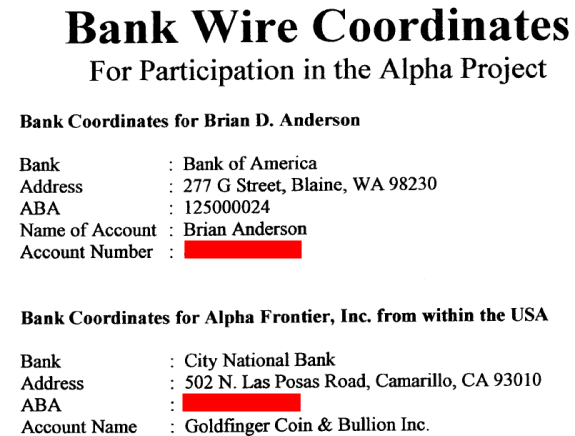
    Why is the document chilling? For starters, its references a bank account held by Goldfinger Coin & Bullion Inc. in Camarillo, Calif. If that name does not ring a bell, think “E-bullion,” the now-shuttered money-exchange business purportedly backed by gold.

    James Fayed, the operator of Goldfinger and E-Bullion, was charged in 2008 with operating an unlicensed money-transmitting business. Investigators said E-Bullion had been used to transact at least $20 million in Ponzi scheme payments.

    During the same general time period in 2008, the SEC was conducting a Ponzi scheme investigation into a separate company known as Gold Quest International (GQI), which used E-Bullion and claimed to be registered in Panama.

    GQI operated from Las Vegas. It initially tried to claim that it was immune to U.S. law because of links to a “sovereign” Indian tribe. GQI was charged in May 2008 by the SEC with operating a Ponzi scheme. The purported “attorney general” of the purported “sovereign” tribe reacted by trying to file a lawsuit against the SEC for the preposterous sum of $1.7 trillion. A federal judge was not amused, and struck the bizarre filings.

    Woman Stabbed To Death

    On July 28, 2008, Pamela Fayed — James Fayed’s estranged wife — was brutally murdered in a parking garage in California. She was stabbed in the chest, neck and face — and left to die, according to court filings. Prosecutors said there was no evidence of robbery or carjacking. The murder, according to court filings, occurred just minutes after a meeting Pamela attended with her criminal attorney and her husband’s criminal attorney.

    James Fayed was present at the meeting, according to court filings. A meeting with separate attorneys — this one involving a divorce hearing — had been scheduled for the next day, July 29, 2008. Prosecutors said that James Fayed was at risk of being ordered to turn over nearly $1 million to Pamela at the divorce proceeding.

    Pamela had advised the government in June 2008 that she wished to cooperate in its criminal investigation of E-Bullion, according to prosecutors.

    “Pamela’s murderer left the crime scene in a red SUV that was captured on surveillance video, along with its license,” prosecutors said. “The license was traced to Avis car rentals in Camarillo, not far from [the] defendant’s business. The vehicle had been rented from Avis on July 3, 2008 using an American Express card issued to defendant and GCB.

    “An American Express credit card with the same account number was found in defendant’s wallet during a search of his residence in the days following Pamela’s murder. During the search of defendant’s residence, officers also found approximately $60,000 in cash wrapped in plastic material; approximately $3,000,000 in gold; and approximately 31 firearms, including one with a long-range night vision scope, along with thousands of rounds of matching ammunition,” prosecutors alleged.

    Prosecutors also alleged James Fayed arranged for the July 28 meeting to create an alibi.

    Read a court filing in the federal case against James Fayed in which prosecutors alleged he operated an unlicensed money-transmitting business. The filing references the alleged murder plot.

    Murder Charges Filed

    James Fayed and an employee — Jose Luis Moya — were charged by the Los Angeles District Attorney’s office with murder and a conspiracy plot in September 2008. Fayed paid Moya “approximately $25,000 to arrange the murder of Pamela Fayed,” investigators said.

    On July 3, 2008, investigators said, “Fayed and his company — Goldfinger, Inc. — rented a Suzuki sport utility vehicle that was used by the killers at the Watt Tower parking garage where Pamela Fayed was killed.

    “The Suzuki SUV was driven to Fayed’s Ventura County ranch on Happy Camp Road after the killing,” according to investigators. Moya returned the vehicle to Avis the next day.

    OSC Document Outlined Purported Anderson/E-Bullion Meeting In 2003

    The OSC document filed in Canada is important — and we suggest you read every word of it from the link below — because exhibits in the document show the murkiness and just plain creepiness of the HYIP and Ponzi worlds. One exhibit suggests Anderson planned to meet with Fayed and his wife in 2003 to discuss business.

    The document also references Alishtari and FEDI, claiming an investment program was backed by $125 billion in gold. Among other things, the document lists the name of Goldfinger Coin & Bullion and an account number, along with directions on how to open an E-Bullion account.

    Screen shot: From exhibit in 2003 OSC filing.

    Also included in the document is a purported joint-venture agreement marked “STRICTLY CONFIDENTIAL” that purportedly was used by Anderson to recruit investors into an international fraud scheme.

    Parallels To AdSurfDaily Case

    Parts of the document include claims very similar to claims made by promoters of the alleged AdSurfDaily (ASD) Ponzi scheme in the United States. Anderson, for example, was positioned as a “very successful business executive” who attended a function to observe Alishtari receive an award “for Republican Business Man of the Year for the State of New York.” Similar claims were made about ASD President Andy Bowdoin.

    Investor payouts, according to an exhibit in the OSC document, were called “rebates.” ASD, whose assets were seized by the U.S. Secret Service in August 2008 amid Ponzi allegations, also called its payouts “rebates.” Exhibits in the OSC document were thick with references to God and family — another similarity to the ASD case.  Anderson’s efforts to promote the program were deemed “heroic,” and business was conducted in part from Boca Raton, Fla. ASD was thick with Florida members.

    In a purported email from Anderson dated April 17, 2003, according to an exhibit within the OSC document, Anderson laid out the case for the new venture.

    “Dear Family,” the email began. Chillingly, the email appears to reference Pamela Fayed, allegedly murdered by her husband and conspirators five years later. The email suggests there once were happy days between the Fayeds.

    “I am very pleased that my recommendations and leg work have paid off and the Alpha Project will be merging its gold value/currency transfer through E-Bullion,” the email purportedly sent by Anderson claimed.

    “E-Bullion is owned by a wonderful couple who have their roots in Egypt and, therefore, are Arab in descent. I will be spending personal time with them on Monday in California.”

    Screen shot: Exhibit of purported Anderson email in 2003 OSC filing.

    The email, which discusses a trip to Panama, promised investors an “offshore” company and outlined a plan to sell “debit cards” through vending machines that would be positioned in posts offices, hotels and college buildings.

    Put “$20 into a vending machine and the machine spits out a loaded Debit card for you,” the email said. “Now you can begin to see why the Alpha Project in will in time be another Microsoft in size.”

    Claims in HYIP and Ponzi schemes that a company is destined to become the “next” Microsoft or Google are common. Beyond that, the use of debit cards in the murky HYIP and autosurf words is becoming increasingly popular — as are appeals for investors to entrust funds to “offshore” businesses, amid claims that such businesses are outside the reach of U.S. law enforcement.

    Read the OSC document from 2003.

  • Scott Rothstein Property To Be Auctioned Saturday; Big Crowd Expected; Politicians Likely To Stay Home

    Disbarred attorney and Ponzi scheme suspect Scott Rothstein’s name is radioactive among politicians of both major parties in the United States. The embarrassment began to build when Rothstein, a celebrated schmoozer and source of campaign funds, fled to Morocco after the alleged $1.2 billion scheme began to unravel last fall.

    Things got worse yet when federal prosecutors began to seize Rothstein’s assets, including an 87-foot yacht registered in the Marshall Islands, two $1.6 million Bugati Veyrons, a $495,000 Mercedes, two $484,000 Rolls-Royces and lots of Ferraris, Lamborghinis and other extremely expensive cars.

    Rothstein’s vanity purchases knew no limits — and neither did his appetite for chumming up to politicians. The next round of embarrassment for politicians will occur Saturday in Tamarac, Fla.

    Property linked to Scott Rothstein and his collapsed Fort Lauderdale law firm, Rothstein Rosenfeldt Adler, will be sold at auction.

    Fisher Auction Co., appointed by the bankruptcy trustee, will conduct the event.  The auction will take place at AMC Liquidators Showroom, 3705 West Commercial Blvd., in Tamarac. Registration opens at 8 a.m. Items go up for bid at 10 a.m.

    “Prospective bidders must have a $500 refundable cash deposit in order to be a qualified bidder,” said Lamar Fisher, president and chief executive officer of Fisher Auction Co. “All purchases on auction day are payable in cash only. No checks, no credit cards.”

    Why the need for a cash deposit?

    “We have a tremendous volume of items to move on auction day and must make sure those who are serious bidders have the opportunity to bid,” Fisher said. “We have security in place and have used a higher than typical deposit to help insure that.”

    Among the items: computers, telephones, conference room furniture, oriental carpets “from all locations” and “the contents of Scott Rothstein’s personal suite of offices.” Sports items, too.

    “Mr. Rothstein was an obvious avid memorabilia collector,” Fisher said.

    Sports items include (but are not limited to): a University of Florida – NCAA 2007 Final Four, Atlanta, GA. framed authentic cut from the original floor of this game #1/1900;  an official art poster by Charles Fazzino; three dimensional artwork of Yankee Stadium; imitation player cards with original signatures of players Nos. 11, 24, 20, 35, 2, 13, 42, 51, 55 ; Manager Joe Torre – #187/500; an NFL football in a plastic display case; “1972 Perfect Season” (Miami Dolphins) signed by all players; and other signed memorabilia.

    These items also are listed in the preliminary auction inventory:

    • Mens pair of cuff links in shape of gold star, signed by Sen. John McCain.
    • Mens pair of cuff links, Maverick, signed John McCain. With framed recognition letter.
    • President & Vice President of United States, Inauguration 2009, pair of cuff links with matching tie tack.
    • Mens pair of cuff links – United States Senate – goldtone.
    • China bowl signed – “Charlie Crist.” (Florida governor and Senate candidate.)
    • Jeweled figurine of elephant depicting Republicans.
    • Framed photograph of Scott Rothstein, Kim Rothstein & Sen. Joe Lieberman. Signed by Lieberman.
    • Framed photograph of Gov. Arnold Schwarzenegger with a signed personal note to Scott Rothstein..
    • Framed photograph of Scott Rothstein with Charlie Crist. Signed by Crist.
    • Framed photograph of Scott Rothstein with John McCain. Signed by McCain.
    • Framed photograph of Scott Rothstein with Alan Spector. Signed by Spector.
    • Framed certificate from the State of Florida Executive Department signed by Charlie Crist.
    • Framed photograph of Scott Rothstein, Cindi McCain, John McCain and Charlie Crist. Signed by McCain and Crist.
    • Framed photograph of Scott Rothstein and Gov. Jebb Bush. Signed by Bush.
    • Framed photograph of Scott Rothstein and Gov. Bill Richardson. Signed by Richardson.
    • Framed photograph of John McCain, Cindy McCain, Scott Rothstein and Kim Rothstein. Signed by McCain.
    • Framed photograph of Mel Martinez and Scott Rothstien. Signed by Martinez.
    • Framed photograph of Attorney General Bill McCollum and Scott Rothstein. Signed by McCollum.
    • Framed photograph of George W. Bush and Scott Rothstein. Signed by Bush.
    • Framed photograph of John McCain, Cindy McCain, Charlie Crist and Scott Rothstein. Signed byMcCain.
    • Framed photograph of Gov. Sarah Palin, Kim Rothstein and Scott Rothstein. Signed byPalin.
    • Framed letters to Scott Rothstein signed by Gov. Charlie Crist.
    • Framed invitation to dinner reception in honor of Gov. Charlie Crist at the Casa Casuarina.
    • Framed letter to Scott Rothstein from Gov. Arnold Schwarzenegger with photos.
    • Framed letter signed by Sen. Jeff Atwater.
    • Framed letters signed by Sen. John Ensign of the National Republican Senatorial Committee.
    • Framed letters signed by Sen. Mel Martinez.
    • Framed letter signed by Sheriff Al Lamberti.

  • MAGNIFYING GLASS: Local Cops Alerted Receiver In Cook/Kiley Ponzi Case That Credit Card Was Being Used After Asset Freeze

    Player in a Ponzi scheme? If alleged Minnesota schemer Trevor Cook’s experience is any indication, you should expect to be placed under a microscope by local merchants and police if you’re named in a complaint by regulators.

    Cub Foods, a Minnesota-based grocery chain, placed Cook under video surveillance when he entered a local store. A loss-prevention specialist cited fears Cook might use the store to purchase gift cards in a scheme to hide assets from investigators.

    Meanwhile, the 71-member police department in Eagan, Minn., alerted the court-appointed receiver in the alleged Cook/Pat Kiley scheme that Cook was using a credit card after a federal judge froze his assets, according to court filings.

    Cook now is the subject of a contempt hearing. Receiver R.J. Zayed said Cook initially failed to disclose the existence of four credit cards and is not cooperating, and the SEC said U.S. Chief District Judge Michael Davis may have to jail Cook to enable investigators to prevent assets from being dissipated.

    Cook had at least one other undisclosed credit card, Zayed said.

    “The only reason the fifth card was known to the Receiver was because the Eagan Police Department informed the Receiver of this account after Cook used it to purchase” gift cards, Zayed said.

    Zayed said Cook used credit cards after the asset freeze was imposed in November to purchase more than $30,000 in gift cards at Target, Holiday, SuperAmerica, Home Depo, AMC Theater, Regal Cinema, Nordstroms, Cheesecake Factory, Olive Garden, Old Chicago, Ruby Tuesday, Chilis, Applebees, PetSmart and Bath&Body Works.

    Cook also purchased “numerous phone cards,” Zayed said.

    Although Cook now has turned over the gift cards and the credit cards, he has taken the 5th Amendment in the case. Zayed, though, argued that Cook was using the 5th Amendment in a bid to pick and choose when and how he would cooperate in locating and preserving receivership assets.

    “Cook now tells the Court that he will not turn over any additional assets because it would violate his privilege against self-incrimination,” Zayed argued in a brief to Davis. “Cook cannot have it both ways, turning over assets when it benefits him while continuing to hide other assets from the Receiver. Approving Cook’s strategy would make a mockery of the Court’s Orders and runs afoul of basic Fifth Amendment jurisprudence.”

    By turning over some assets and testifying to the existence of others, Zayed argued, Cook has waived his 5th Amendment protections.

    “Cook voluntarily testified about assets in his possession when he turned over a portion of those assets to the Receiver,” Zayed said. “He did not do this accidentally or out of the goodness of his heart.

    “He did it to present himself in the most positive light he could to the Court when he was caught violating the Court’s Orders,” Zayed continued. “Cook also testified with respect to his assets when he provided the Receiver with a laundry list of expenses and asked the Receiver to provide him and his wife with thousands of dollars in monthly living expenses from the Receivership estate to maintain his lifestyle. Having ‘testified about certain assets for his benefit, Cook cannot now shield all other relevant facts on these topics.”

    Counting holiday delays and time scheduled for attorneys to file briefs, the Cook contempt proceedings have been under way for more than a month. The SEC and the CFTC sued Cook and Kiley in November, alleging an international Ponzi scheme involving more than $190 million.

    In 2006, the National Futures Association (NFA) fined Cook $25,000, saying he had committed a “very serious violation” in the manner in which he treated funds entrusted to him by an 80-year-old woman who was the guardian over her elderly sister. The case featured assertions of side-dealing and fabricated signatures on account documents.

    A footnote in NFA’s summary of the case concluded that Cook was operating an unregulated gold and bullion business. The name he chose for the business closely resembled the name of a futures-trading firm, but Cook told NFA that the name was a coincidence.

    Read NFA’s summary of the evidence in the Cook case and its decision. Pat Kiley, a former Christian radio host, was among the witnesses called.

    Davis may rule on the contempt issues next week.

  • UPDATE: Prosecutor Lauds FBI Terrorism Task Force In Case That Linked Serial HYIP Promoter To Scheme Operated By Man Convicted Of Financing Terrorism

    EDITOR’S NOTE: In an earlier post, we briefly touched on Ponzi peddler Brian David Anderson and his tie to an HYIP operated by a man convicted of financing terror. Federal prosecutors now have released a formal statement on Anderson’s guilty plea in a related Ponzi scheme — and the statement thanked the FBI’s Joint Terrorism Task Force for its work in the case.

    Here, now, the story . . .

    Critics long have fretted about the often-murky world of brick-and-mortar and electronic HYIPs and autosurfs, pointing out that no one really knows the motivations of the operators and their pitchman and that vast sums of money easily could fall into the hands of terrorists.

    Now federal prosecutors have lauded the FBI’s Joint Terrorism Task Force for its work in the successful prosecution of Canadian citizen Brian David Anderson, whom investigators linked to an international HYIP known as Flat Electronic Data Interchange (FEDI).

    Anderson was identified in legal filings as a FEDI pitchman, claiming FEDI was a commodities exchange and that he was selling “seats.”

    FEDI actually was a fraudulent loan-investment scheme operated as an HYIP by Abdul Tawala Ibn Ali Alishtari, also known as “Michael Mixon.” Alishtari, 46, of Ardsley, N.Y., pleaded guilty in September 2009 to fleecing investors out of millions of dollars.

    In the same case — a case in which Anderson’s name was referenced as a FEDI pitchman in a grand-jury indictment — Alishtari pleaded guilty to financing terrorism.

    “Alishtari . . . admitted that he stole millions from investors and knowingly financed what he believed to be tools of terror,” U.S. Attorney Preet Bharara said in September, after the guilty plea. “In enriching himself, Alishtari displayed a deliberate disregard for the financial and personal security of others.”

    Investigators said Alishtari “facilitated the transfer of $152,000, with the understanding that the money would be used to fund training for terrorists.

    “In the latter half of 2006,” according to investigators, “Alishtari agreed to discreetly transfer these funds for an undercover officer, believing that the money was going to be used to purchase night vision goggles and other equipment for a terrorist training camp in Afghanistan. During his guilty plea, Alishtari admitted that he sent the money from the United States knowing that the funds were to be used to help finance alleged terrorist activity in Pakistan and Afghanistan.”

    Anderson, the former pastor of a church in Canada who was arrested in Spain in 2007, was not linked to terrorism. But Canadian authorities said he pushed FEDI and another investment scheme known as Frontier Assets.

    He pleaded guilty in the United States to criminal charges stemming from the Frontier Assets scheme, and was sentenced last week to 90 months in federal prison. Prosecutors described it as a $4 million Ponzi scheme.

    U.S. District Judge Alvin K. Hellerstein said Anderson “ripped out” investors’ hearts.

    Prosecutors said Anderson told lie after lie to separate people from their money.

    “Anderson touted Frontier Assets as an exclusive ‘private loan program’ that promised high rates of return in the form of interest payments on the invested principal,” prosecutors said.

    The use of vague descriptions was part of the scheme, prosecutors said.

    “[I]n a document titled ‘How Does Frontier Assets Make Their Income,’ Frontier Assets boasted that it had been appointed a ‘Program Manager’ to a ‘major International Business Corporation’ that participates at the ‘private banking level of several significant European and Asian banks,’” prosecutors said.

    Investment jargon also was used to pique investors’ interest, prosecutors said.

    “Frontier Assets claimed the ability to place investors with offshore entities, including ‘Private Placement Investment Programs,’ ‘Real Estate development in Asia and the United States,’ ‘Manufacturing plants,’ ‘Commodities worldwide,’ ‘Forex Exchange,’ and ‘Buying and Selling of specialized bank paper, i.e. CD’s and Bank guarantees,’” prosecutors said.

    Investors’ funds were said to be insured by an “International Foundation,” prosecutors said.

    But Frontier Assets was blowing smoke, prosecutors said.

    “[T]he only funds paid into the Frontier Assets accounts were monies that had been provided by investors in the program, and the only payments out were payments of interest to investors, and transfers to Anderson and other co-conspirators. Like many other Ponzi schemes, more recent investors in Frontier Assets ultimately lost a substantial portion, if not all, of their invested principal. In total, at least 50 investors were defrauded of at least $4 million in funds.”

    Bharara praised the FBI’s Joint Terrorism Task Force for its work in this case.

  • PARTIAL LIST: Gold Nugget Invest (GNI) Just Latest Failed Scheme Promoted By AdSurfDaily Members; One Program After Another Pushed By Promoters Has Collapsed

    EDITOR’S NOTE: This list summarizes several programs pushed by members of AdSurfDaily, a Florida company implicated in an alleged $100 million Ponzi scheme. In some cases, the programs were pushed prior to the seizure by the U.S. Secret Service in August 2008 of 15 bank accounts linked to ASD or Golden Panda Ad Builder, one of the companies implicated in the ASD scheme. Each of the programs listed below came to a dubious end or continue to exist in an unclear, shadowy form. This list is presented in no particular order and does not include every HYIP/autosurf pitched by ASD members.

    UPDATED 3:16 P.M. ET (U.S.A.)

    Gold Nugget Invest (GNI): Collapsed Friday. HYIP. Government of Belize issued warning in November. Ownership hidden behind proxy. Business model unclear. Presented as betting arbitrage, but perhaps was involved in forex. Advertised payout of 7.5 percent per week. Possibly linked to European banking investigation. Changed rules on the fly. Still collecting money after “Re-organization.” Purportedly launched in October 2006, the same month ASD was preparing for launch.

    Genius Funds/Cash Tanker/Saza Investments: Pushed by ASD member “joe” in a post on the ProASD Surf’s Up forum just prior to collapse of GNI. CashTanker, which used a graphic depicting Jesus, now has tanked after advertising payouts of 2 percent a day. “joe” pitched GNI, Genius Funds, Cash Tanker and Saza Investments in an egg-themed promotion in which the word “egg” was used in domain names that redirected to the HYIPs. “joe’s” egg-themed domain that redirected to Cash Tanker now redirects to a program called PTV Partner, an HYIP that bills itself “The Ultimate High Yield Asset for your Financial Portfolio!” “joe’s” egg-themed pitch was based on the screaming notion that “ALL MY EGGS ARE NOT IN ONE BASKET. I MAKE $2000.00 A WEEK.” A street address for the egg-themed domains corresponds to an address in a federal lawsuit involving cell-phone trafficking.

    Regenesis 2×2: Matrix in Seattle area. Records seized by U.S. Secret Service in July 2009. Operators kept under surveillance for five weeks. Multiple search warrants issued. Discarded records found in Dumpster. Sold “commission centers” for $325. Touted itself the “THE ECONOMIC STIMULUS PLAN FOR YOU.” Site appears to have been registered behind a proxy in Europe. Jeffrey William Snyder, one of the individuals kept under surveillance, was a convicted felon on probation for a previous securities scheme.

    GoldenPandaAdBuilder: So-called “Chinese” version of ASD. Assets seized in two forfeiture complaints in ASD case. Operated by Clarence Busby of Georgia. Records in now-dismissed RICO lawsuit against Busby identified him as “Rev.” at least 120 times. Busby was implicated by SEC in 1990s in three prime-bank schemes that promised enormous payouts. Purportedly became Golden Panda president after going fishing with ASD President Andy Bowdoin in April 2008. Federal judge ordered forfeiture of more than $14 million from Golden Panda in July 2009. Busby now purported “chief consultant” of BizAdSplash (BAS). Ceased payouts in July 2009, after declaring “crisis” and claiming members were overpaid. Went offline. Returned online. Went offline again for about two weeks during 2009 Holiday season. Now back online.

    BizAdSplash (BAS): (Also see GoldenPanda entry above.) BAS launched in aftermath of seizure of assets in ASD/GoldenPanda case. Assets seized in civil complaints in ASD/GoldenPanda case total about $80.52 million. Clarence Busby purported to be chief consultant of BAS. BAS touted purported offshore registration in Panama. Georgia corporation records show version of surf’s name used address of UPS Store No. 2644 in Kennesaw, Ga.

    Noobing: Pitched as alternative to ASD after seizure. Noobing targeted deaf people. Deaf member says she reported Noobing to FBI and sheriff’s department in California. There are recent suggestions that deaf members also reported Noobing to SEC. FTC and attorneys general of Minnesota, Kansas and North Carolina joined in suing Affiliate Strategies Inc. (ASI), Noobing’s parent company, in alleged scheme offering guaranteed government grants from economic stimulus funds. Illinois now has joined the FTC action. Original lawsuit filed in July 2009. Like ASD, ASI owned a jet ski. Court-appointed receiver sold it at auction. Receiver performed a preliminary exam of Noobing’s records and determined surf was upside down by approximately $550,000. Noobing gathered money in aftermath of seizure of ASD’s bank accounts. Surf slashed payouts in early 2009, citing unclear ruling in ASD case. Site offline since FTC lawsuit, which did not name Noobing.

    DailyProSurf (DPS): DPS is a largely unknown and mysterious surf site registered by ASD President Andy Bowdoin in August 2006, about two months prior to the formal birth of ASD. Records suggest DPS operated prior to registration, although its ownership was unclear. (NOTE: The story in the DPS link in this paragraph also contains information on 12DailyPro and PhoenixSurf, two surfs sued successfully by the SEC.)

    AdVentures4U (ADV4U): Surf tanked in August 2009. Reportedly had more than 60,000 members. Members identified Steve R. Smith as owner. Smith also purported owner of venture called TradingGold4Cash. In confusing note to ADV4U members, Smith purportedly said his family received threats. Used ASD-like “rebates aren’t guaranteed” excuse upon payout suspension. Urged members not to contact payment processors. Site reportedly conducted business with hotmail address.

    CEP: Judicially declared Ponzi scheme. Smashed by SEC. ASD once advertised it accepted funds through CEP Trust, the payment processor associated with the CEP Ponzi scheme.

    MegaLido: Pushed by ASD members in aftermath of seizure of ASD’s assets and positioned as a safe, “offshore” alternative, MegaLido tanked late in 2008, during the Christmas season, a few months after the ASD seizure. MegaLido purportedly had 27,000 members. MegaLido might have had a tie to Instant2U, another surf that tanked during the 2008 Holiday season. “MegaLido Rocks!” one ASD promoter blared, noting excitedly that it paid 12 percent a day and “It’s Offshore!” Instant2U advertised 14 percent a day.

    Frogress: Pitched by ASD members in aftermath of seizure. Frogress tanked in January 2009, just after the Christmas holiday in 2008.

    DailyProfitPond: Another surf pitched by ASD members in aftermath of seizure. DailyProfitPond tanked in December 2008, in the days leading up to Christmas. One DailyProfitPond promoter said it was possible to start with $12 and turn it into $12,000. The “return” was listed as 150 percent over 30 days.

    AdViewGlobal (AVG or AVGA): Surf with ASD/Bowdoin ties. Formally debuted in February 2009, with a push from the now-defunct Pro-ASD Surf’s Up forum and ASD members. Tanked in June 2009 after collecting untold millions of dollars.

    Perhaps one of the most bizarre autosurfs ever to enter the “industry.” Switched to “private association” structure after reportedly meeting with felon convicted in a 1990s securities scheme. Cited U.S. Constitutional protection despite purported headquarters in Uruguay.

    AVG disclaimed any ties to ASD, despite fact its CEO was a former ASD executive who submitted a sworn affidavit in the ASD case. Issued news release disclaiming ASD ties; release was signed by an ASD employee who had testified in federal court for ASD in 2008. Said the fact AVG’s graphics appeared on ASD-controlled website was “operational coincidence.”

    Announced bank account “suspension” in March 2009, blaming it on members who wired too many transactions in excess of $9,500. Announced CEO resignation, saying CEO would remain in “accounting” department. Announced new wire facility as done deal in May 2009. Company it identified as wire facilitator issued public denial, suggesting AVG was trying to funnel money to itself through a shell company.

    Shell company operated by man with two large bankruptcy filings, including one in which an address listed as an apartment was the address of a mail drop. Purported AVG “compliance” department head was sued twice in 2008 for noncompliance with federal law. AVG claimed to own eWalletPlus payment processor. Actual eWalletPlus ownership far from clear. At least two people close to AVG money had spectacular bankruptcy filings. Andy Bowdoin, whom members later said was AVG’s silent head, was arrested for felony securities violations in the 1990s and entered guilty pleas.

    AdGateWorld (AGW): Now-defunct surf launched after ASD seizure. Later purportedly sold to interests in the “Middle East.” Claims cannot be verified. AGW linked to ASD member Jack Schrold, a Florida attorney once suspended from the Florida bar for misconduct. Schrold was sued successfully by the FTC for the actions of his credit-repair firm, and also was convicted separately of knowledge of the commission of conspiracy and wire-fraud. AGW announced its death as “End of Dream.” Blamed members in announcement: “This honest and legitimate approach using the advertising rebate model apparently did not meet the expectations of the herd mentality.”

    PaperlessAccess: Mysterious upstart surf. ASD President Andy Bowdoin appeared in a video for Paperless Access in 2009, after the ASD seizure. Video appeared online in March 2009 — during time frame in which AVG was announcing bank-account suspension and the departure of its CEO. PaperlessAccess positioned as way for ASD members to regain money seized by the government. Bowdoin did not identify the owners of Paperless Access, describing them only as a small group of people. Nor did Bowdoin mention that the government was establishing an ASD refund program.

    PremiumAdsClub (PAC): Tanked in February 2009. Members said it collected money right up to the end.

    AggeroInvestment: Had PAC ties. Advertised 60 percent a month, plus bonuses. Collected money to the bitter end.

    QBusinessSolution: Surf with purported ties to former ASD executive Juan Fernandez, who took the 5th Amendment in the ASD forfeiture case. # # #

  • EDITORIAL: Gold Nugget Invest ‘Players’ Create Smokescreen For Failed HYIP; Defend Company On Ponzi Boards, Claiming United States Has No Jurisdiction

    EDITOR’S NOTE: Claims often are made that it’s “safe” for U.S. residents to invest in “offshore” opportunities and that offshore enterprises are outside the reach of U.S. regulators and law-enforcement agencies. This column refutes those assertions — and also includes information on Abdul Tawala Ibn Ali Alishtari, also known as “Michael Mixon.” Alishtari operated an investment scheme known as FEDI and was convicted in September of stealing millions of dollars from participants and of financing terrorism.

    UPDATED 3:58 P.M. ET (U.S.A.) Lots of people say that HYIPs are harmless. They continue to promote the programs even though they’d never encourage their children to hop into a car driven by a  stranger or tell their parents or friends it was OK to hire a roofing contractor who was not registered at City Hall.

    Why purported operators of online High Yield Investment Programs (HYIPs) get a pass when strangers driving cars and fly-by-night home-improvement contractors do not is a matter for great introspection. It’s a pretty safe bet, though, that it comes down to reckless — and even criminal — greed.

    The Gold Nugget Invest (GNI) HYIP tanked Friday, after collecting untold sums. GNI’s website disappeared for a while after an announcement by the company that it was embarking on a “Re-organization.” The site now is back online. The “Re-organization” appears to be just another way to collect money by changing the distribution scheme.

    “Earn up to . . . 20% monthly,” the site says. “No Risk Wager.” There is no corresponding announcement on the site’s landing page that it changed the rules, withheld payouts to members under a previous scheme and, apparently, lost access to a hefty sum of its cash when assets linked to Yesilada Bank through a purported “Correspondent Bank” purportedly were frozen by “German Authorities” on an unspecified date.

    GNI’s announcement about the purported actions by “German Authorities” was vague and ambiguous.

    “This particular frozen account contains all of Yesilada’s client’s foreign exchange funds,” GNI said Friday. “There are dozens of legitimate clients, along with GNI, whose lives have been put on hold pending the resolution of an investigation which has NOTHING to do with GNI. It’s a matter of being at the wrong place at the wrong [] time.”

    GNI’s claims could not be independently verified. The company does not publish financial information that could help investors make an informed decision. Its announcement was so overwrought with florid language that members still don’t know what it means.

    Even if the claims are true, however, the only thing they demonstrate is that the company is responding to a purported crisis caused by unspecified third parties by advertising a “No Risk Wager” that implies a payout of 20 percent a week.

    Good grief. (Look in the Comments section below for GNI’s entire announcement about its problem and its “Re-organization” plan. It is one for the ages.)

    As we reported yesterday, the conspiracy theorists already have surfaced in an apparent bid to help GNI deflect attention from the fact it collected money under one set of rules, changed the rules — and now intends to continue to collect money (while holding onto earlier money it collected), thus further distancing its original investors from their money and not informing new investors in plain sight about the previous problems.

    Incredibly, some existing members of GNI are applauding GNI’s actions, saying they are consistent with a company that is “honest.” Some of the same cheerleaders are saying the United States does not have jurisdiction in matters pertaining to GNI or its purveyors. Why the apologists would tout the company’s “honesty” while also saying the SEC can’t touch it is just another one of the many incongruities of the HYIP world.

    If you are on the fence about GNI — if you find yourself desperately wanting to believe the cheerleaders and apologists — perhaps you’ll find this story at Canada.com informative. It’s a brief on Brian David Anderson, a Canadian citizen who was just sentenced to federal prison in the United States for targeting U.S. citizens in a financial-fraud scheme.

    Anderson, by the way, originally was arrested by Spanish authorities in Madrid. He was jailed in the United States and pleaded guilty in August 2008 . It is not even remotely unusual for governments to cooperate when investigating fraud and Ponzi schemes. The British Columbia Securities Commission noted Anderson was in a U.S. jail when it issued this news release on his penalty for targeting Canadians in a securities scheme.

    “Anderson told the panel in a letter that he was ‘unable to appear in response’ to the findings because he is incarcerated in a New York prison,” BCSC said. “He also said he is not in a position to pay the [$250,000] fine.”

    He was not in position to pay the restitution, either. Many HYIP promoters know that, if the operator goes to jail, no one gets paid.  Investors are told not to raise a ruckus, the suggestion being that raising a ruckus might capture the attention of authorities — and if the authorities swoop in, well, game over.

    Under this reasoning, it is best to stay quiet, even if it means a schemer has to steal from others to make payments to his or her original investors. Many of the promoters suspect a theft has occurred. They ignore it or talk around it because no gun was used. They’d call the police if a roofing contractor ever scammed their widowed mother. They’d join a posse if — heaven forbid — their missing child last was seen getting into the car of a stranger. The HYIP schemer get a pass because personal investment cash or commission cash is on the line.

    Know Who Your HYIP Neighbors Are?

    Anderson helped pitch a scheme known as Flat Electronic Data Interchange (FEDI). The FBI identitied Abdul Tawala Ibn Ali Alishtari as the operator of FEDI. Alishtari pleaded guilty in September 2009 to fleecing investors in the scheme — and also to charges of financing terrorism and conspiracy to commit wire fraud.

    Alishtari, who used the name “Michael Mixon,”  facilitated the “transfer of $152,000, with the understanding that the money would be used to fund training for terrorists,” the FBI said. “In the latter half of 2006, Alishtari agreed to discreetly transfer these funds for an undercover officer, believing that the money was going to be used to purchase night vision goggles and other equipment for a terrorist training camp in Afghanistan. During his guilty plea, Alishtari admitted that he sent the money from the United States knowing that the funds were to be used to help finance alleged terrorist activity in Pakistan and Afghanistan.”

    Anderson was not linked to terrorism, but his ties to FEDI are documented in one filing after another in Canada. Here is a mention of FEDI from the Alberta Securities Commission.

    International law enforcement regularly shares information and works cooperatively. Here are some more examples:

    Colombia recently handed over to the United States Colombian citizen David Murcia, whose pyramid scheme caused rioting in South America and later was linked to international narcotics trafficking. Authorities in Panama recently arrested U.S. citizen Jeffrey Lane Mowen, who is now in a U.S. jail awaiting trial on Ponzi charges and charges he plotted to have four witnesses against him murdered.

    John and Marian Morgan  were arrested in Sri Lanka and brought to the United States. Their alleged financial scheme purportedly operated out of Europe, although the Morgans are U.S. citizens who allegedly targeted U.S. customers.

    Web records suggest that GNI’s servers are in the United Kingdom and that almost 57 percent of GNI’s website traffic originates in the United States. Other countries driving measurable traffic are Canada, Australia, the U.K., Italy and Japan. The records, however, strongly suggest that traffic from the United States dwarfs traffic from other countries.

    This almost certainly means that GNI was reliant on U.S. dollars to sustain itself. Much of the cheerleading for the company appears to come from U.S.-based investors. The most probable reason for their continued support of the company is the fear that they’ll lose their current stakes and perhaps even get sued by people they enrolled in the program if they don’t spin the recent GNI events as a positive.

    The Gag Reflex

    The behavior of cheerleaders in murky HYIP circles is enough to make a person want to hurl. The most offensive cheerleaders are the ones who position themselves as “experts.” They are experts only in the same sense that Charles Ponzi and Bernard Madoff were experts. They are people who prey on ignorance to line their pockets with commissions. The arguments are an embarrassment to any person with a functioning brain, so utterly pretentious — and often so utterly passive-aggressive — that they trigger the gag reflex.

    A common tactic is to position people concerned about their funds as troublemakers or whiners. The worried parties are told that they are immature, that responsible adults don’t whine — and that responsible adults never put in more money than they can afford to lose. Such insults, which often are encased in smiles and expressed with great confidence, often include the claim that the SEC has no jurisdiction or that the “opportunity” is a “game” and therefore cannot be regulated by government.

    Professional HYIP pushers are at risk of being charged under U.S. law with selling unregistered securities as investment contracts — at a minimum. The Ponzi board “experts” argue that no contract exists and that it therefore follows that no charges can be brought. The argument does not pass the giggle test. Among the reasons it’s made is because the purveyors don’t want investors to call the SEC — or the FBI or state attorneys general or state securities regulators or provincial securities regulators or international law-enforcement agencies.

    The purveyors also are at risk of being criminally charged under U.S. law with wire fraud. GNI operated over the Internet — just like AdSurfDaily, an alleged autosurf Ponzi scheme based in Florida. It is known that some ASD members also promoted GNI. They announced their participation even after the U.S. Secret Service seized tens of millions of dollars from ASD in August 2008 amid allegations of selling unregistered securities and operating a wire-fraud and money-laundering scheme.

    A racketeering statute also is cited in two forfeiture complaints against ASD-connected assets. When the Secret Service filed the ASD allegations, federal prosecutors included copies of successful complaints filed against 12DailyPro and PhoenixSurf, two autosurf firms prosecuted under securities statutes.

    GNI’s apologists would rather you not know about these things.

    Bottom line: The cheerleaders don’t want to give up their commissions or profits. At the same time, they don’t want to be sued or named a defendant in a civil-enforcement action or a criminal complaint. They know the programs are illegal and that they have vast exposure, so they make excuses for the company and just plain lie — or pass along deceptions such as the SEC has no jurisdiction over the enterprises.

    Let us say it plainly: You do not have an idea of who your HYIP neighbors are. You do not have a clue about what happens to the money after it leaves your bank account or your payment processor. If you claim otherwise, you are deluding yourself. If you race to announce to forums to exclaim you “got paid,” you are setting the stage for others to get fleeced.

    This applies to virtually all the online HYIPs.

    If you are a U.S.-based GNI investor, you likely bought an unregistered security from a person who was not licensed to sell securities or are the victim of some sort of commodities or forex fraud. As noted above, web records suggest that nearly 57 percent of GNI’s traffic originated in the United States. It is likely that more than 57 percent of GNI’s money pool was comprised of U.S. dollars because of the ready supply of U.S.-based promoters, sometimes called referral “whores.”

    It’s an offensive description, to be sure. The “industry” itself is offensive. It leads to one ugly result after another. Eventually it’s going to lead to a result that is so unquestionably ugly that it cannot be pooh-poohed or explained away by greedsters and scammers posing as “experts” on Internet forums.

    Did we mention that Brian David Anderson, who pushed FEDI and whose name now is linked with the name of a man convicted of financing terrorism, was a Christian minister — and that he is in his 60s, and that he pitched FEDI in a hotel room and that he claimed repeatedly that it was “backed by gold?”

    Make sure you get a copy of our PDF compilation of President Obama’s Executive Order establishing the Interagency Financial Fraud Enforcement Task Force and remarks on the Task Force by U.S. Attorney General Eric Holder. Read this story, and get the PDF near the bottom.

  • ASD ALL OVER AGAIN? Gold Nugget Invest (GNI) Collapse Brings Out The Conspiracy Theorists, Apologists; Theorists Claim Interpol Investigating SEC

    EDITOR’S NOTE: Conspiracy theories quickly became part of the AdSurfDaily story after federal agents seized tens of millions of dollars from the company in August 2008 amid Ponzi scheme allegations.

    Yesterday reports surfaced that Gold Nugget Invest (GNI), a High Yield Income Program (HYIP) positioned as a betting arbitrage, had collapsed. GNI reportedly announced that it had engaged in forex trading, an announcement that surprised some members who apparently believed they had invested in a sports-betting enterprise.

    As was the case with ASD, conspiracy theories surfaced quickly after GNI’s purported collapse. The post below summarizes some of the early, tortured claims.

    Here, now, the post . . .

    UPDATED 10:26 A.M. ET (U.S.A.) Did you know any of the following things:

    That Interpol had unearthed a complex plot by Former President George W. Bush to undermine the world economy and install banking puppets?

    That Bush had started “drug trafficking operations,” funding them with Ponzi proceeds and profits from manufacturing weapons?

    That Interpol was investigating the SEC for financial crimes and that others were suing the SEC for $3.87 trillion because the agency and President Bush somehow had established a secret trading platform and were operating their own Ponzi scheme on Wall Street?

    That at least one member of President Obama’s cabinet recently had been secretly arrested for a crime related to “sabotage” and then, apparently, secretly released and permitted to continue in his old job?

    That Obama himself had been warned that he faced arrest for the manner in which he was running the country?

    That U.S. Attorney General Eric Holder and the attorneys general of the U.S. states have been warned secretly that they face arrest?

    That the U.S. government and its clandestine operatives somehow had staged the attempt to blow up a Northwest Airlines flight bound for Detroit on Christmas Day?

    That it was OK for GNI to collect large sums of money from new members — even if it knew it did not have the resources to pay its current members — because members’ first duty was to the company and not to themselves?

    That an apparent decision by GNI to lock up members’ funds for 14 months was entirely appropriate because its first duty was to save itself  so it later could redistribute the funds through a scheme with different rules?

    That members who placed money with the company and pulled it out with interest after 30 days were in no small part responsible for GNI’s problems?

    That criticizing GNI management in any way demonstrates that the critics are immature and not responsible adults?

    We knew none of these things until reports of GNI’s collapse and its hard-too-decipher “Re-organization” program surfaced yesterday. The reference to Interpol’s purported SEC probe  seems to be tied to SEC-initiated litigation against CMKM Diamonds and other individuals and companies.

    CMKM Diamonds was a Pinksheet stock.

    How all of the other conspiracy theories evolved is unclear.

  • REPORTS: Gold Nugget Invest (GNI) Has Collapsed; Belize Issued Warning In November, But Program Pitched On Surf’s Up In December

    There are multiple reports that the Gold Nugget Invest (GNI) HYIP has collapsed — although the early spin is that the program is embarking on a “Re-organization.”

    The government of Belize put out a warning on GNI in November.  Some members said the warning was meaningless, and continued to tout the program. GNI’s website now says it is offline for maintenance.

    “We are busy updating our site for you and will be back soon,” the site says.

    A purported announcement by the company of multiple problems — everything from “catastrophic script failure(s) to potentially catastrophic hackers” to an apparent banking investigation in Europe that led to assets being frozen — was circulating among members today.

    The purported announcement is filled with baffling prose, and members are trying to figure out what it all means.

    Here are a few paragraphs:

    As we welcomed Year 2010, we (Principals, Staff and Associates) felt the need to reflect on the challenges GNI faced and were able to overcome; and what if anything, we could learn from having faced these challenges.

    These challenges were broad in scope – which included catastrophic script failure(s) to potentially catastrophic hackers; from being flush with cash when we shouldn’t have been and devoid of funds when we should have (had ample amounts). Despite these hardships, and in contravention to those who wish nothing but our demise, never did we consider abandoning our friends and associates without whom we never would have experienced, learned and grew with the project uniquely known as GNI.

    The last quarter of 2009, however, placed significant obstacles in our pursuit of success, each having the capability of wiping out any well-managed program, anywhere!

    During the Christmas / New Year Holiday, needing a crystal clear vision of our financial vortex, I met with Jurgen and others to obtain their trading reports and declare our Profit / Loss position to the Principals of GNI. With Arthur leading the way, we were able to evaluate with no uncertainty, our financial, technical and situational oversight in preparation for year 2010.

    Specifically, we looked at:

    1. Yesilada Bank. That entity having the most significant impact is / was the freezing of assets by the German Authorities, of Yesilada’s Correspondent Bank. This particular frozen account contains all of Yesilada’s client’s foreign exchange funds. There are dozens of legitimate clients, along with GNI, whose lives have been put on hold pending the resolution of an investigation which has NOTHING to do with GNI. It’s a matter of being at the wrong place at the wrong. time.

    Twenty-three weeks without the availability of OUR (and some of our best clients) funds, while continuing to honor our obligation of paying interest on those funds becomes a loss ranging from 10% – 12.5% a week. We arrive at those numbers simply by adding the percentage we could have received (which fluctuates based on the traders success) had they not been frozen, with that percentage we would have otherwise not had to pay out; over a twenty-three (23) week period. If we released the actual dollar amount that is involved, the numbers become staggering if not overwhelming.

    As significant as this amount became, it was a manageable scenario using reserves and our favorable Forex positions. In defiance of all economic logic, the dollar began and continues to this day to gather strength against the Euro; weakening our positions considerably.

    2. New Competition. About the same time (late September, early October) several well-managed, aggressive and unique Sports Arbitrage programs came on-line decreasing our market share, not in terms of investment dollars, more so for viable arbs.

    The bottom line seems to be that GNI, which almost certainly operated as a Ponzi scheme, doesn’t have the cash required to sustain itself — and doesn’t have the cash to pay members.

    We reported weeks ago about the Belize warning about GNI. (Also see our Dec. 4 report about an “egg-themed” pitch for GNI and three other HYIPs.)

    The pitch appeared on the Pro-AdSurfDaily Surf’s Up forum, saying in all-caps, “ALL MY EGGS ARE NOT IN ONE BASKET.

    “I MAKE $2000.00 A WEEK.”

    The promo later was deleted at Surf’s Up.