Category: Ad Surf Daily

  • EDITORIAL: In The End, Surf’s Up Demonstrated That All Its Members Were Expendable And That Its Heart Beat Only For Bowdoin And A Limited Few

    Surf's Up wore its heart on its site: Was there complete intelletual detachment -- or was it for the love of money?
    Surf's Up wore its heart for ASD on its site: Was there complete intellectual detachment — or was it for the love of money or for another reason?

    On Nov. 27, 2008, just eight days after a federal judge ruled that Florida-based AdSurfDaily had not demonstrated it was a lawful business and not a Ponzi scheme, ASD gave its official endorsement to the Surf’s Up forum, which suddenly went missing last week after shilling for ASD President Andy Bowdoin 24/7 for more than a year.

    After the endorsement, Bowdoin, whom federal prosecutors said was at the helm of a $100 million autosurf Ponzi scheme that had moved “several million” dollars offshore, then largely ceased having direct contact with ASD members. His infrequent messages were released through Surf’s Up.

    Surf’s Up was famous for enforcing what it described as a “Poof!” penalty that caused countless posts to be deleted if readers shared unflattering opinions of Bowdoin or provided links to external sources of information to help others shape their opinions. On one hand, Surf’s Up railed against Big Brother; on the other, it served as the Thought Police.

    In the end, though, Surf’s Up proved to be expendable without notice — apparently even without notice to the members or all of the Mods. There is a chance that some of the Mods had been lying to the other Mods all along, perhaps never revealing that the forum itself would go missing one day.

    The “Poof!” penalty, in the end, applied even to Surf’s Up. The whole of it — 1,005 threads that had managed to survive — simply vanished like so many posts from individuals who dared to question Bowdoin or the ASD enterprise. Someone — and it’s unclear if that person was acting as an individual or at the behest of ASD or another entity or person — had the power of maximum “Poof!” and made the decision that the forum had outlived its usefulness.

    The root of the word usefulness is “use.” Indeed, the forum’s rank-and-file members were viewed as simpletons and used as pawns in a concerted effort to confuse and cloud the issues. After they were misinformed and used, the entire forum was discarded  — just like the ASD “ad-packs” that Bowdoin was permitted to display after the seizure of tens of millions of dollars from the firm amid Ponzi, money-laundering, wire-fraud and securities allegations.

    Bowdoin never displayed the ads. ASD simply put them on ice and shoved them in a corner. It was as though they never existed; it was as though the plan all along was to use as many members as possible for as long as possible — until they became expendable en masse, until they became something that could be poofed like a critical post about Bowdoin on Surf’s Up.

    ASD’s endorsement of Surf’s Up always had more than just a whiff of a plan. The “tell” was that  Surf’s Up embraced the endorsement, rather than repudiating it. Why would any person or entity that values intellectual honesty ever accept the endorsement of a man with a felonious history, a man surrounded by felons when he was operating the company, a man surrounded by more than just a few scofflaws, a man consumed by trouble, a man who was the target of an active criminal investigation by the top law-enforcement agencies in the United States?

    Andy Bowdoin deserved only the same business loyalty accorded Bernard Madoff, which is to say none. Madoff had no apologists. Bowdoin had them by the hundreds — in the earliest days by the thousands. The disconnect was so stunning it almost defied description.

    The clear purpose of some of the Mods and members was to shill voluntarily and unapologetically for a man implicated in a criminal investigation by the U.S. Secret Service, the IRS and the Justice Department. The frequent deletions were just another form of shilling.

    Bowdoin also was under investigation by the state of Florida. Just days before Surf’s Up accepted the endorsement, Bowdoin was sued in Florida for racketeering by three ASD members seeking class-action status. The Florida RICO case later was dismissed by the plaintiffs — only to be refiled in the District of Columbia. Bowdoin never responded to the complaint, and yet the shilling continued.

    It also is believed that the Securities and Exchange Commission and state-level securities regulators and attorneys general are at least tangentially involved in the ASD probe. Their involvement might be deeper than is commonly believed. It is known, for example, that the SEC has information on at least four ASD members who had previous run-ins with the agency.

    To say Bowdoin has trouble no matter which way he looks is to state the obvious. His legal and PR dangers are clear and present. They are obvious to all observers, including his supporters, apologists and the Mods at the Surf’s Up forum.

    This, of course, begs the question of why any person would have chosen to champion Bowdoin. To do so was just plain madness, especially given the fact that Bowdoin was arrested in Alabama in the 1990s for fleecing investors and entered guilty pleas to felonies. A business partner, Clarence Busby of Georgia, was implicated by the SEC in a prime-bank scheme in the 1990s.

    In the Busby case, the SEC said he fraudulently represented to investors that the investments in three prime-bank schemes were risk-free and that the ventures would pay returns ranging from 750 percent to 10,000 percent.

    Yes, three prime-bank schemes. Yes, 10,000 percent.

    “In total, Busby raised nearly $1 million from more than 70 investors,” the SEC said. “None of the investors earned the exorbitant returns promised by Busby.”

    The answer to the question of why any person would shill for Bowdoin under these exceptionally weighty circumstances might be simple: total intellectual detachment/dishonesty or money or the promise of money to come. After ASD endorsed Surf’s Up, some of the Mods and members peeled off and created a cheerleading site for the AdViewGlobal (AVG) autosurf.

    Some ASD members now say Bowdoin was the silent head of AVG, which launched after two forfeiture cases and a racketeering lawsuit were brought against ASD. Public records show that AVG launched after Bowdoin had met with federal prosecutors and members of law enforcement over a period of at least four days in December 2008 and January 2009 to discuss a possible plea deal in an ASD criminal prosecution.

    AVG itself listed Bowdoin family members George and Judy Harris as its owners. AVG’s onetime chief executive officer was Gary Talbert, an ASD executive who filed sworn court documents in the ASD case. The two surfs had other employees, promoters and members in common, including the Surf’s Up Mods who peeled off to start the AVG forum.

    In June 2009 — after earlier having provided a tortured explanation that bizarrely both confirmed and denied that ASD and AVG were interconnected — AVG ceased paying members. ASD, in at least one previous iteration, had done the same thing, according to members.

    Read about AVG’s denial/confirmation: It was one for the ages.

    Surf’s Up deleted post after post about the AVG autosurf, thus shielding Bowdoin family members and perhaps Bowdoin himself from criticism. Few people seem to believe there was anything that approached an arm’s length between ASD and AVG. No one has said precisely how much money AVG took in and how much members lost through a second potential entanglement with a Bowdoin enterprise — an entanglement promoted by some of the Surf’s Up Mods.

    The operative word is “some.” At least one of the Surf’s Up Mods appears not to have become entangled in AVG, but the fact remains that none of the Mods publicly divorced themselves from the ASD circus. Rarely in life is one witness to such a circus. It is almost impossible to contemplate the circus without cracking a smile, even though the ASD case is an extremely serious matter. Various efforts to defend ASD were just plain bizarre.

    An organization known as ASD Members International (ASDMI) was launched with the stated mission of litigating against the government even if it was behaving legally. There were efforts to destroy the careers of civil servants, career prosecutors and political appointees.

    Various letter-writing campaigns ensued — all aimed at neutralizing public officials charged with the responsibility to investigate and prosecute ASD. If a person brought up the subject of AVG on Surf’s Up, the post was deleted. If a person raised the prospect of forming a militia and storming Washington with guns, the post stood — unless the entire thread later got deleted because someone had the temerity to take his or her brain out for a walk and opine that maybe, just maybe, Bowdoin was a con man who happened to get caught in a very big way.

    Mixed in with claims that people who questioned Bowdoin were “rats,” “maggots” and “cockroaches” were claims that God was on his side. Accompanying these starkly mixed messages were discussions aimed at getting AARP, which advocates for senior citizens, to advocate on behalf of ASD. No one seems to have made the calculation that so many fraud schemes fleece so many senior citizens that there was not a prayer of AARP entering the case  on ASD’s side. In fact, the organization joined in an effort to strengthen Florida’s securities laws after the ASD case was brought.

    A federal judge now has signed a final forfeiture order in the ASD case. The order gives the government title to tens of millions of dollars seized from the company. Prosecutors have said all along — in news releases, in court filings and on a Justice Department website — that they intended to implement a restitution program to compensate ASD victims from seized funds.

    This apparently mattered little to some of the Surf’s Up Mods and members and brought out what perhaps was the most bizarre thing about the forum: the continued advocacy and promotion of surf programs despite what had happened to ASD, Golden Panda and LaFuente Dinero. Some of the members even had the gumption to assail the government for “slow” ASD refunds when Bowdoin himself had caused the delays.

    At the very same time they were excoriating the government, they were promoting new surf sites, including the ASD-connected AVG. Those positions were irreconcilable. Period.

    One cannot at once be both a person expecting compensation for Bowdoin’s illegal actions and a promoter of the next scheme with Bowdoin ties — unless one is willing to discard any association with intellectual honesty and simply ignore facts that are inconvenient.

    In the end, Surf’s Up poofed itself, demonstrating for the ages that those hundreds of thousands of words in the 1,005 threads that managed to survive before the forum itself went offline meant nothing.

  • Judge Signs Forfeiture Order In AdSurfDaily Case; Gives Government Title To $65.8 Million In Bowdoin Bank Accounts; Case Resolved In ‘Entirety’

    Andy Bowdoin

    After more than 17 months, more than 165 court filings and more than $1 million in legal fees, ASD President Andy Bowdoin has lost the August 2008 civil forfeiture case and the government has been granted title to $65,838,999.70 seized from Bowdoin’s 10 Bank of America accounts.

    U.S. District Judge Rosemary Collyer, whom Bowdoin attempted to have disqualified from the case last month, has entered a default judgment and final order of forfeiture in the case.

    In a footnote, Collyer said the order decreeing forfeiture “resolves all remaining issues and this forfeiture action in its entirety.”

    As PatrickPretty.com first reported last year, three of Bowdoin’s accounts contained the exact same sum: $1,000,388.91. Why the accounts contained the exact same sum remains a mystery.

    Another mystery is why Bowdoin, 75, initially submitted to the forfeiture on Jan. 13, 2009 — a year ago next week — but then changed his mind more than a month later and attempted to reassert his claims as a pro se litigant. Bowdoin’s former attorneys, Akerman Senterfitt, said in court filings that Bowdoin began to file pro se “without consulting with counsel and without bothering to advise counsel that he would be submitting motions on his own.”

    Akerman Senterfitt filed a motion to withdraw as Bowdoin’s counsel, saying its representation of him had become unreasonably difficult.

    Bowdoin’s pro se re-entry in the case coincided with the shift by the AdViewGlobal (AVG) autosurf to a “private association” structure. This shift was announced to AVG members on Feb. 26, 2009, after AVG said it had consulted with a company known as Pro Advocate Group.

    Bowdoin signed the first of his pro se pleadings just one day before, on Feb. 25, 2009. Pro Advocate Group, which says it can help people practice law and medicine without a license through a private-association structure, is associated with Karl Dahlstrom.

    In 1997, Dahlstrom was sentenced to 78 months in federal prison for his participation in a securities scheme. In court documents in a tax case, Karl Dahlstrom is described as having  “been in the abusive trust business for many years.”

    Bowdoin has not publicly revealed the identities of his pro se advisers, describing them as members of a “group.” Nor has Bowdoin revealed how much he paid for the pro se advice.

    Bowdoin, however, told members in a letter published on the now-defunct Pro-ASD Surf’s Up forum in March 2009 that he had paid his professional lawyers $800,000 before firing them. In September 2009, Bowdoin said his legal fees had exceeded $1 million.

    “Now I’ve spent over a million dollars in legal fees to get your money back, and to stay out of prison,” Bowdoin said on Sept. 21, according to a transcript by the U.S. Secret Service. Bowdoin made the remark in a conference call with members. The Secret Service transcribed the call, and then filed the document  in court.

    Collyer refused to disqualify herself last month, saying Bowdoin no longer had standing in the case.

    Read the final order of forfeiture in the August 2008 case against assets connected to ASD.

    Collyer earlier ordered the forfeiture of more than $14 million from the bank accounts of Golden Panda Ad Builder, whose assets also were seized in the ASD case.

    Bowdoin did score a win of sorts in the forfeiture litigation. He asked for — and was granted — an evidentiary hearing in 2008 to refute the government’s Ponzi allegations and to ask for the emergency release of $2 million because the company could not pay its rent and hosting bills and needed money to implement a new business plan.

    Prosecutors did not object to the hearing, but pointed out that Bowdoin had $1 million in a bank on the Caribbean island nation of Antigua in an account under a different name.

    Bowdoin asserted his 5th Amendment right against self-incrimination, advising the court through counsel that he would not testify at the evidentiary hearing he had requested. Surf’s Up described the performance of ASD’s witnesses at the hearing as uniformly “excellent,” while at once describing the government’s case as “not so much.”

    At the same time, the forum helped spread the rumor that the government had admitted that ASD was not a Ponzi scheme.

    In November 2008, Collyer ruled that ASD had not demonstrated at the hearing that it was a lawful business and not a Ponzi scheme. A month later, prosecutors filed a second forfeiture complaint against ASD-connected assets, restating the Ponzi allegations despite the Surf’s Up claim that prosecutors had admitted ASD was not a Ponzi scheme.

    The AVG autosurf was laying the groundwork for launch within days of Collyer’s November 2008 ruling against ASD. Promoters highlighted its purported location in Uruguay as a reason to join.

    AVG suspended cashouts in June 2009, exercising its version of a “rebates aren’t guaranteed” clause.

    Dozens of pro se litigants attempted to intervene in the ASD case, largely causing the court docket to swell from about 40 entries in January 2009 to its current total of 166.

  • BLOCKBUSTER ARREST: MLM Pyramid Scheme Operator Charged With Laundering Drug Money; David Murcia Extradited From Colombia To Stand Trial In New York

    EDITOR’S NOTE: Finding the United States an unfriendly environment, the so called autosurf and HYIP “industries” increasingly are relying on offshore money-exchange businesses and debit cards to entice participants, advising them that the offshore locations are “safe” havens that “shelter” U.S. residents from regulators and law-enforcement agencies.

    In August 2009, we reported that a Dallas-based company, Virtual Money Inc., which  provided debit cards to Florida-based AdSurfDaily Inc., was indicted on charges of helping a Colombian cocaine operation launder money by providing cards that were used to convert drug proceeds to cash at ATMs in Medellin. ASD is implicated in an alleged $100 million Ponzi scheme.

    In a follow-up story, we asked if autosurf and HYIP enthusiasts who describe the enterprises as harmless despite the fact they steal wealth from a large group to give it to a smaller one had yet felt a “lump” in their throats because law enforcement also had tied the offshore debit-card business to international narco-trafficking.

    That lump only should be getting bigger.

    The story below is about D.M.G. Group (DMG) and its operator, David Eduardo Helmut Murcia Guzman (David Murcia). DMG used debit cards as the principal part of a pyramid scheme that largely targeted the poor in Colombia. The scheme is believed to have collected hundreds of millions of dollars from as many as 400,000 people before collapsing in 2008.

    Murcia, who owned two airplanes, three yachts and at least 12 luxury vehicles, was arrested in Panama in 2008, just as he was attempting to flee to Costa Rica to avoid extradition to Colombia. He was convicted of money-laundering in Colombia in December 2009, sentenced to 30 years in prison and fined $12.5 million. Viewed as a Robin Hood figure by some people, Murcia portrayed himself as a man simply interested in creating wealth for others. His arrest initially led to rioting in Colombia.

    Police used tear gas to disperse protesters, and the government launched a nationwide crackdown on Ponzi and pyramid schemes and declared a state of emergency. Dozens of schemes using various corrupt business models were operating simultaneously, sucking wealth from the economy and placing it in the hands of a small number of people. At least 12 people reportedly were killed in Colombia during Ponzi/pyramid-related rioting. Only the people who got into the schemes first made money. By some estimates, 90 percent or more of the participants lost money.

    One of the fraudulent companies operating at the same time as DMG was known as DRFE (Dinero Rapido Facil en Efectio), which means “Rapid Money, Easy Cash.” It, too, collapsed.

    DMG, for its part, had 59 offices in Colombia; the government shuttered them all in a single day, after linking DMG money to international drug traffickers.

    Here, now, the story about the dramatic extradition of Murcia to the United States yesterday . . .

    David Murcia

    His jailers at La Picota prison in Bogota placed him in handcuffs. They wrapped him in a heavy, bullet-proof jacket. From there they took him to the Catam military airport under heavy guard. He was led to a plane owned by the U.S. Drug Enforcement Administration (DEA). Officials made sure that the moments were captured on film and videotape. They were sending a simple message: We will come after you, no matter where you are, even if you pretend you are Robin Hood.

    And with that David Eduardo Helmut Murcia Guzman (David Murcia), known as the “Bernie Madoff of Colombia” for his collapsed financial scheme, was whisked to Miami. He’ll be tried in New York on charges of conspiring to launder millions of dollars in narcotics proceeds through his company, D.M.G. Group (DMG), a house of cards propped up by a pyramid-scheme involving debit cards and promises that participants would get back 100 percent of what they paid in and perhaps more.

    “Extradition signals Colombia’s continuing commitment with the U.S. in fighting drug dealers,” said New York City Police Commissioner Raymond Kelly. “It is also important in attacking the money laundering that accompanies drug trafficking. The black market peso exchange is just one of many schemes to launder drug money and corrupt once legitimate business in the process. Left to their own devices, narcotics traffickers would undermine entire economies through drug trafficking, money laundering, extortion and corruption. This was an auspicious victory in a continuing fight.”

    U.S. prosecutors yesterday pointedly called DMG “a vehicle for a multi-level marketing scheme.” Participants were told to buy prepaid debit cards that operated on a points system and would permit them to buy electronics and other merchandise at DMG retail stores and enable them to get back 100 percent of what they paid in and perhaps more.

    Points accumulated when purchases were made and participants introduced others to the scheme, which was sold as an opportunity to buy anything they wanted — from groceries to flat-screen TVs and motorcycles — while getting the products and at least 100 percent of the purchase price back in six months.

    Murcia, 28, founded DMG in Colombia’s coca-growing region. The complex scheme ultimately led to questions about how Murcia, a high-school graduate, had figured out a way to give back at least 100 percent of the purchase price of products without operating a shell game in which money was taken from new participants to pay returns to the original participants. Murcia never could explain clearly how the program worked, and sometimes used accounting terms such as “cash flow” to deflect questions. He had assembled a massive following of devotees, many of whom zealously defended the program, saying Murcia was helping people rise out of poverty.

    At first it was speculated that DMG bought merchandise in bulk and sold it to debit-card customers at grossly inflated prices to create a hugely profitable spread. That all changed, however, when investigators found $3.2 million in cash stuffed in cardboard boxes in the coca-growing region — and linked the cash to Murcia — and later linked Murcia to a reputed drug smuggler.

    U.S. prosecutors now say Murcia had acquired so much money that it created a problem for him — the classic dilemma faced by corrupt operations. In the fall of 2007, Murcia and Margarita Leonor Pabon Castro, a 35-year-old co-defendant in the U.S. case, “approached another individual in Colombia and said that they had cash — apparently in U.S. dollars — that they could not deposit into the Colombian banking system.”

    Murcia and Castro asked the unidentified person to set up an account in the United States. A U.S. account was opened at Merrill Lynch in the name of Blackstone International Development. Neither Murcia nor Casto was listed as owners of the account.

    In March 2008, Murcia and Castro told the person who had opened the account that they had “provided $2.2 million worth of Colombian Pesos to German Enrique Serrano-Reyes, 45, in Colombia, and, in exchange, Serrano-Reyes had caused nearly $2.2 million to be wired into the Blackstone Account through 18 separate wire transfers.”

    Prosecutors seized the Blackstone Account in May 2008.

    When Murcia was informed of the seizure of the Blackstone Account, he “told the individual who set up the account that he should not attempt to retrieve the contents of the account, and should not under any circumstances inform the authorities of [Murcia] or [Castro’s] interest in the Blackstone Account, prosecutors said.

    Also indicted in the United States was William Suarez-Suarez, 41, whom prosecutors said was the head of DMG’s Colombian operations and attempted to bribe officials in Colombia.

    Suarez-Suarez, according to prosecutors, helped Murcia and “others” establish “hundreds of subsidiary and affiliated companies linked to DMG in countries including Colombia, Panama, and the United States.”

    DMG also had links to the drug trade in Mexico, prosecutors said. Murcia, Santiago Baranchuk-Rueda, 34, Daniel Angel Rueda 36, and Luis Fernando Cediel Rozo, 34, “coordinated the pick-up and transportation of millions of dollars in narcotics proceeds in Mexico,” prosecutors said.

    “The defendants concealed narcotics proceeds by investing them in legitimate real estate
    and limited liability companies in the United States,” prosecutors said.

    U.S. Attorney Preet Bharara said prosecutors and their law-enforcement colleagues would leave no stone unturned in fighting international money-laundering and drug-trafficking.

    “David Murcia Guzman is charged with using his namesake company as cover for the laundering of illicit drug proceeds,” Bharara said. “[He] allegedly played a shell game with dirty money, masking millions for narco-traffickers as legitimate transfers. This extradition affirms that we will not tolerate the abuse of the U.S. banking system to stimulate the black market economy.”

    John P. Gilbride, DEA Special-Agent-in-Charge, said investigators have the experience and the patience to peel back layers of the onion to expose the corruption.

    “Hiding behind a corporation name did not make this business legitimate,” Gilbride said. “In fact, it was facilitating millions of narco drug dollars into pesos for drug traffickers worldwide. This extradition highlights law enforcement’s international efforts to identify and arrest those who profit from the sale of illegal narcotics.”

    Bharara thanked the government of Colombia for its cooperation.

    Murcia faces a prison term of 20 years in the United States, if convicted. He’ll serve any sentence that emerges in the United States, and then will be sent back to Colombia to serve his 30-year sentence there.

  • North Carolina Man Adds To List Of Alleged Schemers Who Bought Jet Skis With Fraud Proceeds; J.V. Huffman Jr. Also Faces Trial On Weapons Charge

    J.V. Huffman Jr. Source: Catawba Country Sheriff's Office

    It’s not as though alleged fraudster J.V. Huffman Jr. did not have the expensive cars and real estate often associated with Ponzi schemes or financial frauds.

    Huffman, jailed awaiting trial in North Carolina on Ponzi and weapons charges, had plenty of those, according to William Walt Pettit, the court-appointed receiver. He had an Aston Martin ($100,000+), three Mercedes (nearly $180,000 combined), and a Prevost motor home (insured against loss for $825,000) , for example. And Huffman had at least 14 parcels or properties, including a $765,000 property in North Carolina and multiple interests in time-shares at Walt Disney World in Orlando.

    But Huffman also had jet skis, which oddly seem to have become a signature purchase among operators of alleged Ponzi schemes or financial frauds. Disbarred Florida attorney Scott Rothstein, implicated in an alleged $1.2 billion Ponzi scheme, had jet skis.

    Affiliate Strategies Inc., a Kansas company under whose umbrella the shuttered Noobing autosurf fell, had a jet ski. ASI is among a number of companies sued by the Federal Trade Commission and the attorneys general of four states for operating a grant-writing scheme.

    Florida-based AdSurfDaily, whose president is implicated by the U.S. Secret Service in a $100 million Ponzi scheme, also had jet skis — two of them. Andy Bowdoin told his members that the jet skis (and a lakefront home) were for their benefit, but the statement was met with anger, the jet skis and Bowdoin’s other marine equipment dismissed derisively as “water toys.”

    Huffman’s next court appearance in North Carolina has been delayed until Jan. 25. He also faces a civil prosecution by the SEC, which said his Ponzi scheme began in 1991 and operated for 17 years before collapsing.

    The weapons charge was added when guards found a razor blade hidden in Huffman’s Bible in his jail cell. Prosecutors said the alleged financial scheme largely was targeted at Lutherans.

    SEC investigators said Huffman and his company — Biltmore Financial Group — gathered as much as $25 million from 500 investors. At first, Huffman told investors he operated a mutual fund.

    After the 9/11 terrorist attacks and the ensuing volatility in financial markets, Huffman changed his story, telling investors that he pooled funds to purchase and sell safe mortgages that had strong equity positions and were insured, the SEC said.

    “Contrary to his representations, Huffman and Biltmore did not invest the funds as represented,” the SEC said. “Instead, Huffman spent investor funds to subsidize his lavish lifestyle. Returns to investors were paid from money invested by new investors. The purported insurance protecting the investments did not exist and much of the principal has been dissipated or used to purchase real estate for Huffman and/or his wife, expensive automobiles or other luxuries.”

    In another claim reminiscent of the AdSurfDaily case, the SEC said Huffman dropped famous acronyms such as “FDIC” to get people to invest with him.

    North Carolina Secretary of State Elaine F. Marshall is spearheading the criminal prosecution.

    “People who are knowledgeable in the investment industry came to us saying that the
    promises being made sounded ‘too good to be true,’” she said, after agents arrested Huffman in November 2008. “In most cases, when an investment sounds too good to be true, it usually is.”

  • BULLETIN: California Man Sentenced To 90 Years In Prison For Fleecing Elderly Investors In Ponzi Scheme

    BULLETIN: Convicted Ponzi swindler Jeffrey Gordon Butler has been sentenced to 90 years and eight months in a California state prison.

    Butler, 51, of San Juan Capistrano, Calif., was convicted in June 2009 of 693 felony counts, including making untrue statements of material fact in the offer and sale of securities, the offer and sale of unqualified securities, theft from elderly persons, using a scheme to defraud in the sale of a security and filing false tax returns.

    Butler’s wife, Peggy Warmath Butler, 49, was convicted of four felony counts of filing false tax returns. She was sentenced today to one year in jail, followed by seven years’ formal probation.

    Orange County prosecutors objected to her sentence, saying it was too light.

    So many Ponzi victims testified in the sentencing phase of the trial that the process took four days to complete and was interrupted by the holidays. Because so many victims were nearing the end of their life spans, prosecutors recorded their statements on videotape prior to the trial and played them at the sentencing.

    At least six victims died during the course of the trial, and 52 victims died prior to the case being brought before the jury.

    “Many of Jeffrey Butler’s victims had trouble believing that he was capable of stealing their life’s savings,” said Tony Rackauckas, Orange County District Attorney. “He stole more than money from the people who trusted him. Jeffrey Butler also stole his victims’ dignity, independence, and dreams

    “By sentencing him to 90 years in prison it means that Jeffrey Butler will spend the rest of his life in prison unable to victimize another person,” Rackauckas said.

    See Dec. 16 story.

  • Deaf Woman, 64, Says She Lost $5,300 In Noobing Autosurf And ‘Can’t Sleep At Night’; Contacts FBI And San Bernardino Sheriff’s Office For Help

    Noobing promoter Jim Beach pitched the program using sign language on YouTube.
    Noobing promoter Jim Beach pitched the program using sign language on YouTube.

    EDITOR’S NOTE: “Carolyn,” the subject of this story, is deaf. She uses a videophone and a human interpreter. The interpreter served as Carolyn’s voice for the interview, translating the Blog’s questions for Carolyn and her responses.

    Here, now, the story . . .

    A 64-year-old California woman — “Carolyn” — said she lost $5,300 in the Noobing autosurf.  Carolyn is deaf. She described herself as a person of limited means financially, saying her experience with Noobing is keeping her awake at night and that the company simply pretended she did not exist when she repeatedly sought answers.

    Carolyn, who lives in the Mojave Valley community of Needles in San Bernardino County, said she was introduced to Noobing, part of the Affiliate Strategies Inc. (ASI) umbrella of companies, in January 2009.  The introduction was made by another deaf person who had 18 members in her downline.

    Carolyn’s sponsor was in the downline of Noobing promoter Jim Beach, Carolyn said. The sponsor lost more than $6,000 in Noobing, Carolyn said.

    ASI was named a defendant in a fraud lawsuit filed by the Federal Trade Commission in July 2009. Neither Noobing nor Beach is a defendant in the FTC action, but Noobing is mentioned in court documents filed by Larry Cook, the court-appointed receiver.

    In a preliminary report, Cook said Noobing generated more than $590,000 in revenue in 2008 and and more than $541,000 in 2009 before going offline. He estimated that Noobing was in the hole nearly $550,000 since 2008, and noted that the ASI network of companies “were high revenue/low margin operations which required significant cash in-flows from new victims to meet current trade creditor and consumer refund obligations.”

    Beach used sign language and promoted the autosurf on YouTube, according to web records. Carolyn, who described herself as “fairly new” to the Internet, said she became increasingly worried about the money she had entrusted to Noobing.

    On a website deemed “The Official Web Blog” of Noobing, the program was described as a “hit” among deaf people. Noobing, according to the Blog, was promoted at Deaf Expos in Kansas, Missouri, New Jersey and Texas in 2008 “to connect with the often overlooked hearing impaired business community.”

    Deaf people “waited in long lines just for a chance to check out Noobing,” according to the Blog.

    Beach, whom the Blog described as “Noobing Sales Manager” and a CODA — the child of a deaf adult — traveled extensively to recruit  deaf members, according to the Blog.

    Carolyn communicated with Beach at least three times in her early days with Noobing in 2009,  but he told her he “left the management of Noobing in April 2009,”  Carolyn said. He then asked her if she wanted to join a program involving the sale of vitamins. Carolyn declined to join the vitamin program.

    Noobing was no help when she called to get answers, Carolyn said.

    “Whenever I called Noobing, they would just hang up on me,” Carolyn said, adding that her sponsor also has ceased communicating with her.

    She added that she “had to go to a debt counselor.”

    “It’s a frustrating road to hoe,” Carolyn said. “It has been very frustrating.”

    “It was on my [credit] card,” she said. “I just racked up my debt unbelievably.”

    Carolyn provided this URL as an example of a site at which hearing-impaired members discussed and promoted Noobing:

    http://www.alldeaf.com/introduce-yourself/60136-hi-deafies-new-here-today-want-friends-affiliate-noobing.html

    Noobing was popular among members of AdSurfDaily, a Florida company implicated in an alleged $100 million Ponzi scheme. Carolyn said she was not a member of ASD, adding that she has contacted the Internet Crime Complaint Center operated by the FBI, the National White Collar Crime Center and the Bureau of Justice Assistance to complain about Noobing.

    She also contacted the San Bernardino County Sheriff’s Department, and will meet with an investigator tomorrow, Carolyn said.

    “I feel depressed,” she said. “I feel I’ve been really victimized. It’s hard to make ends meet. I can’t sleep at night; I’m constantly worried over my finances.”

    Read an Aug. 3, 2008, story about the litigation against ASI and other defendants. The case largely centers around an alleged grant-writing scheme.

    Visit the site of Larry Cook, the court-appointed receiver in the FTC case against ASI and other defendants.

    Visit the site of Kansas Attorney General Steve Six, one of four state attorneys general who have joined the FTC in the ASI action.

  • BizAdSplash Now Says It May Be Offline Until Jan. 11; Surf Says It Wishes Members A Happy New Year

    UPDATED 12:04 P.M. ET (U.S.A.) BizAdSplash (BAS) now says it may be offline until Jan. 11. “due to the challenges of the transfer of our servers.”

    A message website visitors see is confusing because it does not state plainly when the autosurf will return. Rather, it says BAS will come back online “on or before January 11th.”

    The message is unsigned. BAS, which suspended member cashouts and declared a “crisis” in July because it had overpaid members, later returned. The site appears to have gone offline again Dec. 23, but initially reported that it would return today.

    BAS lists its “chief consultant” as Clarence Busby, the former president of Georgia-based Golden Panda Ad Builder, the so-called “Chinese” option for AdSurfDaily members. The U.S. Secret Service seized tens of millions of dollars in a civil-forfeiture case against ASD and Golden Panda assets in August 2008.

    After reconciliations, about $14 million was attributed to Golden Panda. More than $65 million was attributed to ASD.

    All three of the so-called AdSurfDaily clone surfs that promoted “offshore” locations after the seizure of ASD and Golden Panda’s assets — BAS, AdViewGlobal and AdGateWorld — now have either have gone offline or are existing in unclear forms.

    All three of the surfs tried to implement reconfigurations. None appears to have been able to sustain itself in a new form. BAS repeatedly has cited server problems as a reason for its absence.

    See Dec. 30 story.

  • DEVELOPING STORY: Is It All Over For Surf’s Up? Pro-AdSurfDaily Forum Shows Same Message Former AdViewGlobal Forum Displayed When It Vanished

    UPDATED 5:25 P.M. ET (U.S.A.) Has the Pro-AdSurfDaily Surf’s Up forum followed in the footsteps of a Pro-AdViewGlobal forum and disappeared for the ages?

    The URL for Surf’s Up — http://asdmembers.ning.com — is displaying the same message the AVG forum displayed when it vanished last summer after the controversial autosurf with close ASD ties stopped paying members. Surf’s Up also is known as the ASD Member Advocates Forum.

    Surf’s Up received the official endorsement of ASD in November 2008, just days after a pivotal court ruling went against ASD.

    “This social network has been taken offline by its owner,” the Surf’s Up site now says. Although there is an additional note that “It’s likely that the owner will bring it back online shortly,” the AVG site had the same note and never returned.

    Other autosurfing-related sites hosted on ning.com have displayed the same message — never to return.

    The note on Surf’s Up began to appear at some point today today. A “Page Not Found” message is found in the upper-left corner of the screen. The precise time the site went offline is unclear.

    Also unclear are why the site went offline and who took it offline.

    At one point, Surf’s Up had moderators in common with the AVG site. Recently, though, the Surf’s Up Mods who maintained the AVG forum have made few — if any — appearances on Surf’s Up.

    The AVG forum debuted in the early days of AVG’s existence. References to AVG began to appear online in December 2008, less than a month after a Nov. 19, 2008, ruling by U.S. District Judge Rosemary Collyer that ASD had not demonstrated it was a lawful business and not a Ponzi scheme at an evidentiary hearing it requested.

    AVG said it was headquartered in Uruguay. Members promoted it as a safe, offshore alternative to ASD that was outside the jurisdiction of U.S.-based regulators and law-enforcement agencies. Some participants later said Bowdoin was the silent head of AVG.

    AVG suspended members cashouts in June 2009.

    Surf’s Up made news during the Christmas holiday by publishing holiday greetings from ASD President Andy Bowdoin, implicated in an alleged $100 million Ponzi scheme. The forum also published a third-party note in which Bowdoin purportedly asked members for help in obtaining video of ASD “rallies” that might be helpful to his case.

    Some ASD members said they were shocked that Bowdoin appeared to be addressing members as though it was business-as-usual for the embattled firm, which may owe members millions of ad impressions. Federal prosecutors said the surf engaged in wire fraud, money-laundering and the sale of unregistered securities — all while operating a massive Ponzi scheme.

  • Better Business Bureau Revokes Accreditation Of Speed Of Wealth After SEC ‘Green’ Ponzi Action; Firm Experiences ASD-Like PR Disaster In Wake Of Allegations

    The accreditation of a Colorado company implicated in an alleged $30 million “green” Ponzi scheme by the SEC has been revoked by the Denver/Boulder branch of the Better Business Bureau.

    BBB now gives Speed of Wealth a rating of “F” — the worst possible score on a scale of “A+” to “F” — and says the accreditation was revoked because the company did not comply with BBB standards.

    Speed of Wealth’s BBB accreditation was revoked on Dec. 16, precisely one month after the SEC accused the firm of selling a Ponzi scheme for Philadelphia-based Mantria Corp. A rating for Mantria was not immediately available. The BBB of the Mid-Atlantic region, Metro Washington, D.C., and Eastern Pennsylvania says on its website that the organization is in the process of updating its report on Mantria.

    Under “Government Actions” in Speed of Wealth’s BBB listing, the organization summarizes the SEC allegations against Speed of Wealth and Mantria and provides links to the SEC’s charging document and news release in the case (emphasis added):

    On November 16, 2009 the U.S. Securities and Exchange Commission “SEC” filed a complaint with charges against Mantria Corporation, Troy B. Wragg, Amanda Knorr, Speed of Wealth LLC, Wayde M. McKelvy, and Donna M. McKelvy alleging that they are involved in perpetrating a $30 million Ponzi Scheme, which they persuaded more than 300 investors nationwide to participate in purported environmentally- friend[ly] investment opportunities.

    Click below view the entire press release and the complaint from the “SEC”:

    http://denver.bbb.org/Storage/33/Documents/9-16-09%20SEC_Complaint_Speed%20of%20Wealth.pdf

    http://www.sec.gov/news/press/2009/2009-247.htm

    PR Disasters Mark Speed Of Wealth, AdSurfDaily Cases

    Speed of Wealth’s website now throws a server error and appears to have been disabled. In a column in the Denver Business Journal last month, reporter Renee McGaw said she attempted to email Wayde McKelvy, a Speed of Wealth principal, to get his comments on the SEC action.

    McGaw reported that her email to McKelvy resulted in a steady stream of pitches to join wealth-building programs.

    “YOU MUST START YOUR OWN BUSINESS Renee!” McKelvy exclaimed to McGaw in one email. “What You Have Been Taught About Building Wealth is DEAD WRONG!”

    The Denver Post also wrote about the Trump Network emails from McKelvy in the wake of the SEC action. A college professor interviewed by the newspaper said words such as “amazing,” “unbelievable” and “phenomenal” used by McKelvy to describe the Trump Network should be considered red flags.

    The emails demonstrated that a crisis affecting one company can bring an unwanted spotlight on wholly separate brands. Indeed, the Denver Post reported that it contacted the Trump Network for comment on McKelvy’s emails. The calls were not returned.

    Even the names of President Obama, former President Bill Clinton and Secretary of State Hillary Clinton became part of the Mantria/Speed of Wealth story. The companies used a video that included images of Obama, the Clintons and other politicians and media figures in promotional materials.

    Meanwhile, the McKelvy emails were reminiscent of the experiences reporters had when they tried to contact Florida-based AdSurfDaily for comment after federal prosecutors seized tens of millions of dollars from the firm amid Ponzi allegations in August 2008.

    Like Speed of Wealth, ASD also has a rating of “F” from the BBB, which cites government actions against the autosurf firm. Unlike Speed of Wealth, ASD has unresolved consumer complaints, according to the BBB.

    Reporters who called ASD got a recording featuring the voice of ASD President Andy Bowdoin. Bowdoin, whom prosecutors later said had “followers,” intoned in the recording that that God was on the company’s side.

    Thirteen months later, Bowdoin told an audience listening to a conference call that his ongoing legal fight against the government was inspired by the story of a former Miss America who now operates a Christian organization. The PP Blog contacted both the Miss America Organization and the Christian organization for comment.

    The Miss America Organization did not return the call; the Christian organization, Salem Family Ministries, responded by saying it had no comment, except to say it did not recognize Bowdoin’s name. The Secret Service transcribed Bowdoin’s remarks in the conference call and presented them to the federal judge hearing the forfeiture cases against the firm.

    Companies in legal crisis can lose the PR war quickly if their initial actions lead to more questions than answers. Within days of the federal action against ASD, Bowdoin invoked “Satan,” comparing the U.S. Secret Service to the 9/11 terrorists who killed nearly 3,000 people.

    In a Nov. 19 conference call with participants, McKelvy described the SEC allegations as “ridiculous,” but at the same time acknowledged he possibly sold securities without a license, according to the Denver Business Journal.

    But in the same conference call — just days after the SEC action — McKelvy also said he was turning his attention to the Trump Network, an MLM opportunity. The comment — and the emails Speed of Wealth sent out to promote the Trump Network — led to more headlines in newspapers, forums and Blogs.

    Read Speed of Wealth’s BBB report.

    Read ASD’s BBB Report.

  • 2009 Ends With Ponzi Clawbacks In Nadel Case, Demands By Fleeced Investors In Bolze Case For Politicians To Return Tainted Campaign Donations

    EDITOR’S NOTE: There is a link at the bottom of this story to a report filed by Burton Wiand, the receiver in the Arthur Nadel Ponzi case in Sarasota, Fla. We encourage readers to read the document in its entirety. The Nadel case is not yet a year old. Nadel, who turned 77 today and is  a onetime attorney, was disbarred in 1982 for taking money from a trust fund to pay off a loan shark, a fact allegedly hidden from investors. Nadel allegedly also employed an unlicensed accountant.

    Among other things, the Wiand document shows that unwinding a Ponzi scheme is a monumental undertaking. At the same time, the document may leave some readers scratching their heads and asking how on earth any person actually could advocate for Ponzi schemes — and yet such advocacy occurs on a daily basis in the bizarre world of autosurf and HYIP Ponzi schemes, where so-called “leaders” get paid for recruiting people into Ponzis.

    Here, now, the story . . .

    Arthur Nadel turns 77 today. He is jailed in New York.
    Arthur Nadel turns 77 today. He is jailed in New York.

    Burton Wiand, the court-appointed receiver in the alleged Arthur Nadel Ponzi scheme involving at least $350 million, has identified at least 85 investors who received more than they paid in and is working to identify more.

    Clawbacks have begun in earnest, with the winners offered a choice of settling for 90 percent of the total they received and returning the money or being sued for 100 percent and paying lawyers to defend them in the lawsuits.

    Meanwhile, fleeced investors in a separate Ponzi case in Tennessee are demanding that politicians who received campaign donations from the Dennis Bolze Ponzi scheme return the money so it can be used to compensate victims.

    Bolze, 61, of Gatlinburg, Tenn., pleaded guilty Nov. 10 to all counts against him, and is awaiting sentencing. He was accused of wire fraud and money-laundering in a $21.5 million scheme.

    WATE reported that Bolze gave money to a number of politicians.

    Beyond the Bolze case, it is clear that substantial sums of Ponzi money made its way into the coffers of local, state and national politicians in various jurisdictions. It is equally clear that there is no uniform approach to returning the money. Some politicians have said they’ve spent the money. Others have said they donated it to charity after Ponzi allegations surfaced. Still others have returned money.

    Unlike fleeced Ponzi investors who receive tainted largess directly, politicians’ ill-gotten gains may come indirectly from a polluted money stream linked to a Ponzi. There are allegations in Florida, for instance, that disbarred Fort Lauderdale attorney Scott Rothstein provided campaign donations from Ponzi proceeds, while at the same time paying lawyers in his now-shuttered, 70-attorney firm from Ponzi proceeds. It is possible that some of the Ponzi money paid to attorneys also made its way into the political process.

    Elsewhere in Florida, there are allegations that Andy Bowdoin, president of Quincy-based AdSurfDaily — itself implicated in a Ponzi scheme — donated at least $5,500 to the National Republican Congressional Committee (NRCC) — before the alleged ASD Ponzi scheme was exposed in August 2008.

    Meanwhile, the Miami Herald reported that Allen Stanford, implicated in an alleged $7 billion Ponzi scheme, also donated to politicians prior to the scheme being exposed. Like the Rothstein case, politicians in both major U.S. political parties received donations.

    Nadel Clawbacks

    In the Nadel case, Wiand estimated that the winners received at least $39 million in fictitious profits — ill-gotten gains from the scheme. He has settled with 26 investors to date, meaning that at least 59 potential clawback cases remain to be resolved. The number could increase because Wiand still is working to identify winners.

    The Sarasota Herald Tribune reported that six of the 26 settled clawback cases were settled in the final two weeks of 2009. One investor agreed to return $207,000 in fictitious profits by making four payments over the next three years.

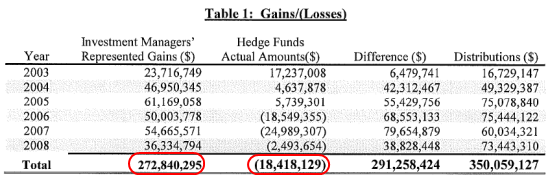
    This chart from Burton Wiand's court filings in the Arthur Nadel case shows that the hedge funds purported to have recorded more than $272 million in gains between 2003 and 2008, then the funds actually lost more than $18 million. In 2007, the funds purported to have gained more than $54 million, but actually lost nearly $25 million.
    This chart from Burton Wiand's court filings in the Arthur Nadel case shows that the hedge funds purported to have recorded more than $272 million in gains between 2003 and 2008, when the funds actually lost more than $18 million. In 2007, the funds purported to have gained more than $54 million, but actually lost nearly $25 million.

    The SEC approved the 90 percent settlement figure, Wiand said. He added that the window was closing on the discount deal.

    In a November court filing, Wiand said that “those who do not settle with the Receiver should anticipate that litigation will be commenced in the immediate future” and that the discount “will no longer be available.”

    It appears as though two groups of clawback targets exist: a group of 85 who received letters and were offered the discount, and a group of an unknown size that will receive settlement letters soon.

    Wiand said the group of 85 represented about $16.2 million in fictitious profits from the scheme. The other group represents about $22.8 million.

    Read Wiand’s interim receivership report in the Nadel case.

    See Nadel story in Sarasota Herald Tribune.

    See Bolze story from WATE.

  • SENIORS HARMED: Judge Issues Findings In CFTC Case Against Matthew B. Pizzolato; Says Investors Lost Retirement Savings In Scheme

    A Louisiania man charged criminally in an alleged Ponzi scheme and sued civilly on the same day last month lied to investors, some of whom liquidated retirement savings and annuities only to suffer massive losses by entrusting funds to Matthew B. Pizzolato, a federal judge has ruled.

    The case against Pizzolato is proceeding on separate tracks: a criminal prosecution by U.S. Attorney Jim Letten with the help of the FBI, the IRS, the U.S. Postal Inspection Service and the State of Louisiana Office of Financial Institutions, and a civil prosecution brought by the Commodity Futures Trading Commission.

    U.S. District Judge Mary Ann Vial Lemmon of the Eastern District of Louisiana now has extended an asset freeze, enjoined Pizzolato from breaking commodities laws and issued some findings in the civil case.

    Pizzolato is  26. He formerly resided in Tickfaw.

    Among Lemmon’s findings were that Pizzolato and his co-defendants in the civil case — William Guidry, 35, of Plano. Texas, and Jacksonville, Fla., and Capital Funding Consultants LLC of Covington, La. — ripped off senior citizens. Guidry and Capital Funding’s assets also have been frozen, and they have been enjoined from breaking the law.

    “Specifically, the order finds that Pizzolato, as part of a broader scheme in which he solicited $19.5 million, obtained more than $3.1 million from 24 mostly elderly investors, which he gave to Guidry to invest,” CFTC said.

    “Despite representing to these elderly investors that their funds would be invested in safe, secure investments with guaranteed rates of return, Pizzolato gave the funds to Guidry to trade high risk commodity futures, among other things,” CFTC continued. “The order also finds that Guidry and Capital Funding misappropriated more than $221,815.53 of investor funds for personal purposes, and used some of those misappropriated funds to trade commodity futures in accounts owned by Capital Funding. The investors were not told about Guidry’s commodity futures trading losses. The order further finds that Guidry and Capital Funding commingled commodity pool participants’ funds with the funds of other persons.”

    In the criminal case, which is being heard by U.S. District Judge Lance M. Africk, Pizzolato was charged with 52 counts of mail fraud, two counts of wire fraud, seven counts of money laundering, and single counts of securities fraud, obstruction of justice and witness tampering.

    He faces more than 1,100 years in prison and a fine of more than $16 million, if convicted on all counts. As many as 160 people were duped, prosecutors said.

    Prosecutors said Pizzolato attempted to silence employees with bribes of $20,000 and get them to destroy records to cover up the scheme. Meanwhile, they said Pizzolato obstructed justice by stealing documents that could incriminate him from the home of a client.

    Among the luxury items Pizzolato purchased with investors’ money were a BMW 750LI, a Mercedes Benz S430V, a Range Rover Sport and a Chevrolet Corvette, prosecutors said. He also bought sports tickets, a $35,000 engagement ring, a $500,000 home in Ponchatoula, La., and spent $35,000 on Carnival cruises.

    All in all, Pizzolato took about $19.5 million from clients and spent “nearly all” of it, prosecutors said.