Category: Ad Surf Daily

  • Gadfly Prison Inmate Jonathan Lee Riches Enters Madoff Fray; Files Motion To Intervene In Bankruptcy Case

    jonathanleeerichesmadoffsmallVeteran court watchers might have wagered it was only a matter of time before Jonathan Lee Riches filed a motion in the Bernard Madoff bankruptcy case.

    Had you placed a friendly wager, you’d be a winner. Riches’  brief  was recorded yesterday. He called it an “Amicus Curaie” motion to gain standing with the Court.

    Riches, also known as #40948018, is a prisoner at Federal Correctional Institution (FCI) Williamsburg, in Salters, S.C. His brief was filed longhand — on tablet paper. You can see it on the Madoff Trustee site, operated by Irving Picard, the court appointed trustee.

    Doing a stint for wire fraud, Riches has, among other things, sued the Williamsburg prison telephone number. He also has sued Plato and  Nostradamus, among more than 1,000 others.

    We’re publishing this post for a couple of reasons. The first is that the motion is laugh-out-loud funny. Riches, for example, claims he met Madoff on eharmony.com in 2001. A romantic relationship ensued, and Madoff picked Riches’ brain to learn how to become a better criminal.

    Riches also claims Madoff took money from Williamsburg inmates after offering them 16.8 percent interest, and then invested the money in a Swiss Ponzi scheme.

    So, have a laugh during these troubled times.

    Our second reason for publishing this post is a serious one. Readers following the AdSurfDaily Ponzi scheme litigation know that a strange motion also was filed in that case. Curtis Richmond, a man linked to a sham Utah “Indian” tribe purportedly founded in an Arby’s restaurant, filed a motion to have the case dismissed.

    He was denied leave to file, and has a history of filing frivolous litigation, as does Riches.

    Here we have two very serious cases — Madoff and ASD/Andy Bowdoin — and the judges and true parties to the cases have to accommodate nonsense in a search for the truth. It’s still nonsense, even if it does make you laugh.

    Riches’ brief was funny, to be sure. And there also is humor to be found in a brief filed by a member of a sham “Indian” tribe founded in Arby’s.

    Devoting airtime or column inches to things of this nature often is a tough call. On one hand, neither court brief cited above serves the interests of justice. On the other, however, it’s hard to ignore the human-interest elements of either brief. Madoff on eharmony? Arby’s Indians?

    So, we’ll keep this post brief and acknowledge both the humor and the very serious business at hand.

  • Seniors In Gallery Of Ponzi Rogues; Grandpa Breaks Bad

    bowdoinmadoffnadel

    We noted Sunday that a startling number of senior citizens have been implicated in Ponzi schemes or accused of monumental financial misdeeds. Featured in this graphic are (left to right): Andy Bowdoin, president of fundamentally defunct AdSurfDaily Inc. of Quincy, Fla.; Bernard Madoff, head man at fundamentally defunct Bernard L. Madoff Investment Securities of New York; and Arthur Nadel, principal in several fundamentally defunct hedge funds in Sarasota, Fla.

    Bowdoin is 74. Prosecutors said he fleeced investors in a $100 million Ponzi scheme by selling unregistered securities and calling them “advertisements.”

    Madoff, who might have presided over the biggest Ponzi scheme in world history, is 70. Losses could reach $50 billion.

    Nadel, 76, was arrested yesterday in Tampa, after being on the lam for two weeks. An estimated $300 million is missing from hedge funds he managed in Sarasota.

    Authorities said all three men lived well while investors were being taken to the cleaners. Just prior to a federal seizure of his assets in August, Bowdoin put a gleaming new Lincoln in the driveway — after setting up a sham entity, diverting ASD money to it in a bid to hide assets, and using ASD cash to fuel personal spending in the hundreds of thousands of dollars by family members and preferred investors, prosecutors said.

    Bowdoin has surrendered claims to approximately $100 million in cash and other assets seized by the Feds. In a second forfeiture complaint that is unresolved, prosecutors seek to take control over other assets tied to the firm, including cars, a 20-foot Triton Cabana boat, jet skis and other property purchased with the proceeds of an illegal enterprise.

    Irving Picard, the trustee in the Madoff case, has filed papers to reject expensive automobile leases. While Madoff was engaging in a Ponzi scheme, Picard said, investors were footing the bill for three Mercedes, a Range Rover, a Lexus and a Cadillac.

    madoffleases

    Lease costs for the Mercedes units alone exceeded $4,200 a month, while the lease for the Range Rover cost $1,153 monthly. The Lexus ($888/month) and the Cadillac ($884/month) were relative bargains compared to the other vehicles.

    Prosecutors now say Nadel also took money from company funds and used it for family businesses. The receiver in the Nadel case, Burton Wiand, said in court filings that one of the family business owns as many as five airplanes.

    Other seniors in Ponzi trouble include Richard Picolli, 82, operator of the alleged Gen-See Ponzi in western New York. Prosecutors said he mostly targeted Catholics.

    Meanwhile, Ronald Keith Owens, 73, was just sentenced in Texas to 60 years in prison for running a “prime bank” Ponzi scheme promising huge returns out of the Bahamas and elsewhere.

    Elsewhere, James Blackman Roberts, 71, of Heber Springs, Ark., was just sentenced to 15 years in prison for running a $43.5 million Ponzi scheme.

  • Nadel Diverted Client Funds To Family: Feds

    nadelcheck500

    Florida hedge-fund manager Arthur Nadel turned himself in yesterday to the FBI in Tampa.

    Nadel had gone missing Jan. 14. He was immediately jailed. A bail hearing is set Friday.

    Previously we’ve written about some of the Nadel parallels to the AdSurfDaily Ponzi scheme case. Some of the parallels grew even more striking yesterday, with assertions by federal authorities that Nadel had diverted client funds to family businesses and his wife.

    Federal prosecutors filed a second forfeiture complaint last month against assets tied to ASD. The government seized real estate, automobiles, a boat and other water equipment paid for with ASD money diverted to family members of ASD President Andy Bowdoin.

    In a forfeiture complaint filed in August, prosecutors seized tens of millions of dollars Bowdoin had in bank accounts, plus other real estate tied to ASD. The total amount seized in the case is at least $93.5 million.

    Burton W. Wiand, the receiver in the Nadel case, now has gone to court to attach family assets.

    “Based on our investigation, it is likely that a significant sum of the proceeds of Nadel’s scheme made its way into other accounts controlled by Nadel and/or his wife, Marguerite Nadel,” Wiand said.

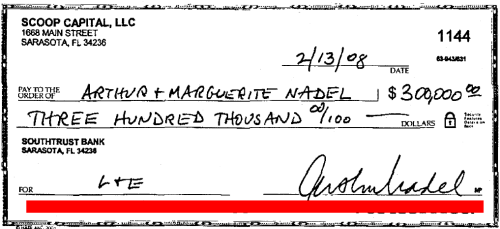
    Last year, for instance, Nadel signed checks transferring at least “$1,003,500.00” from Scoop Capital to himself and his wife, Wiand said.

    The scheme likely had been under way for years, Wiand said.

    “Further, in 2003 and 2004 I have already seen documentation showing that at least $685,000.00 was transferred to Nadel and his wife (and have reason to believe that significantly more money was transferred to them),” Wiand said. “In short, it is apparent from the documentation that large quantities of money were diverted from the Hedge Funds to Nadel and Mrs. Nadel. Indeed, to date we have not uncovered any source of income for Nadel or his wife that was not in some manner funded with money from the scheme.”

    Nadel made the checks out by hand, making them payable either to himself or his wife and himself. Sometimes he used the couple’s formal names — “Arthur” and “Marguerite”; other times he used the informal “Art” and “Peg.”

    As the hedge fun assets dwindled, Nadel acquired jets, airplanes and real estate for the family businesses, according to court filings.

    Precisely how clients’ money was plundered virtually it its entirety was unclear. What is clear is that the scheme began to unravel when the alleged Bernard Madoff Ponzi was revealed.

    Nadel, prosecutors said, had been under pressure from colleagues to hire an independent accountant to audit the firms’ assets, but always said no. When the Madoff case made headlines, colleagues insisted on an independent audit. Nadel fled on Jan. 14, a date by which it had become clear that the audit would be performed, prosecutors said.

    Peg Nadel has not been charged with any crimes.

  • Readers Ask: Are The Surf Promoters REALLY That Stupid?

    duhWe’ve received a number of comments from readers that fall along these lines: Are the people promoting autosurfs despite what has happened to AdSurfDaily, LaFuenteDinero and Golden Panda — and the collapse of MegaLido (and others) — REALLY that stupid?

    The short answer is maybe. Each and every one of them is risking the same personal fate as Andy Bowdoin and others before him. Like Bowdoin, they could find themselves enjoying a quiet breakfast one morning when the life-altering knock comes to the door. Because Bowdoin involved family members, knocks also came to the doors of loved ones. The Feds now intend to sell their property, too. Why? Because it was obtained illegally from proceeds of a crime.

    So why continue to promote autosurfs, perhaps even become a “founder” in one of them? Here’s the long answer:

    Damage Control

    For some promoters, it’s actually a tortured form of damage control because they know they’re crooks. To acknowledge the government is right is to acknowledge a crime — and to create a problem with downline members in the autosurf under investigation or in other surfs yet to make the Feds’ radar screens.

    Depending on the level of a downline member’s losses, he or she just might be inspired to sue or actually even call authorities. The promoters don’t want that to happen, so they project an air of confidence. The gambit is that “confidence” in the program and business model — even if it has been blasted to smithereens by the Feds — minimizes the chances of getting arrested or sued by people whose pockets they’ve picked.

    Did you know that “con man” is short for “confidence man?”

    Think about it: The government has just pulverized three autosurfs — not one, not two, but three. Most people would take that as a strong clue that there is nothing to be confident about, that prosecutors understand precisely what is going on, precisely how to dismantle the operations and precisely how to litigate against autosurfs to make it virtually impossible for the government to lose a case.

    The only people “confident” in the model are the con artists. It’s part and parcel to their existence. It’s what they do.

    Henceforth, prosecutors will need only to summon the ASD, LaFuenteDinero and GoldenPanda litigation templates, insert the facts concerning any new surf they seek to dismantle, file the paperwork in the appropriate U.S. District Court — and wait for the surf operator to fold, perhaps after he or she spends hundreds of thousands of dollars to defend a case that can’t be won.

    Like Andy Bowdoin did.

    Greed

    Another reason people continue to promote autosurfs or become an autosurf founder is because they’re just plain greedy and have decided to ignore the consequences. They’ve seen how ASD put $100 million on the table, and have envisioned themselves receiving a big chunk of a like amount.

    Greed definitely is in play in some cases. If someone sends you an email promoting a new surf site in the aftermath of the ASD experience,  it makes little sense to ponder the motivation. Simply assume it’s greed or criminality.

    Addiction

    Yet another reason some people continue to promote is because they’re addicted to the surfs. It’s almost akin to a morbid drug, alcohol or gambling addiction. Despite obvious, painful consequences, they have the need to serve the addiction.

    Did you notice how some people recoiled when commentators said that the government’s seizure of ASD cash was the equivalent of seizing drug money? The comparison was perfectly rational — the illegal sale of drugs poses a clear and present danger to society, and the illegal sale of securities poses a clear and present danger to society — but the comparison separated some people from their senses or caused them to change the subject.

    What does ASD have to do with drugs? they asked, often testily. Acknowledging an addiction is horribly painful, which is why addicts prefer the disease to the cure.

    All of these are reasons why the answer to the “stupid” question has to be maybe. Criminals, greedy people and addicts aren’t necessarily stupid — but, of course, some of them are.

    Crowds have been lining up to perform street justice on Ponzi purveyors in New York in the wake of the Bernard Madoff scandal. The more patient public, for its part, has never been more interested in seeing Ponzi purveyors brought to the official halls of justice — and yet the autosurf promoters don’t seem even to know there never has been a worse time to be in the Ponzi business.

  • BREAKING NEWS: Natures Discount Drops RICO Lawsuit Against Bowdoin, Busby, Garner

    Natures Discount, a former AdSurfDaily advertiser, has dropped a racketeering lawsuit it brought in November against ASD President Andy Bowdoin, Golden Panda President Clarence Busby, and Robert Garner, an attorney who appeared in a video touting ASD’s legality.

    Bank of America also was named a defendant in the Natures Discount complaint, though not as a RICO defendant. Natures Discount asserted that the bank didn’t pay close enough attention to Bowdoin and Busby and aided them in their scheme to defraud customers.

    The allegations against BOA also were dismissed.

    “Pursuant to Rule 41(a) of the Federal Rules of Civil Procedure, Plaintiff hereby gives notice of its voluntary dismissal of the above-styled action without prejudice,” Natures Discount said in court filings today. “Each party will bear their own costs.”

    The dismissal follows on the heels of a government notice last week that it intends to litigate two separate forfeiture actions filed against ASD to their conclusion and take possession of all seized money and property tied to the firm.

    Should the government prevail — and ASD already has surrendered claims to assets seized in the initial forfeiture complaint filed in August — it would mean the government would have exclusive control over virtually all of ASD’s money and property.

    Prosecutors last week established a procedure for members to file for ASD refunds, saying it intended to liquidate real estate and other assets seized from ASD. Members seeking refunds will be required to file petitions and certify under oath that they were crime victims.

    In December, a second forfeiture complaint filed against assets tied to ASD alleged that hundreds of thousands of dollars of ASD funds were used to fuel personal spending by Bowdoin family members. Included were automobiles, a boat, jet skis, hauling trailers and a family home in Tallahassee.

    The government has not guaranteed any refund amount, and its probe is ongoing. All of ASD’s assets were forfeitable under U.S. law because they were the proceeds of a criminal enterprise, prosecutors said.

  • MegaLido: Is There An ‘Instant2U.com’ Tie?

    egoldenpandasmallIn the weeks following the seizure of cash and property linked to AdSurfDaily Inc., some former members of ASD turned their attention to promoting MegaLido.

    MegaLido was pushed as a safe, offshore alternative to ASD and Golden Panda, and a way to make up ASD/Golden Panda losses that stemmed from the government seizure of cash and other assets linked to the firms.

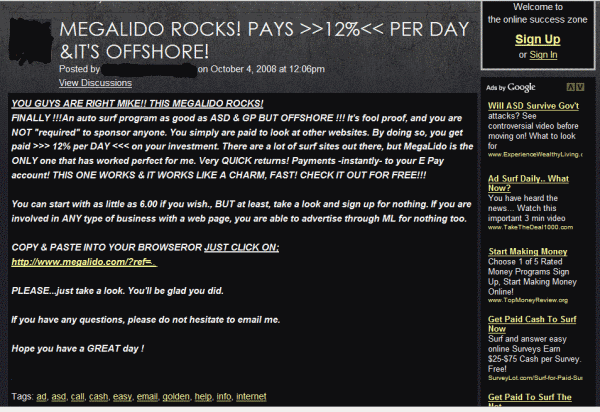
    “MegaLido Rocks!” one promoter blared, noting excitedly that it paid 12 percent a day and “It’s Offshore!”

    MegaLido ultimately tanked, leaving members holding the bag.

    Now it appears as though MegaLido had at least an indirect tie to an autosurf known as instant2u.com, the domain for which was registered July 27, only a few days before the government seized ASD assets.

    instant2u promoted 14 percent a day.

    instant2u.com also failed. Based on forum reports, the surf began to fail sometime in November — just as MegaLido was coming to prominence in the surf world. Soon thereafter, though, MegaLido also failed.

    If you type instant2u.com into the location bar of your browser, you’ll see that the domain tries to redirect to MegaLido, which is throwing a “Failed To Connect” error.

    It is not known if the domains had common ownership or were working together in indirect fashion to harvest money from customers. What is known is that autosurfs often join forces to create churn. CEP, yet another autosurf Ponzi scheme, had money in 26 separate autosurfs or HYIPs, prosecutors said.

    The instant2u redirect to MegaLido might not be evident in all browsers, but we tested it in Firefox and it tried to redirect to MegaLido. People are complaining about it on a MegaLido forum. They know they’ve been “had” whether the two surfs had common ownership or not.

    These developments demonstrate, once again, that there is nothing noble about the autosurf business. instant2u became the subject of Web discussions as early as July 31, just one day before ASD’s assets were seized.

    ASD effectively went out of business Aug. 1, followed within weeks by both instant2u and MegaLido. Some of the people who promoted all three surfs are still promoting surf sites, demonstrating that they’re willing to relieve people of their money no matter what.

  • EDITORIAL: AdSurfDaily Refund Procedure Takes Weapon Away From Serial Ponzi Autosurf Promoters

    The government has established a refund procedure for the AdSurfDaily, LaFuenteDinero and GoldenPandaAdBuilder Ponzi case that requires victims to file petitions for remission or mitigation.

    Petitions must be filed in writing and under oath. The government will provide instructions. Patience is required because the case has not been litigated to conclusion.

    “Under Section 9.8(a)(1) and (2) of Title 28 of the Code of Federal Regulations, in a petition for remission or mitigation of forfeiture a non-owner victim must demonstrate that it suffered a pecuniary loss of a specific amount directly caused by the criminal offense(s) underlying the forfeiture, or a related offense, and that the loss is the direct result of the criminal acts,” the government said.

    We see this as a valid, useful approach, something that places a critical check on the wink-nod nature of autosurfs. Serial promoters now know — beyond a shadow of a doubt — that the government views autosurfs as criminal enterprises. If you played the game, you have to take proactive steps to get your money back, and you have to certify you were a crime victim.

    It might be hard to certify yourself a crime victim if you’re still playing the autosurf game and your name pops up the next time an autosurf gets busted. It will be harder yet to persuade people that government “evil” led to your demise after you’d been warned repeatedly not to play the game.

    Most members will view the refund procedure as a minor hurdle. After all, they relied on assertions Andy Bowdoin made that the program was legal. They were shocked at the seizure and appalled beyond measure as details about the depth of ASD’s deception came to light.

    But this will be a bitter pill for some ASD members to swallow, perhaps particularly serial promoters, promoters who race from program to program and actively, even aggressively promote autosurf Ponzi schemes.

    They were “shocked” by ASD developments only in the same sense Captain Renault was “shocked” at the gambling “going on” inside Rick’s Café Américain in “Casablanca,” which is to say they weren’t shocked at all. Like Renault, they pocketed their winnings and looked forward to pocketing some more in wink-nod fashion.

    What the government is doing, plainly, is signaling autosurf participants that they’re not going to be able to claim victimhood in one autosurf while collecting profits and insisting all is legal and completely above-board in another.

    What’s been most appalling about the ASD case is the insistence by some people that autosurfs are a harmless game. Even as autosurfs were folding and failing during the holidays, taking members’ money and leaving them with even deeper feelings of uncertainty and insecurity during lean economic times, they continued to promote these miserable businesses.

    One board we visited a few days ago included a thread in which people were inquiring how to get ASD refunds while the same people were actively promoting other autosurfs. It is impossible to reconcile these conflicting messages, which must be both instructive and maddening from a prosecutor’s point of view.

    Prudence, Professionalism, Sound Judgment

    The reason there is money to distribute — and the government warns it won’t be 100 percent — is because dedicated public servants exercised prudence, professionalism and sound judgment in seizing the cash before ASD could plunder all of it or abscond with all of it and cite “rebates aren’t guaranteed” as its “out.”

    It will take some time to get a refund. The government has to liquidate assets, and there is the issue of a second forfeiture complaint filed last month against other assets tied to the firm.

    Although ASD has surrendered claims to assets seized in August, the forfeiture complaint filed last month was filed as a separate action. Included were real estate, automobiles, water craft and other items seized from favored participants, including Bowdoin family members.  How that case will proceed is unclear. People from whom the property was seized can file claims and challenge the seizure, just as ASD did the first time around.

    In any event — and if the government prevails in the second case — the cars and water craft are all “used” items now and won’t fetch anything that approaches 100 cents on the dollar, especially at auction prices. And who will want to buy the old Masonic Hall in Quincy for $800,000 like Bowdoin did? Because Florida has one of the highest foreclosure rates in the United States and is experiencing falling property values, none of the real estate is apt to be sold at anything that approaches a break-even price.

    Also gone is the money ASD spent on legal fees.

    Employees, Quincy Get The Shaft Because Bowdoin Misled Them

    Quincy, Fla., is a proud community that is struggling. The riches of old largely are gone, which is why ASD gained acceptance in the community quickly. People were thrilled to hear an important new business was in town — a business that demonstrated that the power of the Internet could be harnessed even in small communities.

    But Bowdoin fleeced Quincy, just as he had fleeced ASD members.

    ASD always was unsustainable. The business model was unsustainable. Paying “rebates” was only one thing that made it unsustainable. ASD also had to pay employees. Whether they received checks or “ad packs” as compensation, the company could not pay them without putting an even greater strain on the Ponzi. “Ad packs” were the worst remedy of all because they created even greater deficits.

    This doesn’t even take payroll taxes and other taxes into account. And it doesn’t take the light bill and equipment costs into account or the cost of compliance. One of the biggest reasons autosurfs are moving offshore is because they know they can’t get around the issue of selling unregistered securities by calling them “advertisements.” There is no sense spending money on compliance only to be told that the only way you can comply is to stop offering “rebates” and simply sell advertising for a fee. The riches evaporate when an autosurf company comes into compliance.

    Rebates are what draws the crowd. It’s like giving away free food and drinks. Absent huge piles of disposable start-up capital or spectacular amounts of revenue from sources beyond “advertising” fees, however, an enterprise such as ASD can’t sustain itself. The best it can do is create the illusion of sustainability. The reason start-up capital has to be disposable in the ASD business model is because every dollar that floats into the firm creates a liability of $1.25.

    No legitimate venture-capital firm would fund such a company. The model is unsustainable on its face. Due diligence by the venture capitalists would be reduced to its bare essence: If $1 in means $1.25 out, then this is a Ponzi scheme. It is no more complicated than that, which is why autosurfs rely on smoke and mirrors.

    Refund Procedure

    Here, verbatim, is a notice the Department of Justice posted yesterday:

    U.S. Department of Justice
    Jeffrey A. Taylor
    United States Attorney
    District of Columbia

    Judiciary Center
    555 Fourth St., N.W.
    Washington, D.C. 20530

    January 23, 2009 Update
    Ad Surf Daily, La Fuente Dinero & Golden Panda Ad Builder

    In two related civil forfeiture cases now pending in the United States District Court for the District of Columbia, the Department of Justice (though the United States Attorney’s Office) has alleged that funds and assets it seized from several Internet-based businesses, “Ad Surf Daily,” “La Fuente Dinero” and “Golden Panda Ad Builder,” constituted proceeds of one or more federal criminal offenses. Specifically, the government alleged that each of these three so-called autosurf businesses, which had promised income opportunities to paying members, were actually “Ponzi” schemes that violated the federal wire fraud and securities fraud statutes. Under federal law, all proceeds of such criminal offenses are forfeitable to the United States.

    On January 13, 2009, in the first civil forfeiture lawsuit against over $53 million and other real and personal property, claimants AdSurfDaily, Inc., Thomas A. Bowdoin, Jr., and Bowdoin/Harris Enterprises, Inc. filed a “Motion for Leave to Withdraw Claims Release of
    Claims to Seized Property and Consent to Forfeiture.” In that motion, these individuals and entities asked to have all previous challenges they had made to the government’s effort to forfeit the property named in that lawsuit withdrawn. On January 22, 2009, the Court granted that motion and deemed the claims withdrawn. Earlier, on September 22, 2008, the individuals and entities that had challenged the government’s lawsuit against funds seized from the Golden Panda Ad Builder operation also moved to withdraw their challenges to the government’s lawsuit.

    The government intends to pursue each forfeiture case to its completion, and to perfect the forfeiture of all fraud proceeds as quickly as possible. Although the recent withdrawals of the prior challenges to the first forfeiture case should expedite resolution of that lawsuit, the forfeiture process is not yet completed. Moreover, even upon their forfeiture, disposition of noncash assets will take some time because such assets must be liquidated before any funds derived from those assets can be made available as victim compensation.

    Individuals who sent money to Ad Surf Daily (or AdCashGenerator), La Fuente Dinero or Golden Panda Ad Builder, and who suffered a pecuniary loss, may choose to file petitions for remission or mitigation of the forfeiture with the Department of Justice. Under Section 9.8(a)(1) and (2) of Title 28 of the Code of Federal Regulations, in a petition for remission or mitigation of forfeiture a non-owner victim must demonstrate that it suffered a pecuniary loss of a specific amount directly caused by the criminal offense(s) underlying the forfeiture, or a related offense, and that the loss is the direct result of the criminal acts.

    The Department of Justice will work with the records it receives to build a database of former members of these auto-surf “Ponzi” schemes. The Department will endeavor to contact members with information about how they may properly file petitions for remission or mitigation with the Department (in writing and under oath). The Department may employ individuals or entities to assist it in identifying potential petitioners, to assist them in filing petitions, and to expedite resolution of each petition it receives. Because some existing records may be incomplete or out of date, potential petitioners may want to provide to the Department their current contact information directly, preferably by completing the information submission form located at www.usdoj.gov/usao/dc/Victim_Witness_Assistance/adsurfdaily.html or by emailing information to the Department at usadc.adsurfdaily@usdoj.gov (Prospective petitioners who already provided such information, by submitting the form, email or letter, need not do so again.)

    Prospective petitioners’ contact information should include, at minimum, full names, member numbers, total funds paid to Ad Surf Daily, La Fuente Dinero or Golden Panda Ad Builder, and methods of payment. Mailed correspondence should be directed to the Asset Forfeiture Unit of the United States Attorney’s Office for the District of Columbia, and sent to the address listed at the top of this memo.

    The United States will not have access to funds before the forfeitures are concluded, and forfeiture orders issue from the Court.

  • Edward Purvis, Head Of ‘Christian’ Group, Indicted For Running Ponzi Scheme; Case Has Echoes Of Ad Surf Daily Probe

    In a complex case apt to remind some members of AdSurfDaily about strange twists and turns the ASD case has taken, an Arizona man has been indicted on charges of running a Ponzi scheme that fleeced Christians.

    ponzinewsEdward Anthony Purvis was accused of setting up the Ponzi through an organization known as Nakimi Chi Group Ministries International (NGGMI), collecting at least $8 million in the process.

    The case has featured allegations of bribery, claims that proceeds from the enterprise could not be taxed, and bizarre legal filings naming a judge, court clerk, investigators and a reporter defendants.

    Purvis already is in prison, serving an 18-month term. He was convicted in May of attempting to bribe a police officer in Chandler, Arizona, and of harassing public officials in a bid to thwart an investigation by the Arizona Corporation Commission.

    The commission ordered more than $11 million in restitution and administrative fines of $250,000.

    Cash-Gifting Scheme, Coupled With Ponzi And Affinity Fraud

    “Although investors expected a return that was allegedly guaranteed, Purvis and [civil co-defendant Gregg] Wolfe referred to these investments as ‘donations’ and the dividend income as ‘gifts,’” the commission said.  “In some instances, investors received phony account statements that showed their investments were increasing in value when they were not. In other instances, investors did not receive any documentation at all.”

    Purvis and Wolfe, the commission said,  “funneled investor money into offshore accounts and used it for cars, jewelry, a down payment on a luxury home, gambling debts, a payment to a woman’s professional soccer team, and for Purvis’ legal fees in connection with the Commission’s proceedings.”

    Prosecutors in the AdSurfDaily case said ASD funds were used to purchase luxury automobiles, real estate, jewelry, a 20-foot Triton Cabana boat, jet skis and trailers to haul the water equipment. Prosecutors also said ASD had money in offshore accounts in Canada and Antigua.

    ASD President Andy Bowdoin, prosecutors said, also made claims that Russian hackers had stolen $1 million from ASD. Bowdoin never filed a police report, which prompted questions from members about whether the money actually had been stolen or was hidden offshore.

    Case Takes Criminal Twist

    Arizona Attorney General Terry Goddard now is prosecuting a criminal Ponzi case against Purvis. A grand jury handed down an indictment Friday.

    “Purvis told some investors that by forming a ‘corporation sole’ they would not have to pay taxes on the investment return paid by N.G.G.M.I. each month or that payments made by N.G.G.M.I. were ‘gifts’ and therefore were not taxable,” according to the indictment.

    The indictment accused Purvis of multiple felonies, including theft, securities fraud, selling unregistered securities and running a racketeering enterprise.

    Purvis targeted at least one pastor, church elders and at least two congregations, authorities said.

    Members of the Arizona Corporation Commission said affinity fraud is one of the worst forms of financial fraud because it takes advantage of people’s tendency to trust members of a group.

    “This tragic case demonstrates how important it is for investors to verify the registration of both the seller and the security before they buy—no matter who is selling the investment,” said Commissioner Bill Mundell.

    “Watch out!” warned Commissioner Jeff Hatch-Miller. “In rough financial times, the scam artists are out in full force.”

    Echoes Of ASD

    Last fall, some ASD members advocated an approach by which members would send certified letters to prosecutors and others involved in the case in a bid to undermine the government’s efforts.

    The strategy previously had been employed by members of a Utah Indian tribe a federal judge ruled a sham. A cornerstone of the strategy is to force recipients of certified letters to default on demands made in the letters, and then to seek punitive financial judgments through UCC filings.

    Curtis Richmond, a member of the Utah-based tribe, attempted to file a motion to have the ASD case dismissed. On Nov. 19, Judge Rosemary Collyer refused to accept the motion, denying Richmond leave to file.

    The tribe, known as Wampanoag Nation, Tribe of Grayhead, Wolf Band, has been implicated in a number of attempts to stifle prosecutors, judges, investigators and others by making vexatious court filings and filing fraudulent judgments against litigation opponents and public officials.

    Richmond was convicted in February 2007 of criminal contempt of court for threatening or trying to intimidate judges in a case separate from the ASD case. His name is listed on incorporation papers for an entity known as Pacific Ministry of Giving International. California records say the registration has been forfeited.

    Investigators in Arizona say Edward Purvis and Nakimi Chi Group Ministries International employed some of the same methods the sham Utah Indian tribe employed to nuisance public officials.

    Purvis filed fraudulent $15 million liens against a judge, a court clerk and two investigators, for example, according to an indictment charging him with felony counts of bribery and harassment of public officials.

    Investigators said Purvis bribed former Chandler police officer Bradley Todd Forward to gain access to confidential files used in the investigation of N.G.G.M.I. by the Arizona Corporation Commission.

    Here is the indictment against Forward for helping Purvis.

    And here is the criminal indictment against Purvis for the Ponzi and affinity fraud.

    (Note: The indictment URLs load slowly.)

  • ASD: Spending Spree Coincided With 2-for-1 Las Vegas Rally

    Less than two weeks after a May 31 AdSurfDaily rally concluded in Las Vegas, ASD funds were used to retire a $157,000 mortgage. Another $62,000 was used to purchase two cars — a 2008 Honda CRV and a 2009 Acura, federal prosecutors said.

    The beneficiaries of the mortgage retirement and the Honda were George and Judy Harris. George Harris is the son of Edna Faye Bowdoin, the wife of ASD President Andy Bowdoin.

    On June 10, Edna Faye Bowdoin worked with her son to establish an account at Capital City Bank. More than $177,000 in ASD funds were transferred from Bank of America and deposited into the Capital City account, prosecutors said.

    On June 23, George Harris used $157,216 of the money to pay off the mortgage. Earlier, on June 11, an ASD check for $28,607 was used to purchase the Honda. The vehicle was registered in the names of George and Judy Harris, prosecutors said.

    On June 10 and June 11 alone, prosecutors said, almost $240,000 in ASD funds were used for personal purchases by Bowdoin family members or friends, the home and two cars included.

    The timing of this is important. In December 2007, only six months prior to the Las Vegas rally, ASD was struggling. Within days of the conclusion of the Las Vegas rally, however, company funds were used to go on a buying spree and the company was scurrying to find ways to hide assets, prosecutors said.

    ASD used matching bonuses to lure prospects to Las Vegas. Some prospects excidedly talked about spending $35,000 at the rally and emerging with 70,000 “ad packs.”

    Two-for-one deals, of course, put even more strain on Ponzis because $35,000 now has the compounding power of $70,000, and $50,000 has the compounding power of $100,000.

    Give ASD $50,000. Receive a matching bonus, effectively doubling the power of your spend. Emerge with the purported capacity to earn $1,000 a day (1 percent of $100,000) by clicking on ads.

    People saw a way to turn their $50,000 spend into a $365,000-a-year job — a job that required only minutes a day and computes to $7,260 an hour in paper “profit.”

    That’s what Bernard Madoff allegedly did — showed people “profits” on paper to keep them coming back for more. Bowdoin showed the “profits” electronically, in members’ back offices.

    It was always absurd. It was absurd from Day One. It can be dressed up to seem plausible, even smart, but it is always and forever absurd.

    “Rebates aren’t guaranteed” sanitizes none of this; it’s just a way for an autosurf operator to live very well while money is flowing in and to license himself to keep all the cash when when the enterprise begins to collapse.

    Coupled with hundreds of thousands of dollars that were exiting ASD for personal purchases by family members — and profits taken by other insiders — ASD was adding new layers of impossibility to its already-impossible mathematical structure.

    And rank-and-file members were shouldering the burden — first for additional deficits created by two-for-one deals, and later for personal purchases and rewards given insiders.

    A review is in order (emphasis added):

    “Mr. Bowdoin and associates issued ad packages to friends and family (who  paid nothing for the ad packages) as free investment, and compensation programs,” prosecutors said.

    “Mr. Bowdoin, and others working with or associated with ASD, also gave ad packages to employees/workers as compensation for services performed for ASD,” prosecutors said.

    “These individuals also were able to pull out considerable funds from the so-called rebate program even though in many cases they put little, if any, of their own money into the scheme,” prosecutors said.

    “For example, a former employee took over $30,000 out of ASD after putting in nothing. Another former employee pulled out over $300,000 after putting in about $10,000,” prosecutors said. “One ASD promoter pulled out almost $100,000 after putting in less than $1,000.”

    In their December forfeiture complaint, prosecutors told the stories of some ASD insiders. One of the claims was about a claim Andy Bowdoin made about Russian hackers stealing $1 million from ASD. He didn’t report the theft to police, even though a tremendous sum allegedly had been stolen from the company.

    But Andy Bowdoin did sponsor rallies, after seeing how well they worked in Iowa. And after the rally concluded in Las Vegas, hundreds of thousands of dollars left ASD and was used for personal purchases by family members, prosecutors said.

    And when rallies in Chicago, Miami and Tampa concluded, they added, a $50,000 Lincoln was purchased with ASD funds. Bowdoin had found a way to make up an alleged $1 million theft and buy lots of new things — a boat and jet skis included.

  • Donald Manning, President Of Purported Offshore Investment Firm, Faces 10 Years In Prison, $500,000 Fine

    BLOG UPDATE 8:51 P.M. EST (U.S.A.):

    We’ve updated this post to note that Donald Manning, who pleaded guilty yesterday to running a Ponzi scheme, was captured in February 2008 — in Nicaragua.

    Cameron Campbell, a Manning Ponzi co-defendant, is a former attorney from La Jolla, Calif. See an FBI news release at the bottom of this post.

    Here, now, our earlier post . . .

    There has been considerable chatter in the autosurf world recently that incorporating offshore protects owners and participants from prosecution.

    Don’t tell that to Donald Manning. He was president of a purported investment company incorporated in the Caribbean Turks and Caicos Islands.

    Now Manning faces up to 10 years in prison and a fine of up to $500,000 after pleading guilty to running a Ponzi scheme, wire fraud and conspiring against the United States. The guilty plea was entered in U.S. District Court in San Diego after an investigation by federal and state agencies, including the FBI and the Arizona Department of Corporations.

    The Brixon Group defrauded numerous investors, including senior citizens and members of Manning’s own family members, prosecutors said.

    An alleged co-conspirator, meanwhile,  has gone missing. The FBI is seeking Joseph Wayne McCool, and is asking the public for assistance in locating him.

    U.S. Attorney Karen P. Hewitt announced the Manning guilty plea. Manning will be sentenced in April by U.S. District Judge Barry Ted Moskowitz.

    Prosecuting attorneys William Cole and John Owens said Manning ran a Ponzi scheme at Brixon Group.

    “Along with co-conspirators Joseph Wayne McCool and Cameron Campbell, Manning recruited retirees and members of his own family to invest millions of dollars in the Brixon Group,” the FBI said in a news release. “Manning told investors that the Brixon Group guaranteed large, guaranteed returns and that the investments were risk free. Manning also told investors that part of their investment would go toward humanitarian efforts overseas and that co-defendant McCool was a banking expert who, prior to working with Brixon, had successfully managed a large private trust in Europe.”

    Manning admitted that he and his co-conspirators concealed from investors “that most of the money invested in Brixon would not be placed into investments and that new funds received from investors would be used to make payments to earlier investors,” prosecutors said.

    “Manning further admitted that, through the Brixon scheme, he and his co-conspirators converted much of the investors’ money to their own personal use.

    Cameron Campbell previously pleaded guilty and is serving a 63-month sentence in federal prison.

    McCool, however, has gone missing.

    “Law enforcement continues to seek the public’s assistance in locating Joseph Wayne McCool, whose whereabouts are currently unknown,” the FBI said.

    See this case information on the case from the Arizona Corporation Commission.

    See this news release on Cameron Campbell from U.S. Attorney Karen Hewitt of the Southern District of California.

  • Introducing Ponzi News (Beta)

    featuredponziOver the next few days we’ll be rolling out a beta version of a new web publication known as Ponzi News.

    It’s at PonziNews.com.

    The content will be targeted at consumers, many of whom were only vaguely familiar with the term “Ponzi scheme” prior to the Bernard Madoff affair.

    We chose “Ponzi News” as the title and created the PonziNews.com domain because those two simple words capture the essence of the editorial product. Ponzi News will publish news about Ponzi schemes and Ponzi allegations.

    Ponzi schemes exist from Wall Street to Main Street. People who wear $1,000 suits run Ponzi schemes, as do people who sit in their underwear all day long at their computer.

    Many people outside the Internet Marketing universe have never heard phrases such as “autosurf” and “HYIP.” But as the economy shrinks and unemployment increases, the autosurf and HYIP operators will be only too happy to give them an education.

    So, Ponzi News also will cover news from the polluted worlds of autosurfs and HYIPs.

    Regulators said recently that investment schemes using the Ponzi model have been on the uptick. If you’ve been paying attention to developments in the autosurf world, for instance, you’ve noticed that several new surfs have popped up in recent days.

    And you’ve noticed that several surfs also have failed.

    Our aim with Ponzi News is to keep consumers informed about Ponzi schemes and become an outlet for news that enlightens, educates and informs them on this very important topic.

    Visit Ponzi News Beta.

    We’ll be adding some content during the day today.