UPDATED 11:15 P.M. EDT U.S.A. Still pushing UFunClub (or Unascos) and absurd propositions such as UToken? Follow the narrative of the Spanish National Police and see if it reminds you of anything you’ve heard before. Any number of digital-currency scams currently are fleecing people globally.
Indeed, National Police have announced the arrests of 20 individuals and the seizure of millions of dollars after an investigation into a purported digital currency known as unete or unetes offered through a “program” known as “Unetenet.”
From the English translation (italics added/no editing performed):
National Police agents have broken up an alleged criminal organization specialized in the commission of massive fraud by the method of the “pyramid schemes”. The group had obtained more than 50 million euros through scams 50,000 people, 6,000 of them located in Spain. After more than year and a half of investigation, agents were able to confirm the existence a company that captured his victims through publicity events, as events in luxury hotels, promotional videos or educational talks and offered them extra income quickly inserting ads company network. Money that was developed by the company in a con artist invented virtual currency, I really had no value, and thus impossible to recoup their investments.
Arrests were made in Madrid, Valencia, Malaga, Seville, Langreo, Alicante and Arrecife (Las Palmas), police said.
El Pais, the Spanish newspaper, reported last month that the currency was devised by Spaniard José Manuel Ramírez Marco. The publication carried a photo of Marco posing in front of a building dubbed “Dubai Internet City.”
Any number of recent schemes have claimed ties in Dubai.
Authorities investigating unete got a break when a former employee of the company filed a complaint, apparently at the Interior Attaché in Bolivia. Complaints also came in from various parts of Spain, police said.
In a money-laundering probe, police seized at least 18 computers, hard drives and CPUs, three tablets, “numerous documents related to fraud and money laundering,” 15,505 euros and two luxury cars.
“In addition, an account has been locked in Latvia with millions of US dollars [possibly $22 million or $27 million], plus Canadian dollars, British pounds [presumptively] and Australian dollars.
BULLETIN: (7th Update 6:32 p.m. EDT U.S.A.) Multiple media outlets are reporting a mass shooting at two separate military centers in Chattanooga, Tenn. An early report in the Chattanooga Times Free Press says four U.S. Marines have been killed and a police officer shot and wounded.
A gunman apparently also has been killed.
The U.S. Navy has confirmed a shooting incident in Chattanooga.
#BREAKING CORRECTION: #USNavy confirms shooting at building on Amnicola Highway.
U.S. Attorney Bill Killian of the Eastern District of Tennessee has called the shootings an “act of domestic terrorism,” according to an AP report via the Washington Post. Chattanooga Mayor Andy Berke called the shootings a “horrific incident in our community.”
Horrific incident in our community. We will release details as they are confirmed. Prayers to all those affected — Andy Berke (@AndyBerke) July 16, 2015
The shootings happened about 40 minutes and six miles apart, first at a military recruitment station and then at a Navy and Marines reserve center. It appeared that the Marines were killed at the reserve center.
The U.S. Marines Corps has confirmed the deaths of four marines at the Navy & Marine Reserve Center.
JUST NOW: Confirmed 4 Marine fatalities at Navy & Marine Reserve Center in TN. Names of Marines released upon notification of next of kin.
FBI identifies shooter as Mohammod Youssuf Abdulazeez, 24. Statement from FBI (italics added):
The FBI’s Knoxville Field Office, along with the Chattanooga Police Department and other law enforcement partners, are working jointly to investigate today’s shootings at a military recruitment center and a reserve center in Chattanooga, Tennessee in which four individuals were killed and three injured. The shooter, Mohammod Youssuf Abdulazeez, 24, is also deceased. While it would be premature to speculate on the motives of the shooter at this time, we will conduct a thorough investigation of this tragedy and provide updates as they are available.
U.S. Attorney General Loretta E. Lynch calls it a “national security investigation.” (Full statement/italics added):
“On behalf of the Department of Justice, I offer my heartfelt condolences and deepest sympathies to the loved ones of the U.S. servicemembers who were murdered and the law enforcement officer who was wounded in this shameful and cowardly act of violence. I have directed the FBI to take the lead in the national security investigation of this heinous attack on members of our military. The U.S. Attorney’s office and department prosecutors are also actively involved. In the days ahead, we intend to work with our partners in law enforcement and the intelligence community to ensure that the American people are protected and that justice is served.”
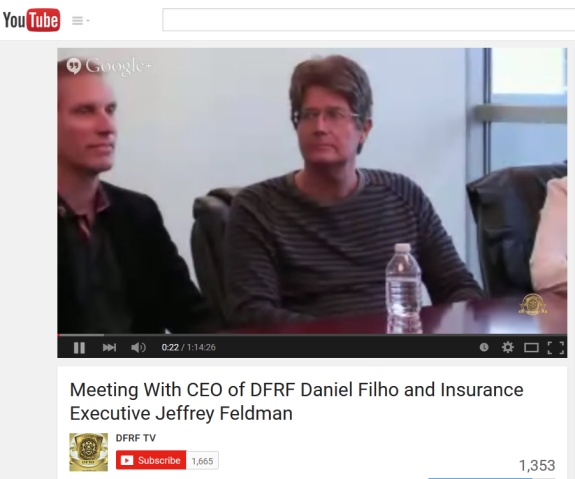
Daniel Fernandes Rojo Filho (left) and Jeffrey A. Feldman: Source: DFRF Enterprises’ pitch on YouTube.
As the PP Blog reported late yesterday, a federal warrant for the arrest of alleged DFRF Enterprises’ Ponzi- and pyramid figure Daniel Fernandes Rojo Filho has been issued. The FBI has brought a criminal charge of wire fraud against Filho, 47, a citizen of Brazil who has lived in the United States. The SEC lists an address for him in Winter Garden, Fla.
“He claims to be the U.S. representative of Accedium Insurance Company (“Accedium”), which is based in Barbados and London,” the SEC continued. “In July 2007, he filed for personal bankruptcy. In 1998, he was found guilty of fraud and forgery for having received $2.5 million in premiums from a rental car chain for insurance policies that he did not actually obtain. In 1996, the state of Florida revoked his license to sell insurance after he pleaded no contest to charges that he submitted false insurance claims for losses he supposedly suffered from Hurricane Andrew. He has made materially false and misleading statements about DFRF in public meetings and videos posted on the internet.”
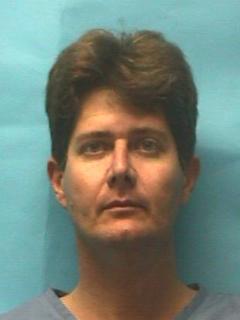
Florida state records show that Feldman served time in a Florida prison between Dec. 28, 1998, and March 2, 2001, on charges of fraud and theft. The 2001 photo at the right, sourced from the Florida Department of Corrections, is his mugshot.
A June 24, 1993, story in the Lakeland Ledger reported that Florida state agents accused Feldman of faking “at least 15 clothing receipts from high-class stores for $76,661 and [turning] them in as part of his homeowner’s claim” after Hurricane Andrew.
One of the ways DFRF duped investors, according to both the SEC and the FBI, was to make them believe their money was insured through the Accedium firm. In an FBI affidavit, the agency described two alleged co-conspirators. One of them appears to be Feldman, referenced as “CC-2.”
From the FBI affidavit (italics added):
Bank records reviewed to date indicate that no money has been paid to any entity by the name of Accedium, the company that allegedly insured investments in DFRF. In a December 8, 2014 DFRF video, which was posted on the internet, an individual identified herein as Co-Conspirator 2 (“CC-2”) was identified as an “insurance executive,” and described as “the person responsible for the insurance company.” In a subsequent DFRF video, posted on the internet on December 10, 2014, FILHO represented that DFRF obtained its Accedium insurance through CC-2. CC-2’s license to sell insurance, however, was revoked in 1996.
The screen shot at the top of this story showing Filho and Feldman is from a YouTube video dated Dec. 8, 2014.
10th Update 10 a.m. EDT July 14 U.S.A. Daniel Fernandes Rojo Filho, the alleged operator of the $15 million DFRF Enterprises LLC Ponzi- and pyramid scheme sued civilly by the SEC in late June, has been charged criminally with wire fraud and is wanted by the FBI. An arrest warrant has been issued.
Court filings show that the FBI was conducting a parallel criminal probe while the SEC was conducting its civil probe. The FBI filed a criminal complaint under seal on June 25, about five days before the SEC filed its civil complaint under seal.
The SEC announced its civil action on July 2. The complaint tied TelexFree Ponzi- and pyramid figure Sann Rodrigues to Filho. In terms of victims, TelexFree may be the largest Ponzi- and pyramid scheme in U.S. history. Having potentially gathered $1.8 billion, TelexFree may be among the largest Ponzi schemes of all time.
Filho, like Rodrigues, is a citizen of Brazil. Both men have used addresses in Massachusetts and Florida.
Federal prosecutors from the office of U.S. Attorney Carmen M. Ortiz of the District of Massachusetts moved to unseal the criminal complaint on July 8. U.S. Magistrate Judge Jennifer C. Boal lifted the seal on the same day, making the wire-fraud complaint and arrest warrant against Filho a public record.
In a July 10 filing, an SEC investigator said this (italics added):
“I have had several conversations with an FBI agent involved in the investigation and the recently-filed criminal proceeding against defendant Filho. I have been informed that the FBI has been unable to execute the arrest warrant issued for defendant Filho in this matter and that the FBI currently considers defendant Filho a fugitive. (A process server retained by the Commission has made several unsuccessful attempts to serve Filho at his residence.) I have been informed that the FBI is actively searching for Filho and has initiated a border watch.”
Filho is 47 and has an address in Orlando, Fla., according to an FBI affidavit. The SEC complaint gives his place of residence as Winter Garden, Fla., which Wikipedia says is 14 miles west of Orlando in Orange County.
The FBI affidavit alleges the FBI has received complaints about him from multiple individuals and that Filho has at least two co-conspirators.
At the same time, the affidavit alleges that DFRF opened “at least 19 bank accounts at different financial institutions” since 2014 and that Filho “is a signatory” on 17 of the 19 accounts.
Much of the FBI information is similar to the SEC’s allegations against Filho.
From the FBI affidavit (italics added):
Among other things, FILHO and others acting at his direction falsely represented that DFRF owned and operated gold mines in Africa and South America, that any investors’ money was 100% insured, and investors could withdraw their principal investments at any time. FILHO never invested the money as promised; instead, FILHO used the money for other purposes, including his own personal and other business expenses.
In its complaint last month, the SEC alleged that, “[s]ince June 2014, he has siphoned more than $6 million out of DFRF — approximately 40% of the total received from investors. This includes more than $1.8 million in cash withdrawals, approximately $1.8 million for personal expenses (including $500,000 for travel), and almost $2.5 million to acquire a fleet of luxury automobiles.”
The SEC further alleged that Filho caused more than $310,000 to flow to Rodrigues. Rodrigues, who once claimed to have hauled $3 million out of TelexFree, is not referenced in the FBI affidavit.
In December 2014, Filho issued a bad check for $10,000 to a DFRF investor, according to the FBI affidavit.
See PP Blog follow-up story dated July 14 here. The story discusses Jeffrey A. Feldman, one of Filho’s co-defendants in the SEC case. Feldman has an address in Boca Raton, Fla.
UPDATED 10:04 A.M. EDT JULY 18 U.S.A. The Zeek Rewards’ receivership this morning told the PP Blog it had “no comment” on a report that alleged Zeek insider Darryle Douglas was involved in a new scheme known as “AuctionAttics.”
BehindMLM.com reported early yesterday that Douglas, who owes the Zeek estate $2.2 million plus postjudgment interest, was involved in the selling of shares in a purported “profit pool” offered by Auction Attics. The report led to immediate questions about whether Douglas, a Californian, was involved in another cross-border offering fraud and would market it to former Zeek members.
Zeek is alleged by the SEC and federal prosecutors in the Western District of North Carolina to have been a Ponzi scheme that gathered hundreds of millions of dollars. The SEC filed civil charges in August 2012. Prosecutors have filed criminal charges against alleged operator Paul R. Burks and former executives Dawn Wright-Olivares and Daniel Olivares, her stepson.
Wright-Olivares and Olivares entered guilty pleas to the criminal charges in February 2014. The criminal case against Burks is proceeding toward trial. Douglas was identified as a Zeek “insider” in a lawsuit filed by Zeek receiver Kenneth D. Bell in February 2014.
AuctionAttics appears to be an upstart MLM “program” pitched on social-media sites such as Facebook. The “program” appears to be in prelaunch phase and to have a dotcom website that uses graphics that resemble Post-it brand notes, a trademark owned by 3M.
A spokesperson for 3M did not immediately return a call by the PP Blog for comment on whether the company was concerned its trademark was being infringed by AuctionAttics.
A snippet from the Business North Carolina story (italics added):
“Some of these folks had been engaged in this kind of thing before, and frankly, some of our largest winners re-engaged in similar schemes right away.”
Based on a victims’ count on the order of 800,000, Zeek likely is the largest or second-largest Ponzi scheme in U.S. history. (In the end, the TelexFree scheme shut down by the SEC and federal prosecutors last year may take the title, but the final numbers are unclear.)
Zeek was a purported “penny auction.” AuctionAttics appears to be using a similar theme, amid suggestions that its customers can be both bidders and sellers who will generate enormous personal profits either way.
The AuctionAttics website appears to be publishing testimonials attributed to people who were big winners, despite the fact the “program” appears not even to have launched.
One of the testimonials quotes “Maria” as saying, “I can earn much more selling on Auction Attics than i [sic] could anywhere else.” The “program” itself claims “Maria didn’t have a store front, she sold reconditioned cell phones exclusively on Auction Attics and earned up to 500% profit.”
Another “program” claim: “Micheal [sic?] and Brenda buys [sic] items, and then sells [sic] them on Auction Attics. They have the potential to earn $1,000’s weekly!”
“Micheal” and Brenda, meanwhile, are quoted as saying, “What a business, we love it.”
The images depicting them appear to be clipart.
An “opportunity” page on the site of AuctionAttics positions the “program” as the next Apple, Instagram and eBay. Namedropping is a common theme in MLM/network-marketing scams.
Among other things, the website of Auction Attics purports to sell “Cover Ads,” explaining them in this fashion:
“Cover ads are so called because they cover more than the original cost of your item even when it was new.”
In July 2014, according to court filings, Zeek’s Burks, Wright-Olivares and Olivares agreed to a $600 million civil consent judgment with the receivership “to be satisfied with substantially all of their assets.”
In an extraordinary statement issued on a Sunday, U.S. Attorney General Loretta E. Lynch said “[t]he U.S. government stands ready to work with our Mexican partners to provide any assistance that may help support his swift recapture.”
The reference was to reputed Mexican druglord Joaquin Guzman Loera, known as “El Chapo.” News broke earlier today that Guzman had escaped from a prison about 55 miles outside Mexico City, reportedly by tunneling out.
“We share the government of Mexico’s concern regarding the escape of Joaquin Guzman Loera ‘Chapo’ from a Mexican prison. In addition to his crimes in Mexico, he faces multiple drug trafficking and organized crime charges in the United States.
“The U.S. government stands ready to work with our Mexican partners to provide any assistance that may help support his swift recapture.”
The escape triggered an international media sensation, with publications across the globe covering the sudden disappearance of the leader of the Sinaloa cartel.
Guzman initially escaped in 2001, but was recaptured last year. His latest escape is leading to fears he’ll soon be back at the helm of the murderous cartel and create even more international problems for Mexico’s government, which has been unable to contain him. As the PP Blog noted in 2014, Forbes magazine once described him as a billionaire and as one of the world’s most powerful people.
BULLETIN: (5th Update 12:54 a.m. EDT July 9 U.S.A.) Three individuals have been indicted on multiple criminal charges in Nevada, with a grand jury alleging they were at the helm of a $1.5 billion Ponzi scheme targeted at Japanese victims. The criminal case follows a civil action filed by the SEC in 2013.
Charged with eight counts of mail fraud and nine counts of wire fraud were Edwin Fujinaga, 68, of Las Vegas; Junzo Suzuki, 66, of Tokyo; and Paul Suzuki, 36, of Tokyo, the U.S. Department of Justice said. Fujinaga also is charged with three counts of money laundering.
All of the defendants were associated with a company known as MRI International Inc. (MRI). The FBI led the criminal probe.
The news may create consternation among cross-border scammers who venture into the United States to hatch fraud schemes.
“The defendants allegedly preyed on thousands of unsuspecting Japanese victims to enrich themselves by operating a billion-plus dollar Ponzi scheme,” said Assistant Attorney General Leslie R. Caldwell. “This prosecution shows that the Criminal Division will pursue not only those who victimize American citizens, but also those who use the U.S. as a home base to defraud victims abroad.”
As the PP Blog reported in 2013 (italics added):
Part of the scam featured “tours” of MRI’s offices in Las Vegas. The alleged scam is evoking images of Bernard Madoff’s colossal Ponzi scheme, in the sense it appears to have gone undetected for years.
At the same time, the alleged Fujinaga/MRI fraud is reminiscent of the epic Trevor Cook Ponzi scheme in Minnesota, in the sense that investors appear to have been lulled into a false sense of security because the company had a physical presence. It is somewhat common for fraudsters to tout a brick-and-mortar presence as “proof” no fraud scheme is occurring, even though case after case has demonstrated that the frauds may be buried deep inside an enterprise that at first glance appears to be legitimate.
“These defendants are accused of using a Nevada corporation to conduct their $1.5 billion fraud scheme and falsely telling thousands of overseas victims that their investments would be safely held and managed by an independent, third-party escrow agent in Nevada,” said U.S. Attorney Daniel G. Bogden of the District of Nevada “Fraudulent ruses and schemes perpetrated by Nevadans using Nevada corporations and entities will continue to be addressed by this office.”
MRI purportedly specialized in “factoring,” whereby the company purchased accounts receivable from medical providers at a discount, and then attempted to recover the entire amount, or at least more than the discounted amount, from the debtor.
According to allegations in the indictment, from at least 2009 to 2013, Fujinaga and the Suzukis fraudulently solicited investments from thousands of Japanese residents, and MRI currently owes investors over $1.5 billion. Specifically, the indictment alleges that Fujinaga and the Suzukis promised investors a series of interest payments that would accrue over the life of the investment and that would be paid out along with the face value of the investment at the conclusion of the investments’ duration. The defendants allegedly solicited investments by, among other things, promising investors that their investments would be used only for the purchase of medical accounts receivable (MARS) and by representing that investors funds would be managed and safeguarded by an independent third-party escrow company.
The indictment further alleges that MRI operated as a Ponzi scheme, wherein the defendants used new investors’ money to pay prior investors’ maturing investments. According to the indictment, the defendants also allegedly used investors’ funds for purposes other than the purchase of MARS, including paying themselves sales commissions, subsidizing gambling habits, funding personal travel by private jet, and other personal expenses.
In January 2015, the SEC said a final judgment from its 2013 civil case “requires Fujinaga and MRI to pay more than $580 million.”
EDITOR’S NOTE: 3:13 p.m. NYSE has announced trading has resumed. Outage lasted more than three hours. Earlier brief below . . .
**____________________**
FLASH: (4th Update 1:01 p.m. EDT U.S.A.) The New York Stock Exchange floor has halted trading, according to an 11:51 a.m. (EDT) message on its status page.
“NYSE/NYSE MKT has temporarily suspended trading in all symbols,” the message reads in part. “All open orders will be cancelled. Additional information will follow as soon as possible.”
NYSE Tweets say the halt is attributable to “a technical issue.” A cyber breach is not responsible, the exchange said.
From CNBC: “It’s been a little bit of a bumpy day. We had some technical problems even before the opening,” said Art Cashin, director of floor operations at the NYSE, in a CNBC interview.”
In a 12:01 p.m. message, the NYSE said, “NYSE Arca and NYSE Amex/Arca Options are unaffected by this issue and continue normal operations at this time.”
The Dow Jones Industrial Average was down more than 213 points at 12:13 p.m.
(1 of 2) We’re experiencing a technical issue that we’re working to resolve as quickly as possible.
Let’s say you’re an MLMer or network marketer. Your email inbox begins to fill up with offers for a scheme that purports to be an “advertising program” favored by famous brands. Spammers are trying to blast their way into your social-media accounts.
The messages: You’re going to be rich in no time. Beyond that, you’re going to receive valuable shares in a startup.
This was Bossteam E-Commerce Inc. — and it was a noxious Ponzi fraud whose “Inc.” designation was meaningless and served as a reminder that a corporate registration is not proof no scam is occurring.
AdSurfDaily ($119 million) was an “Inc.” running a fraud. Bernard Madoff was at the helm of an LLC involved in the largest Ponzi scheme in U.S. history. (NOTE: MLMers/network marketers should think about these things that next time they point to an “Inc.” or “LLC” designation” as proof of legitimacy. TelexFree, accused of operating a combined Ponzi- and pyramid scheme that gathered on the order of $1.8 billion, was both an “Inc.” and an “LLC.” Rex Venture Group “LLC” operated the Zeek Rewards scheme believed to have gathered on the order of $897 million. At one point in time, promoters of ASD, TelexFree and Zeek pointed to corporate registrations as proof no scam was occurring. The same thing happened with DFRF Enterprises, currently in the news.
As the PP Blog reported in May 2012, the Bossteam “program” surfaced in British Columbia and allegedly sold memberships for up to $5,000 each. Prospects allegedly were told they’d get paid for clicking on ads and could exchange purported “private” shares through a purported “internal trading platform.”
But “Bossteam committed fraud when they created the false impression that Bossteam members and well-known local and international businesses were paying Bossteam to advertise on its websites,” a panel of the British Columbia Securities Commission found in a decision dated yesterday. “This was untrue, as the majority of ads appearing on Bossteam’s websites were associated with Bossteam’s own accounts, and not to accounts for parties that had paid Bossteam to post their links.(NOTE: Bossteam is hardly alone in this category. Remember EAdGear?)
ASD, Zeek and TelexFree also had purported “advertising” elements.
It gets worse — and MLMers/network marketers need the learn from this history.
The panel found that each of the respondents breached the Act by:
distributing securities of Bossteam without first having filed a prospectus, contrary to section 61(1);
engaging in conduct that perpetrated a fraud on those who purchased securities of Bossteam, contrary to section 57(b);
withholding information concerning the sale of securities of Bossteam in response to a demand for production issued under section 144 of the Act, contrary to section 57.5; and
attempting to conceal or withhold information concerning the sale of securities of Bossteam by instructing others to deny Bossteam had offered such securities to the public and to refer to the concept of online trading as being planned for the future, contrary to section 57.5.
Put another way, Bossteam first ripped off its members and then tried to draft them into an international conspiracy to cover up the fraud scheme.
The decision involved the conduct of Bossteam, Guan Qiang Zhang (also known as Victor Zhang) and Yan Zhu (also known as Rachel Zhu).
Among the panel’s conclusions was that “Zhang contravened section 57.5 of the Act by attempting to conceal information concerning the sale of Bossteam securities when he instructed others to stop referring to Shares as shares and instead call them consumer credits.”
It is common for HYIP scammers to try to tweak language to skirt securities laws. Both before and after the tweaks, the scammers may seek to dupe the fleeced masses into doing the same thing — a circumstance that leads to a flood of misinformation on the web.
One of the classic fraudulent tweaks occurs when a scheme purports to be morphing from a private offering into one that soon will trade on one or more public stock exchanges. Here is part of what the BCSC said in its May 2015 Investor Alert on the DFRF scheme.
The BCSC has become aware that [Daniel Fernandes Rojo] Filho is offering investments to British Columbians with returns of up to 15% per month. Filho is also promising that DFRF will soon be listed on a public stock exchange, after which the value of members’ investments will triple within 30 days. Members will continue to receive up to 15% per month on their investment. These returns are economically impossible. Also, when selling securities, it is illegal to represent that those securities will be listed on an exchange without certain conditions being met.
Daniel Fernandes Rojo Filho also has been cited in filings as Daniel Fernandez Rojo Filho.
The SEC announced its action against Filho, DFRF and others last week. Here is part of what the agency said (italics added):
The SEC alleges that Filho and others began selling “memberships” in DFRF last year through meetings with prospective investors primarily in Massachusetts hotel conference rooms, private homes, and businesses. DFRF promoted the investment opportunity through online videos in which Filho falsely claimed that the company had registered with the SEC and its stock would be publicly traded. As DFRF’s marketing reach widened, membership sales dramatically increased from under $100,000 in June 2014 to more than $4 million in March 2015 alone.
Since late March 2015, the defendants have claimed that DFRF is registered with the Commission, its stock is about to become publicly traded, and current investors may convert their membership interests into stock options at $15.06 per share. At first, Filho represented that public trading would start in mid-April 2015. Since then, he has announced several delays and offered various excuses. On June 17, 2015, he claimed that, although public trading has not begun, the value of DFRF stock now exceeds $64 per share.
DFRF and Bossteam were not precisely alike, but both schemes allegedly were offering frauds that operated as Ponzi schemes and duped investors with talk of trading shares. Bossteam allegedly lined up about $14 million, with DFRF coming in at about $15 million.
Bossteam has been cease-traded. Zhang and Zhu have been banned from the British Columbia securities trade. Fines and disgorgement against the pair total $28 million.
Many current online HYIP schemes share a common story of above-market returns, with shared wealth being enjoyed by the masses. These may be advanced as private or public offerings, with references to in-house platforms or public stock exchanges. The term “IPO” also is used in some schemes.
In recent years, the schemes have led to losses that cascade across the globe. The schemes may be positioned as “offshore” and therefore safe or even guaranteed. There may be accompanying claims prestigious banks or insurance companies provide financing or a guarantee against losses.
Among the SEC defendants in the DFRF case is Heriberto C. Perez Valdes, 46, of Miami. The SEC alleged that he is a manager of a Massachusetts DFRF entity “with responsibility for “all administrative and executive work.’”
The agency further alleged that Valdes also is “an administrator of Platinum Swiss Trust, a purported Swiss private bank that is not actually authorized to conduct banking activities in Switzerland. (Emphasis added.) “He has made materially false and misleading statements about DFRF in public meetings and videos posted on the internet.”
How deep did the deception go? Perhaps deep into Boston Harbor.
“On October 16, 2014, DFRF sponsored a public event on a cruise ship in Boston harbor,” the SEC alleged. “Several videos of the event were posted on the internet. In one video, Filho states that DFRF makes a gross profit of 100% on its gold production in Africa, it needs the investors’ money to ‘leverage’ its credit line in Switzerland and triple its available funds, it pays 15% per month to investors (but cannot promise to do so without violating the law), and the investors’ money is fully insured. In a second video, Valdes states that the investors’ money is held in Switzerland and is fully guaranteed.”
Like other schemes (including TelexFree), an insurance company was said to provide DFRF members a safeguard against losses.
Here is part of what the SEC alleged against DFRF defendant Jeffrey A. Feldman, 56, of Boca Raton, Fla. (Italics added.)
He is the sole officer and director of Universal Marketing Group, Inc., a Florida corporation. He claims to be the U.S. representative of Accedium Insurance Company (“Accedium”), which is based in Barbados and London. In July 2007, he filed for personal bankruptcy. In 1998, he was found guilty of fraud and forgery for having received $2.5 million in premiums from a rental car chain for insurance policies that he did not actually obtain. In 1996, the state of Florida revoked his license to sell insurance after he pleaded no contest to charges that he submitted false insurance claims for losses he supposedly suffered from Hurricane Andrew. He has made materially false and misleading statements about DFRF in public meetings and videos posted on the internet.
URGENT >> BULLETIN >> MOVING: (15th Update 4:43 p.m. EDT U.S.A.) The SEC has gone to federal court in Massachusetts, charging DFRF Enterprises and alleged operator Daniel Fernandes Rojo Filho with operating a combined pyramid- and Ponzi scheme targeted at “Spanish and Portuguese-speaking communities in Massachusetts, Florida, and elsewhere in the U.S.”
Six alleged promoters also were charged.
In its complaint, the SEC ties Filho to Sann Rodrigues, a figure in the TelexFree Ponzi- and pyramid-scheme case filed by the agency last year in Massachusetts.
A stunning allegation from the SEC complaint (italics added/light editing performed):
. . . Filho has caused DFRF to pay more than $310,000 for the benefit of Sanderley Rodrigues de Vasconcelos (“Rodrigues”). Rodrigues is the subject of a 2007 consent judgment in a Commission enforcement action concerning the “Universo Foneclub” pyramid scheme, and he is a defendant in the Commission’s pending enforcement action concerning the “TelexFree” pyramid scheme. On March 21, 2015, Filho caused DFRF to pay $50,000 to a business belonging to Rodrigues. (The payment was made less than one month after Filho publicly denied any link between DFRF and TelexFree.)
On March 30, 2015, Filho caused DFRF to pay $100,000 to the same business. On April 2, 2015, Filho caused DFRF to supply more than $160,000 so that another business belonging to Rodrigues could purchase a 2008 Lamborghini sports car. There is no evidence that Rodrigues provided any services or other benefit to DFRF.
All in all, according to the SEC, Rodrigues received more than $310,000 from DFRF’s fraud scheme. He has claimed he received at least $3 million from TelexFree.
After Rodrigues was arrested in the United States in May on charges of immigration fraud, he asserted his current income was $80,000 a year, according to court filings. He also claimed to own two homes — one in Massachusetts and one in Florida — free and clear.
The PP Blog reported on June 30 that a wanted notice on INTERPOL’s website said Rodrigues was being sought by Brazil for “Tax Evasion and not obey[ing] a Judicial Order.” Though granted conditional bail in the immigration case, Rodrigues now is being held in the United States on Brazil’s warrant.
He also is implicated in a scheme known as IFreeX, the subject of a warning by the Massachusetts Securities Division last year.
In the SEC complaint filed under seal June 30 and made public today, the agency described DFRF as an ongoing offering fraud and Filho as a thief who had siphoned investors’ outlays from the scheme.
“Filho has also used the investors’ money for his personal benefit,” the SEC charged in its 22-page complaint. “Since June 2014, he has siphoned more than $6 million out of DFRF — approximately 40% of the total received from investors. This includes more than $1.8 million in cash withdrawals, approximately $1.8 million for personal expenses (including $500,000 for travel), and almost $2.5 million to acquire a fleet of luxury automobiles.”
The scheme allegedly gathered about $15 million, the SEC charged.
“DFRF and its operators falsely claimed that they were running a lucrative gold mining business when in reality they were operating a Ponzi and pyramid scheme that preyed on investors in particular ethnic communities who stand to lose millions of dollars,” said John T. Dugan, associate regional director of the SEC’s Boston Regional Office. “Investors were not given the full story about the true value and security of their investments.”
Charged promoters include Wanderley M. Dalman of Revere, Mass.; Gaspar C. Jesus of Malden, Mass.; Eduardo N. Da Silva of Orlando, Fla.; Heriberto C. Perez Valdes of Miami; Jeffrey A. Feldman of Boca Raton; and Romildo Da Cunha of Brazil.
On Jan. 19, 2015, the PP Blog reported that DFRF was the apparent sponsor of an event in Florida that featured an appearance by Brazilian racing legend Emerson Fittipaldi. Sann Rodrigues — now jailed in the United States on a warrant from Brazil — also was seen with Fittipaldi.
The SEC alleges that DFRF Enterprises, named for its founder Daniel Fernandes Rojo Filho, claimed to operate more than 50 gold mines in Brazil and Africa, but the company’s revenues came solely from selling membership interests to investors and not from mining gold. With the help of several promoters, they lured investors with such false promises as their money would be fully insured, DFRF has a line of credit with a Swiss private bank, and one-quarter of DFRF’s profits are used for charitable work in Africa. The scheme raised more than $15 million from at least 1,400 investors by recruiting new members in pyramid scheme fashion to keep the fraud afloat, and commissions were paid to earlier investors in Ponzi-like fashion for their recruitment efforts.
Rodrigues is not listed as a codefendant in the SEC’s case against Filho and the other defendants.
But the agency alleged that DFRF also had paid those defendants. Since June 2014: “approximately $521,000 to Valdes, $252,000 to Feldman, $221,000 to Silva, $56,000 to Jesus, $51,000 to Dalman, and $33,000 to Cunha.”
As was the case with TelexFree, some investors paid their sponsors directly, instead of paying DFRF, the SEC alleged.
“The amount of checks and cash that the individual defendants collected directly from investors is currently unknown,” the agency said.
Included among a “a fleet of luxury automobiles” acquired by Filho from investors’ money were a 2014 Rolls Royce, a 2015 Lamborghini, a 2014 Lamborghini, a 2012 Ferrari, a 2006 Ferrari, a 2013 Mercedes, a 2015 Cadillac and a 2014 Cadillac, the SEC charged.
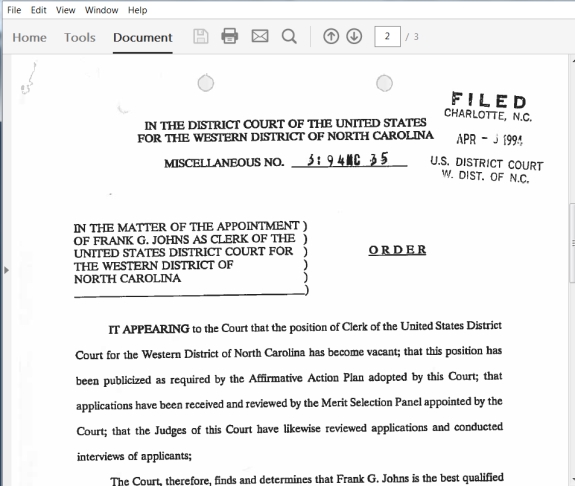
Viewed as a PDF, this is a section from a court order signed by three federal judges appointed by the President of the United States. The order from April 1994 officially appointed Frank G. Johns clerk of the U.S. District Court for the Western District of North Carolina.
UPDATED 9:21 A.M. EDT JULY 2 U.S.A. As the PP Blog reported on June 25, at least one odd sideshow is occurring while court-appointed receiver Kenneth D. Bell is pursuing clawback actions against alleged “winners” in Zeek Rewards.
A filing docketed June 23 and attributed to Canadian alleged winner Catherine Parker led to questions about whether Parker, of Hamilton, Ontario, was a “sovereign citizen.” Parker is facing a default judgment of nearly $214,000. Among other things, the June 23 filing attributed to her accused longtime U.S. Court Clerk Frank G. Johns of the Western District of North Carolina of dishonoring his office.
Johns has held the office for more than two decades.
The filing identified Johns as a “respondent.” It also requested “a certified copy” of any oath taken by Johns and “certified copies and detailed lists of all [the clerk’s] court related bonds, sureties, indemnifications, and insurance related policies.”
Such tactics are consistent with filings by “sovereign citizens.” It is unclear whether Parker adheres to the bizarre “sovereign” ideology, some of which surfaced in the AdSurfDaily Ponzi case and ultimately led to criminal charges and convictions against ASD story figure Kenneth Wayne Leaming.
Leaming acted out on some of his legal fantasies, ultimately participating in the filing of bogus liens against U.S. judicial officials. “Sovereigns” sometimes don’t know when to stop, and escalations often land them in trouble.
Chief Deputy Clerk Terry T. Leitner of U.S. District Court for the Western District of North Carolina responded to the June 23 filing attributed to Parker today.
This is from a letter from Leitner to Parker today (italics added):
In response to your request for a copy of the oath of office form for Frank G. Johns, Clerk, U.S. District Court, this office does not release copies of personnel documents.
This letter will confirm, however, that Frank G. Johns was appointed Clerk of the U.S. District Court for the Western District of North Carolina on April 11, 1994. The oath of office taken by a Clerk may be found in the United States Code at 28 USC Section 951.
Attached is a copy of the Order appointing Mr. Johns which is public record.
Included with the Leitner letter was a copy of a 21-year-old court order from April 1994 that appointed Johns clerk of the district. Three judges signed the order, including then-U.S. District Judge Graham C. Mullen. The order was signed on April 5, 1994. It went into effect on April 11 of that year.
Mullen, who is hearing the Zeek clawback cases, went on to become Chief Judge of the district. A former Naval officer, Mullen is now a Senior District Judge. He also is presiding over the SEC’s Ponzi/pyramid action against Zeek brought in August 2012.
The June 23 letter attributed to Parker appears to contend she entered a defense to the clawback action in October 2014 but that the defense never was entered into the record of the case. Johns entered a clerk’s order of default judgment against Parker on Jan. 6, 2015. The letter requesting the clerk’s oath was filed more than six months later. It complained about Parker’s name being presented in all-caps and accused two attorneys working for the Zeek receivership of dishonoring the court.
The June 23 filing attributed to Parker marked at least the second time a resident of Canada has filed a document that raised questions about whether a person north of the U.S. border was playing potentially costly “sovereign” games in the Zeek clawback actions in the United States.
Bell alleged in September 2014 that Sandra Gavel of Sechelt, British Columbia, was a Zeek winner who owed the receivership estate nearly $90,000, plus interest. As was the case with Parker, Bell alleged that Gavel had received Ponzi proceeds that had come from Zeek victims.
Gavel wrote a letter to the North Carolina court in October 2014 that sought to make Johns or the court itself a “respondent” and asserted Johns had made an “offer to contract” with her, according to records.
“Your offer to contract is hereby rejected as unacceptable,” the letter read in part. It also solicited “evidence that the United States Constitution, North Carolina Constitution, United States Laws, United States statutes and United States codes apply to me.”
Like the June 23 letter attributed to Parker, the Gavel letter described Gavel as a “natural person.”
As is the case with Parker, it is unclear whether Gavel adheres to “sovereign” ideology. But Bell raised questions about Gavel’s curious letter in February 2015. From the receiver (italics added/spacing approximated):
However, Ms. Gavel failed to file a substantive answer to the Complaint. Rather, acting pro se, Ms. Gavel filed a letter that was received by the Court on October 24, 2014. (Doc. No. 32). In the letter, Ms. Gavel states:
Your offer to contract is hereby rejected as unacceptable. . . . I do NOT consent to the jurisdiction of any United States Magistrate, or the jurisdiction of any United States Article III Judge in the UNITED STATES DISTRICT COURT WESTERN DISTRICT OF NORTH CAROLINA . . . .
(Id.). It is unclear whether, in light of the Defendant’s pro se status, the Court construes this letter as a Rule 12(b)(2) motion to dismiss for lack of personal jurisdiction or merely a failure to answer or defend.
Defendants, of course, are entitled to defend themselves in actions brought in U.S. courts. In general, pro se filers — people representing themselves — are held to lower pleading standards. Regardless, they are expected to follow the rules of the court. In U.S. courts, judges have the power to construe a pleading by a pro se filer because the plain meaning may not be clear.
When “sovereigns” are involved, however, it often is the case that the filers are being deliberately obtuse, sometimes as a means of harassment against judges, clerks and litigation opponents. One “sovereign” strategy present in the AdSurfDaily case has been described as “mailbox arbitration” — making an impossible demand of an opponent or perceived opponent, putting in on a tight deadline and declaring a “win” if the demand isn’t met.
The practice needlessly adds to litigation costs and wastes the time of the courts.
The June 23 letter attributed to Parker asserted that Johns had 30 days to produce his oath and other information.
Failure to do so “is your tacit admission to perpetrating fraud upon Catherine Parker in her natural capacity,” the letter read in part.
Johns is a lawfully appointed clerk whose appointment to office was witnessed and verified by three U.S. judges appointed by the President of the United States. Their order was signed on April 5, 1994 and, as noted above, became effective on April 11 of that year. It is captioned “ON THE MATTER OF THE APPOINTMENT OF FRANK G. JOHNS AS CLERK OF THE UNITED STATES DISTRICT COURT FOR THE WESTERN DISTRICT OF NORTH CAROLINA.”
It has legal effect even though the name of Johns appears in all-uppercase lettering.
 UPDATED 11:15 P.M. EDT U.S.A. Still pushing UFunClub (or Unascos) and absurd propositions such as UToken? Follow the narrative of the Spanish National Police and see if it reminds you of anything you’ve heard before. Any number of digital-currency scams currently are fleecing people globally.