We feel for the residents of North Salem, N.Y., and the residents of Quincy, Fla. Fate has put them in the media glare. Talk at Westchester County lunch counters is not about how the Mets or Yankees or Red Sox will do this year. It’s about how Paul Greenwood, the town supervisor of North Salem, got arrested for fleecing universities and public-employee pension funds out of perhaps hundreds of millions of dollars.
Meanwhile, in Gadsden County, the talk in Quincy is less about how Florida State will perform on the football field this fall in nearby Tallahassee and more about how Andy Bowdoin was accused of running a $100 million Ponzi scheme.
Dozens of people in Quincy are out of work because of Bowdoin. Some of them weren’t even earning wages. They were being paid with what Bowdoin called “ad packs.” Prosecutors called them unregistered securities.
Greenwood and Bowdoin have embarrassed their communities, putting on a show before their fraud was exposed. Greenwood declined to take a salary for overseeing the town. Bowdoin, for his part, let the local Chamber of Commerce do his bidding — never telling local executives about a previous felony conviction for securities fraud.
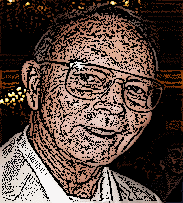
Paul Greenwood.
Local merchants were stunned when prosecutors announced Bowdoin was the head of an international wire-fraud and money-laundering operation disguised as an advertising service. He’d secreted away money on the Caribbean island nation of Antigua — now in the news because of Allen Stanford — while at the same time paying $800,000 cash for the old Masonic Hall in town, prosecutors said.
Quincy viewed him as a savior; North Salem viewed Greenwood as a leader. Prosecutors now say he spent up to $80,000 on individual Steiff Teddy bears. Carnegie Mellon University, the University of Pittsburgh, the Iowa Public Employees Retirement System and pension funds in Sacramento and North Dakota now might have to insist that stuffed animals be sold to be made whole.
If “whole” is possible, that is.
Imagine what it’s like to have to rely on the sale of Teddy bears at auction to offset pension-fund losses. Such are the ugly incongruities of the times.
On the Surf’s Up forum, the Mods are saying there are no ties between AdSurfDaily and AdView Global. But information on AVG’s website tells a different story.
George F. Harris is named a trustee of a new group that’s calling itself “AV Global Association.” Harris is the son of Edna Faye Bowdoin, wife of ASD President Andy Bowdoin. Federal prosecutors went to court in December, filing a forfeiture complaint against property obtained with ASD funds by Harris and his mother.
Included was a home in Tallahassee, Fla. The $157,000 mortgage on the property was retired with ASD funds moved from the company’s Bank of America accounts into a separate account established by Harris and his mother, prosecutors said.
ASD funds also were used to purchase a $28,000 Honda CRV for Harris and his wife, Judy Harris, prosecutors said.
Also named in the association document is Gary Talbert, a former executive at ASD. ASD is headquartered in Quincy, Fla., and was accused in August of operating a $100 million Ponzi scheme and selling unregistered securities by masking the company as an advertising service.
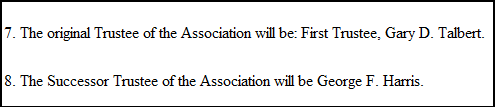
Trust Document screen shot.
The association document is reproduced below:
ARTICLES OF ASSOCIATION
OF
AV Global Association
(A Private Membership Association)
ARTICLE I
Declaration of Purpose
1.This Association of members hereby declares that our main objective is to protect our rights to freedom of choice regarding our advertising and marketing information and conduct, through maintaining our Constitutional rights.
2.As members, we affirm our belief that the Constitution of the United States is one of the best documents ever devised by man and the signer of the Declaration of Independence did so out of love for their country. We believe that the First Amendment of the Constitution of the United States of America guarantees our members the rights of free speech, petition, assembly, and the right to gather together for the lawful purpose of advising and helping one another in asserting our rights under the Federal and State Constitutions and Statutes. We strive to maintain and improve the civil rights, constitutional guarantees, freedom of choice in advertising and marketing information and conduct and political freedom of every member and citizen of the United States of America.
3.We declare the basic right of all of our members to select spokesmen from our number who could be expected to give wisest counsel and advice concerning advertising and marketing enterprises and to select from our number those members who are the most skilled to assist and facilitate the actual performance of advertising and marketing enterprises.
4.We proclaim the freedom to choose and perform for ourselves the types of advertising and marketing enterprises.
5.The Association will recognize any person (irrespective of race, color, or religion) who is in accordance with these principles and policies as a member, and will provide a medium through which its individual members may associate for actuating and bringing to fruition the purposes heretofore declared.
ARTICLE II
Name and Status
1.The name of this national membership association shall beAV Global Association, hereinafter referred to as “Association”.The Association is formed under common law and forms no legal entity distinct from that of its members for litigation purposes.
ARTICLE III
Membership and Dues
1.Membership shall be open to any person which or who adheres to the purposes of this Association in Article I.
2.A yearly membership may be offered at ten dollars ($10.00) or more, as determined by the Trustee(s).Additional assessments may be made at any time for services or benefits rendered.Honorary memberships may be offered and recognized until December 31, 2009.
3.This membership does not entitle a member to any interest in the Association or management thereof, and a member will not be liable for any debts, obligations, liabilities, judgments, suits, etc., of the Association.
4.The Trustee(s) shall have the right to sanction a member upon unanimous vote of the Trustee(s), after a hearing of the facts where the member may be present after notification.The sanctions include removal from active membership or imposing any other special and necessary conditions upon any member who shall discredit or bring harm to the Association in any manner.
5.Any disputes or complaints that arise between the members will be settled by the Association’s Dispute Committee Panel.Any controversy or claim arising out of, or relating to, this association or its members will be resolved by an association Dispute Committee Panel of twelve (12) members in good standing randomly appointed from the existing members of the association that are willing and able to serve.A time and location of the hearing will be determined by the Trustee and travel and lodging expenses will be provided by the association for the Panel.All Parties to the hearing will be allowed to introduce any and all evidence, call witnesses and cross-examine witnesses.A two-thirds (2/3) majority of the Panel is required to decide which party is to prevail and the amount of monetary judgment.If a two-thirds (2/3) majority decision cannot be obtained, a new association Dispute Committee Panel may be appointed to decide the case or controversy.
ARTICLE IV
Officers and Duties
1.All officers shall be members of the Association.
2.The officers shall be President, Vice-President and Secretary-Treasury.
3.Officers shall be appointed and removed by the Trustee(s).Officer positions may be vacant for any period of time.The Trustee(s) may serve as Officers.
4.The President, or in his/her absence, the Vice-President, shall preside over all membership meetings of the Association, manage all affairs as an agent and defend all actions for and against the Association and its members.
5.The Vice-President’s duties are the same as the President’s and the Vice-President will serve at the pleasure of the President.
6.Secretary-Treasurer:The Secretary-Treasurer will record and maintain minutes of all meetings and keep all records of the Association.
ARTICLE V
Trustees
1.All Trustee(s) will be members of the Association.
2.The Trustee(s) will assume control and the legal, liable, financial and tax responsibility of the Association as the principal.The Trustee(s) will set the compensation of the Officers, Trustee(s) and any other employees of the Association.The liability of the Association is limited to the assets and property of the Association and does not extend to the Trustee(s) individually.
3.The Trustee(s) may appoint a Special Trustee for the limited purposes of representing the Association in court or other legal proceedings as either plaintiff or defendant. The Trustee(s) may appoint a Special Trustee for the limited purposes of maintaining, preparing and filing all local, state and federal tax returns.
4.The Trustee(s) will have the power and responsibility to select from the membership the member(s) who will perform assistance in educating and administering advertising and marketing information to fellow members in accordance with the Declaration of Purpose and to contract with them for such purpose.The Trustee(s) will not contract for any advertising or marketing that would constitute a clear and present danger of substantive evil.
5.The Trustee(s) will have the power and responsibility to determine levels of membership, levels of membership benefits, what benefits will be offered to all members free of charge and for what benefit and at what amount of cost to the member “special assessment” feeswill be levied.
6.All official decisions and actions of the Association will be upon majority consent of the Trustee(s), memorialized by minutes.
7.The original Trustee of the Association will be:First Trustee, Gary D. Talbert.
8.The Successor Trustee of the Association will be George F. Harris.
9.In the event of death of the First Trustee or should he become mentally or legally incapacitated and unable to perform her duties, the Successor Trustee shall assume the position of First Trustee.The First Trustee hereby authorizes any and all successor trustee(s) to this “Association” access to the association information and conduct concerning the First Trustee for the evaluation of mental or legal incapacity of the First Trustee at any time.
10.Provided, however, that a Trustee may be removed by the Protector of this association when the Trustee has been guilty of mismanagement, fraud, malfeasance or any other overt acts that do not work in the best interest of the association and its members.The guilt of the Trustee is to be determined by the sole discretion of the Protector.The Protector shall have the sole authority to appoint a replacement Trustee in any event other than himself or herself who will remain as Trustee unless replaced by the Protector or a vote of the membership according to these Articles of Association.The Protector of this Association is Nate Boyd.In the event of death of Nate Boyd, Protector, the Successor Protector will be George Harris.
11.When the Association membership achieves one million (1,000,000) members, they will have the power to replace with a member of their own choice the Trustee and his successors upon two thirds (2/3) majority vote.
ARTICLE VI
By-Laws
1.By-laws may be adopted by the Association for the purpose of carrying out the Association’s Declaration of Purpose. The Board of Trustee(s) may promulgate and adopt by-laws by unanimous consent which will have the same force and effect as the Articles of the Association provided that said by-laws do not contravene the Articles of Association and provided that said by-laws may be repealed by two-thirds (2/3) majority vote of the members.
ARTICLE VII
Amendments
1.The Articles of Association may be amended upon unanimous consent of the Trustee(s).The amendments will be submitted to the members for their ratification.If the Association achieves ratification by three-fourths (3/4) of the members, that existed at the time the amendment was first submitted, within one year of passing the amendment, the amendment will become a part of the Articles of Association and be binding upon all the members.
ARTICLE VIII
Dissolution
1.The Association will terminate upon the death of the last remaining member or upon unanimous decision of the Trustee(s).All assets and liabilities will then revert to the trustee(s) at the time of dissolution.
ARTICLE IX
Construction and Interpretation of These Articles
1.Any reference in these Articles to the masculine also includes the feminine when appropriate and any reference in these Articles to the singular also includes the plural when appropriate.
2.This Association will be construed and interpreted under the laws of the State of Florida, U.S. Constitution and the Florida Constitution.
Editor’s Note: At the time of publication, this document was published at:
UPDATED 7:18 P.M. EST (U.S.A.) The FBI has made arrests in the Westridge Capital Management case.
Paul Greenwood and Stephen Walsh, principals in WCM and an arm known as WG Trading of Greenwich, Conn., both were arrested. WCM is headquartered in Santa Barbara, Calif.
Greenwood and Walsh were arraigned this afternoon in New York. Bail was set at $7 million each. They were freed pending a March 11 hearing before which they’ll need to demonstrate that they have at least $1 million in cash or property not connected to fraud.
Authorities said they ran a huge financial scheme, converting tens of millions of client dollars to their own use.
Included in the purchases were $80,000 Steiff Teddy bears at various auctions, including auctions at Sotheby’s, authorities said. A $3 million home also was purchased for Walsh’s ex-wife.
Greenwood is the town supervisor of North Salem, N.Y., on the Connecticut border. He did not attend the community’s regular council meeting last night and has ducked media and financial investigators for days.
Greenwood and Walsh were accused of securities fraud, wire fraud and conspiracy. They were sued last week by Carnegie Mellon University and the University of Pittsburgh amid fears that $114 million had been lost as a result of massive fraud.
The Iowa Public Employees Retirement System (IPERS) severed its contract with WCM earlier this week, on the heels of the action by CMU and Pitt and in the wake of the suspension of Greenwood and Walsh from the National Futures Association for stonewalling during an audit.
IPERS entrusted $339 million to WCM.
Below are snippets from the federal criminal complaint, which accuses Greenwood and Walsh of using clients’ money to make personal purchases and transferring clients’ money to family members. Walsh, according to the complaint, made at least two transfers of $500,000 each to a bank account in the name of his wife.
“From time to time, PAUL GREENWOOD and STEPHEN WALSH, the defendants, directed [an] Employee to wire funds from the Account to their own bank accounts, bank accounts in the name of their family members, and bank accounts of other persons and entities to pay for personal expenditures of GREENWOOD and WALSH that were unrelated to the business of WG Investors.
“The Employee recalled effecting transfers to pay for, among other things, the following: (a) the purchase of expensive collectible items by GREENWOOD; (b) the purchase of horses by GREENWOOD; (c) transfers of cash to WALSH’s then-wife; and (d) transfers of cash for the purchase of an apartment for WALSH’s ex-wife pursuant to a divorce settlement,” said FBI agent James C. Barnacle Jr., in the complaint.
Greenwood converted a farm once owned by the late actor Paul Newman into a horse-show center and was credited by North Salem residents as a responsible public steward.
In secret, according to the FBI, Greenwood and Walsh were running a criminal financial enterprise.
“At the beginning of each calendar year,” Barnacle said, “the Employee added up the transfers that GREENWOOD and WALSH had directed for their personal benefit and prepared a promissory note for GREENWOOD and WALSH to sign that included the amounts of money that GREENWOOD and WALSH had taken from the Account.
“From time to time,” Barnacle said, “GREENWOOD directed the Employee to understate the losses reported to investors and include a portion of the losses in the promissory notes executed by GREENWOOD and WALSH. Thus, the GREENWOOD Notes and the WALSH Notes include amounts reflecting funds misappropriated for the personal benefit of GREENWOOD and WALSH and losses fraudulently hidden from investors.”
Hundreds of millions of dollars cannot be accounted for.
Invesigators called it a $1.3 billion scam. In a separate action, the Commodity Futures Trading Commission charged Greenwood, Walsh and others with fraud.
“[The] Defendants treated investor money — some of which came from a public pension fund — as their own piggy bank to lavish themselves with expensive gifts,” said Stephen J. Obie, CFTC’s acting director of enforcement.
UPDATE 5:23 P.M. EST (Feb. 25, U.S.A.) The story below is from Feb. 24, the day before Greenwood and Walsh were arrested. See our Feb. 25 story to read about the arrests.
Two principals of Westridge Capital Management (WCM) are mum about the controversy swirling around the firm and affiliated companies. Neither Paul Greenwood nor Stephen Walsh are responding to media inquiries about the whereabouts of hundreds of millions of dollars entrusted to WCM by universities and public-employee retirement funds.
Greenwood has a secondary problem: He is the town supervisor of North Salem, N.Y., a Westchester County community on the Connecticut border. A local newspaper, The Journal News, has tried unsuccessfully to contact Greenwood. The paper reports that an administrative assistant for the town of North Salem relayed a message from Greenwood that he could not comment on advice of counsel.
On its website, North Salem’s did not mention the firestorm surrounding its town manager.
WCM is based in Santa Barbara, Calif. Greenwood and Walsh control an arm of the company — WG Trading Investors — in Greenwich, Conn., according to court documents. Another arm known as Westridge Capital Management Enhanced Funds is registered in the British Virgin Islands and also was named a defendant in a lawsuit filed Friday by two Pennsylvania universities.
No attorneys have entered appearance notices for Walsh or Greenwood in a lawsuit filed in U.S. District Court for the Western District of Pennsylvania by Carnegie Mellon University and the University of Pittsburgh. The schools filed the lawsuit under emergency circumstances. They alleged that money was “converted” and that they were denied answers when they inquired about the whereabouts of their investments, which total a combined $114 million.
A federal judge placed severe restrictions on WCM’s ability to spend money as a result of the lawsuit.
Pitt directed a fresh $21.3 million to the company earlier this month, as an audit by the National Futures Association was getting under way. NFA suspended Greenwood and Walsh for stonewalling during the audit. Neither the company nor Greenwood and Walsh answered questions from the schools.
From the CMU/Pitt lawsuit filed Friday.
CMU, according to the lawsuit, sent an administrator to New York, New Jersey and Connecticut to make personal contact with the WCM and affiliated companies controlled by Greenwood and Walsh. The school got no answers, and joined with Pitt — which also reported stonewalling — in filing the lawsuit.
How much WCH and affiliates have under management is unclear. Documents suggest as many as 16 public pension funds have stakes in the company or affiliates.
A large fund for Pennsylvania educators recently approved up to $1 billion for investment with the firms, but the Pennsylvania School Employees Retirement System did not execute the contract, the Pittsburgh Post-Gazette reports.
Yesterday the Iowa Public Employees Retirement System (IPERS) canceled its contract with WCM and sought the return of $339 million.
Reporters in Iowa, Pennsylvania, Connecticut and New York are working on the WCM story now. It hasn’t gained national traction yet, but that may be coming. NFA’s documentation of its bid to audit Greenwood and Walsh raises troubling questions about the whereabouts of hundreds of millions of dollars, and there have been no answers so far.
An autosurf known as “Premium Ads Club” has tanked. A poster at the ASA Monitor forum said he invested money for his child’s chemotherapy treatment in it.
Premium Ads Club advertised a payout of 135 percent over 15 days. Members said the surf was collecting money as late as this weekend and had just come off a series of 15 percent bonus promotions.
Other surfs in bonus mode now include AdViewGlobal and BizAdSplash, both of which surfaced in the weeks following the government seizure of nearly $100 million from AdSurfDaily Inc. amid allegations of selling unregistered securities and running a Ponzi scheme.
Email To Members
Members say they received this email (below) from the surf, which used SolidTrustPay, the same processor to which ASD was transferring money last summer prior to the seizure. Incredibly, the surf said it collected money from 500 members in the past four days to try to make the Ponzi go away.
The Ponzi did not go away, of course. Premium Ads Club also said it was not blaming anybody, but then proceeded to blame the members for panicking and bringing down operations.
We have not edited this note, except to add italics:
We are truely sad and sorry to send this…
Dear Members,
It is with really heavy hearts that we send this update to you. We are truly sorry and sad to inform you that PAC is officially closed as of now.
The Deposits have been disabled.
There are a few events that have led to this untimely event.
Our Cashflow got seriously affected from when we implemented the PinCode and the recent site accessibility issues.
Sadly members chose to go into Panic mode and stop despositing into PAC. Withdrawals took a huge upswing and in the past 7-9 days and we have had to use up our reserve to supplement payouts to the tune of 10-15K daily. We will need at least another 30K (as of now) to meet today’s payouts.
We have been upfront with you that while we have a business plan, we would still be dependent on member spends to make payouts and would have been at least for 6-9 months minimum.
We also have had 2 of our Private Programs being under investigation so, some of our funds are frozen there.
We hoped by using up our reserve fund, the situation could be turned around. With over 500 new members in the last 4 days, we were almost sure PAC would come through. Unfortunately it hasn’t happened and we are forced to make this decision.
It is not all over. We are still going ahead with the IBC and will continue to do business.
We have a long term investment that will start paying a steady income in some months.
How will this affect you? We are conducting an audit and all members who are not in profit will be refunded. We will do right by you all.
We will begin by refunding AP and LR as soon as the audit is over, because we have those funds.
STP and SP are running on a huge deficit and it will take some time.
We truly understand how disappointing this is and there are just no words for us to express how disappointed we are too.
AggeroInvestment and Scotia Ads are unaffected and will continue to run as normal.
However, we feel that it is best that Roger takes over the day to day operations of AI and he has agreed.
We ask for your understanding and hope that you will trust that we had not forseen that simple technical matters would undo the hard work we all put in together.
We are not blaming anyone.
It is just a sad fact that needs to be pointed out.
We had the very best of intentions and were unable to fulfil them. There are no words to tell you how truly sorry we are.
UPDATE 5:41 P.M. EST (U.S.A.) The Iowa Public Employees’ Retirement System (IPERS) has terminated its investment-management contract with Westridge Capital Management (WCM) of Santa Barbara, Calif.
IPERS’ move comes on the heels of a lawsuit filed Friday by two Pennsylvania universities that sued WCM amid concerns that they potentially had lost $114 million in an investment scheme.
Iowa public retirees have $339 million potentially at risk with WCM. The organization said the Securities and Exchange Commission and the Commodity Futures Trading Commission have opened investigations.
Documents filed in the case suggest as many as 16 universities or public-employee pension funds used WCM as investment advisers. WCM’s name is cited, for example, in publications put out by pension funds in Pennsylvania, Iowa, North Dakota and California.
WCM also was involved in litigation in Nebraska that ultimately made its way to the Nebraska Supreme Court. At issue in the Nebraska case was the prudence and legality of putting state assets at risk in highly speculative futures and commodities.
Litigants claimed WCM effectively had lost more than $40 million investing funds for state pensioners, but the state was made whole when the fund showed a profit and the matter largely disappeared.
WCM, its principals and various entities associated with the firm were named Friday in a federal lawsuit filed by Carnegie Mellon University and the University of Pittsburgh in Pennsylvania.
The National Futures Association suspended two WCM principals — Paul Greenwood and Stephen Walsh — for stonewalling during an audit earlier this month. Auditors said they found what amounts to personal IOUs from Greenwood and Walsh for loans taken from the fund and placed with an investment arm Greenwood and Walsh control in Connecticut.
Greenwood is the town supervisor of North Salem, N.Y., a Westchester County community on the Connecticut border.
NFA’s auditors said the “note[s] receivable” [are] actually comprised of several individual notes, executed by Greenwood and Walsh over the years, each totaling millions of dollars.
“These notes are almost identical in their terms and indicate that the respective ‘sum is representative of the general partner’s share of losses, withdrawals and payments,” NFA said.
Auditors also said “the financial record indicates $8.2 million of the assets [are] ’employee advances.’”
IPERS said WCM managed about 2 percent of the its portfolio. A spokesperson told the Des Moines Register that $339 million in pension funds — its entire WCM stake — had been frozen as a result of the federal probe. IPERS stressed that WCM held only a small part of the pension fund’s assets and that retirees payments are not at stake.
“The U.S. Commodity Futures Trading Commission and the U.S. Securities and Exchange Commission . . . are now investigating WG Trading,” IPERS said. “These agencies cannot release information during an active investigation. Their involvement provides IPERS added protection as the commissions have the authority to act in ways that will protect investors.”
Here’s what IPERS said it has done:
Terminated Westridge Capital Management’s contract.
Demanded the return of all IPERS’ assets, which had an estimated market value of $339 million on Jan. 31, 2009.
Filed a claim with the NFA for a release from the trading ban so holdings can be liquidated and IPERS’ assets returned.
Began aiding the Commodity Futures Trading Commission and the Securities and Exchange Commission in their investigations.
“The IPERS Investment Board and staff continue to follow developments and will take further action, including legal action, if necessary to protect IPERS’ assets,” IPERS said. “The Investment Board’s policy is to vigorously seek recovery of losses through legal action should losses occur because of fraud. However, IPERS cautions investigations are still underway, and there have been no findings against the company previously under contract to IPERS.”
We’ve previously pointed out that, in recent times, some of the actions filed against financiers and fund managers — and the findings of investigators — have read like works of fiction. On Friday, for example, Irving Picard, the trustee in the Bernard Madoff case, asserted that Madoff appears not to have purchased securities for customers in at least 13 years.
It’s an incredible assertion that suggests Madoff was running a virtually pure Ponzi: money in, money out, with no attempt even to try to make it work in a legitimate way.
Now comes incredible assertions by the National Futures Association against Paul Greenwood and Stephen Walsh, who’ve been suspended from NFA for stonewalling on an audit.
On Friday, Carnegie Mellon University and the University of Pittsburgh sued Greenwood, Walsh, Westridge Capital Management (WCM) and related entities for the return of $114 million feared lost in an investment swindle.
At least 16 public entities invested with WCM, including universities and retirement funds for educators, police officers and firefighters. It is possible than $2 billion or more is at risk.
CMU and Pitt sued in the aftermath of the NFA audit. NFA’s documentation of its attempts to audit Greenwood and Walsh — its recounting of the stonewalling and its partial findings based on what it what it was able to uncover despite the stonewalling — is yet another example of nonfiction that reads like fiction.
Big money is involved here, and the facts are not all known. But NFA’s document can only be described as jaw-dropping. It really makes one wonder how many other shoes will drop and how many more times the public will be asked to suspend its disbelief before these almost unbelievable financial tales come to an end.
Hats off to Houston Chronicle writer Loren Steffy, who explained economically why cons work.
A con, Steffy explained, works because the con weaves “a tapestry of believable lies.” It’s a pointed, short, highly memorable line that deserves special mention because it puts readers “right there.”
Steffy detailed some of disgraced financier Allen Stanford’s lies in this column. Lots of things in the column reminded us of the Andy Bowdoin case. Bowdoin is the head of AdSurfDaily Inc., a Quincy, Fla.-based company accused of operating a $100 million Ponzi scheme.
Here are some Stanford/Bowdoin parallels:
Friends in high places. Stanford went around saying he’d been knighted by Prince Phillip. Bowdoin went on a tour to showcase a special award he’d received for business acumen from President Bush. It turned out that Buckingham Palace called Stanford on his lie; in fact, he’d been given the title of “Sir” by the prime minister of Antigua, a Caribbean Island nation of 85,000 known for lax banking standards and money-laundering.
In Bowdoin’s case, the U.S. Secret Service called Bowdoin on his friends-in-high-places lie. It turned out that the award he received was an award for writing checks to the National Republican Congressional Committee. Basically, Bowdoin wrote a check for banquet tickets and called it a special honor from the President of the United States. Bowdoin, by the way, had more than $1 million on deposit in Antigua. The Sunday Times reports today that $8 billion is missing from Stanford’s bank and that regulators suspect a Ponzi scheme.
Charities and sports. Stanford “sold” clients on his benevolence. So did Bowdoin, who once gifted 100,000 ASD “ad packs” to a charity. Stanford was big on sports sponsorships. Bowdoin told his faithful that ASD soon would become a sponsor for professional auto racing. Members claimed ASD would have a car in the Indy 500.
Holes in the resume: Stanford claimed to be related to the founders of Stanford University. The school exposed the lie and sued him for trademark infringement. Bowdoin claimed to have operated a string of highly successful businesses. Turned out that one of his highly successful enterprises was at the center of a securities-fraud investigation in Alabama and that Bowdoin and co-scammers had fleeced investors out of hundreds of thousands of dollars. He pleaded guilty to a felony, was sentenced to a year in prison, but the sentence was suspended when he agreed to make restitution.
In August 2008, he still owed the Alabama victims $45,000. Just a month before, he paid $50,000 for a new Lincoln. In June, ASD cash was used to retire the $157,000 mortgage of his wife’s son and daughter-in-law, and about $28,000 was used to buy them a new car. At the time, Bowdoin owed his ex-wife more than $162,000.
Nothing out of the ordinary. As Stanford’s empire was collapsing, he told investors that the SEC investigation they were reading about in the newspaper was a “routine” look into the business. He also said he was cooperating fully, which the SEC said was a lie when it later alleged a multibillion-dollar, international fraud scheme.
Bowdoin told members that his business had been approved by regulators and was perfectly compliant. It turned out that ASD didn’t even have a compliance attorney and knew in 2007 — months before it started gathering tens of millions of dollars from members at company “rallies” — that the business was illegal. In the hours after the August seizure of ASD’s assets by the government, people with close ties to Bowdoin sought to assure members that the matter was a temporary blip that would be settled within days.
For good measure, Bowdoin later told ASD members that Ponzi allegations against ASD hand been dropped in Florida. People flooded forums to share the good news — except it wasn’t true. As recently as last week, some ASD members continued to make the claim that Ponzi allegations had been dropped, despite the fact that the office of Florida Attorney General Bill McCollum specifically refuted the claim months ago.
UPDATE 10:55 P.M. EST (Feb. 22, U.S.A.) We’ve added to the bottom of this post some information about Westridge Capital’s website, which appears to consist of a single page and is amateur by any modern standard. We’ve also associated a second domain to the company. It, too, appears to consist of a single page — a page that appears to be just a holding page from the company’s hosting provider.
We’ve also added some links to public employee retirement funds that list Westridge Capital Management in their financial reports.
Here, below, our earlier post . . .
It could be the maximum case of brains getting drained by fraudulent investment advisers.
Two universities in Pennsylvania known for producing top thinkers in computer science and medicine fear they have lost at least $114 million in an investment swindle and have filed an emergency lawsuit to recover the money.
Because the investment fund in question has as many as 16 participants, including university foundations and retirement and pension plans — and perhaps $1.8 billion or more under management — the losses could be enormous.
Carnegie Mellon University and the University of Pittsburgh seek the immediate return of money they invested with Westridge Capital Management (WCM) of Santa Barbara, Calif. Also named in the complaint are company principals and various affiliates, including WG Trading Investors LP of Greenwich, Conn.
The universites said they contacted the Securities and Exchange Commission and the Commodity Futures Trading Commission this week and requested an emergency investigation. Attorneys for the universities filed a lawsuit in U.S. District Court for the Western District of Pennsylvania.
In an extraordinary assertion made after a panicked trip Monday by a university administrator to New York, New Jersey and Connecticut to speak with WCM executives, CMU and Pitt said the money might have been “converted” and IOUs left in its place.
“The Defendants named herein have converted investor funds to their own use,” the universities charged.
Lawsuit claims managers left IOUs for hundreds of millions of dollars.
Two of WCM’s principals — Paul Greenwood and Stephen Walsh — were suspended by the National Futures Association (NFA) last week in a little-publicized emergency action.
The universities, in their lawsuit, said “personal promissory notes” for “hundreds of millions of dollars” from Greenwood and Walsh made payable to WG Trading Investors were uncovered in an NFA audit last week.
Greenwood and Walsh control WG Trading Investors, also known as WGTI.
NFA said Greenwood and Walsh stonewalled and refused to participate in the audit in any material way. One of the excuses Walsh used, despite the obvious importance of the audit, was that he “would be in a meeting all day” and unavailable to speak with NFA, the universities said in the lawsuit.
Greenwood and Walsh are sole proprietor Commodity Pool Operator (CPO) Members of NFA in Greenwich, NFA said.
“Additionally,” NFA said, “Greenwood and Walsh have failed and refused to respond to NFA’s inquiries regarding numerous promissory notes totaling hundreds of millions of dollars executed by them individually in favor of an investment vehicle to which two NFA listed commodity pools have loaned a total of over half a billion dollars.”
Read the CMU/Pitt lawsuit against Westridge Capital Management, WG Trading Co. Limited Partnership,Westridge Capital Management Enhanced Funds Inc., WG Trading Investors LP, Paul Greenwood, Stephen Walsh, Jack Eldred Reynolds, James Carder and Deborah Duffy.
Updates: We typed Westridge Capital Management’s street address as listed in the lawsuit into Google. Several businesses are listed at the same address — 222 E Carrillo St, Santa Barbara, Calif. 93101. The busineses list “suite” numbers. Westridge Capital’s suite number is 300.
Its site basically is a blue page that lists only Westridge Capital’s name, Santa Barbara street address, phone and fax numbers, and an email address. There is no content on the landing page beyond that.
We associated a second domain using registration data for the westridgecap.com domain. Here is the second domain:
The wgtrading.com domain resolves to a holding page that says:
“Welcome wgi6 to Your New Virtual Private Server !
“We would like to welcome you to your new Virtual Private Server. We are committed to bringing you the best service and finest Internet hosting solutions available. To help you get acquainted with your Virtual Private Server we have prepared “Getting Started” pages on our Web site. We encourage you to visit these pages and add them to your list of bookmarks.
“Best wishes in using your new Virtual Private Server!”
The wgtrading.com domain has been registered since July 12, 2000, when Bill Clinton was president. Meanwhile, the westridgecap.com domain has been registered since Oct. 22, 2003.
By coincidence the words appear in the 13th paragraph of a Chicago Tribune story invoking investors’ sustained lack of luck and reporting on a new series of Ponzi schemes the U.S. Commodity Futures Trading Commission is investigating.
The words were spoken by Gregory Mocek, former CFTC enforcement director, and are the most important words spoken to date during the financial meltdown. They should be the new “Shot heard ’round the world.”
Ponzi schemes involving foreign currency trading have been so rampant they could “eat up all of the commission’s investigation and litigation resources, and there will be nothing left to protect the integrity of legitimate markets,” Mocek told the newspaper.
It’s the problem in a nutshell. With great economy and not an ounce of hyberbole, Mocek defined the problem. As always, the question is, “Will anybody listen?”
Give Them Big Guns And A Camera
Regulators need the financial equivalent of automatic weapons provided the DEA when drug dealers switched from 38s to Uzis. They need bigger budgets, more enforcement staff, more computers, more laptops, more training, more undercover agents, more political support, less criticism and tools that work. At the same time, they need better PR skills, more news savvy and the power of arrest. They need cameras to take mugshots, a website that publishes the mugshots, and the ability to explain the arrest in nontechnical terms.
To the best of our knowledge, no federal law-enforcement agency provided photos of Bernard Madoff or R. Allen Stanford, despite the extraordinary allegations against them. The public needs those photos. The media need those photos. Bloggers need those photos. Webmasters need those photos. It’s a key step in getting this cancer under control. The Sarasota County Sheriff’s office provided a photo of Arthur Nadel. Why can’t federal agencies do the same?
Clean Up The Internet
It is a mistake of grand proportions to assume the Ponzi problem and the financial skullduggery exist only in the brick-and-mortar world, that the practitioners exclusively wear suits, read the Wall Street Journal and shuttle from appointment to appointment in fine rides like Madoff or Stanford.
Indeed, many of the most egregious offenders don’t have well-known names, spend much of the day in their underwear, read Internet boards as opposed to the Journal, don’t have appointments that even resemble anything traditional and don’t even leave their homes — not even to go to the bank.
They are destroying wealth. They are sucking hundreds of millions of dollars out of the economy, perhaps even billions of dollars. Their ability to accumulate wealth at the expense of others has nothing to do with skill and has everything to do with timing: They read High Yield Investment Program (HYIP) and “autosurf” boards on the Internet, send email to their followers when they spot an opportunity, fund their purchases via wire transfer through Canada and, when it’s time to take their “profits,” they take them by wire transfer and deposit them in banks via ACH.
At this very minute, hundreds of HYIPs and autosurfs are selling unregistered securities to U.S. residents and are using virtually pure Ponzi models to do it. They’re advertising huge returns — 30 percent a month and even 144 percent in 12 days — while stressing in U.S. English that they are safe opportunities and outside the reach of U.S. law enforcement in places such as Panama and Uruguay.
Because they use U.S. English and their websites can be copied, nonEnglish-speaking criminals and people who speak limited English as a second language are simply cutting and pasting content, starting their own HYIPs and autosurfs, paying off members to instill early trust — and then vanishing with U.S. dollars when they’ve met their criminal target.
And then starting all over again.
They need only about $400 to steal tens of millions of dollars. If they already own the php script, their investment shrinks to the price of a domain name, a hosting account for a month or two and their time.
Canadian companies used by the criminals include AlertPay and SolidTrustPay. These companies are permitting money-laundering by turning a blind eye to it. If they do take an overt step to instill client discipline, they get targeted by DDOS attacks that knock their servers offline.
PayPal won’t touch this business. Much of it went to Canada when the United States put an end to eGold’s love affair with customers who laundered money through the system.
A surf known as “MegaLido” is a case in point. No one other than the operator knows for certain where MegaLido was located. It came to life in the aftermath of the government seizure of nearly $100 million from Florida-based AdSurfDaily Inc. amid Ponzi allegations, and even was promoted by ASD members. MegaLido used AlertPay and SolidTrustPay, recruited an estimated 27,000 members, collected money from the members — and then simply vanished.
It looks as though it had a partner in the crime — a surf known as Instant2U — which also fled with money it collected. AlertPay and SolidTrustPay reportedly are providing partial refunds from money the criminal surfs left in the system, but it wasn’t enough to make “investors” whole.
AlertPay suffered a DDOS attack during the process and was knocked offline.
Forex scheming also is a big part of these games. CFTC, the SEC, the FBI, the IRS and prosecutors need tools. They need political clout behind them. It is clear that the American people have had it with Ponzi schemes and massive financial fraud. There never has been a better time for politicians to curry favor with voters by blasting these schemes back to the Stone Age.
The new “Shot heard ’round the world’ should be plugged into one of the bailout packages because it provides exceptional value for taxpayers, exquisite headlines for politicians and exceptional tools for law enforcement to nuke these operations and stem the flow of poison.
At the moment, advocates for Ponzi schemes — yes, the schemes have advocates and even crackpots who want to sue the government for enforcing existing laws — are sending letters to Sen. Patrick Leahy.
They want Leahy, chairman of the Senate Judiciary Committee, to investigate the prosecutors and the U.S. Secret Service for breaking up the ASD Ponzi scheme. Some of the very same people are promoting offshore scams in Panama and Uruguay.
It is time to nuke these miserable businesses. Gregory Mocek laid out the problem, and he couldn’t be more right.
UPDATE 2:49 P.M. EST (U.S.A.) At a gathering of creditors today, Irving Picard, the trustee overseeing the liquidation of Bernard L. Madoff Investment Securities, said he could find no evidence that Madoff even purchased securities for customers in the past 13 years. Cash came in — and immediately went out — to sustain the Ponzi, Picard said. We’ve added a Madoff Discussion Topic at the bottom of this post.
Here, below, our earlier post . . .
This is a discussion thread for readers to share their views on developments in the autosurf world. Offer your opinions on any of the discussion topics below — or even all of them.
First, however, some news:
The bankruptcy judge in the CEP Ponzi scheme case has ordered some large judgments against “winners” who were sued in adversarial proceedings by William Perkins, the CEP receiver.
Judge James E. Massey even ordered interest be paid on the judgment amounts. “Winners” who are now losers include:
Chris Barany: $225,702.90
Earl Reed: $146,677.50
Ginger Phillips Reed: $103,339.70
Jessica Phillips: $44,821.85
As a side note, our research suggests that AdSurfDaily President Andy Bowdoin was a participant in the CEP Ponzi scheme. ASD once advertised it accepted payments from CEP Trust, the failed payment processor owned by the operators of the CEP Ponzi scheme.
DISCUSSION TOPIC: If you’ve been following the ASD case, you’ve read that ASD was an exciting, new business model and Andy Bowdoin a genius. But how could that be true if ASD was a member of other autosurf Ponzi schemes?
Ponzis And The Deaf
As reported on PonziNews, the SEC has taken action against a Hawaii-based firm that allegedly ran a Ponzi scheme targeting the hearing-impaired communities of the United States and Japan.
Investigators say Billion Coupons Inc., run by Marvin Cooper, made affinity fraud part of a $4.4 million Ponzi scheme.
“A Ponzi scheme targeting members of the Deaf community is particularly reprehensible,†said Rosalind R. Tyson, director of the SEC’s Los Angeles Regional Office.
This week, a surf came under fire in forums for slashing payouts to customers. The surf, known as Noobing, targeted the deaf at Deaf Expo events in 2008 and in YouTube videos.
DISCUSSION TOPIC: Given customers’ claims of “bait and switch,” the fact Noobing launched after the government seized ASD’s assets, Noobing’s statement that people should be angry at the government — not Noobing — for its decision to slash payouts, and the targeting of deaf people, is an investigation warranted?
Andy Bowdoin
Two months have passed since prosecutors filed a second forfeiture complaint against assets tied to ASD. The complaint alleged that ASD funds were used to fuel big spending by Bowdoin family members. It further alleged that $1 million purportedly was stolen from ASD by “Russian” hackers and that Bowdoin didn’t file a police report. Meanwhile, it also alleged that money in addition to what “Russian” hackers took also was stolen — and that Bowdoin didn’t file a police report about those thefts, either.
ASD said it had more than $1 million on deposit in Antigua, which this week became the center of an international financial scandal involving billionaire Allen Stanford, the biggest banker on the Caribbean island. Customers flooded banks in the tiny nation to withdraw money, and the government of Antigua appealed for calm.
Last summer, Bowdoin told a federal judge that ASD needed money to operate and asked her to free up seized funds. But Bowdoin didn’t tell the judge about the money in Antigua until after prosecutors pointed it out. After prosecutors revealed the presence of the Antigua money, Bowdoin explained in a conference call that the cash — at least $500,000 of it — was a deposit so ASD could process credit-card orders.
But the account was in a name other than ASD.
DISCUSSION TOPIC: Did Andy Bowdoin get the money out of Antigua before the onset of the banking crisis? Why was the money in a name other than ASD’s if it was used to process credit cards for ASD? Why didn’t Bowdoin repatriate the money and use it to pay ASD employees and restart the company?
Surf’s Up
On Nov. 27, ASD offered the Surf’s Up forum its official endorsement. This was several days after ASD lost the evidentiary hearing and several days before major prelaunch buzz for AdViewGlobal (AVG) began.
With ASD’s endorsement in hand, some of the Surf’s Up Mods and members started a new site on ning.com to promote AVG. For its part, AVG says it has no ties to ASD, even though the two companies share a common executive, a common customer-service representative, and AVG’s graphics once appeared on a webroom operated by ASD — and AVG listed its street address as ASD’s street address in Quincy.
DISCUSSION TOPIC: Should Surf’s Up have accepted the endorsement? Does it make sense to promote yet-another surf, especially when the surf has clear ties to ASD?
BizAdSplash
Despite all the upheaval in the financial world — and despite the fact the Feds are working harder than ever to expose Ponzi schemes — BizAdSplash says things are going just fine. Yesterday it announced a new promotion: 100 percent matching bonuses for customers and sponsors.
Here is the announcement:
Over the past week we have had a number of you contact us about your initial deposit and that you only purchased a small amount of Ad Packages just to test the system. Now you are ready to make a larger purchase. Your question is can we get the 100% match or discount on the cost of a larger Ad Package. Biz Ad Splash has agreed to open a small window for this 100% additional match. Any new purchases made from outside the system will be given the same benefit as your initial purchase and will be given the 100% match along with the sponsor match. This is only on purchases made on February 23 through February 28. This is a tremendous opportunity for all our Biz Ad Splash advertisers.
Thank you for your patience while we are in our beta launch. We value your participation in Biz Ad Splash and we look forward to exceeding your expectations.
The Biz Ad Splash Team
DISCUSSION TOPIC: Is BizAdSplash, which launched only a short time ago, already hurting? Is it desperately trying to collect cash to survive? How can it possibly fund payouts for customers and sponsors when the 100 percent matching bonuses create so much extra liability?
Will the surf hide behind “rebates aren’t guaranteed” if things go South? If that happens, will surf participants still think “offshore” surfing is the ticket to prosperity?
And how can any of the new surfs — BizAdSplash, AdviewGlobal, AdGateWorld — expect to thrive when they are fundamentally competing for the same business in a world in which many governments are going after Ponzi schemes with exceptional vigor?
Bernard Madoff
Trustee Irving Piccard now says that Bernard Madoff didn’t even purchase securities for customers in the past 13 years, instead taking incoming money to pay off older investors in a virtually pure Ponzi scheme.
DISCUSSION TOPIC: Given that Madoff escaped detection for years — and given that Allen Stanford appears to have escaped detection for years — are you worried that other Ponzi shoes may drop?