Category: The Economy

  • BREAKING NEWS: FBI Serves Papers On Stanford For SEC; Antigua Calls For Calm; BizAdSplash Asks Customers For More Money, Promotes 100 Percent ‘Matching’ Bonus Program

    FBI agents today located financier R. Allen Stanford in Virginia and served papers on him at the behest of the Securities and Exchange Commission. Stanford was not taken into custody.

    The SEC issued a statement:

    “At the request of the SEC, Special Agents of the Federal Bureau of Investigation’s Richmond Division today located and identified Stanford Financial Group chairman Allen Stanford in the Fredericksburg, Va., area. The agents served Mr. Stanford with court orders and documents related to the SEC’s civil filing against him and three of his companies. The SEC very much appreciates the outstanding assistance of the FBI in this matter.”

    Stanford and three of his companies were accused Tuesday of running a fraudulent, multibillion dollar investment scheme.

    His companies include Stanford International Bank (SIB) of Antigua; Houston-based broker-dealer and investment adviser Stanford Group Co. (SGC), and investment adviser Stanford Capital Management.

    Also charged were SIB Chief Financial Officer James Davis and Stanford Financial Group Chief Investment Officer Laura Pendergest-Holt.

    Meanwhile, the government of Antigua and banking officials in Antigua appealed for calm after customers flooded banks and tried to withdraw cash. The government of Antigua released two extraordinary statements urging customers not to panic.

    Read the statement from the Bank of Antigua.

    Read the statement from the Antigua & Barbuda Bankers Association.

    Elsewhere, the governments of at least five Latin America countries are investigating Stanford banking or securities outlets. At least one Stanford outlet in Venezuela was seized, and two in Ecuador were seized. Banking authorities in Panama also seized a Stanford outlet.

    Attorneys in the United States are investigating Stanford for running a Bernard Madoff-like Ponzi scheme through his network of companies.

    Regional Autosurf Ties

    AdSurfDaily Inc., a U.S. company accused of operating a $100 million Ponzi scheme, had at least $1 million on deposit in Antigua, according to court filings. At the same time, other firms involved in the autosurf business have been promoting their offshore locations in country’s such as Panama and Uruguay as a key selling point.

    Today, BizAdSplash, one of the surfs, told members about a special deal it was offering. BizAdSplash says it is registered in Uruguay; its servers resolve to Panama.

    Despite all the upheaval in the financial world — despite the alleged Madoff Ponzi, the alleged AdSurfDaily Ponzi, the alleged egregious financial abuses of Allen Stanford — BizAdSplash today encouraged customers to give it even more money.

    One promoter called the BizAdSplash news an “EXCITING MAJOR ANNOUNCEMENT!!!!: 100% Match Week.”

    Here is the deal BizAdSplash promoted today (italics added):

    Over the past week we have had a number of you contact us about your initial deposit and that you only purchased a small amount of Ad Packages just to test the system. Now you are ready to make a larger purchase. Your question is can we get the 100% match or discount on the cost of a larger Ad Package. Biz Ad Splash has agreed to open a small window for this 100% additional match. Any new purchases made from outside the system will be given the same benefit as your initial purchase and will be given the 100% match along with the sponsor match. This is only on purchases made on February 23 through February 28. This is a tremendous opportunity for all our Biz Ad Splash advertisers.

    Thank you for your patience while we are in our beta launch. We value your participation in Biz Ad Splash and we look forward to exceeding your expectations.

    The Biz Ad Splash Team

  • Surf’s Up Deletion Raises Quid Pro Quo Questions

    Andy Bowdoin. Surf's Up quid pro quo?
    Andy Bowdoin. Surf's Up quid pro quo?

    UPDATED 1:22 P.M. EST (U.S.A.) Earlier this month a photo of Olympic swimmer Michael Phelps holding a bong sparked a firestorm, which ultimately led to a public apology from the celebrated gold medalist. Phelps subsequently was fired by Kellogg Co. because it cherished its brand and didn’t want the cereal- and snack-eating children of America to believe it endorsed smoking marijuana.

    Phelps is one of the most important athletes in the world. He can help companies sell products by the truckload and further instill their brands in the consciousness of buyers. Despite Phelps’ extraordinary accomplishments (eight gold medals at the 2008 Olympics), his apology, his youth (he’s 23) and his magnetic drawing power, Kellogg’s said goodbye, issuing a special statement to do so.

    A photo of an Olympian smoking pot is “not consistent with the image of Kellogg,” the company said.

    Phelps was not charged with a crime and will not be. USA Swimming, the governing body for the sport in the United States, however, suspended him for three months.

    “This is not a situation where any anti-doping rule was violated, but we decided to send a strong message to Michael because he disappointed so many people, particularly the hundreds of thousands of USA Swimming member kids who look up to him as a role model and a hero,” the organization said. “Michael has voluntarily accepted this reprimand and has committed to earn back our trust.”

    Some Phelps’ sponsors stood by his side, while not marginalizing his conduct or making excuses for it.  No company will risk its reputation by running interference for Phelps.

    A Study In Contrast

    Now, compare the actions of USA Swimming and Kellogg’s to the actions of the Pro-AdSurfDaily “Surf’s Up” forum. (It may seem like a stretch, but it’s not: The Surf’s Up forum says it is comprised of professional business people with professional advertising needs, and ASD says is is a professional advertising company.)

    In August, ASD was accused of operating a wire-fraud and money-laundering operation whose central component was a $100 million Ponzi scheme that had money on deposit in at least three countries. Surf’s Up’s raison d’être — it’s reason for being — was to advocate for ASD and ASD President Andy Bowdoin, a convicted felon. Indeed, the site’s formal name is the ASD Member Advocates forum.

    Rarely in U.S. business does a professional entity make unrestrained cheerleading for a convicted felon involved in possible new felonies its signature calling. Most entities would be afraid of the stain spilling over or perhaps being drawn into a criminal investigation themselves. As a practical matter, there is little upside for an entity that associates itself with felons.

    Since its inception, Surf’s Up has been famous for deleting posts that painted ASD in an unflattering light. It also is famous for heckling and even banning posters who asked tough questions.

    But the site’s strangest act to date was to accept ASD’s official endorsement, which the embattled company issued publicly Nov. 27 on its Breaking News site. While most entities on earth would repudiate  the endorsement of a felon who has other felony charges possibly waiting in the wings, Surf’s Up embraced it. The endorsement came only days after a federal judge ruled that ASD had not demonstrated at an evidentiary hearing last fall that it was a legal business and not a Ponzi scheme.

    Unlike Kellogg’s and USA Swimming — both of which issued special statements to distance themselves from a bong — Surf’s Up issued no such statement to distance itself from an alleged $100 million Ponzi scheme.

    Within a couple of weeks of the endorsement, some of the Surf’s Up Mods were promoting AdViewGlobal (AVG), a new surf that shares an executive with ASD and a customer-service employee who testified for ASD at the Sept. 30-Oct. 1 evidentiary hearing.

    One of AVG’s first formal acts was to claim it had no ties to ASD, despite the executive it shared with ASD and despite the shared customer-service rep, who also doubled as a spokesman for AVG.

    AdViewGlobal says Quincy is its home.
    AdViewGlobal says Quincy is its home.

    And AVG made the “no ties” claim despite the appearance of AVG graphics on an ASD-controlled webroom, including a graphic that listed AVG’s address as 13 S Calhoun Street, Quincy, FL 32351, which also happens to be the street address for ASD.

    Most entities shy away even from the appearance of impropriety. Surf’s Up didn’t even do that. In fact, it cheered anew for another controversial surf: AVG.

    Could ASD’s endorsement of Surf’s Up been quid pro quo for its months-long loyal cheerleading and a reward for helping build a customer base for AVG?

    It sure looks that way, especially when Surf’s Up embraced the endorsement instead of repudiating it. And it really looks that way, considering the fact that some Surf’s Up Mods and members created a site to cheerlead for AVG shortly after receiving ASD’s endorsement.

    But it especially looks that way when Surf’s Up deletes posts such as this one (below) that appeared yesterday. The post was on the topic of a second forfeiture complaint that had been filed against assets tied to ASD (December) and Bowdoin’s decision (January) to give up his fight for assets seized in the first complaint in August (italics added):

    Anyone else think the “kids” Barb believes Andy may have been nobly protecting when he gave the members money to the government refers to the adult son and daughter-in-law of Faye Bowdoin? The government “went after” the property (homes and cars) of Mrs. Bowdoin’s adult son and daughter-in-law because the Harris’ home mortgage was paid off, and a car and boat were purchased, with ASD funds and funds withdrawn from AdSurfDaily’s Bank of America accounts and deposited into newly established accounts at Capital City National Bank in the name of a business named Bowdoin/Harris Enterprises. Bowdoin/Harris Enterprises was incorporated in Florida in June of 2008.

    Just in case Barb’s right, and she seems to have a close connection to the Bowdoin’s, if Andy was motivated to give up all claims to the members funds in order to protect George and Judy Harris, let’s see what the kids were up to, that caught the eye of the government:

    June l0, 2008
    George Harris and Faye Bowdoin opened a Bowdoin/Harris Enterprises bank account at Capital City National Bank (CCNB) using $l77,900.l2 withdrawn from AdSurfDaily’s Bank of America accounts.

    June ll, 2008
    Judy and George Harris purchase new car for $28,607.67 with funds in an ASD bank account at BOA; the vehicle owners are the Harris’s.

    June 23, 2008
    George Harris transferred $l57,2l6.79 from CCNB account to Citi Mortgage, to pay off the mortgage on the home he and Judy were buying.

    “Kids” George and Judy took money that had been “paid to the order of AdSurfDaily” by the members and used it as if it was their own. They didn’t have to use what was left of their personal income after they paid federal income taxes and FICA, like you and I would have to do.

    Andy may have been worried about those kids, but I’m saving my sympathy for the kids whose college funds were raided, or whose homes were foreclosed on.

    None of these actions — the establishment of an ASD cheerleading site, the acceptance of ASD’s endorsement, the establishment of a cheerleading site for AVG — is consistent with the actions of a professional business entity.

    All of the actions, however, are consistent with a pattern of misinforming and deceiving — of running interference for a criminal enterprise.

    It is beyond loathsome, but it’s business-as-usual at Surf’s Up.

  • Noobing Removes References To Rachel Ray, Red Cross From Surf Website; Members Blast Firm In Forums

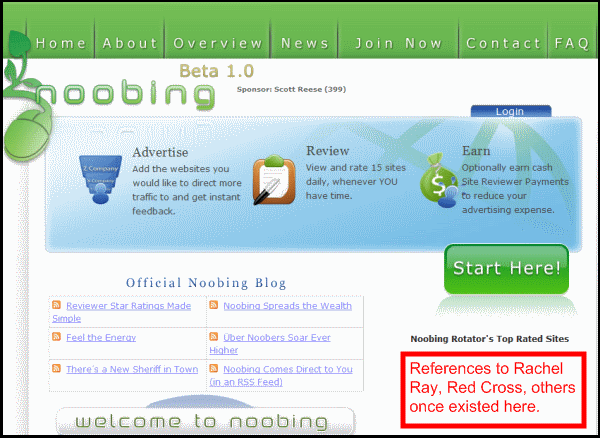
    UPDATE 9:08 A.M. EST (FEB. 19 U.S.A.) After having gone missing yesterday, entries below “Noobing Rotator’s Top Rated Sites” on Noobing’s main page have returned. But previous entries for Rachel Ray, the Red Cross, Omaha Steaks and OrganicConsumers no longer are there. Here, below, our earlier post . . .

    Controversial surf site Noobing has removed references to celebrity chef Rachel Ray, the International Red Cross and other entities from its website. Links to Ray’s site and the Red Cross had appeared on the main page at the Noobing site, under a headline titled “Noobing Rotator’s Top Rated Sites.”

    Noobing site references to Rachel Ray, Red Cross, Omaha Steaks and OrganicConsumers.
    Noobing site references to Rachel Ray, Red Cross, Omaha Steaks and OrganicConsumers.

    Noobing, which pitched itself heavily to hearing-impaired clients, has been under fire for days because it slashed advertiser payouts. Members said that, in its early days last fall and into the winter, the company paid ad-viewing “incentives” of between 1 percent and 3 percent to customers.

    The Surf recently has paid “incentives” of significantly less than 1 percent, causing members to ask publicly for refunds and accuse the firm of “bait and switch.” Noobing countered by saying refunds would not be granted because “incentives” weren’t guaranteed.

    Noobing said its decision to slash “incentives” was based on an unclear ruling in the AdSurfDaily Ponzi scheme case. Noobing launched after ASD’s assets were seized by the U.S. Secret Service in August 2008, amid allegations of wire-fraud, money-laundering, selling unregistered securities and operating a $100 million Ponzi scheme.

    Customers now are questioning why Noobing even chose to launch and wondering out loud if Noobing had done all of its regulatory homework up front. Noobing said members should be angry at the government, not the company.

    “If there is a bad guy in this whole story, it’s the government!” the employee exclaimed. “Let’s get mad at them! How can sharing our revenue to help control costs for legitimate advertisers be a bad thing? How can keeping $90+ million dollars to protect the people who worked with ASD be a fair result? It’s madness!!! Our government is the bad guy here, not Noobing.

    “Let’s get mad at the source of this challenge!” the employee railed. “Call your congressman, send letters, speak publicly!!”

    See related post. Also, see this related post.

    Why Noobing removed the references to Rachel Ray, the Red Cross and others is unclear. The information went missing without explanation.

    The development may prompt Noobing members to question whether the company had signed agreements with Ray and the Red Cross to advertise on Noobing, or whether the sites were simply inserted in the Noobing rotator to create the impression that a relationship existed.

    Promoters of ASD placed the main page of Facebook.com in the rotator, suggesting that Facebook itself was an ASD advertiser. Pages from other social-networking sites also were placed in the rotator. An undercover agent working for a Secret Service/IRS task force placed a MySpace page in the rotator and qualified for ASD viewer “rebates” even though the MySpace page offered nothing for sale.

    Rachel Ray, Red Cross, other references now missing from Noobing.
    Rachel Ray, Red Cross, other references now missing from Noobing.

  • ASD: A Thimble, A Pinhead And A Quark Before Nothingness

    Andy Bowdoin.
    Andy Bowdoin.

    UPDATED 10:21 A.M. EST (U.S.A.) Tomorrow will mark an important anniversary in the AdSurfDaily Ponzi case: the passage of two full months since prosecutors filed a second forfeiture complaint against assets tied to the firm.

    Neither ASD President Andy Bowdoin nor members of his family from whom property was seized has filed a claim. No attorney has entered an appearance notice. The lack of action is in stark contrast to what happened in August after the first seizure of ASD assets.

    Amid much fanfare — and amid a strangely jubilant atmosphere fueled by people who refused to disengage from their trances — Bowdoin moved quickly in August to stake a claim to tens of millions of dollars and other assets seized. Some Bowdoin zealots predicted a slam-dunk win for ASD, especially after it advised the court that it would be willing to operate under monitoring and supervision if some of the Great Man’s money was returned.

    What the ASD supporters didn’t see — what some of them refused to see — was that the money was seized as the assets of a criminal enterprise that had money on deposit in at least three countries and had been taking steps to get more and more money outside the United States. One of the countries — Antigua — is now front-and-center in a massive case of international financial fraud involving R. Allen Stanford and his companies.

    It will be well worth your time to click on the link above. Read the story, and read the entire SEC complaint from a link at the bottom of the story. Some of the allegations — the tortured explanations by Stanford and his companies — will remind you of elements of the ASD case.

    Also note that the money ASD had on deposit in Antigua was not in ASD’s name. Bowdoin, however, had control of the money and could have converted it to his own use at any moment in time. The amount was at least $1 million, according to court filings.

    Andy Bowdoin was at the helm of the ASD enterprise and, by implication in the forfeiture complaint, was a criminal. He took the 5th prior to the evidentiary hearing because he knew of the possible criminal repercussions of testifying. The ASD monitoring plan was a bid to short-circuit a possible criminal prosecution by getting the government to agree that only highly technical violations of the law had occurred. In other words, a possible $100 million Ponzi fraud using the financial systems of at least three countries was no big deal.

    Prosecutors never were going to accept a Bowdoin-provided remedy, especially one that attempted to sanitize criminality by treating wire fraud, money-laundering and a Ponzi scheme as minor offenses. An acceptance of such a deal would have sent a clear signal that the worst that could happen to a probable autosurf Ponzi scheme operator was court-supervised monitoring of the scheme — as it re-started with returned funds and attempted not to engage in wire fraud, money-laundering and the sale of unregistered securities.

    Such an outcome would have marked a chilly day for U.S. jurisprudence, the day America’s courts provided wink-nod cover for probable Ponzi-pushing felons — and even handed them back money and turned a blind eye to abuses that occurred before the good guys arrived.

    Investigators went on to discover that Bowdoin told insiders that $1 million had been stolen from ASD by “Russian hackers.” He didn’t even file a police report, but he did tell Judge Rosemary Collyer that ASD couldn’t operate and needed her to free up money to pay employees and bills. What Bowdoin didn’t tell the judge up front, as he asked her to release seized funds, was that ASD had more than $1 million on desposit in Antigua, under a name other than its own. And he also didn’t tell the judge about the earlier alleged theft of $1 million by “Russian hackers.”

    As a PR ploy, however, the offer to operate under supervision was a masterstroke. It kept members’ hope alive and enabled ASD supporters to paint the prosecutors and even the judge as unreasonable if they couldn’t see the beauty of the monitoring plan.

    At ASD’s request, an evidentiary hearing was held Sept. 30 and Oct. 1. ASD insisted it was not a Ponzi scheme, called an expert witness to knock down the government’s assertions, and summoned three other witnesses to help make its case. At the conclusion of the hearing, some members of the Pro-ASD Surf’s Up forum, drunk on fantasy, partied long into the night. They were certain that ASD had won and dismissed all reports that didn’t validate their delusions.

    In November, Judge Rosemary Collyer ruled that ASD had not demonstrated it was a legal business and not a Ponzi scheme at the evidentiary hearing. She found nothing of merit in the expert’s argument, pointing out holes through which one could drive a convoy of earth-moving machines. Some ASD members instantly claimed the fix was in. Such claims, of course, should be seen for what they are: self-validating drivel.

    With a fresh win, prosecutors filed a second forfeiture complaint on Dec. 19. It is the most important document so far, the one that dealt ASD a crushing blow and signaled a nuclear development to come.

    Prior to the December complaint, ASD could fit its remaining credibility in a thimble. Now it could fit it on the head of a pin. A quark, believed to be the smallest part of an atom, could accommodate ASD’s credibility at the conclusion of the case — with room to spare.

    This case will be marked by a complete absence of ASD credibility, one of the reasons some ASD supporters and Surf’s Up members are furiously trying to change the subject and get people to take their eyes off the ball.

    This case has a high probability of reducing the cheerleaders to emotional rubble and undermining the good works of their lives. Goodness exists in all people. A person can be stubborn and completely wrong-headed — and still be a good person. The line gets drawn, however, where wrong-headedness morphs into deliberate attempts to deceive and misinform.

    Some Surf’s up members now are promoting AdViewGlobal (AVG), a company that shares a common executive with ASD and a common customer-service employee operating from Florida — even though AVG claims to be registered in Uruguay and running things out of Panama. Yesterday, in the wake of the SEC’s allegations against Stanford, banking customers in Panama and other countries in Central America, South America and the Caribbean were lining up to get their money out of local banks.

    The ASD case is no more about the abuse of government power than it is the Easter Bunny. ASD is an international racketeering enterprise. If you’re carrying its water, you are a racketeer — and your quark awaits before nothingness finally settles in.

  • BREAKING NEWS: Feds Charge Billionaire Allen Stanford With Running Massive Offshore Fraud Scheme In Antigua

    Antigua was very much on the minds of members of AdSurfDaily Inc. after Andy Bowdoin told investigators last summer the company had more than $1 million on deposit in the Caribbean island nation of Antigua, a 108-square-mile country with a history of lax banking standards.

    The money was not in ASD’s name, according to prosecutors.

    Antigua this evening is very much back in the news: The Securities and Exchange Commission has charged Robert Allen Stanford and three of his companies “for orchestrating a fraudulent, multibillion dollar investment scheme centering on an $8 billion CD program” run out of an Antigua bank.

    Forbes magazine lists Stanford as one of the richest men in the United States, with personal wealth estimated at $2.2 billion. The SEC’s complaint is, simply put, a piece of nonfiction that reads like a piece of impossible fiction. The document include lines that require readers to suspend their disbelief — in the same fashion and form readers of documents in autosurf Ponzi scheme cases are required to suspend their disbelief before recognizing that some people actually believe they can fool all of the people all of the time.

    Charged along with Stanford were Stanford International Bank (SIB) of Antigua; Stanford Group Co. (SGC), a Houston-based broker-dealer and investment adviser, and Stanford Capital Management (SCM), an investment adviser .

    Meanwhile, the SEC also charged SIB Chief Financial Officer James Davis, and Laura Pendergest-Holt, chief investment officer of Stanford Financial Group (SFG).

    An Instant Receivership

    U.S. District Judge Reed O’Connor entered a temporary restraining order, froze the defendants’ assets and immediately appointed a receiver.

    “As we allege in our complaint, Stanford and the close circle of family and friends with whom he runs his businesses perpetrated a massive fraud based on false promises and fabricated historical return data to prey on investors,” said Linda Chatman Thomsen, director of the SEC’s Division of Enforcement. “We are moving quickly and decisively in this enforcement action to stop this fraudulent conduct and preserve assets for investors.”

    Rose Romero, director of the SEC’s Fort Worth regional office, said the scale of the fraud was mind-boggling.

    “We are alleging a fraud of shocking magnitude that has spread its tentacles throughout the world,” Romero said.

    “Acting through a network of SGC financial advisers, SIB has sold approximately $8 billion of so-called ‘certificates of deposit’ to investors by promising improbable and unsubstantiated high interest rates,” the SEC said. “These rates were supposedly earned through SIB’s unique investment strategy, which purportedly allowed the bank to achieve double-digit returns on its investments for the past 15 years.”

    It was all a web of deception, the SEC said.

    “[The] defendants have misrepresented to CD purchasers that their deposits are safe, falsely claiming that the bank re-invests client funds primarily in ‘liquid’ financial instruments (the portfolio); monitors the portfolio through a team of 20-plus analysts; and is subject to yearly audits by Antiguan regulators,” the SEC said.

    In a Bernard Madoff-like assertion, SIB claimed results that were the envy of investors worldwide — and yet defied the laws of probability, the SEC said.

    “SIB reports identical returns in 1995 and 1996 of exactly 15.71%,” investigators said in the complaint. “[But] [a]s Pendergest-Holt — SIB investment committee member and the chief investment officer of Stanford Group Financial (a Stanford affiliate)  — admits, it is simply ‘improbable’ that SIB could have managed a ‘global diversified’ portfolio of investments in a way that returned identical results in consecutive years.

    “A performance reporting consultant hired by SGC, when asked about these ‘improbable’ returns, responded simply that it is ‘impossible’ to achieve identical results on a diversified investment portfolio in consecutive years. Yet, SIB continues to promote its CDs using these improbable returns,” investigators said.

    In a line that reads as though it came out of a Madoff or autosurf Ponzi complaint, the SEC said Stanford tightly compartmentalized knowledge and hid details about its financial underpinnings to fool investors.

    “[C]ontrary to assurances provided to investors, at most only two people — Stanford and Davis — know the details concerning the bulk of SIB’s investment portfolio,” investigators said. “And SIB goes to great lengths to prevent any true independent examination of those portfolios. For example, its long-standing auditor is reportedly retained based on a ‘relationship of trust’ between the head of the auditing firm and Stanford.”

    Stanford told lie after lie to keep investors from asking too many questions, investigators said.

    “[C]ontrary to recent public statements by SIB, Stanford and Davis (and through them SGC) have wholly failed to cooperate with the Commission’s efforts to account for the $8 billion of investor funds purportedly held by SIB,” investigators said. “In short, approximately 90% of SIB’s claimed investment portfolio resides in a ‘black box” shielded from any independent oversight.

    “In fact, ” investigators continued, “far from ‘cooperating’ with the Commission’s enforcement investigation (which Stanford has reportedly tried to characterize as only involving routine examinations), SGC appears to have used press reports speculating about the Commission’s investigation as way to further mislead investors, falsely telling at least one customer during the week of February 9, 2009, that his multi-million dollar SIB CD could not be redeemed because ‘the SEC had frozen the account for two months.’

    “At least one other customer who recently inquired about redeeming a multi-million dollar CD claims that he was informed that, contrary to representations made at the time of purchase that the CD could be redeemed early upon payment of a penalty, R. Allen Stanford had ordered a two-month moratorium on CD redemptions,” investigators said.

    Who’s Minding The Store?

    In another line that sounded as though it could come from an autosurf Ponzi complaint, the SEC said that a cattle rancher and car salesman — along with a person with no prior experience in financial services or securities — were key members of SIB’s braintrust.

    “SIB is operated by a close circle of Stanford’s family and friends,” the SEC said. “SIB’s investment committee, responsible for the management of the bank’s multibillion dollar portfolio of assets, is comprised of Stanford; Stanford’s father who resides in Mexia, Texas; another Mexia resident with business experience in cattle ranching and car sales; Pendergest-Holt, who prior to joining SFG had no financial services or securities industry experience; and Davis, who was Stanford’s college roommate.”

    Stanford abuses were not limited to SIB, the SEC said.

    “[Investigators] also allege[] an additional scheme relating to $1.2 billion in sales by SGC advisers of a proprietary mutual fund wrap program, called Stanford Allocation Strategy (SAS), by using materially false historical performance data,” the SEC said.

    ‘[T]he false data helped SGC grow the SAS program from less than $10 million in 2004 to more than $1 billion, generating fees for SGC (and ultimately Stanford) of approximately $25 million in 2007 and 2008,” the SEC said. “The fraudulent SAS performance was used to recruit registered investment advisers with significant books of business, who were then heavily incentivized to reallocate their clients’ assets to SIB’s CD program.”

    Read the remarkable SEC complaint against Stanford and his companies and managers.
  • Noobing Had ‘Deaf Sales Team’ And Strong YouTube Presence

    mrjimbeachcomdeafnoobingvideoUPDATE 4:16 P.M. EST (U.S.A.) The Noobing domain — www.noobing.com — is now back online. It had been offline for more than an hour, throwing this error message: “The remote name could not be resolved: ‘gonoobing.blogspot.com.’

    What caused this and why the domain tried to resolve to a Blog instead of the sales website are unclear.

    Meanwhile, Noobing identifies Jim Beach, an employee cited in the story below, as “Noobing Sales Manager.” On what it deems its “official” Blog, Noobing says Beach is the son of a deaf parent and, in 2008, traveled to Deaf Expo events in New Jersey, Kansas, Texas and Missouri to promote Noobing.

    “And Noobing was a hit at each,” the company said on its Blog.

    Here, below, our earlier post . . .

    An autosurf under fire in recent days for slashing payouts pitched itself directly to the deaf and employed a salesman who promoted a Noobing “Deaf Team” on YouTube.

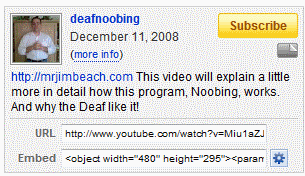
    The Noobing salesman’s name is Jim Beach. His YouTube name is “deafnoobing.” Beach, who lives in Kansas — the home state of Noobing — also owns a domain named mrjimbeach.com, which redirects to the Noobing autosurf site. From there, customers who wish to register are included in a downline with the user ID of “Jim Beach (70).”

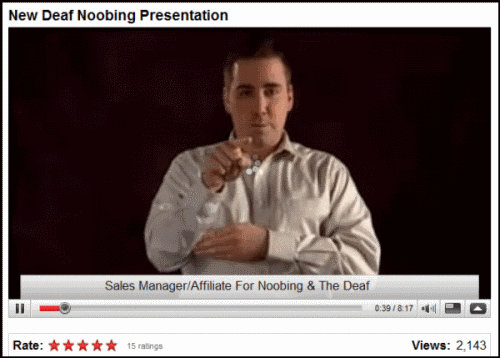
    Beach, who speaks in Noobing videos and also uses sign language, repeatedly is referred to as Noobing’s point man on the ASA Monitor forum.  He has produced a number of YouTube videos that position Noobing as a good opportunity for deaf people.

    On his YouTube site, Beach instructs that “Deaf Noobing is dedicated to helping the deaf community succeed in all areas of life! Physically, financially and spiritually!

    “Let the Deaf world show the rest of the world that Deaf People are GREAT PEOPLE!” the site exclaims.

    Pitch to deaf members.
    Pitch to deaf Noobing prospects.

    The YouTube page includes at least three URLs deaf people can advertise on Noobing if they don’t have their own business to promote. One of the URLs appears to be a subdomain that uses Beach’s name and the name of a wellness site. Another URL is the address for Clickbank, and yet another is an address that redirects to an affiliate site that sells Multi-PureDrinking Water Systems.

    Noobing has come under intense fire in forums in recent days for slashing payouts to advertisers. A Noobing employee blamed the cuts on an unclear ruling in the ADSurfDaily Ponzi scheme case, and encouraged Noobing members to complain to the government.

    At the same time, Noobing openly criticized members who signed up for the program while not owning their own businesses. Beach’s YouTube page, however, seems to imply that people could sign up for Noobing as long as they had a URL to insert in the advertising rotator.

    Nonbusinesses advertising in ASD’s rotator and a lack of member controls were elements in the forfeiture case filed by federal prosecutors last August.  Meanwhile, Noobing is being slammed in forums for sending a mixed message and is being accused by posters of “bait and switch.”

    See related post.

    Sign-language Noobing pitch.
    Sign-language Noobing pitch.

  • ‘Noobing’ Autosurf Has Hearing-Impaired Clientele; Surf Blames Slashed Payouts On Unclear Ruling In ASD Ponzi Case

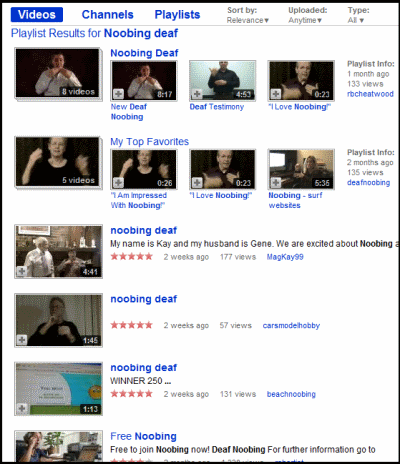
    Sampling of YouTube videos by hearing-impaired Noobing members
    Sampling of YouTube videos by hearing-impaired Noobing members.

    UPDATED 9:11 PM. EST (U.S.A.) An autosurf excoriated in forums for slashing payouts has hearing-impaired clients, according to several videos on YouTube.

    At least 15 of the YouTube videos feature sign language and appear to have been created by hearing-impaired members of Noobing. Many of the videos use the word “Noobing” — coupled with the word “deaf” — to generate keyword-search volume.

    Meanwhile, Noobing members are asking tough questions on forums, saying they were led to believe the money they spent on advertising would generate returns of 3 percent. Noobing slashed returns to a fraction of 1 percent, and says members weren’t guaranteed any return at all.

    Earlier today a Noobing employee blamed the lower rates on the government. Tonight the same  Noobing employee said the slash in payouts was because of an unclear ruling in the AdSurfDaily Ponzi case.

    “The SEC did not contact us,” explained the employee, on the ASA Monitor forum. “We are simply being smart and not putting ourselves in a bad position to risk losing everything. Once ASD gave up, and we stood without a firm ruling from the courts, the risk was too high. We’d have preferred that ASD won, or that at least we got a clear ruling, as it is now, cautious action is best.”

    ASD President Andy Bowdoin surrendered his claim last month to tens of millions of dollars and other property seized by the government in August. Noobing debuted after the government’s move last summer. A second forfeiture complaint against assets tied to ASD was filed in December. ASD has not submitted a claim to the assets, including a boat, water equipment, automobiles and real estate owned by Bowdoin family members.

    Prosecutors said the property was purchased with the proceeds of a criminal enterprise: ASD.

    Members have complained that Noobing now is paying only a fraction of 1 percent, meaning that money directed at the firm is producing little income. Some members said Noobing should provide refunds, but the Noobing employee said that wouldn’t happen because the company never guaranteed a return.

    “If there is a bad guy in this whole story, it’s the government!” the employee exclaimed. “Let’s get mad at them! How can sharing our revenue to help control costs for legitimate advertisers be a bad thing? How can keeping $90+ million dollars to protect the people who worked with ASD be a fair result? It’s madness!!! Our government is the bad guy here, not Noobing.

    “Let’s get mad at the source of this challenge!” the employee railed. “Call your congressman, send letters, speak publicly!!”

    Some ASD members also are railing against the government.

    Noobing members, though, find themselves hamstrung by Noobing’s argument that returns — or “incentives,” as the company calls them — weren’t guaranteed. It’s fundamentally the argument prosecutors said ASD used to insulate itself from Ponzi claims.

    And now Noobing is using the argument, even though it is still operating. Noobing also says advertising purchases are nonrefundable, as did ASD.

    At the same time, Noobing members are accusing the company of “bait and switch,” saying it never should have opened for business if it didn’t address all regulatory issues up front, including potential challenges for selling unregistered securities and operating a Ponzi scheme.

    One of the YouTube videos shows Noobing members how to sign up for a Clickbank affiliate account in case they don’t have their own business to advertise. Over the past two days, Noobing has criticized members who didn’t have a business to advertise for signing up.

    See related post.

  • EDITORIAL: Cancel Their Ponzi Ticket, Sen. Leahy

    Sen. Leahy, in oline chat with eighth-graders.
    Sen. Leahy, in online chat with eighth-graders.

    Four more U.S. banks failed yesterday. Three failed on the previous Friday. Thirteen have failed year-to-date. To say this is unsettling is to grossly understate the severity of the banking problem and the drag on the U.S. and world economies.

    Stories about Ponzi schemes and mortgage fraud are in the news daily. The obvious fear among regulators is that more Bernard Madoffs and Arthur Nadels will emerge. The situation is ripe for Ponzi schemes to be exposed because people need cash and actually fear Ponzi fraud now, meaning they’re predisposed to request redemptions just in case. Ponzi operators won’t be able to fund the redemptions, and the fraud will be exposed at the revulsion of the world.

    And yet some members of the Surf’s Up forum, which is associated with the AdSurfDaily Ponzi operation, are writing incredibly brazen letters to Sen. Patrick Leahy. These letters are a bid to get the Senate Judiciary Committee to investigate the prosecutors who prevented the ASD Ponzi from mushrooming. Sen. Leahy is committee chairman.

    Make no mistake about it, Sen. Leahy: ASD is a $100 million Ponzi scheme and every bit as dangerous as the Madoff and Nadel schemes. ASD thrived for months and collected tens of millions of dollars — now subject to forfeiture because of quick action by the U.S. Secret Service, the IRS and the Justice Department — and tried to cover its tracks by drafting investors into a contract that provided no consumer protections at all. The contract was nothing more than an inartful, cynical bid to legalize Ponzi schemes and skirt securities laws by calling an investment program an “advertising” program.

    Members of the Judiciary Committee should pay close attention to the ASD contract, which appears starting on P. 68 of this document, an Aug. 5 forfeiture complaint against assets tied to ASD. The Justice Department filed a second forfeiture complaint on Dec. 19, outlining even more ASD abuses and highlighted by a claim that “Russian” hackers stole $1 million from ASD.

    ASD President Andy Bowdoin did not even file a police report, which raises even more questions — questions such as “Why not?” and “Did a theft actually even occur?”

    Members of the Judiciary Committee also should know that Bowdoin already has surrendered claims to money and property seized in the August forfeiture complaint.

    At the same time, members of the committee should seek to determine if the Robert Garner mentioned beginning on P. 160 of this Senate document pertaining to a 2001 money-laundering investigation is the same Robert Garner mentioned in the ASD forfeiture complaint.

    The Surf’s Up members’ bid to misinform the Judiciary Committee and sanitize Ponzi schemes is reprehensible, an insult to hard-working and underfunded law-enforcement agencies, the highly capable men and women who staff the agencies, and dedicated prosecutors at all levels of government.

    And it is a slap in the face to hard-working Americans who are living through lean times, struggling to make ends meet and are stunned beyond words at the devastation wrought by the Ponzi economy.

    We call on Sen. Leahy, a former prosecutor, and the Judiciary Committee to fully investigate so-called “autosurf” Ponzi fraud and propose legislation that will help federal and state prosecutors combat it. A law that specifically codifies the crime and spells out penalties would be a good first step.

    We suggest that Sen. Leahy and members of the Judiciary Committee work closely with Attorney General Holder and SEC Chairman Schapiro in crafting legislation that specifically addresses autosurf and HYIP Ponzi fraud.

    This insidious business is sucking wealth out of the economy and creating an environment in which criminals and even terrorists can thrive. Mini-Madoffs exist far and wide across the autosurf landscape. They are engaging in the sale of unregistered securities, wire fraud, money-laundering, mail fraud and racketeering, and they are being aided by people who are doing everything in their power to change the subject and sanitize what amounts to organized theft on a global scale.

    Cancel their Ponzi ticket, Sen. Leahy.

  • Reports: U.S. Regulators Probing Bank In Antigua

    Multiple media outlets — including Bloomberg News, the Associated Press and Business Week — are reporting that the Securities and Exchange Commission, the Financial Industry Regulatory Authority and the Florida Office of Financial Regulation are investigating Stanford Financial Group.

    At issue is the extraordinary rate of return advertised by Stanford International Bank Ltd. (SIB), an Antigua-based arm of Stanford Financial Group. Stanford Financial Group is an investment firm headquartered in Houston. It is run by billionaire R. Allen Stanford, whose fortune was estimated at $2.2 billion by Forbes magazine.

    SIB’s certificates of deposit, for instance, have been advertised to return double or even triple the rates of U.S.-based CDs. The FBI now has joined the probe, the Wall Street Journal reports.

    The question on the lips of reporters is whether Allen Stanford in the next Bernard Madoff. Fueling concern have been the reports of financial analyst Alex Dalmady. Take a minute to read Dalmady’s report if you’ve been following the AdSurfDaily case. Antigua is a Caribbean nation and favored spot for U.S. residents to move money offshore.

    AdSurfDaily Inc., an alleged $100 million Ponzi purveyor, had more than $1 million on deposit in an Antigua bank, according to Aug. 25 court filings.

    “[Andy Bowdoin] told the Secret Service that an Antigua account (in another name), holds over one million ASD dollars,” federal prosecutors said.

    Perhaps ASD members would be wise to ask Bowdoin the name of the Antigua bank in which the funds are deposited.

    But, getting back to SIB . . .

    SIB has a strong presence in Florida. Dalmady, the financial analyst, has been asking some troubling questions and relating some troubling observations. One of the things that bothered him about SIB was the “unsophisticated” appearance of its website

    It’s an observation mindful of reactions to the ASD website.

    Reports now are circulating that SIB reserved the right to refuse early CD redemption requests, which has a whiff of some of the language ASD used to protect what federal prosecutors said was a Ponzi scheme. It’s not quite “rebates aren’t guaranteed,” but why restrict access to customers’ money, especially when you’re operating offshore? It only raises red flags.

    Stanford Financial is blaming the probe on disgruntled employees; ASD blamed bad press it was getting on disgruntled MLMers.

    It’s early. No charges have been filed against Stanford Financial Group.

  • Bill McCollum, Florida Attorney General, Seeks Tougher Securities Laws, Even As ASD Faithful Work Against Him

    Bill McCollum
    Bill McCollum

    While some members of the “Surf’s Up” Pro-ASD forum are sending letters to Sen. Patrick Leahy (D.-Vermont)  in a bid to get him to endorse Ponzi schemes, Florida Attorney General Bill McCollum is working with legislators to strengthen securities and fraud laws.

    And McCollum also is working with AARP to strengthen the laws. Last year, Surf’s Up members tried to organize a campaign to solicit AARP’s support for Ponzi schemes — after earlier waging a campaign to have McCollum and a Florida TV station charged with deceptive business practices for shining the light on ASD.

    McCollum has joined forces with state Sen. Garrett Richter and state Rep. Tom Grady to introduce legislation that would broaden state authorities’ ability to investigate and pursue securities fraud and enhance the registration requirements for investment advisors, dealers and others.

    The proposal would permit McCollum to participate in civil investigations with the approval of the Office of Financial Regulation (OFR).

    “Recent headlines and alleged fraud have clearly identified the need to have an ‘all hands on deck’ approach when helping protect Floridians and their investments,” McCollum said. “I appreciate the legislative leadership on this initiative.”

    OFR would have enhanced enforcement powers under the proposal, authorizing “the emergency suspension of persons and firms for failure to provide financial books and records to OFR,” McCollum’s office said.

    Such a measure could be a killer to autosurfs.

    The autosurf trade’s existence depends on not revealing financials because they reveal the Ponzi nature of the programs. The surf model further depends on not registering as securities dealers and not registering the securities themselves. Virtually all autosurfs that employ the ASD model try to skirt securities laws by saying they’re selling “advertising,” not investments.

    OFR also could apopt sanctioning guidelines for registrants who violate the Florida Securities and Investor Protection Act.

    “These enhanced capabilities — plus the Attorney General’s ability to engage in civil investigations — will help prevent and discourage future bad acts by a financial advisor or firm,” McCollum’s office said.

    Grady (R.- Naples) is a securities attorney and expert in securities regulation. He drafted the bill and is sponsoring it in the House.

    “In order to have a strong economy, investors must have confidence in the market. By increasing the tools available to the state to prosecute violators of our securities laws, we protect investors and foster needed trust in the system,” Grady said.

    Richter (R.- Naples) is a banker. He is chairman of the Senate Banking & Insurance Committee, and is sponsoring the bill in the Senate.

    “The integrity of our markets is critical to building a strong economy. This legislation will reinforce our regulatory system and bolster investor trust,” Richter said.

    Under the bill, OFR will be permitted to increase the penalties for violations of the Florida Securities and Investor Protection Act. Penalties may include suspending or permanently barring violators from doing business in Florida.

    “It will also strengthen the licensure registration process by providing additional grounds for denial of a registration, including imposing disqualifying periods for persons who have been convicted of certain crimes,” McCollum’s office said.

    “There is a need to reinforce our regulatory framework. The proposed legislation will provide the Office with the means to take swift action against violators,” said Alex Hager, Interim Commissioner of OFR.

    Florida senior citizens are constant targets of scammers, and AARP said it supports the legislative initiative.

    “AARP welcomes these important efforts by Sen. Richter, Rep. Grady and Attorney General McCollum to crack down on these fraud artists,” said Jack McRay, advocacy manager for AARP’s Florida state office. “Even one criminal fraudster can wreak havoc on countless older Floridians’ security, destroying many lifetimes worth of hard work and prudent saving.”

    Some Surf’s Up members have championed “Professor” Patrick Moriarty’s idea to write letters to Leahy, chairman of the U.S. Senate Judiciary Committee, in a bid to get him to investigate the prosecutors in the ASD case.

    Leahy is a former prosecutor. In 1974, prior to his Senate days, he was named one of the top three prosecutors in the United States.

  • Judge Scolds Ponzi Operator Who Fleeced Millions From Victims, Including Seniors Who Plowed Life Savings Into Scam

    In a North Dakota Ponzi case, former insurance salesman Larry Atkins was charged with 78 felonies. Authorities said he ran a Ponzi scheme that stole more than $3 million from at least 30 victims, including senior citizens and vulnerable adults.

    Some of the elements of the Atkins’ Ponzi are similar to the alleged AdSurfDaily Ponzi, which roped in senior citizens and others across the United States based on assurances that everything was legal.

    Atkins, 65, apologized for his behavior — and then proceeded to explain how he was the victim in the case. All of this was too much for the presiding judge, who scolded Atkins in open court, according to InForum, a news site for Fargo and Moorhead.

    It also infuriated Adam Hamm, North Dakota Insurance Commissioner. Hamm immediately revoked Atkins’ license after the judge sentenced Atkins to eight years in prison and issued a statement on the commission’s website.

    Among the felony counts upon which Atkins was convicted were selling unregistered securities and exploiting a vulnerable adult.

    “Mr. Atkins’ behavior was utterly reprehensible,” Hamm said. “He violated the trust that people gave him and caused disastrous results to their lives.”

    “[Atkins’] total and complete breach of ethical behavior is truly shameful,” Hamm said.