The government has established a refund procedure for the AdSurfDaily, LaFuenteDinero and GoldenPandaAdBuilder Ponzi case that requires victims to file petitions for remission or mitigation.
Petitions must be filed in writing and under oath. The government will provide instructions. Patience is required because the case has not been litigated to conclusion.
“Under Section 9.8(a)(1) and (2) of Title 28 of the Code of Federal Regulations, in a petition for remission or mitigation of forfeiture a non-owner victim must demonstrate that it suffered a pecuniary loss of a specific amount directly caused by the criminal offense(s) underlying the forfeiture, or a related offense, and that the loss is the direct result of the criminal acts,” the government said.
We see this as a valid, useful approach, something that places a critical check on the wink-nod nature of autosurfs. Serial promoters now know — beyond a shadow of a doubt — that the government views autosurfs as criminal enterprises. If you played the game, you have to take proactive steps to get your money back, and you have to certify you were a crime victim.
It might be hard to certify yourself a crime victim if you’re still playing the autosurf game and your name pops up the next time an autosurf gets busted. It will be harder yet to persuade people that government “evil” led to your demise after you’d been warned repeatedly not to play the game.
Most members will view the refund procedure as a minor hurdle. After all, they relied on assertions Andy Bowdoin made that the program was legal. They were shocked at the seizure and appalled beyond measure as details about the depth of ASD’s deception came to light.
But this will be a bitter pill for some ASD members to swallow, perhaps particularly serial promoters, promoters who race from program to program and actively, even aggressively promote autosurf Ponzi schemes.
They were “shocked” by ASD developments only in the same sense Captain Renault was “shocked” at the gambling “going on” inside Rick’s Café Américain in “Casablanca,” which is to say they weren’t shocked at all. Like Renault, they pocketed their winnings and looked forward to pocketing some more in wink-nod fashion.
What the government is doing, plainly, is signaling autosurf participants that they’re not going to be able to claim victimhood in one autosurf while collecting profits and insisting all is legal and completely above-board in another.
What’s been most appalling about the ASD case is the insistence by some people that autosurfs are a harmless game. Even as autosurfs were folding and failing during the holidays, taking members’ money and leaving them with even deeper feelings of uncertainty and insecurity during lean economic times, they continued to promote these miserable businesses.
One board we visited a few days ago included a thread in which people were inquiring how to get ASD refunds while the same people were actively promoting other autosurfs. It is impossible to reconcile these conflicting messages, which must be both instructive and maddening from a prosecutor’s point of view.
Prudence, Professionalism, Sound Judgment
The reason there is money to distribute — and the government warns it won’t be 100 percent — is because dedicated public servants exercised prudence, professionalism and sound judgment in seizing the cash before ASD could plunder all of it or abscond with all of it and cite “rebates aren’t guaranteed” as its “out.”
It will take some time to get a refund. The government has to liquidate assets, and there is the issue of a second forfeiture complaint filed last month against other assets tied to the firm.
Although ASD has surrendered claims to assets seized in August, the forfeiture complaint filed last month was filed as a separate action. Included were real estate, automobiles, water craft and other items seized from favored participants, including Bowdoin family members. How that case will proceed is unclear. People from whom the property was seized can file claims and challenge the seizure, just as ASD did the first time around.
In any event — and if the government prevails in the second case — the cars and water craft are all “used” items now and won’t fetch anything that approaches 100 cents on the dollar, especially at auction prices. And who will want to buy the old Masonic Hall in Quincy for $800,000 like Bowdoin did? Because Florida has one of the highest foreclosure rates in the United States and is experiencing falling property values, none of the real estate is apt to be sold at anything that approaches a break-even price.
Also gone is the money ASD spent on legal fees.
Employees, Quincy Get The Shaft Because Bowdoin Misled Them
Quincy, Fla., is a proud community that is struggling. The riches of old largely are gone, which is why ASD gained acceptance in the community quickly. People were thrilled to hear an important new business was in town — a business that demonstrated that the power of the Internet could be harnessed even in small communities.
But Bowdoin fleeced Quincy, just as he had fleeced ASD members.
ASD always was unsustainable. The business model was unsustainable. Paying “rebates” was only one thing that made it unsustainable. ASD also had to pay employees. Whether they received checks or “ad packs” as compensation, the company could not pay them without putting an even greater strain on the Ponzi. “Ad packs” were the worst remedy of all because they created even greater deficits.
This doesn’t even take payroll taxes and other taxes into account. And it doesn’t take the light bill and equipment costs into account or the cost of compliance. One of the biggest reasons autosurfs are moving offshore is because they know they can’t get around the issue of selling unregistered securities by calling them “advertisements.” There is no sense spending money on compliance only to be told that the only way you can comply is to stop offering “rebates” and simply sell advertising for a fee. The riches evaporate when an autosurf company comes into compliance.
Rebates are what draws the crowd. It’s like giving away free food and drinks. Absent huge piles of disposable start-up capital or spectacular amounts of revenue from sources beyond “advertising” fees, however, an enterprise such as ASD can’t sustain itself. The best it can do is create the illusion of sustainability. The reason start-up capital has to be disposable in the ASD business model is because every dollar that floats into the firm creates a liability of $1.25.
No legitimate venture-capital firm would fund such a company. The model is unsustainable on its face. Due diligence by the venture capitalists would be reduced to its bare essence: If $1 in means $1.25 out, then this is a Ponzi scheme. It is no more complicated than that, which is why autosurfs rely on smoke and mirrors.
Refund Procedure
Here, verbatim, is a notice the Department of Justice posted yesterday:
U.S. Department of Justice
Jeffrey A. Taylor
United States Attorney
District of Columbia
Judiciary Center
555 Fourth St., N.W.
Washington, D.C. 20530
January 23, 2009 Update
Ad Surf Daily, La Fuente Dinero & Golden Panda Ad Builder
In two related civil forfeiture cases now pending in the United States District Court for the District of Columbia, the Department of Justice (though the United States Attorney’s Office) has alleged that funds and assets it seized from several Internet-based businesses, “Ad Surf Daily,†“La Fuente Dinero†and “Golden Panda Ad Builder,†constituted proceeds of one or more federal criminal offenses. Specifically, the government alleged that each of these three so-called autosurf businesses, which had promised income opportunities to paying members, were actually “Ponzi†schemes that violated the federal wire fraud and securities fraud statutes. Under federal law, all proceeds of such criminal offenses are forfeitable to the United States.
On January 13, 2009, in the first civil forfeiture lawsuit against over $53 million and other real and personal property, claimants AdSurfDaily, Inc., Thomas A. Bowdoin, Jr., and Bowdoin/Harris Enterprises, Inc. filed a “Motion for Leave to Withdraw Claims Release of
Claims to Seized Property and Consent to Forfeiture.†In that motion, these individuals and entities asked to have all previous challenges they had made to the government’s effort to forfeit the property named in that lawsuit withdrawn. On January 22, 2009, the Court granted that motion and deemed the claims withdrawn. Earlier, on September 22, 2008, the individuals and entities that had challenged the government’s lawsuit against funds seized from the Golden Panda Ad Builder operation also moved to withdraw their challenges to the government’s lawsuit.
The government intends to pursue each forfeiture case to its completion, and to perfect the forfeiture of all fraud proceeds as quickly as possible. Although the recent withdrawals of the prior challenges to the first forfeiture case should expedite resolution of that lawsuit, the forfeiture process is not yet completed. Moreover, even upon their forfeiture, disposition of noncash assets will take some time because such assets must be liquidated before any funds derived from those assets can be made available as victim compensation.
Individuals who sent money to Ad Surf Daily (or AdCashGenerator), La Fuente Dinero or Golden Panda Ad Builder, and who suffered a pecuniary loss, may choose to file petitions for remission or mitigation of the forfeiture with the Department of Justice. Under Section 9.8(a)(1) and (2) of Title 28 of the Code of Federal Regulations, in a petition for remission or mitigation of forfeiture a non-owner victim must demonstrate that it suffered a pecuniary loss of a specific amount directly caused by the criminal offense(s) underlying the forfeiture, or a related offense, and that the loss is the direct result of the criminal acts.
The Department of Justice will work with the records it receives to build a database of former members of these auto-surf “Ponzi†schemes. The Department will endeavor to contact members with information about how they may properly file petitions for remission or mitigation with the Department (in writing and under oath). The Department may employ individuals or entities to assist it in identifying potential petitioners, to assist them in filing petitions, and to expedite resolution of each petition it receives. Because some existing records may be incomplete or out of date, potential petitioners may want to provide to the Department their current contact information directly, preferably by completing the information submission form located at www.usdoj.gov/usao/dc/Victim_Witness_Assistance/adsurfdaily.html or by emailing information to the Department at usadc.adsurfdaily@usdoj.gov (Prospective petitioners who already provided such information, by submitting the form, email or letter, need not do so again.)
Prospective petitioners’ contact information should include, at minimum, full names, member numbers, total funds paid to Ad Surf Daily, La Fuente Dinero or Golden Panda Ad Builder, and methods of payment. Mailed correspondence should be directed to the Asset Forfeiture Unit of the United States Attorney’s Office for the District of Columbia, and sent to the address listed at the top of this memo.
The United States will not have access to funds before the forfeitures are concluded, and forfeiture orders issue from the Court.
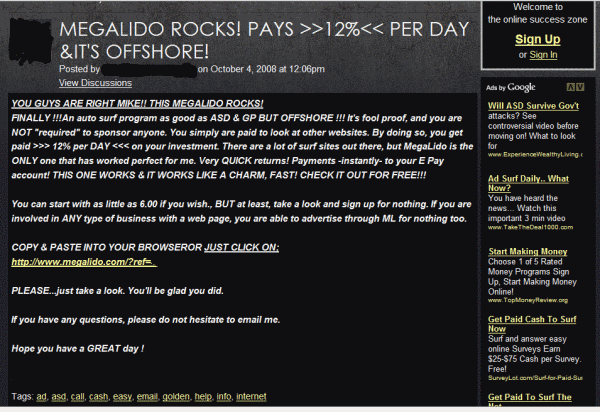
 We’ve received a number of comments from readers that fall along these lines: Are the people promoting autosurfs despite what has happened to AdSurfDaily, LaFuenteDinero and Golden Panda — and the collapse of MegaLido (and others) — REALLY that stupid?