“Birdman[:] The Pigeon King and the Ponzi Scheme That Shook Canada” appears online today at the website of the New York Times Magazine.
The story by Jon Mooallem examines the strange case of Arlan Galbraith, the narratives surrounding his “Pigeon King” scheme, Galbraith’s efforts to serve as his own attorney, how a veteran prosecutor new to fraud cases traced a “whole maze of sensational subplots” and eventually scored a conviction.
Most of all, Mooallem’s story shatters myths that frequently accompany Ponzi schemes.
As longtime PP Blog readers have observed, one Ponzi scheme after another serves up sensational subplots. But in the end, many Ponzi schemes can be viewed as a sort of rolling confessional. Perpetrators feeling the heat from investors or the media may blame “haters” — or, as the Times put it, quoting Galbraith, “fear mongers and envious critics.” At least in the early stages, some investors may side with the perpetrators because the alternative is simply too painful to contemplate.
Can a Ponzi scheme last for years? Certainly. The Times’ story brings home this point, shattering the myth that a lack of police action (or the perception of a lack of such action) means that everything is OK.
Are payments to investors proof no underlying fraud is occurring? No. The Times also drives home this point.
What about a venture that owns property or advances a development plan and perhaps a new product? Are those things proof no scam is occurring?
Of course not, as the Times’ story points out.
One of Galbraith’s victims, an early believer who eventually accepted the reality that she and her husband had been duped, took out a loan for $125,000 to invest in the scheme. This ultimately resulted in a classic confrontation on the witness stand, resulting in a “catharsis” that happened “on both sides.”
The victim is stuck with at least $86,000 in remaining payments on the loan at $1,000 a month, but that’s just part of it from an emotional standpoint.
From Mooallem’s story (italics added):
Officials in Ontario realized they had a potential avian refugee crisis on their hands. Farmers in the province had been left holding an estimated 400,000 pigeons — birds they suddenly had no incentive to keep. There was concern the pigeons could swarm into downtown Toronto like a plague.
The province’s agricultural ministry was inundated with calls. It gave out advice about euthanasia and resources for proper disposal. Then in July, the agency began clearing out some of the largest barns itself. Crews gassed 175,000 pigeons in five weeks, working 16-hour days, six days a week. An internal assessment noted that, in retrospect, it would have been wise to have grief counselors on hand; many breeders had grown attached to their pigeons.
Not all of the pigeons could be gassed because they were kept in barns that could not be sealed. How to dispose of them? The methods, according to Mooallem, included drowning and wringing their necks. Investors horrified by the circumstance in which they found themselves made the call in certain instances.
The scheme gathered about $42 million. When it collapsed, it took with it hundreds of thousands of birds.
Galbraith’s “pigeon” Ponzi scheme involved tales of breeding pigeons for racing and meat. It was not an MLM HYIP scheme, but many of the lessons are the same. He trotted out the “haters” defense, something in common with many Ponzi-board schemes.
At least for a while, even his victims were willing to support him, another thing in common with MLM HYIP scams.
The defenses and support unraveled over time — and there was plenty of time to contemplate events surrounding the Pigeon King scheme. It may take years to bring a case. The case then may be delayed in the courts.
An investigative report by Better Farming magazine helped bring down the scheme, Mooallem reports. So did Plain Interests, an Amish newspaper.
And so did David Thornton, the operator of CrimeBustersNow. (PP Blog note: Thornton wrote about Pigeon King here in this July 19, 2010, comment.)
Thornton, Mooallem wrote in the Times, was an “eccentric with a bullhorn.”
There is no good state in which to run a Ponzi scheme, but Michigan and Colorado — the states in which “Achieve Community” operated — are two of the worst.
This is because both states have racketeering statutes that have been used in Ponzi-scheme cases. The case of Joel Wilson, convicted yesterday in Michigan on criminal charges of racketeering, selling unregistered securities, securities fraud and larceny, is one Achieve Community members can use to inform themselves.
Achieve reportedly is under investigation by the state of Michigan. It’s also under investigation by the state of Colorado, and the U.S. Securities and Exchange Commission has filed civil charges that Achieve was a combined Ponzi- and pyramid scheme that gathered more than $3.8 million.
Alleged Achieve operators Troy Barnes of Michigan and Kristi Johnson of Colorado have asserted their Fifth Amendment right not to incriminate themselves. Criminal probes may be occurring on more than one front.
The office of Michigan Attorney General Bill Schuette has declined to talk about Achieve. But Schuette had plenty to say about Wilson and his investment company known as “The Diversified Group Advisory Fund LLC.”
“I am pleased we have secured justice for the victims who lost their life savings,” said Schuette. “Financial exploitation is a growing crime in Michigan, and we are cracking down on these con artists. Be skeptical of anyone who promises huge returns for a small investment.”
Wilson potentially faces decades in prison.
Fallout from the case was not limited simply to Wilson. A saleswoman also was charged criminally. She, too, was convicted of racketeering, plus embezzlement from a vulnerable adult, and seven counts of false pretenses.
The saleswoman, Shawn Dicken, 40, of Bay City, was sentenced last year to “to 11 years, eight months to 20 years” in prison, Schuette’s office said.
Achieve Community allegedly offered a return of 700 percent in as little as a few months. Promoters of the scheme parroted information put out by the “program” to draw recruits who’d help drive the “cycler.”
With Diversified Group, Dicken “failed to disclose the risks associated with the actual investment in question,” prosecutors said.
She also touted “guaranteed” returns, they noted.
That senior citizens were targeted led to the charge of embezzlement from a vulnerable adult which, like racketeering and false pretenses, is a felony.
Achieve Community largely operated over the Internet and is known to have recruited senior citizens. Internet-based schemes typically increase the odds that vulnerable people will be plundered.
BULLETIN: (3rd update 7 p.m. ET March 6 U.S.A.) The court-appointed receiver in the Zeek Rewards Ponzi- and pyramid case has sued “alleged winners” with addresses in the United Kingdom.
Receiver Kenneth D. Bell identified the defendants as:
Shaun Smith, Bridgnorth, $262,900.31; Peter William Bennett, Wokingham, $257,573.30; Mark Anthony Ferrie, Abergavenny, $212,072.60; Gary Bryan Morris, Abergavenny, $342,405.01; Kalpesh Patel, Newham, London, $140,842.47; Parvis Parvizi, Macclesfield, $90,518.83; Cathal Lambe, Omagh, $90,311.21; Adrian John Hibbert, Sully, $82,103.51; John Noakes, Croydon, London, $59,850.62.
The action against the U.K. defendants is believed to be the second against residents of Europe. Bell sued alleged Zeek winners from Norway last month. The receiver previously sued U.S. residents and residents of Australia, New Zealand, Canada and the British Virgin Islands.
Zeek, an MLM “program,” operated from Lexington, N.C. At least three Zeek executives have been charged criminally. Court filings alleged the far-reaching scam that operated over the Internet gathered about $897 million in less than two years.
The SEC sued Zeek in August 2012, alleging a massive fraud scheme involving the sale of unregistered securities.
Bell contends the winners must return their Zeek hauls because they “won” money from victims “in an unlawful combined Ponzi and pyramid scheme.” The case against the U.K. defendants is filed in U.S. District Court for the Western District of North Carolina.
Inset from a video promoting TLC’s “laso” tea by Rodney Blackburn on YouTube.
UPDATED 3:08 P.M. ET U.S.A. Fresh from the alleged “Achieve Community” pyramid- and Ponzi scheme, the apparent collapse of “Trinity Lines” and potential debacles involving “BRING THE BACON HOME,” “Unison Wealth” and others, Rodney Blackburn now is promoting a “tea” purported to mitigate HIV.
HIV is the virus that causes AIDS.
The tea, called “laso,” is offered by an MLM “program” known as “Total Life Changes” or TLC, Blackburn says.
Laso also “prevents colds and flu,” “prevents cardiovascular diseases” and reduces cancer risks, according to footage from Blackburn’s TLC promo on YouTube.
At the same time, according to the 11:48 Blackburn promo titled “Total Life Changes – Rodney’s Review,” the tea tackles weight loss, combats aging, “helps in Herpes treatment,” “prevents high blood pressure,” “prevents wrinkles,” “alleviates asthma,” “removes intestinal sludge,” “removes parasites” and plenty more.
The tea, according to Blackburn’s promo, also is “good for reducing diabetes” and even participates in the battle against tooth decay,
On Feb. 12 in a sealed court filing, the SEC described “Achieve Community” as a scheme engaged in securities fraud. A federal judge approved an asset freeze, and one or more Achieve-related criminal investigations are under way. “Trinity Lines” then went missing, and so did a bunch of Blackburn promos for other schemes.
A Blackburn sales video for TLC, however, appeared yesterday. Blackburn suggests in the production that he’s interested in returning to his MLM roots after taking HYIPs out for a ride. He previously claimed that 97 percent of people lose money in MLMs — this in a video in which he was touting multiple HYIP schemes and practically daring the SEC to investigate.
Earlier this year Blackburn was touting something called “Military Medical Relief 21,” or MMR21, a “program” aimed at military personnel. Those promos also disappeared.
“Mitigates HIV,” Blackburn says of the tea, after narrating other purported claims about its medicinal power.
“I mean, strengthens your memory — all sorts of things,” the huckster continues. “They have twenty-six different benefits.”
Read the definition of “mitigate” at dictionary.reference.com. (One of the meanings is “tomakelesssevere.”)
Whether an MLM tea can make HIV “less severe” and do all the other things advertised in Blackburn’s video is an open question.
From a YouTube pitch for TLC’s “laso” tea by Rodney Blackburn.
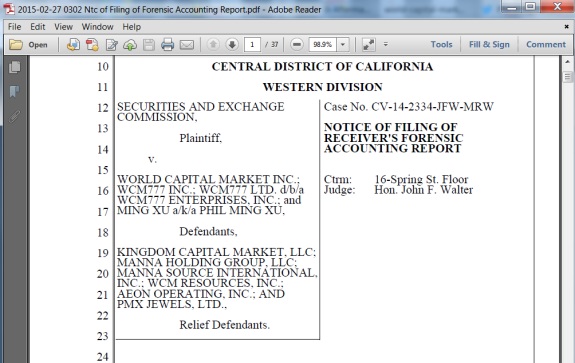
“Many investors gave cash to the company and to their leaders (or upline sponsors) who then deposited the cash along with other investor funds.” — Krista L. Freitag, court-appointed receiver in the WCM777 pyramid- and Ponzi case, Feb. 27, 2015
EDITOR’S NOTE: Tens of millions of dollars allegedly flowed through WCM777 and related entities. At the bottom of this column, you’re going to read that an apparent apologist for accused Ponzi schemer Ming Xu is claiming the U.S. Securities and Exchange Commission is violating his human rights. Fair warning: You might want to have your vomit bucket at the ready . . .
UPDATED 10:31 A.M. ET U.S.A. Here’s how you rob the Christians in an offering fraud that involves the sale of tens of millions of dollars in unregistered securities across state and national borders: You start an MLM “program,” get it in the churches and on YouTube, permit “leaders” to gather money from their enraptured audiences and put out the word that $1,999 returns $3,200 in 100 days.
It might help if you have a storefront in, say, Peru. It also might help if you have, say, promoters willing to tout the “program” in webinars and from a “function room in a hotel in Massachusetts.” At the same time, it might help if you have promoters willing to steal the intellectual property of the “Rocky” movie franchise to drive dollars into any of the “77 domestic and 23 foreign bank accounts” you’re using. (The bank-account information is sourced from a forensic accounting by Krista L. Freitag, the court-appointed receiver in the WCM777 case. It was filed Feb. 27 in U.S. District Court for the Central District of California and is the basis for part of this PP Blog column. Links to exhibits are provided near the bottom of the column.)
Along the way, it might help if you follow the standard blueprint from one MLM scam after another that calls for you to disarm skeptics by dropping the names of plenty of famous businesses, perhaps with the aim of hoping your “leaders” will follow your lead and do the same thing. Damn! Wouldn’t you know it! They did exactly that! (See link in first paragraph of this story.)
It might be particularly helpful if you make a calculation that a bank such as HSBC in Hong Kong might frown upon a subpoena issued in the United States and clam up when it comes to assisting the receiver appointed to your case after the SEC moves in.
“To date, HSBC-Hong Kong has not responded to the Receiver’s requests/subpoena,” Freitag advised U.S. District Judge John F. Walter in her forensic accounting.
Or maybe HSBC doesn’t want to open a new can of worms after it settled with the Justice Department in December 2012 by forfeiting $1.256 billion and entering into a deferred-prosecution agreement after it was accused of “willfully failing to maintain an effective anti-money laundering (AML) program, willfully failing to conduct due diligence on its foreign correspondent affiliates, violating [the International Emergency Economic Powers Act] and violating [the Trading with the Enemy Act].”
“Vincent,” the alleged Ming Xu email to Messina began. “We have lots of members for our social capital company, WCM777 in Brazil. They paid us in Brazil. How to move the money legally from Brazil to USA or Hong Kong?”
Whether Messina provided guidance on how to get money out of Brazil and move it to the United States and Hong Kong is unclear. Ming Xu’s email, however, suggests that WCM affiliates in Brazil, like their U.S. counterparts, also were collecting money directly from MLM recruits and that Ming Xu needed to find a way to get the cash under his control.
Freitag says she has traced $5 million in Ming Xu proceeds to Messina, and Walter ordered Messina to return it. Only $2.133 million has been returned, Freitag says.
Messina wasn’t just a lawyer; he was a WCM777 “insider,” the receiver alleges.
Because Freitag has access to certain WCM777 banking records, she has been able to determine that “$29,404,996” went to HSBC in Hong Kong “for 7 Receivership Entities and 1 individual.”
Ming Xu used numerous companies as part of his overall money-moving scheme, the receiver contends.
Here’s how she describes one transaction that occurred after WCM777 got in trouble with the Massachusetts Securities Division in late 2013 and agreed to return money to the fleeced investors in that state (italics added):
“ . . . rescission payments were made to WCM777 investors in accordance with the Consent Order issued by the Massachusetts Securities Division. Bank records show that funds from ToPacific bank accounts were used to make payments to the Massachusetts WCM777 investors.”
“ToPacific” was a company in the WCM777 fold.
How circuitous were things within WCM777 (italics added):
“the payment methods with which investors payments were made varied from third-party electronic disbursement (primarily Global Payout) to physical checks written directly on Receivership Entity bank accounts. There does not appear to be any consistency in the bank accounts from which investor checkswere written. Rather, bank records indicate payments were made to investors from whichever accounts happen[ed] to have funds available at the time the payments were made.”
The FBI has been warning about shell companies involved in crime and how banks and payment processors can get caught up in it since at least 2010. Even so, the WCM777 entities somehow managed to open at least 100 bank accounts while also gaining access to bank wires and at least one payment processor.
Here’s how Freitag describes the overall scheme (italics added/light editing performed):
“The Receivership Entities’ primary source of income was investor deposits, which was also the primary source of virtually all funds distributed to the investors; [t]he vast majority of the Receivership Entities’ business activities revolved around raising and distributing investor funds; [i]nvestor funds were so materially commingled between and among the Receivership Entities that the entities operated as a unitary enterprise, rather than as separate entities.”
And while WCM777 recruits thought they were joining an MLM “program,” their money financed the purchases of two golf courses in California, several pieces of real estate, including one with live koi, and a series of purported investments elsewhere. These allegedly included jewelry or gold, oil and gas — and even piles of “jeans, shorts, pants and leggings” stored by Ming Xu’s sister.
Ming Xu’s Mom allegedly got a new house, but not until after the cash to purchase the home had passed through bank accounts linked to Ming Xu and his sister.
The Ming Xu Twitter account, which once claimed all would become known when “blood moons” appeared in the sky and published a picture of Apple co-founder Steve Wozniak, whom Ming Xu had corralled at a networking event in California, now includes a link to a website that claims (italics added):
U.S. Securities and Exchange Commission was wrong to close down the company and confiscate about $43M cash asset and oil reserve asset of $50M. It has violated the company’s legal interests and human rights of Ming Xu.
Read the exhibits from Freitag’s forensic accounting. (Here’s one; here’s the other.)
As noted above, you might want to have a vomit bucket handy if you’re contemplating how certain MLM “programs” are operating these days in the era of epic white-collar fraud and while terrorism, beheadings and attacks on police are occurring.
Florida “Expat” and Zeek Rewards Ponzi-scheme figure T. LeMont Silver yuks it up in the Dominican Republic. Source: YouTube.
UPDATED 10:24 P.M. ET U.S.A. Zeek Rewards “winner” T. LeMont Silver, his wife Karen and a Silver shell company known as Global Internet Formula Inc. allegedly hauled more than $2.3 million out of the shuttered MLM “program.”
Receiver Kenneth D. Bell sued them in February 2014, alleging their gains had come from victims of the Zeek Ponzi- and pyramid scheme.
But now a North Carolina attorney and law firm for the Silvers and Global Internet say they never paid a $5,000 retainer and have racked up other unpaid legal bills. The attorney, Bruce Simpson, of James McElroy & Diehl of Charlotte, says he and the firm want out.
And it’s not just because of unpaid bills, Simpson advised Senior U.S. District Judge Graham C. Mullen today in court filings.
On June 27, 2014, a San Antonio lawyer by the name of W. James Jonas III contacted the firm, seeking “local counsel” for the Silvers and Global Internet. Jonas would serve as lead counsel and “be responsible for all the heavy lifting,” according to Simpson.
James McElroy & Diehl was to be paid a $5,000 retainer by the Silvers and Global Internet, but the retainer was not paid, Simpson told the judge. Part of the agreement was that the clients regularly would pay for legal fees and expenses once the retainer was consumed.
The Silvers and Internet “have failed to pay any of the legal fees and expenses” and have been “generally unavailable,” Simpson said.
Moreover, “at several critical junctures related to the representation, Jonas has reported that needed activity or responses related to the lawsuit could not proceed because he was unable to obtain needed payment, cooperation and information from Mr. and Mrs. Silver and Global.”
The only information James McElroy & Diehl have on the Silvers and Global is that they can be reached through a San Antonio address for Jonas, according to Simpson.
Post-Zeek, the Silvers appear to have transplanted themselves from Florida to the Dominican Republic. They even were featured in a video about the “ExPat” lifestyle.
A $5,000 retainer is about 0.21 percent of the alleged haul of the Silvers and Global Internet.
Jonas, a onetime Republican lobbyist, has had an interesting career. In 2010, the Houston Chronicle reported his life was in “ruins” after his then-wife caught him in 2007 having an affair with a “network marketing consultant.” During the following year Barack Obama won the Presidency and Democrats added seats in the Congress, causing the lobbying business of Jonas to take a serious hit.
Before long, he was involved in a messy divorce and behind on child-support payments, and a judge put him in jail, the Chronicle reported.
Jonas appears to have rebounded by 2013. The San Antonio Express-News reported he was paid “big city dollars” as the attorney for Crystal City, a small Texas town of 7,200.
Some Crystal City officials reportedly believed the city was grossly overspending on Jonas’s fees.
EDITOR’S NOTE: The MLM “program” known as Wings Network is alleged to have operated through two business entities that used the name “Tropikgadget.” The SEC’s case, announced Friday, is filed in U.S. District Court for the District of Massachusetts. That’s the same venue in which the agency’s epic TelexFree case was filed last year.
There can be no doubt — zero, none — that vulnerable immigrant populations in Massachusetts are being targeted in one MLM scheme after another. Speakers of Spanish or Portuguese may be particularly at risk. It’s also apparent that Asian, Haitian and African population groups are being targeted and that the risk is not unique to Massachusetts residents. The WCM777 “program,” for example, brushed through Massachusetts, where it was aimed at speakers of Portuguese and was stopped by the Massachusetts Securities Division in late 2013.
MSD also has squared off against a “program” known as EmGoldEx. In this scam, investors were promised returns of up to 1,105% and photos of children “getting paid” were used as lures to drive dollars.
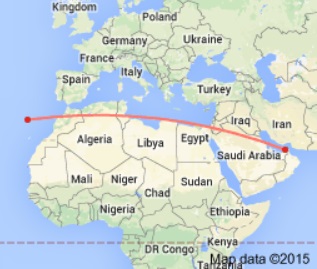
One of the Tropikgadget entities — Tropikgadget Unipessoal LDA — allegedly was set up in the Madeira Free Trade Zone in November 2013 and later abandoned. Madeira, whose largest city is Funchal, is a North Atlantic Portuguese archipelago slightly closer to continental Africa than continental Europe. It is worth pointing out that the SEC publicly thanked both Portugal’s securities regulator (Comissão do Mercado de Valores Mobiliários) and the office of Portugal’s Attorney General (Procuradoria-Geral da República of Portugal) for assistance in the American probe.
The other Tropikgadget entity — Tropikgadget FZE — appears to have been set up in Sharjah, United Arab Emirates, also in November 2013. Sharjah, on the Persian Gulf, is the UAE’s third most populous city, behind Dubai and Abu Dhabi, according to WikiPedia. The paper presence of these companies at geographic points on the North Atlantic and the Persian Gulf more than 4,300 miles away from each other and how they enlisted Massachusetts residents to do their bidding probably is a story unto itself, but it is a story for another day. What’s news today is that Wings Network was operating in Massachusetts at Ground Zero for TelexFree after the TelexFree action and, like TelexFree, is accused of fleecing vulnerable immigrant populations.
At least seven of the 12 charged Wings Network promoters had addresses in Marlborough, Mass. This is potentially important because TelexFree’s U.S. operations were based in Marlborough. TelexFree operated through various U.S. entities and a Brazilian entity known as Ympactus. Brazil-based TelexFree/Ympactus figure Carlos Costa has TelexFree business partners in Massachusetts, waved the flags of Madeira and Portugal in a 2013 TelexFree promo and invoked God in appeals to support TelexFree. Sann Rodrigues, a charged TelexFree promoter associated with an MLM entity known as iFreeX that also operated in Massachusetts and has come under scrutiny, has claimed “God” invented MLM and “binary.” Rodrigues, according to the SEC, is a recidivist pyramid-schemer.
There’s also evidence that the Zeek Rewards “program” taken down by the SEC in 2012 targeted vulnerable people.
**____________________**
Funchal, Madeira, to Sharjah, UAE. Source: Google Maps.
UPDATED 11:32 A.M. ET U.S.A. The SEC’s “Wings Network” case announced Friday is the latest example of the MLM world’s intolerable capacity to deceive. Though the facts alleged by the SEC are alarming, the action against two companies, three officers and 12 promoters is not an indictment of the trade. Indeed, the agency worked with the Direct Selling Association to expose one of the most mind-numbing lies.
But you still have to wonder if MLM and network marketing in general are on the road to perdition. This is because the horrifying abuses and thematic lies that propped up Wings Network are so common across the larger MLM trade that one can be forgiven for wondering if targeting vulnerable population groups and institutionalizing prevarication is Rule No. 1.
How DSA Got Involved In The Wings Network Case
Adolfo Franco, the trade association’s executive vice president and chief operating officer, sits at the intersection of commerce and government affairs. He’s an old political hand and has worked as a Republican strategist and assistant administrator for Latin America and the Caribbean for the U.S. Agency for International Development (USAID). Franco wants the MLM industry to prosper, and he wants to make sure he has a wholesome story to tell in government corridors.
Wings Network didn’t give him one, to be sure.
You see, Wings Network is accused by the SEC of using the DSA’s name to sugarcoat a creeping, cross-border fraud scheme that ultimately gathered at least $23.5 million. What actually happened, according to the SEC and an affidavit prepared by Franco, is that DSA received an “e-mailed request” for a DSA membership “application.” It then sent out the application, which was never returned. Not only was the application not returned, according to the affidavit, DSA never even heard back from Wings Network.
What allegedly happened next will surprise no one who follows the bizarre dramas MLM has been serving up for the past several years. This simple request for a membership application was conflated by Wings Network and affiliates as an endorsement by DSA of Wings Network.
By April 2014, according to the SEC, DSA became aware of this ribald deception. The association reacted by sending Wings Network a cease-and-desist letter, directing Wings Network and affiliates to stop claiming membership in DSA and stating point-blank that “any indication that Wings Network is a member of the DSA is fraudulent.”
Multiple Layers Of Deception
Could it get worse? Sure. Wings Network hucksters also are accused of duping participants into believing the “program,” which advertised guaranteed income, had the additional benefit of insuring them against loss.
Anyone who’s been following the unbelievably noxious example of TelexFree can tell you that the same thing allegedly happened there. The same thing currently is happening in a “program” known as “MooreFund,” and it previously happened in the AdSurfDaily Ponzi scheme in 2008 broken up by the U.S. Secret Service.
The MLM scammers look for a tiny kernel of truth and then wrap a lie around it: A “program” may have a bank account, for example. Money in the account may be insured by the FDIC in the event of a bank collapse.
From this, the “programs” themselves and affiliates conflate a fantastically malignant construction by which no one can lose money because of the “insurance.” It is just a contemptible lie. It’s also one that has been bettered by new versions of the lie. These versions — as is the case with Wings Network, TelexFree and MooreFund — hold that private insurers or even software companies such as Symantec have the companies’ backs and that these private insurers never would do business with a fraud scheme.
Supplementing this lie are companion lies — advanced by Wings Network, TelexFree and others — that a business registration with a Secretary of State or equivalent agency domestically or overseas is proof that there is no underlying scam. (One need only to look at Bernard L. Madoff Investment Securities LLC to understand just how preposterous this type of lie is.)
Here’s the thing: The type of lies advanced by Wings Network are not unusual for “opportunities” using an MLM or network-marketing business model. DSA happened to be the victim of brand-leeching and runaway disingenuousness in this case, but other cases show it’s hardly alone. Even the names of the U.S. government and various U.S. agencies have been dropped in this fashion.
Not even the “brands” of God and Jesus Christ are off-limits in the MLM sphere. Sometimes an asserted endorsement by a deity is supplemented by suggestions that living legends of entertainment and business have piled aboard a “program” train.
This is a short summary of these tactics as employed by recent MLM or network-marketing schemes that either cratered on their own or collapsed after regulatory intervention. (Note: Some background information also appears in the summary):
WCM777. Operated by Ming Xu. Targeted people who spoke Spanish, Portuguese, English and Asian languages. Dropped names of God, “Yahweh,” Jesus Christ, Al Gore, Steve Wozniak, Sylvester Stallone, “Rocky,” Eric Garcetti, Siemens, Goldman Sachs, the Denny’s restaurant chain and many, many more famous companies. (As many as 700.) Basic sales message: Send us money. Get rich. Estimated haul: $80 million in less than a year. Estimated number of victims: tens to hundreds of thousands.
TelexFree. Operated by James Merrill, Carlos Wanzeler and Carlos Costa. Largely targeted people in the United States and internationally who spoke Spanish, Portuguese and English. Global penetration at an almost unfathomable level. Appears to have created black market and back-alley economy in Massachusetts. Became subject of undercover investigation by the U.S. Department of Homeland Security. Dropped names of God, Jesus Christ, MLM Attorney Gerald Nehra, President Obama, Massachusetts Commonwealth Secretary William Galvin, the SEC, the U.S. Attorney General. Basic sales message: Send us money. Get rich. Estimated haul: $1.82 billion in about two years. Estimated number of victims: hundreds of thousands to more than 1.8 million.
Zeek Rewards. Operated by Paul R. Burks. Targeted people who spoke Spanish, Portuguese, English and Asian languages. Global penetration at an almost unfathomable level. Affiliates targeted Christians. Dropped names of the Association of Network Marketing Professionals, MLM attorneys Gerald Nehra and Kevin Grimes, plus MLM consultants Keith Laggos and Troy Dooly. Basic sales message: Send us money. Get rich. Estimated haul: $897 million in less than two years. Estimated number of victims: hundreds of thousands. “Clawback” cases to return alleged ill-gotten gains may affect 10,000 or more affiliates.
eAdGear. Operated by Charles Wang and Francis Yuen. “Primarily” targeted “investors in the U.S., China, and Taiwan,” according to the SEC. Dropped names of Google, Yahoo, Target Corp., Lbrands (Victoria’s Secret), Avon, Sears, Nordstrom, eBay, QVC, HSN, J.C. Penney, Banana Republic, Dillard’s, Kohl’s, Macy’s, Amazon.com, Men’s Wearhouse, Kmart, New York magazine and many, many more. (As many as 253 brands were abused.) Basic sales message: Send us money. Get rich. Estimated haul: $129 million. Estimated number of victims: tens of thousands.)
Wings Network now stands accused of targeting “many members of the Brazilian and Dominican immigrant communities in Massachusetts” in a combined pyramid- and Ponzi scheme that raised at least $23.5 million.
If that sounds familiar, perhaps it is because the TelexFree “program” was accused last year by the SEC of doing the same thing in the same place. Like Wings Network, TelexFree reached across national borders to plunder investors. Recent filings by the court-appointed trustee in the TelexFree bankruptcy case — and these filings are subject to amendment in part because there are more than 1 trillion disparate data points involved in the reverse-engineering of TelexFree — list the “nature” of the company’s business as “pyramid scheme.”
Other filings by Stephen B. Darr, the trustee, suggest that TelexFree gathered more than $1.8 billion in about two years of operation through a series of entities in the United States and an affiliate in Brazil known as Ympactus. The dollar volume alone is simply mind-boggling, more so when one considers the records so far denote “1,894,940 Participant names, spanning 35,110 pages.”
Some readers who sift through the TelexFree material will need a name-pronunciation guide and a world atlas. TelexFree didn’t just mow down Americans. The records suggest, for example, that the “Embassy Of Nigeria P O Box 1019 Addis Ababa Ethiopia” has contacted Darr. One document lists “Baker Island,” which WikiPedia says is an uninhabited Pacific atoll tended to by the U.S. Fish and Wildlife Service, as the “country” of an investor.
It is clear that TelexFree had investors (at least) in Argentina, Australia, Belarus, Belgium, Bolivia, Cambodia, Canada, Chile, China, Colombia, Croatia, Cyprus, Dominican Republic, Ecuador, Egypt, El Salvador, France, French Polynesia, Germany, Ghana, Guatemala, Honduras, Hong Kong, Hungary, India, Indonesia, Ireland, Italy, Japan, Jordan, Kenya, Lebanon, Luxembourg, Malaysia, Mexico, Moldova, Netherlands, New Zealand, Nigeria, Norway, Paraguay, Peru, Philippines, Poland, Portugal, Puerto Rico, Qatar, Romania, Russia, Rwanda, San Marino, Serbia, Singapore, South Africa, Spain, Sweden, Switzerland, Taiwan, Tanzania, Thailand, Togo, Turks and Caicos, U.S. Virgin Islands, Uganda, Ukraine, United Arab Emirates, United Kingdom, United States, “Unknown” country, Uruguay, Uzbekistan and Venezuela.
MLM in this form is “fraud creep” running wild. It is posing dangers to individual participants, including those who can ill afford to take a financial hit. Beyond that, it is posing a danger to the U.S. financial infrastructure.
Economic security is national security, friends. These MLM HYIP “programs” pose an untenable security threat. Many of them are shrouded in multiple layers of mystery.
DSA Needs To Do More
It is good to see that the DSA worked with the SEC on the Wings Network case. It would be better yet if the organization studied why so many MLM HYIPers appear to move from fraud scheme to fraud scheme to fraud scheme.
Where did these people start their “MLM journeys?” Did they start at, say, Herbalife or Amway after buying into the dream and the attendant hype? And did they get churned by those “traditional” MLMs, only to become shark bait for the HYIPs?
With so many of the scams selling the message that it’s nearly impossible to make money in “traditional” MLMs and that 97 percent of people who latch onto the MLM dream of riches emerge as losers or highly vulnerable treaders of water in rough seas, isn’t it time for those traditional MLMs to question whether they are creating the refugees and providing the training for the targeting?
Herbalife is not an HYIP. But it sells a dream and has a high burn rate. The most recent scheme to sell against traditional MLM is “Achieve Community,” taken down by the SEC last month.
Whether or not “the 97 percent” claim is precisely true is immaterial. What’s material is the ready availability of vulnerable population groups and refugees from “traditional” MLMs.
TelexFree even may have channeled Herbalife, calling its cheerleading sessions “extravaganzas” and latching onto the sport of soccer.
Stemming this hurtful tide should be a top priority at DSA. The wave of scams is not docile. It very well might be eroding protective shores in violent fashion and creeping up on the road to perdition.
URGENT >> BULLETIN >> MOVING: (14th update 3:19 p.m. ET U.S.A.) The U.S. Securities and Exchange Commission has gone to federal court in Massachusetts, alleging the “Wings Network” MLM “program” is a Ponzi and pyramid scheme that gathered at least $23.5 million.
Wings Network purported to offer “digital and mobile solutions to customers, including apps and cloud storage.”
“However, Wings Network’s revenues actually came solely from selling memberships to investors, not from the sale of any products,” the SEC said.
Company operators and at least 12 promoters have been charged, the SEC said. A federal judge has ordered an asset freeze. Some of the SEC employees involved in the prosecution of the Wings Network action also are involved in the TelexFree Ponzi- and pyramid case filed last year in Massachusetts federal court.
“Although Wings Network purported to use a multi-level distribution network to sell products and services, it had little or no revenue from the sale of those products or services,” the SEC charged. “Instead, to the extent that it and its members obtained revenue, that revenue was derived from the recruitment of new members. In fact, its own procedures made it clear that members were not required to sell products to receive promised profits – simply recruiting other members to purchase membership packs was enough.”
The SEC also charged that Wings Network last year falsely implied that it had a “relationship” with the Direct Selling Association, a trade association for MLM firms. But when the DSA “compliance monitoring team became aware that Wings Network was claiming membership, the DSA sent Wings Network a cease and desist letter to stop representing that DSA had any connection with Wings Network.”
Charged Wings Network entities include Tropikgadget Unipessoal LDA and Tropikgadget FZE. The LDA entity was incorporated in the Madeira Free Trade Zone in November 2013 with its principal place of business in Lisbon, Portugal, the SEC said.
“It withdrew its license from the Madeira Free Trade Zone in April 2014,” the SEC said.
The FZE entity “incorporated in the United Arab Emirates in November 2013 with its principal place of business in Lisbon, Portugal,” the SEC said. “Tropikgadget FZE holds the rights to Wings Network marketing and brand services, which includes but is not limited to, the names Wings Network, Wingsnetwork, and WingsNetwork.Com.”
Charged executives and/or operators include Sergio Henrique Tanaka, 40, of Sao Paulo, Brazil, and Davie, Fla.; Carlos Luis da Silveira Barbosa of Lisbon, Portugal; and Claudio de Oliveira Pereira Campos, also of Lisbon. No ages were given for Barbosa and Campos.
Meanwhile, the charged promoters include Yinicius Romulo Aguiar, 42, of Marlborough, Mass.; Thais Aguiar, 34, the wife of Yinicius and also of Marlborough; Andrew Elliot Arrambide, 47, of Sandy, Utah; Julio G. Cruz, 34, of Duluth, Ga.; Wesley Brandao Rodrigues, 28, of Marlborough; Dennis Arthur Somaio, 35, of Marlborough; Elaine Amaral Somaio, 35, of Marlborough; Pablo Andres Garcia, 38, of Waco, Texas; Viviane Amaral Rodrigues, 37, of Clinton, Mass.; Simonia De Cassia Silva, 43, who sometimes operated from Massachusetts and Florida; Geovani Nascimento Bento, 41, of Marlborough; and Priscila Bento, 36, of Marlborough.
Named relief defendants as the alleged recipients of ill-gotten gains from the scam were Uninvest Financial Services Corp. of Deerfield Beach, Fla.; Compasswinner LDA of Setubal, Portugal; and Happy SGPS SA of Santa Cruz, Madeira, Portugal.
“After establishing a network of lead promoters, recruitment of new members surged through the use of social media such as Facebook and YouTube,” the SEC said. “The promoters used Facebook to publicize ‘business meetings’ that took place at hotels and other locations in Connecticut, California, Florida, Massachusetts, Pennsylvania, Texas, Georgia, and Utah. The promoters also set up storefronts or ‘training centers’ to lure investors into attending Wings Network presentations. For example, one promoter used a storefront in downtown Philadelphia to make presentations to prospective investors, and another promoter rented office space in Pompano Beach, Fla., and spread the word in the local Latino community to attract prospective investors to come in and hear presentations.”
The scheme raised at least $23.5 million and targeted “many members of the Brazilian and Dominican immigrant communities in Massachusetts,” the SEC said.
Massachusetts Commonwealth Secretary William Galvin, head of the Massachusetts Securities Division, charged Wings Network and some individuals last year. Both Galvin and the SEC have squared off against TelexFree, a massive scheme targeting immigrant communities.
In a statment today, the SEC thanked MSD and Comissão do Mercado de Valores Mobiliários of Portugal and the Procuradoria-Geral da República of Portugal.
Here are the alleged hauls or alleged qualifying criteria in the pay plan for some of the charged promoters, according to the SEC:
Yinicius Romulo Aguiar, “at least $1 ,302,880.”
Andrew Elliot Arrambide allegedly reached the “Director” rank, “indicating that he had accumulated at least $6 million from investors.”
Julio G. Cruz also achieved the Director rank, “indicating that he had accumulated at least $6 million from investors.”
Wesley Brandao Rodrigues allegedly achieved the “Senior Manager rank, “indicating that he had accumulated at least $1.5 million from investors. According to Tropikgadget records, Wesley Rodrigues generated commissions of $791,745 from the sale of Wings Network membership packages.”
Elaine Amaral Somaio. “According to Tropikgadget records, Elaine Somaio generated commissions of $557,240 from the sale of Wings Network membership packs.”
Pablo Andres Garcia. “According to Tropikgadget records, Garcia generated commissions of
$550,135 from the sale of Wings Network membership packs.”
Viviane Amaral Rodrigues. Allegedly reached the Director rank, “indicating that she had accumulated at least $6 million from investors. According to Tropikgadget records, Viviane Rodrigues generated commissions of at least $434,150 from the sale of Wings Network membership packs.”
Simonia De Cassia Silva. “According to Tropikgadget records, Silva generated commissions of $419,900
from the sale of Wings Network membership packs. She temporarily moved and used an office space in Pompano Beach, Florida where she and Vinicius Aguiar promoted Wings Network locally.”
Geovani Nascimento Bento. “According to Tropikgadget records, Geovani Bento generated commissions of $163,845 from the sale of Wings Network membership packs.”
False Claims Of Insurance Coverage
Perhaps mirroring a TelexFree trick in Brazil, Wings Network hucksters also are accused of duping members into believing their payments were insured. From the SEC complaint (italics/carriage returns added):
Campos, Viviane Rodrigues, Vinicius Aguiar, and other promoters represented to prospective investors that their initial investments in the Member Packs would be 100% guaranteed through insurance issued by Porto Seguro, the fourth-largest insurance company in Brazil.
In making these claims, Campos, Viviane Rodrigues and Vinicius Aguiar pointed to the existence of Porto Seguro S.A. insurance associated with the Wings Card, a debit card issued to Wings Network members for payment processing.
In a You Tube video that solicited investors to purchase Wings Network memberships, Campos guaranteed that everything purchased by the investors would be insured for a year by Porto Seguro. In their presentations to investors, Rodrigues and Aguiar emphasized that the investments were guaranteed while juxtaposing the Porto Seguro logo. Viviane Rodrigues and Vinicius Aguiar also included a slide purportedly of a Porto Seguro insurance policy.
A woman has contacted the court presiding over the Achieve case to solicit help in getting back her money. The six-page filing by Arla Mendenhall, who identified herself as an Achieve investor, further questions how Achieve treated her for tax purposes.
A similar situation at Zeek, according to court filings, led to a 2014 criminal charge of tax-fraud conspiracy against Zeek operator Paul R. Burks. Prosecutors alleged that Burks failed to file corporate tax returns and accused him of issuing “fraudulent IRS Forms 1099s, causing victim-investors to file inaccurate tax returns for phantom income they never actually received.”
Mendenhall claimed in a communication to the court presiding over the Achieve case that she received a 1099 that asserted she was paid $6,000 by Achieve, even though “I only withdrew $800.00.”
The remaining $5,200 was “reinvested in the business,” she advised the court.
All in all, Mendenhall contended she plowed $8,450 into Achieve.
Records in the Zeek case list her as a “winner” of a Zeek sum in excess of $1,000, meaning she’s a defendant in a class-action clawback case filed by Zeek receiver Kenneth D. Bell in 2014. Senior U.S. District Judge Graham C. Mullen of the Western District of North Carolina granted class certification earlier this month.
Separately, posters at the RealScam.com antiscam forum have linked Mendenhall to cash-gifting schemes such as The People’s Program and Blessing Gold Club.
In 2013, the PP Blog reported that certain Blessing Gold Club promoters were promoting Better-Living Global Marketing and its Zeek-like Bidders Paradise arm. BLGM purportedly operated offshore, giving rise to questions about whether U.S. members involved in Zeek later had moved to a new venue in an effort to continue to pick fruit from a poisonous tree.
On Feb. 12, U.S. District Judge Robert E. Blackburn of the District of Colorado froze Achieve Community assets after the SEC contended Achieve was a pyramid- and Ponzi scheme that had gathered more than $3.8 million.
“I had no knowledge of anything illegal when I joined this Business,” Mendenhall said in her filing today.
Much of the information submitted by Mendenhall appears to have originated in her Achieve Community back office.
Alleged Achieve operators Troy Barnes and Kristi Johnson have invoked their Fifth Amendment right not to incriminate themselves in the SEC’s civil case. Barnes has claimed he faces a criminal investigation.
BULLETIN: (Updated 8:17 a.m. ET Feb. 25 U.S.A.) An HYIP “program” that operates at MooreFund.com is using a “Norton Secured” seal that is not authorized, Symantec told the PP Blog late this afternoon.
Symantec, owner of the famous Norton brand, is a software and computer-security company. Its name is misspelled as “Symentec” on the FAQ page of MooreFund in an awkwardly worded passage that plants the seed Symantec and other security firms are providing deposit insurance.
Under a subhead that reads “How can I be sure that Moore Fund is licensed and safe,” the MooreFund site claims (italics added/verbatim):
Moore Property Investment Co Limited is registered in United Kingdom and verified by Worlds most popular security insurance company like Symentec-Norton (veriSign), Comodo and TRUSTe. MOORE PROPERTY INVESTMENT CO LIMITED holds a website identity assurance warranty of $1,750,000. This means that you are insured for up to $1,750,000 when relying on the information provided by IdAuthority on this site. US Patent Number 7,603,699.”
The PP Blog contacted Symantec after observing a YouTube promo today for MooreFund by Achieve Community huckster Rodney Blackburn. The Blog also contacted the U.K.’s Financial Conduct Authority because MooreFund purports to operate from the United Kingdom through Moore Property Investment Co Ltd. FCA, closed for the evening, did not immediately respond to a request for comment.
Update 8:17 a.m. ET Feb. 25 U.S.A. Chris Hamilton, a spokesperson for FCA, declined this morning to comment specifically on MooreFund. Hamilton added, however, that “the FCA is one of a number of organisation that does investigate, and prosecute, Ponzi schemes. The other UK authorities include the Police and the Serious Fraud Office.” (Original story continues below . . .)
“They have insurance to cover . . . so, it helps you to feel, you know, more peace of mind in getting into an investment like this,” Blackburn says in his video for MooreFund. The 13:11 production is dated today and titled, “Moore Fund- Rodney’s Review on this HYIP.”
Blackburn also advised MooreFund registrants to place banner ads for the “program” on other HYIP sites. In what might be a troubling trend, HYIP schemes recently have been publishing ads for other HYIP schemes, a development that suggests tainted proceeds are circulating among any number of scams.
Achieve Community, which was charged by the U.S. Securities and Exchange Commission on Feb. 12 with operating a Ponzi- and pyramid scheme that had gathered more than $3.8 million, permitted members to place banner ads for other “programs.”
Like Achieve, MooreFund has a presence on well-known Ponzi-scheme forums such as MoneyMakerGroup and TalkGold. The “program” purports to offer four investment plans. These promise absurd daily interest rates of between 1.5 percent and 3 percent, with “compounding” available on three of the four plans and tiered recruitment commissions offered on all four.
Investors, according to the website, may send in sums from $15 to $99,999, a circumstance that suggests MooreFund is operating both a micro and macro scam.
MooreFund claims its accepts Bitcoin. It also claims prospects can send money via Western Union, bank wire and a range of processors, including well-known fraud enablers such as SolidTrustPay, Perfect Money and EgoPay.
The site includes a number of awkward passages in English such as “Fill up the form to make a new deposit,” “Sometime website is down due to ongoing maintenance work,” “You just have to contact the support department and ask for cancelling your investment” and “MooreFund minimizes risk level by offering deposit insurance system.”
This is the supposed insurance (italics added/verbatim):
Plan Beginner – 99.99% of the funds are insured Plan Pro – 75% of the funds are insured Furthermore, You can cancel and refund your money anytime between first 7 days of your deposit.
Using a calculator on the MooreFund site, Blackburn asserts that by compounding his $500 deposit over the course of a year, he’ll emerge with $53,721.54.
“Guys, that is a nice little nest egg right there,” he says.
BULLETIN: “Achieve Community” Ponzi/pyramid defendants Troy Barnes and Kristi Johnson have informed the U.S. Securities and Exchange Commission that they have invoked their Fifth Amendment right not to incriminate themselves in the agency’s civil case.
A deposition scheduled for Barnes Feb. 20 in Detroit was canceled. So was a deposition set for Johnson today in Denver.
Barnes, according to the SEC, advised the agency in an email that he consulted with an attorney and understands he is the “target of a criminal Investigation involving many of the same issues” before the SEC.
“If Deposed, I intend to take the Fifth Amendment in any and al[l] ongoing investigations Including Kristine Johnson, Work With Troy Barnes Inc. And The Achieve International LLC,” Barnes wrote.
Achieve allegedly operated through Work With Troy Barnes. Achieve International allegedly received ill-gotten gains from the fraud.
Precisely who is representing Barnes is unclear. Johnson is represented by David A. Zisser, a veteran securities attorney.
In court filings today, the SEC said it had learned Barnes “has discussed moving victim funds in this matter outside of the United States in a manner that would make recovery for the benefit of investors particularly difficult or impossible.”
When and with whom Barnes allegedly discussed moving the money are unclear. The SEC said today that, as a result of the asset freeze imposed Feb. 12 in the Achieve case, it has frozen more than $2.5 million.
Johnson, the agency alleged, “withdrew approximately $80,000 in TAC investor funds in cash from a TAC-related account or accounts” on Feb. 6, six days before the agency brought its fraud complaint and a judge imposed an asset freeze.
Although both Barnes and Johnson have stipulated to the entry of a preliminary injunction in the SEC case, Work With Troy Barnes Inc. and Achieve International LLC have not. A hearing is set for tomorrow in Colorado.
If the corporate entities do not appear, the SEC said in court filings, the agency intended to ask a judge to extend the injunctions to the companies. And if the judge wanted to hear testimony, the agency said it has “two witnesses who are not local to Colorado, but rather reside in Washington, D.C. and North Carolina, respectively.”
These unidentified individuals could testify by telephone, the agency said.
 “Birdman[:] The Pigeon King and the Ponzi Scheme That Shook Canada” appears online today at the website of the New York Times Magazine.