Blog

  • URGENT >> BULLETIN >> MOVING: Would-Be Bomber With Claimed al Qaeda Ties Arrested In Plot To Blow Up New York Federal Reserve Bank, FBI Says

    “As alleged in the complaint, the defendant came to this country intent on conducting a terrorist attack on U.S. soil and worked with single-minded determination to carry out his plan. The defendant thought he was striking a blow to the American economy. He thought he was directing confederates and fellow believers.”U.S. Attorney Loretta E. Lynch, Eastern District of New York, Oct. 17, 2012

    URGENT >> BULLETIN >> MOVING: A Bangladeshi national who claimed al Qaeda ties has been arrested on charges he intended to blow up the New York Federal Reserve Bank to “destroy America,” the FBI said.

    Quazi Mohammad Rezwanul Ahsan Nafis, 21, was arrested near the bank this morning after an FBI sting, the agency said.

    The public was not in danger because the “explosives that he allegedly sought and attempted to use had been rendered inoperable by law enforcement,” the FBI said.

    CBS News is reporting that Nafis was arrested “with his finger on the fake detonator.”

    “Attempting to destroy a landmark building and kill or maim untold numbers of innocent bystanders is about as serious as the imagination can conjure,” said Mary E. Galligan, acting assistant director in charge of the FBI’s New York Field Office.

    Before settling on the bank as a target, Nafis contemplated attacks on “a high-ranking U.S. official and the New York Stock Exchange,” the FBI said. The agency did not name the official.

    Nafis had been in the United States since January, the FBI said.

    While in the United States, Nafis “attempted to recruit individuals to form a terrorist cell,” the FBI said.

    And Nafis spoke about “our beloved Sheikh Osama bin Laden” to “justify the fact that Nafis expected that the [Federal Reserve Bank] attack would involve the killing of women and children,” the FBI said.

    New York was the site of one phase of the 9/11 terrorist attacks, which killed nearly 3,000 people.

    One of the people Nafis sought to recruit “was actually a source for the FBI,” the agency said. “Through the investigation, FBI agents and NYPD detectives working with the [New York Joint Terrorism Task Force] were able to closely monitor Nafis as he attempted to implement his plan.”

    From an FBI statement (italics added):

    During the investigation, Nafis came into contact with an FBI undercover agent who posed as an al Qaeda facilitator. At Nafis’ request, the undercover agent supplied Nafis with 20 50-pound bags of purported explosives. Nafis then allegedly worked to store the material and assemble the explosive device for his attack. Nafis purchased components for the bomb’s detonator and conducted surveillance for his attack on multiple occasions in New York City’s financial district in lower Manhattan. Throughout his interactions with the undercover agent, Nafis repeatedly asserted that the plan was his own and was the reason he had come to the United States.

    Earlier this morning, Nafis met the undercover agent and traveled in a van to a warehouse located in the Eastern District of New York. While en route, Nafis explained to the undercover agent that he had a “Plan B” that involved conducting a suicide bombing operation in the event that the attack was about to be thwarted by the police.

    Upon arriving at the warehouse, Nafis assembled what he believed to be a 1,000-pound bomb inside the van. Nafis and the undercover agent then drove to the New York Federal Reserve Bank. During this drive, Nafis armed the purported bomb by assembling the detonator and attaching it to the explosives.

    Nafis and the undercover agent parked the van next to the New York Federal Reserve Bank, exited the van, and walked to a nearby hotel. There, Nafis recorded a video statement to the American public that he intended to release in connection with the attack. During this video statement, Nafis stated, “We will not stop until we attain victory or martyrdom.” Nafis then repeatedly, but unsuccessfully, attempted to detonate the bomb . . .

  • AdSurfDaily Figures Todd Disner, Dwight Owen Schweitzer Appeal Lawsuit Dismissal

    AdSurfDaily figures Todd Disner and Dwight Owen Schweitzer — later to become pitchmen for the alleged Zeek Rewards Ponzi scheme — have appealed the dismissal of their ASD-related lawsuit.

    In August, U.S. District Judge Rosemary Collyer dismissed claims by the ASD duo that their 4th Amendment rights had been violated when ASD computer records were seized in 2008.

    Disner and Schweitzer had no standing to make the claim and had no privacy interests in records they voluntarily conveyed to ASD, Collyer ruled.

    In September, the duo sought to reopen the case and have Collyer removed from hearing it, but Collyer said no.

    Disner and Schweitzer now have appealed to the U.S. Court of Appeals for the District of Columbia the Aug. 29 final judgment and their denied motions to reopen the case and have Collyer stand down.

    The combined ASD and Zeek schemes fetched at least $719 million, according to federal records. On Aug. 17, the SEC described Zeek as a $600 million Ponzi- and pyramid fraud.

    ASD was a $119 million Ponzi scheme, according to the U.S. Secret Service. The Secret Service said in August that it also was investigating Zeek.

  • Now, A ‘Turkish Bonds’ Ponzi Scheme Aimed At Retirees, Feds Say; 2 Men Charged In Illinois — And 1 Man Is ‘Fugitive’

    EDITOR’S NOTE: This may be one for your “Bubba Blue” notebook on how to have your Ponzi scheme.

    A principal of USA Retirement Management Services and a pitchman have been charged in an alleged $28 million fraud scheme involving nonexistent “Turkish bonds” and targeted at senior citizens and “individuals with substantial savings,” federal prosecutors in the Northern District of Illinois said.

    Facing arraignment in Chicago today are Robert C. Pribilski, 54, of Lisle, and John T. Burns III, 53, of Naperville.

    Pribilski, a USA Retirement principal, was charged with five counts of wire fraud and four counts of mail fraud. Seminar pitchman Burns, meanwhile, was charged with three counts of wire fraud and three counts of mail fraud, prosecutors said.

    Mahmut Erhan Durmaz, 42, also was charged with five counts of wire fraud and four counts of mail fraud, but is a “fugitive believed to be residing in Turkey,” prosecutors said.

    While in the United States, Durmaz resided in the Chicago suburb of Streamwood. He also lived in Los Angeles and has used the name Francois E. Durmaz, prosecutors said.

    Durmaz fled the United States on “the same day that a judge froze” his personal and business assets after an SEC civil action against Durmazin and against Pribilski in 2010, prosecutors said.

    The scheme operated between 2005 and 2010 and featured the sale of promissory notes “that falsely represented USA Retirement ‘absolutely and unconditionally’ promised to pay investors between 4.75 and 11 percent annually, prosecutors said.

    From a statement by the office of Acting U.S. Attorney Gary S. Shapiro:

    Pribilski and Durmaz falsely claimed that the interest would be generated from investments in Turkish bonds. Instead, Pribilski and Durmaz operated a Ponzi-type scheme, using funds from the sale of promissory notes to make payments to other investors without disclosing that there were no Turkish bond investments. In offering and selling USA Retirement promissory notes, all three defendants falsely told investors that they had many years of investment banking experience in the purchase and sale of Turkish bonds, and that they had personally profited from such investments through USA Retirement. In fact, the defendants had no such banking experience and did not make any investments in Turkish bonds.

  • American Accused In Alleged California Ponzi Scheme And Wanted By INTERPOL Convicted In Drug Case In Ireland

    Scott Edward Cavell. Source: INTERPOL.

    A California man wanted by U.S. prosecutors in a Ponzi-scheme case was living in a rented house in Ireland and has been convicted in an Irish drug case, the Independent reported.

    Scott Edward Cavell, now 29, was described on the FBI website in 2009 as “still a fugitive, believed to be outside the United States.”

    At the time of this post, INTERPOL has a listing for Cavell on a warrant from the Eastern District of California.

    But that may change, according to details published by the Independent about comments made by an Irish judge (italics added):

    Judge Nolan said he was satisfied that Cavell had profited from the drugs operation but accepted that it is “highly likely” that he will face a lengthy prison term in America when the “federal authorities there have their say with him”.

  • $250 Million-Plus Ponzi ‘Arbitrage’ Scheme In South Africa Allegedly Led To Murder/Suicide; A ‘Tangled Web Of Close Corporations, Trusts And Offshore Bank Accounts’

    MoneyWeb has the story of Relative Value Arbitrage Fund (RVAF), an alleged massive Ponzi scheme in South Africa in which Herman Pretorius shot and killed a business partner in July and then shot and killed himself.

    The scheme appears to have gathered R2.2bn, the equivalent of more than $250 million (U.S.).

    From Julius Cobbett at MoneyWeb (italics/bolding added):

    RVAF curators estimate that the scheme received R2.2bn from about 3000 investors. At the time of Pretorius’s death, the RVAF owed an estimated R3.1bn to investors.

    The difference between the amount received and owing is most likely explained by the fund’s performance, which is believed to be fictitious.

    Investigations following Pretorius’s death show that he alone was in control of a tangled web of companies, close corporations, trusts and offshore bank accounts.

    Read the MoneyWeb story.

    NOTE BY PP BLOG: Some scammers on Ponzi-scheme forums also purport to engage in “arbitrage.” The collapse of purported arbitrage “program” Gold Nugget Invest (GNI) in 2010 brought out the “conspiracy theorists,” the PP Blog reported at the time.

    Among the bizarre assertions was that the SEC was under investigation by INTERPOL.

    It is common for Ponzi-board scammers to use terms that sound impressive — arbitrage, for instance — in their scams.

    “Ken Russo,” a former Ponzi-board pitchman for the alleged Zeek Rewards Ponzi scheme, was promoting something called “NewGNI” even as he was promoting Zeek, according to his posts at the TalkGold Ponzi forum (as “DRdave”).

    NewGNI may be a follow-up scam to the GNI scam.

    Read a January 2010 PP Blog story on some of the bizarre claims surrounding the collapse of GNI, a scheme also pushed by some members of the AdSurfDaily Ponzi scheme.

  • PONZI NOTES: (1) Kansas Lawyer Allegedly Ran Scheme Out Of Trust Accounts And Scammed Intended Beneficiaries, Including Clients’ Children And Grandchildren And Prominent University, Feds Say; (2) Former Texas Attorney Pleads Guilty In $7.8 Million Caper

    Yesterday was another bad day for the legal profession’s noble members: They once again had to bear headlines about fraud schemes allegedly operated by colleagues past and present.

    In Kansas, attorney Robert M. Telthorst, 52, of Topeka, was charged with wire fraud and money-laundering amid allegations he ran a Ponzi scheme for all or parts of seven years with clients’ trust accounts.

    After a man identified in court documents as “Otto K.” died, Telhorst was appointed to administer payments to two of the man’s daughters and entrusted with $463,344, prosecutors said.

    One of the daughters was to receive a lump sum, the other a monthly allotment, prosecutors said.

    In the trust for the daughter who was to receive monthly income, “the balance dropped from more than $208,500 to less than $150 after Telthorst removed most of the funds for his own benefit,” prosecutors said.

    Separately, Telthorst scammed three granddaughters of a client by raiding their educational trusts that had been set up with $10,000 each.

    “He depleted all three trusts, leaving them each with balances of less than $350,” the office of U.S. Attorney Barry Grissom of the District of Kansas said.

    Beyond that, two other clients had set up an $80,000 trust to benefit the Business School at the University of Kansas.

    “The balance in the account dropped to less than $1,750 after Telthorst diverted funds to his own benefit,” prosecutors said.

    Assisting in the Telthorst probe were the the FBI and the Shawnee County District Attorney’s Office, prosecutors said.

    Meanwhile, former attorney Billy Frank Davis of Houston pleaded guilty to wire fraud in a case that alleged he held himself out as a real-estate professional for 10 years but actually was running a Ponzi scheme with “a substantial portion of the funds he solicited.”

    “Davis admitted to using a variety of ploys to perpetuate his Ponzi scheme, all of which involved falsely representing to investors the existence or nature of various real estate investment opportunities, accepting funds from investors under such false pretenses, and then using the investor funds in a manner other than as represented to investors,” the office of U.S. Attorney Ken Magidson of the Southern District of Texas said.

    Davis, also known as Bill F. Davis, is 67. The scheme fetched $7.8 million, prosecutors said.

    Sentencing is scheduled for Jan. 11 before U.S. District Judge David Hittner. Davis faces up to 20 years in federal prison, and the FBI led the probe, prosecutors said.

  • ASD Figure Kenneth Wayne Leaming’s Birther Lawsuit Against Obama, Holder Gets Tossed

    Screen shot: Part of the Leaming/Stephenson complaint demanding gold and silver.

    After he was charged with filing false liens and other crimes and jailed near Seattle, AdSurfDaily story figure and purported “sovereign citizen” Kenneth Wayne Leaming apparently thought it prudent to sue President Obama and U.S. Attorney General Eric Holder.

    Leaming, 56, advanced a theory that Obama was not born in the United States, was not eligible to be President and had appointed Holder unlawfully.

    It therefore followed, according to Leaming and co-plaintiff and former business colleague David Carroll Stephenson, that Holder was “Personating [sic] the Attorney General of the United States” and could not lawfully appoint or delegate authority to “Any United States Attorney.”

    And because Holder had oversight responsibility over the U.S. Attorney’s Office in the Western District of Washington that had brought the criminal charges against Leaming and Stephenson after an FBI probe, the duo apparently surmised, it followed that the prosecution was unlawful and should be declared “VOID For FRAUD” because the U.S. Attorney also is “personating” [sic] a federal officer.

    In their June lawsuit, Leaming and Stephenson demanded compensation in “gold” and “silver” for each day they allegedly were held unlawfully. Over time, the docket of the case swelled to more than 30 entries.

    On Oct. 11, however, U.S. District Judge Robert S. Lasnik dismissed the Leaming/Stephenson lawsuit “for failure to identify any viable claim for relief.”

    The judge also ordered “all pending motions” stricken as moot.

    Leaming and Stephenson remain jailed near Seattle.

    In court filings earlier this month, federal prosecutors said Leaming was instrumental in founding the “County Rangers,” a “sovereign group’s armed enforcement wing.”

    He is charged with filing false liens against at least five federal officials involved in the prosecution of the AdSurfDaily Ponzi scheme, which the U.S. Secret Service described as a fraud operated by Andy Bowdoin that had gathered at least $119 million.

    Bowdoin, 77, was sentenced in August to 78 months in federal prison.

    Leaming initially was arrested by the FBI in November 2011. He was indicted in January 2012 on charges of filing false liens, harboring fugitives, possessing firearms as a convicted felon and uttering a bogus “Bonded Promissory Note” with a face value of $1 million and depositing it in U.S. Bank.

    Stephenson, a tax fraudster already jailed when Leaming was arrested and jailed, worked with Leaming to file false liens against U.S. prison officials, prosecutors said.

    See Nov. 27, 2011, PP Blog story that outlines FBI allegations that Leaming was discussing a way to serve Stepenson-related papers on U.S. Chief Justice John Roberts through the school attended by his children, who are minors.

    Roberts is the top judicial officer in the United States.

  • The Bizzare Saga Of Denny Ray Hardin: 10-Year Prison Sentence Of Purported ‘Sovereign Citizen’ Whom Prosecutors Said Tried To ‘Extinguish Over $100 Million Worth Of Debt’ Upheld By Appeals Court

    EDITOR’S NOTE: In August 2011, the FBI warned of debt-elimination schemes advanced by purported “sovereign citizens.” The story below outlines a “bonded promissory notes” scheme advanced in Missouri by Denny Ray Hardin. It is worth noting that AdSurfDaily figure Kenneth Wayne Leaming is jailed near Seattle awaiting trial in a case that alleges he issued a “bonded promissory note” and filed false liens against public officials.

    ** ____________________________ **

    The 10-year prison sentence of a purported “sovereign citizen” who hatched a scheme in which bogus financial products were sold to customers in a bid to eliminate their debts has been upheld by the U.S. Court of Appeals for the 8th Circuit.

    Denny Ray Hardin, 53, of Kansas City, Mo., was convicted in September 2011 of 11 counts of creating fictitious obligations and 10 counts of mail fraud.

    The circumstances that led to Hardin’s arrest and trial were just plain bizarre. Hardin, according to prosecutors, divined a a construction by which he was a private banker authorized to issue “bonded promissory notes” (BPNs) backed by the government.

    Customers were told they could use Hardin’s manufactured notes to wipe out their debts, and Hardin charged $100 or more for the notes, prosecutors said.

    Hardin called his purported bank “The Private Bank of Denny Ray Hardin,” and he operated it from his residence, prosecutors said. The scheme in part operated online, but also through the mails.

    “Hardin defrauded customers by selling them BPNs with the false promise that these fictitious instruments can discharge debts,” prosecutors said. “Hardin defrauded creditors by presenting them with worthless BPNs.”

    U.S. District Judge Gary A. Fenner sentenced Hardin to 10 years. An appeal followed.

    In upholding the sentence, a three-judge appeals panel from the 8th Circuit noted that Fenner could have sentenced Hardin to nearly 34 years in prison but used his discretion under the circumstances of the case to depart downward, ordering a 10-year-sentence and three years’ supervised probation after Hardin’s release.

    Records in the case show that Hardin, in October 2010, was ordered “committed to the custody of the United States Attorney General for hospitalization and treatment” after he raised issues of his own competency to stand trial.

    In May 2011, Hardin was ruled competent to stand trial.

    At a pretrial conference in August 2011, prosecutors announced they had at least 30 witnesses and 487 trial exhibits.

    Hardin, who had decided to represent himself and had been appointed stand-by counsel, “refused to participate in the proceeding and objected to the Court’s jurisdiction, according to a memo by the presiding magistrate judge. (Read memo at Leagle.com).

    The conviction followed on Sept. 14, 2011, and the appeals panel last week upheld the 10- year sentence.

    Among other things, the panel rejected as “meritless” Hardin’s claims that the district court had no jurisdiction over him.

    These are among the findings of the appeals panel (italics/bolding added):

    Witness testimony and documentary evidence established that (1) Hardin produced
    fictitious financial instruments that he called “bonded promissory notes” and (2) Hardin claimed that these notes had monetary value to discharge debt and were authorized by the United States Department of Treasury. Hardin typically sold the bogus notes for a fee and then mailed them to financial institutions on behalf of the purchaser with the stated purpose of extinguishing that purchaser’s debt, including mortgage debt. Hardin continued this course of action even after he was advised about the illegality of his conduct. See 18 U.S.C. § 514(a) (producing fictitious obligations with intent to defraud), § 1341 (using mail in a scheme to defraud).

    At sentencing, the panel recounted, “additional evidence was introduced to show that Hardin sold the fictitious instruments to over 50 customers and attempted to extinguish over $100 million worth of debt . . .”

  • 2 California Members Tell Court Zeek Rewards Left Them ‘On The Verge Of Financial Devastation’

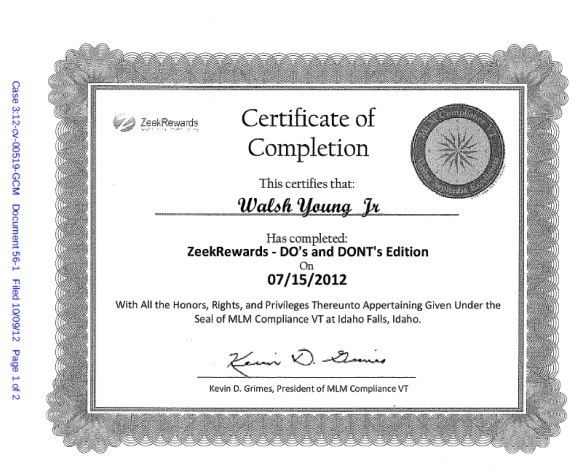
    The logo of Zeek Rewards appears on this “Certificate of Completion” issued to Zeek member Walsh Young Jr. (Source: screen shot of exhibit filed by Young Oct. 9.)

    For Californians Walsh J. Young Jr. and May Causing, the Zeek Rewards MLM scheme left them “on the verge of financial devastation,” according to a new filing in the Zeek Ponzi scheme case.

    The self-written, self-submitted filing by Young and Causing appeared yesterday on the docket of Senior U.S. District Judge Graham C. Mullen of the Western District of North Carolina. Mullen is presiding over the Zeek case brought by the SEC Aug. 17.

    Causing plowed $5,000 into the Zeek scheme in April 2012, funding her Zeek account with an “Official Check” from Citibank, according to the filing and an exhibit that accompanied it.

    Causing resides in Eagle Rock.

    On June 4, Young plowed $2,000 into Zeek, using a cashier’s check from Bank of America, according to the filings. Later — on June 26 — he plowed another $6,000 into Zeek, again using a Bank of America cashier’s check.

    Young resides in Bell.

    The filing alleges that Zeek business meetings were conducted by affiliates in Rancho Cucamonga, Harbor City, Cerritos and Carson.

    Prospects, according to Young and Causing, were told that they could purchase “name brand merchandise at 95% off of retail prices” and that the company had a “long standing track record with 15 years of rock solid business practices.”

    The pitch, according to Young and Causing, included references to the business bona fides of Zeek operator Paul Burks and Kevin Grimes, “known to be the best MLM attorney in the industry.”

    Prospects also were told that Zeek shared “50% of its daily profits with vested affiliates,” according to the filing.

    The filing claims that Zeek pitchman Tom More had acquired “over a million VIP points” and that Dolly Inocencio had acquired “over 250,000 VIP points.”

    All in all, the Zeek deal seemed to make sense, given the claims, according to Young and Causing.

    “This offer made it difficult to walk away with taking no action and in consideration of the money being received by Mr. Tom More and Ms. Dolly Inonencio, early Zeek members,” Young and Causing wrote.

    Then came news of the August SEC action, which alleged Zeek was a $600 million Ponzi- and pyramid scheme and Burks was a securities fraudster. The SEC said last month that its probe was ongoing.

    The filing by Young and Causing closed with an assertion that they “have suffered a tremendous financial hardship and are left on the verge of financial devastation” — and it asked the judge and court-appointed receiver Kenneth D. Bell for help in making them whole.

    Young and Causing also alluded to a “class” of Zeek members in their filing, but the meaning of that was not immediately clear. The caption of their filing complains of “false business practices, false hopes disguised as lucrative financial business opportunities and ill gotten gain.”

    Bell said in court filings Monday that he will “investigate potential claims against professionals and others” involved with Zeek to determine “who may be liable for the role they played in facilitating the operation.”

    Claims against the unidentified “professionals” and others will be pursued, if warranted, Bell advised the judge.

    Clawback actions against Zeek “net winners” also are contemplated, Bell said.


  • 10 Individuals, Including 6 Pitchmen, Indicted In Alleged ‘Vendstar’ Bizop Scam That Fleeced Customers $10,000 At A Time, Prosecutors Say

    “Instead of becoming successful entrepreneurs, the individual investors become victims of fraud, often losing their life’s savings. In this way, business opportunity schemes tarnish the American Dream of success through hard work. We will help protect the investing public by prosecuting these cases aggressively.” —  U.S. Attorney Wifredo A. Ferrer of the Southern District of Florida., Oct. 10, 2012

    Ten alleged bizop fraudsters, including six pitchmen from New York, have been indicted in the Southern District of Florida in a scam involving vending machines that fleeced investors $10,000 at a time, the Justice Department said.

    The case was brought after a probe by the U.S. Postal Inspection Service that reached into at least three states and involved a company known as Multivend LLC, which did business as Vendstar. A grand jury returned the indictment in Miami.

    Scammers gained a head of steam through newspaper and Internet ads, prosecutors said, alleging that purported “locating companies” assisted Vendstar in the scam.

    Despite the claim customers’ machines would be placed at quality locations, the scammers “generally placed consumers’ machines wherever they could as quickly as they could, often in businesses that had not consented to housing the machines and that soon demanded that the machines be removed,” prosecutors said.

    “The U.S. Postal Inspection Service will continue to work with our partners in law enforcement to ensure that the U.S. Postal Service isn’t used as a conduit to defrauding the American consumer,” said Tony Gomez, acting inspector in charge of the U.S. Postal Inspection Service in Miami.

    Here is the list of defendants:

    • Edward Morris “Ned” Weaver, 39, of Perrysburg, Ohio, the president and chief executive officer of Vendstar.
    • Lawrence A. Kaplan, 54, of Brooklyn, N.Y., the technical support manager for Vendstar.
    • Scott M. Doumas, 40, of East Setauket, N.Y., a salesman and sales manager at Vendstar.
    • Mark Benowitz, 65, of Holtsville, N.Y., a salesman at Vendstar.
    • Richard R. Goldberg, 40, of Bay Shore, N.Y. a salesman at Vendstar.
    • Richard Linick, 70, of Coram, N.Y., a salesman at Vendstar.
    • Paul E. Raia, 61, of Brookhaven, N.Y., a salesman at Vendstar.
    • Howard S. Strauss, 63, of Jericho, N.Y., a salesman at Vendstar.
    • Wallace W. DiRenzo, 67, of Cleveland, Ohio, who operated Nationwide Locating Company, which was based in North Palm Beach, Fla.
    • James P. Ellis, 42, of Northport, Ala., who operated Vending Dreams, Priority Placements, Clear Vision Marketing, Map Marketing and Secure Placement.

    From a Justice Department statement (italics added):

    Each of the defendants is charged with conspiracy to commit mail and wire fraud, and an enhanced penalty for telemarketing , which together provide for a maximum sentence of 10 years in prison. Weaver, Kaplan, Benowitz, Goldberg, Linick, Raia, Strauss and DiRenzo also are charged with mail fraud, and/or wire fraud, each of which carry a maximum of 20 years in prison.

  • BULLETIN: AdSurfDaily Figure Kenneth Wayne Leaming Was Founder Of ‘Sovereign Group’s Armed Enforcement Wing’ And Had ‘Assault Rifle’ With Bayonet At Time Of Arrest, Prosecutors Say; Probe Was Part Of Deeper Investigation Into ‘Sovereign Citizens’ Operating Nationally Through Washington State

    Kenneth Wayne Leaming

    BULLETIN: The November 2011 arrest by the FBI of Kenneth Wayne Leaming was part of a deeper probe into the activities of a “national” group of “sovereign citizens”  operating in the Pacific Northwest, new court filings by federal prosecutors in the Western District of Washington reveal.

    “Local jurisdictions alerted federal law enforcement that they had received a significant number of threats from members of this group,” prosecutors said.

    Leaming, prosecutors said, was “a long-time constitutionalist/sovereign citizen, who had a
    documented history of holding himself out as a law enforcement officer and/or a lawyer . . . He also was instrumental in founding the ‘County Rangers,’ the sovereign group’s armed enforcement wing. Members of the County Rangers were issued realistic-looking badges and credentials were required to possess firearms as part of their duties, and held themselves out as law enforcement agents.”

    Leaming, 56, of Spanaway, Wash., is a figure in the AdSurfDaily Ponzi scheme story. Some ASD members have claimed Leaming was performing legal work for them, and his name appears on the ASD court docket as the filer of a purported “Notice of Final Determination and Judgment.”

    Such filings have been associated with the “sovereign citizens” movement.

    As first reported on the PP Blog last year, Leaming, 56 and a convicted felon for piloting an aircraft without a license, was found with two federal fugitives from Arkansas at the time of his arrest.

    Both of those fugitives — Timothy Shawn Donavan and Sharon Jeannette Henningsen — now have been convicted of multiple counts of mail fraud in a home-based business caper in Arkansas, according to court files.

    The new filings by prosecutors came in response to a bid by Leaming to challenge the search warrant in the case and to suppress evidence against him.

    Leaming was indicted on charges of filing false liens, harboring fugitives, possessing firearms as a convicted felon and uttering a bogus “Bonded Promissory Note” with a face value of $1 million and depositing it in U.S. Bank.

    The bank “briefly credited Leaming’s account in the amount of $31,350, before realizing the amount was wholly fictitious and reversing the credit,” prosecutors said.

    At least four of Leaming’s “sovereign” associates — David Russell Myrland, Timothy Garrison, Raymond Leo Jarlik-Bell and David Carroll Stephenson  — already have been charged or convicted in various schemes, prosecutors said.

    Bogus liens linked to Leaming were found during a search of Jarlik-Bell’s residence, prosecutors said, making a veiled reference to the ASD case as a “a large wire fraud case” in the District of Columbia.

    Whether Jarlik-Bell has any ASD ties is unclear.

    The liens had been filed with the Pierce County Auditor [in Washington state] against a “federal District Judge, an AUSA, and other federal agents and employees, ” prosecutors said.

    Other records show that each of the alleged lien targets had ties to the ASD case, including U.S. District Judge Rosemary Collyer of the District of Columbia. Collyer presided over the ASD case.

    Prosecutors now assert that agents conducted a search of Leaming’s Spanaway residence and found an “AK-47 style assault rifle with a bayonet; several handguns (one of which was in a drawer of the desk Leaming was sitting at as entry was made); two other rifles; and a shotgun.”

    From the prosecution filing (italics added):

    “Immediately after execution of the search warrant, but before Leaming was transported from the scene, agents asked Leaming questions about the presence of firearms for officer safety purposes. Leaming admitted that a number of firearms were present in the home.”

    Meanwhile, agents found a “box of ‘County Ranger’ badges and other false law enforcement credentials,” prosecutors said.

    At the same time, agents found “numerous boxes of correspondence and legal paperwork documenting other apparent fraud schemes,” prosecutors said.

    Leaming is contending that the alleged liens aren’t really liens and, even if they were, “he had some constitutional right to file them,” prosecutors said.

    He also contends that he has a Constitutional right to possess firearms as a convicted felon and that the government is not permitted to regulate firearms ownership, prosecutors said.

    As the investigation continued more bogus liens were discovered against other government officials, prosecutors said.

    Those liens have been linked to Leaming and Stephenson, a jailed former business colleague of Leaming’s. They were filed in Pierce County “against the Warden” of the Federal Correctional Institution in Phoenix and the “direct[or] of the Bureau of Prisons,” prosecutors said.

    From the prosecution’s filing (italics added):

    ” . . . during the investigation agents also discovered that Leaming was preparing and using false and fictitious financial instruments. These instruments were typically called “Bonded Promissory Notes,” and purported to be issued by the Federal Reserve or the United States Treasury.”

    As to the firearms allegations, Leaming “advanced some type of nonsensical, quasi-legalistic explanation as to why they were not, in fact, firearms,” prosecutors said.

    Leaming has been jailed since his November 2011 arrest. Since that time, he has sued President Obama, Attorney General Eric Holder and a county sheriff in Arkansas, according to court filings.

    ASD operator Andy Bowdoin was sentenced in August to 78 months in federal prison. He admitted in May that ASD was a Ponzi scheme. Prosecutors said the scheme gathered at least $119 million.