Blog

  • Zeek Promoters Send Email To AdSurfDaily Members, Asking Them To Wire Money To Confessed Ponzi Schemer Andy Bowdoin’s Jailhouse Account In The District Of Columbia; Zeekers ‘Owe This Man A Great Deal Of Gratitude And More’ For Opening ‘Path To Success,’ Email Claims

    ASD's Andy Bowdoin

    UPDATED 8:42 A.M. EDT (JULY 14, U.S.A.) It’s beginning to look as though the Zeek Rewards’ MLM “program” has within it a large downline consisting of members of the AdSurfDaily Ponzi scheme. And in what may go down as one of the most spectacular PR blunders in the history of multilevel marketing, some former ASD promoters who now are Zeek promoters are encouraging their email contacts and downline members to wire money to jailed ASD President and recidivist securities huckster Andy Bowdoin — while using Zeek’s name in the appeal and describing Bowdoin as a pioneer who inspired “programs” such as Zeek to model themselves after ASD.

    “You are also all aware that I believe those of us in Zeek and other programs that modeled themselves after the business model that Andy pioneered owe this man a great deal of gratitude and more,” the email read in part. “Please get in touch with your down lines as well.” (The email is reproduced below.)

    For good measure, the email described Bowdoin as the man who’d provided MLMers the “path to success.” It also included a link to join the Zeek “program” under a headline of “Tired of Recruiting and Selling?” and this text teaser: “Get Rewarded DAILY for Placing Ads just like this one! Get Paid Every 24 Hours.”

    A second ad in the email encouraged readers to “Get your FREE Gold Savings Account here and qualify to receive Free Gold.”

    The PP Blog received news of the email early last evening, as it was preparing a post that reported an alleged HYIP purveyor in Ohio had been named in a 49-count federal indictment charging him with wire fraud and money-laundering. Terrance Osberger, 48, of Genoa, Ohio, was accused of pushing HYIP Ponzi schemes through an enterprise known as Eagle Trades LTD.

    The returns Osberger allegedly offered were on par with the returns suggested by both ASD and Zeek: in the hundreds of percent per year. And like ASD and Zeek, Osberger allegedly used SolidTrustPay, an offshore payment processor, and issued a preemptive denial that a fraud scheme was under way. The alleged Eagle Trades HYIP fraud appears to have gathered at least $1.8 million, a relatively modest sum compared to HYIP frauds such as ASD ($110 million), Legisi ($72 million), Pathway To Prosperity ($70 million) and Genius Funds (an estimated $400 million).

    In February 2012 — while announcing the guilty plea of Gregory McKnight in the Legisi HYIP Ponzi scheme — a special agent of the U.S. Secret Service noted that such schemes engage in form-shifting.

    “Fraudulent schemes such as this have evolved significantly over the last several years,” said Jeffrey Frost, special agent in charge of the U.S. Secret Service Detroit Field Office.

    AdSurfDaily was an online Ponzi scheme that said it set aside 50 percent of its daily revenue to share with affiliates. Those affiliates received an unusually consistent return of 1 percent a day. ASD described itself as a revenue-sharing program and encouraged members not to describe the “opportunity” as an investment.

    Zeek also says it is a revenue-sharing program. Like ASD, Zeek claims it sets aside 50 percent of its daily revenue to share with affiliates. Affiliates have said they are earning between 1 percent and 2 percent a day, a percentage that corresponds to an annualized return of between 365 percent and 730 percent.

    And like ASD, Zeek tells affiliates not to describe the “opportunity” as an investment program. Some Zeek affiliates are said to earning $1 million a month. Similar to ASD, which preemptively denied it was a Ponzi scheme, Zeek has preemptively denied it is a “pyramid scheme” — all while planting the seed that the U.S. government is running a pyramid scheme through its Social Security program.

    In May, ASD’s Bowdoin pleaded guilty to wire fraud in the ASD Ponzi case. The ASD patriarch admitted his “program” was a Ponzi scheme, saying in a statement of offense the company never operated lawfully from its 2006 inception. As part of a plea bargain, Bowdoin has been banned from multilevel marketing, Internet programs and mass-marketing.

    The email circulating yesterday disclosed none of these things, instead painting Bowdoin as an MLM pioneer and inspirational figure.

    Nor did the email disclose Bowdoin’s felonious history as a securities huckster in Alabama a decade before he rolled out ASD in 2006. And it did not disclose that one of his business partners in ASD was implicated by the SEC in the 1990s in three prime-bank swindles, including one that suggested prospects could earn a return of 10,000 percent. In court documents originally filed under seal in February 2009 — as an upstart autosurf known as AdViewGlobal was launching — the U.S. Secret Service alleged that Bowdoin also had a “silent partner” in ASD.

    That silent partner, according to the Secret Service, was Bowdoin’s sponsor in the 12DailyPro Ponzi scheme that sucked in tens of millions of dollars before the SEC destroyed it just months before ASD launched in the late summer and fall of 2006. Bowdoin and his silent partner simply tweaked the 12DailyPro business model, reducing the daily payout rate to about 1 percent and using linguistic sleight of hand in a failed bid to keep ASD under the radar, according to court filings.

    Bowdoin’s nearly four-year-long legal saga began in July 2008, with the U.S. Secret Service starting an undercover probe. That probe has led to the filing of at least three civil forfeiture complaints, the seizure of tens of millions of dollars, court actions and seizures of bank accounts against certain individual ASD members, special statements by the U.S. Department of Justice and the U.S. Secret Service and the ultimate filing of criminal charges against Bowdoin.

    In 2009, Bowdoin and former ASD attorney Robert Garner were accused of racketeering in a proposed class-action lawsuit filed by three former ASD members. That lawsuit was placed on hold because of all the other litigation piling up against Bowdoin and ASD-related assets.

    All of it appears to be meaningless to certain ASD members now promoting Zeek.

    Also apparently meaningless is Bowdoin’s record of criminality in Alabama in the 1990s in at least three counties

    In June 2012, Bowdoin’s bond was revoked after federal prosecutors proffered evidence that he continued to promote scams after the seizure of more than $80 million in the ASD case by the U.S. Secret Service in August 2008 and after Bowdoin was arrested on the ASD-related Ponzi charges in December 2010. One of the alleged “programs” linked to Bowdoin by investigators was AdViewGlobal, an ASD-like autosurf that collapsed during the summer of 2009.

    Bowdoin also was linked to a “program” known as “OneX,” which prosecutors described as a “fraudulent scheme” and “pyramid” that was recycling money in ASD-like fashion. Some Zeek promoters also are known to have been OneX promoters. It also is known that some Zeek promoters also are pushing JSS Tripler/JustBeenPaid, a “program” that purports to pay 2 percent a day (730 percent a year) and may have ties to the “sovereign citizens” movement.

    In recent days, JSS/JBP published a claim that it had hired a criminal defense lawyer in Salt Lake City. Like ASD, Zeek, OneX and Eagle Trades, JSS/JBP has a business relationship with SolidTrustPay. (NOTE: OneX now claims it no longer uses SolidTrustPay and is trying to get a new processor after a deal it thought it had with another processor fell through. In a conference call earlier this week, OneX blamed its members for the developments and claimed it had been targeted by fraudsters. Now under indictment in Ohio, Eagle Trades’ Osberger told investors in Massachusetts that his “program” also had been targeted by fraudsters, according to records.)

    The email some ASD members received last night that references Zeek appears to have forwarded by former ASD pitchman Todd Disner, who became a Zeek promoter. Former ASD member Barb Alford — also a Zeek promoter — appears to have been the author. The email’s “To” line also references Jerry Napier, another former ASD promoter who became a Zeek promoter.

    Napier once was featured in a promo on Zeek’s Blog. Records suggest he signed a petition in 2008 — after two forfeiture complaints were filed against ASD-related assets — that asked the U.S. Senate to investigate the ASD prosecution team and the U.S. Secret Service agent who developed the ASD Ponzi case with the assistance of a Florida-based Task Force consisting of investigators from the IRS, the Secret Service and other agencies.

    Alford is a former moderator of the pro-ASD Surf’s Up forum, which disappeared mysteriously in 2010. Teralynn Hoy, another former Surf’s Up moderator, hosted a conference call for Zeek last year. Zeek once listed Hoy as an “employee.”

    In 2011, Disner joined with former ASD member Dwight Owen Schweitzer — who also became a Zeek promoter — in a lawsuit against the United States for alleged misdeeds in bringing the ASD Ponzi case. Disner and Schweitzer, who have raised the prospect in court filings that they could face prosecution for tax evasion in the aftermath of the the ASD investigation, continue to press the lawsuit — despite Bowdoin’s guilty plea to wire fraud in the ASD Ponzi case and acknowledgement he was operating a Ponzi scheme.

    Here is the email circulating last night (italics/bolding added):

    As you all are aware, Andy, is now sitting in a DC jail ward. He is in need of funds in his account so that he can purchase shoes, tooth brushes, tooth paste etc. the prison system charges ridiculous prices for this stuff. A pair of shoes alone in there costs 65.00.

    You are also all aware that I believe those of us in Zeek and other programs that modeled themselves after the business model that Andy pioneered owe this man a great deal of gratitude and more. Please get in touch with your down lines as well.

    I have received info where funds can be wired into his account to help him with his daily needs.

    We can do this one of two ways. Anyone wishing to assist in the effort can send the money to me and I will wire all at once or we can do it individually. I have enclosed the wiring information below.

    Let’s not drop the ball on this one. Anyone willing to do the right thing, one more time, please contact me.

    I would appreciate any help you can give. It is not right that this man sits alone in jail hundreds of miles from home with no end in sight when it was he who gave us the path to success.

    Respectfully
    Barb Alford
    [Phone number deleted by PP Blog]

    It has to go through Western Union to be placed on his account.

    City Code: [Deleted by PP Blog]
    State: Tennessee
    Senders Acct # [Deleted by PP Blog]
    Sender: Thomas Bowdoin

    Here is his address if you want to write him
    Correction Treatment Facility
    1901 East St. SE
    Med-96 Inmate 335084
    Washington DC 20003

    George said he gets his mail on Tuesdays and Saturdays.

    Anyway, GF, I know you said a few people might want to donate to help him. I know he would love to get a letter from YOU. I am sending one tomorrow so he can get it on Saturday, I hope.


  • KABOOM! Alleged HYIP Operator Indicted On 49 Ponzi-Related Charges By Federal Grand Jury In Ohio After IRS Probe; ‘Program’ Was Pushed On MoneyMakerGroup And TalkGold; Wire Fraud And Money-Laundering Alleged Against Terrance Osberger Of Eagle Trades LTD

    BULLETIN: The operator of an alleged HYIP fraud known as Eagle Trades LTD has been indicted on 49 Ponzi-related charges of wire fraud and money-laundering after a probe by the IRS, federal prosecutors in the Northern District of Ohio said.

    Terrance Osberger, 48, of Genoa, Ohio, has been charged with one count of wire fraud and 48 counts of money-laundering, the office of U.S. Attorney Steven M. Dettelbach said.

    Records show that the “program,” which allegedly offered returns in the hundreds of percent over 190 days, was promoted in 2009 on the TalkGold and MoneyMakerGroup forums. Separately, records show that state securities regulators in Massachusetts filed civil charges against Eagle Trades in 2011, alleging that two investors in the state were instructed by Osberger to send “their joint $103,000 investment through SolidTrustPay.”

    SolidTrustPay is a Canadian payment processor favored by HYIP scammers.

    The money sent through SolidTrustPay appears to have made its way into an Eagle Trades’ bank account in Ohio “over the course of several successive days,” according to the Massachusetts filing. But due to the “high volume of transactions and the intermingling of funds” in the account, Massachusetts investigators said they were “unable to definitely determine the ultimate destination of the $103,000 investment.”

    Another Massachusetts investor was instructed by Osberger to wire $50,500 to a Cyprus entity known as F.B.M.E. Bank Ltd. That transaction proved to be difficult to reverse-engineer because of international red tape, according to the Massachusetts complaint.

    The Massachusetts filings speak to the recovery difficulties investors may encounter when doing business with murky enterprises that may have one or more offshore arms, the ability to send and receive money via offshore payment processors and a corresponding ability to dump the money into domestic or international bank accounts — before moving it again.

    Eagle Trades, according to an evidence exhibit prepared by Massachusetts investigators, told investors that they “will quickly notice that we have reengineered the mold regarding High Yield Investment Programs [HYIPs], making it easier than ever for you to be more informed regarding your investment options and earn a realistic, yet sustainable investment return.”

    Current HYIPs such as JSS Tripler/JustBeenPaid are making similar claims about purported sustainability and reengineered platforms while also luring prospects by advertising returns that correspond to annualized returns in the hundreds of percent — and all while using SolidTrustPay and other offshore processors.

    JSS/JBP purportedly is operated by Frederick Mann, a former pitchman for the AdSurfDaily Ponzi scheme, which also had a presence on the Ponzi boards, also used SolidTrustPay and also planted the seed that annualized returns in the hundreds of percent were possible.

    ASD President Andy Bowdoin, 77, is jailed in the District of Columbia. He pleaded guilty to wire fraud in May and acknowledged ASD was a Ponzi scheme that never operated legally from its 2006 inception.

    Over time, Eagle Trades told Massachusetts investors waiting for their payouts that it had been targeted in a”massive, seven-figure fraud” and provided a series of excuses about why investors were not getting paid. But federal prosecutors in Ohio now say Osberger was using Eagles Trades to defraud customers.

    He potentially faces decades in prison.

    “Osberger misused investor funds for his own personal use,” federal prosecutors said. “In other cases, he misused investor proceeds to repay earlier investors in what is commonly known as a Ponzi scheme, according to the indictment.”

    And, federal prosecutors said, “Osberger listed Eagle as a subsidiary of Falcon Financial Group Limited, with addresses in Belize and the Commonwealth of Dominica and utilitzed Aurum Capital Holdings, which maintained several offshore bank accounts during the scheme, according to the indictment.

    From "Exhibit 1" in the state-level case against the Eagle Trades HYIP in Massachusetts.
  • MORE SENIOR FRAUD: ‘Insider Lending’ Scam: Illinois Man, 82, Pleads Guilty To Duping Bank He Once Led; Bank Later Failed

    In what federal prosecutors described as an “insider lending” scam, the 82-year-old former chairman of a bank that failed in 2011 has pleaded guilty to duping the bank and regulators by concealing his interests in loans made by the bank to his secret business associates.

    James A. Regas, of Oak Brook, caused employees of Western Springs National Bank & Trust to make false financial reports to the FDIC and “admitted that he falsified and concealed material facts that should have been fully disclosed to the bank’s directors and government regulators during 2008 and 2009,” federal prosecutors said.

    Meanwhile, Regas signed reports to the FDIC “knowing they contained false information regarding the delinquency status of certain loans” prosecutors said.

    All in all, the bank lost about $681,000 on loans in which Regas had an undisclosed interest. Each of the loans went to business associates of Regas and, in one case, Regas received about half of the proceeds of a $500,000 loan “indirectly through a third-party,” prosecutors said.

    In another case, an $803,000 loan was used to partially finance the acquisition of three properties “in which Regas and family members had financial interests.” In a third case, a $750,000 loan was made to a real-estate investor who used the proceeds to purchase an apartment building from Regas.

    “That building served as collateral for the bank on another loan that Regas acquired and sold through a nominee company,” prosecutors said. “These loans enabled Regas to use bank funds for his own benefit without having to apply for loans himself, posting collateral or signing any promises to repay the bank’s money, while evading federal restrictions on insider loans.”

    “Regas knowingly submitted false conflict-of-interest statements to the bank, in which he denied having any financial relationship with any of the bank’s borrowers,” prosecutors said.

    He faces up to five years in federal prison and a restitution order. Sentencing is set for Oct. 25.

  • DEVELOPING STORY: CFTC Seeks Asset Freeze Amid Allegations Of Fraud Against Russell R. Wasendorf Sr. Of Peregrine Financial Group Inc.; Wasendorf Reportedly Attempted To Kill Himself Yesterday; Trevor Cook Ponzi Victims At Risk Of Getting Fleeced Twice

    EDITOR’S NOTE: The PP Blog first became aware of reports about the suicide bid of Russell R. Wasendorf Sr. last night, after being contacted by a reader who was defrauded in the Trevor Cook Ponzi scheme. Wasendorf apparently sought to take his own life on the sparkling Cedar Falls, Iowa, property of Peregrine Financial Group Inc., the company he founded in 1990 in Chicago. A deeply disturbing, multipronged mystery has emerged . . .

    ** ___________________________________ **

    Russell R. Wasendorf Sr.

    After a reported suicide bid yesterday, Russell R. Wasendorf Sr. is said to be comatose today. Regulators now say that more than $200 million in customer funds is missing from Peregrine Financial Group Inc. (PFG). By law, the customer money was supposed to have been segregated and separately accounted for.

    “The whereabouts of the funds is currently unknown,” the CFTC said today in a court filing in Chicago that accused Wasendorf and PFG of fraud and sought an asset freeze.

    Those alarming words followed on the heels of an emergency enforcement action yesterday by the National Futures Association, which alleged that Wasendorf “may have falsified bank records” to create the impression that PFG had about $400 million in segregated accounts in late June.

    Of the $400 million, $225 million purportedly was held at U.S. Bank.

    But when NFA checked with U.S. Bank yesterday, it learned that only about $5 million was on deposit, according to the emergency filing.

    Wasendorf is a member of NFA’s Futures Commission Merchant Advisory Committee with a term ending in February 2015, according to NFA’s website. He’s now effectively been accused of fraud by the same organization he purportedly served as a committee member.

    Whatever fraud was taking place at PFG, NFA and CFTC now say, appears to date back at least to February 2010. And that fraud, according to the NFA filing, appears to have carried over into both this year and last.

    PFG does business online as PFGBest at PFGBest.com. The website features a photo of PFG’s glistening headquarters building in rural Cedar Falls, Iowa.

    The building near the small city of about 40,000 nestled in America’s heartland, however, may belie the reality at PFG.

    In February 2012, R.J. Zayed, the court-appointed receiver in the Trevor Cook Ponzi scheme case in Minnesota, sued PFG. Among the allegations was that the company turned a blind eye to Cook’s Forex fraud and checkered history with NFA.

    Cook’s Ponzi scheme gathered about $194 million and rendered some investors destitute. About $30 million of that sum was lost in trading accounts at PFG, according to the receiver’s lawsuit.

    PFG, according to the lawsuit, permitted Cook to open, manage and maintain trading accounts “in the face of overwhelming red flags of fraud or insolvency.”

    Cook is now two years into a 25-year prison sentence for his Ponzi scheme, which has led to criminal charges and convictions of pitchmen Jason Bo-Alan Beckman, Gerald Durand and former radio huckster Pat Kiley.

    During the same month Zayed sued PFG, the company agreed to settle an earlier NFA complaint in which it was accused of failing to diligently supervise introducing brokers. One of the respondents in the case was Russell R. Wasendorf Jr., Wasendorf’s son. Wasendorf Jr. is the president and chief operating officer of PFGBest and founded its Forex division, according to the PFGBest website.

    The company agreed to pay $700,000 to settle the case with no acknowledgment of wrongdoing, according to NFA.

    About five months later, Wasendorf Sr. was accused of fraud. Details remain sketchy. It is unclear how much — if any — of the fraud for which he now stands accused is related to the Cook fraud.

    What is clear is that Cook himself  was in trouble at least two prior times with NFA, with the self-regulatory organization alleging in 2005 that he manipulated an elderly woman and caused her to liquidate a $100,000 annuity with which she already was earning an annual return of 8.75 percent.

    Cook told her she could earn more through him, according to the NFA complaint.

    NFA documentation in that case references an entity known as Private Financial Group which, curiously, also used the acronym PFG, the same acronym used by Peregrine Financial Group.

    Cook’s Ponzi scheme was exposed in 2009.

  • UPDATE: (1) Article In Portuguese By Zeek Affiliate On Google News Says Program Has 100,000 Members In Brazil Alone; (2) American Pitchman Calls Zeek An ‘Investment’ On YouTube — And Then Takes It Back

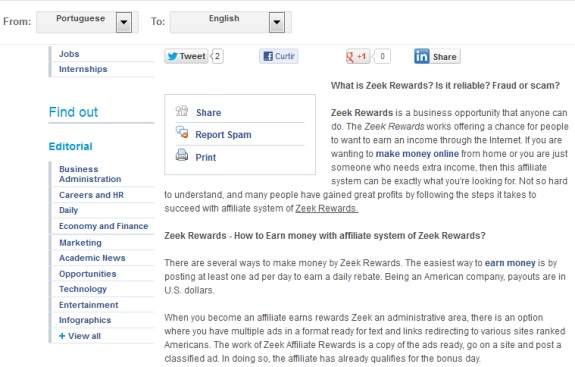
    Screenshot: Part of a promo for Zeek translated from Portuguese to English by Google Translate

    UPDATED 1:59 P.M. EDT (U.S.A.) An article on Google News by an apparent Portuguese-speaking affiliate of the U.S.-based Zeek Rewards MLM “program” that is married to a penny-auction site known as Zeekler claims that Zeek has more than 100,000 members in Brazil alone.

    Meanwhile, a promo by an American affiliate dated July 7 on YouTube describes Zeek as an investment program — before the affiliate backtracks and says Zeek is not an investment program. The YouTube development first was reported by BehindMLM.com. (Link at bottom of story.)

    Portuguese is the official language of Brazil, the largest country in South America. The claim of 100,000 Brazilian members could not immediately be confirmed, and no breakdown of the specific Zeek membership ranks Brazilian members had chosen was provided in the article. Zeek categorizes members as “Free,” “Silver” ($10 a month), “Gold” ($50 a month) and “Diamond” ($99 a month).

    In addition to selecting a membership rank within the Zeek MLM organization, affiliates can opt to send the company up to $10,000 as a means of gaining a daily share of what is known as the Retail Points Pool (RPP). Those shares later can be converted to cash payouts that correspond to an annualized return in the hundreds of percent. The RPP program has led to questions about whether Zeek is selling unregistered securities as investment contracts and using linguistic sleight-of-hand in a bid to avoid regulatory scrutiny.

    Zeek, purportedly part of Rex Venture Group LLC,  is based in North Carolina. On June 20, the office of North Carolina Attorney General Roy Cooper said it had concerns about the company, which plants the seed that members can earn a return of between 1 percent and 2 percent a day but denies it is offering an investment program. Zeek’s business model resembles that of AdSurfDaily, which the U.S. Secret Service said in 2008 was a massive, online Ponzi scheme that was offering securities and disguising itself as an “advertising” program.

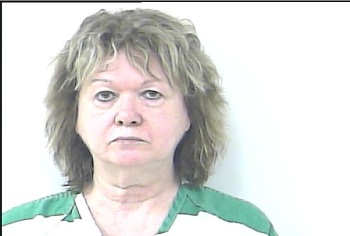
    Andy Bowdoin's booking photo in the District of Columbia.

    ASD President Andy Bowdoin is now jailed in the District of Columbia after pleading guilty to wire fraud in the ASD Ponzi case in May 2012. ASD’s purported payout of 1 percent a day was on par with Zeek’s purported daily payout. Because it is known that some affiliates of the ASD Ponzi scheme also are promoting Zeek and because Zeek has highlighted some of those ASD promoters on its website, questions have been raised about whether a core group of MLMers who move individually or as part of “teams” from one investment scheme to another is engaging in willful blindness by promoting Zeek, which is similar to ASD in key respects.

    And because the U.S. government returned millions of dollars to ASD victims last year in the form of remissions payments that came from funds seized in the ASD Ponzi case, questions have been raised about whether Zeek’s growth has been fueled at least in part by the funds originally seized in the ASD case. The government is believed to have returned about $59 million to former ASD members.

    Although Zeek says it is not offering a return on investment and instead is offering revenue-sharing program, the resultant payouts correspond to figures typically associated with HYIP Ponzi investment schemes. Like Zeek, ASD also claimed to be a revenue-sharing program.

    The English version of the Portuguese article for Zeek, according to Google Translate, includes this line: “The easiest way to earn money is by posting at least one ad per day to earn a daily rebate.” (Emphasis added by PP Blog.)

    ASD also called its payouts to members “rebates.” The affiliate article for Zeek in Portuguese includes this phrase: “uma bonificação diária.” The phrase, according to Google Translate, means “a daily subsidy” or “a daily rebate.”

    In the ASD case, federal prosecutors said use of the word “rebate” was a means of masking the investment element of the ASD “program.”

    Zeek also may have a presence in Portugal itself, according to text below a YouTube video (www.youtube.com/watch?v=w07uP5XF39w) in which former ASD pitchman Todd Disner appears. Disner speaks in English in the video, but others appear to be speaking Portuguese and a link below the video points to a website styled in part as zeekportugal.com. Other text at the YouTube site points to a YouTube site styled “parttimezeekrewards’s channel.”

    Disner and former ASD member Dwight Owen Schweitzer sued the United States in November 2011, claiming that ASD was a legitimate business and that government undercover agents who joined ASD had a duty to identify themselves to ASD management. Schweitzer also is promoting Zeek, according to an online promo on a classified-ad site.

    ASD’s Andy Bowdoin’s guilty plea and acknowledgement ASD was a Ponzi scheme were recorded in May 2012, about six months after Disner and Schweitzer sued the government. Both men are seeking to press forward with the lawsuit, despite Bowdoin’s guilty plea to wire fraud and Ponzi concession. The duo claims the seizure of information from ASD’s database by the government was unconstitutional under the 4th Amendment. A federal judge in Florida is expected to rule soon on whether the Disner/Schweizer claims can proceed.

    Virality And Customer-Service Concerns

    The article on Google News that claims that Zeek has 100,000 members in the Portuguese-speaking country of Brazil may speak to the virality of the “program” on the Internet. At the same time, it may explain — at least in part — why Zeek’s customer-support systems appear to be severely taxed if not broken, with Zeek instructing its members to go to their uplines for support. Requests for help through Zeek itself have backed up for weeks or even months. Some English-speaking members of Zeek have complained their support tickets were ignored or closed without explanation.

    Having thousands or even tens of thousands of affiliates in countries whose citizens may not be fully conversant in English leads to questions about whether Zeek has both the resources and the infrastructure to support a global membership base, even as some Zeek members who may not speak English are sending the company one-time sums of up to $10,000 and monthly fees on top of that. It also leads to questions about whether Zeek can police its own global network of affiliates, whether Zeek has the capacity to adequately monitor claims about the “program” in languages other than English and whether Zeek can determine whether its U.S. domestic and international affiliates are operating in “teams” to engage in downline “stacking” designed to concentrate earnings in favored familial or local pools.

    Like ASD, Zeek has instructed members not to describe the “opportunity” as an investment program. But BehindMLM reported yesterday that a Zeek member on YouTube was doing just that before catching himself and going into backtrack mode. From BehindMLM.com, quoting from a Zeek affiliate’s July 7 YouTube promo (italics added):

    [8:58] Do it, I did it! Do it and you’ll see how quickly you can recoup your investm..recoup your investment-ahh, I’m sorry, it’s not an investment – your original purchasing of bids.

    Visit this story thread on BehindMLM.com.

  • REPORTS: Accused Montana Ponzi Schemer Richard F. Reynolds Has Been Arrested In Kansas

    Richard F. Reynolds, the accused Montana Ponzi schemer, has been arrested in Kansas, ABCMontana is reporting via the Associated Press.

    The AP report cites a report that first appeared in the Bozeman Daily Chronicle.

    Reynolds also is known as Richard F. Adkins. In March, the office of Montana Commissioner of Securities Monica J. Lindeen said Reynolds presided over an “elaborate” caper that swindled “at least 140 victims from 21 states and 6 countries.”

    Millions of dollars were involved, Lindeen’s office said at the time.

    Between 2008 and 2011, the scam “shuffled investor’s money across more than 30 bank accounts to be spent on new cars, international vacations, and a new home for Reynolds and his wife,” Lindeen’s office said in March.

    As many as eight corporations Reynolds created over the three-year period may be part of the swindle, Lindeen’s office said.

    See ABCMontana report.


  • UPDATE: 2 Purported ‘Sovereigns’ Jailed In Florida On Fugitive Warrant From Alabama

    Travis Lee Lambert. (From booking photo in St. Lucie County, Fla.)

    Purported “sovereign citizens” Travis Lee Lambert and Janet Tharpe Hancock are listed as prisoners at the St. Lucie County Jail in Fort Pierce, Fla.

    Lambert, 62, and Hancock, 61, were booked at the jail July 2, according to the St. Lucie County Sheriff’s Office. They are being held on fugitive warrants from Alabama.

    Lambert was charged last year with the unauthorized practice of law amid allegations he filed court pleadings for Hancock, his girlfriend and a convicted burglar out on bond during an appeal.

    “Sovereign citizens” may have an irrational belief that laws do not apply to them.

    Hancock is at least the second female “sovereign citizen” arrested in Florida in recent weeks. “Linda Louise” was arrested in May by police in Punta Gorda.

    Janet Tharpe Hancock. (From booking photo in St. Lucie County, Fla.)

    See report in Andalusia Star News.

  • ZEEK SLAYER? Now, A Penny-Auction Site Married To MLM-Like Scheme Purportedly Tied To Effort To Save Children From Hunger Or Becoming ‘Sex Slave[s]’; Build Up To ‘Founding Member’ Sales Pitch Drops Names Of White House, Chelsea Clinton, Historian And Presidential Adviser Doug Wead, Unidentified Presidential Candidate And NBC News Anchor Lester Holt

    From YouTube sales pitch for BidsThatGive by Randy Jeffers. (Children's faces masked by PP Blog.)

    EDITOR’S NOTE: It is true that far too many of the world’s children live in poverty. It also is true that children may become the objects of criminals who engage in human trafficking and that children are exploited in the sex trades. It is equally true that legitimate charities exist to combat these horrific situations and that one MLM “program” after another has tried in recent times to tug at the human heart and “marry” their “programs” to a purported cause. If you desire to improve the human condition for the masses of children, it likely is best to donate directly to a legitimate charitable organization, rather than joining a get-rich-quick scheme that says it is doing good work behind the scenes.

    ** __________________________________________ **

    UPDATED 6:57 P.M. EDT (U.S.A.) WARNING: The following development in MLM La-La Land may be harmful to your gag reflex.

    Zeek Rewards, the U.S.-based MLM “program” that wraps itself in the American flag, collects sums of up to $10,000 from participants, plants the seed affiliates can earn a return of between 1 percent and 2 percent a day while insisting it is offering neither securities nor an investment program, has a payout scheme similar to the AdSurfDaily Ponzi scheme and securities swindle, is married to a penny-auction site known as Zeekler that has told successful bidders for sums of U.S. cash that they can receive their money via offshore payment processors and preemptively denies it is a pyramid scheme, has some emerging, U.S.-based competition.

    The name of the “program” is “BidsThatGive” — and it unabashedly tugs at heartstrings while at once asking prospects to imagine themselves behind the wheel of a grand automobile and feeling good because they also could become a “Contributor” for $10 a month, a “Guardian” for $50 a month, a “Benefactor” for $100 a month” or a Global Ambassador” for $250 a month and pile up mountains of cash while they’re displaying a social conscience.

    Two of the core aims of the “program,” according to a nine-minute video promo running on YouTube, are to help impoverished children and children who’d been exploited and became “sex slave[s].” The prelaunch of BidsThatGive appears to have been timed to coincide with the Independence Day holiday period in the United States.

    One of the assertions in a the YouTube video is that the “rewards” the company provides include “an orphanage and a school, church or hospital built in your name.” All of this apparently is possible because BidsThatGive has a “global business model” and employes a “concept” known as “PPSC,” which stands for Private Profit Sharing Company.

    But before we get to the uber bizarre, let’s address the run-of-the-mill bizarre in this latest entry in MLM La-La Land.

    BidsThatGive is a little bit Andy Bowdoin. Indeed, the emerging penny-auction company with an MLM-style compensation plan, claims it’s not an MLM program and tells prospects they’re “probably not going to sleep at night” once they understand the profit potential. Bowdoin, the infamous AdSurfDaily Ponzi schemer, told prospects that ASD was not a “network marketing company” and used largely the same line about all the sleepless nights excited prospects would experience.

    Meanwhile, BidsThatGive is a little bit like AdViewGlobal (AVG), a collapsed 1-percent-a-day Ponzi autosurf federal prosecutors said in April 2012 had ASD ties. AVG once claimed that one of its desires was to save the rainforest through charitable contributions. BidsThatGive also resembles ClubAsteria, which offered outsize weekly returns ranging from 3 percent to 8 percent and told prospects that its charitable arm would provide relief to victims of the devastating earthquake in Japan last year. ClubAsteria also purported to provide aid to children and claimed its mission was to elevate the word’s poor out of poverty.

    Last year, the American Red Cross sent Club Asteria a letter demanding it stop using the Red Cross name in promos.

    And BidsThatGive also resembles DataNetworkAffiliates (DNA), which tied itself to the U.S. AMBER Alert system for rescuing abducted children and said its “token system” could help prevent child poverty.

    “Help DNA Feed A Million. OVER 1000 AN HOUR DIE. The DNA Token System Can Prevent This!” the company exclaimed.

    Among other things, DNA used a YouTube video to trade on the name of Adam Walsh, the 6-year-old who was abducted and murdered in Florida in 1981. Adam’s father, John Walsh, became a prolific advocate for children and later became the host of the “America’s Most Wanted” television series.

    DNA, which was associated with longtime MLM huckster Phil Piccolo, appears not to have helped a single abducted child or a single child living in poverty. Affiliates, though, tried to plant the seed that the DNA “program” was backed by Oprah Winfrey and Donald Trump. When DNA’s CEO resigned suddenly in 2010, the company waited nearly a week to announce the departure — and then misspelled the former CEO’s name.

    BidsThatGive Operator

    Randy Jeffers, an MLM aficionado, is the purported operator of BidsThatGive, according to promo videos on YouTube. Jeffers also presides over a nonprofit entity known as “Liberty Kidz,” which says its “[v]ision is to empower a child to be all that he or she is created to be, by providing homes, help and hope for discouraged, displaced and distressed children of the world.”

    A similarly named Jeffers’ entity known as Liberty International LLC filed for bankruptcy in August 2010, listing about $1.94 million in debt and $641 in assets, according to federal records. The assets consisted of the balance of a business checking account.

    What follows are comments from Jeffers in the nine-minute sales pitch for BidsThatGive on YouTube (italics added):

    You know, there are so many terrible things that happen to children all over the world. Right now a little boy is dying of hunger, a little girl just got sold by her mother and is being forced into life as a sex slave.

    Right now, children are being physically abused, and then there’s so many children that are just left by themselves and there’s no one there to love or care for them. I don’t know why bad things happen to innocent little children, but they do. But here’s what I do know: All of us can do something about it.

    You see, that’s our No. 1 purpose. This company was founded to be a true partnership between those children, the children’s charities that it supports and its affiliates who make it all happen.

    A ‘Founding Member’

    One of the founding members of BidsThatGive is Glen Woodfin, according to 6:56 promo video dated July 2 and running on YouTube.

    Woodfin describes himself in the video as an American who once moved to Brazil to be with his “multimillionaire” fiance who had 90 employees. Enjoying the “good life” on the beach while sitting around drinking “coconut milk” was fun for a while, but ultimately led to a desire to become more productive and to develop an online skill set. Woodfin ultimately discovered he had a talent for search engine optimization and that clients were interested in those services.

    Glen Woodfin, who says he's done SEO for a Presidential candidate, does a little dance in his Bids That Give sales pitch on YouTube.

    His SEO skills ultimately became so good that “I was hired by somebody running for President . . .,” according to Woodfin, who narrates the video. He did not identify the candidate.

    Woodfin, however, goes to to explain that he was fortunate to know author and White House adviser Doug Wead, who wrote “All The President’s Children,” a New York Times Bestseller. (Wead’s Wikipedia entry says he advised GOP Presidents George H.W. Bush and George W. Bush.)

    Apparently in the market for SEO advice, Wead turned to Woodfin, according to the video.

    “He said, ‘Glen, we’ve got one of the Presidential children about to get married in three weeks, and we don’t have a website up. Can we get in there and get to the top of the search engines with it?’” Woodfin recalled.

    That Presidential child, according to Woodfin, was Chelsea Clinton, daughter of former President Bill Clinton and U.S. Secretary of State Hillary Clinton.

    Over the weekend Chelsea Clinton got married, Woodfin said, his SEO techniques on Wead’s behalf put a site known as ChelseaClintonWeddingWatch.com at the top of the rankings. (Chelsea Clinton was married on July 31, 2010.)

    When NBC News anchor Lester Holt was interviewing Wead, Woodfin said, Holt mentioned the website Woodfin had put at the top of the rankings, apparently attributing the feat to Wead.

    Neither BidsThatGive nor Jeffers is mentioned in the first three minutes of the Woodfin video. But at roughly the 3:03 mark, Woodfin announces, “I’m going in business with a gentleman named Randy Jeffers. Randy Jeffers started the No. 1, fastest-growing MLM of all time, called Destiny. They put in 1 million distributors in 18 months.”

    Woodfin goes on to say that Jeffers recently called him and offered him a “founder’s membership” in BidsThatGive.

    “While he’s talking, the hair start[s] standing up on my arm, and I got thrilled,”  Woodfin recalled. “As a matter of fact, every time I get off the phone with him now, I’m just, ‘Thank you for putting this together.’ It’s based on penny auctions . . .”

    It’s not known whether Woodfin contacted the White House, Wead, Clinton and Holt as a courtesy to let them know he’d be using their names in a YouTube pitch for Jeffers’ BidsThatGive. What is known is that namedropping is common in the MLM sphere — often without the knowledge of those whose names are dropped.

    Although the Woodfin pitch did not imply that any of the celebrities or institutions mentioned in the pitch endorsed BidsThatGive, the implication was clear that BidsThatGive prospects who joined under Woodfin would gain access to an SEO expert who’d worked for a Presidential candidate and knew a Presidential adviser.

    Neither the Jeffers’ video nor the Woodfin video referenced the Liberty International LLC 23-month-old bankruptcy filing. Nor did either video address any of the potential problems BidsThatGive could encounter from regulators.

    Like the Zeek Rewards’ business model, the BidsThatGive model resembles that of ASD. In 2008, the U.S. Secret Service seized more than $80 million from ASD-related bank accounts, including $65.8 million in the personal accounts of Andy Bowdoin.

    Court records showed that ASD was trading on the name of then-President George W. Bush. Analysts saw it as a transparent bid to sanitize the “opportunity” by trying to link it to the White House.

    Major politicians from both sides of the aisle have seen their names used in promos for “opportunities” that proved to be Ponzi schemes.

    Former President Clinton’s name and image were used by the Mantria Corp. Ponzi scheme. Clinton is a Democrat.


  • RECOMMENDED READING: The Age Of Evolving MLM Radicalism: BehindMLM Reports On Lawsuit Threats And Security Taunts Directed At Blogger Who Took Issue With How American MLM Brand ‘Xocai’ Chocolate Was Being Marketed In Norway

    U.S.-based Xocai features attractive products in attractive packaging. The behavior of some of its supporters is decidedly less than attractive, something that is generating negative headlines in Europe and the United States.

    From the Stepfordian cheerleading for the Zeek Rewards MLM “program” (and its purported nonguaranteed, nonreturn return of between 1 percent and 2 percent a day) to the mind-bending and long-running circus surrounding AdSurfDaily (1 percent a day with an operator who was a recidivist securities huckster and now has pleaded guilty in the ASD MLM Ponzi case) and JSS Tripler/JustBeenPaid (2 percent a day while fretting about “cruise missile” attacks on its server by purported criminal governments bent on destroying free enterprise), a certain sphere of the MLM universe has been serving up a symphony of the bizarre.

    But what reportedly occurred in Norway recently in the MLM sphere not only is bizarre, but also makes some MLMers look like a gang of out-of-control, conspiring thugs and extortionists.

    BehindMLM.com is reporting today on lawsuit threats and other hair-raising taunts directed at a Norwegian critic who raised questions about how the Xocai MLM “opportunity” was being presented in Norway.

    Xocai is a brand of chocolate marketed by Nevada-based MXI Corp. MXI stands for Marketing Xocolate International Corp., according to the company.

    No legitimate MLM company or MLM affiliate should tolerate or model this fantastically ill-advised behavior, which can have severe repercussions and is creating negative headlines for both Xocai and MLM.

    It is the worst possible sort of “public relations” in “defense” of a company. Not only does it smack of a bid to force mob rule in the Internet Age and speak to issues of extortion, emotional blackmail and the disingenuous whitewashing of ill intent, it raises very real concerns about how a mob can undermine free speech and jeopardize the security of individual MLM critics and their family members, friends and associates.

    It is worth noting that supporters of AdSurfDaily also threatened to sue critics. At the same time, it’s worth noting that a threat to sue an ASD critic for $40 million in July 2008 became part of a government series of exhibits in the ASD Ponzi case.

    But the story about the negative PR Xocai suddenly is experiencing goes far beyond simple lawsuit threat reportedly made in its name. Indeed, the story of the lawsuit threat is gathering attention because of companion threats, even as company says it is trying to build a powerful brand.

    Xocai says it recently obtained a trademark on the phrase “Healthy Chocolate” and seeks to become a business icon. These things are commendable, and the company has made its accomplishments and goals part of its PR stable.

    “Approval of the ‘Healthy Chocolate’ trademark represents a significant milestone for MXI,” said Andrew Brooks, founder and chief operating officer of MXI Corp., in a May 21 news release on the company’s website.

    “We’ve increasingly become known as the ‘Healthy Chocolate’ company, utilizing proprietary formulations of premium ingredients, along with cold-processing techniques, to retain the nutritional potency of cacao and açai berries,” said Brooks. “With this milestone, we now have another important tool to establish ourselves as the icon for Healthy Chocolate, both inside and outside our industry.”

    We’re wondering today whether the company, which plainly states it seeks to become a business icon and clearly values its brand and its new trademark, finds the BehindMLM story disturbing enough to repudiate the behavior that is the subject of the story.

    The PP Blog will provide space to Xocai should it choose to speak to the events in Norway. It could score a lot of PR points by denouncing those events and putting it on the record that it will not tolerate MLM thuggery in its name.

    Every word of the BehindMLM story is worth reading. (Link below.)

    The upshot is this: An apparent Xocai “defender” unhappy about a series of Blog reports planted the seed that the company would be filing a “a seven digit lawsuit” against the Blogger. The lawsuit, according to the “defender,” was backed by the majority of a trade association consisting of 9,000 Norwegian Xocai members.

    But the menacing reportedly didn’t stop there.

    In fact, according to the BehindMLM story, it devolved into a situation in which the “defender” planted the seed that other Xocai “defenders” would make trouble for the Blogger with his private employer. To maximize the chill, the “defender” made sure the critic knew that an intelligence-gathering operation was occurring behind the scenes and that Xocai supporters might just appear at his gate and at the gates of his loved ones.

    Of course, the Xocai “defender,” a purported “association,” washed its hands of any suggestion its intent was anything less than noble. The seeds planted that the life of the Blogger, his personal security and the security of his loved ones could be ruined in an instant if he didn’t behave in a certain way — well, those things apparently were not to be viewed as threatening. It was just business, or so the disingenuous, vomitous talking points of the “defender” go.

    Our view is that is just the latest example of something we’re inclined to describe as an  evolving MLM radicalism. It is particularly dangerous because certain parts of the MLM universe are known to reflexively model anything that “works” with complete disregard for the consequences.

    It reminded us of what happened to this police chief in Georgia earlier this year. The chief allegedly was targeted in an intimidation campaign by a “sovereign citizen.”

    The bid to “defend” Xocai by trying to make a Blogger believe everything he valued in life could be gone in an instant is deplorable. It is ugly past comparison. Unfortunately it is hardly unique in the recent annals of MLM’s Thug Wing.

    Read the story on BehindMLM.com.


  • BULLETIN: Missing Investment Adviser Named In SEC Civil Complaint Yesterday In Atlanta Has Been Charged Criminally In New York

    BULLETIN: Aubrey Lee Price, the missing Georgia man sued by the SEC in an alleged $40 million investment-fraud caper that depleted “substantially all” of the reserves of a bank in Southern Georgia, has been charged criminally in New York with embezzling $17 million from the bank.

    The office of U.S. Attorney Loretta E. Lynch of the Eastern District of New York said Price “disappeared after telling acquaintances that he had lost a large amount of money through trading activities and that he planned to kill himself.”

    He has been missing since at least June 16, prosecutors said.

    Price last was seen boarding a ferry boat in Key West, Fla. The ferry was bound for Fort Myers, prosecutors said.

    “Price has told acquaintances that he owns real estate in Venezuela and Guatemala,” prosecutors said. “Price recently traveled to Venezuela and returned to the United States from that trip on June 2, 2012.”

    After a Price company bought a controlling portion of the bank’s stock in December 2010, he “took on the responsibility of investing the bank’s capital” in early 2011, prosecutors said.

    Although the bank was told Price was investing the bank’s capital in U.S. Treasury securities, “Price fraudulently wired the bank’s funds to accounts that he personally controlled at other financial institutions and provided bank management with altered documents to make it appear as if he had invested the bank’s money in Treasury securities,” prosecutors said.

    The FBI is leading the criminal probe.

    Anyone with information regarding Price’s whereabouts or the alleged crime is urged to contact the FBI’s office in New York at 212-384-1000. Prosecutors said this email address also may be used: ny1@ic.fbi.gov.

    Persons with information on his whereabouts also may contact the Atlanta office of the FBI at 404-679-9000 or the Lowndes County Sheriff’s Office at 229-671-2985, the SEC said yesterday.

  • Raymond Bitar, Full Tilt Poker CEO, Arrested; Gambling Site Linked To THREE U.S. Banks That Failed, Feds Say; ‘The On-Line Casino Become An Internet Ponzi Scheme,’ Top FBI Official Says

    Three vulnerable U.S. banks that processed illegal gambling payments for Full Tilt Poker in exchange for investments in the institutions later failed, federal prosecutors in the Southern District of New York said yesterday. The failures of Sunfirst Bank in St. George, Utah, and All American Bank and New City Bank — both of which were “single-branch” banks in Illinois — allegedly cost the FDIC more than $70 million.

    Now, Full Tilt Poker Chief Executive Officer Raymond Bitar has been arrested in New York. The arrest occurred yesterday upon his return from Ireland, and Bitar, 40, was charged in an 11-count, superseding indictment with lying to players about the security of their funds and other crimes. He’d earlier been charged with gambling, bank fraud, and money laundering offenses.

    News of Bitar’s arrest occurred on the same day the SEC alleged that a Georgia man effectively had gutted a bank in the state as part of a $40 million investment scheme. That man, Aubrey Lee Price,  now is listed as missing. Fraud schemes have contributed to multiple bank failures in the United States.

    In one of three counts that allege Full Tilt’s Bitar committed wire fraud against Full Tilt players, he is accused of lying to participants on an “internet forum” about players’ money being kept separate from corporate funds. Prosecutors said that Full Tilt was using players’ money as its own to sustain the scheme.

    At one point, according to prosecutors, Full Tilt owed players $344 million but had only $145 million “in all of its bank accounts.” At another point, Full Tilt owed players $390 million but had only $60 million on-hand.

    Among the astonishing allegations by federal prosecutors yesterday in the aftermath of an FBI investigation was that Vitar did not halt the Full Tilt Ponzi scheme after the government brought the initial set of charges in 2011. Instead, he continued to operate it offshore and “lured players to continue gambling with Full Tilt Poker by continuing to promise them that their funds were safe. In actuality, [Bitar] was using new customer deposits to pay off some of the backlog of player requests to withdraw funds and to cover the company’s operating expenses, including salary for [Nelson] Burtnick and himself.  In effect, Full Tilt Poker operated what was, by then, nothing more than a Ponzi scheme. When the scheme finally collapsed, Full Tilt Poker was unable to pay players the approximately $350 million it owed them.”

    Nelson Burtnick was the head of Full-Tilt’s payment-processing department. He also was charged yesterday in the superseding indictment.

    Prosecutors said Bitar and Burtnick “hired agents to create dozens of phony companies, complete with fake websites, and to open bank accounts using the names of these phony companies as a cover to process payments for Full Tilt Poker.”

    The codes of credit-card transactions were altered to circumvent Visa and MasterCard processing regulations and to dupe banks into processing illegal gambling transactions, according to the superseding indictment.

    To keep cash flowing to Full Tilt, Bitar and Burtnick also found a way to disguise e-checks that relied on “ACH” transactions routed through an electronic network administered by the Federal Reserve. Dummy companies were used to exploit the network, federal prosecutors charged.

    “Bitar and Full Tilt Poker persisted in soliciting U.S. gamblers long after such conduct was outlawed,” said Janice K. Fedarcyk, FBI assistant director-in-charge. “As alleged, Bitar has already been charged with defrauding banks to conceal the illegal gambling. Now he stands accused of defrauding Full Tilt’s customers by concealing its cash-poor condition and paying off early creditors with deposits from later customers. The on-line casino become an Internet Ponzi scheme.”

    Losses to customers involved “hundreds of millions of dollars” while Bitar and Full Tilt owners were paid “over $430 million,” said U.S. Attorney Preet Bharara.

    With yesterday’s arrest “and the new charges brought against him, Raymond Bitar will now be held criminally responsible for the alleged fraud he perpetrated on his U.S. customers that cost them hundreds of millions of dollars,” said Bharara. “The indictment alleges how Bitar bluffed his player-customers and fixed the game against them as part of an international Ponzi scheme that left players empty-handed.”