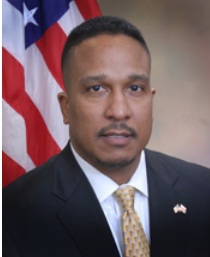
“Persaud preyed on people who trusted him by promising high and steady returns while hiding his unconventional trading strategy. When Persaud blatantly lied to investors and hid their losses through a Ponzi scheme, he should have known that an SEC enforcement action was in the stars.” — Eric I. Bustillo, director of the SEC’s Miami Regional Office, June 21, 2012
BULLETIN: The SEC has gone to federal court in Orlando, Fla., alleging that Gurudeo “Buddy” Persaud was operating a Ponzi scheme and making trading decisions “premised on the idea that gravitational forces affect mass human behavior, and in turn, the stock market.
“For example,” the SEC charged, “Persaud believed that when the moon exerts greater gravitational pull on the Earth, people feel dejected and are more inclined to sell securities.”
One of the victims was a widow “who worked two jobs to make ends meet,” the SEC said.
The woman “invested $175,000 from life insurance proceeds from her husband’s sudden death,” the SEC said.
Persaud, 47, of Orlando, has been charged with fraud after allegedly telling investors their money would be safe and would generate annual returns of between 6 percent and 18 percent. He was associated with an entity known as White Elephant Trading Company LLC, the SEC said.
The scheme affected at least 14 investors and gathered more than $1 million, operating between July 2007 and January 2010, the SEC charged.
“[I]n making trading decisions, Persaud chiefly relied on an Internet service that provided directional market forecasts based on lunar cycles and gravitational pull,” the SEC alleged.
“Persaud touted his experience in the financial services industry as a certified financial planner and gave investors his personal guarantee their principal contributions were secure,” the SEC charged. “He made numerous misrepresentations and omissions to investors, foremost among them failing to disclose his trading strategies were based on lunar cycles and the gravitational pull between Earth and the moon.”
Moreover, the SEC said, Persaud “pooled the [investor] contributions and traded or misappropriated them as he saw fit. Thus, even if Persaud wanted to provide account balances, he could not have. Instead, he invented them.”
In November 2010, the SEC said, Persaud emailed a purported account letter to an investor who’d plowed $75,000 into the scheme. The letter falsely showed the investor had an account balance of $108,361.
In reality, the SEC charged, “White Elephant’s bank and brokerage account statements showed less than $20,000 remaining in all the accounts combined, and trading losses of approximately $399,000.”
By Jan. 5, 2011, the SEC charged, Persaud told another investor that her account balance was $175,313.23 at the end of December 2010.
By that time, however, “White Elephant’s bank and brokerage account statements showed approximately $5,300 remaining in all the accounts combined.”
“By February 2011, there were no funds remaining in the White Elephant bank accounts because Persaud misappropriated investor contributions, fraudulently paid investor contributions as purported investment returns to conceal investor losses, and lost the remainder of investors’ money in trading based on his lunar cycle trading strategy,” the SEC charged.
BULLETIN: (UPDATED 2:04 P.M. EDT U.S.A.) The office of North Carolina Attorney General Roy Cooper told the PP Blog this morning that it never said the Zeek MLM or auctions programs were legal.
The agency said it had asked a local television station to issue a corrected report, and the station has removed a video report that Zeek was linking to from its Blog this morning.
“We do have concerns about [Zeek],” said Noelle Talley, a spokeswoman for Cooper.
Zeek has two arms: an MLM program known as Zeek Rewards, and a penny-auction site known as Zeekler. Zeek Rewards plants the seed that participants can earn a return of between 1 percent and 2 percent a day. The Zeekler arm is auctioning sums of U.S. currency and advertising that successful bidders can receive their winnings through offshore payment processors.
Zeek has denied it is operating either an investment program or a “pyramid scheme” through its Zeek Rewards’ MLM arm. It also claims to run clean penny auctions through Zeekler. Some customers, however, have complained they had not received their winnings of auction cash.
The TV station — WFMY Channel 2 — aired a video report that focused on a “penny auction craze.” The report, which made a passing reference to Zeek’s MLM arm, focused on Zeek’s Zeekler arm while explaining the concept behind penny auctions and the potential pitfalls. A Blog version of the station’s report references both company arms and notes that “a court has not yet ruled whether this operation is legal or illegal.”
WFMY’s video version, however, suggested that Cooper’s office had received a handful of complaints about the Zeek arms but had determined Zeek was conducting business legally.
No determination that Zeek is operating legally has been made, Talley stressed this morning.
The PP Blog learned this morning that Zeek’s news Blog was linking to the broadcast version of the WFMY report. The TV station now has removed the video, Cooper’s office said.
In another strange development, at least two Zeek affiliates have spammed the TV’s station’s website with offers for Zeek. One of the spams appears to have originated with Barbara Alford, a promoter of the AdSurfDaily Ponzi scheme and a former moderator of the pro-ASD “Surf’s Up” forum that mysteriously disappeared in 2010 after shilling for accused ASD Ponzi schemer Andy Bowdoin around the clock for more than a year.
Bowdoin pleaded guilty to wire fraud in the ASD Ponzi case last month. He is jailed in the District of Columbia. Zeek’s business model is similar to the model employed by ASD.
Cooper’s office supplied the PP Blog with a list of complaints the state has received about Zeek. (Note: The paragraphs below do not take into account all of the complaints Cooper’s office has received about Zeek. There are at least 10 complaints on file.)
One complaint that originated in Utah on May 16, 2012, alleged that a customer had given Zeek $20,000 in April but never received credit and was unable to get any satisfaction from customer service.
“The customer service is non existent and I am beginning to think Zeekler is a pyramid scam,” the customer told Cooper’s office.
Zeek responded to the complaint by informing Cooper’s office that it believed the Utah complainant wasn’t actually a Zeek customer. Rather, according to Zeek, the complainant was the father of two sons who were Zeek affiliates and had contacted the attorney general out of “personal curiosity.”
Another complaint received by Cooper’s office from a Florida man in November 2011 was forwarded to the Securities Division of the North Carolina Secretary of State’s office for review, according to the correspondence trail. No final outcome is noted.
Another complaint Cooper’s office received on May 8 originated in the District of Columbia after being sent to the Office of the Attorney General of District of Columbia by an individual in Oregon four days earlier. The District of Columbia forwarded the complaint to Cooper’s office, which opened a file.
“This is a Huge Ponzi scheme,” the sender complained. “If not [looked] at carefully and stopped by the US AG, [t]his would be a tremendous task to [sort] out to pay back the consumer. This is [n]o different tha[n] AD Surf Daily ([i]f you remember the [c]ase).”
Meanwhile, a Zeek customer in Miami contacted Cooper’s office and told the agency that he had sent U.S. Postal Service money orders totaling $1,000 to Zeek in April and that the sum never was credited to his Zeek account.
Yet another Zeek customer — this one from California — told Cooper’s office that he had wired more than $2,000 in March from his account at Bank of America to Zeek’s account at NewBridge Bank in North Carolina. Although the complainant said he’d confirmed both through his bank and NewBridge that Zeek had received the money, the money never got credited to his Zeek account.
The California customer also told Cooper’s office that Zeek closed his support ticket without providing a resolution, a circumstance that forced the aggrieved customer to open a second ticket.
Zeek announced suddenly on May 28 — Memorial Day — that it was closing its NewBridge bank account.
Another individual who contacted Cooper’s office suggested she’d also contacted her member of Congress, the IRS, the FTC and the SEC about Zeek and questioned whether a “whistleblower” award might be available if Zeek proved to be a scam. That communication identified several purported Zeek promoters, including former AdSurfDaily promoter Todd Disner.
Federal prosecutors sent this letter to an attorney for accused Ponzi schemer Andy Bowdoin of AdSurfDaily on April 17, 2012. It was entered in the public record on April 24. The letter describes the "OneX" program pushed by Bowdoin as a "fraudulent scheme." Bowdoin pleaded guilty to wire fraud in the ASD Ponzi case less than a month later. He is currently jailed in the District of Columbia awaiting formal sentencing Aug. 29. (Red highlight by PP Blog.)
“Like [AdSurfDaily], OneX does not generate income by selling a product to consumers outside the system. Instead, it simply re-distributes funds among participants. Thus, a participant will not earn money unless he or she recruits new members. When the addition of new members stops, the program ceases to exist.” — From court filing by Office of U.S. Attorney Ronald C. Machen Jr. in Ponzi scheme case against AdSurfDaily President Andy Bowdoin, April 24, 2012
OneX, which went missing weeks ago, now is back — sort of.
The “program” held a bizarre conference call last night, claiming it was trying to resurrect itself after server problems that lasted weeks even as it suggested it was trying to come up with a word combination that would put questions about the program to rest.
“We just have to call certain things that we were doing a different name,” asserted lead huckster “J.C.” during the call.
Precisely what J.C. meant by his “different name” comment was unclear. Much is murky about the purported “program,” which ASD’s Bowdoin claimed last year was great for college students and could result in riches for former ASD members.
During the call, OneX created a potential PR disaster for Bank of America, which once was the banker for the AdSurfDaily Ponzi scheme and was sued by ASD members who claimed the bank aided ASD President Andy Bowdoin in foisting a massive fraud scheme on the public.
Bank of America has denied the claims against it. Those claims were part of a 2009 racketeering lawsuit filed against Bowdoin and Robert Garner, a onetime attorney for ASD.
Among other highlights from yesterday’s OneX call:
“J.C.” — whom at least some members believed was the owner of OneX — denied he was the owner. Rather, J.C. described himself as a “consultant.”
Regardless, J.C. claimed he’d written a letter to SolidTrustPay to “reverse” deposits made into the OneX account and to return the money to the senders. OneX had received the money from about 22 OneX members as a result of a programming error, J.C. explained. He did not explain how a consultant — as opposed to an owner — had any authority to ask SolidTrustPay to do anything.
In any event, OneX no longer is doing business with Canada-based SolidTrustPay, according to J.C.
J.C. said the “program” has another payment-processing solution waiting in the wings and may make an announcement Thursday. He did not identify the processor, claimed OneX again would open itself to member withdrawals — but further claimed the new processor “is wanting us to stagger” payouts and to begin with “a small amount.”
“We don’t know the numbers yet. Next Thursday we can talk about it,” J.C. said.
Later in the call, with the name of the payment processor still not disclosed, J.C. said this:
“And I will tell you also that it’s not one that is outside the United States. They work with Bank of America.”
Francis Schaeffer Cox: Guilty in murder plot against public officials.
On Feb. 27, the PP Blog reported that a website registered in the name of purported JSS Tripler/JustBeenPaid operator Frederick Mann was publishing links to at least 11 videos featuring Francis Schaeffer Cox, an Alaska man implicated in an alleged “militia” murder plot against public officials.
These were among the remarks attributed to Mann at BuildFreedom.com — as a drop-down ad for JSS/JBB was displayed on the page.
“To what extent do the people and activities featured so far on this page provide real solutions? How far do they go toward neutralizing the real enemies? What activities need to be added to increase the prospects for freedom?”
The PP Blog almost immediately began to receive threats from “MoneyMakingBrain,” a Mann “defender.”
JSS/JBP purports to provide an investment return of 2 percent a day. It has no known securities registrations. In May, Mann said that government employees were “much worse than the Mafia.”
Government workers, Mann intoned in May, were “part of a criminal gang of robbers, thieves, murderers, liars, imposters.” He also speculated that the web servers of JSS/JBP could be targeted in a “cruise missile” attack.
Cox was convicted yesterday after a jury trial on a charge of conspiracy to commit murder. So, too, was Cox associate Lonnie Vernon.
EDITOR’S NOTE: The PP Blog first reported on the arrest in France of alleged international fraudster Vladislav Anatolievich Horohorin on Aug. 11, 2010. The arrest came as the result of an undercover operation the U.S. Secret Service conducted on online forums.
As the Blog reported at the time, “The arrest of Vladislav Horohorin is notable on a number of levels. First, the arrest in Europe was a result of an online fraud scheme that allegedly crossed international borders and made its way to the United States, where criminal charges were filed. At the same time, the crime allegedly involved the transfer of money though international payment processors. Perhaps more than anything, however, the case against Horohorin demonstrates that the U.S. Secret Service is “plugged into” forums that promote international lawlessness. His arrest is very bad news for credit-card crooks and HYIP and autosurf Ponzi schemers — and their corrupt colleagues.”
Today the PP Blog is reporting that the United States successfully arranged the extradition of Horohorin. His first court appearance was made in the District of Columbia, the venue from which the AdSurfDaily Ponzi case brought by the Secret Service is playing out. The office of U.S. Attorney Ronald C. Machen Jr., which was instrumental in guiding the ASD case, is in charge of certain elements of the Horohorin case.
The office of U.S. Attorney Sally Quillian Yates of the Northern District of Georgia also is handing elements of the Horohorin prosecution.
The allegations in the case are alarming: “According to the indictment filed in the Northern District of Georgia, Horohorin was one of the lead cashers in an elaborate scheme in which 44 counterfeit payroll debit cards were used to withdraw more than $9 million from over 2,100 ATMs in at least 280 cities worldwide in a span of less than 12 hours,” the Justice Department said in a statement. “Computer hackers broke into a credit card processor located in the Atlanta area, stole debit card account numbers, and raised the balances and withdrawal limits on those accounts while distributing the account numbers and PIN codes to lead cashers, like Hororhorin, around the world.”
** ______________________________________ **
UPDATE: Alleged international credit-card fraudster Vladislav Anatolievich Horohorin, also known as “BadB,” is in an American jail after an undercover probe on online forums by the U.S. Secret Service and a parallel investigation by the FBI.
Ronald C. Machen Jr., U.S. Attorney for the District of Columbia
“We are pleased that he has been extradited to the United States to face these criminal charges in a District of Columbia courtroom,” said U.S. Attorney Ronald C. Machen Jr. of the District of Columbia. “This prosecution demonstrates that those who try to rip off Americans from behind a computer screen across an ocean will not escape American justice.”
Horohorin, whose age was listed as 27 after his August 2010 arrest in France on U.S. charges, also will be prosecuted in U.S. District Court for the Northern District of Georgia.
“International cyber criminals who target American citizens and businesses often believe they are untouchable because they are overseas,” said U.S. Attorney Sally Quillian Yates of the Northern District of Georgia. “But as this case demonstrates, we will work relentlessly with our law enforcement partners around the world to charge, find and bring those criminals to justice.”
News of Horohorin’s extradition by France to U.S. soil occurred against the backdrop of claims by an HYIP “program” known as JSS Tripler/JustBeenPaid that members must affirm they are not with the “government” and that the “program” is not located in any “unfriendly political jurisdictions.”
A JSS/JBP “defender” known as “MoneyMakingBrain” asserted in March that “law enforcement agencies don’t pay attention to what’s being said on forums and blogs.” The claim was at odds with various public records that show U.S. law enforcement pays close attention to forums and Blogs and even conducts undercover operations by infiltrating forums.
Among other things, “MoneyMakingBrain” asserted he’d defend JSS/JBP’s purported operator Frederick Mann “so help me God.” The PP Blog became the subject of threats from “MoneyMakingBrain.” JSS/JBP, which uses offshore payment processors, purports to provide a return of 60 percent a month, has no known securities registrations and may have ties to the “sovereign citizens” movement.
Underscoring the importance of the Horohorin arrest and extradition, Machen and Yates were joined in the announcement by the head of the U.S. Department of Justice’s Criminal Division and top officials from both the U.S. Secret Service and the FBI.
Horohorin, said Assistant Attorney General Lanny Breuer, was “one of the most notorious credit card traffickers in the world.”
“Due to our strong relationships with our international law enforcement partners, we secured his extradition to the United States, where he now faces multiple criminal counts in two separate indictments,” Breuer said. “We will continue to do everything we can to bring cybercriminals to justice, including those who operate beyond our borders.”
A top U.S. Secret Service official, meanwhile, said the agency viewed the alleged Horohorin caper as an “attack” on America’s financial system.
“The Secret Service is committed to identifying and apprehending those individuals that continue to attack American financial institutions and we will continue to work through our international and domestic law enforcement partners in order to accomplish this,” said David J. O’Connor, assistant director of investigations.
In addition to providing security for the President of the United States, the Secret Service is in charge of protecting America’s financial infrastructure. The agency has described AdSurfDaily as a “criminal enterprise,” with the Justice Department asserting that ASD was an example of an “insidious” business that permitted fraud to spread globally.
Just two days after Horohorin’s first appearance in a U.S. courtroom in the District of Columbia, AdSurfDaily members Todd Disner and Dwight Owen Schweitzer claimed that the federal prosecutors who brought the ASD Ponzi case in August 2008 had gone shopping for a “frendly [sic] forum” in which the government could enlist “some of their Washington D.C. operatives to become members of ASD, thereby making them potential witnesses.”
Disner and Schweitzer sued the United States in November 2011 for alleged misdeeds in the ASD case. Among other things, Disner and Schweitzer asserted that undercover agents who joined ASD had a duty to inform ASD management. The Secret Service described ASD as a massive online Ponzi scheme involving at least $110 million. ASD President Andy Bowdoin pleaded guilty to wire fraud last month, admitting ASD was a Ponzi scheme and that the company never operated legally from its inception in 2006.
Disner and Schweitzer now are affiliates for Zeek Rewards, a “program” that plants the seed it can provide an ASD-like return of 1 percent or more per day without being a pyramid scheme and without constituting an investment opportunity. The payout Zeek plants the seed it can provide is on par with the returns advertised by JSS Tripler/JustBeenPaid, which does not disclose its base of operations.
A top FBI official said the arrest of Horohorin showed that international agencies are working together to divorce criminals from their abilities to use computers to reach across borders to pull off egregious crimes.
“Horohorin’s extradition to the United States demonstrates the FBI’s expertise in conducting long-term investigations into complex criminal computer intrusions, resulting in bringing the most egregious cyber criminals to justice, even from foreign shores,” said Brian D. Lamkin , special agent in charge of the Atlanta division. “The combined efforts of law enforcement agencies to include our international partners around the world will ensure this trend continues.”
Court and other records show that Horohorin, like ASD, had a presence in both the District of Columbia and the Northern District of Georgia.
After the August 2008 seizure by the U.S. Secret Service of tens of millions of dollars in the AdSurfDaily Ponzi case, Dwight Owen Schweitzer became a pitchman for the Zeek Rewards "program," according to this ad. Schweitzer, a former attorney whose license was suspended in Connecticut, and fellow ASD figure Todd Disner sued the United States in November 2011 for alleged misdeeds in the ASD case, claiming the government had authored a "tissue of lies" in the ASD case and that ASD was a legitimate business. ASD President Andy Bowdoin admitted last month that ASD was a Ponzi scheme and that his business never operated legally from its 2006 inception, putting Bowdoin at odds with both Disner and Schweitzer and also purported MLM expert Keith Laggos, who curiously opined ASD was not a "Ponzie" scheme. Bowdoin is now jailed in the District of Columbia after a federal judge revoked his bond. The judge ordered Bowdoin jailed pending formal sentencing after the government proffered evidence that Bowdoin continued to promote fraud schemes after the seizure of $65.8 million from his personal bank accounts in 2008 and after Bowdoin was arrested in December 2010 on ASD-related charges of wire fraud, securities fraud and selling unregistered securities.
EDITOR’S NOTE: The filing by Todd Disner and Dwight Owen Schweitzer to which the PP Blog refers in this story was in response to a May 18 government motion to dismiss a lawsuit filed by Disner and Schweitzer against the United States in the Southern District of Florida or to transfer the case to U.S. District Court for the District of Columbia. The government filed its motions on the same date ASD President Andy Bowdoin pleaded guilty to wire fraud and admitted that ASD was a Ponzi scheme . . .
BULLETIN: In a curious, 23-page narrative, AdSurfDaily figures Todd Disner and Dwight Owen Schweitzer — who went on to become promoters of the Zeek Rewards MLM — have raised the prospect that they could be prosecuted for tax evasion because of the government seizure of ASD’s database in August 2008.
Neither Disner nor Schweitzer referenced Zeek in a filing stamped June 15 and entered today on the docket of U.S. District Judge Cecilia M. Altonaga of the Southern District of Florida. But the filing includes the name of Zeek consultant Keith Laggos, positioning Laggos as an expert on Ponzi schemes who ventured an opinion that ASD was not a Ponzi scheme.
The Disner/Schweitzer filing does not mention that Laggos repeatedly misspelled “Ponzi” as “Ponzie” in his purported expert opinion in the ASD case. Nor does it mention that Laggos was prosecuted by the SEC in a 2004 case that alleged he issued laudatory press releases and a laudatory article for a company that later become the subject of a securities investigation without disclosing he was being compensated for touting the purported opportunity.
Laggos neither admitted nor denied the SEC’s allegations, which involved a company known as Converge Global Inc. and a subsidiary known as TeleWrx Inc. The future Zeek consultant settled the 2004 SEC case by disgorging nearly $12,000, paying interest of nearly $2,000, paying a civil fine of $19,500 and agreeing to a five-year penny-stock ban.
Laggos was permanently enjoined in the case from violating Section 17(b) of the Securities Act, which makes it unlawful to tout a stock without disclosing the nature and substance of any consideration, whether present or future, direct or indirect, received from an issuer, underwriter or dealer.
An image of Laggos now appears in a commercial for Zeek, and a publication owned by Laggos has issued laudatory coverage of the purported MLM opportunity, which plants the seed it provides a return of between 1 percent and 2 percent a day without being a “pyramid scheme” and without constituting an investment opportunity.
It is known that Zeek and ASD had common promoters and that, beginning in about July 2011, some well-known figures in the ASD story began to emerge publicly as Zeek boosters. Among them are former “Surf’s Up” moderator Terralynn Hoy and former ASD pitchman Jerry Napier.
Hoy, who has been listed as a “Zeek” employee and has hosted at least once conference call for Zeek, was a moderator of a defunct ASD cheerleading forum known as “Surf’s Up.” While “Surf’s Up” still was operating, Hoy became a moderator of a forum that led cheers for an autosurf known as AdViewGlobal, which federal prosecutors now say was a fraudulent scheme backed by ASD President Andy Bowdoin. Both Surf’s Up and the AdViewGlobal forum, which also now is defunct, described ASD figure and purported “sovereign citizen” Curtis Richmond as a “hero.”
Richmond has a contempt of court conviction for threatening federal judges and once was sued successfully under the federal racketeering statute for participating in a scheme in which enormous purported judgments were filed against public officials and the officials were threatened with arrest. ASD is known to have had ties to tax deniers and “sovereign citizens.”
Some Zeek promoters also are pushing a purported “opportunity” known as JSS Tripler/JustBeenPaid that may have links to the “sovereign citizens” movement. Frederick Mann, the purported operator of JSS/JBP, does not identify where the purported opportunity operates from and has speculated that the servers of JSS/JBP could be targeted in a “cruise missile” attack by the government.
JSS/JBP advertises a return of 2 percent a day, a percentage that Zeek sometimes says it has matched or exceeded — though Zeek generally stays between 1 percent and 2 percent a day when the purported payout is averaged over a week, Zeek promoters claim.
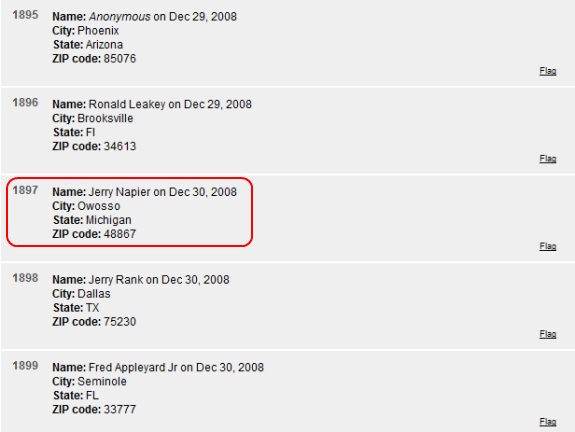
As a Zeek promoter, Napier was given a puff piece last summer by the purported Zeek opportunity. An individual with the same name appears to have signed a petition in December 2008 calling for the U.S. Senate not to investigate ASD and Bowdoin, but to investigate various federal prosecutors and the U.S. Secret Service agent who brought the ASD Ponzi case in August 2008. The petition showing the name of “Jerry Napier” appears to have been signed by “Jerry Napier” after federal prosecutors brought a second forfeiture case against ASD-related assets on Dec. 19, 2008. As was the case with the August 2008 forfeiture filing by the government, the December 2008 case alleged a Ponzi scheme.
Today’s filing by Disner and Schweitzer advances a theory — even after Bowdoin’s guilty plea to wire fraud last month and public acknowledgment that he presided over a Ponzi scheme — that the government’s Ponzi claims constituted a “house of cards.”
It also plants the seed that prosecutors shopped the ASD case to a “frendly [sic] forum” in the District of Columbia to make it easier for the government to enlist “some of their Washington D.C. operatives to become members of ASD, thereby making them potential witnesses.”
Disner and Schweitzer claim that the seizure of ASD’s database in Florida was unconstitutional because it subjected them to an invasion of privacy and potentially a tax investigation.
“The plaintiffs have alleged that the information taken by the defendant places the plaintiffs in jeopardy of the defendant seeking to prosecute the plaintiffs for tax evasion as a result of the defendant having taken the plaintiffs records which are necessary to enable the plaintiffs to file accurate tax returns for the period covered by those records,” Disner and Schweitzer argued.
And Disner and Schweitzer further ventured (italics added):
As a result of the government’s action, the plaintiffs cannot file accurate tax returns, have lost both past and future business revenues, their reputations have been damaged to the extent that they recruited others to join in the program that the defendant alleged to be a Ponzi scheme, and by inference the plaintiffs have therefore enlisted others to participate in an illegal enterprise. The injuries suffered by the plaintiffs are not hypothetical or conjectural but are both finite and calculable. They have alleged that the actions taken against them were authorized without meeting the constitutionally guaranteed and statutorily increased requirements to establish probable cause and resulted in an illegal search and seizure of their property and effects.
Neither Zeek nor any of its executives or promoters have been accused of wrongdoing. Zeek, though, claimed last month that it was closing two U.S. bank accounts and looking to open an account with a bank it did not name.
Zeek is using offshore payment processors linked to numerous schemes that promote outsize returns. A Zeek auction arm known as Zeekler is auctioning sums of U.S. cash and telling winners it will pay them via offshore processors.
Components of the Zeek scheme are similar to components of the ASD Ponzi scheme.
In 2008, an HYIP scheme known as Legisi resulted in an an SEC civil prosecution. Court papers showed that the U.S. Secret Service and state regulators in Michigan were conducting an undercover probe of Legisi which, like JSS/JBP, sought to make participants affirm they were not government employees.
Like ASD’s Bowdoin, Legisi operator Gregory McKnight pleaded guilty to wire fraud. Records show that a tier of the purported Legisi program offered a daily return that was about one-fourth the daily return Zeek plants the seed can be realized through its purported opportunity.
Although Surf’s Up, which received ASD’s official endorsement as a news outlet with Hoy as a moderator, led cheers for ASD and Bowdoin until the forum mysteriously vanished in January 2010, Hoy appears to believe that Ponzi schemes actually can exist.
SSH2 Acquisitions, a Nevada company that listed Hoy as a director, claimed in 2010 that it had been defrauded in a Ponzi scheme.
Depending on how they navigate the site, PennyAuctionCustomers.com visitors may encounter a confusing series of screens and ultimately may be shown an ad for JSS Tripler/JustBeenPaid, which may have ties to the "sovereign citizens" movement. The PennyAuctionCustomers site purports to sell customers for the ZeekRewards MLM "program" that plants the seed it provides a daily return of between 1 percent and 2 percent while not being a "pyramid scheme" and while not constituting an investment program.
PennyAuctionCustomers.com advertises that it sells “customers” to members of the Zeek Rewards MLM, collects money through PayPal, serves confusing pop-up messages, uses the name of AdSurfDaily figure Todd Disner in its meta data — and sends traffic to the preposterous JSS Tripler/JustBeenPaid “program” that advertises a return of 60 percent a month.
Whether the site has any affiliation with Disner is unclear. What is clear is that Disner is a Zeek Rewards member who sued the U.S. government last year for alleged misdeeds in the AdSurfDaily Ponzi case, including a claim that federal prosecutors and the U.S. Secret Service had relied on a “tissue of lies” in bringing the ASD case.
This Zeek ad attributed to former AdSurfDaily member Dwight Owen Schweitzer paints Zeek as an investment program through which participants can "earn 1%+ a day compounded."
Disner’s co-plaintiff in the case was fellow ASD (and Zeek) member Dwight Owen Schweitzer, a former attorney whose license was suspended in Connecticut. The government asked a federal judge last month to dismiss the Disner/Schweitzer complaint, pointing out that ASD President Andy Bowdoin had pleaded guilty to wire fraud in the ASD case.
Bowdoin, 77, is now detained in Washington, D.C., awaiting formal sentencing by U.S. District Judge Rosemary Collyer in August. Court papers show that Bowdoin admitted ASD was a Ponzi scheme and that he had presided over an illegal money-making business since the inception of ASD in 2006.
Zeek’s business model closely resembles that of ASD. Like ASD, Zeek plants the seed that it provides a daily return that corresponds to an annual return in excess of 300 percent. Zeek participants must place an ad online daily to earn the purported daily payout. ASD members were required to view ads.
The U.S. Secret Service seized more than $80 million in the ASD Ponzi case, including more than $65.8 million from Bowdoin’s bank accounts in August 2008.
When the PP Blog visited PennyAuctionCustomers.com, accessed the “FAQ” page and sought to leave the page, the Blog’s browser encountered multiple pop-up screens that displayed confusing messages. Eventually the Blog was shown a page on the site with banner ads for the JSS/JBP “program” and a “program” known as Banners Broker.
The banner ad near the bottom of this page on the PennyAuctionCustomers.com website points visitors to the JSS Tripler/JustBeenPaid "program" after soliciting visitors to purchase "customers" for the Zeek Rewards MLM "program." A JSS/JBP site loads when the "Triple Your Money" banner is clicked.
“DO YOU LIKE ZEEK REWARDS?” the PennyAuctionCustomers site inquires.
“WELL YOU WILL LOVE THIS,” it asserts. “Two Other Highly Lucrative Programs That Do Not Require Any Sponsoring of Other Affiliates That You May Wish To Join If You Are Looking To Boost Your Income!”
It then points visitors toward JSS/JBP and Banners Broker.
Like Zeek (and ASD before it), the JSS/JBP and Banners Broker “programs” are being advertised on well-known Ponzi scheme forums such as TalkGold and MoneyMakerGroup. The various promotions lead to questions about whether fraudulent schemes are simply recycling money from scam to scam to scam, polluting the money stream at multiple points nationally and internationally.
These phrases are among the meta data on the PennyAuctionCustomers site:
zeekrewards 90 day strategy
zeekrewards calculator
is zeekrewards legit
is zeekrewards legal
todd disner zeek rewards
An Oregon entity known as Media Clinch LLC appears to be conducting the Zeek “customer” sales through PayPal while at once pointing traffic toward Banners Broker and JSS/JBP, which purportedly is operated by Frederick Mann. Mann and JSS/JBP may have ties to the so-called “sovereign citizens” movement in which adherents display an irrational belief that laws do not apply to them and courts have no jurisdiction over them.
Although JSS/JBP appears to rely on “offshore” payment processors linked to fraud scheme after fraud scheme, the PennyAuctionCustomers Zeek promos through the Media Clinch LLC PayPal account introduces the prospect that soiled proceeds from multiple fraud schemes also could be flowing into PayPal.
Media Clinch LLC, according to Oregon records, is managed by Sean Walters. Zeek has an affiliate by the same name.
BULLETIN: Timothy Shawn Donavan and Sharon Jeannette Henningsen — the two fugitives arrested in November in Washington state with AdSurfDaily figure and purported “sovereign citizen” Kenneth Wayne Leaming — have been found guilty of mail fraud and conspiracy in Arkansas in a multimillion-dollar home business caper involving envelope-stuffing.
Donavan, 63, and Henningsen, 67, potentially face decades in prison after a jury returned guilty verdicts on 18 counts of mail fraud and one count of conspiracy. KATV.com is reporting there were more than 21,000 victims in the case.
On May 31, the PP Blog learned that Leaming had been subpoenaed as a witness in the case and was transported from a federal detention facility near Seattle. Leaming, 56, is believed to be on his way back to Washington state. His trial is set for September on charges of filing false liens against at least five public officials involved in the ASD Ponzi case. He also is accused of harboring fugitives, being in possession of firearms as a convicted felon and uttering a bogus promissory note.
Court records in Arkansas show that Donavan and Henningsen sought to represent themselves pro se but ignored orders by a federal judge to stop filing extraneous and off-topic pleadings. The judge ultimately ordered counsel to take over for the former fugitives because Donavan and Henningsen’s “persistence in refusing to obey Court directions and in injecting extraneous and irrelevant material into the record.”
NOTE: 10:46 A.M. EDT: Certain references to “Aaron” (below) in the context of “Aaron and Shara” have been deleted, pending the resolution to a report we received that disputed certain information.
Question: Did the Zeek Rewards MLM “program” that plants the seed it provides a return of between 1 percent and 2 percent a day without constituting an investment opportunity give a puff piece to an affiliate who signed a petition in 2008 that called for the U.S. Senate to investigate the federal prosecutors and the U.S. Secret Service agent who brought the AdSurfDaily Ponzi case?
Separately, this classified ad for Zeek from “Jerry Napier” of Owosso, Mich., ran on Nov. 17, 2011.
On Dec. 30, 2008, “Jerry Napier” of Owosso, Mich., signed a petition that called for the U.S. Senate to investigate (see No. 1897 on the petition) then-U.S. Attorney General Michael Mukasey; then U.S. Attorney Jeffrey Taylor of the District of Columbia; then-lead ASD prosecutor William Cowden; and Roy Dotson, a special agent of the U.S. Secret Service, according to ipetitions.com.
Screen shot and highlight by PP Blog.
“Whereas, we as Americans have a right to advertise with any company without interferences [sic] by [sic] Attorney General and /or any of its agents,” the petition began. “Whereas, Ad Surf Daily [sic] hereafter (ASD) [sic] an advertising company on the internet were [sic] members received re-bates [sic] for advertising and looking at other advertising sites, thus purchase [sic] products and services.”
In August 2008, the U.S. Secret Service and federal prosecutors brought the first of at least three civil-forfeiture actions in the ASD Ponzi case. Those actions were parallel to a criminal investigation that ultimately led to the arrest of ASD President Andy Bowdoin in December 2010 and his guilty plea to wire fraud last month.
ASD, like Zeek, planted the seed that it paid a daily return on the order of 1 percent.
Among the other top Zeek earners listed in the post are “Aaron and Shara” and Trudy Gilmond. “Aaron and Shara” is a veteran HYIP team.
Gilmond, whom Zeek identifies as a Zeek “employee” on its website, once was a promoter of a scheme known as Regenesis 2X2, which became the subject of a U.S. Secret Service probe in 2009.
The 2008 petition calling for the Senate to investigate the ASD prosecutorial team also includes “Catherine Parker” as a signatory (on Page 33, Nos. 1604 and 1605). “Catherine Parker” was quoted in emails that became part of the ASD story. (See such an attribution on AdLandPro, a site from which ASD was promoted.)
URGENT >> BULLETIN >> MOVING: (UPDATED 6:23 P.M. EDT U.S.A.) AdSurfDaily President Andy Bowdoin — the confessed author of a $110 million online Ponzi scheme — was jailed at the conclusion of a bond-revocation hearing in Washington today.
Bowdoin is being detained at a local Department of Corrections facility in the District of Columbia, the jail confirmed this evening. No other information was immediately available.
Federal prosecutors in the District of Columbia say Bowdoin was detained after the proceeding before U.S. District Judge Rosemary Collyer.
In April, prosecutors said Bowdoin continued to promote scams after the ASD Ponzi probe began in July 2008 and after his December 2010 arrest by the U.S. Secret Service on Ponzi-related charges. Prosecutors identified those scams as “OneX” and AdViewGlobal, an ASD-like autosurf.
Bowdoin, 77, pleaded guilty to wire fraud in the ASD case last month. His formal sentencing has been set for Aug. 29 before Collyer.
Bowdoin faces up to 78 months in federal prison, when sentenced by Collyer. He has been banned from multilevel marketing, Internet programs and mass marketing.
The Star Tribune and the Pioneer Press are reporting that Trevor Cook Ponzi scheme pitchmen Jason Bo-Alan Beckman, Pat Kiley and Gerald Durand have been found guilty in federal court in Minnesota.
 BULLETIN: The SEC has gone to federal court in Orlando, Fla., alleging that Gurudeo “Buddy” Persaud was operating a Ponzi scheme and making trading decisions “premised on the idea that gravitational forces affect mass human behavior, and in turn, the stock market.