Blog

  • Document Linked To Company Associated With AdSurfDaily Figure Kenneth Wayne Leaming Is Referenced In Congressional Record As ‘Claim Against The United States Of America’

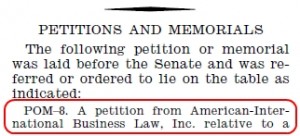
    Screen shot from the Congessional Record of April 8, 2011. (Also see image and link to full-scale PDF below.)

    UPDATED 6:55 P.M. EDT (U.S.A.) A garden-variety, lawful protest commonly received in mailrooms within the halls of power? A self-serving, reality-inverting tale of the civil-forfeiture case against the proceeds of an alleged $110 million autosurf Ponzi scheme? A backdoor bid to end-run rulings made by the U.S. Judiciary and hand an invoice to the U.S. Congress for purported damages and financial penalties against public officials sprouting from the government’s alleged mishandling of the ASD case?

    The staff of Senate Judiciary Committee Chairman Patrick Leahy, D-Vermont, did not immediately respond to a PP Blog request for comment this afternoon on a document apparently tabled by the panel after it was received in April after having been submitted by American-International Business Law Inc.

    AdSurfDaily figure Kenneth Wayne Leaming, a purported “sovereign citizen,” is listed in Washington state records (as “Kenneth Wayne”) as the chairman and president of American-International Business Law Inc. The firm’s name appears in the Congressional Record of April 8 as the presenter of a “petition . . .  relative to a claim against the United States of America.”

    Among other things, Leaming, who once was convicted of piloting an airplane without a license,  also was accused of practicing law without a license. He has purported to be a specialist in admiralty law — and has advertised the availability of a lower rate for “prepaid” clients.

    Details about the April document were not provided in the Congressional Record entry, and Leahy’s committee staff was unable to provide details immediately. The Blog asked the staff staff to provide a copy of the claim and, if possible, forward it to the Blog. Whether the staff will be able to accommodate the request was not immediately clear.

    Leaming and ASD member Christian Oesch unsuccessfully sought to sue the United States last year in the U.S. Court of Federal Claims, apparently seeking the staggering sum of more than $29 TRILLION — more than twice the U.S. Gross Domestic Product in 2009.

    Their lawsuit targeted federal employees who had a role in the civil-forfeiture case filed against tens of millions of dollars alleged to be the proceeds of a massive Ponzi scheme conducted by Florida-based ASD. About $65.8 million was seized by the U.S. Secret Service from the personal bank accounts of ASD President Andy Bowdoin, and federal prosecutors in the District of Columbia scored a clean sweep in forfeiture-related litigation. The government now holds title to about $80 million seized from ASD-related bank accounts.

    The lawsuit came in the form of purported “Certificates of Default” issued against public officials on Feb. 16, 2010, by Tina M. Hall, a notary public with ties to Leaming.

    Hall’s notary license was revoked by the state of Washington in October 2010, about three months after Leaming and Oesch filed their lawsuit. The PP Blog reported yesterday that the license of Kathryn E. Aschlea, a second notary with a tie to Leaming and American-International Business Law Inc., also had her license revoked by the state of Washington.

    When Judge Christine Odell Cook Miller dismissed the Leaming/Oesch lawsuit in December 2010, she noted that the complaint included a claim by Hall that the officials had failed to respond to “claims in admiralty.”

    “At this point the complaint deteriorates into rambling,” the judge wrote  in her dismissal order.

    Whether the Judiciary Committee received a similar rambling narrative from Leaming and Oesch and one or more notaries public is unclear.
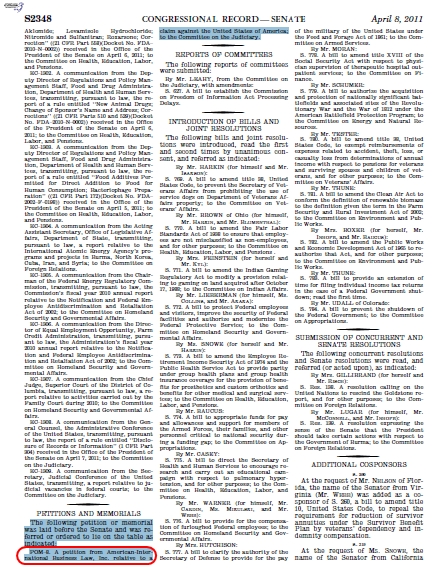
    See February 2009 story about ASD-related letter-writing campaign to Sen. Leahy by ASD figure “Professor” Patrick Moriarty. See follow-up editorial by PP Blog. Read May 2009 “Poof Penalty” story. Click here to read a Congressional Record PDF that includes the American-International Business Law Inc. reference.

  • BULLETIN: Second Notary With Tie To AdSurfDaily Figure Kenneth Wayne Leaming Has License Revoked In Washington State; Woman’s Name Appeared On ASD Court Docket Last Year

    Kenneth Wayne Leaming, aka "Kenneth Wayne" and "Keny."

    BULLETIN: The state of Washington has revoked the notary license of Kathryn E. Aschlea. The precise reason for the revocation was not immediately clear, although the state’s website said Aschlea “failed to comply with [a] fine and education sanction.”

    Aschlea is listed in Washington state records as a business associate of AdSurfDaily figure Kenneth Wayne Leaming, a purported “sovereign citizen.” On June 11, 2010, Aschlea was blocked by U.S. District Judge Rosemary Collyer from filing a document styled “Claim by Notary Presentment/Acceptance” in the ASD forfeiture case in the District of Columbia.

    The revocation of Aschlea’s license occurred about 10 months after the state revoked the notary license of Tina M. Hall, another Leaming business associate who tried to file notary claims in the civil-forfeiture case against the assets of ASD President Andy Bowdoin.

    Collyer blocked Hall from filing claims on Jan. 27, 2010, and Feb. 9, 2010, according to the docket of the case.

    Aschlea is listed in Washington records as vice president of American-International Business Law Inc., Leaming’s Spanaway-based firm.

    In 2010, some ASD members said Leaming was performing legal work for them. There is no record that he is a licensed attorney, despite the fact advertisements describing him as one have appeared online.

    Cornell University Law School, Justia.com and Oyez.org removed Leaming’s online profiles in November 2010. The profiles had featured a photograph of Leaming — and advertised a fee structure of up to $250 an hour.

    In December 2010, the U.S. Court of Federal Claims dismissed a bizarre, ASD-connected, pro se lawsuit brought against the United States by Leaming and ASD figure Christian Oesch. Hall’s also name is referenced in the dismissal.

    Dozens of pro se litigants sought unsuccessfully to intervene in the ASD civil-forfeiture case brought by federal prosecutors and the U.S. Secret Service in August 2008 in U.S. District Court for the District of Columbia. Among the bizarre claims in the pleadings was that the government had produced no “EVIDENCE” against ASD — despite the fact that some of the evidence had appeared on the public record of the case a year before the claims that no “EVIDENCE” had been produced were made.

    At least one other notary public in Washington state lost her license as a result of performing work for Leaming, according to records. In 2005, the notary — a woman — told the Washington State Bar Association that Leaming had coerced her into notarizing documents and that he had been “physically and emotionally abusive to her.”

    The woman “voluntarily resigned her notary license as a consequence of the acts” directed at her by Leaming and obtained a protection order against Leaming, according to a letter the Practice of Law Board of the State of Washington sent Leaming in 2005.

    See the PP Blog’s tag cloud archive on stories that reference Leaming, who also in known as “Kenneth Wayne” and “Keny.”


  • UPDATE: ASD’s Bowdoin Claims Hurricane Irene Knocked His Fundraising Website Offline; Accused Ponzi Schemer Says He’s Confident Jury Will Acquit Him; Messages Follow Earlier Claims From ASD Figures That May Raise Questions About Whether An Effort To Obstruct Justice Was Under Way

    Andy Bowdoin

    In recent emails to members, accused Ponzi schemer Andy Bowdoin of Florida-based AdSurfDaily has predicted that a jury in the District of Columbia will acquit him based on the testimony of expert witnesses.

    Bowdoin, 76, has been appealing to members he is accused of defrauding in a $110 million scheme to pony up $500,000 to pay for his criminal defense on charges of wire fraud, securities fraud and selling unregistered securities.

    Formal fundraising efforts have been under way since July 26 — after weeks of online hoopla that preceded Bowdoin’s  bid raise to money from the people he is accused of scamming. Those efforts have not gone well: Bowdoin said last week that he had raised only $19,300 and was $480,700 short of his goal of raising half a million dollars.

    In an email some members received today, Bowdoin said he encountered more trouble over the weekend.

    “Our Website was down most of the weekend, due to power outages caused by [H]urricane Irene that took our server Offline,” Bowdoin advised members.

    But he assured them that the site now was back online — and that he was confident he would be acquitted.

    “When you watch my Good News Update video and read the 3 Expert Witness testimonies on our Website, you will understand why we are so confident the Jury will come back with a Not Guilty verdict on all counts against me and ASD,” Bowdoin said.

    The email was titled, “More TRUTH – Why We Will Be Found “Not Guilty”! A largely similar email ASD members reported receiving on Aug. 26 was titled, “The TRUTH – Why ASD is Not a Ponzi Scheme!”

    Why Bowdoin asserted ASD had been charged with a crime was unclear. Bowdoin was indicted as an individual in December 2010. The government already has at least three civil judgments against about $80 million seized from ASD-related bank accounts in 2008 — and has implemented a program in which ASD members who filed for remission and provided the required documentation will be compensated through the seized funds described in the civil judgments.

    The indictment against Bowdoin, which has been a public record since he was arrested in December, does not name ASD a criminal defendant. After his arrest, Bowdoin was warned by a judge not to tamper with witnesses or the jury and not to obstruct the investigation.

    Within days of Bowdoin’s arrest, some ASD members received an email that encouraged them to contact the remissions administrator and “write that you knew this was not a investment and you where (sic) purchasing advertising.”

    The email was attributed to Gary Talbert, a former ASD executive, and purported to have been based on an email conversation with Bowdoin after his arrest.

    “Got a email from Andy and he told me to go ahead and send this email out to everyone,” noted the email attributed to Talbert.

    Various email missives have encouraged ASD members either not to file for remissions or to insert addendums on the official remissions form.

    Also see this story from September 2009. Meanwhile, see this story from November 2010 — just days prior to Bowdoin’s arrest.

  • WHEN PONZIS COLLIDE: Receiver’s Probe Into Commodities Online LLC ‘Severely Delayed And Impeded’ By ‘Noncooperation’; Federal Judge Orders James Clark Howard III And Sutton Capital LLC To Disgorge $1.45 Million; Firm That Listed AdSurfDaily Figure (And ‘Surf’s Up’ Mod) As ‘Director’ Sued Howard In 2010

    James Clark Howard III

    A federal judge in Florida has ordered a convicted narcotics and firearms felon who emerged as a central figure in a Ponzi scheme case after his release from prison to disgorge $1.45 million.

    The order, signed Aug. 23 by U.S. District Judge Patricia A. Seitz, applies to James Clark Howard III and Sutton Capital LLC.

    Howard, a co-managing member of Commodities Online LLC, “directed” that $1.3 million in investor funds from Commodities Online be wired to Sutton Capital, “his wholly owned limited liability company,” Seitz found.

    In the 1990s, Howard was sentenced to 57 months in federal prison on cocaine and weapons charges. He also was implicated last year in a separate fraud scheme targeting Haitian Americans.

    The SEC sued Commodities Online in March, alleging that the firm was selling unregistered securities and operating an international commodities fraud from South Florida.

    Seitz found that the $1.3 million transaction was recorded on the books of Commodities Online as a “loan” to Sutton, “even though no evidence has been found establishing a promissory note, interest rate or terms of repayment.”

    The $1.3 million transaction occurred on Feb. 9, 2010, Seitz found.

    On Feb. 18, 2010, Howard directed another $150,000 be transferred from Commodities Online to Sutton, Seitz found. She now has ordered Howard and Sutton to return the entire amount of $1.45 million from both transactions, saying they “remain in possession and control of these investor funds.”

    Separately, David S. Mandel, the court-appointed receiver in the Commodities Online case, said aspects of his investigation have been “severely delayed and impeded by the noncooperation of the majority of the former officers of the Defendants.”

    Although Commodities Online may own iron ore in Mexico, efforts to get at the truth have been hampered  “due to the current nature of business in Mexico, and in particular, the iron ore business, which at times can be unsafe, unreliable and uncertain,” Mandel said.

    In court filings, Mandel said that he has “received information that others have been purporting to act on the Defendants’ behalf in Mexico.” Mandel hired local counsel in Mexico, an attorney who is a citizen of Mexico and an international security firm to peel back layers of the onion and to protect receivership assets.

    A forensic accounting of Commodities Online and thousands of transactions is ongoing, Mandel said.

    One phase of the forensic accounting involved 9,500 transactions and 35 bank accounts “maintained at various financial institutions,” Mandel said.

    An updated analysis of records shows that Commodities Online gathered nearly $12 million from “insiders and related parties” between January 2010 and April 2011, and paid the insiders and related parties more than $20.2 million.

    All in all, the scheme gathered more than $35 million, according to the analysis.

    Howard was arrested by the Boca Raton Police Department in a separate scheme targeting Haitian Americans on March 5, 2010.

    About six months later — in September 2010 — he was sued by a Nevada company that listed former AdSurfDaily member and Surf’s Up moderator Terralynn Hoy as a director.

    The Nevada company — SSH2 Acquisitions Inc. — alleged that Howard was part of a Ponzi scheme that also involved Patricia Saa, Sutton Capital LLC and Rapallo Investment Group LLC.

    Howard and the defendants, according to the lawsuit, told SSH2 it was trading in commodities and “would produce profits of 40% per month or more, while not risking any of the invested funds.”

    In its lawsuit, SSH2 alleged that its dealings with Howard and the others began in “early 2009” and continued through March 2010.

    If SSH2?s assertions against Howard and the others are true, it means the transactions occurred during a period in which Hoy, later to emerge as an SSH2 director, also was moderating cheerleading forums for ASD and the AdViewGlobal autosurf.

    Surf’s Up became infamous for deleting commentary unflattering to ASD President Andy Bowdoin and links members left to outside sources of information. The forum mysteriously vanished in January 2010, after cheerleading for Bowdoin and ASD nonstop for more than a year.

    AdViewGlobal, which collapsed in June 2010, purported to operate from Uruguay and enjoy protection from U.S. regulators because of a purported “private association” structure. ASD was implicated by the U.S. Secret Service in August 2008 in an alleged $110 million Ponzi scheme. Bowdoin was arrested on charges of wire fraud, securities fraud and selling unregistered securities in December 2010.

    Former moderators of Surf’s Up, which unabashedly cheered for Bowdoin and received ASD’s official endorsement in November 2008, just days after a key court ruling in a civil-forfeiture case went against Bowdoin and ASD, largely have been silent since the January 2010 disappearance of Surf’s Up.

    It is not known if individual ASD members also invested money with Howard. What is known is that many ASD members did not skip a beat after the Secret Service moved against ASD in August 2008. Within days, some ASD members were promoting other autosurf schemes, HYIP schemes and cash-gifting schemes, positioning them as a way ASD members could make up their ASD losses.

    Hoy has not been accused of wrongdoing. Court filings and other records suggest that Hoy could have been conducting business with firms (ASD, Sutton and Rapallo) and individuals (Bowdoin, Howard and Saa) who were running separate Ponzi schemes involving at least $149 million and perhaps more.

    SSH2, with Hoy as a director, alleged that it was scammed by Howard, Sutton and Saa, and plowed$39 million into their Ponzi. The firm accused the defendants of selling unregistered securities and causing at least $19 million in damages. It specifically accused Howard and the other defendants of not revealing that Howard was a convicted felon.

    As a Surf’s Up moderator, however, Hoy presided over a forum that overlooked or pooh-pooed matters pertaining to the alleged ASD Ponzi, ASD’s alleged sale of unregistered securities to thousands of people internationally and Andy Bowdoin’s previous encounters with law enforcement in fraud cases.

    In October 2008, at the conclusion of an evidentiary hearing, Surf’s Up held an online party for Bowdoin, who’d been charged with felonies in an Alabama securities caper in the 1990s and avoided jail by agreeing to make restitution to investors he defrauded. The party was conducted during an active criminal investigation into Bowdoin’s conduct at ASD.

    A federal prosecutor was derided as “Gomer Pyle” on Surf’s Up. He also was described as a “goon” and a person who should be made to suffer in a medieval torture rack. Critics were described as “rats” and “maggots.”

    The party was conducted despite the fact the Secret Service had alleged that one of Bowdoin’s business partners had been implicated by the SEC in the 1990s in three prime-bank schemes.

  • BULLETIN: FLORIDA — AGAIN (UPDATE): James Risher Ponzi Scheme Used Pitchman Who Targeted Teachers, Retirees, Church Members, Golfers, SEC Says; Risher Had 5 Prior Criminal Convictions; Pitchman Daniel Joseph Sebastian Now Charged Civilly

    “[Y]ou invest in this fund and all of a sudden you start making more money than you’ve ever made in your life with your investors. And then all of a sudden you start making enough money where you don’t have to go to work . . . [a]t Safe Harbor, you could retire today, like right now. And I’m telling you, you get rid of the struggle.” — SEC,  quoting accused Ponzi pitchman Daniel Joseph Sebastian, Aug. 29, 2011

    BULLETIN: A Ponzi schemer arrested on criminal charges in June had the help of a pitchman who targeted senior citizens, church members, educators and golfers, the SEC said. The agency identified the pitchman as Daniel Joseph Sebastian of Celebration, Fla.

    Sebastian conducted business as “Safe Harbor,” and helped James D. Risher pull off a $22 million Ponzi scheme that affected more than 100 investors, the SEC said.

    Risher, 61, of Sanibel, Fla., was arrested on criminal charges by the U.S. Postal Inspection Service in June. He, too, now has been charged civilly by the SEC, which noted he had been charged criminally five times since 1992 in various schemes and had spent 11 of the past 21 years in jail.

    “Risher, who masqueraded as a highly successful equity trader, teamed up with Sebastian to tout sophisticated trading strategies they claimed would generate substantial profits for investors,” said Eric Bustillo, director of the SEC’s Miami Regional Office. “Instead, Risher and Sebastian used investors’ life savings and retirement nest eggs to line their own pockets.”

    The scheme also operated under the names of Safe Harbor Private Equity Fund, Managed Capital Fund and Preservation of Principal Fund, the SEC said.

    Risher had been arrested at least four times in Georgia, and at least once in Florida prior to the 2007 launch of the Safe Harbor scheme, the SEC said.

    Sebastian turned to old customers of his insurance business and recruited them into the Ponzi scheme, the SEC said.

    “From 2007 through July 2010, Sebastian solicited his former insurance customers, educators, retirees, and members of several churches in Florida,” the agency charged. “During the same time period, he also solicited investors in California, other states, and Canada. Sebastian persuaded his former customers to roll over the funds in their insurance and annuity products into the Fund. He told his customers the Fund would provide a higher rate of return than they could receive from the products he had previously sold them. At least one investor liquidated an annuity she had purchased from Sebastian and invested the proceeds in the Fund.”

    No registration statement was filed for any elements of the Safe Harbor scheme, the agency said.

    “Throughout the fraud, Sebastian also hosted numerous annual golf tournaments and other promotional events for investors, which Risher sometimes attended,” the agency charged. “At an investor event held on March 12 through 14, 2010 at an Orlando resort, Sebastian told investors in a speech, ‘[Y]ou invest in this fund and all of a sudden you start making more money than you’ve ever made in your life with your investors. And then all of a sudden you start making enough money where you don’t have to go to work . . . [a]t Safe Harbor, you could retire today, like right now. And I’m telling you, you get rid of the struggle.’”

    Read the SEC complaint.


  • Ponzi Forum Pitchfest Begins For ‘Fast Profits Daily; ‘Any Attempts To Acquire A Refund Or Chargeback Constitute Theft And Fraud, And Are Grounds For Legal Prosecution,’ Matrix Cycler Says

    UPDATED 2:49 P.M. EDT (U.S.A.) A pitchfest for an apparent cycler matrix called “Fast Profits Daily” has begun on the TalkGold Ponzi forum. Fast Profits Daily shares a street address in Delaware with another apparent matrix program known as “2X2 Prosperity Formula” and a purported vacation program known as “DREAM STYLE VACATIONS, LLC,” according to research.

    Why the businesses all use the same address and whether they are affiliated entities was not immediately clear.

    Meanwhile, the emerging Fast Profits Daily cycler matrix appears to have links to the AutoXTen cycler matrix and lists Scott Chandler, Randal Williams and Brent Robinson as pitchmen-in-chief on its landing page.

    Chandler, Williams and Robinson are “three of the world’s most famous network marketers,” according to the landing page. Until recently, Chandler and Robinson also were associated with AutoXTen, the Jeff Long-promoted scheme enabled by AlertPay.

    Long , a former pitchman for Data Network Affiliates and NarcThatCar, said on the firm’s web-based help desk that AutoXTen was suited for churches. The AutoXTen help desk also declared that the firm was relying on AlertPay to avoid PayPal “limits.”

    Early info about Fast Profits Daily is bizarre, incongruous and confusing. The PP Blog visited the site yesterday. A launch countdown timer indicated the launch would occur within three hours, conflicting with a printed message that the launch would occur in days.

    Today the countdown timer says the launch will occur in fewer than 10 hours. Like yesterday’s countdown timer, the information conflicts with the “days” printed message.

    Precisely what Fast Profits Daily is selling is unclear. Website visitors are told that “160 countries” will be involved in an “unprecedented opportunity of a lifetime.” The site also publishes a conflicting report that 140 countries are involved.

    “Turn a ONE-TIME $50 or $250 into $1,000, $5,000 even $35,000 over and over monthly, weekly, even daily,” the site advertises.

    On a separate page, the site declared in red type that “ALL Purchases are FINAL and NO REFUNDS or CHARGEBACKS are allowed.

    “Any attempts to acquire a refund or chargeback constitute theft and fraud, and are grounds for legal prosecution,” the site continues. “Purchaser will be liable for all legal and administrative cost associated with the chargeback and minimum penalty of $500USD. Plus any unused services shall be forfeited upon expiration or termination of services.”

    The Fast Profits Daily site also has a headline in red titled, “TRAVEL RELATED REFUNDS / CANCELLATIONS:” Separately, the DREAM STYLE VACATIONS site, which says it accepts AlertPay and Sold Trust Pay, has a headline in red titled, “Travel Related Cancellations/Refunds:” The headline wording is the same as the wording on the Fast Profits Daily site, except the words “cancellations” and “refunds” are transposed.

    Fast Profits Daily did not say whether it intended to prosecute senior citizens and other vulnerable individuals who may come to believe they’d been ripped off and filed a dispute or chargeback.

    Although Fast Profits Daily did not reveal the choice of law under which the firm operates, its servers appear to resolve to Dallas. The website domain is registered behind a proxy, but the website itself lists its address as:

    PMB 6747
    2711 Centerville Rd., Ste 120
    Wilmington, DE 19808
    USA

    As noted above, the same address is associated with 2X2 Prosperity Formula. The 2X2 website features a photo of an orange sports car, a luxious home (or perhaps a rental property) — and a happy family, including young children, walking along a beach with an ocean in the background. Also as as noted above, a third “opportunity” known as “DREAM STYLE VACATIONS, LLC” uses the same address.

    A promo for Fast Profits Daily was posted on the TalkGold Ponzi forum two days ago. Separately, the MoneyMakerGroup Ponzi forum has a thread for 2X2 Prosperity Formula that appears to have been established in February 2009. Based on the post count in MoneyMakerGroup’s 2X2 thread, the “program” appears not to have gained much traction — but its website remains active.

    Like the Fast Profits Daily site, the site for 2X2 Prosperity Formula also appears to be hosted in Dallas.

    UPDATE 2:49 P.M: This thread at MLM.com may be useful.

  • With A New Month Approaching, PP Blog Again Asks For Donation Assistance From Readers, Encourages Them To Use The Blog’s Tools To Peel Back The Online Fog And Strip Away The Web Thicket That Provides Cover For Fraudsters

    Dear Readers,

    The PP Blog is read each day by Ponzi scheme victims, victims of affinity fraud and various forms of securities fraud and commodities fraud, victims of online scams, researchers, media outlets, members of the antiscam community, financial-services companies and law-enforcement agencies. We are pleased that they turn to the Blog for information.

    Our current editorial well consists of 1,310 posts and nearly 11,000 comments from readers. All in all, the Blog publishes approximately 17,622 internal links and links to scores of offsite sources of information. The Blog’s internal search function and 5,537 cloud tags enable readers to find meaningful information quickly. The Blog’s most popular tags are found in the lower section of the sidebar on the right. The search function is in the upper-right corner of the Blog.

    The tags are important for a number of reasons. If you look at our current, 29-entry tag on Club Asteria, for instance, you’ll notice a cloud archive of our coverage. If you scan the headlines of the stories that reference Club Asteria, you’ll see that the headlines may reference other entities. And if you read the stories, you’ll find information that may help you ask questions, fill in the blanks, connect dots, solve mysteries and resolve conflicts that have been swirling in your head. It very often is difficult to connect dots online and to spot and analyze incongruities. The tags and search function of the Blog can help you do these things.

    In the Club Asteria example, for instance, readers may find themselves asking why a company that purports to elevate the world’s poor out of poverty was being promoted by well-known hucksters on forums associated with Ponzi schemes — and why purported “earnings” from a program targeted at a vulnerable population were being broadcast on the TalkGold forum, for instance. They also may question whether the presence of Club Asteria promotions on the Ponzi boards polluted Club Asteria’s revenue stream — and whether the world’s poor received proceeds from a polluted stream.

    Meanwhile, they may ask whether the impoverished people of the world were the real winners — or whether the serial Ponzi hacks and apologists were — even as they were promoting and collecting commissions and “earnings” from, say, Centurion Wealth Circle or AutoXTen or JSS Tripler or Exotic FX after earlier promoting and collecting commissions from, say, Pathway to Prosperity and perhaps ignoring this document from the U.S. Postal Inspection Service. (See the cloud tag for the U.S. Postal Inspection Service here. The Blog has cloud tags for many law-enforcement agencies. These tags help readers understand the cases investigated by the agencies and the types of occurrences that may draw their attention, the expansion of white-collar crime, the challenges the agencies encounter — and the strange if not downright bizarre nature of some of the cases under investigation.)

    Things often do not occur in a straight line on the Internet. There may be dozens, hundreds or even thousands of hopscotching points before a true picture emerges. Finding useful information online that enables you to make informed choices can be an exercise in futility. In the case of corrupt online “opportunities,” for example, a program’s sponsor and affiliates may employ a keyword strategy that seizes on the word “scam” — and then directs traffic to pages that explain why the purported “opportunity” is not a scam. The fog and ground-level thicket that emerges can become impossibly deep, a situation that provides cover for both scams and scammers.

    Our search function, tags, archives and internal and external links can assist you in piercing the fog, navigating the thicket and analyzing the “Big Picture.”  Because the big picture often ends in misery,  the faster you see it, the better for you and your pocketbook.

    On July 26, the Blog enabled a donation button. We received seven donations, which enabled us to get through the month of August. Now, at the end of August, we are confronting a lack of resources needed to get through the month of September.

    Publishing simply isn’t healthy right now. Our challenge was made more difficult by the DDoS attacks against the Blog, an increase of our hosting costs and the underperforming economy.

    We are gratified that the Blog has become a useful resource for readers. We are grateful for the thoughtful communications we receive from readers.

    And now, as was the case last month, we again ask our readers for their help. For security reasons, we will not publicly reveal the Blog’s precise monthly costs. On April 6, the Blog was subjected to a threat and a bid to chill our reporting, and reported the incident to a federal law-enforcement agency. The threat concerned our hosting and security arrangements. What the Blog is able to say publicly is that a sum of about $400 monthly from its readers would make a considerable difference to the Blog.

    The donation button is active in this post, and it continues to be active in the sidebar to the right.

    Thank you.

    Patrick


  • Is Ponzi Legend ‘Ken Russo,’ AKA ‘DRdave,’ Now Performing PR Work For Club Asteria In Wake Of Negative Findings By Italian Regulator? Infamous Forum Pitchman Who Claims To Have Received Thousands Of Dollars Via Wire From Firm Posts 854-Word Club Asteria Puff Piece On TalkGold

    Club Asteria promoter "Ken Russo," aka "DRdave," posted this purported $1,311 payment from Club Asteria June 2 on the TalkGold Ponzi forum.

    Club Asteria updated its news website yesterday for the first time since July 21, a period of more than a month. But the Virginia-based company did not address a new order issued Monday by the Italian regulator CONSOB in its three-month-long investigation into how Club Asteria was promoted in Italy.

    And neither did Club Asteria promoter “Ken Russo,” who simply copied the entire 854-word puff piece Club Asteria posted on its news website yesterday and pasted it into the Club Asteria thread at the TalkGold Ponzi scheme and criminals’ forum.

    Whether “Ken Russo” understands that legitimate companies would be aghast if their affiliates trolled for business and performed PR outreach on known Ponzi forums linked to international fraud schemes that have gathered huge sums of money is unclear. What is clear is that “Ken Russo” is using TalkGold as a cheerleading outlet for Club Asteria — even as he uses it to cheer for other schemes.

    Whether Club Asteria will take any sort of action against “Ken Russo” for trolling for business on TalkGold or reproducing 854-word Club Asteria PR pieces verbatim on a known Ponzi forum is not known. “Ken Russo” is hardly the only known Ponzi pimp who has led cheers for Club Asteria on the Ponzi boards, and Club Asteria has benefited from the Ponzi board cheerleading though a series of “I got paid” posts and reports that the firm’s membership roster had swelled into the hundreds of thousands.

    Club Asteria now is conceding that it is having trouble launching a suite of new products — and that the delay in launching the suite could extend for another 60 days. Club Asteria buried the news about the specific length of the delay in the fourth paragraph of the puff piece “Ken Russo” regurgitated on TalkGold, after congratulating itself in the first paragraph for its diligence in implementing a new scheme and assuring members “how anxious and excited we all are to see all these new items being produced, tested and the logistics worked out so they can be introduced to our members.”

    “Ken Russo” posts as “DRdave” at TalkGold, which is referenced in U.S. court filings as a place from which Ponzi schemes are promoted. He is a figure who elicits nearly constant criticism from the antiscam community for turning a blind eye to fraud schemes while seeking to create plausible deniability of any personal responsibility for permitting fraud to mushroom globally by accepting claims made by “opportunity” sponsors at face value and not questioning obvious incongruities.

    If an “opportunity” claims a unique ability to pay spectacular, higher-than-market returns with an accompanying, unverifiable claim that external income streams enable the returns — often in the mind-blowing region of hundreds of percent on an annual basis — “Ken Russo” accepts the claim at face value and parrots it.

    On Talk Gold, “Ken Russo” made a claim about Club Asteria that projects to an annual payout of more than 200 percent. Other promoters have claimed Club Asteria had the capacity to pay out more than 500 percent annually — all while claiming Club Asteria also paid affiliate commissions to recruiters. The confluence of payout schemes — combined with the lack of any verifiable information on Club Asteria’s sales figures and income streams and the highly public presence of known Ponzi scheme promoters — strongly suggest that Club Asteria was conducting a global Ponzi scheme

    “Ken Russo” previously has claimed on TalkGold to have received thousands of dollars in compensation via wire from Club Asteria, including payments received after Club Asteria’s PayPal account was frozen in May and after CONSOB opened its probe during the same month. Some Club Asteria members, including “Ken Russo,” have claimed they were paid through AlertPay, a payment processor based in Canada.

    The full effect of Monday’s order by CONSOB remains unclear because a reliable English translation was not immediately available. The PP Blog has asked both CONSOB and Italy’s Embassy to the United States to provide one, owing to the virality Club Asteria achieved worldwide and the presence of thousands of Club Asteria promos in English. TalkGold features a 137-page thread in English on Club Asteria.

    Neither CONSOB nor the Embassy has declined the Blog’s request, which may signal that an official translation could be released in the coming days. CONSOB raised concerns in May that Club Asteria was being promoted illegally in Italy on websites, forums and social-media outlets such as Facebook.

    Club Asteria said in June that it was experiencing a cash crunch and that its revenue had plunged “dramatically,” blaming members for events and comparing the situation to a  bank run. Club Asteria first slashed members’ weekly cashouts from an apparent norm of between 3 percent and 4 percent a week, and then suspended cashouts altogether.

    Some Club Asteria members claimed that the company paid out up to 10 percent a week, and scores of promoters globally are believed to have offered prospects inducements to join, including the partial reimbursement of sign-up fees. Many — if not most — of those members likely locked in losses for both themselves and their downlines by offering the inducements because their costs could not be retired after Club Asteria itself suspended cashouts.

    It is common on the Ponzi boards for posters to offer inducements as a lure to attract prospects to join schemes of all stripes. When “Ken Russo” was promoting the purported MPB Today “grocery” program on the Ponzi boards last year, he advertised that one of his downline members was offering prospects cash rebates of $50 to join MPB Today.

    An untold number of Club Asteria promoters offered similar inducements to their prospects while encouraging new enrollees to do the same, a situation that could have caused Club Asteria’s coffers to fill with cash. It is not known if Club Asteria affiliates who pledged to partially reimburse their recruits sign-up fees have honored their pledges in the aftermath of the firm’s decision to suspend weekly cashouts.

    What is known is that the Club Asteria offer was targeted at the world’s poor — and that the firm may have gained penetration in 150 or more nations. Italy is believed to be the first nation to publicly ban Club Asteria promoters.

    Club Asteria promoter "Ken Russo," aka "DRdave," posted this purported payment of $5,462.80 from AutoXTen July 13 on TalkGold

    When not regurgitating Club Asteria fluff on TalkGold, “Ken Russo” is helping an “opportunity” known as AutoXTen gain a head of steam on TalkGold. On July 13, “Ken Russo” claimed on TalkGold to have received a payment of “$5462.80” via AlertPay for “AutoXTen.”

    “Thanks AutoXTen!” “Ken Russo wrote, posting as “DRdave.” Join us today! Just $10 to get started!!”

    AutoXTen has been linked to Jeff Long, a pitchman for both the Data Network Affiliates (DNA) and Narc That Car MLM schemes last year. DNA, in turn, was linked to serial MLM pitchman Phil Piccolo, known online as the “one-man Internet crime wave.”

    Both DNA and Narc That Car carded an “F” grade from the Better Business Bureau, the BBB’s lowest score. Some promoters then attacked the BBB.

    Long now says the AutoXTen scheme is appropriate for churches — a claim DNA made about its scheme.

    “Ken Russo” also is promoting Centurion Wealth Circle, an AlertPay-enabled scheme whose earlier cycler scheme collapsed. Centurion, which also was widely promoted on Ponzi boards such as TalkGold, now is attempting to revive itself by incorporating a new cycler known as “The Tornado.”

    On July 13, ClubAsteria promoter "Ken Russo," aka "DRdave," posted these purported payments from Centurion Wealth Circle totaling $276 on TalkGold.

    On July 11, two days before he reported a payment of “$5462.80” from Long’s AutoXTen scheme, “Ken Russo” reported on TalkGold (as “DRdave”) that he had received three Centurion payments totaling $276.

    This claim followed on the heels of claims by “Ken Russo” (as “DRdave”) that he had received $2,032 from Club Asteria between late May and late June.

    The claims raise the prospect that multiple schemes, including Club Asteria, AutoXTen and Centurion, have come into possession and redistributed money from other fraud schemes promoted on the Ponzi boards.

    And because “Ken Russo” is hardly alone in his Ponzi forum efforts to promote Club Asteria and any number of schemes in addition to Club Asteria, it raises the prospect that every single one of the schemes is shuffling fraud proceeds back and forth.

    “Ken Russo,” for example, could have used proceeds from any number of schemes to join Club Asteria and any number of emerging schemes — with his downline members doing the same thing.

  • URGENT >> BULLETIN >> MOVING: Brett Blackman, President Of Collapsed ‘Noobing’ Autosurf, Subjected To $27 Million Judgment In ‘Grants’ Scheme And Banned From Marketing Money-Making ‘Opportunities,’ FTC Says; Blackman Firm Faces Separate $27.2 Million Judgment

    URGENT >> BULLETIN >> MOVING: The price of Brett Blackman’s serial scamming finally has been determined: $54.2 million.

    Blackman, the president of an autosurf known as “Noobing” that targeted people with hearing impairments, has been subjected to a personal judgment of $27 million and banned from marketing money-making “opportunities,” the FTC said.

    Blackman also has been kicked out of the telemarketing business, the agency said.

    Noobing was among a group of companies that operated under the banner of Affiliate Strategies Inc. (ASI), which the FTC and the attorneys general of three states sued in 2009 in an alleged scam that offered “guaranteed” government grants of $25,000.

    ASI has been subjected to a judgment of $27.2 million. It also has been banned from offering money-making “opportunities” and telemarketing, the FTC said.

    Although Noobing was not named in the complaint, the surf collapsed from the strain and got dragged into the ASI mess. Larry Cook, a court-appointed receiver, said in 2009 that Noobing was upside down to the tune of $550,000 when the FTC brought the fraud action against ASI and other defendants.

    Noobing became popular after the seizure of tens of millions of dollars in the AdSurfDaily autosurf case in 2008. ASD members helped popularize the purported “opportunity.” During Cook’s ASI investigation, he determined that U.S.-based Noobing also had an offshore arm on the Caribbean island of Nevis.

    A federal judge ordered all offshore cash repatriated.

    The ASD and ASI cases have strange parallels. Both firms displayed a zeal for religion that incongruously clashed with romantic thoughts about offshore autosurf profits, as though involving people of faith in fraud schemes somehow was consistent with Biblical principles and offshore insolvency somehow was less problematic than insolvency in Florida or Kansas.

    Meanwhile, both firms had acquired jet skis, according to court records. Both firms later lost their water toys through forfeiture or seizure.

    Both Noobing and ASD positioned themselves as victims of an out-of-control government. After shills helped Noobing gain a head of steam on the Ponzi scheme forums — as though the ASD seizure never had occurred — enthusiasts proceeded to engage in spectacular fantasies of building wealth by viewing ads in Noobing’s rotator.

    Those fantasies collapsed when Noobing suddenly slashed payouts, bizarrely citing a purported unclear ruling in the ASD case months after a federal judge said ASD had not demonstrated at an evidentiary hearing that it was not operating as a Ponzi scheme. Noobing’s former wink-nod cheerleaders then advanced a scheme by which they’d file for credit-card chargebacks amid claims Noobing did not perform as advertised.

    Noobing, though, turned the tables by denying refunds and claiming surfing rebates never were guaranteed — a strategy ASD itself allegedly had employed to insulate itself from prosecution for selling unregistered securities. Former Noobing cheerleaders became livid, creating a Ponzi forum PR disaster for the firm.

    Former Noobing cheerleaders wanted their money — and they wanted it right now.

    Noobing’s turning of the tables, however, did not last long. Within months the FTC brought the fraudulent grants case — and what remained of the wreckage of Noobing was consumed in a sea of litigation that had grown to include a fourth state attorney general joining the case against ASI and the other defendants.

    Blackman is unable to pay the $27 million judgment, the FTC said, adding that ASI is unable to pay its $27.2 million judgment.

    In the end, not even Noobing’s offshore plan, Ponzi forum presence and autosurf cash cow were enough to prevent the collapse of the ASI marketing machine because the surf itself was insolvent and the companies were recycling money back and forth.

    “The Receiver’s work over the past three weeks suggests the Defendants’ operations were insolvent on the date [July 24, 2009] the [Temporary Restraining Order] was entered and that for at least all of 2009, Defendants operated only by signing up new victims faster than the old victims could obtain refunds,” Cook said in a devastating preliminary report in August 2009.


  • After Weeks Of Prelaunch Hype And A Month Of Formal Fundraising, Andy Bowdoin Says He Is $480,700 Short Of $500,000 Goal; AdSurfDaily Patriarch And Accused Felon Says In Email That He Has Collected Only $19,300 To Pay For Criminal Defense In $110 Million Ponzi Case

    He once had command of legions — and AdSurfDaily members lined by the hundreds and waited in line for hours to pay Andy Bowdoin to give them a chance to “build wealth.” At its peak in the summer of 2008, ASD reportedly was posting tens of millions of dollars a week in revenue.

    But that was then.

    Now, three summers later, Bowdoin says he is having trouble even establishing contact with members listed in a database that contains 77,000 names. Those few members still willing to read his emails have been stingy with their wallets and pocketbooks.

    A month ago — after preliminary fanfare that started weeks prior — Bowdoin formally asked members to pony up $500,000 to pay for his criminal defense on charges of wire fraud, securities fraud and selling unregistered securities. Bowdoin’s “positive” appeal to get members to join “Andy’s Fundraising Army,” though, has been a dud.

    The army has managed to cough up only $19,300, leaving Bowdoin $480,700 short of his goal, according to Bowdoin.

    Bowdoin, however, said in an email that he remains positive — and that he’ll launch a Facebook fan site to broaden his appeal.

    Whether his potential Facebook donors will want their names and photographs splashed all over Bowdoin’s fan page — thus exposing themselves to questions about why they are cheerleading for an accused felon implicated in an alleged $110 million Ponzi scheme after earlier having been implicated in a separate securities swindle — remains unclear.

    Some ASD figures have identified themselves as “sovereign citizens.” Others have emerged as multilevel-marketing (MLM) junkies who race from scheme to scheme to scheme. Still others have circulated purported prayers calling for death and destruction to rain down on federal prosecutors and the men and women who guard the President of the United States and the U.S. financial infrastructure.

    Two ASD figures thought it prudent last year to sue the United States for more than $29 TRILLION — more than double the U.S. Gross Domestic Product in 2009.

    One ASD member claimed that $21 in “silver coinage” taken to a Missouri courthouse could reverse a mortgage foreclosure. Another was sued successfully under the federal racketeering statute in a scheme to have enormous financial judgments placed against public officials. Yet another advanced a belief that the United States passed secret legislation in the 1990s in anticipation of a visit by a race of reptilian aliens.

    During that same decade Bowdoin was arrested in Alabama in a securites caper. And one of his business partners was implicated by the SEC in three prime-bank schemes.

  • UPDATE: CONSOB, Italy’s Securities Regulator, Issues New Order In Probe Related To Club Asteria; Findings And Effect Not Immediately Clear; Google Translation Software Calls CONSOB A ‘Bag’; Yahoo Calls Club A ‘Starfish’; PP Blog Awaits Official Government Translation

    Dear Readers,

    The PP Blog became aware last night that CONSOB, Italy’s equivalent of the U.S. Securities and Exchange Commission (SEC), had issued a new order on Monday in its investigation into certain claims made online in Italy about the purported Club Asteria business “opportunity.”

    Club Asteria has been widely promoted online as a “passive” investment program that provides a weekly return that projects to yearly gains in the hundreds of percentage points. The firm, which claims to be a revenue-sharing program, is based in Virginia. Its offer is targeted at the world’s poor.

    The CONSOB order, which addresses concerns first raised by the agency during the spring about how citizens of Italy were approached in online solicitations to join Club Asteria, was signed by CONSOB President Giuseppe Vegas on Aug. 22 and announced yesterday.

    The PP Blog has a copy of the order. What it does not have is a reliable translation from Italian to English.

    Italy first raised issues about Club Asteria in May. It is believed to be the first nation to have done so publicly, and Club Asteria may have sales affiliates in 150 or more countries worldwide. The Italian probe — coupled with claims about Club Asteria in other languages or in butchered or even highly polished, stylized English — led to questions about whether Club Asteria and tens of thousands of affiliates were selling unregistered securities on a global scale — with Club Asteria being the beneficiary of an unlawful offering.

    Because Google’s translation tool leaves a lot to be desired — and because the CONSOB order potentially affects thousands of Club Asteria members and was released in Italian — the PP Blog contacted CONSOB by email at 5:49 a.m. (EDT, U.S.A.) today to see if an official English translation was available and to clarify certain CONSOB findings. The Blog addressed CONSOB in English — and is uncertain if its email was received in Italy and understood.

    It’s easy to imagine an Italian reporter who did not speak English and needed the SEC to provide a document in Italian or an SEC employee to answer questions in Italian encountering the same information hurdles.

    At 1:08 p.m. (EDT, U.S.A.) today — approximately seven hours after asking CONSOB for assistance and lacking confidence that its email to CONSOB in Italy had been received and understood — the PP Blog contacted Italy’s U.S. Embassy in Washington by phone. The Blog asked the Embassy’s assistance in translating the new CONSOB order from Italian to English, and the Embassy provided an email address through which the Blog could submit a request for journalistic assistance through the Embassy. At 1:55 p.m. (EDT, U.S.A.), the Blog emailed the Embassy with the CONSOB order as it exists in Italian, and also supplied a link to the CONSOB webpage at which the agency’s order is published. The Blog is awaiting the Embassy’s response.

    An English translation by Google of the CONSOB order is available, but it is highly confusing, if not tortured. CONSOB, for instance, is described in the translation as “THE NATIONAL COMMISSION FOR THE SOCIETY AND THE BAG.” A translation available through Yahoo is no better; it refers to Club Asteria as “Club Starfish.”

    Club Asteria, which trades on the name of the World Bank and has blamed members for its PR problems and a freeze of its PayPal account, has not updated its news webpage since July 21. Members across the globe have been left in an information vacuum for weeks, while the firm directs attention to its glossy “e-Magazine” and asks members to “Imagine the Possibilities with Club Asteria.”

    The PP Blog hopes to publish a comprehensive report about CONSOB’s findings after it hears back from the Embassy.

    For now, the Blog is reporting that suspension orders against two websites CONSOB identified in May as Club Asteria troublespots apparently continue to be in effect and that the sites are serving PDFs in Italian of the Italian allegations.

    Posters on Ponzi scheme forums well-known to U.S. law enforcement claim that Club Asteria has more than 300,000 members globally — and Club Asteria sales pitches on the Ponzi forums and websites independent of the forums are almost incomprehensibly reckless.

    Some members have claimed that a monthly payment of $19.95 to Club Asteria produces a “passive” income of $20,800 a year. In other words, more or less pay Club Asteria a yearly total of $240 in 12 easy installments of $20 a month. Do nothing else unless you want to sponsor new members to make even more money. Receive  nearly $21,000 annually — forever.

    The offers are targeted at the world’s poor.

    Whether the impoverished people of the world made any meaningful money after becoming pitchmen for Club Asteria remains far from clear. What is clear — if the “I Got Paid” posts on Ponzi forums are reliable — is that well-known Ponzi pitchmen cleaned up by recruiting members for Club Asteria.

    In July 2010, the Financial Industry Regulatory Authority (FINRA) issued a warning about HYIP schemes popularized in web forums and through social-media outlets. FINRA called the HYIP sphere a “bizarre substratum of the Internet.”

    Just a month before, in June 2010, the United States and six other member-nations of the International Mass Marketing Fraud Working Group (IMMFWG) issued a warning about global marketing fraud.

    It is known that some promoters race from online scheme to online scheme.

    A photograph of Hank Needham, a Club Asteria principal, appears online in a 2008 sales pitch for the alleged $110 million AdSurfDaily Ponzi scheme. Like Club Asteria, ASD was based in the United States — and also was promoted on the Ponzi boards.

    ASD President Andy Bowdoin was arrested by the U.S. Secret Service in December 2010 after his indictment on felony charges of wire fraud, securities fraud and selling unregistered securities online.