BULLETIN:(UPDATED 6:10 P.M. EDT (U.S.A.) North Dakota Attorney General Wayne Stenehjem has issued a cease-and-desist order against Kenneth Jacobi and his company, XM Brands Inc., amid allegations of deceptive trade practices in the sale of acai berry and teeth-whitening products on the Internet.
Jacobi’s enterprises are based in Hollywood, Fla. In the order, North Dakota said it also had “concerns about the safety and efficacy of the products” sold by Jacobi and XM Brands and warned participants in the business not to destroy evidence.
“Efficacy” means effectiveness.
“XM Brands’ deceptive marketing practices are a ruse to trick consumers into unwanted or unauthorized purchases,†Stenehjem said. “Making it worse, because consumers often purchase the products via pop-up websites, it is very difficult for them later to locate the website to cancel.â€
The PP Blog visited three websites referenced in the order by their URLs. All three sites — VividWhiteSmiles.com, MyEverBriteSmile.com and DazzlingWhiteSystem.com — were registered behind a proxy. North Dakota investigators said Jacobi and XM Brands “are believed” to own the sites.
The alleged scheme featured “free trial†or “negative option†marketing practices that tricked consumers and trapped them into making unwanted and unauthorized purchases, investigators said.
“Consumers unknowingly are enrolled by XM Brands in a membership program with automatic future shipments of products, and XM Brands charges the consumer’s credit card the full price of the product each month until the consumer is eventually able to cancel the enrollment,†Stenehjem said.
In the order to cease and desist, the state alleged that XM Brands and Jacobi “have refused to provide responses and produce documents” requested by the state after it launched an investigation May 6.
Parrell Grossman, director of North Dakota’s Consumer Protection division, advised consumers to be on the look out for scammers.
“Teeth whitening, anti-aging, acai berry, and diet pill products lend themselves to deceptive ‘free trial’ or ‘negative option’ marketing techniques,†Grossman said. “Steer clear of deceptive website solicitations and instead talk to your dentist, health care provider, or local health food store about safe and effective solutions.â€
XM Brands is awash in a sea of complaints, North Dakota investigators said.
“One Better Business Bureau in Florida received over 1,000 complaints against XM Brands last year alone,” Stenehjem’s office said.
Florida also is investigating XM Brands, according to the website of Attorney General Bill McCollum. The Better Business Bureau of Southeast Florida and the Caribbean says it is compiling information on the firm and has received “numerous” complaints.
As of today, the BBB website referenced 1,387 complaints against XM Brands.
Read the cease-and-desist order, which references a number of names that may be associated with Jacobi’s business. The order applies to the businesses and their “officers, directors, owners, agents, servants, employees and representatives.”
Jacobi and XM Brands are “liable for their own misconduct and/or for directing others to engage in misconduct,” according to the order. The state issued a warning in the order that destruction of evidence or hiding documents and records could result in criminal prosecution.
A Texas man paid a Belize company to produce ads that ran on CNBC and Fox Business News for his oil-and-gas venture, but the offer proved to be fraudulent and the SEC has filed an emergency court action to stop the scheme, the agency said.
Jon C. Grinder of Houston used “at least” $210,000 of investor funds to pay the offshore firm to launch the TV ads, which claimed investors could earn annual returns of up to 40 percent from “low risk producing wells.”
Ginder personally called prospects who responded to the ads. The SEC described the scheme as multilayered, saying Ginder “fraudulently raised approximately $3.5 million from over 50 investors nationwide through three unregistered oil and gas limited partnership offerings.”
Investors were told their money would be used to purchases leases and renovate existing wells to enhance production, amid claims that “historical oil and gas data” suggested production would surge once the properties were improved.
The SEC described the claims as “wildly optimistic” and “fraudulent on their face” because “the historical oil and gas production from the partnership leases was very poor” and “many of the wells had no recent production history.”
In one of the offerings, annual production was estimated at 91,000 barrels even though the wells had produced a total of only 67,000 barrels in the preceding 15 years.
“There were no reserve reports or any other credible basis upon which he could form a reasonable belief that the wells could be reworked to yield a production rate in a single year that would exceed over 135 percent of the prior combined 15 years[‘] worth of productivity,” the SEC said.
During the first year of the venture (2008), total production after several wells “purportedly” were reworked topped out at only about 3,522 barrels — a far cry from the projection of 91,000 barrels, the SEC said.
In 2009, the agency said, production topped out at about 3,986 barrels.
Ginder continued to raise funds based on the same “false and misleading” projections through March 2010, while also failing to disclose the venture was operating at a loss, the SEC said.
But production misrepresentations were only part of the scheme, the SEC said.
Ginder, according to the agency, also used investor funds to provide an unauthorized, interest-free loan of $300,000 to a penny-stock company “founded by his friend and in which Ginder owned stock.”
The penny-stock firm “failed to repay the loan,” the SEC said.
Ginder also did not disclose that $800,000 in investor funds were used to purchase leases from a private company he controlled, netting him a cash profit of $700,000 and 10 “partnership units” worth $60,000 each, the agency charged.
All in all, Ginder netted $1.3 million from self-dealing, the SEC alleged.
The SEC has asked a federal judge to freeze Ginder’s assets, along with the assets of two related companies: Northamerican Energy Group Inc. (NEG) and Northamerican Energy Group Corp. (NEGC). The agency alleged that the scheme operated between February 2008 and May 2010.
In this YouTube promo for Data Network Affiliates (DNA), the images of Donald Trump and Oprah Winfrey streamed for 10 continuous minutes. There is no evidence that either celebrity endorsed the company. Claims also were made on YouTube that Apple Inc. had a special "branding" relationship with DNA. No evidence to support the claim has surfaced.
In 2009, Oprah Winfrey sued more than 40 companies for trademark infringement amid claims they were fleecing the public by implying she endorsed their Acai berry products.
Winfrey, an American television and business icon, is based in Chicago. Harpo Productions, which produces The Oprah Winfrey Show and The Dr. Oz Show, filed the infringement lawsuit on behalf of Winfrey and Dr. Mehmet Oz, a heart surgeon.
“Neither Ms. Winfrey nor Dr. Oz has ever sponsored or endorsed any acai, resveratrol or dietary supplement product and cannot vouch for their safety or effectiveness,” Harpo said on the Oprah website last year. “It is our intention to put an end to these companies’ false claims and increasingly deceptive practices.”
Oz issued a statement last year on the Oprah site, saying scammers were using his name to swindle the public.
“The companies that are using my name to hawk these products are duping the public,” Oz said. “I do not endorse any of these products. By falsely presenting products as ‘scientifically proven’ and endorsed by well-known figures, these companies do a gross disservice to the public health and could even pose a danger to those who believe their false and unproven claims. I am taking this step in the interest of public safety. I feel compelled to stand up against these companies and their deceitful practices.”
The Federal Trade Commission announced today that its Chicago office will announce an “action against Internet Marketers of Acai berry weight-loss pills and ‘colon cleansers.’” The FTC announcement is expected Monday.
It was not immediately clear if the agency’s decision to announce the news in Chicago was a coincidence. What is clear is that Winfrey’s name often is appropriated by scammers or purveyors of questionable “business opportunities” and products and services in a bid to leech off her brand and drive sales.
It also is clear that Illinois Attorney General Lisa Madigan is taking action against firms that falsely state or imply their products are endorsed by celebrities. The names of Winfrey and Oz are mentioned in three lawsuits Madigan filed last year.
Other celebrity names mentioned in the Illinois lawsuits, which alleged deceptive trade practices for the manner in which products were marketed and customers were approached and billed, include Rachel Ray, Gweneth Paltrow, Courtney Love and Eva Longoria-Parker.
Madigan said scammers linked the names of celebrities to purported deals that involved free trials and claims of weight loss.
“For thousands of dieters, the quest for a miracle product has become a nightmare,” Madigan said last year. “Far too often, consumers end up losing their money — not weight — in these deals.”
The attorney general did not mince words when describing bogus marketing practices.
“We must hold these Internet scammers accountable for their role in a seedy marketing game that steers unsuspecting consumers to online schemes,” Madigan said. “We also need to send a clear message to other marketers and networks in the business of designing misleading, traffic-enticing schemes.”
Earlier this year, Winfrey’s image appeared for 10 consecutive minutes in a YouTube video pitch for Data Network Affiliates (DNA), which purports to assist law enforcement in locating abducted children. The image of Donald Trump, another American business and entertainment icon, appeared in the same pitch.
Other YouTube pitches for DNA implied that the company had a special, cell-phone branding deal with Apple Inc., which brought the world the iPhone.
Neither the Winfrey organization nor the Trump organization returned calls from the PP Blog earlier this year. Apple also did not return calls.
It is common for multilevel-marketing (MLM) participants to make fantastic claims about products, including false claims they are endorsed by celebrities and captains of industry.
The ad for DNA that included Winfrey’s image appeared months after she filed the lawsuit in the Acai berry cases last year. One DNA pitchman said in a conference call earlier this year that the company had “certain people on speed dial that’s incredible.â€
UPDATED 2:40 P.M. EDT (U.S.A) The Newark Star-Ledger and the Asbury Park Press are reporting that New Jersey real-estate developer Eli Weinstein has been arrested by the FBI in a Ponzi and affinity-fraud case that may involve $200 million or more.
Both newspapers had photographers on the scene as the arrest was made this morning.
2:40 P.M. UPDATE: Weinstein is 35. He lives in Lakewood, N.J. Federal prosecutors, led by U.S. Attorney Paul J. Fishman, have issued a statement that describes the case as a Ponzi and affinity-fraud scheme targeting orthodox believers of the Jewish faith.
“Weinstein is charged with offering an array of lucrative investment opportunities that served the single purpose of fattening his wallet,” Fishman said. “It is always offensive when someone steals from others to finance his own luxurious lifestyle, but it is especially galling to exploit a community with whom one shares an inherent trust.â€
A veteran FBI agent said the scheme was contemptible.
“Based on the allegations in the criminal complaint – lies, threats, deliberate misrepresentations, and even counterfeit checks, it is clear to us that the defendants in this matter exploited the close community ties of the Orthodox Jewish Community for one goal: to steal money through an elaborate real estate and Ponzi scheme,†said Michael B. Ward, special agent in charge of the Newark division.
“This investigation highlights the need for consumers to do their own homework before entering into any business arrangements and not simply take the word of the other partners,” Ward continued. “If something seems too good to be true, it almost always is.”
Ward credited the IRS for assisting in the probe, saying its role was important in unmasking the scheme.
“At its most basic level, this is a case about greed and the abuse of trust,” Ward said. “The subjects in this case did not utilize overly sophisticated fraud schemes, but rather took advantage of trusted relationships to persuade victims to invest in their staged real estate ventures, which were often supported by false and forged documents.â€
Also charged in the case was Vladimir Siforov, 43, of Manalapan, N.J. He “remains at large,” prosecutors said.
Weinstein’s New Jersey Ponzi arrest was the second in the state in recent months to allegedly involve a spectacular sum of money.
Nevin J. Shapiro, 41, of Miami Beach, Fla., was arrested in New Jersey in April on charges of running an $880 million Ponzi scheme involving a bogus wholesale grocery business.
The alleged Weinstein and Shapiro schemes combined may involve more than $1 billion.
EDITOR’S NOTE: The arrest of Vladislav Horohorin is notable on a number of levels. First, the arrest in Europe was a result of an online fraud scheme that allegedly crossed international borders and made its way to the United States, where criminal charges were filed. At the same time, the crime allegedly involved the transfer of money though international payment processors. Perhaps more than anything, however, the case against Horohorin demonstrates that the U.S. Secret Service is “plugged into” forums that promote international lawlessness. His arrest is very bad news for credit-card crooks and HYIP and autosurf Ponzi schemers — and their corrupt colleagues.
Here, now, the story on the arrest of Horohorin . . .
A credit-card trafficker based in Russia has been arrested in France on U.S. charges after the U.S. Secret Service infiltrated an online scheme operating internationally through Internet forums, the Justice Department said.
Undercover Secret Service agents “negotiated the sale of numerous stolen credit card dumps,” the Justice Department said.
Vladislav Anatolievich Horohorin, 27, was arrested in Nice. He was indicted under seal in November 2009 on U.S. charges of access device fraud and aggravated identity theft. The seal was lifted today.
Authorities said they believed he was “one of the most prolific sellers of stolen data” in the world, noting Horohorin was known in web forums as “BadB.” He lived in Moscow, and was a citizen of both Israel and the Ukraine.
The Justice Department revealed today that the U.S. Secret Service used an “online undercover identity” to interact with operators of the international scheme, which featured the sale of stolen credit-card information known as “dumps.”
Payments were transferred through online currency services, including a service known as “Webmoney” that was hosted in Russia, the Justice Department said.
“Cyber criminals who target U.S citizens should not fool themselves into believing they can elude justice simply because they commit crimes outside of our borders,” said Assistant Attorney General Lanny Breuer. “As this and so many other cases demonstrate, working hand in hand with our partners around the globe, we will do everything in our power to bring these criminals to the United States to answer for their alleged crimes.”
Horohorin was arrested Aug. 7 as he attempted to board a flight to Moscow. He will be extradited to the United States, the Justice Department said.
A top Secret Service official said the agency would be relentless in its pursuit of cyber-criminals.
“This arrest is an illustration of the success that comes from international law enforcement and private sector partnerships and confirms the Secret Service commitment to traversing the globe in pursuit of online criminals,” said Michael Merritt, assistant director for investigations.
In August 2008, Merritt was among the officials who announced the seizure of tens of millions of dollars in the alleged AdSurfDaily Ponzi scheme.
Assisting the Secret Service in the Horohorin probe were the French Police Nationale Aux Frontiers, the Netherlands Police Agency National Crime Squad High Tech Crime Unit, and the FBI’s Atlanta Field Office.
Horohorin was one of the founders of a network known as CarderPlanet, a forum through which criminals sold stolen financial data to other criminals.
Using his “BadB” forum identity, Horohorin “advertised the availability of stolen credit card information through these web forums, and directed purchasers to create accounts at “dumps.name,” a fully-automated dumps vending website operated by Horohorin and hosted outside the United States,” the Justice Department said.
“The website was designed to assist in the exchange of funds for the stolen credit card information,” the Justice Department said.
The FTC said today that images of President Obama were used to help a bogus "medical discount plan" trick customers into believing they were purchasing health insurance.
EDITOR’S NOTE: Some readers will recall that one of the Secret Service’s allegations in the AdSurfDaily Ponzi case is that pitchmen tried to sanitize the scheme by making false claims that ASD President Andy Bowdoin had received an award for business acumen from President George W. Bush and Vice President Dick Cheney.
Others will recall that Mantria Corp. — implicated in a Ponzi scheme by the SEC — used images of former President Clinton and other world figures to sanitize a “green” energy scheme.
Now comes word that the FTC has brought a fraud case against a company amid allegations it used images of President Obama, the White House, the U.S. Capitol and lawmakers to sanitize a bogus “medical discount plan” marketed as health insurance.
Here, now, the story . . .
A company that used images of President Obama and the White House — along with logos that resembled the logos of government agencies — has been charged by the Federal Trade Commission with marketing a bogus “medical discount plan” as healthcare insurance.
At least two other firms and their operators and associates have been charged separately with running discount scams, and a nationwide crackdown involving at least 24 states is under way. The FTC has dubbed the sweep “Operation Health Care Hustle.”
“With so many Americans struggling to deal with the costs of health care, these medical discount benefit plans sound appealing because they masquerade as health insurance,†said David Vladeck, director of the FTC’s Bureau of Consumer Protection. “But they are not insurance. They don’t offer the benefits of health insurance, and victims don’t know they’ve been ripped off until after they’ve tried to use the service and paid their bill.â€
The fraud case against Health Care One LLC and associated firms illustrates the dangers not only of promoting scams, but also of of trying to recruit customers into them by implying a product or service is endorsed by the President, members of Congress or the government in general.
Indeed, Health Care One’s website already has been seized by a court-appointed receiver — and content that once appeared on the site and affiliated sites has vanished. In a remarkable news presentation today, the FTC released a video pitch used by the company.
Healthcare One LLC used images of the White House while scamming customers, the FTC said.
The pitch features video of Obama addressing Congress about healthcare issues on Sept. 9, 2009. Heathcare One makes Obama the star of the video, showcasing remarks in which the President stated, “No one should go broke because they get sick.†Vice President Joe Biden and House Speaker Nancy Pelosi are in the background of the video.
The video then cuts away to a passage in which Obama said, “That is heartbreaking. It is wrong, and no one should be treated that way in the United States of America.”
The video then quickly cuts away again to an image of the U.S. Capitol. Official-looking logos appear on the screen, along with the words “REGISTRATION NOW OPEN[:] NATIONAL HEALTHCARE DISCOUNT PROGRAM[:] FOR ALL UNINSURED AMERICANS.”
A narrator simultaneously declares that “registration is now open for a national healthcare discount program.” The narrator — as an image of the White House replaces an image of the Capitol — goes on to say that “Citizens4Healthcare is now authorized to offer you savings of 20 to 60 percent on doctors, hospitals, prescription drugs and more.”
As the video proceeds, the narrator declares that “there are daily registration limits for this program, so call now for immediate acceptance . . .”
Healthcare One was specifically charged with claiming it sold health insurance when it did not — and of misleading the public into thinking it was affiliated with the federal government.
“Defendants’ advertisements lead consumers to reasonably believe that Health Care One’s program is affiliated with, or endorsed or sponsored by, the federal government,” the FTC said.
“It is not,” the agency said flatly in court filings, accusing the company of selling a scam.
Read more about “Operation Health Care Hustle.” (Look in the upper-right corner of the screen when you land on the FTC page. You”ll find links to other cases announced today — and also a link to the video cited above.)
BULLETIN: The Better Business Bureau of Southeast Florida and the Caribbean has given Data Network Affiliates (DNA) an “F” rating after the company failed to respond to complaints.
DNA, a purported multilevel-marketing (MLM) firm, publishes a street address in Boca Raton, Fla., on its website. The BBB’s file on DNA lists the Boca Raton address.
DNA now joins Dallas-based Narc That Car, also known as Crowd Sourcing International, in the lineup of purported license plate data gathering firms to have received an “F” from the BBB. The “F” rating is the BBB’s lowest on a 14-step rating scale.
Separately, bizarre events at DNA continue to occur. Earlier this year, DNA purported to be in the business of gathering license-plate numbers to assist law enforcement in locating abducted children. In a conference call, a DNA pitchman criticized the AMBER Alert program, claiming it had a bloated budget. The same pitchman recommended that members gather license-plate data at “churches” and “doctors’ offices,” triggering concerns that DNA’s business model could lead to untenable invasions of privacy.
It is far from clear that DNA has any capacity to help law enforcement locate missing kids. The company’s domain name is registered in the Cayman Islands. Earlier this year, DNA claimed the offshore address was arranged through a domain registrar so company executives would not have to put up with “stupid” calls.
DNA later declared itself the world’s low-price leader in the cell-phone business, before acknowledging that it had not studied pricing before announcing it could offer an “unlimited” plan for $10 a month, including a free phone.
DNA later said it also had ventured into the businesses of selling a purported spray to be applied to license plates that would prevent motorists from getting tickets if they ran a red light at an intersection equipped with a camera — all while purporting to support law enforcement.
The company also announced it had ventured into the mortgage-reduction business, claiming churches had the “MORAL OBLIGATION” to support the program.
In July, DNA asked existing members to pretend the company had not launched in March, asking them to “Make believe that July 26th, 2010 is the LAUNCH DATE for DNA…â€
DNA than rescheduled the make-believe launch to Aug. 9. It is unclear if the imaginary launch occurred as advertised. A countdown timer set for Aug. 23 now appears on the website.
Meanwhile, the company appears to have renamed its Business Benefit Package, which once used the acronym BBP, to the BBB. BBB is the acronym used by the Better Business Bureau.
DNA regularly employs capital letters to stress sales points in pitches to members.
“Please attend our next WEBINAR it will CHANGE YOUR LIFE,” DNA said in a recent email, which also included a pitch for products described as the “DNA Photo Blocker & The DNA $5.95 TELE-FAX BOX.”
It was not immediately clear if the product advertised as “DNA Photo Blocker” was the same product previously advertised as “DNA Protective Spray.â€
The website of AdViewGlobal (AVG), an autosurf with close ties to the alleged AdSurfDaily Ponzi scheme, has gone offline.
Why AVG’s site was offline was not immediately clear. One person told the PP Blog that the site had been “down for days.” AVG’s domain, which lists a registration address in Uruguay and appears to use a dedicated server that resolves to Panama, would not return a ping this morning.
Aug. 1 was the two-year anniversary of the seizure by the U.S. Secret Service of tens of millions of dollars in the ASD case. AVG, fueled by the participation of ASD members, launched in the aftermath of the ASD seizure and the filing of a racketeering lawsuit against ASD President Andy Bowdoin.
Promotions for AVG began to appear online less than a month after ASD lost a key court battle in November 2008. In January 2009, AVG graphics were seen on an ASD-controlled website, but AVG denied any ties to ASD. By February 2009, AVG was up an running, and some of the moderators of the Pro-ASD Surf’s Up forum started a forum to promote AVG.
AVG, whose site remained online after the company suspended payouts in June 2009 and announced it was conducting an audit of itself, perhaps is one of the oddest autosurfs of all time.
Although AVG denied any ASD ties, the person issuing the denial on behalf of AVG was a former ASD employee. Even while issuing the denial, the former ASD employee confirmed that Gary Talbert, a former ASD executive, was the chief executive officer of AVG.
AVG later went on to form a purported “private association” purportedly based in Uruguay. The surf bizarrely claimed U.S. Constitutional protections despite the competing claim it operated on foreign soil.
By June 25, 2009, AVG had collapsed — after running a virtually never-ending series of promotions that offered 200 percent bonuses to both existing members and the prospects they recruited. One promoter claimed that $5,000 placed with AVG turned into $15,000 “instantly!”
The surf later said it was the victim of a $2.7 million theft.
AVG went offline for a brief period in September 2009 after its domain-name registration expired. Records show that the domain name is valid until Sept. 22, 2010 — more than a month from today’s date.
Read this story for the names of other autosurfs/HYIPs promoted by ASD members.
Read this story on AVG threats directed at members and the media after its collapse.
Read this story on a method an AVG member said would help other members qualify for bonuses. (Make sure you read the comments from readers below the story.)
EDITOR’S NOTE: It is common for fraudsters to claim that “offshore” locations insulate HYIPs, autosurfs and other investment-fraud schemes from prosecution in the United States. It is equally common for purveyors to claim the schemes are harmless. The story of the alleged DMG pyramid scheme is one in which prosecutors allege a monstrous multilevel-marketing company created hundreds of shell companies and laundered money for narco businesses. The case is being prosecuted by U.S. Attorney Preet Bharara’s Terrorism and International Narcotics Unit.
Here, now, a story that destroys some of the myths advanced on the Ponzi boards . . .
U.S. officials now have confirmed the extradition of Margarita Leonor Pabon Castro from Colombia to the United States to face charges she helped a corrupt multilevel-marketing (MLM) company launder money for narcotics traffickers.
South American media first reported the extradition last week.
Pabon Casto, 36, was the legal adviser to David Eduardo Helmut Murcia Guzman (David Murcia), prosecutors said. Murcia, the head of D.M.G. Group (DMG), was extradited under heavy guard in January, and whisked to the United States by the U.S. Drug Enforcement Administration (DEA).
DMG used debit cards as the principal part of a pyramid scheme that largely targeted the poor in Colombia. The scheme is believed to have collected hundreds of millions of dollars from as many as 400,000 people before collapsing in 2008.
Pabon Casto was Murcia’s “personal friend,” sat on boards of companies related to DMG and “also assisted in accounting matters for DMG and in hiding information from Colombia’s
Superintendencia de Sociedades, an agency responsible for the regulation of corporations,” prosecutors said.
Part of the scheme involved the establishment of “hundreds of subsidiary and affiliated companies linked to DMG in countries including Colombia, Panama, and the United States,” prosecutors said.
Pabon Casto and six others now are charged with laundering narcotics proceeds through DMG and affiliated companies.
“With her alleged participation in a sophisticated money laundering conspiracy, Margarita Pabon Castro used her legal and accounting expertise to hide millions of dollars in dirty money,” said U.S. Attorney Preet Bharara. “Alongside our law enforcement partners here and abroad, the Manhattan U.S. Attorney’s Office will continue to pursue money launderers who profit from and drive the international drug trade.”
The DEA assisted in the extradition.
“By joining efforts with our law enforcement and prosecutorial partners, we identified, indicted and extradited those responsible for a million-dollar-a-year money laundering organization who worked for drug traffickers around the world,” said John P. Gilbride, DEA special agent in charge.
Thousands of U.S. consumers, businesses and nonprofits were tricked into paying “bogus bills” for the renewal of their website domains by “con artists” in Canada, the FTC said.
A federal judge now has issued judgments of more than $4.2 million against the accused scammers. In the cases of three defendants, the judgment was suspended based on their inability to pay. A fourth defendant, Steven E. Dale, was ordered to pay the full amount of $4.2 million.
The sum is “immediately due and payable,” ruled U.S. District Judge Robert M. Dow Jr.
Consumers were led to believe they would lose their website addresses unless they paid invoices, which proved to be bogus. Another part of the scheme featured a claim that a “Search Optimization†service would “direct mass traffic†to consumers’ sites and that a “proven search engine listing service†would help consumers gain “a substantial increase in traffic,†the FTC said.
“[M]ost consumers who paid the defendants’ invoices did not receive any domain name registration services,” the FTC said, adding that the “search optimization†service “did not result in increased traffic to the consumers’ Web sites.”
EDITOR’S NOTE: The SEC complaint against Candice D. Campbell is yet-another case apt to cause unease in the incongruous worlds of online HYIP, autosurf and investment fraudsters. Among the allegations against Campbell, a purported day-trader and “CFO” of an unincorporated, Canton, Mich.-based company known as CJ’s Financial, is that she lied to investors and used a website to weave a false tale to prospects. When payments dried up earlier this year, the company allegedly emailed false information to investors in a bid to lull them. An evidence exhibit in the case shows that a free Yahoo email account was used, rather than an email account originating on the purported investment company’s servers.
The investment-fraud landscape is filled with incongruities. The use of free email services by purportedly successful investment companies to hawk programs and explain away problems is just one of them. Other incongruities that often signal fraud include claims that monthly returns of a preposterous percentage are “guaranteed” and that investors need not worry about paying taxes. Such claims are notable parts of the investment-fraud universe — and are elements in the SEC’s case against Campbell.
Here, now, the story on the Campbell allegations . . .
Investigators have whacked yet-another “small” Ponzi scheme — one in which Candice D. Campbell of Canton. Mich., is alleged to have used a number of claims typically associated with online HYIP and investment-fraud schemes.
The SEC has obtained an emergency asset freeze in U.S. District Court for the Eastern District of Michigan against Campbell and her unregistered company, CJ’s Financial (CJF). The scheme collected more than $1 million from 60 investors between May 2009 and June 2010, the agency said.
CJF’s website now appears to be offline. But the SEC said that, as recently as July 9, the firm portrayed itself on the website as an “independent investment firm dedicated to putting your money to work for you!”
Investors were told their funds were “guaranteed” to generate returns of at least 10 percent monthly. Claims of unusually high, “guaranteed” returns are one of the classic signatures of fraudsters, according to regulators.
Another classic hallmark of fraud is a claim lacking supporting details that a company or individual is “registered” or “licensed.” Among the SEC’s assertions against Campbell was that CJF used a vague claim that she was “licensed by the appropriate licensing agency for the financial planner/investment banker profession and that he/she is in good standing with such agency.â€
The SEC said Campbell was registered neither with the SEC nor the Michigan Office of Financial and Insurance Regulation. Campbell formerly worked in the “automobile industry,” according to the SEC.
Her role in the automobile industry was not immediately clear.
At the same time, in a claim that featured the use of capital letters for emphasis, CJF investors were told their “initial investment will NEVER go down in value” and that “there will be ‘NO PENALTIES OR TAXES to pay when you withdraw your money, because CJ’s Financial pays your Capital Gains taxes!’”
Frequent use of capital letters to stress sales points and an accompanying appeal to purported “tax” benefits often are associated with investment-fraud schemes.
When the CJF scheme began to collapse, the firm allegedly trotted out what regulators previously have described as a classic ruse to mask a Ponzi scheme in progress — fabricating a government action or events that had not occurred to explain why a business was not meeting its obligations to investors.
The SEC even used the word “ruse” in its complaint against Campbell and the company, highlighting the allegation under a subhead that reads, “Defendants Create A Phony SEC Asset Freeze As A Ruse To Prevent Investors From Withdrawing Their Money.
Meanwhile, the agency used strong verbs to paint a word picture of the scam (emphasis added by PP Blog):
“In 2010, as investors began requesting the return of their money, Defendants concocted a scheme to convince investors that, notwithstanding Defendants’ prior representations that investors would be able to withdraw their money ‘whenever they want,’ Defendants could not return investor funds. Defendants told investors that CJF’s bank accounts and other assets had been frozen by the Commission.”
In truth, the SEC said, the money had not been frozen. The agency then laid out an allegation that a CJF employee using a free yahoo email address to conduct business for CJF sent repeated emails to customers to update them on events that were not really happening.
The emails, which the SEC released in redacted form, paint a picture of CJF lulling investors with words and describing a purported meeting among the company, its “attorneys” and the agency that never occurred.
“[O]n May 26, 2010, Ramona Mangan, who is Campbell’s assistant, sent an e-mail to CJF’s clients updating them about the ongoing ‘government’ investigation of CJF,” the agency alleged. “Mangan acknowledged that CJF ‘knows and understands’ that ‘[m]any individuals are in need of money,’ and assured investors CJF was ‘doing everything we can do to get this issue corrected.’
“Nevertheless,” the agency continued, “Mangan claimed that ‘CJ’s Financial hands are tied in this matter.’ According to Mangan, ‘Since the Ponzi Scheme in 2009 government officials do not investigate lightly and perform detailed investigations to ensure the public is safe from fraudulent activity and trading.’”
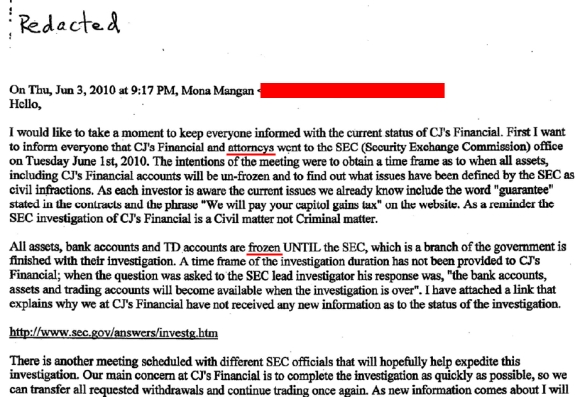
On June 3, Mangan sent another email — this one claiming that CJF’s assets had been frozen and that company “attorneys” were working with the SEC and visited its offices June 1 to determine when the purported asset freeze would be lifted, according to the agency.
“According to Mangan,” the SEC said, “‘CJ’s Financial and attorneys [sic] went to the SEC (Security Exchange [sic] Commission) office on Tuesday June 1, 2010. The intentions of the meeting were to obtain a time frame as to when all assets, including CJ’s Financial accounts will be un-frozen and to find out what issues have been defined by the SEC as civil infractions.’”
“Later in the e-mail,” the SEC continued, “Mangan reiterated that ‘All assets, bank accounts and TD accounts are frozen UNTIL the SEC, which is a branch of the government is finished with their investigation.’ Mangan quoted the ‘SEC lead investigator’ as stating that ‘bank accounts, assets and trading accounts will become available when the investigation is over.’ Mangan assured investors that ‘Our main concern at CJ’s Financial is to complete the investigation as quickly as possible, so we can transfer all requested withdrawals and continue trading once again.’”
Campbell made similar claims to investors, the agency alleged.
Regardless, the agency said, “Contrary to the information Mangan and Campbell provided to investors, there was no meeting on June 1, 2010 between the Commission and CJF and its attorneys, and the Commission had not frozen Defendants’ bank accounts, trading accounts, or other assets. Defendants fabricated this story to keep investors from realizing Defendants had stolen their money.”
Mangan is not named a defendant in the complaint.
Investigators said Campbell used only a “small” percentage of the more than $1 million collected to make trades.
“Campbell diverted the money for personal uses, including paying for vacations, cars, jewelry, sporting goods, and furniture,” the SEC charged. “Classic” Ponzi payments were made to some investors, the agency added.
Here is how Campbell, who is accused of depositing client funds into her personal account and diverting “at least” $540,000 for her personal use, spent much of the money, according to the SEC:
Cash withdrawals ($138,000).
Purchases of airline tickets and travel, including travel to resorts in Florida and Arizona ($127,000).
Purchases from several jewelry retailers ($33,046).
Purchases from sporting-goods retailers ($28,350).
Purchases from furniture stores ($29,124).
Purchases from a laser-surgery center ($20,650).
Purchases at automobile dealerships (at least $100,000).
“In an apparent effort to keep the Ponzi scheme from collapsing, Campbell used more than $350,000 of investor money to pay other investors,” the SEC charged.
Read the SEC complaint. (Make sure you read the emails, which are included in the PDF file.)
The SEC claims this June email painted a false picture than CJF could not pay investors because the agency had frozen its assets. The SEC did not file a complaint against the company and gain an asset freeze until Aug. 4. NOTE: The entire email is not reproduced in this screen shot, and the PP Blog added the red lines.
 BULLETIN: (UPDATED 6:10 P.M. EDT (U.S.A.) North Dakota Attorney General Wayne Stenehjem has issued a cease-and-desist order against Kenneth Jacobi and his company, XM Brands Inc., amid allegations of deceptive trade practices in the sale of acai berry and teeth-whitening products on the Internet.