Blog

  • Ponzi Operator D.J. Harriett Pleads Guilty; Tells Judge He Attempted Suicide During Scheme’s Collapse And Also Is Suffering From Cancer

    David J. Harriett

    An Ohio man who fleeced more than 200 people in a $7 million Ponzi scheme tried to commit suicide in November when the scheme was collapsing and also is suffering from pancreatic cancer, the Warren Tribune-Chronicle is reporting.

    The story of David J. Harriett demonstrates the enormous emotional pressure on both perpetrators and victims in Ponzi cases.

    Separately, WYTV, the ABC outlet in Youngstown, is reporting that Harriett has advised a federal judge that he has only months to live.

    Harriett, 60, of Warren, pleaded guilty to mail fraud in the scheme yesterday in Cleveland. The case against him was brought last month as part of President Obama’s Financial Fraud Enforcement Task Force, U.S. Attorney Steven M. Dettelbach said.

    “These types of financial frauds, in which people portray themselves as legitimate investors but simply take their clients’ money, are a serious problem and we will continue to prosecute them vigorously,” Dettelbach said.

    Sentencing is scheduled for Aug. 18. Harriett faces a maximum of 78 months behind bars.

    Demonstrating the investing public’s discontent with Ponzi schemers, some of Harriett’s fleeced clients yesterday fretted that he might not live long enough for justice to be served. Harriett, whose website noted that he had gone on a Caribbean cruise in December 2008 in the months prior to the scheme’s collapse, is free on bond pending sentencing.

    Harriett admitted yesterday that he told investors he was a project manager for the construction of franchise restaurants for McDonald’s and Pioneer Chicken and that investors who helped him build the restaurants were given promissory notes that guaranteed the return of their investments with interest.

    His claims were false, the FBI said. No such construction contracts existed, and Harriett was using money from new investors to pay old investors in a Ponzi scheme.

    See our earlier report.

    Read the story in the Tribune-Chronicle.

    Read the report by WYTV. (NOTE: If you visit the WYTV site, a video accompanying the report is in the upper-right corner of the page. The video shows the types of emotions that Ponzi victims express.)

    NOTE: This story has been republished at a URL that is different than its original URL. Although this post reflects a date of June 13, it is not the original publication date. Click here to read why.

  • FTC Issues Warning On Oil-Spill Schemers; Be On The Look Out For Insurance, Contracting, Jobs And Charity Scammers

    As the attention of the United States and much of the world is riveted on the oil gusher in the Gulf of Mexico, the Federal Trade Commission is warning consumers that schemers will try to take advantage of the environmental disaster to lines their own pockets.

    “It’s no secret that scam artists follow the headlines, and the daily news of the oil spill in the Gulf of Mexico is no exception,” the FTC said today. “[I]t’s likely that scammers will use e-mails, websites, door-to-door collections, flyers, mailings and telephone calls to make contact and solicit money.

    “Some may claim they’re raising money for environmental causes or offer fraudulent services like remediation services related to the oil spill,” the FTC warned. “Others may claim they can expedite loss claims for a fee. Still others may knock on your door and talk about placing booms or checking for oil on your property. Chances are they’re trying to gain your trust to get inside your home or get access to your personal information.”

    Many scams cropped up after Hurricane Katrina in August 2005, the agency said.

    Oil-spill-related scams could included solicitations for donations to bogus charities that use “copy-cat names to cash in on the reputations of older, more established charities,” the FTC said.

    Use the Better Business Bureau’s website to check out a charity and do other research, the FTC advised.

    “Rather than clicking on a link to a purported website, verify the legitimacy of a nonprofit organization by using search engines and other online resources to confirm the group’s existence, history, mission and nonprofit status,” the FTC advised. “To ensure your contributions are received and used for the purposes you intend, contribute directly to organizations you know rather than relying on other people to make a donation on your behalf. If you get pressure to make a contribution, look for another charity. Reputable charities don’t use those kinds of tactics.”

    Job-scammers also could surface in the Gulf region or elsewhere, the FTC cautioned.

    “Avoid any job or volunteer opportunities that require you to pay a fee before the job begins,” the agency said.

    Because of frauds associated with Hurricane Katrina, the U.S. government formed the National Center for Disaster Fraud (NCDF).

    “The NCDF was originally established by the Department of Justice to investigate, prosecute, and deter fraud in the wake of Hurricane Katrina, when billions of dollars in federal disaster relief poured into the Gulf Coast region,” the FTC said. “Its mission has expanded to include suspected fraud from any natural or man-made disaster.”

    If you suspect someone is trying to pull off a scam related to the oil spill, the FTC recommends that you contact NCDF by phone at 1-866-720-5721; by email at email: disaster@leo.gov; or by fax at 225-334-4707.

    Read the FTC’s full warning.

    NOTE: This story has been republished at a URL that is different than its original URL. Although this post reflects a date of June 13, it is not the original publication date. Click here to read why.

  • BULLETIN: Ponzi Swindler And Racketeer Scott Rothstein Sentenced To 50 Years In Federal Prison For $1.2 Billion Scam; Schemer Forged Judges’ Signatures, Threatened Reporter

    BULLETIN: Scott Rothstein, the disbarred Florida lawyer who sold interests in nonexistent legal settlements, forged the signatures of federal judges on court documents to hoodwink investors and keep money flowing to his $1.2 billion Ponzi scheme and threatened to sue a reporter asking tough questions, has been sentenced to 50 years in federal prison.

    Rothstein, one day shy of his 48th birthday, was sentenced by U.S. District Judge James Cohn.

    His lawyer had sought a 30-year sentence. Prosecutors recommended 40 years, based on Rothstein’s post-arrest cooperation. Rothstein faced a maximum sentence of 100 years.

    By comparison, infamous Wall Street swindler Bernard Madoff was sentenced to 150 years for his $65 billion fraud. Tom Petters, who hatched a massive Ponzi scheme involving bogus sales of merchandise to prominent retailers, was sentenced to 50 years for his $3.65 billion fraud.

    Guessing the length of Rothstein’s sentence had become sport on the Internet, with people from all over the world advancing their notions.

    In the end, Cohn said Rothstein, who also threatened to sue at least one reporter who was in the process of exposing the fraud, deserved 50 years. The scheme destroyed the Rothstein Rosenfeldt Adler law firm in Fort Lauderdale and has subjected multiple people to investigation, indictments and lawsuits.

    Rothstein pleaded for mercy, saying he was a “changed man” who had contemplated suicide while operating the scheme but ultimately returned from Morocco to face the charges and assist prosecutors in their efforts to untangle the colossal mess.

    The elaborate Ponzi fraud included bogus legal settlements, forged court documents, fraudulent promissory notes, fraudulent campaign donations and gratuities paid to “high ranking members of police agencies,” prosecutors said.

    Rothstein forfeited $1.2 billion, 24 pieces of real estate, luxury cars such as Bugattis, Rolls-Royces and Cadillacs, yachts, shares in businesses and more.

    Here are snippets from Rothstein’s letter to Cohn that asked for fairness and mercy (italics added):

  • SEC: Texas ‘Man Of God’ Ran Nigerian ‘Oil Tanker’ Scheme On Elderly Christians Who Believe He’ll Still Deliver; One Widow May Be Out More Than $1 Million

    EDITOR’S NOTE: The allegations against Samuel O. LeMaire are alarming. The case against him may prove to be one that demonstrates how vulnerable people of faith may be to affinity fraud while at once demonstrating how victims don’t want to believe they’ve been fleeced by a con artist even when the evidence is overwhelming.

    As many as 50 people have been fleeced in an international scheme in which they were told their investment money would be used in part to help needy children in Nigeria, the SEC said.

    Samuel O. LeMaire, a Nigerian living in Texas since the 1980s, told elderly Christians he was starting a “foundation” to help the children and that profits would come as soon as he raised enough money to pay taxes on crude oil from tankers situated “overseas,” the SEC said.

    The agency is treating the action against LeMaire as a case of “religious affinity fraud” because he positioned himself as a “minister” and “Man of God,” targeted investors who had no knowledge of the oil business and repeatedly asked them to give him money to finance the offloading of the oil to make profit distributions possible.

    No investors received any profits, the SEC said.

    Investigators said they believed there was no oil at all, despite the names of LeMaire’s companies — Petrogas Overseas Trading LP and Petroenergy Inc. — and despite LeMaire’s claims he was a former oil executive in Nigeria and well-connected in the oil business.

    LeMaire’s scheme had been operating for “at least” two years, and he was collecting money up until the bitter end by telling investors he needed to raise $90,000 to pay “excise taxes” on the oil before profits could be distributed, the SEC said.

    At various times, LeMaire told investors the deal was “done or almost done, the funds were in transit, the funds were in a bank account ready to be wired, or any number of similar stories,” the SEC said.

    In truth, “LeMaire used investor funds to finance his own lavish lifestyle and support friends and family in the U.S. and abroad,” the SEC said. Investor funds were used for travel and entertainment and to purchase clothing, jewelry and meals in high-end restaurants.

    When issued a subpoena, LeMaire asserted his 5th Amendment right not to incriminate himself and declined to answer questions about Petrogas, the SEC said.

    Investors were promised returns ranging from 300 percent to 1,000 percent, the SEC said, alleging that the scheme raised at least $2.3 million since 2007.

    “The mindset of all Petrogas investors was, and still is, that God wanted them to invest with LeMaire, and that ‘it will all work out in the end,’” the SEC said.

  • BULLETIN: Ponzi Suspect Alan Todd May, On Lam From Dallas And Wanted By U.S. Secret Service, Captured In San Francisco

    BULLETIN: Ponzi suspect Alan Todd May of Dallas has been captured by the U.S. Marshals Service in San Francisco.

    May, 45, was wanted by the U.S. Secret Service. In March, the SEC accused May of running an oil-and-gas Ponzi scheme through companies variously known as Prosper Oil & Gas Inc. and Prosper Energy Inc.

    May, who has a long criminal record and was described by the SEC as a “felon,” assumed “multiple identities to evade apprehension,” according to U.S. Marshal Federico Rocha.

    May pitched his scheme in ads in the Wall Street Journal, Barron’s, the Oklahoman, the Jewish Voice, the Abilene Reporter and on eBay, the SEC said in March.

    Records show that May was arrested 13 times between 1983 to 2002 for crimes such as theft, theft by check and credit card abuse. He also had been apprehended for probation violations and failure to appear in court.

    “These arrests resulted in at least 14 convictions, with dispositions ranging from probation to 20-years’ imprisonment,” the SEC said. “Most recently, he was released from prison in or about 2007.”

    In his latest scheme, the SEC said, May sold royalty interests in wells in to at least 99 investors, advertising returns of up to 38 percent.

    “May or other Prosper employees used investor funds for various lavish personal expenses, including approximately $611,000 for vehicle purchases and expenses (including purchases by May of a Ferrari, a BMW and a Mercedes), $400,000 in credit card payments, $430,000 for meals, entertainment and retail purchases, $324,000 in travel expenses, and $89,000 in cash withdrawals,” the SEC said in March.

    “In addition, during the scheme, May and Prosper acquired multiple houses and condominiums, including homes in Dallas, each valued at approximately $1.5 million. May also caused $611,000 in investor funds to be transferred to his personal bank accounts,” the SEC said.

    The Marshals Service said the scheme may involve $7 million.

    Records suggest May was booked into the Glenn E. Dyer Detention Facility in Alameda County without bail.

    “This arrest was a result of the combined efforts of the Dallas Fort Worth Fugitive Apprehension Strike Team, U.S. Secret Service and the Northern District of California Fugitive Task Force,” the Marshals Service said.

    NOTE: This story has been republished at a URL that is different than its original URL. Although this post reflects a date of June 13, it is not the original publication date. Click here to read why.

  • Head Of Justice Department’s Criminal Division Announces Guilty Plea Of Texas Man In Commodities Ponzi Case; Multiagency Crackdown Against Scammers Continues

    In yet another sign that U.S. policy is to turn up the heat on Ponzi and HYIP purveyors, the head of the Justice Department’s Criminal Division announced the guilty plea of a Texas man accused both criminally and civilly of running a Forex HYIP and Ponzi scheme.

    Ray M. White, 51, of Mansfield, faces up to 10 years in federal prison after pleading guilty yesterday to a criminal count of commodities fraud. The announcement was made by Assistant Attorney General Lanny A. Breuer, who was appointed to the post by President Obama in 2009.

    White also faces civil prosecutions by the SEC and CFTC.

    Breuer was joined in the announcement by U.S. Attorney James T. Jacks of the Northern District of Texas. Multiple news releases by the government yesterday in the White case referenced President Obama’s Financial Fraud Enforcement Task Force.

    The Obama administration has made Ponzi- and financial-fraud busting one of its top priorities. Ponzi schemes have drained tens of billions of dollars from the economy during a period in which the United States and much of the world are trying to rebound from a growth-killing recession.

    In January, U.S. Attorney General Eric Holder announced that fraudsters were writing their own tickets to jail.

    “White admitted that in July 2008 he contracted with an investor to sell $50,000 in commodities through CRW Management LP,” the Justice Department said. “[F]rom July 2008 until January 2009, he knowingly and willfully cheated and defrauded, made false statements to, and deceived the investor by making several misrepresentations in connection with the contract to sell commodities.”

    The scheme featured a claim “to the investor that his funds would be used to trade off-exchange foreign currency contracts and that CRW averaged 7 percent per week returns through off-exchange foreign currency trading,” the Justice Department said.

    Like many Ponzi schemes, “White provided written account statements showing purported returns, and represented to this investor that CRW would maintain separate bank accounts for each investor,” the Justice Department said. “White admitted that in fact, these account statements were false and that he did not maintain separate bank accounts for the investors.”

    Prosecutors said “the vast majority of the funds were never used to trade off-exchange foreign currency.”

    White, in fact, lost money in his trading scheme, despite his 7- percent- per-week profits claim, prosecutors said.

    White solicited at least $10.9 million from late 2006 until March 2009 from more than 250 investors,  according to the SEC and CFTC.

    “White used at most $93,900 of the $10.9 million he raised to trade in the foreign currency market,” prosecutors said. “The remaining approximately $10.8 million was either misappropriated or returned to CRW customers as part of the Ponzi scheme.”

    Prosecutors were quick to point out that White’s Ponzi meant pain for his family and others.

    “White used the funds to finance his son’s car-racing career, to purchase a company called Hurricane Motorsports LLC, in Arlington, Texas, and to purchase a home and other real property,” prosecutors said.

    He faces a maximum prison sentence of 10 years and a maximum fine of $1 million. U.S. District Judge Barbara M.G. Lynn is scheduled to sentence White on Sept. 17.

    NOTE: This story has been republished at a URL that is different than its original URL. Although this post reflects a date of June 13, it is not the original publication date. Click here to read why.

  • EDITORIAL: Grab Your Umbrella And Air Freshener: Data Network Affiliates’ Vomit Spigot Wide Open And Raining Down On World Of MLM

    EDITOR’S NOTE: Readers with queasy tummies are duly cautioned that this post is on the subject of MLM vomit. No, the troops aren’t packaging and selling regurgitated stomach juice and chunky bits that pay commissions 10 levels deep — at least not yet. This post discusses MLM advertising vomit as practiced by Data Network Affiliates, which has declared that a mysterious practitioner known as “Mr P” is promoting the “D.N.A. 1000 Team.” Mr. P is said to be a “19 Time Million Dollar Earner” who “Holds Every MLM World Recruiting Record.”

    Here, now, our take on the vomitous pitch . . .

    Incoming! If you are a member of Data Network Affiliates (DNA), you have a duty to grab your umbrellas, air freshener and garden hose and warn your downline to do the same. It has become clear that the company has turned its vomit spigot wide open.

    Yesterday’s vomit attack followed on the heels of a vomitous flurry late last month that prompted members to imagine themselves racking up 10,000 miles while recording license-plate data for the company.

    “Imagine driving 10,000 miles for your DNA Business = up to a $5,000 Tax Deduction,” DNA prompted members in May.

    If you are a member of DNA — and if you are a multilevel-marketing (MLM) aficionado or one of the industry’s so-called servant-leaders — you have a duty to warn all potential prospects to be prepared for sustained email vomit attacks. Advise them that, if they intend to open the emails, to make sure the laptop on their home-office network works outdoors.

    Under no circumstances should DNA emails be opened indoors. The vomit they project can damage your carpeting, furniture, curtains and fixtures, all while stinking up the inside of your home, perhaps forever. Remember: A stink-removal crew is expensive, and there’s no guarantee the stench will fully dissipate. You could awaken in the middle of the night six years from now, take a sniff and again reach the horrifying conclusion that, yep, its still there.

    Important: Open DNA’s emails only outdoors. The initial burst of pressure from the vomit will be sufficient to pump it on an arc away from your laptop, and your laptop’s built-in vomit seal will protect it from damage. The seal will close instantly when it senses a temperature drop in the the hot-air belch that accompanies the vomit, thus protecting your computer from drips and embarrassing streaks from run-off.

    Open the emails quickly and step back. Be prepared: It may take up to three minutes for the vomit to stop gushing. Have the umbrella at the ready in case you were unable to step back quickly enough and got caught in the vomit storm.

    After the storm subsides, use the garden hose to clear the umbrella of both liquid and chunky vomit. Apply the air freshener liberally to the umbrella. Let it dry. Repeat the process as necessary or buy dollar-store, disposable umbrellas in bulk. Hint: A dollar store also is a great place to buy air freshener in bulk.

  • APOLOGISTS INTERRUPTED: Two Court Rulings Show That HYIP Operators, Players Setting Stage For Painful Downfalls, Foreclosures; Woman Loses Home While New Mom Loses Everything

    EDITOR’S NOTE: UPDATED 9:22 P.M. EDT (June 7, 2010, U.S.A.) This post is presented in seven parts. With the exception of the lengthier introduction, each part includes six to eight paragraphs. You’ll see a “GO TO PAGE” prompt at the bottom of each section. Simply click on the next page number to continue reading.

    The post takes a stark look at two recent court cases. WARNING: Some readers may find the content objectionable because it describes family-unfriendly events that occurred as a result of HYIP Ponzi schemes that operated in the Forex and futures spheres and promised huge returns. We are publishing the post because we believe it is in the public interest to do so. It reflects this Blog’s view that Ponzi apologists and pitchmen pushing unrealistic, unsustainable returns on forums and though other forms of mass communication are undermining family economies and regional economies, while threatening national economies and posing significant security risks to the nations of the world.

    If you are still pushing HYIP and investment-fraud schemes on the Ponzi boards, lying to yourself by clinging to the notion that such schemes are “games” and you’re causing no real harm by promoting them or introducing people to the “opportunities,” be advised that these cases may interrupt your fantasy.

    One of the cases is about how a woman who thought she had met a successful and generous man through an online dating service was ordered to surrender her property in Florida, despite the state’s famous Homeowner’s Exemption. The second case is about how a woman who became romantically involved with a Ponzi schemer lost just about everything. At the moment, there are hundreds of Ponzi and fraud cases with significant social and economic consequences either being investigated or working their way through the courts.

    We’ll start the editorial with the case involving the Florida woman who lost her home because it was paid for with Ponzi proceeds, even though she was unaware she had been given money from a Ponzi.

    After we outline the Florida case, we’ll turn your attention to a separate case in Tennessee in which a woman who received illegal proceeds from her Ponzi operator/paramour lost the value of a home paid for with Ponzi proceeds and lost the value of hundreds of thousands of dollars in cash and gifts that flowed from the Ponzi.

    The paramour in the Tennessee case, Luis H. Rivas, initially fled after being exposed. He ultimately was captured, arrested, charged in both federal and state courts and convicted. In November, he was sentenced to nearly 25 years in prison. Meanwhile, federal records show that the woman, Pamela Morgan, now owes the Rivas bankruptcy estate $235,100 to cover fraudulent cash transfers, $225,000 to cover a fraudulent transfer that was plunked down on a new home, $82,266 to cover fraudulent transfers that led to the purchase of a Volkswagen Toureg, and $9,821 to cover fraudulent transfers that led to the purchase of furniture.

    In the end, a federal judge also determined that Morgan owed the estate $11,000 to cover fraudulent transfers that led to the purchase of her engagement ring after she left her marriage for Rivas, who previously had spent years in prison for another fraud scheme.

    When Rivas was sentenced by a federal judge in November, some of the victims asked the judge to go light on him or not even to order a jail sentence. After all, they reasoned, should Rivas be permitted to return to the Forex HYIP business, he just might be able to reverse his $35 million fraud and make everybody whole.

    That he’d previously been sentenced to more than a decade in prison for running cons and, in fact, had fled when his latest con was exposed somehow did not fully compute. Some victims said they believed he should be set free to resume his purported trading program, thus viewing a $35 million fraud like a traffic-court case in which the defendant was charged with an innocuous offense such as overtime parking and viewing the fraudster himself as the remedy, not the problem.

    This sort of thinking is so obviously flawed that it reads like fiction and challenges readers to suspend their disbelief — but it surfaces on a daily basis because both promoters and true victims in the schemes have a profound need to create psychological wiggle room.

    In the case of true victims, the wiggle room is needed because acknowledging they have been conned in a fraud and have little hope of making a full recovery simply is too painful to contemplate. In the cases of the Ponzi players and pitchmen, the wiggle room is needed to let them off the hook and to rationalize continued participation in the frauds, which often pay commissions to recruiters for bringing in new marks whose money is used to reward earlier participants in the schemes.

    The tortured result is to give aid and comfort to the thieves who caused spectacular losses while at once directing tiny daggers to the law-enforcement agencies, courts, receivers and trustees who suddenly have a glut of Ponzi cases that have consumed billions of dollars and altered the lives of tens of thousands of victims.

    If you are collecting commissions and/or salary and payments from such schemes or recommending the schemes to prospects on the Internet, through the mails, through conference calls or other group functions or though other forms of mass communications, you are setting the stage for misery that could lead to the sort of court actions described in this post.

    This misery includes protracted litigation, insoluble personal problems, romantic conflicts, conflicts with friends, family and acquaintances, attorneys’ bills, dispossessions and hourly, spirit-crushing stress.

    Promoter? Awake yet?

    What you are doing by involving yourself in HYIPs and investment frauds as a promoter or wink-nod cheerleader is deluding yourself by slipping into a convenient psychology that lets you off the hook for the pain you potentially are causing both people you know and strangers alike. While you are arguing that pushing such schemes is a sign that you embrace “freedom of choice” and that only psychologically unhealthy people would see things a different way, you are revealing yourself as a pusher of poison and hiding behind your bogus manta of self-actualization. Your delusion is on display for all the world to see, and your purported journey toward self-discovery is more accurately described as the relentless pursuit of criminal self-indulgence.

    God pity the world if your delusions of self-actualization gain a viral following. Bottom line: You are participating in schemes that create endless nightmares, undermine families and family economies, undermine regional economies and threaten national economies and the security of nations worldwide — and you’re trying to sell yourself on the impossible notion that you’re somehow a modern-day freedom fighter and that the rest of society and the reporters and Bloggers who cover the schemes just don’t “get it.”

    Take these three things to the bank:

    Wherever there is an HYIP or autosurf Ponzi scheme, there is a player railing against the government. Wherever there is an HYIP or autosurf Ponzi scheme, there is a player railing against reporters and Bloggers and forum posters who are trying to educate the public about such schemes and the lengths to which players go to sanitize the schemes and rationalize their behavior, which is a cancer on the world.

    And wherever there is an HYIP or autosurf Ponzi scheme, there is a player railing against the court-appointed receiver or trustee. The player paints the false picture that the receiver or trustee’s greed is the issue — all while the player conveniently ignores the fact that the schemers created the situation that made it necessary for the court to appoint professionals to unravel these hugely complex frauds through a supervised, costly, time-consuming process that is undertaken only because of the conduct of fraudsters and their shills and apologists.

    With each passing day — as more and more schemes emerge — players are further marginalizing themselves, further identifying themselves not only as a criminals, but as a delusional ones. Society at large does, indeed, “get it.” What it “gets,” plainly, is the correct notion that HYIP and autosurf Ponzi pushers are capable of conflating one convenient reality after another and shaping those realities to fit any awkward or bizarre circumstance that arises.

    Despite your claims, neither you nor your marks are being denied freedom of choice. What you’re being denied is the license you divine yourself to commit crimes on a local, regional, national or international scale. If your theories had any validity at all, you’d be permitted not to feed the parking meters in your neighborhood simply because you are you and thus insulated from getting a ticket by the mere circumstance of you being you.

    On a grander scale, you’d be permitted to create a license to steal huge sums of money simply because you are, well, you — and thus insulated from prosecution by the mere circumstance of you being you.

    But it’s not about you; it’s about the lives you are helping to ruin through your relentless pursuit of thrill profits and your relentless insistence that the cops, the courts, the journalists, the forum critics and the receivers and trustees are all wrong and have ganged up against you in a giant conspiracy to strangle the human spirit and undermine freedom of choice.

    Far from being a modern-day freedom fighter, you actually are a modern-day, delusional criminal — one who is waging a war on behalf of fellow criminals. You are cementing the destruction of wealth and potentially ushering in an era of a global Third World economy.

    You are dangerous — and the law can’t get to you soon enough. Period.

    Here, now, briefs on two cases that interrupt your forum delusions . . .

  • OFFICIALS: Ponzi Schemes, Investment Fraud Have Led To Staggering Losses In Utah; Hundreds Of Potential Perpetrators Identified

    UPDATED 8:38 P.M. EDT (U.S.A.) Recent Ponzi schemes and cases of investment fraud have cost Utah residents an estimated $1.4 billion, the FBI said today.

    About 370 investigative “subjects” — defined as “potential perpetrators” in current cases — have been identified, and the agency and its law-enforcement partners have embarked on a public awareness and education campaign aimed at keeping Utahns safe from scammers.

    About 4,400 people have been affected by investment-fraud schemes in the state, the FBI said. The education campaign includes billboards and public-service messages.

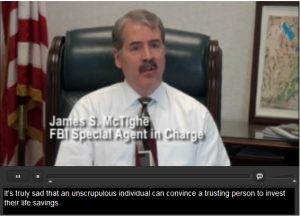
    Under the umbrella of the Utah Securities Fraud Task Force, the FBI and its partners — including the SEC, the IRS, the U.S. Postal Inspection Service, the Utah Department of Commerce’s Division of Securities, the Utah County Attorney’s Office, the United States Attorney’s Office for the District of Utah and the Utah Attorney General’s Office — have produced a video that encourages viewers to be aware that schemers may target them based on their religious affiliation or interests.

    “Affinity fraud is when someone you know — for example a church member, a coworker, or a friendd — takes advantage of you in an investment fraud scheme,” said James S. McTighe, FBI special agent in charge.

    Con artists have been known to deliberately target members of the Church of Jesus Christ of Latter-Day Saints, the FBI said.

    No group of believers — and no group of people who share a common bond — is immune to the cunning of expert con men, the FBI added.

    An investor featured in the educational video said her experience of being duped can serve as a warning to others:

    “He was a religious man, so he says, and he really, he really put on the ‘You know I am so guided by the spirit’, and ‘I know I am here to help you’, and ‘just trust me,’” the woman said.

    Nothing about a Ponzi scheme is good news, warned the SEC’s top official in Salt Lake City.

    “Ponzi schemes always collapse eventually and it’s typically because you run out of newer investors,” said Ken Israel.

    How do fraudsters profit from a Ponzi scheme?

    “The hallmark of the Ponzi scheme is that you use money from new investors to pay off your old investors and of course put a bunch in your pocket at the same time,” said Keith Woodwell, director of the Utah Division of Securities.

    Officials warned the public to be on the look out for “signs of trouble”:

    • The investment offer is unsolicited.
    • It sounds too good to be true.
    • You’re promised big monthly or yearly returns with little or no risk.
    • You’re asked to keep the investment offer secret.
    • The promoter cannot answer specific questions or provide you with written financial documentation.
    • Slick websites and glossy literature can be deceiving, and also be suspicious of documentation that looks unprofessionally produced.
    • The promoter won’t give you time to research the investment.
    • You are told you are one of the lucky few allowed in on the investment.
    • You are required to bring in more investors.
    • The salesperson is not licensed or the product is not registered.

    “Con artists who run Ponzi schemes often promise big financial returns and may tell potential investors they operate programs that can sound impressive,” the FBI said. The agency advised investors to do their homework and be skeptical of pitches for programs such as these:

    • Foreign Exchange Currency Trading.
    • Prime Bank Investment.
    • Commodities Investments.
    • Real Estate Investments.

    “Research before you invest, the FBI warned, recommending these resources for Utah residents:

    Get educated for free at the June 30 “Fraud College” at Utah Valley University in Orem

    Watch the Task Force video.

    Get more information from the FBI:

    NOTE: This story has been republished at a URL that is different than its original URL. Although this post reflects a date of June 13, it is not the original publication date. Click here to read why.

  • FEDS: Former Police Officer Recruited Active-Duty and Retired Cops, Firefighters Into Ponzi Scheme, Defrauding Them Of Nearly $900,000

    In yet-another action brought through the interagency Financial Fraud Enforcement Task Force (FFETF), a former police officer in a Cleveland suburb has been charged with operating a Ponzi scheme that defrauded law-enforcement colleagues and firefighters out of $889,000, federal prosecutors said.

    Raymond Thomas, 49, who formerly lived in Mentor, Ohio, and served on the Warrensville Heights Police Department, also was charged with filing a false tax return that understated his income in 2006 by more than $186,000.

    “It is particularly troubling to discover that a former law enforcement officer has committed a crime, especially given that law enforcement officers take an oath to uphold the law,” said U.S. Attorney Steven M. Dettelbach of the Northern District of Ohio. “These charges allege that Thomas did more than just violate the laws he had sworn to uphold, they charge that he actually targeted the law enforcement community to sustain his Ponzi scheme.”

    Prosectutors alleged that Thomas told about 25 investors — many of whom included Cleveland-area active and retired police officers and firefighters — that money they invested with him would earn “above average fixed returns with below average risk.”

    Thomas purported that he owned three legitimate companies — Strictly Stocks Investment Co. Inc., JR Ventures and Adams Title Agency — and that “Strictly Stocks would make quarterly payments to investors from income derived from ‘trading only in stocks and options,’” prosecutors said.

    JR Ventures was described as a trucking business that included a car and limousine service, and Adams Title Agency was described as a real-estate management company, prosecutors said.

    Thomas told investors that there money could be entrusted to any or all of the three companies and would be used for no other purpose than to create legitimate investment income.

    But Thomas “did not invest the money as he represented,” prosecutors said. “Instead, [he] unlawfully commingled investor funds; used investor funds for unauthorized purposes, including to make Ponzi payments to previous investors; and misappropriated investor funds for his own purposes and personal use.”

    Using words that have been associated with various so-called “mini-Madoffs” accused of operating smaller Ponzi schemes in the aftermath of Bernard Madoff’s $65 billion scheme, prosecutors said that “Thomas sent numerous interest checks, quarterly dividend checks, and financial statements to investors.”

    President Obama formed the FFETF in November 2009.

    Dettelbach’s office has brought a number of Ponzi cases recently. Last month, David Harriett, 60, of Warren, Ohio, was charged with bilking investors by telling them he built franchise restaurants for McDonald’s and Pioneer Chicken.

    In March, Enrique F. Villalba, 47, of Cuyahoga Falls, was charged in a bizarre Ponzi scheme that allegedly combined the science of physics with a unique “momentum filter” that purportedly enabled him to predict how the futures market would behave with “an uncanny degree of certainty.”

    The Villalba scheme was conducted from Beachwood Ohio, prosecutors said.

    Villalba is a graduate of the United States Military Academy at West Point and the University of Puget Sound School of Law.

    NOTE: This story has been republished at a URL that is different than its original URL. Although this post reflects a date of June 13, it is not the original publication date. Click here to read why.

  • Narc That Car President Fidgets, Struggles Through Lengthy Fox 4 News Interview In Dallas; Confirms That Members Who Don’t Recruit Make $5 A Month And Will Not Break Even For Nearly Two Years

    EDITOR’S NOTE: At the bottom of this post you’ll find links to the Fox 4 News website in Dallas-Fort Worth. We recommend you watch the video of the main report on Narc That Car broadcast by the station, and also the videos of a sit-down interview with Narc President Jacques Johnson. The interview was eminently fair, and yet the pyramid concerns remain . . .

    Narc That Car President Jacques Johnson confirmed yesterday in an interview broadcast by Fox 4 News in Dallas-Fort Worth that members who enter license-plate numbers into the company’s database but do not recruit are paid only $5 a month — 50 cents per plate.

    Narc That Car also is known as Crowd Sourcing International or CSI. Narc limits its data-gatherers to entering only 10 plates per month.

    Fox outlets in Atlanta, Los Angeles and Dallas now have broadcast reports about Narc. Despite being given access to the airwaves, no Narc representative or official — including Johnson — has been able to lay to rest questions about whether the company is operating a pyramid scheme.

    Johnson struggled in the lengthy Fox 4 News interview when trying to explain why Narc limits members to recording only 10 plates a month if its aim is to build a well-populated, viable database that would be appealing to clients willing to pay a fee for the information.

    As has been the case in its previous encounters with the media, Narc’s explanations left more questions than answers. Despite being given ample air time by Fox 4, Johnson still left the pyramid concerns on the table by confirming there is virtually no way to make money in Narc if a member does not recruit other members and by declining to name Narc’s clients for its database product.

    Johnson agreed with reporter Steve Noviello that it would take a Narc member not interested in recruiting 20 months — nearly two years — just to break even. Narc charges members a one-time, $100, up-front fee to join the program, which has a “F” rating from the Better Business Bureau.

    If a nonrecruiting member chose to pay Narc an optional $24.95 a month for a website on top of the $100 sign-up fee, the costs of belonging to the program never could be retired because paying Narc the fee would carry with it a built-in loss of $19.95 a month even if the member stayed with Narc long enough to retire the up-front fee, according to the Fox 4 report.

    Even if such a member opts not to pay for a website, the minimum amount of time it would take for the member to retire the $100 fee is about 600 days because of the 10-plate-per-month limit. According to the math of the program, such a nonrecruiting member would earn an average of about 16.66 cents per day.

    Johnson struggled throughout the interview to explain basic claims about the Narc program. The Fox 4 package includes multiple parts, including a lengthy interview with Johnson divided into four parts. (See the link under the video box below to visit the Fox 4 website.)

    Visit Fox News 4 to view the entire interview with Johnson.

    NOTE: This story has been republished at a URL that is different than its original URL. Although this post reflects a date of June 13, it is not the original publication date. Click here to read why.