Blog

  • TelexFree Affiliates Gave AdSurfDaily-Like Coaching Tips, Instructed Prospects To Make Deposits At Bank Of America — And To Copy Slips To ‘Team Leader’s’ Gmail Address For ‘Expedited’ Service; TelexFree Also May Have TD Bank Account

    “On or about July 14, 2008, [an undercover agent] opened an ‘upgraded member’ account with [AdSurfDaily]. ASD directs new members either to mail a money order or cashier’s check to its Florida office, or to deposit a certified check, money order or cash at ‘your nearest branch of Bank of America,’ directly into ASD’s BOA account and, thereafter, to fax a copy of the deposit receipt along with their membership number to ASD. On its website, ASD provides its BOA account number as [XXX.] Another [undercover agent] made a direct deposit to ASD’S BOA account by delivering a check to a BOA branch in downtown Orlando, Florida. Thereafter, [an undercover agent] faxed a copy of the deposit receipt via facsimile to ASD’s headquarters in Quincy, Florida.”AdSurfDaily Ponzi scheme forfeiture complaint, Aug. 8, 2008
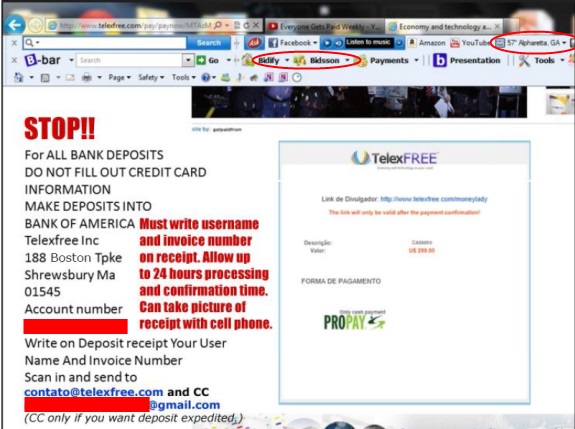
    It was 57 degrees in Alpharetta, Ga., when this screen shot was taken to instruct TelexFree participants on how to deposit money in a TelexFree account at Bank of America in Shrewbury, Mass. (Source: scren shot of section of a PDF instruction manual.
    It was 57 degrees in Alpharetta, Ga., when this screen shot was taken to instruct TelexFree participants on how to deposit money in a TelexFree account at Bank of America in Shrewsbury, Mass. The promoter appears also to have had an interest in Bidify, an “auction” site whose business model was reminiscent of the alleged $600 million Zeek Rewards Ponzi- and pyramid scheme. (Source: screen shot of section of a PDF instruction manual. Redactions/highlights by PP Blog.)

    UPDATED 1:11P.M. EDT (U.S.A.) Information reviewed by the PP Blog shows that promoters of the TelexFree MLM scheme instructed their recruits to deposit money into a TelexFree Inc. account held at a branch office of Bank of America in Shrewsbury, Mass. The recruits then were advised to scan the deposit slip and email a copy to a TelexFree.com email address and optionally send a copy of the slip to an individual dubbed a TelexFree “team leader” who was using a Gmail email address from Google.

    Recruits were told to photograph the slip using a cellphone or tablet computer before scanning it and submitting it via email, according to the instructions.

    The TelexFree promoter using the Gmail address had to ability to “expedite” the process of crediting deposits in the recruits’ back offices at TelexFree, meaning recruits purportedly could start earning money from TelexFree faster because their deposits would be credited quicker, according to the instructions.

    “Alternativey, you can contact your direct referrer, as several Promoters in our upline could also assist with direct deposits to their bank accounts and transfer funds to your registered account immediately,” the instructions note.

    The instructions, which appeared in PDF form in January 2013, were circulated on the Internet. Among other things, the instructions suggest TelexFree has insiders who can speed the flow of money and potentially are collecting the private information of their recruits and potentially subjecting them to identity theft.

    In the early part of the year, some TelexFree promoters worded online promos to suggest that the U.S. government had given the stamp of approval to TelexFree’s operations in the United States. The U.S. government does not issue such endorsements. It is somewhat common in the HYIP sphere for “programs” or promoters to plant the seed an “opportunity” has been approved by the government.

    A TelexFree promo dated March 12, 2013, on Newswire.net, for example, claims that the “TelexFree business opportunity is open to entrepreneurs in Brazil and has recently opened up internationally including being authorized to operate in the United States.”

    TelexFree is under investigation by multiple agencies in Brazil, amid pyramid-scheme and securities concerns. (See BehindMLM.com story dated today on the denial of a TelexFree appeal in Brazil.) Whether a U.S. investigation is under way is unknown.

    What is known is that some affiliates in Brazil appear to believe incorrectly that the U.S. government has approved TelexFree’s operation.

    And it’s also known that the deposit instructions provided to TelexFree recruits strongly resemble the instructions given recruits of the AdSurfDaily Ponzi scheme broken up by the U.S. Secret Service in 2008. The agency seized at least 10 bank accounts held by ASD President Andy Bowdoin at Bank of America and at least five other Bank of America accounts held by an ASD insider. Those 15 accounts ultimately proved to hold about $80 million.

    At least one undercover agent followed ASD’s instructions to make a deposit at Bank of America and to fax the information to ASD, according to court filings in the ASD case. Federal prosecutors in the District of Columbia later applied successfully for warrants to seize the accounts, alleging that ASD was a Ponzi scheme using the U.S. banking system to sustain the scheme.

    Bowdoin later pleaded guilty to wire fraud and was sentenced to 78 months in federal prison.

    As appears to be the case in TelexFree, some ASD members also claimed an ability to speed the flow of money while perhaps making back-office exchanges with recruits. It is possible that ASD never knew its own real bottom line because of the back-office dealings of insiders and other sponsors, including promoters who instructed recruits to pay them directly instead of ASD.

    Some TelexFree affiliates have claimed that a payment of $15,125 to TelexFree will create an income of at least $1,100 a week for a year. The instructions on how to deposit money in Bank of America and scan receipts also claim that TelexFree is using a credit-card processor known as ProPay.

    Some TelexFree affiliates have claimed TelexFree also is banking with TD Bank. In those cases, affiliates are instructed to send money to TelexFree LLC — as opposed to sending it to TelexFree Inc., as was the case with the Bank of America instructions.

    This set of instructions appeared in a promo for TelexFree dated Jan. 17, 2013. (Source: screen shot. Redactions/highlights by PP Blog.)
    This set of instructions appeared in a promo for TelexFree dated Jan. 17, 2013. (Source: screen shot. Redactions/highlights by PP Blog.)

    TelexFree Inc. uses a Massachusetts address; TelexFree LLC uses a Las Vegas address, according to public records. Why some promoters are instructing recruits to send money to the LLC version of the name at TD Bank while others are instructing that money be sent to the Inc. version at Bank of America is unclear.


  • UPDATE: Statue Of Jesus Christ Used In TelexFree Promo On YouTube

    Depictions of Jesus Christ were used in the Profitable Sunrise and the equally bizarre “Cash Tanker” HYIP schemes — and now are being used in promos for TelexFree, an MLM “opportunity” under investigation in Brazil amid pyramid-scheme and securities concerns.

    It looks as though the statue of Christ the Redeemer in Rio de Janeiro has been used in promos for both TelexFree and Profitable Sunrise, which the U.S. Securities and Exchange Commission said in April 2013 was a fraud scheme operating in part through a “mail drop” in England.

    1.

    From a promo for TelexFree playing on YouTube.
    From a promo for TelexFree playing on YouTube. Another part of the video shows money being tossed by one TelexFree pitchman and raining down on another.

    2.

    From a Profitable Sunrise promo.
    From a Profitable Sunrise promo.


  • Notes/Analysis On TelexFree: A Little Like AdSurfDaily/AdViewGlobal, TextCashNetwork, Zeek Rewards, Profitable Sunrise And World Marketing Direct Selling

    TelexFree affiliates have shared a photo of James M. Merrill posing in front of an office building in Massachusetts. The photo, however, is not proof of TelexFree's legitimacy and raises questions about whether the company was trying to plant the seed it had a massive physical presence in the United States.
    TelexFree affiliates have shared a photo of President James M. Merrill posing in front of an office building in Massachusetts. The photo, however, is not proof of TelexFree’s legitimacy and raises questions about whether the company was trying to plant the seed it had a massive physical presence in the United States.

    UPDATED 10:22 P.M. EDT (U.S.A.) The purported TelexFree “opportunity” is under investigation by multiple agencies in Brazil, its purported base of operations despite competing claims the company is headquartered in the United States.  The notes below concern TelexFree’s U.S. presence and positioning. They are presented in no particular order of importance. TelexFree says it is in the communications business.

    TelexFree has a footprint in Massachusetts at 225 Cedar Hill Street, Suite 200, Marlborough. It is a shared office facility. Ads for the building suggest a conference room with video capabilities can be rented by the hour. One suggested use of the room is for attorneys to rent it to conduct depositions. Some attorneys practicing in the state and federal courts use the building as a business address.

    Other lessees include the Massachusetts Library System (MLS), which describes itself as “state-supported collaborative” to foster “cooperation, communication, innovation, and sharing among member libraries of all types.” MLS uses Suite 229, according to its website.

    TelexFree operates as an MLM. One of the problems in the MLM sphere is that purported “opportunities” and their promoters have been known to dupe participants by leasing virtual office space to create the illusion of scale or of a massive physical presence.  Such was the case with a Florida entity associated with AdViewGlobal, an AdSurfDaily knockoff scam that purported to pay 1 percent a day. As the PP Blog reported on May 31, 2009 (italics added):

    Research suggests a company with which AVG has a close association is headquartered in a modern office building in the United States. The building was constructed in 2003. Office functions and conferencing can be rented by the hour. Two large airports are nearby, and a major Interstate highway is situated one mile from the building.

    It is a virtual certainty that AVG, which purported to operate from Uruguay, actually was operating from the U.S. states of Florida and Arizona and using a series of business entities to launder the proceeds of its fraud scheme. AVG disappeared mysteriously in June 2009.

    On Dec. 14, 2011, the PP Blog reported that Text Cash Network (TCN) — another purported MLM “opportunity” — was using a virtual office in Boca Raton, Fla., in a bid to create the illusion of scale. TCN promoters published photos of a glistening building with TCN’s name affixed near the crown of the building. The Boca Raton Police Department, however, said the firm’s name did not appear on the building.

    Although the PP Blog is unaware of any bids to Photoshop TelexFree’s name on a large office building, affiliates have shared photos of TelexFree President James M. Merrill posing in front of the large Massachusetts building. So there can be no confusion, TelexFree does not own the building. TelexFree affiliates/prospects should not rely on the photo of the building as proof of the legitimacy of the company. The photo itself raises questions about whether Merrill and TelexFree were trying to create the illusion of scale. Even though the answer could be no, the negative inferences that can be drawn from the photo contribute to MLM’s reputation for serial disingenuousness.

    TelexFree also has a presence in the state of Nevada. Records show that an entity known as TelexFree LLC is listed as “Domestic Limited-Liability Company” situated in Las Vegas. Listed managers include Carlos N. Wanzeler, Carlos Costa and James M. Merrill. TelexFree operates in Massachusetts with an “Inc.” version of the name — i.e., TelexFree Inc., having undergone a name change in February 2012 from Common Cents Communications Inc. In Massachusetts, James Merrill is listed as the registered agent, president, secretary and director of the firm, with Carlos Wanzeler listed as treasuer and director. Unlike the Nevada “LLC” version of TelexFree, Carlos Costa appears not to hold a title in the Massachusetts “Inc.” entity.

    The footprints in the United States are important in the sense that they establish a business presence in the country should TelexFree become the subject of U.S. investigations akin to what is happening now in Brazil, where pyramid-scheme and securities concerns have been raised. Along those lines, records of the Financial Industry Regulatory Authority (FINRA) appear not to list TelexFree — despite the fact affiliates in the United States have claimed members acquire “stock” from TelexFree that can be sold through TelexFree and that affiliates purchase “contracts” from TelexFree.

    One YouTube video viewed by the PP Blog shows a TelexFree affiliate purportedly cashing out his stock through his TelexFree back office. The affiliate appears to be speaking in U.S. English, citing the date as March 19, 2013. In the video, the affiliate describes his pitch as a “quick withdrawal video” — i.e., proof that TelexFree is legitimate because it pays.

    “OK,” the narrator intones. “I’m going to sell all my stock.” The video shows a tab labeled “Stock” and a subtab styled “Repurchase” in the back office.

    The narrator then clicks on a series of graphics styled “REPURCHASE” and tells the audience that he wants to show it all the “stock that I have that converts to actual money.” He then proceeds to a “Withdraw” subtab under a “Statement” tab. These actions eventually expose a screen that shows an “AVAILABLE BALANCE” of $927.61 for withdrawal.

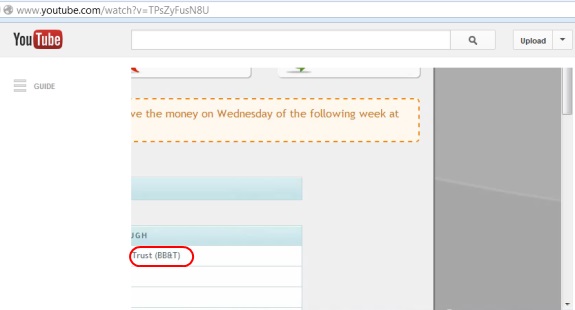
    For a brief moment, the acronym “BT&T” flashes on the screen, suggesting the TelexFree affiliate is seeking to have his earnings from stock sales relayed through North Carolina-based Branch Banking & Trust. The interesting thing about that is that the alleged $600 million Zeek Rewards Ponzi- and pyramid scheme claimed it had a banking relationship with BB&T.

    In May 2012 — on Memorial Day — Zeek mysteriously announced it was ending its relationship with BB&T. It was unclear from the TelexFree affiliate’s video whether he was a BB&T customer or whether TelexFree was. What is clear is that the SEC moved against Zeek in August 2012, accusing the company of securities fraud and selling unregistered securities as investment contracts. The U.S. Secret Service said it also was investigating Zeek.

    In this TelexFree promo running on YouTube, the acronym BB&T flashes on the screen in a TelexFree affiliate's back office.
    In this TelexFree promo running on YouTube, the acronym BB&T flashes on the screen in a TelexFree affiliate’s back office.

    Among the problems with HYIP schemes is that banks can become conduits through which illicit proceeds are routed or stockpiled. Zeek used at least 15 domestic and foreign financial institutions to pull off its fraud, according to court filings.

    Because HYIPs offer commissions to members who recruit other members along with “investment returns,” legitimate financial institutions can come into possession of money tainted by fraud.

    Like Zeek (and AdViewGlobal and AdSurfDaily), TelexFree has a presence on well-known forums listed in U.S. court records as places from which Ponzi schemes are promoted.

    TelexFree shares some of the characteristics of fraud schemes such as Zeek, AdViewGlobal, AdSurfDaily, Profitable Sunrise and others. ASD, AVG and Zeek, for instance, had a purported “advertising” element. So does TelexFree.

    TelexFree affiliates claim they get paid for posting ads online for the purported “opportunity.” Zeek affiliates made the same claim.

    It is highly likely that Zeek and TelexFree have promoters in common, a situation that potentially is problematic, given that some affiliates may have used money from Zeek to join TelexFree — and the court-appointed receiver in the Zeek case is pursuing clawbacks against “winners.” In short, some of the winnings could have been spent in TelexFree.

    An online promo for Zeek in July 2012 claimed North Carolina-based Zeek had 100,000 affiliates in Brazil alone. TelexFree affiliates are claiming that their “opportunity” now has hundreds of thousands of affiliates, which suggests TelexFree has achieved Zeek-like scale. Whether it enjoys Zeek-like, money-pulling power on the order of $600 million is unclear.

    What is clear is that TelexFree, like Zeek before it, is spreading in part through the posting of promos on classified-ad or similar sites across the United States. Profitable Sunrise, another HYIP, spread in similar fashion. Dozens of U.S. states issued Investor Alerts or cease-and-desist orders against Profitable Sunrise, which the SEC accused of fraud in April 2013.

    To gain an early sense of the scale TelexFree may be achieving in the United States, the PP Blog typed into Google the term “TelexFree” and the names of several U.S. states known to have taken actions against Profitable Sunrise. This revealed URLs such as “TelexFreeOhio” and “telexfreetexas.blogspot.com,” for two examples. It also showcased classified-ad (or similar) sites on which TelexFree promos are running or have run.

    Finally, the state of Massachussets was the venue from which the prosecutions of the infamous World Marketing Direct Selling (WMDS) and OneUniverseOnline (1UOL) pyramid-schemes were brought in federal court. Those fraud schemes were targeted at Cambodian-Americans. The state does not take kindly to affinity fraud. In March, Massachusetts securities regulators charged a man in an alleged fraud bid against the Kenyan community.

    Among the claims of the MLM hucksters pitching WMDS and 1UOL was that members could purchase an income. Some TelexFree affiliates are making similar claims.

    The WMDS and 1UOL frauds became infamous as the source of death threats, including one against a federal prosecutor.

    Media outlets in Brazil have reported that death threats have surfaced over the TelexFree scheme.

    For the reasons cited above and more, it would be surprising if things end well in the United States for TelexFree, which has Zeek and ASD-like signatures of MLM disasters waiting to happen.


  • REPORT: TelexFree Diverted $88 Million After Brazilian Judge Blocked Payments

    cautionflagUPDATED 1:04 P.M. (JULY 5, U.S.A.) Quoting a prosecutor, the website of iG — a Brazilian communications provider — is reporting that the TelexFree MLM “program” allegedly diverted $88 million after a judge in the state of Acre blocked payments as a pyramid-scheme probe got under way last month.

    TelexFree also operates in the United States. The “program” has been pitched to victims of the murky Profitable Sunrise “opportunity,” which the U.S. Securities and Exchange Commission described in April as a pyramid scheme that may have collected tens of millions of dollars through offshore bank accounts.

    At least one U.S. video pitch for TelexFree described the purported opportunity as a “program” that provided a guaranteed payout of at least $1,100 per week for a year to individuals who sent in $15,125 for the purchase of a “contract.” TelexFree has been under investigation in Brazil for weeks. Behind MLM.com is reporting that seven Brazilian states have opened probes.

    Here is a link to a Google translation in English of today’s iG story.

    Whether U.S. investigators have opened probes into TelexFree is unknown. The opportunity, however, may have U.S. exposure to charges it is selling unregistered securities as investment contracts. MLM “programs” such as Zeek Rewards and Profitable Sunrise have been shut down under U.S. securities laws.

    Like Zeek Rewards and Profitable Sunrise, TelexFree has a presence on well-known Ponzi-scheme forums such as TalkGold and MoneyMakerGroup.

    Such MLM “programs” typically have promoters in common, a circumstance that raise questions about whether promoters are engaging in willful blindness and polluting banks both domestic and across national borders with unlawful proceeds from scams that may have ties to organized crime — or worse. TelexFree purports to be in the communications business.

    In August 2012, the SEC described Zeek Rewards as a $600 million Ponzi- and pyramid scheme operating from Lexington, N.C. The precise base of operations of Profitable Sunrise remains unclear. The SEC said it used a “mail drop” in England.

    HYIP schemes typically generate protests when governments move against them. Such appears to be the case with TelexFree, which appears to have affiliates willing to march in the streets in apparent “defense” of the “program.”

    As was the case among certain Zeek Rewards affiliates in the United States, certain affiliates of TelexFree in Brazil appear to be engaged in efforts to demonize law enforcement and to chill courts or enforcement agencies. After the AdSurfDaily Ponzi scheme was exposed in the United States in 2008, bogus liens seeking billions of dollars were filed against public officials.

    Because money directed at HYIP schemes typically involves transfers among any number of conduits to keep schemes afloat, law-enforcement agencies often seek asset freezes to prevent the movement of money. In the absence of such freezes or if freeze orders are ignored, less money may be available to compensate victims if an investigation ultimately reveals fraud has occurred.

    Large promoters typically gain the lion’s share of HYIP proceeds at the expense of their recruits. The operators of the schemes may siphon millions of dollars along the way even as they make classic Ponzi payouts to promoters to create an air of legitimacy.

  • Law Firm’s Name Used In Bid To Dupe Members Of Banners Broker, Profit Clicking, MLM Attorney Says

    Kevin Thompson of Thompson Burton PLLC.
    Kevin Thompson of Thompson Burton PLLC.

    UPDATED 11:28 P.M. EDT (U.S.A.) Scammers have used the names of government agencies and famous businesses in bids to dupe the public. Now, the name of a well-known MLM law firm appears to have been used for the same purpose.

    Attorney Kevin Thompson published a Blog post today that warns of a bogus Banners Broker/Profit Clicking “Claim Form” on the Web. Thompson is with Thompson Burton PLLC in Tennessee.

    “DO NOT FILL OUT THIS FORM,” Thompson warned in the post. “It’s fraudulent. We did not create this form, or anything like it. We are not representing Banners Brokers or Profit Clicking participants.”

    And, Thompson noted, “The form is requiring highly sensitive information, such as your usernames and passwords for Payza and Solid Trust Pay accounts. It’s also asking for credit card information. If you filled out the form, we strongly suggest you change your passwords and cancel your credit cards immediately.”

    Such events have been associated with phishing schemes and identity-theft schemes.

    Banners Broker is a bizarre “program” that, like many HYIPs, purports to be in the “advertising” business. Promoters have claimed that sending money to Banners Broker results in a doubling of the cash.

    ProfitClicking is a scam that rose up to replace the JSSTripler/JustBeenPaid scam purportedly operated by Frederick Mann. Mann, a former pitchman for the AdSurfDaily Ponzi scheme, may have links to the “sovereign citizens movement.” “Sovereign citizens” may express an irrational belief that laws do not apply to them.

    Among other things, ProfitClicking became known — like JSS/JBP before it — for publishing Terms that read like an invitation to join an international financial conspiracy. Here is Item 6 from the ProfitClicking Terms, as published on Sept. 3, 2012 (italics added):

    6. I affirm that I am not an employee or official of any government agency, nor am I acting on behalf of or collecting information for or on behalf of any government agency.

    Mann once called government employees “part of a criminal gang of robbers, thieves, murderers, liars, imposters.”

    Regulators in Italy and the Philippines have issued warnings about JSS/JBP or ProfitClicking, both of which featured Terms similar to those of Legisi, a $72 million HYIP fraud scheme broken up by the SEC and the U.S. Secret Service in May 2008, about three months before the AdSurfDaily Ponzi scheme ($119 million) was exposed.

    The PP Blog has been subjected to various bids to chill its reporting on the JSS/JPB/ProfitClicking scams, including one from an individual who claimed he’d defend Mann “so help me God.”

    Meanwhile, the PP Blog has received bizarre and menacing spam apparently in support of Banners Broker. (Like JSS/JBP/ProfitClicking, AdSurfDaily, Legisi and Zeek Rewards, Banners Broker has a presence on well-known Ponzi-scheme forums such as TalkGold and MoneyMakerGroup.)

    WARNING: The next paragraph  includes quoted material from one of the Jan. 18, 2013, spams, and the PP Blog is reproducing it to illustrate the bizarre and often menacing nature of the HYIP sphere. Indeed, the apparent Banner’s Broker supporter wrote (italics added):

    ” . . . I am Big Bob’s cock meat sandwich. Your mom ate me and made me do press ups until I threw up . . . I am gonna report you. When you make false accusations, you can get done. Maybe you will be seen in court soon . . .”

    In August 2012, the SEC described Zeek Rewards as a $600 million Ponzi- and pyramid scheme. A number of reload scams have surfaced in its wake. At least one appears to have been a bid to dupe people into sending money to an entity that was posing as a U.S. government agency while claiming to be a recovery vessel for Zeek members who lost money.

    Thompson is encouraging people who may have information about the purported Banners Broker/Profit Clicking “Claim Form” to contact him here.


  • URGENT >> BULLETIN >> MOVING: Threshold Dollar Number For Zeek Rewards’ Net Winners To Avoid Receivership Litigation Now Public; At Least 136 Settlement Agreements Ironed Out, Receiver Says

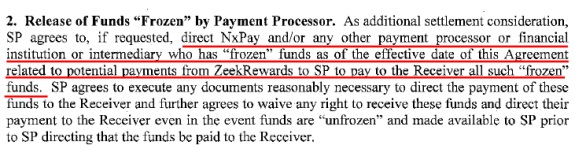
    From a June 28 filing by the court-appointed receiver in the Zeek Rewards Ponzi-scheme case. (Red highlights by PP Blog.)
    From a June 28 filing by the court-appointed receiver in the Zeek Rewards Ponzi-scheme case. “SP” stands for “Settling Party.” (Red highlights by PP Blog.)

    URGENT >> BULLETIN >> MOVING: (UPDATED 8:05 P.M. EDT U.S.A.) From the standpoint of avoiding financial accountability, it may have become more difficult for serial scammers who foist HYIP scams on the international public to thumb their noses at law enforcement and the courts. The court-appointed receiver in the Zeek Rewards Ponzi scheme case has revealed the threshold dollar number used to determine who received emails offering a settlement: That number, according to filings by receiver Kenneth D. Bell, was only $1,000.

    The lowness of the number could send shockwaves across the HYIP Ponzi universe. On well-known Ponzi-scheme forums such as TalkGold and MoneyMakerGroup, serial HYIP scammers routinely pooh-pooh court actions and claim that neither the government nor receivers will bother to seek recoveries from low-level players and “winners” in scams.

    Confident that they’ll never be held accountable, some purveyors move from one HYIP fraud scheme to another.

    In August 2012, the SEC described Zeek as a $600 million Ponzi- and pyramid scheme. Both the SEC and the receiver quickly were demonized on the Ponzi boards.

    Docketed in the Western District of North Carolina yesterday, Bell’s filing makes it plain that he expects any net winner who received $1,000 or more to pay up — and there is no guarantee that the number could not go lower in the future. Beyond that, a provision of the settlement agreement frees the receiver effectively to force net winners who may have money frozen in NxPay “and/or any other payment processor” or bank to make those funds payable to the receivership estate.

    Zeek used NxPay, AlertPay and SolidTrustPay. AlertPay (now Payza) and SolidTrustPay are longtime favorites of Ponzi purveyors and their shills on the fraud forums. Zeek was based in Lexington, N.C.

    If the Zeek settlement stipulations as outlined by the receiver are approved or accented by the court, it would mean that Zeek’s serial HYIP players and their recruits could not hope to stymie law-enforcement agencies and the receiver by waiting them out and removing “profits” from the payment processors or banks at a later date.

    At least 136 Zeek winners have agreed to settlements after being approached by the receiver, Bell said. Virtually all of the settlements have included a substantial discount on the order of 40 to 50 percent. The discount amounts, Bell has said, will enable the receivership to collect some money for Zeek victims without going to the additional expense of filing lawsuits.

    Winners who cooperated early with the receivership may stand to gain much better deals than stragglers who potentially could be held accountable for more lucrative dollar sums if successfully sued. Zeek had more than 2 million user IDs, Bell has said. About 1 million affiliates paid money to Zeek, which may have a universe of tens of thousands of “winners.”

    The $1,000 threshold in the early settlement emails was established after the receivership consulted with the SEC, according to a filing yesterday by Bell.

    Here are a several examples of the existing settlement agreements, according to the June 28 filing (bolding added):

    • A Zeek winner of $1,254 has agreed to a settlement of $600 “to be paid within 7 days of the effective date of this agreement.”
    • A Zeek winner of $9,249 has agreed to a settlement of $4,500 “to be paid as follows: $375 a month for 12 months beginning in April 2013 (to be paid by the 25th of each month).”
    • A Zeek winner of $28,909 has agreed to a settlement of $22,000 “to be paid as follows: $6,000 within 15 days of the effective date of the agreement and then eight payments of $2,000 due on the 15th day of each following month.”
    • A Zeek winner of $114,000 has agreed to a settlement of  “$47,500 to be payable on or before May 31, 2013.”
    • A Zeek winner of $170,440 has agreed to a settlement of “$84,981 to be payable in one payment of $23,165 on or before June 15, 2013 with the remainder ($61,770) to be paid by July 15, 2013 or in 10 equal consecutive monthly payments of $6,177.60 beginning on or before July 15, 2013 and to be paid by the fifteenth day of each following month.”
    • A Zeek winner of $176,000 has agreed to a settlement of “$88,000 to be paid within 7 days of the effective date of this agreement.”

    As things stand, Bell has settled with winners of more than $3.2 million for better than $1.81 million. The “Settlement as % of Winnings” is listed as 56.12 percent in the June 28 filing.

    NOTE: Our thanks to the ASD Updates Blog.


  • Philly Affinity Fraudster Traded On Coca-Cola’s Name And Ran Ponzi, Feds Say

    ponzinews1EDITOR’S NOTE: Affinity fraud takes many forms. The case against Constant Damas appears to have been one that married an appeal to a common nationality to an appeal to the taste buds and brand recognition. Scammers often trade on the names of famous companies and individuals. And they often issue appeals to people of common ancestry or background.

    UPDATED 8:56 P.M. EDT U.S.A. A 45-year-old Philadelphia man who worked as an account manager at Coca-Cola Co. used his famous employer’s name to dupe people into investing in his Ponzi scheme, the office of U.S. Attorney Zane David Memeger of the Eastern District of Pennsylvania said.

    Constant Damas swindled more than $1 million from at least 20 people over a period of five years, federal prosecutors said.

    Damas is a native of Haiti and targeted the Haitian community, including family members and friends, prosecutors said.

    He has pleaded guilty to two counts of wire fraud. From a statement by prosecutors (italics added):

    Between 2007 through the end of 2012, Damas, who was an account manager at Coca-Cola Company, misrepresented to various individuals, including family members and friends in his Haitian community, that he was an investment manager at Coca-Cola.  He told his victims that, through this position, he could invest their money in Coca-Cola’s investment opportunities.  In fact, Damas did not hold this position and no such opportunities existed.  To entice his victims, Damas often made the following false representations to them:  he would collect a sum of money from the victims as their “principle” investment; the victims would receive an interest payment of a certain amount every month; and they could receive their principle payment upon request.  Damas, however, did not return the full “principle” investment amount back to his victims, and many of the victims did not receive any of their funds back or any interest payments.  Upon his arrest in February 2013, Damas admitted to federal agents that this was a “scam business.”

    Damas is scheduled to be sentenced Sept. 30. He potentially faces decades in federal prison.

  • UPDATE: Italy Finalizes Suspension Order Against Alleged Profitable Sunrise Pitchman Who Got Booted By WordPress

    ponzinews1UPDATE: CONSOB, the Italian securities regulator, has finalized a March 27  suspension order against alleged Profitable Sunrise pitchman Daniele Verzari.

    Verzari allegedly pitched Profitable Sunrise as the “founder” of the Vdproject Italy team on a Blog hosted by WordPress. After CONSOB announced a temporary suspension order on April 2, WordPress gave Verzari the boot. He also allegedly promoted schemes known as “Vityazi” and “Bestforinvest.”

    On April 4, the U.S. Securities and Exchange Commission (SEC) filed a pyramid-scheme complaint against Profitable Sunrise in federal court in Atlanta. Records show that the SEC has issued subpoenas to several Profitable Sunrise pitchmen in the United States.

    The murky scheme may have collected tens of millions of dollars by targeting U.S. investors, routing the proceeds of the scheme through offshore bank accounts and using a mail drop in England, the SEC said. Profitable Sunrise operated through an entity known as Inter Reef Limited.

    Profitable Sunrise purportedly was operated by “Roman Novak.” It allegedly offered five HYIP plans, including one bizarrely dubbed the “Long Haul” that purported to pay 2.7 percent a day with the payout due April 1, the day after Easter. Profitable Sunrise went missing from the Web on or about March 14.

    The actions by CONSOB and the SEC demonstrate that HYIP schemes can create trouble not only for purveyors such as “Novak,” but also for commission-based promoters.

    Scammers have targeted Profitable Sunrise victims in multiple reload schemes.

  • 2 Purported Maryland ‘Sovereign Citizens’ Charged In Earlier Alleged Scam Now Charged In Different County In New Alleged Scam

    Seven purported “sovereign citizens” illegally squatted in a Waldorf home and have been charged in Charles County with burglary, authorities said.

    Two of the “sovereigns” earlier were charged with doing the same thing in a Montgomery County home, NBCWashington.com is reporting.

    Also see June 8 PP Blog report on incident in Montgomery County.

    View more videos at: http://nbcwashington.com.

  • WAFF: Purported ‘Sovereign Citizen’ Who Filed Bogus Liens Now Guilty Of Resisting Arrest

    Donna Jo Kirkland, a purported Alabama sovereign citizen” who filed bogus liens against public officials and then didn’t remove them as required to honor and maintain her probation agreement, now has been found guilty of resisting arrest.

    WAFF-TV: News, Weather and Sports for Huntsville, AL

  • MASS. ATTORNEY GENERAL: Former Middlesex County Banker Was Ponzi Schemer Who Scammed For 12 Years And Created Bogus CD Receipts And 1099s

    ponzinews1A Massachusetts woman formerly employed at Bank of America ran a Ponzi scheme on the side, forged withdrawal slips and stole millions of dollars from family and friends over a period of 12 years, the state’s attorney general said.

    Elaina Patterson, 53, of Wilmington, has been indicted on charges of Larceny over $250 from a Person over Sixty (15 counts) and Larceny over $250 (16 counts).

    Bank of America discovered the fraud during an internal investigation in 2011 and alerted the office of Attorney General Martha Coakley, Coakley’s office said.

    Patterson allegedly offered customers “fake” investment products and created bogus receipts for certificates of deposit and 1099 tax forms as part of the fraud. The scheme allegedly began in 1999, prior to Bank of America’s ownership of the bank.

    “We allege that this defendant used her position as a banker to garner trust from friends and family, and then pushed fake investment opportunities that promised high rates of interest,” Coakley said. “Once this scheme began to unravel, we allege that she began to steal from customers in order to fund withdrawals from investors and cover her illegal activity.”

    Patterson was indicted by a grand jury in Middlesex County. She had worked at a branch bank in the small city of Reading, Mass.

    From a statement by Coakley’s office (italics added):

    Authorities allege that between July 1999 and September 2011, Patterson made approximately $6 million in fraudulent transactions involving 31 investors and customers.

    At the beginning of the scheme, Patterson allegedly persuaded family and friends to invest their money in accounts that she characterized as offering high interest rates, normally between 10 and 15 percent. Authorities allege that she regularly portrayed these accounts as being exclusively for high-level investors and corporations, but said that due to her position at the bank, she was able to set up these accounts for family and friends.

    The investigation allegedly revealed that Patterson convinced 15 family members and friends to invest nearly $4.5 million as a part of this scheme, and that she issued fake certificate of deposit receipts and Form 1099s on bank forms to make the investments appear legitimate. Authorities allege that, in a number of instances, Patterson set up accounts in the investors’ names without their knowledge, put her own address on the accounts, deposited the investors’ funds, and used the money both to fund payments to other investors and to funnel money into her personal accounts.

    Further investigation allegedly revealed that beginning in 2009, Patterson began stealing money from the accounts of customers, many of them elderly, in order to conceal her previous theft from investors. Authorities allege that Patterson stole almost $1.5 million from 16 different customers by forging signatures on withdrawal slips. She allegedly used approximately $400,000 of this amount to repay customers stolen from earlier in the scheme and the majority of the balance of that stolen money to fund “interest payments” and other payments to the investors. 

    In the end, investigators uncovered a total of approximately $6 million in alleged fraudulent transactions. Patterson made payments back to customers and investors of almost $3.8 million, leaving the total alleged net theft at more than $2.1 million.