Blog

  • BehindMLM Reader Claims ‘Excited’ Attendees Were Fainting At Florida Gathering Of World Consumer Alliance; ‘Program’ That Published Laundry List Of HYIP Ads Apparently Conducting 9-Month ‘Prelaunch’

    EDITOR’S NOTE: Longtime huckster Phil Piccolo learned long ago that God and starving children “work” in MLM. We can’t help but wonder how many shills would flop over backward at his events if he ever finds out that fainting also “works.”

    ** _______________________________ **

    A reader tells BehindMLM that attendees of a “World Consumer Alliance” (WCA) event in Sarasota, Fla., were fainting from apparent excitement.

    WCA, with Paul Skulitz as the advertised admin, came out of the gate as “Wealth Creation Alliance,” saying it was selling “ad units” and declaring it was operated by an “Executive Dream Team.” (See Sept. 5, 2012, PP Blog story.)

    Here’s a snippet from a September 2012 WCA sales pitch (italics added):

    “We are fully operational right now and in our company pre-launch, this simply means that you are able to sign up for free and receive your business website and purchase advertising units as well. You can also refer and sign others in as well. We are also currently receiving payments and more importantly we are paying referral bonuses and daily profit sharing. Our pre-launch will continue through October 2012. We will hold our first major event the first weekend of November. (Details will be forthcoming)

    On Sept. 7, the PP Blog reported that WCA was publishing promos for various HYIP schemes, including one that called itself A2P. A2P purported to be in “Pre-launch” and advertised these purported features.

    • 7% daily payout for 30 days
    • 10% income on 2 levels
    • Join Free!

    WCA appears now to be stuck in “prelaunch” mode through March 8 after missing a November launch date. Read the comment by “Disgusted WCA Affiliate” at BehindMLM. (Make sure you page up to read the Sept. 13, 2012, WCA story from Oz at BehindMLM.)

  • CURIOUS: 3 Of 5 ‘Most Popular’ Stories On PP Blog Last Week Were ‘Old’ Articles On The AdSurfDaily And AdView Global Scams

    UPDATED 8:55 A.M. ET (U.S.A., DEC. 11) Are Zeekers doing research in advance of clawback actions in the Ponzi scheme case or otherwise trying to get a sense of history? Are they (or other readers) trying to gain a better understanding of ties that may exist among Zeek, AdSurfDaily and AdViewGlobal?

    Three of the PP Blog’s five “Most Popular” stories last week were “old” articles about ASD and AVG, according to a tracking service used by the Blog. AVG had not dominated reader interest on the PP Blog for nearly three years.

    Here are links to (and briefs about) those stories:

    From July 16, 2009: (No. 2 in ‘Most Popular’ rankings last week.) BREAKING NEWS: Federal Judge Says Curtis Richmond, Six Other Parties Who Used Pro Se Litigation Blueprint, Cannot Intervene In AdSurfDaily Forfeiture Case

    The July 16, 2009, story reported that seven would-be, pro se intervenors in the ASD Ponzi case were denied standing by a federal judge. In her ruling, the judge pointed out that the first filing occurred in February 2009. It is “representative and seems to be a ‘form’ complaint inasmuch as the others are duplicates,” the judge said.

    A key part of the ruling (italics added): “Fraud victims who voluntarily transfer their property to their wrongdoers do not retain a legal interest in their property; instead, such victims acquire a debt against their wrongdoers.”

    Waves of other pro se filiers later were denied standing in the case. (On at least two occasions, the judge denied the would-be intervenors en masse.)

    It perhaps is worth pointing out that standing also could become an issue in the Zeek case. Given ASD’s history, it also seems possible that “defenders” of the Zeek scheme will ponder the use of shared litigation templates. (The ASD templates, which advanced conspiracy theories and accused public officials of crimes,  didn’t “work.” To date, one Zeeker has accused the court-appointed Zeek receiver of a crime.)

    From Dec. 7, 2009: (No. 4 in “Most Popular” rankings last week.) AdViewGlobal Recording Suggests Member Cashed Out $10,000 Only Days After Formal Launch And That Insiders Were Awarded Bonuses; Less Than Two Weeks Later, Surf Switched To ‘Private Association’ Structure

    The Dec. 7, 2009, story reported that AVG, a  purported offshore entity, had conducted conference calls earlier in the year and lured prospects with “bonuses.” It also reported that some AdSurfDaily figures were among the first to receive the “bonuses.”

    It perhaps is worth pointing out that an effort by some Zeek insiders now appears to be under way to lure their downlines into nascent “programs,” at least one of which is being positioned as a way to maintain a Zeek downline in a new “program” and receive a bonus. The name of the new “program” that purportedly will provide bonuses to Zeek members and its base of operations are unclear.

    Zeek and ASD figure Todd Disner, however, recently was reported to be in Hong Kong with a “lost” passport.

    “Todd Disner,” said Zeek figure Robert Craddock on a call last week. “Bless his heart. I don’t know if he’s found his passport yet, but he’s . . .  in Hong Kong right now assisting us with this new program. And he’s lost his passport. So, I don’t know if he’s made it back to the states yet or not. And, so, we’re all working very, very hard to pull this together for you.”

    Some Zeekers have ported themselves to schemes such as “BannersBroker” and “GoFunPlaces.” It is possible that any number of Zeek members took soiled proceeds from previous scams to their new “opportunities.” What’s not known at this time is what will happen if Zeek “winners” who are the prospective targets of clawback litigation will do if they moved illicit Zeek proceeds into another scheme or dissipated the money in other ways.

    From the Dec. 7, 2009, story (italics added):

    The conference call, hosted by Terralynn Hoy, a Moderator at both the Pro-AdSurfDaily Surf’s Up forum and a ning.com forum set up to promote AVG, did not disclose how the member amassed a large sum in only days and qualified for a cashout. But another participant in the call announced that the man excitedly expected to receive a check for $10,000.

    Terralynn Hoy, a figure in both the ASD and AVG stories, hosted at least one call for Zeek in 2011. ASD was a $119 million Ponzi scheme that collapsed in August 2008. AVG collapsed in a sea of mystery in June 2009. Before it collapsed, it sought to make an 80/20 “program” mandatory and exercised its version of a “rebates aren’t guaranteed” clause.

    Lots of Zeek members tried to encourage fellow members and prospects to keep 80 percent in the “program” and remove only 20 percent. Like ASD and AVG, Zeek also had a version of a “rebates aren’t guaranteed” clause. Some Zeek “defenders” now claim that Zeek should be left alone because it never promised anybody anything. ASD and AVG members said the same thing about those “programs.”

    From July 24, 2009: (No. 5 in “Most Popular” rankings last week.) UNCONFIRMED: Harris Family In Uruguay, AVG Staff Fired

    This story reported that certain members of the Bowdoin-Harris family involved in both ASD and AdViewGlobal purportedly had moved to Uruguay. News about the purported move broke after AVG was mentioned in a racketeering lawsuit against ASD in June 2009.

    From the July 24, 2009, story (italics added):

    AVG has a history of blaming members for its problems and deflecting accountability from management to the rank-and-file. In the past, it has blamed members for the suspension of a bank account and threatened to sue members who shared information outside association walls — and even to contact their ISPs to suspend service of people who asked pointed questions about the company in forums.

    Yesterday’s announcement by AVG also blamed the delay in audit findings on unspecified “complications created by changes in payment processors.”

    Prior to its August 2012 collapse, Zeek appears to have experienced problems with banks and payment processors. Some Zeek promoters cautioned fellow members not to talk too much about Zeek in public. On Aug. 4, Zeek complained on its Blog about unspecified “North Carolina Credit Unions” saying unfair or untrue things about Zeek.

    Zeek members were warned there would be consequences to members who did not toe the company line.

    Just 13 days later, on Aug. 17, the SEC filed an emergency action in federal court that alleged Zeek was a $600 million Ponzi and pyramid scheme

     

  • OREGON LIVE: State Takes Action Against Alleged Gifting Pyramid

    OregonLive (The Oregonian) is reporting that the state has taken action against participants in an alleged cash-gifting pyramid scheme.

    Like recent cases in Connecticut and Michigan, the Oregon case involves women. The paper is reporting that four naturopathic physicians were involved in the scheme. One of them was ordered to pay a fine of $15,000 and make restitution.

    From The Oregonian (italics added):

    A letter from the attorney general’s office warned Abundance members that their involvement could run afoul of the Board of Naturopathic Medicine. “A doctor’s solicitation of patients to join a pyramid club can result in discipline by the state board,” the letter said.

    Read the story in The Oregonian. (The reader comments below the story also are well worth reading.)

    Read the state’s warning on cash-gifting pyramid schemes.

    A snippet (italics/bolding added):

    Many Oregonians are being defrauded by unlawful pyramid schemes operating under the guise of so-called “gifting clubs” such as the Dinner Club or Women’s Empowerment Network. These “clubs” are elaborate scams designed to make money for a few at the expense of many.

    The promoters of the scheme claim that IRS regulations allow people to “gift” one another up to $10,000 per year tax free. For example, persons are asked to pay $5,000 to enter at the bottom of the pyramid or “tree” along with others. As these people encourage others to join the club, they rise on the tree to the top position, where the total amount collected from “gifts” is $40,000, a $35,000 profit. Often, people at the top re-invest another $5,000 and start the process anew.

    Each of the eight persons just entering the tree delivers his/her $5,000 “gift” directly to the person at the top of the pyramid. This also helps convince new players that they will eventually receive a $35,000 return on their “gift.”

    These schemes are doomed to failure. Each “tree” involves 8 persons who “gift” $5,000 each. The person at the top of the tree gets $40,000 and the other 7 people hope that enough players come on board to push them to the top. For each person at the top, there are 8 people who are likely to lose their investment and the chance of a big “payoff.” Eventually, these schemes collapse because they run out of prospective participants.

    No matter what the promoters may tell you, gifting clubs are illegal. They are unlawful pyramid schemes. Gifting clubs and pyramids have not been approved by the Oregon Attorney General, local district attorneys, or the Division of Finance and Corporate Securities. Operating or participating in a pyramid scheme violates Oregon’s Unlawful Trade Practices Act, which imposes civil penalties of up to $25,000 per violation.

  • UPDATE: See Copy Of Letter From Zeek Receiver To Northern California Federal Court In Advance Of Possible Clawback Actions

    Below is a copy of a letter sent by counsel for the court-appointed receiver in the Zeek Ponzi scheme case to U.S. District Court for the Northern District of California. The PP Blog obtained a PDF of the letter from a publicly available source and took a screen shot of the PDF. The redactions were added by the PP Blog to obscure a specific phone number for an attorney and the name of a paralegal and a specific number for her. The Blog redlined the information in an abundance of caution because it could not immediately determine if was intended only for court personnel. The letter is otherwise unchanged.

    The letter and accompanying filings set the stage for the receiver to pursue clawback lawsuits against Zeek winners. You’ll note from the letter that the receiver paid a $46 filing fee. The same fee is referenced in filings in other federal districts. As of today, the receiver appears to have filed in 68 districts. That number is an estimate by the PP Blog and is unofficial.

    Receiverships act to gather money for distribution to victims of fraud schemes. They come with costs, such as professional fees, filing fees and delivery fees (such as mail fees and courier fees). Such fees are not unusual.

  • BULLETIN: Another Major Scam Rocks Florida: Claudio Eleazar Osorio Arrested By Feds, Sued By SEC; Miami Entrepreneur And Friend To Politicians Accused Of Stealing Millions From Investors

    BULLETIN: Florida has served up another doozy — one that is an embarrassment to major figures in both major U.S. political parties.

    Claudio Eleazar Osorio, also known as Claudio Osorio Rodriguez, 54, was arrested by federal agents today, amid charges he scammed the U.S. government out of $10 million in the aftermath of the devastating earthquake in Haiti in January 2010.

    If promising to provide post-earthquake housing in Haiti and not delivering were not enough, Osorio also concocted a ruse by which investors came to believe their money was guaranteed by “a Middle Eastern sovereign wealth fund,” according to court filings today.

    “This claim was patently false,” the SEC charged. “The Middle Eastern sovereign wealth fund investment was a ruse to solicit additional funds from investors.”

    The Aventura resident was charged with conspiracy to commit wire fraud, wire fraud, major fraud against the United States, conspiracy to commit money laundering and making false statements to a U.S. government agency.

    Also charged criminally was accountant Craig Stanley Toll, 64, of Pembroke Pines.

    In a parallel civil action, Osorio and Toll were sued by the SEC, which alleged a massive fraud at Osorio’s InnoVida Holdings LLC.

    Osorio, the SEC said, raised at least $16.8 million from investors and “stole nearly half” of it to “pay the mortgage on his multi-million dollar mansion and other lavish highlife expenses.”

    “From his lap of luxury, Osorio concocted a compelling story about InnoVida by recruiting an impressive board of directors and boasting a bogus financial condition to lure investors into funding his scheme of lies,” said Eric I. Bustillo, director of the SEC’s Miami Regional Office.

    Former Florida Gov. Jeb Bush, a Republican and the son of former President George H.W. Bush and the brother of former President George W. Bush, once sat on InnoVida’s board. So did Ret. Gen. Wesley Clark, a onetime Democratic candidate for President. Osorio also is listed in a Federal Election Commission database as an individual contributor to the Presidential campaigns of Barack Obama and Hillary Clinton, and the Congressional campaign of Debbie Wasserman Schultz, among others.

    From a statement by the office of U.S. Attorney Wifredo A. Ferrer of the Southern District of Florida (italics added):

    The indictment further alleges that between January 2010 and March 2011, Osorio, Toll and others applied for and obtained a $10,000,000 loan from the Overseas Private Investment Corporation (“OPIC”), a U.S. government agency that promotes U.S. government investments abroad to foster the development and growth of free markets. The purported purpose of the loan was to build a manufacturing facility and 500 homes in Haiti (“the Haiti project”) for displaced families in the aftermath of the January 2010 earthquake. The indictment alleges that Osorio, Toll and others made materially false representations and omissions concerning, among other things, the profitability of Innovida, the purported use of the loan proceeds, an equity contribution to be made by Innovida, and contracts that Innovida purportedly had obtained with third-party vendors. Osorio used the OPIC loan proceeds to repay investors and for his and his co-conspirators’ personal benefit and to further the fraud scheme.

    The SEC, meanwhile, described Osorio as a “former Ernst & Young Entrepreneur of the Year award winner.”

    From a statement by the SEC (italics added):

    To induce funds from investors, Osorio and Toll allegedly produced false pro forma financial statements. A pro forma financial statement for March 31, 2009, stated that InnoVida had more than $35 million in cash and cash equivalents and more than $100 million of equity. A pro forma financial statement for Dec. 31, 2009, listed more than $39 million in cash and cash equivalents and $122 million of equity. In reality, the company’s bank accounts held less than $185,000 on March 31, 2009, and less than $2 million on Dec. 31, 2009. Toll failed to review all of InnoVida’s bank account statements when he drafted financial statements. Instead, he accepted Osorio’s misrepresentations that InnoVida had these assets in an account to which Toll did not have access.

    The SEC alleges that Osorio offered bogus share prices to prospective investors based on false valuations. He told one investor that InnoVida was valued at $250 million, and then a week later told a different investor that the company was worth $50 million. The latter investor purchased $100,000 of Osorio’s stake in the company for five cents per share.

    Read a March 2011 story in the Sun Sentinel.

    Read the SEC complaint.

    Read the indictment.

  • The Incredible Reach Of Zeek: Receiver Files In Guam

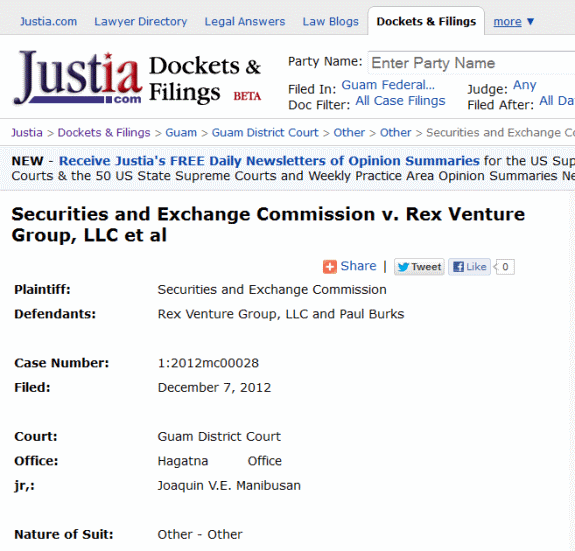
    This filing in Guam by the court-appointed receiver in the Zeek Rewards Ponzi scheme case may be the first in a U.S. territory.

    In yet another indicator of the incredible reach of the alleged Zeek Rewards Ponzi scheme, the court-appointed receiver has filed court paperwork in Guam.

    Guam is a U.S. island territory “approximately 3,300 miles West of Hawaii, and 1,500 miles east of the Philippines and south of Japan,” according to the website of Naval Base Guam.

    Whether U.S. military members in Guam bought into Zeek is unclear. Zeek was based in North Carolina, home state to four military installations.

    In August, the SEC said Zeek “raised money from more than one million Internet customers nationwide and overseas.” In July, the PP Blog reported that an article on Google News by an apparent Portuguese-speaking affiliate of Zeek claimed that the MLM “program” had more than 100,000 members in Brazil alone. Haaretz.com reported in August that Zeek may have had 20,000 members in Israel.

    In recent days, Zeek receiver Kenneth D. Bell has been posting notice of the August SEC complaint and his appointment as receiver in federal courts in multiple states.  The filing in Guam appears to be the first in a U.S. territory, as opposed to a state. The filings set the stage to consolidate Zeek-related court actions in the Western District of North Carolina before Senior U.S. District Judge Graham C. Mullen.

    Bell has said he’ll pursue clawback litigation against Zeek “winners.”

    Some military members were victims of the infamous “3 Hebrew Boys” Ponzi scheme in South Carolina, another state that includes multiple military installations.

    Some promoters of AdSurfDaily, a Zeek-like “program” that planted the seed it provided a return of 1 percent a day, deliberately targeted military members and their spouses.

    From a May 2008 pitch for ASD targeted at military families. ASD collapsed in August 2008.
  • UPDATE: Receiver Sets Stage For Clawbacks In Zeek Ponzi Scheme Case: Filings Provide Clues About U.S. States In Which Fraudulent Transfers Allegedly Occurred

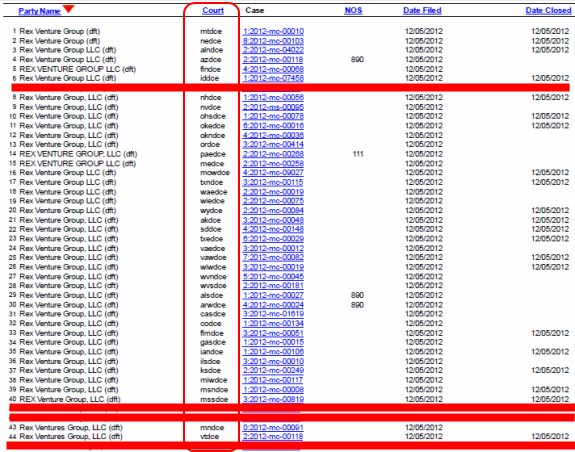
    These filings related to the alleged Zeek Rewards Ponzi scheme operated by Rex Venture Group LLC are appearing in federal court dockets in multiple states today. There are 94 federal judicial districts in the United States, and such a filing is possible in any district in which the court-appointed receiver believes Zeek Ponzi proceeds reside.

    UPDATED 11:02 P.M. ET (U.S.A.) PP Blog reader “Tony” posted comments this morning about cases involving Rex Venture Group LLC popping up in federal courts beyond the Western District of North Carolina, home base of the SEC’s Zeek Ponzi scheme case and the court-appointed receiver. Rex Venture is the parent company of North Carolina-based Zeek.

    Tony initially observed that he’d seen case numbers for Rex-related filings such as this one on Justia.com, a site that tracks court filings. Tony noticed Justia references to filings in the Western District of Arkansas and in Arizona.

    It turned out that these two filings were only the tip of the iceberg. As the day proceeded, more and more references to filings began to appear on PACER, the public-access system for the federal courts.

    The ASDUpdates Blog has been tracking the filings today. As of the time of this post, there appears to be more than 40 such filings in various federal districts in various states. That number could increase because there are 94 federal districts and the filings will occur in districts in which the Zeek receiver has traced assets linked to the scheme.

    Receiver Kenneth D. Bell has said he intends to pursue clawback litigation against Zeek net winners in order to make victims of the alleged Zeek fraud scheme as whole as possible. The early math of Zeek suggests there were about eight losers for every Zeek winner.

    The filings now appearing on the dockets today in various federal districts are yet another indicator of the massive scale of the alleged Zeek fraud, believed to be the largest Ponzi scheme in U.S. history based on the number of victims. That number is estimated in the neighborhood of 1 million.

    In August, the SEC described Zeek as a $600 million Ponzi- and pyramid fraud.

    Today’s filings are not lawsuits against individual Zeek promoters; those will come later, if the receiver and the promoters cannot negotiate a deal that will result in the return of sought-after funds. Today’s filings — in effect — are formal notifications to court officials in the various districts that the receiver may be operating in their districts under the authority of the federal court for the Western District of North Carolina.

    Senior U.S. District Judge Graham C. Mullen of the Western District of North Carolina is presiding over the SEC’s Zeek case and the receivership.

    Despite the SEC’s Zeek action, the HYIP universe continues to serve up wantonly destructive fraud schemes, thus potentially creating victims by the tens of thousands at a time. In many cases, the schemes are advanced by willfully blind hucksters, including hucksters who populate Ponzi scheme boards such as TalkGold and MoneyMakerGroup and race from scheme to scheme to scheme.

  • BULLETIN: Proposed Class-Action Against Zeek In Louisiana Transferred To North Carolina

    BULLETIN: A federal judge has transferred from the Eastern District of Louisiana to the Western District of North Carolina a proposed class-action lawsuit against Rex Venture Group LLC, Zeek Rewards and Paul R. Burks.

    The ruling by U.S. District Judge Carl J. Barbier  in New Orleans likely paves the way for Senior U.S. District Judge Graham C. Mullen of Charlotte to issue a specific order to stay the case. Both Burks and Kenneth D. Bell, the court-appointed receiver in the Zeek Ponzi scheme case brought by the SEC on Aug. 17 in Mullen’s courtroom, have sought the stay.

    In August, Mullen issued an order that “[a]ll Ancillary Proceedings are stayed in their entirety, and all Courts having any jurisdiction thereof are enjoined from taking or permitting any action under further Order of this Court. . . .”

    The prospective class action was filed in Louisiana on Aug. 24, a week after Mullen issued the stay in North Carolina.

    Burks has contended that the Louisiana plaintiffs tried to circumvent the Aug. 17 stay issued by Mullen by bringing an action in another federal district.

  • EDITORIAL: The ‘Zeek-Step,’ The Stepfordian Shuffle And The Stalinist HYIP

    On Jan. 22, 2011, nearly two years ago and long before the SEC brought the Zeek Ponzi scheme case in August 2012, the PP Blog proposed a new term in an effort to distill the economic and logistical nightmares of viral Internet crime to their essence: fraud creep. This followed our Dec. 12, 2010, post, which explained that America’s largest sports stadiums may not be large enough to accommodate all the victims of a single, web-based crime.

    Today the Blog is proposing another new term: Zeek-step, also known as “The Stepfordian Shuffle.” Zeek-step gets its name from the collapsed Zeek Rewards “program,” a 1.5.-percent-a-day ROI abomination (with accompanying recruitment commissions) boosted in part by serial MLM racketeers and Ponzi-forum criminals who pretended the 2008 AdSurfDaily Ponzi case never happened.

    To do the Zeek-step is to pretend the ASD Ponzi case brought by the U.S. Secret Service more than four years ago is meaningless. At the same time, the Zeek-step is characterized by post-complaint efforts to demonize the SEC and the receiver — and to paint Zeek as a noble enterprise, the sender of a high tide that would lift all MLM boats. The trouble with that claim is that the purported high tide appears to have sunk more than 80 percent of vessels that sought to navigate the Zeek waters.

    If you’re a Zeek victim — and if you’re unfamiliar with the ASD case — you should acquaint yourself with it right away. “Programs” such as ASD and Zeek were cancers on the global marketplace. The math of such schemes is approximately this: 86 percent of participants will become “losers” who subsidize enormous “profits” for a super-class consisting of about 14 percent — the “winners.”

    There may be 1 million or more victims of Zeek, according to court filings. Putting it another way, Zeek could fill the Rose Bowl to capacity with victims about 10 times over. The logistical challenges confronting the court-appointed receiver in the Zeek case may be unprecedented. So, yes, Zeek was an instance of fraud creep. The ASD case — large for its time four years ago with about 100,000 members — has been dwarfed by Zeek.

    Protecting The Super-Class

    Although the Zeeks of the world often are positioned as the byproduct of ingenious Democratic Capitalism even as critics incongruously are dismissed as Communists, Socialists, Nazis and enemies of the “free market,” the fact remains that “programs” such as Zeek are designed to channel huge sums to a super-class that largely is preordained. If Zeek were a political entity, this super-class would be seen as a Soviet-era Politburo. The rest of the field would consist of peasants who keep the uppermost Stalinists in fine liquor and cigars.

    One of the chief incongruities of “programs” such as Zeek is that “defenders” invariably position themselves as visionary Capitalists and rail against Statism — indeed, it’s axiomatic in HYIP schemes that a government agency that stops a scheme will be described as evil — and yet the “programs” being defended are all about keeping the Stalinists in their Chaikas and dachas.

    One way to view Zeek is as a for-profit enterprise that taxed 86 percent of its participants at 100 percent to create the “profits” for the elitist 14 percent. It is likely that some of the people among the 14 percent paid ZERO DOLLARS to Zeek. Zeek was particularly noxious because it planted the seed that MLMers without big lists still could profit by sending the company up to $10,000 and generating a profit over time from an abomination known as the Retail Points Pool.

    The SEC said Zeek manipulated the numbers to make that appear possible, to make it appear as though Zeek were a profitable enterprise capable of paying a return of 1.5 percent a day to potentially millions of people. The Secret Service said ASD did the same thing.

    Zeek was offensive at many levels, including the intellectual one. Most notable, in our view, is that purported Capitalists “defending” Zeek by railing against alleged Statism as practiced by the SEC don’t seem to make the connection that Zeek set things up to the maximum advantage of the Stalinists of the Electronic Age.

    A Ponzi-forum huckster with a big list and practiced in the art of turning blind eye to every HYIP fraud scheme that comes down the pike had a decided advantage over, say, an 85-year-old Florida widow who maxed out her credit card to join Zeek because the huckster caused her to believe she’d have more to leave to her children and grandchildren when God called her home.

    It is our hope that the SEC and the U.S. Department of Justice will act aggressively and quickly to oppose a motion filed Friday by certain members of the alleged Zeek Rewards Ponzi scheme to appoint an “examiner.”

    Jordan Maglich of PonziTracker has a fine story on Friday’s filing. Could it be true that some Zeekers actually want to further deplete the receivership estate of resources that should go to true victims?

    In the PP Blog’s view, embracing a story that Zeek was a legitimate Capitalist venture is to embrace a wicked myth. Hell, Stalin himself might have been the first in, seeing the beauty of how the profits could have propped up the Politburo. If the initial scheme that drove the vast majority of the profits to the elite Statists collapsed, he could simply have announced another five-year plan. PolitburoBids2.com?


  • Website Of MPB Today, Bizarre ‘Grocery’ MLM, Inaccessible

    From a 2010 affiliate promo for MPBToday.

    DEVELOPING STORY: The website of MPBToday — a Ponzi forum darling featuring a 2X2 matrix cycler in 2010 — has been inaccessible for at least 24 hours.

    Fabled Ponzi huckster “Ken Russo” — later of Zeek Rewards — was among MPBToday’s promoters.

    Although the MPBToday site returns this message — “Site temporarily unavailable. Connection timed out – please try again.” — it is returning a ping. MPBToday’s domain registration is not expired. The reason the site will not load is unclear.

    MPBToday, operated by Gary Calhoun and tied to a home-delivery grocery business known as Southeastern Delivery in Pensacola, Fla., was the subject of controversy since its inception.

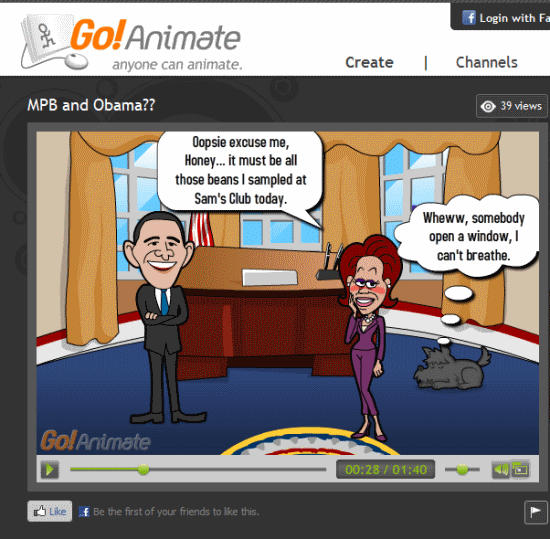
    Some MLMers promoted the purported “opportunity” in bizarre fashion. In one promo, for example, President Obama and U.S. Secretary of State Hillary Clinton were depicted as Nazis — with First Lady Michelle Obama depicted as having experienced an embarrassing gas attack in the Oval Office after having sampled beans at a Sam’s Club store.

    In another bizarre pitch, an MPB Today affiliate claimed there were scammers within the company’s ranks, a circumstance that made it important for prospects to enroll in an honest downline.

    An investigation of MPBToday was said earlier this year to be under way. The website continued to appear online after vague reports of the probe surfaced. Now, however, the website is offline.

    In 2010, the U.S. Department of Agriculture said it was conducting a review of MPBToday.

    Questions also have been raised about whether MPBToday was conducting a pyramid or Ponzi scheme or both.

  • BULLETIN: Receiver Re-Serves Zeek Member Who Sought To Quash Subpoena

    BULLETIN: An apparent Florida member of the Zeek Rewards “program” who claimed last week that the court-appointed receiver situated in North Carolina had served a subpoena improperly from the Tar Heel state via U.S. Mail now has been served again — this time through a more expensive process that involved certified U.S. Mail, FedEx and a Florida federal district court.

    Receiver Kenneth D. Bell said in a court filing today in North Carolina that he had sent a revised subpoena to Nathaniel Woods of Ocala, Fla.

    This time, the subpoena was issued by U.S. District Court for the Middle District of Florida, as opposed to U.S. District Court for the Western District of North Carolina, Bell said.

    And it was sent by both certified mail and FedEx, Bell noted, adding that the subpoena “requires the requested documents to be produced at a location in Jacksonville, Florida, less than 100-miles from Mr. Woods’ residence in Ocala.”

    Jacksonville is approximately 85 miles from Ocala. The address at which the documents must be produced is the Jacksonville office of the McGuireWoods law firm. The firm is counsel for the receiver and also has an office in Charlotte, N.C.

    The implication is that Woods now will have to travel from Ocala to Jacksonville to comply with the second subpoena. In the initial process, he could have mailed the requested documents to North Carolina, the home base of the receivership.

    Senior U.S. District Judge Graham C. Mullen now should rule Woods’ objections to the manner in which he initially was served moot, Bell argued.

    Mullen is overseeing the Zeek case from the Western District of North Carolina.

    Bell’s earlier method of serving subpoenas was designed to save money, he advised the judge.

    From the receiver’s filing today (italics added):

    One of these subpoena recipients, Nathaniel Woods, admittedly received his subpoena, but has filed a motion to quash his subpoena on various procedural grounds. The Receiver’s initial investigation found that Mr. Woods may have received more than $500,000 in other people’s money in net winnings from this scheme. Thus, the documents sought by the Receiver from Mr. Woods are clearly relevant, and are at least likely to lead to relevant and admissible evidence. Indeed, Mr. Woods could simply have contacted the Receiver to discuss or object to the original subpoena or obtain more time to respond, as many other subpoena recipients have done. The Receiver has worked with everyone who has responded in good faith to obtain relevant documents on an agreed schedule. Many recipients are also pursuing the opportunity offered by the Receiver to reach a prompt settlement of the fraudulent transfer claims.

    Thus, Mr. Woods’ motion to quash only serves to delay – on the grounds of form, not substance – the production of documents to which the Receiver is undoubtedly entitled in his role as appointed by this Court.

    Bell also advised Mullen that the first batch of subpoenas that went out earlier this month were targeted at “approximately 1,200 of the largest net winners of the Zeek Rewards scheme.

    “On average,” Bell advised the judge, “these net winners made over $100,000 from the scheme’s victims.”

    From the initial mailing of “approximately 1,200 subpoenas,” the receiver said, “to date only 26 have been returned as undeliverable, confirming the Receiver’s belief that this initial method of delivery would accomplish the practical goal of actual notice.”

    And, he noted, “It would have cost more than five times as much to serve the subpoenas via certified mail or FedEx and taken far longer to issue them from numerous judicial districts and make arrangements for production of the documents within 100 miles of each address.”

    The goal of the initial mailing “was to implement a streamlined process that would most effectively begin the process of recovering Receivership Assets and initiating a dialogue with the net winners who are willing to cooperate with the Receiver in gathering information and discussing the return of fraudulently transferred funds,” Bell said.

    In August, the SEC described Zeek as a $600 million Ponzi scheme and pyramid fraud.