Blog

  • UPDATE: Sentencing For Legisi HYIP Ponzi Swindler Gregory McKnight Rescheduled For Feb. 5

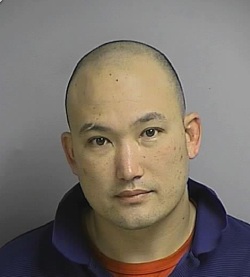
    This grainy likeness of Legisi HYIP operator Gregory N. McKnight appears in U.S. court files.

    Sentencing for a Michigan man federal prosecutors accused of “semantic obfuscation” for the manner in which his “program” was promoted has been rescheduled for Feb. 5, according to the docket of U.S. District Judge Mark A. Goldsmith of the Eastern District of Michigan.

    The sentencing delay for Gregory N. McKnight, who conducted the Legisi HYIP Ponzi swindle, is at least the third. McKnight originally was scheduled to be sentenced Sept. 11. That date was delayed until Nov. 19 — and now has been delayed until Feb. 5.

    Prosecutors did not return a call seeking comment on the Legisi case, McKnight and the reason for the sentencing delay.

    But it is known that the court-appointed receiver in the Legisi case has moved for a contempt of court order against Paul Harary. Harary, 48, is a purported one-time FBI informant now in federal prison in Alabama for his role in a Boca Raton, Fla., investment fraud that occurred in 2004 and 2005.

    Receiver Robert B. D. Gordon (Corrected Aug. 22, 2013) alleges that Harary informed individuals who were researching McKnight for the purposes of selling him investments prior to the filing of the SEC’s Ponzi case in May 2008 that McKnight likely was operating a Ponzi scheme and offering impossible returns.

    Harary also allegedly consulted with at least one of the individuals about Legisi’s bizarre Terms of Service, including a provision that required investors to affirm they were not with the government, namely the IRS, the FBI, the CIA and the SEC. Harary, the receiver alleged, told the individual “that if Legisi was not doing anything wrong why would Legisi want these representations from their customers[?]”

    Despite Harary’s alleged misgivings about McKnight and Legisi and an acknowledgment by at least one of the individuals that McKnight likely was running a scam, the individuals allegedly decided to solicit money from McKnight for the purpose of investing in penny stocks and a real-estate limited partnership.

    McKnight allegedly turned over more than $20 million, beginning about a year prior to the collapse of his Ponzi, according to the receiver.

    But now Harary is ducking a deposition aimed at getting to the heart of the alleged fraudulent transfer, according to the receiver.

    HYIPs are infamous for using wordplay to try to duck securities regulators. An evidence exhibit in the Legisi case includes a transcript of McKnight interacting with undercover agents who’d infiltrated the purported “opportunity.”

    McKnight, according to the transcript, informed the agents that he was presiding over a “loan” program, not an investment program.

    The MoneyMakerGroup Ponzi forum also is referenced in court documents in the Legisi case.

    Zeek Rewards, another alleged Ponzi scheme, also was pushed on MoneyMakerGroup. Zeek, too, insisted it was not offering investments.

    McKnight pleaded guilty in February to wire fraud. Prosecutors have asked for a prison sentence of 15 years.


  • Firm Assisting In Zeek Receivership Probe Has Another High-Profile Case; New York Times Reports That Kroll Investigative Firm Discovered ‘Well-Concealed Ponzi Scheme’ At Kabul Bank And ‘114 Rubber Stamps For Fake Companies’

    A company retained by the court-appointed receiver in the Zeek Rewards Ponzi scheme case received a prominent mention in the New York Times yesterday.

    The company, the Kroll investigative firm, uncovered a massive Ponzi fraud at Kabul Bank in Afghanistan in which hundreds of millions of dollars were siphoned from depositors to benefit a “narrow clique” of people tied to the Afghan government, according to an audit report obtained the Times.

    Loan books were “almost entirely fraudulent,” the Times reported, citing the Kroll forensic audit.

    “At one point, Kroll’s investigators found 114 rubber stamps for fake companies used to give forged documents a more legitimate look,” the Times reported, citing the audit.

    From the Times (italics/bolding added):

    What Kroll’s audit found is that on Aug. 31, 2010, the day the Bank of Afghanistan seized Kabul Bank, more than 92 percent of the lender’s loan portfolio — $861 million, or roughly 5 percent of Afghanistan’s annual economic output at the time — had gone to 19 related people and companies, according to the audit.

    Kroll is one of the firms retained by Zeek receiver Kenneth D. Bell. Its name is referenced in the Preliminary Liquidation Plan Bell filed Oct. 8.

    In the filing, Bell informed Senior U.S. District Judge Graham C. Mullen of the Western District of North Carolina that Zeek had “at least one foreign account” that had not been seized in the aftermath of the SEC’s Ponzi scheme investigation.

    It was “not clear” whether the funds would be recoverable despite the fact the bank that holds the account has been served with a freeze order, Bell advised Mullen in the filing.

    Bell did not name the bank or its home country in the filings. Nor did he say how he discovered the account.

    On Aug. 17, the SEC described Zeek as a $600 million Ponzi- and pyramid fraud operating from Lexington, N.C.

    Some Zeek members have worked virtually nonstop since that time to demonize Bell, a former federal prosecutor who once successfully prosecuted a Hezbollah terrorist cell operating in the United States.

    Zeek had “internet customers and contacts throughout the United States and internationally,” Bell advised Mullen.

    Kroll Ontrack has assisted the receivership “with the collection of electronically stored information obtained from” Zeek, Bell advised Mullen.

    In the case in Afghanistan, Kroll prepared the audit for the country’s central bank, according to the Times. Twenty-two people have been charged in the Afghanistan case.


  • THANKSGIVING BLOTTER: Police Tell San Gabriel Valley Tribune That Apparent ‘Sovereign’ Escaped Holding Cell Through 9-In. Crack And Stole ‘Beanie’ From Dollar Store To Conceal His Hairdo; Arthur Guerrero Back In Custody On $1.035 Million Bail

    An apparent California “sovereign citizen” arrested on Nov. 6 escaped through a 9-inch crack in a holding cell at the Glendora Police Department and, while making off, stole a “beanie” from a dollar store to disguise his appearance by concealing his overflow hairdo, authorities told the San Gabriel Valley Tribune.

    Here’s now the paper put it in its lede yesterday on the Thanksgiving Eve rearrest of 24-year-old Arthur Guerrero (italics added):

    Police Wednesday caught up with the big-haired suspect who escaped through a small gap in the station’s booking cage earlier this month.

    On Nov. 6, Guerrero was arrested on charges of having fraudulent license plates on his vehicle and refusing to identify himself, the newspaper reported.

    After he apparently wormed his way through the crack in the holding cell, he allegedly stole food from a grocery store and also shoplifted his getaway disguise from the dollar store, the paper reported.

    Separately, Patch.com (Glendora) is reporting that Guerrero was found at the same Greater Los Angeles residence to which police were dispatched Tuesday amid reports that a different man being sought by bounty hunters was seen with a firearm.

    Citing police, Patch.com identified Jose Rosas, who goes by the name of Emmanuel “Manny” Freeman, as the other man.

    “Rosas is reportedly an L.A. Occupy activist and is wanted for obstructing an officer during a L.A. Occupy protest in Long Beach, said [Lt. Brian] Summers” of the Glendora police, Patch.com reported.

  • Nathaniel Woods Plants Seed That Zeek Receiver Issued ‘Bogus Subpoena’ And Committed Felony; Claims Reminiscent Of Assertions Made In AdSurfDaily Ponzi Case

    UPDATED 5 P.M. ET (U.S.A.) Various members of the Florida-based AdSurfDaily 1-percent-a-day Ponzi scheme advanced various theories that judges, prosecutors and investigators committed various felonies during the course of the probe and follow-up actions in court. The claims were absurd on their face and, when the arguments were rejected, they were replaced by conspiracy theories. Time after time the conspiracy theories expanded to accommodate unpleasant fact sets, with various “defenders” of ASD retreating into an infinite set of contingencies and conflating one artificial reality after another.

    Now, a Florida resident and apparent participant in Zeek Rewards has filed a document in federal court that accuses the court-appointed receiver in the Zeek Ponzi scheme case of committing a felony. The receiver, Kenneth D. Bell, is a former federal prosecutor who once successfully prosecuted a Hezbollah terrorist cell operating in the United States.

    The PP Blog contacted the Zeek receivership today to seek comment from Bell. The Blog’s message was not immediately returned.

    In separate filings that appear on the docket of Senior U.S. District Judge Graham C. Mullen of the Western District of North Carolina, Nathaniel Woods claimed Bell or Bell’s receivership team unlawfully mailed a “bogus subpoena” to him in Ocala, Fla., thus committing a felony under Florida law.

    Mullen is presiding over the Zeek Ponzi case. In August, the SEC accused Zeek of operating a $600 million Ponzi- and pyramid scheme. Zeek’s business model was very similar to the model of ASD. ASD’s business practices triggered both civil and criminal investigations by the U.S. Secret Service in 2008.

    The subpoena, Woods claims, was meant for the purposes of “intimidation and harassment” on the part of the receiver.

    And Woods further claims that sending a “bogus subpoena” from North Carolina to Florida through the U.S. Mail constitutes “simulated process” under Florida law, a “third degree felony.”

    An accompanying document filed by Woods as an exhibit claims that “preliminary Zeek Rewards records” reviewed by the the receivership show that Woods received more than $496,000 from Zeek but paid nothing (“$0.00”) into the purported program.

    Bell is seeking the return of the money, describing it as “money lost by victims,” according to the exhibit.

    Woods is seeking to quash the subpoena, which demands records of Woods’ interactions with Zeek dating back to January 2010. He also claims the subpoena was only an “alleged subpoena” and was improperly served.

    A domain styled “500FREEBIDS4U.COM” is registered in the name of Nathaniel Woods at the Ocala street address to which the subpoena was sent, according to records. Other domains listed with an email address that appears on the registration data attributed to Nathanial Woods include Mybidshack10k.com, Mybidshackhow.info, Mybidshack4u.com and Mybidshackearn.info.

    Daryle Douglas, a onetime purported Zeek executive, also has been associated with a MyBidShack entity, according to researcher “K. Chang.”

    Zeek was a purported “penny auction” company operated by Paul R. Burks through Rex Venture Group LLC in Lexington, N.C. The penny-auction site was known as Zeekler. Zeek’s MLM arm was known as Zeek Rewards. Burks has consented to a judgment in the case. He has neither admitted nor denied the SEC’s allegations, which include securities fraud and the sale of unregistered securities.

    On Aug. 17, the U.S. Secret Service said it also was investigating Zeek. The SEC has said Burks duped investors into believing the purported Zeek “program” was paying a legitimate return of about 1.5 percent a day.

    Bell has said that perhaps 1 million people sent money to Zeek. Viewed by the number of potential victims and the number of transactions, Zeek may be the largest Ponzi scheme in U.S. history.

    Earlier this month, Bell said the receivership had gathered evidence that nearly 1 billion transactions were conducted through Zeek in about 18 months.

    AdSurfDaily was a Ponzi scheme that promoted a payout of 1 percent a day. It has about 100,000 members and gathered about $119 million, also in about 18 months, according to records.

    Records suggest that Zeek, which launched after the Secret Service brought the ASD Ponzi case, did about five times the dollar volume of ASD and potentially had 20 times the user volume.

    The civil portion of the ASD case dragged out for all or parts of five years. ASD President Andy Bowdoin admitted in May 2012 that ASD was a Ponzi scheme. In August 2012, less than two weeks after the SEC brought the Zeek case, Bowdoin was sentenced to 78 months in federal prison.

    ASD and Zeek are known to have had members in common.

  • BULLETIN: SEC: Purported ‘Trust’ Was $15 Million Prime-Bank Ponzi Swindle Operated By Two 70-Year-Olds; 1 Of The Accused Hucksters Has Prior Conviction For Trafficking Cocaine; Investors Were Told ‘Department Of Homeland Security’ Was A Customer And That The Devil Was Behind The Adage, ‘If It Sounds Too Good To Be True . . .”

    EDITOR’S NOTE: They don’t come any weirder than prime-bank swindles — and this one is one of the strangest we’ve ever reported on. 

    UPDATED 8:19 A.M. ET (NOV. 20, U.S.A.) Two individuals — both now 70 — conducted a prime-bank Ponzi swindle known as “the Trust” since at least 2004, the SEC said late this afternoon.

    The scheme allegedly operated in more than 20 states, but was concentrated in Georgia, the SEC said.

    One of the accused allegedly claimed he first heard about the Trust in the 1990s from a man named “John” in London. The other allegedly claimed this adage — “If it sounds too good to be true, it probably is” — was the work of the devil.

    Investors were told the U.S. Department of Homeland Security was a lending customer of the purported trust, a purported “loan” program that operated secretly in England and provided a return of 38 percent a year, the SEC said.

    They also were told that the trust “was started after World War II and is comprised of several extremely wealthy European families,” that the trust “owns banks in Europe,” that the trust “has the power to create money through fractional banking and the sale of banking debentures” and “funds humanitarian projects around the world,” the SEC alleged in the complaint.

    Charged in the alleged $15 million caper were Billy W. McClintock of Bradenton, Fla., and Dianne Alexander of Carlsbad, Calif. Alexander also is known as Linda Dianne Alexander and previously lived in Cumming, Ga. McClintock has claimed to be a gospel singer, was convicted of cocaine trafficking in 1989 and served prison time in Kentucky, the SEC said.

    “McClintock and Alexander pitched an investment opportunity that simply did not exist,” said William P. Hicks, associate director of Enforcement in the SEC’s Atlanta Regional Office. “They merely reshuffled funds between investors in a modern take on a classic prime bank scheme.”

    Some of the allegations against McClintock and Alexander are reminiscent of elements of the AdSurfDaily, Legisi and Zeek Rewards cases.

    In the ASD, Legisi and Zeek cases, for instance, investors were told not to refer to the programs as “investment” programs, according to records.

    Here is one of the allegations against McClintock and Alexander (italics added):

    Apparently attempting to avoid scrutiny by federal securities enforcers, McClintock told Alexander not to refer to investor payments as an “investment,” but rather as a “loan,” and that she should never refer to those whose money she took as “investors,” but rather as “Trust lenders.”

    Alexander recruited at least 220 people into the scam, which had “downline” investors, the SEC said.

    “Alexander recklessly relied solely on McClintock’s representations about the profits to be generated by the Trust, without taking any independent steps to either verify the existence of the Trust or whether McClintock was in fact receiving payments from the Trust,” the SEC charged.

    And Alexander issued appeals to religious faith to reel in investors, calling the adage “If it sounds too good to be true, it probably is” a “lie that came from the pit of hell,” and saying, “Put your money in the Trust and your trust in God,” the SEC charged.

    Clarence Busby, a figure in the AdSurfDaily Ponzi story, was implicated by the SEC in three prime-bank swindles in the 1990s, according to records.

    Read the SEC complaint.


  • SPECIAL REPORT: AdSurfDaily/Zeek Pitchman Todd Disner Gave Thousands To Gingrich, Romney After Soliciting Money To Sue The United States; Records Show Tax Liens Of More Than $405,000 Dating Back To 1999

    EDITOR’S NOTE: ASD was a multilevel-marketing scheme that planted the seed it paid a return of 1 percent a day on top of two-tiered affiliate commissions totaling 15 percent for recruiters. Federal prosecutors described the purported “opportunity” as a Ponzi scheme based in the the small town of Quincy, Fla., and operated by recidivist securities felon Andy Bowdoin.

    UPDATED 9:46 A.M. ET (NOV. 18, U.S.A.) A Florida man who claimed in a November 2011 lawsuit against the United States that AdSurfDaily was not a Ponzi scheme doled out thousands of dollars to Republican candidates and organizations in the following months, records show.

    The man, ASD promoter Todd Disner of Miami, joined with fellow Miami resident and suspended Connecticut attorney Dwight Owen Schweitzer in suing the United States as pro se plaintiffs after soliciting donations from fellow ASD members to fund the lawsuit earlier in 2011, according to records. As the lawsuit proceeded, Disner and fellow ASD promoter Schweitzer raised the prospect in court filings that the seizure of ASD’s database in a 2008 case brought by the U.S. Secret Service and federal prosecutors in the District of Columbia could lead to the ASD duo’s prosecution for tax evasion.

    A federal judge tossed the lawsuit in August 2012, but Disner and Schwetizer are appealing. They have accused the judge of “sophistry.”

    Both Disner and Schweitzer have been engaged in continuous litigation against the United States for more than a year. Neither has been charged with a crime. After their days promoting ASD, Disner and Schweitzer went on to promote Zeek Rewards, an ASD-like,  1.5-percent-a-day “program” with accompanying commissions that triggered probes by both the SEC and the U.S. Secret Service. On Aug. 17, the SEC accused North Carolina-based Zeek of operating a $600 million Ponzi-and pyramid scheme that potentially swindled more than 1 million investors.

    Zeek operator Paul R. Burks did not contest the SEC’s civil allegations and consented to a judgment in the case. Records show that Burks gave $2,500 to the campaign of GOP Presidential hopeful Ron Paul between 2011 and early 2012.

    On Dec. 26, 2011, only weeks after the Disner/Schweitzer lawsuit was filed against the government, Disner provided a donation of $1,000 to the GOP Presidential campaign of Newt Gingrich (Newt 2012), Federal Election Commission records show. The Gingrich donation by Disner appears to have been his first to a national candidate or organization. The FEC database, for example, shows no donations from Disner between Jan. 1, 1990, and Dec. 25, 2011.

    Disner matched the Dec. 26 donation with another $1,000 to Gingrich in January 2012, according to FEC records.

    Separately, records in Miami-Dade County show that the IRS filed a tax lien against Disner for $101,723 on Aug. 1, 2006. Included in that sum was $95,015.97 allegedly owed from 1999, and $6,707.77 allegedly owed from 2002.

    ASD, operated by the now-convicted and jailed Andy Bowdoin, launched just weeks after the IRS filed the lien against Disner. Two years to the day after the lien was recorded in Miami-Dade, the Secret Service seized $65.8 million from 10 Bowdoin bank accounts.  A raid of ASD’s headquarters followed four days later. Bowdoin later was charged criminally with operating a Ponzi scheme. Among the allegations against Bowdoin was that he had used money from the ASD Ponzi scheme to make a donation to the National Republican Congressional Committee.

    Bowdoin, 77, pleaded guilty to wire fraud in May 2012. In August, he was sentenced to 78 months in federal prison. Prosecutors said he was at the helm of a $119 million Ponzi scheme and promoted other MLM fraud schemes even after his December 2010 arrest.

    On Nov. 21, 2007, according to records, the IRS filed another lien against Disner in Miami-Dade totaling $294,940.89. This lien was for the 2003 and 2004 tax years. The IRS filed yet another lien against Disner on Oct. 22, 2008. This one sought $8,661.36 for the 2000 and 2001 tax years.

    All in all, records show three tax liens against Disner for the combined sum of $405,325.99.

    Whether Disner has cleared the IRS liens is unclear. What is clear is that, in June 2012, he raised the prospect in court filings that he could be prosecuted for tax evasion because of the seizure of ASD’s database in 2008. Records in the Zeek case, meanwhile, show that the Zeek database also has been seized.

    Records suggest that, with Gingrich out of the GOP Presidential race by May 2012, Disner switched his support to Mitt Romney, who went on to become the party’s nominee. Romney ultimately lost in the general election to President Obama, a Democrat seeking a second term.

    Gingrich, a former Georgia Congressman, is a former Speaker of the U.S. House of Representatives.

    On June 25, 2012, Disner gave $1,000 to Romney for President Inc., according to FEC records.

    Just days earlier — on June 18, 2012 — Disner and Schweizer claimed in federal court that the government’s Ponzi case against ASD was a “house of cards,” despite Bowdoin’s guilty plea and acknowledgment that he had operated a Ponzi scheme and that ASD never had operated lawfully after its 2006 inception.

    A month later — on July 17, 2012 — Disner gave $200 to the Republican National Committee, according to FEC records.

    Exactly a month after that — on Aug. 17, 2012 — the SEC filed an emergency action in federal court that accused Burks of presiding over a massive fraud scheme that effectively extended across the world.

    Within days of the SEC action, Disner — who previously solicited money to sue the United States for alleged misdeeds in the ASD Ponzi case — participated in a conference call with self-described Zeek “consultant” Robert Craddock, who himself was soliciting money for some sort of court action against the SEC or the court-appointed receiver in the Zeek case.

    Nothing has been filed by Craddock to date. During one call, Craddock dropped the name of former Florida Attorney General Bill McCollum, claiming McCollum as a “friend.” McCollum is a Republican. In 2008, while attorney general, McCollum accused ASD of operating a pyramid scheme.

    Some ASD members reacted by suggesting that McCollum and a Florida TV station that carried the news of the ASD lawsuit should be charged with Deceptive Trade Practices.

    Despite Craddock’s claim after the SEC action that McCollum’s law firm SNR Denton had become the attorneys for a Craddock and a group of Zeek members, SNR Denton appears to have decided not to represent Craddock or his group.

    FEC records show that Disner gave $1,500 to the Republican National Committee in September 2012.
  • FLORIDA: 4 Purported ‘Sovereign Citizens’ Arrested On Forgery Charges In Alleged Counterfeit Check Scheme

    Christopher Bull. Source: Osceola County Sheriff’s Office.

    Four purported “sovereign citizens” — three with Florida addresses and one with a North Carolina address — were arrested yesterday after investigators received reports of counterfeit checks being passed at local businesses, the Osceola County Sheriff’s Office said.

    A search of a room at the Red Roof Inn on Kyngs Heath Road in Kissimmee led to the discovery of “multiple computers, printers, scanners and other materials consistent with manufacturing counterfeit checks,” the sheriff’s office said.

    Arrested were Darryl Causby, 50, of Orlando; Drew Causby, 23, of Nebo, N.C.; Christopher Bull, 34, of Kissimmee; and Annette Bruce, 45, of Haines City.

    The suspects had been staying at the Red Roof Inn, and a search also turned up “written materials regarding the Sovereign Citizen Movement,” the sheriff’s office said.

    WFTV.com said reporter Melonie Holt called all four suspects at the jail — and that Bull called back.

    From WFTV (italics added):

    Bull went on to explain that he was acting as a banking institution when he attempted two bank drafts at a local Amscot. The banking institution listed on the check was the Federal Reserve Bank of Chicago, which doesn’t do business with individual account holders. Bull said his signature on the check made it legal tender.

    See WFTV.com report:

  • VIDEO LINK: In Panel Discussion, MLM Aficionado Len Clements Describes Zeek As Pyramid Scheme And SEC Action As ‘Righteous Kill’; Attorneys Comment On Where Receivership May Be Going

    MLM attorney Kevin Thompson hosted the panel yesterday. (See video below.) Panelists included attorney Jordan D. Maglich, attorney Phillip G. Young Jr., attorney (and Thompson partner) Walt Burton, Troy Dooly of MLMHelpDesk and Len Clements of Market Wave.

    Maglich, Young and Burton offered some helpful commentary on where the Zeek receivership may be going. Clements hit a high note when he used the phrase “righteous kill” to describe the SEC’s Aug. 17 Zeek action in the context of pyramid schemes.

    “In this case there is no question on the pyramid side that they (Zeek) were absolutely operating as such, right up [until] the very end,” Clements opined.

    Separately, a poster on Dooly’s Blog claimed yesterday that she had paid her Zeek sponsor by cashier’s check drawn in the name of the sponsor — as opposed to paying Zeek directly — and that the sponsor funded her Zeek participation “by transfering money she already had sitting in an e-wallet into my new Zeek account.”

    The same thing happened in the AdSurfDaily Ponzi case, which leads to questions about why MLMers continue to engage in this extremely odious practice and whether individual promoters of HYIP schemes are engaging in wire fraud, mail fraud, money-laundering and tax fraud.

    Both ASD and Zeek appear to have had supreme difficulty in posting member payments to their accounts; that, in itself, may be a key marker of a fraud scheme in progress because it signals an “opportunity” may be having both banking and customer-service problems.

    Upline sponsors who accept cashier’s checks and use private systems to “help” recruits  — whether those private systems are internal or external to the “opportunity” — could be creating both civil and criminal liability for themselves. When an HYIP scheme goes south, it may be hard for a victim who paid an upline member to demonstrate a loss. Beyond that, a sponsor who cuts corners and has the knowledge that an “opportunity” is having trouble posting payments could be accused of willful blindness.

    For background, see this June 3, 2011, story. Also see this June 3, 2009, story.

    For additional background, see this Dec. 17, 2010, story. Below is a snippet (italics added):

    The U.S. Secret Service and federal prosecutors have seized nearly $250,000  from two alleged ASD promoters and filed a new forfeiture complaint dated today.

    More than $153,000 has been seized from a bank account controlled by ASD promoter Erma Seabaugh, known as the “Web Room Lady.” Seabaugh was a purported ASD “trainer,” prosecutors said.

    She was accused in the complaint of accepting checks made out to ASD, depositing them into her bank account and transferring “ad packs” to her downline by using ASD’s internal system.


  • STUNNING: Nearly 1 BILLION Zeek Transactions Over 18 Months, Receiver Says; ‘Sheer Quantity Of Data’ And ‘Inadequate And Incomplete’ Records Necessitate Delay In Filing Of Liquidation Plan

    EDITOR’S NOTE: It’s this simple: Ponzi = Pain — and even “ordinary” Ponzi schemes often result in extraordinary paper chases. The Zeek case may be setting a new standard for the extraordinary.  

    The receiver in the Zeek Rewards Ponzi scheme case informed a federal judge today that “the Receivership Team is still in the process of reconstructing over 18 months of ZeekRewards financial information involving more than 931 million transactions.”

    It was not immediately clear if the jaw-dropping number set a record for a Ponzi case. About 2.2 million “unique users” of Zeek exist, and about 1 million affiliates “paid money into” Zeek, receiver Kenneth D. Bell said.

    Without objection from the SEC, Bell has asked Senior U.S. District Judge Graham C. Mullen for a delay until Dec. 17 in the filing of a liquidation plan.  On Aug. 17, the SEC accused Zeek — through its parent company Rex Venture Group LLC — of operating a $600 million Ponzi- and pyramid scheme. In terms of the number of participants, Zeek may be the largest Ponzi scheme in U.S. history.

    “In short, the magnitude of the transactions, the inadequate and incomplete nature of the Receivership Defendant’s financial records, and the sheer quantity of data and Affiliates all necessitate additional time for the Receiver to analyze, account, and liquidate the assets of the Receivership Defendant,” Bell wrote.

    Bell also filed reports today that showed the McGuireWoods law firm and FTI Consulting Inc., a forensic accounting firm, are providing significant billing discounts to the receivership estate. The law firm is providing a 15 percent discount, Bell said.

    Meanwhile, the accounting firm is providing a discount of more than 22 percent, Bell said.

    “As of September 30, 2012, the Receiver recovered $293.7 million for the Receivership Estate,” Bell said. “Combined, MW and FTI request $853,491.29 in fees and services. The fees requested are less than 0.3% of the recovery for the Estate.”

    Here is the breakdown, according to the receiver’s first application for fees and expenses:

    • Receiver and law firm (billing for services of $718,713.86 and expenses of $49,388.37).
    • FTI (billing for services of $82,430 and expenses of $2,959.06).

    From footnotes in the billing report (italics added):

    1 At the time of the Receiver’s appointment, the Receiver and MW agreed to a 15% reduction in the hourly rates for the Receiver and all of MW’s attorneys and paraprofessionals. In accordance with the SEC Guidelines, long-distance travel time was billed at a rate that was reduced 50% from the already-discounted rates, resulting in an effective discount of 64% or greater for travel time, and a total discount of $21,258.05 in fees related to travel time alone. The Receiver and MW also determined to write off the time for 11 timekeepers in a further effort to increase savings to the estate.

    2 In keeping with the rate discounts applied by MW, FTI reduced the hourly rates for its Senior Managing Directors to $495, Managing Directors to $410, Senior Directors to $395, Directors to $350, Senior Consultants to the range of $270-$320, and Consultants to the range of $210-$225. The average reduction in bill rates is 22.5% per hour.

    3 FTI has agreed to not charge for travel time. Additionally, FTI has waived its customary administrative expense that is usually 6% of fees charged.

    The judge must approve the billings.

    NOTE: Visit the Zeek files site maintained by the ASDUpdates Blog.

  • BULLETIN: Securities Fraudster/Ponzi Schemer Sentenced To 40 Years

    BULLETIN: Jasen M. Snelling — who last month was sentenced to nearly 11 years in prison in a federal Ponzi-scheme case brought in Ohio — now has been sentenced in Indiana state court to 40 years.

    The state case was brought after an investigation by the office of Indiana Secretary of State Connie Lawson. Snelling was accused of selling unregistered securities, theft and using victims’ money as his own. The scam involved entities known as CityFund Advisory and Dunhill Investment.

    “While we are pleased with today’s sentencing, we will continue to aggressively pursue this case in criminal courts, civil courts or administrative proceedings, if necessary, in order to hold all those accountable who contributed to the financial losses and deep sorrow of these victims,” Lawson said in a statement today.

    Snelling, a resident of Cincinnati, was prosecuted in Indiana by Franklin County Prosecutor Mel Wilhelm, Lawson said, adding that Indiana investors lost more than $3 million.

    “This sentencing showcases cooperation between state and local officials,” Lawson said. “Securities fraud is a serious crime and by working together we can root out more fraud and abuse and stop these schemes before investors lose millions.”

    After pleading guilty in June to federal charges, Snelling, 48, was sentenced in October to 131 months and ordered to pay $5.3 million in restitution. The scam created about 72 victims, federal prosecutors said.

    “Consistent with a classic Ponzi scheme, early investors were paid interest or return of capital payments, which were not generated by investment earnings, but rather by monies solicited from later investors,” U.S. Attorney Carter M. Stewart of the Southern District of Ohio said at the time. “These payments served to lull the victims into a false sense of security and to prevent or delay the discovery of the fraudulent investment scheme.”

    Snelling compounded matters by engaging in “obstruction” and tax crimes, federal prosecutors said.

    And, they noted, “Snelling was ordered to forfeit a boat, trailer and real estate he owned in Michigan.”

    The IRS and the U.S. Postal Inspection Service handled the federal probe.

  • Purported Illinois ‘Sovereign’ Arrested On Charges She Filed False Liens Totaling $1.2 TRILLION; Judges, Famed Prosecutor, Assistants, Federal Agents Allegedly Targeted

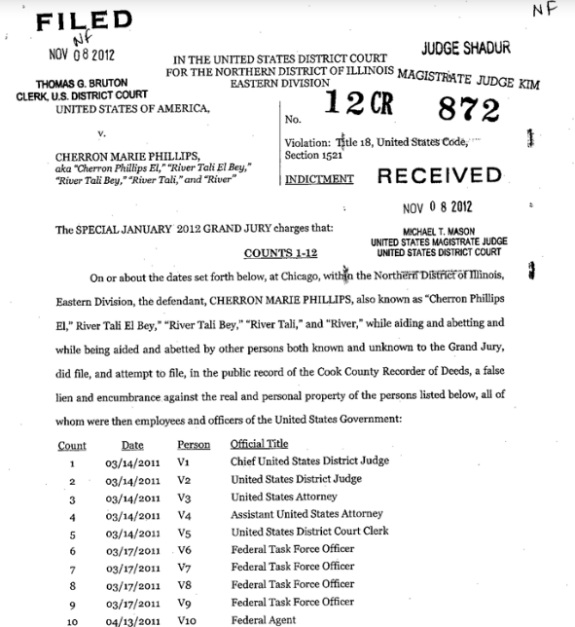
    Part of the first page of the indictment against purported “sovereign citizen” Cherron Marie Phillips. Source: Screen shot of document published by the Chicago Tribune.

    During his days at the Justice Department, Patrick J. Fitzgerald perhaps was America’s most famous prosecutor. When he wasn’t prosecuting terrorism cases in New York (United States v. Usama bin Laden, et al.), he was prosecuting Mafia figures (United States v. John Gambino).

    Fitzgerald, now 51 and in private practice, has drawn praise and criticism for his actions against politicians and public officials from both sides of the aisle. From Chicago, he was involved in the successful prosecution of former Illinois Gov. Rod Blagojevich, a Democrat, in an alleged conspiracy to sell the U.S. Senate seat of Barack Obama, who’d been elected President of the United States in 2008.

    And Fitzgerald also presided over the successful prosecution of Scooter Libby, a fixture in the Republican administration of President George W. Bush and Vice President Dick Cheney. It was an exceptionally famous “CIA leaks” case, the underpinnings of which were known as “The Plame Affair,” a sort of Watergate of the early 2000s.

    Given Fitzgerald’s participation in high-profile cases against international rogues and terrorists, organized-crime figures and U.S. domestic political elites on both sides of the aisle, it’s easy to forget he also prosecuted or supervised the prosecution of ordinary cases. One such case involved a defendant by the name of Devon Phillips, who pleaded guilty to drug charges four years ago, the Chicago Tribune reported.

    Cherron Marie Phillips, Phillips’ sister and a purported “sovereign citizen,” now has been charged with filing false liens that seek $100 billion each from Fitzgerald and 11 other public officials, including a chief U.S. District Judge, a U.S. District Judge, two U.S. Magistrate Judges, an assistant U.S. Attorney, a federal court clerk, four federal Task Force officers and a federal agent.

    Fitzgerald and the other federal officials are not identified in the Cherron Phillips indictment, but the indictment charges a bogus lien for $100 billion was filed by Phillips in Chicago against a “United States Attorney” on March 14, 2011. The famed prosecutor was Chicago’s U.S. Attorney (the Northern District of Illinois) on that date.

    If Phillips were to get her way, every man, woman and child in the United States would owe her brother $3,821.65, a figure arrived at by dividing $1.2 trillion — the sought-after sum — by 314 million, the approximate U.S. population.

    The liens were filed in the “public record of the Cook County Recorder of Deeds,” according to the indictment.

    Based on the content of the indictment and other records, it appears as though the office of U.S. Attorney Stephen R. Wigginton of the Southern District of Illinois is prosecuting the case against Phillips to remove any questions about whether she could be treated fairly by prosecutors in the Northern District of Illinois. Fitzgerald once led the Northern District and, as noted above, he and an assistant U.S. Attorney from that office allegedly were targeted in the liens caper.

    The indictment did not say whether taxpayers will incur additional expenses because of the need for a prosecutor in a different district to handle the case. There have been instances in other states in which both federal judges and federal prosecutors have recused themselves because of actions brought by purported “sovereigns.” Judges from other districts and even other states effectively have been flown in to preside over such matters, invariably because the officials targeted in liens capers become potential witnesses.