Tag: ASD

  • EDITORIAL: Bowdoin’s Public Support Largely Has Vanished

    Andy Bowdoin
    Andy Bowdoin

    In 2006 and 2007, AdSurfDaily Inc. used the services of Virtual Money Inc., a debit-card provider accused last year of laundering money for a major narco business in Medellin, Colombia.

    ASD also has been linked to the CEP Ponzi scheme, the PhoenixSurf Ponzi scheme (which also used Virtual Money debit cards), the 12DailyPro Ponzi scheme and e-Gold, which was indicted and convicted of money-laundering.

    ASD President Andy Bowdoin also has been linked to a little-known (and now gone) enterprise known as DailyProSurf, which preceded ASD and used two of the three words that comprised the title of the infamous 12DailyPro Ponzi scheme — and, as it turned out, one of two words that comprised the title of the infamous PhoenixSurf Ponzi scheme.

    Earlier this year Bowdoin appeared in a video pitch for a purported surf known as PaperlessAccess. It was a way for ASD members to get their money back, he explained. The Pro-ASD Surf’s Up forum later explained that PaperlessAccess has misrepresented itself to Bowdoin. Some people observed that PaperlessAccess appeared to be using the same surf script ASD used — and the same database.

    Bowdoin’s public support largely has evaporated. Although he continues to have apologists willing to twist facts and conflate new realities to explain away every bit of bad news — including people who cling to a fantasy that ASD can demonstrate it was not a Ponzi scheme — his remaining loyalists long ago lost the PR battle. “Evil government” never was much of an argument, mostly because people generally support the police. Bowdoin himself exposed the fallaciousness when he acknowledged ASD was operating illegally.

    The court already has rejected one argument advanced by an ASD expert witness, ruling that attorney Gerald Nehra had “demonstrated the fallibilities of the professional expert witness, who was defensive on his client’s behalf rather than neutral in his expertise.”

    Among the problems with Nehra’s testimony at an evidentiary hearing last fall, the judge said, was that it contradicted the testimony of other ASD witnesses and “relied solely on the written words contained in the Terms of Service without independent investigation or review of ASD’s business records to ascertain how ASD operates in fact before opining.”

    Keith B. Laggos, another expert ASD reportedly has on its side, had problems with the SEC for publishing “laudatory” press releases and a “laudatory article” about a company without disclosing he was being compensated by the company.

    “[T]he final judgment entered against Laggos provides for disgorgement of $11,989.87, plus prejudgment interest in the amount of $1,996.77, for a total of $13,986.64; the imposition of a civil penalty of $19,500; and a five-year penny stock bar,” the SEC said in 2005.

    Moreover, some ASD promoters have been linked to any number of failed schemes, including MegaLido, Noobing and Regenesis 2×2, which now is under investigation by the U.S. Secret Service in Washington state. One of the purported Regenesis principals was released from federal prison only in January, after serving time in a previous fraud scheme.

    Larry Cook, the receiver in a fraud case against Noobing’s parent company, Affiliate Strategies Inc., said in court filings Thursday that the company and affiliated companies were broke.

    In the early stages, it has been hard to get a fix on finances because “several thousand intercompany transfers” occurred, Cook said, adding that “for at least all of 2009, Defendants operated only by signing up new victims faster than the old victims could obtain refunds.”

    Some ASD promoters, of course, also pitched BizAdSplash (BAS) — even though “chief consultant” Clarence Busby operated Golden Panda Ad Builder, whose assets ($14 million) were seized in the ASD probe. BAS currently is paying no one. Neither is AdGateWorld (AGW), another surf pitched by ASD members. ASD’s name once appeared in the AGW Terms of Service.

    If that were not enough, members now say that ASD President Andy Bowdoin was the silent head of AdViewGlobal (AVG), which suspended cashouts June 25, closed its forum, announced it was keeping all money sent in by members under a “rebates aren’t guaranteed” clause and conducting an audit of itself.

    AVG recently announced it had reported the theft of $2.7 million to state and federal authorities. The announcement was made one day after ASD announced in court filings that it was negotiating with federal prosecutors.

    Bowdoin, who also has been named a defendant in a racketeering lawsuit but has not responded to the complaint, even acknowledged in his own court filings that ASD was operating illegally, claiming the government had an extraordinary duty to inform him that what he was doing was breaking the law.

    AVG launched despite ASD’s unresolved legal nightmare, which leads to questions about whether Bowdoin also believed the government had an extraordinary duty to tell him that AVG was illegal.

    The ASD case is strange by any standard one chooses to apply, including the incongruous standards of the autosurf world. At various times it has featured court filings by Curtis Richmond, a man associated with a group that declared itself a sovereign Indian tribe and organized its own Supreme Court, using the address of a Utah doughnut shop. The group derisively became known as the “Arby’s Indians” because it once held a meeting at an Arby’s in Provo.

    Richmond and co-defendants in a Utah civil case were found by a federal judge last year to have engaged in racketeering in a scheme to destroy the credit of public officials involved in litigation against the tribe, which the judge ruled a “complete sham.”

    Even jailed racketeer and former U.S. Rep. James Traficant became a side note in the ASD case, after some ASD members circulated this PDF in sympathy of his views on what they view as a banking and Federal Reserve conspiracy.

    “Redeemable currency must promise to pay a dollar equivalent in gold or silver money,” Traficant was quoted as saying in 1993, before he was jailed.  “Federal Reserve Notes (FRNs) make no such promises, and are not ‘money.’”

    ASD-related litigation is not the only trouble that has dogged Bowdoin since the filing of the federal forfeiture case last August.  In December 2008 — in an unrelated case in Gadsden County, Fla. — a process server attempted unsuccessfully to serve Bowdoin with a lawsuit for an unpaid bill, and reported back to the court that “the address appears vacant.”

    Bowdoin’s last known address was 8 Gilcrease Lane in Quincy, according to April court filings by his former attorneys. Bowdoin fired his attorneys and proceeded as a pro se litigant, but later was ordered to hire a new attorney.

    Meanwhile, there has been virtually no public activity since early January in the case against Bowdoin filed last year by Florida Attorney General Bill McCollum, whom some ASD members said should be charged with Deceptive Trade Practices for suggesting ASD was illegal. The Florida case has been reassigned to different judges twice this year.

    Bowdoin claimed last year that Ponzi allegations brought by McCollum had been dropped, which triggered ASD members to race to forums to share the good news and caused McCollum’s office to issue a statement denying that Ponzi allegations even had been brought in Florida. The Florida prosecution was brought as a pyramid scheme.

    While it was awaiting a court ruling in October pertaining to the Ponzi allegations in federal court and the allegations that ASD had virtually no revenue other than fees paid by new members,  ASD suddenly announced it expected to receive a $200 million infusion from Praebius Communications, a penny-stock firm that publishes no financials.

    Members were skeptical and said they’d try to confirm the story through Praebius, and ASD quickly removed the announcement from its Breaking News website — but not until other members once again had raced to forums to share good news that turned out to be disappointing news.

    In the federal forfeiture case filed in August, Bowdoin ceded tens of millions of dollars to the federal government in mid-January, but signed a court document Feb. 25 saying he’d changed his mind and planned to continue to litigate as his own attorney.
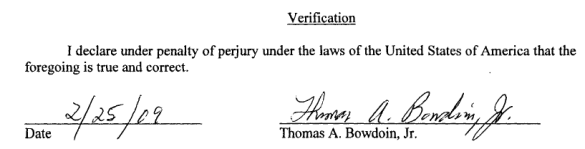
    Reduced screen shot of Bowdoin's sworn certification in a pro se pleading. Feb. 25 was the recorded date of the signature. A day earlier -- on Feb. 24 -- reports circulated that the Secret Service had seized the banks accounts of some individual ASD members. On Feb. 26, AVG announced it was switching to an "association" structure.
    Reduced screen shot of Bowdoin's sworn certification in a pro se pleading. Feb. 25 was the recorded date of the signature. A day earlier — on Feb. 24 — reports circulated that the Secret Service had seized the banks accounts of some individual ASD members. On Feb. 26, AVG announced it was switching to an "association" structure.

    Bowdoin signed the document one day after reports surfaced that the U.S. Secret Service had seized other bank accounts in the ASD case. On Feb. 26, one day after Bowdoin signed the first of his pro se pleadings, AVG announced it had consulted with Pro Advocate Group and was switching to an “association” structure.

    Pro Advocate Group is associated with Karl Dahlstrom, who was convicted of securities fraud in the 1990s and sentenced to 78 months in federal prison. The “association” structure that emerged cited the U.S. Constitution as the document from which it derived its authority, but AVG said it was headquartered in Uruguay and its servers resolved to Panama.

    AVG used U.S.-based Google services for communications, even though it had its own server. The likely reason for that was to preserve an ability to communicate in case the company’s servers were shut down.

    ASD’s servers were shut down for spam and abuse last year. At least one domain associated with AVG — http://advglobal.com — has been shut down this year. A note in the domain data suggested the server was suspended for spam and abuse.

    Beyond that, there is confusion over precisely who owns eWalletPlus, the online payment processor associated with AVG. Bowdoin was said to have paid $75,000 for eWalletPlus in November — the same month a federal judge ruled ASD had not demonstrated it was a legal business and not a Ponzi scheme — but at least three other companies or individuals have claimed to own the firm.

    The situation is both a maze and amazing. A company known as Vana Blue Inc. that trades as a penny stock now has specifically disclaimed ownership of Karveck International — yet another name associated with AVG — and yet Vana Blue once boasted that it had acquired Karveck International, after earlier boasting it had acquired a company known as Karveck Corp.

    Vana Blue also claimed to own TMS Corp., which had claimed to own eWalletPlus. Meanwhile,  an entity known as TMS Association also claimed to own eWalletPlus. A third entity — TMS  Corp. USA LLC — also has become part of the AVG alphabet soup.

    Amid these bizarre circumstances, Andy Bowdoin’s support has collapsed — with the exception of a small universe of people eager to trot out a new conspiracy theory to deflect blame from the responsible parties.

  • SOURCE: Andy Bowdoin Was Head Of AdViewGlobal; Secret Service Seized Computer Used By Insider; Money Missing From Firm; Arizona Authorities Involved; Surf Immersed In Sea Of Uncertainty As Patriarch Deflects Blame

    EDITOR’S NOTE: Information in this story was gleaned Tuesday and Wednesday from a source who spoke to the PatrickPretty.com Blog on the condition of anonymity. We interviewed the source Wednesday. The source said a large group of individuals once loyal to Andy Bowdoin no longer could stand in his corner. “We got mixed up in ASD and feel horrible about it,” the source said.

    UPDATED 10:22 A.M. EDT (U.S.A.) Andy Bowdoin was the recognized head of AdViewGlobal among a core group of insiders and dispatched his stepson, George Harris, to Switzerland to establish bank accounts, according to information provided the PatrickPretty.com Blog.

    In an email that circulated among ASD members — some of whom were described as sickened by Bowdoin’s gall — Bowdoin denied that Swiss accounts ever were opened. He acknowledged, though, that both George and Judy Harris trekked to Switzerland, accompanied by another individual.

    His concession has led to questions about whether Bowdoin was telling the truth that no Swiss accounts were opened. The U.S. government is engaged in an active campaign to pierce Swiss banking secrecy and has scored landmark wins in recent months that have resulted in indictments against Americans who were using the banks to evade income taxes.

    Meanwhile, the U.S. Secret Service has seized at least one computer used by an AVG insider and the Phoenix Police Department is investigating a purported theft of $2.7 million from AVG, according to the email.

    “There is no doubt in my mind whatsoever” that remarks attributed to Bowdoin in the email were authored by Bowdoin, the source said.

    Bowdoin told a person who questioned his business judgment that Harris was unable to open Swiss accounts because “the banks said they did not like accounts with a lot of out going transactions,” according to the email.

    A person who participated in AVG took Bowdoin to task for laissez-faire management, a lack of follow-up controls and various business blunders — one of which purportedly was a deal assembled in November 2008 to acquire the Phoenix-based EWalletPlus payment processor for $75,000.

    (NOTE: Even after reviewing the email, we could not determine who actually owns eWalletPlus. At least three companies or individuals have claimed to own the web-based payment processor, which is offline. The website now resolves to a parked page and appears to be for sale on sedo.com.)

    Bowdoin performed virtually no due diligence before acquiring eWalletPlus, according to the email, but explained “[a] lot of business is conducted without ever meeting the owner because there are so many ways to perform due deligence [sic] in this high tech world.”

    The purported deal, according to the email, involved a purchase contract and occurred the same month a federal judge ruled that ASD had not demonstrated it was a legal enterprise and not a Ponzi scheme at a Sept. 30-Oct. 1 evidentiary hearing ASD specifically requested.

    Bowdoin’s purported actions lead to questions about whether he was prepared to remain in the illegal autosurf business no matter what a federal judge said. At the same time, the email leads to questions about why a group of AVG insiders ever would follow Bowdoin from ASD to the new company with serious legal business still on the table.

    “It doesn’t make sense,” the source said. “These guys got greedy and thought by running things offshore,” they were . . . “[untouchable.]”

    Plans to develop AVG were discussed at a private meeting on a cruise ship among 13 people, the source said.

    Problems developed when AVG was unable to gain or maintain control over bank accounts — including one at First Caribbean Bank — needed to operate the business. One of the issues was who had signature authority over accounts, according to the email.

    AVG blindly paid $20,000 to a formerly trusted person to set up a legal structure and bank account in Costa Rica — and George and Judy Harris “went down” to Costa Rica to get the lay of the legal landscape and review the corporate documentation, according to Bowdoin’s remarks in the email.

    While in Costa Rica, George Harris was advised by a local attorney that the fee for setting up a corporation was only $1,200, which led to questions about whether the formerly trusted party had skimmed $18,800 in the purported $20,000 deal.

    “[S]omeone made a lot of profit,” Bowdoin said, according to the email.

    In any event, the bank account in Costa Rica was needed as a conduit to forward funds to Uruguay, according to Bowdoin, citing a claim made by the formerly trusted party.

    No money made its way into the account in Costa Rica, even though the formerly trusted party was supposed to place $2.2 million in the account for later transfer to Uruguay, according to the email.

    Bowdoin appointed Judy Harris an AVG trustee in a bid to get control of the money, according to the email.

    “Yes, I asked Judy to be trustee to see if we could over come the money that had been stolen,” Bowdoin said, according to the email. “But when people started cashing out excessively it was soon apparant (sic) that it could not be overcome without some changes in page impressions. If the money had not been stolen all of the cash out requests could of been paid and there would of been plenty of operating capital. Hopefully some of the members will be able to come up with a solution.”

    Infighting developed over whether AVG would be operated from the United States or Uruguay. Bowdoin groused that labor was less costly in Uruguay, but an AVG insider insisted the company operate from inside the United States, according to the email.

    “I never had all of these problems with ASD,” Bowdoin said, according to the email. “It is evident now that I should of been more hands on in management.”

    Bowdoin’s behavior cannot be reconciled, said the source, who acknowledged embarrassment for having participated in ASD after his instincts told him something was wrong.

    At an ASD rally in Florida last year, the source said, he observed a man holding a briefcase. The man explained that the briefcase was “full of cashiers checks for $50,000 apiece,” the source said.

    Later, members of his downline group shared reports that “people with piles and piles of cash” had attended ASD rallies.

    “I don’t believe [Andy Bowdoin] for a second,” the source said. “He lost all credibility in our camp after firing his attorneys — and [filing] all those [pro se] motions.”

    By the time the government seized Bowdoin’s assets last summer, the source said, a family member had lost tens of thousands of dollars consisting of an initial outlay and unredeemed paper profits that ASD displayed in the family member’s back office.

  • BREAKING NEWS: Vana Blue Inc. Says Karveck International Deal Is Off; News Release Raises New Questions About Ownership Of AdViewGlobal Autosurf

    UPDATED 2:55 P.M. EDT (U.S.A.) In a short Business Wire news release late this morning, Vana Blue Inc. said it “has canceled all agreements with Karveck Int’l and has no affiliation with [the] company or its affiliates.”

    The company claimed to own Karveck International in February 2009, declaring it a “newly acquired asset” that had produced $1.8 million in revenue in January. Karveck was described as a company that “specializes in internet advertising and promotion in a search engine and ad clicking type environment.”

    Today’s news release, however, said the deal once described as completed never was finalized and that the cancellation came as a result of “further due diligence.”

    “Vana Blue was unable to complete this transaction but is in the final stages of negotiation with an oil company to continue its plans of acquisitions,” said Donald Rex Gay, Vana Blue’s president.

    Vana Blue is a Pinksheet stock that trades under the symbol VBLU.

    Among other things, Vana Blue has said it owned the eWalletPlus payment processor that has been associated with AdViewGlobal (AVG), an autosurf with ties to AdSurfDaily Inc. Karveck’s name also has been associated with AVG, but AVG identified George and Judy Harris as its owners.

    George Harris is the stepson of ASD President Andy Bowdoin.

    AVG was in prelaunch phase in January, the month before Vana Blue announced the sales figures for Karveck International.  There has been one report that AVG registered in Uruguay as Karveck International, but that report has not been confirmed.

    Vana Blue’s domain name now resolves to a GoDaddy.com parked page. Meanwhile, the domain for eWalletPlus also resolves to a parked page and appears to be for sale on sedo.com.

    Today’s Vana Blue news release used a Gmail address. Previous news releases by the firm used an email address at the Vana Blue domain.

    AVG announced to members Aug. 5 that it had reported a theft of $2.7 million to state and federal authorities. The surf made the announcement one day after ASD announced in court filings that it was negotiating with federal prosecutors in a case that involved the seizure of tens of millions of dollars last August from Bowdoin.

    Vana Blue used mail services in both Phoenix and Las Vegas for its street address, according to records. Vana Blue also has said it had an agreement with a company known as Net Auction Plus, an eBay alternative, “to provide online, affordable, and flexible payment services.”

    The NetAuctionPlus.com domain name is registered to Michael Austin and uses the same Phoenix mail-service address as Vana Blue. The NetAuctionPlus.com domain throws a server error.

    Austin’s name also has been associated with eWalletPlus, but is only one of several names associated with the payment processor and money-services business. AVG promoters have claimed that eWalletPlus was AVG’s in-house payment processor.

    The names of at least two other companies — TMS Corp. and TMS Association — also have been associated with Vana Blue. Both firms purportedly owned eWalletPlus.

    A third firm with a similar-sounding name — TMS Corp. USA LLC — is registered in Nevada and Arizona.

    Records show the registration of TMS Corp. USA LLC was recorded by Gary Talbert, a former ASD executive. The Arizona registration lists ASD’s street address in Quincy, Fla.

    Federal prosecutors said last year that ASD’s Quincy address was bogus.

    In January, Karveck International was referred to in this Business Wire news release carried by Reuters as “Karveck Corporation.” It was described as a media company with “international reach that provides high volume exposure for websites thus creating advanced advertising on the internet for big and small businesses and for individuals who have products and services to sell.”

    The name change from Karveck Corp. to Karveck International was not explained.

    AVG has a history of issuing confusing announcements. In May — on the same day the Obama administration announced a crackdown on international monetary fraud — AVG announced it had secured a new offshore wire facility after losing a previous facility in March.

    The surf, which purports to be headquartered in Uruguay, provided account numbers and detailed wire instructions for members. Three days later, a company AVG identified as a facilitator of the transfers issued an express, public denial that it had any business relationship with AVG.

    AVG never acknowledged the denial. Instead, the surf issued an announcement signed “AVGA Management” that the wire deal it just had described as completed had failed because of unsuccessful negotiations.

  • DEVELOPING STORY: Firm That Provided AdSurfDaily Debit Card Indicted; Feds Say Virtual Money Inc. Helped Colombian Drug Operation Launder Money In Medellin

    virtualmoneyUPDATED 9:49 A.M. EDT (U.S.A.) A Dallas-based company and its president were charged in a sealed indictment in April 2008 with helping a Colombian cocaine operation launder money by providing debit cards that were used to convert drug proceeds to cash in Medellin.

    The company — Virtual Money Inc. — once provided debit cards to AdSurfDaily Inc., a Florida company accused in August 2008 of  money-laundering, wire fraud and operating an autosurf  Ponzi scheme.

    Prosecutors brought a forfeiture complaint for tens of millions of dollars in the ASD money-laundering case. A grand jury in the Virtual Money case has authorized forfeiture complaints totaling $7.12 million.

    Prosecutors said that Virtual Money, known simply as VM, helped the Colombian drug operation offload at least $7.1 million in drug proceeds at automated teller machines in Medellin. Medellin once was home base of the infamous Medellin Cartel, operated by drug lord and terrorist Pablo Escobar. Escobar was killed by Colombia National Police in 1993.

    Escobar was implicated in the assassination of Colombian presidential candidate Luis Carlos Galán and the bombing of Avianca Flight 203 over Colombia, which killed 110 people.

    Autosurf promoters long have claimed that participation in illegal surf enterprises is harmless. The indictment against VM — and the allegations that it laundered money for a Colombian drug organization — demonstrates the dangers of participating in murky businesses in which participants have no way of knowing what is in the hearts and minds of other participants.

    It was not immediately clear how long ASD used the VM debit card, which was heavily promoted in early 2007 when ASD said it was having cash-flow problems.

    Two Colombian conspirators “directed their agents in the United States to provide proceeds of sales of controlled substances to agents of VIRTUAL MONEY, INC. to be sent to Colombia so the proceeds could be made available to the clients,” according to the indictment.

    VM “stored value cards were used by the members of the conspiracy to make available at a Daviviendo Bank ATM in Medellin, Colombia the peso equivalent of US $2,430,810.24 in April 2006; US $2,437,023.53 in June 2006; and US $2,257,761.45 in August 2006,” prosecutors charged.

    The VM indictment, which was brought in Connecticut after a two-year investigation by the Drug Enforcement Administration, was unsealed in September. It names 10 defendants, including VM President Robert Hodgins.

    Debit cards with “stored value” have become an increasingly popular way for autosurfs to collect and distribute money.

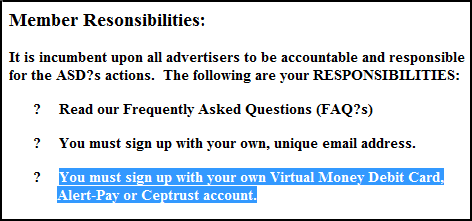
    In 2007, members of an ASD downline team hailed the VM debit card as one of the key advantages of ASD membership. The same downline team claimed that ASD provided “shelter” from the Federal Trade Commission and the Securities and Exchange Commission

    ASD downline group pitches VM card in 2007.
    ASD downline group pitches VM card in 2007.

    The card “[c]an be used in over 210 countries and territories and growing!” a sales pitch by the downline group said. “Funds conversion to local currencies at local ATMs.”

    VM’s website now directs either to a “Forbidden” error or a message that explains the company is not operational, depending on what URL visitors use.

    “We have a dedicated team working around the clock to ensure that the advanced and trusted service that all Virtual Money Card Holders have been use to over the past years, will be back and available as soon as possible as we are currently updating our facilities and servers,” VM said in the message.

    Australia has banned the sale of the VM card.

  • EDITORIAL: Members Turn On Each Other As 11th Hour Dawns For Andy Bowdoin And AdSurfDaily Inc.

    The coming hours and days may mark the end of AdSurfDaily. Fragmentation, fractiousness and bitterness are marking ASD’s final descent into infamy.

    Steve Watt of TheJoyLuckClub, for instance, is accusing the Mods at the Pro-ASD Surf’s Up forum of covering up for Andy Bowdoin and AdViewGlobal (AVG), an offshoot of ASD.

    We wish we could applaud Watt’s actions. We cannot.

    Steve Watt is promoting yet another surf site at TheJoyLuckClub, despite everything that has happened and despite announcing that he was out of the surf-promoting business. He also has contributed to the delay of the government’s proposed restitution program by being an early champion of Curtis Richmond’s pro se pleadings, and doesn’t seem to understand that TheJoyLuckClub’s message is at odds with itself.

    At one time, Watt announced a denial by U.S. District Judge Rosemary Collyer of a Richmond pro se pleading would lead to a “Major Criminal Complaint that will be filed with the U.S. Atty. General.” Watt encouraged members to join a nonprofit organization he and other Surf’s Up members formed — ASD Members International (ASDMI) — to litigate against the government even if it was behaving legally.

    One of ASDMI’s co-founders was Patrick Moriarty, currently under indictment for federal tax fraud. In 2006, Moriarty started a nonprofit for a Missouri man accused of murdering a woman in cold blood, shooting a police officer four times and shooting another man eight times.

    Richmond, meanwhile, is associated with a Utah “Indian” tribe a federal judge ruled a “complete sham.” The “tribe” became infamous for becoming embroiled in vexatious litigation against public officials, and the oddities did not end there.

    Some people who used a sham tribal “arbitration” panel known as the Western Arbitration Council (WAC) to do their bidding against the government were jailed for tax crimes, including Bruce Robert Travis. Among other things, Travis is the self-published author of “My Past Life As Jesus” and “The Messiah For Hire.”

    Travis, associated with tax denier Royal Lamarr Hardy, now reportedly is working on a book in which he’ll describe what it’s like to be Jesus behind bars.

    Dale Stevens, “chief” of the sham Utah tribe to which Richmond belonged — the Wampanoag Nation, Tribe of Grayhead, Wolf Band — was arrested for child pornography and anounced his intention to marry two underage girls.

    One of the girls was 12. Stevens, 69, said he’d hoped to enter into marital bliss with her in exchange for half a cooler of “energy bars.”

    Despite all the information at their disposal about entities and individuals with whom they were associating themselves on the periphery, neither Watt nor Surf’s Up divorced themselves from the circus.

    Regardless, Watt now writes that he is unhappy that the Mods refused to send an email blast to encourage Surf’s Up members to cooperate in a story proposed by Mike Mason, who once worked as a television journalist in Florida and has started a Blog.

    The Mods at one time sent blasts if Bowdoin or favorite sons cleared their throats. They used the forum to champion ridiculous, pro se pleadings after Bowdoin declared his paid attorneys incompetent and fired them — and even after a federal judge in a separate case had ruled that Curtis Richmond and others had engaged in racketeering and mail fraud in a bid to destroy the credit of public officials in Utah by placing enormous, fraudulent judgments against them for having the temerity actually to do their jobs.

    Richmond was hailed a “hero” on Surf’s Up. Never mind that he once signed a fraudulent “award” issued by WAC against a family-services worker in Utah for $300,000.

    A family-services worker who was doing the good work of protecting children.

    Good grief.

    And never mind that Bowdoin and Richmond’s drivel delayed for months the government’s plan to implement a restitution program for participants who certified under oath they were crime victims. Surf’s Up almost never missed a chance to rally the troops to hate the government, even if it meant dispossessed widows caught up in the scheme had to wait even longer for their chance to get some money back.

    At Surf’s Up, the widows always could wait.  It’s a plain fact that some of the Mods and members started a forum to promote AVG after receiving ASD’s official endorsement just days after a key ruling went against Bowdoin in November, just weeks after Bowdoin took the 5th Amendment in his own case.

    “Too honest” to testify, a Surf’s Up poster ventured. A $50,000 Lincoln was parked in Bowdoin’s driveway when the remark was made, having been purchased for cash with ASD “rally” money diverted to another Bowdoin enterprise. Meanwhile, victims of a Bowdoin securities scheme a decade ago got a check for $100.

    Not to worry. If Bowdoin could not produce an audited balance sheet certifying ASD’s solvency and the courts could not see the beauty of ASD’s business plan, the widows always could make up their losses in AVG, which purportedly was headquartered in Uruguay and immune from all the meddling by the evil U.S. government.

    Here is a plain fact — and it is a fact no matter what you read on Surf’s Up: ASD was catastrophically insolvent. It ignored the liabilities side of the ledger and hid behind “rebates aren’t guaranteed.”  As a practical matter, ASD had no means even to deliver all the “ads” it sold. If you joined ASD, you gave Andy Bowdoin a license to keep your money.

    The government intervened to give you a shot at getting some of your money back before the Ponzi scheme collapsed. The reason the restitution program hasn’t started is because the government has been unable to perfect its title to the money because of pro se pleadings by Bowdoin and others. No restitution program can begin until the government has clear title to the proceeds seized from ASD.

    AVG, for its part, announced in June that it was suspending cashouts and exercising its version of a “rebates aren’t guaranteed” clause. In effect, AVG seized the money — the exact same thing Surf’s Up railed against the government for doing last year. The AVG forum started by some of the Surf’s Up Mods and members went missing after AVG suspended cashouts.

    Two of the Surf’s Up Mods announced yesterday that no email blast urging members to cooperate with Mason would be forthcoming. It first was explained that one of the Mods had been sick and that the proposal couldn’t be addressed immediately. Then it was said the Mods had to consult by phone to approve any blast. Finally, it was said that two of the Mods had communicated with Mason, but a decision had been made not to bring the matter to the attention of the full Surf’s Up membership.

    In essence, the Mods explained that Mason was an unknown commodity and might slant his coverage to the government’s point of view.

    For all intents and purposes, the ASD forfeiture case will end soon. It will be a clear, clean win for the public officials who prevented this contemptible Ponzi scheme from mushrooming globally and sucking wealth from 84 percent of members so 16 percent could enrich themselves.

    We’d like to give Steve Watt credit for calling out the Surf’s Up Mods and regret that we cannot — and we sincerely hope that Steve will see the light.

  • UPDATE: Vana Blue Website Still Offline; No Pinksheet Stock Activity For Seven Trading Days Amid Maze Of Claims

    Not a single share of Vana Blue’s penny stock has traded hands since July 30, a period of seven full trading days, according to Yahoo Finance. In news releases, Vana Blue identified itself as the owner of eWalletPlus, a payment processor later linked to the AdViewGlobal (AVG) autosurf.

    Vana Blue, which used mailing services in Phoenix and Las Vegas as its address, is a registered corporation in Nevada. Its website now resolves to a server that beams ads from GoDaddy.com, but until recently resolved to a server from which the company told its story.

    The company has claimed to own a company that variously has been described as TMS Corp. and TMS Association, which purportedly developed eWalletPlus. In January, Vana Blue also claimed to own a company that variously has been described as Karveck Corp. or Karveck International, a purported advertising and media company.

    In February, Vana Blue reported that Karveck had posted $1.8 million in revenue in January — the month AVG was in prelaunch.

    Among other things, Vana Blue also had said it signed an agreement with a company known as Native Express Inc. “to develop oil and gas resources” in Utah. Vana Blue also has said it had an agreement with a firm in Jamaica known as Internet Mobile & Caribbean Network Ltd. to “facilitate the sales of the Compass Pre Paid debit card throughout Jamaica and the Caribbean.”

    Meanwhile, Vana Blue also has said it had an agreement with a company known as Net Auction Plus, an eBay alternative, “to provide online, affordable, and flexible payment services.” The NetAuctionPlus.com domain name is registered to Michael Austin and uses the same Phoenix mail-service address as Vana Blue.

    The NetAuctionPlus.com domain throws a server error. Austin’s name was mentioned in an announcement last week by AVG that it had reported a theft of $2.7 million to unspecified law enforcement agencies. AVG, which purports to be headquartered in Uruguay, did not explain when the alleged theft occurred and did not provide details.

    Austin’s name also has been associated with eWalletPlus, but is only one of several names associated with the payment processor and money-services business. AVG promoters have claimed that eWalletPlus was AVG’s in-house payment processor. At one time, the eWalletPlus domain resolved to the same server in Panama that hosted AVG, but the domain now resolves to a parked page and appears to be offered for sale on sedo.com.

    In a purported public filing dated March 31, Vana Blue identified its officers as Donald Rex Gay, Leonard Capelli and Michael Reis, saying it owned TMS Corp and Karveck International.

    Only days later, a man associated with both the AdSurfDaily and AVG autosurfs — Gary Talbert — registered an entity known as TMS Corp. USA LLC, according to records. Talbert’s U.S. registrations occurred within days of a March 20 announcement by AVG that he had resigned as its chief executive officer and a March 23 announcement that AVG’s bank account had been suspended because too many members had wired transactions in excess of $9,500.

    TMS Corp. USA LLC is registered in Nevada, and lists Gary D. Talbert of 2601 E Thomas Rd, Ste 220-A Phoenix, AZ 85016, as its manager. A company by the same name also is listed as a foreign LLC in Arizona, with Gary D. Talbert of 13. S. Calhoun Street, P.O. Box 109, Quincy, FL 32351, as its manager.

    The S. Calhoun Street building address is the same address AdSurfDaily Inc. used.

    In a forfeiture complaint against ASD last year that alleged wire fraud, money-laundering, the sale of unregistered securities and a Ponzi scheme, federal prosecutors said the building address was bogus.

    One of the officers of Vana Blue is named a defendant in a counterclaim by the U.S. government that alleges more than $252,000 in federal income tax is unpaid. The same individual — Donald Rex Gay — is listed in Louisiana records as a person who has been involved in a number of businesses.

    Gay denied in pro se court filings that he owed the taxes.

    Records in Illinois note that Michael Reis, also listed by Vana Blue as an officer, was ordered in 2000 to cease and desist from the practice of public accounting without a license.

  • AdGateWorld Joins AVG, BAS In No-Pay Surf Lineup

    Members of AdGateWorld (AGW) are complaining today that the surf is not paying rebates. AGW now joins AdViewGlobal (AVG) and BizAdSplash (BAS) in the nonpaying lineup.

    All three surfs launched in the aftermath of the seizure of tens of millions of dollars last year from Florida-based AdSurfDaily Inc., amid allegations of wire fraud, money-laundering, engaging in the sale of unregistered securities and operating a Ponzi scheme. The surfs quickly became known as ASD clones, with promoters that touted offshore locations as a safety buffer between participants and U.S.-based regulators and law-enforcement agencies.

    At one point, the acronym ASD appeared in the Terms of Service on the AGW website.

    In recent weeks, AGW said it had new owners in the Middle East. Those reports could not be confirmed.

    Members today, however, said that AGW announced yesterday it had no money to pay rebates this week.

    The surf did announce that it would provide members a new splash page to create interest in the program, members said. The idea was to create an “AdGateWorld awareness campaign.”

    AGW recently took bonuses away from members, members said. Yesterday’s announcement was simply signed “AdGateworld.”

  • And The Ponzis Will Die As One . . .

    Dear Readers,

    Two days ago we received a note from a woman who identified herself as a member of AdViewGlobal (AVG). The note was intended for publication, but we declined to publish it.

    The woman described herself as angry about developments at the surf. We would have published the note, except for one thing: The woman included two URLs, along with an appeal for readers to click on PTC  ads on her website.

    So, in one breath, she was condemning AVG. In the next, she was encouraging people to engage in click fraud so she could earn a fee. There was virtually no editorial content on the site.

    Bids to commit click fraud were an element of the ASD case, of course. Despite all that has happened, some people continue to show annoyance that their favorite surf or surfs aren’t paying, and yet try to line their own pockets with fraudulent fees.

    Screent shot of pitch last year for ASD members to commit click fraud.
    Reduced screen shot of pitch last year for ASD members to commit click fraud.

    It’s hard to imagine that anyone actually joined AVG, given the events at ASD. But it’s even harder to imagine that a person bitter about suspended AVG payouts then would arrive at the conclusion that she could make up for lost money by taking money out of the pockets of PTC advertisers.

    And, speaking of the word “imagine,” we offer this — with our apologies to the late John Lennon.

    Imagine there’s no Surfing
    It’s easy if you try
    No Ponzi below you
    Nothing above you to deny
    Imagine all the Surfers
    Saying no to pay to play

    Imagine there’s no Cashouts
    It isn’t hard to do
    Nothing to shill or ply for
    And no soiled commissions too
    Imagine all the Surfers
    Saying no to clicking for a fee

    You may say that he’s a schemer
    But he’s not the only one
    He hopes someday you’ll join him
    And the Ponzis will be as one

    Imagine no rebate schemes
    I wonder if you can
    No appeals to greed or hunger
    A brotherhood of anti-scam
    Imagine all the Surfers
    Respecting the nobility of the working man

    You may say that he’s a schemer
    But he’s not the only one
    He knows now you won’t join him
    And the Ponzis will die as one

  • EDITORIAL: The End Of Wink-Nod

    One year ago today, the U.S. Secret Service arrived in the small town of Quincy, Fla., and changed history. By executing a search warrant at the headquarters of AdSurfDaily Inc. — and going about their business in very public fashion — agents sent the message that the so-called autosurf “industry” no longer had a safe haven anywhere on U.S. soil.

    In all of 2008, the Secret Service issued exactly six national news releases. One of them dealt with AdSurfDaily. Given the special nature of the work the Secret Service performs and the extreme competence of the men and women who serve their country in this unique fashion — and the fact that ASD merited a news release — well, connect the dots.

    The wink-nod days are over for the surfs.

    Promoter? “Industry” expert? “Team” organizer? Good luck. You’re going to have to work twice as hard for your ill-gotten gains (with the prospect of getting busted always in play), and your forum spiel and YouTube videos are becoming less and less effective. They make you look like a person who will do anything — up to and including pretending the Secret Service never visited Quincy — to pocket a commission.

    Agents exposed the “industry” for exactly what it is: a poison field laced with land mines and trip wires and occupied by schemers and liars and criminals and money-launderers.

  • BREAKING NEWS: Federal Judge Denies Curtis Richmond’s Disqualification Motion In ASD Case; Motions To Set Aside Forfeiture By Three Other Pro Se Litigants Also Denied

    UPDATED 3:40 P.M. EDT (U.S.A.) A federal judge said she will not recuse herself from the AdSurfDaily forfeiture case and has denied a motion by Curtis Richmond to disqualify herself. Meanwhile, the judge also denied motions by other pro se litigants in the ASD case.

    Richmond filed the motion to disqualify Judge Rosemary Collyer, claiming the judge had displayed “extreme bias.” But Collyer denied the motion this afternoon in a Memorandum Opinion. Richmond is associated with a sham Utah “Indian” tribe and has a history of filing 11th-hour motions to force judges to recuse themselves from cases.

    “Mr. Richmond is not a party entitled to seek disqualification,” Collyer said. “Mr. Richmond further contends that he can seek this Court’s recusal under Rule 63 of the Utah Rules of Civil Procedure, erroneously referring to the Utah Rule as a federal rule. The Utah Rules of Civil Procedure do not apply in this Court. Even if Mr. Richmond had attempted to proceed under the applicable federal statute governing disqualification, 28 U.S.C. § 455, he would be barred from proceeding because he is not a party to this case.”

    Collyer also denied a motion by Richmond to unseat the judge that accused her of treason, declaring the matter moot.

    Other pro se litigants whose motions were denied today include Christian Oesch, Jeffrey Robinson and Joan Hughes.

    “Movants here are not the first to attempt to intervene in this case and seek its dismissal,” Collyer said. “The Court addressed previous motions to intervene in a July 16, 2009, Memorandum Opinion, wherein it found that the motions to intervene must be denied because the movants did not have a cognizable interest in the defendant properties, and therefore did not have standing to contest this forfeiture action.”

    “The movants here are in the same position,” Collyer said. “Since these movants are ineligible to intervene and seek dismissal, they are not parties to the case and their motions to set aside forfeiture will also be denied.”

    Collyer denied seven pro se motions to intervene July 16.

  • Sunday News And Notes: ASD Anniversary Passes Without Mention On Surf’s Up; Would-Be eBay Competitor Used Same Phoenix Address As Vana Blue Inc.’s eWalletPlus Subsidiary

    Andy Bowdoin
    Andy Bowdoin

    The one-year anniversary of the seizure of AdSurfDaily’s bank accounts and tens of millions of dollars occurred yesterday, but there was no discussion about it on the Pro-ASD Surf’s Up forum. No one appears to have started a thread to commemorate the anniversary.

    ASD’s Breaking News site, which recently went offline and now resolves to a parked page that beams ads, gave Surf’s Up its official endorsement Nov. 27. The endorsement occurred eight days after a federal judge ruled ASD had not demonstrated at an evidentiary hearing that it was a legal business and not a Ponzi scheme.

    ASD asked for the hearing. The government did not object. ASD President Andy Bowdoin took the 5th Amendment, advising the court through his attorneys that he would not testify at a proceeding his own company requested.

    Although some Surf’s Up members continue to blame the government for events and criticize the prosecutors for being slow to issue refunds from seized funds, the ASD side is responsible for slowing the case to a crawl. At the same time, Bowdoin always has claimed in court filings that the money belonged to him and not the members. It’s one of the few areas in which both Bowdoin and the prosecutors are in agreement.

    Bowdoin submitted to the forfeiture in January, meaning the case nearly was litigated to conclusion. His forfeiture decision  put the government in position to begin an orderly process to implement a restitution program for participants who certified they were crime victims. The first step, according to the government, was to liquidate ASD’s assets. The government advised victims that patience would be required because it would take time to liquidate real estate and other seized assets and to carry out other administrative functions. (See story.)

    ASD’s motion to submit to the forfeiture was filed Jan. 13; it was the 39th entry on the case docket, and the judge’s order (Jan. 22) granting Bowdoin’s request to forfeit the money was the 41st. The docket now has 80 entries, meaning it effectively has doubled in size despite the fact the case nearly was litigated to conclusion in January.

    Less than two weeks after the judge granted Bowdoin’s forfeiture motion, pleadings by pro se litigants who opposed the government’s point of view and sought to intervene in the case began to appear on the docket. The docket has been dominated since January by pro se litigants, including Andy Bowdoin, who fired his paid attorneys and said he changed his mind about submitting to the forfeiture after consulting with a “group” of members.

    As of today, various pro se pleadings  have resulted in delays of at least seven months in implementing the orderly restitution process the government said it contemplates for crime victims. ASD has been ordered to show cause by Aug. 7 why Bowdoin’s motions — and why motions filed by a new Bowdoin attorney — should not be denied. The judge said she had heard neither from Bowdoin nor his attorney since May.

    Timeline

    Judge Rosemary Collyer issued the ruling that ASD had not demonstrated it was a legal business and not a Ponzi scheme Nov. 19. On the same date, ASD said on its Breaking News site that it was “Shaken but Not Stirred!” by the ruling, punctuating its comment with an exclamation point. ASD gave Surf’s Up its official endorsement on the Breaking News site Nov. 27, eight days after Collyer’s ruling.

    References to a new surf with ties to ASD — AdViewGlobal (AVG) — began to appear online by mid-December. On Dec. 19, federal prosecutors filed a second forfeiture complaint tied to assets allegedly paid for with money that originated with ASD, including automobiles, a boat, jet skis and marine equipment, and a mortgage on the Tallahassee home of George and Judy Harris. George Harris, whom Bowdoin identified as head of ASD’s real-estate division, is Bowdoin’s stepson.

    On June 10 and June 11 alone, prosecutors said, almost $240,000 in ASD funds were used for personal purchases by Bowdoin family members or friends. The purchases were made less than two weeks after ASD concluded a rally in Las Vegas in which Bowdoin told participants that he thanked God for making him a “money magnet.” He implored attendees to visualize themselves wealthy, to “have an attitude of gratitude with God” and to imagine lots of big checks coming in from AdSurfDaily.

    By the end of July — after more ASD rallies — Bowdoin plunked down nearly $50,000 to purchase a new Lincoln. His assets were seized days after the purchase.

    On a date uncertain in either December or January, some of the Mods and members of Surf’s Up started a forum to promote AVG. Reports suggested that as many as 30 former ASD members were “founders” of AVG.

    On Jan. 15, two days after Bowdoin advised the court that he intended to submit to the forfeiture and never reintroduce his claims to tens of millions of dollars and other seized property, three ASD members sued Bowdoin for racketeering. Bowdoin has not responded to the complaint. No attorney has entered an appearance notice for him.

    AVG’s graphics were seen on an ASD-controlled website Jan. 31, just hours before AVG’s official launch after operating in prelaunch phase in January — and after AVG had specifically disclaimed any affiliation with Bowdoin or ASD. Pro se filings in the ASD case began to appear within days of AVG’s formal launch.

    On Feb. 24, reports surfaced that the U.S. Secret Service had seized the bank accounts of at least four additional participants in ASD, including at least one participant who had joined AVG. On Feb. 25, Bowdoin signed the first of his pro se pleadings. As February drew to a close — and before the world knew about Bowdoin’s shift in strategy to pro se — a Surf’s up Mod implored members to be patient, hinting the case soon would take a turn for the better from ASD’s point of view.

    “[J]ust hold on — a little bit longer now baby,” the Mod implored.

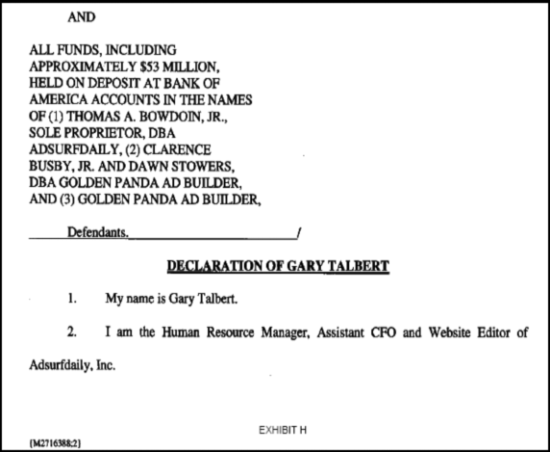
    On March 20, less than two months after its formal launch, AVG announced that Chief Executive Officer Gary Talbert had resigned but would continue to working in “accounting.” Talbert was an ASD executive who signed a sworn affidavit in the ASD case. In an Aug. 18 docket entry, Talbert identified himself as “Human Resource Manager, Assistant CFO and Website Editor.”

    Although AVG identified Gary Talbert as the CEO of AdSurfDaily, Talbert did not say the same thing about himself in court filings.
    Although AVG identified Gary Talbert as the CEO of AdSurfDaily, Talbert did not say the same thing about himself in court filings.

    On Feb. 3, AVG identified Talbert as ASD’s chief executive officer, despite Talbert’s own court filings in which he noted his titles and never claimed to be ASD’s CEO. AVG continued to insist there was no affiliation with ASD.

    On March 23, AVG announced its bank account had been suspended. Members also reported glitches with eWalletPlus, a money-exchange business associated with AVG. On March 26, three days after the announcement of the account suspension, an AVG promoter sent out an email that said $5,000 spent with AVG turned into $15,000 “instantly!” because of a matching-bonus program AVG was running. The promoter was identified as a participant in the CEP Ponzi scheme.

    ASD once advertised it accepted CEP Trust as a payment method. CEP Trust was the failed payment processor associated with the CEP Ponzi scheme. AVG advertised huge matching bonus programs for weeks in what some people saw as a bid to collect large sums of cash as quickly as possible. eWalletPlus eventually went offline.

    ASD once advertised it accepted CEP Trust, the failed payment processor associated with the CEP Ponzi scheme. A CEP promoter named in court filings sent out a promotion for AVG in March, claiming $5,000 spent with AVG turned into $15,000 'instantly!' The promotion was emailed three days after AVG announced its bank account had been suspended because too many members had wired transactions in excess of $9,500.
    ASD once advertised it accepted CEP Trust, the failed payment processor associated with the CEP Ponzi scheme. A CEP promoter named in court filings sent out a promotion for AVG in March, claiming $5,000 spent with AVG turned into $15,000 'instantly!' The promotion was emailed three days after AVG announced its bank account had been suspended because too many members had wired transactions in excess of $9,500.

    On or around May 23, AVG announced the launch of a new website. The launch failed, and members grumbled. On June 1, AVG announced the launch of yet another new website. By June 25, AVG announced that it was suspending member cashouts, making an 80/20 program mandatory and exercising its version of a “rebates aren’t guaranteed” clause that permitted it to keep members’ money.

    Thicket Gets Thicker

    The AVG site operated by some of the Surf’s Up Mods and members went offline after AVG made the June 25 announcement about suspended payouts. On the same date, AVG threatened members and media outlets with copyright-infringement lawsuits for sharing news about the suspended cashouts.

    Four days later — on June 29 — Bernard Madoff was sentenced to 150 years in prison for operating a massive Ponzi scheme.

    On June 30, AVG’s name was mentioned in documents filed in the racketeering lawsuit that had been filed against Bowdoin in January. The documents listed the names of some employees or members AVG and ASD had in common, but AVG has not been named a defendant in the RICO case.

    July opened in unkind fashion for AVG. On July 1, just days after it announced the suspension of cashouts, AVG announced a new payment plan. Members said the plan was baffling because it appeared not to take into account matching bonuses the company had advertised and also increased the window for earning back money directed at the firm from 150 days to 180 days to 210 days, while at the same time suggesting it might take forever for members to get a return.

    AVG identified George and Judy Harris as its owners on July 1. In the hours that followed, it closed its forum, reopened it, and closed it again. The actions occurred over a period of three days — and in the wake of complaints from members who had been pleading with the company to provide understandable explanations and to stop blaming participants for AVG’s seeming inability to explain itself.

    In a bizarre communication, AVG advised members that the initial forum closure had occurred because posts by some members were contributing to the confusion of other members. Nearly 50 posts were deleted, members said.

    Within days the situation grew murkier. By the end of the month, new questions about AVG were raised after the company was tied to a firm known as Karveck International, a subsidiary of Vana Blue Inc., a Pinksheet stock.

    Vana Blue is registered as a corporation in Nevada. The company uses an address in Las Vegas that resolves to a mailing service, and an address in Phoenix that also resolves to a mailing service. VanaBlue says it owns the eWalletPlus payment service, whose website now resolves to a page that beams ads, as does Vana Blue’s own website.

    One of the officers of Vana Blue is named a defendant in a counterclaim by the U.S. government that alleges more than $252,000 in federal income tax remains unpaid. The same individual — Donald Rex Gay — is listed in Louisiana records as a person who has been involved in a number of businesses.

    Gay denied in pro se court filings that he owed the taxes.

    Taking On eBay?

    In April 2008, Vana Blue announced that it had “signed an exclusive agreement with Net Auction Plus (an alternative to eBay with lower fees and other eBay processes) to provide online, affordable, and flexible payment services.

    “The start-up auction site has already over 200 power sellers from eBay committed to the new site when the site goes live in May,” Vana Blue said.  “The fees generated by the new site should tremendously increase monthly revenue based on the business from the power sellers.”

    Vana Blue’s TMS Corp. subsidiary — the owner of eWalletPlus — would be a pivotal player in helping Net Auction Plus compete against eBay.

    The domain NetAuctionPlus.com throws a server error. But the address listed in the registration data is the same address of the Phoenix mail service Vana Blue used: 4757 E Greenway Rd. Suite 107B-105 Phoenix, Arizona 85032.