UPDATED 7:24 P.M. EDT (U.S.A.) Michael Fayad and Jonathan Goodman of Akerman Senterfitt have asked a federal judge to withdraw themselves and the firm as attorneys for AdSurfDaily Inc., Bowdoin/Harris Enterprises Inc. and Andy Bowdoin.
At the same time, the firm cited attorney-client privilege with respect to its communications with Bowdoin.
In asking for leave to withdraw, the attorneys said their representation of Bowdoin had become “unreasonably difficult.”
“After this Court denied Claimant’s Emergency Motion for Return of Seized Funds [on Nov. 19, 2008], the client-lawyer relationship between the Firm and all three Claimants substantially deteriorated and has not improved thus rendering the representation unreasonably difficult,” the lawyers said.
U.S. District Judge Rosemary Collyer ordered the lawyers to instruct Bowdoin on critical points of law last week, after Bowdoin had filed a series of motions acting as his own attorney. The firm never formally withdrew from the case, but Bowdoin said in court filings that he had fired Fayad and Goodman.
Bowdoin told ASD members March 13 that he had spent $800,000 on the forfeiture case filed last August and dismissed the attorneys for getting “no results.” He added that he had consulted with a “group” that “said that my attorneys had taken the wrong approach. The group was very confident that they could help because the government had broken so many laws and had violated our rights as citizens of the United States.”
Akerman Senterfitt advised Collyer today that it had contacted Bowdoin and his corporate alter egos “recently” and advised them on the critical matters, which dealt with a rule that corporations could not proceed as pro se litigants.
“The Akerman Senterfitt law firm has recently been able to contact its clients and has obtained their consent to withdraw from representing them,” the firm said. It did not say how it contacted Bowdoin or identify his whereabouts.
“In addition, Akerman Senterfitt’s two corporate clients have been specifically advised that they cannot appear as litigants in this Court on a pro se basis and that they must have counsel,” the firm said. “Through their principal, Mr. Bowdoin, the two corporate clients provided written acknowledgment of their understanding of this legal rule.”
Collyer said last week that AdSurfDaily Inc. and Bowdoin/Harris Enterprises Inc. could not represent themselves pro se on claims to seized proceeds because they are corporations. Bowdoin is permitted to represent himself as an individual on claims, but the corporations must have an attorney.
Plaintiffs in a racketeering lawsuit against Bowdoin that is separate from the forfeiture case said they have not been able to serve Bowdoin or co-defendants Robert Garner or Clarence Busby.
Garner was an ASD attorney. Busby was president of Golden Panda Ad Builder, a company whose assets were seized in the ASD probe. The RICO lawsuit has been pending since Jan. 15. A second summons was issued March 18.
Why Bowdoin, Garner and Busby have not been served is unclear. Garner is listed as a director of AdSurfDaily Inc. in Nevada corporation records. But ASD’s incorporation in Nevada appears to be in default for not filing an annual update of officers by Dec. 31, 2008.
ASD is listed as a Nevada-based foreign corporation in Florida, with Bowdoin holding the titles of director, president, secretary and treasurer. Garner’s name is not listed in the Florida documents, which were filed May 23, 2008.
ASD, in longhand, listed its address as 13 S. Calhoun St., Quincy, Fla., in its May 2008 Florida filing. Federal prosecutors said the address was bogus. The same address is listed in Nevada corporation records. Public filings suggest that the U.S. Secret Service was on the ground in Quincy prior to the seizure of ASD’s assets last August. The forfeiture complaint contains a photograph of an ASD sign the prosecution said listed the bogus address.
Florida filings from 1995 and 1996 by Bowdoin’s wife, Edna Faye Bowdoin, list the address of the building ASD went on to use as its headquarters as 11 S. Calhoun Street. The building once was home to Faye’s Florist Inc. The same building was listed by Edna Faye Bowdoin as having the 13 S. Calhoun Street address and serving as headquarters for Bowdoin/Harris Enterprises, according to June 2008 Florida records.
Fayad and Goodman today did not say where Bowdoin could be reached, acknowledging that they were aware of his pro se pleadings because they were a matter of public record.
“Given the attorney-client privilege, the Akerman Senterfitt law firm cannot disclose the
specific issues underlying the problems with the client-lawyer relationship,” the firm said.
“However, without breaching the attorney-client relationship, and based on documents which Mr. Bowdoin publicly filed with the clerk’s office, it is obvious that Claimants have decided to represent themselves without consulting their counsel,” the firm continued.
“By way of example only, Mr. Bowdoin has recently filed, on a pro se basis, a series of motions. Mr. Bowdoin filed these motions without consulting with counsel and without bothering to advise counsel that he would be submitting motions on his own. Under these circumstances, the Akerman Senterfitt Law Firm cannot render effective assistance of counsel.”
In a proposed order for leave to withdraw as Bowdoin’s counsel, the firm said Bowdoin’s last known address was 8 Gilcrease Lane, Quincy, FL 32351.
AdViewGlobal (AVG), a surf firm that has close ties to ASD, introduced members to a firm known as Pro Advocate Group in February. Pro Advocate Group says it can help people practice law without a license. Bowdoin’s pro se pleadings began to appear at the same time AVG introduced the company.
Karl Dahlstrom is associated with Pro Advocate Group. He was sentenced to 78 months in federal prison in the 1990s for securities fraud.
Fayad and Goodman filed notice with the court last fall that Bowdoin would exercise his 5th Amendment right against self-incrimination at the Sept. 30-Oct. 1 evidentiary hearing. Bowdoin did not appear for the hearing or take the stand.
In his pro se pleadings, however, Bowdoin acknowledged ASD was operating illegally last summer when agents seized real estate and tens of millions of dollars amid allegations of wire fraud, money-laundering and running a Ponzi scheme.
Bowdoin said he was denied “fair notice” that his conduct was illegal. Within days of his claim, Gary Talbert, a former ASD executive, resigned as chief executive officer of AVG.
The Paperless Access video starring ASD President Andy Bowdoin went missing because the company misrepresented itself to Bowdoin, according to a Mod at the Pro-ASD Surf's Up forum.
Upstart surfing company Paperless Access “was not accurately presented” to Andy Bowdoin, who made the decision to ask the company to remove a video that starred Bowdoin, a Mod at the Pro-ASD Surf’s Up forum reported tonight.
The Mod said Paperless Access had been banned as a topic for forum discussion, advising members that, if they wanted to talk about it, to “please start a group in the Business Center!”
With those words, Surf’s Up closed the thread to discussion. The forum had deleted at least three previous threads about Paperless Access and the Bowdoin video in recent days.
Many ASD members expressed outrage after Bowdoin appeared in the video. Tonight members were questioning why Bowdoin sent a broadcast email for Paperless Access today, after declaring it did not accurately represent itself to him and deciding to ask the company to remove the video.
Bowdoin, whom lawyers said today had managed for more than two months to avoid being served a lawsuit accusing him of racketeering, enraged some ASD members by appearing in the video.
He pitched Paperless Access as a way ASD members could recapture money seized by the U.S. Secret Service last year amid allegations of wire fraud, money-laundering and operating a $100 million Ponzi scheme.
A Blog reader, “Joe,” reported this evening that Paperless Access is registered as a Wyoming corporation. We confirmed the registration through the state database.
“Joe” also reported that the company appears to be trading on Ponzi pain, saying it had positioned itself as an outlet for people who “had income seized by the government for buying advertising” or people who know people who’ve had income seized by the government.
Paperless Access even has an acronym for seized money: LAL, which stands for “Legal Advertising Losses.”
At the same time, “Joe” said he visited the site and found that seven out of 25 sites he viewed in the advertising rotator were not compliant with the Paperless Access Terms of Service. This computes to a noncompliance rate of 28 percent.
Plenty of surfs have failed in recent weeks and months, including Aggero Investment, Premium Ads Club, MegaLido, Frogress, Daily Profit Pond and others.
Promoters pitched some of the failed surfs as a remedy for ASD’s woes.
Surf’s Up did not explain how Paperless Access had misrepresented itself to Bowdoin. The video was pulled a few days ago.
We’re about to engage in some speculation on the AdSurfDaily case — and we’ll readily concede it’s exactly that: speculation. None of this should be taken as high truth or an assertion we are “right.” It should be taken as an exercise in critical reasoning.
This is a long post. Care to come along for a ride whose purpose is to explore possibilities?
The first thing you’ll need to do is suspend your disbelief and accept the premise that AdSurfDaily Inc. actually is capable of telling the truth — perhaps not the whole truth, but something that may amount to a convenient truth. This will be a leap for many of our readers, but if you want to accompany us on this ride you’ll have to willing to make this leap.
One of the reasons this requires a leap is because ASD President Andy Bowdoin’s words and actions strain credulity virtually across the board. After insisting for months ASD was perfectly legal, he now says it was illegal — but that ASD was denied “fair notice” of its illegal business practices.
At the moment, Bowdoin is leading yet another charge to have ASD members pummel the government with letters of support for a business he concedes is illegal. Bowdoin also encouraged members to contact talk-show host Glenn Beck.
Earlier he filed a petition for emergency relief that asked the government to return seized funds, saying the company couldn’t pay its rent or hosting bills, but didn’t mention ASD had more than $1 million parked offshore in Antigua. Only after prosecutors revealed the existence of the Antigua money did Bowdoin acknowledge it to members.
A few months after Bowdoin’s Antigua tie was exposed, the banking system on the Caribbean island nation was endangered with the exposure of the alleged Allen Stanford Ponzi scheme. The crisis rippled across the Caribbean and into Central and South America.
Back when Bowdoin still was saying ASD was legal, he demanded an evidentiary hearing to make the company’s case — and then took the 5th. Meanwhile, ASD’s fingerprints also are all over the AdViewGlobal autosurf, which recently announced its bank account had been suspended and yet extended a 200 percent, matching-bonus program — all while it was having trouble processing cash-out requests.
Bowdoin’s stepson is an AVG trustee. The company, which purported to be offshore, came to life after the ASD seizure. AVG employed former ASD employees and used the ASD webroom. A graphic showing AVG’s street address as the same street address ASD used appeared in the webroom. It was removed after Web reporters pointed it out. Incredibly, AVG insisted there were no ASD ties. Equally incredibly, the person making the announcement was a former ASD employee.
AVG claimed to be headquartered in Uruguay. Its servers resolved to Panama, one of the countries affected by the alleged Stanford Ponzi scheme.
Bowdoin recently appeared in a video — now taken offline — for Paperless Access, a new surf company. He said the company could help ASD members recapture money seized by the government. He did not identify the owners of Paperless Access. Nor did he explain how the company was legal and able to comply with securities laws — while not operating as a Ponzi scheme.
The Issue
Assertions have been made that the U.S. Secret Service mistakenly left behind “several piles” of undeposited cashier’s checks at ASD headquarters during the August raid last year. Upon recognizing this after the agents left, ASD dutifully notified the Secret Service about the checks. Over a period of days, the Secret Service was said to have accepted some of the checks after being notified by ASD, but not all of them.
Bowdoin’s Take
Our source for this claim is none other than Andy Bowdoin himself. Here is what he said during a conference call last summer (italics and bold emphasis added):
“Now, to show how inefficient they were in doing their search at the office, they overlooked several piles of cashier’s checks,” Bowdoin said of the Secret Service, according to a transcript of his remarks during an Aug. 12 conference call. ASD members circulated the transcript.
“There was one that was made out for several hundred thousand dollars. Federal agents were present at the bank, and one of our people turned them in and said, ‘Here, you overlooked these.’ They went ahead and made a deposit so that they could seize that money,” Bowdoin continued.
“The next day [employees] found a little over a million dollars in checks that [the Secret Service] had missed. And they took them to the Secret Service office in Tallahassee and gave that to them. Monday, back in the office, they found a few more checks at the office totaling about $40 thousand to $50 thousand. They took those to the Secret Service office in Tallahassee, and they said they didn’t want any more money. They said to send it back to the members.
“Now, why didn’t they send all the cashier’s checks back that they took, back to the members? Why didn’t they do that, if they were looking out for the people? If they had been concerned about the people, they would have. The government has done a great injustice to these people by taking those cashier’s checks and cashing those checks into the U.S. Treasury.”
Bowdoin’s assertion that checks the Secret Service missed during the raid kept popping up over a period of days after the raid may be important.
Golden Panda
There also have been assertions that not all checks sent to Golden Panda Ad Builder made their way into government accounts for later use in a restitution fund for victims. Bob Guenther, for example, claims that about $1.5 million was returned to Golden Panda members, in part through his efforts.
Among the people to whom money was returned were Joe Shoop, an ASD promoter; an unnamed “high-profile Dallas Cowboy executive”; and retired and active-duty police officers in Texas and California, Guenther said.
Who recruited the members into Golden Panda is unclear. Guenther said the government should have returned all seized checks to ASD and Golden Panda members.
The Exercise In Critical Reasoning
What could the claim that the Secret Service mistakenly left behind “several piles” of checks mean?
Well, it could mean the Secret Service actually did mistakenly leave behind the checks and decided to accept some of them but not all of them them after being notified by ASD. There could be sensible, logical reasons completely consistent with the aims of law enforcement for not accepting all of the checks.
Not accepting all of the checks also could be a bureaucratic blunder.
We highly doubt the Secret Service mistakenly left behind “several piles” of checks — as Bowdoin claimed — at ASD headquarters, but concede it’s possible. It’s also possible that ASD was telling the truth when it said it notified the agency about the checks and that the Secret Service eventually told ASD it didn’t want any more checks — what Bowdoin and others have painted as investigative/administrative incompetence.
But what if it wasn’t an investigative/administrative error at all? What if the Secret Service made a tactical decision to leave a limited number of checks in the former flower shop that once housed ASD to see what would happen after agents left?
Such an approach could lead to clues that would enable the government to better fund a restitution account for victims.
In our view, no private citizen had any business working as an intermediary or third-party collector to gather money sent to ASD or Golden Panda. We’re not aware of any assertions that a third party collected money from ASD, but we are aware of a report that at least one ASD downline sponsor was pressured by a third party to return money the sponsor accepted directly from a recruit to pay for ASD “advertising.”
At the same time, we are aware of assertions that money was collected by a third party or parties and was returned to Golden Panda members.
The return of the money could have affected the government investigation and hindered its efforts to create the biggest resitution pool possible.
This is a money case. One of the ways to solve a money case is to follow the money. Even if the Secret Service mistakenly left the checks behind at ASD, not accepting some of the checks later might have created an opportunity for it to follow the money and produce new leads.
Now, understand: We have no insider’s knowledge from investigators — and, as noted above, this column is engaging in speculation. But what if the Secret Service, say, wasn’t satisfied at the time of the raid that it had identified all of ASD’s financial conduits?
It might make sense to leave some checks behind and then follow those checks if and when ASD acted on them. If higher crimes were suspected, leaving some money behind might help expose the tentacles of a criminal enterprise and lead to resources that could be used for victim compensation.
The same thing could be said about checks delivered to Golden Panda in Georgia. It is possible that the Secret Service wasn’t certain that it had located all of Golden Panda’s financial conduits and permitted Golden Panda to exercise some control so agents later could follow the money.
Want to add another layer?
What if ASD had what amounts to a banking slush fund set up offshore (or domestically) and kept uncashed checks in a secret domestic location, which is to say not at the headquarters building that was searched?
Are you ready to say for certain that ASD kept all undeposited checks at its headquarters? Are you ready to say for certain that the Secret Service missed “several piles” of checks when the man making the claim is a known fraudster who wouldn’t take the witness stand at his own evidentiary hearing?
What if ASD didn’t have an offshore or domestic slush fund but was in the process of setting one up, perhaps contemplating that it could fund the account with some of the undeposited checks? It would make sense for ASD to stash some checks outside the headquarters building until they could be used to fund the secret account.
Are you ready to rule that out?
And what if, after the raid, ASD considered the dramatic criminal consequences of such deception, and then created a cover story that the agents had left behind “several piles” of checks during their search?
One way to explain the sudden appearance of checks that had been stashed is to say the Secret Service missed them during the headquarters raid.
What if an ASD insider came to the building late at night — hours after the raid, while people were sleeping — and planted stashed checks inside for employees to find in a bid to create the appearance agents had done sloppy work in missing “piles” of checks?
What if ASD feared the Secret Service might suspect ASD had a slush fund offshore or elsewhere and knew any stashed checks effectively had become worthless? In other words, the mere act of depositing them in the slush fund would demonstrate the criminality. Holding onto checks that had been stashed could lead to uncomfortable questions from customers. So could depositing them in a secret bank.
ASD indeed could have notified the Secret Service about checks the company still had in its possession. It could have created a cover story that agents had “missed” the checks, when agents hadn’t missed them at all because they were not at the locations searched at the time of the search.
Mind you, we are not saying ASD created a cover story. What we’re saying is that it is common for criminals to create cover stories and for co-conspirators to agree to the stories. If ASD kept checks at a secret location, those checks would pose a problem that ASD could “solve” with a cover story that agents had missed “several piles” of checks.
An Ongoing Probe
The ASD case was (and is) an investigation by the Secret Service, the IRS and perhaps other law-enforcement agencies. It was (and is) an ongoing conspiracy investigation, and no agency involved is about to share the prongs of their investigative techniques and prosecution strategy.
This is why any efforts from individuals and groups post-seizure to force, say, Golden Panda to return funds to specific individuals very well could be problematic. It’s the prosecution’s case.The prosecution is empowered to investigate and prosecute the case without interference. Its theory of the case is that the assets of ASD and Golden Panda are the proceeds of a criminal enterprise and that a conspiracy existed.
For the purposes of this prosecution, the Feds effectively view ASD and Golden Panda as one in the same because of their native ties. The assets were seized in an “all funds” forfeiture complaint. It is highly possible that prosecutors view the individual entities as components of a larger racketeering and money-laundering enterprise.
Racketeering. Money-laundering. Wire fraud. Mail fraud. Perhaps other types of criminal fraud.
If you’ve been paying attention, you know that private litigants have sued ASD President Andy Bowdoin, ASD attorney Robert Garner and Golden Panda President Clarence Busby in a civil RICO complaint. The theory is that businesses and individuals known and unknown were engaged in a racketeering enterprise.
The pool of money to compensate victims is now smaller because of private interventions by individuals and a group during an active investigation by authorities.
Money has been returned to private individuals by private individuals during a public investigation. We have seen no evidence that any person who intervened to return funds on behalf of another individual did so with the authority, support and encouragement of law enforcement.
We believe it best to let the prosecution handle its case as it sees fit. Freelancing by private individuals to return money never should have been part of this mix. The act alone created potential injustice for ASD and Golden Panda victims. Even before the forfeiture case has been litigated to conclusion, some victims have been made “whole” and have not been subjected to the haircut everyone else stands to get.
The money in the ASD and Golden Panda case was under arrest. Prosecutors have the authority to claw back all refunds that occurred as the result of the actions of an intermediary. At the same time, prosecutors can claw back money the Feds might have been monitoring or strategically permitting to enter the banking system to see where it eventually would land.
UPDATED 2:13 P.M. EDT (U.S.A.) A temporary restraining order against Florida resident Jack Arons by Dallas attorney Larry Friedman has been dropped.
Arons and Friedman are in mediation to try to settle a dispute that resulted in Friedman accusing Arons of slander and libel March 5. The mediation is occurring via telephone and will resume next week.
The lawsuit stemmed from the affairs of the ASD Members Business Association (ASDMBA) Trust.
Bob Guenther is the de facto head of the Trust. ASDMBA members said Guenther has not provided transparent accounting for the Trust and engaged in threatening behavior when his management was questioned.
Guenther is facing two felony charges of aggravated harassment in Arizona. A court date is set next month. Police alleged that he repeatedly violated a court order prohibiting him from threatening an Arizona company.
Friedman is an attorney for the Trust. ASDMBA members funded the Trust with contributions, expecting that their legal interests would be covered in the AdSurfDaily case. Some members said they filed complaints with the Texas Bar and the office of Texas Attorney General Greg Abbott.
Guenther said the Trust had an insurance policy and, if members had valid complaints, they should contact him to make a claim against the policy.
“If anyone has any VALID complaint about the administration of the ASDMBA, the disbursement or use of the funds, or any other questions not answered, then they should get a lawyer, file suit, and Ill turn it over to our insurance company,” Guenther said on March 26, in a Comment to this Blog.
Guenther did not say what process was in place to determine if a complaint was valid. He added that the Trust had a second trustee, Kenneth Devolpi.
“Hopefully Mr Friedman will continue to represent the ASDMBA, without compensation, as he has done for the last 90 days or so, and the other Trustee, Kenneth deVolpi, will not resign,” Guenther said in a Comment.
Devolpi lists members of Guenther’s family, including Guenther’s wife, as Facebook friends. Guenther’s daughter lists Devolpi as a friend, as does Guenther himself.
ASDMBA members have raised concerns in recent days that Guenther now seems to be backing away from claims that ASDMBA is a Trust.
“This association was not formed as a formal Texas ‘TRUST,’ Guenther said in a Comment to this Blog. “No representation to that effect have ever been made. It is a simple association, formed with a set of self imposed administration guidelines.”
The organization, however, was referred to as a Trust in recorded conference calls and online chat forums. The dispute now seems to center on the meaning of the word “Trust.”
Guenther also said in a Comment that about $1.5 million was returned to members of Golden Panda Ad Builder, acknowledging that the money did not become part of a federal pool to compensate victims of what prosecutors described as a $100 million Ponzi scheme involving ASD and Golden Panda.
This may lead to questions about whether some victims received preferential treatment and whether federal prosecutors will seek to have the money returned to the pool.
Money was returned to police retirees and active-duty officers in Texas and California, and to a “high profile Dallas Cowboy” executive, Guenther said. He acknowledged that he had a hand in the return of the money.
A five-figure sum was returned to Joe Shoop, an ASD promoter, Guenther said.
Guenther did not say under whose authority the money was returned. He ventured, however, that “The Feds who raided the ASD headquarters,upon finding over $35 Million in uncashed cashiers check, should have ordered the return of the uncashed checks to the rightful owners.”
The money returned to Golden Panda members was not seized in a raid by the U.S. Secret Service of ASD’s headquarters in Quincy, Fla., last year. The returned money, rather, had been sent to Golden Panda in Georgia.
Bank of America has filed a motion to dismiss claims against it in a class-action racketeering lawsuit against ASD President Andy Bowdoin, ASD attorney Robert Garner and Golden Panda Ad Builder President Clarence Busby.
BOA was not named a RICO defendant in the lawsuit. Instead, former ASD members Mike Collins of Savage, Minn.; Frank Greene of Washington, D.C.;Â and Natures Discount of Aventura, Fla., accused the bank of aiding and abetting Bowdoin, Busby and Garner in an organized effort to defraud.
Tens of millions of dollars connected to ASD, Golden Panda and LaFuenteDinero were seized by the U.S. Secret Service in August, amid allegations of wire fraud, money-laundering, selling unregistered securities and operating a Ponzi scheme.
“Banks are not guarantors of their customers’ conduct,” BOA argued in its motion to dismiss. The bank further argued that the complaint was vague and speculative, lacking in facts to such a degree that U.S. District Judge Rosemary Collyer of the District of Columbia must dismiss BOA as a defendant.
The bank filed the motion on its behalf, not on behalf of the RICO defendants. Neither Bowdoin nor Garner nor Busby has responded to the lawsuit, which was filed Jan. 15, more than two months ago. The court reissued the summons last week to the trio of RICO defendants.
“All told, Plaintiffs’ allegations merely describe Bank of America as having engaged in legitimate banking services without pleading any facts that Bank of America engaged in any wrongdoing whatsoever,” BOA said in its motion.
The plaintiffs, however, said BOA ignored red flags that should have signaled the bank that surf-operators Bowdoin and Busby were using it to launder money and conduct a criminal enterprise.
“From ASD’s inception in November 2006, Defendant Bank of America played an integral role in ASD’s operations and success,†the plaintiffs charged. “While other financial institutions and payment processors refused to facilitate ASD’s fraud, Bank of America, even in the face of significant banking best practices ‘red flags’ and likely violations of the Bank Secrecy Act and relevant anti-money laundering statutes, not only conducted business with ASD and the RICO Defendants, but it also substantially assisted the expansion of the ASD scheme.â€
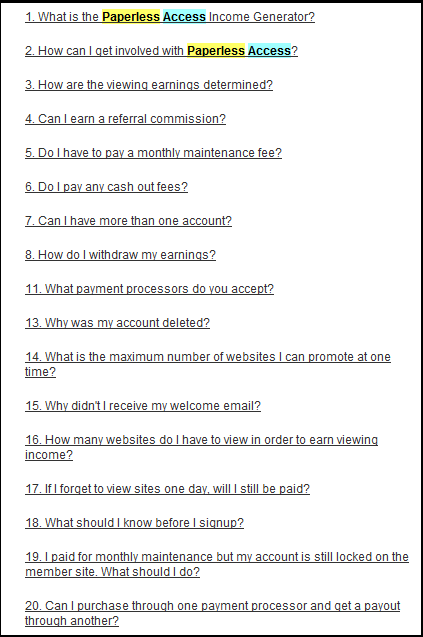
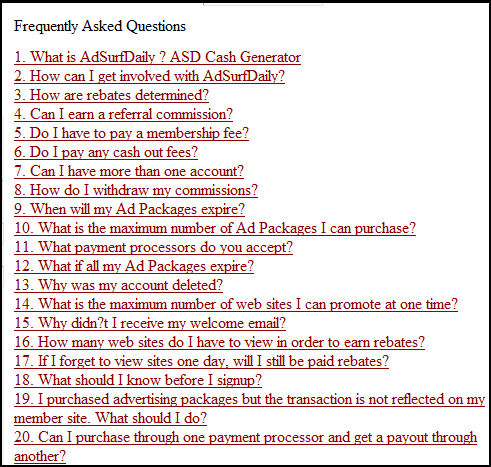
A web page in Google cache from March 12, 2009, that shows information about a new surf program known as Paperless Access is identical in places to a June 16, 2007, archived page for ASD Cash Generator.
ASD President Andy Bowdoin introduced members to Paperless Access in a video two days ago, saying the company could help ASD members recover money seized by the government in August 2008. Bowdoin said he is not involved in Paperless Access, and was vague in his description of the company program.
Paperless Access appears to be in prelaunch phase. Google cache from March 12 reveals that a template used by the company or a promoter was similar to the template ASD used in its formative stages.
The word “Generator” was used by both companies: Paperless Access saying it was an “Income Generator” and ASD calling itself a “Cash Generator.” Meanwhile, the FAQs for both companies were largely identical in certain places and precisely identical in others.
Below are two screen shots of the first 20 FAQs for both companies.What ASD called “rebates,” Paperless access appears to be calling “viewing earnings.”
Paperless Access FAQs
Screen shot taken today from March 12, 2009, Google cache page for Paperless Access. This screen shot is of a section of FAQ's on the page and has been magnified. Compare to the ASD Cash Generator FAQs, as reproduced in a screen shot below.
ASD Cash Generator FAQs
Screen shot taken today of section of ASD Cash Generator FAQs, as it existed on June 16, 2007.
Here is the Google Cache URL from March 12, 2009, for Paperless Access. There are references on the page to PaperlessAccess.com and PaperlessAccess.org.
When Curtis Richmond began filing pleadings in the ASD case, the Surf’s Up forum hailed him a hero. Prosecutors see things a different way.
A federal judge should not permit Richmond and three others to intervene in the AdSurfDaily forfeiture case because the pleadings “will cause either manifest injustice, unconscionable delay, or both,” federal prosecutors said late yesterday.
“Movants are but an unhappy few of the many thousands of victims of the fraud schemes
described in the complaint,” prosecutors said of Richmond and three other men who used Richmond’s pro se litigation blueprint. “They seek to muscle aside their fellow sufferers, and cannot even pretend to be acting in the best interests of the other [ASD] victims.”
Prosecutors said the government is establishing a mechanism to provide refunds to ASD victims and that Richmond’s filings essentially create a small, special class of victims and could result in interminable delays for rank-and-file ASD members.
Absent in the prosecutors’ response to Richmond were direct references to assertions by Richmond and the others that the government had committed crimes. Some ASD members treated Richmond’s assertions as red meat for the masses, using them to feed dissent against the government and build support for ASD President Andy Bowdoin.
Prosecutors virtually ignored the assertions. Richmond was convicted of contempt of court in 2007 for threatening federal judges. He also was ordered by a federal judge to pay damages and costs to Utah public employees targeted by vexatious legal filings. The employees sued Richmond, a member of a sham Utah “Indian tribe,” under federal racketeering statutes.
The Four-Corner Offense?
It is NCAA “March Madness” basketball tournament time in the United States. Sometimes basketball teams try to slow down the game by employing the “four-corner offense,” situating players in a square and simply passing the ball around the square, rather than advancing it toward the basket.
Prosecutors may be anticipating a four-corner offense from Bowdoin and others to slow down the ASD case. They referenced Bowdoin’s own pro se pleadings in the case, but did not respond to them directly in their response to motions by Richmond and the others.
It would not be surprising if the government later takes the stand that Bowdoin’s filings are designed to delay justice. Pointedly, prosecutors described Bowdoin as “apparently proceeding pro se,†a possible sign of developments to come.
For scale, consider that the first filing in one of the Utah cases involving Richmond was entered on Aug. 11, 2004 — four and a half years ago. By Jan. 14, 2009, the case file had grown to include 321 separate entries, not taking entries that don’t qualify as formal filings into account.
In January, Bowdoin, acting under advice of paid counsel, submitted to the August forfeiture of tens of millions of dollars seized from him. But Bowdoin now says he has changed his mind about submitting to the forfeiture, even though he also concedes ASD was operating illegally at the time of the seizure — exactly what the government contended all along.
The ASD case was nearly litigated to conclusion when pro se pleadings began to pour in. In their response to Richmond, prosecutors streamlined their pleadings — addressing Richmond’s filing and three similar ones by other pro se litigants in the same document, rather than producing an individual response to each of the four motions.
Individual motions might have required to court to act on four more documents, thus slowing down the case even more.
If history is a guide, though, ASD members should not be surprised if the case slows to a crawl, thus delaying refunds. In the past, Richmond has filed pro se document after pro se document — and then turned to appeals courts for remedies when denied by district courts.
He even has named judges defendants in his pleadings.
Below are two discussion topics. The idea of this thread is to provide some space for readers to explain how their thinking about AdSurfDaily has evolved over time.
Please leave a comment on one or both topics.
TOPIC ONE: When you reflect on ASD, what single event or series of events has most influenced your thinking?
TOPIC TWO: Describe your thoughts when you observed the emergence of AdViewGlobal and came to learn it had very close ties to ASD.
UPDATED 8:13 P.M. EDT (U.S.A.) An inquiry about AdViewGlobal (AVG) at the Pro-AdSurfDaily Surf’s Up forum has not been answered for hours by the moderator to which it was directed or any Mod.
The Mods appear either to have been away from the forum for virtually the entire U.S. East Coast business day or simply made the choice not to moderate.
At the time of this update, more than eight hours have passed since the AVG inquiry was made. Update 6:45 P.M: After nine hours, the post referencing AVG at the Surf’s Up forum was deleted.Here is a screen shot taken prior to the deletion. The shot was reduced in size to fit into this space:
Meanwhile, a post highly critical of ASD President Andy Bowdoin has been permitted to stand. Update: 6:45 P.M: The critical post from “adam” has been deleted, along with a second critical post by another Surf’s Up member. Here is a screen shot of “adam’s” post prior to deletion. It has been reduced in size to fit into this space:
Update 7:14 P.M:. As noted above, the post from “adam” critical of Andy Bowdoin has been deleted. Left standing was a post critical of “adam” for being critical of Andy Bowdoin. Here is a screen shot:
At the same time, members’ inquiries on a forum some of the Surf’s Up Mods and members set up for AVG are not being answered. Update 8:13 P.M: It appears as though a Mod is answering inquiries now at the AVG forum.
AVG recently announced a 200 percent, matching-bonus offer. The site has transitioned to what it calls a “private association” that involves figures associated with ASD, including George Harris, Bowdoin’s stepson.
Why the Mods appear to have been away so long is unclear.
Promotional material for AdSurfDaily featured a photograph of Andy Bowdoin and claimed the company had advertising relationships with some of the top brands in the world.
Meanwhile, the document introduced readers to Golden Panda Ad Builder, referencing it as ASD’s “Chinese Site” and asking readers to specify if they’d like to advertise on the site.
The document was created on July 6, 2008, in Adobe Illustrator, and was converted to PDF format, according to its “Properties” function. It is possible that an earlier version of the document was in use before the July 6 version.
Among the major advertisers referenced were Google, Kodak, Starbucks, Quiznos Sub, Callaway Golf, Macy’s, Toshiba, NBC, Farmers Insurance, USA Today, Priceline.com and more. Individual logos of the companies were pictured.
A Secret Service Task Force quietly opened a probe into ASD on July 3, 2008. On July 7, just a day after the July 6 promo for ASD was created, an IRS/Secret Service Task member opened a free ASD account. On July 14, an IRS/Secret Service Task force member opened a paid account. A separate Task Force member funded the account by delivering a check to a Bank of America branch office in Orlando, Fla.
Despite claims ASD was home to famous, paid advertisers, ASD has not provided any documentation in court filings to substantiate the claims.
Promo for ASD references prominent brands in ASD customer base.
“This new approach to Internet advertising has businesses of all sizes, from small home
based businesses to large corporations such as Google, Starbucks, Kodak, etc., joining ASD,” the promotion said.
“Not only are there over 75,000 small businesses advertising with ASD, but now major corporations are as well. Remember, a part of the daily rebate comes from the revenue corporations pay to advertise with ASD. The following are just a few of these companies,” the promotion said, introducing 24 corporate logos from prominent companies.
The individual logos appeared on Page 10 of the document. Page 11 featured a photo of Andy Bowdoin and what purported to be his business biography, including references to Dale Carnegie and “the notorious Napoleon Hill.”
A White House tie also was claimed.
“In fact, AdSurfDaily President and CEO, Andy Bowdoin, was invited to Washington, D.C., in June, 2008, by United States President George Bush and Vice President Dick Cheney to receive the Medal of Distinction, at the White House. This is a very special honor for his service and leadership contributions in business,” the document crowed.
Prosecutors said claims about Bowdoin’s White House ties were false. The Medal of Distinction is offered by the National Republican Congressional Committee for campaign donations to keep Republican members in Congress. The “medal” signifies a person’s ability to write a check for what amounts to banquet tickets.
At the same time, the July 6 document references a so-called “Chinese site,” instructing readers to specify if they’d like to advertise on it.
Members were told to provide a “[s]hort description of where you would like the funds to be placed (English site, Spanish Site, Chinese Site),” and to specify “which promotion is running.”
Within days, however, Bowdoin distanced himself from Golden Panda Ad Builder, the so-called Chinese site. During the same time period, it was revealed that Golden Panda Ad Builder president Clarence Busby had been accused of investment fraud in the 1990s by the Securities and Exchange Commission.
Read the July 6 promo for ASD. To see the “Properties” showing the date in Adobe Reader, click on “File” and select “Properties.”
First, members of the Pro-AdSurfDaily Surf’s Up forum tried to whip up support for ASD President Andy Bowdoin by sending Kool Aid packets to Bill O’Reilly of Fox News. Now Bowdoin himself, through a Surf’s Up Mod, is urging members to write letters to Glenn Beck, another Fox personality.
And, taking a page from his own playbook, Bowdoin also has asked members to write to President Obama, the Justice Department and elected officials “to stop this misuse of power.”
The move comes on the heels of a stunning court motion Bowdoin filed March 11 in which he acknowledged ASD was operating illegally when the government seized tens of millions of dollars from Bowdoin last summer. Bowdoin claimed in the filing that he did not know ASD was operating illegally at the time of the seizure and that the government denied him fair notice and due process.
In the filing, Bowdoin claims to be a “defendant” in a “quasi-criminal” prosecution. But Bowdoin hasn’t been named a defendant by the government, which sued the money and property for forfeiture, saying it was the proceeds of a criminal enterprise.
Prosecutors said ASD was engaging in wire fraud, money-laundering and the sale of unregistered securities — all while operating a $100 million Ponzi scheme.
Bowdoin had not communicated with the membership at large in months. He did not tell members about a second forfeiture complaint that had been filed in December against assets tied to the firm. Nor did Bowdoin tell members that, in January, he had submitted to the forfeiture of the money and property seized last summer.
In court filings, Bowdoin now says he has changed his mind about submitting to the forfeiture, even though he acknowledged that ASD was operating illegally — exactly what the government contended.
In his letter to the members, however, Bowdoin did not mention the motion in which he acknowledged ASD was operating illegally.
His last formal contact with the members was in late fall, a few months after the initial seizure, when Bowdoin tried to sell them VOIP phone service, positioning the $19.95-a-month plan as a gift to the membership. Days before, he told members that Ponzi allegations had been dropped against ASD in Florida, even though Ponzi allegations hadn’t been brought in Florida.
During the same time period in the fall, ASD’s Breaking News site announced a deal with Praebius Communications, saying ASD expected to pump $200 million into its coffers as a result of the deal. Praebius is a penny-stock company that does not publish financials.
In early December, an autosurf known as AdViewGlobal (AVG) began to position itself for launch. AVG has close ties to ASD, including George Harris, Bowdoin’s stepson and an AVG trustee; Gary Talbert, a former ASD executive now an executive and trustee for AVG; Chuck Osmin, a former ASD employee now working for AVG; and Nate Boyd, a former ASD compliance officer now listed as the “Protector” of AVG.
By December 19, federal prosecutors filed a second forfeiture complaint, saying Bowdoin’s wife, Edna Faye Bowdoin and her son, George Harris, had used proceeds from ASD to retire the $157,216 mortgage on the home Harris shared with his wife, Judy Harris.
Bowdoin now says that he recently was introduced to a “group” that is giving him legal advice. Bowdoin started filing his own court pleadings in late February, at the same time AVG was introducing members to Pro Advocate Group, which says it can help people practice medicine and law without a license.
Pro Advocate Group is associated with Karl Dahlstrom. In 1997, Dahlstrom was sentenced to 78 months in federal prison for orchestrating a securities scheme.
In his letter to ASD members, Bowdoin did not disclose the name of the “group” from which he was receiving advice. Nor did Bowdoin reference or confirm reports that bank accounts belonging to ASD and AVG members recently had been seized.
He did say he fired his paid attorneys.
Here is Bowdoin’s letter. We added the italics.
Hi Folks,
It’s good to be talking to you once again. My attorneys kept me quiet for months, but after $800,000.00 and no results I fired them all.
About a month ago, several members introduced me to a group that studied what my attorneys did. The group said that my attorneys had taken the wrong approach.
The group was very confident that they could help because the government had broken so many laws and had violated our rights as citizens of the United States.
I have rescinded my decision to release our ownership of all the assets. I filed various motions a few weeks ago, and several more last week, to dismiss our case and to return the assets because of the violations committed by our government.
We are ready to pursue this all the way to the US Supreme Court.
A great injustice has been done to 100,000 people, and we need to stand up and fight for our rights. Some agencies of the government have become so powerful that they believe they are above the Constitution. We, as members of ASD, need to help stop this misuse of power. I ask each one of you to write to the Justice Department, to your senators and representatives, to the President, and even to Glen Beck of Fox News. Tell them all what the Justice Department has done to your business.
We will be filing papers in the next couple of weeks that should really get their attention. Watch for the filings. I will be speaking out on a conference call as soon as the filings are completed. We will notify you of the call. I look forward to talking to you then.
I appreciate your support in helping us get back what rightfully belongs to the members of ASD.