BULLETIN: UPDATED 6:44 A.M. EDT (U.S.A.) Club Asteria, a Virginia-based company that claims to elevate people out of poverty globally by involving them in an MLM-like income and recruitment scheme, has acknowledged a revenue plunge and described it as dramatic.
In an audio recording posted online, the firm blamed its current state on lies from members and bad publicity. The audio is dated June 24.
“It’s taken our revenue, and it has hurt it dramatically,” the company said.
Club Asteria, which described itself as a ’cause’ marketing company concerned about the impoverished people of India and other countries across the world, conceded it has been swamped by “thousands” of support tickets from members.
Eight weeks ago, approximately a year after its launch, Club Asteria discovered that it had liars in its ranks, the company claimed in the recording. The liars created problems, according to the firm.
Among other places, Club Asteria is being promoted on forums linked to numerous Ponzi schemes. A Club Asteria thread on TalkGold, for example, has been active since April 5, 2010. Meanwhile, a Club Asteria thread on MoneyMakerGroup has been active since May 29, 2010. Both forums are referenced in federal court filings as places from which Ponzi schemes are promoted.
Club Asteria did not say in the recording precisely where it believed its problems with untruthful promoters had begun. Nor did the company say how much money it believed it had collected as a result of lies told by its freelance sales staff or what it planned to do with tainted proceeds.
“The challenge that occurred is that, all of a sudden, we found that our membership — many of our members — were presenting Club Asteria in an inaccurate, untruthful manner,” the company said.
False claims and “all kinds of distortions” were being made “all over the Internet” that Club Asteria provided “passive” income of $400 per week, the company said.
Members — and not the company itself — were responsible for the false claims, the revenue plunge and putting the firm at risk, the company suggested in the recording.
“It’s like a bank where somebody says, ‘They have no money left.’ And everybody runs to the bank and takes their money out,” the company said. “Of course, the bank is going to be in serious trouble . . .”
Many Club Asteria members have claimed preemptively in promos for the firm that Club Asteria was not operating a Ponzi scheme. Why the firm chose a bank-run analogy to describe its problems was not immediately clear.
Some Ponzi schemes topple — the Bernard Madoff scheme, for instance — when a company encounters cash-flow problems and cannot meet redemption requests, the Ponzi equivalent of a run on the bank. In a classic Ponzi scheme, no real business exists — and a firm takes money from “new” members to meet the payout expectations of “old” members.
Club Asteria said it hoped to reverse its financial course by inspiring members to sell more products and services to increase revenue. Meanwhile, the firm said it hoped to sell a tablet computer to members on time payments beginning on a date uncertain. Club Asteria did not identify a manufacturer for the computer, but said the device would help members become better equipped to run successful businesses.
Whether impoverished members of Club Asteria could afford a tablet computer or whether such a computer would be operable in all the countries of the world was not made clear in the recording.
Pricing for the tablet was not revealed. The firm also said it planned to offer apparel, vitamins and other products.
There have been claims in recent weeks that Club Asteria has slashed cashouts, which some members claimed provided a return of 10 percent a week. Other members said Club Asteria normally paid between 3 percent and 4 percent a week. In recent days, there have been claims that the firm suspended cashouts altogether. These claims followed on the heels of claims that Club Asteria had offered bonuses convertible to cash to lure members to join.
Club Asteria did not say in the recording whether it believed its bonus program had contributed to its problems. Nor did the firm say why it had come to recognize only weeks ago that false claims about its business opportunity were appearing online.
In a strange turn-of-phrase, however, the company did say this: “We offer them products and services to purchase under the guise of ’cause’ marketing.”
The firm described “cause” marketing as an inspirational “concept” that targets people globally who may be enduring personal poverty and motivates them to climb the ladder of economic success by giving them something in which to believe.
Two of the problems the company is experiencing are that fewer people now believe in it because of the lies told by members and because members were complaining in public about the firm, Club Asteria said.
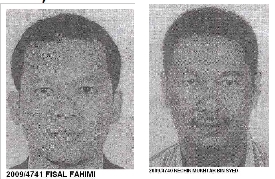
Fahimi Fisal (left) and Mukhtar Kechik. Source: INTERPOL.
Ponzi schemer Robert Miracle, who scammed investors in a $65.3 million oil-and-gas fraud operating in the Seattle area, knows he’ll bed down tonight in custody at the SeaTac Federal Detention Center in Washington state.
His co-defendants, though, are less certain of their sleeping spots — and still have to worry about knocks at doors in the middle of the night.
Fahimi Fisal and Mukhtar Kechik — both Malaysian nationals of middle age — are international fugitives wanted by INTERPOL. Fisal is 40; Kechik is 54. There are “Wanted” posters in each of their names.
Miracle, 50, Bellevue, Wash., was sentenced this week to 13 years in federal prison, but he already was in custody. While awaiting trial in May 2009, his bail was revoked for not complying with the conditions of his release.
In February 2009 — just two months after the $65 billion Bernard Madoff caper came to the fore and the word Ponzi became a daily part of the national and international dialogue — Miracle, Fisal and Kechik were charged in in a 23- count indictment alleging conspiracy, mail fraud, wire fraud, money-laundering and tax evasion. The criminal case against Miracle and his co-defendants was one of the first major prosecutions of the post-Madoff era.
Many towns across the United States now have their own individual “mini-Madoffs,” and the alleged schemers are accused of consuming individual and family wealth on a local, regional, national or international scale, taking wrecking balls to churches, charities and endowments — and leaving Ponzi pain on the doorsteps of hundreds of thousands of people.
The Miracle scheme “ruined people’s lives,” prosecutors said, quoting U.S. District Judge James L. Robart, who sentenced Miracle. Miracle pleaded guilty to mail fraud and tax evasion.
Prosecutors said he operated companies purportedly involved in oil development in Indonesia, and sold “shares” in ventures known as Laramie Petroleum Inc., MCube Petroleum Inc., Diski Limited Liability Co., Basilam Limited Liability Co. and Halmahera-Rembang Limited Liability Co.
“Miracle and his co-defendants represented to investors that various companies were making money from oil field development and services on oil and gas fields in Indonesia,” prosecutors said. “In fact, the proceeds of later investors were used to pay off the investments of earlier investors in the form of a ‘ponzi’ scheme.”
This May 1 promo for Club Asteria describes its as an "investment company" and instructs prospects that "you will not again anything unless you invest." The promo advertises returns of up to 7 percent a week. "I am happy because even if I am not doing anything I still manage to earn from it," the promo claims.
P2P was promoted on the TalkGold and MoneyMakerGroup Ponzi forums.
A little over a month later, in July 2010, the Financial Industry Regulatory Authority (FINRA) described the HYIP sphere as a “bizarre substratum of the Internet” and issued a fraud alert. FINRA also referenced the P2P case. At the same time, it pointed to the collapsed Genius Funds Ponzi, believed to have consumed $400 million.
Genius Funds also was promoted on TalkGold and MoneyMakerGroup.
In December 2010, the interagency Financial Fraud Enforcement Task Force led by U.S. Attorney General Eric Holder specifically warned the public to be wary of social-networking sites and chat forums. The warning was part of “Operation Broken Trust,” a law-enforcement initiative in which investigators described more than $10 billion in losses from recent fraud cases.
One of the cases described was the SEC’s action against Imperia Invest IBC, a murky offshore business accused of stealing millions of dollars from the deaf.
Imperia Invest also was promoted on TalkGold and MoneyMakerGroup.
Last week, promoters of a Virginia-based company known as Club Asteria (CA) announced on the Ponzi boards that PayPal had frozen CA’s funds and blocked its access to the PayPal system. Although CA has been presented as a wholesome “opportunity” recognized by the Internal Revenue Service as a nonprofit organization (see graphic below), the CA promoter who announced the PayPal news last week on MoneyMakerGroup simultaneously was promoting two “programs” that purportedly pay 60 percent a month.
Some CA promoters claim CA pays 520 percent a year. Even jailed Ponzi schemer Bernard Madoff would blush at such advertised rates of return.
MoneyMakerGroup is referenced in federal court filings as a place from which Ponzi schemes are promoted. So is TalkGold, another well-known forum in the HYIP world.
This morning — also on the MoneyMakerGroup — a different CA promoter announced that CA’s Andrea Lucas had responded to last week’s PayPal news. Even as the CA member was announcing on a known Ponzi scheme and criminals’ forum that Lucas had issued a statement on the PayPal matter, he simultaneously was promoting two HYIPs and something called One Dollar Riches.
“OneDollarRiches allows you to parlay a small investment of just one dollar into a constant stream of cash, day in and day out!” according to its ad. “You can make 100 times your investment in just a few days by following our simple step by step instructions.”
The mere presence of CA promotions on the Ponzi boards leads to questions about whether the firm’s receipts are polluted by Ponzi proceeds. Paying members from such proceeds would put CA members in possession of tainted money — and banks into which they deposited those proceeds also would be in possession of tainted money.
Lucas, according to the CA website, now has publicly acknowledged last week’s actions by PayPal. Details, though, were spartan. CA did not say how much money PayPal had frozen. Meanwhile, the firm instructed members to fund their accounts by using offshore processors.
At the same time, CA urged members not to spread bad news about the company on forums. Members who shared negative information were subject to having their CA accounts revoked, according to the company.
“Members shall not publically (sic) disparage, demean or attack Club Asteria, its members, services or charitable activities,” CA remarks attributed to Lucas on the CA website read. The remarks were dated May 16 and appeared in the “News” section of the site.
In the same announcement, Lucas acknowledged that a “small group” of CA members “used their PayPal accounts to cheat fellow members.”
The company claimed it had turned the members “over to the authorities,” but did not identify the authorities or say whether they were based in the United States or elsewhere.
CA, which said PayPal was “acting with integrity,” then counseled its members to rely on offshore processors.
“First, if you have been paying for your membership through PayPal, please discontinue your subscription with PayPal immediately and start using one of the other approved payment processors AlertPay, Towah or CashX to ensure that your membership stays current,” the remarks attributed to Lucas read.
“Second, Do NOT use online forums, websites or social networks to lodge blame or complaints about PayPal or your Club Asteria team,” the remarks continued. “There is no benefit or purpose in this, and it only serves to create discord and spread rumors. Not only that, doing so is a direct violation of Code of Ethics & Conduct, Rule 8 and can result in immediate revocation of your membership.”
CA’s bizarre announcement occurred against the backdrop of thousands of bizarre promos for the firm that appear online. Some promos claim $20 spent with CA monthly turns into a lifetime income of $1,600 a month. Others claim CA is a “passive” investment opportunity, which raises questions about whether CA — whose members claim the program typically pays out about 3 percent to 4 percent a week or up to 208 percent a year — is selling unregistered securities as investment contracts.
Lucas has been referred to in promos as a former “chairman” and “vice president” of the World Bank. Several promos have described her as a Christian “saint.”
CA’s claims that only a “small group” of members is causing problems may be dubious. Wild claims have been made in promo after promo for the firm, which says it is not in the investment business.
This promo for CA contains a link that resolves to an active CA affiliate site. The affiliate site has a low affiliate ID number, suggesting the affiliate was one of CA's earliest members. The promo claims CA is a 501 (c)(3) nonprofit organization recognized by the IRS.
BULLETIN: UPDATED 8:48 A.M. EDT (U.S.A.) Steven Byers, the president and chief executive officer of WexTrust Capital LLC, has been sentenced to 160 months in federal prison for his role in an alleged $255 million Ponzi and fraud scheme that cost investors millions of dollars.
Byers, 48, of Oakbrook, Ill., was sentenced by Judge Denny Chin of the U.S. Court of Appeals for the Second Circuit. Chin, formerly a U.S. district judge, was nominated to the appeals court by President Obama and received unanimous approval (98-0) in the U.S. Senate in the months after he sentenced Bernard Madoff in June 2009 to 150 years in federal prison for his $65 billion Ponzi scheme.
Chin also ordered Byers to make $7.7 million in restitution to victims and ordered the forfeiture of $9.2 million. Byers also will be on supervised probation for three years after he serves his prison sentence. The scheme largely was targeted at Orthodox Jews, according to court filings.
U.S. Attorney Preet Bharara described the sentence imposed by Chin against Byers as properly severe.
“Steven Byers used smoke and mirrors to defraud his investors out of millions of dollars,” Bharara said. “But his scheme was ultimately exposed for the sham that it was, and now he will be punished severely for his crimes.”
Prosecutors specifically charged Byers with fleecing investors in a $9.2 million, private-placement offering that claimed the money would be used to “purchase and operate seven commercial properties that were leased to the United States General Services Administration (GSA).”
“The seven GSA properties, however, were never purchased,” prosecutors said. “Instead, funds raised from investors were diverted for other purposes.”
Chin is scheduled to sentence Joseph Shereshevsky, Byers’ co-defendant, on May 13. The SEC said in August 2008 that Shereshevsky was a convicted felon who had been arrested for bank fraud in the 1990s.
It is common in the Ponzi universe for securities swindlers to start new schemes. Some fraudsters have hatched new schemes while on probation for previous swindles. Others have hatched new schemes from their jail cells.
UPDATED 9:28 A.M. ET (U.S.A.) On Dec. 1, a federal magistrate judge set bail of $350,000 for AdSurfDaily President Andy Bowdoin and ordered him not to commit a federal, state or local crime after his arrest by the U.S. Secret Service on charges of wire fraud, securities fraud and selling unregistered securities.
Bowdoin, 76, was specifically warned that he could be held in contempt of court for violating conditions of his bail. The conditions included an order not to obstruct the investigation or tamper with witnesses.
Now an email attributed to former ASD and AdViewGlobal executive Gary Talbert has surfaced that is raising questions about whether Bowdoin is trying to suppress the victims’ count and manipulate ASD members who seek to file restitution claims with Rust Consulting Inc., the official claims administrator in the $110 million Ponzi case.
The email specifically references Bowdoin’s arrest, but makes no reference to the bail conditions set by U.S. Magistrate Judge Thomas G. Wilson in advance of a scheduled appearance by Bowdoin in U.S. District Court for the District of Columbia Dec. 17.
Bowdoin made his initial court appearance before Wilson in Florida.
“Got a email from Andy and he told me to go ahead and send this email out to everyone,” noted the email attributed to Talbert, who filed a sworn affidavit on ASD’s behalf in U.S. District Court for the District of Columbia in 2008. “He does have a hearing on Dec. 17th in Washington D.C. He and his lawyers are still positive on the out come.”
“Here is just a idea and I think this will work for everyone,” the email continued. “This should keep everyone legal. Because I think everyone understood it was not a investment. I believe it is time to fill out the info. from Rust inc. with the following addendum.
“Where it asks for your signature write in there ‘See addendum’.
“Now put this in your own words on the addendum. Here is a out line.
“On the addendum write that you knew this was not a investment and you where purchasing advertising. Now since the gov. stopped my advertising company and I did not get my advertising I would like to get my advertising money back from whom ever is holding it now. Sign it and send it in with the forms from Rust.”
News about the email attributed to Talbert was spreading among ASD members last night. Separately, ASD figures Kenneth Wayne Leaming and Christian Oesch have filed an ASD-related lawsuit in the U.S. Court of Federal Claims that apparently seeks the spectacular sum of $29 TRILLION from a federal judge, three federal prosecutors and a Secret Service agent involved in the ASD Ponzi case.
On June 30, 2009, AdViewGlobal was cited as an extension of ASD in a racketeering lawsuit filed against Bowdoin by ASD members. The reference was dated June 29, 2009, the same day Bernard Madoff was sentenced to 150 years in federal prison for his Ponzi scheme.
Federal prosecutors now say Bowdoin faces up to 120 years in prison if convicted of all counts against him.
“AVG is the next iteration of the Ponzi scheme auto-surf programs, which [are] staffed with former ASD executives and Bowdoin disciples, including George Harris, the stepson of Bowdoin, who is listed as an AVG trustee, Gary Talbert, former ASD executive served as CEO of AVG and now serves as an accountant, Nate Boyd, a former compliance officer at ASD, serves as ‘Protector’ of the AVG association, and Chuck Osmin, a former ASD employee who testified on ASD’s behalf at the evidentiary hearing before this Court last fall is a customer service representative of AVG,” the RICO plaintiffs claimed.
The grand jury that indicted Bowdoin began to meet in May 2009. During that same month, AVG was scurrying to reconfigure itself after gathering money from members and offering 200 percent “bonuses” for months. AVG launched in the aftermath of the seizure of tens of millions of dollars from Bowdoin in August 2008, the filing by the government of a second forfeiture complaint against ASD-connected assets in December 2008 and the filing of the racketeering lawsuit against Bowdoin.
In January 2009, just days prior to its official launch in early February, AVG bizarrely both confirmed and denied it had ties to ASD.
The appearance of AVG graphics in an ASD-controlled webroom after the federal seizure was an “operational coincidence,” AVG memorably explained. The announcement was attributed to Chuck Osmin, himself a former ASD employee.
Even though AVG previously had denied ASD ties, the upstart surf then announced that Talbert was its CEO.
“Since Mr. Talbert was and is the C.E.O. for both companies and had worked with the same web room company while at ASD, it would be very natural for him to choose and use many of the same venders (sic) that he had used before. So, the fact that ASD and AdView Global are using the same web room hosting company is no accident, in fact it is an operational coincidence,” AdViewGlobal said.
Why the surf identified Talbert as ASD’s CEO was unclear. He was listed in his own sworn court documents in the ASD case as ASD’s “Human Resource Manager, Assistant CFO and Website Editor.”
By March 2009, AVG announced that Talbert had resigned as AVG’s chief. It also announced that its bank account had been suspended, blaming the development on members.
In May 2009, AVG announced that it had secured a new, offshore wire facilitator to help it gather money from members. The announcement was made on the same day the Obama administration announced a crackdown on offshore financial fraud. (See this story and included links for updates on AVG’s purported facilitator, KINGZ Capital Management. There is a tie between KINGZ and Minnesota Ponzi schemer Trevor Cook.)
By June 25, 2009, AVG announced it was suspending cashouts, again blaming the development on members while threatening members and journalists with copyright-infringement lawsuits for reporting the news.
Just four days later, on June 29, 2009, the RICO plaintiffs in the ASD lawsuit referenced AVG in a court filing docketed the following day, June 30. By September 2009, federal prosecutors made a veiled reference to AVG in filings in the ASD case.
By Sept. 29, 2009, an email attributed to ASD spokeswoman Sara Mattoon was circulating among ASD members. The email specifically instructed members not to fill out a government form that would be used as part of the restitution process.
“Soon after the ASD shutdown, the DOJ (Dept of Justice) set up a website for people to file a claim for the money they had in ASD,” Mattoon was quoted as saying in the email. “As soon as I heard about it, I told everyone not to do it because I could see what the Government was trying to do, but some people didn’t realize what it was and afterwards they regretted doing so.”
The Matton email referenced an earlier email attributed to ASD member and purported trainer Robert Fava. Like the Mattoon email, the Fava email discouraged members from filling out the government form, describing it as “ammunition” that could be used against ASD.
This is actually Post No. 1,007 since the PP Blog switched to the WordPress platform two years ago this month. We’d hoped to commemorate our 1,000th WordPress post in the actual 1,000th post, but missed the chance because of Breaking News concerning the Financial Fraud Enforcement Task Force’s Operation Broken Trust.
The PP Blog's Breaking News graphic was stolen and used in a promotion for Data Network Affiliates (DNA) earlier this year. DNA, which purports to be in the business of helping the AMBER Alert prohram rescue abducted children, now apparently has morphed into a company known as OWOW, which has instructed members to advertise a secret cure for cancer.
Several hours after we reported that the Task Force now was counting investment-fraud victims by the tens of thousands and noting that even deaf people had been targeted in massive scams, we reported that Walmart had joined the “If you see something, say something” terrorism-awareness campaign operated by the Department of Homeland Security (DHS).
Walmart was instantly and savagely pilloried on YouTube, apparently for holding the view that DHS deserved private-sector help in its work to keep America safe. On. Dec. 6, when the PP Blog first observed the DHS video on YouTube announcing the Walmart partnership, the video had received only 310 views. That number now has shot up to 289,657. YouTube posters called DHS Secretary Janet Napolitano names that could peel paint. We’ll leave it at that, except to say that scores of Americans appear to have emerged as kneejerk critics and appear unwilling to view America’s economic well-being within the lens of national security.
Indeed, how safe is America — and the world at large — if fraud victims are being counted in numbers that would fill stadiums and vast sums of wealth are being consumed and disappearing down ratholes? In the Task Force announcement, Attorney General Eric Holder said that, since Aug. 16 alone, cases investigated by the Task Force have uncovered losses of more than $10.4 billion. The schemes affected at least 120,000 victims.
The victims’ count in just this relatively small cluster of cases is more than enough to fill the Rose Bowl in Pasadena or Michigan Stadium in Ann Arbor, America’s largest college-football stadium.
Just prior to our Operation Broken Trust post — in Post No. 999 — we reported that the AdPayDaily autosurf, which has promoters and members in common with both AdSurfDaily and AdViewGlobal, was showing signs of collapse. Flash forward to Post No. 1,002: In this post, we reported that a New York Internet Marketer had been arrested by the U.S. Postal Inspection Service for cyberstalking.
Vitaly Borker apparently believed it prudent to use the Internet to threaten to rape women who had received what investigators described as bogus and inferior-quality goods from him. A fair reading of the complaint against Borker shows that he used the same type of gutter language directed at Napolitano on YouTube — you know, for her apparent High Crime of asking Walmart shoppers to be aware of their surroundings in the Age of Terrorism.
We next reported on a 54-year prison sentence handed down to a former Indiana pastor who duped Christian investors in a Ponzi scheme. After that, we reported that a company that once did business with Steve Renner’s Cash Cards International had been implicated in a massive Forex scheme that affected at least 800 investors.
Renner was the operator of the INetGlobal autosurf, which the U.S. Secret Service said in February was operating a Ponzi scheme affecting thousands of people, including victims of Chinese descent who may have limited ability to understand English. The Secret Service said an undercover agent had been introduced to INetGlobal by an AdSurfDaily member.
On Dec. 8, we reported that a Maryland man had been arrested after the FBI intercepted his plot to detonate a car bomb at a military-recruitment center. A similar plot had been unmasked by the FBI in Portand, Ore., on the day after Thanksgiving. It was aimed at a Christmas tree lighting ceremony, meaning it was aimed at children and families.
Here is one way to look at the alleged Thanksgiving plot: The arrest was announced on Nov. 26. By Dec. 6, crackpots were flooding YouTube with paint-peeling comments about Napolitano and the terrorism-awareness campaign. Two days after that, on Dec. 8, a man was arrested in the Maryland plot. He allegedly also talked about blowing up Andrews Air Force Base, which happens to be the home base of Air Force One, which happens to be the aircraft used by the President of the United States.
We haven’t even written about Wikileaks and the arrest in Britian of Julian Assange. Wikileaks’ sympathizers reacted by bringing DDoS attacks, apparently based on the belief that the best way to show support for Assange was to send out an army of bots to disrupt the websites of businesses that did not support Assange.
By week’s end, Prince Charles and Camilla, the Duchess of Cornwall, were surrounded by a mob unhappy about the skyrocketing costs of getting a college education in the United Kingdom. Civility, it seems, can be cast out the door in a country minute and replaced by the taunts of a mob.
Yesterday, as we again sought to commemorate our 1,000 post, word arrived about the apparent suicide of Bernard Madoff’s son on the second anniversary of his father’s arrest.
There is no doubt — none whatsoever — that Ponzi = Pain. There also is no doubt that the Internet has ushered in an era of unprecedented, mass-produced, viral crime. Criminals have been aided in their nefarious pursuits by crackpots who employ no editorial filters and simply create or repeat lies that institutionalize crime as an occupation and even celebrate it.
At the precise moment in time in which Americans and other citizens of the world could benefit most from serious words and serious research backing those words, some of the world’s great publishing companies are struggling to make ends meet. Print circulation is down. Journalists are losing jobs. Designers and salespeople are losing jobs.
The switch to electronic publishing platforms has been accompanied by piracy, wanton theft and trademark infringement that further erodes the value of words and intellectual property, undermines the economy and adds to concerns about national and international security. People, including well-intentioned people, simply copy-and-paste entire editorial wells from one site to another. The public becomes confused about the original source of material, which often is shoe-horned to fit a specific agenda.
Earlier this year, the PP Blog’s Breaking News graphic was stolen by a member of Data Network Affiliates (DNA), an MLM company that routinely targets promos at Christians and, among other things, has claimed it is helping the AMBER Alert program rescue abducted children. DNA now apparently has morphed into a company known as OWOW, which is asking members to suggest that a product known as TurboMune cures cancer.
This is not “freedom,” as the scammers would have you believe; it is theft and piracy on the high electronic seas, plain and simple. It also often is the case that this specific brand of theft also gets mixed with appeals to faith, meaning the scammers are seeking to pluck heartstrings and separate Believers from their money.
There simply is no way that any government or branch of government can be at all places at all times. Although it is fashionable to describe efforts to battle crime in the Age of the Internet and the Age of Terrorism as an effort by Big Brother to assign each individual citizen his or her own bureaucrat to bring commerce and freedom to a screeching halt, such opinions often are simple rants that lack any real-world context.
Within hours of the PP Blog’s publication of a story about the alleged Portland plot, the Blog was bizarrely assailed by an MLM aficionado for DNA/OWOW as a tool for Israel. Michael Chertoff, a former federal judge, federal prosecutor and DHS secretary, was described as a “suspect” in the 9/11 attacks, which the poster blamed on Israel while calling Chertoff an Israeli scum bag.
As noted above, when Janet Napolitano announced a simple partnership with Walmart to encourage citizens to be aware of their surroundings, she encountered vicious name-calling — and it all happened during the same week yet-another bombing plot was unmasked, the Task Force was noting that America’s largest stadiums were not large enough to accommodate recent victims of financial fraud, DDoS attacks were aimed at companies deemed by third parties to be unfriendly to Wikileaks and the future king of England and his wife were surrounded by an angry mob.
Even if one is willing to assume that Wikileaks seeks to serve a higher, noble purpose, directing DDoS attacks at businesses and government sites hardly helps Assange elicit sympathy or understanding. He lost an important round in the PR war last week, as did the unthinking crowd that assailed Napolitano and the mob that heckled Prince Charles and the Duchess.
The lionization of crackpots of all stripes is rapidly emerging as a dangerous, unintended consequence of the Internet — as are all the tortured claims that MLM products treat or cure cancer, create vast sums of wealth for ordinary participants and the tortured claim that appropriating the names of Walmart and Winfrey and Trump and Buffet and Clinton is just another word for freedom.
Far from promoting freedom, the crackpots and criminals are promoting anarchy. They do not seek to compete in either a free marketplace of commerce or a free marketplace of ideas. Rather, they seek to commit crimes on a global scale and to fill entire stadiums with victims — even as would-be terrorists speculate about throwing cocktail bombs into military-recruitment centers and shooting soldiers and staff as they flee the flames through the doors.
In Portland, meanwhile, the idea was to kill wide-eyed children contemplating the miracles of Christmas and Santa Claus with a fireball that also would consume their parents.
We conclude this 1,000 post commemoration with a simple thought: Death and taxes are not the only two certainties of life. It is equally certain that law enforcement needs the proactive participation of the public more than ever. It is one thing to direct reasonable criticism at agencies and public officials; it is quite another to cheer against the people who are responding to unprecedented security challenges while trying to make sure the stadiums fill up with football fans, not victims.
BULLETIN UPDATED 11:51 A.M. ET (U.S.A.): Mark Madoff, the older of Ponzi swindler Bernard Madoff’s two sons, has been found dead in New York on the second anniversary of his father’s arrest, the New York Times is reporting.
The death was the apparent result of a suicide by hanging, the newspaper reported. Mark Madoff’s body was found this morning in his Manhattan apartment.
“Mark Madoff took his own life today,” said attoney Martin Flumenbaum in a statement released on BusinessWire. “This is a terrible and unnecessary tragedy. Mark was an innocent victim of his father’s monstrous crime who succumbed to two years of unrelenting pressure from false accusations and innuendo. We are all deeply saddened by this shocking turn of events.”
Bernard Madoff confessed his scheme two years ago today, ushering in an era of unprecedented Ponzi scheme investigations and the unmasking of so-called “mini-Madoffs” in businesses large and small across the United States.
Flumenbaum is a partner at Paul, Weiss, Rifkind, Wharton & Garrison. Flumenbaum represents Mark Madoff and Andrew Madoff, Bernard’s Madoff’s youngest son.
Mark Madoff was 46. He had not been charged with a crime. Neither has Andrew Madoff. Lawsuits have been piling up around the massive Bernard Madoff swindle.
EDITOR’S NOTE: The briefs below summarize recent developments in Ponzi cases or actions in new Ponzi cases.
Sentenced:Matthew B. Pizzolato, 26, Tickfaw, La. Ripped off senior citizens in Ponzi scheme.
In sentencing Pizzolato to 30 years in federal prison, U. S. District Judge Lance M. Africk said Pizzolato “stole from hard working Americans†and “swindled the salt of the earth,†prosecutors noted.
“[B]ecause of you,” the judge noted, “many must find ways to pay for their daily bread.â€
Prosecutors called the 30-year sentence “powerful.”
“[The] powerful 30-year federal prison sentence handed down by U. S. District [Judge] Africk against convicted swindler Matthew Pizzolato will hopefully serve as a stark deterrent to those calculating predators who, like Pizzolato, may seek to prey on the trust and innocence of hard working citizens,” said U.S. Attorney Jim Letten. “The human wreckage of broken lives, dreams, and peace of mind — as well as stolen life savings — is shockingly evident in this case and in the tragedies of the victims whom Pizzolato hunted. Our hope is that these decent, trusting victims can begin to find some sense of justice and peace knowing that this criminal will not steal again.”
A veteran FBI agent said members of the public would serve themselves well by imagining how a Ponzi scheme aimed at senior citizens could cripple entire families.
“Mr. Pizzolato targeted senior citizens for his own gain,” said David Welker, FBI special agent in charge. “Personalizing this — what if it was your own mother, father or grandparent? Mr. Pizzolato’s actions were reprehensible and his punishment reflects the seriousness of his crime.â€
The IRS is well-equipped to peel back layers of the Ponzi onion, a criminal investigator said.
“Special Agents of IRS Criminal Investigation are highly trained investigators who specialize in financial crimes of greed,” said Michael J. De Palma, special agent in charge of the IRS Criminal Investigation Unit. “We are committed in our efforts and will continue to work with our Law Enforcement partners and the United States Attorney’s Office to pursue evidence of criminal activity wherever it leads.”
Postal inspectors have prioritized the investigation of crimes against senior citizens, an official said.
“Frauds against the elderly are a priority for the Postal Inspection Service and we will continue to work closely with our partners to aggressively investigate these types of crimes,” said Keith E. Milke, U. S. postal inspector in charge.
Accused: Laurence M. Brown, a certified public accountant in Armonk, N.Y. Brown was arrested on allegations of securities fraud, wire fraud and money-laundering. Prosecutors said he fleeced investors in a $2 million Ponzi scheme involving a purported gas pipeline in Tennessee. Brown was sued separately by the SEC.
One need not pull off a Bernard Madoff-sized fraud to get the attention of the Feds, a top prosecutor said.
“Laurence Brown allegedly concocted a scheme that fleeced clients and fattened his own wallet,” said U.S. Attorney Preet Bharara. “[The] charges show that you do not have to be a billion-dollar Ponzi schemer to get our attention. We are committed to rooting out financial fraud wherever it may hide.”
Investors were duped into putting money into a company known as Infinity Reserves-
Tennessee Inc. The SEC also charged Ronald J. Mangini in its civil case, saying he and Brown fraudulently sold securities and misappropriated the money for their own use. Mangini also is an accountant, the SEC said.
“In fact,” the SEC said, “the securities Brown and Mangini sold were fictitious.
“Infinity Reserves is the name of a company owned by one of their clients, and the company’s principal asset is a now defunct natural gas pipeline in Tennessee,” the agency continued. “Without the knowledge or authorization of the client, who is the sole shareholder of Infinity Reserves, Brown and Mangini have been falsely holding themselves out to investors as senior officers of Infinity Reserves with authority to sell the phony securities at issue.”
Arrested: Former Grand Am racecar driver Henri Zogaib has been arrested again after making bail in the original case filed against him in Florida, WFTV reports.
As the original Ponzi probe progressed, investigators discovered other victims, including NASCAR drivers, the station reported.
Zogaib’s bail now has been upped to $2.2 million, and there may be other victims, the station reported. Bail on the original arrest was set at $100,000.
Guilty plea: Donald Anthony Young, 38, of Palm Beach, Florida, has pleaded guilty to one count of mail fraud and one count of money laundering. Federal prosecutors charged him in a $25 million fraud scheme involving companies operating in Pennsylvania.
“He solicited individuals to invest with him, claiming that their funds would be invested in the stocks of large stable companies,” prosecutors said. “Ultimately, Young obtained more than $95 million from his investors. Instead of investing all of these funds as promised, Young allegedly diverted more than $25 million of investor funds for his own use, purchasing, among other things, luxury homes for himself in Palm Beach, Florida, Coatesville, Pennsylvania, and Northeast Harbor, Maine.
“When investors requested redemptions, Young was forced to liquidate other investors’ funds to make the pay outs,” prosecutors said.
Young also tried to obstruct the SEC probe, prosecutors said.
“When the United States Securities and Exchange Commission opened an investigation into Young’s business, Young attempted to obstruct the investigation by providing false and misleading information to the SEC and by refusing to provide the SEC documents, to which it was legally entitled.”
Young used $1.9 million in funds stolen from investors “to purchase his luxury home in Palm Beach,” prosecutors said.
In January, U.S. Attorney General Eric Holder ventured to the Palm Beach area, warning fraudsters they were writing their own tickets to jail.
Young faces up to 30 years in prison when sentenced in October, prosecutors said.
First, Richard M. Hersch, 72, told investors they’d earn up to 6 percent a week by plowing money into his company, All States ATM Inc.
He then explained the company had “contracts” with major horse-racing tracks in California and elsewhere to operate Automated Teller Machines (ATMs) on the “back side†of the tracks.
Ordinary horse-racing fans could not use the ATMs, according to Hersch, because the “backside” was off-limits to the general public and situated for the convenience of racetrack employees, horse owners, horse trainers and others — his own, highly profitable niche.
Hersch then made the investments appear to be even more lucrative by explaining “the racetracks allowed him to operate a check-cashing or loan service on the back side of the track for the exclusive use of those with access to that area,” prosecutors said.
To further disarm skeptical prospects, “Hersch claimed that he had 160 employees and hundreds of ATMs and that his company was in its eighth year of business,” prosecutors said.
But the tracks Hersch said used his ATM and check-cashing business “reported having no contracts with him or All States ATM to provide financial services of any sort,” prosecutors said.
Hersch was charged with mail fraud and structuring, and was arrested last year by the FBI and IRS. Investigators determined he had coaxed more than 150 people to invest about $25 million in his company.
He pleaded guilty in November and was sentenced yesterday, acknowledging he operated an HYIP fraud and conspired with others to structure 15 transactions totaling $141,500 to evade currency-reporting requirements. Prosecutors said he and co-conspirators withdrew cash from a bank account in amounts between $9,000 and $9,500 because they knew that withdrawals of cash over $10,000 triggered the reporting requirements.
U.S. District Judge John A. Houston sentenced Hersch to 110 months in federal prison and to pay “at least” $9.2 million in restitution.
“[Hersch’s] sentencing should remind the public of the financial perils associated with high yield investment fraud scams,” said Keith Slotter, FBI special agent in charge.
HYIP schemers will get caught, a veteran IRS investigators warned.
“Currency-report information filed by banks and financial institutions provides a paper trail, or roadmap, for investigations of financial crimes and illegal activities, including tax evasion, embezzlement, and money laundering,” said Leslie P. DeMarco, special agent in charge of the IRS Criminal Investigation unit in the agency’s Los Angeles Field Office.
“Individuals who deliberately break down cash withdrawals into amounts less that $10,000, so as not to trigger a bank’s reporting requirement, are committing a financial crime,†said DeMarco. “In this investigation, IRS special agents used their financial expertise to uncover Mr. Hersch’s intentionally structured cash withdrawals, designed to hide his investment fraud scheme.â€
U.S. Attorney Laura E. Duffy of the Southern District of California said Hersch’s sentence sent a message to financial fraudsters who are duping investors.
“[The] sentence demonstrates our commitment to investigating and prosecuting those individuals who prey upon innocent victims in our community through fraudulent investment schemes,†Duffy said.
Hersch now joins the ranks of Bernard Madoff, 71, (New York/Florida); Richard Piccoli, 83, (New York); Andy Bowdoin, 75, (Florida); Julia Ann Schmidt, 68, (Texas); Judith Zabalaoui, 71, (Louisiana); Arthur Nadel, 77, (Florida/NewYork); Ronald Keith Owens, 73, (Texas); James Blackman Roberts, 71, (Arkansas); Larry Atkins, 65, (North Dakota), Richard Taft Johnson, 67, (Michigan), Maxwell B. Smith, 69, (New Jersey) and others as senior citizens implicated in large financial frauds.
Detectives from the office of Richmond County District Attorney Daniel M. Donovan Jr. have arrested a Staten Island man on charges of stealing $2.5 million from investment clients.
Separately, a New York newspaper is reporting that Thomas Carson used some of the money to pay for 30 separate treatments for varicose veins on his legs. Carson is being called a “mini-Madoff.”
Still smarting from the $65 billion Bernard Madoff Ponzi scheme, New Yorkers can be downright hostile to accused financial fraudsters. One reader of SILive.com, the website of the Staten Island Advance, left a comment that inmates at New York’s famous Rikers Island prison facility were apt to be impressed by Carson’s cosmetically altered legs.
Donovan said Carson, 45, operated TDML Inc. and a .org website that bore the company’s name to defraud clients in a securities and forex scheme.
“[Carson], while not quite rising to the level of a Bernard Madoff, is alleged to have stolen $2.5 million from his investors, who also happened to be friends and social acquaintances,” Donovan said.
“Instead of making the agreed-to investments, the defendant is alleged to have used the funds to underwrite a luxurious lifestyle, including expensive cigars, cosmetic medical treatments, and trips to resorts in Las Vegas and the Caribbean islands,” he continued. “It is further alleged that he attempted to conceal this fraud and deceive his victims by manufacturing phony account statements with fictitious transactions and balances.â€
Donovan’s Detective Investigators Squad arrested Carson yesterday. He was charged with felony counts of Grand Larceny, Criminal Possession of Stolen Property and Criminal Possession of a Forged Instrument. Carson was listed this morning as an inmate at Otis Bantum Correctional Center, one of 10 jails on Rikers Island.
Seven friends and social acquaintances gave Carson $4 million to invest, Donovan’s office said.
“The funds were to be invested into an account at a New Jersey-based foreign currency exchange trading firm,” Donovan’s office said. “Instead, the defendant is alleged to have diverted $2.5 million for his personal use, while investing $1 million in his own accounts at TDML and later returning $500,000 to his investors.”
The reaction of New Yorkers — and residents of many other cities — to financial fraudsters is in stark contrast to the reactions of members of a bizarre subculture that actually advocates for the legalization of Ponzi schemes.
Instead of applauding the U.S. Secret Service in August 2008 for halting the alleged AdSurfDaily Ponzi scheme in Florida, some members of the ASD autosurfing enterprise directed forum catcalls at agents and prosecutors, calling them “Satan” and comparing them to the 9/11 terrorists who killed 3,000 people.
When the SEC acted against a $28 million Ponzi scheme known as Gold Quest International in May 2008, participants in the scheme reacted by attempting to sue the agency for $1.7 trillion.
If Richmond is convicted of the felony counts in New York, he potentially faces decades in prison.
One of the Trevor Cook homes. From court filings in the SEC/CFTC case.
Some of the investors in the Trevor Cook/Pat Kiley Ponzi scheme are none too pleased with Cook’s plea deal, which may place a ceiling of 25 years on any prison sentence he receives while tens of millions of dollars remain missing.
One investor has told the PP Blog that a group of investors is seeking a meeting with prosecutors either to overturn the plea deal or delay Cook’s sentencing until more information becomes known. Cook, 38, is scheduled to be sentenced in Minneapolis July 26, one month from today.
Cook pleaded guilty in April to mail fraud and tax evasion. Under the terms of the agreement, he is required to cooperate with authorities and R.J. Zayed, the court-appointed receiver, to unravel the scheme. Although Cook has met with both the government and Zayed, investors are concerned that he is incapable of telling the entire truth. Their concerns are based on his history of telling spectacular lies and thumbing his nose at both investors and the court by spending investors’ funds even after his assets were frozen in November 2009.
Records from the National Futures Association (NFA) show that Cook has a history of scamming. In 2006, NFA fined Cook $25,000, saying he had committed a “very serious violation†in the manner in which he treated funds entrusted to him by an 80-year-old woman who was the guardian over her elderly sister. The case featured assertions of side-dealing and fabricated signatures on account documents. Read more about Cook’s NFA encounter here. Read more on yet-another case in which Cook’s name was referenced by NFA here.
Before we get into the details of some of recent events in the Cook case, we’d like to provide a short capsule based on court filings. It has become clear that the Cook Ponzi scheme has caused financial pain for hundreds of people, including loved ones, and also has resulted in frustration — some of it of the needless and senseless variety.
Such frustration surfaces in virtually all Ponzi cases, in part because the crimes can be extraordinarily elaborate even though the basic concept of a Ponzi is simple: tricking people into believing everything is on the up-and-up by using cash from new investors to pay earlier investors or duping people into rolling over their investments instead of taking distributions to keep the cash from drying up — all while the Ponzi schemer siphons funds and glad-hands and back-slaps with investors, politicians, bankers and others to create the illusion of success.
At the end of the day, however, Ponzis are about people. They cause pain and frustration for every person and institution they touch.
Cook’s in-laws, Clifford and Ellen Berg of Apple Valley, Minn., received $948,848.36 from the scheme. Zayed recovered $726,650.38 of that sum, and then effectively sued the Bergs by seeking a court order for the balance of $222,197.98. The SEC, which had named the Bergs relief defendants in the case for receiving ill-gotten gains, backed Zayed in his efforts to recover the balance. Records show that the Bergs raised $194,000 to pay the receivership estate through the sale of two cars, the tapping of an IRA account and by taking out a mortgage on their cabin. They were given credit by the receivership for $13,500 from the sale of another vehicle, but still came up nearly $15,000 short of the sum needed to retire the receivership balance. If the shortage is not paid by Sept. 15, a judgment will be entered against the Bergs, who have retained the right to be treated as victims of their son-in-law and to file a claim for the principal they invested with Cook.
Zayed effectively had to sue Wells Fargo by seeking a court order to force it to turn over the relatively small sum of $9,275.22 from Cook’s bank accounts. This document is worth reading because it paints a picture of a receiver — Zayed — encountering frustrating resistance in his bid to round up assets for victims. Although the Cook/Kiley Ponzi is extremely serious business that has altered the lives of more than 1,000 people, the document linked to above is almost dolefully comedic. Zayed eventually had to file a 12-page legal document to force the return of the sum. Just 13 days after Zayed asked a federal judge to order Wells Fargo to return the money, he filed a three-page document advising the judge that the bank finally had turned over the sum — something he’d been trying to get it to do for months.
If you’re a victim of a Ponzi scheme or a loved one of a Ponzi schemer — such as Gina Cook, Trevor Cook’s wife — this document shows that your life may start to revolve around attorneys. No matter how you slice it, the result is conflict — legal, emotional or otherwise.
Can Cook Be Trusted In Any Context?
As noted above, some investors fear that Cook is incapable of telling the full truth. There is fear that he has stashed money and covered his tracks so well that he could emerge from prison and benefit from his crime — or perhaps permit insiders or unknown criminal colleagues to benefit from the fraud while he is jailed.
International litigation can be an extremely complex thing. The Cook case, according to Zayed, has required the notarization of documents “under the Hague Convention standards.”
 BULLETIN: UPDATED 6:44 A.M. EDT (U.S.A.) Club Asteria, a Virginia-based company that claims to elevate people out of poverty globally by involving them in an MLM-like income and recruitment scheme, has acknowledged a revenue plunge and described it as dramatic.