Tag: Club Asteria

  • UPDATE: PowerPoint Presentation For Club Asteria Says ‘Passive’ Income ‘100% GUARANTEED’: Is ‘Ken Russo’ Tone Deaf? Promoter Brags About $321 Payment Sent By Wire While Another Laments Payment Of 30 Cents; Members Say They’ll Contact AlertPay

    Screen shot from a PowerPoint presentation on Club Asteria. The presentation is attributed to Andrea Lucas and is accessible online. (White highlights in screen shot added by PP Blog.)

    UPDATED 9:09 A.M. EDT (June 14, U.S.A.) A PowerPoint pitch titled “Asteria Corporation” raises serious questions about the nature of the business “opportunity” and may undermine Club Asteria’s own claims that members alone are to blame for the company’s apparent troubles.

    The document is slugged “[ClubAsteriaPresentation]” and attributed to Asteria Corp. and Andrea Lucas. It describes the “program” as one that enables “passive” income and provides a “25% Matching Bonus” — and claims Gold and Silver members are “100% GUARANTEED to Make Money.”

    Screen shot: The "Properties" of this Club Asteria PowerPoint pitch identifies Andrea R. Lucas as the author.

    The PowerPoint presentation leads to questions about whether Club Asteria is selling unregistered securities as investment contracts. Meanwhile, it casts doubt on Club Asteria’s claim that members are uniquely responsible for positioning the program as a passive investment opportunity with guaranteed earnings.

    Virginia-based Club Asteria identifies Andrea Lucas as its managing director. The program, which members say has slashed payouts and sends money via wire from a Hong Kong company known as Asteria Holdings Limited, is being investigated by Italian authorities. Club Asteria acknowledged last month that its access to PayPal had been blocked, blaming the development on misrepresentations made by members. Member payouts plunged after the PayPal development.

    Promoters of Club Asteria routinely trade on the name of the World Bank.

    Separately, promoter “Ken Russo” — posting on the TalkGold Ponzi scheme and criminals’ forum as “DRdave” weeks after the PayPal freeze and the developments in Italy — noted he has received by wire $1,632 from Club Asteria since June 2. In separate posts, “Ken Russo” claimed to have received $1,311 on June 2 and $321 on June 12. Both payments came from “Asteria Holdings Limited (Hong Kong),” according to the posts.

    Other Ponzi-forum posters claim they were less fortunate than “Ken Russo.” A poster on MoneyMakerGroup, for example, lamented a payment this week of only 30 cents.

    “my astrios (sic) stand at almost 1000 and you will be shocked to know that i earned only 30 cents this week, thats (sic) like 4 cents per day for an investment of $1000,” the poster complained.

    Another MoneyMakerGroup poster said this: “I made 80 cents from my 2,500 asterios.”

    Even TalkGold, which provides the cyberspace criminals and hucksters use to fleece hundreds of thousands of people globally in one Ponzi or fraud scheme after another, is questioning why Russo appears to be doing so well while others have been left holding the bag.

    “Something unreal compare[d] to others cashouts amount (sic),” a TalkGold Mod wrote on June 10 about “Ken Russo’s” June 2 claim of a $1,311 Club Asteria payout.

    Other forum posters say they plan to retaliate against Club Asteria by filing disputes with Alert Pay, an offshore processor used by Club Asteria.

    “This worked for me with genius funds,” wrote one TalkGold promoter, referring to Genius Funds, an international scam promoted on the Ponzi boards that the Financial Industry Regulatory Authority (FINRA) said last year stole $400 million.

    And the TalkGold poster who’d previously been ripped off in the Genius Funds scam and filed an Alert Pay dispute said he’d do the same thing with Club Asteria — and encouraged others to do the same.

    “Yesterday I filed 3 complaints for myself and family and if enough people do it, maybe they will block their alertpay account and share it out to us,” the poster claimed.

    He found a receptive audience, and a TalkGold poster who responded to his plea to contact Alert Pay suggested Andrea Lucas was trying to stop members from filing disputes.

    “I have contacted to Alertpay too just some days ago,” the TalkGold poster wrote. “Andrea Lucas contacted to me and started whine. Whaiting (sic) message from Alertpay.

    “I think their PayPal account was blocked in the same way as it’s going to be with their Alertpay account,” the poster wrote. “Some smart guys did it before us.”

    Some Club Asteria members have offered inducements for prospects to join the program, including partial reimbursements of monthly fees. Such members now potentially find themselves in the position of having locked in their own losses by bribing prospects up front and expecting to recapture the expense as the program expanded.

    In 2010, “Ken Russo” — while promoting the MPB Today “grocery” program on the Ponzi boards — said one of his downline members was offering up-front payments to incoming prospects to drive business to MPB Today.

  • CFTC Revokes Registrations Of 2 Texas Firms That Operated Forex Ponzi Scheme Targeted At Elderly Churchgoers And Others In At Least 4 States; Firms Used ‘Charts’ Showing Magnificent Earnings And Cherry-Picked Name Of Warren Buffett For Fraud Pitch

    SCREEN SHOT OF SECTION OF OCT. 25, 2010, FINDINGS OF FACT: M25 and M37 used a "chart" projecting magnificent earnings and encouraged investors to roll over their returns by plying them with a purported "renewal bonus." After 11 years, $100,000 would turn into $1 million, according to the firms' claims. The firms also claimed they outperformed legendary investor Warren Buffett, according to uncontested findings of fact by U.S. District Judge Barbara M. G. Lynn. It is common in online fraud schemes for pitchmen to use charts and spreadsheets that promise spectacular returns. It also is common for scammers to trade on the name of Warren Buffett or other well-known business titans as a means showing off, sanitizing fraud schemes and gaining "legitimacy" by osmosis. (Red Emphasis added by PP Blog.)

    EDITOR’S NOTE: The cases against M25 Investments Inc. (M25) and M37 Investments LLC (M37) include elements that are common in online fraud schemes. For starters, the offers were targeted at senior citizens and people of faith. Moreover, the firms relied on PowerPoint presentations and charts that wowed victims with tales of fantastic earnings. The fraud schemes also traded on the name of a celebrity — in this case, famed investor Warren Buffett.

    Much of the information in the story below comes from uncontested findings of fact by a federal judge. Taken line by line, the CFTC’s allegations upon which the judicial findings were based paint a picture of the sort of fraudulent sales pitches that occur daily on the Ponzi forums and personal websites of hucksters. Spreadsheets that show fabulous earnings projections are in common use in the universe of fraudsters, for instance. So is the use of the name of a celebrity or famous company to sanitize a scheme and disarm skeptics.

    And appeals to faith are used daily online to separate Believers from their money.

    Even as this story is being published, members of Club Asteria are doing the sorts of things that led to a two-year legal quagmire for M25 and M37, a litigation nightmare the firms brought on themselves by relying on cheerleaders to drive business, engaging in affinity fraud and then trying to cover it up, according to court filings.

    Club Asteria members, for example, are using spreadsheets and earnings charts to lure prospects. Meanwhile, they’re trading on the name of the World Bank, citing guaranteed earnings, mixing in appeals to charity and using religious imagery to drive business to the Virginia-based firm . . .

    Two Texas firms that targeted a Forex Ponzi scheme at elderly people of faith and others in at least four states have had their registrations revoked by the Commodity Futures Trading Commission.

    The revocations against M25 Investments Inc. (M25) and M37 Investments LLC (M37) of Waxahachie mean that the firms no longer are registered Commodity Trading Advisors. CFTC’s issuance of the revocations follows on the heels of an administrative action the agency filed in February. The CFTC also sued the firms in federal court two years ago, gaining restitution and penalties of more than $16 million.

    An administrative law judge found the firms “unfit for registration” last month. Neither firm contested the administrative action.

    On Oct. 25, 2010, U.S. District Judge Barbara M. G. Lynn found that the firms operated a Ponzi scheme that gained a head of steam by luring customers with promissory notes that guaranteed interest payments of 2 percent a month or 24 percent a year.

    Neither M25 nor M37 contested the findings. Both firms agreed to an issuance of a consent order with specified penalties and a demand for restitution. The firms neither admitted nor denied the allegations.

    Business was solicited online and through word-of-mouth, and clients often did not even know the difference between the two firms, Lynn ruled.

    “Some or all” of the firms’ customers were unqualified investors who did not have the required millions of dollars of assets to become an “eligible contract participant,” the judge ruled.

    Sales pitches for both firms claimed the ability to outperform famed investor Warren Buffett while making ancillary claims the companies could turn $100,000 into $1 million if customers stayed with them for 11 years and plowed their interest payments and annual renewal bonuses of 2 percent back into the companies.

    The scheme gathered about $8 million from about 213 customers, the judge ruled, noting that company “representatives” solicited business after church services and in customers’ homes.

    On March 31, 2009, according to the judge’s uncontested findings of fact, the firms owed customers $7.6 million but had only $3.9 million in total assets. Investors were shielded from the news and issued false account statements showing gains.

  • URGENT >> BULLETIN >> MOVING: Club Asteria Promoters Blocked By CONSOB, Italian Equivalent Of SEC; Agency Issues Suspension Order; Is ‘Opportunity’ Described As ‘Passive’ Investment Being Targeted At Deaf?

    BULLETIN: UPDATED 7:35 P.M. EDT (U.S.A.) The Commissione Nazionale per le Società e la Borsa (CONSOB), the Italian equivalent of the U.S. Securities and Exchange Commission, is conducting a probe into claims made about Club Asteria and has issued a 90-day suspension order that bars promoters from trading in Italy.

    Club Asteria is based in Virginia. Members say it also conducts business from Hong Kong.

    Promoters in Italy positioned Club Asteria as an investment company that “guaranteed” returns, CONSOB said in preliminary findings.

    CONSOB’s action is detailed in Resolution No. 17790.

    “Asteria Corporation presents itself as a company that ‘started as a U.S. financial company, with the aim of offering . . . humanitarian, educational and financial support in the poorest countries in the world, proposing an investment program with the slogan: ‘How to Invest € 15 After a year and earn 1200 Euros a month and a half for ever!’” the Italian regulator said. (Italian-to-English conversion by Google Translate.)

    The translation uses the phrase “sign language,” giving rise to questions about whether Club Asteria members were targeting the deaf. Investors were encouraged to use PayPal to join.

    Club Asteria reported a problem with its PayPal account last month, claiming promoters had misrepresented the company. A website apparently operated by promoters in Italy appears to have been stripped of content.

    It was not immediately clear if CONSOB removed the content or caused it to be removed from a domain name that ended with an .it extension. The website now carries this message:

    “Il sito à momentaneamente chiuso” — or “The site is temporarily closed.”

    CONSOB said there also were “several” Italian forums in which Club Asteria and the possibility of getting “easy money” from monthly payments were discussed. Word about Club Asteria also was spreading through social-media sites such as Facebook, the regulator said.

    ClubAsteria has been promoted in English on the TalkGold and MoneyMakerGroup forums, both of which are referenced in U.S. court filings as places from which Ponzi schemes are promoted.

    Scores of Club Asteria promoters — not just in Italy — have positioned the firm as a seller of a “passive” investment program that pays $400 a week based on a payment of $19.95 a month.

    Such claims also were made in Italy, CONSOB said.

  • Exotic FX, HYIP Promoted On Ponzi Scheme And Criminals’ Forums By Club Asteria Members, Collapses; Did Club Asteria Also Have Tie To Collapsed Imperia Invest IBC Fraud Scheme?

    Exotic FX, an HYIP promoted on the Ponzi scheme and criminals’ forums by members of the Club Asteria HYIP, has collapsed. Exotic billed itself a “PRIVATE ASSET HAVEN.” The dollar value of member losses is unclear, and the firm’s website no longer loads.

    Chatter on Ponzi boards such as TalkGold and MoneyMakerGroup also suggests that ClubAsteria is in a free-fall, although the Virginia-based firm continues to wax on about its “deep philosophical commitment.” Some Club Asteria members have claimed a $19.95 monthly payment to the firm returns $400 a week.

    Club Asteria lists its managing director as Andrea Lucas, “former Director of the World Bank.”

    The news of the Exotic FX collapse comes on the heels of news that H. David Kotz, the inspector general for the Securities and Exchange Commission, opened a probe earlier this year into the actions of an SEC employee who was a member of Imperia Invest IBC, yet another fraud scheme promoted on TalkGold and MoneyMakerGroup.

    Imperia stole millions of dollars from thousands of deaf investors, the SEC charged last year.

    In October, the PP Blog published a story about the dramatic, emergency action the SEC filed against Imperia. Some Imperia supporters came to the Blog to defend the firm and insist the SEC had no jurisdiction.

    One of Imperia’s supporters claimed a “retireed (sic) exec of the World Bank” had vetted Imperia. The supporter did not identify the retired World Bank executive.

    In the murky world of HYIPs, there often is connectivity among scams. Promoters race from scheme to scheme to scheme, injecting fraud proceeds from one scam into another scam. Because the scams “pay” in their early stages to build credibility — and because money from the scams get deposited into banks — the banks come into possession of fraud proceeds.

    See Oct. 7, 2010, story on the SEC’s action against Imperia Invest. (Make sure you read the comments thread below the story.)

  • Club Asteria Members Posting On Ponzi Boards Turn Their Attention To ‘JSS Tripler’ Amid Claims Daily Payout Of 2 Percent ‘Indefinitely Sustainable’; ‘Bizarre Substatum’ Gets Crazier Yet

    From a YouTube promo for JSS Tripler.

    We’ve previously noted that the Financial Industry Regulatory Authority (FINRA) has described the HYIP sphere as a “bizarre substratum of the Internet.”

    That substratum now is getting crazier yet.

    Three weeks ago, Club Asteria was a great darling of the Ponzi boards. But weekly payout rates that purportedly have been slashed — coupled with a purported freeze of Club Asteria’s PayPal account — appear to have put the “program” in a death spiral.

    Club Asteria stopped short of announcing it had placed a call to the coroner, but did announce a “downward spiral,” according to a post on the MoneyMakerGroup Ponzi scheme and criminals’ forum.

    Not to worry, though: Some Club Asteria promoters on the Ponzi forums have turned their attentions to JSS Tripler, whose site appears to be accessible through multiple domains, including a site known as JustBeenPaid (JBP).

    JBP appears to be tied to something called Synergy Surf, which appears to be another darling of the Ponzi boards.

    “I buyed (sic) new 8 positions for that,” a MoneyMakerGroup poster announced.

    JPB encouraged enrollees to “[s]et up your AlertPay account and fund it, or link your credit card to it,” according to web records.

    These instructions also were provided.

    • Upgrade in JBP by making your $10 or $20 payments.
    • Enter your AlertPay email address in the JBP Member Area.
    • Buy and/or sponsor downline members.
    • Study and apply ‘Upgrade Your Brain’ and the ‘Big Success Breakthrough’ — see ‘Access Our Products’ in your JBP member area.
    • Make JBP’s Synergy Surf (JSS) your primary moneymaker.

    In the spring of 2009 — as the AdViewGlobal (AVG) autosurf was in its death throes before a fatal gurgle — the AVG braintrust pointed the finger of blame at the membership.

    Other surfs that launched in the aftermath of the seizure of tens of millions of dollars from Florida-based AdSurfDaily did the same thing. These included AdGateWorld, which once referenced ASD in what appeared to be a copy-and-paste lift from ASD’s Terms of Service, and BizAdSplash, whose purported “chief consultant” was ASD/Golden Panda Ad Builder figure Clarence Busby.

    Fast forward two years, and Club Asteria, which lists Andrea Lucas as managing director, appears to be doing the same thing — along with serving up some Busby-like syrup for the soul:

    “Greed is a very powerful motivation, but the kindness, generosity and goodness in all of us all are even more powerful,” Club Asteria is reported on MoneyMakerGroup to have intoned.

    “The challenges that we are facing recently have been caused by a small percentage of our members misusing their membership privileges,” Club Asteria is reported to have told members. “As any good company would have done to protect their members and future members, we had to reinforce our Code of Ethics and Conduct, to ensure that our message of a better life for all of us is presented honestly and accurately.

    “We are working very hard to make sure that any benefit from Club Asteria and all of our products and services are accurately represented. Any company, no matter how good their products and services are, can be destroyed with misleading information, bad publicity, false rumors and inactivity of their members/customers.”

    Two years ago, AVG’s death spiral began as the ASD grand jury was meeting in the District of Columbia. The surf first slashed payouts — something Club Asteria reportedly is doing right now — and then eliminated them altogether, while at once announcing an 80/20 program would become mandatory after AVG completed an audit of itself.

    One of the issues complicating matters for AVG was the purported misuse of a member-to-member cash button. Club Asteria members also purportedly misused a money-transfer facility.

    “Bizarre substratum of the Internet” just about covers it — except for the heartache and myriad nightmares created by the various HYIP darlings, of course.

    Thinking Outside The Box

    Our friends at RealScam.com report another nightmare in the making. It’s bizarrely called Insectrio — and it bizarrely has an “Egg” plan purported to pay 103 percent after one day, a “Larva” plan purported to pay 120 percent after five days and other plans advertised to pay even more.

    The sales pitch for Insectrio, apparently an emerging HYIP, touts MoneyMakerGroup, TalkGold and DreamTeamMoney.

    Given JBP’s prompt for enrollees to “upgrade” their brains — which we view as a prompt to think outside the box — the PP Blog concludes this post by providing readers an outside-the-box way to look at the Insectrio offer:

    InSECtrio.

    Indeed, the three letters centering the HYIP’s name are real attention-getters.

  • As Promos On Ponzi Forums Continue And Members Claim IRS Recognition, Club Asteria Acknowledges That Its Members Used PayPal ‘To Cheat Fellow Members’; Says Fraudsters Were Turned Over To Unidentified ‘Authorities’; Existing Members Of Virginia-Based Firm Told To Use Offshore Processors

    This May 1 promo for Club Asteria describes its as an "investment company" and instructs prospects that "you will not again anything unless you invest." The promo advertises returns of up to 7 percent a week. "I am happy because even if I am not doing anything I still manage to earn from it," the promo claims.

    In June 2010, the U.S. Department of Justice used its Blog to warn about the emerging threat of “mass marketing fraud,” specifically citing the criminal allegations of a $70 million Ponzi fraud against Nicholas Smirnow of Pathway To Prosperity (P2P).

    P2P was promoted on the TalkGold and MoneyMakerGroup Ponzi forums.

    A little over a month later, in July 2010,  the Financial Industry Regulatory Authority (FINRA) described the HYIP sphere as a “bizarre substratum of the Internet” and issued a fraud alert. FINRA also referenced the P2P case. At the same time, it pointed to the collapsed Genius Funds Ponzi, believed to have consumed $400 million.

    Genius Funds also was promoted on TalkGold and MoneyMakerGroup.

    In December 2010, the interagency Financial Fraud Enforcement Task Force led by U.S. Attorney General Eric Holder specifically warned the public to be wary of social-networking sites and chat forums. The warning was part of “Operation Broken Trust,” a law-enforcement initiative in which investigators described more than $10 billion in losses from recent fraud cases.

    One of the cases described was the SEC’s action against Imperia Invest IBC, a murky offshore business accused of stealing millions of dollars from the deaf.

    Imperia Invest also was promoted on TalkGold and MoneyMakerGroup.

    Last week, promoters of a Virginia-based company known as Club Asteria (CA) announced on the Ponzi boards that PayPal had frozen CA’s funds and blocked its access to the PayPal system. Although CA has been presented as a wholesome “opportunity” recognized by the Internal Revenue Service as a nonprofit organization (see graphic below), the CA promoter who announced the PayPal news last week on MoneyMakerGroup simultaneously was promoting two “programs” that purportedly pay 60 percent a month.

    Some CA promoters claim CA pays 520 percent a year. Even jailed Ponzi schemer Bernard Madoff would blush at such advertised rates of return.

    MoneyMakerGroup is referenced in federal court filings as a place from which Ponzi schemes are promoted. So is TalkGold, another well-known forum in the HYIP world.

    This morning — also on the MoneyMakerGroup — a different CA promoter announced that CA’s Andrea Lucas had responded to last week’s PayPal news. Even as the CA member was announcing on a known Ponzi scheme and criminals’ forum that Lucas had issued a statement on the PayPal matter, he simultaneously was promoting two HYIPs and something called One Dollar Riches.

    “OneDollarRiches allows you to parlay a small investment of just one dollar into a constant stream of cash, day in and day out!” according to its ad. “You can make 100 times your investment in just a few days by following our simple step by step instructions.”

    The mere presence of CA promotions on the Ponzi boards leads to questions about whether the firm’s receipts are polluted by Ponzi proceeds. Paying members from such proceeds would put CA members in possession of tainted money — and banks into which they deposited those proceeds also would be in possession of tainted money.

    Lucas, according to the CA website, now has publicly acknowledged last week’s actions by PayPal. Details, though, were spartan. CA did not say how much money PayPal had frozen. Meanwhile, the firm instructed members to fund their accounts by using offshore processors.

    At the same time, CA urged members not to spread bad news about the company on forums. Members who shared negative information were subject to having their CA accounts revoked, according to the company.

    “Members shall not publically (sic) disparage, demean or attack Club Asteria, its members, services or charitable activities,” CA remarks attributed to Lucas on the CA website read. The remarks were dated May 16 and appeared in the “News” section of the site.

    In the same announcement, Lucas acknowledged that a “small group” of CA members “used their PayPal accounts to cheat fellow members.”

    The company claimed it had turned the members “over to the authorities,” but did not identify the authorities or say whether they were based in the United States or elsewhere.

    CA, which said PayPal was “acting with integrity,” then counseled its members to rely on offshore processors.

    “First, if you have been paying for your membership through PayPal, please discontinue your subscription with PayPal immediately and start using one of the other approved payment processors AlertPay, Towah or CashX to ensure that your membership stays current,” the remarks attributed to Lucas read.

    “Second, Do NOT use online forums, websites or social networks to lodge blame or complaints about PayPal or your Club Asteria team,” the remarks continued. “There is no benefit or purpose in this, and it only serves to create discord and spread rumors. Not only that, doing so is a direct violation of Code of Ethics & Conduct, Rule 8 and can result in immediate revocation of your membership.”

    CA’s bizarre announcement occurred against the backdrop of thousands of bizarre promos for the firm that appear online. Some promos claim $20 spent with CA monthly turns into a lifetime income of $1,600 a month. Others claim CA is a “passive” investment opportunity, which raises questions about whether CA — whose members claim the program typically pays out about 3 percent to 4 percent a week or up to 208 percent a year — is selling unregistered securities as investment contracts.

    Lucas has been referred to in promos as a former “chairman” and “vice president” of the World Bank. Several promos have described her as a Christian “saint.”

    CA’s claims that only a “small group” of members is causing problems may be dubious. Wild claims have been made in promo after promo for the firm, which says it is not in the investment business.

    This promo for CA contains a link that resolves to an active CA affiliate site. The affiliate site has a low affiliate ID number, suggesting the affiliate was one of CA's earliest members. The promo claims CA is a 501 (c)(3) nonprofit organization recognized by the IRS.
  • Post On Infamous Ponzi Forum Claims PayPal Has Frozen Club Asteria Funds; Virginia-Based Firm Reportedly Slashes Weekly ‘Earnings’ Payout And Arbitrarily Withholds Payments To Members

    UPDATED 9:37 A.M. EDT (U.S.A.) A post on the MoneyMakerGroup Ponzi scheme and criminals’ forum claims that PayPal has frozen funds of Club Asteria (CA), a Virginia-based firm that trades on the name of the World Bank and does not publish verifiable financial data.

    There was no independent confirmation of the claim on CA’s landing page or the news section of its website this morning, which leads to questions about whether prospects contemplating joining the “opportunity” know about the purported PayPal development and its negative effect on CA’s operations.

    Whether CA’s current members have been instructed by the company to let prospects know about the purported PayPal development is unclear. If the PayPal news is true, prospects denied access to it at sign-up could create problems for the company and its promoters, potentially setting the stage for a flood of refund requests.

    Under PayPal’s user agreement, the company reserves the right to hold funds and limit account access for up to 180 days if it detects unusual or fraudulent activity. CA, according to the MoneyMakerGroup post, now is urging members to use offshore processors.

    CA, according to the MoneyMakerGroup post, said it had done nothing wrong — but pointed the finger of blame for the purported freeze at certain members who allegedly had “fraudulently misused their Club Asteria membership and PayPal accounts.”

    MoneyMakerGroup member “10BucksUp,” who is promoting CA alongside “programs” known as JSS Tripler and Ad2Million amid claims that JSS and Ad2Million pay 60 percent a month, attributed the news of the PayPal freeze to Andrea Lucas, CA’s managing director.

    “Last week PayPal has discontinued their services to our members due to no fault of Club Asteria,” the remarks attributed to Lucas read.

    “Unfortunately their immediate action was to discontinue our services without further consideration and freeze all of the funds that our members had paid to Club Asteria via PayPal,” the remarks attributed to Lucas read.

    The MoneyMakerGroup post suggests that CA withheld the PayPal news from members for a week while apparently still collecting fees from existing and incoming members through offshore processors such as AlertPay, CashX and Towah. The amount purportedly frozen by PayPal was not specified.

    Regardless, the purported PayPal freeze “occurred when approximately 50 members fraudulently misused their Club Asteria membership and PayPal accounts and we asked PayPal for assistance in dealing with this issue,” the remarks attributed to Lucas read. “PayPal’s response to our request for help was to discontinue their service to us.”

    When the ASAMonitor Ponzi scheme and criminals’ forum mysteriously shut down last fall, its website initially was set to redirect to CashX. Like the MoneyMakerGroup and TalkGold forums, ASA Monitor also is referenced in federal court filings as a place from which Ponzi schemes are promoted.

    The current CA thread on MoneyMakerGroup consists of 200 pages; the current CA thread on TalkGold has 120 pages. The degree to which CA is being promoted on known Ponzi and huckster forums leads to questions about whether its revenue stream is polluted by fraud proceeds.

    Whether CA reported the purported PayPal hijinks of its members to law enforcement was unclear. Also unclear was how CA apparently had arrived at the conclusion that “approximately 50” of its members had engaged in fraud.

    What is clear, according to forum posts at MoneyMakerGroup and elsewhere, is that “earnings” from Club Asteria plunged to 0.66 percent this week in the aftermath of the purported PayPal freeze. Members of CA have claimed on the Ponzi boards in recent weeks that the company typically paid 3 percent to 4 percent a week. Members also have said that CA threatened to file lawsuits against some promoters.

    Despite the purported dip to 0.66 percent, one MoneyMakerGroup member — “akledba” — speculated that CA would “give” 7 percent next week.

    “Everything is intelligently calculated,” akledba ventured. He did not say whether his analysis was based on an examination of CA’s books or explain how he had arrived at the conclusion that next week’s payout would increase more than tenfold.

    In any event, akledba noted that he was not worried.

    “For me I have nothing to loose (sic) as I got the break even 3 months ago,” akledba wrote. “Thank God for the profit!”

    Some CA members have published spreadsheets and earnings projections that claim CA pays up to 10 percent a week. Other members have said or implied that a simple monthly payment of $20 to Club Asteria is enough to elevate members out of poverty and create a cash cow that will pay $1,600 a month in less than two years.

    An unidentified lawyer for CA was interacting with PayPal to restore services, according to the remarks attributed to Lucas. The remarks expressed disappointment at PayPal’s actions and noted that “[o]ur revenue this week has been severely affected and gone down substantially as a result of both our members and e-commerce clients not being able to purchase our goods and services by paying with PayPal.

    “In fact,” the remarks attributed to Lucas continued, “many of their purchases had to be returned because payment could not be accepted.” The MoneyMakerGroup post did not specify how many purchases were reversed and the degree to which the reversals had affected CA’s cash flow.

    Whether CA had a duty to inform prospects visiting its website about the purported PayPal freeze to aid them in making an informed decision about joining the “opportunity” was not addressed in the remarks attributed to Lucas.

    Members have described Lucas as a former “chairman” and “vice president” of the World Bank. CA has been operating for about a year. The World Bank said in March that a person named Andrea Lucas last was employed by the institution in 1986, nearly 25 years ago. The bank described Lucas as a former department head.

    Only members who signed off on the CA’s two-week-old “Code of Ethics and Conduct, Terms of Service and Policies and Procedures, have kept their subscription up to date and have read the [Club Asteria] News within the past 5 days, have participated in today’s revenue sharing,” the remarks concluded.

    The remarks were dated May 12. The number of CA members who did not receive a payout this week was not disclosed. Some CA members have said the firm has more than 300,000 members and is surging toward 500,000.

    If the claim on the notorious MoneyMakerGroup board is true, it may mean that CA is unable to access PayPal funds, accept incoming payments for purchases through PayPal or send money via PayPal. The PP Blog reported on April 4 that legions of CA members were promoting the program as a “passive” investment opportunity. Such promos raise a question about whether CA and its affiliates are selling unregistered securities as investment contracts.

    In bizarre promotions for CA, many members have preemptively claimed that the firm is not operating a Ponzi scheme.

    On May 1, the Blog reported that a YouTube video promoting CA encouraged members to fund their accounts with PayPal. The text portion of the YouTube promo asserted that CA pays members “$400 USD EVERY WEEK,” and the video portion appears to have violated the copyright of Warner Music Group (WMG).

    PayPal’s Acceptable Use Policy expressly bans items that “support pyramid or ponzi schemes, matrix programs, other ‘get rich quick’ schemes or certain multi-level marketing programs,” according to the policy.

    PayPal customers that act as a money transmitter, sell stored value cards, securities and investment interests require preapproval from the processing giant, according to the policy. Although CA has insisted it is not in the investment business, thousands of its own members appear to disagree. Promos for the firm have claimed a $20 monthly payment turns into an annual income of more than $20,000 in less than two years — with the money doubling if there is a second account in a household.

    One promo for CA viewed by the PP Blog this morning used two bullet points and the language of the investment trade to coach members and prospects:

    • Invest only what you can afford to loose (sic).
    • Don’t put all of your eggs in one basket.

    Although the promo reproduced the information attributed to Lucas on the MoneyMakerGroup board, the promo appeared on a Blog separate website titled the “DoNothingMoney Blog.”

    PayPal’s policy also bans purchases associated with “off-shore banking” and transactions that involve “currency exchanges.” CA members say their electronic “earnings” payouts bear the name of a Hong Kong entity and that CA is in the business of facilitating money exchanges. Virginia-based CA says on its website that its Terms of Service “are governed by the laws of Hong Kong.”

  • UPDATE: Promo For Club Asteria Says Earnings ‘1000% Guaranteed,’ Introduces ‘Benefactor’ Program; Pitches Purportedly Show How To Earn ‘Huge Amount Without Doing Nothing’

    At least 20 charts showing a scenario for progressive Club Asteria earnings appear in this Blog promo. The promo, which is hosted on Blogger, Google's free Blogging service, was the subject of a forum post two days ago that appears to have been deleted. Although the forum post is missing, the Blog and the promo remain.

    Club Asteria, a Virginia-based company that acknowledged last week that it had liars selling its “opportunity,” appears to be having difficulty controlling its own members. A multisite promo that includes a promise of guaranteed earnings coupled with a “benefactor” program that encourages members to pay prospects’ fees to join the program now has surfaced.

    A forum post that appeared Friday claimed Club Asteria earnings were “1000% Guaranteed.” The post included a link to a Blog and videos that promote Club Asteria. Although the forum post itself appears to have been deleted, the Blog and videos remain.

    Among the text claims in the promo is that Club Asteria members can be “100% passive” and earn money. It also claims that benefactoring members into Club Asteria by paying their fees for fives months is something “we expect.”

    Such claims lead to questions about whether Club Asteria is selling unregistered securities as investment contracts and whether members are bribing prospects to join while at once encouraging new members also to bribe prospects in an endless cycle.

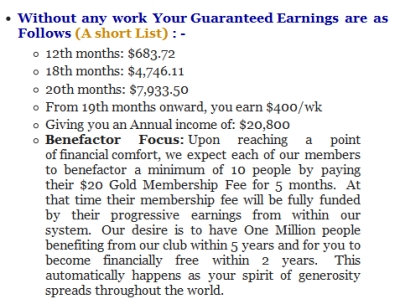
    How much can a person earn by paying Club Asteria $20? Here are the answers, according to the promo. (Verbatim.)

    • Without any work Your Guaranteed Earnings are as Follows (A short List) : –

    12th months: $683.72
    18th months: $4,746.11
    20th months: $7,933.50
    From 19th months onward, you earn $400/wk
    Giving you an Annual income of: $20,800
    Benefactor Focus: Upon reaching a point of financial comfort, we expect each of our members to benefactor a minimum of 10 people by paying their $20 Gold Membership Fee for 5 months. At that time their membership fee will be fully funded by their progressive earnings from within our system. Our desire is to have One Million people benefiting from our club within 5 years and for you to become financially free within 2 years. This automatically happens as your spirit of generosity spreads throughout the world.

    "Guaranteed" earnings and a "Benefactor" program are being outlined in this current promo for Club Asteria.

    In addition, the promo preemptively claims “Club Asteria is NO PONZI.” It also features at least 20 charts that outline progressive earnings during a 20-month window and notes that “spread sheets with various combinations as to how 100% passives too can make money to the tune of $400 and above every week” are available.

    The Club Asteria referral ID in the promo is a number in excess of 300,000. Members have said the program, which trades on the name of the World Bank, is on its way to recruiting 500,000 members, with 1 million members the ultimate, short-term goal.

    At least one other thing about the promo is incongruous: Although it claims earnings are guaranteed, it also claims the earnings “scenario” presented is “based on present conditions” and that earnings are not guaranteed.

    See earlier story.

    Although this forum post promoting Club Asteria appears to have been deleted, a Blog promo to which it linked remains. The forum post promised "1000% Guaranteed" earnings of $1,600 a month," claiming members can make "huge" sums "without doing nothing." The Blog post is at odds with itself in that it both promises "Guaranteed" earnings and says earnings are not guaranteed.
  • PICTURE STORY: Club Asteria Promoters Claim Program Is ‘Passive’ Investment Opportunity; ‘Single Account’ Said To Return ‘About $20,000 Per Year’; Why Not Open Second Account In Same Household? Affiliate Asks

    Club Asteria members now say the firm, which trades on the name of the World Bank, suddenly threatened recruits for making false claims about the program.

    The PP Blog reported on April 4 that the program, which is being pumped on the Ponzi boards and the personal websites of thousands of Club Asteria members, was routinely being positioned as a “passive” investment opportunity. Some affiliates have tried to plant the seed that Google, Yahoo, MSN and America Online endorsed the program.

    Such claims not only raise questions about whether Club Asteria is selling unregistered securities as investment contracts, but also raise questions about how much revenue the Virginia-based firm has raised based on the lies and misrepresentations of its own members.

    Liars’ accounts will be terminated, the company reportedly advised members in recent days. What prompted Club Asteria to issue the warning was unclear. Also unclear is whether the firm has any means of determining how much revenue it has generated based on the false, misleading or dubious claims of its membership base, which is worldwide in scope.

    The company provided no guidance to members on how they could be certain the money they received from Club Asteria was clean. Some of the forums from which the “opportunity” is being promoted are referenced in federal court filings as places from which Ponzi schemes are promoted.

    “YOU MUST REMOVE THIS MATERIAL IMMEDIATELY AND CEASE THESE ACTIVITIES OR YOUR ACCOUNT WILL BE SUSPENDED AND/OR TERMINATED AND POSSIBLE LEGAL ACTION AGAINST YOU WILL BE INITITATED (sic),” the firm reportedly warned in all-caps.

    Club Asteria did not specify what form any legal action against its members would take or how many members received the warning. Nor did the firm say who would pay for any litigation that ensued or how international members would be served process. International litigation can be extremely costly and time-consuming.

    Also unclear was whether Club Asteria planned to file police reports or notify agencies such as the Federal Trade Commission about the problems it claims its members are creating.

    “YOU HAVE 72 HOURS TO RESPOND TO THE EMAIL ADDRESS WITH LINKS OR OTHER DOCUMENTATION SHOWING YOUR SITE IS IN COMPLIANCE,” Club Asteria reportedly continued.

    Promoters claimed that Club Asteria specifically warned members that they:

    • [C]annot say or imply that a Club-Asteria member can earn money without working for it.
    • [C]annot say or imply that there is some minimum guarantee of how much money you will earn every week.
    • [C]annot make or imply income projections of ANY type. Only income examples found on the Club-Asteria site and in official member materials may be used at any time.
    • [C]annot say or imply that Club-Asteria membership is a passive investment or imply that this is an investment of any type.
    • [C]annot say or imply that someone should join if they have no interest in the benefits of our products, programs and services.
    • [C]annot invite, solicit or encourage others to join just because of our rewards program.
    • [C]annot create your own website and say anything you want about Club-Asteria.

    Research suggests, however, that thousands of websites globally have positioned Club Asteria as a “passive” investment program and published earnings suggestions, promises or guarantees. Each and every claim puts the enterprise at risk, and unringing the bell after months and months of dubious claims may be a tall order.

    The screen shots below are just a small sampling of the kinds of claims that appear online about Club Asteria. Each of the sites was active as of this morning, despite the purported warning Club Asteria issued last week.

    Purportedly quoting an upline sponsor, this Club Asteria pitch talks about the great expansion of the program and claims "completely passive members make very good money." The program is designed, according to the pitch, to deliver "returns" of $400 a week — or "about $20,000 per year." Opening a second account in the household "will simply double" the $20,000, according to the promo.
    This pitch urges prospects to create income for life and earn "$400 Every Week."
    This YouTube pitch for Club Asteria claims the opportunity pays "$400 USD EVERY WEEK" and suggests PayPal can help members fund their accounts. YouTube appears to have removed the soundtrack from the promo because it violated the copyright of Warner Music Group (WMG).
    This Facebook promo advertises a "minimum of about $1,600 per month forever."
    Club Asteria, according to this promo, enables members to "Earn 100% Passive." It also claims "80% is reinvested."
    Another pitch that highlights the purportedly "passive" nature of Club Asteria. This promo references the name of the World Bank and claims the program is "Real, Safe and Legal." Meanwhile, the promo makes the preemptive claim Club Asteria is not a "Ponzi." Many promoters preemptively have claimed the firm is not operating a Ponzi. Club Asteria does not publish verifiable financial data.
    This promo declares that Club Asteria "is not just a passive income."
    Club Asteria advertised in "Jobs" listings in Germany. The ad claims members are "guaranteed to earn $400 a week without much effort."
  • FTC: Acai-Berry Scammers Created ‘Fake’ News Sites And Traded On Famous Name Of ‘Consumer Reports’ To Fleece The Masess; Letters ‘CNN’ Were Used In Web Domains In Illinois, State AG Says

    This "fake" news site is now known as "Exhibit A" in the FTC's case against alleged acai-berry scammers.

    EDITOR’S NOTE: If this federal and state action doesn’t get the attention of the out-of-control, direct-sales crowd that divines itself the right to plant the seed that an “offer” is endorsed by famous companies and people, well, perhaps nothing will. Even as this story is being written, affiliates of Club Asteria, a purported “passive” investment company, are planting the seed that the firm is endorsed by Google, Yahoo, MSN and America Online. Club Asteria promoters also routinely trade on the name of the World Bank. Club Asteria is being pitched on forums populated by serial Ponzi scheme promoters.

    UPDATED 2:23 P.M. EDT (U.S.A.) One of the most cherished brand names in the United States — “Consumer Reports” — was appropriated by acai-berry hucksters to confuse the marketplace and rip off customers, the FTC charged today.

    As the PP Blog reported Friday in advance of the FTC’s formal news conference this morning, “fake” news websites also were used in the alleged scam. The FTC announced today that it was seeking an asset freeze against 10 acai-berry operations. The actions were brought in federal courts in Washington state, Illinois, Michigan, New Jersey, New York and Georgia.

    Illinois brought its own action at the state level against an alleged acai huckster in Sauk Village, near Chicago.

    “Almost everything about these sites is fake,” said David Vladeck, director of the FTC’s Bureau of Consumer Protection. “The weight loss results, the so-called investigations, the reporters, the consumer testimonials, and the attempt to portray an objective, journalistic endeavor.”

    Lisa Madigan, the attorney general of Illinois, said the scheme also masked a continuity-billing fraud while confusing the public about what is real and what is not.

    “Consumers across the country visit these fake marketing sites that are carefully — and illegally — disguised to represent professional news organizations, only to wind up unknowingly debited for extra diet products,” Madigan said. “These Internet con artists are profiting from their purposely deceptive marketing ploys.”

    Consumer Reports itself was affected in the brazen scheme, according to court filings. The publication, which is published by Consumers Union of Yonker’s, N.Y., is an American treasure that readers rely on for unbiased news and reviews.

    The magazine filed an affidavit in the FTC case that advised a federal judge about the unauthorized trading on its name.

    The website consumerproductsdaily.com, which has no tie to Consumer Reports or any of its websites, used language such as “As seen on . . .” followed by the logos for Consumer Reports and other news outlets, Consumer Reports said.

    “Consumers Union has no affiliation with consumerproductsdaily.com or with any other website using the Consumer Reports logo in a similar fashion,” Consumer Reports said. “Consumers Union has never licensed or in any way authorized the use of the Consumer Reports trademark in connection with the website consumerproductsdaily.com or with any website employing a similar format.”

    Injury to the Consumer Reports brand and confusion about perceived ties to acai-berry companies were not just limited to the consumerproductsdaily.com site, according to the affidavit.

    “Additionally, Consumers Union has received numerous complaints and inquiries from consumers regarding web sites with a format similar to consumerproductsdaily.com, including consumerdigestweekly.com, weeklyhealthnow.com, healthnews10.com, and health9news.com,” Consumer Reports said. “Many of the complaints voiced concern that these web sites were infringing the Consumer Reports trademark, while other complaints questioned Consumer Reports’ affiliation with these web sites.”

    For its part, the FTC said the “fake news sites” also used titles such as “News 6 News Alerts,” “Health News Health Alerts” and “Health 5 Beat Health News.”

    “The sites often include the names and logos of major media outlets — such as ABC, Fox News, CBS, CNN, USA Today, and Consumer Reports — and falsely represent that the reports on the sites have been seen on these networks,” the agency said.

    How slow were some affiliate marketers to take the clue that this form of marketing had come on federal radar screens? Even as marketers were using the name of Consumer Reports to hawk the alleged acai scam, the magazine was warning readers about  fake news sites pitching acai products.

    Even after today’s actions, some affiliates are continuing to use the very template the government now describes as “Exhibit A” in a fraud case.

    Charged by the FTC were Beony International LLC, Mario Milanovic and Cody Adams; Zachary S. Graham, Ambervine Marketing LLC and Encastle Inc.; Intermark Communications Inc. also doing business as Copeac and IMM Interactive; Ricardo Jose Labra; Thou Lee, also doing business as TL Advertising; Circa Direct LLC and Andrew Davidson; Coulomb Media Inc. and Cody Low, also known as Joe Brooks; DLXM LLC, and Michael Volozin, also known as Mikhail Volozin; Charles Dunlevy; Tanner Garrett Vaughn, also doing business as Lead Expose Inc., and Uptown Media Inc.

    Named in Madigan’s complaint in Illinois was Ishmael Lopez Jr. Investigators there said at least two sites linked to Lopez used the letters CNN in their domain names, according to the complaint.

    View government “Exhibit B,” which the FTC says outlines how the scheme was designed to work.

  • Club Asteria Pitchman Uses Name Of Another Famous Bank In Ponzi-Forum Promo For ‘ThatFreeThing’; No Immediate Comment From JP Morgan Chase

    UPDATED 10:51 A.M. EDT (U.S.A.) The name of JPMorgan Chase — one of the most prominent financial institutions in the world — is being used by “manolo” in a pitch for the ThatFreeThing (TFT) MLM program on the TalkGold Ponzi scheme and criminals’ forum.

    “manolo” also is promoting Club Asteria (CA), a highly questionable “program” that trades on the name of the World Bank. The World Bank’s name also appears in promos on TalkGold and other Ponzi forums such as MoneyMakerGroup.

    JPMorgan Chase did not respond immediately to a request for comment about the use of its name in TFT promos and whether TFT and its affiliates were authorized to use the bank’s name in sales pitches.

    TFT affiliates in multiple forums and social-networking sites have been using the Chase name to drive “sign-ups” to the MLM by planting the seed that Chase will pay them $150.

    “Members are signing in (sic) their droves, and corporate businesses see this…now the back office is loaded with Tons of freebee’s (sic) …like Free $150 fro (sic) Chase bank !!!” a three-exclamation-point promo from a poster on Scam.com screamed yesterday.

    On TalkGold, meanwhile, “manolo” was circulating the Chase name in a post that asked, “Did you see the $150 you get for FREE when you open up a Chase Bank account?”

    “These types of freebies are HUGE when we post them because you can literally get someone to join for $25 and instantly show them how to put $150 in their pocket in the very first day,” the post declared.

    “manolo” appeared to be quoting an email sent to him earlier this month by “TFT Support.”

    Chase’s name also is referenced in a 12-page TFT thread on the MoneyMakerGroup Ponzi forum. There, within the TFT thread, promoter “strosdegoz” also is pitching something called Exotic FX, which purports to be a “PRIVATE ASSET HAVEN.” At the same time, “strosdegoz” is promoting a “program” known as “Cycle2Riches,” which appears to be a matrix cycler that uses a notorious business model that has been attacked by the U.S. Secret Service.

    “strosdegoz” and “manolo” are believed to be one-in-the-same. How either TFT or Club Asteria could assure members its income stream was not polluted by proceeds from fraudulent enterprises promoted on MoneyMakerGroup, TalkGold and other Ponzi forums is unclear.

    Both MoneyMakerGroup and TalkGold are referenced in federal court filings as places from which Ponzi schemes are promoted. Any new Chase customer who opened an account with the bank in response to the TFT promos on the Ponzi forums conceivably could cause fraud proceeds to flow into the bank. The Ponzi forums are populated by serial hucksters.

    TFT promos that reference Chase also are appearing on Facebook. Chase appears recently to have offered a promo by which certain customers who established a banking relationship with it and met other conditions could qualify for a $150 reward. Details about the Chase offer, which appears to have expired, were not immediately clear.

    Records suggest, however, that Chase never promised to put $150 in the pockets of new customers “on the very first day,” as the TFT promo implied. Moreover, Chase is Chase, and TFT is TFT. If the Chase offer was available to the public, there was no reason to pay TFT any money to gain access to the Chase offer.

    Chase currently is offering a $125 bonus to certain new customers through May 16, according to its website. But the offer varies by state and comes with conditions such as making a minimum opening deposit of $100 and establishing direct deposit from “payroll, pension or government benefits, such as Social Security.”

    New accounts come with banking fees if customers don’t meet the minimum qualifications, and no one gets the reward money instantly, according to the Chase website.