Tag: Faith Sloan

  • Firm In Which TelexFree Figure Faith Sloan Allegedly Hid Money Charged With Fraud In Separate Case

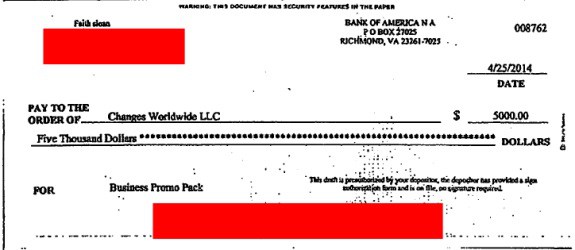
    After the SEC's TelexFree case in 2014, Faith Sloan allegedly sent money to Changes Worldwide, a firm bow charged with fraud by the CFTC,
    After the SEC’s TelexFree case in 2014, Faith Sloan allegedly sent money to Changes Worldwide, a firm now charged with fraud by the CFTC. From: federal court files.


    UPDATED 12:14 P.M. EDT U.S.A. Back in April 2014, the SEC charged online huckster Faith Sloan with fraud for pushing the TelexFree scheme. Two month later, in June 2014, the SEC accused Sloan of violating the TelexFree asset freeze by sending nearly $15,000 to an online scheme known as Changes Worldwide LLC for the purchase of “business promo packs.”

    She also was accused of violating the freeze by sending $3,990 to an entity known as Changes Trading. There has been concern for years about serial MLM HYIP participants proceeding from fraud scheme to fraud scheme to fraud scheme. This sometimes is described as “whack-a-mole.”

    Now, the U.S. Commodity Futures Trading Commission has charged both Changes Trading and Changes Worldwide with fraud. Also charged were Changes operator Timothy Baggett of Lakeland, Fla., and Kimball Parker of Lehi, Utah, along with Parker’s Utah company, MakeYourFuture LLC.

    The CFTC prosecution appears not to be related to the SEC’s TelexFree case, except in the sense that it demonstrates a continuing need for discernment and that discernment may be in short supply. Sloan is not a CFTC defendant.

    From the CFTC (italics added):

    The CFTC Complaint alleges that the Defendants engaged in a fraudulent scheme to misrepresent the profitability and success of a futures trading system that they sold to customers, including making fraudulent representations in marketing materials, on their websites, and in one-on-one communications with customers and prospective customers regarding the profitability of their trading system. According to the Complaint, from at least March 2014 through the present, the Defendants induced at least 289 customers to pay them more than $853,294.98 for the trading system.

    Specifically, as alleged, the Defendants made material, false representations in his solicitations of customers and prospective customers, including that their trading system had “never had a losing month,” and generated “300% annual returns.” According to the Complaint, to support these claims, Defendants posted so-called “documented and verifiable results” on their websites showing returns of between 11% and 68% each month from January through December 2014.

    However, as the Complaint further alleges, Defendants’ “documented and verifiable results” were false and did not reflect any actual trading of real money in any futures account. Meanwhile, according to the Complaint, Parker and Baggett consistently lost money trading futures in their personal accounts, and customers also consistently lost money attempting to trade according to the system, a fact that Defendants were made aware of by customer complaints.

    A bogus “live training room” and “robot” also were part of the scheme, the CFTC alleged.

    Kenneth D. Bell, the receiver in the Zeek Rewards Ponzi- and pyramid case, has raised the issue of promoters/participants jumping to new schemes. Robert Craddock, a figure in the Zeek scheme later charged with ripping off the Deepwater Horizon oil-spill fund, once had an association with Changes Worldwide.

    BehindMLM.com has some history on the Changes-related companies and notes Baggett also allegedly was involved in the BidsThatGive scheme.

    Read the CFTC complaint, which explains how Baggett’s MLM business purportedly selling vitamins and vacations allegedly ended up getting involved in the futures business.


  • Faith Sloan’s Alleged TelexFree Haul: $710,319

    newtelexfreelogoUPDATED 3:32 P.M. EDT U.S.A. Faith Sloan received $710,319 from the TelexFree Ponzi- and pyramid scheme, according to filings by TelexFree bankruptcy Trustee Stephen B. Darr.

    Sloan, whose address was listed as Virginia Beach, Va., is a longtime Illinois HYIP huckster on Ponzi boards and social media. She and three other TelexFree promoters were charged in April 2014 with securities fraud by the SEC. The state of Illinois later barred her from the securities industry and warned her that violating the ban could result in a felony charge.

    Her alleged TelexFree haul was not known at the time.

    Darr, who has been investigating TelexFree for nearly two years, now wants to add Sloan and dozens of other alleged major winners as named defendants in a proposed class-action lawsuit filed in February that would return the winnings to the bankruptcy estate. Another proposed defendant is Randy Crosby, charged alongside Sloan by the SEC two years ago. His alleged haul, according to Darr, was $487,621.

    An individual identified as Sonya Crosby at the same address received $541,450, according to Darr. She, too, has been named a proposed defendant in the class action.

    As of April 4, no adequate class representative had been found, Darr advised Chief Bankruptcy Judge Melvin S. Hoffman of the District of Massachusetts.

    Sloan previously had complained that the SEC was picking on her, given that others in TelexFree had received more from the scheme and were not charged by the agency. As investigations evolve, however, the SEC sometimes files amended complaints or brings individual actions against defendants not charged out of the gate.

    Such as the case with HYIP huckster Matthew John Gagnon in 2010. He also was sued by a court-appointed receiver and charged criminally by the U.S. Secret Service.

    Alleged Zeek Rewards’ winner Trudy Gilmond wasn’t originally charged by the SEC. But as the probe continued, Gilmond was sued by both the agency and the receiver.

    Zeek receiver Kenneth D. Bell has expressed concerns about promoters moving from one fraud scheme to another. In March, SEC Enforcement Director Andrew Ceresney commented on the “whack-a-mole” nature of online pyramid schemes.

    Sloan has not been charged criminally. On the civil side, she is defending against the action filed by the SEC and also is named a defendant in multiple TelexFree fraud actions brought by private plaintiffs. If Hoffman approves Darr’s motion to file an amended complaint naming Sloan a “winner,” it would open a new litigation front against her.

    It is unclear if the SEC will name any additional TelexFree defendants.

    Darr’s motion to amend the complaint to include Sloan and additional defendants is available on the Trustee’s website. The proposed complaint is included as Exhibit A.


  • TELEXFREE CLASS-ACTION: Judge Restrains Assets Of 2 Alleged Promoters, Including Scott Miller And ‘MyAdvertisingPays’ Pitchman Daniil Shoyfer

    ponzinews1Let’s begin by pointing out that Daniil Shoyfer and Scott Miller have not been charged by the SEC in its 2014 TelexFree action. There are asset freezes aplenty in that government-brought case, including freezes against alleged promoters Sann Rodrigues, Faith Sloan, Randy Crosby and Santiago De La Rosa.

    The asset restraints imposed yesterday by U.S. District Judge Timothy S. Hillman against Shoyfer (of New York) and Miller (of Indiana) flow from an altogether different case: a proposed class-action brought by plaintiffs last year.

    Indeed, private plaintiffs represented by private attorneys — as opposed to government plaintiffs represented by government attorneys — have now managed to persuade a judge to block the flow of funds alleged to be tainted by fraud.

    This is horrible news if you’re a serial promoter of MLM fraud schemes or Ponzi-board “programs” because it demonstrates that the government no longer is your singular worry. Put another way, even if the SEC or some other agency “misses” you, aggressive class-action attorneys may not.

    They even may be tracking you as you move from scheme to scheme — and, of course, agencies such as the SEC follow court filings in related actions closely.

    Even though the private lawyers did not get everything they sought in yesterday’s order by Hillman, they got enough to seriously complicate the lives of their targets. Although the judge did not restrain assets with no nexus to the alleged $3 billion TelexFree Ponzi- and pyramid scheme, both Shoyfer and Miller now must make monthly financial reports to the court.

    From the order:

    “Each Individual Defendant shall file a statement of accounting with the Court, under seal, on the last day of each month by 5:00 p.m. EST, setting forth all monetary expenditures and the sale and/or transfer of all assets made in the prior month . . . To the extent that any Individual Defendant seeks to expend money or to sell, transfer dissipate, assign, pledge, alienate, encumber, diminish in value, or otherwise dispose of any funds or other assets which they would not be permitted to do under the terms of this Order, such defendant may file a motion with the Court setting forth, in detail the nature of the transaction.”

    And, the judge continued, “The Individual Defendants may petition the Court to exempt from this Order any fund or other assets in any bank, brokerage or other financial institution accounts and any other assets held by of for the benefit of such defendant on the grounds that such assets are not traceable to monies received by him in connection with his involvement with TelexFree. The Individual Defendants shall submit detailed financial statements and/or other documentary evidence to establish the funds held or assets in question are funds or assets were acquired independently. The Individual Defendants shall also submit an accompanying affidavit signed under the pains and penalties of perjury attesting to the authenticity and truth of the evidence submitted in support of their motion to exempt. All filings made pursuant to this section shall be filed under seal. After reviewing the filing, the Court will determine whether notice to the Plaintiffs, discovery and/or a hearing will be required.”

    The class-action lawyers already have accused Shoyfer of promoting “MyAdvertisingPays” on the heels of TelexFree. They alleged MAPS, as it is known, is another Ponzi scheme.

    So, under the terms of the order, it would appear that, if Shoyfer wants to keep any MAPS income that flowed to him on the grounds it did not originate with TelexFree, he would have to petition the court to do so.

    Miller, known for telling a “Carlos Danger” joke to a TelexFree audience and pitching the program to Americans while it was under investigation in Brazil amid reports of threats against a judge and prosecutor, was part of an effort to solicit sums as high as $15,125 from TelexFree prospects. Viewers were told their $15,125 would return at least $1,100 a week for a year.

    In restraining the assets of Miller and Shoyfer, Hillman found that the plaintiffs likely would prevail on the merits. Unlike Shoyfer. Miller did not seek to block the preliminary injunction.

    But Hillman also cautioned the plaintiffs that more work was needed and that the “depiction of Shoyfer as a ‘Top Level Promoter’ who swindled TelexFree victims out of millions of dollars is, on the current record, nothing more than unsupported rhetoric.”

    NOTE: Our thanks to the ASD Updates Blog.


  • URGENT >> BULLETIN >> MOVING: SEC Charges Alleged Zeek Promoter Trudy Gilmond

    breakingnews725URGENT >> BULLETIN >> MOVING: (5th Update 9:15 p.m. ET U.S.A.) The SEC has gone to federal court in the Western District of North Carolina and charged Zeek Rewards’ figure Trudy Gilmond with securities fraud, selling unregistered securities and failure to register as a broker-dealer.

    Among the allegations: Gilmond knew Zeek was under investigation in 2012 and cashed out without telling investors the “program’s” days likely were numbered. She also is accused of joining with Zeek’s principals in playing word games to sanitize the fraud.

    Gilmond, 45, of Vermont, is the first individual Zeek promoter charged in an alleged Ponzi- and pyramid scheme said to have gathered more than $850 million. She previously had been sued by court-appointed receiver Kenneth D. Bell as an alleged “winner” in the scheme.

    The Zeek receivership estate was awarded a judgment of more than $2.1 million against Gilmond, who previously promoted the collapsed Regenesis 2X2 scheme investigated by the U.S. Secret Service in 2009.

    In its complaint, the SEC said Gilmond is a “self-described network marketer who has participated in numerous MLM programs, operating under the trade name ‘Team Fired Up’ to attract followers and new recruits to join her ‘downline’  in those MLM programs (several of which ultimately collapsed in a fashion similar to ZeekRewards).”

    Zeek’s former COO Dawn Wright-Olivares, an SEC civil defendant who also has been charged criminally, recruited Gilmond, the SEC charged.

    Bell has raised the issue of MLMers or direct marketers moving from one fraud scheme to another. Gilmond now joins MLM promoter Matthew John Gagnon as a roving huckster pursued by both a receiver and the SEC. Gagnon also was pursued by criminal authorities.

    It perhaps never has been more dangerous for hucksters to move from scheme to scheme to scheme. Serial promoters Faith Sloan and Sann Rodrigues were charged by the SEC in the TelexFree Ponzi- and pyramid case and also are being pursued by class-action attorneys. Rodrigues, who once claimed God invented MLM and “binary,” also has been hit with criminal charges of immigration fraud.

    The SEC later tied Rodrigues to Daniel Fernandes Rojo Filho, an alleged fraudster from DFRF Enterprises who previously was tied to the infamous EMG/Finanzas Forex Ponzi scheme.

    With respect to Gilmond, the SEC described her as “one of the most successful and prolific promoters of ZeekRewards. From at least September 2011 until ZeekRewards was shut down in August 2012, Gilmond worked closely with the company founders and served as a senior ‘field liaison’ to promote the scheme, persuading scores of unsophisticated retail investors to buy ZeekRewards securities upon the promise of profit sharing. Gilmond reaped more than $1.7 million in transaction-based commissions and bogus profit-sharing for her recruiting efforts.”

    Some of the specific allegations against Gilmond in the SEC complaint (italics added/editing performed):

    Based on Gilmond’s efforts and the misstatements on the website, many of Gilmond’s team members ultimately purchased the ZeekRewards securities, earning Gilmond substantial commissions.

    As a field liaison, Gilmond had access to portions of ZeekRewards’ internal electronic investor database so that she could make adjustments to individual accounts to address her affiliates’ concerns or complaints. Among other things, Gilmond had the ability to adjust the number of “points” earned and could assign downline recruits to certain affiliates, both of which impacted the measure of profit sharing or commissions paid to those affiliates. In addition, Gilmond developed close ties with Wright-Olivares and other ZeekRewards insiders, which gave her unique access and insight not available to a typical investor.

    Having worked closely with the company founders and insiders to promote the scheme in her role as a senior field liaison, and given her prior experience with similar MLM programs that ultimately collapsed, Gilmond knew or should have known that the ZeekRewards scheme’s outsize returns (averaging 1.5% per day) were too good to be true and could not be sustained.

    Gilmond also helped conceal from investors and regulators the true nature of the ZeekRewards scheme. To that end, Wright-Olivares and others directed, and Gilmond helped implement, several superficial or nominal changes to certain ZeekRewards features. This included removing any references on the website to the terms “investment” and “ROI”; substituting a daily award percentage that in the aggregate approximated 125% every 90 days rather than “guaranteeing” a 125% return; and requiring investors to give away VIP bids to foster the illusion of contributing efforts to the enterprise.

    Aware that ZeekRewards was under investigation by several law enforcement agencies and that the business was in serious trouble in 2012, Gilmond and others withdrew substantial sums of money from the scheme before it was shut down, without advising investors that the scheme was likely to collapse.

    Read the SEC statement and complaint against Gilmond.

    NOTE: Our thanks to the ASD Updates Blog.


  • URGENT >> BULLETIN >> MOVING: Zeek Receiver Sues MLM Attorney Gerald Nehra

    breakingnews725URGENT >> BULLETIN >> MOVING:  (7th Update 8:33 p.m. EDT U.S.A.) The court-appointed receiver in the Zeek Rewards Ponzi- and pyramid-scheme case has sued MLM attorney Gerald Nehra and his law firm and law partner.

    Named defendants are Nehra as an individual and as a member of the Nehra and Waak law firm of Michigan, and Richard W. Waak. Like Nehra, Waak is named as an individual and as a member of the firm. The two lawyers’ individual professional LLCs also are named.

    The 21-page complaint by Zeek receiver Kenneth D. Bell is dated Sept. 21 and alleges damages of at least $100 million. A section of the complaint quotes a July 22, 2012, email from Waak that reads, “I have primary responsibility for the Zeek Rewards account with our law firm.”

    The SEC moved against Zeek a month later, in August 2012, alleging a massive Ponzi- and pyramid scheme. At least three Zeek executives, including alleged operator Paul R. Burks of North Carolina, later were charged criminally. Two of the executives — Dawn Wright-Olivares and her stepson Daniel Olivares — have pleaded guilty.

    From the receiver’s complaint (italics added):

    By virtue of their knowledge of [Zeek operator Rex Venture Group]  and ZeekRewards and their legal expertise, Nehra and Waak knew or should have known that RVG was perpetrating an unlawful scheme which involved a pyramid scheme, an unregistered investment contract and a Ponzi scheme. Despite this knowledge, Nehra and Waak encouraged investors to participate in the scheme by knowingly allowing their names to be used in providing a false façade of legality and legitimacy and gave improper legal advice that allowed the scheme to continue far longer than it would have without the Defendants’ support. Nehra and Waak’s improper and negligent actions, which breached their fiduciary duties to RVG and assisted RVG’s Insiders to breach their fiduciary duties, caused significant damage to RVG.

    Nehra and Waak also face the prospect of private litigation flowing from the alleged TelexFree Ponzi- and pyramid scheme.

    In a complaint filed May 3, 2014, plaintiffs accused Nehra of counseling TelexFree “on methods to evade United States securities laws that were intended to offer, in part, protection from pyramid Ponzi schemes; all to enrich himself financially and serve his own selfish interests.”

    He further was accused of encouraging unknowing TelexFree members to “participate in the evasion of federal and state securities laws.”

    The Zeek receiver made similar claims against the lawyers.

    “With their inside knowledge of multi-level marketing schemes and access to RVG’s Insiders, Nehra and Waak knew or should have known that insufficient income from the penny auction business was being made to pay the daily ‘profit share’ promised by ZeekRewards,” Bell alleged.

    “The Defendants knew or should have known that the money used to fund ZeekRewards’ distributions to Affiliates came almost entirely from new participants rather than income from the Zeekler penny auctions. Further, based on their inside knowledge and access, Nehra and Waak knew or should have known that the alleged ‘profit percentage’ was nothing more than a number made up by Burks or one of the other Insiders. Rather than reflecting the typical variances that might be expected in a company’s profits, the alleged profits paid in ZeekRewards were remarkably consistent, falling nearly always between 1% and 2% on Monday through Thursday and between .5% and 1% on the weekends, Friday through Sunday.”

    Nehra also was a figure in the 2008 AdSurfDaily Ponzi scheme story, opining that ASD was not a Ponzi scheme despite remarkably consistent returns. ASD operator Andy Bowdoin later pleaded guilty to wire fraud and acknowledged his company was a Ponzi scheme and never operated lawfully from its inception in 2006.

    Like Bowdoin, Zeek’s Burks is accused of making up numbers to dupe participants. In TelexFree-related matters, class-action lawyers argued that “Attorney Nehra’s extensive experience in multi-level marketing, and particularly his involvement with the Ponzi schemes involving Ad SurfDaily and Zeek Rewards, armed him with the knowledge of what constitutes violations of United States securities law. Indeed, Attorney Nehra was well aware that the use of semantics and obscured phraseology to obfuscate securities laws fails to legitimize TelexFree’s illegal Pyramid Ponzi Scheme.”

    Zeek receiver Bell accused Nehra and Waak of  turning a “blind eye” to incredible claims by Zeek and of suggesting cosmetic changes to language instead of “recommending substantive changes that would make the program lawful.”

    At least one alleged TelexFree promoter accused by the SEC last year of securities fraud has alleged she was duped by both the company and Nehra. That claim was made by veteran HYIP Ponzi pitchwoman Faith Sloan.

    NOTE: Our thanks to the ASD Updates Blog.


  • Now, ‘TelexMOB’

    TelexMoblogoUPDATED 11:25 A.M. EDT U.S.A. Something calling itself “TelexMOB” has established a web presence this month. A logo resembling that of TelexFree — an alleged Ponzi- and pyramid scheme said to have gathered $1.8 billion across national borders — appears on the site.

    BehindMLM.com was first with the news today.

    The PP Blog has sent requests for comment to three government agencies and to Stephen B. Darr, the court-appointed trustee in the TelexFree bankruptcy case. The Blog will post the responses, if received.

    Update 10:10 a.m. EDT U.S.A. “I have no comment, since I have no knowledge of TelexMOB,” Darr said in an email this morning.

    Update 11:25 a.m. EDT U.S.A. The U.S. Securities and Exchange Commission this morning declined to comment on TelexMOB. (Original story continues below . . .)

    It is not unusual for knockoff schemes to emerge in the HYIP sphere in the aftermath of a collapse, a disappearing act or a government action. Examples of this include the infamous JSSTripler 2 scheme, a scam riding on the name of the JSSTripler/JustBeenPaid scheme, which advertised an annual return of 730 percent in 2012.

    Content appears on the TelexMOB website in English and Portuguese. Some of the English is fractured. A 16-page pdf handout on the site is written in Portuguese. The last two words in the pdf, however, are in English.

    “Welcome Back,” it reads, potentially a direct appeal to TelexFree participants.

    The site appears to be using a New Zealand privacy service. The servers may be in the United States.

    JSSTripler 2 was memorable for reasons beyond its knockoff name. In January 2012, for example, it sparked legendary HYIP huckster Faith Sloan to call “Ken Russo,” another legendary huckster, a “crybaby.”

    A claim of Dengue Fever accompanied the JSSTripler2 scheme.

    Sloan published a JSSTripler 2 earnings calculator. She’d later become a defendant in the SEC’s civil case against TelexFree, filed in April 2014.

  • BULLETIN: Zeek Figure Robert Craddock Indicted In Separate Scheme

    breakingnews72BULLETIN: Florida resident Robert Craddock, a figure in the Zeek Rewards Ponzi-scheme story, has been indicted in a separate scheme involving the alleged theft of more than $135,000 from a compensation fund set up to assist businesses affected by the Deepwater Horizon oil spill in 2010.

    The office of U.S. Attorney A. Lee Bentley III of the Middle District of Florida announced Friday that Craddock, 54, of Port Orange, had been charged with wire fraud. The U.S. Secret Service conducted the probe.

    BehindMLM.com reported the news in a story dated March 16.

    Prosecutors said in a statement that Craddock “crafted fictitious invoices to support the amount of lost earnings that he claimed.”

    From the statement by prosecutors (italics added):

    According to the indictment, following the April 2010 explosion of the Deepwater Horizon oil rig (which was being leased by BP, formerly known as British Petroleum), Craddock submitted a claim to BP and the Gulf Coast Claims Facility (“GCCF”), an independent facility established by BP to compensate qualified claimants, for lost earnings purportedly related to the impact of the oil spill on his businesses.

    Though uncharged in the Zeek case, Craddock has been described by the SEC as an obstructionist who encouraged victims of the $897 million Zeek scheme not to cooperate with Kenneth D. Bell, the court-appointed receiver.

    Separately, the Daytona Beach News-Journal is reporting that local property records showed that Craddock, a pilot, recently “bought a home complete with aircraft hangar that backs up to a runway in Spruce Creek Fly-In.”

    In 2012, Craddock was involved in a fundraising venture purportedly to assist Zeek participants to mount a challenge against the SEC for bringing the Zeek Ponzi case. This occurred through a Craddock venture known as Fun Club USA, later described by litigants suing Craddock for alleged trademark infringement as a shell company engaged in a “shake-down” bid against affiliates of at least three MLM networks: Zeek, OfferHubb and BTG180.

    Precisely how much Craddock collected in the Zeek-related fundraising effort is unclear. Also unclear is precisely how the money was used.

    Zeek figures Todd Disner and T. LeMont Silver — alleged winners of millions of dollars from Zeek — helped champion the fundraising venture. Disner also was a figure in the AdSurfDaily Ponzi-scheme story, something Zeek receiver Kenneth D. Bell pointed out to a federal judge.

    Bell has raised concerns that MLMers or network marketers are moving from fraud scheme to fraud scheme to fraud scheme.

    Craddock has been a lightning rod for MLM controversy. In November 2012, for example, he bizarrely planted the seed that MLM attorney Kevin Thompson was practicing law without a license. Thompson described Craddock as a liar.

    But if there is a signature Craddock moment, it occurred in July 2012, when Craddock sought to disable a HubPage critical of Zeek by alleging author K. Chang had engaged in libel, trademark infringement and copyright infringement. It was all a fantastic crock, and K. Chang eventually prevailed.

    Less than a month after Craddock moved against K. Chang, the SEC and the U.S. Secret Service moved against Zeek.

    Court records from the ASD Ponzi case show that ASD also tried to chill reporters with threats about lawsuits in the weeks prior to a government raid on ASD headquarters in August 2008.

    In 2014, Craddock was listed as a copyright enforcer on the website of an entity known as Changes Worldwide LLC. The SEC has accused TelexFree figure Faith Sloan of violating the asset freeze in the TelexFree case by sending thousands of dollars to Changes Worldwide. Sloan also was a Zeek affiliate.

    Craddock later reportedly authored a book whose sales copy included a claim that the U.S. government should have modeled a “stimulus program” after Zeek, which prosecutors have described as a Ponzi- and pyramid scheme that had gathered $897 million and affected hundreds of thousands of people globally.

    The SEC declined to comment on the book, which was offered on Amazon.com.

  • [PART 1]: CLAIM: Major TelexFree Promoter Operated Out Of New York City Beauty Salon And Marriott Hotel

    “Because that’s where the money is.” Classic rejoinder attributed to Brooklyn-born criminal Willie Sutton, reportedly after he was asked why he robbed banks. The often-quoted line may or may not be apocryphal. (Also see “Sutton’s Law” on the need to consider the obvious and “When you hear hoofbeats, think of horses not zebras.”)

    newtelexfreelogoUPDATED 5:26 P.M. EDT U.S.A. If you had the means to throw down $140 for “Chocolate Body Therapy” or $260 to get the “Prince or Princess for a Day” treatment, would you also have the means to direct some cash to an MLM “program” purported to double or triple your money?

    Daniil Shoyfer of Staten Island perhaps thought so. In a proposed class-action lawsuit against various TelexFree figures, the plaintiffs accuse Shoyfer of holding TelexFree pitchfests at Salon Delacqua, a beauty shop that offers moderately priced and upscale services on 86th Street in Brooklyn. The meetings appear to have occurred at 8 p.m., near or at the shop’s published closing time.

    These pitches included promises of “fabulous wealth,” according to the plaintiffs. The salon also advertises a “Brazilian Karatine” hair-strengthening treatment that takes three hours and begins at $250.

    And when Shoyfer wasn’t at the salon, he allegedly was at the Marriott Hotel Grand Ballroom at 102-05 Ditmars Blvd. in the Queens neighborhood of East Elmhust near LaGuardia Airport, pitching the “program” in a room that hotel says on its website can be configured to seat 400.

    The demographics from the neighborhood (2010) suggest that 30 percent of its residents were born outside of the United States, with a Latino population on the rise.  TelexFree was accused last year by the SEC of targeting immigrants.

    Shoyfer pitchfests also were hosted elsewhere in the Greater New York City region, and allegedly were conducted in English and Russian. The sites included the SOHO Lounge in Brooklyn and a real-estate office in the Rego Park neighborhood of Queens.

    Accused TelexFree executive Steve Labriola was a co-host at a Shoyfer Marriott pitchfest, dubbed a “Superweekend in NY,” according to the plaintiffs.

    Shoyfer allegedly took his marching orders from Labriola and other TelexFree “founders,” including accused Ponzi schemers James Merrill, Carlos Wanzeler and Carlos Costa. Also within the alleged den of financial impropriety were accused TelexFree securities fraudster Joe Craft, an accountant, and Katia Wanzeler, the wife of Carlos Wanzeler.

    Along for the ride in the TelexFree swindle, according to the plaintiffs, were Sann Rodrigues, Faith Sloan, Randy Crosby and Santiago de la Rosa, all four of whom were accused by the SEC last year of securities fraud and named defendants in the proposed class action. It is one of several tied to the alleged TelexFree Ponzi- and  pyramid scheme.

    “Defendant Shoyfer was the creator and leader of a large network of TelexFree Promoters based primarily in New York City, but extending into other states as well, including Massachusetts, and he is believed to have been the largest single Promoter in the greater New York area,” the plaintiffs alleged. “Under any view, Shoyfer funneled a portion of his ill-gotten gain up the food chain to TelexFree, its masterminds and other Defendants.”

    The complaint includes alleged passages from Shoyfer text messages to his TelexFree group. These suggest he was gathering cashier’s checks from his downline, and included a claim that he had made “$142,320 in a single week in February 2014” from TelexFree.

    According to the complaint, in December 2013, prior to TelexFree’s Sunday night bankruptcy filing in April 2014, Shoyfer told his group this on behalf of himself and TelexFree “founders” (italics added):

    From my upper line “Happy New Year everyone!!! 2014 is gonna be the best year for Telexfree$$$! TelexMobil is about to be launched in January! ! And, on Thursday January 23rd at 6.30 pm I will be doing my first Telexfree Superweekend in NY with Steve Labriola (director of international marketing TF) at Marriott Hotel Grand Ballroom by La Guardia Airport at 102-05 Dimars Blvd, Flushing NY 11369 (parking available). Now is the time to meet with top corporate representative..and my top leaders in my rapidly growing team.. You MUST invite your people (forward this msg to them), especially those who r still sitting on sidelines, debating about legibility [sic] and future of this company. .Trust me after this event, all negativity will disappear. .and you will double and triple you earnings in this busine$$ venture in 2014…”

    On Feb. 26, 2014, about two days before the Massachusetts Securities Division made public the news that TelexFree was under investigation, Shoyfer allegedly told his group this on behalf of himself and TelexFree “founders” (italics added):

    I just received checks from everyone but will wait for u to bring it until 2 p.m… then I’m going to FedEx.

    On Feb. 28, the very day news broke that MSD was investigating TelexFree even as the company was reaching into Spain and conducting an event at an ornate hotel in Madrid, Shoyfer allegedly told his group this on behalf of himself and TelexFree “founders” (italics added):

    Bring me certified checks now I will send them to ewallet by federal express and they will post it immediately.

    TelexFree is alleged to have changed its compensation plan on March 9, 2014, much to the fury of affiliates.  Shoyfer, however, continued to promote it, according to the plaintiffs (italics added):

    Hey..my team Telexfree! ! And here we go again..Come to check out and learn about new compensation plan TF 2.0.. and how to grow it even faster and MUCH more aggressively and efficiently than the one we had before.…Here is this week’s schedule. . Monday 03/24 at Salon Delacqua (2027 86 str) at 8.00 pm (in English) ..Wednesday 03/26 at SOHO launch(2213 65th street) at 7.45 pm ( in Russian) and Thursday 03/27 at 7.30 pm at 63-112 Woodhaven Blvd in a real estate office. In my case, since I have started from absulute zero during this passed week Mon 03/17- Sun 03/23/14 I booked 11,500 from new one and 21,600 still coming from old plan..A total of 31,100 in 7 short days… Go Telex!!!”

    The import of this, according to the plaintiffs, is that [a]fter the institution of the new TelexFree compensation plan in March of 2014, Shoyfer took part in a closed meeting with TelexFree’s Directors and Owners in Marlborough, Massachusetts, at which Shoyfer was instructed not to discuss the new TelexFree compensation plan with other, non-insiders, as the new compensation plan was detrimental to Promoters and was adopted to forestall filing bankruptcy.”

    In short, the plaintiffs accuse Shoyfer of working in concert with TelexFree management to dupe people into enrolling “right up until TelexFree’s bankruptcy filing.”

    Filings in the TelexFree bankruptcy case suggest Shoyfer received nearly $88,000 from TelexFree in two separate payments just prior to the April 13 bankruptcy filing. The first, for $9,902.37, occurred on March 21, and the second, for $78,037.33, occurred on March 28.

    NOTE: Part 2 of this two-part PP Blog series on the class-action lawsuit, which was filed in U.S. District Court for the Southern District of New York, will be published later. Part 2 will cover other allegations from the complaint, filed Dec. 12. A copy of the complaint is available through TruthInAdvertising.org.  (Link to complaint temporarily disabled by PP Blog at 9 p.m. EDT March 9, 2015.)


  • Zeek Figure Robert Craddock’s Fun Club USA Severely Sanctioned In Trademark-Infringement Case; Judge Orders Default For Failure To Follow Court Order

    OfferHubb.net Inc. sued Zeek Rewards figure Robert Craddock in February 2014, alleging Craddock “immediately” embarked on a web-based disparagement campaign after OfferHubb chose in July 2013 not to renew a contract with Craddock and Craddock’s Fun Club USA Inc.

    Co-defendants included Craddock’s wife, Sylvia Salgado Craddock, and Fun Club.

    Craddock was accused in the complaint of cybersquatting, trademark infringement, wrongful use of a computer, misappropriation of trade secrets, wrongful interference with economic relations, breach of contract, unjust enrichment, defamation and hiding behind a shell company.

    Now, a federal district judge in Nevada — following the October recommendation of a magistrate judge   — has ordered sanctions.  This includes the striking of the answer Fun Club filed in February. It also includes a default order against the enterprise.

    Why? Fun Club’s “failure to comply with this Court’s Order to obtain counsel,” Judge Richard F. Boulware II said in the order.

    Boulware also ordered the clerk to enter judgment and close the case. The financial fallout was not immediately clear.

    As the PP Blog reported in October (italics added):

    Fun Club and Craddock are referenced in a blistering memo filed in the Zeek Ponzi- and pyramid-scheme case by the SEC on Dec. 17, 2012. In the memo, the SEC accused Craddock of encouraging Zeek affiliates “not to cooperate” with Kenneth D. Bell, the court appointed receiver. The SEC further alleged that Craddock was spreading misinformation about how the agency viewed its own case against Zeek and that Fun Club appeared to have been formed 11 days after the SEC emergency action against Zeek on Aug. 17, 2012.

    Craddock has not been charged by the SEC with wrongdoing . . .

    The trademark-infringement claim may be particularly concerning to the MLM trade, given that Craddock has asserted he works as a copyright and trademark agent on behalf of MLM “programs.”

    On July 22, 2012, while purportedly working as a “consultant” for Zeek, Craddock filed a copyright- and trademark-infringement complaint against a HubPages website operated by Zeek critic K. Chang. K. Chang, who also posts on publications such as the PP Blog and BehindMLM.com, ultimately prevailed in the action brought by Craddock.

    Less than a month later, the SEC brought the Ponzi- and pyramid action against Zeek.

    Earlier this year, a website known as Changes Worldwide identified Craddock as its copyright agent. Filings by the SEC in June 2014 alleged that Faith Sloan, accused in April 2014 of securities fraud by the agency in its Ponzi- and pyramid complaint against the TelexFree “program,” sent more than $15,000 to an entity known as Changes Worldwide LLC after an asset freeze was imposed against Sloan in the TelexFree case.

    Sloan also was a Zeek affiliate. Whether proceeds that originated in Zeek and/or TelexFree made their way into Changes Worldwide is unclear.

    Craddock also was sued for trademark infringement and other alleged offenses by a firm known as BTG180, which accused Craddock of using the alleged Fun Club “shell corporation” to engage in a “shake-down” bid against affiliates of at least three MLM networks: Zeek, OfferHubb and BTG180.

    NOTE: Our thanks to the ASD Updates Blog.

  • BULLETIN: Lucrazon ‘Program’ Sued In Massachusetts, Amid Allegations Of Fraud

    breakingnews72BULLETIN: (Updated 10:18 a.m. ET Dec. 24 U.S.A.) Lucrazon Global, a purported revenue-sharing program pushed on Ponzi boards such as MoneyMakerGroup, has been sued in federal court by private plaintiffs who allege fraud.

    Named defendants in the Dec. 9 complaint in Massachusetts federal court are Lucrazon LLC and Lucrazon Global LLC, both of Delaware and California. Plaintiffs are Scott Bonarrigo of Massachusetts and Todd Betlejewski of California.

    Oscar Garcia and Alex Pitt are identified in the complaint as officers or employees of Lucrazon.

    Former TelexFree huckster Faith Sloan at one time pushed Lucrazon. Sloan was accused by the SEC of securities fraud earlier this year in a case that alleged TelexFree was a massive, international fraud.

    Some promoters of the WCM777 Ponzi scheme broken up by the SEC earlier this year also were targeting prospects for Lucrazon and seeking to get them to buy in at $8,000. The PP Blog noted in April that Lucrazon was promoting “Luxury Car Giveaways” and touting appearances by politicians/business figures such as Carlos Gutierrez, Mitt Romney and Vicente Fox at a Los Angeles confab.

    Garcia and Pitt are accused in the complaint of making repeated false and misleading representations “that the [Lucrazon] daily bonuses ‘could go to $20 a day, $50 a day . . . who knows.'” However, this was never possible and based upon faulty (as well as meticulously and deliberately skewed) mathematical statistics promulgated to entice Plaintiffs and others into buying into Defendants’ scheme.”

    Bonarrigo bought in for $46,000, with Betlejewski paying Lucrazon “approximately $110,000,” according to the complaint.

    “Further, Defendants and Oscar Garcia and Alex Pitt (again, falsely and in an attempt to mislead Plaintiffs) represented that Defendants would assemble some 10,000 merchant accounts each making $10,000 into a $100 million bundle, akin to mortgage bundles, and then sell them to the banks at many times monthly recurring commissions,” the complaint alleges. “This never happened and Defendants never intended to do so.”

    From the complaint (italics added):

    Defendants also advised Plaintiffs that online accounts were worth 10 times the monthly commissions, retail accounts were worth 30 times commissions, and medical accounts were worth 60 times monthly earnings, and that Plaintiffs could sell those accounts every month, or keep them for an alleged large payoff when the bundles were sold. This was not true [sic?] never offered to Plaintiffs nor did Defendants make any attempts to secure such sales that would provide Plaintiffs the ability to elect to either sell or retain their merchant accounts . . .

    . . . As further enticement, Defendants repeatedly advised Plaintiffs and others that when these “bundles” were sold, each Brand Partner position (to which both Plaintiffs purchased several) was entitled to a share of this pool of money, and that leaders of said accounts, like Plaintiffs, would be offered interest into another bundle. This was not true [sic?] never offered to Plaintiffs nor did Defendants make any attempts to secure such sales that would provide Plaintiffs the ability to elect to either sell or retain their merchant accounts or be offered the opportunity to re-invest their proceeds towards another endeavor . . .

    Despite Defendants’ false and misleading representations, and due solely to Plaintiffs’ own work ethic and business acumen, Plaintiffs began to successfully develop business accounts and profit, which, per Defendants’ representations, was to be passed onto Plaintiffs as part of the aforementioned “daily bonuses.” In fact, said “bonuses” were to commence in January of 2014. Not surprisingly, Defendants never paid any amount of “bonuses” to either Plaintiff . . .

    Despite this, and for vague and illusory reasons, these bonuses owed and due to Plaintiffs were then postponed to February of 2014, then yet again to March of 2014, then again in April of 2014 . . .

    As such, Plaintiffs [believe] that there simply was no intent whatsoever to actually pay out these “bonuses” but instead Defendants’ representations to the contrary were simply part and parcel of an overall fraudulent scheme to secure as much monetary benefit as possible from Plaintiffs at Plaintiffs’ expense and detriment.

    What is more, when daily bonuses did finally begin to commence, they were nothing like what was promised to issue, both in terms of amount and frequency of disbursement. Then mysteriously, all bonus payments simply stopped . . .

    However, despite this demonstrable cessation of payments, Plaintiffs’ back office reporting evidences that Defendants falsely and deceptively reported these payments or “bonuses” has having been successfully transmitted, when no such payments were in fact issued to Plaintiffs in any fashion. Put bluntly, Defendants is intentionally and knowingly withholding money that rightfully belongs to Plaintiffs.

    NOTE: Our thanks to the ASD Updates Blog. View complaint here.

  • DEVELOPING STORY: Zeek Figure Robert Craddock Accused Of Trademark Infringement And Engaging In ‘Shake-Down’ Bid Against MLM Affiliates

    EDITOR’S NOTE: The story below focuses mostly on a lawsuit filed against Zeek Rewards figure Robert Craddock by a Nevada company known as BTG180. A lawsuit filed against Craddock by a Wyoming company known as OfferHubb.net Inc. makes similar claims against Craddock.

    ** ___________________________________**

    breakingnews72DEVELOPING STORY: (4th Update 10:12 a.m. EDT Oct. 14 U.S.A.) Zeek Rewards figure Robert Craddock has been accused in a private lawsuit filed in Nevada federal court of trademark infringement and using a “shell corporation” to engage in a “shake-down” bid against affiliates of at least three MLM networks: Zeek, OfferHubb and BTG180.

    The alleged shell corporation is known as Fun Club USA Inc., according to a complaint filed Feb. 5, 2014.  It has “no employees,” was  “never capitalized” and created a condition under which Craddock was able to use funds directed to the corporation by MLMers as his personal funds, the plaintiffs contend.

    The plaintiffs in the case are listed as BTG180 LLC and Randall Jeffers. A second complaint against Craddock was filed on the same day, also in Nevada. Plaintiffs in that case are OfferHubb.net Inc. and David Flynn, who allege that Craddock “immediately” embarked on a web-based disparagement campaign against them after OfferHubb chose in July 2013 not to renew a contract with Craddock and FunClub USA.

    OfferHubb.net Inc. further accused Craddock of misrepresenting the company, breaching the OfferHubb Terms of Service by inducing affiliates to make side deals and accept kickbacks from affiliates and cross-selling other MLM opportunities in contravention of his agreement with OfferHubb.

    BTG180 is associated with a “program” known as BidsThatGive, which positioned itself as an opportunity to fight child poverty and the exploitation trades. An apparent prelaunch for BidsThatGive was conducted in July 2012, the month before the SEC moved against Zeek.

    Fun Club and Craddock are referenced in a blistering memo filed in the Zeek Ponzi- and pyramid-scheme case by the SEC on Dec. 17, 2012. In the memo, the SEC accused Craddock of encouraging Zeek affiliates “not to cooperate” with Kenneth D. Bell, the court appointed receiver. The SEC further alleged that Craddock was spreading misinformation about how the agency viewed its own case against Zeek and that Fun Club appeared to have been formed 11 days after the SEC emergency action against Zeek on Aug. 17, 2012.

    Craddock has not been charged by the SEC with wrongdoing.

    Despite the SEC’s December 2012 assertions against Craddock and Fun Club, however, BTG180 appears to have entered into a contract with Craddock and Fun Club on Aug. 12, 2013, just five days shy of the one-year anniversary of the SEC’s complaint against Zeek. In the August 2012 action, the agency accused Zeek of engaging in securities fraud, selling unregistered securities and operating a combined Ponzi and pyramid scheme that had gathered hundreds of millions of dollars in just shy of 20 months.

    BTG180, according to its own lawsuit against Craddock and Fun Club filed in February 2014, paid Craddock and the shell company $50,000 in advance of work Craddock had agreed to perform for BTG180.

    BTG180 says it wants back the $50,000 because Craddock failed to deliver. It also contends other actions by Craddock caused it to suffer damages.

    Part of Craddock’s duties, according to the complaint, was to “market the BTG180 network marketing opportunity to former affiliates of the Zeek Rewards network, which had provided products similar to those provided by BTG180.”

    Craddock did not perform the agreed-to work, according to the lawsuit. Instead, he attempted to “induce BTG180 to promote and incorporate into its product line a so-called checking account draft processing system known as BTM. Craddock is the founder of a corporation  known as BTM Check Draft Inc.”

    Without authorization from BTG180’s Jeffers, according to the complaint, Craddock pitched his BTM check system to the members of BTG180, amid false claims that it “had been approved by BTG180” and was in the company’s product stable.

    Other “confrontations” between Craddock and “BTG180 executives” ensued, and Craddock tried to “induce” BTG180 to “market other products for him,” according to the complaint.

    When Craddock “continued to defy Plaintiffs requests to stop these actions,” according to the complaint, “BTG stopped paying Craddock and Fun Club.”

    Under the terms of the contract, according to an exhibit in the case, Craddock and Fun Club were to receive $20,000 a month through BTG180, plus approved expenses, from Sept. 1, 2013 through Sept. 1, 2014.

    Craddock also was required not to reveal BTG180’s trade secrets and proprietary information, according to the exhibit.

    But at some point during contractually required Craddock visits to BTG180’s operations in Nevada, according to the complaint, BTG180 came to believe that “Craddock used a computer or several computers at BTG180’s offices to access and download and/or retain contact information of BTG180’s affiliates.”

    Craddock, according to the complaint, then sought to harm BTG180 by “disrupting and ruining its relationships with its affiliates.”

    As part of his plan to ruin BTG180, according to the complaint, Craddock established a website styled BTGlegal.com and engaged in trademark infringement while doing so. As a further part of this scheme, according to the complaint, Craddock used the website to paint Jeffers as dishonest and unethical, saying Jeffers and “other principals” of BTG180 had criminal records and a history of defrauding people.

    At the same time, according to the complaint, Craddock claimed that BTG180 had been “classified” a Ponzi scheme, that the company was to be “investigated,” that “reports” about BTG180 had been filed with the North Carolina Attorney General, that a Zeek-like action against BTG180 was planned by investigators and that “BTG180 affiliates could face criminal or other legal charges for signing up new affiliates.”

    Craddock, according to the complaint, issued an “edict” that “all BTG180 affiliates were under a cease and desist order to stop doing business with BTG180.”

    By December 2013, according to the complaint, Craddock was soliciting monthly donations of $25 each from BTG180 affiliates, saying the money would help them get back sums they had paid to BTG180. At the same time, according to the complaint, Craddock was encouraging members to contact a reporter at ABC News by email and to use a subject line that read, “They Took My Money and Used Kids to Lure me In.”

    In 2012, according to the BTG180 complaint, Craddock had solicted donations from Zeek members amid assertions he was protecting their legal interests. He eventually did the same thing to BTG180 and OfferHub participants, a “shake-down” bid targeted at MLMers, according to the complaint filed by BTG180.

    Craddock is accused in the complaint of cybersquatting, trademark infringement, wrongful use of a computer, misappropriation of trade secrets, wrongful interference with economic relations, breach of contract, unjust enrichment, defamation and hiding behind a shell company.

    The trademark-infringement claim may be particularly concerning to the MLM trade, given that Craddock has asserted he works as a copyright and trademark agent on behalf of MLM “programs.”

    On July 22, 2012, while purportedly working as a “consultant” for Zeek, Craddock filed a copyright- and trademark-infringement complaint against a HubPages website operated by Zeek critic K. Chang. K. Chang, who also posts on publications such as the PP Blog and BehindMLM.com, ultimately prevailed in the action brought by Craddock.

    Less than a month later, the SEC brought the Ponzi- and pyramid action against Zeek.

    Earlier this year, a website known as Changes Worldwide identified Craddock as its copyright agent. Filings by the SEC in June 2014 alleged that Faith Sloan, accused in April 2014 of securities fraud by the agency in its Ponzi- and pyramid complaint against the TelexFree “program,” sent more than $15,000 to an entity known as Changes Worldwide LLC after an asset freeze was opposed against Sloan in the TelexFree case.

    Sloan also was a Zeek affiliate. Whether proceeds that originated in Zeek and/or TelexFree made their way into Changes Worldwide is unclear.

    BehindMLM.com, recently the subject of a DMCA takedown notice by Sloan but now back online, reported yesterday that Changes Worldwide and a companion entity known as Changes Trading are having payment problems. As the PP Blog reported on Oct. 2, the email address Sloan used to file the complaint against BehindMLM.com was associated with a 2×2 matrix “program” known as “Diamond Holiday Feeder” that was making the HYIP rounds in 2010.

    Despite the fact Sloan accused BehindMLM.com of using on its website copyrighted material she owned, one of her 2010 promos for Diamond Holiday feeder used nearly three minutes of a soundtrack recorded in 2009 by The Black Eyed Peas to celebrate the 24th season of the Oprah Winfrey Show.

    MPB Today, a collapsed matrix cycler that led to racketeering charges in Florida against the “program” operator, is an example of a 2×2. Another example is Regenesis 2×2, which led to a U.S. Secret Service probe in Washington state in 2009. Some Zeekers are known to have promoted Regenesis 2×2.

    News broke last week that Craddock is listed on Amazon.com as the author of a book on Zeek Rewards. Marketing copy for the book asserts that the U.S. government should have modeled a “stimulus program” after Zeek, rather than shutting it down.

    In the current infringement actions against Craddock, the dockets of the case suggest Craddock no longer has paid counsel and is seeking to litigate pro se against the plaintiffs, contending that the cases should have been handled through binding arbitration, not actions in federal court.

    Craddock’s wife is a co-defendant, amid claims she and her husband used Fun Club USA to dupe MLMers who provided money to protect their legal interests.

    NOTE: Our thanks to the ASD Updates Blog.