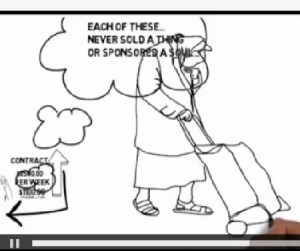
Perhaps you remember the TelexFree ad by a promoter who introduced “Aunt Ethel” by way of an artist’s rendering and accompanying narration. Ads for MLMs and network-marketing “programs” that depict an artist’s hand “drawing” the story are somewhat common.
The ads are designed to make you want to jump right in. After all, if the Aunt Ethels of the world see the value after being introduced to a “program” by a loved one or friend, well, who would question Aunt Ethel?
In a swipe at Herbalife, activist investor Bill Ackman has introduced an ad in which an artist’s hand draws the story on how to avoid pyramid schemes. One of the characters in the ad bears a striking resemblance to Herbalife CEO Michael O. Johnson.
The 6:22 ad is running on YouTube and Vimeo and is titled, “Pyramid Schemes: A Primer.” A 6:27 version in Spanish also is available.
From an ad for TelexFree.
The SEC accused TelexFree last year of operating a massive pyramid scheme. The case is important because it demonstrates that the presence of a “product” in a scheme does not take pyramid concerns off the table.
TelexFree appears to have channeled Herbalife in some ways. Herbalife, for example, called meetings “extravaganzas.” So did TelexFree. Herbalife also has been a soccer sponsor. TelexFree did the same thing.
Meanwhile, TelexFree is alleged to have targeted communities whose first languages were ones other than English. Ackman contends Herbalife targets Latinos and other members of minority communities.
Ackman has alleged for more than two years that Herbalife is a pyramid scheme. Herbalife says it is not.
Florida “Expat” and Zeek Rewards Ponzi-scheme figure T. LeMont Silver yuks it up earlier this year in the Dominican Republic. Source: YouTube.
MLM, witness your latest PR train wreck — as voiced by alleged Zeek “winner” and purported “revenue sharing” consultant/trainer and Florida “Expat” T. LeMont Silver. (Video below.)
In a consolidated motion in response to motions by various alleged Zeek “winners” to dismiss the clawback lawsuits against them, the court-appointed receiver in the Zeek Rewards Ponzi- and pyramid case has asked the court to take “judicial notice” of two YouTube videos featuring Silver, a veteran HYIP huckster.
In typical HYIP fashion that marries the merely imponderable to the truly bizarre, one of them painfully is titled, “(T. Le Mont Silver, Sr.), (7 Figure Producer) shares about Plan B part #2.” (Bold emphasis added by PP Blog.)
The HYIP sphere, the staging waters for boat sharks who throw purported rescue jackets to victims bloodied in the water from earlier scams and desperately struggling to stay afloat, is infamous for Plans B.
Although the “program” isn’t identified in the video, Silver’s Plan B appears to be the ill-fated JubiRev/JubiMax. (See June 18, 2013, BehindMLM.com story.)
MLM may have a problem with “serial participants” in Zeek-like schemes to defraud, Zeek receiver Kenneth D. Bell suggests in the motion asking the court to take judicial notice of the Silver videos.
The language chosen by the receiver is similar to language the SEC used in 2013 to describe MLM HYIP huckster Matthew John Gagnon. Gagnon, the SEC said at the time, was a “serial fraudster.”
The context of the SEC’s Gagnon prosecution may be important. Indeed, one of the “programs” he was accused of promoting was the infamous Legisi scheme, a semi-offshore debacle the SEC took down in 2008. Like Zeek, the Legisi case started with asset freezes and the appointment of a receiver.
Time slowly marched on. But in 2009, the receiver sued Gagnon. In 2010, the SEC filed civil charges against him. He was charged criminally in 2011.
Legisi, the SEC said, operated a “classic pooled investment vehicle.” In one of the Silver videos cited by the receiver, Silver describes his “Plan B” program as the operator of a “pot.”
Women between the ages of 30 and 55 were the financial targets of the “opportunity,” according to one of the videos referenced by Bell.
The video tends to suggest that Silver understood how Zeek got caught by using highly questionable “bids” as its “product” and that the MLM’s trade’s serial fraud wing immediately sought more clever disguises — hiding an HYIP scam behind the purported sale of ostensibly legitimate products such as cosmetics and diet shakes, for instance.
Silver has appeared in “many” online videos and has promoted “several ‘revenue sharing’ schemes in addition to Zeek,” receiver Kenneth D. Bell advised Senior U.S. District Judge Graham C. Mullen.
Bell supplied the court links to the videos.
In the HYIP sphere, the term “revenue sharing” is used to make schemes appear to be innocuous.
As noted above, the HYIP sphere is infamous for purported Plans B, which typically are cosmetically tweaked reload schemes designed to fleece an initial group of marks for a second time.
Here, it’s appropriate to revisit HYIP history for a second time. If you believe AdSurfDaily Ponzi schemer Andy Bowdoin caused an almost inconceivable amount of PR damage to the MLM trade by comparing the U.S. Secret Service to “Satan” and the 9/11 terrorists, wait until you get a load of what T. LeMont Silver does in one of his videos cited by the receiver. (Video appears at bottom of this column.)
By way of background, the HYIP sphere is infamous for dropping the names of famous entities and people, even if they have no ties whatsoever to the “opportunity” being presented.
Although Silver apparently isn’t selling Avon or Amway or Mary Kay or Herbalife or ViSalus in the video, he drops the names of all of them (and more). Along the way he drops in a veiled reference to Zeek, describing it as a penny auction “program” in which affiliates would “make large purchases of . . . let’s say ‘bids’,” with Zeek’s product creating a “big issue” with regulators.
Silver notes that he’ll provide “training” for the upstart “program,” positioning it as a way for average MLMers to make money without having to recruit or to orchestrate “dog and pony” presentations. Regardless, Silver assures the audience that he’s a master of the MLM dog and pony. He further suggests that, because Zeek’s “bids” had caught the attention of regulators, the trade’s braintrust now is turning toward “more traditional MLM-type products and services.”
Putting lipstick on brand-new HYIP pigs or evolving ones is part and parcel to the HYIP sphere. Silver’s video suggests that the HYIP trade has learned that sketchy products such as Zeek’s bids might not fly and now was concentrating on attracting women between the ages of 30 and 55 by wrapping cosmetics, weight-loss shakes, home products and travel into a purported “revenue sharing” model in which participants who bought in would receive “pro rata” shares from a giant revenue pot.
After suggesting he has inside information about the new HYIP regime, Silver curiously observes that he is “very, very key on genealogical integrity.” We interpret this to mean that he’d be exceptionally pleased if people with existing MLM organizations within traditional companies would port them into his next scam.
Even though he’s apparently not selling Amway in the video, he bizarrely also prompts viewers not to dare “call Amway Scamway.” Equally bizarrely, Silver congratulates the company for “legitimizing this industry” back in the 1970s by purportedly “kick[ing] the backside” of the U.S. government and the government’s “[p]atootie.”
“My goodness,” he says. “Thank you, Amway.”
Yes. T. LeMont Silver has now publicly thanked Amway for kicking the government’s ass 35 years ago and, under his interpretation of In the Matter of Amway Corporation, Inc., et al., paving the way for people to send tremendous sums of money to companies with presumptively better disguises than Zeek.
Amway is a lot of things — good and bad — to a lot of people. Unlike Zeek, however, it is not an HYIP that offered “passive” investors who sent in $10,000 or smaller sums a laugh-out-loud, average daily return of 1.5 percent, basically in perpetuity.
Gawd!
Our take on Silver’s take of the 1979 non-HYIP Amway decision is that it somehow made preposterous “revenue sharing programs” as seen in the HYIP sphere lawful or that all HYIP schemes are lawful if they have product such as those offered by Avon, Amway, Herbalife and the others. But the pyramid analysis, of course, does not exclusively hinge on whether a company has a “product.” If it did, Zeek (“bids”) and BurnLounge (“music”) would still be in business. Moreover, there would be no Bill Ackman/Herbalife dichotomy, no question about whether Herbalife was Jurassic Park or Disneyland. In short, MLM heaven on earth would not be a rumor, it would be a reality.
“Plan B,” meanwhile, is a virtual calling card of HYIP swindles, with prospects typically given instructions to join at least two “programs” in case one of them fails or to quickly join another “program” when a favored one collapses or encounters regulatory scrutiny.
Silver is a longtime pusher of “Plan B” MLM HYIPs, which, as noted above, typically call themselves “revenue sharing programs.” He’s hardly alone. Zeek figure and purported MLM expert Keith Laggos pushed the Lyoness “program” to Zeekers as a “Plan B” just prior to the Aug. 17, 2012, collapse of Zeek. (See Aug. 12, 2012, PP Blog editorial: “Karl Wallenda Wouldn’t Do Zeek.”)
Lyoness, among other things, dropped the name of Nelson Mandela in sales promos.
Among the tips Laggos provided to listeners of a Lyoness conference call was this: “Don’t put no more than 70 percent back in [Zeek]. Take out 20 or 30 percent [on] a daily basis. [Unintelligible.] This would be a good place. But, by the same token, if you put $10,000 in Zeekler, if nothing happens over the next year, you’ll probably make $30,000 or $40,000, if that’s all you do without building the front end, the matrix . . . The same amount of money in Lyoness, you’re looking . . . and not doing anything else, without single sponsoring . . . you can probably make a quarter-million dollars.”
One of the problems with HYIP schemes is that they cause polluted money to flow between and among scams, in part because the scams have serial promoters in common. The inevitable result is that payment vendors become warehouses for fraud proceeds, prompting the government to apply for asset freezes and account seizures to stop the flow of tainted cash.
Receiver Cites Second Silver Video
The second video featuring Silver — an alleged winner of more than $1.71 million in Zeek — is titled “Internet Entreprenuer Family Chooses Cabrera [Dominican Republic] For Their New Expat Lifestyle.” It shows Silver and his wife — another alleged Zeek winner — lounging in the Dominican Republic after the collapse of the Zeek scheme.
Prior to relocating to the Dominican Republic, Silver told his downline in a failed MLM “program” known as GoFunPlaces to take advantage of “low-hanging fruit” (other disaffected GoFunPlaces members) and become recruiters for a “program” known as Jubimax. The “programs” ultimately accused each other of fraud.
Silver also promoted “OneX,” which federal prosecutors in the District of Columbia described as an AdSurfDaily-like, money-circulating scheme. ASD operator Andy Bowdoin, now jailed after the collapse of the ASD fraud in 2008, also promoted OneX, explaining to prospects that they’d earn $99,000 very quickly and that he’d use the money he’d earned to pay for his criminal defense in the ASD case.
Bowdoin asserted OneX was great for college students. Silver asserted that positions being given away were worth $5,000.
Prosecutors also linked Bowdoin to AdViewGlobal, an ASD reload scam that operated as a “Plan B.” AdViewGlobal, which purported to operate offshore but actually was operating from Florida and Arizona, mysteriously vanished in the summer of 2009.
Zeek receiver Bell, who connected alleged Zeek winner Todd Disner to the ASD Ponzi scheme in court filings this week, now says in court filings that certain Zeek clawback defendants “may well be serial participants in these types of schemes.”
One of the things that makes Zeek-related litigation unique in the history of actions flowing from HYIP schemes is that Bell is not limiting his lawsuits to a relatively small universe of alleged major winners such as Silver. In a proposed class action, he’s also pursuing more than 9,000 alleged winners of smaller sums (more than $1,000 but less than $900,000), something that could have a long-needed chilling effect on serial promoters who may enter an HYIP Ponzi knowingly but less publicly.
Some early HYIP Ponzi entrants may recruit heavily at first and be satisfied with smaller sums, because the larger plan is to get out quickly on the theory smaller winners won’t be pursued.
Regulators have warned for years about the online phenomenon of “riding the Ponzi.”
California-based WCM777, an MLM “program,” got booted out of Massachusetts in November 2013, amid allegations of securities fraud and affinity fraud targeted at the Brazilian community through hotel pitchfests. WCM777, purportedly operated by Ming Xu and recruiting affiliates to conduct business over the Internet, later got booted out of California. In addition to the Brazilian community, WCM777 targeted people who speak Spanish and people who speak Chinese, perhaps Christians in particular.
Massachusetts launched a probe into TelexFree, another MLM “program” associated with hotel pitchfests and affiliate recruitment over the Internet, at least by Feb. 28 of this year — probably sooner, given the nature of WCM777. TelexFree largely is targeting speakers of Portuguese and Spanish, perhaps Christians in particular. It also has an affiliate presence in India and Africa (at least).
Although the schemes do not appear to have common ownership, both WCM777 and TelexFree offered plans that encouraged recruits to buy in at higher levels to get higher “earnings.” Affiliates of each scheme appear to have engineered subschemes in which their recruits could buy in at higher levels than the “programs” themselves advertised, potentially introducing a second layer of fraud.
What this means, in essence, is that neither TelexFree nor WCM777 may know their real bottom lines and that the firms created an environment that encouraged back-alley, illegal sales of securities and secret deal-making among individual promoters. Individuals ostensibly acting as brokers for TelexFree and WCM777 could be cherry-picking cash and not even sending it to the “program” operators. In short, certain people could be creating personal and organizational underground economies and fleecing TelexFree and WCM777 even as they fleece their own marks and recruits.
Hidden members of both “programs” may be getting paid in cash by their upline sponsors or ostensible brokers, with no record of their participation — even if they supplied cash or an equivalent to join the “programs.”
The only safe assumption in HYIP Ponzi Land is that any system that can be abused will be abused. That’s why these “programs” necessarily must be viewed through the lens of national security.
Presented below are some screen shots that demonstrate promotional ties between TelexFree and WCM777. In certain instances, the websites pictured below are promoting not only TelexFree and WCM777, but also other “programs.” One of them, for instance, is promoting the almost indescribably insidious and bizarre Banners Broker “program.”
As always is the case in HYIP investigations, the concern is that banks locally, regionally, nationally and internationally are being used by corporate scammers first as warehouses to store illicit proceeds — and later, by individual promoters at potentially thousands and thousands of locations, as virtual ATMs that provide the service of offloading the “earnings” of the promoters.
The interconnectivity of these schemes endangers local, regional, state, provincial and national economies. In many cases, promoters engage in willful blindness and simply move to another MLM HYIP scam when the current “hot” one encounters regulatory intervention or craters on its own.
It’s often the case that promoters plant the seed that a scheme has been endorsed by a government or that a corporate registration is surefire “proof” that no scam exists. Social media invariably is used to help a scheme proliferate or achieve Internet virality.
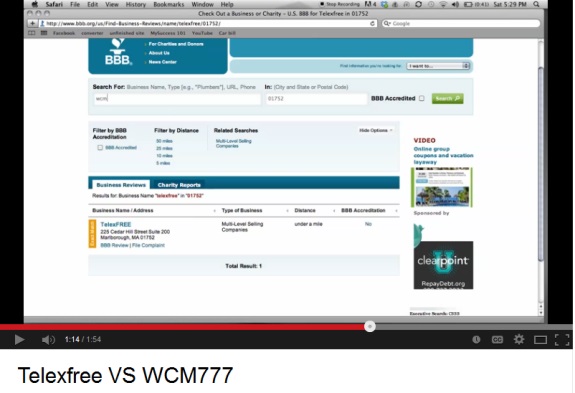
One of the shots below is from a YouTube video in which a TelexFree promoter seeks to plant the seed that TelexFree is backed by the Better Business Bureau. The narrator’s words in the video suggest he sought to plant the same seed about WCM777 but had to backtrack when he discovered a BBB listing that referred to WCM777 as a Ponzi scheme.
“Today we’re going to compare two of the most dynamic companies out there taking over right now,” the narrator said.
After recording a search of the BBB site for a TelexFree listing and finding one, the narrator suggested that the listing alone was proof that TelexFree was not a scam. He thereafter performed a search for WCM777 and found a Ponzi reference, thus triggering what appeared to be backtracking from his earlier claims that TelexFree and WCM777 were “dynamic companies.”
It also could be the case, we suppose, that he already knew about the WCM777 Ponzi listing before performing the search and that the design all along was to get people to go with TelexFree because WCM777 was a scam. Even under that interpretation, however, the video still demonstrates the underhandedness within the HYIP sphere.
The HYIP sphere always screams incongruity. Keeping that in mind, we’ll point out that one of the screen shots below shows TelexFree executive James Merrill in the same affiliate-manufactured frame as Massachusetts Commonwealth Secretary William Galvin. It was a clear bid to suggest that because TelexFree was registered as a corporation in Massachusetts, the “program” couldn’t possibly be a scam.
That is hogwash, of course. Galvin did not endorse TelexFree when his office approved a corporate registration. Besides, Galvin — as Commonwealth Secretary — oversees both the Massachusetts Corporations Division and the Securities Division. The Securities Division is probing TelexFree and possibly can rely on various documents in the Corporations Division to help investigators connect dots.
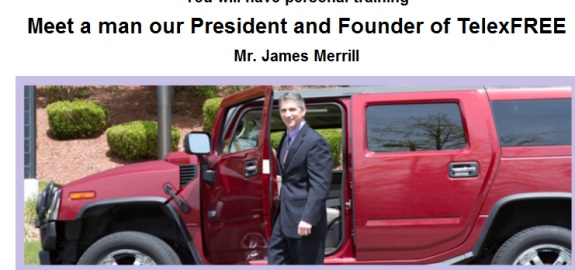
Beyond that, the website from which the screen shot promoting TelexFree by marrying images of Merrill and Galvin was taken also is promoting WCM777. Also shown below is an image from the same site in which Merrill is shown posing beside a giant SUV. Contrast that image against the image of Merrill posing in front of a large Massachusetts building as though TelexFree were its only occupant. TelexFree promoters have used the same approach, planting that seed that TelexFree owns the building and has a large physical presence in the United States.
That’s hogwash, too. TelexFree was an occupant of Suite 200 at a Regus center in Marlborough, along with dozens of other companies.
Finally, before observing the shots below, recognize that MLM itself — never a stranger to scandal — may be on the verge of experiencing a PR and legal crisis of unprecedented proportions.
People have harshly criticized hedge-fund manager Bill Ackman for attacking Herbalife. Among his contentions is that Herbalife is a pyramid scheme that targets vulnerable populations. Say what you will about Ackman’s Herbalife claims, but it is crystal clear that affinity fraud and the viral looting of impoverished/disadvantaged people have existed in the MLM realm for a long time and continues to be seen. One might even be inclined to say a market-making fraud blueprint exists within MLM: mow down one affinity cluster or population group and then move to another.
At a minimum, “programs” such as TelexFree and WCM777, which clearly have positioned themselves as wealth recipes for immigrants and vulnerable populations, can help Ackman shape and inform his Herbalife hypothesis.
James Merrill is TelexFree’s president and thus an MLM executive. TelexFree and Merrill, to date, have played into virtually every MLM stereotype that exists — everything from private jets, monster SUVs and stretch limos to business registrations and mail drops in Nevada.
Most disturbingly, though, Merrill represents an American MLM company that has been banned in Rwanda, an African nation that is trying to reverse poverty and receives aid from the World Bank. It’s hard to conceive that MLM — particularly American MLM — could card a worse PR disaster. Regardless, one could be in the offing.
Picture Story
1.
A TelexFree promoter who also promoted WCM777 extends the myth that TelexFree has a large physical presence in the United States and plants the seed that Massachusetts Commonwealth Secretary William Galvin endorsed TelexFree. Galvin’s office is investigating TelexFree after previously booting WCM777 from the state.
2.
A promoter simultaneously pitches TelexFree and WCM777. This shot is from the same site described in the photo above. The site may be based in Ecuador.
3.
This shot is from the same two sites described in the captions above — and features TelexFree President James Merrill posing with a giant SUV.
4.
This shot was taken on the same site described in the three preceding captions above. In this fourth shot, a person promoting both TelexFree and WCM777 claims that the purported parent company of WCM777 provided a loan of $20 million to a restaurant chain that sells Mexican food. The PP Blog has deleted an image of the chain’s logo that appears in the WCM777 promo. The same site plants the seed that WCM has provided hundreds of millions of dollars in loans to jewels of American business.
5.
This site features promos for various purported “opportunities,” including TelexFree and WCM777. Though not shown in the photo, the site also is promoting the uber-bizarre Banners Broker “program.” The site may be based in Italy.
6.
This site also is simultaneously promoting TelexFree and WCM777.
7.
This YouTube site describes TelexFree and WCM777 as “dynamic companies” and plants the seed that TelexFree is endorsed by the Better Business Bureau.
From a Blog leading dubious cheers for the TelexFree MLM “program.”
UPDATED 12:07 P.M. EDT (U.S.A.) You can’t blame legitimate MLMers if they’re feeling a little jittery. Herbalife, one of the industry’s stalwarts, is under investigation by the FTC, which has many duties, including enforcing laws against false advertising and pyramid schemes. Precisely why the FTC is investigating Herbalife is unknown. Hedge-fund manager Bill Ackman says Herbalife is a pyramid scheme that plumbs and churns vulnerable population groups. (See Nov. 13, 2013, PP Blog editorial: “Herbalife And Polarization In The Latino Community.”)
A public company, Herbalife itself announced the probe on March 12, saying it had received a “Civil Investigative Demand” (CID) and will “cooperate fully” with the agency.
But even as Herbalife wore a confident face and shared the FTC news, others within the MLM realm were making the trade look ridiculous on a global scale. MLM already is known for train wrecks (see example) and spectacular PR gaffes (see example). The sorry circus taking place outside of Herbalife’s immediate sphere of influence (see below) couldn’t come at a worse time for the firm.
To Herbalife’s credit, there was no attempt to demonize the FTC or pretend the CID was unimportant. So, score an early point for the supplement-maker in the category of PR awareness.
The unfortunate reality for Herbalife, however, is that it is ensconced in an industry that serves up one outrageous scam after another. And because some quirky or downright bizarre MLM “programs” have shown an almost unbelievable ability to raise tremendous sums of money quickly, the issue is not simply about a PR deficit. It’s also about national and cross-border security.
That’s why Herbalife’s conduct while it is under investigation by the FTC matters to the entire trade.
Attempts by Stepfordian MLMers to paint law enforcement as the enemy and dismiss the importance of a CID sent by North Carolina Attorney General Roy Cooper to the Zeek Rewards MLM “program” in July 2012 made MLM look silly. Claims from Zeek’s Stepfordian wing that the receipt of a CID was “exciting” news made it look beyond clueless.
Whether the trade likes it or not, all of this Stepfordian behavior gets pinned on “MLM.” And MLM therefore looked particularly ridiculous when the SEC, a month after the North Carolina CID, described Zeek as a Ponzi- and pyramid scheme that had gathered hundreds of millions of dollars in less than two years and had ripped off hundreds of thousands of people by planting the seed it paid an interest rate of 1.5 percent a day and that earnings could be “compounded.”
So, if you’re a legitimate MLMer and need a comforting thought, here’s one for you: Unlike Zeek, Herbalife isn’t trying to sell the “exciting” angle to its legions of members during a government probe. And here’s a tip for legitimate MLMers and individuals considering signing up for an MLM: When someone tells you a government investigation is exciting news, get the hell off the list or stop reading the Blog. Recognize that you’re being splashed with sugary vomit and programmed by an MLM Stepfordian.
The PP Blog’s analysis of Zeek is that it was a criminal enterprise from the start that was designed in part to reel in participants dissatisfied with traditional MLM companies such as Herbalife that sell the dream but have low distributor success rates and high burn rates. Refugees from Herbalife and other traditional MLMs were perfect marks for Zeek’s MLM, a collection of predatory vultures unlike the MLM world had ever seen.
We’re bringing this up because MLM so often ventures into Stepfordland. So, odd as it sounds, Herbalife did itself (and the industry) a favor by avoiding the word “exciting” when describing a CID. For perfectly understandable reasons, it allowed only that it “welcomes the inquiry given the tremendous amount of misinformation in the marketplace” and that it is “confident that Herbalife is in compliance with all applicable laws and regulations.”
Even though Herbalife did not fumble the ball when announcing the probe, the company still needs to work on its messaging. Last year, when the firm was confronting Ackman’s pyramid allegations and companion assertions that it was plumbing and churning Latinos/Hispanics to sustain growth, Herbalife described former U.S. Surgeon General Richard Carmona — a new appointee to its board — as “[b]orn to a poor Hispanic family in New York City.”
In highlighting Carmona’s circumstances as a newborn delivered into poverty in the Big Apple more than 60 years ago, Herbalife perhaps was projecting some stress. Whether it also was projecting an accidental hint of a Stepfordland within Herbalife remains on open question.
Given the disturbing plumbing-and-churning assertions against the firm, Herbalife would have done better by simply announcing Carmona’s appointment and including only his academic/business/public-service credentials in the announcement. It doesn’t matter that other enterprises with which he is involved have used the same line about hailing from a “poor Hispanic family” to describe him. They’re not being accused of pillaging vulnerable populations.
In short, Herbalife cannot afford to be seen as a Stepfordland company. Nothing can erode marketplace confidence faster.
Poor or even insidious messaging has harmed MLM for years. It is an industry that, unfortunately, is known for serial disingenuousness, absurd misrepresentations, gross distortions, impossible constructions and outright lies.
How Other Industry Messages Could Hurt Herbalife
On March 11, a day before Herbalife announced the FTC probe, members of the TelexFree MLM were taking to the web and planting the seed that President Obama had TelexFree’s back. The assertions are either a gross misunderstanding of the JOBS Act and the concept of raising startup capital through crowdfunding or a typical MLM lie to provide extra cover for the scheme. (See Google Translation from Portuguese to English here. See original here.)
For starters, TelexFree, which appears to have gathered $1 billion or more in less than two years, wants the public to believe it is not selling securities, despite affiliate claims the “program” delivers “passive” income. Moreover, it is not raising capital under the JOBS Act, which is a work-in-progress. In October 2013, the SEC formally proposed that a “company would be able to raise a maximum aggregate amount of $1 million through crowdfunding offerings in a 12-month period.”
The sum of $1 million is less than the sum TelexFree pitchman and former SEC defendant Sann Rodrigues says he’s earned from TelexFree since Feb. 18, 2012.
Rodrigues started pitching TelexFree before the JOBS Act even became law and before the SEC even promulgated rules. So, strike the JOBS Act claim.
Beyond that, TelexFree is under investigation by the Securities Division in its home state of Massachusetts. There’s also at least one probe in Africa, specifically in Rwanda, where a genocide occurred in the 1990s. Meanwhile, in South America, Brazilian prosecutors have called TelexFree a pyramid scheme. Police in Europe have issued warnings about TelexFree, amid concerns that the “opportunity” is targeting the Madeiran community.
At a minimum, TelexFree is at least as clueless as Zeek, home of the “exciting” CID. As noted above, TelexFree pitchman Sann Rodrigues is a former defendant in an SEC pyramid-scheme and affinity-fraud case. If that weren’t enough, TelexFree executives and reps apparently have access to a “private jet” that recently made a flight between the Dominican Republic and Haiti.
If there’s a surefire way to destroy the public’s confidence in the emerging JOBS Act, it’s for a bunch of MLMers to go around planting the seed that the President of the United States has authorized TelexFree as a crowdfunding company — and to water that seed by talking about “private jets” that can be flown by the TelexFree MLM into Haiti to line up struggling Haitians to sell credit repair and financial advice to struggling Americans.
Yes, we know: It’s altogether too much to believe. But the bitter reality for MLM — and therefore for Herbalife — is that it’s actually happening.
TelexFree says it’s in the communications business, and is expanding from VOIP into cell phones and, highly curiously, credit repair and financial advice. This is an MLM quagmire if ever there was one, especially since American MLMers say sums from $289 to $15,125 sent to TelexFree virtually triple or quadruple in a year.
If MLMers ever wonder why the trade has so many critics, they need look no further than TelexFree or Zeek before it.
With Zeek smoldering in the ashes of Ponzi/pyramid history and TelexFree serving up a current symphony of the bizarre, the MLM trade now also is confronting yet-another epic PR disaster — namely, a “program” known as WCM777 that, like TelexFree, is under investigation in multiple countries.
Like TelexFree and Zeek, WCM777 also promoted preposterous returns.
But that might be just the beginning of WCM777’s problems. Among other things, WCM777 has claimed it is “Launching The Way TV to transform nations & Joseph Global institute to train a group of Josephs to bless the world.”
But the “Joseph Global Institute” and a companion enterprise that trades on the name of Harvard appear to be shams. And The Way TV launched long ago through an entity known as Media for Christ, which became the center of an international firestorm over a production known as “Innocence of Muslims.”
Particularly disconcerting now are reports that tens of millions of dollars may have gone missing from the WCM777 coffers. In 2013, the SEC alleged that a “program” known as Profitable Sunrise may have gathered tens of millions of dollars before disappearing.
Don’t kid yourself: There is no doubt that the circumstances surrounding some MLM “programs” are affecting economic security and contributing to concerns about national security.
MLM Minefields
As noted above, precisely why the FTC is investigating Herbalife is unclear. The Zeek case initiated by the SEC, however, could supply a clue or even a specific reason for the U.S. government to be concerned about Herbalife. A look at the list of alleged “winners” by the court-appointed receiver in the Zeek case suggests that Zeek became popular in immigrant communities, which may signal MLM affinity fraud on top of Ponzi and pyramid fraud.
It also may signal immigrant-on-immigrant crime under the MLM umbrella.
This information is preliminary, meaning a more thorough analysis is needed. But it at least suggests that some MLMers are proceeding from fraud scheme to fraud scheme and either laying waste to immigrant communities in the United States or setting the stage for immigrant populations to become immersed in litigation and MLM scams.
The surname name of “Johnson,” for instance, is one of longstanding in America. So, it can be expected that a major fraud scheme with 1 million or so members such as Zeek would pull in a number of people with that last name. There are about 45 people with that name on the Zeek list.
At the same time, there are about 60 people on the list with the Asian name of “Li.” So, “Li” has significantly more appearances than “Johnson.”
And what about “Smith,” another traditional American name? Well, there are about 52 “Smiths” on the list. Contrast that with the names “Nguyen” (about 146) and “Chen” (about 137).
There also are many Latino/Hispanic names on the Zeek list. Mind you, this is the list of alleged Zeek winners, not losers. The list of losers — perhaps as many as 800,000 — is not publicly available. (Because it is believed that many Zeek members had multiple user IDs, the number of user IDs may exceed the actual number of losers. But even if the 800,000 figure only incorporates user IDs, it remains troubling. The early data on the winners’ names suggest that immigrants could have been targeted as marks by other immigrants and also by long-established American MLMers.)
Latino groups have voiced concerns about Herbalife targeting vulnerable populations. With Zeek data suggesting such targeting occurred within Zeek, the MLM trade have may to confront some tough questions: Is a mature American MLM market being shored up by a disproportionate share of recent or relatively recent immigrants? And are American MLM companies prospecting in new lands creating losing propositions for the native inhabitants of those lands?
TelexFree certainly has targeted Portuguese and Spanish speaking populations — in the United States, Brazil and elsewhere. So has WCM777, which also has targeted Asians and Asian-Americans.
People are free to criticize Bill Ackman’s assertions that Herbalife is a pyramid scheme that is targeting vulnerable populations. But if MLMers who criticize Ackman expect to be taken seriously, they’d better be able to explain what appears to have happened at Zeek and what appears to be occurring now with both TelexFree and WCM777.
U.S. MLMers of any stripe — from longstanding citizens and naturalized ones to individuals hoping one day to proudly call themselves Americans — need to say no loudly to “programs” such as Zeek, TelexFree and WCM777.
And at a minimum, Herbalife needs to stop selling a message of “get rich quick” or turning a blind eye to it and stop trying to explain away its burn rate as the byproduct of affiliates who didn’t work hard enough to realize the dream.
Herbalife cannot be blamed for Zeek, but the burn rate may explain how Zeek and similar schemes rise to cherry-pick traditional MLMers and their recruits who have made little or no money with companies such as Herbalife.
No matter what the FTC has on its mind, any assertion by Herbalife that its current program is exemplary will be the strongest evidence of all that it, too, resides in MLM La-La Land. That would be a tragedy, given that Herbalife is viewed in the MLM community as a beacon of freedom.
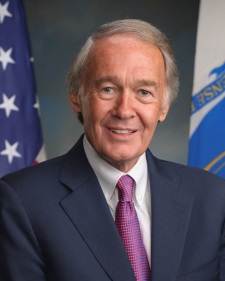
BULLETIN: Sen. Edward J. Markey, D.-Mass., has called for an investigation of Herbalife, an MLM program.
“There is nothing nutritional about possible pyramid schemes that promise financial benefit but result in economic ruin for vulnerable families,” Markey said in a statement. “Herbalife may be a purveyor of health and wellness products, but some of its distributors are suffering serious economic ill-health as a result of their involvement in the company. I have serious questions about the business practices of Herbalife and their impact on my constituents, and I look forward to receiving responses to my inquiries.”
Markey is a member of the Commerce, Science and Transportation Committee.
One family in Norton, Massachusetts reported that it lost $130,000, including the family’s entire 401(K), investing in Herbalife. Another Massachusetts resident claimed that she was encouraged to recruit new members by approaching her family and also received pressure to spend money to buy more Herbalife products so that she could qualify as a so-called “Supervisor” in the Herbalife system. She also stated that she was encouraged to stay in the program even after she said she wanted out.
Herbalife stock fell about 10.35 percent today, to $65.92, on the news of Markey’s call for probes.
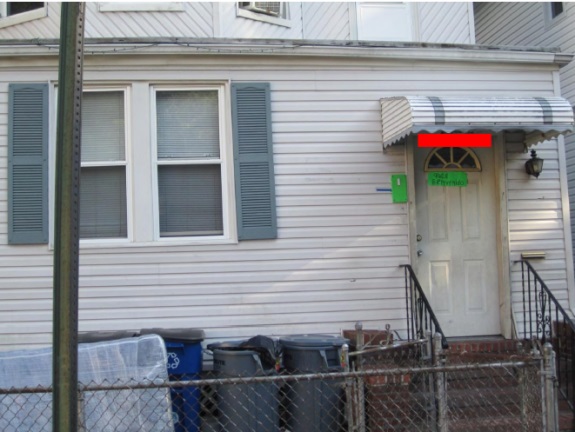
A purported “nutrition club” site visited by Bill Ackman’s team. Source: Pershing Square Capital Management LP report on Herbalife. (Red block by PP Blog.)
The PP Blog’s take on Bill Ackman’s take on Herbalife is that the Los Angeles-based MLM firm dupes prospects into believing they’re boarding the bus to Disneyland, but it’s really the bus to Jurassic Park. Latinos, African Americans and other vulnerable populations pile on bus after bus and become financial protein for the pyramid scheme of a voracious Tyrannosaurus rex.
Our take on Herbalife’s take on Ackman, meanwhile, is that if anybody’s a T.rex with a ferocious financial jaw, it’s Ackman. Herbalife, in business since 1980, is no pyramid scheme, it says.
Nearly a year has passed since Ackman showed the world photos of several purported Herbalife “nutrition clubs,” including one in which at least four trash cans and a discarded mattress were lined up outside a less-than-welcoming entrance. Through these clubs, Ackman suggests, Herbalife reps operate unlicensed restaurants by calling them places at which “social gatherings” occur, skirt local sanitation requirements and lure neighbors into becoming reps for the supplement manufacturer by offering “complimentary beverages” served in unbranded, disposable cups.
The clubs, Ackman suggests, symbolize the surreal point at which the Disneyland dream ends and the Jurassic Park nightmare with elements of black comedy begins. No legitimate business would describe these food-serving clubs with drawn blinds, seating and blenders as nonrestaurants. And a legitimate business certainly wouldn’t provide rules for their continued operation.
But that’s exactly what Herbalife did — and it did it while claiming it was an MLM company that not only wanted to tackle MLM competitors such as Nature’s Sunshine and traditional-retail competitors such as Jenny Craig, but also wanted to “go after” restaurants such as McDonald’s and KFC, Ackman contends.
If a nutrition club was located in a residential neighborhood, it was not permitted to “use exterior signage of any kind” under the Herbalife rules, Ackman says, quoting from the rules. Nonresidential sites could have a sign, but the sign must “ensure” that the “location is not perceived as a store, restaurant, franchise or similar operation.”
Say what?
Did Herbalife really signal to distributors that restaurants fit nicely within its business model as long as they weren’t called restaurants — and, in any event, to make sure they were well-hidden from the food-service police?
Ackman broadly asks his audience to ponder what would happen if McDonald’s pretended not to be in the restaurant business and published Herbalife-like talking points that operators actually were charging a “daily, weekly or monthly membership fee” to recover costs, not a fee that represented “the price or cost of products.” He specifically asks what would happen if McDonald’s instructed franchisees to go light on the signage and to pull down the blinds to fend off claims that a restaurant was operating in the shadows.
The nutrition clubs, among other Herbalife-related matters, caught the attention of the League of United Latin American Citizens (LULAC), which was none too pleased. LULAC says Herbalife needs to get a handle on its “bizarre” rules as they pertain to nutrition clubs and require them “to come into compliance with the law.”
Herbalife’s nutrition clubs are required to follow a bizarre set of rules that prohibit club owners from displaying the Herbalife logo on the outside of the store, posting prices for their products, having an open/closed sign and advertising. Clubs are required to cover their windows, sell only Herbalife products, destroy used containers, and keep products hidden until they are sold. These bizarre rules appear to be designed to bolster Herbalife’s contention that nutrition clubs are not retail stores, restaurants or food establishments when in fact that is exactly what they are because they are selling food at fixed retail locations. Herbalife distributors should demand that the company ensure its nutrition clubs are in compliance with local, state & federal health and business codes that apply to retail food outlets. Better yet the company should franchise the nutrition clubs as most other national brands have done when selling food at fixed retail locations. The “future of the company” shouldn’t depend on hiding from the law.
LULAC National Executive Director Brent A. Wilkes followed up with a Nov. 11 editorial in the Huffington Post in which he contends Herbalife engages in “predatory business practices” and “targets the Latino community in a methodical and calculated manner.”
“Somewhere between 60 to 83 percent of them are Latino,” Wilkes’ Nov. 11 editorial contends. “300,000 to 400,000 Latino distributors will quit this year alone only to be replaced by another 300,000 to 400,000 new Latino distributors. If left unchecked, Herbalife could recruit, defraud and dispose of as many as 4 million Latino distributors over the next 10 years.”
It seems that Herbalife is Jurassic Park to Wilkes, too.
The Nov. 11 editorial followed a Nov. 4 column on Fox News Latino by Rafael A. Fantauzzi, who spoke out in favor of Herbalife. Fantauzzi, according to his bio line in the piece, is president & CEO of the National Puerto Rican Coalition (NPRC) and a board member of the Hispanic Association on Corporate Responsibility (HACR).
This is among Fantauzzi’s contentions (italics added):
Herbalife has succeeded at something that quite a few companies, and the Federal government for that manner, have failed, and that is to achieve real Hispanic inclusion. Hispanics make up at least 60 percent of Herbalife’s direct selling workforce – better known as distributors.
Fantauzzi goes on to contend that “critics of Herbalife and multi-level marketing companies are confusing business ventures with a welfare program.”
Say what?
Fantauzzi explains on Fox News Latino:
Critics “assume that everyone must have equal outcomes, not just equal opportunity,” he writes. “If individuals want to become distributors/salesmen for these companies, their compensation and reward is based on the results of their effort. A worker that dedicated time and sweat and achieved high sales and promotions should be rewarded. His/her compensation should not be equal to that of an individual who did not put much effort or thought into this venture. Plain and simple, this is a business, not a charity.”
Earlier, on Oct. 29, NPRC congratulated Herbalife for appointing former U.S. Surgeon General Richard Carmona to its board. Carmona’s appointment occurred on the heels of Herbalife’s Sept. 5 announcement that it had hired former Los Angeles Mayor Antonio Villaraigosa as a senior adviser to chairman and CEO Michael O. Johnson.
In its news release introducing Carmona, Herbalife apparently felt the need to describe him in part as “[b]orn to a poor Hispanic family in New York City.” Villaraigosa, in an Herbalife-released statement about his appointment, noted that the firm has a “strong presence within the Latino community.”
It’s no secret why Herbalife is recruiting such prominent and influential Latinos for its team: The firm is under attack from Latino groups or politicians representing them, including LULAC and MANA, a national Latina organization. On Sept. 5, Tito Jackson, a Boston city councillor who said last year that children who speak Spanish as their first language or are of Latino/Hispanic descent make up 43 percent of the student body of the Boston Public School District, asked FTC Chairwoman Edith Ramirez to open an investigation into Herbalife’s business practices.
Among Jackson’s fears, according to his letter to Ramirez, is that Herbalife is a pyramid scheme that “pr[e]ys on disadvantaged populations.”
Ackman is a Harvard-educated billionaire who runs a hedge fund and is famous for upsetting Wall Street suits. He’s also an Herbalife short-seller who’d benefit if the stock price craters. Herbalife naturally detests him.
But if Bill Ackman is right — if Herbalife is Jurassic Park — it will be the greatest call since Harry Markopolos called Bernard Madoff a Ponzi schemer and federal prosecutors later called him an affinity fraudster with enough hubris to chomp down on human souls for decades.
If Ackman is wrong — if Herbalife is Disneyland or the government comes to believe it would create too much market uproar by even bringing a case or could lose any case it did bring — Herbalife might emerge as a category creator: an MLM company deemed too bizarre to fail.
This “Badass Content” on Empower Network was about the tragic death of a key Herbalife salesman.
If you’re an MLM company facing a PR problem or a crisis involving the firm and its distributors, don’t expect fellow MLM firm Empower Network to solve it for you. In fact, it’s probably prudent to expect that Empower Network will only magnify your bad press or virally blab the things you’re trying to keep in-house.
To the uber-bizarre Empower Network, the sudden death of a top Herbalife distributor is “badass content” that plays well alongside other Empower Network “badass content” such as a story posted by “Team America” and titled, “Ingredients for Success: An Interview with Nu Skin President and CEO Truman Hunt.”
Background
Herbalife, according to BehindMLM.com, notified distributors last week about the death of John Peterson, saying in an email that Peterson had died as a result of “a tragic accident at his home in Steamboat Springs, Colorado.”
“Tragic” was an apt descriptor, to be sure, especially since the New York Post reported that authorities were looking at the death as a suicide carried out with a gun while the MLM trade tries to come to grips with assertions by Bill Ackman that Herbalife is a pyramid scheme. Peterson was 58, married and the father of three children. He reportedly had earned millions of dollars through Herbalife, in part by driving business to the firm through a purported “leads” program.
Herbalife denies it is a pyramid scheme and has sought to distance itself from such “leads” programs.
But returning to the subject of all this purported “Badass Content”: The “Team America” post about Nu Skin on Empower Network appears to have been lifted in its entirety from the trade publication Direct Selling News by an Empower Network affiliate interested in getting more sign-ups for Empower Network by using DSN’s Nu Skin story as a lure.
Meanwhile, Herbalife’s in-house announcement about the death of Peterson appears also to have been cherry-picked by Empower Network affiliates, reposted on Empower Network’s Blogging platform, repurposed as “Badass Content” and used to lure sign-ups for Empower Network.
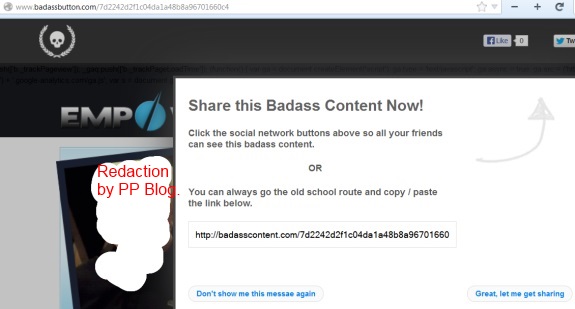
When one clicks the incongruous “Badass” button above the Empower Network postings about Peterson’s death, one is taken to a page that in part reads, “Share this Badass Content Now! Click the social network buttons above so all your friends can see this badass content.”
Yes, really. The death of an Herbalife pitchman in the prime of his life while his family grieves qualifies as “Badass Content” on Empower Network.
Another part of the message points visitors to a domain styled “BadassContent.com,” which is registered in the name of David Sharpe of Empower Network LLC. Sharpe is one of EmpowerNetwork’s purported founders, and the LLC is listed as a Florida company with Sharpe as one of its two managers. When the PP Blog tried to visit the “badass” URL about Peterson’s death, the McAfee SiteAdvisor security software used by the Blog issued a “Suspicious Site” warning and a message that in part read, “When we visited this site, we found it exhibited one or more risky behaviors.”
McAfee SiteAdvisor warning about “badasscontent” domain. Red highlights by PP Blog.
Empower Network also appears to control a domain styled BadassButton.com.
On Aug. 12, the PP Blog reported that a video playing on YouTube sought to drive traffic to Empower Network by depicting U.S. Vice President Joe Biden as a recent enrollee in the bizarrely named CashCropCycler HYIP “program” who confesses to President Obama that he’s “[j]ust out bumbling around and sticking my foot in my mouth.”
But if you complain to YouTube about Empower Network, according to David Wood, another of the purported founders, there may be hell to pay, so you should “Back the fuck down.”
“Be warned: BIG, SCARY WARNING,” Wood wrote. “I’m in the process of having lawyers research into whether or not we can sue the shit out of you.”
Yes, really. Welcome to the MLM La-La Land of Empower Network. It’s like the La-La Lands of Zeek Rewards and AdSurfDaily and MPB Today needed a replacement and that some of MLM’s purported greatest thinkers have decided that what the MLM world really needs is even more madness.
Can there be any doubt that MLM is just asking for it?
One self-described Christian pastor and Empower Network promoter on YouTube tells his audience that there’s money to be made in Empower Network, despite all the swearing. Just tune it out and recognize that swearing is a personal choice and hardly is limited to the MLM sphere, he instructs.
“This is just an open environment where we accept everybody of all types of beliefs, whether you’re a Christian or an Atheist or a Jew or a Muslim — or, you know, you . . . believe in Scientology and all that good stuff,” the pastor explains.
He added that he looked at network marketing in general as an “opportunity to be able to advance the kingdom of God” and at Empower Network in specific as a “vehicle to help you to get the money that God wants you to have so that you can advance the kingdom of God.”
Had the pitch for Empower Network appeared on Empower Network instead of YouTube, the pastor could have given his God talk its very own “Badass” button (with a representation of a human skull included) to drive traffic.
The only remaining mysteries, we suppose, is whether God, being God, would have cared enough to solve the little problem McAfee has with the “badass” domain — and whether He’d be offended that His name, once again, was being used to promote an MLM “program.”
Did we tell you that the PP Blog received information today that strongly suggested that some “sovereign citizens” were pitching a scheme by which winners in the Zeek Rewards MLM scheme, which the SEC has described a year ago as a $600 million fraud, could short-circuit “clawback” litigation from the court-appointed receiver?
We’ll keep you up to date as that MLM La-La Land story develops.
EDITOR’S NOTE: The PP Blog called the Federal Trade Commission to get its take on these news releases, which use the agency’s name and imply that the FTC recently has given several MLM “opportunities” a clean bill of health. The agency did not immediately respond.
What would you think if you read a headline on Google News yesterday such as this: “Herbalife Pyramid Scheme Rumors Untrue: FTC Speaks out on Pyramid Definition.”
Would you think, perhaps, that the FTC recently had conducted an investigation into Herbalife’s business practices and “spoke out” yesterday in defense of the firm after determining that it had been subjected unfairly to “rumors” that it was orchestrating a pyramid scheme — and that any questions about the the legality of Herbalife had been laid to rest by the government?
And what would you think if you read headlines such as these:
Each of the headlines listed above has appeared online in recent days — some of them carried by Google News, which published the feeds of SBWire, a news-release service. The release that uses both the FTC’s name and Herbalife, for example, carries an Aug. 5 dateline from Altamonte Springs, FL. The release that references the FTC and Javita carries an Aug. 2 dateline from Orlando, FL.
The release on Javita uses this deck: “Javita Pyramid Scheme question answered. FTC decides on Pyramid meaning.” Meanwhile, the release on Herbalife carries this deck: “Herbalife Pyramid Scheme Accusations Are Without Merit. Consumers Can Now Intelligently Determine Themselves Herbalife Pyramid Allegations Are Not True Based On FTC Pyramid Definition.”
The release that references Herbalife goes on to assert that Herbalife is “not a pyramid scheme at all by the FTC’s definition.”
Each of the news releases referenced above appears to be a bid to sell an MLM “leads” program by planting the seed that the FTC recently has given the green light to each of the companies. The basis of the claims curiously appears to be a 15-year-old speech (May 13, 1998) an FTC official gave on the subject of pyramid schemes that in part defined pyramid schemes as schemes that “promise consumers or investors large profits based primarily on recruiting others to join their program, not based on profits from any real investment or real sale of goods to the public.”
That the speech was given in 1998 and may have less relevance 15 years later was not made clear in any of the news releases. Beyond that, the thinking of agencies such as the FTC and SEC may evolve as the schemes themselves evolve.
In the 1998 speech, the FTC official went to to say (italics added):
“Some schemes may purport to sell a product, but they often simply use the product to hide their pyramid structure. There are two tell-tale signs that a product is simply being used to disguise a pyramid scheme: inventory loading and a lack of retail sales. Inventory loading occurs when a company’s incentive program forces recruits to buy more products than they could ever sell, often at inflated prices. If this occurs throughout the company’s distribution system, the people at the top of the pyramid reap substantial profits, even though little or no product moves to market. The people at the bottom make excessive payments for inventory that simply accumulates in their basements. A lack of retail sales is also a red flag that a pyramid exists. Many pyramid schemes will claim that their product is selling like hot cakes. However, on closer examination, the sales occur only between people inside the pyramid structure or to new recruits joining the structure, not to consumers out in the general public.”
We’ll leave it to you to decide if it is wise for MLmers to try to shoehorn a 15-year-old speech into news releases in 2013 that imply the FTC recently has scrubbed each of the “opportunities” referenced above and made a legal conclusion that no pyramid schemes exist.
Shares of MLM company Herbalife were halted this morning after its auditor — KPMG — issued a statement yesterday that it was informed “late last week” that “the partner in charge of KPMG’s audit practice in our Los Angeles business unit was involved in providing non-public client information to a third party, who then used that information in stock trades involving several West Coast companies.”
KPMG did not specifically mention Herbalife in its statement. Nor did the auditing firm say who informed it that its “partner in charge” was involved in chicanery. KPMG did, however, say that it had fired the partner and was “resigning” two clients.
The Wall Street Journal is reporting that Herbalife shares were “halted minutes after the opening bell due to news pending.”
Separately, the New York Times is reporting that Herbalife “is poised to disclose on Tuesday that KPMG will have to resign as the company’s auditor.”
That disclosure now has occurred — and trading in Herbalife shares has resumed.
Herbalife said this morning in a statement that KPMG wallked away from the company after stating “it had concluded it was not independent because of alleged insider trading in Herbalife’s securities by one of KPMG’s former partners.”
That former partner was the KPMG engagement partner on Herbalife’s audit until April 5, Herbalife said.
“KPMG advised the Company it resigned as Herbalife’s independent accountant solely due to the impairment of KPMG’s independence resulting from its now former partner’s alleged unlawful activities and not for any reason related to Herbalife’s financial statements, its accounting practices, the integrity of Herbalife’s management or for any other reason,” Herbalife said.
Herbalife has been the subject of a battle between titans Carl Icahn, who is bullish on the company, and Bill Ackman, who claims Herbalife is a pyramid scheme. On its website, Herbalife denies it is either a pyramid scheme or a Ponzi scheme.