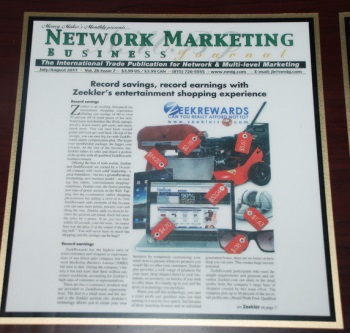
In December 2013, these plaques of Network Marketing Business Journal Zeek puff pieces were put up for auction by the court-appointed receiver for Zeek. On March 22, 2017, the SEC charged former NMBJ publisher Keith Laggos with securities fraud.
Keith Laggos, an AdSurfDaily Ponzi scheme figure and the onetime publisher of Network Marketing Business Journal, has been charged by the SEC with securities fraud for illegally touting the Zeek Rewards scheme and using NMBJ to sanitize the egregious fraud that gathered hundreds of millions of dollars.
Among the agency’s allegations is that “Laggos’s favorable editorials of the scheme contained material misstatements and omissions. Laggos published theses misstatements despite being made aware of their inaccuracy and otherwise being in a position as a paid consultant for ZeekRewards to know of their falsity.”
The former .com site for NMBJ now is showing a “For Sale” sign.
From an SEC statement on March 23, 2017 (italics added):
The SEC alleges that, from at least June 2011 through July 2012, Laggos, through NMBJ and while acting a paid consultant for ZeekRewards, was paid at least $64,000 for publishing several editorials providing crucial publicity to the ZeekRewards scheme. These publications promoted ZeekRewards as the “company of the month” and touted, among other things, the scheme’s supposed record earnings and opportunity to generate income for participants. Laggos failed to disclose the fact that he was paid for the favorable editorial coverage, the amount that he was paid, and that he was a paid consultant for ZeekRewards.
Laggos, a prior defendant in an SEC touting case, agreed to pay $79,190.68 to settle the Zeek matter, the SEC said. In addition, he agreed to a permanent injunction from future violations of Sections 17(a) and 17(b) of the Securities Act, from participating in future securities offerings and from providing paid publicity to securities.
The SEC moved against Zeek on Aug. 17, 2012. (See Aug. 12, 2012, PP Blog editorial that references Laggos: “Karl Wallenda Wouldn’t Do Zeek.”)
One of the core signatures of an HYIP scam is highlighted when a “program” is presented as a “Plan B,” typically in the context of creating “multiple income streams” or “in case Plan A fails, you’d better have a “Plan B.”
Zeek Rewards A-lister Keith Laggos gushed about Lyoness, his “Plan B” program. Zeek collapsed in a pile of Ponzi rubble and Lyoness later caught the attention of authorities in Australia.
Fellow Zeek A-Lister T. LeMont Silver pushed an ill-fated series of Plans B such as JubiMax/JubiRev and GoFunRewards/GoFunPlaces.
Now it has come to pass that a “program” whose actual name is Plan B reportedly has encountered a police raid in Europe in which money and expensive cars were seized. Perhaps showcasing its Stepfordian mindlessness, the “program” added “4you” to its name, becoming “PlanB4You.”
AdVentures4U, a similar MLM fraud, tried a similar tactic before crashing in 2009. That “program” was a “Plan B” for MLM scammers who earlier had joined the AdSurfDaily and AdViewGlobal MLM scams.
If the PlanB4You name wasn’t enough of a giveaway that the “program” was one to be avoided, PlanB4You’s presence on the MoneyMakerGroup Ponzi forum provided another one. (It’s on TalkGold, too.)
From a Zhunrize slide as viewed through Open Office. Red highlight by PP Blog.
2ND UPDATE 5:25 P.M. EDT U.S.A. Purported “Plans B” are one of the core signatures of the the MLM HYIP sphere, which is known for incredibly toxic global frauds such as Zeek Rewards and AdSurfDaily. In 2009, an ASD reload scam known as AdViewGlobal was positioned as a “Plan B.”
The individual schemes of Zeek and ASD took in a combined sum of at least $969 million. AdViewGlobal appears to have disappeared with millions of dollars — after targeting ASD victims for a second time.
Laggos’ listeners were told that, if things went south at Zeek, Lyoness would be an excellent hedge through which $10,000 directed at the scheme might return “a quarter-million dollars.”
“Plan B” also is known as “Don’t put all your eggs in one basket.” HYIP prospects often are told to join more than one scheme or to quickly get in another if something goes wrong with the current scheme, sometimes known as “Plan A.”
Plan B schemes typically are a means by which prospects are lured into a continuous cycle of MLM frauds. Zeek and OneX promoter T. LeMont Silver later went on to “Plan B” schemes such as GoFunPlaces/GoFunRewards and JubiMax/JubiRev. Those schemes cratered or encountered difficulties. Silver now is pushing the exceptionally murky BitClub Network “opportunity” as a Plan B.
MLM HYIP schemes may switch forms. They may appear as straight-line investment-fraud schemes such as Legisi, which collapsed after an SEC intervention in 2008. ASD was an “autosurf advertising” scheme that collapsed in 2008 after an intervention by the U.S. Secret Service. Zeek, a purported “penny auction” company, collapsed in 2012 after an SEC intervention.
The trend now appears to be to wrap traditional products such as cosmetics and diet shakes into murky and confusing schemes that pay recruitment commissions. No specific payout may be mentioned.
The phrase “Plan B” even appears in promo material for Zhunrize. The material also references Plan A. Based on this information, it appears as though Zhunrize was touting itself as both a “Plan A” and “Plan B” scheme.
“Do you know anyone who would like to develop a plan ‘A’ Or plan ‘B’?” the Zhunrize promo queries.
In the promo, Zhunrize prospects are told they can earn “thousands each month by helping others to save time, gas, money and avoiding crowds.”
One of the problems in this bizarre sphere of MLM is that tainted money from earlier scams may flow into emerging scams, in effect making banks and payment vendors warehouses for a continuous stream of fraud proceeds that flow between and among pyramid schemes and Ponzi schemes.
Like Lyoness, Zhunrize is involved in the shopping-portal business. Like Zeek and other “programs,” Zhunrize also was positioned as a “profit-sharing” or “revenue-sharing” opportunity.
Case files associated with various recent HYIP/revenue-sharing schemes put losses in the billions of dollars. Because some promoters simply move from one scam to another, they are eviscerating wealth on a global scale.
If someone pitches you on an MLM “Plan B,” run like the wind.
BULLETIN: (Updated 2:35 p.m. EDT U.S.A. Aug. 29) Lyoness, the purported “Plan B” scheme of Zeek Rewards and AdSurfDaily figure Keith Laggos, has been charged in Australia with operating a pyramid scheme.
News of the Australian prosecution was published tonight by BehindMLM.com.
The Australian Competition and Consumer Commission has instituted proceedings against Lyoness International AG, Lyoness Asia Limited, Lyoness UK Limited and Lyoness Australia Pty Limited (together ‘Lyoness’) for operating a pyramid selling scheme and engaging in referral selling.
Although Lyoness has been investigated by regulators for conduct in other countries, this is the first court action taken against Lyoness alleging that the Lyoness Loyalty Program constitutes a pyramid scheme.
Pyramid schemes involve new participants providing a financial or other benefit to other existing participants in the scheme. New participants are induced to join substantially by the prospect that they will be entitled to benefits relating to the recruitment of further new participants. Pyramid schemes may also offer products or services, but making money out of recruitment is their main aim, and often the only way for a member to recover any money is to convince other people to join up. In contrast, people in legitimate multi-level marketing schemes earn money by selling genuine products to consumers, not from the recruiting process.
The ACCC alleges that Lyoness has operated the scheme in Australia from mid-2011 and that it continues to operate the scheme. The scheme offers ‘cash back’ rebates to members who shop through a Lyoness portal, use Lyoness vouchers or present their Lyoness card at certain retailers.
Whilst cash back offers themselves are not prohibited by the Australian Consumer Law (ACL), the ACCC alleges that the Lyoness scheme also offers commissions to members who recruit new members who make a down payment on future shopping.
“Pyramid schemes are often sophisticated and may be operated under the guise of a legitimate business. Although these schemes can appear to be legitimate, the most significant inducement for new members to get involved is to earn ‘residual’ or ‘passive’ income from new members signing up,” ACCC Chairman Rod Sims said.
“The concern with pyramid schemes is that the financial benefits held out to induce potential members to join up rely substantially on the recruitment of further new members into the scheme. For these schemes to work so that everyone can make a profit, there would need to be an endless supply of new members.”
“Under the Australian Consumer Law, it is illegal not only to establish or promote a pyramid scheme, but also to participate in one in any capacity,” Mr Sims said.
The ACCC also alleges that the conduct by Lyoness breached the ACL prohibition on ‘referral selling’, where a consumer is induced to buy goods or services by the promise of a commission or rebate contingent on a later event.
The ACCC is seeking declarations, pecuniary penalties, injunctions, an order requiring the Lyoness website to link to the case report and costs.
As Lyoness International AG, Lyoness Asia Limited and Lyoness UK Limited are located overseas, the ACCC will be making arrangements for service on those entities.
The first Directions Hearing in these proceedings will be at 9.30am on 16 September, 2014 before Justice Flick in Sydney.
Laggos pushed Lyoness as a “Plan B” to members of Zeek Rewards, suggesting in 2012 that it could be used as a “passive” hedge in case things went south at Zeek. Indeed, things did go south at Zeek: The U.S. Securities and Exchange Commission (SEC) described it as an international Ponzi- and pyramid scheme that had gathered hundreds of millions of dollars while engaging in securities fraud and selling unregistered securities as investment contracts.
Among the tips Laggos provided Zeekers on a Lyoness conference call was this: “Don’t put no more than 70 percent back in [Zeek]. Take out 20 or 30 percent [on] a daily basis. [Unintelligible.] This would be a good place. But, by the same token, if you put $10,000 in Zeekler, if nothing happens over the next year, you’ll probably make $30,000 or $40,000, if that’s all you do without building the front end, the matrix . . . The same amount of money in Lyoness, you’re looking . . . and not doing anything else, without single sponsoring . . . you can probably make a quarter-million dollars.”
News of the Lyoness action in Australia was received on the same day that TelexFree was squaring off against both the SEC and federal prosecutors in Boston over matters pertaining to scheduling. TelexFree was charged by the SEC in April 2014 with operating a massive Ponzi- and pyramid scheme. The agency had charged Zeek less than two years earlier
TelexFree figures James Merrill and Carlos Wanzeler were indicted in July 2014 on criminal charges of wire fraud and wire-fraud conspiracy.
Lawyers from both sides are battling over contentious issues such as whether the SEC’s civil case should be stayed (delayed indefinitely) in favor of the criminal case and whether Merrill can receive a speedy, fair trial on the criminal side of things.
An enormous amount of evidence remains to be sifted through by both sides.
“The United States Attorney’s office has contacted the parties indicating that it intends to seek a stay of these proceedings while the criminal case is pending and sought assent from the parties,” the SEC and defense attorneys said in a joint filing in the agency’s civil case today. “The parties have not unanimously assented to a stay.”
On the criminal side of things, Merrill contended today that his right to a fair trial would be put at risk if prosecutors were permitted to use “additional press releases and newspaper notices” to contact potential TelexFree victims.
“Every press release and/or newspaper notice issued by the government will likely repeat the government’s characterization of TelexFree and Mr. Merrill” as a pyramid scheme and a pyramid schemer, Merrill attorney Robert Goldstein contended.
And, Goldstein argued, “Mr. Merrill hereby respectfully opposes the government’s motion for complex case designation and exclusion of time . . . wherein the government seeks the exclusion of 90 days commencing on September 10, 2014, and instead respectfully asks the Court to defer a ruling regarding the exclusion of any time until the September 10, 2014 status conference (i.e., after the defense has had at least a minimal amount of time to review the government’s automatic discovery production, which was received today.”
Among other things, prosecutors contended that “evidence underlying this case is closely tied to certain foreign countries, especially Brazil” and that “it is likely that the parties will need to review evidence in foreign countries and arrange for foreign witnesses and/or law enforcement officers to travel to the United States to testify at trial.”
Schemes that operate over the Internet may grow to affect hundreds of thousands of people. Cases can become extremely complex if a pyramid or Ponzi scheme (or both) are alleged.
Regulators have warned for years that the schemes may use intricate disguises and exceptionally complex mechanics to ward off prosecutions. Cross-border schemes can pose monumental challenges to law enforcement.
Florida “Expat” and Zeek Rewards Ponzi-scheme figure T. LeMont Silver yuks it up earlier this year in the Dominican Republic. Source: YouTube.
MLM, witness your latest PR train wreck — as voiced by alleged Zeek “winner” and purported “revenue sharing” consultant/trainer and Florida “Expat” T. LeMont Silver. (Video below.)
In a consolidated motion in response to motions by various alleged Zeek “winners” to dismiss the clawback lawsuits against them, the court-appointed receiver in the Zeek Rewards Ponzi- and pyramid case has asked the court to take “judicial notice” of two YouTube videos featuring Silver, a veteran HYIP huckster.
In typical HYIP fashion that marries the merely imponderable to the truly bizarre, one of them painfully is titled, “(T. Le Mont Silver, Sr.), (7 Figure Producer) shares about Plan B part #2.” (Bold emphasis added by PP Blog.)
The HYIP sphere, the staging waters for boat sharks who throw purported rescue jackets to victims bloodied in the water from earlier scams and desperately struggling to stay afloat, is infamous for Plans B.
Although the “program” isn’t identified in the video, Silver’s Plan B appears to be the ill-fated JubiRev/JubiMax. (See June 18, 2013, BehindMLM.com story.)
MLM may have a problem with “serial participants” in Zeek-like schemes to defraud, Zeek receiver Kenneth D. Bell suggests in the motion asking the court to take judicial notice of the Silver videos.
The language chosen by the receiver is similar to language the SEC used in 2013 to describe MLM HYIP huckster Matthew John Gagnon. Gagnon, the SEC said at the time, was a “serial fraudster.”
The context of the SEC’s Gagnon prosecution may be important. Indeed, one of the “programs” he was accused of promoting was the infamous Legisi scheme, a semi-offshore debacle the SEC took down in 2008. Like Zeek, the Legisi case started with asset freezes and the appointment of a receiver.
Time slowly marched on. But in 2009, the receiver sued Gagnon. In 2010, the SEC filed civil charges against him. He was charged criminally in 2011.
Legisi, the SEC said, operated a “classic pooled investment vehicle.” In one of the Silver videos cited by the receiver, Silver describes his “Plan B” program as the operator of a “pot.”
Women between the ages of 30 and 55 were the financial targets of the “opportunity,” according to one of the videos referenced by Bell.
The video tends to suggest that Silver understood how Zeek got caught by using highly questionable “bids” as its “product” and that the MLM’s trade’s serial fraud wing immediately sought more clever disguises — hiding an HYIP scam behind the purported sale of ostensibly legitimate products such as cosmetics and diet shakes, for instance.
Silver has appeared in “many” online videos and has promoted “several ‘revenue sharing’ schemes in addition to Zeek,” receiver Kenneth D. Bell advised Senior U.S. District Judge Graham C. Mullen.
Bell supplied the court links to the videos.
In the HYIP sphere, the term “revenue sharing” is used to make schemes appear to be innocuous.
As noted above, the HYIP sphere is infamous for purported Plans B, which typically are cosmetically tweaked reload schemes designed to fleece an initial group of marks for a second time.
Here, it’s appropriate to revisit HYIP history for a second time. If you believe AdSurfDaily Ponzi schemer Andy Bowdoin caused an almost inconceivable amount of PR damage to the MLM trade by comparing the U.S. Secret Service to “Satan” and the 9/11 terrorists, wait until you get a load of what T. LeMont Silver does in one of his videos cited by the receiver. (Video appears at bottom of this column.)
By way of background, the HYIP sphere is infamous for dropping the names of famous entities and people, even if they have no ties whatsoever to the “opportunity” being presented.
Although Silver apparently isn’t selling Avon or Amway or Mary Kay or Herbalife or ViSalus in the video, he drops the names of all of them (and more). Along the way he drops in a veiled reference to Zeek, describing it as a penny auction “program” in which affiliates would “make large purchases of . . . let’s say ‘bids’,” with Zeek’s product creating a “big issue” with regulators.
Silver notes that he’ll provide “training” for the upstart “program,” positioning it as a way for average MLMers to make money without having to recruit or to orchestrate “dog and pony” presentations. Regardless, Silver assures the audience that he’s a master of the MLM dog and pony. He further suggests that, because Zeek’s “bids” had caught the attention of regulators, the trade’s braintrust now is turning toward “more traditional MLM-type products and services.”
Putting lipstick on brand-new HYIP pigs or evolving ones is part and parcel to the HYIP sphere. Silver’s video suggests that the HYIP trade has learned that sketchy products such as Zeek’s bids might not fly and now was concentrating on attracting women between the ages of 30 and 55 by wrapping cosmetics, weight-loss shakes, home products and travel into a purported “revenue sharing” model in which participants who bought in would receive “pro rata” shares from a giant revenue pot.
After suggesting he has inside information about the new HYIP regime, Silver curiously observes that he is “very, very key on genealogical integrity.” We interpret this to mean that he’d be exceptionally pleased if people with existing MLM organizations within traditional companies would port them into his next scam.
Even though he’s apparently not selling Amway in the video, he bizarrely also prompts viewers not to dare “call Amway Scamway.” Equally bizarrely, Silver congratulates the company for “legitimizing this industry” back in the 1970s by purportedly “kick[ing] the backside” of the U.S. government and the government’s “[p]atootie.”
“My goodness,” he says. “Thank you, Amway.”
Yes. T. LeMont Silver has now publicly thanked Amway for kicking the government’s ass 35 years ago and, under his interpretation of In the Matter of Amway Corporation, Inc., et al., paving the way for people to send tremendous sums of money to companies with presumptively better disguises than Zeek.
Amway is a lot of things — good and bad — to a lot of people. Unlike Zeek, however, it is not an HYIP that offered “passive” investors who sent in $10,000 or smaller sums a laugh-out-loud, average daily return of 1.5 percent, basically in perpetuity.
Gawd!
Our take on Silver’s take of the 1979 non-HYIP Amway decision is that it somehow made preposterous “revenue sharing programs” as seen in the HYIP sphere lawful or that all HYIP schemes are lawful if they have product such as those offered by Avon, Amway, Herbalife and the others. But the pyramid analysis, of course, does not exclusively hinge on whether a company has a “product.” If it did, Zeek (“bids”) and BurnLounge (“music”) would still be in business. Moreover, there would be no Bill Ackman/Herbalife dichotomy, no question about whether Herbalife was Jurassic Park or Disneyland. In short, MLM heaven on earth would not be a rumor, it would be a reality.
“Plan B,” meanwhile, is a virtual calling card of HYIP swindles, with prospects typically given instructions to join at least two “programs” in case one of them fails or to quickly join another “program” when a favored one collapses or encounters regulatory scrutiny.
Silver is a longtime pusher of “Plan B” MLM HYIPs, which, as noted above, typically call themselves “revenue sharing programs.” He’s hardly alone. Zeek figure and purported MLM expert Keith Laggos pushed the Lyoness “program” to Zeekers as a “Plan B” just prior to the Aug. 17, 2012, collapse of Zeek. (See Aug. 12, 2012, PP Blog editorial: “Karl Wallenda Wouldn’t Do Zeek.”)
Lyoness, among other things, dropped the name of Nelson Mandela in sales promos.
Among the tips Laggos provided to listeners of a Lyoness conference call was this: “Don’t put no more than 70 percent back in [Zeek]. Take out 20 or 30 percent [on] a daily basis. [Unintelligible.] This would be a good place. But, by the same token, if you put $10,000 in Zeekler, if nothing happens over the next year, you’ll probably make $30,000 or $40,000, if that’s all you do without building the front end, the matrix . . . The same amount of money in Lyoness, you’re looking . . . and not doing anything else, without single sponsoring . . . you can probably make a quarter-million dollars.”
One of the problems with HYIP schemes is that they cause polluted money to flow between and among scams, in part because the scams have serial promoters in common. The inevitable result is that payment vendors become warehouses for fraud proceeds, prompting the government to apply for asset freezes and account seizures to stop the flow of tainted cash.
Receiver Cites Second Silver Video
The second video featuring Silver — an alleged winner of more than $1.71 million in Zeek — is titled “Internet Entreprenuer Family Chooses Cabrera [Dominican Republic] For Their New Expat Lifestyle.” It shows Silver and his wife — another alleged Zeek winner — lounging in the Dominican Republic after the collapse of the Zeek scheme.
Prior to relocating to the Dominican Republic, Silver told his downline in a failed MLM “program” known as GoFunPlaces to take advantage of “low-hanging fruit” (other disaffected GoFunPlaces members) and become recruiters for a “program” known as Jubimax. The “programs” ultimately accused each other of fraud.
Silver also promoted “OneX,” which federal prosecutors in the District of Columbia described as an AdSurfDaily-like, money-circulating scheme. ASD operator Andy Bowdoin, now jailed after the collapse of the ASD fraud in 2008, also promoted OneX, explaining to prospects that they’d earn $99,000 very quickly and that he’d use the money he’d earned to pay for his criminal defense in the ASD case.
Bowdoin asserted OneX was great for college students. Silver asserted that positions being given away were worth $5,000.
Prosecutors also linked Bowdoin to AdViewGlobal, an ASD reload scam that operated as a “Plan B.” AdViewGlobal, which purported to operate offshore but actually was operating from Florida and Arizona, mysteriously vanished in the summer of 2009.
Zeek receiver Bell, who connected alleged Zeek winner Todd Disner to the ASD Ponzi scheme in court filings this week, now says in court filings that certain Zeek clawback defendants “may well be serial participants in these types of schemes.”
One of the things that makes Zeek-related litigation unique in the history of actions flowing from HYIP schemes is that Bell is not limiting his lawsuits to a relatively small universe of alleged major winners such as Silver. In a proposed class action, he’s also pursuing more than 9,000 alleged winners of smaller sums (more than $1,000 but less than $900,000), something that could have a long-needed chilling effect on serial promoters who may enter an HYIP Ponzi knowingly but less publicly.
Some early HYIP Ponzi entrants may recruit heavily at first and be satisfied with smaller sums, because the larger plan is to get out quickly on the theory smaller winners won’t be pursued.
Regulators have warned for years about the online phenomenon of “riding the Ponzi.”
URGENT >> BULLETIN >> MOVING: (8th Update 2:40 p.m. ET March 4, U.S.A.) The court-appointed receiver in the Zeek Rewards Ponzi- and pyramid-scheme case has sued alleged insiders and net winners, including members of the 2008 AdSurfDaily Ponzi scheme.
Parts of the complaint read like a re-living of the ASD scheme, with Zeek Receiver Kenneth D. Bell alleging Zeek’s penny-auction arm (Zeekler) was in trouble early on and that Zeek operator Paul Burks borrowed money from another insider to keep things going. The fraud later expanded massively, Bell alleged.
At one point, according to Bell, former Zeek COO Dawn Wright-Olivares “excitedly” told Burks, “I think we can blow this OUT together — we’ve already attracted a great many big fishes.”
But the insiders “were aware that the payouts to Affiliates would be funded by new participants rather than retail profits from the penny auctions,” Bell alleged.
Named defendant “insiders” were Burks of Lexington, N.C.; Wright-Olivares of Clarksville, Ark.; Daniel Olivares of Clarksville, Ark.; the estate of the late Roger Anthony Plyler of Charlotte; Alexandre “Alex” de Brantes, the husband of Wright-Olivares and a resident of Clarksville, Ark.; and Darryle Douglas of Orange, Calif.
Burks, the receiver alleged, received “in excess” of $10 million from Zeek; Wright-Olivares received more than $7.8 million; Daniel Olivares received more than $3.1 million; Plyler, who once lent money to Burks, received more than $2.3 million; Douglas received more than $1.975 million. An amount was not listed for de Brantes.
Named winners were former AdSurfDaily member Todd Disner of Miami (more than $1.875 million); former ASD member Jerry Napier of Owosso, Mich. (more than $1.745 million); Trudy Gilmond of St. Albans, Vt. (more than $1.75 million); Durant Brockett of Las Vegas (more than $1.72 million); Darren Miller of Coeur d’Alene, Idaho (more than $1.635 million); Rhonda Gates of Nashville (more than $1.425 million); Michael Van Leeuwen, also known as “Coach Van” of Fayetteville, N.C. (more than $1.4 million); David Sorrells of Scottsdale, Az. (more than $1 million); T. Le Mont Silver Sr. of Orlando, Fla. (more than $773,000 under at least two user names, and more than $943,000 through a Florida shell entity known as Global Internet Formula Inc. with one or more Zeek user names).
One of Silver’s usernames was “mentor,” Bell alleged.
Also named winners were Karen Silver, Silver’s wife (more than $600,000); veteran HYIP pitch team Aaron and Shara Andrews of Lake Worth, Fla. (more than $1 million through a Florida shell entity known as Innovation Marketing); David and Mary Kettner of Peoria, Az. (more than $930,000 via one or more user names and shell companies known as Desert Oasis International Marketing LLC and Kettner & Associates LLC); Lori Jean Weber of Land O’Lakes, Fla. (more than $1.94 million through a shell company known as P.A.W.S. Capital Management LLC).
Bell also sued a “Net Winner Class” of as many as 9,000 U.S. residents or entities who allegedly harvested illicit gains of $1,000 or more from Zeek. Lawsuits against international winners will come later, Bell said.
In December 2013, Wright-Olivares and Olivares were charged criminally. They pleaded guilty last month for their roles in the scheme and are liable for more than $11.4 million in restitution and penalties, the SEC said.
As the SEC previously alleged, Zeek relied on a so-called “80/20” program to sustain the Ponzi deception. Bell today built on that theme. From the complaint against insiders (italics added/spacing modified):
Dawn Wright-Olivares explained and promoted the plan in a Skype chat as follows:
Here’s a scenario here where you could be receiving $3,000 per month RESIDUALLY. Let’s use a 1% daily cash-back figure in this example (Please note: This is only an example and the actual amount will vary day to day).
When you reach 50,000 points in your account, then you could start doing an 80/20 cash-out plan. Pay close attention? When you hit 50,000 points in your account, if the daily cash-back percentage is 1%, ZeekRewards will be awarding you with $500.00 each day. First of all, did you catch that? … you’re making $500 per day … it’s your money! Ok, the 80/20 plan works like this, take 80% of that $500 (or $400) and purchase more VIP bids to give away to new customers as samples to continue growing your points balance.
Then, keep doing what you’ve been doing every day, which primarily consists of giving free bids away as samples and placing one free ad per day for Zeekler.com’s penny auctions and submitting into your ZeekRewards back office. Then, pull out 20% of the $500 (or $100) and request a check weekly. That’s $700 per week, or about $3,000 per month in residual income! And keep in mind, these amounts can continue to grow day after day and month after month.
HYIP schemes, including ASD and Zeek, often implement deceptions such as 80/20 programs as part of a bid to reduce cashout amounts to let the scheme continue to live. Insiders and veteran Ponzi pushers typically know they’re a crock.
Daniel Olivares, Bell said, has a Zeek user name of “dcolive.”
On June 14, 2012, about two months prior to the collapse of Zeek, RealScam.com moderator and PP Blog poster “Glim Dropper” posted a link on the PP Blog that established a tie between Zeek promoters and ASD promoters. ASD was a $119 million Ponzi scheme operated by now-jailed operator Andy Bowdoin.
RealScam.com is an antiscam forum.
The link “Glim Dropper” posted was at a URL styled “dcolive.com.”
From “Glim Dropper’s” observations at the time (italics added):
I’d draw your attention to about five minutes into the call when Dawn recalls a conversation with Jerry Napier. Jerry was quoted as loving ZR and never wanting to have to build another organization with another program and mentioned a previous program and the litigation it was still facing and he mentioned “similarities” between ZR and that previous program.
It is common in the HYIP sphere for promoters to move from one fraud scheme to another.
Napier’s exposure to ASD is unknown. But the Zeek receiver now says Napier received illicit gains of more than $1.745 million. The alleged illicit Zeek gains of former fellow ASD member Todd Disner are even higher: $1.875 million.
Precisely how many ASD members went on to join Zeek is unclear. What is clear is that both firms used similar business models and sweetened the deal for certain members.
Bell alleged today that Zeek had a “Sweet 16” deal in which participants paid $999 to mine even more “passive” gains.
“The Sweet 16 was another means by which [Rex Venture Group] made payments on a passive investment,” Bell alleged. “It did not involve the sale of a product, nor did it require a member to recruit other participants into the program.”
Disner once filed suit against the United States, alleging its ASD Ponzi case was a “tissue of lies” and a “house of cards.” A federal judge tossed the lawsuit, after Bowdoin pleaded guilty to wire fraud and admitted ASD was a Ponzi scheme.
Sann Rodrigues (right) will be a headliner at a TelexFree event scheduled next month in Spain. Source: TelexFree rolling promo on website.
Calling Sann Rodrigues its “TOP PROMOTER IN THE WORLD,” the alleged TelexFree pyramid scheme curiously has announced that Rodrigues will be a headliner at a TelexFree rah-rah session in Spain on March 1 and 2.
An image of Rodrigues now rolls across TelexFree’s website. But the promo does not mention that Rodrigues was successfully sued by the U.S. Securities and Exchange Commission in federal court in Massachusetts in 2006. The agency alleged that he was presiding over a pyramid scheme known as FoneClub and engaging in affinity fraud targeted at the Brazilian and Brazilian-American communities in Massachusetts.
A federal judge held Rodrigues, also known as Sanderley R. De Vasconcelos, “jointly and severally liable” with FoneClub for “$3,269,459 in disgorgement plus $151,928.49 in prejudgment interest,” the SEC said in 2007.
Prosecutors in Brazil have alleged that TelexFree is a massive pyramid scheme. The purported “opportunity” operates from Massachusetts, the same venue from which Rodrigues was sued by the SEC.
In the AdSurfDaily Ponzi-scheme case in 2008, the U.S. Secret Service alleged that neither ASD nor a business partner disclosed that the partner had been an SEC defendant in a successful 1997 prosecution that alleged the partner had pitched three prime-bank swindles, including one that advertised a return of 10,000 percent.
ASD was a $119 million Ponzi scheme targeted in part at the Christian community, federal prosecutors alleged.
In the $850 million Zeek Rewards’ Ponzi- and pyramid scheme in 2012, former SEC defendant Keith Laggos emerged as a key cheerleader. Laggos was sued by the SEC in 2004 in a case that alleged he didn’t disclose he was being paid to tout stock.
It won’t be quite like buying Bonnie and Clyde’s fateful getaway car, but it still will represent a purchase of American crime or fraud history. In Lexington, N.C., tomorrow — on the second and final day of the court-approved Zeek Rewards auction — pieces of MLM Ponzi-scheme history will be put up for bid.
And in Zeek’s case, it’s branded history: cases of water bottles with Zeekler.com branding, cases of coffee mugs with ZeekRewards branding, cases of key chains with Zeekler branding, cases of refrigerator magnets with Zeekler branding.
The taglines on the Zeek coffee mugs read, “save money — make money.”
Auctioneers also have put something called the “Zeek-Israel Jerusalem Trophy” up for bid.
Also on the auction list are plaques of Zeek puff pieces that appeared in the July-August 2011 edition of Network Marketing Business Journal. Here’s the headline: “Record savings, record earnings with Zeekler’s entertainment shopping experience.”
About a year after the July-August 2011 NMBJ article appeared, the SEC alleged that Zeek was a $600 million Ponzi and pyramid fraud. ASD was a $119 million Ponzi scheme exposed by the U.S. Secret Service in 2008.
Plenty of gift cards, furniture, computer equipment and other items linked to Zeek also are up for bid tomorrow.
In terms of the number of victims — somewhere on the order of 800,000 — Zeek is believed to be the largest Ponzi scheme in U.S. history. Kenneth D. Bell is the court-appointed receiver.
UPDATED 7:36 P.M. ET (U.S.A.) Let’s say you’re out there feverishly flogging the TelexFree MLM even as the pyramid-scheme probe moves forward in Brazil, a judge and prosecutor have been threatened with death and TelexFree executive Carlos Costa is pulling an Andy Bowdoin and telling the world that God used him to bring the purported opportunity to the flock.
There’s always risk associated with HYIP schemes. Now, however, it seems those risks are becoming even greater.
Here is a key fact: The sender used an IP based in France that has been associated by Project Honeypot with comment-spamming — pitches for porn sites and sites that purport to give you a good price on designer goods in advance of a predicted “downturn,” for example. (Basic message: You can look wealthy even if you’re not, even after the economy tanks. Buy your knockoffs now and look good when the sky is falling on your life.)
The sender, now adding HYIP schemes to the porn and designer-good mix from that specific IP, used a handle that incorporated the word “Silver” within its overall handle and sought to plant a URL at the PP Blog to a Panamanian venture that advertises a custody service for precious metals. The PP Blog is declining to publish the URL and the name of the enterprise which, among other things, reproduces on its website the logos of an internationally famous insurer based in London and an internationally famous accounting firm based in Chicago. The site also publishes various contact phone numbers in the United States, Panama, New Zealand, Australia, Switzerland, the United Kingdom and Hong Kong. Although there is a chance that the service is legitimate, the PP Blog questions why someone or some thing is spamming links to the precious-metals site and loading them up further with links to “positive” coverage of seemingly unrelated HYIPs.
For the purposes of this PP Blog post, the Panamanian venture is a sidebar tidbit. Far more interesting was the body content of the spam, which appears to be a compendium of gushing affiliate pitches for TelexFree that appear on the net. The spam appears to have been cobbled together by a human scraper or scraping device of some sort that had visited one or more TelexFree-related websites. Links embedded in the spam are the “real story” in the context of this PP Blog post.
So, for starters, TelexFree’s name is being used as part of a bid to drive traffic to a precious-metals website on which visitors curiously are told they must provide 15 days’ notice if they wish to visit the office in Panama City. The PP Blog likely was targeted by the spammer simply because the word “TelexFree” appears here many times in reports about TelexFree-related events in Brazil and the United States.
The spammer — be it bot or human — appears to have made the calculation that TelexFree members might be the perfect customers for the precious-metals venture. Contained within the spam were three links: One to a site styled TelexFreeUnitedStates and two to a URL-shortening service that redirected visitors to Photobucket, the popular image-hosting and story-sharing website.
Here’s where the story really begins . . .
One of the picture stories told at at the Photobucket site was told inside a subfolder of a folder labeled “aaronsharazeek.” (Emphasis added.) The subfolder was slugged “First Zeek Red Carpet Event April 18th 2012.” Zeek conducted a Red Carpet event on that date.
The SEC moved against Zeek on Aug. 17, 2012. On the same date, the Secret Service said it also was investigating Zeek. Court records suggest the SEC began the Zeek probe at least by April 17, 2012, one day before the April 18 Zeek Red Carpet event highlighted within the “aaronsharazeek” folder on Photobucket.
On April 17, 2012, according to court filings, the SEC tasked an IT specialist to “conduct Website/video capture” of ZeekRewards.com.
Paul Burks appears to have been in deep thought on April 18, 2012, one day after the SEC tasked an IT specialist to capture content from Zeek Rewards.com. This is a slice of a photo from a larger photo that appears on Photobucket in a folder labeled “First Zeek Red Carpet Event April 18 2012.”
Precisely when Zeek operator Paul R. Burks found out about the SEC probe remains unclear. But photos inside the “First Zeek Red Carpet Event April 18th 2012” subfolder at the Photobucket site show a Burks who appears to be in deep thought. One can only wonder what 66-year-old Burks was thinking about on that date. His health? His wife’s stress level, given the noise Zeek was creating in the small town of Lexington, N.C.? His ability to keep Zeek going? The prospect that investigators were closing in?
There are 18 other photos in the Red Carpet event subfolder, some showing Zeek luminaries such as former SEC defendant Keith Laggos, former Zeek COO Dawn Wright-Olivares, former Zeek videographer OH Brown (looking happy), former Zeek trainer Peter Mingils (identified in one photo as the “V.P. of the Association of Network Marketing Professionals”). Other photos of Zeek personalities/staffers appear in the folder, as do photos showing attendees.
Absent the “Silver”/TelexFree spammer, the PP Blog likely never would have seen these photos.
Also within the “aaronsharazeek” folder at Photobucket is a subfolder slugged “Zeek Trip,” and subfolders slugged “Banners Broker” and “telexfree.” The “Zeek Trip” folder appears to contain four photos of Zeek-related real estate in Lexington, N.C. (In the ASD Ponzi case, affiliates suggested that ASD couldn’t possibly be illegitimate because ASD had an office. The same thing has been asserted by TelexFree promoters.)
Meanwhile, the “Banners Brokers” folder contains a video of a sales pitch, and the “telexfree” folder contains images of government documents from the state of Massachusetts and the country of Brazil that appear to have been designed to plant the seed that TelexFree couldn’t possibly be a scam.
Taken as a whole, the various folders and photos demonstrate the interconnectivity of MLM HYIP schemes, regardless of who actually controls the Photobucket site. It is known from other sources that some Zeekers also were in the JSSTripler/JustBeenPaid scam and the exceptionally murky Profitable Sunrise scam shut down by the SEC and various state regulators earlier this year.
Banners Broker is an uber-bizarre Ponzi-board program. On July 2, 2013, the PP Blog reported that MLM attorney Kevin Thompson said that the name of his law firm had been used by scammers in a bid to dupe members of Banners Broker and Profit Clicking, the JSS/JBP-associated “program” linked to Frederick Mann that may have ties to the extremist “sovereign citizens” movement. The July 2 PP Blog post was titled, “Law Firm’s Name Used In Bid To Dupe Members Of Banners Broker, Profit Clicking, MLM Attorney Says.”
Within the July 2 post, the PP Blog reported that it had received menacing messages in apparent “defense” of Banners Broker. As the Blog reported at the time (italics added):
WARNING: The next paragraph includes quoted material from one of the Jan. 18, 2013, spams, and the PP Blog is reproducing it to illustrate the bizarre and often menacing nature of the HYIP sphere. Indeed, the apparent Banner’s Broker supporter wrote (italics added):
” . . . I am Big Bob’s cock meat sandwich. Your mom ate me and made me do press ups until I threw up . . . I am gonna report you. When you make false accusations, you can get done. Maybe you will be seen in court soon . . .”
It is as ugly today as it was on the January date the PP Blog received the communication.
Why “programs” such as TelexFree, Zeek Rewards, BannersBroker and ProfitClicking become popular with people of faith is one of the head-scratching mysteries of current times. Gold fever, of course, is nothing new; it’s been around for centuries. What’s at least relatively new in the Internet Age is that the gold- and silver-sellers appear to be piggybacking off HYIP pitchmen, apparently hoping to rope in customers for shiny-object schemes.
This “comment” sent to the PP Blog on Nov. 22 sought to drive traffic to a precious-metals site by planting a link to the site and also planting links related to TelexFree.
On Oct. 25, the PP Blog reported that an alleged shiny-object scheme had taken root in Zeek’s back yard in North Carolina. On June 19, the PP Blog reported that the receiver in the Legisi HYIP Ponzi case was going after assets linked to E-Bullion, a collapsed payment processor with shiny-object woo. James Fayed, E-Bullion’s operator, is sitting on death row in California after a jury found him guilty of arranging the brutal contract slaying of his own wife.
The Legisi scheme was targeted at Christians, and E-Bullion’s cheerleaders included the Canadian clergyman Brian David Anderson, who was sent to U.S. federal prison in 2010 for the Frontier Assets Ponzi scheme. Anderson also was linked to the Flat Electronic Data Interchange (FEDI) HYIP scheme that put Abdul Tawala Ibn Ali Alishtari, also known as “Michael Mixon,” in federal prison after his September 2009 convictions for financing terrorism and fleecing FEDI investors.
Yes, financing terrorism.
Alishtari traded on his purported ties to prominent politicians, just like ASD’s Andy Bowdoin. At least one of the schemes linked to Alishtari and Anderson used the term “rebates,” just like ASD. The narrative surrounding FEDI read like impossibly outrageous fiction, a mind-bending example of a shiny-object scheme. Ten members of purported “Royal families” in the Middle East were said to have set aside “50 Billion in Gold” ($5 billion each) to advance the scheme. Another entity in the Middle East was said to have supplied a “total of 100 Billion in Gold.” Still another entity was said to have put up “500 Million dollars in liquid gold assets.”
FEDI marks were solicited to purchase what effectively were trading desks that somehow would enable them to profit on the coattails of Middle East royals interested in escrowing huge sums to fund worldwide construction projects, with money purportedly flowing to the “labor” force. If that weren’t enough, the scheme purportedly was married to a venture that purportedly would put vending machines in at least 50,000 locations. The vending machines purportedly would sell debit cards, and were purportedly backed by $150 billion in gold and an insurance policy in Canada.
In March 2012, the PP Blog reported on FTC allegations that three Florida companies and a Florida man had roped customers into a shiny-object scam, a precious-metals boondoogle allegedly carried out by telemarketers.
Imagine what would happen if a scamming telemarketing firm had the customer lists for TelexFree, Zeek, Banners Broker, Profit Clicking, AdSurfDaily, Legisi and others.
If the MLM industry seeks to win favor on Main Street and stop being the brunt of jokes, it needs to act forcefully to eradicate these schemes. MLM attorneys need to stop permitting schemes to trade on their names, thus potentially setting the stage for prospects to believe that no scam could be occurring because no lawyer would permit his name to be used in this fashion.
But even today, what does one get when one visits the website of TelexFree? A pitch in which the alleged TelexFree pyramid scheme announces its pride at having MLM lawyer Gerald Nehra on board.
Zeek traded on the name of MLM attorney Kevin Grimes, who comes off in Red Carpet Day shots as a Zeek crowd prop, and also the name of Nehra. Bidify traded on Kevin Thompson’s name. The lawyers should not permit this to happen. And they should stop making personal appearances at “opportunity” events and start questioning why so many of these “programs” are targeted at people of faith and promise or suggest the likelihood of absurd returns.
Profitable Sunrise — perhaps recognizing that an MLM scheme can be made to appear legitimate if affiliates simply are provided the name of a purported lawyer — appears to have conjured up an attorney’s name out of thin air. It then allegedly proceeded to run off with millions and millions of dollars. When ASD’s Bowdoin switched from the two scams that eventually put him in prison (ASD and AdViewGlobal) and began pitching the alleged OneX pyramid scheme, one of the first things he did was assure the former ASD members he was pitching in a webinar that OneX had an “attorney,” adding that the venture was a great fit for college students. Bowdoin, mixing in God talk during the October 2011 webinar, never identified the purported lawyer by name. Neither did a former ASD pitchwoman pitching the OneX scheme alongside Bowdoin.
In the absence of self-imposed, self-regulatory restraints in the MLM industry — lawyers restraining themselves from becoming accidental or purposeful stage props and sanitizers of “programs,” for example — MLM prospects may be well-advised to view any MLM “program” with the highest degree of skepticism, regardless of the programs’ wares.
Every single one of the “programs” referenced in this story has ridden on the coattails of a deity and lawyers. It did not matter whether the lawyers were real or imagined.
And it did not matter that the Gods of many faiths were observing it all, perhaps mournfully wondering how the precious Children of the Earth had come to view MLM money as the maximum deity.
MLM pitchmen and AdSurfDaily figures Todd Disner and Dwight Owen Schweitzer — both of whom went on to become promoters of the alleged Zeek Rewards Ponzi scheme — have accused a federal judge of “sophistry.”
Sophistry, according to Dictionary.com, means “a subtle, tricky, superficially plausible, but generally fallacious method of reasoning.”
Disner turned to MLM after his days as a founder of the Quiznos sandwhich franchise. Schweitzer is a former attorney whose license was suspended in Connecticut. Both men live in southern Florida.
The curious assertion by Disner and Schweitzer against U.S. District Judge Rosemary Collyer appeared on Collyer’s court docket in the District of Columbia on Sept. 17, one month to the day after the SEC alleged in the western District of North Carolina that the Zeek Rewards MLM “program” was a $600 million Ponzi scheme and pyramid fraud that potentially had affected more than 1 million people.
Senior U.S. District Judge Graham C. Mullen of the western District of North Carolina is presiding over the Zeek case. Kenneth D. Bell is the court-appointed receiver.
Zeek and ASD are known to have members in common.
The ASD Ponzi scheme, which collapsed in 2008, affected at least 97,000 people and created at least 9,000 victims, federal prosecutors said.
Disner and Schweitzer also were pitchmen for ASD, which federal prosecutors in the District of Columbia have described as a $119 million Ponzi scheme marketed MLM-style. The ASD duo sued the United States in November 2011, claiming their records in ASD’s database were private and thus unlawfully seized and accusing federal prosecutors and a U.S. Secret Service agent of presenting a “tissue of lies” when bringing the civil- forfeiture case against $65.8 million in the bank accounts of ASD President Andy Bowdoin in August 2008.
On Aug. 29, Collyer sentenced Bowdoin to 78 months in federal prison. Bowdoin, 77, pleaded guilty to wire fraud in May 2012, admitting in a statement of offense that ASD was a Ponzi scheme and that his business never operated lawfully from its inception in 2006.
But Disner and Schweitzer now claim Bowdoin’s admission “was a necessary part of his plea bargain” with the government. They further assert that Bowdoin’s admission was the “coerced confession of an 80 year old man.”
In court filings in May, however, Bowdoin said this:
“I have read this Plea Agreement and discussed it with my attorneys, Michael McDonnell, Esq. and Charles Murray, Esq. I fully understand this Plea Agreement and agree to it without reservation. I do this voluntarily and of my own free will, intending to be legally bound. No threats have been made against me nor am I under the influence of anything that could impede my ability to understand this Plea Agreement fully. I am pleading guilty because I am in fact guilty of the offense(s) identified in this Plea Agreement.” (Italics/bolding added by PP Blog.)
In the filing docketed Sept. 17, Disner and Schweitzer claim the Secret Service “manufactured” events to ensure that the ASD case was heard by Collyer. Earlier, Disner and Schweitzer advanced a theory that undercover agents who joined ASD in 2008 had a duty to identify themselves to ASD management.
Even after Bowdoin pleaded guilty in May, Disner and Schweitzer contended that the government’s case was a “house of cards,” according to court filings.
Disner and Schweitzer now have asked for their lawsuit to be reopened and to have Collyer removed from the case. In ASD-related litigation, Collyer has ordered the forfeiture of more than $80 million.
The bid by Disner and Schweitzer to have Collyer removed from ASD-related litigation is at least the third. In 2009, purported “sovereign” being Curtis Richmond unsuccessfully sought to have Collyer removed. So did Bowdoin.
Disner is now involved with purported Zeek Rewards consultant Robert Craddock in an effort to raise money to challenge either the SEC or the court-appointed receiver in the Zeek case.
Among the early theories advanced by Craddock was that Mullen — the judge in the Zeek case — was playing politics by appointing Bell’s firm as the receiver to enable the firm to gorge itself on fees.
Both ASD and Zeek were accused of selling unregistered securities as investment contracts. The U.S. Secret Service brought the ASD case, with the SEC bringing the Zeek case.
The Secret Service confirmed on Aug. 17 that it also was investigating Zeek. The SEC said that, since January 2011, Zeek had “raised more than $600 million from approximately 1 million investors nationwide and overseas by making unregistered offers and sales of
securities through the ZeekRewards website in the form of Premium Subscriptions
and VIP Bids.”
Zeek was an arm of North Carolina-based Rex Venture Group LLC and was operated by Paul R. Burks, the SEC said.
In their filing accusing Collyer of sophistry, Disner and Schweitzer appear to suggest that Collyer needs a lesson in MLM from purported MLM expert Keith Laggos and MLM attorney Gerald Nehra.
Laggos, an SEC defendant in a 2004 case that alleged he issued laudatory press releases without disclosing he was being compensated, is listed in court records as a Zeek consultant. Laggos settled the 2004 SEC case without admitting or denying liability but agreeing to pay more than $30,000, including a $19,500 civil penalty.
Laggos once opined that ASD was not a Ponzi scheme. Nehra also opined that ASD was not a Ponzi scheme. Richard W. Waak, Nehra’s law partner, is listed in court filings by Zeek as an attorney for the firm.
Screen shot: Accused Ponzi schemer Paul R. Burks of Rex Venture Group LLC advised Senior U.S. District Judge Graham C. Mullen of the Western District of North Carolina today about Zeek's relationships with various financial vendors. The alleged Zeek Rewards Ponzi scheme operated through Rex Venture..
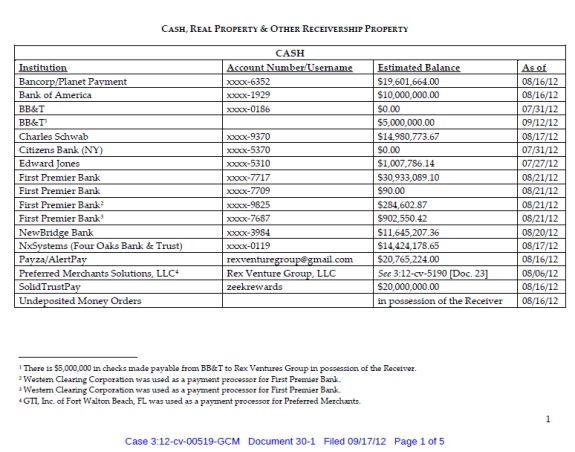
BULLETIN: (UPDATED 9:18 P.M. EDT U.S.A.) New court filings by accused Ponzi schemer Paul R. Burks of Rex Venture Group LLC show that Zeek Rewards had more than $40 million in offshore payment processors.
Included in that sum is $20.765 million in Canada’s AlertPay/Payza, and $20 million in Canada’s SolidTrustPay.
Today’s filing also shows $10 million on deposit at Bank of America. Court filings in the AdSurfDaily Ponzi scheme case brought by the U.S. Secret Service in 2008 show that ASD also banked at Bank of America.
On Aug. 17, the SEC alleged that North Carolina-based Zeek was a massive online Ponzi- and pyramid scheme that had gathered $600 million since January 2011. Filings by Burks today suggest Zeek did it all with fewer than 40 employees, including part-time contractors such as attorneys and consultants in areas such as payroll, accounting, compliance and marketing.
Included among the consultants listed by Burks was Keith Laggos, a purported MLM expert. Laggos once opined that AdSurfDaily was not a Ponzi scheme. ASD President Andy Bowdoin later admitted that it was. Bowdoin was sentenced last month to 78 months in federal prison.