Tag: Kenneth D. Bell

  • URGENT >> BULLETIN >> MOVING: Federal Judge Denies Alleged Zeek Winners’ Motion To Intervene In Case And Dissolve Receivership

    breakingnews72URGENT >> BULLETIN >> MOVING: (3RD UPDATE 8:44 P.M. EDT U.S.A.) Senior U.S. District Judge Graham C. Mullen has denied a motion by alleged winners in Zeek Rewards to intervene in the SEC’s Ponzi-scheme case and to dissolve the receivership.

    In December 2012, alleged Zeek “winners” Trudy Gilmond and Kellie King asked Mullen for permission to intervene in the case and to end the court-appointed receivership, arguing that Zeek did not sell securities as defined under federal law.

    Mullen today denied the motion on both fronts.

    Kenneth D. Bell is the receiver. He opposed the Gilmond/King motion. So did the SEC, which described Zeek in August 2012 as a $600 million Ponzi- and pyramid fraud selling unregistered securities through Rex Venture Group LLC in North Carolina.

    Gilmond may have more than $1.364 million at risk in a clawback lawsuit. King potentially faces a claim from Bell for more than $205,180, according to court filings.

    “Gilmond and King seek to improperly interfere with a settled SEC enforcement action against defendants Rex Venture Group and Paul Burks to deny the Receiver the ability, as directed by the Court, to marshal the estate’s assets for the benefit of all aggrieved ZeekRewards investors,” the SEC argued in January. “The Motion to Intervene is a transparent attempt to obtain prospective relief in an improper forum with respect to clawback litigation the Receiver has yet to initiate.”

    For his part, Bell said Gilmond and King were engaging in “delaying tactics.”

    Gilmond and King are represented by Ira Lee Sorkin, Bernard Madoff’s defense attorney.

    “The issue Gilmond and King seek to litigate — whether the ZeekRewards program was an ‘investment contract’ or ‘security’ — has been resolved for the purposes of this settled SEC enforcement action,” the SEC argued in January.  “As a result, Proposed Intervenors assert no ‘claim or defense that shares with the main action a common question of law or fact.’  Thus, there is no basis for intervention.

    “Finally,” the SEC continued, “Proposed Intervenors provide no factual or legal support for their request to dissolve the receivership in this matter.  Therefore, the Motion to Intervene should be denied in its entirety.”

    Mullen did just that today.

    Zeek operator Paul R. Burks consented to a judgment in the SEC case in August 2012.

    NOTE: Thanks to the ASDUpdates Blog.

  • URGENT >> BULLETIN >> MOVING: Threshold Dollar Number For Zeek Rewards’ Net Winners To Avoid Receivership Litigation Now Public; At Least 136 Settlement Agreements Ironed Out, Receiver Says

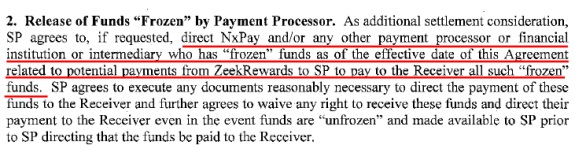
    From a June 28 filing by the court-appointed receiver in the Zeek Rewards Ponzi-scheme case. (Red highlights by PP Blog.)
    From a June 28 filing by the court-appointed receiver in the Zeek Rewards Ponzi-scheme case. “SP” stands for “Settling Party.” (Red highlights by PP Blog.)

    URGENT >> BULLETIN >> MOVING: (UPDATED 8:05 P.M. EDT U.S.A.) From the standpoint of avoiding financial accountability, it may have become more difficult for serial scammers who foist HYIP scams on the international public to thumb their noses at law enforcement and the courts. The court-appointed receiver in the Zeek Rewards Ponzi scheme case has revealed the threshold dollar number used to determine who received emails offering a settlement: That number, according to filings by receiver Kenneth D. Bell, was only $1,000.

    The lowness of the number could send shockwaves across the HYIP Ponzi universe. On well-known Ponzi-scheme forums such as TalkGold and MoneyMakerGroup, serial HYIP scammers routinely pooh-pooh court actions and claim that neither the government nor receivers will bother to seek recoveries from low-level players and “winners” in scams.

    Confident that they’ll never be held accountable, some purveyors move from one HYIP fraud scheme to another.

    In August 2012, the SEC described Zeek as a $600 million Ponzi- and pyramid scheme. Both the SEC and the receiver quickly were demonized on the Ponzi boards.

    Docketed in the Western District of North Carolina yesterday, Bell’s filing makes it plain that he expects any net winner who received $1,000 or more to pay up — and there is no guarantee that the number could not go lower in the future. Beyond that, a provision of the settlement agreement frees the receiver effectively to force net winners who may have money frozen in NxPay “and/or any other payment processor” or bank to make those funds payable to the receivership estate.

    Zeek used NxPay, AlertPay and SolidTrustPay. AlertPay (now Payza) and SolidTrustPay are longtime favorites of Ponzi purveyors and their shills on the fraud forums. Zeek was based in Lexington, N.C.

    If the Zeek settlement stipulations as outlined by the receiver are approved or accented by the court, it would mean that Zeek’s serial HYIP players and their recruits could not hope to stymie law-enforcement agencies and the receiver by waiting them out and removing “profits” from the payment processors or banks at a later date.

    At least 136 Zeek winners have agreed to settlements after being approached by the receiver, Bell said. Virtually all of the settlements have included a substantial discount on the order of 40 to 50 percent. The discount amounts, Bell has said, will enable the receivership to collect some money for Zeek victims without going to the additional expense of filing lawsuits.

    Winners who cooperated early with the receivership may stand to gain much better deals than stragglers who potentially could be held accountable for more lucrative dollar sums if successfully sued. Zeek had more than 2 million user IDs, Bell has said. About 1 million affiliates paid money to Zeek, which may have a universe of tens of thousands of “winners.”

    The $1,000 threshold in the early settlement emails was established after the receivership consulted with the SEC, according to a filing yesterday by Bell.

    Here are a several examples of the existing settlement agreements, according to the June 28 filing (bolding added):

    • A Zeek winner of $1,254 has agreed to a settlement of $600 “to be paid within 7 days of the effective date of this agreement.”
    • A Zeek winner of $9,249 has agreed to a settlement of $4,500 “to be paid as follows: $375 a month for 12 months beginning in April 2013 (to be paid by the 25th of each month).”
    • A Zeek winner of $28,909 has agreed to a settlement of $22,000 “to be paid as follows: $6,000 within 15 days of the effective date of the agreement and then eight payments of $2,000 due on the 15th day of each following month.”
    • A Zeek winner of $114,000 has agreed to a settlement of  “$47,500 to be payable on or before May 31, 2013.”
    • A Zeek winner of $170,440 has agreed to a settlement of “$84,981 to be payable in one payment of $23,165 on or before June 15, 2013 with the remainder ($61,770) to be paid by July 15, 2013 or in 10 equal consecutive monthly payments of $6,177.60 beginning on or before July 15, 2013 and to be paid by the fifteenth day of each following month.”
    • A Zeek winner of $176,000 has agreed to a settlement of “$88,000 to be paid within 7 days of the effective date of this agreement.”

    As things stand, Bell has settled with winners of more than $3.2 million for better than $1.81 million. The “Settlement as % of Winnings” is listed as 56.12 percent in the June 28 filing.

    NOTE: Our thanks to the ASD Updates Blog.


  • Zeekers Share Their Conspiracy Theories At Newspaper Site

    zeekmemdayThe Dispatch of Lexington, N.C., published a story June 7 to update readers on Zeek Rewards-related litigation — specifically the date of a hearing on a motion by certain Zeek members (alleged net winners) to dissolve the receivership. (See link to story/Comments below.) As of this morning, about 27 comments appear below the story. The comments appear to be from Zeek supporters. Zeek was based in Lexington.

    Zeek, the SEC said in August 2012, was a $600 million Ponzi- and pyramid fraud that duped investors into believing they were receiving a legitimate return averaging about 1.5 percent a day. Zeek’s business model was similar to AdSurfDaily, a Florida-based Ponzi scheme that collapsed in 2008. Federal prosecutors said ASD had gathered about $119 million.

    ASD became infamous not only for its purported payout of 1 percent a day, but also for the extremely strange behavior of some of its supporters. Curtis Richmond, one of the scheme’s cheerleaders, was a purported “sovereign” being once sued successfully under the federal racketeering statute for his role in various bizarre plots advanced by a purported “Indian” tribe in Utah known derisively as the “Arby’s Indians.” (The “tribe” once held a meeting in an Arby’s restaurant.) Among other things, the “tribe” issued arrest warrants for public officials and litigation opponents and used the address of a Utah doughnut shop as the address of its purported “Supreme Court.”

    Richmond accused the judge presiding over the ASD case of dozens of felonies, saying she was guilty of “TREASON.” Moreover, Richmond claimed the judge’s supervising judge was conspiring with the judge to deny ASD members justice. For these claims (and more), Richmond was accorded the title of “hero” on the “Surf’s Up” forum, an ASD cheerleading site set up after the U.S. Secret Service raided ASD in August 2008. Among the Surf’s Up faithful was Terralynn Hoy, who later presided over at least one conference call for Zeek. (See this PP Blog Comments thread from June 2012. Props to GlimDropper of RealScam.com.)

    Many highly peculiar narratives were advanced by ASD supporters. One of them held that the U.S. government took about $80 million seized in the ASD case and plowed it into a secret fund through which it almost immediately generated $1 billion in interest that the United States used to pay for black ops. Another held that all commerce is lawful as long as the parties agree that it is lawful, a position that would legalize slavery. Yet another held that the ASD judge was on the take and “brain dead” if she ruled against ASD. Still another held that undercover agents who joined ASD to get the lay of the land had a duty to inform ASD management.

    On Surf’s Up, an ASD supporter claimed that a “militia” should storm Washington with guns. Another claimed a federal prosecutor should be placed in a medieval torture rack. Beyond that, a purported “prayer” was circulated that called for federal prosecutors to be struck dead.

    Given that ASD operator Andy Bowdoin once described himself (from a stage in Las Vegas) as a Christian “money magnet” and later claimed that the Secret Service was “Satan” and compared the agency to the 9/11 terrorists who killed nearly 3,000 people in New York, Pennsylvania and Washington, it’s no surprise that it became next-to-impossible to keep track of all of the ASD conspiracy theories.

    What is surprising is that any number of Zeekers seem willing to buy into the same sort of mind-numbing mind-set.

    At The Dispatch site, apparent Zeek supporters are claiming that:

    • the “SEC messed us all up.”
    • the court-appointed receiver “should be on trial.”
    • “someone paid these guys off with MINIMAL evidence!”
    • “Gestapo/KGB/SS tactics” are being used against Zeek by people in the “Executive Branch.”
    • the government is “not allowing anyone to [grow] economically.”

    Friends, a 1.5-percent-a-day “program” pushed on well-known fraud forums such as TalkGold and MoneyMakerGroup is a scam. Period. The SEC acted in the best interest of Zeek investors — and in the best interest of the people of the United States who are sick and tired of seeing their country used as a playground for HYIP scammers or worse. The security condition created by “programs” such as Zeek, Profitable Sunrise, JSSTripler/JustBeenPaid and others is untenable.

    Kenneth D. Bell, the court-appointed receiver for Zeek, has been doing a commendable job amid extremely trying circumstances. (In terms of the number of victims, Zeek may be the largest Ponzi scheme in U.S. history.) Bell is a former federal prosecutor known for having once successfully prosecuted a Hezbollah terrorist cell operating in the United States. He was appointed by a federal judge who is a former Naval officer. Claiming Bell should be put on trial is pure idiocy. So is clinging to a belief that the government somehow has outlawed the growth of business in the United States.

    No one got “paid off” to do anything against Zeek — and the evidence that Zeek had an insurmountable mountain of unfunded liabilities and was paying members with money from other members is overwhelming.

    Claims about Gestapo, KGB and SS tactics also were made by ASD members. Dwight Owen Schweitzer, later of Zeek, sued the United States (with fellow ASD and Zeek member Todd Disner). Among other things, Schweitzer and Disner claimed they were “unaware of any remission payments having been made” through the government-sponsored restitution program — this despite the fact the government had returned tens of millions of dollars to ASD investors and had issued news releases repeatedly about the program.

    For good measure, Schweitzer and Disner also claimed that undercover agents who joined ASD “should have reported their own violations of the ASD terms of service” to ASD management. The pair made this bizarre claim long after ASD lost in the District Court and in the U.S. Court of Appeals. Amazingly, the claim also was made after prosecutors pointed out that some ASD members were recruiting for ASD even though they knew it was a Ponzi scheme and that Andy Bowdoin’s silent partner in ASD was his sponsor in the 12DailyPro Ponzi scheme broken up by the SEC in February 2006 — months before ASD launched and years before Zeek launched.

    So, if you’re inclined to call accused Ponzi schemer and Zeek operator Paul R. Burks a genius while ranting against the government, you are according that title to a man who appears to have learned nothing from the ASD and 12DailyPro (and Legisi and PhoenixSurf and CEP and Imperia Invest IBC) prosecutions. If you are unhappy that the government’s Zeek action froze money you were counting on — well, that’s understandable. At the same time, however, there is a good chance you don’t understand the context of your own unhappiness. Zeek and Burks are to blame, not the SEC and the receiver.

    If you joined another Zeek-like “program” after the SEC action, the best that can be said is that you are slow to learn. The worst is that you are a budding “Ken Russo,” perhaps the most intransigent Ponzi-board scammer in the Western Hemisphere. Zeek member “Ken Russo” sells people into Ponzi misery for a fee.

    Repeatedly.

    What ASD and Zeek both appeared to be was a bid to dupe investors into believing that, if 12DailyPro’s return of 12 percent a day for 12 days for thousands of members was impossible, the “smaller” daily returns of ASD (1 percent) and Zeek (1.5 percent) for between 90 and 150 days for hundreds of thousands of members somehow were more plausible.

    Read story and Comments thread in The Dispatch. While you’re doing so, remember that Zeek once auctioned sums of U.S. currency (while wrapping itself in the American flag) and told successful bidders they could pick up their cash via offshore payment processors that enable fraud schemes like JSSTripler/JustBeenPaid and its 2-percent-a-day “program” globally.

  • Zeek Rewards Claims Portal Is Open

    breakingnews72The claims portal for Zeek Rewards has opened on schedule. It is accessible through a “File a Claim” button on the website of the court-appointed receiver and also has a separate URL. Claims must be filed by 11:59 p.m. (prevailing Eastern time) on Sept. 5, 2013.

    A claims FAQ is accessible here.

    Senior U.S. District Judge Graham C. Mullen of the Western District of North Carolina approved the Zeek claims process on May 8.

    In a letter to Zeek participants last week, receiver Kenneth D. Bell said there potentially is more than 1 million claimants.

    In August 2012, the SEC described Zeek as a $600 million Ponzi- and pyramid fraud operated by Paul R. Burks and Rex Venture Group LLC of Lexington, N.C. Zeek, the SEC said, was selling unregistered securities and duping investors into believing they were receiving a legitimate return of about 1.5 percent a day.

    Since that time, the SEC has filed an action against a murky HYIP known as Profitable Sunrise that promoted returns that exceeded even Zeek’s purported numbers and appears to have been using a series of offshore bank accounts. The Profitable Sunrise action was filed in April 2013, amid allegations pitchmen may not have known for whom they were working in a bid to glean commissions.

    Reload scams surfaced in the immediate aftermath of the SEC’s Zeek action. The same thing is happening in the aftermath of the Profitable Sunrise action. Various “opportunities” are being pitched as cure-alls for losses in the “programs.” Some of the reload scams appear to be bids to intercept information from Zeek and Profitable Sunrise victims.

    At least 36 U.S. states or provinces in Canada have issued cease-and-desist orders or Investor Alerts against Profitable Sunrise. Notices also have been published by the governments of the United Kingdom, Italy and New Zealand. The state of North Carolina has published at least two warnings about reload scams. Some of the actions by state regulators in the United States have identified alleged Profitable Sunrise pitchmen.

    Despite the warnings, pitchmen for other HYIP schemes have been spamming websites with offers for other “programs” that promise absurd rates of return.

    Bogus “refund” sites have surfaced after the fall of other major Ponzi schemes. Scammers also have been known to discourage participants in “programs” from filing claims, apparently as part of bids to minimize the victims’ count. Some participants in the AdSurfDaily Ponzi scheme, for example, planted the extortive seed that they might sue anybody who filed a claim.

  • BULLETIN: Zeek Rewards Claims Portal Scheduled To Open ‘On Or Before’ May 15, Receiver Says

    breakingnews72BULLETIN: The claims portal for the alleged Zeek Rewards Ponzi scheme is scheduled to open on or before May 15, the court-appointed receiver has announced.

    “It is with pleasure that I report on May 8, 2013, the U.S. District Court for the Western District of North Carolina granted our motion seeking Court approval of our Claims Process for ZeekRewards,” receiver Kenneth D. Bell wrote in a May 9 letter to Zeek investors published on the receivership website.

    Bell cautioned claimants not to submit claims before the portal opens. And, he noted, most claims will be handled electronically. Special permission must be received from the receiver in writing to submit a claim in any other form.

    The PP Blog reported yesterday that Senior U.S. District Judge Graham C. Mullen had approved the claims process.

    “Our proposed Claims Process was designed to provide the greatest possible return to the investors and other potential creditors of the Receivership Defendant by minimizing the percentage of Receivership Assets we have to spend to reconcile and determine claims,” Bell wrote.


  • URGENT >> BULLETIN >> MOVING: Zeek Rewards Claims Process Approved By Federal Judge

    breakingnews72URGENT >> BULLETIN >> MOVING: A federal judge has approved the claims process in the Zeek Rewards Ponzi scheme case.

    The order approving the process was signed today by Senior U.S. District Judge Graham C. Mullen, meaning that claims must be submitted within 120 calendar days from today. Zeek Rewards receiver Kenneth D. Bell submitted his plan to the court on March 29.

    Mullen, consistent with Bell’s recommendation, ordered the receivership to publish notice of the claims process on certain MLM sites and also in the Wall Street Journal, USA Today, the Charlotte Observer, the Lexington Dispatch and through certain financial-industry trade groups.

    The information also will be made available on the receivership website. Based on the order, it is expected that the receiver’s web portal for the submission of claims will become available within 14 days and that claims submitted prior to the opening of the portal will be disallowed.

    The process calls for affiliates to provide documentation of their claims. There will be a reconciliation process by which the cash outlay to Zeek will be balanced against the money affiliates may have received from Zeek.

    Claimants will not be compensated for Zeek’s so-called “Retail Profit Points” (RPP). Bell advised Mullen in March that the points “aspect of the multilevel marketing program did nothing more than redistribute funds among Affiliates in Ponzi-scheme fashion.”

    Read Mullen’s order. (Thanks to the ASD Updates Blog.)

  • RECEIVER: AlertPay And SolidTrustPay May Hold Additional Zeek Assets; Forensic Team Is Working ‘To Investigate And Seize These Funds’

    EDITOR’S NOTE: One way to read a report filed yesterday by the court-appointed receiver in the Zeek Rewards Ponzi-scheme case is as a warning manual that brings to life the kind of vexing problems HYIP schemes create for operators, vendors and participants — including “insiders.” Kenneth D. Bell’s report to Senior U.S. District Judge Graham C. Mullen of North Carolina strongly hints that the receivership has identified “key insiders.” Their names have not been published in court filings . . .

    recommendedreading1UPDATED 4 P.M. EDT (U.S.A.) Although early filings last year in the Zeek Rewards Ponzi scheme case suggested that offshore payment processors Alert Pay (Payza) and Solid Trust Pay held more than $40 million connected to Zeek, the court-appointed receiver has advised a federal judge that the two processors may hold even more than originally believed.

    Both AlertPay and SolidTrustPay operate from Canada. Their names appear constantly in Ponzi-board promos for fraud schemes. The companies’ names also have appeared in court filings related to various HYIP schemes, including the alleged $72 million Pathway To Prosperity fraud in 2010 and the $119 million AdSurfDaily fraud in 2008.

    In 2009, while the ASD case was still in the courts, some members of AdSurfDaily received mysterious “final refunds” from SolidTrustPay through an STP-connected email address of oceannamusic@xplornet.com. The purported pro rata refunds led to questions about whether some ASD members were benefiting at the expense of others while the case still was in the U.S. courts and whether ASD actually had money in SolidTrustPay under the name of a different company or a user other than President Andy Bowdoin. (See July 2009 post by PP Blog guest columnist Gregg Evans here.)

    Later, an emerging scam known as JSSTripler/JustBeenPaid purportedly operated by former ASD pitchman Frederick Mann began to use the offshore processors — amid claims from JSS/JPB pitchmen that they not only were recruiting for JSS/JBP, but also managing both the JSS/JBP accounts of their sign-ups and the payment-processor accounts of the sign-ups.

    Because HYIP schemes proliferate in part through the willful blindness of promoters and serial con artists, a situation has evolved over the years in which fraudulent proceeds circulate between and among scams and their individual promoters. “Alan Chapman,” a Zeek pitchman, also was promoting JSS/JPB and a follow-up scam known as “ProfitClicking,” for instance. Serial huckster “Ken Russo” also promoted Zeek and JSS/JBP — and many more schemes, including ASD and Profitable Sunrise, which the SEC described last month as a scam that may have gathered tens of millions of dollars.

    But a new filing by Kenneth D. Bell, the Zeek receiver, suggests that the receivership may seek to foreclose any after-the-fact opportunities for offshore processors to duck their responsibilities to the receivership estate and for holders of the offshore accounts to benefit from Zeek after the SEC brought spectacular allegations of Ponzi- and pyramid fraud against Zeek in August 2012.

    Zeek, the SEC said last year, was a $600 million fraud scheme that used at least 15 foreign and domestic financial institutions.

    A forensic accounting has led Bell to believe that “both Payza and SolidTrustPay may have additional Receivership assets.”

    In a report to Senior U.S. District Judge Graham C. Mullen, Bell said he is working “to investigate and seize these funds.”

    And, Bell advised Mullen, “[t]o the extent these entities allowed affiliates to withdraw funds after receiving notice of the Receivership, the Receiver may seek reimbursement of indemnification for the funds from the payment service providers.”

    If Bell somehow is able to foreclose chicanery involving serial Ponzi pitchmen and the scamming insiders with offshore accounts, it could go a long way toward minimizing the spread of fraud schemes over the Internet.

    Bell’s April 30 filing also reveals that the receivership has recovered $291,000 from a “merchant services account reserve” that had been held by American Express for Rex Venture Group, Zeek’s parent company. At the same time, it reveals that Bell — to date — has recovered $36,000 from Zeek net winners in prelitigation settlements. That number may grow. The deadline to enter into negotiations for a prelitigation settlement is May 31.

    More than anything, though, Bell’s report to the court showcases the enormous problems created by HYIP schemes. Among the problems outlined in the filing:

    Potentially costly and time-consuming litigation disputes for all parties. Zeek operator Paul Burks is claiming privilege on certain matters. Some Zeek “winners” have filed motions that could slow down the refund process for Zeek victims at large.

    Taxes: Zeek appears to have misclassified certain employees as independent contractors, which has tax ramifications.

    Incomplete records. Because of poor records at Zeek, some members who received 1099 tax forms from the receivership received forms that showed earnings either higher or lower than actual earnings. The receivership has prepared amended 1099s for certain Zeek members.

    Possible disputes with vendors. Bell’s report noted that USHBB Inc. asserted it was owed $878,856 by Zeek. USHBB produced video promos for Zeek. In September 2012, the PP Blog reported that Zeek once listed USHBB executive OH Brown as an employee. Meanwhile, USHBB once produced videos for a collapsed MLM scheme known as Narc That Car.)

    Clawback litigation: In the absence of settlements, the receiver potentially could file actions that involve thousands of Zeek affiliates in possession of ill-gotten gains from the scheme.

    Read the receiver’s April 30 filing. (Our thanks to the ASD Updates Blog for providing the filing.)

    Visit the receivership website.


  • NO REST FOR THE WEARY: Apparent Zeek Rewards Reload Scam Exposed, WFMY Reports

    WFMY interviewed Zeek rewards receiver Ken Bell as part of its report on a reload scam."
    WFMY interviewed Zeek Rewards receiver Ken Bell as part of its report on an apparent reload scam.

    WFMY (CBS/Greensboro, N.C.) is reporting that it exposed an apparent Zeek Rewards reload scam operating on Google’s Blogspot platform — and that Google has removed the offending Blog.

    The scam was operating at a URL of ZeekRewardsIsComingBack.blogspot.com, the station reported. WFMY contacted Zeek Rewards’ receiver Kenneth D. Bell as part of its report. Bell told the station that the Blogspot site looked like “another attempt to revictimize” Zeek investors.

    Whoever controlled the Blogspot site was telling Zeekers there was a “simple process” to “get your money back,” WFMY reported.

    Separately, the PP Blog located content online that suggests the Blogspot site was soliciting Zeek victims to send funds to at least three offshore payment processors: Payza, Liberty Reserve and Perfect Money. All three processors are known to do business with international scoundrels.

    On April 1, the PP Blog observed an online pitch for an entity that appeared to be using the name and address of a U.S. government agency while promising “to recover” funds lost through Profitable Sunrise. The fake agency claimed it could recover losses for a sum of less than $50 and encouraged Profitable Sunrise members to send money to purported accounts at the Liberty Reserve and Solid Trust Pay payment processors.

    The Blog reported information about the fake site to a U.S. government agency.

    North Carolina regulators have repeatedly warned about so-called “reload scams,” including scams that surfaced after the SEC alleged in August 2012 that Zeek was a $600 million Ponzi- and pyramid scheme and scams that surfaced after North Carolina brought a cease-and-desist order against the Profitable Sunrise HYIP in February. The SEC has alleged that Profitable Sunrise was a massive online pyramid scheme.

    In 2010, the state of Delaware charged a Detroit man with racketeering for his alleged role in swindling a woman who’d earlier been ripped off in a securities swindle.  The state deemed the follow-up swindle an “investment recovery scam.” Delaware is among many U.S. states investigating Profitable Sunrise.

    Zeek itself is known to have used offshore payment processors. Prior to the SEC bringing spectacular allegations of fraud against Zeek last year, Zeek was auctioning sums of U.S. currency and telling members they’d be sent their winnings through offshore processors.

    Here’s the WFMY report on the apparent Zeek Rewards reload scam . . .

  • ZEEK RECEIVER TO NET WINNERS: ‘The Time For Court Action Is Drawing Closer’

    UPDATED 1:20 P.M. EDT (APRIL 4, U.S.A.) The court-appointed receiver in the Zeek Rewards Ponzi scheme case has warned net winners that “the time for court action is drawing closer” and that “there is an opportunity for settlement.”

    Receiver Kenneth D. Bell published a letter to winners today on the website of the receivership.

    A snippet from the letter (italics added):

    The time for court action is drawing closer. I am sending this message to make sure that net-winners understand that there is an opportunity for settlement, but that the window for the opportunity is closing. To allow a reasonable time for all those who would like to pursue a settlement to do so, I am going to continue to make my team available to negotiate settlements for at least 60 more days. Therefore, if net winners want to pursue a settlement they should contact us by no later than May 31, 2013. After that date, I will assume that all net-winners that want to avoid the legal process by discussing settlement have done so, and I will move forward with court action, likely in June 2013, against the remaining net-winners.

    breakingnews72In August 2012, the SEC descibed Zeek as a $600 million Ponzi- and pyramid scheme operated by Paul R. Burks through Rex Venture Group LLC. Based on the number of victims, Zeek may be the largest Ponzi scheme in U.S. history.

    Bell noted in the letter that he already has discussed settlements with a “number of net-winners” and that “we have successfully negotiated payments which will, subject to Court approval, result in the release of the Receiver’s claims against those winners.”

    Some winners have received significant discounts, Bell said. But he noted that settlements depend on circumstances and that not all winners will get the same deal.

    “The settlements take into account the amount of the affiliate’s winnings, the nature of their involvement and their involvement of others, their cooperation, their ability to repay the money (and the time period in which the repayment can reasonably be made) and other individual factors and circumstances,” Bell said in the letter.  “The amounts of the settlements have ranged from approximately 40% to 80% of the affiliate’s net winnings. However, not all net winners have been or will be offered discounted settlements and the amounts of future settlements may vary from this range. The amount of the settlement offered to each net-winner will be based on the affiliate’s particular circumstances and ultimately must – in both my and the Court’s opinion – be in the overall best interests of the victims, considering the costs associated with the legal process.”

    Senior U.S. District Judge Graham C. Mullen of the Western District of North Carolina is presiding over the Zeek case.

    Mullen’s name also was in the news last week as a result of a different government action that alleged fraud.

    On March 27, the CFTC sought an asset freeze against James Harvey Mason of Graham, N.C., The JHM Forex Only Pool (JHM) and Forex Trading at Home (FTAH).

    Mullen granted the freeze, amid CFTC allegations that Mason fraudulently solicited “at least $1.1 million from at least 60 individuals to participate in off-exchange foreign currency (forex) commodity pools and misappropriat[ed] at least $600,000 of participant funds.”


  • FOR ZEEKERS: Court-Appointed Receiver Asks Federal Judge To Approve Claims Process, Bar Date — And More

    “In examining these facts, the Receiver has determined that because the VIP Points aspect of the multilevel marketing program did nothing more than redistribute funds among Affiliates in Ponzi-scheme fashion, points generated and/or accumulated by Affiliates will not be an includable part of an Affiliate’s claim for purposes of receiving a distribution from the Receivership Estate. Including any of these points as part of any claim of an Affiliate would merely effectuate a continued redistribution of funds from later-investing Affiliates to earlier-investing Affiliates. In other words, these Retail Profit Points were an instrument for the perpetration of the Scheme and will, therefore, not be honored as claims by the Receiver. Instead, the Receiver will solely recognize the actual cash paid to ZeekRewards by or for the benefit of an Affiliate, not Retail Profit Points accumulated by such Affiliates that were ‘earned’ through the perpetration of the Scheme.”Kenneth D. Bell, court-appointed receiver in the Zeek Rewards Ponzi scheme case, March 29, 2012

    recommendedreading1In a Good Friday filing, the court-appointed receiver in the Zeek Rewards Ponzi-scheme case has asked a federal judge to approve the claims process and a procedure by which claimants will be notified.

    Receiver Kenneth D. Bell also asked Senior U.S. District Judge Graham C. Mullen of the Western District of North Carolina to set a deadline for claims to be filed (the “bar date”).

    The claims process is largely designed to be handled over the Internet because there may be more than 800,000 claimants, nearly all of whom had an existing electronic relationship with Zeek, Bell advised Mullen.

    It is likely to be a bittersweet day for many Zeek affiliates. Some may be be happy because the approval motion means the receivership is advancing the ball down the field, meaning a key milestone has been met in the process of putting money back in victims’ hands. But it also may be a day that brings Zeek’s alleged fraud into fuller focus, causing winces among affiliates who trusted the “program” and their purported upline leaders.

    Here is the wince — and it’s one that occurs in Ponzi scheme after Ponzi scheme carried out on the Internet:

    Bell advised Mullen that claimants should not be compensated for Zeek’s so-called “Retail Profit Points” (RPP), saying the points “aspect of the multilevel marketing program did nothing more than redistribute funds among Affiliates in Ponzi-scheme fashion.”

    And, Bell advised Mullen, “these Retail Profit Points were an instrument for the perpetration of the Scheme and will, therefore, not be honored as claims by the Receiver. Instead, the Receiver will solely recognize the actual cash paid to ZeekRewards by or for the benefit of an Affiliate, not Retail Profit Points accumulated by such Affiliates that were ‘earned’ through the perpetration of the Scheme.”

    The process calls for affiliates to provide documentation of their claims. There will be a reconciliation process by which the cash outlay to Zeek will be balanced against the money affiliates may have received from Zeek, Bell advised Mullen.

    Visit the receiver’s “Case Documents” page to read the motion to approve the claims process and other filings. (The approval motion is titled, “Receiver’s Motion for Order Seeking Approval of (1) Claims Process, (2) Setting of Bar Date, and (3) Certain Notice Procedures.”

    Bell also published a “Letter from the Receiver” today. Read it here. (It is dated 3-29-13.)

    In August 2012, the SEC described Zeek as a $600 million Ponzi- and pyramid scheme that had duped people into believing they were earning an average of 1.5 percent a day on their money legitimately.

    It may be an especially introspective Easter weekend for some Zeek affiliates, given they also were involved with Profitable Sunrise, now the subject of Investor Alerts or cease-and-desist orders in at least 34 U.S. states or provinces in Canada. The United Kingdom and New Zealand also have issued warnings on Profitable Sunrise, whose website has gone missing.

  • No Immediate Comment From Zeek Receiver On Third-Party Lawsuit That References Zeek Pitchman T. LeMont Silver And 100 ‘Does’; MLMers Sue Each Other — And Receiver’s Law Firm Represents Plaintiffs In One Of The Cases

    gofunplacesUPDATED 8:48 A.M. EDT (MARCH 24, U.S.A.) Oz at BehindMLM broke the news that eAdGear Inc. and GoFunPlaces Inc. have sued Randal Williams and JubiMax LLC (and others) — and that Williams earlier had sued eAdGear and GoFunPlaces (and others).

    You’ll see a reference to Randal Williams in this August 2011 PP Blog story about a scheme known as “Fast Profits Daily,” a cycler matrix pitched in part from the Ponzi boards. Fast Profits Daily had promoter ties to Jeff Long’s AutoXTen cycler matrix. Two of the infamous claims surrounding AutoXTen was that $10 could fetch $200,000 very quickly and that the “program” was suited for churches.

    Long was fresh from the NarcThatCar and DataNetworkAffiliates MLM scams when AutoXTen was gaining a head of steam. (Memory Lane: DNA misspelled the name of its own departing CEO while at once claiming domain registration in the Cayman Islands, a tax haven.)

    There is plenty of offshore intrigue in the developing stories about eAdGear/GoFunPlaces/Williams/JubiMax matters, too.

    As for Fast Profits Daily? Well, it claimed that “ALL Purchases are FINAL and NO REFUNDS or CHARGEBACKS are allowed. Any attempts to acquire a refund or chargeback constitute theft and fraud, and are grounds for legal prosecution.”

    Pardon us while we vomit as we remember recent MLM history and the interconnectivity of schemes and report on some new history in the making . . .

    The stories by Behind MLM on the allegations flying between parties in the matters pertaining to eAdGear, GoFunPlaces, Williams and JubiMax aren’t apt to make the trade feel any better about itself, perhaps particularly since at least 30 regulatory agencies have issued cease-and-desist orders or Investor Alerts on the Profitable Sunrise scheme.

    MLMers rushed to Profitable Sunrise, too. This they did both before and after after the August 2012 Ponzi complaint by the SEC against the Zeek Rewards “program.” And they did it after the attorney general of North Carolina issued a warning on “reload scams.”

    The PP Blog yesterday sought comment from the Zeek Rewards receivership on the actions involving eAdGear, GoFunPlaces, Williams and JubiMax.

    That’s because eAdGear once filed a lawsuit against ZeekRewards.com, amid some strange circumstances.

    And it’s also because McGuireWoods, the law firm for the Zeek receivership, also is representing eAdGear and GoFunPlaces in their lawsuit against Williams and JubiMax and 100 “Does.” (It is not the Charlotte-based Zeek receivership suing Williams, JubiMax and the Does, it is Los Angeles-based attorneys from the same national law firm hired by the Zeek receiver.)

    Whether Kenneth D. Bell, the receiver in the Zeek case, was aware of the McGuireWoods-managed lawsuits against Williams and JubiMax is unclear. The receivership did not immediately reply to emails seeking comment.

    Also unclear is whether the lawsuits could pose any conflict for the receivership.

    In the eAdGear/GoFunPlaces lawsuit against Williams/JubiMax, the firms raise the name of T. LeMont Silver in the body of the complaint.

    Silver is a former Zeek pitchman who participated in a conference call with Zeek figure Robert Craddock to condemn the SEC and the receiver for their actions in the Zeek Ponzi case.

    Silver recently has been musing about “asset protection things” — this after the Zeek receiver has publicly stated that he has “obtained information indicating that large sums of Receivership Assets may have been transferred by net winners to other entities in order to hide or shelter those assets.

    Meanwhile, former Zeek pitchman Gregory Baker also participated in conference calls with Craddock. After Zeek, Baker became a pitchman for GoFunPlaces.